




Abstract

Case study
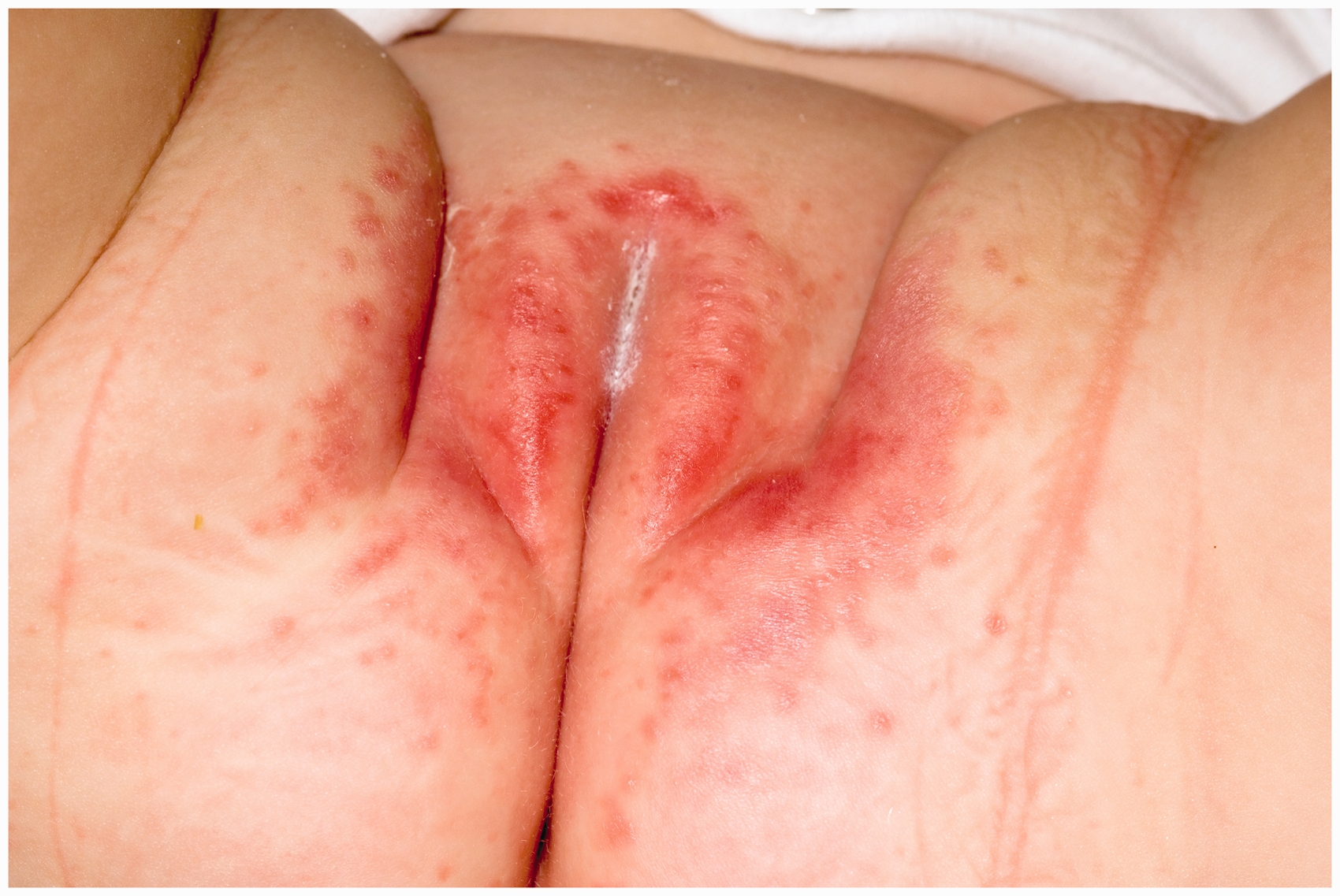
A 6-month-old girl presents with redness of the perivulval area for the past 3 days.
Dr P. Marazzi/Science Photo Library.
This is candidal nappy rash
Nappy rash is an acute inflammatory skin reaction in the nappy area. It is usually a form of irritant contact dermatitis. In this condition, the skin’s natural barrier can be compromised by a number of factors. These include: Excessive hydration, friction between skin and nappy, prolonged skin contact with urine and faeces and the consequent increase in skin pH. The wet skin and alteration of its acidic pH make it vulnerable to colonisation by micro-organisms, particularly candida albicans.
Nappy rash is common. An estimated 25% of nappy-wearing infants are affected at any one time (Ravanfar et al., 2012). Peak prevalence is between the ages of 9 and 12 months, but the condition can also affect older children and adults that are incontinent (Cohen, 2017).
The rash typically appears as well-defined patches of erythema and papules on the convex surfaces of the nappy area. There tends to be skinfold sparing. In the acute phase, the skin may look glazed. Fine scaling is seen in longstanding cases. The patient may appear distressed and uncomfortable. Features of secondary infection should be considered, especially if the rash persists despite initial measures.
Candidal: Shiny, well-demarcated, erythematous patches with ‘collarettes’ of scale; groin creases can be involved, oral candidiasis may co-exist Bacterial: Marked erythema with exudate; there may be pustules, papules or blisters
Skin swabs are not often needed, but should be considered if the rash is severe, or a secondary infection is suspected.
The initial management centres on simple measures. These include: Ensuring the nappy fits correctly; nappy-free time; cleaning the skin as soon as possible after soiling/wetting; avoiding soap; and the use of barrier cream. Disposable gel-matrix nappies have a greater absorbency than cloth nappies and are less likely to cause nappy rash. Understandably, nappy choice will depend on cost and environmental impact.
Where the rash looks inflamed, a 1-week course of topical hydrocortisone 1% cream can be prescribed (for children over 1 month of age). If candidal infection is suspected or confirmed, a topical imidazole cream should be offered. The barrier preparation should be stopped until the infection has settled. For cases where a bacterial infection is suspected or confirmed, a 7-day course of flucloxacillin should be prescribed (clarithromycin if penicillin-allergic).