



Abstract
In science, medicine and technology, our discoveries and theories are constantly under scrutiny. Changes in society can create a need for new research and the questioning of topics previously thought to be understood. There are many examples that illustrate this, none more contentious than the subject of addiction. This article aims to explore our developing knowledge of behavioural addiction and examines social media in particular. Furthermore, the article considers the associated symptoms and the importance of their recognition to facilitate early identification of mental health disorders in primary care.
Clinical case scenario
A 16-year-old patient, Tracy, has an appointment in your morning clinic, for ‘Sleeping problems’. During the telephone consultation, she describes that her difficulty with sleep is disrupting her schoolwork, mood, energy and relationships. You decide to ask questions pertaining to her lifestyle, activities she enjoys and her evening routine before sleep. Her response to the majority of your questions is ‘I spend most of my time scrolling through Instagram on my phone’.
What screening questionnaires could you use in your consultation? What conditions should you consider in your differential diagnosis?
Addiction
In 1964, the World Health Organisation (WHO) introduced the term ‘dependence’ to replace ‘addiction’ and ‘habituation’. It was a general title with reference to a whole range of drugs (WHO, 2020a). The International Statistical Classification of Diseases and Related Health Problems (ICD), which is governed by the WHO, is a diagnostic system that is used for coding, epidemiological reporting, communicating clinical findings to colleagues and providing a basis for precision in research (Saunders, 2017). The term ‘dependency’ has been developed over the years, with changes made to include the substances known to cause it.
However, in its most recent publication, ICD has had to completely rethink how it classifies and defines this topic. The ICD-11’s final draft was released in June 2018. It was presented to the World Health Assembly in 2019 and is scheduled to be implemented in 2022 (WHO, 2018). In this edition, the term ‘addiction’ has returned, with a section titled ‘Disorders due to addictive behaviours’. This is independent from substance use and has been defined as: … recognizable and clinically significant syndromes associated with distress or interference with personal functions that develop as a result of repetitive rewarding behaviours other than the use of dependence-producing substances. Disorders due to addictive behaviours include gambling disorder and gaming disorder, which may involve both online and offline behaviour (WHO, 2020b).
Classification systems publish their latest editions rarely, often being decades apart. They have significant impacts in the worlds of clinical practice and research, receiving considerable attention when they are announced. The Diagnostic and Statistical Manual of Mental Disorders (DSM) is a system that is used in the USA and primarily focuses on mental health, in contrast with ICD, which is used in every other country and focuses on conditions and diseases in all areas of medicine, including mental health (Sztainert, 2018). The differences can also be demonstrated in relation to addiction. The DSM-5 has included ‘internet gaming disorder’ in a chapter titled ‘Conditions for further study’; in addition, ‘gambling disorder’ is a new entity in the ‘Substance-related and addictive disorder section’ (Saunders, 2017). However, in the ICD-11, ‘gambling disorder’ and ‘gaming disorder’ are identified as individual diagnoses (WHO, 2020b).
The ICD-11’s inclusion of these new diagnoses, particularly gaming disorder, has sparked extensive debate and controversy (Sarkar, 2018). It could be argued that the research relating to these complex problems is inadequate. Therefore, individualising them as diagnosable conditions creates the risk of overlooking possible underlying psychiatric issues. On the other hand, even if the evidence-base is incomplete, defining them as disorders will inherently attract and demand more research work in these fields, which will ultimately benefit patients. The psychological risks of gambling and gaming have been researched and theorised for decades. However, it is only now that their addictive properties have been recognised as disorders. It is clear that addiction is a highly contentious issue and will always be a field for evolving definitions, changing inclusion criteria and regular deliberation within the research and clinical communities.
Technology use
Mobile phones and the internet
It would be remiss to discuss social media, without first mentioning internet and phone addiction. Although comparatively new fields in the context of research, they have both been extensively debated over the years but remain controversial. For instance, a small study identified 30 subjects with ‘pathological internet use’, of which 27 had comorbid or underlying psychiatric disorders (Pies, 2009). Regarding mobile phone addiction, comorbidities reported include sleep affectations, anxiety, stress, depression and consumption of substances, such as alcohol or tobacco, particularly in adolescents (De-Sola Gutiérrez et al., 2016). The high rate of psychiatric comorbidities with both internet and phone addiction prompts scepticism about identifying them as independent conditions, similar to those that remain dubious about ICD-11’s inclusion of ‘gaming disorder’. Some claim that internet addiction is a ‘compulsive-impulsive spectrum disorder’, whereas others suggest that its related behaviours may be attributed to symptoms of depressive disorders (Pies, 2009). Nevertheless, it is clear that these addictions have a strong association with psychiatric disorders, which poses the complex and taxing question of causality.
Social media
Social media is a relatively new phenomenon. It can be defined as: forms of electronic communication (such as websites for social networking and microblogging) through which users create online communities to share information, ideas, personal messages, and other content (such as videos) (Merriam-Webster, 2021a).
The use of the internet for social media has rapidly increased over the past few years. Forty-five percent of internet use was reported as being for social networking in 2011, which had risen to 66% by 2017 (Office for National Statistics, 2017). However, a more significant statistic is social media’s prevalence among arguably the most impressionable demographic, young people. Ninety-one percent of 16–24-year-olds report using the internet for social media (Royal Society for Public Health, 2017).
Young people today, spend a significant proportion of their time online. In 2017, a study by Ofcom discovered that children aged 12–15 years old spent close to 21 hours per week online, of which 74% reported having a social media profile (Ofcom, 2017). The incredible growth of social media over the last few years can be attributed to its numerous benefits. It provides platforms for expression that can impact positively on self-identity and provides a means to build and maintain relationships. Furthermore, it allows access to other people’s health experiences and expert information, offers emotional support, and facilitates community building (Royal Society for Public Health, 2017). However, potential harmful effects are not so well known.
Social media: Young people and addiction
Young people
Adolescence and young adulthood are crucial times for emotional, psychological, and social development (Royal Society for Public Health, 2017). During this period, young people become exposed to a wide range of decision-making opportunities that are frequently associated with risk. An important influence on decision-making, particularly in relation to risk-taking behaviour, is an individual’s sensitivity to reward. This can be defined as ‘the positive response to the occurrence or anticipation of a reward, together with a desire, drive and willingness to pursue rewards’ (Carver and White, 1994).
Evidence suggests that, those around the ages of 12 to 13 years have the highest sensitivity to reward. This can be attributed to pubertal-induced developments in the socio-emotional system of the brain. Between adolescence and adulthood, improved self-regulation occurs, resulting from the maturation of the cognitive-control system (Steinberg, 2008). The proclivity for reward-seeking behaviour and the developed ability for self-control, occur at different points in an individual’s life, with varying degrees of overlap. As a consequence, there is a period of uniquely high vulnerability (Steinberg, 2008). This could provide an ideal platform for an addictive substance or activity to flourish, particularly if the addictive properties are poorly understood; as is the case with social media.
Gaming disorder, gambling disorder and now social media disorder?
In 2012, a study explored people’s everyday desires, desire regulation and resistance, using experience sampling. A multilevel analysis strategy was used and included data from 205 adults, who furnished a total of 7827 reports of their desires over the course of a week. Self-control is a fascinating and intricate topic. In the context of this study, it was defined as ‘participants not enacting the desired behaviour when attempting to resist’, whereas self-control failure was those ‘enacting the desired behaviours despite an attempt to resist’. Results showed that self-control failure rates were highest for desires to engage in media activities, with 42 % of those desires enacted even when people had attempted to resist, which was higher than the self-control failure rates of alcohol – 22%, coffee – 12% and even tobacco – 15% (Hofmann et al., 2012). This is an astonishing finding.
Social media is predicated on reward systems to engage users, with ‘Likes’ for posts on Facebook or Instagram, ‘re-tweets’ on Twitter and various achievements for uninterrupted use on Snapchat. Similar reward systems are demonstrated in addictive activities such as gambling and gaming. Although the nature of the activity and reward differs, the ultimate effect of all three remains the same: consistent and continued user engagement. It is this process that underpins all behavioural addictions.
If social media is addictive, is it dangerous? Why is it necessary to recognise it alongside gaming and gambling disorders? In order to bring attention to this subject, there needs to be reasoned benefits for its identification. Are there advantages in recognising signs of social media addiction? What do young people seek to gain from preventing social media overuse? To answer these questions, it is pertinent to recognise and appreciate the detrimental consequences that social media may inflict on an individual’s mental health.
The negative effects of social media
Sleep
Sleep and lack of quality rest is often at the centre of psychiatric conditions, such as depression and anxiety. For young adults, sleep is particularly important, with teenagers needing around one to two more hours of sleep every night compared with adults (Royal Society for Public Health, 2017). Warwickshire County Council conducted an online survey as part of their 2018 public health annual report, questioning 2324 10–18-year-olds, on five base themes in relation to social media use: wellbeing, identity, lifestyle, relationship and fear of missing out (FOMO). Thirty-one percent agreed that social media impacted on their sleep, with 21% checking social media if they woke up during the night (Warwickshire County Council, 2018). There have been many studies linking social media overuse and poor sleep in young people, with its influences on sleep having a cyclical effect; reduced quality sleep from social media use leads to poorer mental health, which in turn worsens sleep, consequently causing heavier social media use (Centre for Mental Health, 2018).
Anxiety and depression
Over the last 25 years, rates of anxiety and depression have risen in young people by 70% (Royal Society for Public Health, 2017). With an extensive list of signs and symptoms, the crippling effect that these conditions have on an individual’s physiological and psychological wellbeing should not be underestimated. Low mood, reduced energy, poor sleep, loss of appetite and anhedonia, are just a few of the numerous symptoms (NICE, 2009). The Royal Society for Public Health conducted a national survey, questioning 1479 young people, between 14 and 24 years in age, to gather information regarding Facebook, Instagram, Snapchat, Twitter and YouTube. Their aim was to discover how these platforms influenced young people’s health and wellbeing and whether it was positive or negative. Fourteen factors were questioned, including depression, anxiety, loneliness, and sleep. Each participant was asked to reflect on their personal experiences and rank how each platform impacted on these components. All but one, YouTube, had a net negative impact on health and wellbeing, with all having a negative effect on sleep (Royal Society for Public Health, 2017).
Furthermore, there is now emerging evidence associating the increased use of social media, with a greater likelihood of developing depression in young people. Use of social media for more than 2 hours per day has been shown to be correlated with poorer mental health, increased psychological distress and suicidal ideation (Royal Society for Public Health, 2017).
Cyberbullying
Social media has created a world of constant communication, which has its obvious advantages. Unfortunately, it has also created another channel for bullying; online bullying, also known as cyberbullying.
The detrimental consequences of bullying are vast, including depression, anxiety, self-harm, and low academic performance (StopBullying.Gov, 2017). These effects can have long-lasting implications into adulthood. In 2017, 10 000 young people aged 12 to 20 years were surveyed with regards to bullying. An astonishingly high 17% reported having experienced cyberbullying, with 45% of this group suffering from it at least once a month (Ditch the Label, 2017).
Fear of missing out
FOMO is a relatively new concept, and the term has been popularised through the advent of social media. It can be defined as ‘fear of not being included in something (such as an interesting or enjoyable activity) that others are experiencing’ (Merriam-Webster, 2021b). It could be argued that FOMO drives a desire to be constantly connected with others. Fifty-four percent of 8 to17-year-olds reported that they would feel isolated if they could not communicate with their friends via technology (UK Safer Internet Centre, 2018). This typifies the remarkable influence that social media possesses over young people’s relationships and interactions, in this day and age.
FOMO can also lead to the use of social media as a comparison tool. Twenty-nine percent of 10 to 18-year-olds, reported that they often or occasionally felt their friends had ‘better lives’ than them when they looked on social media (Warwickshire County Council, 2018). Furthermore, there is an emergence of young people describing distress, anxiety, and feelings of inadequacy as a result of FOMO (Royal Society for Public Health, 2017).
The nature of social media is such that users post their achievements or enjoyable experiences, but rarely declare moments of failure or disappointment. This is an untrue representation of real life and could have disastrous implications for young users. It sets unrealistic expectations, which cultivates a pursuit for unattainable perfection.
Social media addiction in general practice
The clinical scenario at the start of this article, posed a case of a young patient with symptoms suggestive of depression. Crucially, she also demonstrated behavioural addictive tendencies. As we have already explored, identifying the causative factor for her symptoms is exceptionally challenging; perhaps even unnecessary. Is she depressed because she is addicted to social media, or is her depression driving her social media overuse? What is important, however, is acknowledging that these symptoms can, and often do, co-exist.
Depression and anxiety are very common presentations in general practice. Our patient, Tracy, presented with clear signs of depression, including reduced motivation, low mood and difficulty sleeping. This is seldom the reality, and the first signs of these conditions are often subtle. For example, disengagement from activities that were previously enjoyed, accompanied by an overuse in a particular activity that engages the reward system of the brain quickly and effectively. Such activities could include winning a bet on a gamble, completing a level on a smartphone game, or perhaps even getting a ‘like’ on a social media post.
In general practice, we often use questionnaires to help identify and monitor mood and dependence disorders. The Patient Health Questionnaire (PHQ-9) is used for depression, the Generalised Anxiety Disorder assessment (GAD-7) for anxiety and the Alcohol Use Disorders Identification Test (AUDIT) for harmful alcohol consumption (Mulvaney-Day et al., 2018).
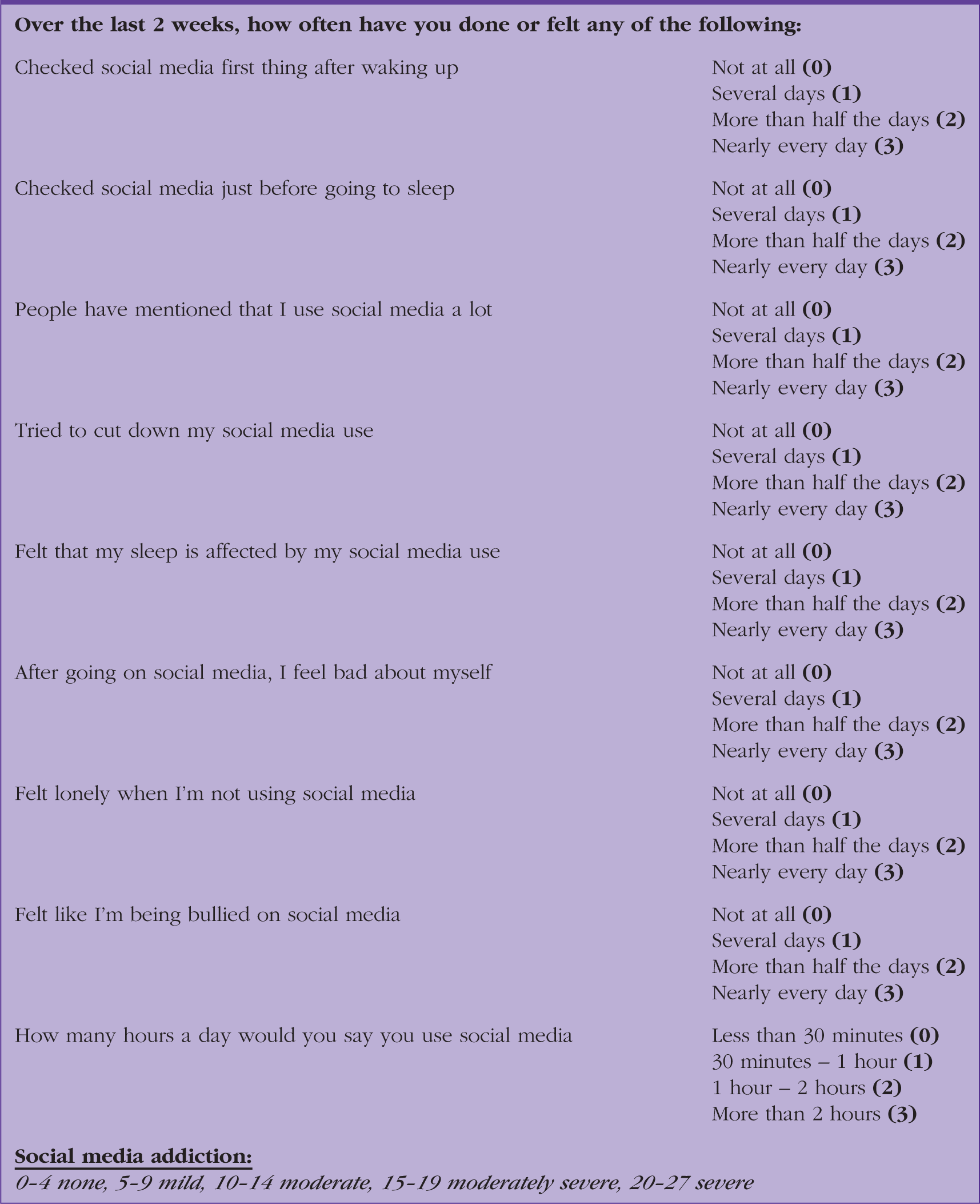
For our patient, the lesser known PHQ -A, which is the PHQ-9 adapted for young people aged 11 to 17-years-old, could be used (Johnson et al., 2002). However, she has shown specific addictive tendencies and this questionnaire would miss the opportunity to identify and address them. A comprehensive nine-item social media disorder scale is available (Eijnden et al., 2016), however, there are no screening tools designed specifically for use in primary care.
Social Media Addiction Questionnaire (SMA-9).
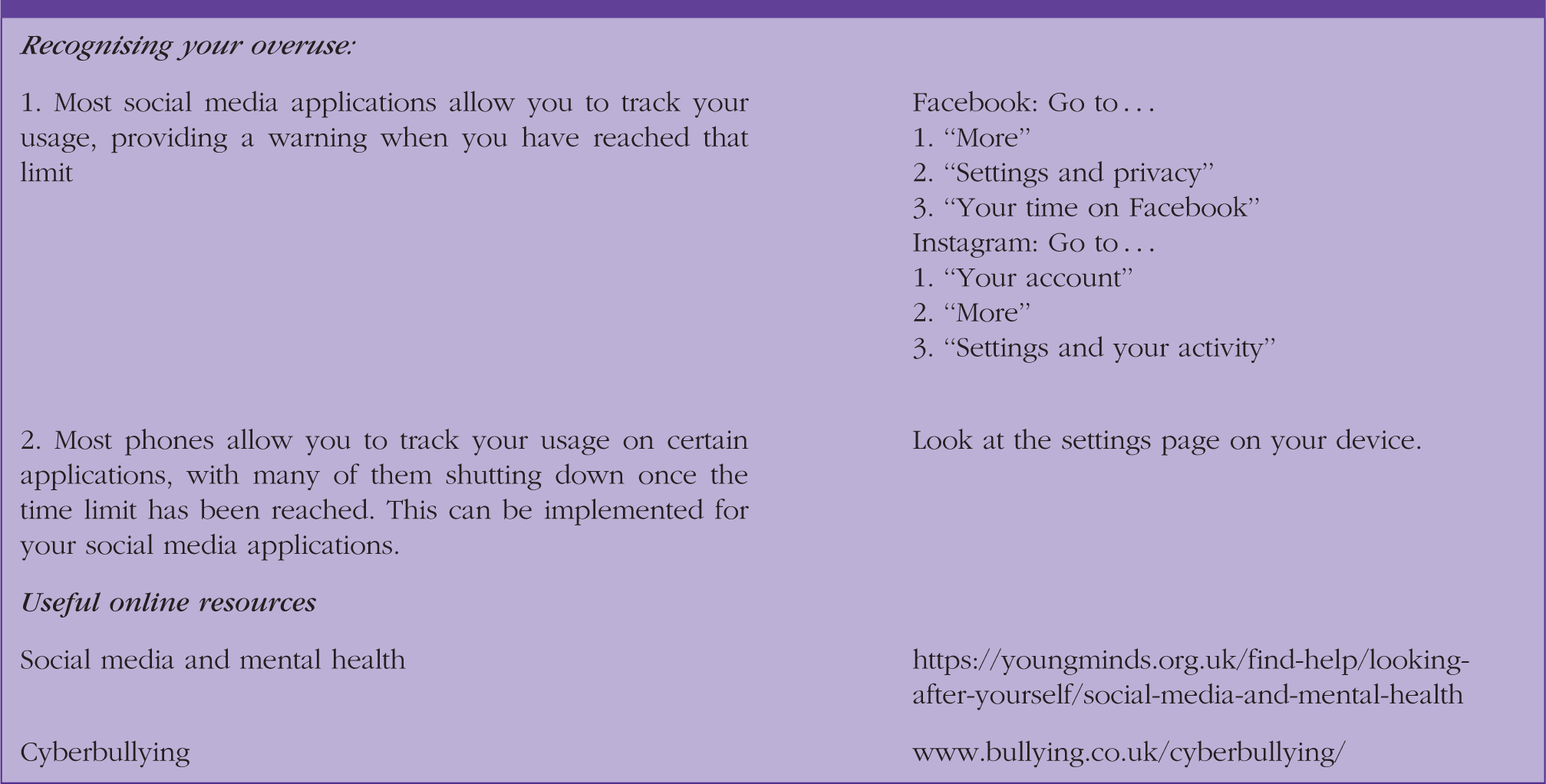
Social media addiction toolkit.
Conclusion
In 2015, through a freedom of information request, it was demonstrated that less than 1% of the total NHS budget was spent on Child and Adolescent Mental Health services, with only 8.7% of the total mental health budget allocated to under 18-year-olds (YoungMinds, 2018).
The underfinancing of mental health, and specifically young peoples’ psychiatric services, is a topic that is often discussed within the healthcare communities. It was only in 2019 that the country’s first specialist clinic for gaming addiction was launched under the NHS. This service formed part of the National Centre for Behavioural Addiction, where gambling addiction is also treated (NHS, 2019). In 2020, the National Gambling Treatment Service conducted an extensive media campaign through digital media, radio, pubs, motor way service stations, GP surgeries and health publications (BeGambleAware, 2020). This was a monumental recognition of the disastrous consequences that behavioural addiction can have to the individual suffering from the addiction and the families involved.
This article attempts to, not only propose that social media addiction exists, but more importantly, illustrate the devastating consequences its addictive properties can have on a young person’s mental health and wellbeing. The inclusion of gambling and gaming as individual diagnoses in the ICD-11, reflects the modern changes in society. Additionally, the recent campaign to promote the national gambling treatment service, exemplifies the acknowledgement of behavioural addiction at a national level. It may be several years until social media addiction is considered in conjunction with gaming and gambling disorders and even longer until adequately financed services are implemented to help those suffering from it. Until then, it is imperative that GPs consider social media addiction and its associated symptoms when consulting with young patients, and are mindful of other behavioural addictions that are not yet identified by the diagnostic criteria.
KEY POINTS
Depression and anxiety are on the rise, particularly among young people The inclusion of behavioural addictions in ICD-11, represents a change in how these conditions are viewed Clinicians should consider behavioural addiction disorders and their associated symptoms in other mental health presentations, to encourage earlier recognition Gaming and gambling disorders have now been acknowledged by international diagnostic criteria; however, their addictive properties have been publicly known and theorised long before this recognition Social media addiction does exist; clinicians need not wait until it becomes acknowledged as a disorder or until treatment centres are established, to help young patients Recognition and early signposting in general practice is vital, to help patients suffering from the direct and indirect consequences of social media addiction
