



Abstract
Background:
Patients with Parkinson’s disease (PD) receiving device-aided therapies (DATs) frequently experience vitamin B depletion and nutritional challenges. However, the effects of continuous subcutaneous apomorphine infusion (CSAI) on vitamin B status and nutritional outcomes in advanced PD remain unclear.
Objective:
To evaluate the clinical effectiveness of CSAI and associated changes in vitamin B status, homocysteine (Hcy) levels and nutritional outcomes in patients with advanced PD.
Design:
A prospective observational cohort study in a single centre.
Methods:
Thirty patients with advanced PD were enrolled between January 2023 and March 2025. Clinical, biochemical and nutritional assessments were performed at baseline and after 3 months. Motor outcomes included daily OFF hours, dyskinesia hours, Hoehn and Yahr stage and the Unified PD Rating Scale (UPDRS). Biochemical measures comprised serum vitamins B1, B6, B12, folate and plasma Hcy levels. Nutritional status was assessed using body weight, body mass index (BMI) and the Mini Nutritional Assessment–Short Form (MNA-SF).
Results:
Thirty participants (mean age 68.5 ± 9.2 years; disease duration 12.0 ± 3.9 years; Hoehn & Yahr 3.7 ± 0.7) completed follow-up. After 3 months of CSAI, daily OFF hours, dyskinesia hours and UPDRS Part 4 scores decreased significantly (p < 0.05 for all). The oral levodopa daily dose was significantly reduced (p < 0.001). Serum vitamin B1 and B12 levels increased significantly, while Hcy levels showed a modest but significant reduction (p < 0.05). Body weight, BMI and total MNA-SF score remained unchanged (p > 0.05). However, MNA-SF categories shifted toward improved nutritional classification (p = 0.008). Adjunctive antiparkinsonian medications were significantly reduced, while levodopa remained universally prescribed.
Conclusion:
CSAI significantly reduced motor complications and oral levodopa exposure. Secondary analyses showed selective biochemical improvements with stable overall nutritional status. Findings should be interpreted considering the observational design, lack of control group and short follow-up.
Plain language summary
Patients with Advanced Parkinson’s disease (PD) are at risk of vitamin B deficiencies and other nutritional challenges, especially when receiving device-aided therapy (DAT). These risks are particularly noted in patients treated with levodopa-carbidopa intestinal gel infusion (LCIG). Continuous subcutaneous apomorphine infusion (CSAI) is an alternative treatment option, but its effects on vitamin B status and overall nutrition are not well understood. This study evaluated changes in clinical measures, rating scales, vitamin B levels, and nutritional outcomes in 30 patients over 3 months of CSAI treatment. After 3 months, patients showed significant improvements in motor symptoms. Daily levodopa doses were reduced, and both daily OFF hours and dyskinesia hours decreased significantly. Serum vitamin B1 and B12 levels increased significantly, while Hcy levels decreased slightly but significantly, suggesting an overall improvement in vitamin B status. Cognitive assessment and general nutritional measures, including body weight, body mass index (BMI), and Mini Nutritional Assessment-Short Form (MNA-SF) scores, showed no significant changes. However, the distribution of nutritional categories shifted modestly, with a small reduction in the proportion of patients classified as malnourished and a slight increase in those with normal nutritional status. Overall, CSAI therapy was associated with substantial improvements in motor complications and a significant reduction in oral levodopa exposure. There was a significant reduction in the use of most adjunctive antiparkinsonian medications, while levodopa therapy remained universally prescribed. At the same time, metabolic and nutritional parameters showed generally small-to-moderate changes over the short-term follow-up period. In summary, 3 months of CSAI treatment was associated with improved motor function and better vitamin B status in patients with advanced PD, whereas cognitive and general nutritional outcomes remained stable. These findings indicate that CSAI may offer metabolic benefits and warrant further investigation regarding its potential role in preventing nutritional deficiencies.
Background
While levodopa remains the most effective medication for controlling the symptoms of Parkinson’s disease (PD), chronic levodopa therapy is associated with long-term nutritional complications, including specific vitamin deficiencies and weight loss.1,2 These nutritional problems have traditionally been attributed to gastrointestinal factors such as delayed gastric emptying, constipation and impaired intestinal absorption resulting from levodopa-induced dysmotility. 3 In addition, protein-rich foods may interfere with the intestinal absorption of levodopa by competing with dietary amino acids for transport across the intestinal wall and the blood–brain barrier, thereby compromising both motor control and nutritional balance. 4 However, emerging evidence indicates that these complications are not solely gastrointestinal but also metabolic in nature. Chronic levodopa therapy, whether in the form of oral levodopa or levodopa-carbidopa intestinal gel infusion (LCIG), appears to increase the metabolic demand for vitamin B cofactors required for methylation reactions.5,6 Previous studies have also demonstrated that long-term levodopa treatment increases serum homocysteine (Hcy) levels, a marker of methylation load and inflammation.7,8 Consequently, elevated serum Hcy has been associated with increased oxidative stress, neurotoxicity and peripheral nerve damage, including neuropathy. 1
Apomorphine acts as a direct dopamine receptor agonist, alleviating motor symptoms to a degree comparable with levodopa.9,10 CSAI is an established DAT for PD, offering substantial benefits in reducing motor fluctuations without exacerbating troublesome dyskinesia. It has also been shown to improve specific non-motor symptoms, including cognitive and behavioural domains.11,12 Among the currently available DAT, CSAI is delivered via continuous subcutaneous infusion, like other infusion-based approaches such as levodopa infusion.13,14 The pharmacological effects of CSAI are well documented, demonstrating both short- and long-term efficacy in controlling persistent motor fluctuations.11,15 Furthermore, CSAI provides rapid improvements in patients’ quality of life. 16 Recent clinical observations indicate that patients receiving CSAI frequently exhibit a reduction in their daily levodopa requirements,11,17,18 which may potentially mitigate complications associated with long-term levodopa exposure; however, this remains an observational finding and has yet to be confirmed in well-controlled studies. 1
Early but recent evidence indicates that CSAI may exert a more favourable effect on vitamin B metabolism and nutritional status than chronic levodopa-based therapies.1,19 This advantage is thought to arise from its pharmacological independence from catechol-O-methyltransferase pathways and the consequent avoidance of methylation-related vitamin depletion. 20 Furthermore, the introduction of CSAI frequently permits a reduction in daily levodopa dose, which may lessen cumulative metabolic stress associated with long-term levodopa exposure.1,21 Our recent abstract showed earlier observations involving 20 PD patients on conventional therapy and 15 receiving CSAI for at least 1 month support this hypothesis, as patients on CSAI exhibited higher vitamin B12 levels and required lower levodopa doses than those treated with standard oral regimens. 22
Methods
Study design and eligible patients
This was a single-centre, single-group, pre–post observational cohort study evaluating the effects of CSAI in patients with advanced Parkinson’s disease, with patient enrolment conducted between 1 January 2023 and 1 March 2025. The primary objective was to assess changes in vitamin B (vitamins B1, B6, B9 and B12) status and nutritional outcomes before and after 3 months of CSAI treatment, specifically examining whether CSAI influenced motor outcomes, PD clinical severity scales, levodopa equivalent daily dose (LEDD), daily levodopa dose, vitamin B levels, Hcy concentrations and overall nutritional status. This investigation formed part of the Thai PD Apomorphine Registry Project, established in 2020. 23 Data were collected during in-person outpatient visits at the Movement Disorders Clinic, Chulalongkorn Centre of Excellence for PD and related disorders (www.chulapd.org), King Chulalongkorn Memorial Hospital and were supplemented by information retrieved from the hospital’s pre-existing electronic data collection system.
Eligible participants were adults diagnosed with PD according to the Movement Disorder Society clinical diagnostic criteria, 24 who experienced disabling motor fluctuations despite optimised oral or transdermal dopaminergic therapy. All patients were required to have maintained a stable medication regimen for at least 4 weeks before baseline and to be able to complete PD diaries independently or with caregiver assistance. Each participant underwent a structured interview to document comorbidities and the use of medications, vitamins or supplements that might affect vitamin B metabolism. Exclusion criteria comprised atypical Parkinsonian syndromes, uncontrolled psychiatric disorders, significant hepatic or renal impairment, QTc prolongation, known hypersensitivity to apomorphine and recent initiation of high-dose vitamin B supplementation or other medications known to influence vitamin B metabolism. 25 Therefore, participants taking medications known to interfere with vitamin B or Hcy metabolism were excluded from the study. These include drugs that impair vitamin absorption or utilisation, such as proton pump inhibitors and H2 receptor antagonists (which reduce gastric acid and thereby hinder vitamin B12 absorption), metformin (which interferes with ileal vitamin B12 uptake), loop diuretics such as furosemide (which increase urinary thiamine excretion) and antiepileptic agents including phenytoin, carbamazepine and valproate (which accelerate folate and vitamin B6 catabolism). Additional exclusions applied to patients taking isoniazid, hydralazine, methotrexate or other medications known to increase metabolic demand for vitamin B cofactors. This approach ensured that the assessment of vitamin B and Hcy levels reflected the effects of CSAI rather than potential pharmacological confounders. Finally, patients with clinically significant renal impairment, defined as known chronic kidney disease or abnormal renal function tests (serum creatinine above the laboratory reference range), were excluded from participation. Renal function parameters were within normal limits in all included participants at baseline.
The study protocol was approved by the Ethics Committee of the Faculty of Medicine, Chulalongkorn University (IRB No. 647/63; COA No. 394/2021, approved on 11 March 2021; with extension approval COA No. 1491/2024 until 10 March 2025). The study was conducted in accordance with the Declaration of Helsinki and Good Clinical Practice guidelines, and written informed consent was obtained from all participants.
Data collection for patient demographics and biomarkers
Following informed consent, all participants underwent a comprehensive baseline assessment that included demographic data, physical examination, detailed medication history, medication use, PD clinical severity scales and cognitive scales, electrocardiography and laboratory investigations. Detailed antiparkinsonian medication data were collected at baseline and after 3 months of CSAI therapy. Recorded medications included oral levodopa preparations, dopamine agonists, monoamine oxidase-B inhibitors (MAO-B inhibitors), catechol-O-methyltransferase inhibitors (COMT inhibitors), anticholinergic agents and amantadine. All dopaminergic treatments were converted to levodopa equivalent dose (LED) using established conversion formulas. 26 The LED during CSAI usage encompassed the contribution of CSAI, calculated using standard conversion factors, along with all concomitant dopaminergic medications.
Clinical severity was assessed using the Unified Parkinson’s Disease Rating Scale (UPDRS) parts I, II, III and IV at baseline and at 3 months. This scale allows comprehensive evaluation of motor symptoms, motor complications and nonmotor aspects of daily functioning before and after initiation of CSAI therapy.
Cognitive function was assessed using the Montreal Cognitive Assessment (MoCA). 27
In addition to standardised haematological and biochemical profiles, laboratory sampling was performed to determine serum concentrations of vitamin B1 (thiamine), vitamin B6 (pyridoxine), vitamin B12 (cobalamin), folate (vitamin B9) and plasma Hcy.
Reference ranges for water-soluble vitamins can vary between laboratories owing to differences in analytical methodology, calibration standards and specimen handling.28,29 Inter-laboratory variation is particularly evident for vitamin B6 and vitamin B12, where reported concentrations depend on whether microbiological assays, high-performance liquid chromatography (HPLC) or immunoassay techniques are employed. To ensure internal consistency and comparability, the reference ranges used in this study were derived from the hospital’s accredited clinical biochemistry laboratory’s validated standards (ISO 15189:2012; ISO 15190:2003). This approach aligns with previous reports highlighting the influence of assay methods and standardisation practices on the interpretation of B-vitamin biomarkers.
The normal reference ranges for these biomarkers were as follows:
Vitamin B1 (thiamine): 28–85 µg/mL
Vitamin B6 (pyridoxine): 12.6–45.2 µg/mL
Folate (vitamin B9): 3.1–20.5 pg/mL
Vitamin B12 (cobalamin): 187–883 pg/mL
Hcy: 5.98–15.39 µmol/L
All samples were processed and analysed using standard laboratory procedures within the hospital’s accredited clinical biochemistry laboratory.
Body weight and body mass index (BMI) were measured under standardised conditions at each assessment. Nutritional status was evaluated using the Mini Nutritional Assessment–Short Form (MNA-SF), a validated instrument for identifying malnutrition and risk of malnutrition in older adults. 30 The MNA-SF comprises six items addressing recent changes in food intake, weight loss, mobility, psychological stress, neuropsychological problems and BMI, providing a concise yet comprehensive overview of nutritional health. Based on the total score, participants were categorised into one of three groups: malnourished (0–7 points), at risk of malnutrition (8–11 points) or normal nutritional status (12–14 points). 30
No systematic dietary intervention was implemented during the study period. Participants were advised to maintain their usual dietary habits throughout follow-up. Additionally, at baseline, some participants were already taking vitamin supplements, such as vitamin D and vitamin B, as part of routine clinical care and these regimens remained unchanged before enrolment. No modifications were made to existing supplementation during the three-month observation period, and no new vitamin supplements were initiated unless clinically required. Importantly, no participants needed to start or alter vitamin supplementation during follow-up. At the 3-month follow-up visit, participants completed PD diaries documenting daily OFF hours, dyskinesia hours, CSAI use and concurrent medications, with the latter expressed as the LEDD and daily levodopa dose. Body weight and BMI were reassessed at every visit to monitor changes over time. At the 3-month follow-up, participants also provided a second blood sample for repeat measurement of serum vitamin B1, vitamin B6, vitamin B12, folate and plasma Hcy concentrations.
CSAI titration period in a daycare service
All participants underwent supervised CSAI titration in a dedicated daycare setting as part of the Thai Apomorphine Registry, which integrates clinical data collection and patient monitoring using digital technologies. 31 The titration process followed the standard clinical protocol established for the registry and was consistent with international best practice.32,33
CSAI was initiated using a portable infusion pump delivering apomorphine hydrochloride via a subcutaneous cannula, typically over 12–16 waking hours per day. The initial infusion rate was individualised, generally starting at 3–6 mg/h, and subsequently titrated to achieve optimal reduction in OFF hours without inducing troublesome dyskinesia. Small on-demand bolus doses were permitted and recorded during the titration period. Concomitant oral dopaminergic therapy was adjusted at the investigator’s discretion, with gradual reduction of oral levodopa or adjunctive agents when hyperkinesia or dyskinesia emerged. All medication adjustments were documented and converted to LEDD and daily levodopa dose. Infusion-site care followed a standardised protocol, including site rotation and local hygiene measures to minimise cutaneous reactions. Participants were reviewed at 3 months following CSAI initiation, and all continued therapy for more than 3 months.
Study outcomes
The primary outcomes were the change from baseline to 3 months in daily OFF hours and dyskinesia hours.
Secondary outcomes included changes in LEDD, oral levodopa daily dose, UPDRS parts III and IV.
In addition, serum biochemical markers of vitamin B status (vitamin B1, vitamin B6, vitamin B12 and Hcy) were assessed as predefined secondary metabolic outcomes. These measures were included to evaluate potential metabolic effects of dopaminergic treatment modifications during CSAI therapy.
Further secondary outcomes included changes in nutritional status (body weight, BMI and MNA-SF) and cognitive status (MoCA).
Sample size calculation and statistical analysis
Sample size estimation was based on detecting a clinically relevant reduction in daily OFF hours, assuming a standard deviation of 2.68 h derived from a previous CSAI study. 21 With a power of 80%, an effect size of 0.8 and a two-sided significance level of 0.05, the calculated minimum sample size was 25 participants. Allowing for an anticipated dropout rate of approximately 10%, the target enrolment was increased to at least 28 participants.
The study was designed and powered to detect changes in motor fluctuations, reflecting the primary therapeutic objective of CSAI. Analyses of biochemical and nutritional parameters, including B-vitamin indices, were predefined secondary analyses within this prospective cohort and were not used for sample size determination.
Continuous variables are presented as mean ± standard deviation (SD) and median with interquartile range (IQR) to provide a comprehensive description of data distribution. Categorical variables are summarised as number (percentage). The mean ± SD describes central tendency and dispersion under approximate normality, whereas the median and IQR provide a robust summary for skewed data or in the presence of outliers.
Distributional assumptions were evaluated using graphical methods, including histograms and Q–Q plots. Given the sample size of approximately 30 participants, parametric methods were considered appropriate where distributions did not show substantial deviation from normality, consistent with the central limit theorem. Comparisons before and during CSAI usage were performed using paired-samples t-tests. Where marked non-normality was observed, non-parametric methods were applied as appropriate.
In addition to p-values, effect sizes were calculated using Cohen’s d for paired samples to quantify the magnitude of change. Mean differences with corresponding 95% confidence intervals (CIs) are reported to provide estimates of precision. Adverse events were summarised descriptively. All statistical analyses were performed using IBM SPSS Statistics version 23.0 (IBM Corp., Chicago, IL, USA). A two-tailed p-value <0.05 was considered statistically significant.
Results
Baseline demographics of 30 advanced PD patients before using CSAI
Table 1 summarises the demographic and clinical characteristics of the 30 patients with advanced PD before initiation of CSAI. The dataset was additionally screened for potential outliers, and no data entry or analytical errors were identified. To provide a more complete representation of the data distribution, results are reported as mean ± SD, together with the median and interquartile range (IQR), as described in Table 1.
Demographic data of 30 advanced PD patients before using CSAI.
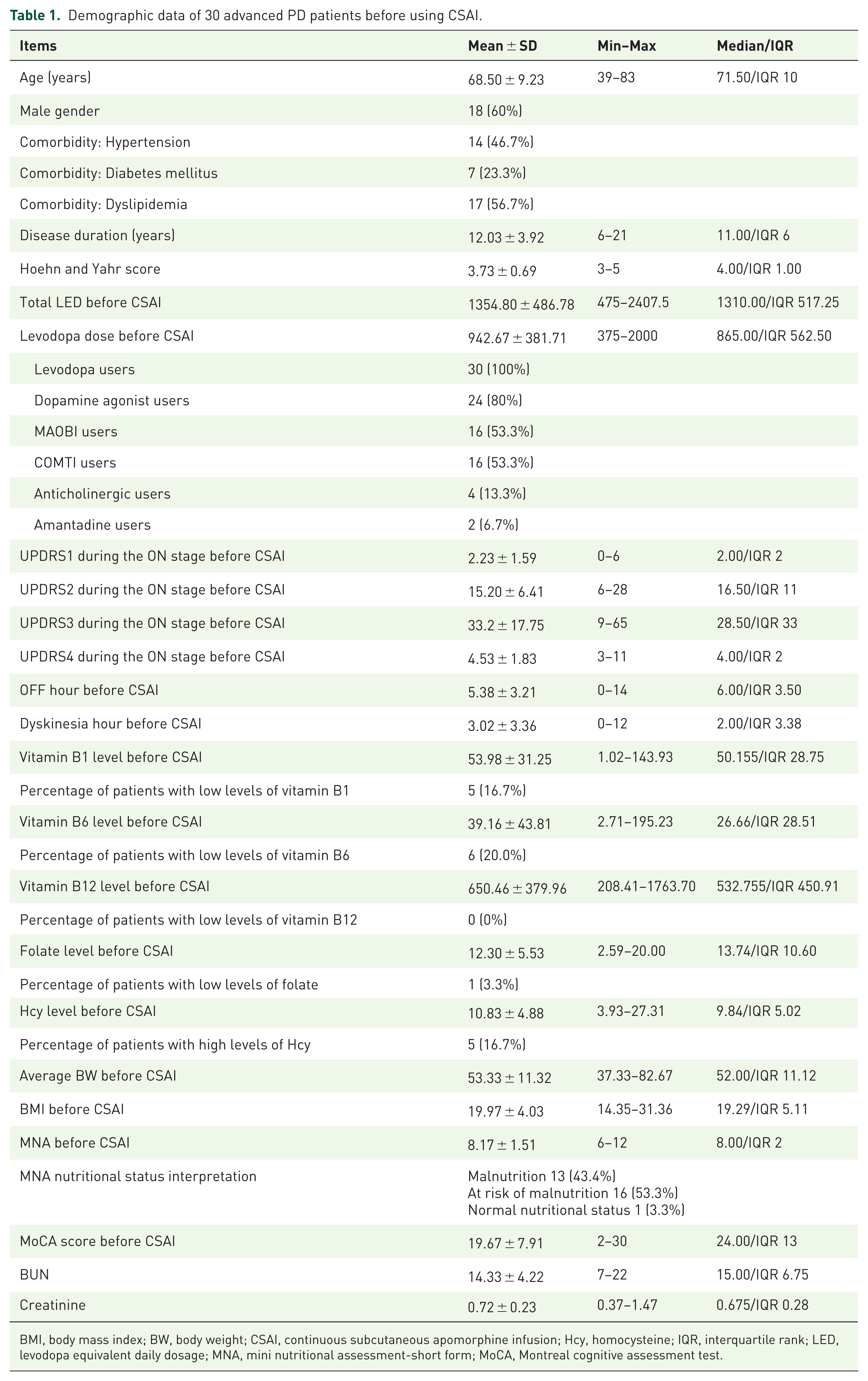
BMI, body mass index; BW, body weight; CSAI, continuous subcutaneous apomorphine infusion; Hcy, homocysteine; IQR, interquartile rank; LED, levodopa equivalent daily dosage; MNA, mini nutritional assessment-short form; MoCA, Montreal cognitive assessment test.
The mean age of participants was 68.50 ± 9.23 years, with a mean disease duration of 12.03 ± 3.92 years and a mean Hoehn & Yahr stage of 3.73 ± 0.69, indicating moderate-to-advanced disease severity. 60% of the cohort were men. Comorbidities were common and included dyslipidaemia (56.7%), hypertension (46.7%) and diabetes mellitus (23.3%). A total of 30 patients were receiving antiparkinsonian medications. All patients (30, 100%) were on levodopa therapy. Dopamine agonists were used by 24 patients (80%). MAO-B inhibitors were prescribed to 16 patients (53.3%), and an equal proportion (16, 53.3%) were receiving COMT inhibitors. Anticholinergic medications were used by four patients (13.3%), while amantadine was prescribed to two patients (6.7%). Overall, levodopa was the most commonly used medication, often in combination with other adjunctive therapies. Baseline medications, calculated as levodopa equivalent doses, were 1354.80 ± 486.78 mg per day for total LED and 942.67 ± 381.71 mg per day for oral levodopa before CSAI.
In terms of clinical rating scales, UPDRS part 1 during the ON stage of 2.23 ± 1.59 points, UPDRS part 2 during the ON stage of 15.20 ± 6.41 points, UPDRS part 3 during the ON stage of 33.2 ± 17.75 points, UPDRS part 4 during the ON stage of 4.53 ± 1.83 points, OFF hour before CSAI of 5.38 ± 3.21 h per day, dyskinesia hour before CSAI of 3.02 ± 3.36 h per day,
Baseline laboratory investigations demonstrated mean serum vitamin concentrations within normal limits: vitamin B1 53.98 ± 31.25 µg/dL, vitamin B6 39.16 ± 43.01 µg/dL, vitamin B12 650.46 ± 379.96 µg/dL, folate 12.30 ± 5.53 µg/dL and Hcy 10.83 ± 4.88 µmol/L. The proportions of patients with subnormal vitamin levels were as follows: vitamin B1 5 (16.7%), vitamin B6 6 (20%), vitamin B12 0 (0%), folate 1 (3.3%) and Hcy 5 (16.7%). Notably, none of the patients exhibited low baseline vitamin B12 concentrations.
Nutritional status, assessed using body weight, BMI and MNA-SF score, was overall within the normal range. However, categorisation by MNA-SF indicated a high prevalence of malnutrition risk: 13 (43.4 %) participants were malnourished, 16 (53.3 %) were at risk of malnutrition and only 1 (3.3 %) participant had a normal nutritional status. Cognitive assessment yielded a mean MoCA score of 19.67 ± 7.91, consistent with mild cognitive impairment typical of advanced PD.
Comparison of clinical parameters between before and after using CSAI
Table 2 presents the clinical and biochemical parameters of advanced PD patients before and after treatment with CSAI, with paired t-tests used for statistical comparisons. On average, patients received a CSAI dose of 5.18 ± 1.63 mg/h for 11.25 ± 1.54 h daily. Compared with baseline, patients using CSAI found a significant reduction in average LEDD from 1362.59 ± 446.78 mg/day to 787.97 ± 462.87 mg/day (p < 0.001). Likewise, daily levodopa dose significantly decreased from 951.67 ± 346.16 mg/day to 579.00 ± 463.02 mg/day during CSAI usage (p < 0.001). This finding highlights the strong levodopa-sparing effects of CSAI, demonstrating its ability to substantially reduce daily oral dopaminergic medication requirements.
Comparison data of 30 PD patients who underwent CSAI.

Statistical analysis was performed by the paired sample T test and the Fisher’s exact test or Chi-square test as appropriate.
BMI, body mass index; BW, body weight; LED, levodopa equivalent daily dosage; MNA, mini nutritional assessment-short form; MoCA, Montreal cognitive assessment test.
the asterisk represented p-value < 0.05, which was considered statistically significant.
Assessment of primary outcomes
Regarding the primary outcomes, CSAI was highly effective in alleviating motor complications. Mean daily OFF hours decreased markedly from 5.38 ± 3.21 h to 0.87 ± 1.42 h (p < 0.001), while dyskinesia duration significantly declined from 3.02 ± 3.36 h to 0.97 ± 1.50 h (p = 0.001). These findings indicate that patients experienced substantially longer periods of stable “on” time with satisfactory motor function following CSAI initiation.
Assessment of secondary outcomes
Secondary outcomes included changes in LEDD, oral levodopa daily dose, UPDRS parts III and IV, serum biochemical markers and nutritional status revealed interesting outcomes after using CSAI as follows;
A total of 30 patients were evaluated before and during CSAI usage. Mean oral daily levodopa dose decreased markedly from 942.67 ± 381.71 mg per day to 593.33 ± 367.97 mg per day (p < 0.001). However, the total LED did not show any statistically significant change from 1354.80 ± 486.78 mg per day to 1377.29 ± 454.19 mg per day (p = 0.806). In terms of drug use, levodopa use remained unchanged, with all patients (30, 100%) receiving it both before and during CSAI usage (p = n significantly a). The proportion of patients using dopamine agonists decreased from 24 (80%) before CSAI to 21 (70%) during CSAI usage, a statistically significant difference (p = 0.049). Similarly, MAO-B inhibitor use declined significantly from 16 patients (53.3%) to 5 patients (16.7%) (p = 0.045). COMT inhibitor use also showed a significant reduction, from 16 (53.3%) to 9 (30%) patients (p = 0.017). Anticholinergic use decreased significantly from 4 (13.3%) to 3 (10%) patients (p = 0.001). Amantadine use declined from 2 (6.7%) to 1 (3.3%) patients; however, this change was not statistically significant (p = 0.067). Although the oral levodopa dose and the use of other dopaminergic medications decreased, the total LED during CSAI use was slightly higher, without a significant difference, reflecting apomorphine’s contribution to the overall dopaminergic load. In summary, during CSAI usage, there was a significant reduction in the use of most adjunctive antiparkinsonian medications, while levodopa therapy remained universally prescribed.
Clinical severity scales improved during CSAI usage, especially with UPDRS part 4, where UPDRS 4 decreased from 4.53 ± 1.83 to 2.43 ± 1.14 points (p < 0.001), while UPDRS part 3 remained unchanged significantly with CSAI (p = 0.159). Vitamin status also improved during CSAI usage. Serum vitamin B1 levels increased from 53.98 ± 31.25 µg/mL to 83.20 ± 33.98 µg/mL (p = 0.013), and vitamin B12 levels rose from 650.46 ± 379.96 pg/mL to 874.15 ± 478.09 pg/mL (p = 0.045). In contrast, vitamin B6 and folate concentrations remained unchanged (p > 0.05 for both). Serum homocysteine levels showed a decrease from 10.83 ± 4.88 µmol/L to 10.75 ± 4.54 µmol/L (p = 0.038).
In terms of nutritional status, mean body weight, BMI and MNA-SF scores remained stable throughout the three-month CSAI treatment period (p > 0.05 for all). However, categorical interpretation of MNA-SF scores demonstrated a statistically significant improvement (p = 0.008). The number of patients classified as malnourished decreased from 13 (43.4%) to 12 (40%), those at risk of malnutrition declined from 16 (53.3%) to 15 (50%), and the proportion with normal nutritional status increased from 1 (3.3%) to 3 (10%). Regarding cognitive function, mean MoCA scores did not change significantly following CSAI initiation (p = 0.584).
Assessment of effect size to see the absolute magnitude of change
In terms of effect size with evaluation before and after initiation of CSAI, total LED did not change significantly (mean difference −22.49 mg/day; t(29) = −0.248, p = 0.81), with a negligible effect size (Cohen’s d = −0.05, 95% CI −0.40 to 0.31). However, daily oral levodopa dosage was significantly reduced (mean difference 349.33 mg/day, 95% CI 206.7–491.9; t(29) = 5.008, p < 0.001), with a large effect size (d = 0.91, 95% CI 0.49–1.34). Motor fluctuations improved substantially, with significant reductions in OFF hours (mean difference 4.48 h, 95% CI 3.26–5.70; t(28) = 7.504, p < 0.001; d = 1.39, 95% CI 0.88–1.90) and dyskinesia duration (mean difference 2.224 h, 95% CI 0.99–3.46; t(28) = 3.701, p = 0.001; d = 0.69, 95% CI 0.28–1.09). While UPDRS part 3 scores did not change significantly (mean difference 3.967, 95% CI −1.65 to 9.58; t(29) = 1.446, p = 0.16; d = 0.26, 95% CI −0.10 to 0.63), UPDRS part 4 scores showed a marked and significant improvement (mean difference 2.100, 95% CI 1.63–2.57; t(29) = 9.064, p < 0.001), with a very large effect size (d = 1.66, 95% CI 1.10–2.21).
Regarding biochemical parameters, vitamin B1 levels decreased significantly (mean difference −29.18, 95% CI −51.43 to −6.93; t(18) = −2.756, p = 0.013; d = −0.63, 95% CI −1.12 to −0.14), and vitamin B12 levels also declined modestly but significantly (mean difference −150.54, 95% CI −297.09 to −3.99; t(18) = −2.158, p = 0.045; d = −0.50, 95% CI −0.97 to −0.02). In contrast, changes in vitamin B6 (mean difference −91.93; p = 0.20; d = −0.31), folate (mean difference 1.415; p = 0.29; d = 0.25), and homocysteine levels (mean difference 1.255; p = 0.038; d = −0.52) were either non-significant or modest in magnitude. Anthropometric and nutritional measures remained stable, including body weight (mean difference 0.46 kg; p = 0.77; d = 0.06), BMI (mean difference 0.23 kg/m2; p = 0.71; d = 0.07) and MNA-SF total score (mean difference −0.17; p = 0.58; d = −0.10). Cognitive performance, as assessed by the MoCA, did not change significantly (mean difference = 0.38; t(7) = 0.574, p = 0.58), with a small effect size (d = 0.20).
Overall, CSAI therapy was associated with substantial improvements in motor complications and a significant reduction in oral levodopa exposure. At the same time, metabolic and nutritional parameters showed generally small-to-moderate changes over the short-term follow-up.
Discussion
In the present study, patients with PD receiving CSAI demonstrated significant improvement in all primary outcome measures (p < 0.05), including reductions in the mean LEDD and daily levodopa dosage (excluding CSAI) by 574.62 mg/day and 372.67 mg/day, respectively. OFF hours decreased by an average of 4.51 h per day, while dyskinesia duration was reduced by 2.05 h per day. These findings are consistent with those reported in the TOLEDO study, which demonstrated that continuous subcutaneous apomorphine infusion significantly reduced daily OFF hours and increased ON time without troublesome dyskinesia in advanced PD, with sustained benefits in its long-term extension phase.11,15,18
Beyond motor improvements, biochemical analyses in the current study revealed significant increases in serum vitamin B1 and vitamin B12 levels, accompanied by a modest but statistically significant reduction in homocysteine concentrations (p < 0.05 for all). These findings suggest that CSAI may exert a stabilising influence on vitamin B-related metabolism compared with long-term levodopa-based therapy, which increases methylation demand and predisposes to vitamin depletion.1,2 Importantly, CSAI did not cause unintended weight loss or gain and was associated with a gradual improvement in nutritional status relative to baseline, as evidenced by a significant categorical improvement in MNA-SF scores. This information suggests that CSAI, unlike some other DATs, may not result in a statistically significant improvement in nutritional health during treatment. Furthermore, no significant cognitive decline was observed, with MoCA scores remaining stable throughout the study period, indicating that CSAI does not adversely affect cognitive function.
Apomorphine differs fundamentally from levodopa in its mechanism of action. Unlike levodopa, apomorphine does not require COMT for dopaminergic activation and therefore spares the methyl donor S-adenosyl-L-methionine (SAM). This distinction minimises the conversion of SAM to S-adenosylhomocysteine and subsequent Hcy accumulation, which are central to the methylation burden associated with long-term levodopa use. By avoiding this pathway, CSAI may help preserve methylation capacity and protect against oxidative stress, DNA, and myelin demethylation, and peripheral neuropathy. 34 This biochemical balance provides a plausible mechanistic explanation for the stability of Hcy and the observed increases in vitamins B1 and B12 in our cohort, suggesting a potential metabolic advantage of CSAI over levodopa-based therapies.
In contrast, chronic levodopa therapy is frequently associated with reduced serum vitamin B concentrations and elevated Hcy levels.7,8,35 This phenomenon arises because levodopa is methylated by COMT using SAM as a cofactor, leading to increased Hcy production. 36 Vitamins B12, folate and B6 are essential cofactors for Hcy metabolism through remethylation and transsulfuration pathways; thus, chronic levodopa exposure increases the metabolic demand for these vitamins.5,6 The resulting hyperhomocysteinaemia has been linked to oxidative stress, neurotoxicity and peripheral neuropathy, while reduced SAM availability may further disrupt methylation reactions essential for myelin integrity, DNA regulation and neurotransmitter synthesis.1,6
Therefore, levodopa metabolism contributes to Hcy generation through O-methylation mediated by COMT, increasing methyl-group turnover and potentially influencing systemic B-vitamin indices. COMT inhibitors, which act predominantly in the periphery, may attenuate this levodopa-induced methylation burden and thereby reduce Hcy formation. However, following CSAI initiation, our study found a significant reduction in the use of most adjunctive antiparkinsonian medications, including COMT inhibitors. At the same time, levodopa therapy remained universally prescribed with a lower daily dose. Therefore, a balance among levodopa dose, COMT inhibition and systemic B-vitamin metabolism is important and represents a mechanistic axis warranting further investigation.
Consistent with these mechanistic insights, our study demonstrated that CSAI use was associated with significant increases in vitamins B1 and B12 and a modest but statistically significant reduction in Hcy. These findings indicate a healthier metabolic profile for CSAI compared with oral levodopa or LCIG.1,19 Several factors may contribute to this effect. First, CSAI reduces dependence on high-dose oral levodopa, thereby lowering methylation demand and helping preserve vitamin B12 levels. 2 Second, CSAI bypasses gastrointestinal variability, including delayed gastric emptying, impaired intestinal absorption and amino acid competition, allowing more predictable dopaminergic stimulation and potentially stabilising nutrient absorption. Finally, the selective improvement in vitamins B1 and B12, without significant change in folate or B6, may reflect the particular vulnerability of B12-dependent methylation pathways to levodopa-related metabolic stress. 19 Importantly, while the observed decrease in Hcy levels was statistically significant, the magnitude of reduction was modest and its clinical significance over a relatively short follow-up period should be interpreted with caution. Longer-term controlled studies are needed to determine whether such changes translate into meaningful clinical benefit.
The mechanism underlying the increase in vitamin B1 observed with CSAI use remains to be fully elucidated. Although thiamine deficiency may occur in advanced PD, its pathophysiology remains poorly understood. 37 Proposed explanations include the contribution of thiamine to dopaminergic neuron integrity, since reduced dopamine levels have been reported in the striatum of patients with thiamine deficiency, and the possibility that gastrointestinal dysfunction in PD impairs intestinal vitamin B absorption. 38 In this context, the significant rise in vitamin B₁ following CSAI in our study may be associated with the significant reduction in levodopa consumption, which then leads to the improvement in gastrointestinal motility and better nutritional absorption while minimising long-term levodopa-related metabolic disturbances.1,21
Vitamin B12, meanwhile, plays a critical role in maintaining neuronal integrity through two methylation-dependent pathways: methionine-synthase-mediated remethylation of homocysteine and methylmalonyl-CoA-mutase-mediated myelin synthesis. Deficiency or functional depletion of vitamin B12 can impair these reactions, promoting axonal degeneration and cognitive decline. The preservation of vitamin B12 observed with CSAI may therefore confer indirect neuroprotective benefits by sustaining myelin maintenance and mitigating oxidative stress. 6 This hypothesis accords with previous evidence linking elevated Hcy to peripheral neuropathy and neurotoxicity in patients on long-term levodopa therapy.1,19
In this study, nutritional status was evaluated at baseline and during CSAI usage using body weight, BMI and the MNA-SF. The mean baseline BMI was 19.97 ± 4.03 kg/m2, within the 18.5–22.9 range generally regarded as normal or healthy. However, according to the MNA-SF classification, only one patient (3.3%) had a normal nutritional status, whereas the majority (96.7%) were either at risk of malnutrition or already malnourished. This apparent discrepancy indicates that BMI alone may not adequately reflect the nutritional challenges commonly faced by individuals with advanced PD. The finding is consistent with previous reports showing a high prevalence of malnutrition in advanced PD and emphasising the importance of routine nutritional assessment in this population39,40.
Following CSAI treatment, overall nutritional indices, including body weight, BMI and the mean MNA-SF score, did not change significantly from baseline. Nevertheless, categorical nutritional status based on MNA-SF improved significantly (p = 0.008): the proportion of malnourished patients decreased from 43.4% to 40%, those at risk of malnutrition declined from 53.3% to 50%, and the proportion with normal nutritional status increased from 3.3% to 10%. These results suggest that CSAI may help improve or stabilise nutritional status without causing unintended weight loss or excessive weight gain, potentially through its levodopa-sparing effect and stabilisation of metabolic demand. Overall, these observations reinforce that body weight and BMI alone are insufficient indicators of nutritional well-being in PD. Comprehensive instruments such as the MNA-SF remain essential for accurate assessment. 41 Although the MNA-SF is a validated and widely used screening tool for identifying malnutrition in older adults, its application in advanced PD warrants cautious interpretation. Several items within the scale – particularly those related to mobility, functional capacity and neuropsychological status – may be influenced by motor fluctuations and treatment-related improvements. Consequently, changes in MNA-SF classification following initiation of CSAI could partly reflect improved motor performance rather than purely nutritional changes. For this reason, objective measures such as body weight, BMI and biochemical vitamin markers were evaluated in parallel and may more directly reflect nutritional and metabolic status in this population. Therefore, MNA-SF findings in the present study should be interpreted as complementary to, rather than a substitute for, objective nutritional parameters.
Motor complications in PD can contribute to both weight loss and weight gain. Patients with marked motor fluctuations often exhibit increased metabolic activity and elevated energy expenditure. 42 Stabilising these motor fluctuations and reducing OFF hours through CSAI may therefore improve patients’ ability to eat regularly and maintain adequate nutritional intake, thereby mitigating the risk of weight loss. Cognitive impairment is another factor influencing nutritional status, typically leading to weight loss rather than gain through mechanisms such as impaired meal preparation, diminished hunger recognition and unsafe food handling; effects that become more pronounced with advanced dementia. 43 Conversely, dopamine agonists may provoke compulsive behaviours, including binge eating, that can result in new-onset food cravings and unwanted weight gain.42,44 As a dopamine agonist, CSAI may help stabilise nutritional status not only by reducing motor fluctuations but also by alleviating impulsive–compulsive disorders (ICDs). 45 The absence of significant changes in body weight and BMI observed in our study is likely multifactorial: CSAI appears to stabilise motor complications and reduce energy expenditure, while any increase in food intake due to improved motor function or mild ICDs may be balanced by the presence of mild cognitive impairment (MoCA 18–25 points), which can limit excessive intake and protect against major weight loss. Moreover, the relationship between vitamin B12 status and cognitive function must also be interpreted within the framework of the two-compartment model of B12 metabolism. Peripheral biomarkers, such as serum B12 and homocysteine, primarily reflect systemic one-carbon metabolism and do not necessarily reflect intracerebral B12 availability. CNS B12 homeostasis depends on regulated transport across the blood–brain barrier and may be partially compartmentalised from peripheral metabolic fluctuations. Consequently, levodopa-induced changes in peripheral methylation demand may influence circulating homocysteine levels without directly implying altered CNS B12 status. This distinction is particularly relevant when interpreting potential cognitive implications of B12-related metabolic changes.
Unlike oral or intestinal levodopa, apomorphine bypasses the gastrointestinal tract entirely, avoiding malabsorption, dietary protein interference and gut-related adverse effects that may contribute to weight loss and micronutrient depletion. 46 When comparing CSAI with LCIG in terms of nutritional outcomes, both therapies have been associated with changes in body weight; however, the magnitude and frequency of weight loss appear to be lower with CSAI. 2 A single report suggested that patients treated with CSAI may experience weight loss ranging from 3 to 7%, but this was considerably less pronounced than the reductions typically seen with LCIG therapy.47–49 Moreover, LCIG users are more likely to develop vitamin deficiencies, particularly vitamin B6, than those receiving CSAI.50,51 In our cohort, no clinically significant weight loss was observed during the relatively short treatment period with low-to-moderate CSAI doses. Nonetheless, it remains uncertain whether weight changes might emerge with higher doses or longer exposure, as apomorphine-induced anorexia has been described historically. 52 Hence, the nutritional and appetite-related consequences of chronic high-dose apomorphine therapy warrant further investigation.
Finally, the use of CSAI may confer additional benefits by supporting gastrointestinal function and gut microbiome health in PD. Growing evidence suggests that patients with PD exhibit significant alterations in gut microbiota composition, which can influence levodopa metabolism, nutrient absorption and vitamin B12 homeostasis.53,54 Intestinal dysbiosis has been associated with impaired vitamin B12 uptake and elevated homocysteine concentrations, potentially exacerbating neurodegenerative processes and worsening both motor and cognitive symptoms.1,55–57 Traditional oral levodopa therapy may further disrupt gastrointestinal motility and microbial balance, contributing to malabsorption and increased metabolic demand for B-vitamins.
In contrast, CSAI bypasses gastrointestinal variability entirely, providing continuous dopaminergic stimulation without reliance on intestinal absorption. This delivery method avoids the erratic bioavailability and amino acid competition that characterise oral levodopa therapy, thereby reducing gastrointestinal strain and potentially stabilising nutrient absorption and vitamin metabolism. 4 By bypassing gut metabolism, CSAI may help maintain a more balanced microbiome, reduce microbiota-mediated degradation of B vitamins and stabilise key biochemical markers, such as homocysteine and vitamin B12. Although the present findings indirectly support this hypothesis by showing improved nutritional and biochemical profiles, dedicated studies exploring the interactions among CSAI, gut microbiota composition and vitamin B metabolism are warranted.
The strengths of this study lie in its comprehensive evaluation of the effects of CSAI in advanced PD, integrating clinical, nutritional and biochemical assessments. While previous research has primarily focused on the motor benefits of CSAI,11,15 our study expands this evidence base by including detailed assessments of nutritional indices (MNA-SF, BMI and body weight) and vitamin-related biomarkers (B1, B6, B12, folate and Hcy). CSAI therapy was associated with substantial improvements in motor complications and a significant reduction in oral levodopa exposure. At the same time, metabolic and nutritional parameters showed generally small-to-moderate changes over the short-term follow-up. This multidimensional approach offers a broader understanding of patient health and may help elucidate the metabolic implications of reducing oral levodopa exposure. Furthermore, the paired pre–post design enhances internal validity by minimising interindividual variability. The consistent improvements observed across motor, nutritional and biochemical domains collectively support the real-world clinical effectiveness and tolerability of CSAI in the management of advanced PD.
Nonetheless, several limitations should be acknowledged. First, the observational pre–post design without a control group precludes definitive causal inference and cannot fully exclude placebo or time-related effects. Additionally, biochemical parameters may fluctuate naturally over time and the short-term longitudinal design limits the ability to evaluate long-term nutritional or metabolic stability. Second, the follow-up period was relatively short, limiting conclusions about sustained benefits. Third, dietary intake and physical activity were not systematically controlled. However, all participants underwent direct interviews to document medication and supplement use and those taking drugs known to interfere with vitamin B metabolism were excluded. Fourth, minor variations in the timing of blood sampling and assay methodology may have influenced biochemical results. Finally, although total serum vitamin B12 and homocysteine levels were assessed, more sensitive biomarkers of functional B12 status, such as methylmalonic acid (MMA) and holotranscobalamin (holo-TC), were not measured. These parameters may allow earlier detection of subclinical or intracellular B12 deficiency. Their absence may limit the sensitivity of our metabolic assessment, and future studies incorporating MMA and holo-TC would provide a more comprehensive evaluation of vitamin B12 metabolism during CSAI therapy. Despite these limitations, the study provides valuable real-world evidence by integrating assessments of clinical, nutritional and biochemical parameters within the same cohort, offering new insights into the broader physiological effects of CSAI.
From a clinical standpoint, these findings underscore the importance of incorporating nutritional biomarker monitoring into DAT programmes. Regular assessment of vitamin B1, vitamin B12 and Hcy could facilitate early detection of metabolic imbalance and guide appropriate supplementation strategies. Future prospective, controlled and multicentre studies directly comparing CSAI, LCIG and oral dopaminergic regimens with biochemical endpoints are warranted to confirm the concept of ‘metabolic stabilising’ as a differentiating advantage of apomorphine therapy. Longer-term follow-up would also help determine whether maintaining methylation balance contributes to enduring neuroprotective and functional benefits.
Conclusion
In summary, this study demonstrates that CSAI was associated with clinically meaningful reductions in motor fluctuations and modest biochemical changes over 3 months in patients with advanced PD. CSAI effectively reduced OFF hours and dyskinesia hours while allowing a significant decrease in oral levodopa requirements. Importantly, it was associated with improvements in serum vitamin B1 and B12 levels and a reduction in Hcy concentration, suggesting a stable short-term metabolic profile compared with long-term levodopa-based therapies. Nutritional indices, including body weight, BMI and MNA-SF scores, remained stable, with a significant categorical improvement in nutritional status and no evidence of unintended weight loss or gain. Cognitive function, as assessed by the MoCA, also remained stable throughout the study period, supporting the cognitive safety and tolerability of CSAI.
Collectively, these findings suggest no evidence of short-term metabolic deterioration during CSAI treatment, reinforcing its role as an effective and well-tolerated DAT that supports both motor and systemic health in advanced PD. However, controlled studies are required to confirm these preliminary observations. Routine monitoring of nutritional biomarkers, particularly vitamins B1 and B12 and Hcy, should be considered as part of comprehensive care for patients receiving chronic levodopa and DATs. Larger, controlled and longitudinal studies are warranted to confirm these findings and to clarify whether maintaining methylation balance during CSAI therapy contributes to long-term neuroprotective and functional outcomes. From a translational perspective, future research should further investigate whether different therapeutic strategies, such as levodopa dose reduction versus the addition of COMT inhibition, differentially influence B-vitamin indices and homocysteine metabolism. Moreover, comparative evaluation of levodopa reduction approaches versus targeted vitamin supplementation may help define the most effective strategy for mitigating the long-term metabolic consequences of chronic dopaminergic therapy.
