



Abstract
High altitude relight is a critical aspect of the aeronautical engine certification and may be addressed with the numerical simulation of two-phase ignition. However, such configurations are stiff and combined with local evaporation may lead to numerical issues. This paper provides several methods to perform two-phase ignition simulations using analytically reduced chemistry in the context of unstructured large Eddy simulation and Euler–Lagrange formalism. Firstly, an exponential formulation combined with a local and dynamic sub-cycling of the stiff chemistry is demonstrated to allow stable integration at the flow time step. Secondly, a particle-bursting method is applied to limit the impact of stiffness induced by the Lagrangian point-source approach in fine meshes. These methods are then applied in the simulation of ignition of a mono-disperse, multi-component kerosene spray in air. The use of the analytically reduced chemistry model enables us to describe in detail the chemical structure of the flame kernel during its formation. Moreover, local increase of fuel concentration is observed as the ignition proceeds which has a large influence on the combustion processes and the flame kernel development.
Keywords
Introduction
Ignition at high altitude condition is a critical aspect of aeronautical engine certification. As evidenced by experimental measurements,
1
low pressure (
On one hand, LPLT conditions impact the chemistry of combustion and more specifically the initiation reactions. Therefore, an accurate chemistry description is required to study these phenomena, which is achieved in this work using the analytically reduced chemistry (ARC) formalism. 10 On the other hand, LPLT conditions also influence the two-phase processes such as fuel atomization and droplet evaporation. Hence, the dispersed phase must be accounted for in ignition simulations to fully understand the effect of LPLT.
Because of the strong evaporation-combustion coupling, ignition of two-phase mixtures is a very stiff process. Indeed, fuel evaporation at droplet positions initially induces very localized fuel spots which undergo endothermic pyrolysis and exothermic oxidation, themselves producing localized hot and cold spots. This finally creates very strong fluctuations of evaporation and chemical reaction rates that are difficult to handle numerically. Therefore, new numerical strategies are required for stable computations.
To this purpose, several numerical strategies are proposed in this study. First, chemistry is integrated with a semi-implicit exponential formulation 11 associated to a local and dynamic sub-cycling (LDSC) procedure. 12 Then a particle-bursting method (PBM) is used to spatially re-distribute the local fuel evaporation source terms inherent to the point source assumption of the Lagrangian formalism. These methods are first presented in the following sections and then applied to the simulation of a three-dimensional (3D) two-phase ignition.
Chemistry
Chemical kinetics
The kinetic mechanism developed by the CRECK modeling group. 13 has been used as reference. This detailed mechanism allows an accurate description of carbonated species combustion. The Jet-A1 aeronautical fuel kerosene is emulated using a multi-component surrogate composed of three species: 60% n-dodecane (NC12) that stands for the paraffin behavior, 20% methyl-cyclohexane (MCYC6) representing the cyclic species and 20% xylene (XYL) for the aromatics (in volume). 14
To be affordable in 3D simulations, the number of species and reactions, and the stiffness of the chemistry must be reduced. 15 This is achieved here with the software ARCANE 16 which automatically and successively applies reduction techniques. Firstly, unnecessary species and reactions are discarded using DRGEP method 17 to obtain a skeletal mechanism. The ARC mechanism is finally obtained by applying the Quasi-Steady-State Approximation (QSS). 10 Under this assumption, species with a very short characteristic timescale are considered to have zero net chemical source term, leading to algebraic expressions for their concentration. Therefore, there is no need to solve their conservation equation, which drastically reduces the numerical cost and the chemical stiffness.
The chemical reduction is performed based on the following test cases: (a) (1D) purely gaseous premixed flames at LPLT conditions, targeting the laminar flame speed, the adiabatic temperature and species concentrations of the main products (CO
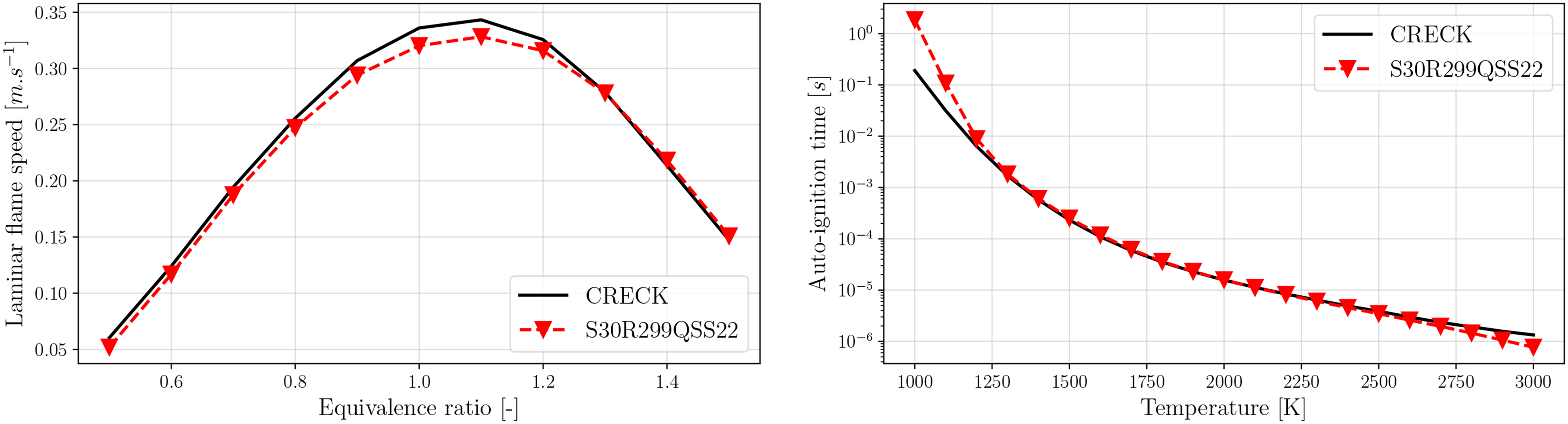
Comparison of analytically reduced chemistry (ARC) scheme (S30R299QSS22) with the reference detailed scheme (CRECK) for laminar flame speed versus equivalence ratio in a 1D premixed flame at
Chemistry integration
The standard numerical integration of the chemistry in explicit solvers consists of a first-order explicit time integration of the species production rates

To avoid the high numerical cost induced by the explicit integration of stiff ARC mechanisms, the exponential integration method
11
is used and summarized below. The species are assumed to be produced or consumed following a first-order differential equation:



In this work, a LDSC procedure is applied to the computation of the chemical source terms.
12
The current time-step of the computation is divided into smaller time-steps (

The exponential integration method associated with the LDSC have been evaluated on gaseous ignition configurations and have demonstrated their efficiency. 12 These methods enable to use large flow time-steps with ARC chemistries up to the acoustic Courant-Friedrichs–Lewy and Fourier limits required by the compressible solver, without compromising the accuracy. Therefore, they largely reduce the computational cost of 3D computations.
Two-phase flow
Discrete multi-component evaporation model
Evaporation is a key element of the two-phase ignition as it determines the amount and the composition of the flammable mixture. The use of a chemical scheme composed of several fuel species with their own decomposition pathways enables us to consider the preferential evaporation effects on two-phase ignition. Moreover, the three-components surrogate model for Jet-A1 is consistant with the use of a discrete multi-components (DMC) evaporation model. In this study, the DMC model is built on top of the Spalding model 18 and is briefly recalled here.
The Spalding droplet evaporation rate writes:



The DMC evaporation model has been validated in a previous study. 20
Point source correction
The standard Lagrangian formalism uses the point source approximation, in which droplets are represented as material points transporting the droplet properties. In this approximation, all source terms produced by droplets are applied to the gas in the cell containing the particle. As a consequence, when using fine meshes the droplet evaporation creates localized peaks in the Eulerian fuel species fields at the droplet position. In the case of ignition, where droplets are placed in a hot environment, the fuel vapor produced in one cell directly pyrolyse before diffusing, resulting in pointwise combustion occurring at the droplet location. This then leads to point-to-point strong gradient variations that are numerically difficult to handle. This problem is well known and a number of regularization methods may be found in the literature. 21 However, most methods involve surrounding cells of the droplet-containing cell, where the operation of finding neighboring cells can be very costly when computing on an unstructured grid.
In this work, an alternative is proposed that stays efficient on unstructured grids. The PBM is based on the R-parcel technique which consists in computing only numerical particles which represent

Illustration of the particle-bursting method (PBM) resulting droplet cluster with the corresponding evaporation rate field.
3D configuration
Two-phase ignition in a spherical bomb is considered and sketched on Figure 3. The domain radius is

Spherical bomb ignition configuration.
The domain is initially filled at the center with a stoichiometric mixture of droplets in air (
Non-reflecting pressure outlet boundary conditions are applied with the Navier-Stokes Characteristic Boundary Conditions formalism 23 to maintain constant pressure in the domain and to evacuate the pressure wave created at ignition.
The ignition is triggered with an energy deposit at the center of the domain. The energy deposit model
24
corresponds to a source term


The computation is performed with the AVBP code (https://www.cerfacs.fr/avbp7x/) which solves the reactive and compressible Navier-Stokes flow equations with a central finite volume Lax-Wendroff scheme, second order both in time and space. 25 The dispersed phase is solved using the Lagrangian formalism. Source terms of mass, momentum and energy from the liquid to gaseous phase are distributed to the closest nodes in the Eulerian grid in a two-way coupling approach.
Results
Overview
The temporal evolutions of maximum temperature and mean heat release rate weighted by the cell volume are displayed on Figure 4. There is a first endothermic ignition phase at
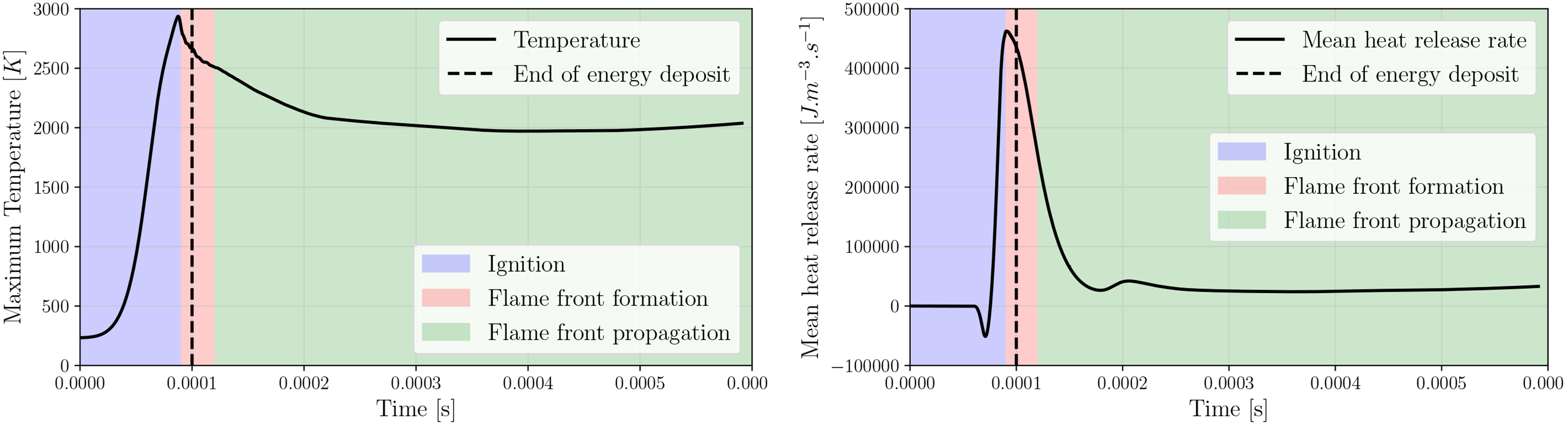
Temporal evolutions of maximum temperature and mean heat release rate over the whole domain.
In the following sections, the two-phase combustion mechanisms are detailed for the three ignition phases: (a) until
Early ignition phase
The energy deposit heats the gas, which then heats the droplets through conduction. Evaporation starts when the droplet temperature is high enough, and is, therefore, strongest at the deposit center where the temperature is highest, as shown on Figure 5. Due to the small droplet characteristic size, the droplet density is high and the resulting evaporation rate field projected on the Eulerian grid is quite smooth, and only a few empty spots appear. One can note that the PBM approach (similarly, to other point source regularization methods) induces an artificial diffusion of the evaporation source terms which could influence the combustion processes. However, for this case (mono-disperse droplet of size
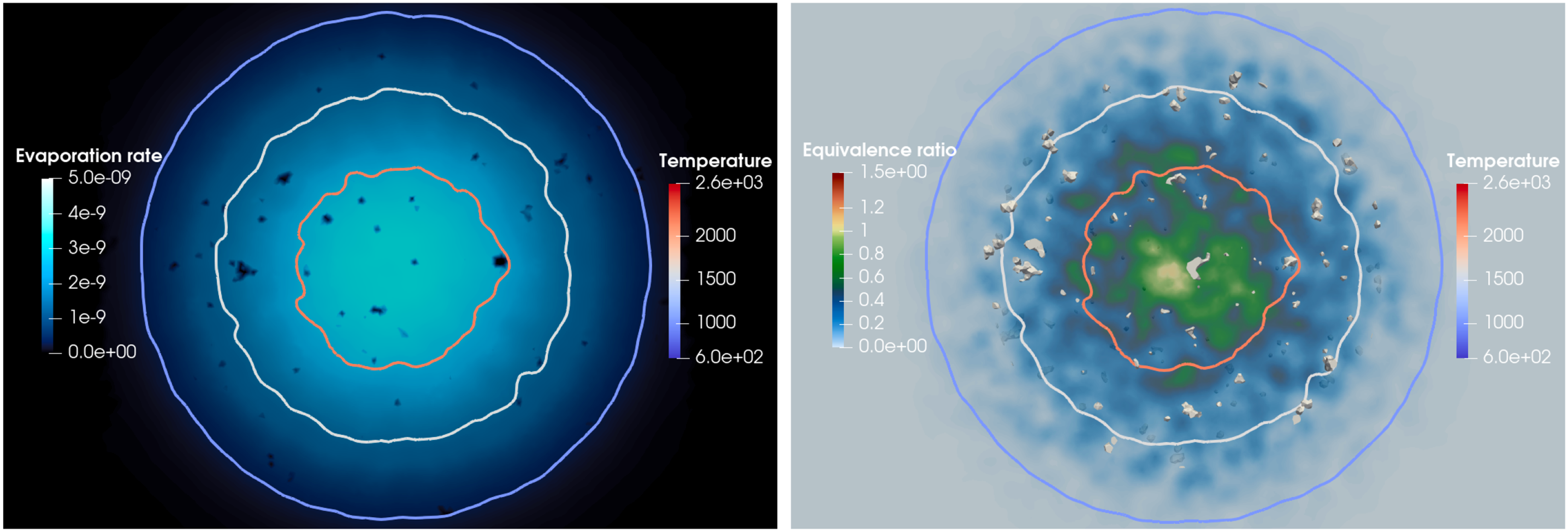
Evaporation rate (left) and equivalence ratio (right) cut-plane fields with temperature iso-contours of
Combustion indeed starts at the kernel center as shown on Figure 6, in a mixed reactor combustion regime, meaning that the thin propagating flame front has not formed yet. This is confirmed by the pool of reactive radical species such as OH found at the center where
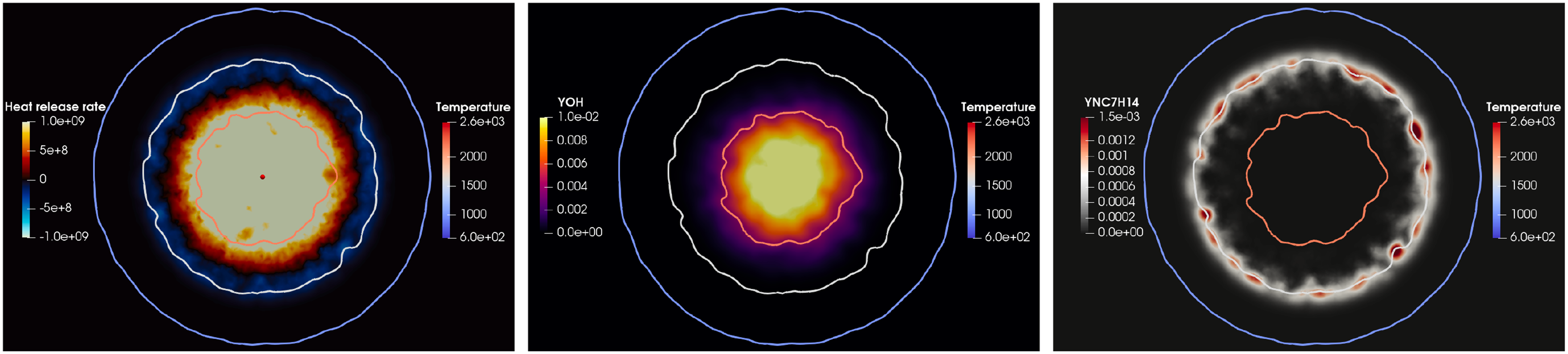
Heat release rate [
The fuel components mass fraction fields displayed on Figure 7 well illustrate preferential evaporation where MCYC6 being the most volatile species evaporates first as soon as
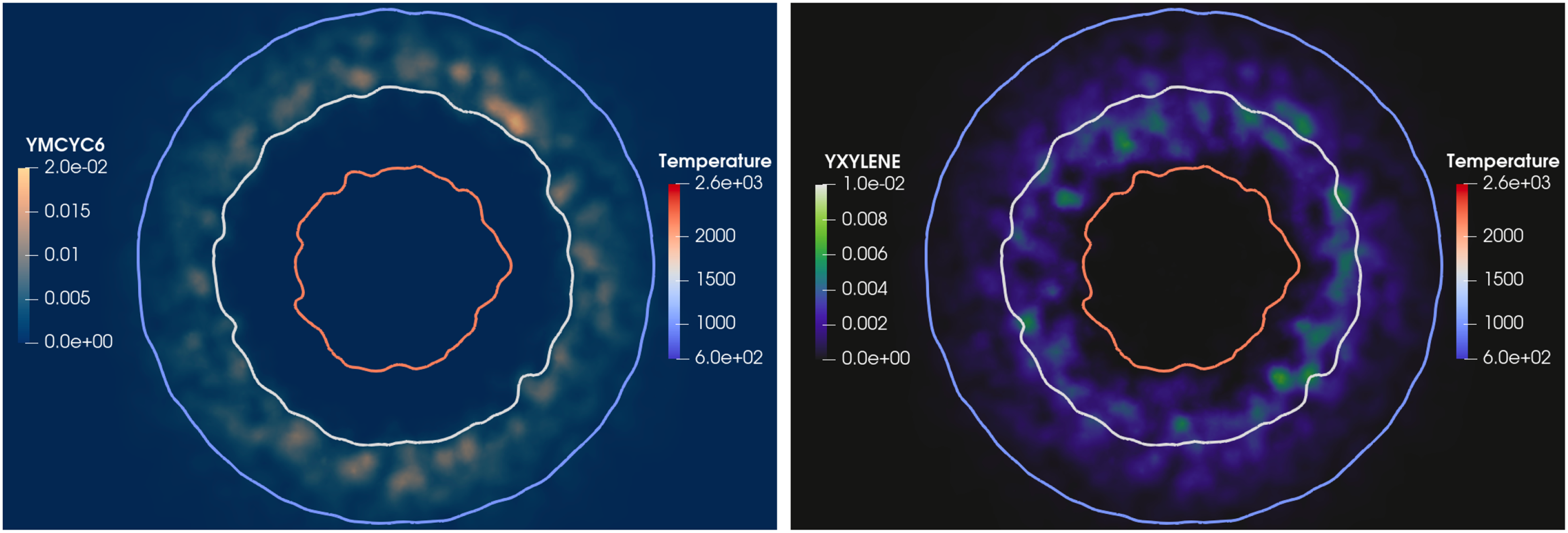
MCYC6 mass fraction (left) and XYL mass fraction (right) cut-plane fields with temperature iso-contours of
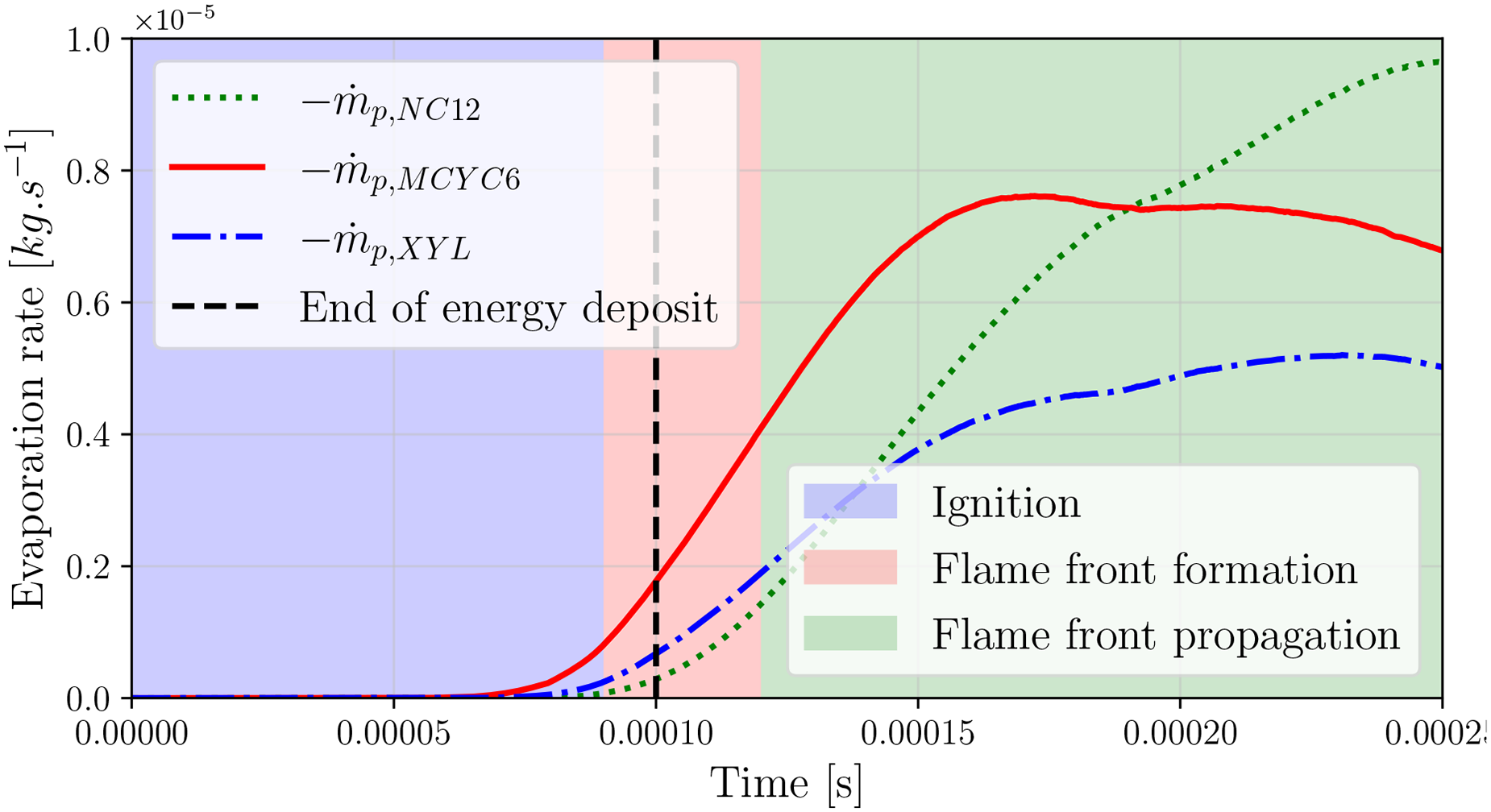
Temporal evolution of the fuel component evaporation rates integrated over the whole domain during the early ignition phase.
Combustion in this early ignition phase has not much progressed even at the kernel center, where the concentrations of the main combustion products CO, CO
Flame front formation
After the ignition phase at
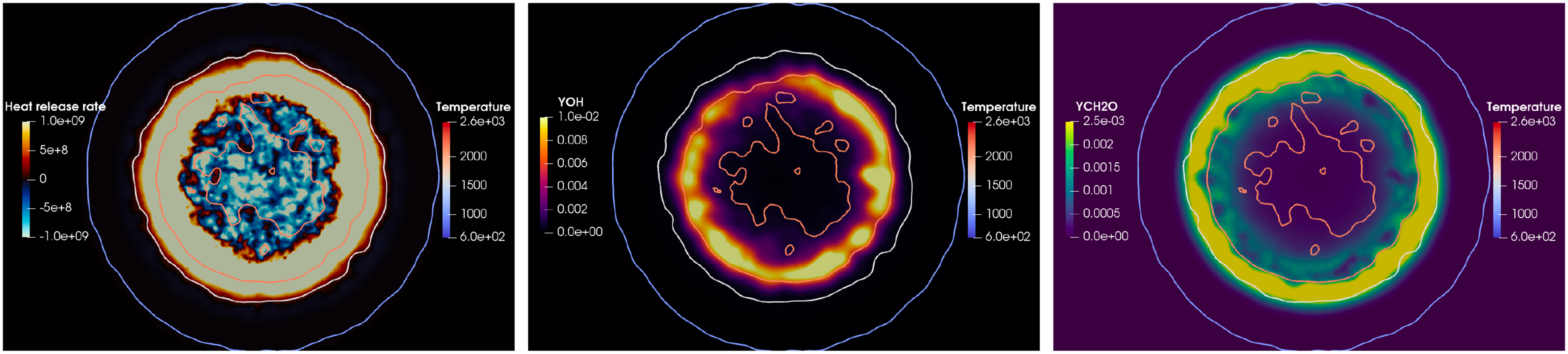
Heat release rate [
Similarly to the previous phase, fuel component vapor is visible along the reaction zone in the low temperature side, but this time NC12 has started to evaporate and is present, in much less proportion, about ten time smaller than MCYC6 and XYL (see Figure 10). Hence again at this stage, the flame properties are mainly driven by these two fuel components.

NC12 (left), MCYC6 (center) and XYL (right) mass fraction cut-plane fields with temperature iso-contours of
As shown on Figure 11 (right), the flame front propagates in a mixture around stoichiometry. The two-phase combustion regime is of the kind of weakly evaporation-controlled where the gaseous mixture has reached flammability before reaching the flame. 28 Therefore, the flame front propagation is not controlled by the droplet evaporation. The weakly controlled evaporation regime is characterized, for laminar propagating flames, by an evaporation peak located ahead of the flame front in the fresh gases. The situation is different in sparked ignition, where the droplet evaporation is triggered by the energy deposition rather than the flame front. Therefore, the peak evaporation is not located in the fresh gases but remains at the kernel center, until all droplets have evaporated, inducing large values of the equivalence ratio there as shown in Figure11.

Evaporation rate [
The evaporated fuel components that evaporate inside the volume enclosed by the flame pyrolyze immediately, leading to the formation of light carbonated species such as CH

CH
The number of droplets was initially set to obtain a stoichiometric total equivalence ratio, computed from the mixing with cold air before energy deposit. Since the pressure is constant in the domain, the temperature increase resulting from the energy deposit induces a local decrease of the gas density and an expanding radial flow, which both reduce the oxidizer mass content. Therefore, the two-phase mixture becomes rich and when the droplets start to evaporate, there are fewer oxygen atoms in the gas phase than initially targeted. The resulting total equivalence ratio can be estimated by correcting the initial value with the gas expansion effect as in equation (13), which gives the maximum value which can be reached:

Finally, the main combustion products are presented on Figure 13. A large amount of CO is released whereas the CO

H
Figure 14 shows the temporal evolution of the smallest droplet radius, which is located at the kernel center. At the flame formation phase (

Temporal evolution of the smallest droplet radius over the whole domain.
Flame front propagation
Jumping to much later time (

Heat release rate [
Figure 15 (center) shows that evaporation now only occurs in a spherical zone around the flame front on the cold air side. This means that evaporation is fast enough in the pre-heat zone to feed the propagating flame, which has become therefore purely gaseous. The evaporation zone lies much further from the hot gas than the flame front because evaporation starts at low droplet temperature (
Finally, due to the high equivalence ratio resulting from the complete evaporation, the flame evolves in a very rich mixture at the flammability limit (
Conclusion
Thanks to numerical stabilization methods for stiff problems, namely exponential chemistry integration, local and dynamic sub-cycling (LDSC) and particle bursting (PBM), the ignition simulation of a mono-disperse, multi-component kerosene droplet cloud was performed. Accurate chemistry was described with an ARC scheme. In particular, the interest of the PBM was demonstrated, allowing to reduce the evaporation rate source term stiffness associated to the point source approximation.
Results clearly highlighted preferential evaporation effects on ignition in two-phase mixtures, with a dominant role of the most volatile species (methyl-cyclohexane and xylene) in the early phases. Due to the high droplet number density, all two-phase fields appeared quite homogeneous and the flame was weakly perturbed by the dispersed phase. The ARC scheme allowed to describe the endothermic pyrolysis of the fuel components, which was also found to play a role in the ignition scenario. Another important observed behavior was the evolution of the equivalence ratio toward very rich values, due to the decrease of oxygen content associated to the density decrease when the gas heats up, while the fuel content in the droplets does not change. This led eventually to a very rich propagating flame, which may endanger the full ignition process. At the end of the simulated sequence, a two-phase flame is obtained which propagates in a purely gaseous mixture as droplets fully evaporate ahead of the reacting zone.
These results are preliminary and should be extended to evaluate and quantify the influence of the control volume size on the combustion processes and the ignition mechanism. Especially for poly-disperse cases where the artificial diffusion effect may have a large influence. Moreover, the PBM still requires further study to define suitable physical criteria to determine the control volume size and the number of child particles, which also depend on the parent droplet diameter and the mesh discretization respectively. Once validated against experimental measurements, the proposed numerical methodology will allow to consider other and more complex cases, including poly-disperse effects with a realistic spray distribution, turbulence and influence of high-altitude conditions.
Footnotes
Declaration of conflicting interests
The authors declare no potential conflicts of interest with respect to the research, authorship, and/or publication of this article.
Funding
The authors received the following financial support for this article’s research, authorship, and/or publication: This work was funded by DGAC under the project CEFORA led by Safran Aircraft Engine and Safran Helicopter Engine using GENCI ressources (Grant 2023-A0132B10157).
