



Abstract

Since our last policy update, the External Affairs team has been working hard developing new and forthcoming campaigns, while maintaining our reputation for high-profile and influential publications which continue to generate debate and interest in the public’s health. Here are some highlights of what we have been working on, as well as the projects we are looking forward to for the rest of the year.
Size Matters – An Investigation into Upselling
September saw the publication of Size Matters, our report on the impact on weight gain of upselling – the practice among food and drink businesses of persuading customers to buy something additional or more expensive, that they otherwise would not have bought. Over two-thirds of the adult UK population are now overweight or obese, and if we are to make progress on this, we need to take seriously the obesogenic environment that consumers live in. Published in partnership with Slimming World, the research found that the average person faces as many as 106 upsell attempts per year. To put this in perspective: for consumers who are upsold to, this would lead to an estimated 17,000 extra calories per year, equivalent to a 5-lb weight gain.
As an organisation, we are campaigning for the food and drink businesses that engage in upselling – such as coffee shops, petrol stations, fast-food outlets and cinemas – to pledge to only upsell healthy food, and end the linking of staff pay to successful upsells. The report called for business rates relief to be awarded to those businesses that take these steps towards improving the public’s health.
The release was well received across broadcast media, leading to interviews with our Chief Executive Shirley Cramer CBE, on ITV, Channel 5 and BBC radio, as well as our Director of External Affairs Duncan Stephenson on the sofa on BBC Breakfast. The report also featured in numerous online and print publications, including write-ups in the Daily Mail, The Sun, The Guardian, The BMJ, Huffington Post and was the top story on BBC News online.

Arts and Health
Royal Society for Public Health (RSPH) continues to support ongoing work in the area of arts and health, both through our artistic projects and an active Arts and Wellbeing Special Interest Group. In July, we welcomed the publication of a new report by the All Party Parliamentary Group (APPG) on Arts, Health and Wellbeing, a report we supported and helped develop, and which championed the hugely valuable role the arts can play.
The winners of our photographic art competition, flash points, exploring health issues through different stages of the life course, were announced at an exhibition in Portland Place on 14th September, drawing attendees from across the country. We would like to congratulate the winner of first prize, Natasa Balogh, for her winning piece Sorrow, and also thank our panel for judging the entries: Chris Steele Perkins, Esther Goodwin Brown, Sian Davey, Tom Hunter, Professor Stephen Clift, Michael Pritchard and Duncan Stephenson.
Our dystopian short story competition, Health: from here to where?, being delivered in collaboration with the Health Foundation, has been through the shortlisting and judging process and the winning entries are expected to be announced by November 2017. A book and website are being compiled for publication, presenting some of the winning stories accompanied by illustration by artist Thomas Moore (who was behind Gin Lane 2016).

Social Media and Mental Wellbeing
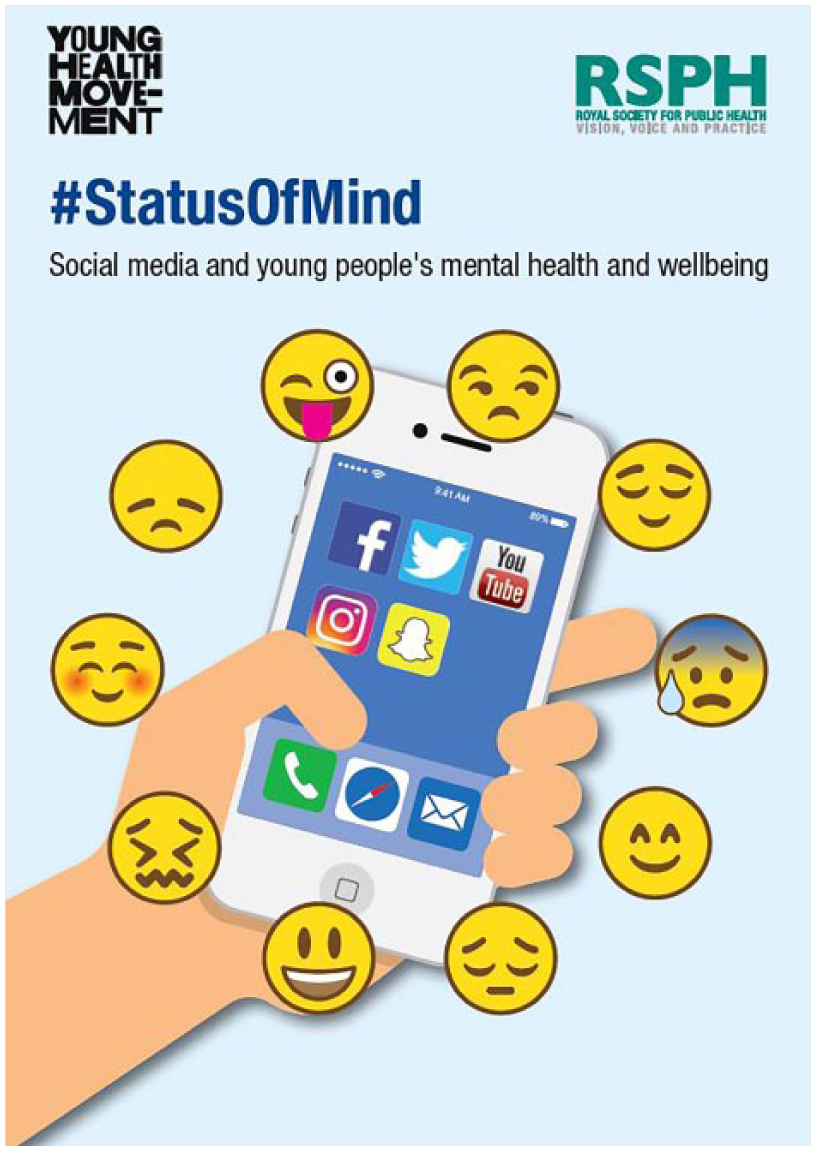
#StatusOfMind, our report examining the positive and negative effects of social media on young people’s mental health and wellbeing, has continued to generate a large amount of interest, both at home and abroad, since its publication in May, including interviews with RSPH spokespeople for documentaries with Vogue Williams and Asri Bendacha.
In September, we gave evidence to a parliamentary inquiry headed by Alex Chalk MP and run by The Children’s Society and YoungMinds on young people’s mental health and social media. The inquiry had a particular focus on cyberbullying in its impact on young people, and we were pleased to be able to feed into this our findings and recommendations from our work on #StatusOfMind.
Drugs Policy
We continue to engage with a wide range of influencers and policy-makers with a view to furthering the drug reform agenda through an approach that continues to focus on pragmatic harm reduction measures. On 11th July, RSPH held a dinner in Parliament together with the Faculty of Public Health, the British Medical Association, and The BMJ, which brought together leading figures in the medical establishment with MPs and policy-makers to discuss and engage with drugs policy. The event was aimed at encouraging key influencers in this area to undertake a joined up approach to drugs policy reform and adopt a more public and progressive stance on the issues. Our Chief Executive, Shirley Cramer CBE, also spoke at a conference held by the Durham Police and Crime Commissioner in July on the arguments for a reformed approach to drugs policy and the importance of buy-in from the law enforcement community.
Our sustained and influential work in this area has generated interest on an international stage, with two of our senior spokespeople addressing major public health conferences in the United States on our approach to drugs reform. In September, our External Affairs Manager and drugs policy lead, Ed Morrow, spoke at the Association of State and Territorial Health Officials (ASPHO) 75th Anniversary Conference, and in November our Chief Executive is due to speak at the American Public Health Association (APHA) conference.
In July, we announced the beginning of a partnership between RSPH and VICE UK, in which we are lending support to VICE’s drug safety campaign, ‘Safe Sesh’. The campaign is a multi-platform initiative that seeks to challenge the current political, cultural and social approaches to drug use in the UK.
Wider Workforce
On 31st October, we held a launch dinner for our report released in partnership with the Professional Standards Authority, Untapped Resources: Accredited Registers in the Wider Workforce. The report explored the current and potential roles of the accredited registers workforce in promoting the public’s health and what challenges the practitioners face to further participation in the wider public health workforce. The dinner brought together key opinion formers within the accredited registers and their professional bodies, along with the Minister of State for Health Philip Dunne MP and a cross section of the health-related charity sector.
Elsewhere, we are continuing to expand our wider workforce agenda through our ongoing project with UK active. Through this we are exploring the role of the fitness and leisure industry in the wider public health workforce and will be presenting our findings at the UK active conference in November.
If you are an RSPH member and feel that you may be able contribute any specialist knowledge to any of the campaigns or research mentioned in this column, please contact Toby Green