



Abstract

It took nearly a century to establish the germ theory, with debate continuing even after microorganisms had been identified, so perhaps it is not so surprising that there is still argument about how to control pathogens, while also protecting the diversity of microbes in the natural environment. Targeting hygiene measures to areas of highest risk seems common sense, although a great deal of research has been needed to establish a convincing evidence base and detailed guidance. This article summarises current understanding about ‘good’ as well as ‘bad’ microbial exposure.

Is it possible to be too clean? In media reporting around hygiene, questions like these are all too common. A new report from the Royal Society for Public Health (RSPH) suggests that they play into public misconceptions about the importance of hygiene, and reinforce misguided beliefs about exposing children to harmful germs. 1 At the same time, research into childhood exposure to ‘good bacteria’ is making it increasingly clear that diverse exposure to human, animal and natural environments, particularly in early life, is key to building a healthy microbiome – the array of microorganisms hosted by our bodies in the gut and respiratory tract.2,3 Targeted Hygiene is a more focused approach to hygiene in the home: the central contention of Too Clean or not Too Clean is that this approach can successfully address both of these points. Targeted Hygiene has been developed by the International Scientific Forum on Home Hygiene (IFH), and set out in more detail in a recent white paper. 4
The Human Microbiome
The misconception that good hygiene itself can be problematic – because it is responsible for reducing contact with important microbes – dates back to the introduction of the ‘Hygiene Hypothesis’ in the late 1980s. This suggested that rising rates of allergies in children at the time were linked to lower incidence of infectious disease in early childhood, and that an underlying cause of this was ‘improved household amenities and higher standards of personal cleanliness’. 5 Despite the subsequent refutation of the ‘Hygiene Hypothesis’, this barbed notion of ‘over-cleanliness’ has not abated, having been widely publicised in the 1990s. 6 As an RSPH national survey revealed, a worrying one in four of the public (23%) still believe that hygiene in the home is not important, thinking children need to be exposed to harmful germs to build their immune system.
The study of the human microbiome is an exciting, newly emerging field with profound implications for the public’s health, which explains the fallacy of ‘over-cleanliness’, while also acknowledging the role that ‘good bacteria’ play in maintaining health. Around 80% of the immune system is located in the gut because of the large population of microbes residing there. The evidence indicates that ‘good bacteria’ can affect significantly various diseases (including gastrointestinal disorders) as well as mental health, weight gain and more.7,8 Knowledge about the role of the human microbiome has now replaced the hygiene hypothesis.
Growing evidence in this field also indicates that failure to build and sustain a healthy microbiome may contribute to rising levels of allergic, autoimmune and other diseases, but this, importantly, is not as a result of being ‘too clean’.3,9 The weight of epidemiological evidence to date indicates that there are multiple underlying causes of reduced microbial exposure, the major factors including urbanisation, access to clean water and food, caesarean sections rather than vaginal delivery and lifestyle changes such as bottle rather than breast feeding, reduced sibling interaction and reduced outdoor activity. 3 Another significant hindrance to a healthy microbiome is excessive use of antibiotics, which are damaging not just to the harmful microbes but the ‘beneficial’ microbes as well. Damage to the microbiome can therefore be reduced by avoiding infections that necessitate using antibiotics – another argument favouring the positive role of good hygiene in supporting a healthy microbiome. 10
Why Targeted Hygiene?
An analysis of UK and US media coverage suggests that we still largely see hygiene as synonymous with cleanliness, with the frequent interchangeable usage of the terms ‘cleaning’ and ‘hygiene’ arguably causing confusion about what hygiene really means. 6 Targeted Hygiene is an approach to risk management in the home and everyday life, which means focusing hygiene practices in places and at times when harmful microbes are most likely to be spreading, in order to break the chain of infection (summarised in Figures 1 and 2). 11

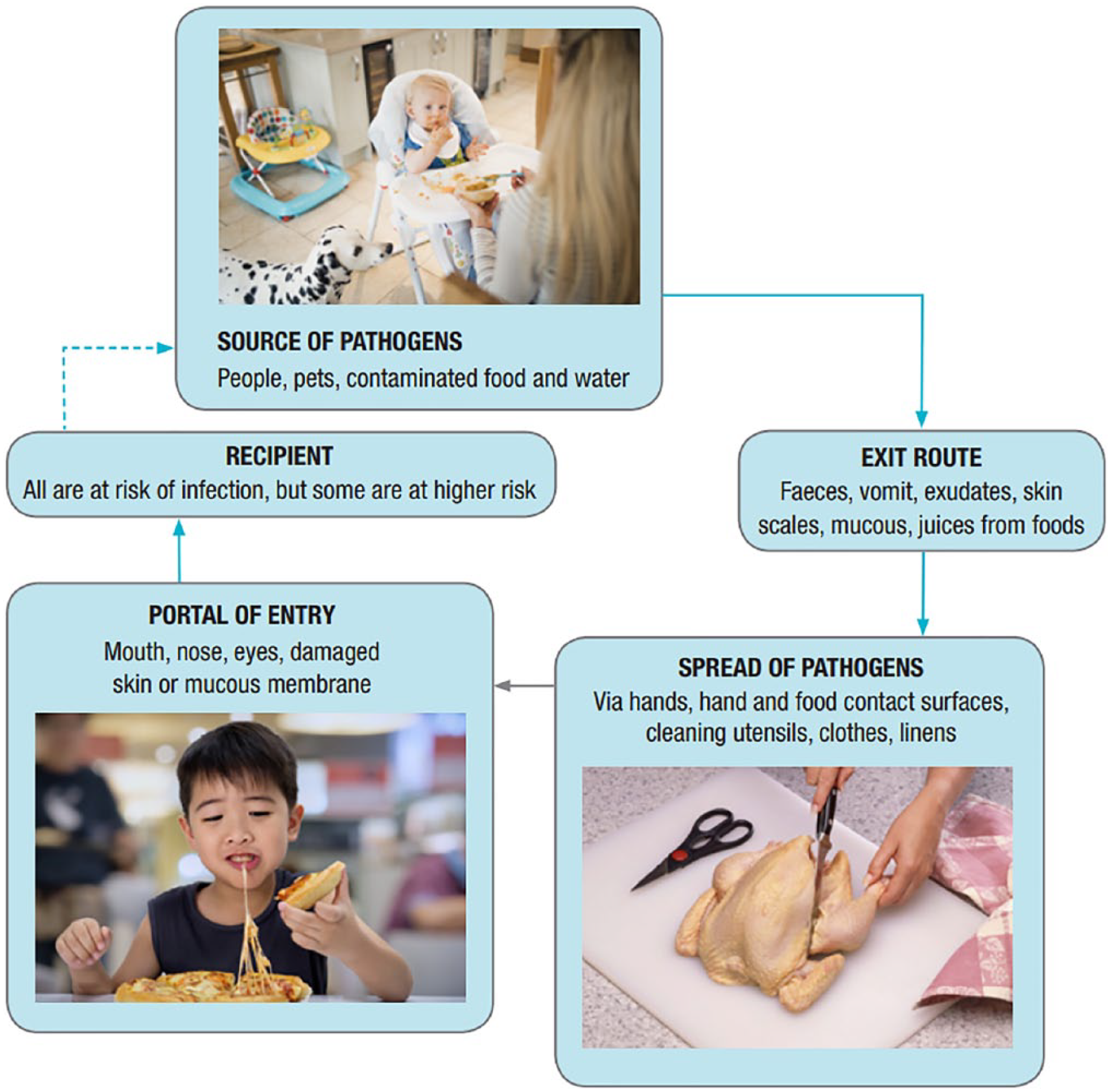
The chain of infection.
The research into public opinion commissioned by RSPH – which will be presented in more detail in a later issue of this journal – revealed that there is considerable public confusion about the relationship between dirt, germs, cleanliness and hygiene. While the importance of hygiene in general is well understood, the times and situations where it is most necessary are not. For example, while there was good understanding of the importance of hands as a means of transmitting harmful microbes, there was poor appreciation of the risks from reusing contaminated dishcloths or by laundering clothing and linens at a low temperature. 1 There was also the common misapprehension that children need harmful germ exposure to build their immune system.
This is why the communication of Targeted Hygiene principles to the public is so important – they form the most effective framework for simultaneously minimising infection risk and promoting a healthy microbiome. To achieve this, Targeted Hygiene depends on differentiating high-risk situations, where harmful microbes are present, from low-risk situations, where microbes are either not harmful or there is little chance of exposure to them. As a result, by focusing hygiene in the places and at the times that matter, exposure to the beneficial microbes required for a healthy microbiome can be sustained. It further supports the microbiome by preventing infections that in turn reduces the need for antibiotics, many of which can adversely affect the microbiome.
What Next?
It is clear that good hygiene practice in the home and everyday life is an important health issue and the most cost-effective and sustainable way to tackle some of the most demanding health issues of the 21st century. The RSPH report argues that a multifaceted approach to improving public understanding of hygiene in the home and everyday lives will be needed to bring about change. 1
A more sophisticated public education programme, at all levels, is central to this. At schools, for example, a Targeted Hygiene approach to breaking the chain of infection should be included in the core curriculum. Manufacturers also have an essential role and a constructive first step here would be directions on product labels that inform consumers on the most effective times and places to use the products.
A critical factor is keeping public confidence in and understanding of home hygiene at the highest levels possible. To this end, there is a need for more research into the extent to which public misconceptions about hygiene represent a barrier to behaviour change, and whether better understanding of hygiene can positively impact on outcomes of hygiene promotion interventions.