



Abstract
Aims:
The aims of this study were to ascertain the comprehensive knowledge, perceptions, and attitudes of people from varying socioeconomic regions towards antibiotic use; identify the misperceptions and malpractices; and inform health policy and practice.
Method:
EBSCO host databases, PubMed, and Google Scholar were searched to obtain relevant primary research papers within the years 2010–2018. Search phrases included the following: ‘antibiotics use’, ‘community perceptions’, ‘public opinion, knowledge, behaviour, practices, perceptions’. Initially, selected papers were screened using the Preview, Question, Read, Summarize (PQRS) model.
Results:
Review of the 20 articles selected was based on six identified themes. It was found that insufficient knowledge and awareness of antibiotics use; self-medication and the use of leftover antibiotics; treating viral diseases with antibiotics or used as painkillers; expecting antibiotic prescription as a culmination of consultation; and the credibility of information obtained are issues that cut across different countries.
Conclusion:
Evidence from this review suggests that misconceptions of antibiotic use are similar in different countries. Therefore, the need for the development and implementation of transferable policies as well as educating the public is necessary for the fight against ABR.
Introduction
Antibiotics are well-known powerful medicines that are used to combat bacterial infections. 1 They are noted as potential life-saving drugs and a protection against infectious diseases. 2 They work by either killing bacteria or keeping them from reproducing. 3 Unfortunately, one of the increasing public health challenges worldwide is antibiotic resistance (ABR) and the increasing threat of ABR is, inarguably, the result of antibiotic use. 4
Not only is ABR associated directly with human consumption but there is also extensive and inappropriate use of antibiotics in animal production leading to the rapid spread of multiresistant microbes from developing to developed countries and vice versa. 5 Regardless of the final consumer, the actions of people towards the stewardship of antibiotics is a major driver for the resistance problem. 6
As the world gets progressively more interconnected and complex, there is a lot of social interaction, trading, and travel, plus advancement in knowledge which is a mark of the blatant reality of this interconnected world. 7 Resistant strains keep moving around the globe regardless of how developed the countries are, hence the need for global interventions. 3
To help solve the resistance problem, Gili et al. 8 believe that the general public has an important role to play. To achieve this, it is necessary to understand their perceptions of antibiotic use; their knowledge on the subject, attitudes, and experiences; and to know if there is an existence of educational needs. 9 Unfortunately, data collected on the aggregated health and economic burden of ABR are scarce, particularly in the low- and middle-income countries. Nevertheless, even with this uncomprehensive data, the issue is currently considered as one of the greatest public health threats – a risk to both the economy and environment – in the world. 10
Several country-based or specific population-based research studies are ongoing worldwide on the basis of varying environmental factors such as relationship between sanitation, infection, and antimicrobial resistance 11 or socioeconomic factors which include the association between poverty and antibiotic use.11,12 However, these studies are highly specific in nature, regardless of how comparable the settings may be, and do not provide a clear cumulative grasp on the subject. 13
This review, therefore, is one such way to enlighten researchers by giving a global picture of how people perceive antibiotic use so as to identify the misperceptions and malpractices and to inform global policies and practices.
Methods
Literature search
Existing relevant primary research papers were collected from the EBSCO (Elton Bryson Stephens Company) host databases, PubMed, and Google Scholar. The search phrases used include the following: ‘antibiotic use’, ‘community perception’, ‘public opinion, knowledge, behaviour, practices, perceptions’, while excluding search phrases such as ‘physician/doctors/healthcare practitioners’ knowledge and perception’. Other limiters included date range (2010–2018), full texted articles, and peer-reviewed journals (Figure 2).
Screening and data analysis
The first read of the collected articles was made to get a better sense of their content. A more critical review of the articles was adopted, following Cohen’s (1990) Preview, Question, Read, Summarize (PQRS) model. According to Ramdhani et al. 14 and Wu and Akyol, 15 the PQRS model stimulates a pre-understanding of the text and improves the researcher’s comprehension of the subject.
A methodological critique of the selected papers was carried out to ascertain the reliability of the chosen literature (Table 1). Findings from the articles were the major bases for this review. The findings of each paper were grouped into themes. Identical themes across papers were synthesized and analysed in Table 2. These themes represented how people use antibiotics – their knowledge, perceptions, and practices. It is expected that these themes will enable people to grasp the cumulative story of antibiotic use, noting people’s perceptions, knowledge, behaviours, and practices across countries and varying socioeconomic regions so as to find the generalizability of the problem for the development of effective health practices and policies.
Grid of methodological critique

WHO: World Health Organization; SPSS: Statistical Package for Social Sciences; OR: odds ratio; CI: confidence interval.
Grid of identified themes

RTI: respiratory tract infection.
Results
A total of 22 papers were initially selected (Table 3), out of which 20 were finally selected for review after screening (Figures 1 and 2).
An overview of reviewed papers


A PQRS chart for the study (created by the author)
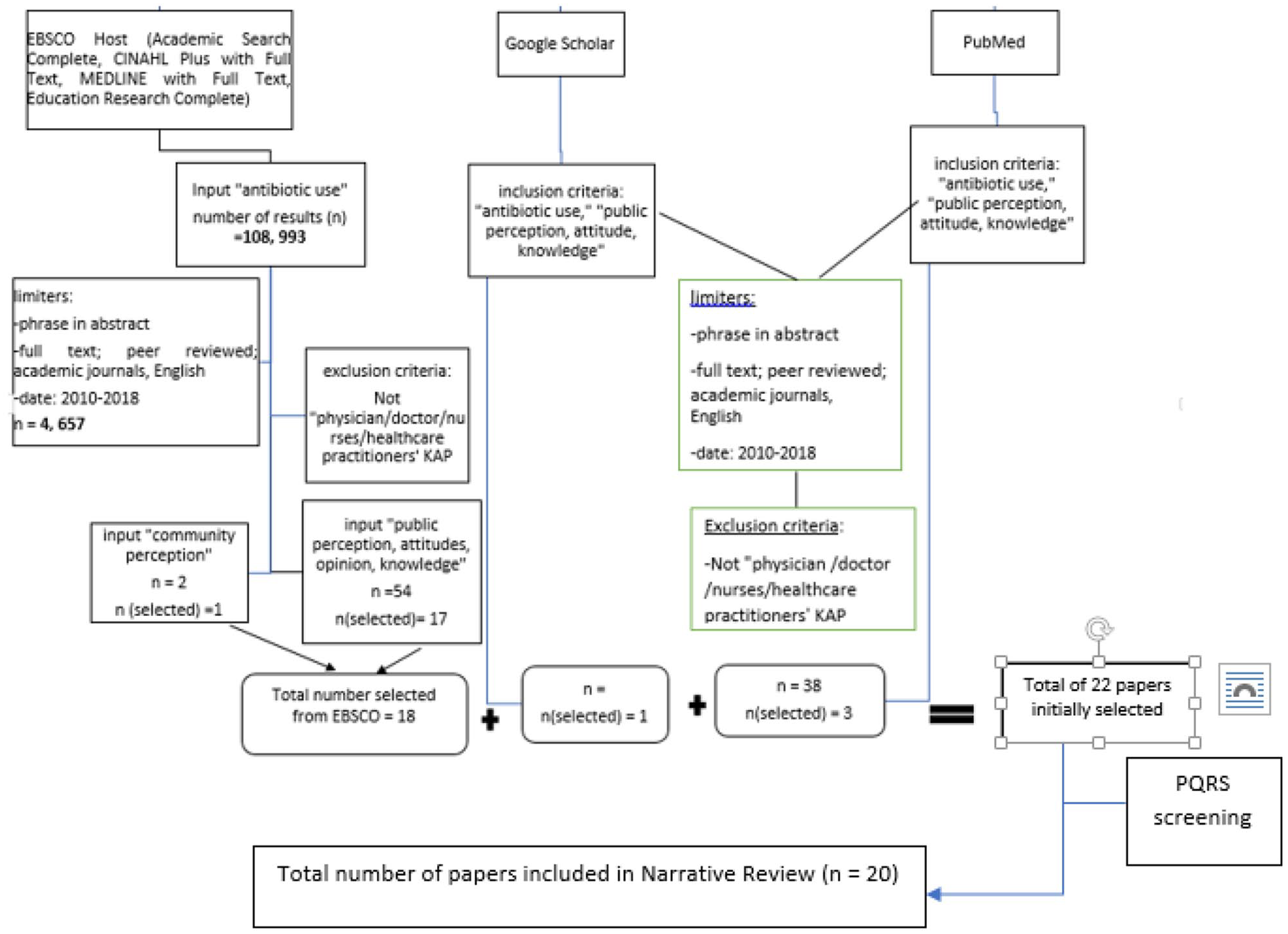
PRISMA flowchart of the literature search outcome
Methodological critique
While Lum et al., 12 Sahoo et al., 11 and Hawking et al. 30 were qualitative studies, Viberg et al. 31 adopted a mixed method – thus both qualitative and quantitative studies. The remaining 16 papers were all quantitative studies.
The qualitative researcher interprets people’s perceptions as well as meanings they attach to their experiences in the natural world. 13 As demonstrated by Lum et al., 12 Sahoo et al., 11 Hawking et al., 30 and Viberg et al., 31 the researchers sought to interpret their findings based on their professional and national backgrounds. The authors of the other 16 papers approached the investigation, measurement, and assessment of human behaviour towards antibiotic use in an objective way. Although such an approach used in understanding human perception is contested, the objectivity allows for an independent exploration of why people do what they do. 32
The qualitative studies were conducted using interviews and focus-group discussions, and these methods allowed participants to freely share their views without fear. All the quantitative studies were cross-sectional surveys. Aside from Lum et al., 12 whose convenience sampling was questionable, the different sampling strategies (random, purposive, snowball) and the analytical tools and methods (SPSS, chi-square tests, NVivo, logistic regression) adopted for the other studies were reliable and increased the validity of the study (Table 1).
Thematic analysis
Level of education and awareness
According to Napolitano et al., 16 there appeared to be a superficiality of knowledge about antibiotics among the participants. Some participants believed that antibiotics were powerful drugs used for a quick relief of any kind of disease.6,11 The level of knowledge about antibiotics use positively correlated with their educational level or awareness.16,22,23,26–28 While the most literate or better educated participants clearly understood the dosage and side-effects of antibiotics, those who were illiterate did not; all they knew was that it was mentioned whenever they visited hospital. 11
The level of education and awareness of participants helped them to identify (or not) improper diagnosis and irrational changes in prescription. 11 Conversely, the participants interviewed by Hawking et al. 30 were all in schools and colleges and had very low antibiotics stewardship education and awareness. 30 This suggests that school is not the only medium for antibiotics education. Instead, as the studies showed, people who lived with healthcare practitioners were well informed.22,24
Interestingly, while findings from Vallin et al. 22 and Agarwal et al. 23 indicated that the majority of the men in Sweden, whether educated or uneducated, and India, respectively, had an accurate knowledge on antibiotic use and resistance compared to the women, Kandelaki et al. 24 and Awadh et al. 19 found that a good knowledge on the subject was rather associated with being female in Saudi Arabia.
Patient expectation and attitudes towards prescription
Even though participants knew little about antibiotics, a number of them always expected to be given antibiotic prescriptions by their general practitioners (GPs). 30 Pan et al. 6 and Awadh et al. 19 found that patients expected their doctors to prescribe antibiotics especially when diagnosed with upper respiratory tract infections (URTIs) and other viral infections so would ask the doctor for antibiotics if not offered. 33 Contrary to this, some consumers rather preferred that their physicians gave a clear and firm directive as to how and when to use antibiotics and were confident in the doctors’ decision, especially when a delayed antibiotic prescription is given.12,22 Consumers interpreted this kind of prescription as a warrant for best treatment and so would use it immediately.12,30
It was also found that most participants rarely completed the course of antibiotics because they felt better.12,17,19 Banerjee and Raghunathan 18 reported that some respondents skipped doses. While some believed that skipping doses contributed to the resistance problem, others were unaware of any associated consequences when doses were skipped. In contrast, Viberg et al. 31 mentioned that some prescribers gave the wrong drugs and sometimes the wrong dosage. Again, most of the antibiotics were given without any laboratory testing and diagnosis which is essential.
Self-medication and use of leftover antibiotics
Lv et al. 29 found out that 40.2% of respondents from their study self-medicated, and in order to have immediate access to antibiotics either for themselves or family members, they frequently hoarded these antibiotics. Another source of leftover medication was a result of a truncated course of treatment. 31 Many respondents were willing to take medications without prescriptions 34 as some claimed they did not need to see a doctor for minor illness 20 or because of the high cost of medical consultation; 25 some people would self-medicate to often avoid staying home from work. 22 Reasons for such choices included lower self-rated health status and the knowledge of antibiotics for treatment of viral infections.16,18 While others claimed that they self-medicated based on pharmacists’ advice, others would rather make use of leftover antibiotics at home.1,25 Vallin et al. 22 found that participants within high-income levels were less likely to self-medicate. Poor people, as asserted by Allcock et al., 33 usually patronized the substandard or counterfeit antibiotics because they were cheap and available and could be readily obtained over the counter.
In contrast, there were others who would rather dispose of leftovers.18,36 Unfortunately, they did this in household sinks instead of following the safe disposal protocols offered. 12 Researchers have reported that this act exposes bacteria in the natural environment (including streams and rivers) to antibiotics causing them to build resistance for their survival 11 and also increase the spread of resistance genes. 18
Treatment of respiratory tract infections and viral diseases and as painkillers
Among respondents from England, Malaysia and Nigeria, there was confusion between antibiotics and painkillers.27,28,30 Similarly, in India, illiterate people and school leavers interviewed believed that antibiotics were painkillers. 18 Some respondents asserted that they used them for the treatment of cold, cough, and sore throat1,23,26,29,21 whereas many others were unaware that antibiotics did not kill viruses.1,24,28,31 Some respondents were able to identify antibiotics such as ampicillin, and tell that they were used to treat bacterial infections but also had the misconception that these same drugs could cure viral infections. 27
Knowledge of ABR
Aside from science students, the majority of the adolescents interviewed by Hawking et al. 30 and respondents from Lim and Teh 28 and Agarwal et al. 23 had a poor understanding of ABR. It was reported that educational level, age, the presence of a healthcare worker in the family, and working activity of participants positively influenced this knowledge.16,26 According to Napolitano et al., 16 the correlation between such people and the fact that they needed no additional information on antibiotics was statistically significant (odds ratio (OR) = 0.46; 95% confidence interval (CI) = 0.23–0.92; p = 0.028). Also, there were other respondents who did not know that the unnecessary use of antibiotics eventually made these antibiotics ineffective.1,6,24 Interestingly, consumers interviewed by Lum et al. 12 felt that the issue of ABR had been sensationalized through exaggerated news. According to Awad and Aboud, 26 more than half of the respondents did not agree that ABR was a worldwide problem.
A larger group of interviewees were not aware of public campaigns on ABR. Regardless, the participants, according to Lum et al. 12 and Sahoo et al., 11 suggested that people should be educated on the issue. One of the global initiatives of World Health Organization (WHO) towards the reduction of resistance was to improve its awareness and understanding. 34 All participants, according to Sahoo et al., 11 did not understand the concept of ABR and a few had noted that previously used antibiotics were not used in recent times. These people suggested that the inefficacy of old antibiotics is due to excessive use of chemicals for cultivation, the availability of fake or low-quality drugs, and people’s non-compliance to prescription, or even due to climate change. 11 Impressively, 94% of respondents from Sweden, Tanzania, the United Arab Emirates, and Palestine appeared to have a good knowledge of ABR and even the resistance development (⩾90%) noting that, the more antibiotics are used in the society, the higher the risk of developing and spreading resistance.21,22
Participants, according to Hawking et al., 30 however, displayed their basic knowledge, after being prompted, to help create awareness. While some respondents disagreed that ABR was a serious problem in our society, whether locally or globally, 18 students who demonstrated more knowledge of the subject insisted on the fact that the current level of awareness was highly inadequate. 29
According to Levy and Marshall, 35 it was widely believed that people from developing countries were at greater risk because antibiotics were cheap, available, and were often used unnecessarily. However, the results gathered show that even developed countries such as England, Australia, and Italy were also facing a high risk of resistance.12,16,30 This suggests the low level of education, awareness, and understanding of ABR across countries.
Source of information
Most participants received their information from the media (newspapers, magazines, the Internet, and television advertisement) or communication campaigns1,16 and from friends and relatives.20,29 Other participants obtained their information from physicians and pharmacists.16,21,26,29
Discussion
ABR is a major challenge to public health with the global potential to kill millions of people each year. Increasing people’s perceptions, attitudes, and knowledge on antibiotics has been identified as an important method of combating the resistance problem.
This review has highlighted a number of issues about people’s perceptions of antibiotics and their use. The participants interviewed in the papers outlined some misconceptions in antibiotic use and resistance. Researchers have identified issues around mistreatment of URTIs and other viral diseases with antibiotics, bad management of leftover drugs and self-medication, low levels of education and awareness, credible sources of information, and the knowledge of ABR itself. These findings will be useful to inform the health and social care sector about necessary interventions. These include training of prescribers, organizing educational campaigns, enforcing drug use and disposal laws, well-informed media publicity, as well as making and implementing policies on antibiotic use. Understanding why patients have such high expectations and perceptions helps facilitate effective communication between the clinician and the patient and therefore assists in strategizing public education. 36 Education, therefore, should be well orchestrated – in schools, accurate information from the media, public campaigns, and physician-patient interactions. Laws regarding disposal must be enforced and new policies should be made to control antibiotic use and disposal. 17 It is imperative to monitor closely those who educate the public as it is the credibility of the information that shapes the perceptions of people.
Conclusion
ABR is a major challenge to public health, with the potential to kill millions of people each year globally. Ongoing research into perceptions, attitudes, and knowledge of antibiotics has been identified as one sure way of combating the resistance problem.
This review has been enlightening in revealing people’s perceptions about antibiotics and their use. The participants interviewed in the papers outlined some misconceptions in antibiotic use and resistance. Researchers have been able to identify that people mistreat URTIs and other viral diseases with antibiotics, bad management of leftover drugs and self-medication. There are low levels of education and awareness, credible sources of information, and the knowledge of ABR itself. Findings will inform the health and social care sector of necessary interventions. These include training of prescribers, organizing educational campaigns, enforcing drug use and disposal laws, well-informed media publicity, and making and implementing policies on antibiotic use.
More research should be conducted into how people perceive antibiotics and resistance, gauging their level of knowledge and monitoring their attitudes and practices so as to devise appropriate plans of action for the fight against antibiotic resistance.
Footnotes
Conflict of Interest
The author(s) declared no potential conflicts of interest with respect to the research, authorship, and/or publication of this article.
Funding
The author(s) received no financial support for the research, authorship, and/or publication of this article.
Ethical Approval
As this review was a secondary research, it did not require the formal approval of a research committee or other regulatory body, hence there was no rigorous ethical review.
