



Abstract
Aims:
Social media, because of its broad coverage, is an attractive option for communicating public health messages. However, the lack of a theoretical framework, supporting the two-way communication of social media, is holding back its development and use. This study investigated the suitability of a dynamic transactional model (DTM) of communication for explaining the use of social media for communicating public health messages.
Methods:
The study was carried out on ‘Don’t know? Don’t drink’, a Facebook campaign against drinking alcohol during pregnancy that targeted women of childbearing age in New Zealand. The comments generated were analysed for two features of DTM, namely inter- and intra-transaction, by examining the plurality of topics and polarity of sentiments, using text-mining techniques.
Results:
The analysis of the textual data revealed nine independent topics, confirming the plurality of topics. The conversation contained both positive and negative terms, establishing the polarity of sentiment.
Conclusions:
This study verified the two DTM features (inter- and intra-transaction) in the comments produced by the ‘Don’t know? Don’t drink’ campaign implemented on Facebook. DTM exhibited the potential to be a theoretical framework for recommending and evaluating social media sites like Facebook for communicating public health messages.
Keywords
Introduction
The broad reach of social media is drawing the attention of public health researchers.1,2 For example, Facebook, with over 2.4 million active users, 3 can reach both the young and mature adults (50+ years). 4 In addition to the broad reach, social media can target individuals with specific characteristics such as people of a certain faith (e.g. Catholics) from a particular country. 5 Communication via this channel is cost-effective,6,7 making it an attractive option for delivering public health messages. 8
Social media communicates both ‘one-to-many’ and ‘one-to-one’, facilitating mass communication and one-to-one interactions with individuals. The two-way communication that eventuates helps in engaging with individual members of the target audience.9,10 Such one-to-one engagement is essential for co-creating value meaningful to the parties concerned. 11 Studies in a controlled setting have shown social media to be effective in co-creating value. For example, Facebook was observed to be effective in facilitating engagement that improved physical activity12,13 and reduced alcohol consumption14,15 of the subjects.
While the benefits of using social media in public health are apparent, a theoretical framework that supports its usage is yet to be established. Unlike traditional media, social media is bi-directional (two-way communication), and the audience actively participates in the communication process. As such, the traditional communication models (e.g. Shannon-Weaver’s model and Berlo’s model) cannot be applied to social media.16–18 The channel, therefore, needs a model that accommodates a two-way communication and active participation of the audience in the communication process. 19 Despite the lack of a theoretical frame, social media is gaining popularity with public health workers; 19 hence, there is an urgency to establish one, which is the focus of this paper.
A review of the literature identified a dynamic transactional model (DTM) of communication suitable for modelling ‘two-way communication’ at a public level. The model accounted for dialogue and learning, 20 both inherent features of social media.21–24 The model, however, needs validation for effective communication before recommending it for conveying public health messages. 25
Dynamic Transactional Model (DTM) of Communication
The primary thesis of DTM is that both the sender and receiver actively participate in the communication process.20,26,27 Communication is effected through the interactions that occur at two separate levels. One is at an inter-personal level between the sender and receiver (inter-transaction), and the other is at the cognitive level of the individuals and occurs when they interact with their knowledge base (intra-transaction). The two types of interactions work seamlessly to divulge information (shared information), which forms the basis for co-creating meaning. A flow diagram showing the two levels of interactions and shared information adapted from Barnlund’s 26 DTM is presented in Figure 1.
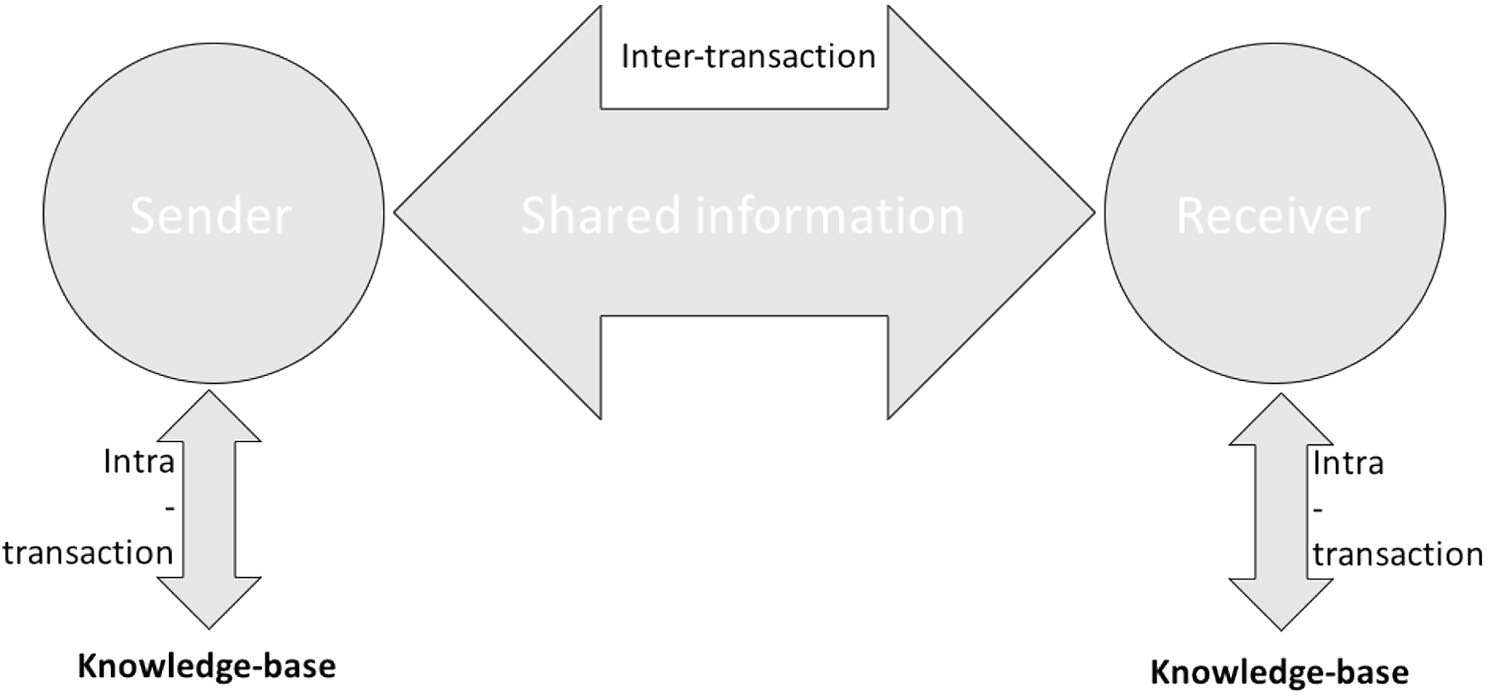
An adaptation of DTM showing the two types of interactions and shared information
Some researchers have extended DTM to mass media, applying it in a novel way to evaluate communication effectiveness.27,28 These researchers aligned mass media communication to the two transactions (inter-transaction: dissemination of stimuli; intra-transaction: search for in-depth information). Separate media, categorised as monitoring (e.g. television ads during news time) and searchable media (e.g. website) based on the way consumers used them, activate the inter- and intra-transaction. For example, consumers pick up the stimuli circulated through television ads while watching the news and make enquiries with the agency or brand concerned (inter-transaction); to acquire perfect knowledge consumers search and access information sources such as websites, blogs and journals (intra-transaction). Using the media channels of the two categories in combination activated the inter- and intra-transaction to effect mass communication. The theory of media complementarity provides the framework for combining the two media categories. 29 This theory was proposed to explain the co-existence of the traditional and new media channels of the current digital age. 30 Geiß et al. 29 applied the theory to combine the monitoring media that typically are the traditional media (e.g. television ads, newspaper ads), and the searchable media that typically are the new form of media (e.g. websites, social media) to communicate brand or public messages.
With monitoring media becoming available online (e.g. Google Adwords), DTM may be extended to digital communication of the present age. For example, in digital marketing, customers are presented with marketing stimuli through the use of Google Adwords ads (monitoring media). The stimuli initiate inter-transactional communication between individual customers and the brand. Prospective customers click on the advertisement to be taken to the website that presents further information about the offerings.31,32 The number of prospects arriving at the website is an indication of the effectiveness of the monitoring media. A key performance indicator conveying the effectiveness of inter-transaction is the click-through-rate. At the site, individuals are presented with the offerings and in-depth information using interactive tools such as a comparison matrix 31 to activate a cognitive process (intra-transactional communication). The expected outcome for the intra-transaction is to make a purchase. Key performance indicators for evaluating the searchable media include sales and average selling price. Thus, the DTM framework stipulates the key performance indicators specific to the stimuli (inter-transaction) and the acquiring of perfect knowledge or performing the desired behaviour in question (intra-transaction).
Extending DTM to Social Media
DTM assumes the existence of a mutual connection between the sender and the receiver. On social media, mutual connections between members exist in the form of friends (e.g. Facebook) and followers (e.g. Twitter). These social media platforms use the mutual connections to facilitate dialogue and learning for members, suggesting the likelihood of a DTM form of communication.
Social media can operate like mass media to reach a large target audience. Studies have shown that the advertising solution of Facebook can disseminate health-related stimuli to a targeted audience that is considerably large. For example, Platt et al. 33 used Facebook advertising to target Facebook users aged 18–24 living in the State of Michigan in the US. This campaign presented the stimuli of a biobanking service of the Michigan Department of Community Health to 779,004 users, generating 1249 video Views and 572 Likes. Another Facebook campaign targeted an even broader audience comprising 18–64 years old Facebook users living in the State of Michigan. 34 This campaign, for the same biobanking service, reached 1.88 million Facebook users in this age category to produce 9009 Likes, 12,909 video Views and 452 Shares. Platt et al. 34 reported 642 comments of which 176 related to newborn screening and biobanking, suggesting a DTM form of exchange. Whether that indeed was the case needs to be investigated. To correctly apply DTM for social media, an investigation to understand the nature of communication through this channel is necessary, that is, whether the communication effected is transactional, comprising inter- and intra-transactional. The study reported here aimed to establish a DTM for communicating public health messages via social media. The aim was achieved by an investigation carried out on a public health campaign implement via Facebook for the two cardinal features (inter- and intra-transaction) of a DTM of communication.
Inter-transaction – plurality of topics
In a typical DTM form of communication, both the sender and recipients exchange information (inter-transaction). As the parties come from different contexts, inter-transaction is bound to generate a variety of ideas and interpretations on the subject matter (a plurality of topics). Such a ‘plurality of topics’ has been observed in the comments accumulated in social media groups of chronic diseases such as diabetes 35 and cancer. 36 The literature recommends such social media groups as information sources because they contain advice and best practices relating to chronic diseases.35,36 While these studies did not have a communication perspective, they still showed that the comments made on social media exhibited the ‘plurality of topics’, which is a consequence of inter-transaction. Therefore, to appropriate a DTM for communicating health messages via social media, an investigation is needed to confirm the plurality of topics in the comments of a public health promotion campaign. The research question set for this study was: ‘Is there a plurality of topics in the comments generated by a health promotion campaign implemented via Facebook?’ (RQ1).
Intra-transaction – polarity of sentiment
Intra-transaction occurs when individuals consult with their knowledge base when responding to a stimulus. 26 If the knowledge base is limited, individuals may access external in-depth information sources (e.g. online journal). The outcome of the intra-transaction is the assignment of meaning to a given stimulus, 26 which is a cognitive process that is not directly observable. The meaning becomes evident in the words used. According to the cognitive dissonance theory, individuals seek consistency between their behaviour and belief. 37 The cognitive process achieves the consistency that may be either a consonance (agreement) or dissonance (disagreement). 38 As the cognitive process occurs internally to individuals, it is not observable but evidenced by what they state. 39 In a social media context, this can be in the form of comments individuals write. An analysis of the sentiment valences (positive or negative) of the comments can reveal the nature of the consistency (agreement or disagreement) achieved. 40
In the case of social behaviours, such as smoking cigarettes and drinking alcohol, individuals view their decision as the preferred one. They rationalise the decision to make the behaviour concerned a non-conflicting one.41,42 The decision is viewed positively, whereas the alternative is viewed negatively. The attitudes and beliefs of the two alternative positions tend to spread wide apart; this phenomenon is referred to as the spreading of alternatives. 42 With the increase in awareness of health consequences, many may have a negative view towards social behaviours, as in the case of smoking. 43 All the same, because of freedom-of-choice, some individuals support and promote such social behaviours. Therefore, in modern societies, due to the spreading of alternatives, attitudes and beliefs towards most social behaviour would polarise into positive and negative sentiments.
On social media, individuals assign meanings to stimuli independent of the sender. In the case of sensitive topics such as drinking alcohol during pregnancy, users’ cognitive process would result in writing comments that may be positive and negative (polarity of views). The words used to write the comments would either be positively or negatively charged. While the cognitive process is not observable, the presence of positive and negative valenced words is evidence for cognitive dissonance. Thus, the polarity of views in the comments confirms the prevalence of intra-transaction in communication via social media. To confirm this, the following research question was investigated: ‘Do the comments made for a health promotion campaign contain a mixture of words bearing both positive and negative valence?’ (RQ2).
Methodology
Study setting
Facebook campaign in New Zealand, ‘Don’t know? Don’t drink’, 44 provided the opportunity to investigate the two research questions to achieve the aim of the study. The campaign conveyed the message that women of childbearing age (18–30 years) should stop drinking alcohol if they are likely to become pregnant. This message was conveyed using a video and three Facebook postings. The video depicted a woman about to pour a glass of alcohol when her reflection in a mirror speaks out to stop her from drinking as she had missed her period; she instead pours a glass of juice. The posters had three taglines, and they were ‘You used a condom, right?’, ‘Missed a pill? maybe?’, and ‘Definitely definitely not pregnant’. Parackal et al. 45 reported the Facebook metrics (e.g. Likes, Views) of this campaign. The number of Views for the video was 203,754, which was substantial, considering there were 431,000 women in the age category 46 that the campaign targeted. In total, the campaign received 6125 Likes, 300 Shares and 819 comments. These metrics suggested that Facebook was effective in disseminating the stimuli for this public health campaign, and that provided the impetus for the current investigation.
Data and analysis
The data for the study reported here used the comments produced for the ‘Don’t know? Don’t drink’ campaign. The comments were written by women aged between 18 and 30 with a New Zealand–based Facebook account that the campaign targeted. The campaign ran from June to September 2015 and generated 819 Facebook comments. The study adopted an exploratory approach using text-mining techniques to analyse the comments (textual data) to answer RQ1 and RQ2. People use emojis and memes when writing comments, hence may contain information relevant to the current investigation. The text-mining methodology employed removes such content to focus on the textual data. Therefore, the present study did not include emojis and memes.
The analysis first reduced the textual data dimensionally using singular value decomposition (SVD). 47 Similar dimensions were combined using variable clustering to form independent topics or themes to answer RQ1. The themes were further analysed by applying SentiWords, a lexicon of words bearing positive and negative sentiment, to answer RQ2. SentiWords comprised 155,000 words with sentiment scores ranging between −1 and 1. 48 This lexicon was chosen as it had a satisfactory precision of sentiment measurement and coverage of words. 49
Data preparation
The comments extracted from the ‘Don’t know? Don’t drink’ Facebook page, after anonymising, were converted into separate files containing a numeric identifier and the corresponding comment. The textual data were processed using the Text Miner add-on to SAS Enterprise Miner version 14.1. The process commenced by parsing the data into terms. The terms were classified into parts-of-speech (e.g. noun, verb, adjective) to establish their grammar roles in the comments. 50 The terms were stemmed to their root-words (e.g. ‘drinking’ stemmed to ‘drink’). Stop-words that included words used for constructing sentences but carried no meaning (e.g. propositions and conjunctions) were removed, and that reduced the size of the textual data without losing information. Based on frequency, the terms were weighted using the inverse document frequency (IDF) method. 51 The final set of textual data was transformed into a term-document matrix to be analysed using statistical techniques to answer RQ1 and RQ2.
Plurality of topics
The study investigated the plurality of topics (RQ1) using an unsupervised machine learning technique, which identified the unique topics in the term-document matrix. The method, first, reducing the term-document matrix into a workable number of dimensions using SVD.50,52 The step collapsed the matrix into 25 dimensions, which is the default number set in SAS Enterprise Miner version 14.1. By using the variable clustering analysis, the dimensions were clustered to produce independent cluster groups. By setting the proportion of the within-group variance to zero, the analysis ensured each group was homogeneous to represent a unified topic. The minimum eigenvalue for retaining each cluster’s principal component was one. The ratio of squared correlation of ‘Own Cluster’ to the ‘Next Closest Cluster’ confirmed the quality of the cluster resolution; the smaller this ratio is, the better the clustering. 53
Polarity of sentiment
The study used SentiWords 48 to investigate the sentiment valence for the comments. The unit of analysis used for this investigation was the terms. By using SentiWords, each term was given a lexicon-based sentiment weighting. For each comment, the positive and negative sentiment scores were aggregated into separate valence variables (‘positive valence’ and ‘negative valence’). The investigation established the association between the topics identified in the previous analysis and the valence variables, using linear regression analysis. For this analysis, the topics were the independent variables and were regressed to the two valence variables in separate regression analysis. The two regression equations revealed the topics that accounted for variance in the positive and negative sentiments in the data.
Results
Plurality of topics
Variable clustering analysis produced nine distinct topics (see Table 1), confirming the plurality of topics. The labels for the nine cluster topics were assigned by reviewing the highest weighted terms and its related comments. As can be seen from the labels, the topics are noticeably different. As shown in Table 1, the ratios for the entire cluster topics were below 0.5, suggesting a satisfactory clustering resolution.
The themes identified in the comments.
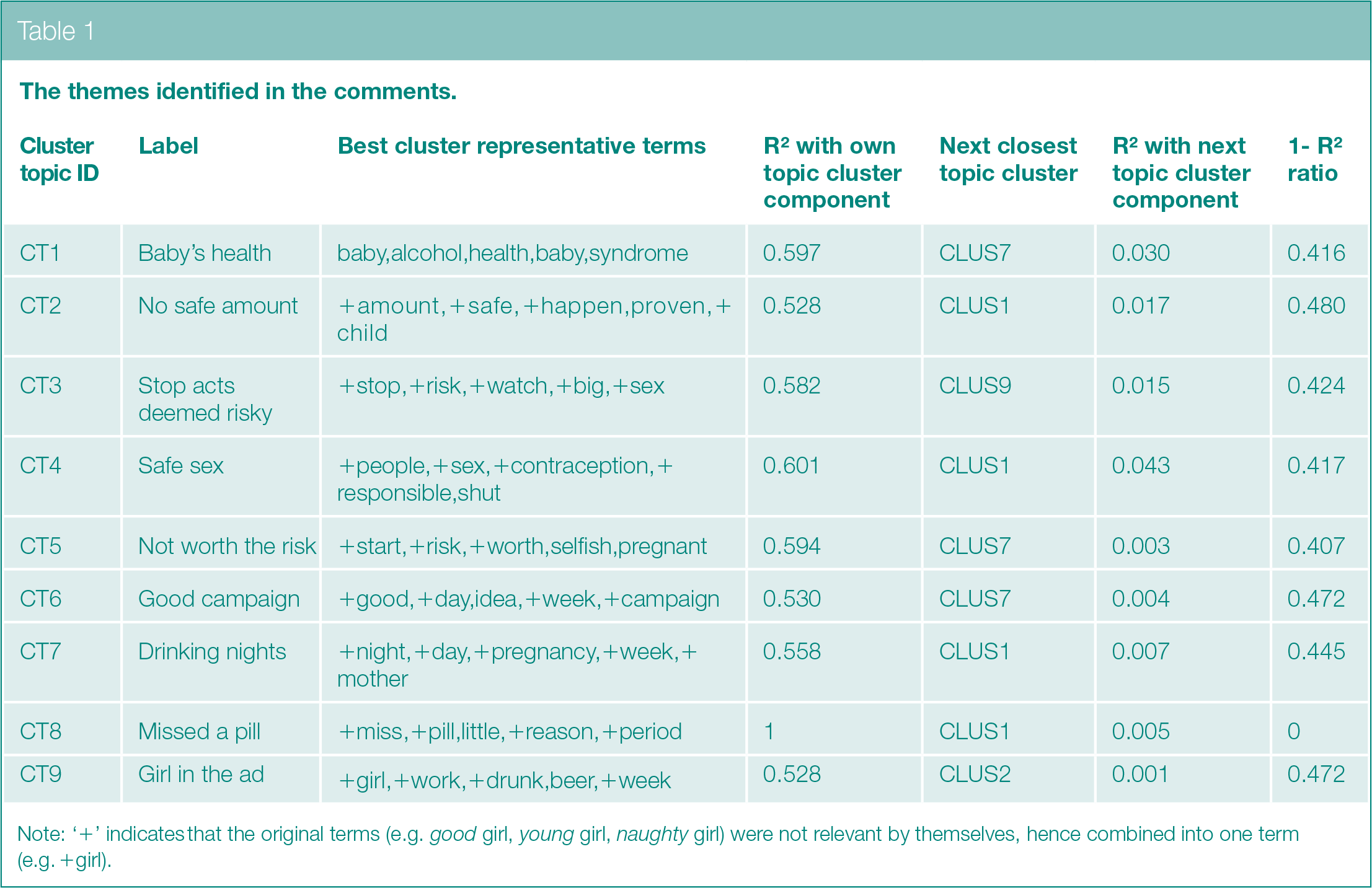
Note: ‘+’ indicates that the original terms (e.g. good girl, young girl, naughty girl) were not relevant by themselves, hence combined into one term (e.g. +girl).
Polarity of sentiment
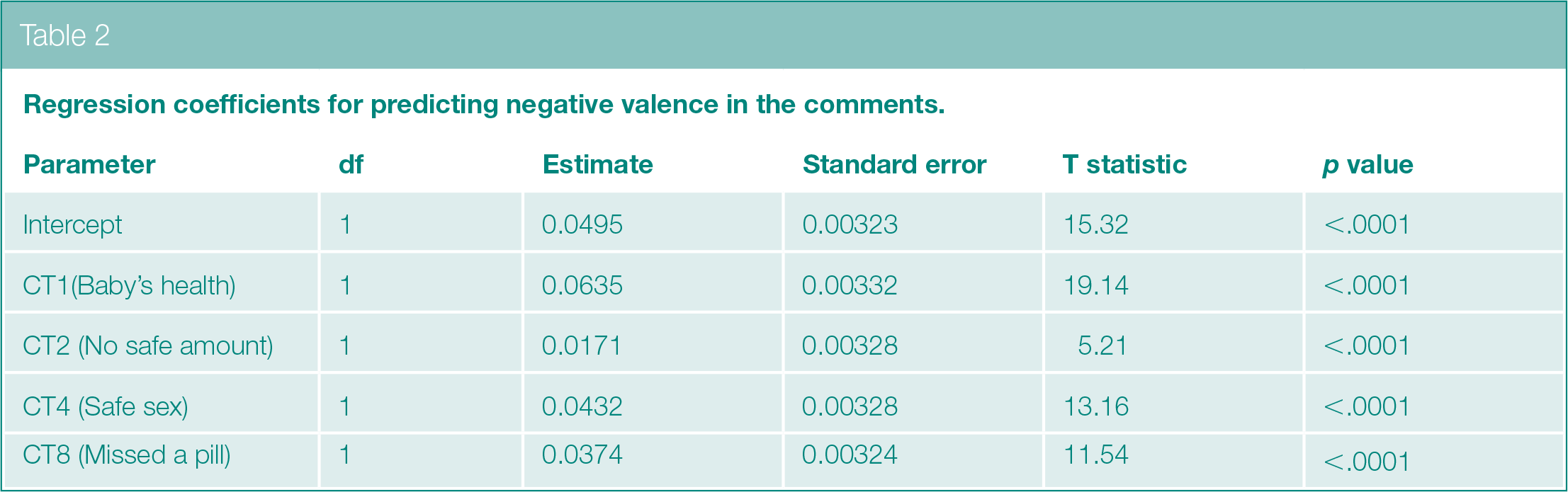
The nine topics produced in the above analysis (Table 1) were separately regressed onto the positive and negative valence variables. For the negative valency, the topics accounted for 52% of variance (R 2 = .52, F(4,813) = 221.24, p < .0001). The four cluster topics (CT1, CT2, CT4, CT8), included in the regression (see Table 2) predicted the SentiWords-defined negative valence variable.
Regression coefficients for predicting negative valence in the comments.
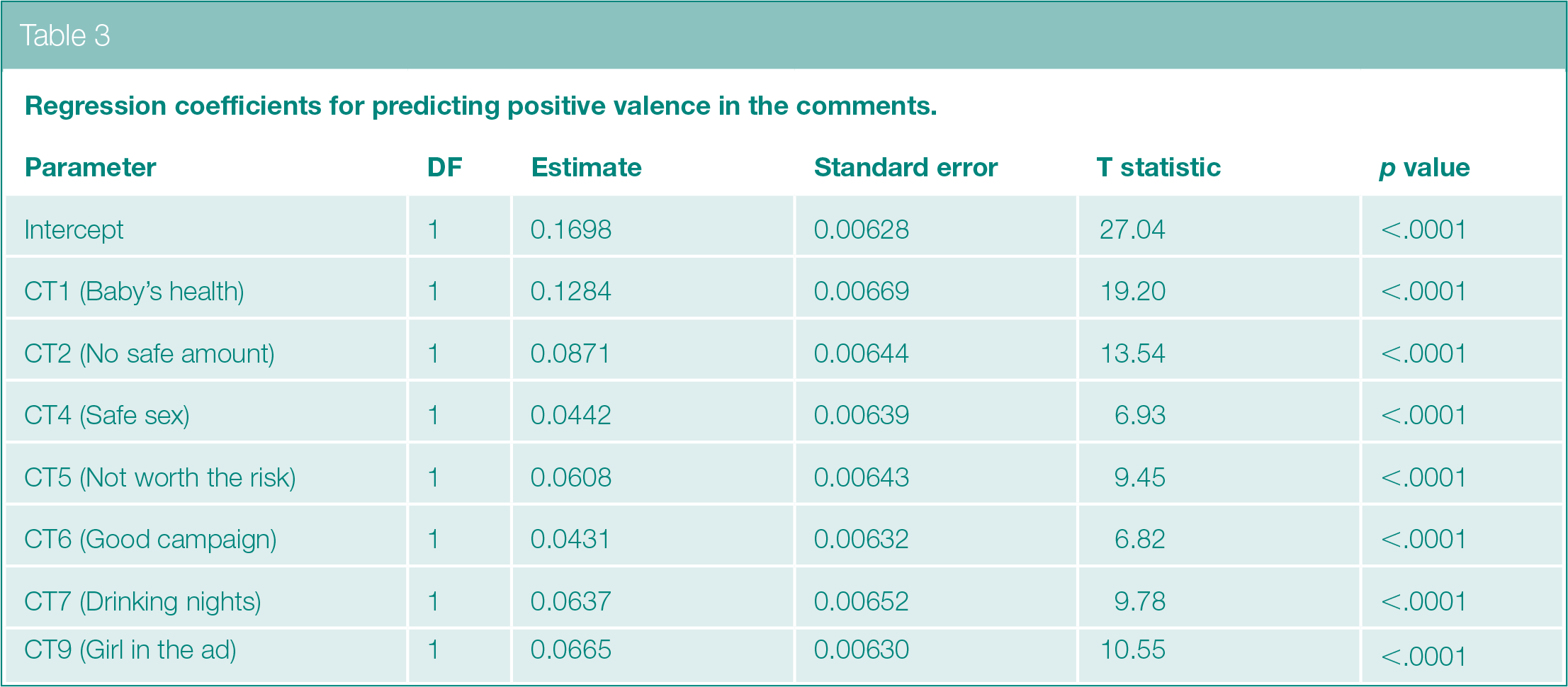
For the positive valence, the topics accounted for 64% of variance (R 2 = .64, F(7,810) = 206.63, p < .0001). Seven topics (CT1, CT2, CT4, CT5, CT6, CT7, CT9) included in the regression (see Table 3) predicted the SentiWords-defined positive valence variable. Three topics (CT1, CT2 and CT4) appeared in both the regression equations, indicating sentiment-heterogeneity across these three topics.
Regression coefficients for predicting positive valence in the comments.
Discussion
The current study aimed to investigate the suitability of the DTM as a theoretical framework for communicating health messages via social media. This exploratory study investigated the comments produced for ‘Don’t know? Don’t drink’, a Facebook-based public health campaign. The study aimed to identify the two transactions (inter- and intra-transaction) that characterise a DTM form of communication. The two transactions were studied separately by investigating the plurality of topics and polarity of sentiment in the comments of the ‘Don’t know? Don’t drink’ campaign.
Plurality of topics
The plurality of topics investigated using text mining uncovered nine separate topics (see the Label column in Table 1) that related to alcohol consumption. The message was conveyed using four stimuli, one video and three postings, each with different taglines. 45 It could be argued that the video message and taglines prompted four of the topics, albeit the target audience initiated the remaining five topics. This observation confirmed the plurality of topics in the comments, which aligns with the DTM assumption that parties in communication simultaneously send and receive information (inter-transaction) (RQ1).20,26,27
People use words to express their emotions on social media. 54 The emotions conveyed with words bear one or the other sentiment (e.g. ‘excellent’: positive valence; ‘disgusting’: negative valence). 55 The presence of words bearing positive and negative valence in the comments analysed suggested heterogenicity in the meaning given by users to the information exchanged. Health promotion campaigners could be opportunistic by interacting with the target audience to provide expert knowledge to rectify any incorrect meaning-making. Such inter-transaction could produce a perfect knowledge in users to encourage the modification of their attitude and behaviour towards the social issue. Ultimately, the strength of the emotions at the individual level will impact the effectiveness of health promotion messages one way or the other. 56 A DTM offers the opportunity to provide additional information as part of the inter-transaction to purposefully engage with the users to encourage attitudinal and behavioural change. The campaign investigated in this study did not provide additional information to the users, but such additional inter-transactions are feasible in a social media setting.
Polarity of sentiment
Meaning-making being a cognitive process is not observable, but according to dissonance theory, the sentiment valence embedded in the responses is indicative of this process. 39 The sentiment valence of the reactions (positive or negative) varies from person to person, depending on their knowledge base. In this study, both types of sentiment were observed, suggesting heterogeneity in the participants’ knowledge base. Three topics (CT1, CT2 and CT4) appeared in both the regression equations (see Tables 2 and 3), suggesting they stimulated both positive and negative valence. The heterogeneity of sentiment observed for the three topics confirmed a polarity of sentiment even at the topic level. The polarity of sentiment noticed at the aggregate (data) and topic level strengthened the occurrence of intra-transaction in the meaning-making of the topics.
The observations reported in this study suggest a DTM could serve as a framework for implementing health promotion via Facebook. With social media sites offering paid advertising solutions (e.g. Facebook Ads), an adaption of Geiß et al.’s 29 method of using a DTM for evaluating mass media could provide the metrics for assessing health promotions. For example, Facebook metrics (e.g. Like, View Share) could provide measurements for the effectiveness of the stimuli, distributed via Facebook Ads, to activate inter-transaction. Intra-transaction being a cognitive process is not observable; however, Facebook’s emoticons (e.g. Anger, Love, Sad) 57 could provide the evaluation for intra-transaction. Sentiment analysis of the comments could interpret the sentiments to reveal any knowledge deficit. Providing in-depth information via inter-transaction could rectify the deficit. Future studies need to validate the evaluative measurements to strengthen the case for recommending a DTM for using Facebook for communicating public health messages.
The investigation in this study was limited to the comments users wrote. With emojis, memes and images also used in writing the comments, it is worth mentioning that they contain information relevant to the sentiments. One may argue that emojis, memes or images strengthen a case for intra-transaction as they require some amount of cognitive processing. With the development of methods for analysing emojis, memes and images (e.g. Highfield and Lever 58 ), a future investigation will further strengthen the support for a DTM of communication for social media communication of public health messages.
Conclusion
Social media is attracting the attention of public health researchers and practitioners but is yet to be established for public health promotion. Interactions on social media occur in real time and can be challenging to manage, particularly for socially undesirable behaviours such as harmful drinking. The traditional communication models do not account for the interactivity, hence are limited. This study suggests a DTM of communication as a theoretical framework for using social media to convey public health messages. The model is unique in that it accounts for interactivity between the sender and receivers at a public level and individual level.
The study investigated and confirmed the presence of inter- and intra-transaction, the two essential features of a DTM of communication for ‘Don’t know? Don’t drink’, a Facebook campaign against drinking during pregnancy. DTM can not only provide a framework for implementing but also evaluating health promotions via social media. Through facilitating interactions (inter-transaction) between the senders and receivers, a DTM form of communication can provide end users with the evidence needed to encourage attitudinal and behavioural change. Finally, strengthening DTM as a theoretical framework for social media with future studies will help in the systematic development of pubilc health communication literature.
Footnotes
Acknowledgements
The authors acknowledge with thanks the Health Promotion Agency (HPA) of New Zealand for funding the thematic analysis of the ‘Don’t Know Don’t Drink’ campaign and for permitting them to publish from the data. As the campaign was planned and implemented by HPA, all ethical considerations were handled by the Agency. There is no competing interest, whatsoever, for any of the authors that might have influenced the work described in this article.
Conflict of Interest
The author(s) declared no potential conflicts of interest with respect to the research, authorship, and/or publication of this article.
Funding
The authors received funding to carry out the thematic analysis for the Don’t Know? Don’t Drink campaign. The funders have granted permission for the authors to publish using the data.
