



Abstract

Introduction
The impact on mental health and wellbeing by the current COVID-19 crisis globally has begun to be widely investigated and documented. 1 The Arts and Culture sector itself has also been impacted by the pandemic; however, as described through this practice as research work, the embodied practices used by some contemporary dancers as self-care practices performed within a group setting can be a valuable addition if comprehensively incorporated into the public health sector.
Today, many of us are spending more and more time daily entangled in the digital online world. The current global situation with the major virus outbreak has highlighted some of the benefits to people broadly having access to the digital online world for health and wellbeing. 2 The pitfalls of digital social interaction have also become increasingly visible. The use of digital online spaces for social connection can have negative effects through the digital performative aspects of self-care. On social media for example, showing people performatively to others that one is self-caring – more often than not – is known to cause suffering rather than wellness. From comparing ourselves to others to feeling like we’re missing out, demonstrating self-care digitally on social media can have a negative effect on mental health. 3
Public health practitioners and researchers play a key role in influencing mental health and addressing a community’s wellbeing. This short article addresses one approach to promote mental and physical health generally and during the pandemic. The pandemic has weighed heavily on the health sector and those who work within it; somatics (embodied practices)4,5 can be a way of adding a new supporting layer to care practices.
Somatics And Contemporary Dance
Somatics as used in this article refers to somatic education or ‘methods of sensory-motor education that improve physical function by increasing sensation and motor control and changing habitual patterns’ as defined by Thomas Hanna in ‘What is Somatics’.4,5 Through this re-education system, a person learns how to release tension and chronic muscular contraction they may not have previously been aware of due to their personal and habitual patterns of how they are moving, standing and sitting in everyday life. This releasing of unnecessary tension is both within the physical body and the mental state of the person.
Somatics is a field of movement techniques that contemporary dancers learn throughout their careers. As a dancer and Feldenkrais® Awareness Through Movement (ATM)6,7 practitioner (RSME/T), 8 my practice as research incorporates my experience with embodied practice into daily wellness training. I regularly teach these techniques to collaborators and people online and in person.
Specifically, in practising Feldenkrais® Awareness Through Movement, but also in other forms of somatics, there are two elements of importance which are emphasised – the first is awareness and the second is movement. My research questions the meaning of what is intended by ‘having awareness’ or even ‘to move’ and suggests that through an artistic approach these meanings can be broadened.
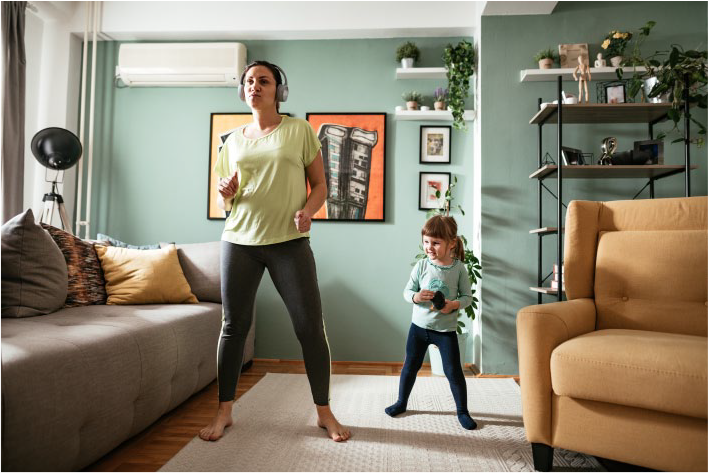
In my contemporary dance practice, I use somatics 8 in both training dancers and with the general public through online sessions. My research has qualitatively shown improvements in the people I work with through discussions, observations and shared reflections. Despite not being able to be in-person together with participants, the use of somatics within digital spaces can have immense benefits by cultivating self-awareness, self-regulation, mental agility and connections with others. Conducting more quantitative research in the use of somatics (embodied practices) on mental health and wellbeing in the public sector would yield benefits to public health.
Working with people online in digital spaces, there are times when a person cannot move both physically in space and mentally in their emotional states; when things both feel and/or actually are weighed down, compressed and strung tight. Somatics and contemporary dance practices can help the person move not only their bodies physically through specific exercises but also their attention or in other words, by moving their awareness of themselves they can affect the quality of their own movements, posture and overall experience.
Practising awareness through movement helps a person feel movement even if it’s not physically possible to move. In other words, we can move our attention through our body to cultivate resilience and sustainability. How does one cultivate resilience? During uncertain times, more than ever we are in need of group and self-care practices that foster a sense of sustainability within ourselves. 9 Not knowing what tomorrow brings can sometimes create anxiety and stress, two factors that are known to have profound effects on wellness but that can, to some extent at least, be addressed through the practices outlined in this article.
Conclusion
Through somatics (embodied practices) I have worked with other dancers and collaborators to discover tools that can help cultivate resilience and sustainability both mentally and physically not only in-person but within even digital and online spaces.
In the past, self-care and its radical history, for example in America from the Black-Panthers to the Women’s Marches, has been a way of building support systems. 10 Having a self-care movement practice helps us build self and group reliance, which is one way we can build health and vitality. That’s not to shift responsibility of care onto the individual rather than the sector meant to support them. However, if the approach of the public health sector towards digital spaces can incorporate a somatics understanding and, alongside more standard modes of treatments, continue to incorporate the work of somatic practitioners that is one way to move towards health and wellbeing in the contemporary moment. Through the body with dance and embodied practice, there is new possibility to find resilience and sustainability during the digital age.
The current times have changed many things and made the digital world even more dominant in our daily lives. In the Feldenkrais® method, change is a constant but now more than ever we see change as a persistent and wearing event like water slowly eroding a riverbank. Most of us don’t like change, we prefer to know what is going to happen, to have a routine. Embodied practices through somatics and contemporary dance are a way of unexpectedly changing our movement patterns and behaviours with awareness. The idea is that practising change can help us stay ready for change in other parts of our lives. With these practices used in digital and online spaces, we can play, dance and move ourselves towards health and wellbeing.
