



Abstract
Aims:
Considerable number of studies in the existing literature indicate the existence of stigma related to many diseases, disabilities, and disorders, but less attention has been given to diabetes-related stigma. This narrative review of literature aims to explore the existence of stigma surrounding type 1 diabetes mellitus (T1DM).
Methods:
Literature were searched using search engines, Google Scholar, PubMed, and Scopus electronic databases published from year 2000 to 2020. Both qualitative and quantitative studies focusing on the stigma associated with T1DM were included. A total of 21 articles met the inclusion criteria. Thematic analysis of collected research material was done.
Results:
Results provided substantial evidence that stigma associated with T1DM was experienced by T1DM patients and their caregivers at some point in their lives and it had affected their lives in different domains such as difficulty finding a spouse, discrimination at employment opportunities, educational institutions, management of disease, being misjudged as a druggie, poor quality of life of the patient and caregiver, depressive symptoms among parents of patients, constant worrying of their child’s disease management, and so on.
Conclusion:
Stigma related to T1DM is experienced by individuals suffering from it, and it is widespread. It not only affects the sufferers but their loved ones also. To reduce and cope-up with stigma, there is a need to increase public education and awareness at a mass level. Further research and awareness will serve to build our understanding of the experience of diabetes-related stigma.
Introduction
The incidence of type 1 diabetes mellitus (T1DM) has been rising rapidly across the world. It is the major cause of diabetes in childhood. Although it can develop at any age, it occurs most frequently in children and young people. T1DM is a chronic condition in which the body’s immune system attacks insulin-producing cells of the pancreas, known as beta cells. As a result, the pancreas produces little or no insulin. For people with T1DM, it becomes mandatory to take multiple insulin injections every day throughout their lives. Without the daily insulin injections, it would not be possible for people with T1DM to survive. 1 Because of onset of T1DM at an early age, and the need for regular treatment with insulin, it is often associated with significant negative psychosocial impact on the sufferers and their caregivers. One such negative consequence is stigma. Stigma can be defined as ‘a mark of shame or discredit’ i or ‘negative feelings that people have about particular circumstances or characteristics that somebody may have’. ii Link and Phelan 2 described stigma as the co-occurrence of its components: labelling, stereotyping, separation, status loss, and discrimination. Due to insulin injections associated with the management of the disease, people with T1DM are more susceptible to being associated with negative social connotations of needle use. Also, in case of hypoglycemic episodes, an individual may display behaviour and symptoms resembling to someone drunk. 3 Presently type 2 diabetes mellitus (T2DM) is considered to be carrying comparatively less stigma probably because in the public opinion, little difference in aetiological terms is made between type 1 and type 2. Furthermore, T1DM is not preventable as of yet and needs to be managed over a lifetime, unlike T2DM which can be prevented with lifestyle modifications, hence stigma associated with T1DM could be comparatively evident. While research on diabetes-related stigma has grown significantly in the last few years, existing literature has focused more on T2DM due to its high prevalence in comparison to T1DM. It is true that the incidence of T1DM is only 5%–10% of the total population with diabetes, but this number (5%–10%) alone is high enough to be considered alarming. It is estimated that 1,110,100 children and adolescents (younger than 20 years) have T1DM with 128,900 cases newly diagnosed each year globally. 1 Despite such a large population being affected by T1DM, not enough attention has been paid to stigma as an important perspective of research pertaining to T1DM. A review was done by Abdoli et al. 4 on stigmatizing features of diabetes that included studies on T1DM and T2DM where stigma associated with T1DM was not discussed distinctly. In addition, mitigating measures or coping strategies mentioned or adopted by respondents to reduce stigma were not discussed in the review. Also, study included the research material that was available for the past 10 years (2007–2017) and only qualitative studies were included. In this study, an attempt has been made to fill these gaps and explore more about stigma related to T1DM existing across different parts of the world. To fill this gap, authors have included both qualitative and quantitative studies, and studies existing for the past 20 years (2000–2020) so that no part of any published research remains unnoticed. This research article has special emphasis on T1DM-related stigma.
T1DM-related stigma needs to be addressed as it can exacerbate the existing health complications among the affected individuals. Stigma not only affects individuals suffering from the illness but their loved ones also, which often includes their parents.
Methodology
For this study, literature search was performed on stigma related to T1DM using search engines Google Scholar, PubMed, and Scopus electronic databases published during the years 2000 to 2020. The search was completed using the keywords ‘Stigma’, ‘Type 1 Diabetes Mellitus’, ‘Diabetes’, and ‘Discrimination’. Abstracts were evaluated, and relevant literature were analysed by the researchers independently. List of references of all the papers were also examined. After evaluation, a total of 21 articles were included in this narrative review. Studies falling under the inclusion criteria were comprehensively reviewed and thematic analysis was carried out.
A flowchart showing the selection criteria has been represented in Figure 1.
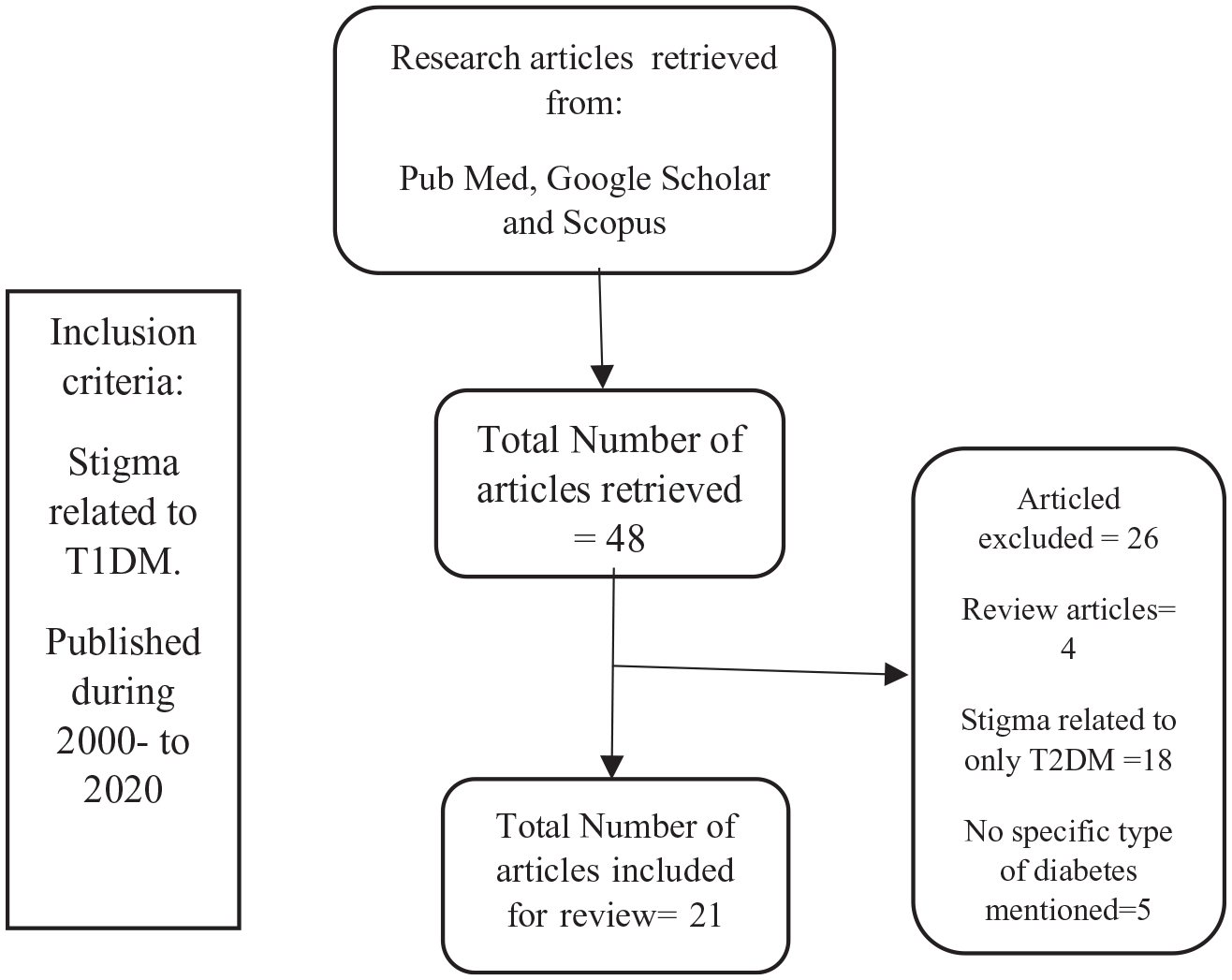
Flowchart showing the studies selection process
Inclusion criteria
Both qualitative and quantitative studies focusing on the stigma associated with T1DM were included irrespective of the country of origin and people on which the research was carried out.
Both self-reported and clinically diagnosed T1DM studies were included.
Exclusion criteria
Research articles mentioning stigma related to any other disease other than T1DM were not included. Review articles on stigma and T1DM were also not included.
Although, the inclusion criteria primarily focuses on T1DM only, but research articles inclusive of T2DM, along with T1DM were also included.
Results
A total of 21 articles met the inclusion criteria. 16 out of the total articles were related to stigma with T1DM only, and 5 articles were related to stigma associated with both T1DM and T2DM. 3 articles were based on information from secondary sources and the rest (i.e. 18 articles) were based on primary data. Included studies were comprised of different research designs, that is qualitative, quantitative, and mixed-method studies. Studies included in the present review were conducted across different parts of the world. A brief summary of the studies included in the present review has been displayed in Table 1.
Summary of studies included in the present review a .

T1DM: type 1 diabetes mellitus; CDI: Children’s Depression Inverntory; SEDM: Self-Efficacy for Diabetes Self-Management; DSAS-DK: Danish Version of the Type 1 Diabetes Stigma Assessment Scale.
List of articles in the table has been arranged year-wise from recently published to old ones.
This study was conducted with an aim to explore stigma related to T1DM. The literature review highlighted how stigma related to diabetes (T1DM) has affected patients’ (T1DM) and their caregiver’s life. Authors withdraw the following themes after evaluation of the research papers.
Impact of stigma on health and quality of life of patients and their caregivers
Negative stereotypes have the potential to impair the quality of life of people with T1DM mediated by psychological distress and depressive symptoms. 14 A significant association was found between experienced stigma and depressive symptoms among the US-based youth living with T1DM. 9 In a national Second Diabetes MILES-Australia (MILES-2) survey, positive associations were observed between diabetes-related stigma and anxiety symptoms, depressive symptoms, and diabetes distress among the patients suffering from T1DM and T2DM. 5 Also, the association of stigma was observed with a lower sense of well-being and lower self-efficacy among Korean young patients living with T1DM and T2DM. 7 A similar experience was shared by young individuals living in Canada, having T1DM. 10
Understanding the relationship between stigma and parents/caregiver’s health is also critical. A study on parents of children from a clinic-based survey in Nagpur, India, revealed that parents who faced stigma, those with severe depressive symptoms were associated with worst glycaemic outcome of the children than those with mild depressive symptoms. 8
Negative impact on diabetes outcomes
When stigmatized people take action to avoid a negative consequence, they frequently do so by confronting or avoiding the specific mechanism/situation that leads to the undesirable outcome they seek to escape. 2 This could be witnessed in various studies where people mentioned that in order to avoid stigma people often end up messing up with their diet regimen or disease management. Patients with diabetes who require insulin therapy avoid others around them while performing insulin therapy. 11 Stigma is a significant barrier to improve care for individuals with T1DM. 19 Children and adolescents acknowledged that they never stuck to their diet regimen to avoid feeling different. In order to avoid feeling judged by others, children tended to refuse significant self-care activities. 16 Health care providers and guardians also reported that keeping diabetes a secret hindered help and care from others when adolescents were in need, which consequently were driven factors that affected the quality of care among adolescents with T1DM. 21
In a cross-sectional survey conducted in Denmark on individuals with T1DM, findings demonstrated that diabetes stigma is negatively associated with both diabetes distress and glycaemic control and should be considered part of the psychosocial burden of adults with T1DM. 6 Negative association of stigma with glycaemic control and hypoglycaemia was reported among the Canadian youth. 10 Similar observation was made among the US-based individuals diagnosed with T1DM, and significant association was found between uncontrolled blood glucose and highest rates of stigma in all aspects of lives of people with diabetes. 9 So the feeling of stigma is closely intertwined with diabetes management, hence it is important to understand and listen to a patient carefully. 11
Fear of not getting married/getting rejected
Misconceptions regarding marital abilities, fertility, genetics, quality of life, sexism in young people suffering from T1DM raises major barriers to marriage. 26 In a study done on individuals diagnosed with T1DM and their parents living in Palestine, 16 fears about marital engagements were expressed. A mother of an 8-year-old daughter expressed that she was worried about her daughter’s marriage and it is important. Similarly, a mother of another child with diabetes expressed that her husband was sad that their daughter will not get married due to diabetes. This experience is not limited to a particular region, rather it has been recorded across various parts of the world. Difficulty finding a spouse was reported by individuals living with T1DM in China 19 and Zambian adolescent girls also had this experience of social stigmatization and were seen as unwanted for marriages. 21 Japanese adults also mentioned fear of ‘disclosing to their fiancés and their parents that they suffer from diabetes’ and some incidents of cancellation of marital engagements. 25 Few studies have incorporated views of people without diabetes. It was found that people without diabetes held a view that individuals with type 1 diabetes do not deserve marriage because high risk in pregnancy complications, and they do not want to have a spouse who is not healthy and has a stressful life. 24
Negative experiences/discrimination at schools or colleges
People who were diagnosed with T1DM, reflected some of their negative experiences in school in terms of not being allowed to eat, being treated differently, participation in activities. In a study based in Australia 29-year-old man stated that he would hate school and really did not want to go as he felt segregated. 22 Another 8-year-old Palestinian boy narrated that sometimes he cries because his teacher stops him from playing, due to a fear of having hypoglycaemia. 16 Zambian adolescents also experienced similar social stigmatization during play with peers, and they expressed they were often excluded from play because others thought the condition was communicable. 21
Stigmatization, isolation, or discrimination was not only perceived by affected children; parents of children also felt their child was treated differently. Mother of a girl mentioned that due to a lack of understanding about diabetes and diabetes management, her daughter was refused from school trip due to a fear of complications (hypoglycaemia, a condition where blood glucose levels are lower than normal 16 ).
Discrimination at work/job and unequal opportunities
The issue of discrimination for people living with diabetes continues to thrive in many countries. For many reasons, opportunities for people with diabetes are not equal. 23 There is a government regulation in China which, individuals with serious endocrine and metabolic disease should not be admitted to universities, junior colleges, or employed by government. 11 A considerable proportion of wage earners with T1DM reported concealing their diagnosis at work for being associated with stigma. They feared disclosing their identity due to being perceived as weak, job discrimination, unwanted attention, and being seen as a person who uses their T1DM for seeking advantage. 13 Restriction in job opportunities has also been reported by Japanese adults also as one of the problems being diabetics. 25
Coping strategies
As long as anyone feels discriminated or stigmatized because of T1DM, interventions are needed to mitigate this additional burden. 12 Various studies have provided strategies to overcome stigma. These strategies were either reported/adopted by individuals experiencing stigma or were explored as part of the study to reduce stigma. Study conducted by Irani et al. 20 explored the strategies to overcome stigma related to T1DM at the individual level. Study was based on 44 people with T1DM who had a history of diabetes for about 2 to 35 years. Respondents suggested obtaining required skills and peer group formation to overcome stigma. Obtaining required skills for living with diabetes includes disease acceptance, accepting social stigma, reinforcing social spirituality, enhancing self-esteem and self-confidence, and effective self-care behaviour. Peer group formation includes forming distant and real groups. Participants referred to the effectiveness of connecting someone who has T1DM, as it could eventually reduce self-stigma. Participants believed that interaction with successful people with diabetes would give them hope and connecting with new people having diabetes would decrease loneliness. Contrary to this, an opposite approach was used by 24 adult patients with T1DM as they suggested hiding their disease, pretending to be healthy, revealing their condition in steps to observe the reaction and limiting social life was a better strategy to deal with stigma. 15
The one who is affected and experiencing stigma would try every possible way to reduce stigma, but the ones who are stigmatizing the condition intentionally or unintentionally (generally, people without diabetes) shall also be targeted as part of the study through awareness programmes. An online survey conducted on US-based individuals with T1DM and with T2DM, respondents suggested increasing public knowledge about the general cause of diabetes, increased education about the management of the diabetes, revising policies, creating school programmes, changing nutritional options in restaurants, and using social media, celebrity campaigns, fundraising/awareness actions as important coping strategies. 17 Disclosure strategies are also one of the suggested coping methods to deal with stigma which includes open disclosure and passive disclosure. 27
The Australian Centre for Behavioural Research in Diabetes has also come up with unique ways to reduce stigma related to T1DM. They suggested being firm and more assertive while expressing what you feel is helpful and hurtful. Joining a support group and seeking help from health care professionals who are helpful and not judgmental was suggested as another way to deal with stigma. In case of severe emotional distress due to diabetes-related stigma, visiting a mental health professional and diabetes expert is recommended. iii
Discussion
This study investigated the existence of stigma related to T1DM and its impact on patients and their caregiver’s life. According to findings from research, it is evident that stigma related to T1DM is widespread. There is a considerable amount of research pertaining to the stigma associated with HIV/AIDS, 28 epilepsy, 29 and leprosy, 30 while diabetes-related stigma has not been addressed and discussed as a serious concern, especially stigma associated with T1DM. Therefore, the current review has tried to identify its existence, possible sources, and mitigating measures to reduce stigma.
One key finding of this review is that negative feelings about self lead to low self-esteem and negative psychological outcomes among the people with T1DM. Constant worry about a child’s health and disease management leads to depressive symptoms and poor quality of life among parents of children with T1DM. A similar observation was made in a review done on stigma associated with people living with HIV/AIDS. The review suggested that people who experience HIV-related stigma were at higher risk of depression. 28 Another finding of our review is that stigma related to T1DM is a barrier to diabetes care and management which consequently leads to poor glycaemic controls. These findings were also in agreement with the findings of another review done on stigma related to individuals living with HIV. Evidence from the review suggested an association between HIV-related stigma and screening, adherence, and the well-being of people living with HIV. 28 Also, the studies from different parts of the world included in the present review indicate that the impact of stigma is quite similar in different countries despite vast cultural diversity. It affects marriage, relationships, employment, and so on. This finding is in agreement with one of the findings of the review study done by Van Brakel 31 on chronic health-related stigma.
Language used by the health professional can have a profound impact on people living with diabetes and their caregivers, about experience and how they feel about their condition while living with it. At the same time, good use of verbal, written, and non-verbal (body language) can lower anxiety and improve self-care among the affected individuals. 32 Labelling of a particular condition can also create inevitably negative consequences, such as stigma, hence, it needs to be treated with caution. 33 Careful use of language has become mainstream in many countries upon realizing the impact of language in the process of making a condition stigmatizing. Diabetes Australia has already issued a position statement to use related language carefully. International Diabetes Federation, American Diabetes Association and American Association of Diabetes Educators have also advocated careful use of language. 34
Over the last few years, advances in technology have led to tremendous improvement in the management of T1DM. ‘Artificial pancreas systems’ have been shown to improve glucose control compared with conventional insulin pump therapy. 35 Hopefully, developments in new technologies from continuous glucose monitoring to the ‘artificial pancreas’ will enable people with T1DM to be less stigmatized in future.
Health care teams should integrate anti-stigma strategies in their routine care plan to reduce stigma among the T1DM-affected individuals. Importance of participatory action research was mentioned to reduce diabetes-related stigma in a study conducted by Doosti-Irani et al., 18 where interventions at the organization level, community level, and family level were done as a result, participants felt significantly empowered.
Hence, the substantial shift needed to bring about change may not be met through individual action alone. Increased public awareness and education regarding causes and management of the disease might help in reducing stigma related to T1DM but health professionals and researchers can help reduce stigma related to diabetes by choosing their words carefully.
Strengths and limitations
The strength of this study is that it addressed the existence of T1DM-related stigma whilst also discussing mitigating measures and coping strategies to overcome stigma.
When strategies are derived from individual experiences and are culturally fitted, there is more hope for their effectiveness and versatility in their application.
The limitation of our study is that no standard definitions or measures of stigma were considered.
Conclusion
Existing literature suggests that stigma related to T1DM is widespread and the availability of so few research articles for the past 20 years on a global platform is indicative of the gap in research conducted in the context of stigma related to T1DM. There is a need to address diabetes-related stigma and intervention programmes to create awareness regarding the same at a global level. This review provides a platform for understanding T1DM-related stigma that describes the causes and consequences and also identifies some potential mitigating strategies. This review is intended to inspire and guide researchers and health care professionals to improve their understanding of T1DM-related stigma and to mitigate this negative phenomenon in diabetes.
Footnotes
Conflict of Interest
The author(s) declared no potential conflicts of interest with respect to the research, authorship, and/or publication of this article.
Funding
The author(s) disclosed receipt of the following financial support for the research, authorship, and/or publication of this article: Corresponding author receives UGC-JRF Fellowship.
