



Abstract
Objective:
This study aims to examine the efficacy of a hypertension awareness education program in Singapore in reaching out to a wider population of diverse racial and intergenerational cohorts by dispatching grade five children as information intermediaries to their immediate and extended family members.
Method:
After receiving structured instruction and training on blood pressure screening, students were requested to share knowledge gained in school with their family members at home and practice blood pressure measurement on family volunteers. We assessed pre- and post-program blood pressure knowledge change, attitude toward screening, and the diffusion of blood pressure information. One adult family member was also asked to complete a short survey at the program end.
Results:
A comparison of the students’ (final n = 3926) pre- and post-program survey data showed that knowledge and attitudes towards knowledge sharing improved after participating in the program. The post-program survey also revealed that students generally felt confident and displayed positive attitudes in performing blood pressure screening on family members. On average, each student practiced blood pressure measurement on 3.04 people. Female family members were more likely to be targeted for knowledge sharing and screening than male family members. The family members’ survey revealed positive attitudes towards screening, but family members were not confident about getting their measurements done regularly.
Conclusion:
The program met its objectives in raising the awareness of grade five children and provision of knowledge. It also met the larger objective of raising hypertension awareness in a wider population, especially those who otherwise might not directly receive health education and blood pressure screening.
Keywords
Background
Hypertension is a major contributor to adult mortality in developed countries. Failure to monitor one’s own blood pressure has been identified as one of the leading risk factors for premature deaths through stroke as well as cardiovascular diseases such as heart failure and myocardial infarction (1,2). Worldwide, 40% of adults aged 25 and above were found with raised blood pressure in 2008 (3). In Singapore, 23.5% of adults aged 30 to 69 years old were diagnosed with hypertension (2). The prevalence increased significantly as adults aged, especially among those over 40, with close to three-quarters (73.9%) of Singaporeans aged 60 onwards diagnosed with hypertension (4).
Considering its negative consequences and prevalence, it is worrying that as many as 26.3% of Singapore residents aged 30 to 69 years who were detected to have hypertension had not been previously aware of their condition (2). It is also possible that this lack of awareness is related to their lack of hypertension knowledge, as indicated by Wong et al.’s study among Singapore Chinese, which revealed that there is a need for health education on stroke risk factors, with hypertension being one of them, particularly among older people (aged 50–59 years) (5).
Despite the lack of hypertension awareness, health promotion efforts directed at the adult population prove to be very challenging (6) due to the lack of channels in which they regularly congregate, such as schools. However, there seems to be potential for children to be information intermediaries to this older population group (7,8). Traditionally, research on intergenerational influence has been unidirectional in nature, with parents being viewed as active agents, and children as the passive agents (9–12). Children were viewed as blank slates and ready to be affected in accordance with parents’ values (13). Discussion in health education management also primarily assumed that information flowed from parents to children. However, the unidirectional relationship is no longer accepted, with some studies pointing out the potential of children’s direct influence on adults’ values, attitudes and knowledge (9–11). Children were recognized as effective messengers to convey to their family members the knowledge intended (7,8,14,15). This is especially so when the message is intergenerational in nature (16). Likewise, in the context of blood pressure measurement, previous studies suggest that children can be effective intermediaries in reaching out to their family members, including possibly high-risk individuals with hypertension (8,17). One study found that parents’ knowledge about hypertension improved after their children attended a school-based program which required children to measure their parents’ blood pressure and share the knowledge learned during the program with their parents (8).
However, to our knowledge, there have been no studies on intergenerational influence on hypertension awareness conducted in an Asian context. Asian societies, such as Singapore, commonly place a huge importance on familial relationship and filial piety (18). The Singapore government, in particular, has made significant conscious efforts to promote ‘strong families as the cornerstone of the nation’ (18, p. 905). Many children in Singapore share the same household with their extended family members such as grandparents and unmarried aunts or uncles, as the government provided a host of incentives to encourage the cohabitation of family members across generations (18). In view of this, it could be surmised that effects of knowledge transfer might not be limited to parents, but also to extended family members such as grandparents, aunts and uncles. Such socio-cultural contexts can potentially augment the effectiveness of a program which utilizes intergenerational influence.
Hence, considering the family-oriented culture of Singapore and building on past hypertension education programs, the Singapore Heart Foundation (SHF) embarked on a hypertension awareness program called BP Initiative @ Schools among grade five children to reach out to a large scale sample. Recognizing the potential role of children in influencing their family members, who possibly are not in any regular blood pressure screening programs, the program aimed to enhance awareness of hypertension and blood pressure measurement among the Singapore population. Primary school students were advised to share their knowledge and measure their family members’ blood pressure level at home. The program planned to reach individuals from diverse age groups, gender, and race and educate them on the importance of blood pressure screening and the risks associated with hypertension. Eventually, adults potentially suffering from hypertension are advised to consult physicians for follow-up. Hence, keeping in mind the objective of the program, we propose the following research questions (RQ) in order to assess the program’s efficacy:
For students who have participated in the BP (blood pressure) program:
RQ1: Are there any improvements in the students’ blood pressure knowledge?
RQ2: Are there any improvements in the students’ attitudes toward acquiring and sharing blood pressure knowledge with their family members?
With regards to the effects on family members:
RQ3: What is the extent of the intergenerational transfer of the blood pressure knowledge from students to their family members?
RQ4: What is the efficacy of the blood pressure measurement training, as assessed by students’ attitudes and self-efficacy in performing the screening?
RQ5: What are family members’ beliefs toward blood pressure screening after going through the blood pressure measurement performed by the students?
In the Results section, we present the results of the evaluation of the BP Initiative @ Schools program on the outcome pertaining to children’s blood pressure knowledge change and perception toward performance of blood pressure measurement, as well as family members’ report of their blood pressure status and attitudes toward blood pressure measurement. Results on gender differences are also presented.
Methodology
Procedure
The following data collection procedure was approved by the Institutional Review Board (IRB) of the university prior to the study. Over 5000 grade 5 students in 35 public schools across various regions in Singapore participated in the program. Grade 5 students were chosen as they are old enough to be able to comprehend the messages and training related to blood pressure matters, yet are at the developmental stage when they are interested in sharing school experiences with family members (19). The fact that they are at the age where they are motivated to disclose information to their parents more than to their teen counterparts makes them appropriate agents for information sharing with parents and family members. The program involved physician-designed classroom instruction on blood pressure and training on blood pressure measurement. Prior to the start of the program, participants were asked to complete a short online pre-program questionnaire, either in school or at their own home. The program commenced with an instructional lecture. It lasted for about 45 minutes to an hour and was conducted by either a physician or staff affiliated to SHF. The instructional content of the lecture included information on the optimal and high levels of blood pressure, causes and risks associated with having hypertension, and prevention and treatment methods to control hypertension.
After the classroom instruction, the students were trained to perform blood pressure screening through live demonstration, peer sharing and role plays. The role-play session was held in six-person groups. A teacher or parent volunteer, trained by staff from SHF, led each group and ensured that the children were able to perform the blood pressure measurement correctly. A blood pressure monitor (Omron BP HEM 7203) was then provided to each student to bring home for one day. The students were asked to share blood pressure knowledge learned during the lecture with their family and to perform the task of taking blood pressure measurement on at least one family member. Subsequently, students were asked to record their family members’ measured blood pressure on a log sheet. When the students returned the blood pressure monitor, they were asked to answer an online post-program survey in school or at home.
Prior to the main study, we tested some aspects of the program separately in several schools (n = 2 schools). Specifically, the lecture on blood pressure information as well as blood pressure screening training was conducted in schools prior to the program implementation. We also pre-tested the pre- and post-program questionnaires on several children (n = 280 children) from our target group to ensure that they could comprehend the survey items. Any items that we thought might be misleading, particularly on the knowledge items, were then revised prior to the administration of the present study. Items measuring self-efficacy and attitudes toward administering blood pressure among the student sample in the pilot program were found to have a high level of reliability (Cronbach’s Alpha = 0.81 and 0.89, respectively), and thus were retained for the present program.
Students’ pre- and post-program survey
The pre-program survey instrument consists of seven true and false items to test the knowledge of the students and three 5-point Likert scale items (1 = strongly disagree, 5 = strongly agree) to find out about students’ attitudes towards acquiring blood pressure knowledge and informing their family on blood pressure matters. The items measuring knowledge (e.g. ‘Blood pressure of 130/80 is normal’) and attitudes towards acquiring and sharing blood pressure knowledge (e.g. ‘I am able to inform my family about health problems caused by uncontrolled high blood pressure’) were self-created by the researcher, with feedback from physicians at SHF.
The post-program survey consists of the same seven knowledge items and three attitudinal questions in the pre-program survey with the addition of a few questions related to students’ experiences in knowledge sharing and performing blood pressure screening on their family members. Specifically, the students were asked to indicate all of the family members with whom they have shared the blood pressure knowledge, how many and on whom they have performed blood pressure screening, and which family members were found with high blood pressure when the students performed the blood pressure screening on them. Their self-efficacy toward performing blood pressure screening was also assessed on a two 5-point Likert scale (1 = strongly disagree, 5 = strongly agree) (e.g. ‘It is easy to perform blood pressure measurement for my family members’), adapted from Lwin and Saw (20). In addition, their attitude toward administering blood pressure measurement was assessed by asking them to fill in their answers to the statement ‘For me, taking blood pressure measurement is …’ on seven 5-point semantic-differential scales, such as ‘difficult–easy’ and ‘useless–useful’, adapted from Lowe, Eves, and Carroll’s (21) affective and instrumental attitude scale. The items for self-efficacy (Cronbach’s Alpha = 0.83) and attitude (Cronbach’s Alpha = 0.85) were found to have a high level of reliability, and hence, they were averaged to form a composite measure.
We chose to include measures assessing knowledge and attitudes toward acquiring and sharing blood pressure knowledge in both pre- and post-program surveys in order to be in line with the primary purpose of the BP Initiative @ Schools program to raise awareness of hypertension and blood pressure measurement among the Singapore population. It is thus important that we assess whether there has been a positive knowledge and attitudinal change among grade five students who acted as agents for information sharing. Other measures in the post-program questionnaire were included to examine the extent of the effects of their information sharing and blood pressure screening toward family members, which effectively can work as proxy for reaching out to the Singapore population.
Log sheet (family members’ survey)
One family member of each student was asked to fill in a short pen-and-paper survey consisting of two items to assess whether they have been previously diagnosed with hypertension by a health professional and whether they have a blood pressure monitor at home. Their perception towards blood pressure screening was also assessed on seven 5-point Likert scale items (1 = strongly disagree, 5 = strongly agree) comprising of items based on constructs of protection motivation theory (22) and were adapted from Lwin and Saw (20), such as self-efficacy (e.g. ‘Having my BP checked is easy’, ‘I am confident that I will be able to check my BP regularly’), response efficacy (e.g. ‘Measuring my BP regularly helps to prevent me from getting a heart disease’), vulnerability (‘It is likely that I will get high BP in the near future’), severity (‘High BP increases the risk of developing a heart disease’), and intention (‘I intend to check my BP regularly’). In addition, they were asked to indicate the usefulness of the blood pressure measurement project for school children on one 5-point Likert scale item (1 = strongly disagree, 5 = strongly agree). The results of the blood pressure screening performed by the students were recorded in this log sheet as well. As well as being a survey questionnaire, the log sheet also served as an information brochure, providing information about healthy and alarming blood pressure levels, things to note when performing blood pressure measurement, and tips to achieve a healthy cardiovascular system.
Results
Students’ survey
Student respondent profile
The participation at the end of the program via the post-program survey generated a total of 5120 responses from students. We eliminated duplicate responses received from users when the same respondent clicked the ‘Submit’ button more than once when completing the online survey. In addition, some students completed only the pre-program survey, while others completed only the post-program survey. In addition, there were a number of cases with particulars missing, hence rendering a lack of match of pre- and post-program surveys. After excluding these cases, the final student sample for analysis was trimmed to 3926 responses. This sample consisted of 1963 (50.0%) for each group of male and female students with mean age of 10.71 years old. The ratio of various racial groups reflected the general population of Singapore, with 2750 (70.0%) Chinese, 674 (17.2%) Malays, 276 (7.0%) Indians, and 220 (5.6%) were from other racial groups (23), while six respondents did not state their racial group.
To analyze the data, we used SPSS 19.0 statistical software package. We performed descriptive statistics such as frequency and mean and paired-sample t-testing to gain understanding of the data. Results from the overall student sample were reported first, followed by gender comparison of the respective topics utilizing independent t-testing.
Knowledge change
In order to answer RQ1, the responses toward each of the seven knowledge questions of each student respondent in both pre- and post-program surveys were compared using a paired-sample t-test. The analysis showed that the program was generally effective in raising the blood pressure knowledge of respondents as shown by the number of questions answered correctly increasing significantly from an average of 2.78 (SD = 1.72) questions on the pre-program survey to 4.68 (SD = 1.46) questions on the post-program survey (t(3,857) = −65.7, p < 0.001). Gender comparison of the post-program knowledge revealed that female respondents (M = 4.74, SD = 1.40) were more likely to attain a higher score of total correct responses as compared to their male counterparts (M = 4.63, SD = 1.52, t(3,860) = −2.21, p < 0.05).
We also conducted an analysis of the area of blood pressure knowledge in which students became more informed, as shown in Figure 1. The results revealed that at the point of the post-program survey, the overall knowledge of the students has increased, with the largest increase in knowledge occurring in Q4 on the normal blood pressure level as indicated by the 55.5% increase in the total number of students who had responded correctly to the question (from 27.2% of sample answering correctly at the pre-program stage to 82.7% at the post-program stage). For the remaining questions, the number of students who have answered correctly increased by around 12.9% to 46.4%. The only exception to the students’ improvement in the blood pressure knowledge was Q6 where there was a 3.2% decrease in the correct answer given.
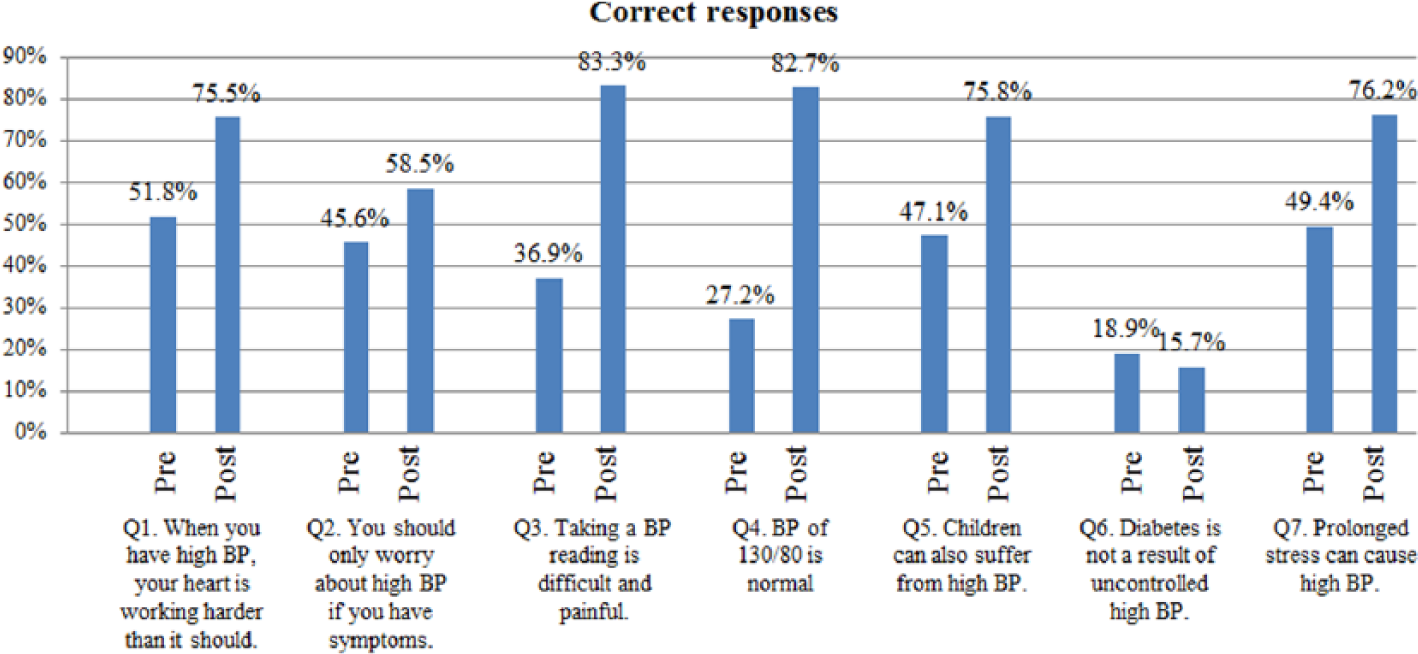
Comparison of correct responses to knowledge questions at the pre- and post-program surveys.
Attitudinal change toward acquiring and sharing knowledge
The program’s effectiveness was also demonstrated through the favorable change in students’ attitudes toward acquiring and sharing knowledge about blood pressure matters after the program (RQ2). Students felt more confident in sharing the prevention methods (Mpre-program = 2.90, SDpre-program = 1.36, Mpost-program = 3.82, SDpost-program = 1.16, t(3,901)= −36.45, p < 0.001) and consequences associated with blood pressure (Mpre-program = 2.80, SDpre-program = 1.34, Mpost-program = 3.63, SDpost-program = 1.17, t(3,903)= −32.95, p < 0.001). Their perception toward their blood pressure knowledge also improved after the program (Mpre-program = 2.31, SDpre-program = 1.11, Mpost-program = 3.37, SDpost-program = 1.04, t(3,895) = −50.09, p < 0.01). Gender comparison of the attitudinal change at the post-program stage revealed that female students (M = 3.75, SD = 0.85) reported a significantly more positive attitude toward acquiring and sharing blood pressure knowledge with their family than male students (M = 3.65, SD = 0.92, t(3893.2) = −3.45, p < 0.001).
Intergenerational knowledge transfer and blood pressure screening
In an effort to assess the extent to which the blood pressure awareness gained by the students is shared with their family members as a proxy of the Singapore population (RQ3), we asked students to list the members of their family with whom they shared their blood pressure knowledge and on whom they performed a blood pressure measurement. We found out that when sharing the blood pressure knowledge, female family members were more likely to be selected as the target of knowledge sharing by students. Mothers (76.7%) were most likely to be chosen as the sharing target, followed by fathers (67.3%). Among extended family members, they were more likely to share with grandmothers (32.2%) than with grandfathers (22.5%), and aunts (21.7%) than with uncles (17.6%). Only 7.5% of the sample did not share the blood pressure information with any of their family members. Female students were also more likely than male students to engage in knowledge sharing with their family members. The percentage of male students who claimed that they did not share knowledge was 8.7% as compared to 6.3% of female students.
Each student performed a blood pressure measurement on an average of 3.04 people (SD = 1.94). This indicates that for each trained student, there is a multiplier effect of 3.04 people whose blood pressure was measured. The difference between male (M = 3.01, SD = 2.08), and female (M = 3.08, SD = 1.81) students was not statistically significant. Similar to students’ target of knowledge sharing, female family members were more likely to be the target of blood pressure screening as compared to their male counterparts. Students were also more likely to measure the blood pressure of their mother (82.9%) first and father next (72.3%). 7.7% of the students reported not performing blood pressure measurement on any of their family members.
Among those whose blood pressure was measured, grandfathers (43.0% of all grandfathers screened) and grandmothers (38.5%) were found to be most likely to suffer from hypertension. Other male family members were also more likely to register a high level of blood pressure than their female counterparts, with 30.0% of uncles and 20.6% of fathers as compared to 21.9% of aunts and 11.1% of mothers found with hypertension.
Students’ self-efficacy and attitudes toward performing blood pressure screening
We also examined the attitudes and self-efficacy level of the students in performing the blood pressure screening in the post-program survey as an effort to measure the effectiveness of the blood pressure measurement training (RQ4). Students felt a high level of self-efficacy in performing blood pressure screening on their family members (M = 4.13, SD = 1.03), suggesting the effectiveness of the program. Female students (M = 4.22, SD = 0.97) had higher self-efficacy than male students (M = 4.04, SD = 1.08; t(3,865) = −5.40, p < 0.001).
Students’ attitudes toward taking blood pressure screening were highly positive (M = 4.25, SD = 0.72 out of a 5-point scale). Most of them were likely to find it beneficial, useful, easy, interesting, relaxing, and enjoyable. Similar to gender comparison on self-efficacy, female students tended to have a slightly more positive attitude (M = 4.32, SD = 0.66) as compared to male students (M = 4.18, SD = 0.77) toward measurement taking (t(3,777.2) = −6.04, p < 0.001).
Family members’ survey
Family member respondent profile
A total of 5898 family members, consisting of 35.8% male and 61.9% female respondents, returned their log sheet. The average age of the family member respondents was 41.7 years old. Around three-quarters of family member respondents were the students’ parents, comprising 47.1% mother and 28.3% father.
Prevalence of high blood pressure among family members
Of this total sample, 13.3% had earlier been informed by a doctor or health professional that they had hypertension, while 70.8% have not been told so (15.9% of sample did not respond). During the students’ blood pressure screening exercise, among those who have not been told that they had high blood pressure, 4.2% were found with either Stage 1 (Systolic BP (SBP) 140–159 mmHg or Diastolic BP (DBP) 90–99 mmHg) or Stage 2 (SBP ≥ 160 mmHg or DBP ≥ 100 mmHg) hypertension, while 24.5% were found with pre-hypertension (SBP 120–139 mmHg or DBP 80–89 mmHg), based on the four classes of blood pressure as defined in the Joint National Committee on Prevention, Detection, Evaluation, and Treatment of High Blood Pressure (NC-7) guidelines (24). In addition, 24.1% of family members reported having a blood pressure monitor at home.
Family members’ beliefs toward blood pressure screening
In order to examine RQ5, we asked a number of items to assess the family members’ beliefs toward blood pressure screening. With regards to their attitudes toward blood pressure screening, family member respondents claimed that having their blood pressure checked at home was simple (M = 4.28, SD = 1.06). Their response efficacy level from the measurement exercise was relatively high, specifically in increasing their awareness of the healthy blood pressure level (M = 4.06, SD = 1.10) and in preventing them from getting heart diseases when they have their blood pressure screened regularly (M = 3.94, SD = 1.15). They were also now likely to be aware that having high blood pressure increases the risk of developing heart disease (M = 4.18, SD = 1.08). Despite realizing these benefits, however, respondents only moderately agreed that they were confident in their self-efficacy or ability (M = 3.67, SD = 1.15) and intention (M = 3.72, SD = 1.12) to check their blood pressure regularly, probably because they did not think that they were susceptible to getting hypertension in the near future (M = 2.81, SD = 1.24). Overall though, they strongly agreed that the program was a useful project for school children (M = 4.30, SD = 1.08).
Discussion
The present study sought to assess the efficacy of a hypertension awareness program which deployed school students as an intermediary to reach a larger group of the public from diverse gender, age, and racial groups. We found out that the program was effective in enhancing students’ and their family members’ awareness and knowledge about hypertension. Students generally showed an improvement in their blood pressure knowledge, positive attitudes and a high confidence level on taking a blood pressure measurement from their family members, after they attended the lecture and training session. The only exception was one knowledge item in which the percentage of students who correctly answered that question (Q6) was lower at the post-program survey than at the pre-program survey, probably caused by the item being a negative statement, and hence creating some confusion amongst the students. Students shared the information they had received about blood pressure with their family members and they also performed a blood pressure screening on them. Family members of students showed favorable attitudes toward the program and saw the benefits associated with the program. In line with past studies (8,17,25), we found that the activities from this program, specifically those involving children bringing home the blood pressure monitor, facilitated discussion and knowledge transfer to their family members. The hands-on activities in performing blood pressure measurement created the teachable moments for family members, opening them to new knowledge and attitudinal changes.
Gender analyses revealed that female students performed better in improving their blood pressure knowledge and in sharing this knowledge with family members compared to male students. Similarly, they generally responded more positively than male students in their attitudes and self-efficacy towards blood pressure screening. The results were in line with Fors et al.’s (17) findings and might be due to gender-role expectations that blood pressure measurement and other medical-nursing jobs should be done by women (26). In addition, on average, the verbal abilities of females are superior to males (27). Consequently, when the female students are given instructions, their superior verbal abilities may have aided them to perform better than their male counterparts (28). Future studies could affirm this proposition by performing a more in-depth gender analysis to find out whether male students were more likely to approach family members of the same or opposite gender, and likewise for female students.
For each student who brought home the blood pressure monitor, an average of 3.04 people had their blood pressure screened, indicating a multiplier effect of three people on average for each student trained. In addition, female family members were more likely to have their blood pressure screened than the male counterparts. This might be attributed to gender differences in interpersonal relationships where women place a higher importance on maintaining such relationships, and hence are more likely to be open to feedback and others’ opinions than men (29). This result also reflects Malhotra et al.’s study, which found that men tended to be unaware of suffering from hypertension and remained untreated compared to women (4). The situation is a cause for concern as men are more likely to suffer from hypertension (2). Similarly, while grandparents were the highest proportion of family members identified with hypertension, parents were more likely to be students’ target of knowledge sharing and blood pressure screening than grandparents. These findings suggest that students tended not to target the higher risk family members in this program. On the other hand, it may also reflect the fact that, despite the family-oriented nature of Singapore society, not all students live with their grandparents, and were unable to reach them easily for blood pressure screening. However, our findings that grandparents have been targeted by quite a large number of students for knowledge sharing and blood pressure measurement indicate the potential of this program to reach out to the elderly population. Future efforts should be made to encourage students to engage grandparents, who are at a higher risk of suffering from hypertension, perhaps by letting students take home the blood pressure monitor over the weekend, so that they are able to perform blood pressure screening on their grandparents who live apart.
Although family members generally showed favorable attitudes toward the program, and found performing a blood pressure measurement easy, they only have moderate confidence levels and intentions of checking their blood pressure regularly. The gaps between attitudes and intention, and eventually the actual act of having regular blood pressure screening and seeking treatment from a physician if necessary, need additional examination. For instance, their level and types of response cost, or their reasons for not having a regular screening, whether time, cost, convenience, or fear of visiting a physician, could be further assessed.
In future studies, we recommend including a control group to examine effects of the program more robustly, particularly the degree to which students’ knowledge and attitudes toward blood pressure measurement differ among those exposed to the program and those who are not. The control group can be created by asking for the participation of a parallel batch of students to complete the pre- and post-program survey without undergoing the blood pressure measurement program. The training and lecture can still be conducted for these students in school, but at a later time, so that the students can still benefit from this education program. In addition, a longitudinal study design can be useful in assessing the retention of students’ blood pressure knowledge, and hence the effectiveness of the program in the long-run, for instance, by collecting responses from the same group of subjects around one year after the program, perhaps by conducting the program at the start of the school year, and the follow-up survey at the end of the school year, before the students move on to the next grade. We also recommend administering the students’ pre- and post-program surveys using a paper-and-pencil method at the school, instead of the online method, to improve the response rate of the program evaluation, as it would be easier to monitor the survey administration and ensure that proper respondent identification is included.
With regard to the impact on family members, in the present study we did not conduct follow-up on those found by students to have high blood pressure other than merely advising them to confirm the diagnosis by visiting a medical professional. We did not track whether they did go for a check-up, which admittedly is one of the current study’s limitations. Future initiatives can study the longer-term impact of the program by contacting family members found with hypertension to check if they performed any follow-up actions, such as visiting a doctor or health professional for further health screening. In addition, a longitudinal study can be designed which includes providing financial support to these family members as an incentive for them to visit a health professional to confirm if they indeed suffer from hypertension. Blood pressure knowledge of the family members can also be included to be directly aligned with what the students were taught and assessed prior to and after the program so as to ascertain the amount of the students’ knowledge sharing with family members. Future facets of the program can also incorporate encouragement of the children to measure the blood pressure of male family members and grandparents in order to better reach this more vulnerable group.
Conclusion
We found the results encouraging in terms of the program meeting its educational objectives in raising the children’s awareness on hypertension and sharing informational materials with family members while practicing blood pressure measurement skills in the home environment. An extension of this program to more schools or cohorts is recommended in order to reach higher levels of awareness diffusion among the Singapore population, especially in reaching out to those who might otherwise not receive personalized health education on blood pressure matters.
Footnotes
Acknowledgements
The authors wish to thank the Singapore Heart Foundation for funding and supporting this research. We are grateful to Goh Chiew Seng, Vernon Kang, and Grace Chen from the Singapore Heart Foundation for their initiative and commitment in the design and implementation of the BP Initiative @ Schools program, the survey administration, and their generous support to allow us to do this study.
Conflict of interest
None declared.
Funding
This research was funded by the Singapore Heart Foundation.