




Abstract
Prior to western arrival in 1778, Native Hawaiians possessed a sophisticated culture and resource management system conducive to an island ecosystem. However, disenfranchisement from ancestral lands and traditional food sources as a result of colonization led to Native Hawaiians being forced to abandon many of their traditional practices. Today, many Native Hawaiians experience food insecurity, placing them at further risk for obesity and other nutrition-related chronic diseases. Consequently, there is a growing need for place-based and culturally relevant strategies rooted in Hawaiian epistemology to address these issues. This paper describes the history and development of one such intervention – the MALAMA study – in the community of Waimānalo that innovatively merges the modern technology of aquaponics with traditional Native Hawaiian practices and values.
Keywords
‘Āina (Land) – The history and values of Native Hawaiians
Native Hawaiians are the Indigenous people of Hawai‘i whose ancestors settled in the Hawaiian archipelago over 1600 years ago. Native Hawaiians developed systems of aquaculture (loko i‘a), irrigated terraces for planting (lo‘i), and other forms of food cultivation situated in a land division system known as an ahupua‘a . Ahupua‘a is a form of land division that extends from the mountain to the sea to ensure access to natural resources needed for daily living (1). This system reinforced the relationship Native Hawaiians have to their ‘āina (land) and its cultivation. The intimate relationship between Native Hawaiians and their natural world is expressed through the cultural value of mālama ‘āina, which means ‘taking care of the land’ (1). To mālama ‘āina for a Native Hawaiian is analogous to taking care of one’s elder sibling, and, in turn, the ‘Āina will take care of its younger siblings.
Starting with the arrival of Captain James Cook in 1778 to the illegal overthrow of the Hawaiian Kingdom in 1893 and subsequent U.S. occupation, Native Hawaiians have been forced to abandon many of their cultural practices and preferred modes of living (2,3). They were disenfranchised from their lands and traditional food sources, disrupting their ancestral relationship with the ‘āina and ability to practice their ancestral kuleana (responsibility) of mālama ‘āina. Land in Hawai‘i was privatized through what is known as the Māhele of 1848. However, land privatization was a foreign concept that was completely at odds with Native Hawaiian traditional perspectives of relationship to land. Therefore, many Native Hawaiians did not stake claim to ancestral lands, resulting in large scale land alienation and disconnection from traditional food sources (1). The Māhele benefited foreigners who acquired large tracts of land to develop a profitable plantation system. This separation from land has led to the current health disparities faced by Native Hawaiians in the present day.
Native Hawaiian health today
Prior to western intrusion in 1778, the British explorer Cook and his expedition first encountered healthy and vibrant Native Hawaiians. Today, as a result of land alienation, Native Hawaiians tend to live in areas that lack healthy food retail outlets, and face higher rates of nutrition-related chronic diseases, such as childhood and adulthood obesity, type II diabetes, and cardiovascular disease (4,5), compared with other major ethnicities in the state. As a result of historical and structural factors, Native Hawaiian nutrition and eating habits fall short of the recommended guidelines. Native Hawaiian health promotion interventions that reintegrate traditional practices may be impactful in reducing risks of nutrition-related disease among Native Hawaiians (6).
In the last few decades, tremendous efforts to revitalize traditional cultural practices have been made to address inequities in areas such as self-governance, education, and research. Many traditional practices that include food production, including kalo (taro) farming and restoration of ancient loko i‘a (fish ponds), and exercising their kuleana of mālama ‘āina (7) have been revitalized. There has been a call for place-based and culturally relevant strategies to promote Native Hawaiian health that is based on Hawaiian epistemology (8,9).
Waimānalo
Waimānalo is a rural community that is located on the eastern side of the island of O’ahu and is home to approximately 7000 residents (10). Nearly one-third of the residents are Native Hawaiian, which is twice the state average (11). The community is designated as a medically underserved population by the U.S. federal government, which indicates a shortage of personal health services and high rates of economic, cultural, and/or linguistic barriers to receiving health care. Similar to other communities with high proportions of Native Hawaiian residents, more than 30% of Waimānalo households are food insecure due to socioeconomic and other barriers (12). Despite these challenges, many strengths and assets reside in this close-knit community including a high number of grassroots efforts to revitalize health and education through Native Hawaiian practices.
The MALAMA program
The MALAMA (Mini Ahupua‘a for Lifestyle And Mea‘ai [food] through Aquaponics) program was conceptualized to build on previous community grassroots efforts related to backyard aquaponics in order to address the pervasive burden that Native Hawaiians currently face with regards to high rates of nutrition-related diseases. This is the first known aquaponics health intervention to date. Consistent with Indigenous Health Promotion ideals, the goal of the MALAMA program is to restore cultural practices and food sovereignty through modern agricultural technology and Hawaiian cultural values in Waimānalo. Aquaponics was attractive to the community because it mimics the ahupua‘a system where fish and plants symbiotically grow in a sustainable and ecological system. Aquaponics systems optimize water and nutrient use efficiency by combining hydroponics (soil-less horticulture) and aquaculture (raising fish in tanks) that uses a fraction of the water and nutrients that traditional terrestrial systems do (13). The aquaponics systems were constructed as backyard models to provide families and communities with a consistent source of vegetables, fruit, and fish (Figure 1).
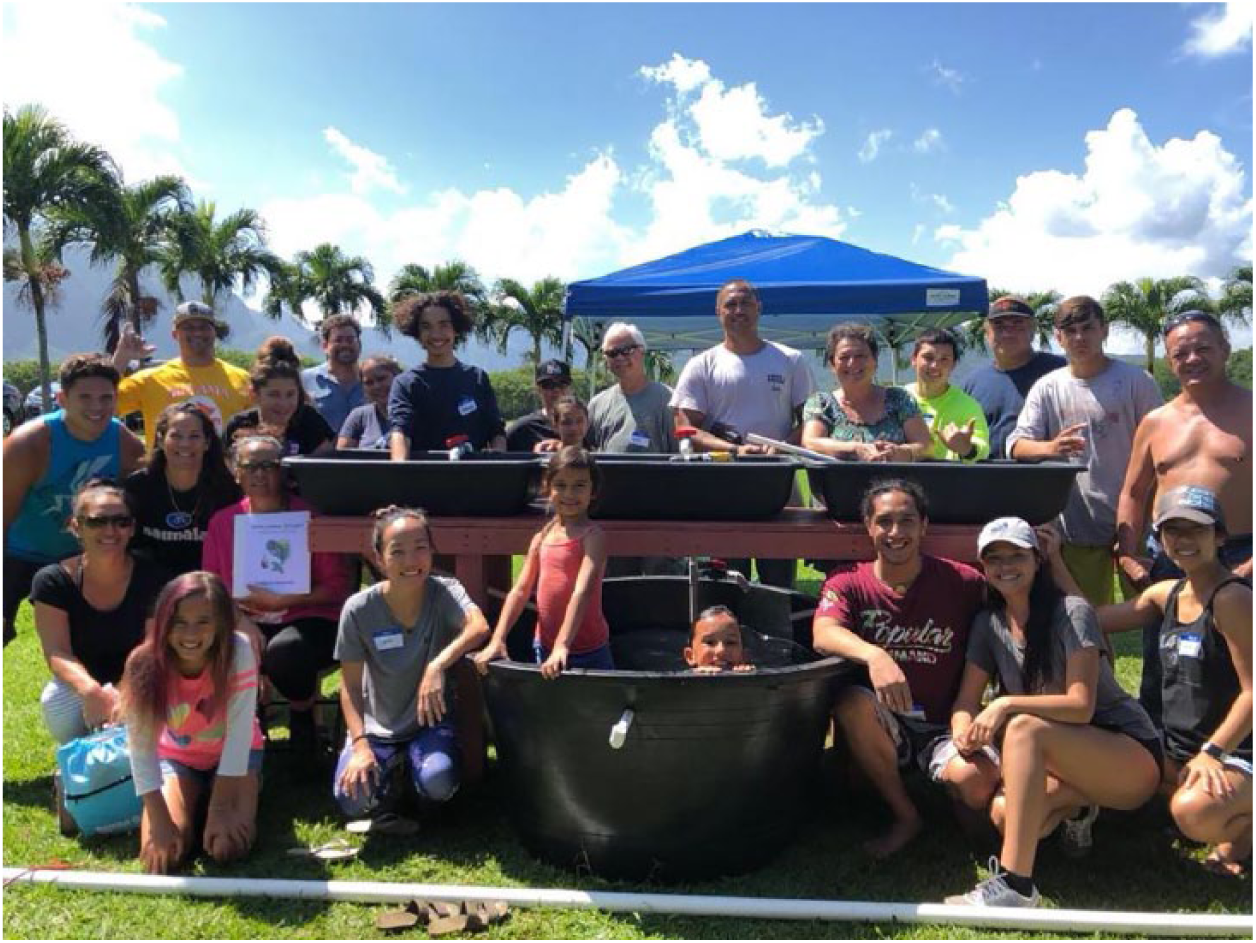
Photo from MALAMA demonstration build day.
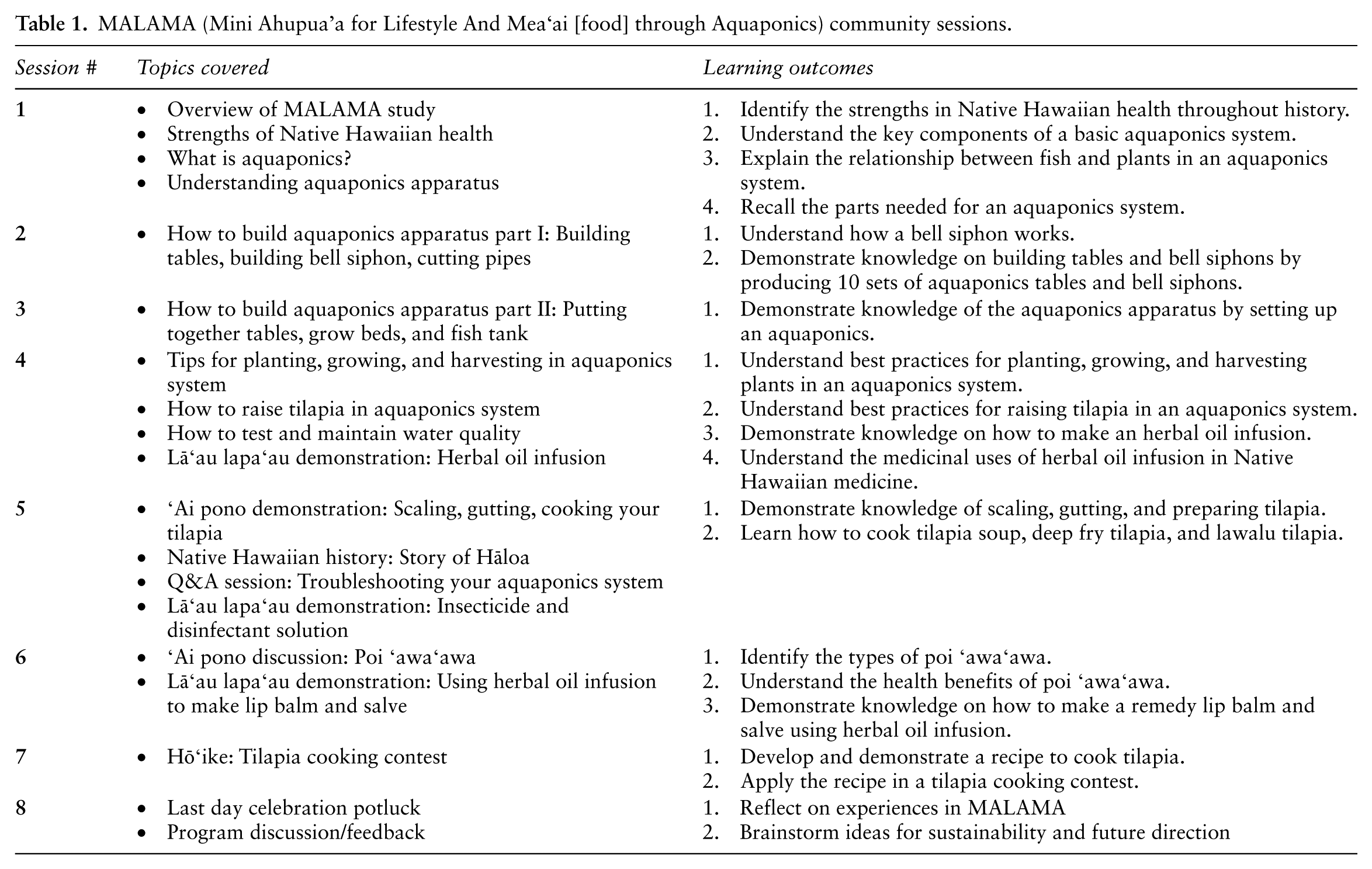
This MALAMA program consisted of eight community workshops and gatherings throughout the 3 months of the program, which ranged from 2 to 5 hours and occurred twice a month. Workshops focused on skills related to building and maintaining aquaponics systems, gardening (planting, growing, and harvesting plants), growing and caring for fish, nutrition education, cooking, traditional medicine demonstrations using produce grown in aquaponics systems, and strategies for making healthy eating choices. See Table 1 for the list of topics and learning outcomes. All workshops used a family-based model with a community of inquiry approach. This approach utilizes cognitive apprenticeship, shared inquiry, peer learning, and collaboration, and addresses the needs of culturally diverse learners (14). The hands-on family-based collective learning approach of this intervention aligned with Native Hawaiian educational pedagogy. Workshops integrated Native Hawaiian cultural practices, including lā‘au lapa‘au (Native Hawaiian traditional healing through plants and spirituality) (15) and ‘ai pono (nourishing foods).
MALAMA (Mini Ahupua’a for Lifestyle And Mea‘ai [food] through Aquaponics) community sessions.
Future directions
Currently, the MALAMA program has completed its initial series of workshops and the mixed-methods data is being analyzed to determine the feasibility and effectiveness of the program. The MALAMA researchers have partnered with other local organizations that support Native Hawaiian health and cultural practices to train other community groups across the islands on building and maintaining backyard aquaponics systems (Figure 2 for a fully functioning aquaponics system). The MALAMA program plans to develop a certification training in aquaponics, including integrating an educational pathway that would train youth to be aquaponics trainers while earning both high school and college credits. Promoting backyard aquaponics systems equips individuals and communities with the capacity and power to have autonomy over their food supply. The MALAMA program embraces the true essence of Hawai‘i, which is to take care of one another by sharing, giving, learning and teaching for the next 100 generations.

A functioning backyard aquaponics system in Waimānalo.
Footnotes
Declaration of conflicting interest
The authors declare that there is no conflict of interest.
Funding
The project described was supported by grant number #2U54MD007601-31 from the National Institute on Minority Health and Health Disparities (NIMHD), a component of the National Institutes of Health (NIH) and its contents are solely the responsibility of the author and do not necessarily represent the official view of NIMHD or NIH.