




Abstract
Background
There is limited information regarding the long-term outcomes of ulna-shortening osteotomy for ulna impaction syndrome. The Disabilities of the Arm, Shoulder and Hand (QuickDASH) questionnaire is a commonly used patient-rated outcome measure to assess function of the upper limb. The purpose of this retrospective case analysis was to compare patient-reported functional outcome with satisfaction in the assessment of long-term outcome after ulna shorting osteotomy.
Methods
A study of 32 patients presenting with ulna impaction syndrome with an average assessment of 54 months (range 8–102 months, SD 25.87) following ulna-shortening osteotomy. Outcome was evaluated using the QuickDASH questionnaire and an ordinal patient satisfaction score. Anonymous QuickDASH scores and patient satisfaction scores were obtained for 22 patients, one of whom underwent bilateral ulna-shortening osteotomy and completed individual responses for each procedure, providing us with 23 responses (68% response rate).
Results
Thirty two patients had an ulna-shortening osteotomy between 2003 and 2012. Fifteen were male (47%) and 17 were female (53%) with an average age at surgery of 43 years (range 15–73, SD 11.27). Two patients underwent bilateral operations. The average QuickDASH score was 22.88 (n = 23, range 0–72.5, SD 24.22) at follow-up. The average work QuickDASH score was 15.39 (range 0–50, SD 20.74). The average sport QuickDASH score was 34.38 (range 0–81.25, SD 28.89). Patient satisfaction scores showed 87% of patients reported an improvement in symptoms and 61% of patients would definitely recommend the procedure to patients with similar symptoms.
Conclusion
Long-term outcomes after ulna-shortening osteotomy show high levels of patient satisfaction and low QuickDASH scores.
Introduction
Ulna impaction syndrome is a common cause for ulna-sided wrist pain thought to occur due to abutment between the ulna and the carpus at the ulnocarpal joint. It is a degenerative condition that results from excess load across the joint, and is commonly associated with positive ulna variance. Positive ulna variance may be congenital, or may result from traumatic or surgical increases in relative ulna length, such as radius malunion or radial head excision. Treatment options aim to relieve symptoms by alleviating pressure at this junction; surgical intervention is indicated when conservative measures fail. Surgical options include debridement of the triangular fibrocartilage complex (TFCC), arthroscopic wafer procedure or ulna-shortening osteotomy (USO). USO is the gold standard against which other procedures are compared 1 but there is little data available regarding long-term outcomes.
The QuickDASH outcome measure is an 11-item self-reported questionnaire designed to measure function and symptoms in patients with musculoskeletal problems affecting the upper limb. 2 It has two optional sections, each with four items, focusing specifically on symptoms relating to work or sports. Each item is scored between 1 and 5, with 5 representing the most severe symptoms or impairment.
Outcomes after USO have previously been reported following assessment with the modified Gartland and Werley scores, 3 Mayo wrist scores and DASH scores. 4 We aimed to assess the functional and patient satisfaction scores in order to establish long-term patient outcomes after USO.
Methods
A retrospective post-operative outcomes analysis was performed on 32 patients identified as having undergone USO for ulna impaction syndrome between October 2003 and September 2011. All of the procedures were performed by specialist upper limb surgeons.
The diagnosis of ulna impaction syndrome was made pre-operatively by a combination of medical history, physical examination and imaging, including MRI scanning.
Post-operative QuickDASH and patient satisfaction questionnaires were posted to patients in April 2012. We used a five-point ordinal patient satisfaction scale asking the patient to rank their current symptoms on a scale of 1–5, with 1 being much better and 5 being much worse. We also asked them whether they would recommend the procedure to a patient with symptoms similar to those they had pre-operatively. A score of 1 meant they would definitely recommend the surgery and a score of 5 meant they definitely would not.
The relationship between the QuickDASH scores and the ordinal patient satisfaction scores were analysed using Spearman’s rank correlation coefficient.
Results
The questionnaires were completed at an average of 54 months post-operatively (range 8–102, SD 25.87). QuickDASH scores and patient satisfaction scores were obtained for 22 patients.
Thirty two patients underwent USO between 2003 and 2012. Of them, 17 were right sided only, 13 were left sided only and two patients underwent bilateral operations. Of these patients, 15 were male (47%) and 17 were female (53%). Two patients required bilateral procedures. At the time of surgery the patients were aged between 15 and 73, with an average age of 43 years.
Anonymous QuickDASH scores and patient satisfaction scores were obtained for 22 patients, one of whom underwent bilateral USO and completed individual responses for each procedure, providing us with 23 responses (68% response rate).
The average post-operative QuickDASH score was 22.88 (range 0–72.5, SD 24.22).
Nineteen responses included the optional section regarding symptoms at work, with an average score of 15.39 (range 0–50, SD 20.74). Eleven responses included the optional section regarding sport-related symptoms, with an average score of 34.38 (range 0–81.25, SD 28.89).
The majority of QuickDASH scores were below 20, although the second largest group for both QuickDASH and WorkDASH scored between 40 and 59, suggesting that a subgroup of patients have less good outcomes in these areas. Only two patients scored more than 60 for the QuickDASH and three scored more than 60 for the SportDASH.
Twenty out of 23 responses (87%) indicated an improvement in symptoms, 80% of which classified symptoms as ‘much better’. Two responses (8%) described symptoms as either ‘somewhat’ or ‘much worse’. One patient (4%) reported no changes in symptoms following surgery.
Fourteen responses (61%) reported that the patient would definitely recommend the procedure to patients with similar symptoms. Six (26%) would probably recommend it. None of the responses reported that patients would not recommend the procedure, although in three of the responses (13%) the patients were not sure if they would recommend it or not.
The relationship between the QuickDASH scores and the patient satisfaction scores was analysed using Spearman’s rank correlation coefficient (Figure 1). The correlation coefficient is 0.77 (p < 0.005) showing a statistically significant, moderately strong correlation between the two scoring systems.
Comparison between QuickDASH and patient satisfaction score.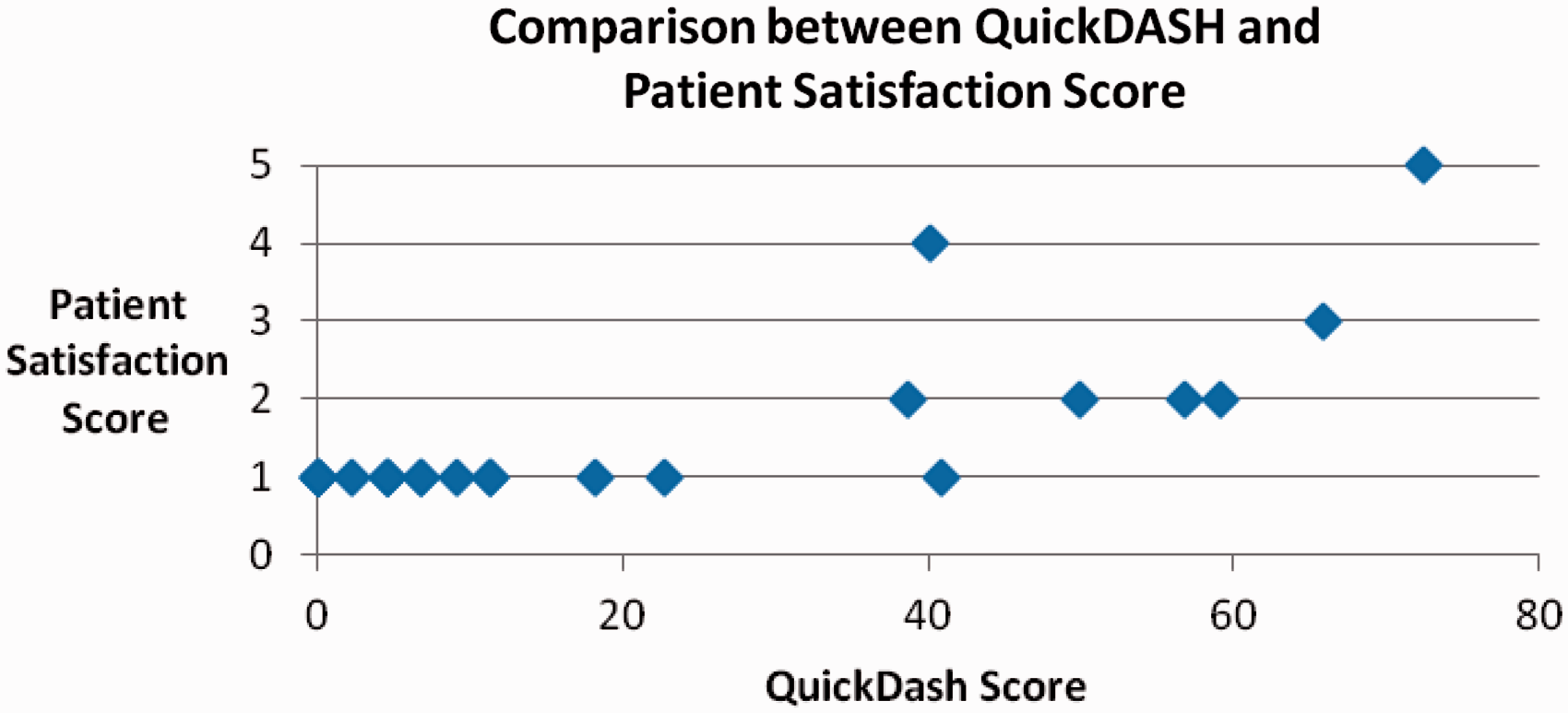
Discussion
This study demonstrates that long-term functional and patient satisfaction outcomes for USO are encouraging, with high rates of satisfaction amongst patients and low QuickDASH scores. However, patients who describe their symptoms as being ‘somewhat worse’ score lower on the QuickDASH score than patients who report their symptoms have ‘somewhat improved’ or not changed.
Reliable and valid outcome measurements are essential when evaluating patient results following surgery. The QuickDASH score has been assessed as being an appropriate tool for the functional evaluation of the wrist and the hand 5 and our data suggest that these scores correlate well with patient satisfaction after USO. However, despite the strength of the correlation, QuickDASH scores for patients who rate their symptoms as ‘somewhat worse’ are lower than those for patients who report their symptoms are ‘somewhat better’ or unchanged.
USO is currently the gold standard for treatment of ulna impaction syndrome. 1 However, other treatments such as non-operative interventions (immobilization, activity modification, nonsteroidal anti-inflammatory medications or local corticosteroids) or the Wafer procedure 1 are available. It would be useful to compare our results with long-term outcomes of patients managed non-operatively, and with other surgical treatments for ulna impaction syndrome. It would also be valuable to assess the correlation between these scores and others, such as the Mayo wrist score or modified Gartland and Werley scores, and whether radiological signs correlate with patient outcomes.
Conclusion
Patients report positive long-term outcomes after USO. High patient satisfaction scores are supported by low QuickDASH scores.
Footnotes
Funding
This research received no specific grant from any funding agency in the public, commercial, or not-for-profit sectors.
Conflict of interest
No competing interests.