Corrigendum to The reliability and validity of novel clinical strength measures of the upper body in older adults. Journal of Hand Therapy 25 (4): 130–138. DOI: 10.1177/1758998320957373.
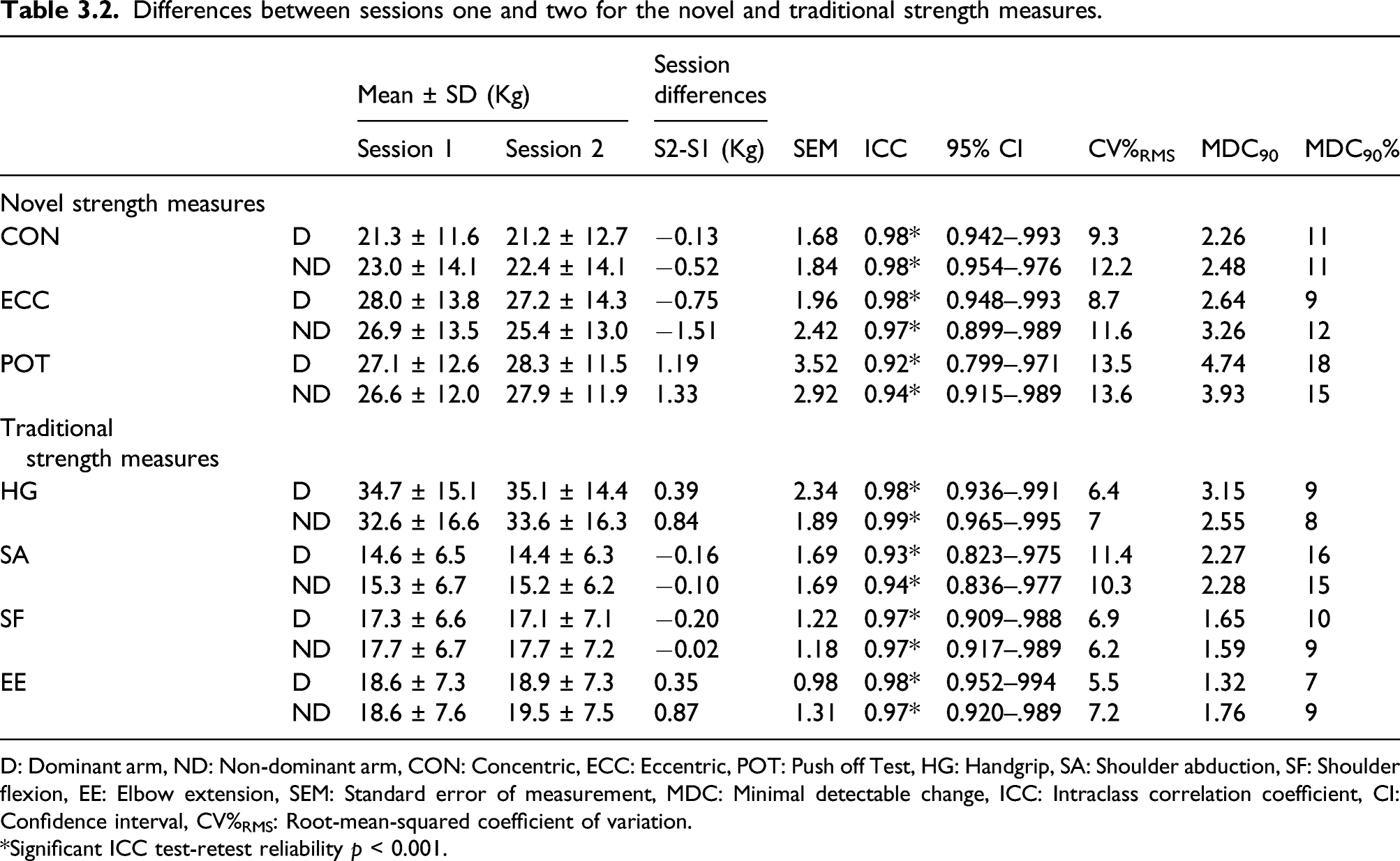
It has been identified the calculations used to establish the minimal detectable change (MDC) and standard error of measurement (SEM) were incorrect in the original manuscript. The corrected SEM was calculated as .1 In addition, SEM is referred to in the original manuscript as the standard error of the mean, this is incorrect and is calculated as the standard error of measurement. The corrected minimal detectable change (MDC) at the 90% confidence interval was calculated using and reported as an absolute and a percentage score.2
Differences between sessions one and two for the novel and traditional strength measures.
*Significant ICC test-retest reliability p < 0.001.
The reported ranges for absolute reliability increased from SEM: 0.17–1.15 to SEM: 0.98–3.52; and the MDC90% from 2.1-9.9% to 7–18%. The changes have been made to Table 3.2 to reflect the new values. Despite the initial errors in calculation, similar to the initial findings the traditional strength measures generally performed better than the novel strength measures. The higher values reported for the novel strength measures (POT, CON and ECC) should be considered when evaluating longitudinal changes during clinical assessment.
References
1.
WeirJP. The intraclass correlation coefficient and the SEM. J Strength Cond Res. 2005; 19(1): 231–240.
2.
BeatonDE. Understanding the relevance of measured change through studies of responsiveness. Spine (Phila Pa 1976). 2000; 25(24): 3192–3199.