



Abstract
Introduction
To our knowledge, no previous studies have directly compared the effects of orthosis wear in males and females with thumb carpometacarpal (CMC) joint osteoarthritis. Therefore, this study aimed to analyze whether there are differences between males and females in pain, hand function, and grip strength following hand-based orthosis wear.
Methods
The study included 14 male and 14 female participants with first- and second-degree CMC joint osteoarthritis. A hand-based orthosis was custom-molded for each participant. Pain, function, grip strength, and pinch strength were evaluated at baseline and after a 6-week period of orthosis wear.
Results
Twenty-eight participants (mean age: males 64.6 ± 5.1 years; females 63.5 ± 3.2 years) completed the study. After 6 weeks of orthosis use, both males and females showed significant improvements in grip strength, pinch strength, hand function, daily activity performance, and pain reduction (all p < .05). Although both sexes benefited similarly in grip strength, pain, and function, females reported significantly greater improvement in satisfaction with hand function (p = .020). Mean adherence was 84.75%, with higher compliance observed in females.
Conclusion
Although both groups experienced significant improvements in pain, function, grip strength, pinch strength, and overall satisfaction with orthosis wear, greater improvement in satisfaction with hand function was observed among females.
Keywords
Introduction
Osteoarthritis is the most common joint disease, primarily affecting individuals over the age of 50. This degenerative and multifactorial condition is characterized by the gradual degradation of articular cartilage due to an imbalance between its synthesis and breakdown. 1 The knee, hip, and hand are the joints most frequently involved. 2 Beyond its functional importance, the human hand also symbolizes power and capability. 3 Among the digits, the thumb is paramount, contributing to 45–60% of hand activities, with the carpometacarpal (CMC) joint playing a critical role in its mobility and stability. 4 In the hand, arthritis most commonly affects the distal interphalangeal joints and the trapeziometacarpal (i.e. CMC) joint. 5 Radiographic studies indicate that osteoarthritis symptoms are present in 44–70% of individuals over 55 years old and 80–85% of those over 75, while radiographic signs of joint degeneration are observed in approximately one in four females and one in 12 males; notably, CMC joint osteoarthritis of the thumb affects more than 20% of individuals over 40 years of age.6,7
Numerous biomechanical and biochemical factors contribute to the development of osteoarthritis, with age and sex being particularly influential. 8 Osteoarthritis is more prevalent in females, especially after the age of 55, a trend attributed in part to hormonal changes such as menopause and reduced estrogen levels—hormones that are crucial for maintaining cartilage thickness.9,10 Furthermore, vitamin D deficiency, which is more common in females, adversely affects calcium absorption, bone density, and cartilage integrity, thereby increasing the risk of osteoarthritis.11,12 Additionally, increased ligament laxity and elevated prolactin levels in females may further exacerbate joint instability and contribute to the development of arthritis. 13 It has also been observed that the CMC joint in females is smaller and exhibits a less congruent, flatter trapezoidal shape compared to that in males, a structural variation associated with a higher likelihood of osteoarthritis.14–16
The unique anatomical design of the thumb—allowing an extensive range of motion—simultaneously predisposes it to instability and degenerative changes, as joint stability largely depends on the integrity of its ligaments and musculature. 17 Other factors contributing to joint degeneration include improper joint mechanics, excessive or abnormal joint movements, hand dominance, smoking, decreased bone density, and occupational stresses.18,19 Clinically, osteoarthritis of the thumb manifests as pain, weakness, joint instability, muscle atrophy, and diminished grip and pinch strength, all of which significantly impair hand function. 20 Since the thumb contributes to nearly half of all hand activities, impairment due to CMC osteoarthritis can substantially compromise manual dexterity and limit participation in essential daily activities. This functional decline may extend to the broader upper limb, reducing overall upper extremity strength and performance. Consequently, such limitations in hand and upper limb function can negatively affect psychological well-being, leading to increased emotional distress and reduced quality of life, particularly among older adults. 21 Studies using the Patient-Reported Outcomes Measurement Information System (PROMIS) have shown that individuals with musculoskeletal disorders such as osteoarthritis report higher levels of depression, anxiety, and social role dissatisfaction due to functional impairment and chronic pain; 22 moreover, the economic burden associated with osteoarthritis treatment is estimated to be seven times greater than that of rheumatoid arthritis. 23
Treatment options for CMC osteoarthritis are broadly divided into conservative management and surgical interventions. While surgical treatment is generally indicated in cases of advanced, debilitating osteoarthritis characterized by severe pain, joint instability, and functional limitations unresponsive to conservative methods, it may also be considered based on radiographic severity, patient occupation, and failure of other interventions.24,25 Conversely, conservative management—including orthotic intervention, activity modification, pharmacologic therapy, and rehabilitation—is typically preferred in earlier stages of the disease or when surgical risks outweigh potential benefits. Patient preferences, pain severity, degree of functional impairment, and comorbidities are also critical factors guiding the choice of conservative treatment. 26 For thumb CMC joint osteoarthritis, the primary treatment objective is to alleviate inflammation by resting the joint, a goal that can be achieved with the use of an orthosis. 27 Although an orthosis does not repair structural damage, it enhances functional activity by reducing pain, slowing degenerative progression, and preventing dislocation and deformity through external stabilization and improved anatomical alignment. 28 A wide array of prefabricated and custom-made orthoses is available, with the hand-based orthosis being a commonly employed device in managing CMC joint osteoarthritis. 29 Studies have demonstrated that the hand-based orthosis minimally restricts movement, is easy and cost-effective to produce, available in various colors, and effective in reducing pain while improving function.30,31
Emerging evidence indicates that anatomical, hormonal, and functional differences between sexes significantly influence the prevalence and progression of CMC joint arthritis in the thumb. 32 However, to date, no studies have directly compared the effects of the hand-based orthosis between males and females. Therefore, this study aims to evaluate and compare the effectiveness of a customized thumb orthosis in both sexes among patients living with CMC joint osteoarthritis.
Materials and methods
Study design
In this quasi-experimental study, the sample size was determined based on a 2013 study by Bani et al. 29 In that study, the standard deviation (SD) of grip strength changes was reported as 5.6 kg, and a precision of 1.4 kg for detecting changes in grip strength was also considered based on their findings. Assuming a 95% confidence interval (CI) and 80% power, a sample size of 23 participants was calculated using the standard formula for quasi-experimental studies. To account for a potential 20% dropout rate, the final sample size was increased to 28 participants (14 male and 14 female).
Participants
Baseline demographic and hand characteristics in male and female participants.

Orthotic intervention
The hand-based orthosis was fabricated based on the principles of Colditz and McKee’s specifications,
35
using 3.2 mm thick maxi-perforated Orfit™ material (Orfit Industries, Wijnegem, Belgium) and designed to cover solely the first CMC joint. Figure 1 illustrates the hand-based orthosis used in this study. Custom-made thumb orthoses were used in this study.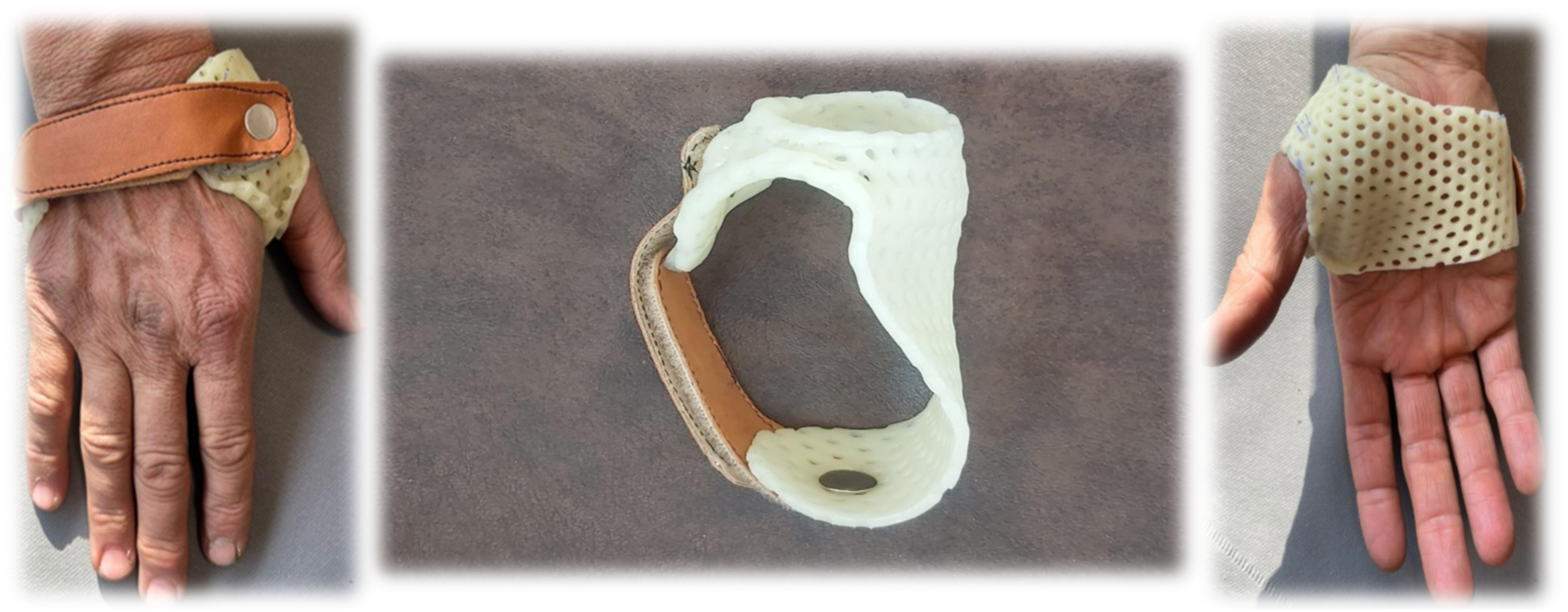
During fabrication, after preparing the hand model, the patient was instructed to position the wrist in extension, with the fingers in flexion, and to bring the thumb and third finger together to create sufficient space for thenar muscle contraction. Following the molding process, gentle upward and lateral pressure was applied to the metacarpal and thenar regions to secure the orthosis adjacent to the joint and maintain proper anatomical alignment.
The primary goal of this orthotic intervention was to achieve precise anatomical alignment of the thumb’s CMC joint, thereby reducing the risk of dislocation and promoting optimal hand function during daily activities. The fabrication process involved applying a posterior force to the joint while simultaneously exerting counter pressure on the thenar muscles. This custom design was specifically tailored to minimize interference with adjacent joints, such as the wrist and phalanges while preserving the mobility and dexterity required for effective hand use. It was also adjusted individually to accommodate each patient’s unique anatomical features.
A certified orthotist meticulously fabricated all hand-based orthoses used in this study. Subsequently, each orthosis underwent a thorough evaluation by an additional experienced orthotist to ensure both structural integrity and precise alignment. Furthermore, previous studies have successfully employed this orthosis for the treatment of thumb CMC joint arthritis. 36
Participants were instructed to wear the orthosis for 6 to 8 h per day during waking hours, particularly while performing daily activities that require use of the involved hand. 37 The orthosis was not required at night or during bathing. The daily duration of orthosis use (hours/day) was recorded by participants in a structured logbook with predefined fields for start/end times and reasons for non-compliance, completed daily to minimize recall bias, with verbal and written guidance provided at the initial fitting; logbooks were reviewed weekly by a certified orthotist to verify compliance.
Outcome measures
Grip and pinch
Grip strength was measured using a dynamometer (Model 5030 J1; Sammons Preston, Bolingbrook, IL, USA), while lateral pinch strength was assessed using a pinch gauge (Model 749,805; Sammons Preston). Both instruments are well-established, reliable, and valid tools for assessing grip and pinch strength.38,39 Positioning followed standardized guidelines from the American Society of Hand Therapists (ASHT) Clinical Assessment Recommendations. Participants were seated with the shoulder in adduction and neutral rotation, elbow flexed at 90°, forearm maintained in a mid-pronation/supination position, and wrist aligned at 0° flexion/extension with no radial or ulnar deviation. All assessments required maximum isometric effort, with three consecutive attempts performed per measurement. To ensure consistency, a minimum 15-s rest interval was provided between trials, and the average of the results was calculated as the final score. 40
Function and pain
Patients’ levels of disability and pain were evaluated before and after the intervention using the validated and reliable Michigan Hand Questionnaire (MHQ). This comprehensive instrument comprises 37 questions across six domains: overall hand function, activities of daily living, work performance, pain, aesthetics, and satisfaction with hand function. The MHQ has demonstrated strong psychometric properties, including in populations with thumb osteoarthritis, as evidenced by Rasch analysis. 41 In this questionnaire, higher scores in all domains—except for pain—indicate superior performance. Following the initial assessment, patients were instructed to wear the orthosis throughout the day during regular activities. After the 6-week intervention period, evaluations were repeated to determine changes and assess treatment efficacy.
Intervention adherence
Daily orthosis wear time (hours/day) was recorded by participants in a logbook and reviewed weekly. Adherence was defined as wearing the orthosis for ≥80% of the prescribed regimen of 6 to 8 h per day, a duration established as most effective for functional improvement in studies of orthotic management for thumb osteoarthritis. 37
Statistical methods
Data from 28 participants (14 males, 14 females) were analyzed pre- and post-intervention using SPSS version 26. Normality of continuous variables (grip strength, pinch strength, MHQ domains: hand function, activities of daily living, work performance, pain, aesthetics, satisfaction) was assessed with the Shapiro-Wilk test. Within-group changes were evaluated using Paired Sample T-tests, and between-group comparisons (males vs females) used ANCOVA, adjusting for baseline values. Categorical variables (dominant/affected hand) were analyzed with Chi-Square tests, showing no baseline differences (p > .05).
No intention-to-treat analysis was needed due to zero dropouts, with adherence monitored via logbooks. Adherence (daily wear time) was compared using independent samples T-tests (continuous) and Chi-Square tests (≥80% threshold, ≥4.8 h/day). A two-way repeated measures ANCOVA assessed time-sex interactions for continuous outcomes, with baseline values as covariates and homogeneity of variances confirmed (Levene’s test, p > 0).
Results
The study included 28 participants with first- or second-degree CMC joint osteoarthritis, divided equally into male and female groups (14 males and 14 females). The mean age of the male participants was 64.6 years (SD = 5.1), and for females, it was 63.5 years (SD = 3.2). All participants were right-hand dominant. The affected side was distributed as follows: in the female group, 71.4% (n = 10) had right-hand involvement and 28.6% (n = 4) had left-hand involvement; in the male group, 57.1% (n = 8) had right-hand involvement and 42.9% (n = 6) had left-hand involvement. There were no statistically significant differences between the groups in baseline characteristics, including age, body mass index (BMI) (males: 25.4 kg/m2, SD = 2.4; females: 26.1 kg/m2, SD = 4.5), dominant hand (males: 100% right-handed; females: 92.9% right-handed, 7.1% left-handed), affected hand (males: 64.3% right, 35.7% left; females: 71.4% right, 28.6% left), symptom duration (males: 10.9 months, SD = 5.4; females: 11.7 months, SD = 11.1), pain levels, overall hand function, grip strength, or pinch strength.
Mean, standard deviation, and confidence interval of the variables at the beginning and after 6 weeks of intervention in the female and male groups.

Intervention adherence
The average daily wear time across all participants was 5.2 h/day (SD = 1.5). Females demonstrated a higher mean wear time of 6.1 h/day (SD = 1.4), compared to 4.4 h/day (SD = 1.0) for males.
Using the adherence criterion of ≥80% of the prescribed 6 h/day (≥4.8 h/day), 18 out of 28 participants (64.3%) met the threshold. Females exhibited markedly higher compliance, with 13 out of 15 female participants (86.7%) achieving adherence, compared to 5 out of 13 males (38.5%).
Impact of orthosis use in females with CMC joint osteoarthritis
After 6 weeks of orthosis use, the female group demonstrated statistically significant improvements in grip strength (p < .001), pinch strength (p < .001), hand function (p = .027), performance in daily activities (p < .001), pain reduction (p < .001), and satisfaction with hand function (p < .001). However, no significant change was observed in aesthetic perception of the hand (p = .732).
Impact of orthosis use in males with CMC joint osteoarthritis
Similarly, the male group showed significant improvements after 6 weeks in grip strength (p < .001), pinch strength (p < .001), hand function (p = .020), performance in daily activities (p < .001), pain reduction (p = .020), and satisfaction with hand function (p < .001). Aesthetic perception of the hand also showed some improvement, although it did not reach statistical significance (p = .096).
Comparison between sexes
Investigating the impact of using an orthosis in males and females and comparing the two groups.

a*Based on the ANCOVA.
Discussion
This study demonstrated that the use of a custom hand-based orthosis in patients with CMC joint osteoarthritis significantly improved multiple outcomes of interest in both sexes. Notably, both males and females experienced significant reductions in pain, and enhancements in grip strength, pinch strength, and overall hand function. However, while improvements in most parameters were comparable between the groups, females exhibited a noteworthy increase in overall satisfaction with hand function, which was statistically significant.
Pain at the base of the thumb is a hallmark symptom of CMC joint osteoarthritis, often resulting from inflammation and degeneration of joint structures. 42 Our findings indicate that the orthosis effectively reduced pain in both males and females. Although initial pain levels were higher in males, the rate of pain improvement was greater in females, possibly due to their longer daily use of the orthosis. These results are consistent with previous studies that suggest orthotic use can alleviate pain in thumb CMC joint osteoarthritis.29,36,43,44
Degenerative changes in the thumb CMC joint are frequently accompanied by diminished grip and pinch strength, often due to pain-related inhibition of force production. 45 In our study, both sexes demonstrated statistically significant improvements in grip and pinch strength after orthosis use (p < .001). These gains align with Bani et al. (2013), who reported significant grip strength increases after 6 weeks of custom orthosis use in CMC joint osteoarthritis patients, though without sex-stratified analysis. 29 Despite inherent baseline strength differences—attributable to stronger male musculature 46 —no statistically significant post-intervention differences emerged between the sexes. These improvements may partially reflect orthosis-induced joint stabilization, reducing excessive CMC mobility and ligamentous strain associated with degenerative changes.29,30,47–49 Similar mechanisms were proposed by Weiss et al. (2004), where custom orthoses significantly improved grip strength, corroborating our findings. 48 While ligamentous laxity was not directly assessed, the observed strength gains could arise from secondary benefits of immobilization, such as reduced pain during forceful tasks and enhanced neuromuscular activation. 50 This parallels Sillem et al. (2011), who noted strength improvements linked to pain reduction in custom orthosis users. 47 Collectively, these findings support orthoses as symptom-alleviating tools via CMC joint stabilization, consistent with biomechanical evidence. 51
The thumb plays a critical role in up to 60% of hand functions. 52 The application of the orthosis not only reduced pain but also substantially improved hand function, as evidenced by the MHQ scores. Both males and females showed significant enhancements in their ability to perform daily activities, although the degree of improvement in work-related tasks was less pronounced, potentially due to the higher physical demands typically associated with male-dominated occupations. 53
CMC joint osteoarthritis, particularly in advanced stages, may lead to visible changes in hand appearance due to joint subluxation or osteophyte formation. 54 However, in our sample—which included only participants with stage I and II osteoarthritis —such alterations were not prevalent. Despite the observed functional improvements, no significant aesthetic changes were detected as measured by the MHQ. This suggests that in early-stage osteoarthritis, orthotic use may improve function without visibly altering hand appearance.
Concerns have been raised about the risk of muscle atrophy—especially in the thenar region—following prolonged orthosis use. 55 However, our 6-week intervention, in line with previous short-term studies (e.g., Arazpour et al., 2017), showed no evidence of significant atrophy. 36 This may be due to the orthosis allowing sufficient muscle activation during functional tasks. Nonetheless, given the short duration and inclusion of primarily early-stage osteoarthritis participants, long-term effects on muscle volume require further investigation.
Patient satisfaction is a critical outcome in the management of osteoarthritis. Although both groups reported significant improvements in satisfaction with hand function, females showed a notably higher increase in satisfaction compared to males (p = .020). This difference may be attributed to variations in daily orthosis use, occupational demands, and perhaps a greater sensitivity to functional improvements among females. 56
Importantly, differences in adherence to orthotic use between sexes may have influenced outcome disparities. The average daily wear time was significantly higher in females (6.1 ± 1.4 h/day) than in males (4.4 ± 1.0 h/day), and 86.7% of females met the adherence threshold (≥4.8 h/day) compared to only 38.5% of males. This higher compliance rate among females may partly explain their greater improvements in pain reduction and satisfaction with hand function. Prior studies have emphasized the role of consistent orthosis wear in optimizing therapeutic effects, particularly in terms of pain alleviation and functional improvement. 31
Limitations and suggestions of the study
The study has several limitations. First, the relatively small sample size and lack of randomization may reduce the generalizability of the findings. Second, most female participants were not employed outside the home, while many men were employed or retired and engaged in more physically demanding tasks. These occupational differences may have influenced hand function and orthotic satisfaction. Third, the 6-week study duration may not adequately capture long-term effects of orthosis use on pain, function, or grip strength. Additionally, the inclusion of participants with early-stage osteoarthritis (Type 1 per the Eaton-Littler classification) limits the applicability of findings to individuals with advanced CMC joint degeneration. The study also did not account for hand dominance or affected side, despite all participants being right-hand dominant with variations in affected side distribution, which may confound functional outcomes. Gender was not considered, only biological sex. Finally, self-reported wear time data may be susceptible to biases such as social desirability or recall inaccuracies.
Future studies should address these limitations while expanding on our findings. Longer follow-up periods are needed to evaluate sustained outcomes of orthosis use. Participant stratification by disease severity (e.g., Eaton-Littler stages) and incorporation of hand dominance/affected side into analyses would enhance clinical relevance. Objective measures of wear time (e.g., wearable sensors) should replace self-reporting to improve adherence data accuracy. Comparative studies assessing custom-made versus prefabricated orthoses across sexes and gender identiries could elucidate factors driving satisfaction discrepancies, particularly given sex-based differences in muscle volume, activity levels, and ligament laxity. Biomechanical investigations into orthosis effects on joint stability and muscle morphology in male and female populations are also warranted. Finally, while the Michigan Hand Outcomes Questionnaire (MHQ) provided robust functional assessment, pairing it with condition-specific tools like the Thumb Disability Exam (TDX) and quantitative pain measures (e.g., Visual Analog Scale) may better capture subtle impairments and pain dynamics in thumb CMC osteoarthritis.
Conclusion
This study demonstrated that the use of a custom hand-based orthosis significantly improved grip strength, pinch strength, overall hand function, and reduced pain in both females and males with CMC joint osteoarthritis. In terms of sex-specific outcomes, the only statistically significant difference observed was in overall satisfaction with hand function, with females reporting both higher initial satisfaction and a greater rate of improvement compared to males.
Footnotes
Acknowledgements
We would like to express our sincere gratitude to the Iranian Research Center on Aging for their assistance in facilitating this study and for providing invaluable guidance throughout the research process.

Ethical consideration
Ethical approval for the study was obtained from the Ethics Committee of the University of Social Welfare and Rehabilitation Sciences, Tehran, Iran (approval code: IR.USWR.REC.1401.081).
Informed consent
Written informed consent was obtained from all subjects before the study.
Funding
The authors received no financial support for the research, authorship, and/or publication of this article.
Contributorship
ZG is the first author and contributed equally as the primary investigator by conceiving the study, designing the experimental protocol, conducting most of the data collection, and drafting the manuscript. MA assisted in the study conception, protocol development, and provided critical revisions of the manuscript. FL contributed valuable input regarding the study methodology and data interpretation. YF key role in sample selection and recruitment, ensuring robust sampling procedures. AB was primarily responsible for the comprehensive statistical analysis and significantly aided in the interpretation of the results. All authors reviewed and approved the final manuscript.
Declaration of conflicting interests
The authors declared no potential conflicts of interest with respect to the research, authorship, and/or publication of this article.
Trial registration
Not applicable because this study is a non-randomized, semi-experimental investigation of orthosis wear in patients with CMC joint osteoarthritis and does not meet the criteria for mandatory clinical trial registration under current regulatory guidelines.
Guarantor
ZG is the guarantor of this study and takes full responsibility for the integrity of the work as a whole—from study conception to publication.