




Abstract
Market definition is the first step of competition analysis. In practice, relevant markets are mostly defined for the end products and services and it is also the same for current cases concerning Internet-based businesses (IBBs). Data has important influence on the competition of IBBs. However, instead of selling data directly, the IBBs usually use data to produce, improve and innovate products and services. Under such circumstances, there may be no relevant market defined for such data following the conventional market definition methods. This article’s investigation shows that online data play different roles in the competition of IBBs and the conventional competition analysis methods only miss some aspects but not all of them. Alternative approaches including the input market definition and the putative online data market definition proposition fail to solve the problem. What might be of help is to switch focus to improving the relevant market definition methods for products and services which online data are related to and pay more attention to the inner relationship between online data and the Internet-based products and services when identifying which market to define.
Introduction
Competition analysis of the Internet-based businesses (IBBs) is currently in the spotlight globally and the Internet giants are paid lots of attention to. 1 The IBBs could show a strong tendency towards ‘winner takes all’ (OECD, 2016, para. 50) and ‘super platforms’ have emerged (Stucke & Ezrachi, 2017, p. 2). There are different approaches to examine and explain this tipping phenomenon. One is through the platform nature of the businesses and the network effects associated (OECD, 2014, para. 151). Such network effects can be either direct, which means the attractiveness of a platform increases when the total number of consumers rise such as the social networking services, or indirect, which means the attractiveness for one consumer group increases when the number of another consumer group grows like the online recruitment platforms (European Parliament, 2015, p. 8; Katz & Srapiro, 1985, p. 424). The indirect network effect is related to the two-sided or multisided markets (hereinafter referred to together as ‘two-sided markets’), which refers to the situation that two or more user groups depending on an intermediary to interact with each other (Evans, 2003, pp. 325–326). 2 It is worth pointing out that the two-sided market is not unique to the IBBs, 3 but becomes prevalent in the online world and is widely seen in the products and services provided by Google, Facebook, Amazon, Microsoft, Apple, etc. Another important approach is from the perspective of data. It is pointed out that the economics of digital data favours concentration and dominance (OECD, 2014, para. 13). With the development of technology, more and more information has become available online in form of data. The IBBs are developing various kinds of products and services that can cultivate online data and are making use of them to carry out competition. This attracts the attention of International organizations, competition authorities and scholars (e.g. Autorité de la concurrence & Bundeskartellamt, 2016; Davilla, 2017; Cowen, 2016; Ezrachi & Stucke, 2016, pp. 11–21; Graef, 2015; Newman, 2014; OECD, 2015, 2016; Peyer, 2017; Ramirez, 2016; Schepp & Wambach, 2016; Tucker & Wellford, 2014). There have also been cases which stress the influence of data in the competition of IBBs. 4
There are different views on whether competition law is suitable for coping with issues raised by online data. Some hold the view that the economic characteristics of online data such as easy to collect, nonexclusive and nonrivalrous are against competitive harm and that the competition law is not suitable for regulating the data of Internet-based products and services (Sokol & Comerford, 2017, pp. 293–317; Tucker & Wellford, 2014, pp. 1–12). However, more calls are being made on looking into online data from the competition law perspective. It has been pointed out that the lack of access to online data can be a significant entry barrier (Mahnke, 2015; Rubinfeld & Gal, 2017; Schepp & Wambach, 2016) and that the high concentration in data power can be a new tool for competitive dominance which may further lead to distortions of competition (Newman, 2014, pp. 420–441; Schepp & Wambach, 2016, p. 120).
Among the challenges brought about by the data-driven economy, 5 the market definition issue is fundamental as it is widely adopted as the first step in competitive analysis. 6 To stress the influence of data, it is proposed that relevant market for online data be defined to better incorporate online data’s effect on competition even when they are only employed as inputs. This proposition was first raised in the Google/DoubleClick merger case, which received great attention on both sides of the Atlantic. In the dissenting opinion of this case, the US Federal Trade Commissioner Pamela Jones Harbour explicitly expressed that, among others, more attention should have been paid to the merging parties’ data sets and that it might have been possible to define a putative relevant market for the data that might be useful for behavioural targeting advertisers and publishers (Dissenting Statement of Commissioner Harbour In the Matter of Google/DoubleClick (hereinafter ‘Dissenting Statement’), 2007, p. 9). This opinion was stressed again in her later academic work. 7 However, the proposition did not further explain that (1) as an input, why data should be paid particularly attention to and defined a relevant market for but not other inputs considering the obtaining and using of inputs in other business realms can also be separate, (2) what important influence of data the conventional competition analysis methods fail to capture, (3) whether defining a relevant market for data can be an effective solution and (4) how can such data market be defined.
Graef (2015) supports the data market definition proposition and contributes to the discussions on how such relevant markets could be defined based on the analysis of online platforms. It is contended that the incumbents try to leverage their market position in order to get more data which would in turn improve their products and that the competition concerns relating to data might not be fully stressed depending only on the relevant markets defined for the final products or services. The substitutability among different kinds of data is analysed and suggestions are given on how to delineate the relevant markets for them. 8 However, this proposition is based more on the importance of considering data in competition analysis without providing adequate support on the justifications especially the effectiveness of solving it in the market definition stage rather than others.
The former introduction shows that although the importance of taking data into competition analysis has been noticed and the propositions of defining putative relevant market for online data have been made, many aspects still remain to be explored more closely such as what, if anything, is missing when assessing online data’s influence on the competition of IBBs based on the current market definition methods? If anything is missing, are there any existing alternative approaches that can solve the problem? If existing alternative approaches fail, will defining relevant markets for online data be a helpful solution? If none of them works, how to cope with the problem?
This article aims to provide a close examination of online data and its relationship with the relevant market definition of IBBs. The second section examines the characteristics of data and shows that despite being seemingly everywhere and nonrivalrous, online data are not readily available and the IBBs need to compete for them, a fact makes online data an important element of competition that worth further examining. The third section introduces the business models of IBBs and explores online data’s different roles in IBBs’ competition. The fourth section investigates how online data are related to the market definition of IBBs at present and what is likely to be missing under the conventional competition analysis methods. The fifth section analyses whether the existing alternative input market approach and the online data market definition proposition can capture what is missing and discusses how to deal with the problem if these approaches fail. The last section concludes.
Characteristics of online data
Collecting and making use of data for business purposes also exist in non-IBBs, long before the Internet came into existence. These data do not seem to cause competitive concerns of the same level as the IBBs do. Considering this, before embarking to discuss data’s relationship with market definition in the IBB sphere, it is worth first exploring what is the nature of online data and does it have any distinguishing characteristics that make it worth to become a concern of competition law.
Data: From the brick-and-mortar world to the digital world
Online data exist in digital form, which can either be imported from the brick-and-mortar world into the digital world through digitalization and datafication or generated directly when users using Internet-based products and services. Digitalization refers to the process of converting information into binary digits (i.e. bits) that can be processed by computers such as the digitalization of books, music and videos (OECD, 2017a, p. 204). Under this circumstance, these virtualized products exist in the form of digital data, organized and functioned by certain algorithms. By connecting to the Internet, the digitalized products and services can be transmitted and accessed online, which greatly enhances the distribution speed. Datafication refers to the digital data generated through monitoring real-world activities and phenomena through sensors (OECD, 2017a, p. 205), such as the datafication of users’ exercise activity by the application Health in iPhone’s IOS system. Apart from converting from the real world, a vast amount of data are generated directly when users use the digitalized products and services, regardless of whether connected to the Internet or not. Examples of the former being data generated through online social networking services and search engine, and the latter being those generated through offline office software such as Word or Excel. Among the data mentioned above, the ones generated by users through using Internet-based products and services, both brick-and-mortar and online, are raising competition concerns and hot debate (e.g. Autorité de la concurrence & Bundeskartellamt, 2016; Bourreau, Streel, & Graef, 2017; Cole, 2018; Graef, 2015; Grunes & Stucke, 2015; Lerner, 2014; Newman, 2014; OECD, 2014, 2017b; Stucke & Grunes, 2015, 2016). This article focuses on these data (online data).
Gathering and making use of data are not innovations of the Internet realm but that of the online data show different characteristics. Data have been collected and employed for decision-making and product improvement for a long time. A local grocery can use its sales records to make stock decisions and a car manufacturer can use user survey data to improve its product design before the Internet and even digital devices came into existence. Personal computer improved the efficiency of data recording and processing. However, before computers are connected with each other, the data generation and collection progress were relatively slow. The advent of the Internet and the advance of Internet-connected digital devices bring significant changes. Online information naturally exists in the form of data. When Internet-based products and services users (‘users’) enter criteria in search engines, post photos on social networking sites or purchase items through online shopping platforms, they generate and provide online data at the same time. The invention of mobile devices such as laptops, smart phones and tablets as well as the advance in both wire and wireless network technologies make it more convenient for users to access IBBs’ products and services. This further accelerates the data generation progress. In addition to being consumers, online users are also asset (i.e. online data) generators and providers for IBBs. Consumer as data providers also exists in the brick-and-mortar world. For example, financial customers may provide their personal data to the financial institutions such as banks. However, as discussed below, the scale, speed, scope and precision of the online data are much wider and higher.
Online data have several distinguishing characteristics. The first is Volume, the scale of data collected. There are increasing numbers of Internet-based products and services that attract users to spend their time online. 9 Because of this and with the increase of IBBs’ ability to collect and store data, the volume of online data is exploding. In 2012, the data of the global datasphere were around 1.2 zettabytes (ZB). 10 This figure surged more than 10 times to 16.1 ZB in just 4 years in 2016 and is expected to shoot up another 10 times to 163 ZB by 2025 (Reinsel, Gantz, & Rydning, 2017). The second characteristic is Velocity. Online data are generated and gathered at tremendous speed, enabling the IBBs to predict events as they occur and transferring the forecasting to nowcasting. 11 This means it is an advantage to possess large amounts of real-time data and take advantage of data’s time value (OECD, 2016, paras. 8–9). The third is Variety, the scope of data. There are various kinds of data based on different Internet-based products and services like social networking services, online search, e-commerce and online music, just to name a few. The content of online data is also wide-scoped, comprising users’ personal information, behavioural information (e.g. search history) and non-behavioural information (e.g. geographic location). Another trait is the level of detail. Take shopping for example, the online platforms can collect data on the items consumers browse before making the final purchase while brick-and-mortar shopping stores can only get data about the consumers’ final choices. Value is also sometimes contended as an important characteristic of online data (International Data Corporation, 2012, p. 1 (IBM Big Data & Analytics Hub, n.d.)). However, deriving value from data is more a parameter of the undertakings’ ability to make use of online data rather than a character of the online data itself.
Rivalrous or not: The abundance and scarcity of online data
The characteristics above present an image that online data are abundant and everywhere (Tucker & Wellford, 2014, p. 2). Because of this, there are views that online data are nonrivalrous (e.g. OECD, 2014, p. 27; Schepp & Wambach, 2016, p. 121; Sokol & Comerford, 2017, p. 299). The rivalrousness describes the degree to which the consumption of a resource affects the potential of the resource to meet the demands of others (OECD, 2014, para. 51). It is argued that collection of data by one undertaking does not prohibit another undertaking from obtaining the same data (Schepp & Wambach, 2016, p. 121; Sokol & Comerford, 2017, p. 299; Tucker & Wellford, 2014, pp. 3–4). The reasons are that online users are multi-homing, using different providers for the same kind of product or service (‘single-product multi-homing’) as well as for a wide range of different Internet-based products and services (‘multi-product multi-homing’) (Autorité de la concurrence & Bundeskartellamt, 2016, p. 28; Sokol & Comerford, 2017, p. 299). Also, since data can be copied endless times, it is possible to obtain data from other undertakings. As a result, scholars like Sokol and Comerford (2017, p. 299) contend that online data are not subject to the control of any IBB and the incumbents do not have exclusivity over online data. If this were indeed the case, there might be no need to explore online data’s relationship with market definition because there is little risk that data may raise competition concerns as they are readily available.
While online data seems to be nonrivalrous and not a barrier to existing and potential rivals, the reality tells a different story. It has been pointed out that there are considerable technological, legal and behavioural barriers to the collection of online data. 12 Lots of valuable data can only be obtained as by-products when users use certain Internet-based products and services (Rubinfeld & Gal, 2017, p. 346). Once collected, the online data are subject to the protection of various kinds of law such as intellectual property law, trade secret law (Graef, 2015, pp. 480–482) and data protection law. 13 There are also contractual prohibitions. Facebook, for instance, prohibits others from accessing and collecting its data without permission. 14 These facts lead to the exclusivity of lots of valuable online data, which can be important inputs for product improvement and innovation. 15 In practice, IBBs especially the giants usually offer a wide range of products and services with multi-features and multi-functions that enable them to collect a wide range of data. 16
The multi-homing and the idea of obtaining data from third parties are unlikely to change the situation significantly. One may argue that some data are collected through certain online channels and kept confidential does not hinder data’s availability and nonrivalrous nature because of the multi-homing phenomena. However, for single-product multi-homing, although it is theoretically possible that users may use different providers of the same kind of product or service, the extent to which they do so in reality is questionable. This is reflected by the fact that some IBBs have incomparable high market shares. For instance, the European Commission (‘the EC’) found in the Google Searching (Shopping) (2017) that for general search services on static devices, Google had market shares ranging from 79.7% to 97.2% (most over 90% with just three exceptions) in the EEA countries followed by its rivals Bing just ranging from 1.2% to 9.7% and Yahoo! only 0.7% to 3.3% (Google Search (Shopping), 2017, para. 279). In addition, Google’s high market shares had lasted for at least nearly a decade (Ibid, para. 282). This situation is unlikely to change in the foreseeable future as there is a feedback loop between enquiry data and online search service. Enquiry data is a key input for the improvement of search services and better services lead to more data. 17 Without enough data, Google’s rivals may not be able to build comparable general search services and without such services it is hard, if possible at all, to harvest enough enquiry data. As regards multi-product multi-homing, the interchangeability of online data obtained from different channels is subject to the usage they are associated with. Some online data may be interchangeable in terms of online advertising, for instance, an online search provider may know a user’s willingness to buy a certain kind of product through the search enquiries while a social networking service provider may obtain the same information through the user’s posts. However, they may not be substitutions as inputs for other products and services. For example, online search data is unlikely to be useful for the improvement of social networking services and vice versa. Thus, it cannot be prejudged that such online data are adequate and nonrivalrous. Beyond this, it has also been pointed out that obtaining data from third parties has considerable drawbacks such as imperfect substitutability, requiring high costs, lacking timeliness, may encounter legal constraints and encounter insufficient incentives for sharing (Autorité de la concurrence & Bundeskartellamt, 2016, pp. 39–42). All in all, despite the adequacy and abundance appearance, the online data are not readily available and the IBBs need to compete for them, making it worth further exploring online data’s relationship with market definition.
Explore online data’s roles in the competition of IBBs
The IBBs run under different business models. Before analysing the relationship between online data and the market definition of IBBs, it is also worth examining what roles the online data play in these business models.
Business models of IBBs
Two-sided or not?
As briefly introduced in the introduction session, the two-sided market theory has been applied to the Internet business realm to help analyse business relationships and to illustrate phenomenon such as the network effects (Evans & Noel, 2007, p. 2; Rysman, 2009, p. 129; Thépot, 2013, pp. 195–221). Before applying this theory directly to the IBBs, it is worth examining what forms a two-sided market and whether an IBB is two-sided at all. A closer study reveals a major problem of this seemingly plausible theory, the theoretical inconsistency. 18 A comparison of some influential views on the requirements for being two-sided is shown in Table 1.
Summary of different opinions on the definition of two-sided market.
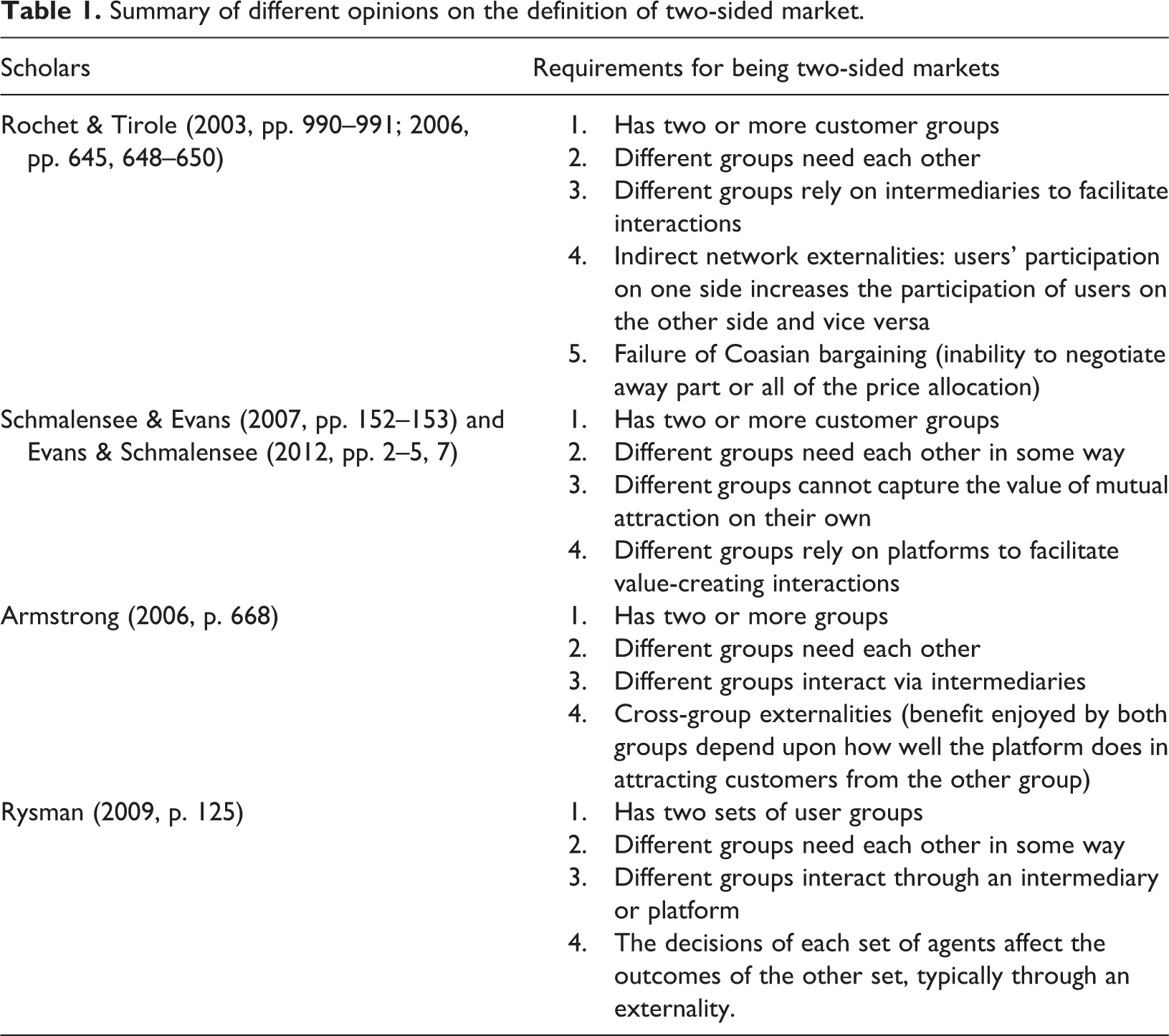
As shown, a general consensus among scholars is that a two-sided market at least should have different customer groups, the groups need each other and they interact via an intermediary or a platform. Even so, whether an IBB is two-sided still needs to be further examined. The online advertising business is an example. Many scholars classify this business into the two-sided market category. 19 It is true that the online advertising business involves multiple parties as most two-sided markets do. Nevertheless, from the perspective of supply and demand, different customer groups generate and satisfy the needs of each other in a two-sided market, while it is the IBBs that generate the needs for both sides in the online advertising business. On one side, the IBBs develop and provide online products and services to customers. Users care more about the quality of online products while the increase of the number of advertisers or the quality of advertisements is unlikely to be a major attraction for consumers to use IBBs’ products and services. On the other side, the IBBs provide advertisers with user information and attention to fulfil their needs. Thus, instead of being a two-sided market, it is more suitable to describe the advertising business as a combination of two closely related markets.
This is not to say that none of the IBBs is two-sided. For instance, the selling and buying sides of an online shopping platform can constitute a two-sided market since the sellers and the buyers need each other and there is an online platform to match them. However, when adding the online advertising business into analysis, it may be inappropriate to just mix all the parties and consider it as a multi-sided market. Instead, it is better to be understood as a combination of one two-sided market (i.e. the trading sides of online shopping) plus one one-sided market (i.e. the advertising market). The analysis above indicates that whether a particular kind of IBBs is two-sided needs to be analysed carefully. Since not all the IBBs are two-sided, a different framework is needed to understand the business models of the IBBs and data’s role in them.
Business models of IBBs under a new framework
The IBBs run under different business models. Some make monetary charge directly for providing products and services. For example, users need to pay money in order to play the online game the World of Warcraft developed by the Blizzard Entertainment, Inc. Yet a more prevalent business model is to provide products and services to users free of monetary charge or for a price well below the cost (both are categorized as free products and services below) and to generate revenue from another related business, which under most circumstances is online advertising. 20 For example, Facebook does not charge users money directly but generates revenue through targeted online advertising based on the data it collects from users (Sengupta, 2012). This model is widely seen in the IBB realm such as online search, social networking services, e-commerce platforms and so on. There are also IBBs that adopt the freemium model, which means users can either choose to use a product or service for free but with advertisements or pay to get an ad-free version. For example, users of Spotify can either choose to use Spotify Free service which allows them to listen to its stream music free of monetary charge but with advertisements or can choose to pay to get the ad-free Spotify Premium version. However, this is not a model of itself but a combination of the first two, giving consumers a flexible choice.
Under both models, the IBBs may collect user data and make further use of them. Figure 1 presents how data are gathered and used by the IBBs. The following session gives further illustrations on it.
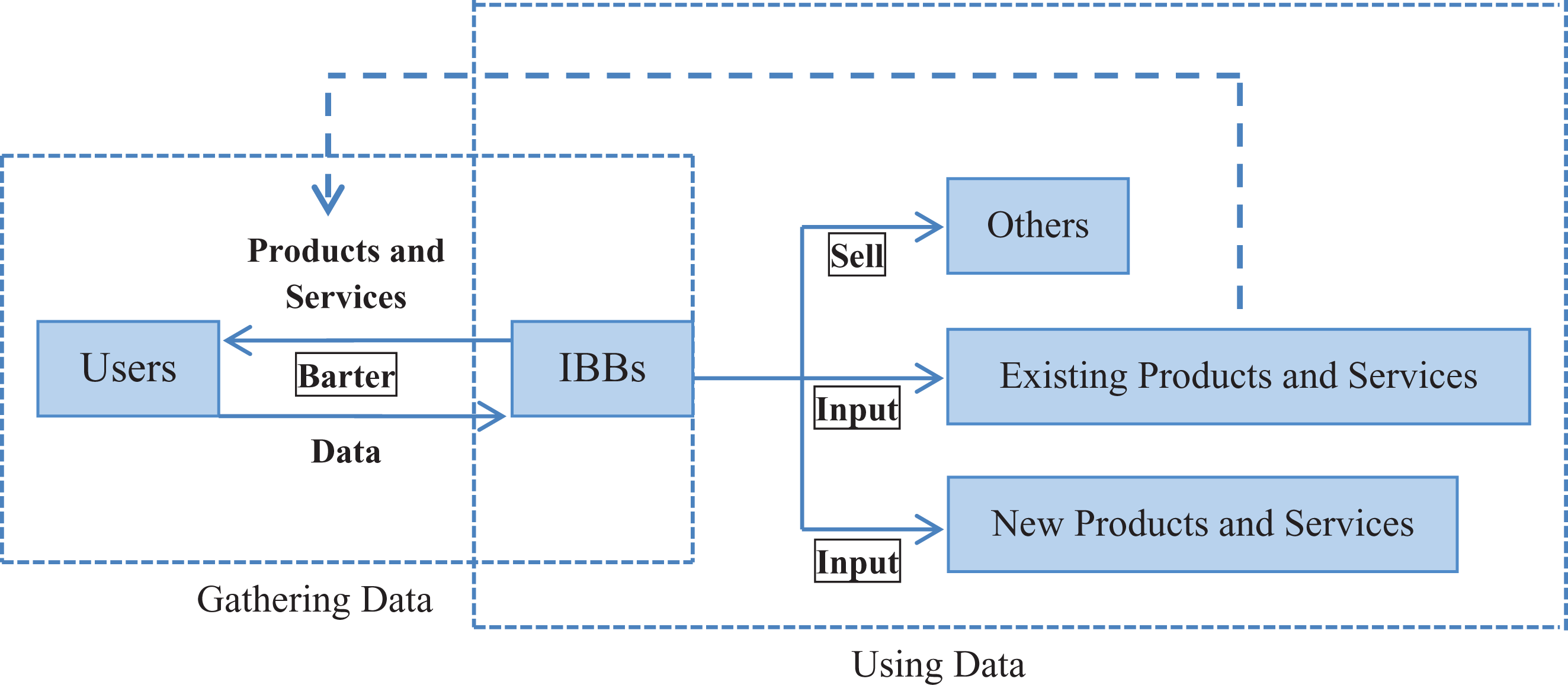
How online data are gathered and used by the IBBs.
Online data’s roles in the IBBs
Online data play different roles in the IBBs and figuring out these roles is crucial for understanding the channels through which online data may exert influence on the competition of IBBs. Online data’s roles can be categorized as the following four.
As a good traded from users to IBBs
There are different opinions on whether the data and products/services exchange between users and IBBs can be recognized as economic transactions. Some scholars contended that unlike usual economic transactions, users as data suppliers are subject to IBBs’ ‘take-it-or-leave-it’ offer without being able to decide the amount and type of information collected from them and what they will get in return (Graef, 2015, p. 490). However, the reason is not strong enough to preclude the trade of data from being an economic transaction because there are also lots of take-it-or-leave-it offer which users cannot negotiate the terms in conventional businesses such as in the banking and insurance realm. These conventional businesses are nevertheless regarded as economic transactions. As regards the amount and type of information, IBBs can have notifications about what type of information they collect, 21 and some also enable users to check the data that have been collected about them. 22 The fact that the amount of data collected is floating ought not to prevent the data exchange from being recognized as economic transactions considering that the floating charge is not precluded from being an economic activity.
Some consider data as the ‘price’ for Internet-based products and services (Gal & Rubinfeld, 2015, pp. 7–8). This is mainly due to the fact that lots of IBBs do not charge users money and online data gathered by IBBs are regarded as a kind of ‘currency’ or compensation for IBBs’ products and services (Graef, 2015, p. 477; Sokol & Comerford, 2017, p. 296). Those hold this view believe that although many Internet-based products and services are provided free of monetary charge, they are actually ‘paid’ by personal information, i.e. user data, and the online data can be perceived as a sort of currency used to pay for the products and services (European Data Protection Supervisor, 2014, para. 1). However, even if the meaning of ‘price’ could be extended to non-monetary form, the ‘price’ proposition still involves a problem: If data is regarded as the ‘price’ paid by users for the Internet-based products and services they received, the Internet-based products and services can also be regarded as the ‘price’ for obtaining user data the other way around (The Netherlands Authority for Consumers and Markets, 2017). Meanwhile, online data also do not have uniform unit value as currency does due to the variety of the information it bears. Thus, although online data can be regarded as a kind of compensation, it is inappropriate and inapplicable to employ online data as a putative price parameter in the competition analysis considering that online data are highly differentiated, just as the products and services of IBBs do.
Actually, the trade between online users who provide online data and IBBs that provide Internet-based products and services is done in another way, the barter. Barter refers to the exchange of one type of good or service for another without using money, the oldest and simplest form of commerce which began before precious metal and money started to be used as a medium for exchange (Black, Hashimzade, & Myles, 2013; Kaikati & Kaikati, 2013, p. 47). Barter requires double coincidence of needs (Starr, 1972, p. 290). Because of the difficulty of matching the offers and demands, it is deemed to be petty, infrequent and a kind of emergency transaction which does not play an important role in economy (Dalton, 1982, p. 185). The Internet provides new opportunities for barter. Both users and IBBs have goods that they can offer and the other side wants. On one side, there are users who are generators and providers of various kinds of online data and want to get Internet-based products and services. On the other side, there are IBBs that offer Internet-based products and services and want to get a wide range of online data. The barter happens every time a user uses an Internet-based product or service that gathers his or her data. This barter relationship is applicable to both the two-sided markets and the joint markets models mentioned above. For example, from the perspective of the buying and selling sides of an online shopping platform like Amazon, it is a two-sided market which provides the market place to sellers and buyers for free and barter for their data. An example of the joint market model can be an online search engine such as Google that provides search services to users for free to barter their data, which can be further processed and used in the joint online advertising market.
It is worth pointing out that this trading process also includes attraction of consumers’ attention from the user side to the IBBs and such attention, which can be resold such as through advertising, is a kind of compensation for IBBs’ free products and services as well. 23 However, this does not preclude the fact that data is also cultivated during the process and in fact online data are employed to better distribute the user attention through targeted advertising (OECD, 2017, p. 266). For the purpose of this article, the focus of analysis below is on the data aspect.
As a good traded by IBBs to others
After IBBs obtain online data, one simple way to make use of them is to sell them directly. An example of this is Twitter, which used to sell the data it gathered from users’ tweeting to other undertakings. The US PeopleBrowsr v. Twitter (2013) is a case involved this. The case is about PeopleBrowsr’s lawsuit against Twitter concerning Twitter’s limitation on its data access. The case documents show that PeopleBrowsr had received tweets data from Twitter’s Firehose for years and paid Twitter over $1 million per year for the access. Selling data can directly bring monetary income for the IBBs and under this circumstance data are commodities bought and sold in the market.
As inputs for existing products and services
Another and more prevalent way to make use of data is not to sell data directly but to use them as inputs for existing products and services. 24 In this respect, data collection is not an end to itself but a step towards final products and services. Under this circumstance, data is an important factor, although not the only one, for the existence and improvement of existing products and services.
Data’s role as inputs for existing products and services functions in two ways. The first is as inputs for the product or service through which they are collected. For instance, online enquiry data can help online search to refine itself and the more search queries a search engine receives the better its ability to rank the related search results (Google Search (Shopping), 2017, paras. 287–290; Pasquale, 2013, p. 6). The second is as inputs for products or services other than the ones through which they are collected (‘cross-product influence’). The most commonly seen examples are data being used as inputs for data analytics services and online advertising. Examples of data analytics services are those provided by Twitter’s Enterprise Data API Platform, Thomson Reuters’s DataScope and the JV created by Telefónica UK, Vodafone UK and Everything Everywhere (Telefónica UK/Vodafone UK/Everything Everywhere/JV, 2012). Online advertising is widely seen in IBBs such as Google, Facebook, Amazon, Microsoft, Apple and Spotify. 25
Another dimension of the second role that is less discussed is data’s cross-product influence beyond data analytics services and online advertising. An example of this is Facebook’s use of WhatsApp data to improve its user matching function. After the Facebook/WhatsApp merger, Facebook changed WhatsApp’s data policy and shared WhatsApp data with Facebook (Commission Decision of 17.5.2017 Imposing Fines under Article 14(1) of Council Regulation (EC) No. 139/2004 for the Supply by an Undertaking of Incorrect or Misleading Information (Case No. M.8228 – Facebook/WhatsApp) (hereinafter ‘Facebook/WhatsApp Fines’), 2017, paras. 45–46). Before the convergence of such data, if one wanted to add WhatsApp friends on Facebook, he or she needed to know the Facebook names of those friends and added them one by one (Smith Jr. & Karmeni, 2015). Based on this post-merger data sharing, Facebook was able to upgrade its function and enable user matching between Facebook and WhatsApp (Facebook/WhatsApp Fines, 2017, para. 30). Facebook’s friends matching and recommendation functions was not a brand new invention due to the incorporation of WhatsApp data. Before it merged with WhatsApp, its People You May Know feature had begun to recommend friends according to users’ profile information and friend links obtained from Facebook’s own data (Logan, 2008). However, the convergence of WhatsApp data provided the chance of developing and expanding its function to match WhatsApp users and Facebook users. In this regard, the WhatsApp data is an important input for the improvement of Facebook features.
The relationship between online data and online businesses is not one-to-one correspondingly. First, different IBBs may need different kinds of data as inputs. Internet-based products and services vary a lot from one another and data that are relevant to one type of online business may be irrelevant to the other. Useful as online search data is for the improvement of online search services, it may of little value to the improvement of social networking services. Differences may even exist within the same realm. For instance, different kinds of inputs are needed for general online search and vertical online search, although both belong to online search services. 26 Second, the same data could be used for different purposes. The data acquired through a particular product or service can be used for improving the product or service through which it is obtained as well as for others. For instance, the data obtained by online search services can be used both for improving online search services and targeted online advertising. 27 Third, a certain product or service may use different kinds of data as inputs. One typical example is online advertising, which may use various kinds of online data as inputs such as those gathered from search engines like Google, online shopping sites like Amazon, online social networking services like Facebook, online music like Spotify, etc.
As inputs for new products and services
It has been pointed out that data has become a core driver for innovation in the digital world (OECD, 2017a, p. 197). Data-driven innovation is contributing to the creation of knowledge and the value of society, bringing new products, processes, markets and business models to the world and this data-driven innovation requires the IBBs to host data of large volumes and variety (OECD, 2015, pp. 209, 238). The artificial intelligence (AI) realm is an example of this. By making use of online data, IBBs can automate their processes and make R&D on new products (OECD, 2017a, p. 203). Online data have been used to train AI algorithms. An example of this is Tay, a chatting bot developed by Microsoft. Tay was released on Twitter on 23 March 2016 under the name TayTweets and handles the Twitter account @TayandYou. 28 A key input for this project is Twitter’s online chatting data. The more users chat with Tay, that is, the more the data inputs, the smarter and more personalized for a user Tay would be (Know Your Meme, 2016; Wakefield, 2016). Although it was soon called back because of moral problems (Victor, 2016), Tay’s experience did show how important data could be for the R&D of new products. Actually, Microsoft continued to explore the AI realm after the Tay incident. Its new product Xiaoice chatting bot has been successful in China and user chatting data is still a core driver (Geoff Spencer, 2018; Vanian, 2016).
Online data and the current market definition of IBBs
After a brief introduction of the basics of market definition in general, this section explores the current relationship between online data and market definition and examines what, if any, the conventional market definition methods fail to capture based on the influence channels figured out in the last session.
Market definition in general
Market definition, which includes both product and geographic dimension, is widely accepted as the first step of competition analysis. Market definition is not an end in itself but an important step towards the competitive assessment by spotting the markets that are ‘worth monopolising’ and the main purpose of market definition is to find out the products which are such close substitutes to the product under scrutiny that are able to exert competitive pressure on the suppliers’ behaviour (Jones & Sufrin, 2016, p. 56). 29 After the relevant markets are defined, market shares and various other factors are taken into consideration to carry out competitive assessment and one of these factors is the accessibility of key inputs (Jones & Sufrin, 2016, p. 338).
In order to assess the competitive constraints among products and services, substitution analyses from both the demand and the supply side are taken into consideration (Jones & Sufrin, 2016, pp. 60–61). The former relates to the ability of customers to switch to substitutes and the latter is about the ability of other undertakings to switch to produce substitutes in a short time. Both quantitative and qualitative methods could be employed to help define the relevant markets. An important quantitative tool is the hypothetical monopoly test, which is normally carried out by starting from the smallest market and see what would happen if the hypothetical monopolist imposes a small (5–10%) but significant non-transitory increase in price. If consumers can turn to other widgets or to suppliers in other geographic areas to make the price increase unprofitable, those widgets and geographic areas are added to the relevant market. The process is repeated until there is a market that would make the price increase profitable. Important as it is, the hypothetical monopoly test is neither the only nor an essential method for substitution analysis. For instance, the EC pointed out in Google Search (Shopping) (2017, paras. 242–243) that different kinds of evidence could be relied upon without hierarchy for the substitution analysis.
The current relationship between online data and the market definition of IBBs
The present cases present two kinds of relationships between online data and the market definition of IBBs. One is to define a market for online data following the conventional market definition methods when online data are directly traded and the other is as a consideration factor in non-data market definition when it is not directly traded.
Market definition for online data
As discussed above, one way the IBBs make use of the online data is to trade them directly. 30 Since price parameter is available because of the existence of selling and purchasing, it is possible to define a relevant market for online data following the conventional market definition methods under this circumstance. In practice, the EC, for instance, has not defined any relevant market for online data in the IBB cases up to now. 31 However, the lack of buying and selling of online data has been a reason for refusing to define a relevant market for it. This view was explicitly expressed in the EU Facebook/WhatsApp (2014) case. Neither Facebook nor WhatsApp sold data directly when the merger was proposed. It was found that Facebook only used data for its own services without selling it to any third parties and WhatsApp did not store or collect user data that would be valuable for advertising purposes (Facebook/WhatsApp, 2014, paras. 70–71). The EC pointed out that it did not consider any possible market definition for the provision of data since the two merging parties were not active in any such potential markets (Facebook/WhatsApp, 2014, para. 72).
Online data as a consideration factor in non-data market definition
There are cases that no market for online data is defined but online data are taken into consideration when delineating online data-related products or services. An example of merger is the Telefónica/Vodafone/Everything Everywhere/JV (2012) dealt by the EC, which concerns data analytics services. In this case, the EC examined whether the provision of data analytic services for mobile advertising could form a separate product market of its own (Telefónica/Vodafone/Everything Everywhere/JV, para. 199). Market investigation of both suppliers and demanders showed that data analytics service for mobile advertising and that for static online advertising collected different kinds of information and user details (i.e. different kinds of data) (Telefónica/Vodafone/Everything Everywhere/JV, para. 200). Data collected by the former were considered to be more personal, geo-located and could link to phone call behaviour while data collected by the latter did not have these traits (Telefónica/Vodafone/Everything Everywhere/JV, para. 200). This difference in online data led the EC to believe that there might be separate markets for online and mobile data analytics (Telefónica/Vodafone/Everything Everywhere/JV, para. 202). Similar analysis has been adopted for the abuse of dominance. In the Google Search (Shopping) (2017, para. 248), one of the reasons to separate offline and online comparison shopping was that the former could not provide the same amount of information compared with the latter. In other words, the offline comparison shopping’s lack of the ability to provide comparable amount of data with online comparison shopping was the reason to separate those two markets.
What the conventional methods may fail to capture
It has been put forward that the product market definition based on data’s current usage fails to fully capture data’s influence on competition (Harbour & Koslove, 2010, p. 773). However, a closer examination is needed on what role(s) of data is (are) causing problems and which aspect(s) of data’s influence is (are) likely to be missing in the competition analysis. To begin with, when there is a buying and selling market for online data, relevant market of such data can be defined based on conventional market definition methods and it is possible to capture online data’s influence on competition. Beyond this circumstance, whether the influence of online data can be fully captured needs to be further explored.
Examine the influence of online data in the barter context
The first thing that needs to be looked at is IBB’s power of acquiring online data through barter. As shown in the Getting Data box in Figure 1, IBBs barter their products and services to users and obtain online data. The identity of an IBB involved in such a barter transaction is both a ‘buyer’ of data and, at the same time, a ‘seller’ of products and/or services. The IBB’s capability of getting user data is positively related to its ability of providing attractive products and services. Other things being equal, the more an IBB’s product or service is used, the better the IBB’s capability of cultivating user data through that product or service. Thus, analysis of the ability of an IBB to harm consumers by offering worse transaction conditions in the barter context – to cultivate more user data (which can be regarded as an increase of the ‘selling price’ of IBBs’ product or service), to lower the quality of its product or service (which can also be regarded as a lower ‘buying price’ for user data) or to drag down innovation – could be carried out based on the relevant markets defined for the product or service provided by the IBB. Such relevant markets have already been defined in the IBB cases dealt by the EC, including the products and services that are free of monetary charge such as the consumer communications services and the social networking services in the Facebook/WhatsApp (2014, paras. 13–34, 45–62), the professional social networking services in the Microsoft/LinkedIn (2016, paras. 87–117), as well as the general search services in the Google Search (Shopping) (2017, paras. 155–190). Therefore, the influence of data on competition in the barter context is possible to be captured based on the relevant markets defined for the bartered products and services, which already exist under the current competition analysis framework.
Examine the influence of online data as inputs for existing products and services
The second is data’s roles as inputs for existing products and services. As discussed above, the lack of data trading has been used as a reason for refusing to define relevant markets for data. 32 However, online data’s influence on competition may be analysed as inputs, such as through barrier to entry, under the competitive assessment of the Internet-based products or services they are related to. In order to examine whether online data’s competitive effect can be fully captured under this circumstance, a revisit of its roles would be helpful. Based on Figure 1, a closer examination is made in Figure 2 to 4. Because there is a feedback loop between data collection and data as inputs, the barter side is also included in the figures to present a more complete view. However, the focus of this section is on data’s roles as inputs.
Data could be used as inputs for the product or service through which it is acquired as well as inputs for other products and services. Assume that there is an IBB(1) that provides online services A (‘Service A’) along with other Internet-based products and services. It collects data set an through providing Service A (‘Data an’). Some of Data an (‘Data anx’) could be used for improving Service A and some (‘Data any’) could be used for another service Z (‘Service Z’) provided by IBB(1). 33 A real-world example of this could be an IBB that collects data from online search services and uses the data as inputs both for online search and online advertising. The relationship is demonstrated in Figure 2.
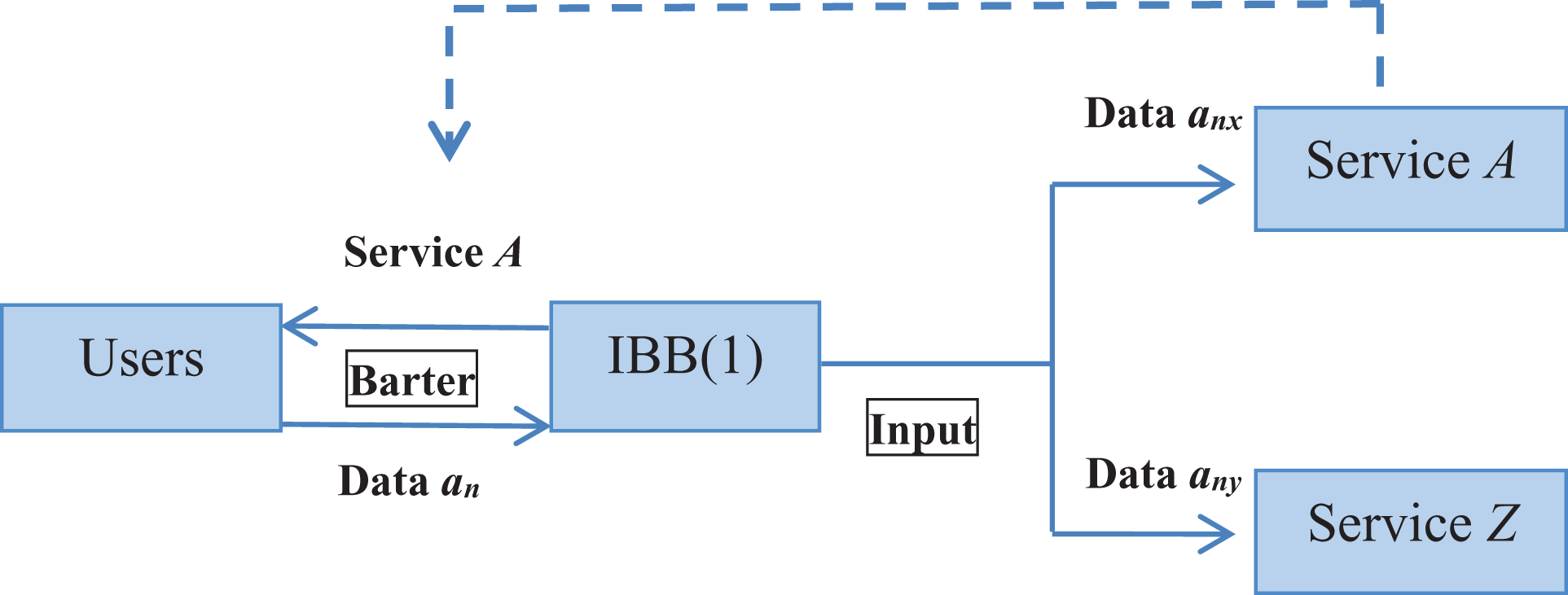
Online data as inputs for existing products and services.
The relationship in Figure 2 can be further split into Figures 3 and 4.
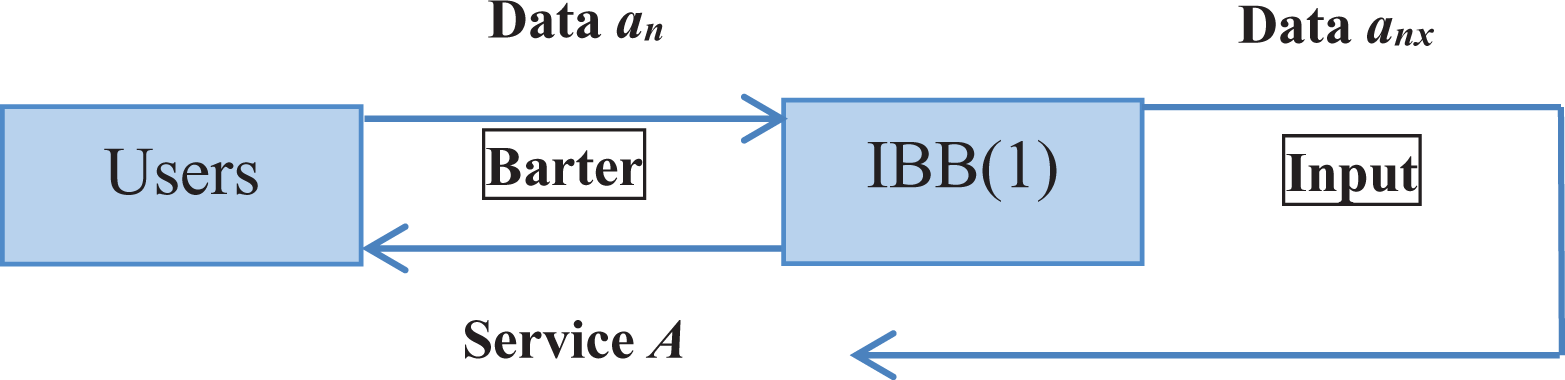
Online data as inputs for the existing product and service through which it is obtained.

Online data as inputs for other existing products and services.
For abuse of dominance, the focus is on the product and the market which the IBB under scrutiny was accused of abusing its dominance. The abusive behaviour of a dominant IBB is based on the market power that has already been held and the market power depends on the route(s) of online data’s influence on competition that has been established. To put it differently, whether through the way presented by Figures 3 or 4, the abusive behaviour itself will not change the path(s) how online data influences competition. Under this circumstance, online data’s influence on competition can be analysed under the relevant markets defined for the product or service under scrutiny. The EU Google Search (Shopping) (2017) case is an example of this. The case is about Google used its dominant position in the general search market to give its own comparison shopping service a more favourable positioning. When defining the relevant markets, one of the reasons for separating the general search from specialized search is that they rely on different sources of data (Google Search, para. 168). Online data’s influence on the general search service was then considered when analysing the barrier to entry and expansion in the competitive assessment section (Google Search, paras. 287–290).
There are different scenarios when it comes to merger. For the usage of data presented in Figure 3, that is, when data is only used for the existing product and service through which it is obtained, if the merging parties have no overlap in their products and services, the merger will not raise competitive concerns in terms of online data because incorporating the data of one products and services will not in itself strengthen the power of the other. If the merging parties do have overlaps in Service A, the competitive influence of the combined online data could be captured by the market definition and competitive assessment of Service A. For instance, in the EU Facebook/WhatsApp (2014) case, both parties provided consumer communications services. The EC defined a relevant market for consumer communications services for smartphones and considered online data’s influence on the competition of this market when analysing consumers’ ability to switch from the demand side and the barrier to entry from the supply side (Facebook/WhatsApp, 2014, paras. 113, 122). It is possible to question whether online advertising is different and to fear that the effects of those inputs would not be captured in that it is related to a large variety of data inputs. However, it is worth noticing that data gathered through online advertising do not equate to the data used for online advertising. The latter is of a larger scope with data obtained from various other sources such as online search, social networking services and online shopping, and this relationship will be discussed later. Bearing this in mind, it will be found that online advertising also matches this rule. For instance, in the EU Google/DoubleClick (2008, paras. 179–190) case, the EC assessed the data DoubleClick collected through its ad-serving services and the influence of these data on competition. The data included those created through DoubleClick’s hosted products for advertisers, which were about users’ browsing behaviour on the publishers’ websites as well as those created through its hosted product for publishers, which were about the advertisers and networks that filled the ad spaces as well as the IP addresses of the users who requested the web pages (Google/DoubleClick, 2008, paras. 182, 186).
Things could become different when considering data’s role as cross-product or cross-service input (‘cross-product input’) as shown in Figure 4. Under this scenario, if the products and services have horizontal overlaps or vertical relationships, relevant market could be defined for them according to the conventional market definition theory and the data’s cross-product input effect can then be captured. For instance, in the EU Microsoft/Yahoo! Search Business (2010) case, both parties provided online advertising services and Internet search services. The EC considered the market definition of these two realms and examined how online search data could influence the online advertising services if the merger was granted. 34
However, problem could rise if there is no horizontal overlap or vertical relationship in the merging parties’ products and services. To illustrate this, based on Figures 3 and 4 above, assume an IBB(2) who provide service B (‘Service B’) and could obtain some data that has overlaps with Data an (‘Data am’), such as user profile information, and some data with no such overlaps (‘Data bn’). Assume some data from Data am and Data bn (‘Data amx’ and ‘Data bnx’, respectively) could be inputs for Service A and some (‘Data amy’ and ‘Data bny’, respectively) could be used for Service Z, but IBB(2) does not provide Service A or Service Z. A real-world example could be a merger between a social networking services provider who also provide online advertising services (i.e. IBB(1)) and a consumer communications services provider who does not provide social networking services or online advertising services (i.e. IBB(2)). Nevertheless, some of the data from the consumer communications services could be valuable inputs for the social networking services and some could be valuable inputs for online advertising services. If IBB(2) proposes to merge with IBB(1), the services themselves do not appear to have horizontal overlaps or vertical relationships. However, the incorporation of data from IBB(2) could influence the competition condition of Service A (Figure 5) and Service Z (Figure 6).

The first circumstance of online data’s cross-product input effect.

The second circumstance of online data’s cross-product input effect.
These are what might be omitted by the competitive analysis based on the conventional market definition methods. Although currently the relevant markets might still be defined in the absence of horizontal overlaps or vertical relationships if there are conglomerate effect concerns, these markets are identified based on the concerns of the conglomerate effects of products and/or services rather than the potential competition influence of inputs, which online data belongs to. In the EU Microsoft/LinkedIn (2016, paras. 308–330) case, for instance, although the EC considered the market definition of the professional social networking services absent horizontal overlaps or vertical relationships, the motivation was to analyse the possibility of pre-installing such services of LinkedIn on the operation system of Microsoft and the possibility of integrating LinkedIn’s features into Microsoft’s productivity software Office. Under this circumstance, market definitions for the Internet-based products and/or services whose data may have cross-product input effects may be left out if the products and/or services do not in themselves raise conglomerate concerns in terms of their function.
Examine the influence of online data as inputs for new products and services
The third thing to be looked at is data’s role as an input for new products and services. In general, the conventional competitive analyses do not consider products or services that are still under R&D and have not been marketed. This is mainly because in the R&D stage, the relationship between market power and innovation is inconclusive (OECD, 2002, p. 8). Take merger as an example, on the one hand, market concentration means more resources available for the merged parties; thus there could be an expected increase in innovation capability after merger. On the other hand, however, less competition post-merger means less pressure to innovate (OECD, 2002). From this perspective, the influence of input (i.e. online data) is not the only thing that is missing under this circumstance – the influence of the merger on products and services under R&D stage is likely to be left out as a whole. In other words, it is not that conventional methods fail to capture the competitive effects of the things under innovation, but they deliberately choose to leave them out.
However, it has been noticed that there are business realms in which the R&D of new products and services plays a vital part in competition and the IBB area is such a realm. The OECD pointed out that in highly dynamic and innovative markets, the competition might be characterized as competition ‘for the market’ rather than ‘in the market’ (OECD, 2002, p. 7; 2012, p. 44). Under certain circumstances, the influence of merger on the R&D of new products and services is taken into consideration, such as the innovation market approach in the intellectual property antitrust realm in the United States and the horizontal agreement realm in the EU (Antitrust Guidelines for the Licensing of Intellectual Property, 1995, pp. 10–13; Guidelines on the Applicability of Article 101 of the Treaty on the Functioning of the European Union to Horizontal Co-operation Agreements (hereinafter ‘EU Horizontal Co-operation Agreements Guidelines’), 2011, paras. 120–122). There are different opinions towards the innovation market definition. Some regard it as a useful tool to capture the competitive effects of the products and services that do not yet exist (Gilbert & Tom, 2001, pp. 49–50). Others pointed out that the definition of such a market would be very difficult to clearly set out and apply, and the result could considerably increase legal uncertainty (OECD, 2002, p. 7). There is a general consensus among competition authorities and academics that if such an innovation market is to be defined, it should be confined to the situation where no market for affected products yet exists (Gilbert & Tom, 2001, pp. 49–50; OECD, 2002, pp. 27, 176–177). In practice, the application of innovation market is limited, with the United States mainly focuses on the intellectual property licensing realm and the EU on the horizontal co-operation agreements. In fact, there are even restrictions within these fields. For instance, according to the EU Horizontal Co-operation Agreements Guidelines, the innovation market will be considered only when the R&D poles are possible to be identified (EU Horizontal Co-operation Agreements Guidelines, 2011, paras. 120–122).
These facts show that the influence of online data on the innovation of Internet-based products and services may not be covered by the merger review but this is deliberately chosen due to the special relationship between R&D and competition rather than being left out inadvertently.
Summary
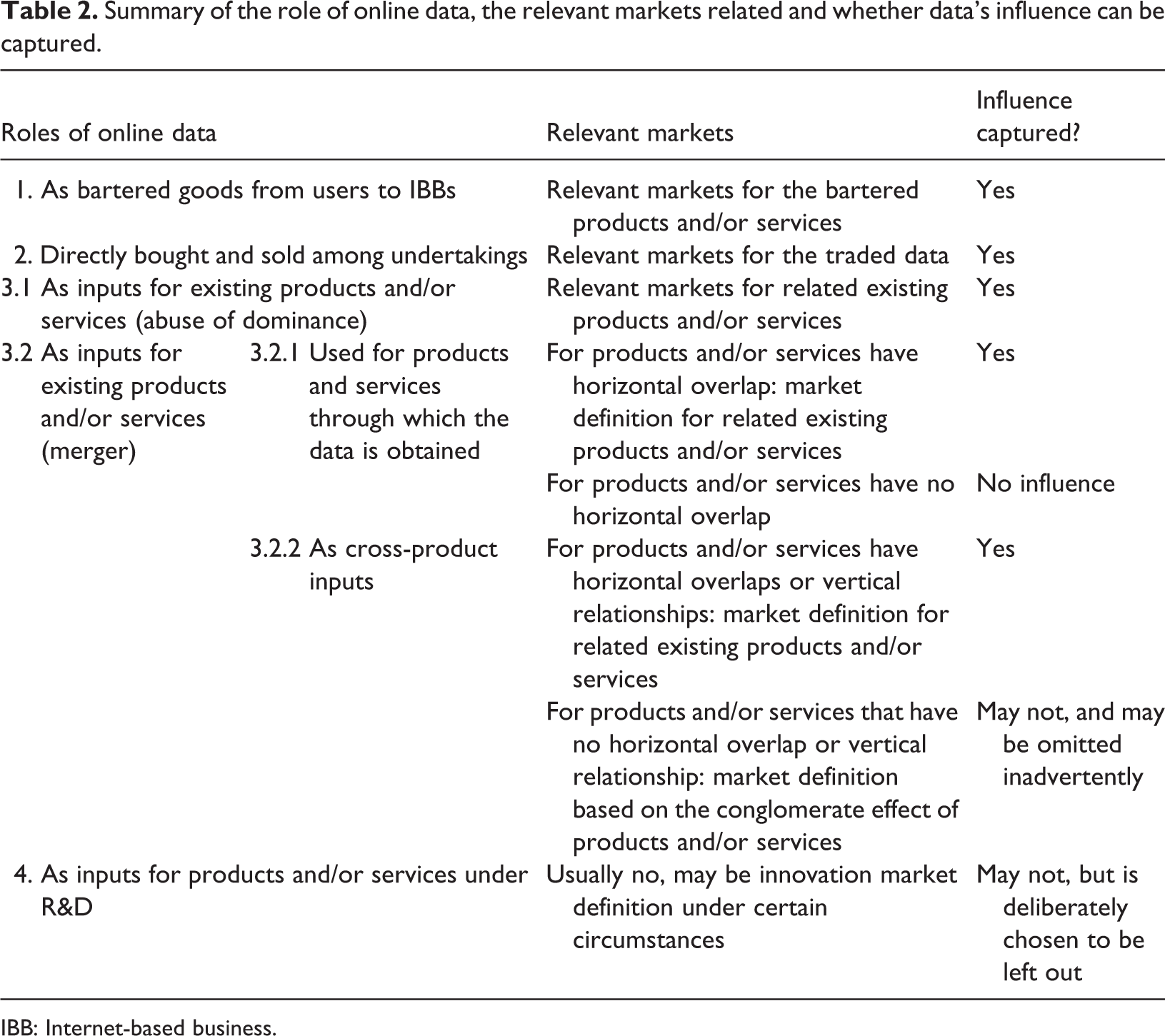
Table 2 gives a summary of the relationship among data, data-related relevant market definitions under different circumstances and whether data’s influence on competition is possible to be captured based on these relevant markets.
Summary of the role of online data, the relevant markets related and whether data’s influence can be captured.
IBB: Internet-based business.
It can be seen from Table 2 that what is likely to be missing when analysing online data’s influence on competition is when data act as cross-product inputs in the mergers for the products and/or services that have no horizontal overlap or vertical relationship, or as inputs for products and/or services under R&D, and the latter is usually deliberately chosen not to be included. Based on this, the following analysis will focus on the former and examine the potential ways to deal with the problem.
Capture what is missing
After figuring out what might be missing by the conventional analysis methods in the last section, this section intends to explore whether the existing alternative approaches are able to capture what is missing and if not, what could be done to cope with the problem.
Explore possible alternative approaches to capture what is missing
Examine existing alternative approach: The input market definition
Since the problems concerning online data are related to their role as inputs, it is worth examining whether the input market definition approach can help to solve the problem. Not every kind of input can be defined an input market for and usually the influence inputs is discussed together with the product or service it relates to, such as under barriers to entry (Jones & Sufrin, 2016, p. 338). 35 Input market definition has been adopted to assist the analysis of abuse of dominance cases, especially concerning refusal to supply. 36 Take EU as an example, as established by cases, such market can be defined when the input is essential for the existence of a downstream product. 37 In the high-tech sector, it was stressed again in the Microsoft Corp. v. Commission of the European Communities (2007, para. 335) that an input market could be defined if the product or service was indispensable to another business and if the undertaking who sought to carry out that business had actual demand for them.
Input market definition is unlikely to fully solve the problem even being introduced from the abuse of dominance realm to the merger realm. This is due to the fact that the online data held by the merging parties may not be essential for each other. Under such circumstances, market cannot be defined according to the input market approach but the merged online data may still have an important influence on competition. For instance, in the EU Facebook/WhatsApp (2014) case, the WhatsApp data was not a must have input for Facebook products and thus do not match the essential input requirement. Nevertheless, the incorporation of WhatsApp data showed the ability to have great influence on the function and competitiveness of the Facebook product. 38
Will market definition for data be a solution?
In order to capture the influence of online data, it has been proposed that putative relevant markets for data be defined. The overlooking of data’s role in competition has been criticized since the Google/DoubleClick (2007) case dealt by the Federal Trade Commission (‘FTC’) in the United States. Newman (2014, pp. 423–425), for instance, contends that Google’s control of user data is a source of its dominant power in the search advertising market. Actually, when making the case decision, FTC Commissioner Pamela Jones Harbour called for attention on how the combination of the merging parties’ online data would influence the competition of online advertising business of the merging parties. She pointed out that the combination of the online search data of Google and the browse data of DoubleClick would create a database that would greatly enforce Google’s capability in targeted online advertising business and that the entity post merger would be a giant with unparalleled data resource access (Dissenting Statement, 2007, pp. 6–8). Based on this, Commissioner Harbour (Dissenting Statement, p. 9) contended that defining a putative relevant product market of data useful for behavioural targeting would have helped to better capture the influence of data. Following this, she and her then Attorney Advisor Tara Isa Koslov propose that for the online services that are fuelled by data, relevant markets for data should be defined separately from the services in which the they are used to reflect the distinction between data collection and the expanded data usage later on, to recognize the increasingly importance of data and to reflect the reality that data might be used for the purposes beyond its initial collection purpose (Harbour & Koslove, 2010, p. 773).
Graef (2015) further develops the data market definition proposition, especially by contributing discussions on how such market could be defined. It is proposed that online data should first be defined as a separate market from offline data because the scope and specificity of the former are incomparable, and then a further separation within online data (Graef, pp. 496–498). It is contended that if different relevant markets can be distinguished for products and services, the online data related to it can also be separated accordingly. Based on this, there can be separate online data markets for online search, social networking services, e-commerce, online search advertising and online non-search advertising – all identical to the relevant markets defined for the products and services (Graef, 2015). The possibility of further separating the data within these markets is also put forward based on the US case PeopleBrowsr, Inc. et al. v. Twitter, Inc. (2013). Twitter is an online communications platform which collects users’ ‘social data’ through its online communications services and after obtaining the data, one way to make use of them is to sell them directly to other undertakings such as data analytics companies. 39 Twitter claimed that it would maintain an ‘open ecosystem’ to its Twitter data. PeopleBrowsr is a technology company whose services include Twitter Big Data Analytics, a service that gets user tweets data, analyses them and sells the results to its clients. PeopleBrowsr built its business upon Twitter data and purchased Twitter data for years before Twitter sought to restrict its data access. PeopleBrowsr contended Twitter’s restriction to be an act of unfair competition. The parties’ documents presented to the court showed that market definition in relation with online data was an important concern in this case. Although the affected market is the data analytics services, the debate was around the substitutability of online data and whether the relevant market could be defined as the Twitter Big Data Analytics market. Twitter argued that the relevant market should not be defined so narrow as a single data brand and there was a large amount of potential online data available for PeopleBrowsr such as those from Google and Facebook (Defendant Twitter, Inc’s Notice of Motion and Motion to Dismiss Plaintiffs’ Complaint, 2012, pp. 14–15). PeopleBrowsr refuted this by pointing out precedents had established the possibility of defining single-branded markets and that other online data were not substitutes to Twitter data, which was ‘a unique, irreplaceable input, providing essential data regarding user influence, emerging trends, and consumer sentiment that is unavailable from other sources’ (Plaintiffs’ Opposition to Defendant Twitter, Inc.’s Motion to Dismiss Plaintiffs’ Complaint, 2013, pp. 24–25). The case was settled in the end thus there was no final judgment from the court on the relevant market definition (Grill, 2013), but based on this case Graef believes it is possible to further separate the market of online data.
There are problems with the putative relevant data market definition proposition. First, there is no need to define putative relevant markets for online data if they are set identical with the relevant markets defined for the existing products and/or services from which they are obtained since the influence of online data on competition can already be captured as inputs based on the latter as discussed above. 40 Second, as for further separating the data market within the scope of a certain kind of product or service market like the Twitter example presented, it is questionable whether this approach is suitable to be generalized. This is because in the PeopleBrowsr v. Twitter case, there is buying and selling of the data and the background of this case is abuse of dominance. As pointed out previously, relevant markets for data can be reasonably defined when there is direct buying and selling of data. 41 Under such circumstance, the data itself is the commodity and the demand and supply substitution for data can be identified. The theory supporting this market definition is identical to any other products and services that are directly bought and sold. Even leave this behind, the case is still subject to the essential principle of the input market definition theory. As discussed above, this theory is insufficient to cope with the problem. 42 Without the support of the buying and selling relationship and the essential principle, the online data market definition proposition provides no additional alternative method to delineate the market; thus the market definition may only depend on the separation of the products and services from which data are obtained and this will lead us back to the first problem again.
To summarize, the discussion above shows that the existing and the proposed alternative market definition methods are insufficient to cope with the omission problem. The input market definition method cannot cover the inputs which are not essential but have significant influence on competition and the online data market definition proposition has the problem of either being redundant for having the same function with the conventional method or fails to provide applicable alternative market definition method.
Switch focus from introducing new methods to improving the existing ones
The problem does not necessarily need to be coped with by introducing new market definition methods. To better capture online data’s cross-product input effect, a better way probably is to improve the existing market definition methods for products and services and to focus more on the inner relationships of online data and how they exert cross-product impacts when identifying which market to define. Although the inner relationship and cross-product effects need to be analysed on a case-by-case basis due to the diversity in online data’s nature and their multiple usages, the following explorations may provide some useful insights.
Looking into the markets: Products and services related to data analysis
Services related to data analysis are where data’s cross-product influence is frequently seen. The online advertising is a representative example of this. In terms of the service itself, online advertising does not have horizontal or vertical overlaps with services such as online search, consumer communications services and social networking services, and usually does not raise conglomerate concerns with these services. However, if the relevant markets of these services were defined according to their competition condition respectively, the influence of cross-product input effect of online data may be captured. For example, in the EU Facebook/WhatsApp case, the EC defined the consumer communications services based on the overlap of the Messenger of Facebook and the WhatsApp application, and defined the relevant market for online advertising services absent service overlap (Facebook/WhatsApp, 2014, paras. 13–44, 69–83). It then analysed the potential influence of the incorporation of WhatsApp data on online advertising services and concluded that it would not raise serious concerns even if the merged entity were to expand data collection and to use WhatsApp user data for online advertising because there would be plenty of online data available for other undertakings which could also be used for online advertising (Facebook/WhatsApp, paras. 180–189). Similarly, in the EU Microsoft/Linkedin case, among the relevant market defined the parties only have overlap in online non-search advertising services but the EC nevertheless defined relevant markets for other products and services mainly out of conglomerate considerations, 43 including the online communications services, professional social network services and online recruitment services (Microsoft/LinkedIn, 2016, paras. 74–151). It then examined whether and how the combination of the parties data would influence the merged parties’ competitive position in online advertising and concluded that the concentration of online data would not cause serious concerns because, among others, there are lots of alternative valuable data for online advertising that are beyond the merging parties’ control. 44
The cases show that once relevant markets for services relate to data analysis and other Internet-based products and services whose data might be input for data analysis have been defined, how the online data obtained from the latter influence the former can be analysed accordingly.
Looking into the markets: Non-data analysis-related products and services
Data’s cross-product input effect is not confined to services related to data analysis but may influence other products and services as well. The EU Facebook/WhatsApp (2014) case is a reflection of this. During the merger review process, third parties raised concerns that the merged entity would be able to make use of the user data from both WhatsApp and Facebook to enable cross-platform communications or to integrate WhatsApp with Facebook, which could add users and/or additional functions to Facebook’s social networking services (Facebook/WhatsApp, para. 159). Based on the market definition of consumer communications services and social network services, the EC examined the potential cross-product usage of data and contended after examination that such cross-product usage of data is unlikely to happen due to technological hurdles (Facebook/WhatsApp, paras. 138–139, 160), although later on it turned out that Facebook provided misleading information concerning the technological capability to employ data in such a cross-product way (Facebook/WhatsApp Fines, 2017, para. 30).
Improving relevant market identification methods
What is worth noting is that the above-mentioned market definitions are based on the competition condition of products and services, such as having overlaps or raising concerns of conglomerate effects. In other words, the markets were not defined because of the consideration of the potential cross-product influence of data but were defined based on other reasons and happened to provide the basis for analysing the influence of online data. For instance, in the EU Facebook/WhatsApp case, there were overlaps or overlap possibilities of the two non-online advertising services, the consumer communications services and the social networking services. Facebook overlapped with WhatsApp in consumer communications services through Facebook Messenger (Facebook/WhatsApp, 2014, para. 15). The EC also investigated the overlap possibility and substitutability between the social networking services, a service Facebook provided, and the consumer communications services, a service WhatsApp provided (Facebook/WhatsApp, paras. 51–62). Also, as discussed above, most Internet-based products and services in the EU Microsoft/LinkedIn case were defined due to conglomerate considerations, such as the delineation of the online communications services even when LinkedIn did not offer any similar service and the online recruitment services, a sector in which Microsoft was not active (Microsoft/LinkedIn, 2016, paras. 75–86, 126–151). Online data’s cross-product effect was evaluated based on these markets.
However, for the products and services that appears to not even raise conglomerate concerns in terms of their functions and features, relevant market may not be defined thus the competitive analysis may not be able to fully cover online data’s cross-product influence. To deal with this problem, it may be helpful to adjust the conventional market definition methods by taking online data’s cross-product influence into consideration when identifying which relevant market to delineate. More specifically, considering relevant market definition for the products and/or services which do not have horizontal overlaps, vertical relationships or conglomerate effects but whose data may have cross-product influence. Although how to figure out such market in practice is a highly practical issue and demands case-by-case analysis thus is not a main focus of this article, it is worth mentioning that market investigation could be a helpful tool. Just as the EU Facebook/WhatsApp case in which third parties raised concerns about the potential cross-product usage of WhatsApp data (Facebook/WhatsApp, 2014, para. 159). Similarly, in the EU Microsoft/LinkedIn case, it was also the third parties pointed out the LinkedIn data were or would be an important input for the customer relationship management software solutions product (Microsoft/LinkedIn, 2016, paras. 246, 257).
Conclusion
Despite the abundant and nonrivalrous appearance, the competition for online data is fierce and IBBs develop various kinds of products and services that can collect online data. These products and services are provided to users under different business models and online data play different roles. It can act as bartered goods transferred from users to IBBs, as goods bought and sold directly among the IBBs, or as inputs for existing products and services as well as for developing the new ones. Currently online data are related to market definition in two ways. One is that relevant markets for online data can be defined when there are buying and selling markets for them. The other is as a factor considered in the market definition process of the products and services they are associated with.
Most of online data’s influence on competition can be captured depending on the relevant market defined under the conventional market definition methods. What may be omitted is online data’s cross-product input influence on the existing products and services in merger when the related products and/or services lack horizontal overlaps, vertical relationships and conglomerate effect. Apart from this, online data’s influence on the R&D of new products and services is also left out, but deliberately. In terms of dealing with the former problem, the input market definition fails due to the limitation of the essential requirement and the online data market definition proposition is redundant for what has already been captured by the conventional market definition methods and fails to supply applicable new ones.
What may help is to switch focus from trying to introduce new market definition methods to improving the existing ones for products and services by taking online data’s cross-product input effect into consideration when identifying which markets to delineate, especially when lacking horizontal overlaps, vertical relationships or conglomerate effects judging from the function of the final products and services.
Footnotes
Declaration of Conflicting Interests
The author(s) declared no potential conflicts of interest with respect to the research, authorship, and/or publication of this article.
Funding
The author(s) disclosed receipt of the following financial support for the research, authorship, and/or publication of this article: The author’s PhD study is sponsored by the Chinese Scholarship Council.
