




Abstract
Regulation of utilities at the state level in the United States is undertaken by a commission on which anywhere from three to seven commissioners sit and must vote on virtually all significant utility actions, including rate requests, resource plans, acquisitions and mergers, and financing mechanisms. Public utility commissions (PUCs) are, in a very real sense, courts with adjudicatory responsibility over the area of state utility laws. In hearing a utility case, they must follow the state’s statutes and court rules. The commissioners function as judges in this court of public utility law. In a majority of states, commissioners are appointed by the state’s governor with the advice and consent of the state legislature. In a significant minority of states, commissioners are elected by popular vote. However, recent changes in US election law have made it easier for corporations and special interest groups, called political action committees, to influence elections through donations targeting direct voter outreach on behalf of specific candidates. This chapter examines what the entry of political spending in PUC elections means, and whether elected commissioners can adjudicate in the public interest, or will adjudicate for special interests. The chapter concludes that while both the appointment and election governance model can produce both “good” and “bad” commissioners, it is the elected commission that is most at risk of selecting commissioners that will not be truly independent and objective arbiters of the law.
The United States has what has been called a balkanized system for regulating its public utilities. The federal government exercises regulatory control, through the Federal Energy Regulatory Commission (FERC), over certain wholesale and interstate aspects of electricity and natural gas supply, while the 50 states and the District of Columbia have jurisdiction over retail supply and distribution of most public utility services. 1,2 While there is often regulatory friction among the states and between the states and the federal government, this construct arises from the country’s foundation as a federation in which the states are delegated regulatory and legal control of activities occurring within their borders that do not impact other states. This dual-authority construct is not unique in the world—for example, the German Federal Republic shares some of these same characteristics—but it is quite rare.
These public utility commissions (PUCs) act as courts of jurisdiction over the rates, terms, conditions, and many of the actions of the public utilities within their state. A panel of judges, usually called commissioners, is empowered to make the final decisions on the cases brought before them. 3 In many Organization of Economic Cooperation and Development member (OECD) nations, the leadership and authority of the utility regulatory authority is vested in an individual who serves at the pleasure of an elected official or board of directors. In the United States, the multi-person commission is the prevalent structure at both the federal and state levels, but it is how these commissioners are selected that is unique. A majority of these commissioners are appointed by the chief executive of the political entity (the president, governor, or mayor), but a significant minority are selected by popular election and are therefore independent of and do not answer to another government body or individual (except through formal impeachment, which is rare).
It turns out that how these commissioners are selected is important. PUCs generally have wide discretion over the implementation of state energy policies through the design and level of utility rates, energy efficiency programs, renewable energy programs, integrated resource planning, certificates of convenience and necessity, abandonment of facilities, 4 and mergers, sales and purchases of utility property to or from other utilities.
Characteristics of the US system of state PUCs
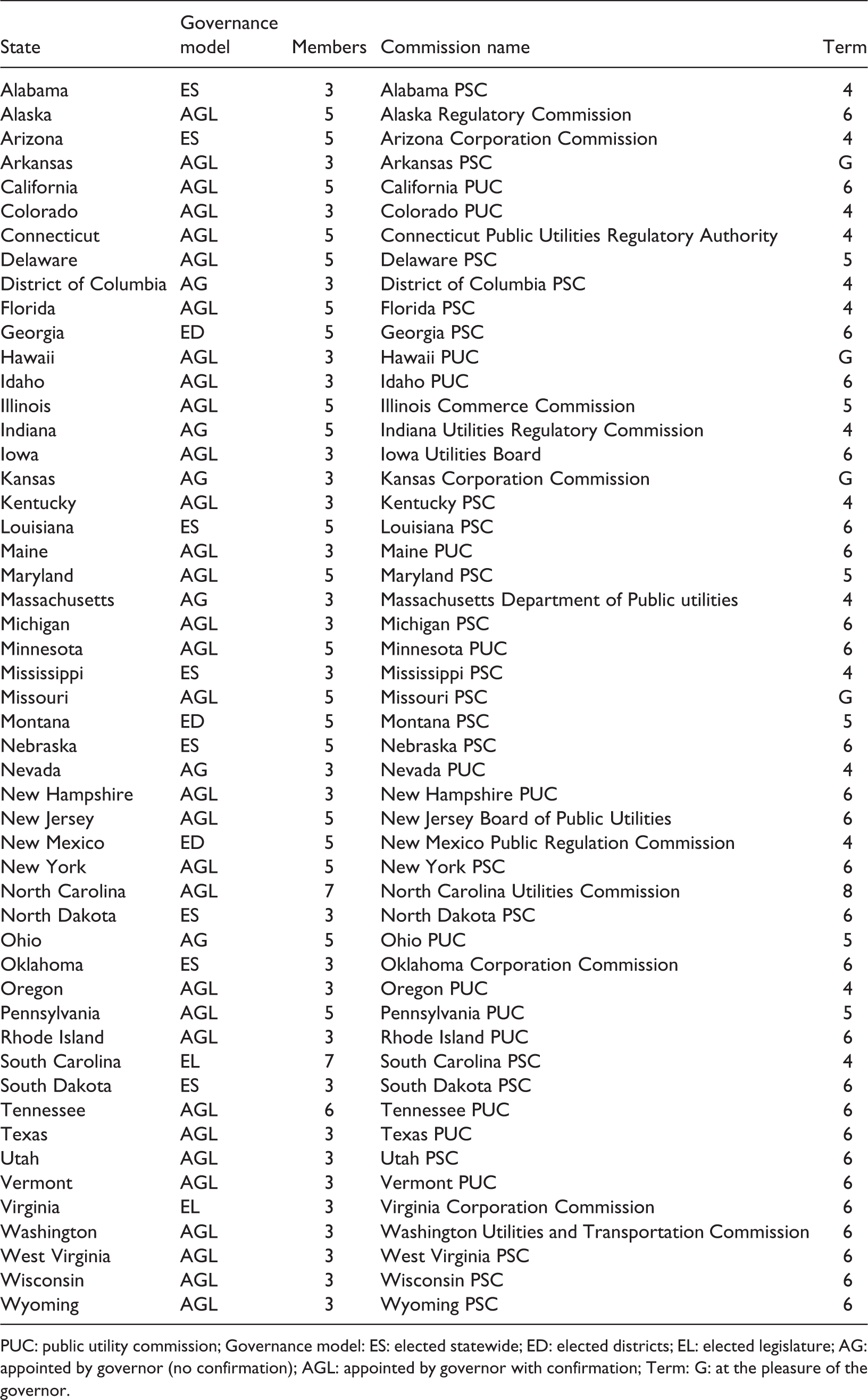
At the federal level, the FERC has five commissioners, who are appointed by the President, confirmed by the US Senate and have a term of 5 years. However, the characteristics of the state PUCs vary widely since these are established by state law. Briefly, most commissions have three members, a sizable minority have five commissioners, and some have six or seven commissioners. The term of service for a commissioner generally varies by state from 4 to 8 years, but in some states, a commissioner serves at the pleasure of the governor. Appendix 1 is a compilation from the Book of States (2017) and Ballotpedia (2018) and lists the states and the characteristics of their PUCs.
The characteristic of greatest concern in this article is the method by which the commissioners are selected. We call this the governance model for the PUC. As shown in Figure 1, the governance model is widely varied as well.
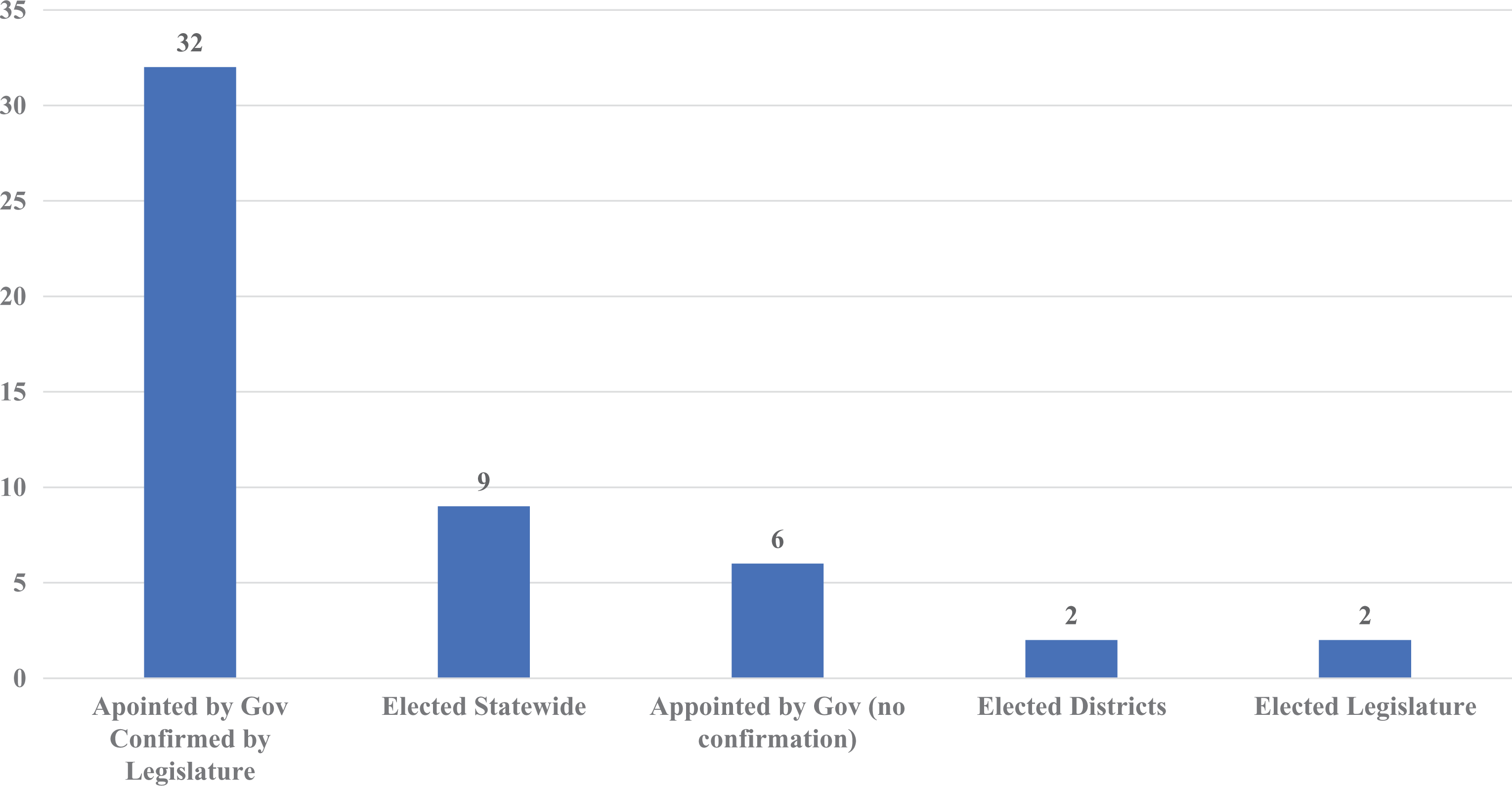
Governance models for state public utility commissions.
The majority of states (38) select commissioners by appointment, while 11 states elect their commissioners through popular election. Two states, Virginia and South Carolina, elect commissioners by majority vote of the legislature.
Standards for a “good” governance model
How should we measure whether a governance model for the selection of commissioners is a “good” model? Without a model of a “good” commissioner, we could not hope to analyze whether the governance model for selecting commissioners can deliver a good result. Thus, we can break the issue down into two related questions: first, what standards should we apply to candidates for a commissioner, and second, what governance model best assures that good candidates are selected.
PUCs are frequently referred to as “quasi-judicial” tribunals. In a very real sense, there is nothing “quasi-” about these commissions’ judicial responsibilities. Like many federal, state, and local special-purpose courts
5
in the United States with limited jurisdiction, the PUC adjudicates specific types of cases using established rules of judicial procedure in its conduct of these cases and their findings. Therefore, commissioners occupy the same role as judges; so, on the question of standards, we look to the judiciary for the standards applied to judges. Applying common judicial standards (American Bar Association, 2000) and adapting them to the public utility sector, we can define a qualified or “good” PUC commissioner as one with the following five traits:
Experience: The candidate should have experience applicable to the utility industry, which would include but not be limited to the law, economics, accounting, engineering, finance, and management.
Integrity: The candidate should be of high moral character and enjoy a general reputation in the community for honesty, industry, and diligence.
Professional competence: The candidate should possess intellectual capacity, professional and personal judgment, writing and analytical ability, knowledge of or capability to learn the essentials of public utility law, and breadth of professional experience.
Independence: The candidate should demonstrate a commitment to fairness, freedom from bias, independence from influence of entities that have a vested interest in commission decisions, and an ability to decide issues according to applicable law.
Public service: The candidate should have a belief and practice that the most important constituency to be served is the public.
Selecting good commissioners
Of the variety of selection methods used by the states for selecting their public utility commissioners, the two principal methods are (i) appointment by the state’s chief executive (i.e. the governor) or (ii) popular election. With the objective of selecting good commissioners, as defined by the standards set forth in the previous section, we aim to determine which of these governance models produce the best results.
Elected versus appointed commissioners
There is ample historical evidence in the United States (and in the world as a whole) that both appointment and popular election can deliver good and bad results, so neither system can be counted upon to always select the best candidates for public office. In theory, there is much to support the concept of popular election of PUC commissioners if we agree that an important trait of a good commissioner is public service, for who better to choose the best public servant than the public itself? While public service is an important criterion in a PUC commissioner, there are four others as well. Meeting these four other criteria is where the election process is most likely to fail.
With respect to experience and professional competency, the electoral process gives, at best, mixed results, especially with elections that are called, in the language of American politics, “down-ballot.” Down-ballot elections are those that are literally toward the bottom of the ballot sheet and often generate very low interest among voters. It is not unusual, for example, to see voter turnout in the 20−30% range for PUC elections in non-presidential general election years. In down-ballot elections, it is common that little effort or research is put into vetting candidates for the office. Consequently, the experience and professional competency of the candidates is not widely discussed nor reported by the media. In such an election, how should a candidate campaign for the office? Offering a recitation of experience and credentials to fill the office is not nearly as compelling as a campaign pledge to never allow a utility to raise its rates, even though fulfilling such a promise would be unenforceable, if not entirely illegal.
This lack of general interest is the same reason why the characteristic of Integrity does not usually get thoroughly vetted in a down-ballot election. More worrisome is that, in today’s electoral environment, we have seen candidates winning elections (both PUC and general elections) who have been under indictment at the time of their election for various illegal acts, including intentional violation of campaign laws (Auslander, 2010; Killough & Reston, 2018) This suggests that integrity may not be a highly important trait in an environment of highly partisan politics.
However, the most significant failure of election of PUC commissioners concerns the independence criterion. Recent court decisions in the United States, most notably Citizens United vs. Federal Election Commission (558 U.S. 310, 2010), have effectively undone limitations on campaign contributions from corporations, unions, and other entities seeking to influence the outcome of elections—so-called political action committees (PACs). While this ruling technically applied only to federal elections, it has been widely interpreted as applying to state and local elections because the federal court found that prohibitions of such contributions violated the First Amendment, which is a constitutional right, not just a federal law.
Some, but not all, states that elect their PUC commissioners have enacted statutes that limit or disallow contributions directly to candidates for those offices from entities that are directly regulated by the commission. Nevertheless, Citizens United allows so-called super-PACs to receive and spend unlimited money on elections with the condition that they may not directly contribute to a candidate nor coordinate campaign activities with the candidate. This has effectively opened the door for utilities, independent power producers, unions, and interest groups with a direct or indirect financial stake in the decisions of the PUC to pour money into PUC elections through PACs and super PACs. It is hardly necessary to directly contribute to or coordinate with a candidate to spend lavishly in support of that candidate through advertising and social media purchases.
The Supreme Court justices attempted to balance this by requiring the disclosure of contributors to such funds so that voters could see whether a candidate might be “in the pocket” of entities that would profit from his or her election. However, this seems to have been based on somewhat naive assumptions about how PACs and super PACs would operate. While super PACs cannot coordinate with the candidate, they can coordinate among themselves so that, for example, PAC A gives money to allied PAC B, which gives money to associated PAC C, so on and so forth, until an ultimate PAC spends the money on efforts to elect a specific candidate through payments to an advertising firm, social media purchases, or other direct voter outreach efforts. Disclosure of donors might remedy this if the chain of donations is fairly short, but it can take time, effort, and money to thoroughly research long chains of affiliated-interest PACs, which may not happen in a down-ballot race. A further complication is that there are provisions in the Citizens United ruling that eliminate the disclosure provision when the donating entity is a public or social interest group whose primary purpose is not raising money for elections. Donations to such entities, often called dark money pools, result in the chain of disclosure becoming a dead end.
Case studies: Money and influence in PUC elections
The danger is real and will become more problematic as time goes on. We consider cases in three states with an elected PUC.
New Mexico
The New Mexico Public Regulation Commission (PRC) is a five-member PUC in which the commissioners are elected by districts within the state. One of the state’s utilities, together with an out-of-state utility, donated almost a half-million dollars to a PAC that spent heavily on television and radio advertising for two candidates running for the PRC (Oxford, 2018). In this case, a local newspaper fortuitously tracked the donation in a campaign donation report, although it took considerable research to do so. The donation was made to a media advertising firm, but of course, the donation report did not specify for whom or for what purpose the donation was made, nor was it required to do so.
However, the problem of buying influence is not restricted to just the utilities directly regulated by a PUC. In the same New Mexico PRC election, the executives of a solar installation company and their family members made substantial individual contributions to a sitting candidate while the commission was considering approval of a proposal by a utility for a solar project to be built by that solar installation company.
In 2019, the New Mexico legislature overwhelmingly approved a resolution that would change the selection process of the PRC commissioners to three appointed commissioners (New Mexico Legislature, 2019). Since the selection process is written into the state’s constitution, it can only be changed by a popular vote approving the legislative resolution. That vote will be taken in November 2020.
Arizona
The Arizona Corporation Commission (ACC) is a five-member PUC in which commissioners are elected state wide. Arizona law does not prohibit regulated companies from donating to the election campaigns of the commissioners. Rather, there is a newly created yet apparently unenforceable 350-page code of ethics for the commissioners that has not prevented campaign contributions from utilities regulated by the commission to the commissioners or their immediate families (Fischer, 2017; Kasper, 2018). Some commissioners have actually gone to court to prevent investigation into contributions made by utilities to their campaigns (Walton, 2017). Nor has the code of ethics stopped ex parte communication between commissioners and regulated entities (Pomerantz, 2018).
It was reported that Arizona’s largest electric utility, Arizona Public Service Company, had spent approximately US$11 million in the 2014 election of certain commissioners of the ACC, which regulates electric utilities (Fischer, 2018). This report was subsequently confirmed by the utility’s own report to the ACC although this information did not come to light until March 2019 (Arizona Corporation Commission, 2019).
Georgia
The Georgia Public Service Commission (GPSC) is a five-member PUC elected by districts. During the past decade, the GPSC became the focus of controversy surrounding the construction of a new nuclear power plant by the state’s largest utility. The 2500-MW nuclear power plant (Vogtle Units 3 and 4) was originally estimated to cost about US$14 billion when construction began in 2008, but current estimates are that the cost will be in excess of US$27 billion (US$10,800 per kW), putting Vogtle in contention for the world’s most expensive power plant ever built. The cost overruns ultimately led to the bankruptcy of Westinghouse Corporation, the plant designer and construction manager, but the utility is pursuing completion through other contractors. The commissioners of the GPSC find themselves in the position of continuing to defend the project and push for its completion, now estimated to be done in 2021−2022. State laws prohibiting campaign contributions to GPSC candidates from entities regulated by the GPSC have not stopped unregulated, vested interests from making such contributions in aid of specific candidates. It has been reported (Landers, 2018) that, in the 2018 election, a 501c(4) organization called Nuclear Matters, operating as the advocacy arm of a 501c(6) organization called the Nuclear Energy Institute, donated US$1 million—an unheard-of amount in any GPSC election—to a Georgia domestic nonprofit organization incorporated just days before the election, called Georgians for a Brighter Future, Inc. (Georgians for a Brighter Future, n.d.). While this organization did not directly contribute to the candidate’s campaign, it did actively engage in advertising for the candidate, including on Facebook, which is apparently the only public face of the organization. The utility company building Vogtle is a member of the Nuclear Energy Institute. The candidate won his election.
This GPSC example shows how money can flow through chains of PACs and advocacy organizations, with the result that the average voter may never know the real entity behind the financial support. In the GPSC example, the issue at stake was not that a pronuclear organization actively advocated for the expansion of the nuclear industry through completion of a particular power plant—that would be expected. What is at stake, however, is the independence of the PUC and whether this particular power plant is in the best interests of consumers or in the best interest of the utility building it.
In each case, the relevant question is whether the public can have trust and confidence that the decisions made by the commission are in the public interest if the industry or company or interest group that most benefits financially from its decisions has contributed heavily to the election of commissioners. At question is whether the Supreme Court justices were right in opining that the public will always know who is in whose pocket.
The appointed commission is not a guaranteed solution
Appointed commissions are hardly perfect, at least without a number of safeguards incorporated into their governance model. It was reported in 2014 that a commissioner of the California Public Utilities Commission, which is an appointed commission, was engaging in private ex parte conversations with the state’s largest utility company concerning a number of management issues and financial crises facing that utility, which were concurrently under investigation by the commission. That utility company was ultimately fined US$1 million for improper contacts and the commissioner in question ultimately stepped down (Lifsher, 2014). The California example is not the only one where a commissioner has stepped out of his role as judge and into the role of advocate.
No governance model is going to result in the selection of the perfect commissioner every time, so the question for the public and the companies regulated by the PUCs is which governance model gives the best chance of selecting commissioners with the traits of experience, integrity, professional competency, independence, and public service. The case studies of elected commissions strongly suggest that the appointment process is the one most likely to deliver these traits, but it is not a guarantee. The appointment governance model also needs a process and standards for commissioner selection.
A better commission governance model
A better governance model would ideally start with a nomination committee that is tasked with casting a wide net for candidates. The nomination committee is responsible for vetting the candidates through personal interviews, references, and verification of experience. From these vetted candidates, the nominating committee would select a small set of finalists of nominees. From these nominees, the chief executive of the state or district, typically the governor, would select the final nominee for the position, who would then be confirmed by the state legislative body after a series of hearings with the nominee. This is the process largely followed by a majority of the states and the federal government.
The importance of the nomination committee cannot be underestimated, since it is there that the hard work of vetting for the traits of experience, integrity, professional competency, independence, and public service is done. This will mitigate the tendency of some governors to appoint political supporters who otherwise have no ability in the field of utility regulation. Likewise, the legislative confirmation will tend to mitigate the influence of politics in the selection of the candidate. Several states and the federal government mandate that no more than a simple majority can be appointed from the chief executive’s political party.
Conclusion
The PUC has an important adjudicatory job in its regulation of public utilities. This job affects the livelihood of virtually all citizens and businesses of the state, as well as its economic development potential. This chapter has examined the governance models for PUCs, which are how the public expresses its control of and over the PUC. I found that both the appointment model and the popular election model can result in good or bad results, but the election model is most at risk of resulting in a weak, dependent, and compromised commission. I found that the appointment model also has its weaknesses, but that these can be mitigated through a well-structured nomination and confirmation process.
Footnotes
Author’s note
The views expressed herein are those of the author and do not necessarily reflect the views of the Western Grid Group.
Declaration of Conflicting Interests
The author(s) declared no potential conflicts of interest with respect to the research, authorship, and/or publication of this article.
Funding
The author(s) received no financial support for the research, authorship, and/or publication of this article.

Notes
Appendix 1. US state PUC characteristics
| State | Governance model | Members | Commission name | Term |
|---|---|---|---|---|
| Alabama | ES | 3 | Alabama PSC | 4 |
| Alaska | AGL | 5 | Alaska Regulatory Commission | 6 |
| Arizona | ES | 5 | Arizona Corporation Commission | 4 |
| Arkansas | AGL | 3 | Arkansas PSC | G |
| California | AGL | 5 | California PUC | 6 |
| Colorado | AGL | 3 | Colorado PUC | 4 |
| Connecticut | AGL | 5 | Connecticut Public Utilities Regulatory Authority | 4 |
| Delaware | AGL | 5 | Delaware PSC | 5 |
| District of Columbia | AG | 3 | District of Columbia PSC | 4 |
| Florida | AGL | 5 | Florida PSC | 4 |
| Georgia | ED | 5 | Georgia PSC | 6 |
| Hawaii | AGL | 3 | Hawaii PUC | G |
| Idaho | AGL | 3 | Idaho PUC | 6 |
| Illinois | AGL | 5 | Illinois Commerce Commission | 5 |
| Indiana | AG | 5 | Indiana Utilities Regulatory Commission | 4 |
| Iowa | AGL | 3 | Iowa Utilities Board | 6 |
| Kansas | AG | 3 | Kansas Corporation Commission | G |
| Kentucky | AGL | 3 | Kentucky PSC | 4 |
| Louisiana | ES | 5 | Louisiana PSC | 6 |
| Maine | AGL | 3 | Maine PUC | 6 |
| Maryland | AGL | 5 | Maryland PSC | 5 |
| Massachusetts | AG | 3 | Massachusetts Department of Public utilities | 4 |
| Michigan | AGL | 3 | Michigan PSC | 6 |
| Minnesota | AGL | 5 | Minnesota PUC | 6 |
| Mississippi | ES | 3 | Mississippi PSC | 4 |
| Missouri | AGL | 5 | Missouri PSC | G |
| Montana | ED | 5 | Montana PSC | 5 |
| Nebraska | ES | 5 | Nebraska PSC | 6 |
| Nevada | AG | 3 | Nevada PUC | 4 |
| New Hampshire | AGL | 3 | New Hampshire PUC | 6 |
| New Jersey | AGL | 5 | New Jersey Board of Public Utilities | 6 |
| New Mexico | ED | 5 | New Mexico Public Regulation Commission | 4 |
| New York | AGL | 5 | New York PSC | 6 |
| North Carolina | AGL | 7 | North Carolina Utilities Commission | 8 |
| North Dakota | ES | 3 | North Dakota PSC | 6 |
| Ohio | AG | 5 | Ohio PUC | 5 |
| Oklahoma | ES | 3 | Oklahoma Corporation Commission | 6 |
| Oregon | AGL | 3 | Oregon PUC | 4 |
| Pennsylvania | AGL | 5 | Pennsylvania PUC | 5 |
| Rhode Island | AGL | 3 | Rhode Island PUC | 6 |
| South Carolina | EL | 7 | South Carolina PSC | 4 |
| South Dakota | ES | 3 | South Dakota PSC | 6 |
| Tennessee | AGL | 6 | Tennessee PUC | 6 |
| Texas | AGL | 3 | Texas PUC | 6 |
| Utah | AGL | 3 | Utah PSC | 6 |
| Vermont | AGL | 3 | Vermont PUC | 6 |
| Virginia | EL | 3 | Virginia Corporation Commission | 6 |
| Washington | AGL | 3 | Washington Utilities and Transportation Commission | 6 |
| West Virginia | AGL | 3 | West Virginia PSC | 6 |
| Wisconsin | AGL | 3 | Wisconsin PSC | 6 |
| Wyoming | AGL | 3 | Wyoming PSC | 6 |
PUC: public utility commission; Governance model: ES: elected statewide; ED: elected districts; EL: elected legislature; AG: appointed by governor (no confirmation); AGL: appointed by governor with confirmation; Term: G: at the pleasure of the governor.