



Abstract
A specific challenge related to infrastructure creation that is faced by several countries has to do with the lack of participation to an optimal level of subnational governments in the development of Public Private Partnership (PPP) projects which, in turn, could offset the existing infrastructure limitations. In this article, we analyze the Mexican case, whose main feature is that, despite implementing the PPP scheme for almost 10 years and having technical assistance from international organizations to establish the required institutional framework (i.e. legal and technical dimensions), local governments have not been able to create the necessary competencies to carry out this type of project. In order to assess local governments on this subject, we conducted an analysis based on the model designed by the OECD in relation to the execution of PPP projects. A proposal to explain the lack of local government participation in PPP schemes, rests on the foundations of so-called “subnational authoritarianism.”
Introduction
Despite counting on the PPP model as a strategy to generate public services and infrastructure since 2012, the Mexico has not attained the expected outcomes. The use of this scheme has been rather limited even though there have been meaningful steps to define the institutional and contractual design thereof, which has led Mexico to occupy the fourth place in Latin America since 2014 regarding its potential capacity to develop sustainable PPP programs.
It is essential to bear in mind that, as it is a Federal Republic, Mexico deals with two different institutional frameworks: “federal” (applicable across the whole country) and “state” (specific to each state). In the case of the development of PPP projects, these two dimensions coexist to foster this funding mechanism. In this context, the works conducted by Wood (1991), Bullock et al. (2017), and Terman and Feiock (2015), highlight the relevance of the coexistence and implementation of both legal frameworks to explain either the success or failures of public policy performance.
In Mexico, during the 2012–2019 period, 25 PPP projects were carried out. 100% of these were classified as federal projects. In light of this, it is necessary to draw our attention to subnational entities to understand the causes of their low participation. Mexico is a Federal Republic comprised of 32 subnational entities known as states, whose engagement in PPP projects can be regarded as meager. 1
The inexistent participation of subnational governments in PPP projects is not a problem exclusive to Mexico. As pointed out by Frank and Martínez-Vázquez (2015), local governments often overlook the development of procurement systems and related capacities. They also underline the fact that the decentralization process, when not being accompanied by a robust accountability and transparency legal environment at the local level, is likely to foster corrupt practices. Reyes-Tagle (2018) and OECD (2018) also analyze the challenges related to national and subnational government coordination along with political commitment. A fact that must be stressed is the high likelihood for the initiated projects to be truncated or unfinished.
This article, based on the Mexican case, shows that states have not intended to implement the required institutional conditions to generate PPP projects. The analysis that supports this idea stems from the OECD model to diagnose a government’s capacity to execute PPP projects. The OECD study is applied on a national level, whereas this paper replicates it for the subnational dimension in the Mexican Republic, assuming that the analyzed items represent the basic conditions for the institutional design in relation to the establishment of the PPP model.
Likewise, this work has special importance within the Mexican context: a developing country, under a Federal model, facing large shortcomings in public infrastructure, with an acceptable institutional framework on PPP, that has not been able to take advantage of this scheme. The Mexican experience may become a valuable reference for other developing countries that seek to develop this investment model.
It is worthwhile to mention that there was institutional support from several international organizations before and after 2012, aimed at fostering the suitable conditions to trigger investment initiatives under the PPP schemes. The outcomes did not meet expectations as they did not manage to capture the local governments’ interest to improve their technical, legal, and institutional capacities to generate PPP projects.
In order to explain the lack of participation of states in the development projects, this article alludes to the concept “subnational authoritarianism” (Gibson, 2013), which is focused on the institutional and political circumstances that lead the behavior and incentives of local authorities.
This study is comprised of six sections: The first one develops a literature review on the relationship between the application of PPP models and subnational governments; the second section expounds the use of the PPP scheme in Mexico; the third presents the used methodology to assess the states capacities to develop PPP models; the fourth one includes a diagnosis of local government capacities to manage and implement the PPP model; the fifth carries out an analysis on the obtained results; finally, the six section draws out the main conclusions of the analysis.
The development of the PPP model and subnational governments
The PPP model is an alternative to the traditional schemes of infrastructure building. In 1992, the British Government launched two public investment schemes to encourage private sector participation: The Private Finance Initiative (PFI) and Public-Private Partnerships (PPP) (Cummings, 2007). These initiatives were directed toward the provision of services, such as transportation, defense, water, education, and health. In a PFI project, the government signs a long-term contract (15 years or more) with a private company to design, finance, construct, and operate schools, hospitals, roads, and prisons (among others). The advantages of this approach are that the government does not need to disburse the expenses for infrastructure all at once and the private counterpart takes charge of maintenance in exchange for a periodic payment.
In theory, PPP projects provide several benefits as a financing option for governments. They contribute to generating basic infrastructure, taking advantage of the economies of scale and the experience of the private sector, while diminishing agency costs. Additionally, in the end, there are efficiency gains (Milgrom & Roberts, 1990). Through this scheme, there is access to multi-year projects that involve large-scale infrastructure, which are not affordable through public funds due to governments’ annual budget cycles and restrictions. Well-designed PPPs provide certainty to private agents as to whether governmental changes will affect previously agreed arrangements. For Middleton (2000), the long-term nature is fundamental for an effective, stable, and long-lasting relationship.
Nevertheless, subnational participation has represented an obstacle that hampers the thorough application of PPP models in developing countries. As pointed out by Frank and Martínez Vázquez (2015), the infrastructure in the subnational dimension has become one of the main challenges of contemporary public finance management and policy. According to Sood et al. (2012), despite the weight of the central/federal governments in the generation of PPP projects in developing countries, the role of subnational governments has gained ground in the making of these kinds of projects. Specifically, from the perspective of Sood et al., focusing on the regions that are encompassed by the Asian Development Bank (ADB), it is necessary to conduct substantial improvements to the financial information standards and performance of local governments (i.e., accountability, information, training and communication). These improvements are likely to help build more trust between the different stakeholders as a result of better information flow as well as the right design of incentive mechanisms to promote low costs and higher yields.
The Economist Intelligence Unit (2017), referring to the Brazilian case, stresses that besides the need for developing the capital markets even more, and increasing the number of commercial banks and institutional investors (domestic and foreigners), a meaningful challenge is linked to the development of technical capacities to evaluate and structure the PPP projects on a local government level. Furthermore, it also emphasizes the requirement for transparency and accountability standards to be strengthened as a way to protect public infrastructure projects from the corrupt mechanisms observed in 2016.
Reyes-Tagle (2018) points out that complexities and risks of PPPs are even more clear at the subnational level. too many local PPP laws at the state level may have the effect of fragmenting the PPP market and discouraging investment. Subnational government entities often have limited capacity for PPP project development and procurement. In this sense, OECD (2018) also emphasizes challenges on coordination, management capacities, political commitment and accountability.
The main aspects to analyze are the figures of PPP model implementation at the states as well as their institutional capacities to undertake this kind of projects.
Public-private partnerships in Mexico
High population growth exerts pressure on investment to finance infrastructure. Notwithstanding the efforts made, public investment has not kept pace with this additional demand. This limitation of public investment has been aggravated by the usual budget cuts produced by the fall in oil prices. Moreover, there is a serious tax evasion problem (Fuentes et al., 2014). Despite the fight to diminish this evasion, it is still largely occurring and brings about a sharp reduction in income for the government.
The reductions in the federal government’s infrastructure spending affected the position of Mexico in the world ranking of infrastructure. According to the 2017–2018 Global Competitiveness Report (WEF, 2017, p. 203), the country was positioned 62 out of 137 nations (from 57 one year earlier, 59 in the year 15/16, and 65 in the year 14/15). This decrease has negative impacts on business and the economic environment. The report shows that economies smaller than Mexico’s have grown faster in terms of infrastructure quality.
The evolution of the federal normative framework in Mexico to promote public-private participation in the development of infrastructure, has had different phases. The privatization program implemented in the 1980s was conceived as a cure to the inefficiencies of state companies, but actually had the goal of balancing federal government public finances (Ramírez Cedillo, 2007). The mixed results of this privatization process caused the search for new mechanisms. At the end of the 1990s, contracts for public works financed by the private sector emerged to trigger investments, especially in the energy sector (the Federal Electricity Commission and Mexican Petroleum para-state company). This type of contract is known as Programa de Inversión de Impacto Diferido en el Gasto (PIDIREGAS, in Spanish).
The use of PIDIREGAS, which basically meant constructing now (by private agents) and paying later (by the government), has brought about criticism due to the lack of fiscal transparency (Del Castillo & Frank, 2003). Over the years, this program has been perceived as a masking of long-term debt in public accounts. In order to improve transparency, in 2002 the Ministry of Finance (SHCP) implemented the following actions: a report on public sector borrowing requirements (SHCP, 2011a); a key ratio for the analysis of the fiscal stance that incorporates off-budget transactions and detailed information on the state of implementation; and the financing of PIDIREGAS projects. These measures improved the country’s risk position and they were also aimed at the reduction of expenditures from the federal budget in order to redirect them to other programs (Nuñez-Luna, 2005).
The program of highway concessions undertaken by President Carlos Salinas’s administration (1986–1992) was a bad experience. Given the need for considerable investments to broaden the federal roads network and guarantee its maintenance and efficient operation, it was decided to grant the private sector 52 freeways with a validity of up to 50 years. In 1997, in the face of financial problems for the operating companies, the federal government had to bail out 23 out of 52 granted freeways, assuming a debt of $57.7 thousand million pesos (US $3.11 billion) (CEFP, 2007). At the end of 1997, the total cost for the rescuing of roads went up to $58.1 thousand million pesos (US $3.14 billion). At the end of 2006, the cost reached $178.3 thousand million pesos (US $9.62 billion). 2
Provision of services project model (PPS)
Once the lessons of the roads rescue was learnt, in the first decade of the 21st century there was a search for schemes to attract private participation under a different design that would allow the flow of financial resources for project construction. This is how provision of services projects, better known as PPS (for its Spanish acronym), emerged on a federal level, emulating the British Private Financing Initiative model (SHCP, 2011b). In a typical case of the PPS model, the providing investor takes over the design, financing, construction, operation, and maintenance of assets and services. By and large, the public sector can propose any project whose services, levels of quality, and long-term risks can be defined. However, in order to develop a PPS project, it must be demonstrated, through cost and benefit analysis, that its net social value will be positive compared to a traditional public investment reference project.
PPS projects presented several design-related problems. A fact to single out is the continuous lack of systemic coordination between agencies involved. This implied either the risk of losing synergies between projects, or the selection criteria not being homogeneously applied. An additional problem was that the multiyear framework was not guaranteed, raising the uncertainty risk for private investors in terms of long-term infrastructure development. Summing up, the PPS model presented a legal puzzle, low coordination, and inability to finance long-term projects. This was the context for the appearance of a new model: PPP projects.
Public-private association model (PPP)
Public-Private Partnerships in Mexico were envisioned as a more comprehensive framework to improve the amount and quality of investment (SHCP, 2011a). They were conceived as contracts between public and private sectors to plan, construct, operate, and maintain long-term public infrastructure works, as well as the provision of services related to these projects. After a long learning process, in November 2009 the Federal Executive sent the Senate an initiative for a Federal Act on PPPs (LAPP).
Before this initiative, the functioning of PPPs was more in the modality of a PPS project and subject to federal entities or states own legislation. As a matter of fact, Nayarit was the first state to rely on a PPP Law in 2006. There was insufficient transparency, especially regarding the adjudication procedures. Given the large scale of highway and water infrastructure projects and the fact that several of them involved the participation of more than one state, more uniform legal certainty and security became a must. In this new rationale, risk analysis had a more profound consideration and so did the determination of the best financial options (traditional public sources or PPPs).
In January 2012, a specific regulatory framework was issued for the development of Public Private Association projects (APP for its Spanish acronym), a Mexican version of the British PPP model, as mentioned before. The PPP Law that emerged (LAPP in Spanish) intended to regulate the process of structuring and approving projects, as well as securing the guarantee and transparency of payments under only one system. The LAPP was published in the Official Gazette (Diario Oficial de la Federación, DOF) on January 12th 2012. The regulatory body of the LAPP was published in the DOF on November 5th, 2012. The law defined mechanisms to solve disputes and the early termination of contracts, bringing legal certainty to the actors involved and minimizing the occurrence of risks.
The modified law empowered the Secretary of Finance (SHCP) over federal dependencies and states in the process of the structuring and preparation of projects. This means that for any project that federal dependencies or states want to develop, they must first apply for the project’s enrollment to the SHCP as a Public Investment Project (PPI for its initials in Spanish) and justify its cost effectiveness. After that, there are legal steps to guarantee the execution of multi-year projects. The Public Expenditure, Financing, and De-Incorporation Inter-Ministerial Commission has to give authorization for the projects to be prioritized and authorized so they can be incorporated into the Public Budget of the Federation in the section that guarantees the multi-year quality of projects. Once the PPP projects are approved, they are submitted to the bidding process under the strict responsibility of the federal agency or state entity. After awarding the projects, the SHCP has the obligation to integrate a registry of the approved projects under the PPP scheme. 3
The works conducted by Sada and Sada (2014) and Lozano et al. (2017) show transparency, information access and accountability weaknesses; however, the current evolution of the legal framework has contributed to improving these aspects and entails greater advantages in relation to previous financing models. In this context, SOFT (2016) expounds the potentialities of the model for the legislative work in the Chamber of Deputies in comparison to the financial restrictions and voids as belonged to former models.
For instance, there is an obligation to register the projects, which means that local governments cannot compromise public funds without making it visible. In addition, it is required to publish the figures of costs and additional revenues linked to the PPP projects. Likewise, it is necessary to determine deductions (recoups) due to a bad performance of the private entities involved in the project. This effort requires the establishment of a surveillance system along with a PPP supervisor, whose main responsibility is to collect “tickets” (evidence) of bad performances, thus minimizing a potential collusion among private parties and reducing the risk of the misuse of public funds.
As for the states’ involvement to formalize PPP model, Reyes-Tagle (2018) show that 27 of the 32 states have their own local PPP framework, many of which have different definitions or scopes. Since the implementation of the PPP Law in 2012, many Mexican states have harmonized their local laws and regulations to be in line with the federal law. Nevertheless, this does not ensure, as it will be seen later, a real participation of states.
Regarding subnational participation in the total number of projects developed in Mexico in the period 2005–2011, the so-called PPS projects, Figure 1 shows 20 projects in different areas (15 federal and 5 belonging to states).
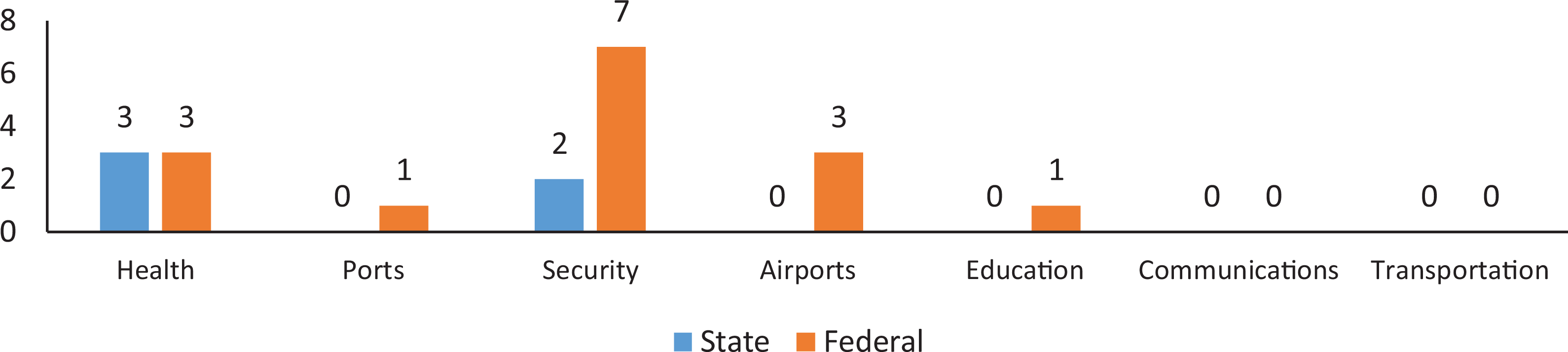
PPS projects-states vs. federation (2005-2011). Source: Own elaboration based upon federal budget.
As for the period 2012–2019, one can see in Figure 2 that there were 25 PPP projects in total (25 federal and 0 belonging to states).

PPP projects-states vs federation (2012-2019). Source: Own elaboration based upon federal budget.
Despite an increase in the total number of projects during this period, there was a dramatic reduction in state participation (down from 25% to 0%). It is important to note that the projects included in this analysis referred to those that were executed. The cases of those that were proposed without being implemented are not considered.
Methodology: Measuring the capacity of state governments in Mexico to implement PPP schemes
As it was described in the previous section, the number of PPP projects carried out during 2012–2019 is zero. In view of this, it is meaningful to analyze whether states fulfill or not the required conditions to develop this kind of projects. Therefore, it is necessary to count on a thorough and robust methodology that provides us with the answer.
An important contribution of this article is the unprecedented exercise of analyzing PPPs at the subnational level in Mexico. Following the methodology of the OECD on regulatory governance and policy for country level (Arndt et al., 2015), a framework of analysis was constructed through the use of 12 criteria grouped into three blocks (Table 1).
Criteria for a successful regulatory PPP framework at the state level in Mexico.

Source
The first block includes an analysis of the elements that are related to the design of a straightforward promotion policy for the PPP schemes, such as: (1) the existence of a clear communication strategy to different groups, aimed at promoting the use of the PPP scheme in the state; (2) a clear leadership commitment at the top level of the subnational entity on behalf of the governor; (3) the existence of a robust and solid mandate included in the state public management strategic documents in order to foster the use of PPP schemes as an alternative to developing investment projects.
The second block comprises a set of factors, so-called institutional elements, which consist of: (1) the existence of a well-designed legal framework to control the implementation of PPP schemes, such as the PPP State Act; (2) the issuing of the regulation on the State Act which must define the scope of actions and limitations that either the state ministries or municipalities face to develop PPP projects or, in its absence, the existence of administrative guidelines. In this section, the existence of any specialized areas within the state governments which oversee and promote the execution of PPP schemes were identified, including control of the project endorsement and its corresponding follow-up.
Finally, the third block is focused on determining the existence of tools to promote the use of the PPP model. In particular, it analyzed: (1) the presence of permanent training programs to build capacities as to the projects’ preparation and endorsement, as well as the conduction of procurement activities; (2) the development of a formal and official data bank on the projects, along with relevant documents that justify their implementation, whose main purpose is to prioritize the development of certain projects, as well as creating suitable conditions for citizenry and firms to have access to relevant public information on PPP schemes; (3) the establishment of clear and transparent processes regarding the evaluation of projects (for those states ministries involved and potential private sector petitioners), and the development of a straightforward endorsement process with a clear and transparent methodology to create certainty before municipality treasury offices and local legislatures; and, finally, (4) the existing capacity of states to manage procurement and follow-up processes on PPP schemes, as well as dealing with contingent liabilities.
Through a careful analysis of the states’ PPP legal frameworks, along with interviews with key actors, this article evaluates if they have in place the required policies, institutions and tools to encourage the development of PPP projects on a subnational level.
Public-private partnerships at a subnational (state) level
Table 2 shows the state level criteria fulfillment established in Table 3 (number of criteria covered /12) * 100. The results for the 32 states show that, even if Mexico occupies the sixth place internationally to potentially develop PPP projects, at a sub-national level the making of PPP projects is incipient. Only some states, like Baja California, Nuevo Leon, Tabasco, and Queretaro, have advanced in the harmonization of their normative framework to the new federal PPP Act. This means that only 4 out of 32 states can be regarded as having an acceptable level, without attaining 100%.
State level fulfillment of criteria for a successful PPP in Mexico (percentage of fulfillment).

Source: Own elaboration based upon the methodology of Arndt et al. (2015) and the state legislation analysis of PPPs.
Percentage of states in Mexico that fulfill selected criteria of the national framework for a PPP project.

Source
It is especially critical to observe a zero percentage in the cases of Coahuila, Durango, Puebla, and Quintana Roo. It is also striking to see entities like Mexico City, the country’s capital, achieve only 8.3%, or the Estado de Mexico, where there is 33.3%. The total population of these two states amounts to almost 24 million inhabitants. The median of accomplishment is located at a 50% range, which is too low.
Table 3 presents the percentage of states that fulfill the criterion (number of states that fulfill the criterion /32) * 100. The higher values correspond to “State PPP Law” and “Approval Processes” criteria with 59.4%. This is followed with 56.3% for “Clear Command,” “Project Management,” “Project Registry,” and “Clear Evaluation Process.” “Guidelines” has 53.1%, “Communication” 50%, and “Leadership” 40.63%. Far behind are “Set of Rules” with 18.8% and “Specialized Area” with 6.3%, and in last place is “Training” with 0%. These last three statistics show that there are neither rules to generate processes to fully fulfill the law, nor a specialized area to build human resource capacities to apply to PPP projects. In simple terms, it seems there are no appropriate conditions at the state level for PPP to emerge and prosper.
If one considers that the compliance mean on the 12 variables, which are part of the assessment, is 42.73%, a rather low figure, it is evident the states lack of commitment to strengthen their capacities as to develop PPP projects.
Analysis
How can one explain the lack of capacity development in subnational governments? As it has already been pointed out, in 2012 a Federal Act on PPP schemes was enacted, implicitly establishing a lapse of time for local governments to prepare for PPP project implementation. It is important to highlight that, stemming from the need to build competencies in subnational governments to generate PPP projects, there were some initiatives that took place. Since 2007, the Multilateral Investment Fund (FOMIN, for its acronym in Spanish) and the InterAmerican Development Bank (IADB) sponsored the Program to Promote Public-Private Partnerships in the Mexican States (PIAPPEM, for its acronym in Spanish), which was aimed to create legal, institutional and technical conditions to develop investment initiatives by adequately using PPP schemes. The work conducted by Woodhouse (2010) is a good example of the effort undertaken by this entity, aimed at improving the states institutional conditions to implement PPP model.
In October 2015, PIAPPEM evolved into a think-tank. PIAPPEM AC’s (a non-profit organization) main objective was to look after the original activities of the program and broaden them, as well as to give technical assistance to disseminate PPP best practices and share those experiences across Mexico and other countries in the region. Unfortunately, this effort did not achieve the expected outcomes, which means that states continue to show a severe shortage in institutional and professional capacities to develop PPP projects. According to the interviews carried out with different actors involved in PIAPPEM activities, it is clear and conclusive that states neither had any interest in the PPP scheme application, nor in the creation of required capacities. It was constantly reiterated that one of the main problems was the high rotation of staff, which had previously caused the collapse of all the work undertaken and had frequently made it necessary to start over.
A possible explanation for this situation can be found in the incentive structure that is faced by local governments. In 2000, Mexico moved toward a democratic system when a new party took over after being under a single ruling party (Partido Revolucionario Institucional, PRI) for 70 years. This change entailed a decentralization process as well as the tacit quest for shaping a new Federal model. As indicated by Weingast (2005), even though Mexico had considered itself a federal country since its 1917 constitution, it was only federal by name; the reality was a centralized model of political power from 1940 to 2000. The democratic transit fell short on the high expectations created, including the implementation of different political, economic and social tools, such as the PPP scheme.
According to Watts (1998), “federalism” is an institutionalized system that distributes power between central and regional governments. In view of this, as pointed out by Menard and Shirley (2005), federalism is a government mechanism that limits the State’s power, preventing the system from abuse of authority in such a way that it splits that power into branches (executive, legislative and judiciary) and hierarchies (national, subnational, as well as other divisions). Likewise, Simision and Ziblatt (2018) state that federalism allows the existence of a closer relationship between government and population, thus fostering more efficient solutions to address local problems, such as ethnic conflicts or even infrastructure issues.
Nevertheless, this model also entails risks, as indicated by Simision and since there can also be pernicious effects. The interaction of a political party system, along with federalism and decentralization, can bring about a deinstitutionalization process that, in its turn, causes the appearance of a “subnational authoritarianism” phenomenon. Gibson (2013) studies this in the cases of Mexico and Argentina. In this context, there is a local group that holds real power and does not allow any kind of competition, turning against federalism itself and even the democratic system. In addition, it generates a high likelihood for the occurrence of corrupt practices.
Even when corrupt practices are also present at a federal level, local governments have been negatively labeled by public opinion for the iterative misuse of public funds. The implicit transparency required by a PPP model, despite its limitations, makes it unattractive for local governments. This model contains requisites that deter subnational entities to contract debt, as they must disclose relevant information, compelling them to be subject to a private oversight; being held accountable in case of bad performance.
In this sense, as for the Mexican case, corruption at a local level has become a serious problem. According to the 2017 National Survey on the Quality of Governmental Impact conducted by the National Bureau of Statistics and Geography of Mexico, the percentage of the population that considers corrupt actions to be either frequent or very frequent in their respective states amounts to an average of 91.1%. The local entity with the highest perception is Mexico City with 96.3% and the lowest one is Hidalgo with 82%. This situation represents a handicap to attracting private investors to fund projects. In 2017, more than 12 former governors were part of media and public opinion scandals due to misuse of public funds.
In its November 2017 edition, “Works,” a leading publication within the Mexican building industry, contained a special report on the preeminent role of contracts in the functioning of this industry. In particular, the cover of the publication makes it clear that the best partner is the one who looks for reliable contracts, transparent negotiations, honesty and has a good reputation. In light of the high levels of mistrust and corruption perceived in the public infrastructure market of Mexico, this publication emphasizes the relevance of reputation and honor as a competitive advantage to participating in the procurement and execution of projects. The link between this idea and the low performance of PPP schemes is evident.
Niedzwiecki (2015) provides the discussion on this matter with relevant elements in connection with the concept of subnational authoritarianism and its effects. She analyzes, for Brazil and Argentina, the implementation of national social programs by subnational governments whose success depends on: (1) its political antagonism with central government; and (2) the nature of the program, which may or may not allow the identification of who the benefits of the program can be attributed to (local or central government). The conclusion of this analysis is that political antagonism is not a key factor for the local government when effectively implementing national social policies. Rather, it depends on whether the local electorate can identify the central government as the responsible party that generates the benefits of the program, in which case, the subnational government will likely hamper its implementation. 4
In addition to the absence of the required conditions for a successful PPP project, there is also the influence of the politically fueled, short-term nature of electoral cycles. In the face of a long and complex PPP process, there are few incentives for municipal authorities to promote this kind of work. Governments are often more interested in investments that give results in the short-term, which is very costly for communities that will be deprived of infrastructure of a larger scale and impact (EIU, 2017). Likewise, moral hazard problems may arise as local governments may conduct themselves in an irresponsible manner when exercising public funds, expecting the federal government to bail them out of the problem. Due to all the aforementioned, the introduction of the PPP model remains unattractive to local governments.
Conclusions
Nowadays, subnational participation in infrastructure development is a challenge for financial policy and management. In this paper, the OECD methodology is used, which aims to diagnose the capacities of national governments in relation to the use of the PPP model and to apply it to subnational governments (states) that are part of Mexico. This study concludes that local governments have not yet developed their legal, technical and institutional capacities to generate PPP projects.
This reality has taken place despite the fact that the introduction of the PPP model in Mexico occurred back in 2012 and international technical assistance alternatives, such as the Multilateral Investment Fund (FOMIN, for its acronym in Spanish), were in place, as well as the Program to Promote Public-Private Partnerships in the Mexican States (PIAPPEM, for its acronym in Spanish) sponsored by the InterAmerican Development Bank (IADB).
A possible explanation for this situation is the existence of the “subnational authoritarianism” phenomenon, as coined by Gibson (2013), wherein local groups take over political power and hamper any potential signs of competition; controlling a public agenda that is far from containing proposals aimed to foster economic growth, undermining democracy frameworks and creating room for corrupt practices. In this context, the PPP model is not attractive for these groups as it promotes transparency, oversight, and accountability procedures, which are not considered by other investment schemes.
As pointed out by Gibson, subnational authoritarianism is a reality in most democracies in the developing and post-communist world. Its occurrence rests on the fact that even periphery governments need the center, and “…the center also ‘needs’ the periphery for vital functions, including maintaining political order throughout the national territory, delivering votes, or providing services.”
Subnational authoritarianism not only distorts democratic processes but also the decisions on fostering improvements to the provision of government services, including public works. In this sense, Niedzwiecki (2015) underlines that local governments have a negative effect in the implementation of national social policies, when their benefits, due to the nature of the program, can be easily attributable to Federal/National/Central government.
In the Mexican case, one should add the 3-year tenure of municipality governments (state government units) to explain the lack of interest in being engaged in long-term infrastructure projects.
Based on the diagnosis carried out in this paper, one can present diverse practical solutions. The first one is related to Gibson’s analysis: local problems must turn into national problems. This condition focuses the attention of external agents onto local problems and makes it unavoidable to disclose and address the scarcity faced by subnational entities. Even though Gibson refers to the improvement of a democratic environment, the proposal of this paper is aimed at creating external pressure which brings about infrastructure development.
This pressure entails the disclosure of the progress level achieved by local governments regarding their compliance to build the required conditions to generate PPP projects. In other words, the analysis conducted in this paper must become a formal practice. Specifically, it should be biannually conducted for each state in order to prepare a ranking on the institutional progress to create suitable conditions to manage this type of project. The ranking should be regarded as public information.
The second solution stems from the fact that building capacities requires funds. That is why it is recommended to establish a Central/National/Federal Fund to be transferred to states aiming at improving their capacities along with operational rules and transparency methods. The impact of the use of this fund can be determined by contrasting the allocated money of the fund with the progress level captured by the aforementioned ranking.
A fact that cannot be overlooked is that, as long as public funds are involved, it is a requirement to count on a legal framework that sanctions the breach of generating the proper institutional conditions to plan, execute and follow-up PPP projects. Currently, Mexico has a comprehensive legal framework related to an administrative and criminal sanctions application, derived from the National Anticorruption System establishment. However, a factor that may impede the correct and fair application of those sanctions is the lack of budgetary resources as well as the shortage of technical and human capacities, both at federal and local levels, faced by the Attorney General Offices (criminal cases) and Administrative Courts of Justice (administrative cases).
The oversight of both the establishment of adequate conditions to manage PPP projects (based on the use of the proposed Federal Fund) and the PPP projects planning, execution and follow-up, can be carried out on a periodic basis by Local Supreme Audit Institutions and, under a federal perspective, by the Federal National Audit Office. This is a technical body of the Federal Congress whose mandate comprises the auditing of federal funds, including ear-marked federal transfers to states and municipalities.
Specifically, these audit tasks should be focused on: (a) the justification for how the project was selected; (b) the existence of an executive plan to develop the project; (c) the identification of technical and financial risk in the execution, operation and sustainability of the project by the overseer subnational entities; (d) the existence of a correct risks transfer between the actors involved in the project; and (e) the presence of mechanisms to solve potential disputes between the parties involved.
As for the transparency and open information of PPP projects, not only for the sake of auditing processes but for other economic and social actors’ reference, the establishment of a National Platform on PPP projects is proposed in the context of the up-coming National Anti-corruption Platform, which must include all the above mentioned elements.
The achievement of adequate normative and institutional conditions to generate PPP schemes must be reflected by an increase in the number of projects. In this context, one of the first steps must be the harmonization of the exiting legal frameworks in the states, related to the planning, execution and operation of PPP projects.
Two additional elements must be considered. Firstly, following Niedzwiecki (2015), the promotion of PPP projects must be aimed at ensuring the acknowledgment before the local electorate of the support and participation carried out by subnational government. Secondly, it is necessary to take into account the tenure of local governments, especially municipalities, so as to establish incentives to promote infrastructure projects. In the Mexican case, in 2018 the re-election of the municipality authorities for three additional years was approved, this situation paves the way for the right long-term conditions.
Finally, the Mexican experience generates a large room for further reflection and study, since the “subnational authoritarianism” phenomenon has been mainly focused on analyzing democracy, health and welfare public policies, but not infrastructure creation. At the same time, the Mexican case represents a lesson for emerging countries that experience a shortage of infrastructure generation by subnational governments.
Footnotes
Declaration of Conflicting Interests
The author(s) declared no potential conflicts of interest with respect to the research, authorship, and/or publication of this article.
Funding
The author(s) received no financial support for the research, authorship, and/or publication of this article.
