




Abstract
Background:
The Internet is a resource used by health professionals as well as the public to access health information. Within this context, little is reported on community pharmacists’ (CPs’) perceptions of online health-related information. The objective of this study was to explore the attitudes of Malaysian CPs towards online health-related information.
Methods:
A qualitative research method was adopted with face-to-face interviews, using a semi-structured interview guide. Purposive and snowball sampling techniques were used to recruit a convenient sample of CPs who were practising in the Federal Territory of Kuala Lumpur, Malaysia. All interviews were audio recorded and transcribed verbatim. The data were analysed by the research team using a thematic content analysis framework.
Results:
Eleven CPs participated in the study. Participants reported that online health-related information was accessible, useful, fast, and in some respects, the Internet is a unique source of information. It was reported that there was a need to establish websites for trusted information. CPs also reported that training was needed in Internet searching and website evaluation skills. Most information accessed by CPs related to drugs and diseases and to knowledge-based information. Barriers to efficacy of Internet usage were related to the reliability and volume of information available on the Internet.
Conclusion:
Frequent use of online health-related information among CPs was reported. Many CPs supported the use of the Internet for health-related information but certain reservations were also reported. An analysis of the reasons for information seeking and barriers suggests that a wider range of influences on health information seeking should be investigated.
Keywords
Introduction
The Internet has revolutionised the way in which information is accessed, shared and communicated around the globe. In the context of health services, it is generally accepted that the Internet plays an increasingly important role in improving healthcare whereby health professionals and the public access, share and collaborate to disseminate health-related information (Bennett et al., 2004; Mo, 2013). Healthcare professionals believe that the Internet provides a useful source of health-related information (McCaw et al., 2008); they search it for the latest research and up-to-date information about diagnosis and management of diseases, patient education material and summaries of guidelines (Bennett et al., 2004). Furthermore, studies have shown that healthcare professionals retrieve information from online journals and participate in continuing professional development (CPD) and/or continuing medical education activities via the Internet (Higgins et al., 2011; McCaw et al., 2008). Despite the promise and potential of the Internet, many significant obstacles in retrieving online health-related information still prevail in practice. Although the Internet is a treasure trove of health-related information (Cheng and Lateef, 2014), healthcare professionals are often flooded with excessive information that is difficult to filter for credibility and accuracy (Higgins et al., 2011). Moreover, lack of familiarity with technology, technology access (Higgins et al., 2011; McCaw et al., 2008), the variety of health-related websites, lack of searching skills and confidence, as well as the difficulty in evaluating the reliability of a website are also reported as impediments to using online health-related resources (Higgins et al., 2011).
Various studies indicate the popularity and routine use of the Internet as a resource of information among physicians (Bennett et al., 2004). However, less is reported from community pharmacists (CPs) who are specialised in medication-related information (Al-Farsi et al., 2014; Jaradat and Sweileh, 2003). CPs are the most readily accessible of healthcare professionals and are recognised as professional health-related advisors (Hassali et al., 2009a). CPs contribute in terms of dissemination of health-related information and act as advisors to consumers about the promotion of wellness and disease prevention (Malaysian Pharmaceutical Society, 2002). In their daily practice, CPs face a variety of questions and therefore it is important for them to know where to source accurate health-related information and how to evaluate that information and communicate it to their customers or patients (Al-Farsi et al., 2014). They also need to have up-to-date knowledge and drug information, as new pharmaceutical products are being continuously launched or discontinued (Al-Farsi et al., 2014; Jaradat and Sweileh, 2003). Therefore, it becomes problematic if CPs fail to choose the most appropriate information resources, and it has been suggested that this might generate distrust in pharmacists’ professionalism (Al-Farsi et al., 2014) and pose a potential risk to consumers. Additionally, in terms of supporting the quality use of medicines, pharmacists must be able to use the Internet as a technology to interpret the quality of online health-related information (Bearman et al., 2005).
In a study carried out in Penang, Malaysia, in which the drug information resources used by CPs was investigated, it was found that the majority of respondents were inclined to use tertiary sources of drug information, such as MIMS Malaysia, British National Formulary (BNF) and Martindale (Hassali et al., 2010). However, there is scarcity of published information and lack of understanding on the use of the Internet for online health-related information by CPs practising in Malaysia. Hence, this qualitative study was aimed to explore CPs’ opinions on health-related information obtained from the Internet, to identify the type of information retrieved and to investigate the barriers while retrieving online health-related information.
Methods
Study design and settings
Since there is a paucity of information on CPs perceptions of online health-related information in the Federal Territory of Kuala Lumpur, we adopted a qualitative approach to enable an initial in-depth exploration which may lead to further research questions. Additionally, qualitative methods provide important insights which can be missed if quantitative methods are employed (Hassali et al., 2013). For data collection, an exploratory technique using semi-structured face-to-face interview methods was employed, as this procedure provides the opportunity to further clarify uncertainties and in-depth exploration on participants’ perceptions (Hassali et al., 2014).
The study site, Kuala Lumpur, is the nation’s capital city and the biggest city in Malaysia. It has become the centre for various socio-economic activities involving finance, business, administration, education, sports, religion and culture (Kuala Lumpur City Hall).
Participant selection and inclusion criteria
A list of 300 CPs practising in Kuala Lumpur was obtained from Pharmaceutical Services Division, Ministry of Health Malaysia. Full-time registered CPs, having a practising license A, working in a retail pharmacy (either independent or chain pharmacy) and located in the Federal Territory of Kuala Lumpur were targeted for this study. A mix of purposive and snowball sampling methods were used to recruit CPs for this study. We employed purposive sampling as this enables the choice of participants who are more likely to be willing to provide information. The chosen participants were then asked to identify other CPs as potential participants. This process was continued until the data had reached saturation point (Kumar, 2014). In this study, we approached four participants purposively and the rest of the participants were recruited via snowball sampling.
Time frame and data collection
Data were collected over a 3-month period. All interviews were conducted at a mutually convenient date, time and venue, according to participants’ preference. Prior to each interview, participants were requested to provide their demographic information as well as written consent of participation.
A semi-structured interview guide was developed and modified from an extensive literature review (Bearman and Bessell, 2005; Bennett et al., 2004; Higgins et al., 2011; McCaw et al., 2008; Peterson-Clark et al., 2010). The guide was subjected to face and content validity by qualitative experts at Discipline of Social and Administrative Pharmacy, School of Pharmaceutical Sciences, Universiti Sains Malaysia (Appendix 1). The interview guide was pilot tested with three CPs and feedbacks were taken into consideration. Data collected from the pilot testing of the interview guide were not included in the final assessment. Every semi-structured interview was audio recorded and then subject to participants’ agreement.
The interviews were conducted in English (Kuala Lumpur Tourism Bureau, 2016), as it is one of the main languages spoken in Kuala Lumpur besides Bahasa Malaysia (Malay), and CPs are equally proficient in both languages. Interviews and analyses were performed in an iterative approach until data saturation was achieved (San et al., 2015). The audio recordings were transcribed verbatim and supplemented with field notes, which were taken by the research team to capture important information and follow-up questions. The first author (SWO) conducted the interviews, which took an average of 20 min for each participant.
The research team assembled and reviewed the responses for each question and emergent themes were coded. Regular meeting was carried out between the research team to solve any discrepancies and mutual consent on the recurring themes was attained. Conclusions were made when no new theme was identified and data saturation was collectively achieved. The team screened the quotes and those that best described the themes were then extracted (San et al., 2015).
Ethical approval
The study protocol was registered with National Medical Research Register (NMRR) and was approved by Medical Research and Ethics Committee (MREC), Ministry of Health Malaysia (NMRR-15-1880-28384).
Results
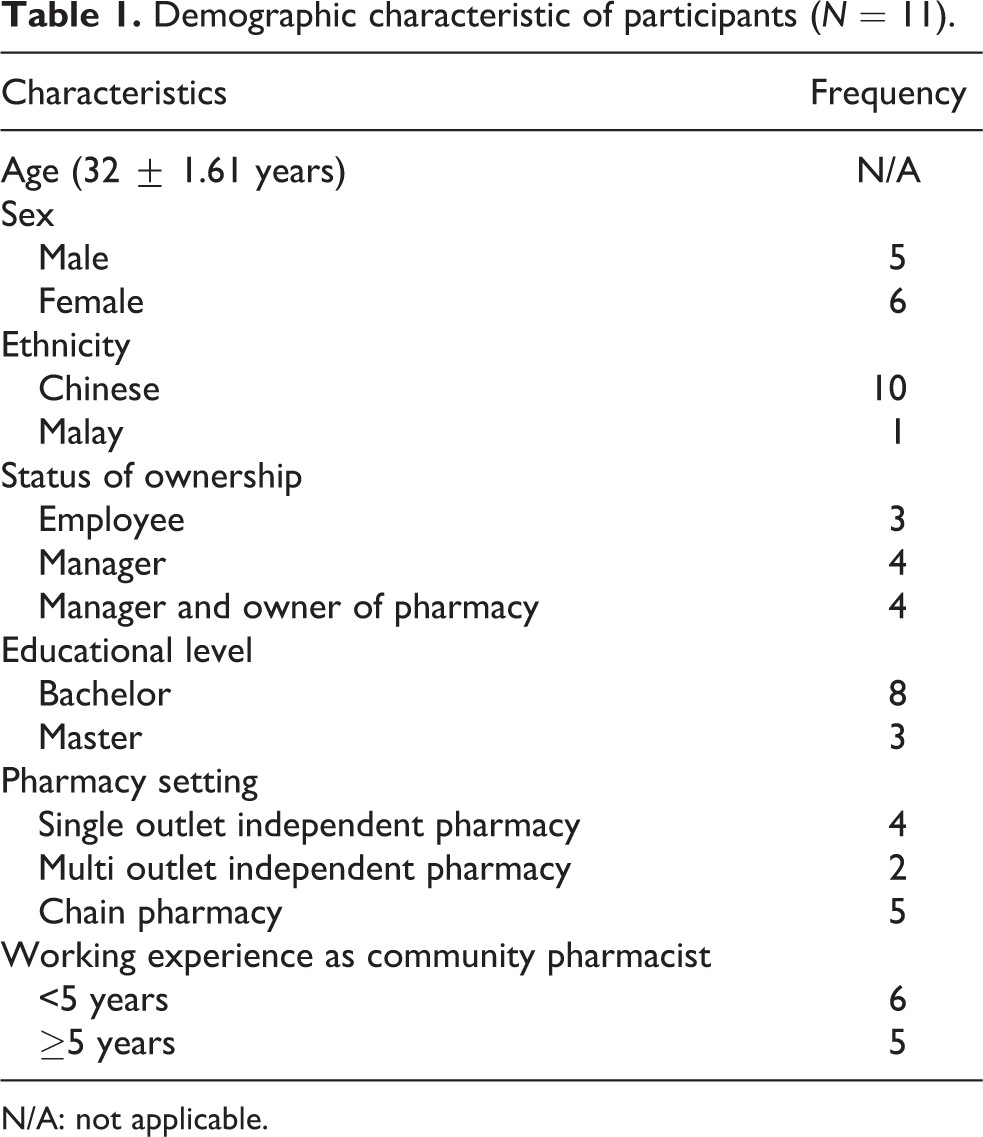
Eleven CPs participated in the research. The mean age of the participants was 32 ± 1.61 years. The cohort was dominated by the Chinese ethnic group (n = 10), eight having bachelor level of education. The demographic characteristics of the participants are presented in Table 1.
Demographic characteristic of participants (N = 11).
N/A: not applicable.
Four main themes emerged from thematic content analysis and are supported by illustrative quotes from the respondents (CP).
Theme 1: Perceptions towards online health-related information
Advantages: Easily accessible; useful, fast and a unique source of information
The majority of participants used the Internet to seek health-related information. They perceived that online health-related information was easily accessible, very useful and helpful. Furthermore, it was informative and participants reported that they could obtain the information instantly, which was especially useful for those working in community pharmacy settings, where they needed to handle customer enquiries face-to-face or over the phone. Actually it is very helpful. First of all, it is very fast, and the information is very detailed, so it is very easy to get what I want. [CP1] It helps a lot and it makes life easier indeed. When you work in a community pharmacy, you really want everything instantly fast. This is because [the] patient is waiting in front of you. So any question they ask, you’ll have to get the information quickly. But of course you’d need some skills to make sure that the information is reliable. [CP6]
Participants agreed that the Internet has the relevant information that cannot be obtained from other sources. I think yes, I do agree. Because to certain extend the information found in books is only valid and up-to-date as of the time it was written. You can’t get anything beyond. [CP10]
Disadvantages: Need established websites for accurate information
Although there is a lot of health information on the Internet, a number of the participants felt that the information should be obtained from established websites in order to gain trustworthy, accurate, reliable and up-to-date information. Depends on the website you are looking for. Usually I’ll look for established website like MIMS, PubMed, which is guaranteed reliable. So the rest I won’t even bother to check, as I really don’t know if the information is accurate. [CP1] Depends on which site you look at, if is Medscape or such like, then you will be able to get those-related journals and you will get a more updated result. If you browse for journals or CPG online then probably get very good, very informative details as well. [CP9]
However, some participants raised the issues regarding whether some online health-related information might not be accurate and reliable and may cause a negative impact. Like those websites that are not honourable certified, sometimes they could make the patient over confident about their disease or the treatment. [CP8] But the thing about online information is how genuine is the website, I would say. Sometimes people can just simply write whatever they believe; it depends on how much you trust the website. [CP10]
Quality determination of online health-related information
When participants were asked about how they determined the quality of online health-related information, they were grouped into three approaches: use of trusted websites, referring to a second source to verify information accuracy, and CPs’ knowledge and experience in using the Internet.
Use of trusted websites
Some participants reported that they only visited established websites for reliable online health-related information. We have to search from trustable website (e.g. Medscape, MIMS & Mayo Clinic), I would say. Usually we don’t use information obtained from blogs and social media, as more often than not, it is not accurate. [CP3] For information on supplement usually I will go directly to the company website or from leaflet, but I certainly will not look into blogs, because blogs are obviously not reliable. For journals, I’ll refer Blackwell and Elsevier, for reliable journals. As for Google search, I will go for Google Scholar, so you can get reliable sources. If it’s just general Google search, all sort of things will come out. [CP6]
Referring to a second source to verify information accuracy
A number of the participants referred to other sources used to verify the information. For example, they compared information between websites, product leaflets, colleagues and drug suppliers. I always refer to those trustable websites (e.g. MIMS online, WebMD, Mayo Clinic, CDC), and of course compare a few of them. There are times where I’ll contact the supplier to double confirm my understanding. [CP7] I think in general, do not take all information from one single website; you should pick from a few and then you judge whether is it really correct, genuine, and subsequently you can pick some trusted website like BNF or WHO to compare. Back up the findings with journals should that be possible. [CP10]
CPs’ knowledge and experience in using the Internet
Some participants claimed that they determined the quality of online health-related information based on their experience and knowledge. I learned a lot when I was working in the government hospital. Usually we will only go for highly ranked journals, meaning we will visit a handful of websites that we have previously identified and deemed trusted. [CP6] Criteria to assess a website? From the website, from the author, I suppose. I’m not sure about other criteria [CP3] What are the criteria? Sometimes they have the trusted logo, and stuff like that? They do have the logo but I don’t remember the name. I do recall seeing the logo. [CP7]
Recommendations for improving Internet searching by community pharmacists
Training in search and website evaluation skills
Many participants were interested in improving their searching and evaluation skills in order to seek health-related information effectively and efficiently from the Internet. The following recommendations were made. Just to improve, for self-development, I think training will be good. If there is training provided, I will attend. [CP6] Prepare workshop on how to search the information correctly. Searching skill, yes, what are the trustable website, and stuff like that. [CP2]
Besides searching skills, participants were also keen to learn more about evaluation of health-related websites and online health-related information. Like how to use the keywords and then how to evaluate whether the information is good or not, I mean whether it is trustable and evaluating the website as well. [CP3] I suppose we can learn about research methodology, stuff like that so when you get to know the fundamental bit, subsequently you’ll know which journals or websites are reliable; and when you do critical appraisal you actually know the level of evidence. [CP6]
Provision of list of trusted websites
Participants suggested a professional organisation should provide a list of trusted websites. Furthermore, participants also mentioned that the government should provide an account to access Micromedex and prepare a Malaysian drug reference database. If the ministry (pharmacy) can come out with an online database, put all the information in it, make accessible to healthcare professionals as well as patients then it will be very useful. So all those inaccurate and non-trustable websites can be filtered out which would prevent us from obtaining incorrect information. [CP2]
Theme 2: Types of online health-related information searched by CPs
Participants searched a wide range of health-related information from the Internet, including drug and disease-related information, information for self-development and updated news from pharmaceutical companies.
Drug-related information
Almost all participants searched for drug-related information, including health supplement-related information and drug distributor or supplier information. Usually I will search for availability of the drugs, which is available in Malaysia, because sometimes customers will ask about it. It could be some very rare drugs that we never come across so I have to find it from Internet. On top of that, I have to check the side effects, drug interactions, and indication of new drugs, if I don’t know. [CP1] I search for product strength, product indication; sometimes the distributor or supplier and MAL number as well (using MOH National Pharmaceutical Regulatory Agency (NPRA) website). [CP7]
Disease-related information
Participants stated that they searched for disease-related information when requested by customers, such as the available treatments for certain illnesses. For example customer asks about fertility. Some of them may be too shy to see the doctor. Some of them could be suffering from pain or wound, so they tried to clarify the actual problem. [CP6] In case of diseases like Zika virus, I’ll just search Zika virus and see what are the treatments available, what are the advices you can give to the customers or stuff like that. [CP10]
Knowledge improvement
Participants also reported that they searched for information from the Internet for self-improvement, including guidelines or protocols, undertook online CPD, as well as read online journals. Sometimes we do look for some papers and clinical study, especially for supplement and all. Yes (look for guidelines or protocols), management of blood pressure, what is the second line, advice for customers and stuff like that. I look for antibiotic management as well. [CP11] Look into what are the companies doing, if there is any new discovery or research that is related to clinical, that is more for my own interest. For example, vaccine to treat Zika, and I’ll keep an eye on any new discovery. It is mainly for the purpose of gaining new knowledge. [CP10]
Theme 3: Barriers towards using online health-related information
Participants reported facing some difficulties with accessing online health-related information. For example, they were uncertain about the reliability of the information, the need to screen through abundant information and sometimes they could not find the information they wanted. There is heap of information online in today’s world; it is too tedious to filter them. And I can’t find what I’m particularly searching for. And I have issue identifying the reliability of the return results. [CP2] Sometimes there isn’t any good website to provide useful information on health supplement, or have very limited resource in this area. [CP8]
Some participants, however, did not consider the abundant amount of information on the Internet to be a barrier. Sometimes there is just too much information to scan through, but if you just keep to certain websites then it will be ok. [CP3] You only focus on the answer you want. [CP4]
One participant claimed that some of the information found was not relevant to the context of healthcare delivery in Malaysia; nonetheless, most participants thought otherwise. More often than not, the information found online is mostly related to western countries rather than ours; and the information is not really applicable to our community. [CP2] I think it’s ok. I know some websites provide general information, like U.S., but I think it’s ok. Because some of the treatment will still be available in Malaysia, and maybe the medicine is also available here too. [CP10]
A few participants highlighted that subscription fees were one of the barriers when they searched for online health-related information. I think in general, online is good, it’s just sometimes it is not user friendly. For example, subscription base or different kind of payments; some sort of barrier for people to really try to understand the problem. [CP10] I do not have enough time during office hours. Sometimes the connection is down or it’s just too slow, otherwise ok. [CP5] Internet is very slow, at least in my office. Especially when patient is waiting, and the connection is not doing any good when I’m searching for the answer, I feel uneasy when they stare at me. [CP9]
Theme 4: Customer enquiries to CPs about online health-related information
Almost all CPs reported that they had come across customers who brought online health-related information to them. The information could be about health supplements, medicine-related topics, disease treatment information or about product availability. However, some of the information was inaccurate due to the unknown source of the information. They’ll actually print out and show the product they wanted, and they show the description, indication and what benefits them. Some of them just get from Google, certain information is incomplete, we need to explain to the customer and further elaborate on what they already knew. [CP7] Sometimes it is reliable, but not always. They usually ask about a product, whether it is available in Malaysia, and most of the time I am surprised that they have a lot of odd information. They ask about supplements, medication-related as well as disease treatment. [CP11]
A few participants advised their customers by recommending appropriate health-related websites to them (upon request). They do ask for which websites to go to. I’ll tell those websites I mentioned earlier, like Mayo Clinic and Medscape. [CP3] Yes, I recommend “patient.co.uk”. That is for patient to read. [CP4]
Discussion
Our study aimed to explore the perceptions of CPs towards online health-related information. All participants in this study stated that they referred to the Internet for health-related information. It is important to note, however, that the widespread availability of online health-related information has provided both advantages and disadvantages (Iwanowicz et al., 2006). The current study highlighted various advantages of Internet health-related information such as enabling pharmacists to retrieve information promptly, thus saving time, to obtain up-to-date information and to obtain information which was easily accessible. These advantages have previously been reported (Cheng and Lateef, 2014). Our participants, however, reported that in spite of accessing online health-related information which is helpful, not all the information is reliable and it requires skill to screen appropriate information. Untrustworthy websites might cause patients to be overconfident about understanding their health condition. This is similar to a finding in another study which reported that online health-related information caused patient denial and fostered the propensity for patients to over self-diagnose (Cheng and Lateef, 2014).
In the current study, some participants claimed to have the ability to determine the quality of online health-related information. We also found that participants browsed search engines such as Google, and many of them visited common trusted websites such as MIMS online, Medscape and Mayo Clinic. These findings could imply that the CPs are less exposed to health-specific websites (Bearman et al., 2005) and perhaps another study focusing on the type of drug information resources that are available could be carried out in the future. Moreover, a number of the participants were unable to evaluate health-related websites and online health-related information, which explains why they referred only to established websites. A few respondents struggled to recall the criteria required to evaluate a website, such as logo, author and honourable sign. Similarly, another study found that pharmacists determined trustworthiness by examining the owner of the website (Peterson-Clark et al., 2010). Therefore, education on how to critically evaluate a website and online information is indicated for all CPs. This was one of the recommendations from participants in our study regarding how to improve their Internet literacy skills. This finding also suggests that a future study to measure pharmacists’ knowledge and capability to evaluate health-related website and online information is necessary.
Participants in the current study indicated that they were keen to be educated on the use of the Internet to support their daily pharmacy practice. Participants emphasised that the education was needed in two areas: effective and competent online information literacy and the assessment of health-related websites and online health-related information, and this was also found in the Bearman’s et al. (2005) study. It is known that short education courses based on critical appraisal principles and health informatics as well as providing pharmacists with specific Internet skills might eventually improve pharmacists’ delivery of medication information and their advice to consumers and other healthcare professionals (Bearman and Bessell, 2005). As clinical practice is continually changing and new medications are constantly being introduced, pharmacists are living in an ‘information intensive profession’. Besides, it was reported that independent pharmacies embrace social media opportunities for drug and disease patient education, and successful pharmacies are those which incorporate these technologies in their practice (Shcherbakova and Shepherd, 2014). Future studies could consider studying the professional use of social media by CPs in Malaysia.
As well as education, participants in our study suggested that the Pharmaceutical Services Division, of the Ministry of Health Malaysia or another related professional organisations, should produce a list of trusted health-related websites and provide accounts to enable CPs to access subscription-based database such as Micromedex, or they should prepare a Malaysian drug reference database for CPs. This finding is another reflection of the limited searching by CPs and their preference for selecting established websites. Our findings are similar to another study whereby pharmacists were less familiar with health-related websites but were commonly utilising commercial search engines (Bearman et al., 2005). CPs are recognised as reliable sources of information because of their accessibility and frequent communication with the public (Hassali et al., 2009b), suggesting that they need to respond to customers instantly. Hence, providing these facilities to CPs will assist and benefit them in their daily practice.
The topics of online health-related information searched by participants in this study were drug-related information including health supplements, disease-related information and information for knowledge improvement. Some of these topics were similar to those found in previous studies carried out in Australia, such as searching for new or foreign medicines, journal articles and patient information (Bearman et al., 2005). In addition, we and others have found that CPs improve their professional knowledge by retrieving clinical guidelines (Bennett et al., 2005), reading online journals (Higgins et al., 2011; McCaw et al., 2008) and undertaking CPD programs (Higgins et al., 2011). It is worth noting that one participant looked for the latest research news from the pharmaceutical industry.
Despite the extensive use of the Internet for health-related information, participants highlighted a few barriers they faced in their daily practice. The difficulties as described by participants on our study and reported in other studies were the massive amount of health-related information to screen through (Bennett et al., 2005; Higgins et al., 2011), lack of time (Bearman et al., 2005; Higgins et al., 2011), slow Internet connection (Bearman et al., 2005), difficulty in searching relevant information (Bearman et al., 2005) and uncertainty about the credibility of online health-related information. Another common barrier claimed by some participants was that subscription-based resources incur costs. One participant suggested that universities should allow their alumni to access the subscribed databases for up to 5 or 10 years after graduation. A previous study showed that barriers might prevent pharmacists from using online health-related information competently or constrain their usage (Peterson-Clark et al., 2010). Although one participant claimed that most information found on the Internet is not relevant to the Malaysian context, other participants thought otherwise. This is because they were able to focus on the information they wanted and treat the information as references. It was noted that a majority of the participants in this study utilise the Internet as the priority resource for health-related information, which might be due to its advantages and their confidence in determining the quality of online health-related information.
The Internet has become the patient’s primary source of reference for information about pharmaceutical, disease and healthcare information (Shcherbakova and Shepherd, 2014). This study found that customers presented online health-related information to CPs regarding medicine-related topics, disease treatments, health supplements or product availability. However, some of this information was inaccurate and not trustworthy. Literature shows that the issue of accuracy or evidence-based information on the web might cause a less literate public to be more vulnerable to misinformation (Mo, 2013). In fact, one of the participants encountered customers who believed only their source of reference. Therefore, pharmacists should have the capability to assess and identify the quality of Internet health-related information and then facilitate their consumers in interpreting the quality of online material resources correctly (Bearman et al., 2005; Pohjanoksa-Mäntylä et al., 2011). In addition, some participants encountered customers who requested them to recommend credible health-related websites (Higgins et al., 2011). This could be due to the fact that pharmacists are considered to be the most trustworthy healthcare providers who are easily accessible by the public, and the study reported that in comparison with physicians and nurses, pharmacists showed the highest rate of sharing information with citizens (Lupiáñez-Villanueva et al., 2009).
Limitations
The data obtained from this study were from CPs who were working in the capital city of Malaysia, Kuala Lumpur, and were qualitative. Therefore, the results cannot be generalised to CPs practising in other states of Malaysia. Another limitation of the study was that a number of CPs declined to participate due to time constraints and lack of manpower in their pharmacies.
Conclusion
The existence of both good and poor quality of online health-related information sources remains an issue, but CPs in our study were able to use well-established health-related websites for information. Recommendations from CPs in this study highlighted the necessity of training in online information literacy. It was recommended that a professional organisation should provide a list of trusted websites, and the government should provide an account to access Micromedex and prepare a Malaysian drug reference database. These recommendations should be given serious consideration as they would assist pharmacists to improve their skills in searching and interpreting online health-related information in a well-structured and time-efficient method. They would also promote the advancement of community pharmacy while also benefitting their customers. Furthermore, CPs should strengthen and develop their role as healthcare professionals to help customers interpret online health-related information and hence make it relevant to consumers.
Footnotes
Acknowledgements
The authors would like to express gratitude to all participants for their contribution to this study.
Declaration of conflicting interests
The author(s) declared no potential conflicts of interest with respect to the research, authorship, and/or publication of this article.
Funding
The author(s) received no financial support for the research, authorship, and/or publication of this article.
Appendix 1
Semi-structured interview guide.

| Internet Use by Community Pharmacist Do you use Internet to seek for health information? Do you search online health information at home, during office hours or others? What type of online health information are you searching from Internet? Besides Internet, do you use other sources to look for health information? Generally, what is your opinion towards online health information? How do you search online health information? Are you confident with your online health information searching skill? Are you confident that you can determine the quality of online health information? How do you evaluate health information on the Internet? Do you need training and practice in order to seek online health information effectively? What is your advice to other community pharmacists while they search for online health information? Have you encountered customers who bring online health information to you? Did your customers ask you to teach them on searching and interpreting online health information? Did your customers ask you to recommend online health-related website? Do you face any difficulty when you search for online health information? |