




Abstract
This qualitative study aimed to investigate enablers and barriers facing community-playgroup families in the provision of play opportunities for children throughout periods of lockdown restrictions during the COVID-19 pandemic. The study used a capabilities approach, focussing specifically on the concepts of resources, capabilities and functionings. Using case study methodology, the study comprised two case studies and involved five community-playgroup families. Data methods included semi-structured interviews with playgroup families and the use of audio data from Zoom™ workshops conducted with families in each case study. A thematic approach to data analysis identified seven themes characterising identified enablers and barriers. These were: internet and networked technologies, ideas and information, routines and structure, relationships, space, everyday life, and support. Implications for how playgroups can support children and families in post pandemic times are discussed.
Introduction
Playgroups are recognised throughout Australia and internationally as groups involving caregivers (i.e. parents, carers and kinship members) and their children (aged birth-to-five years) in regular (e.g. weekly two-hour sessions) opportunities for play and socialisation (Townley, 2018; Sincovich et al., 2020). Providing an accessible and cost-effective early childhood education and care (ECEC) option for families (Daly et al., 2019) playgroups make an important contribution to the early childhood landscape. Known benefits of playgroup participation include socialisation opportunities for families (McLean et al., 2020), parenting support (Hancock et al., 2015) and wellbeing (Berthelsen et al., 2012). Educational outcomes of playgroup participation for children include social and emotional, language and cognitive skills (Hancock et al., 2012; Sincovich et al., 2020) and smooth transitions to school (Knaus et al., 2016).
As a form of ECEC recognised in Australian State (Department of Education and Training Victoria, 2016) and National (Department of Education Employment and Workplace Relations, 2009) curriculum documentation, the traditional community-based model has evolved to comprise many types including caregiver-led and organisation-led, operating along a continuum of support from volunteer-based community-playgroups to fully funded supported-playgroups (Commerford & Robinson, 2016). In the study reported in this paper, the focus is on caregiver-led, community-playgroups. The volunteer nature of community-playgroups means that these groups operate without many of the resources available to supported-playgroups including paid early childhood professionals to facilitate the playgroup and materials such as specialised play equipment to support children’s learning through play. Our use of the term ‘playgroup families’, refers to caregivers and volunteer facilitators attending community-playgroup with their children.
Since the COVID-19 virus was declared a global pandemic in March 2020 (herein referred to as ‘the pandemic’), families in many countries have experienced periods of lockdown restrictions involving educational disruptions and periods of remote-learning. During 2020 and 2021 families in Victoria, Australia, experienced up to six lockdowns requiring families to remain at home, with movement restricted to a 5-kilometre radius for daily activity. Throughout the first and second lockdown periods playgroups in Victoria ceased to operate onsite. This situation meant that playgroup families had to find other ways to maintain connections and support children’s learning through play. Many families turned to remote modes of delivery to support play-based learning opportunities for their preschool children including ‘Playgroup at Home’ – a national initiative incorporating online sessions facilitated by Playgroup Victoria.
Families ubiquitous use of internet and networked technologies is reported in the literature (e.g. Marsh et al., 2016), however, the pandemic situation placed unprecedented expectations on families, to draw on internet and networked technologies to support the provision of children’s learning through play, which we refer to in this paper as ‘play-based remote-learning’. Although many playgroups use social media to communicate about play (McLean et al., 2017), this use evolved organically, and has never been the only means for families to get ideas for play. Research has found that parents’ (Haslam et al., 2017), including migrant mothers (Williams Veasely, 2019) and new mothers (Archer & Kao, 2018), use of social media enables social connections, friendship and parenting support, however, the extent to which social media use in playgroups offers similar types of social support for children’s play-based learning is unclear. The pandemic conditions, therefore, create a unique opportunity to understand the enablers and barriers playgroup families face in the provision of play-based remote-learning.
Families and play-based remote-learning in the first year of the pandemic
During periods of remote-learning families had the extraordinary task of managing competing demands such as illness, economic hardship, fatigue, working remotely and supporting their children’s learning (Hood et al., 2021; Ford et al., 2021). Research reporting on families’ experiences during the first year of the pandemic has identified various perspectives. For example, Dong et al. (2020) surveyed 3275 Chinese parents in early-2020 about their beliefs and attitudes towards ECEC online learning. The authors reported that parents believed online learning was less effective and led to poorer outcomes than traditional ECEC learning environments. Dong et al. found that parents described the atmosphere created by remote-learning as not conducive to children’s learning, with some parents noting that it did not have the atmosphere of a formal classroom due to a lack of children’s social interactions with peers. Parents also reported their own lack of time, management skills and professional knowledge to support children’s online learning. Similar findings using survey methods are reported in other studies. These include in Hong Kong three weeks after kindergarten was suspended where parental dissatisfaction in relation to a lack of variety in activities and the need for more diversified learning experiences (Lau & Lee, 2020) were reported, and in Italy where only 39.6% of 3443 families surveyed described distance learning as a positive experience (Mantovani et al., 2020). Research about families’ experiences of remote-learning in the first year of the pandemic has tended to focus on formal ECEC settings involving an early childhood teacher (ECT) delivering the programme. Very few studies have looked specifically at how families handle and facilitate remote-learning (Stites et al., 2021). Moreover, we do not know how parental experiences and perspectives shape the provision of play-based remote-learning, especially in community-playgroups, which are volunteer operated and caregiver-led.
Pandemic research with ECTs has identified concerns regarding families’ lack of ICT experience to support children’s online learning, and equipment such as computers, not always being available for remote-learning due to shared use among family members (see Aditya et al., 2022; Ford et al., 2021). ECT concerns regarding a lack of parental capacity to support remote-learning have also been raised. These include balancing competing tasks such as work and education tasks for all members of the family and ensuring access to resources such as the internet (Steed, et al., 2022). Despite these findings, ECTs also report families’ positive interactions and communication (Aditya, et al., 2022), including parents sitting with their children during remote-learning sessions and calling, texting and sending ECTs photographs and videos of their children engaging in learning tasks at home (Steed et al., 2022).
The pandemic research with ECTs positions partnerships between families and ECEC as both an enabler and barrier to shaping the provision of play-based remote learning, with some researchers suggesting that teachers and parents’ roles are being shared in new ways and home and educational spaces are becoming mixed up (Malta Campos & Vieira, 2021). As an informal form of ECEC involving caregivers and their children attending together, community-playgroups operate without the support of an ECT teacher. This makes the challenges and opportunities experienced by families in building partnerships for the provision of play-based remote learning in community playgroups unique in ECEC. It is important, therefore, to consider how in the absence of an ECT to guide provision, children’s play-based remote-learning opportunities in community playgroups are shaped by partnerships among playgroup families and/or the broader community including playgroup organisations (e.g. Playgroup Victoria).
The study reported in this paper aimed to examine the enablers and barriers that community-playgroup families face in the provision of play-based remote learning. The research questions guiding this study were: 1. What are the enablers and barriers facing community playgroup families in the provision of play-based remote learning? 2. How are enablers deployed by community playgroup families to counteract the barriers to the provision of play-based remote learning? 3. What characterises the range of enablers deployed by community playgroup families in practice to build capabilities for the provision of play-based remote learning?
Theoretical Framework
Working from a strength-based perspective as a familiar paradigm in ECEC, this project used a capabilities approach, drawing on Sen’s (2009) work which recognises that what people value and have reason to value influences their priorities, decision-making and how resources are used. The research used three core concepts of a capabilities approach to consider the provision of play-based remote learning by community playgroup families. These are: functionings; capabilities; and resources. Functionings are beings and doings. These describe what a person is – such as being happy or sad (beings) or does – such as reading or exercising (doings) (Sen, 2009). Capabilities are the opportunities that a person has to achieve functionings and are shaped by the environment and interactions with others. Resources are means for achieving the functionings that a person values. This research conceptualised the internet and networked technologies as resources for play-based remote-learning. It drew on the playgroup facilitator and playgroup families’ capabilities as opportunities uniquely shaped by the current political, economic and social environment of the pandemic for enabling the achievement of play-based remote learning as a valued functioning.
Methodology
Case study research seeks to understand complex phenomena within the real-world context (Yin, 2015). The pandemic conditions created unique complexities for families who relied on community-playgroup social connections and play opportunities. Due to these real-world lived complexities, a case study (Yin, 2015) methodology was used in this small-scale study to understand enablers and barriers facing playgroup families in the provision of play-based remote learning during pandemic conditions.
Participants
Case study composition.
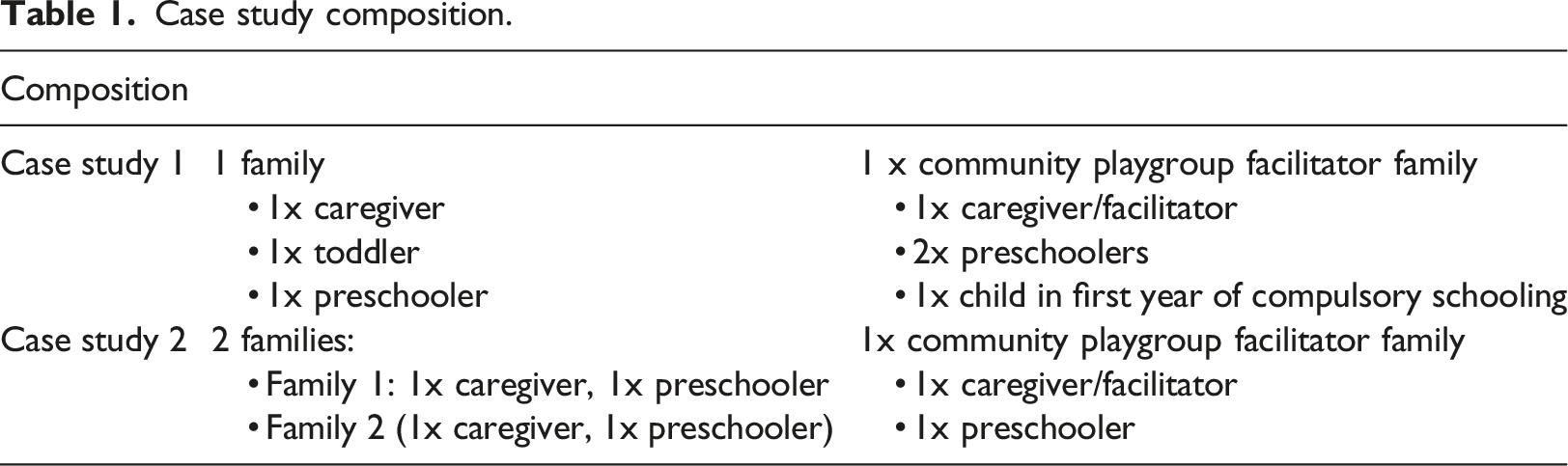
The participating community playgroups were from a cluster of established playgroups running within a regional community centre. Prior to the pandemic each community-playgroup met on a weekly basis for approximately two hours per week. A typical pre-pandemic playgroup session involved a range of structured (e.g. organised art and craft play) and unstructured activities (e.g. outdoor play) using shared resources (e.g. dress ups and construction materials). Both community-playgroups used social media in the form of a private Facebook™ group pre-pandemic and during the first and second lockdown periods to stay connected.
Ethical considerations
Approval for this research was obtained from the Australian Catholic University Human Research Ethics Committee [Approval No. 2020-116H,]. A purposive sampling strategy (Patton, 2015) was used to ensure that all participants were community-playgroup families. Families gave voluntary consent for participation and provided pseudonyms for reporting of data.
Procedure
This research followed three-stages. Stage One focused on establishing enablers and barriers for the provision of play opportunities throughout the pandemic. Data were generated through semi-structured interviews (Kvale & Brinkman, 2009) conducted with each playgroup family over (one hour) Zoom™. Example questions included, ‘What are you utilising every day that may support play-based remote-learning?’ ‘What are the barriers you are experiencing for play-based remote-learning?’ Data from interviews (audio transcripts only) were deductively coded to enablers and barriers for the provision of play-based remote-learning (Braun et al., 2019).
Stage Two focused on identifying how enablers would be deployed by families to counteract barriers to the provision of play-based remote-learning. This stage involved one of the researchers (Author 2) facilitating two, one-hour workshops (one workshop with each case study) with families over Zoom™. These workshops involved data generation from the perspective of community-playgroup families, with the intention of identifying ways that enablers would be deployed in practice to build capabilities for the provision of play-based remote-learning. Following the workshop community-playgroup families in each case study collaborated on the implementation of a light-touch intervention (Edwards et al., 2022) to mobilise the identified enablers in short bursts across four weeks. The term short bursts is used in this research to describe intermittent bursts of 15–30 minutes of play activities implemented by families online and/or offline in relation to a common theme (e.g. colour). Workshop data (audio workshop transcripts only) were deductively analysed to identify enablers and barriers (Braun et al., 2019) and inductively analysed to identify how enablers were intended to be deployed.
Stage Three focused on determining how enablers were deployed in each case study and what characterised the range of enablers deployed by community playgroup families in practice to build capabilities for the provision of play-based remote learning. In Stage Three, data were generated through semi-structured interviews (Kvale & Brinkman, 2009) conducted with playgroup families in each case study over (one hour) Zoom™. Questions included, ‘What did you use that supported play-based remote-learning?’ ‘What do you still need to support play-based remote-learning?’. Interview data were deductively analysed (Braun et al., 2019) to identify enablers and barriers and inductively analysed to identify how enablers were deployed and what characterised the range of enablers deployed to build capabilities for the provision of remote learning.
Data analysis
Data were analysed in three stages, as depicted in (Figure 1). Data analysis.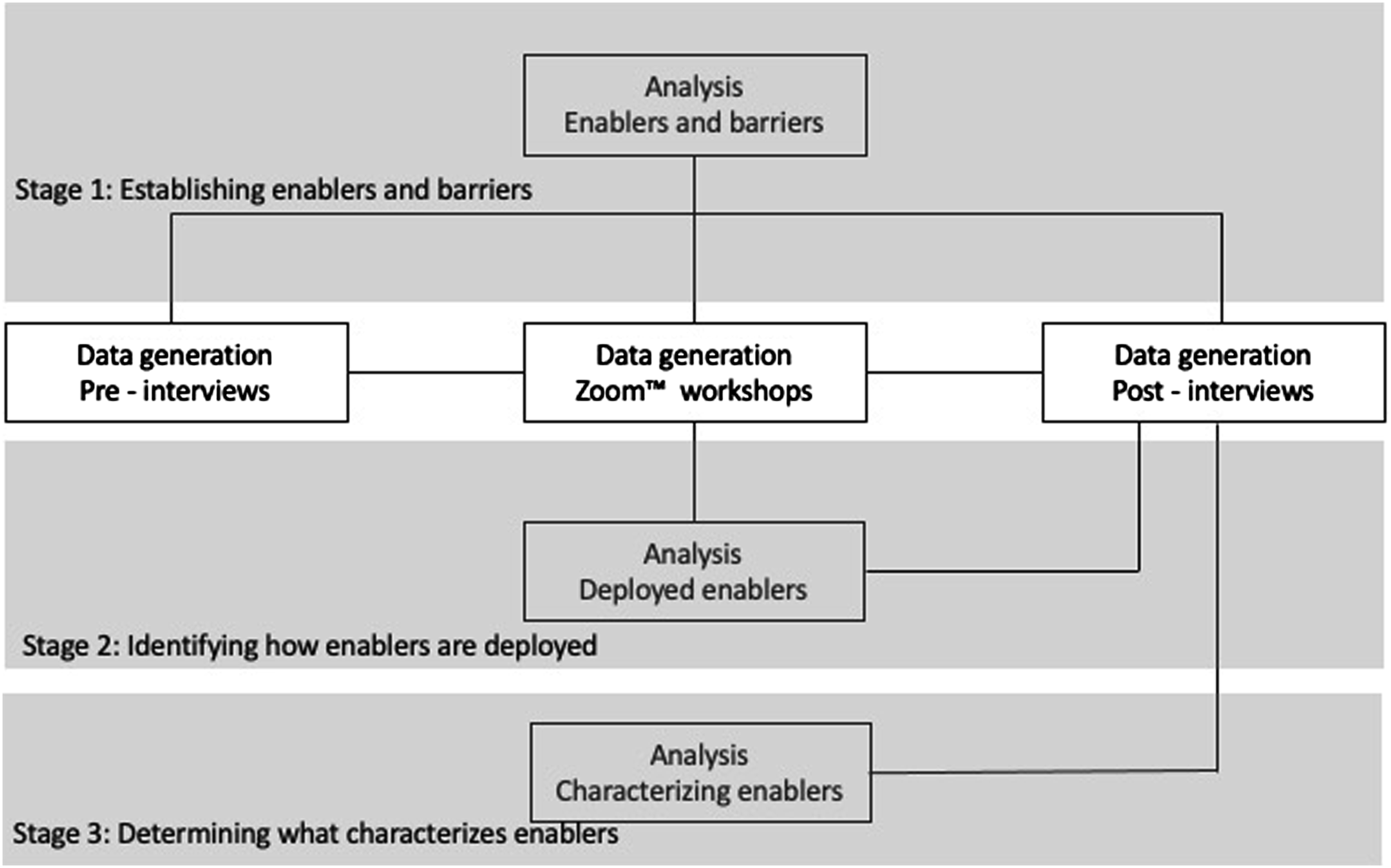
To ensure analytical integrity we were guided by Braun et al.’s. (2019) six phases of thematic analysis as a recursive, non-linear and ongoing process. These were: 1) Familiarisation involving multiple readings and accuracy checking of all transcripts; 2) Generating codes using manual coding; 3) Constructing themes by thematically analysing codes and establishing significance through frequency sampling; 4) Reviewing themes for robustness and refining key themes, 5) Defining themes in a table, signalling sub-themes; and 6) Producing a report using key themes to address the research questions. These phases were carried out individually by two researchers (Author 1 and Author 2) who came together in an ongoing manner and at the end of each phase to review, discuss and compare the data.
Findings
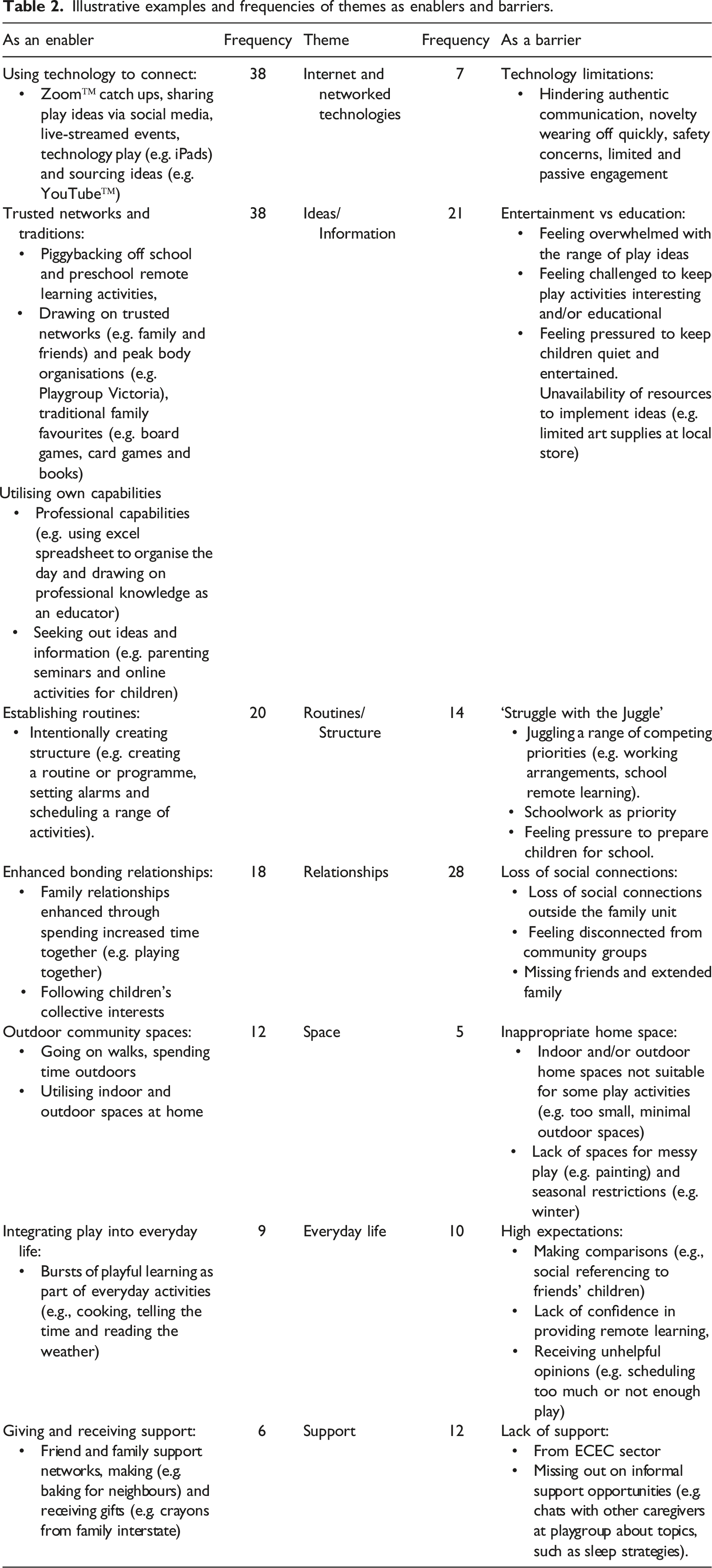
What are the enablers and barriers facing playgroup families in the provision of play-based remote learning?
Illustrative examples and frequencies of themes as enablers and barriers.
Resources deployed by community playgroup families in each case study as enablers of play-based remote learning.
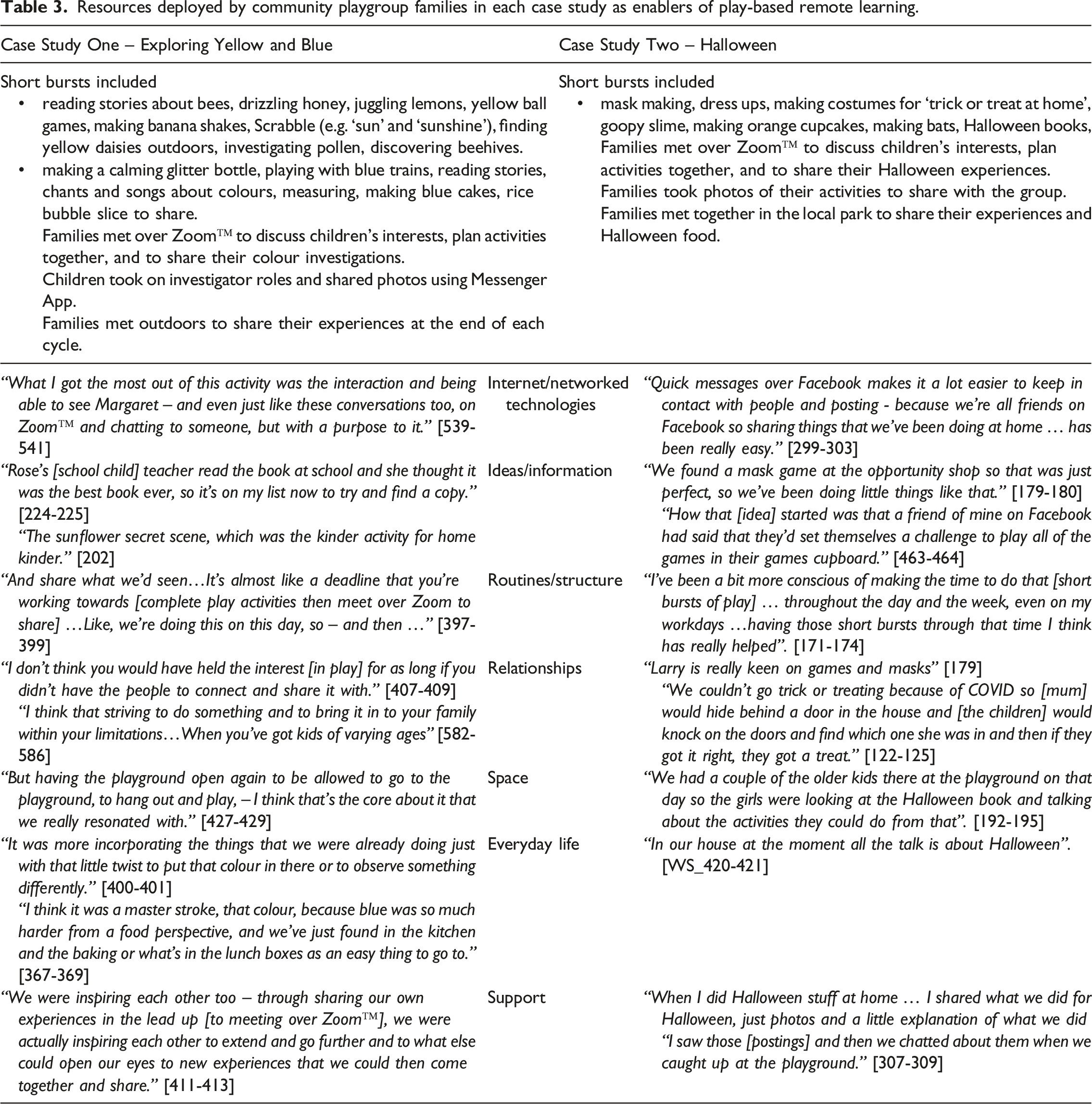
How are enablers deployed by community-playgroup families to counteract the barriers to the provision of play-based remote learning during the COVID-19 pandemic?
Table 3 details how resources were deployed as enablers for the provision of play-based remote-learning in the two case studies.
What characterises the range of enablers deployed by community-playgroup families in practice to build capabilities for the provision of play-based remote learning?
The range of enablers deployed by community-playgroup families were characterised by a common goal to re-establish social connections that had been lost due to restrictions. Playgroup families valued the opportunity play-based remote learning offered to re-connect with other families. In each case study families described using various technologies such as video-conferencing technologies (i.e. Zoom™), messaging applications (i.e. Messenger™) and social media (i.e. Facebook™), and following the relaxation of restrictions in regional Victoria meeting in outdoor spaces such as parks, to re-establish social connections. Connecting around a theme (i.e. colours and Halloween) seemed to provide a common purpose for play-based remote-learning which had previously been missing. Families described feeling ‘like they were still at playgroup’ (CS1, 349) through ‘sharing photos backwards and forwards’ (CS1, 367), talking with children about what their ‘friends had been doing’ (CS2, 281) and catching up to talk about their play. Social connections were particularly valued for pre-schoolers who had less opportunity to maintain connections with friends than their school-aged siblings who maintained ‘friendship connections through lockdown because of home-schooling’ (CS2, 218). Overall, it seemed the opportunity to connect and ‘experience things together’ (CS1, 430) through play-based remote learning was as a valued outcome for all families.
Discussion
Our research sought to understand enablers and barriers to play-based remote learning for community-playgroup families. The pandemic environment has impacted on families’ capacity to engage in play-based remote learning. This research recognised the collective capabilities of community-playgroup families as opportunities uniquely shaped by the pandemic environment for supporting the provision of play-based remote learning. Using a capabilities approach, we found that families valued play-based remote learning for the opportunities it provided to re-establish social connections. The findings identified seven themes, or resources, that community-playgroup families drew on in using their collective capabilities to enable the valued functioning of play-based remote learning. The findings indicated that resources could act as either enablers or barriers, and the ways in which families prioritised and valued social connections, shaped the ways that they drew on resources to counteract barriers. The seven key themes are discussed in three groups below, according to their frequency of occurrence as enablers in the research.
Internet and networked technologies and ideas and information were the most frequently occurring themes. Little research has been conducted around how internet and networked technologies shape the way families provide play-based remote-learning opportunities. Pandemic research has identified families’ use of digital devices to maintain communication, relieve boredom and get ideas for play (Hood et al., 2021). Our research found that when deployed as a mediator of purposeful connections and interactions (motivated by seeking social connection), internet and networked technologies helped counteract barriers including the novelty of technology waning, safety concerns, and a lack of access to multiple devices (Aditya et al., 2022; Malta Campos & Vieira, 2021), through short bursts of activity (e.g. not reliant on technology for extended periods), involving more than one member of the family (e.g. older siblings) and caregivers involvement (e.g. co-viewing). This suggests that community-playgroup families use of internet and networked technologies as a resource for play-based remote-learning was shaped by the environment, particularly the social situation of families feeling isolated. Moreover, through a capabilities lens (Sen, 2009) the value families placed on social connections influenced how the internet and network technologies were used (e.g. to share experiences with other families) in the provision of play-based remote learning.
Playgroup research, in general, has identified that families draw on ideas and information from other playgroup families and trusted networks to support the provision of play (McLean et al., 2018). Our research shows that families relied on trusted networks and family traditions to facilitate play-based remote learning. Inspired by the collective ideas shared with each other through various communication platforms (e.g. Facebook™, Messenger™ and Zoom™ catch ups) families drew on what was familiar (e.g. traditional games and cooking) to support their provision, counteract feelings of overwhelm, sustain children’s interest and reduce boredom during lockdown. Zhang et al. (2021) reported parents with lower stress during the pandemic provided more learning-focused activities at home. Conversely, when parents experienced a high level of stress, children were allowed to have longer screentime. The findings from our research indicate that families drawing on trusted networks and sharing familiar traditions enabled meaningful play-based opportunities, to counteract barriers such as stress-related feelings known to contribute to extended screentime and overuse of activities to keep children quiet.
Moderately occurring themes were routines and structure and relationships and space.
Establishing routines and structure (e.g. setting alarms and formally scheduling in play) supported short bursts of daily play (Stites et al., 2021) and enabled families to manage the ‘struggle with the juggle’ (CS1, 101) – a barrier arising from competing priorities. Playgroup research, in general, reports that families value the opportunities that playgroup provides for children’s regular involvement in play with other children (Berthelsen et al., 2012) that they would not do at home or can be repeated or extended upon in the home (McLean et al., 2018). Our findings suggest that establishing routines and structure for play-based remote learning brings back some of the ‘normality’ that has been lost in the pandemic. These findings are consistent with Ursache et al. (2020) who reported families’ strengths and protective strategies may buffer acute negative impacts of COVID-19 and related school closures for American children of colour. Complementary to our research, some strengths and protective strategies identified by Ursache et al.’s. (2020) include planning, family routines, traditions and celebrations. Our findings further indicate that collective routines with other playgroup families for sharing in the experience together (e.g. children reporting on their play at each Zoom™ catch up) helped ease feelings of pressure (e.g. to prepare children for school) by providing a common focus for play-based remote-learning, however, further research is needed to confirm this.
Community-playgroup families made efforts to maintain playgroup connections and relationships during the first and second lockdown periods of the pandemic (e.g. social media and networked technology), however, our research found that outside of the family unit, these connections were difficult to maintain. Despite this, relationships were identified as an enabler for play-based remote learning, by increasing family bonding relationships and through community-playgroup families collaborating to follow children’s collective interests (e.g. dressing up and cooking). Relationships within families (parent–child and between siblings) were drawn upon to identify children’s play interests and meaningful ways to spend family time together. An increase in family bonding has been reported in pandemic research with parents in China (Dong et al., 2020) and Australia (Hood et al., 2021). Playgroup participation is known to enhance bonding relationships (Edwards et al., 2022) and our findings also indicated enhanced bonding relationships within and across families in the provision of play-based remote learning.
Our study found that space served as a barrier and enabler to play-based remote learning. While spaces for play have been reported as an important feature of onsite playgroups (Edwards et al., 2022), lockdown constraints changed families access to spaces for play. Our research found that spaces in the home and outdoors can support children’s learning through play in periods of remote-learning, however, not all activities were conducive to home spaces (e.g. inappropriate flooring for messy play). When restrictions were eased, community outdoor spaces were quickly utilised as meeting places recognising the potential of hybrid approaches (i.e. in-person and remote) for children’s play-based remote-learning.
Everyday life and support were the least occurring themes. Community-playgroup families utilised spontaneous everyday moments as resources for play-based learning. The collective nature of this involvement seemed to offer release for families tending to hold high or unrealistic expectations for children’s play at home (e.g. teaching numeracy skills), or in counteracting well intended but often unhelpful advice and opinions (e.g. from families' interstate not experiencing the unique circumstances of restrictions in Victoria). Drawing on children’s collective interests, families were able to harness teachable moments that existed in everyday contexts (e.g. measuring during cooking, extending learning from books). Other pandemic research indicates that parental education levels are positively associated with reading books and indoor play and negatively associated with watching videos or playing computer games (Barnett et al., 2021). Our research found that playgroup families drew on their collective capabilities (e.g. existing skills and knowledge) to support the provision of play-based remote learning which may further provide a protective barrier against these negative associations.
A lack of support from the ECEC sector, in general, for families in the provision of play opportunities was a barrier to play-based remote learning. Given the volunteer nature of community-playgroups there were few resources available to support families to provide play-based learning opportunities at home when community-playgroups ceased to operate onsite. Families’ involvement in their children’s education is long established as important, however, what this involves in online or remote-learning situations varies greatly and is not well documented, especially in ECEC (Stites et al., 2021). Although a lack of support from the ECEC sector for remote-learning has been reported in the literature (see Barnett et al., 2021), playgroup families in our research provided support to each other and extended family to counteract this barrier. This included emotional support (e.g. inspiring each other to try new play activities; affirming experiences of play-based remote-learning) and practical support (e.g. giving home-made gifts and receiving art supplies).
Using a capabilities approach what people value and have reason to value and the freedom to choose between these, influences their priorities, decision-making and how resources are used to achieve functionings (Sen, 2009). We found that although community-playgroup families had reason to value play-based remote-learning they valued, and therefore prioritised, the opportunities it provided for families to re-establish social connections that had been lost due to restrictions which forced playgroups to cease operation onsite. Playgroup participation is known to provide unique opportunities for families to socialise, with reported wellbeing and social benefits (Hancock et al., 2015; Williams et al., 2020). Our research indicated that social connections may be even more important in facilitating children’s play-based remote learning. We found that families drew on their collective capabilities and prioritised the deployment of resources as enablers for play-based remote learning to re-establish social connections as a valued outcome of participation. Although socialising and play are established themes in playgroup research (Townley, 2018), this research suggests that resources are deployed as enablers of play-based remote learning when playgroup families prioritise social connections as a valued goal or outcome of their participation (Figure 2). Social connections prioritized as a valued outcome of participation in play-based remote learning opportunities for the deployment of resources as enablers of play-based remote learning.
Limitations
Limitations of this study include a small sample across two community-playgroups. Despite this, participants were active in their participation and eager to share their experiences. The duration of the intervention was four weeks, and it may be that a longer period would have provided different results. Participating community playgroups were situated in a regional community less than fifty kilometres from Melbourne which had experienced slightly less restrictions than metropolitan Melbourne. Caution should be taken to consider results beyond participants. Limitations regarding generalisability (Patton, 2015) of findings to other geographical areas for playgroup families with varying restrictions are also noted. Further studies regarding similar predicaments of children, such as those living in remote and isolated communities, could also be considered.
Conclusion
More needs to be known about the provision of play-based remote learning for pandemic like conditions. When embarking on this research, we believed that the internet and networked technologies would feature as a cornerstone, shaping the ways in which families connected to provide play-based remote learning. But this was not the case. Instead, the ways in which community-playgroup families prioritised and valued social connections, shaped how their collective capabilities were used to deploy resources to counteract barriers to the provision of play-based remote learning. The findings have implications for playgroups as a valued ECEC offering that can operate within and between remote and onsite delivery. The potential for resources to be deployed as enablers of play-based remote learning now and into the future, may be best realised when social connections are prioritised as an outcome of participation.
Footnotes
Declaration of Conflicting Interests
The author(s) declared no potential conflicts of interest with respect to the research, authorship, and/or publication of this article.
Funding
The author(s) received no financial support for the research, authorship, and/or publication of this article.
