




Abstract
Under which conditions do people tend to mistrust Courts, and what is the association between mistrust in Courts and perception of democracy? I argue that exposure to populist leaders and their antiestablishment disruptive rhetoric increases mistrust and its association with dissatisfaction with democracy. However, during times of crisis, courts can fortify democratic principles, thereby weakening this association. This argument is supported by data from a nationwide survey in Brazil during critical years (2018–2020) and the Latinobarómetro survey (2000–2020). Findings show that trust in courts, particularly the Federal Supreme Court (STF), was lowest during Bolsonaro's election and his first year in office, with a strong association between court mistrust and dissatisfaction with democracy. In 2020, when the STF defended federalism and equality against presidential overreach, trust in courts rose significantly, and the connection with democratic dissatisfaction weakened. This study adds to the literature on democratic erosion under populist regimes and highlights the STF's role in protecting Brazilian democracy.
Introduction
It is well-established that trust in public institutions plays a crucial role in functioning democratic societies (Dahl, 1957; Easton, 1975; Hetherington, 1998). Increased trust is advantageous for elected officials and political institutions, as it leads to improved public perception, granting leaders greater flexibility in governance and institutions a stronger base of support, irrespective of the government's performance (Hetherington, 1998). It seems intuitive to think that in a democratic regime, especially in newer democracies, it is important for citizens to trust institutions central to the regime's functioning, such as the Judiciary, to use their services and commit themselves to their protection. However, research shows that even when detesting institutions in some Latin American contexts, people are willing to turn to them (Hilbink et al., 2022). Therefore, what role does trust in institutions play in these regimes, and when are people more likely to mistrust?
Courts are pivotal in establishing and preserving constitutional democracies, with their effectiveness hinging on legitimacy (Epstein et al., 2001). They confer normative legitimacy on behavioural patterns essential for democratic functioning (Dahl, 1957). In certain countries, such as Brazil, the Constitution's institutional design for the Supreme Court provides an especially advantageous venue for political actors to block policies, thanks to the possibility of abstract constitutionality control by multiple legitimate entities (Taylor, 2006).
Politicians’ critiques due to disagreements with their jurisprudential stance is a recurring phenomenon. When faced with specific unpopular decisions, they often advocate for measures to restrict the Court's influence within a particular issue domain (Bartels and Johnston, 2020). This may involve proposing a constitutional amendment to overturn the objectionable ruling. Alternatively, if the Court poses a more pervasive and enduring threat to partisan or ideological interests, there may be efforts to undermine the Court's lasting independence. An illustrative historical example is found in President Franklin D. Roosevelt's second term when the Supreme Court nullified several components of his New Deal program and demonstrated a general opposition to the evolving liberalism of the Democratic Party. In response, Roosevelt introduced a bill endorsing the addition of a new justice for each sitting justice who did not retire at the age of seventy, famously known as FDR's “court-packing plan.”
What is actually new is the widespread targeting of courts by authoritarian populist leaders to advance their political agenda (Magalhães and Garoupa, 2023). The ongoing global rise of populism and the strategy to feed mistrust in institutions have already invited much attention from scholarship in developed countries, such as the United States, where there are already theories on the importance of the source and its effects on court legitimacy, for instance (Nelson and Gibson, 2019). In Latin American countries, scholarship has evidenced the pattern of mistrust in courts (Helmke, 2010; Helmke and Ríos-Figueroa, 2011). However, we still do not have a bigger picture of what drives mistrust in courts in the region and the role of exposure to authoritarian populist leadership.
This article aims shed light to this controversial, understudied subject by leveraging data from the Latinobarómetro and a nationwide representative survey from Brazil, “A Cara da Democracia.” I focus on trust in courts, considering their prominent role in protecting democracy during Bolsonaro's government. The examination is centred around a critical time frame marked by significant challenges to democratic principles and illiberal backlash (Hunter and Power, 2019). A pivotal period in Brazil is analyzed, spanning the 2018 election of President Bolsonaro and the first two years of his term, coinciding with the onset of the COVID-19 pandemic and critical democratic challenges. During this period, several landmark decisions were made by the Federal Supreme Court (STF). In 2020, one instance was the prohibition of police interventions in Rio de Janeiro's favelas during the COVID-19 public calamity, reflecting the judiciary's role in upholding democratic principles during the pandemic.
I have a two-fold objective. First, I focus on exploring the reasons why authoritarian populist leaders would decide to target courts and the specific strategies used by Bolsonaro to attack the main judicial decisions by the STF. Second, as this article's main contribution, I shed light on the association between mistrust in courts and democratic accountability and how the courts might address those situations. Due to the circumstances that facilitated Bolsonaro's election, I hypothesize that levels of mistrust were more pronounced in 2018 and 2019 and would have decreased in 2020, considering the heavy lifting done by courts in containing Bolsonaro's actions during the first year of the pandemic. Additionally, I anticipate finding a strong association between a lack of trust and dissatisfaction with democracy, low social trust, and exposure to populist leaders as circumstances under which we might expect trust in Courts to drop.
This study not only contributes to the growing comparative politics literature on democratic erosion under populist governments but also sheds light on how the STF successfully countered populist rhetoric during the pandemic, ultimately safeguarding Brazilian democracy. Insights into the dynamics of trust and democracy within the Brazilian political landscape help us understand political trust and the effects of populist leaders on institutions’ legitimacy. I draw from the context of a country that has weathered numerous assaults on its institutions in recent years while navigating the challenges of maintaining a newly consolidated democracy, which has begun to show signs of wear and tear.
Why and How Targeting the Courts?
Bolsonaro's relationship with the judiciary, particularly the STF, was tense throughout his mandate. Media reports frequently highlighted direct threats to specific judges, raising concerns about judicial independence. Headlines often depicted Bolsonaro inciting his supporters against the Supreme Court, participating in public protests calling for the Court's closure (Caram and Saldaña, 2020), and making public statements about non-compliance with the STF decisions (G1, 2021). Amid threats of a coup and exhortations to disobey justice, Bolsonaro advanced his agenda of weakening the Court, portraying himself as someone who sought to intimidate the STF and threaten democratic rule.
This strategy of attacking the judiciary is not unique to Brazil. Populists often aim to “occupy” the state, claiming it is full of corrupt elites (Mudde and Rovira Kaltwasser, 2013). In Hungary, Viktor Orbán's party changed civil service laws to place loyalists in bureaucratic positions and acted against judicial independence to support the old ruling elites. Trump also battled the Supreme Court, calling its justices “politicians in robes” (Nelson and Gibson, 2019). In Israel, Netanyahu's government proposed judicial reforms to appoint judges and prevent the Supreme Court from overturning legislation (Prendergast, 2019; Rosenberg, 2023).
Populists from both the left and right often deviate from democratic principles by rejecting values such as tolerance and openness. They curtail press freedom, undermine institutions upholding the rule of law, and alter laws to constrain their authority (Ginsburg et al., 2018). In various contexts, populist leaders have targeted courts, compromising judicial independence for political gain (Magalhães and Garoupa, 2023). This process is described as either judicial erosion of democracy (Aguiar Aguilar, 2023) or judicial backsliding (Haggard and Tiede, 2024).
The question arises: why target courts? The aim of a populist leader targeting courts is often to extend their political lifespan and mitigate uncertainties about their future (Helmke et al., 2022). Courts play a crucial role in protecting democracy against attempts to bypass checks and balances and to consolidate power in the executive (Ginsburg, 2018).
Targeting judicial institutions, especially constitutional courts, reduces the strength of an important veto player in the democratic system. Veto players, as proposed by Tsebelis (1995, 2000, 2002), are decision-makers whose agreement is necessary to alter the status quo. Courts, when interpreting the Constitution, can act as veto players, defining the scope of laws on critical issues. The STF, for instance, plays a significant role in determining policy change or regime stability in Brazil (Taylor, 2006). This role was evident in 2020 when Bolsonaro challenged the country's future amidst a pandemic.
Reducing judicial independence has consequences beyond the judicial branch. Increasing de jure independence incentivizes opposition parties to seek legal recourse, reducing election fraud by exposing election-manipulating agents to greater legal scrutiny, thus affecting democracy directly (Harvey, 2022). If courts lose independence, they can become tools of political control (Shen-Bayh, 2018).
The strategies to manipulate the judiciary vary, from jurisdiction reduction (Toharia, 1975) to techniques for creating vacancies, such as commissioning, offering positions in other branches, and removal by impeachment or threat of impeachment (Castagnola, 2017). Court-packing, broadly defined, involves changing the judiciary's composition to create a new majority (Kosař and Šipulová, 2023), and this strategy has been employed globally. In Argentina, for example, politicians have induced forced resignations and packed courts with favourable judges. They have also used threats, media discrediting, and physical intimidation to ensure compliance with government agendas (Castagnola, 2020). Leaders may also weaken court power by altering the percentage of judges required to declare laws unconstitutional, further diminishing judicial independence (Haggard and Tiede, 2024).
Other strategies include informal interference methods such as subtle threats, unofficial communication, and bribes, which undermine judicial autonomy by increasing secrecy and compromising fairness in political processes (Llanos et al., 2016). Bolsonaro in Brazil exemplifies direct informal interference through rhetorical attacks against the STF. He publicly supported rallies advocating for military intervention and the STF's closure. In August 2021, he reportedly ordered military jets to fly over the STF in a show of intimidation (Vieira et al., 2023). Bolsonaro's actions were so effective that more radicalized supporters started proposing the impeachment of Court members (Aguiar Aguilar, 2023).
Regardless of the strategy employed, powerful populist voices from within the democratic system target one of the foundations of public support. They try to undermine and cause endogenous ruptures in political institutions (Gerschewski, 2021). Advancing these attempts is possible only if the shields protecting these institutions are weakened. Understanding the concept and role of trust is essential to comprehend these protective shields. Trust and legitimacy are closely related but differ substantively. Trust is the confidence in a political system's capacity to deliver results without continuous oversight, whereas legitimacy is the acknowledgement of an entity's rightful authority (Easton, 1975).
Trust, alongside the perceived obligation to obey and normative alignment, is a component of legitimacy (Tyler and Jackson, 2014) and it reflects an individual's belief in the trustworthiness of another person or institution. In contrast, legitimacy involves evaluating whether an institution possesses the inherent qualities to wield power and authority effectively. Courts face a particular vulnerability due to the need to rule often against the preferences of the majority and their dependence on the actions of other actors and institutions (Gibson and Nelson, 2014).
Public support, rooted in trust and legitimacy (Easton, 1975), is crucial for institutions. Together, they form a robust foundation, suggesting that unfavorable outcomes do not necessarily erode fundamental commitment to the institution (Gibson and Caldeira, 2003). Threats to these aspects significantly jeopardize institutions. For the long-term survival of an institution, democracy, or any regime, the endorsement of the majority of its population is essential. The absence of this support generates dissatisfaction, increasing the chances of revolutionary changes in the socio-political system (Miller, 1974).
While trust is often seen as a “precursor to legitimacy” (Popelier et al., 2022, p. 356) or a facet of political support (Easton, 1975), the concept warrants further examination. Research on trust delineates three tiers: specific social trust (linked to individuals or groups), general social trust (the conviction that most people are trustworthy), and political trust (confidence in an institution's capacity to perform its role) (Newton and Zmerli, 2011). Popelier et al. (2022) explore multilevel trust by differentiating the three levels as follows: the individual level (trust manifested by a single person), the organizational level (the collective trust held reciprocally by members of a specific organization), and the community level (the all-encompassing trust collectively held by all members of a given community).
Understanding the concept and role of trust helps explain why populists prioritize undermining it: as trust declines, they justify interventions and increased oversight, aligning with their agenda. As Falleti (2020) points out, societal pressure compels the state to enforce institutions. When people believe in the political system's ability to fulfil its functions and trust in the legitimacy of authority, institutions are shielded from manipulation. However, when this shield weakens, institutions, particularly courts, become vulnerable to interference. Populist leaders exploit this vulnerability by using formal and informal means to erode judicial autonomy.
The relationship between trust in courts and satisfaction with democracy is also crucial for the mechanism here described. Trust in institutions is important, and distrust places the legitimacy of democracy at risk (Inglehart and Welzel, 2005; Putnam, 1994). Judicial institutions play a special role in this equation. In recent democracies, the failure of majoritarian institutions to provide social justice has strengthened counter-majoritarian institutions, especially constitutional courts, seen as capable of correcting representational flaws (Filgueiras, 2013). The judicialization of electoral processes, judicial scrutiny of the executive branch's prerogatives in macroeconomic and national security issues, and fundamental dilemmas of restorative justice are just examples of what has come to be called the judicialization of macro-politics (Hirschl, 2008).
Ideally, the judicialization of politics should strengthen courts, making them saviours in citizens’ views. However, in recent democracies, inequalities and state inefficiency persist, leading to a lack of trust in institutions. This places the judiciary within citizenship criticism due to perceived inequality and failure to correct executive choices (Filgueiras, 2013). Unlike consolidated democracy, inequalities and the inefficiency of the State to carry out equitable public policies persist in recent democracies, which allowed Filgueiras (2013) to conclude that the lack of trust in institutions does not empower the Judiciary but places it within the citizenship criticism due to the permanence of perceived inequality and the failure to correct the Executive's choices.
The theoretical mechanism in this paper can be summarized as follows: Populist leaders target the judiciary, especially constitutional courts, to weaken their veto power within a democratic system. Their goal is to erode the court's ability to check executive power by diminishing public trust in these institutions. This undermines the judiciary's role in protecting democracy and upholding the rule of law. Reduced trust in political institutions correlates with dissatisfaction with democracy (Zmerli et al., 2007), and the same relationship holds for courts. The public sees courts as counter-majoritarian bodies responsible for addressing executive abuses and promoting social justice and equality – roles that may not be fully realized in newer democracies. Thus, when populist leaders undermine the judiciary, they advance authoritarian aims and weaken democratic legitimacy.
The STF in Brazil under Bolsonaro: Navigating Populist Rhetoric and Defending Democracy
The logic of populism has offered an extra challenge to the Courts because populist leaders try to rally a core group of supporters against another outside group (Copelovitch and Pevehouse, 2019). Nothing can prevent this “external enemy” from materializing in the judiciary at some point when they speak out against populist ideas. This happened in Brazil during the government of Jair Bolsonaro, who openly declared himself at war with the STF (Bertholini, 2022).
The primary challenges in the relationship between President Bolsonaro's administration and the Judiciary revolve around anti-corruption (emphasizing the accountability of political elites) and constitutionalism (pertaining to the separation of powers). According to Da Ros and Taylor (2022), this relationship was characterized by a pattern of accommodation in anti-corruption initiatives and confrontation in constitutional issues since Bolsonaro's 2018 election. Although anti-corruption was a key agenda that bolstered Bolsonaro's candidacy, his subsequent alignment with Brazil's established political class, the Centrão, and the series of scandals following it resulted in a backlash against the punitive measures associated with Brazil's most significant anti-corruption operation, “Lava Jato” or Car Wash, which aligned with the STF's approach to the operation.
However, when it comes to constitutionalism, there was a consistent divergence between the Executive and the Judiciary, primarily during the pandemic. As Avritzer and Rennó (2021) highlight, the politicization of the coronavirus crisis in Brazil was marked by an initial conflict between President Bolsonaro and local governors and mayors over the adoption of social distancing measures. This dispute concerning constitutional competencies necessitated the intervention of the STF.
During crises, the Executive typically expands while institutional checks temporarily weaken. However, democratic institutions still maintain their oversight capabilities and must fight against the risk of misuse of the emergency to consolidate political power (Petrov, 2020). During the COVID-19 pandemic, the STF was proactive in its response to President Bolsonaro's management of the crisis. Despite the general trend of relaxed controls over executive actions in crises, the STF took a bold stance against Bolsonaro's disregard for scientific evidence and his reluctance to implement protective measures for the Brazilian population (Llanos and Weber, 2023). This led to policy disputes with both the legislature and state governments, which independently enacted measures like closing transport hubs, prompting Bolsonaro to threaten to annul these local initiatives.
As the coronavirus crisis began, Bolsonaro started to call on his support network to take a stand against the measures of isolation and closure of businesses decreed by governors and mayors. The often-highlighted STF decision in this context was the one reaffirming the concurrent competence attributed by the Constitution to the federal entities, emphasizing the need for cooperative and coordinated action between the federal, state, and municipal governments in dealing with public health issues, especially during the pandemic, without diminishing the essential and legitimate participation of the federal government. The decision defeated the Bolsonaro government and his discourse against isolation measures and public health international standards. For some, the Court did much more than only affirming the Constitution, but also protected itself by empowering others to deal with Bolsonaro, mainly by giving powers to governors to fight the pandemic and ensuring that the Senate minority has the power to investigate the government's pandemic management (Da Ros and Taylor, 2022).
The decision was handed down in Unconstitutionality Action 6.341. A political party filed the action against an act of the federal government of March 20, 2020, which dealt, among other issues, with the adoption of isolation measures, quarantine, restriction of movement on highways, ports and airports, as well as the prohibition of essential activities and services. According to the plaintiff, the normative act would be null and void, considering that the competence to regulate such matters belongs to Congress and could not have been regulated by an act of the President. In addition, lockdowns, isolation, and similar measures would fall under the jurisdiction of the federal entities and could not be limited by a general determination by the federal government. This centralization in the Presidency would empty the constitutional responsibility of the other federal entities to take care of health, manage the unified system, and carry out health and epidemiological surveillance actions (Abboud et al., 2020).
The STF accepted one of the arguments, reaffirming the concurrent competence attributed by the Constitution to the federal entities, emphasizing the need for a cooperative and coordinated approach between the federal, state, and municipal governments in dealing with public health issues, especially during the pandemic. By adopting this approach, the STF ensured that states and municipalities could implement restrictive measures without diminishing the essential and legitimate participation of the federal government.
Bolsonaro, who has always been against isolation measures, participated in more than one gathering a week between the declaration of a state of emergency in May 2020, when Brazil had already recorded 20,000 deaths (Avritzer and Rennó, 2021). When questioned by journalists on April 20, 2020, he also commented that he was not a gravedigger to focus only on discussing death (Gomes, 2020). The STF's decision was published for obvious reasons and received considerable media coverage.
Centralizing lockdown measures under the federal government was a key objective for Bolsonaro to keep the economy running smoothly at the start of the pandemic. The STF's decision represented a defeat for Bolsonaro.
Unlike the case discussed above, another constitutional lawsuit dealt directly with the actions taken by then-president Jair Bolsonaro during managing the COVID-19 pandemic (ADPF 672). Associations directly involved in public health initiated the action requesting the STF to restrict the actions of the federal government and the President, who were believed to have exacerbated the health crisis through their conduct. However, in a decision handed down on April 8, 2020, Justice Alexandre de Moraes refrained from directly examining the actions of the President or the federal government. Instead, he affirmed the competence of states and municipalities to effectively combat the spread of the virus.
The judge explicitly referred to the separation of powers to reaffirm the federal government's authority to plan and implement national public policies to mitigate the social and economic effects of the pandemic. Throughout the decision, there was a consistent emphasis on the importance of respecting federalism and constitutional competencies. According to Abboud et al. (2020), the action represented a democratically risky endeavour, as it could lead the STF to define public policies based on its adopted stance. Unlike challenging specific laws, the ADPF addresses systemic behaviours and omissions that fall within the broad scope of the acts of public authorities.
The STF behaved during one of the most challenging moments in the history of the world by reinforcing the Constitution and protecting its mandates against political clamour, which was more concerned with its ideology than with protecting the population. By doing so, the Court fulfilled its role as a constitutional court by acting as a constant obstacle against government measures characterized by misuse or abuse of power. Ultimately, the STF played a crucial role in fulfilling constitutional obligations that the federal government ignored, and the population recognized this role, even those in favour of Bolsonaro. Trust in the Judiciary was positively impacted during the first year of the pandemic, as the next section shows.
Data, Methods, and Discussion
I analyze descriptive data on trust from the Latinobarómetro Survey (2020), which can help shed some light on the “trend” of trust in courts. I have data from 2000 to 2020. Over the years, the means of confidence in the justice system/courts has held relatively constant, in the middle range between some confidence and a little confidence. Although I do not have data for 2018, it is possible to see from the Latinobarómetro that in July 2017, the levels of mistrust in the court peaked. At that point, marked by a government seen as illegitimate after a presidential impeachment, as I will discuss further, political polarization was at its highest, and populist figures already showed their faces aiming at the upcoming elections.
The lack of trust in the judiciary was already pointed out in Latin America (Helmke and Ríos-Figueroa, 2011). This pattern is still stable in Brazil (Figure 1). However, to try to grasp the surface of the question of what drives mistrust in courts, I also analyzed the perception of the judiciary by ideology to explore if any difference would be seen among the right-wing respondents who are more likely to support or have voted for Bolsonaro than the left ones. To understand how trust in the Judiciary behaved if considering ideology, I considered the 11-point political scale in the Latinobarómetro and grouped answers 1–4 as “left” and 7–10 as “right.”
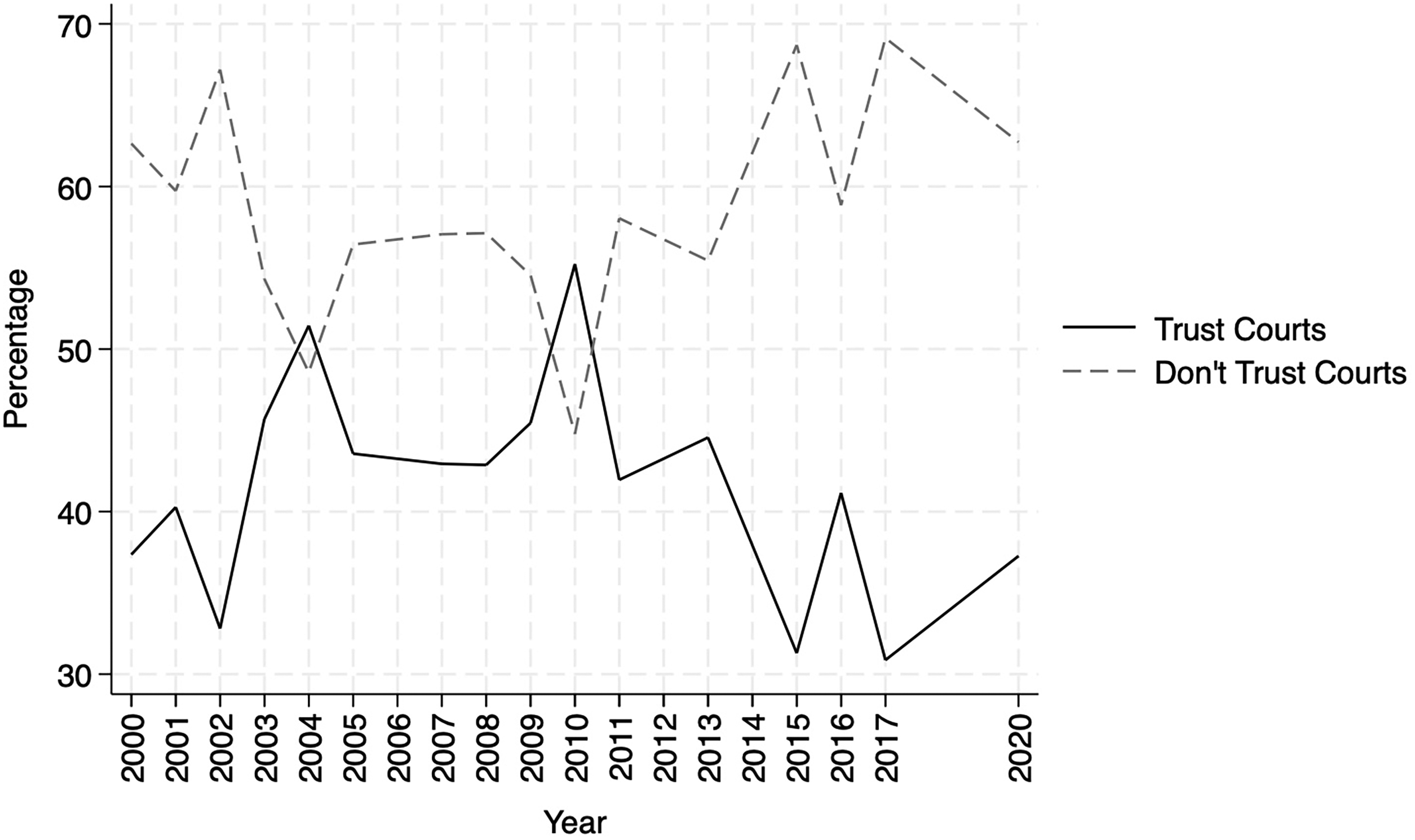
Percentage of Trust in the Judiciary Out of Total Responses (Latinobarómetro 2000–2020).
As Figure 1 illustrates, lack of trust in the Judiciary was always a reality in Brazil, but for the period of interest (2017–2020), it is possible to identify an increase in trust. 30.86 per cent demonstrated some degree of trust in 2017, while in 2020 the percentage was 37.27 per cent. Figures 2 and 3 help us comprehend the patterns among ideological groups. Mistrust in the Judiciary was always higher among leftists, but in 2020, the percentage of respondents that trust the Judiciary to some extent increased in both sides of the political spectrum, not just among the usual supporters of Bolsonaro. In 2017, the percentage of the population who identified as leftists and trusted the Judiciary was 7.27 per cent, while in 2020, it was 8.8 per cent. In the right group, the percentages were 6.45 per cent in 2017 and 20.2 per cent in 2020. Most interesting, the increase in the respondents who identified as right and did not trust the Judiciary was more prominent: 9.85 per cent of total responses in 2017 and 18.22 per cent in 2020. Even though the population more aligned with Bolsonaro's agendas, as the statistical tests will show, did not blame the STF for the failure of the democratic system during the pandemic, the speech against the Judiciary had still some traction among them.

Percentage of Trust in the Judiciary Brazil in the Left Group out of total responses (Latinobarómetro 2000– 2020).
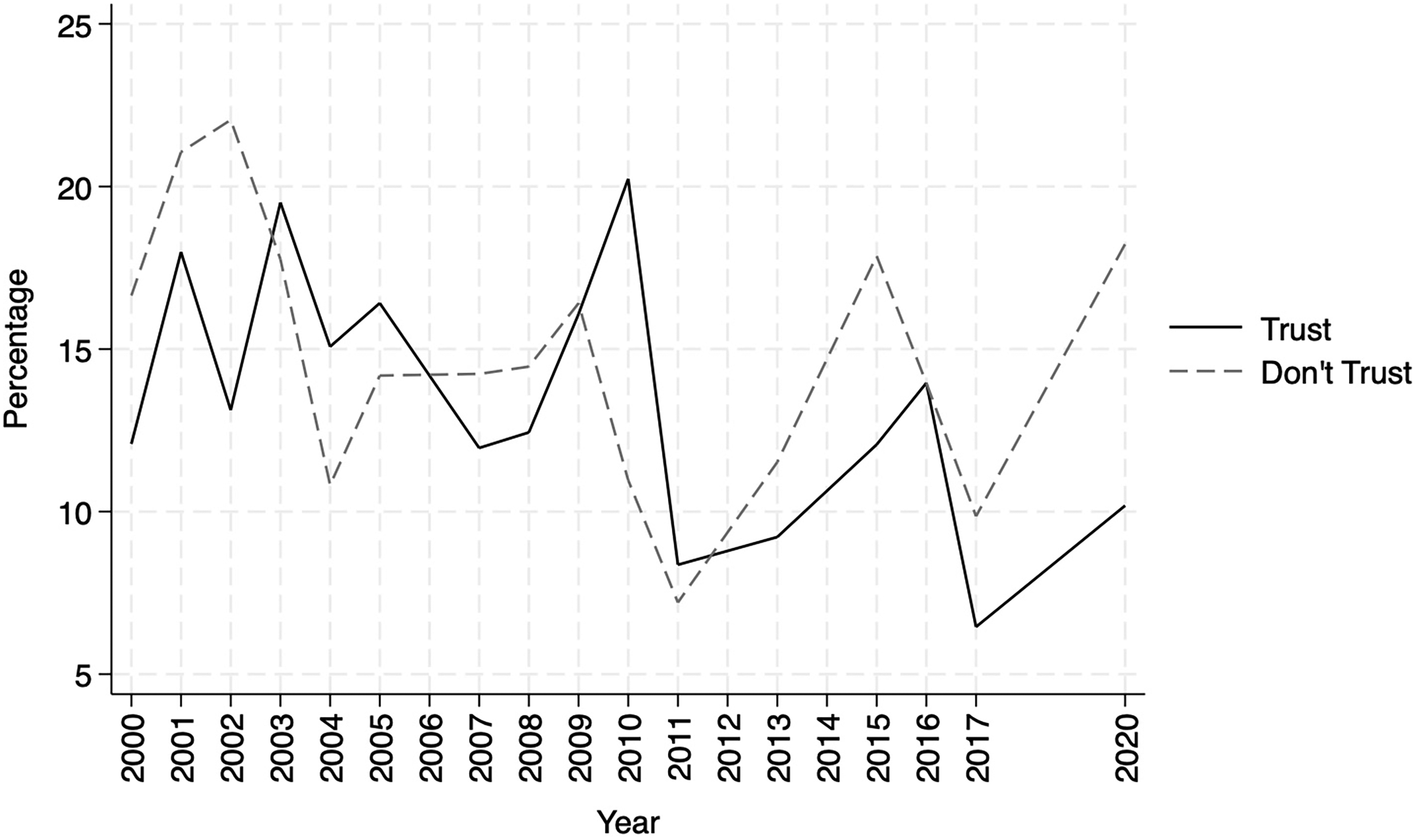
Percentage of Trust in the Judiciary Brazil in the Right Group out of Total Responses (Latinobarómetro 2000–2020).
It is important to note that the Latinobarómetro survey was conducted in November 2020, which was months after the STF made its most significant decisions regarding the pandemic. This is as far as I can go using the regional survey, considering there are no questions about the apex courts in each country or specific decisions. The only question about the Judiciary is regarding confidence.
To explore further confidence in courts, I use the “A Cara da Democracia” (INCT IDDC, 2020) national surveys conducted in March 2018, April 2019, and June 2020 to delve into the dynamics of public opinion and perception of democracy in Brazil. While the sample sizes and interview methods differed across these years, they all represent urban populations, ensuring comparability. Additionally, although the questionnaires varied from year to year, certain questions remained consistent in all three waves, and the order of the questions I am analyzing here remained unchanged. I focus the analysis on these consistent questions to enhance comparability.
Regarding trust in Courts, the worst levels of trust in the Judiciary were found during Bolsonaro's first year, in 2019. Just 8 per cent of the population trusted a lot in the Judiciary during that year, and 38.5 per cent did not trust at all. The numbers in 2018 and 2020 were 11.45 per cent and 35 per cent for 2018 and 15 per cent and 20 per cent for 2020, respectively. The intermediate categories were kept almost constant, except for the intermediary upper category, which jumped from 28 per cent to 40 per cent in 2020. The question about trust in the STF was asked during 2018 and 2019, and the answers corroborate the trend of mistrust during the first year of Bolsonaro's government. In 2018, 28 per cent of the respondents answered that they did not trust at all the STF, while in 2019, the percentage was 43.5 per cent.
To compare the findings from the regional survey with the nationwide one and considering that in both surveys ideology is measured on an 11-point scale, I took the same approach to grouping the political scale, and the results are presented in Figure 4.

Percentage Trust in the Judiciary in Brazil by Ideology Out of Total Responses (“A Cara da Democracia” 2018–2020).
The survey contains other important questions that help us understand attitudes toward the STF and the judiciary in alignment with Bolsonaro's populist rhetoric. One of the questions asked to which extent the respondent agrees that when the STF interferes in the work of the government, it can be ignored by the president or Congress. In 2018, when respondents were asked this question, the combined percentage of those who answered “agree a lot” and “somewhat agree” was 34 per cent. However, in 2019, the combined percentage of these two response options increased to more than 50 per cent of the respondents’ opinions.
In 2020, the survey addressed issues about the role of the STF and its decisions during the pandemic. One pivotal question aimed to gauge respondents’ perspectives on the STF's rulings that constrain the federal government's actions. This inquiry was recorded using the variable “limitgov.” Remarkably, 58 per cent of the respondents indicated their agreement, either strongly or to some extent, with such decisions. Another noteworthy variable, “decisionpandemic,” pertained to which federal entity should assume responsibility for implementing measures to combat the new coronavirus. Strikingly, almost 70 per cent of respondents expressed concurrence with the STF's decision to empower states with autonomy in this regard. In contrast, only 20 per cent endorsed President Bolsonaro's stance.
Again, to measure the effect of ideology on support of the STF's decision, I analyzed how those who perceived Bolsonaro's government as great or good understood the issue decided by the STF. The question asked by the survey was particularly interesting for this analysis because if the respondents who supported Bolsonaro had some bias towards the judiciary, this would be reflected in the answers. Among those who considered the government great, 49 per cent agreed with the judicial decision. Among those who considered it good, 63 per cent agreed with the STF that isolation measures should be determined by governors and mayors and not by the President.
To test my hypothesis that the population recognized the STF as an important piece in democratic stability once the Court decided against Bolsonaro during the hardest moments of the pandemic in 2020, I created a binary logit model from the pool of responses, which showed that dissatisfaction with Brazilian democracy as the dependent variable is strongly associated with the lowest confidence levels of trust in the Judiciary during the years of 2018 and 2019. Still, the same relationship was not present in 2020. Even when a set of controls was included in the models, the results did not change their significance.
I created binary variables, designating “DontTrust = 1” for the lowest trust levels and “DontTrust = 0” for the highest. A similar approach was used for satisfaction with Brazilian democracy, collapsing responses into a binary variable with “Dissatisfaction = 1” for the lowest satisfaction levels and “Dissatisfaction = 0” for the highest. This collapsing method aligns with established strategies in political science literature for capturing general orientations towards parties (Jennings and Niemi, 1968) and political trust (Miller, 1974).
Table 1 shows the results of five logit models, where the variable Dissatisfaction shows the lower satisfaction levels with Brazilian democracy as the outcome. “DontTrustJudiciary” represents the lower level of trust in the Judiciary and is a significant predictor. The first model shows the two variables together; the second considers a robust set of controls; the third, fourth, and fifth show the results for each year separately.
Logit Regression Model Using “DontTrustJudiciary” as a Predictor of Dissatisfaction with Brazilian Democracy (“Dissatisfied”). Data from “A Cara da Democracia” Survey (2018–2020).
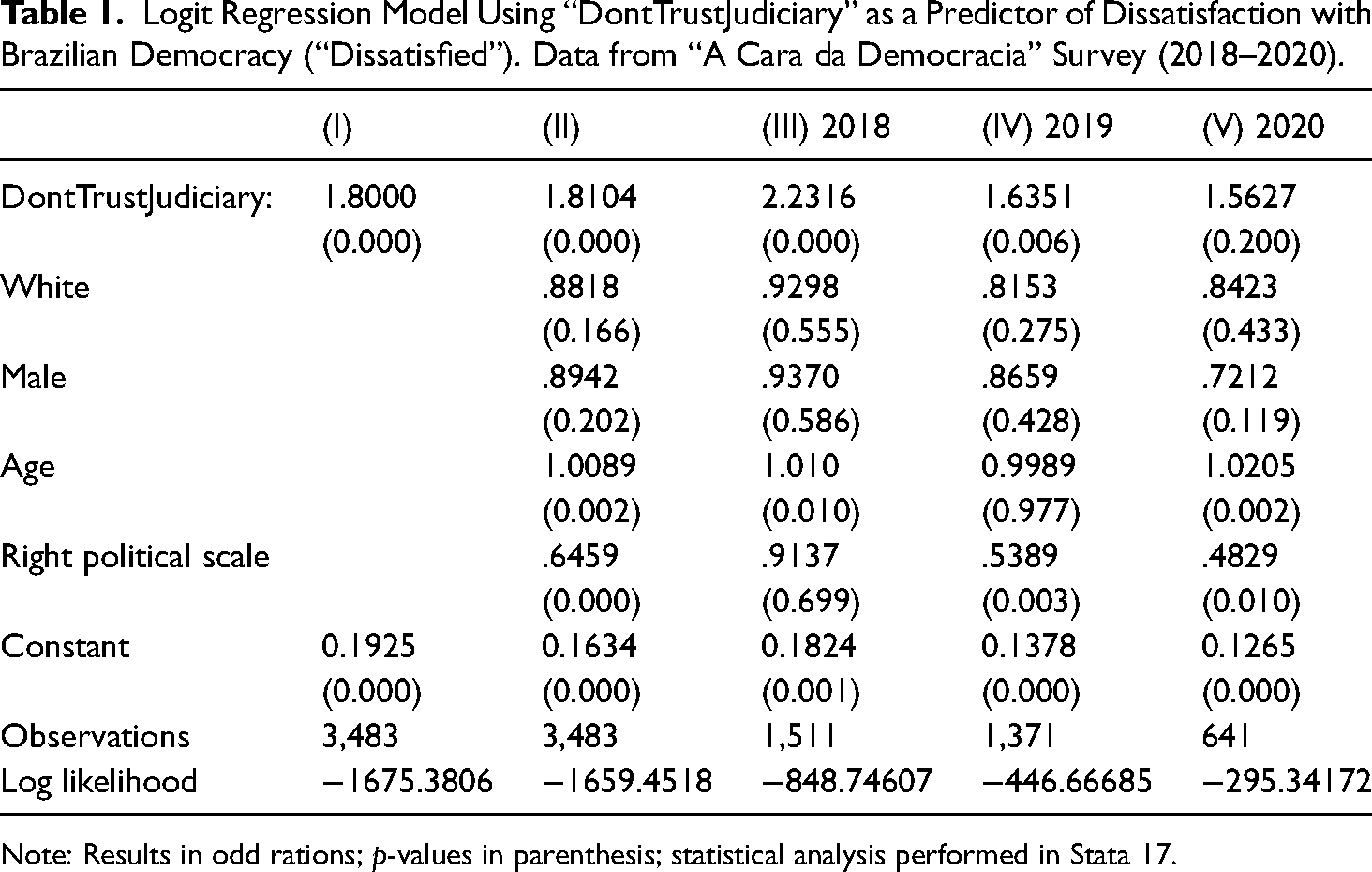
Note: Results in odd rations; p-values in parenthesis; statistical analysis performed in Stata 17.
In 2018, holding other variables constant, individuals who do not trust the Judiciary have approximately 2.23 times higher odds of being Dissatisfied compared to those who trust the judiciary. In 2019, individuals who do not trust the Judiciary had 1.64 times higher odds of being Dissatisfied compared to those who trust the judiciary in 2019. For 2020, however, the coefficient for “DontTrustJudiciary” is not statistically significant.
More than a decade ago, Friedman (2009) proposed a mechanism suggesting that judicial power waxes when judges can discern and are willing to match the larger trends in the public mood and wanes otherwise. The mechanism was tested in Latin America, and it was found that low public support for the Judiciary correlates with political attacks against judges (Helmke, 2010). In other words, Courts are more likely to face challenges to their power when they are perceived as being out of touch with public opinion. Based on those well-established findings, it was with no surprise that scholars perceived authoritarian populist leaders attacking courts constantly and trying to undermine their authority (Arato, 2019). Following what Helmke and Ríos-Figueroa (2011) found previously, the Latinobarómetro survey continues to show that support for courts has been low, at least during the last fifteen years in Brazil. In 2017, the year before Bolsonaro's election and in a moment of general political instability in Brazil following the impeachment of President Dilma Rousseff and corruption scandals, mistrust peaked in the country. With the populist disruptive, and anti-establishment rhetoric, it would be reasonable to expect another peak to be observed in the year after his election, 2020. However, the levels of trust increased in that year. What could explain this change?
I argue that because of the STF's performance during the first year of the COVID-19 pandemic, succeeding in containing presidential overreach, the entire image of the Judiciary was positively affected. To investigate potential change just among Bolsonaro's opposition, I scrutinized trust in the Judiciary among left self-identified respondents and right ones. As Figure 2 shows, the improvement in trust was present in respondents from both political spectrums. Our series of regressions also showed evidence that there was a pattern in the association between mistrust and political ideology, with leftists having lower levels of trust. The Brazilian survey “A Cara da Democracia” results are consistent with the Latinobarómetro ones: improvement is identified in both left and right respondents.
The conclusion might be expected for countries such as the United States, where, for a long time, scholars have argued that there is a weak to nonexistent relationship between ideological identification and support for the courts (Gibson and Caldeira, 2009). In the United States, the impact of political identification was evidenced just when considering judicial outcomes separately, when more support is found among the Democrats for liberal decisions and among Republicans for conservative outcomes (Bartels and Johnston, 2020). In Brazil, however, a simple analysis of Figure 2 leads to the conclusion that mistrust in the Judiciary was always higher among leftists.
When the population perceived the Court as fulfilling its role in democratic stability, they stood by the institution's side. To explore the argument that institutional assessment affects democratic accountability, I showed a series of logit regressions with lower satisfaction with democracy as the main predictor of mistrust in the Judiciary. A strong association between the variables was present in the years before the pandemic. I cannot affirm a causal mechanism because of data constraints. Still, the absence of any association in 2020, alongside the factors discussed above, is evidence that there might be societal awareness of when one of the veto players (Tsebelis, 1995) plays a role in protecting the regime.
Conclusions
The period encompassing Bolsonaro's ascent to power and the unique challenges brought about by the COVID-19 pandemic provides a crucial context for understanding the dynamics of trust in the judiciary. This research, through an analysis of the Latinobarómetro and “A Cara da Democracia” surveys, uses Brazil as a case study to illuminate the intricate relationship between populist rhetoric, institutional trust, and their impact on perceptions of democracy. In nations where there is a declining trust in courts, authoritarian populist leaders can exploit this situation to further weaken these institutions, often portraying them as adversaries of the government. This portrayal is linked to a trend of blaming courts for democratic failures, especially in newly established democracies where counter-majoritarian institutions are viewed as guarantors of a certain level of equity and social justice. However, in times of crisis, courts can rise above this challenge. By upholding democratic principles, they can disrupt this vicious cycle of mistrust and also sever the aforementioned link between mistrust and dissatisfaction with democracy. The mechanism outlined in this paper applies to other countries that, like Brazil, have experienced the conditions described above.
The initial years of Bolsonaro's presidency witnessed a notable surge in mistrust in courts, particularly the STF, aligning with the broader global trend of populist leaders targeting institutions perceived as obstacles to their political agenda. The populist playbook often involves challenging the legitimacy of courts through anti-establishment rhetoric and attempts to curtail their influence.
However, the turning point emerged in 2020, marked by the STF's pivotal decisions that fortified democratic principles and resisted presidential overreach during the pandemic. The judiciary's steadfast defence of federalism, the protection of individual rights, and insistence on evidence-based decision-making seem to have served to elevate public trust in the courts even among those more ideologically aligned with Bolsonaro. Furthermore, the association between mistrust in courts and dissatisfaction with democracy, evident in preceding years, significantly weakened in 2020. The judiciary's proactive role in countering populist rhetoric not only bolstered its legitimacy but also contributed to a positive shift in public perception, challenging the anticipated surge in mistrust during a period of crisis.
This study underscores the resilience of democratic institutions in the face of populist challenges and highlights the pivotal role played by the judiciary in maintaining democratic norms. By successfully navigating the tumultuous political landscape, the STF not only safeguarded Brazilian democracy but also mitigated the corrosive effects of populist narratives on institutional trust. The findings contribute to the understanding of trust dynamics in Brazil but also provide valuable insights for comparative politics scholars grappling with the global rise of populism and its impact on democratic erosion. As Brazil continues to grapple with political challenges, this research serves as a testament to the enduring importance of institutions in preserving the foundations of democracy and invites future studies to apply the mechanisms discussed here to other countries facing similar conditions.
Footnotes
Funding
The author received no financial support for the research, authorship, and/or publication of this article.
