




Abstract
How do people position themselves towards the police? We draw on Motivational Postures Theory to analyse the relationship between citizens and the police in Chile. We present findings from eleven focus groups conducted among diverse social groups (according to nationality, ethnicity and political stance) in three cities. We aimed to uncover the underlying motives and attitudes that shape public interactions with the police. The results describe the main motivational postures towards Carabineros – the main police force in Chile – highlighting the primordial presence of postures of capitulation, resistance, as well as the emergence of a form of conditional commitment. Furthermore, we find evidence for the existence of a sixth posture defined in the literature as avoidance, characterised by an active behavioural disengagement from the police. We conclude by highlighting the importance of understanding the relational dynamics between citizens and the police in democratic societies to shape public policies and law enforcement practices.
Introduction
Police work requires public support to effectively conduct their duties in a democratic context. Positive contact between the police and the citizenry is essential in building police legitimacy and trust (Tyler, 2006). The forms of interaction and encounters with the police impact citizens’ predispositions to collaborate or resist police mandates. In general, a good relationship fosters cooperation, while negative encounters lead to lower levels of trust and decreased willingness to collaborate (e.g. Hough et al., 2013). It is therefore fundamental to understand how people connect with the police and the degrees of desired closeness or distance they want to maintain with police members.
In this article, we draw on Motivational Postures Theory (Braithwaite, 2003) to understand how citizens position themselves towards the police. Motivational postures are signals that express the ways in which actors seek to relate to a source of authority (Braithwaite, 2009). They refer to a set of beliefs and attitudes that summarise a form of psychological disposition towards authorities based on the degree of social distance that citizens wish to maintain between them and authorities (Braithwaite, 2012). This concept has been widely applied in the Anglo-Saxon world to study the link between citizenship and authorities of various kinds (Braithwaite, 2003), including the police (Murphy, 2016). The authors have distinguished between five motivational postures, namely two compliance postures (i.e. commitment and capitulation) and three defiance postures (i.e. resistance, disengagement, and game-playing). Further research has argued for the existence of two other postures, namely, compulsion (Grace, 2020) and avoidance (Gerber et al., 2025).
We present the results of an exploratory qualitative study on the relationship between police officers and citizens conducted in 2022. The study is based on a sample of individuals over eighteen years old in three main cities in Chile. We conducted eleven focus groups with people from different social groups (migrants, indigenous minority members, students, left-wing and right-wing people, and left-wing protesters) to examine different expressions of motivational postures towards the police in Chile. Through a hybrid approach using both thematic content analysis and grounded-theory-based principles, we describe the main motivational postures preferred when interacting with Carabineros – the main police force in Chile. We examine the presence of various compliance and defiance postures within this specific context. Additionally, we analyse whether two newly identified postures – compulsion and avoidance – are evident in our data.
We consider the relevance of this article to be the following. While there is a growing field of studies that have incorporated motivational postures as an interpretative framework to investigate the different forms of linkage between citizens and authorities, most studies focus on the Anglo-Saxon context (e.g. Murphy, 2016; Sargeant et al., 2021), and the majority of studies adopt a quantitative perspective, with only a few studies using qualitative methods (e.g. Black and Heap, 2022; Grace, 2020). Outside the Anglo-Saxon context, recent studies have been implemented in Poland (Kołodziej, 2021) and Slovenia (Hauptman et al., 2024). Despite the existence of studies at the Latin American level that analyse the factors shaping police legitimacy among citizens (Dammert et al., 2021; Gerber et al., 2018; Tufró, 2010), the distance that various social groups maintain with police authority in their daily lives has not yet been thoroughly examined. We reason that the theoretical framework of motivational postures offers a new perspective: it allows for a more nuanced understanding of the relationship between citizens and the police, conceptualising it in qualitatively distinct ways rather than as a continuum from low to high legitimacy. It considers various forms of compliance and dissent, including some that affirm the authority's legitimacy and others that challenge the authority's existence. Notably, these postures can co-exist, suggesting a more complex and multifaceted relationship between citizens and the police. In the Chilean context, motivational attitudes towards the police have only recently begun to be explored (Gerber et al., 2025).
This article contributes to filling gaps in the literature on the relationship between citizens and the police in a Spanish-speaking context – namely, Chile – by using the theoretical framework of motivational postures from a qualitative approach. We also provide complementary information to the findings made by Grace (2020) and Gerber et al. (2025) about potentially new motivational postures beyond the five already defined in Braithwaite's work (2003). Contextually, the case of Chile is highly relevant since the relationship between citizens and the police has shown a high level of volatility. Historically, the police in Chile have been closely associated with the Pinochet dictatorship (1973–1990). After the return to democracy, it positioned itself among the most trusted institutions in the Chilean context for years. However, corruption cases and significant levels of police repression and violence in citizen protests decreased the citizens’ trust levels significantly (Gerber et al., 2023). Later, the police positioned itself again as one of the most valued institutions of the country in a context of increasing citizen insecurity perceptions (Centro de Estudios Públicos, 2024). The motivational postures framework is useful to explore the changes that police legitimacy in Chile has undergone in recent years, from a dimension focused on citizen dispositions towards the police. We also believe that these findings may encourage the use of this analytical framework to investigate police–society interactions in Spanish-speaking and other non-WEIRD countries.
The article is organised as follows. First, we describe the analytical framework of motivational postures and its particularity for the study of the link between citizens and police forces. We then describe and contextualise the case of the main police force in Chile. Next, we detail the methodological decisions of the study and describe the main findings. Finally, we discuss the results and emphasise the importance of understanding the relational dynamics between citizens and police officers to shape public policies and law enforcement practices.
Motivational Postures Theory
Motivational postures theory is a strong analytical framework to understand the relationship between authorities and society. This theory constitutes a way to operationalise the “postures” or psychological disposition of the citizenry to comply with or challenge authorities. It posits that these beliefs and attitudes towards authorities depend on the social distance that individuals wish to establish between themselves and authorities (Braithwaite, 2003). In this context, motivational postures are defined as social dispositions that individuals have regarding preferred forms of social distance towards authorities, which vary depending on the context of interaction and circumstances (Braithwaite, 1995). According to this theory, people's identities determine how they react to authorities, depending on whether they perceive them as a threat to their identity or aligned with their values, expressing different types of motivational postures of compliance or defiance (Braithwaite, 2009). Individuals who maintain greater social distance from authorities will have more negative attitudes and be more willing to challenge or resist, while those with lower distance will align with authority and be more likely to obey (Braithwaite, 2012).
Braithwaite developed this framework after years of research to understand challenges and non-compliance in tax and nursing home settings (Braithwaite, 2003). Since then, the framework has been applied to policing contexts (e.g. Sargeant et al., 2023), child protection (Braithwaite and Ivec, 2022), and regulations in the context of the coronavirus disease-2019 (COVID-19) pandemic (McCarthy et al., 2021), among others.
The literature recognises two compliance postures (i.e. commitment and capitulation) and three defiance postures (i.e. resistance, disengagement and game-playing; Sargeant et al., 2023). In general, they range from greater commitment to authorities (greater cooperation and legitimacy) to greater distancing, which is expressed in forms of challenges (understood as forms of resistance towards or disengagement from authority).
Commitment and capitulation are linked to greater commitment and compliance with authorities. Commitment implies an acceptance of authorities and a moral alignment with its mandates (e.g. a feeling of obedience), while capitulation is more linked to compliance with authorities to avoid trouble (e.g. obeying to “keep them happy”). Grace (2020) suggested the existence of a new posture related to capitulation, namely, compulsion. Compulsion refers to a compliant behaviour with a resistant attitude. Here, people feel compelled to accept the authorities’ decisions, but they do so because they feel threatened. Furthermore, they express grievances about the actions of law enforcement officials.
On the other hand, disengagement, resistance, and game-playing postures involve greater distance from authorities and more challenging postures (Grace, 2020). Resistance implies an active challenge, such as communicating discomfort, raising one's voice, or challenging authority (e.g. “not letting authority push you around” and “making oneself heard”). The resistance posture does not seek to destabilise a system, but is rather a way to communicate dissatisfaction by engaging with the authority when one disagrees with its use of power. It does not involve the use of violence but rather aims to make the authority aware of certain issues and push them to improve the way they do things (Braithwaite, 2009). Disengagement, in turn, implies detachment from authority, showing apathy towards it, while game-playing expresses an instrumental distance from authorities (e.g. “playing along with them”). Disengagement and game-playing express more disdainful forms of defiance than resistance (e.g. dislike, apathy, or indifference).
This theory suggests that disengaged individuals simply ignore the demands and threats of authority, which may be reflected through avoidant behaviour. However, one may question the need to distinguish disengagement (which assumes a certain level of irrelevance of authorities) from avoidant behaviour (where authorities may be actively avoided due to fear). Additionally, while disengagement is more associated with a cognitive dimension, avoidance is primarily focused on behaviour (as has been shown in Chile, Gerber et al., 2025). Unlike the disengagement posture, avoidance implies eluding all types of connection with authority and does not express a position of apathy, but fear (e.g. “avoiding contact out of fear of punishment”) (Gerber et al., 2025). In this light, in addition to analysing whether the traditional motivational postures map into the narratives of different groups in Chile, we aim to explore if there is evidence for the existence of compulsion and avoidance postures in this exploratory qualitative study.
Motivational Postures Towards the Police
The literature has extended the application of the theory of motivational postures to comprehend the orientations and perceptions of the citizenry towards law enforcement (Sargeant et al., 2023). Initially proposed by Braithwaite (1995) to measure motivational postures like disengagement and resistance in the taxation context, a comprehensive scale was later introduced in 2003 (Braithwaite, 2003). This scale was adapted by Murphy et al. (2009) to assess attitudes towards police authority, encompassing four postures: commitment, capitulation, resistance, and disengagement. Because the game-playing posture has been deemed less relevant in policing contexts (Sargeant et al., 2021), subsequent studies concentrated on postures of resistance and disengagement towards law enforcement (McCarthy et al., 2021). The current study is valuable for examining whether game-playing manifests as a form of defiance in the policing context.
Motivational postures towards the police are closely tied to perceptions of legitimacy and procedural justice (Tyler, 2006), as well as the willingness to cooperate with authorities (Wenzel, 2003). Those who question the legitimacy of law enforcement are more inclined to adopt resistance and disengagement postures, distancing themselves socially from the police, while being less likely to exhibit commitment or capitulation postures (Sargeant et al., 2023). For example, some findings indicate that procedural justice can reduce defiant postures and improve compliance among those resisting authority (Murphy, 2016). In other studies, it has been detected that how the police are viewed in an interaction can affect perceptions of procedural justice. In these cases, defiance is linked to a lower perception of procedurally fair treatment (Sargeant et al., 2023). Fair and respectful treatment can thus diminish the social gap between individuals and authorities, reinforcing compliant postures and diminishing defiance. This decreased social distance might, in turn, bolster trust in law enforcement and mitigate conflict and violence between citizens and the police.
It is also noteworthy how motivational postures manifest in the context of police interactions with minority groups. Previous studies have revealed that excessive use of force by police often targets marginalised communities and minority group members, who also endure higher levels of police discrimination compared to other social groups (e.g. Feldman et al., 2019). This unjust treatment of minority groups signals that authorities do not value these groups and influences their motivational postures (Larasati et al., 2021). As a result, findings from Murphy and Cherney (2012) indicate that ethnic minority groups tend to assume more disengaged postures towards law enforcement compared to non-minority groups (e.g. Sargeant et al., 2023).
In general, most studies on motivational postures have been quantitative, with only a few adopting a qualitative perspective. In the context of compliance with COVID-19 sanitary regulations, Grace (2020) examined the willingness of citizens to cooperate in encounters with the police regarding penalty notices for disorder in England. Grace proposed a sixth posture called compulsion, understood as a form of compliant behaviour with a resistant attitude, where people are compelled to accept the decisions of the officers through threat, but continue to express grievances about the actions of law enforcement officials. Finally, Black and Heap (2022) investigated the impact of Community Protection Notices on citizens’ willingness to comply with the law, finding that procedurally just practices favour voluntary compliance. These studies are of significant value, as they provide a nuanced understanding of the dynamics between citizens and the police. Identifying forms of interaction, resistance, and engagement in specific contexts provides important evidence that may be overlooked in quantitative studies. These findings allow us to explore how lived experiences, historical contexts, and socio-political factors shape police–citizen ties. This is particularly important in the Chilean context due to the changes in the relationship between the police and the public in recent years.
The Police in Chile
Since the 1990s, satisfaction with and trust in the police in Latin America have become central topics in regional political debate. With the democratisation of societies, efforts were made to re-legitimise police authority through community engagement policies and collaboration with civil society, framed within citizen security policies (Dammert, 2016). This approach contributed to moving away from the predominant “zero tolerance” and “iron fist” strategies of the authoritarian period (Hathazy, 2016). However, perceptions of corruption, negligence, and abuse of power, along with the growing distance between politics and citizens, have maintained low levels of trust in the police and institutions in general in Latin America (Dammert, 2016), hindering the construction of sustainable trust with communities and limiting the ability to confront the rapid rise of organized crime since the early twenty-first century (Bergman, 2018).
Carabineros, the main police force in Chile, was founded in 1927 and operates under a militarised and centralised model (Hathazy, 2016). In the 1990s, reforms aimed to overcome the distrust generated by its role in Pinochet's dictatorship and with the return to democracy, the legitimisation of police actions increased due to fear of crime and the demand for security, resulting in high trust ratings (Dammert, 2016). However, this level of trust reduced the need for institutional reforms (Dammert, 2019) and allowed Carabineros to establish an independent administrative model, detached from governmental control (Bonner, 2018).
In recent years, cases of corruption, as well as its responsibility for serious human rights violations during the social uprising of 2019 (Carrasco and Disi, 2023) and with the Mapuche people (the largest ethnic minority group in Chile; Gerber et al., 2018), have been key points in understanding the momentary decline in its levels of trust (Dammert, 2019). This is compounded by findings of links between some police officers and criminal networks (Dammert et al., 2021). Under these conditions, its support fluctuated to its lowest levels in history in recent years. However, in the context of a growing insecurity crisis and perceptions of citizens’ unsafety, trust has recently increased again, reclaiming its place as one of the best-rated institutions in the country (Centro de Estudios Públicos, 2024).
Although studies have been conducted on police legitimacy following the social uprising and perceived security crisis (Padilla et al., 2022), addressing the relationship between police and the city's impoverished sectors in Santiago de Chile (Luneke et al., 2022), in protest contexts (Gerber et al., 2023), and within the Mapuche ancestral territory (Gerber et al., 2018), there are few studies on a national-scale aimed at comprehending the dispositions with which the public interacts with Carabineros. In a critical context of exponential growth in perceptions of insecurity and fear of crime (Paz Ciudadana, 2024), where all surveys indicate a recuperation of police trust to historically high levels (Centro de Estudios Públicos, 2024), our study aims to explore the qualitative dimensions of Chilean society's attitudes towards the police. To do this, we explore the different compliant and defiant postures towards the police present in different groups of Chilean society.
The Current Study
To increase our understanding of the ways in which different social groups in Chile relate to the police, we conducted an exploratory qualitative study grounded in the theory of motivational postures. In December 2022, we conducted eleven exploratory focus groups to analyse the motivational postures that people most identify with when thinking about engaging with the police in Chile. We considered individuals from diverse social, political, and ethnic backgrounds across three major cities. The analysis of participants’ experiences and perceptions aimed to capture the varied ways in which people position themselves towards the police, highlighting the complexity of citizen–police relationships in a changing social context.
Participants, Design, and Procedure
We employed purposive sampling to capture a wide range of ages and social backgrounds, deliberately selecting different social groups known to experience varying forms of treatment by the police. Previous studies have pointed out the importance of investigating different forms of legitimacy and support according to political, age, socioeconomic, and ethnic positions (e.g. Gerber et al., 2018). In the Chilean case, previous studies have suggested the importance of political ideologies in police support (e.g. Dammert et al., 2021), as well as variation in police legitimacy and experiences with police forces by socioeconomic status (Frühling and Tyler, 2007; Luneke et al., 2022). Similarly, studies have explored the particularities and often discriminatory experiences of the police with Mapuche groups (Gerber et al., 2018), migrants (Doña et al., 2024), and protesters (Gerber et al., 2023).
To be able to capture social groups facing different challenges in relation to police–citizen relationships, participants were recruited from three major cities in Chile, representing the northern, central, and southern regions (Antofagasta, Santiago and Temuco). Antofagasta is relevant because it is one of the cities that concentrates the largest migrant population – the second largest nationwide after the capital (Albert, 2023) – and where the increase in the migrant population has made police–citizen relations more complex (Arriagada and Contreras, 2023). Temuco, in turn, was considered due to the strong presence of policing towards the Mapuche people due to territorial conflicts (Gerber et al., 2018). Finally, Santiago was considered because it is the place where most political demonstrations take place (Maguire, 2021), leading to frequent clashes between protesters and the police. In each city, we conducted focus groups with participants representing both left-wing and right-wing political positions. Figure 1 highlights the three regions included in the study.

Regions of Chile Included in This Study.
Inclusion criteria were defined based on participants' responses to a questionnaire that captured their political position, age, nationality, and whether they identified as belonging to an indigenous group. Political position was determined based on the question, “Many people, when thinking about politics, use the terms ‘left’ and ‘right.’ Generally, where would you place your political views on this scale? (1 = Left, 10 = Right, 11 = None.)” We invited participants who answered one to five to the left-wing groups and those who answered six to ten to the right-wing groups. We incorporated additional groups tailored to specific issues pertinent to each region: migrants (based on their nationality – Bolivia, Colombia and Venezuela) in the north, left-wing protesters (based on whether they had demonstrated during the last six months) and university students in the central area, and Mapuche individuals (self-identified) in the south. A total of sixty-seven individuals participated, with ages ranging between nineteen and sixty-three years. Recruitment was carried out by an external company. Each focus group was conducted with between seven and eight participants, with both men and women of different ages (for more information, see Table 1). Participation was voluntary, anonymous, and informed, and all participants provided both verbal and written informed consent. This study was approved by the ethics committee of the university of the lead author of this article.
Groups of Participants, City and Zone of Residence, Number of Participants per Focus Group.

Source: Authors’ elaboration.
The groups were moderated by the researchers of this project. A conversational group method (Krueger and Casey, 2014) that allows for the exploration of individual and group opinions through conversational interaction, prompted by the researchers, was used. Group conversations lasted between 60 and 120 minutes. The script addressed topics related to participants’ experiences with the police, perceptions of differential treatment towards various societal groups and motivational postures preferred or used when interacting with the police. The groups were all conducted in Spanish. The quotes used in this study were translated into English by one team member and reviewed by another.
Data Analysis
The data were analysed using NVivo version 14. The analytical techniques used were hybrid, combining deductive approaches based on motivational postures theory, as well as inductive approaches based on themes that emerged from the data, by applying grounded theory principles (Corbin and Strauss, 1990). The first deductive steps were guided through thematic content analysis (Braun and Clarke, 2006), taking into consideration the theory of motivational postures defined in the literature by identifying and coding the main themes of the different proposed postures. Secondly, our data were coded through the three main phases involved in the inductive approach of grounded theory, namely: open, axial, and selective coding (Corbin and Strauss, 1990). This integrated analytical orientation focused on the identification and interpretation of explicit statements made by the participants, following the criteria of exclusive allocation, congruence, and exhaustiveness (Nowell et al., 2017). We conducted constant comparison between quotes and discourses to look for patterns and variations, allowing for a more in-depth interpretation of results (Corbin and Strauss, 1990). This allowed us to analyse the interrelationships between the quotes selected to aid in interpreting participants’ experiences and discourses. To exemplify the findings, we show extracts from the conversations developed in the focus groups. To facilitate interpretation, each extract identifies the sex of each participant (M for man or W for woman), the type of focus group they participated in and the city in which data collection occurred.
Results
Three main findings merit particular attention. First, our research shows that individuals interact with the police in diverse and complex ways, and these interactions vary depending on the context of the interaction. Second, our findings suggest that social factors like nationality, ethnicity, and political stance influence the motivational attitudes individuals adopt when engaging with the police. Finally, all five motivational postures identified in the literature are present in the participants’ narratives. The most prominent motivational postures regarding the desired connection with the police are capitulation, resistance, and a newly identified sixth posture, which has been labelled avoidance. Figure 2 summarises the main findings for each group.
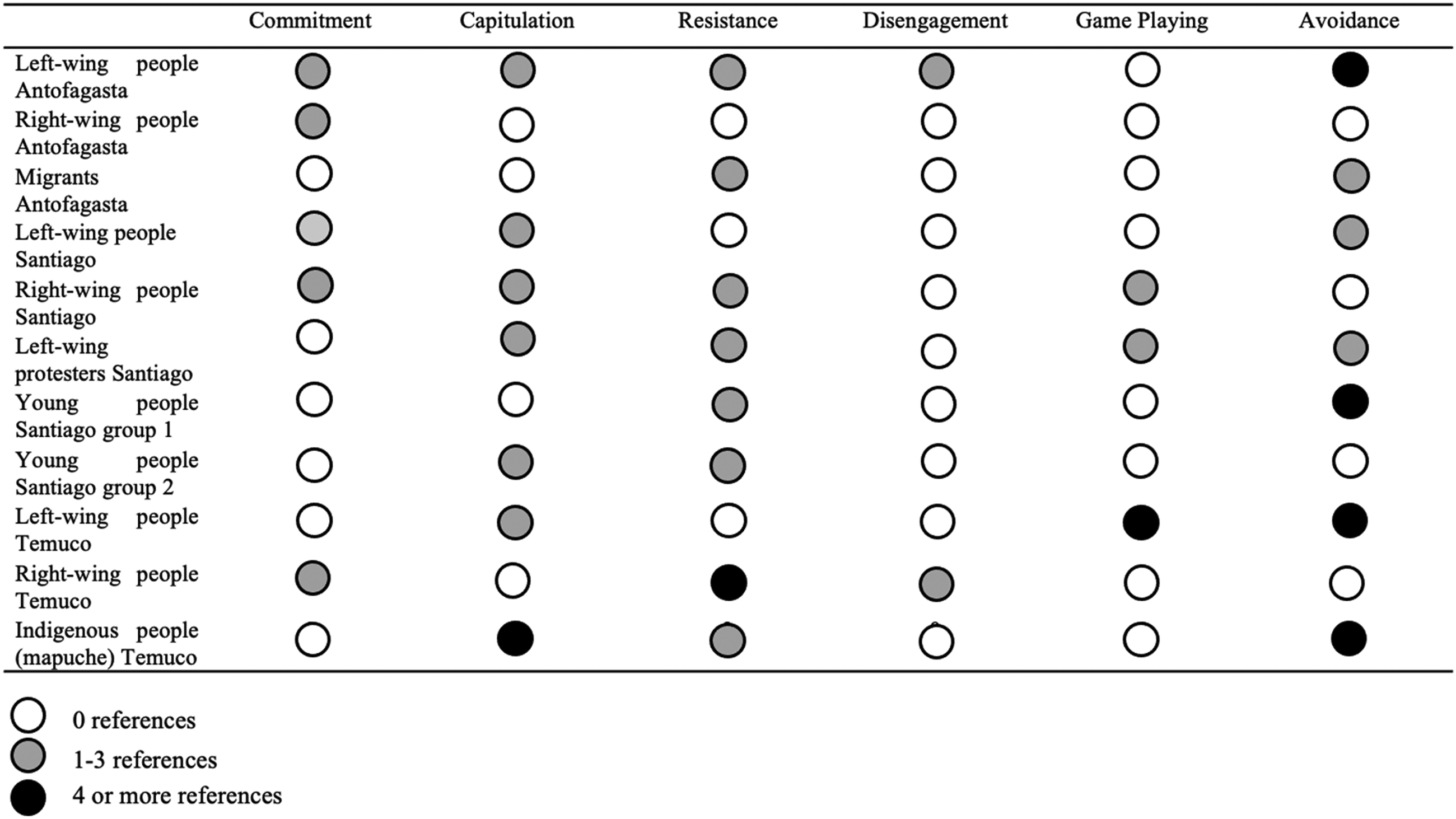
References per Group.
Commitment
In the context of our research, when participants speak of commitment, they refer to examples of everyday interactions – for example, traffic stops, crime control, and patrolling. The willingness to obey out of commitment was expressed in two ways, depending on whether it was conditional or unconditional concerning the actions of the Carabineros. More than a specific type of interaction with the police, what appears to shape the type of commitment – whether conditional or unconditional – is the predominance of normative factors. The primacy of normative factors (legitimacy and procedural justice) tends to favour an internalised unconditional commitment disposition. On the contrary, conditional commitment is contingent on specific conditions being met – particularly respectful and reciprocal treatment by the police. Once these conditions are met, conditional commitment can transform into an engaged form of compliance.
Overall, a few participants across all groups mentioned obeying the police strictly out of unconditional commitment. The willingness to obey out of an unconditional commitment is linked to the mandate of respecting authority based on its symbolic position in society. Those who adhere to this posture align themselves with institutional values, indicating the importance of respecting police and military institutions, as seen in this quote: “I believe that we all need the same, Carabineros and the military, and we all must respect each other, and even more so if a person is wearing a uniform. I mean, sincerely, I prefer to respect them” (W, Left-wing, Santiago).
Unconditional commitment is also expressed in the willingness to empower the Carabineros based on an assessment that they are losing their authority and that there is a critical need to restore the foundations of this authority (Sunshine and Tyler, 2003). As one participant in Temuco says, They no longer have the authority they used to have, where one would see a Carabinero and there was respect. Not anymore. Now one sees a Carabinero, and there's always someone calling them names, and it's like they are losing a lot of respect. I think they need more authority to enforce their service. (M, Right-wing, Temuco)
But more frequently, commitment appears as conditional, relative, and contingent on a specific situation (e.g. police treatment). As one participant expresses, “in general, one should obey them, as long as they comply with the procedure” (W, Left-wing, Santiago). This reinforces the idea of the situated and dynamic nature of motivational postures. In such cases, depending on the interaction with the police, commitment is a conditional stance that can transform (or not) into resistance depending on the actions of the police. For example, in Temuco, conditional forms of commitment can be argued to stem from negative experiences with the police (e.g. during the conflict between the state and the Mapuche). In general, you should obey, because they are an authority that is supposed to be doing good to you and is not doing harm to you. But if there is any point of view that I don't agree with, I will tell them no. (W, Right-wing, Temuco).
Capitulation
In the policing context, capitulating implies submission to authority without actively endorsing it. Our findings indicate that this is one of the most recurrent postures among the different groups considered, although it is expressed in different ways depending on the interactional experiences with the police.
On the one hand, our data show that groups that have suffered mistreatment or experienced violent police repression tend to show a disposition to capitulate – expressed as “fear of punishment” – to avoid reliving these critical experiences. In general, these experiences with the police have occurred in protests (e.g. left-wing participants) and in other cases in more everyday interactions (e.g. Mapuche people). This form of capitulation involves obeying to avoid punishment or retaliation: “I will behave well because I don't want punishment. I don't want to confront Carabineros, I don't want to experience the violence they exert” (M, Left-wing, Antofagasta). Capitulation also means staying quiet out of fear: “even if I faced a procedure that is wrong, I would still keep quiet because … because they will surely hit me” (M, Left-wing, Santiago). In some cases, what is critical is the differential treatment provided by the police based on physical characteristics: “I'm afraid because of my shape, my structure, my face, my hair, they, they might … they might shoot me!” (M, Protester, Santiago). Some women also mention capitulation out of fear: “one listens to them in that sense because if you don't, they will arrest you, and then everything becomes more cumbersome and who knows what could happen. One takes more risks in the end” (W, Mapuche, Temuco). In the same line, participants acknowledge the existence of power asymmetries when dealing with the police: “they have more value as witnesses than we do … so, that's why if a cop treats you badly or does something wrong to you, the best thing is to bow down” (M, Left-Wing, Santiago).
On the other hand, privileged groups, such as right-wing individuals, who have experienced better police treatment, tend to express capitulation more as an attitude to avoid minor consequences or unnecessary efforts, such as wasting time: In what ways could one say no to a Carabinero? Generally, I prefer to say yes, to comply with what they tell me, because it would be a waste of time to argue with them. (M, Right-wing, Santiago)
Resistance
Resistance is the most widespread posture of defiance across different groups. It is tied to the belief that one should not always obey the police, “because there are situations that are not appropriate, may be unlawful, or demand things that should not be required” (M, Left-wing, Antofagasta). These situations include unfair procedures, police mistreatment, or acts of violence (e.g. during protests). Moreover, resistance occurs even among groups that demonstrate greater commitment to the police (e.g. right-wing groups).
The willingness to resist does not imply destabilising the system but raising one's voice against injustice (e.g. police mistreatment) and the ways in which the police (ab)use their power. As one participant expresses: There are many situations where it makes you very angry because you know what they're doing is wrong, and then that instinct of disobedience comes out to say why? Why should I do it? (W, left-wing protester, Santiago)
Interestingly, resistance is also present in right-wing groups that demonstrate greater support for the police. The presence of this posture among individuals with more conservative views in southern Chile, for example, might be related to specific experiences of under-policing and a lack of state protection in the context of the conflict between the State and indigenous communities. You should never say yes to everything, you always have your point of view and if you believe that what you’re being asked or what you’re asking for is not right, you have the right to say no, I don't agree. (W, right-wing, Temuco)
Disengagement
Disengagement is one of the postures described in the literature which had less presence in the participants’ narratives. Only some participants expressed detachment and disinterest towards the police (mostly left-wing individuals). Participants expressed this disconnection by relativising the authority, pointing out that police officers are “like any other person” (W, left-wing, Santiago) or “just another employee” (M, left-wing, Antofagasta). However, we did notice a distinct form of disengagement within the groups, which we categorise as avoidance (Gerber et al., 2025). Although the literature suggests that avoiding contact with authorities is a possible reaction among individuals who express disengagement, we believe it is crucial to make a distinction between the type of disengagement which is triggered by indifference and the type of avoidance which is triggered by fear.
Disengagement is a posture of withdrawal, aiming to sever the relationship with authority to the point where authority becomes irrelevant (Braithwaite, 2012). Therefore, it is a less active stance, linked to indifference. The contexts described by participants are varied and include any form of interaction, with this generality stemming from the sense of irrelevance. It differs from more active postures like avoidance, where individuals take a stance and actively decide to avoid contact with the police (e.g. crossing the street upon seeing a police officer approaching). We illustrate this posture in the following section.
Avoidance
Our findings reveal the presence of a sixth posture labelled “avoidance” characterised by a disposition to the active maintenance of physical distance with the police due to previous negative experiences (Gerber et al., 2025). Avoidance does not seek to appease but rather to avoid any kind of connection or interaction with authority. While disengagement involves a cognitive action, avoidance is a disposition to act. This is most evident during day-to-day interactions with the police (e.g. identity checks), where participants may avoid having contact with them. However, this disposition is often rooted in direct or indirect experiences with police use of force, for example, during demonstrations.
Avoidance is the third most frequently referenced posture in the groups. It is particularly present in disadvantaged groups that have experienced intergroup violence or other forms of unfair treatment by the police in particular contexts (e.g. migrants, Mapuche, and left-wing groups). As participants’ state: “I prefer to avoid contact with the police. The truth is, if I ever have to resort to them and it's necessary […] I want to stay away from them” (M, left-wing, Antofagasta); “when I see them, I avoid them” (M, university student, Santiago); “Honestly, I hope not to have any direct contact with the police […] they look down on you, so you feel uncomfortable, vulnerable, so it's better to avoid situations that put you in conversation with them” (W, left-wing, Antofagasta).
This situation can also be inherited within groups systematically exposed to various forms of violence over time, such as among the Mapuche people. One participant points out: Historically, I have had the experience of torture in my family. Torture, murder […] we all know that it's transgenerational, living in fear, having learned from a young age that they are dangerous, that it's better not to approach them, to turn away if they come down a street. (W, Mapuche, Temuco).
Interestingly, avoidance does not appear as a relevant posture in right-wing focus groups.
Game-Playing
Our findings show that in the Chilean context, game-playing is an imaginative and daring practice to escape limitations (e.g. identity checks and fines) by redefining roles, norms, and rules for a specific purpose. In our data, this motivational posture did not have a quantitatively significant presence, but it was organised in a common way across the different focus groups, regardless of their ideology. Although game-playing is less prominently featured in the policing literature (Sargeant et al., 2021), this study does show that it can be a relevant dimension within citizen–police interactions, at least in the Chilean case.
The expression of this posture in the Chilean case can be captured by the emic concept of “seguirles la corriente” (going along with them). This notion seeks to express that one is following the authorities’ rules in apparent terms, but in subjective terms, there is an active distance from the authority and its orders. This disposition is particularly justified in contexts of problematic encounters with the police, where individuals must operate strategically to avoid being punished – for example, protests, controls, and raids. In a case from the right-wing group, our interviewee avoided police punishment (a speeding ticket) by pretending to comply with their instructions: I exaggerated […] I handed over the car documents, the police officer approached. “Good afternoon.” He said, “sir, you were going at 140 kilometers.” […] I said, “I was speeding, do what you have to do.” And he said, “you know, just go carefully.” (M, right-wing, Santiago)
Game-playing, then, operates as a disposition that involves the reflexivity of the individual who needs to behave according to what the police expect from them. This going along involves performing in a way that requires emotional and theatrical self-control. This means avoiding disruptive behaviours, such as being arrogant or presenting oneself in a certain way to the police, to avoid conflicts. As a protester from Santiago expresses: “there's no need to be arrogant […] you look at the cop, start walking away, and tear up the ticket” (M, protester, Santiago).
This posture seems to be present across all groups and does not appear to depend on prior interactions with the police, although it is not clearly reflected in their accounts. Due to its nature, it is likely to operate more in practice than in the discourse of the different groups. Participant observation methodologies could provide more insight into this kind of disposition.
Discussion and Conclusions
In this study, we sought to explore how different groups of individuals in Chile position themselves in relation to the police in terms of motivational postures. By analysing data gathered from social groups that usually differ in their relationships with the police, we aimed to uncover the underlying motives and attitudes that shape public interactions with the police.
The study concludes with three key points. First, the theory of motivational postures is a robust framework for understanding interactions between citizens and authorities. Unlike theoretical approaches that conceptualise the relationship as a continuum from low to high (e.g. Tyler, 2006), this theory allows for the discovery of new forms of interaction specific to contexts and social groups, as well as to identify various forms of compliance and defiance that co-exist within the same groups of people. This coexistence of different motivational postures further suggests that the ways in which individuals relate to the police are complex and cannot be reduced to being defined as expressing low or high legitimacy. The increase in trust reported by opinion studies (Paz Ciudadana, 2024) is not distributed homogeneously; rather, it coexists with experiences and tensions that vary across social groups. Second, our research reveals that attitudes towards the police vary based on each individual's specific interactions, influenced by contextual factors and past experiences (even historical experiences). In this regard, cases of police corruption do not emerge as a narrative supporting a particular posture towards the police. This opens a complementary line of research that could be further developed in future studies. The qualitative analysis has made it possible to explore these particularities, which have not yet been examined in detail by previous research. Third, the five original postures identified in the literature, and a sixth newly identified posture, avoidance, have different relevance depending on the social group. While resistance and avoidance predominate in groups usually disadvantaged by the treatment of the police, dispositions such as conditional commitment are more common throughout all groups, arguably due to expectations of democratisation and the relationship with authority.
Among the compliance postures, capitulation is present in most groups and more frequently in those who have had negative interactions with the police (e.g. protesters, Mapuche people, and left-wing individuals). The way the willingness to capitulate was expressed in our study indicates obedience without an internalisation of the values underlying perceptions of legitimacy. In this sense, whether due to fear or to avoid problems, by capitulating, individuals show an instrumental disposition to obey the police.
For disadvantaged groups, capitulation is a response to fear and the need to avoid police retaliation, due to past experiences of repression. These findings underscore the importance of recognising the history of the Carabineros as one marked by recurrent repression, which has fostered a widespread sense of fear towards them (Gerber et al., 2023). This can be linked to findings from the literature on the role of fear in the perception of police legitimacy towards various groups (Jackson et al., 2022). In contrast, for privileged groups, such as right-wing individuals, capitulation is a more instrumental strategy, aimed at avoiding minor inconveniences during police checks.
In opposition to capitulation, commitment is the least frequent motivational posture, and it is only occasionally mentioned among some right- and left-wing groups. The surprising appearance of commitment among left-wing individuals in Antofagasta and Santiago warrants some discussion and the consideration of regional differences that may shape experiences with police officers in different ways. In Antofagasta, this connection with the police may be associated with the strong anti-immigrant sentiments present in the area. In this context, the police are perceived as the institution that enforces crime control measures, which could strengthen their relationship with the local community. In Santiago, the presence of commitment-oriented positions within left-wing groups may be attributed to the current high levels of fear of crime across the population, as well as to a growing distance from events that have undermined police legitimacy, such as the social uprising of 2019.
Additionally, the study found the presence of a more conditional form of commitment than that described by the literature. Previous studies indicate that this posture defines the individual's disposition to comply due to a belief in authority, based on moral alignment with principles of law enforcement (Braithwaite, 2012). Our initial findings suggest that this type of unconditional commitment is present in very few participants, being a form of “conditional” commitment being much more present. The latter is based mainly on the assessment of fair treatment and proportional use of power by the police. We believe that further studies should continue to delve into this form of commitment.
It is particularly significant to highlight that the posture of capitulation prevails over commitment among participants, especially in groups with prior negative experiences with law enforcement, such as protesters and the Mapuche community. This reflects a protective strategy rather than the acceptance of police values or legitimacy. This stands in sharp contrast to commitment, where obedience stems from a moral belief in the righteousness of the police. The higher prevalence of capitulation suggests a pragmatic adaptation to authority, motivated more by the desire to avoid conflict and repercussions than by genuine respect.
Among defiant dispositions, resistance is the most commonly adopted by almost all groups, including protesters, Mapuche, left-wing and right-wing participants. The willingness to resist aligns with individuals’ reactions to mistreatment and forms of procedural injustice by the police (Murphy, 2016), accompanied by an explicit expectation for the democratisation of the social bond (Araujo, 2023). Resistance is not exclusive to certain groups historically in tension with Carabineros, but rather constitutes a more transversal posture. In this way, we reinforce the idea that resistance is a central finding that complicates generalised narratives about police–citizen relations. Future studies should further explore these differences across different groups in society. “Game-playing” is a particular disposition mentioned by participants from some right-wing and left-wing groups, which has commonly been excluded from previous research on motivational postures towards the police. There seems to be a link between “game-playing” and what the literature has called “legal cynicism”, that is, the idea that people are “above the law”, that the law does not apply to them, or that laws or rules are not binding. Due to the lack of research on this posture, we believe that ethnographic studies could look into the diverse characteristics that this posture assumes in different social groups, and whether it is linked to a cynical perception of law enforcement.
A significant finding is the identification of a new posture called avoidance, observed in groups with adverse experiences with the police. Unlike traditional disengagement postures, described as a passive and cognitive withdrawal from authority (Braithwaite, 2012), avoidance involves a physical and active disconnection, where individuals seek to minimise contact with the police to prevent conflict. This behaviour, particularly common among groups frequently mistreated by the police, reflects deep-seated distrust and a proactive strategy to maintain personal safety and autonomy in hostile environments. Future studies should further explore the differences between passive disengagement and this active form of avoidance.
Consistent with previous research (e.g. Schuck and Rosenbaum, 2005), relationships between citizens and the police vary depending on the type of contact. For instance, resistance plays a key role in the context of demonstrations, whereas strategic “game-playing” emerges as a common approach during routine interactions with the police. Additionally, the nature of contact varies across groups: left-wing individuals and Mapuche people, for example, often reference experiences related to demonstrations or raids, whereas right-wing individuals tend to focus on everyday encounters, such as identity checks or fines. The challenge with these findings lies in the potential conflation of motivational postures and types of contact. For instance, it is possible that resistance is more frequently observed among groups with greater exposure to demonstrations. Future research should clarify these dynamics by distinguishing different types of contact.
Our findings also put into question one of the claims made by motivational postures theory, namely, the idea that postures are closely linked to people's identities and value systems (Braithwaite, 2009). Here, obedience is not related to the internalisation of a belief. Even in the case of commitment, we find that adherence might be conditional on the way in which police officers behave towards citizens. Furthermore, experiencing one relevant incident with the police (e.g. observing police violence) might have a strong impact on citizens' perceptions of the police but not necessarily modify their identities and values. Future research should focus on analysing the role that people's identities play in shaping their attitudes towards authorities, and the impact of specific events on posture change, using qualitative methodologies – such as life-course or trajectory studies – or experimental/longitudinal.
Some limitations of this research should be mentioned. This is an exploratory study conducted in a specific context. We believe it is necessary to continue investigating those postures that are less frequent in our findings, expanding the sample to explore the differences and similarities among individuals not considered in our sample. For example, this study did not consider age as one of the main analytical variables among the groups of interest. As the literature has shown, as age increases, people tend to have more positive attitudes towards the police (e.g. Hurst and Frank, 2000). The youth groups in this study were among those who most frequently mentioned defiance postures, indicating a desire not to interact with the police.
The specific youth group analysed in this study – university students – presents several characteristics that may set it apart from other youth groups, such as young male adults from lower socioeconomic classes living in marginalised neighbourhoods. Previous research has shown that, in Chile, policing has become an integral part of life among young, urban, and male youths living in low-income neighbourhoods (Cruz, 2009), which are characterised by constant surveillance and over-policing (Han, 2017), a pattern that has also been observed in other Latin American countries (e.g. Germán, 2023; Ghiberto and Puyol, 2019; Roldán, 2023). Future research should consider how age and socioeconomic status interact with each other and how they relate to the motivational postures of youths when interacting with the police.
Regional differences should also be considered in more detail in the future. For example, more research should investigate distinct experiences that migrant groups have with the police – especially when compared to the police forces in their countries of origin – as well as experiences of control and inspection (in the case of Mapuche individuals or leftist participants from other regions).
All things considered, our proposal contributes to the discussion on police legitimacy in Latin America. The study emphasises how police abuse towards specific social groups, such as migrants, indigenous peoples, and protesters, deepens social inequality and the distance between authorities and the public, reproducing a stratified form of citizenship that exacerbates social divisions. Finally, this is the first study to explore motivational postures from a qualitative approach in the Latin American context and the second to use this conceptual framework in the area (Gerber et al., 2025). The findings confirm that a qualitative approach is key to understanding the complexities of interactions between citizens and the police, as well as identifying more nuanced aspects of the different dispositions. The focus groups allowed us to capture a broad spectrum of motivational postures, essential for developing a more accurate understanding of the dynamics between citizens and police officers, which is crucial for the development of public policies and law enforcement practices in Chile and Latin America.
These findings may be useful both to expand qualitative research exploring more fine-grained categories identified in this research, as well as to lay the foundations for quantitative research that might generalise these findings to a broader population.
Footnotes
Declaration of Conflicting Interest
The author declared no potential conflicts of interest with respect to the research, authorship, and publication of this article.
Funding
This article was carried out within the framework of the FONDECYT Regular 2022 Project no. 1221805 and Exploración Project no. 13220187 of the National Research and Development Agency of Chile (ANID). It also had the support of the Center for Conflict and Social Cohesion Studies, CONICYT/FONDAP/1523A0005 and the Scholarship support from the National Research and Development Agency of Chile (ANID/National Doctorate/2023-21231948).
