



Abstract
The current evaluation structure of the effectiveness of cost management strategy is generally one-way, and the evaluation scope is relatively fixed, which leads to the decline of the utility value of the model evaluation. Therefore, the design and analysis of the evaluation model of the effectiveness of enterprise financial investment cost management strategy is proposed. According to the actual evaluation needs and standards, the cost evaluation index parameters are set, and the EVA effectiveness evaluation sequence is designed. Promote flexible and active assessment scope, construct multi-level fuzzy assessment structure, and use risk cross control to realize the design of effectiveness assessment model. The final test results show that the final evaluation utility value of the model exceeds 90% for the three sets of cost management strategic plans. This high value indicates that the model is highly pertinent and stable when it comes to measuring management strategies. Additionally, it broadens the evaluation scope to some degree, enhances the control over evaluation errors, and thus possesses practical application value.
Keywords
Introduction
There are many links in financial investment costs of enterprises, and it is generally difficult to control them. When formulating investment plans and schemes, several factors need to be taken into account comprehensively. These factors include the market environment, economic capacity, controllable costs, and targeted budget. By considering all these aspects, we can ensure the effectiveness and integrity of the management strategy formulation process. 1 The formulation of enterprise financial investment cost management strategy is generally divided into different levels and regions. In order to improve the actual management efficiency and quality, enterprise managers have designed an effectiveness evaluation model. 2 Most of the traditional evaluation models are one-way models, with poor stability and pertinence. It is also difficult to achieve the expected effect on the management of financial investment costs. In addition, the external environment and the impact of specific factors have caused uncontrollable obstacles to daily management and evaluation, affecting subsequent investment analysis. 3 Moreover, the evaluation of investment project cost is usually multi-directional. However, the results of the initial effectiveness evaluation model are quite limited. The extraction of evaluation indicators in this model is relatively rigid. As a result, it fails to meet the requirements for subsequent analysis. Furthermore, the model lacks comprehensiveness and practicality. 4 In order to avoid the above problems and reduce the analysis error of the evaluation model, this paper designs and verifies the evaluation model of the strategic effectiveness of enterprise financial investment cost management. To ensure the authenticity and reliability of the final model test results, the analysis is conducted in a comparative manner. A more realistic environment is chosen as the targeted research background. The stage and cycle of evaluation are set, and corresponding data and information are collected. This process gradually enhances the strategic value of investment projects and increases the degree of alignment between the projects and enterprise development. 5 In addition, with the help and support of relevant technologies, we plan to construct a more adaptable and versatile effectiveness evaluation system. This system will enable us to carry out a thorough evaluation and analysis 6 from the investors’ enterprises’ perspective. We will integrate various aspects such as the comprehensive development strategy, human resources strategy, technology strategy, cultural strategy, and marketing strategy. During this process, we will progressively clarify the corresponding evaluation objectives and numerical benchmarks. We aim to establish a more comprehensive and detailed evaluation model framework. Based on different evaluation stages, we will set specific evaluation objectives, further broadening the model's evaluation scope. This will enhance our control over enterprise investment management and reduce the likelihood of evaluation errors. Additionally, we will design a flexible industry scope, laying a solid foundation for the future growth and investment innovation of enterprises. 7
Related work
In the field of academic research, issues related to financial investment cost management in enterprises are receiving widespread attention. Zhao et al. 8 delved into the inherent connection between corporate financial investment and sustainable development. It examines this relationship from two key angles: green investment, financial efficiency, and sustainable development on one hand, and the costs incurred by enterprises along with government guidance on the other. This exploration offers a fresh viewpoint for comprehending how corporate financial actions impact the broader macroeconomic landscape. Spaces 9 published a study on inclusive finance and the development of small and medium-sized enterprises in Nigeria, revealing the important role of financial inclusive policies in promoting the growth of small and medium-sized enterprises. It also provides a new research perspective for enterprise financial investment cost management, especially in resource allocation and efficiency improvement. Jiehui et al. 10 identified and studied the influencing factors of investment costs in residential development in the era of low profit, revealing the cost challenges and response strategies faced by residential development enterprises in the current market environment, and providing practical guidance for financial cost management in the real estate industry. Hu et al. 11 explored the optimization path of blockchain technology in enterprise economy and financial management, demonstrating the potential for technological innovation to revolutionize financial management models. Wang et al. 12 studied the impact of R&D investment intensity and sales expenses on the performance of biopharmaceutical companies, providing empirical evidence for financial investment strategies in the biopharmaceutical industry. These studies have enriched the theory and practice of financial investment cost management in enterprises from different perspectives, laying the foundation for building a more scientific and reasonable cost management system.
On this foundation, this article takes a further step by proposing the design and analysis of an evaluation model focused on the effectiveness of enterprise financial investment cost management strategies. To align with actual evaluation needs and standards, the article establishes cost evaluation index parameters and formulates an EVA (Economic Value Added) effectiveness evaluation sequence. The goal is to quantitatively assess and evaluate the real effectiveness of cost management strategies. Simultaneously, we aim to encourage a flexible and proactive evaluation scope. To achieve this, we will build a multi-level fuzzy evaluation structure and employ risk cross control mechanisms. These measures will comprehensively and dynamically mirror the effectiveness of cost management strategies, leading to a scientific design and optimization of the effectiveness evaluation models. This model not only assists enterprises in precisely pinpointing strengths and weaknesses in cost management but also offers robust support for devising targeted improvement measures. Ultimately, it fosters the ongoing enhancement of enterprise financial investment cost management.
Design the effectiveness evaluation model of enterprise investment cost management
Set the parameters of cost evaluation indicators
Generally, when investing, enterprises will conduct multi-dimensional research on invested projects in advance, collect relevant data and information, and form complete and detailed investment costs. 13 Although this form can achieve the expected evaluation tasks or objectives, it lacks the pertinence and reliability of the evaluation, and the set evaluation standards are not consistent, leading to errors in the final evaluation results. Therefore, the cost evaluation index parameters 14 are set in combination with the actual measurement needs and standards of the enterprise. From the perspective of the value chain, the first step is to establish a dynamic cost-benefit evaluation constraint index parameter matrix. In this matrix, we set cost expenditures, capital chain factors, operating costs, and other elements involved in the investment process as controllable constraint index parameters. Additionally, we define the corresponding evaluation criteria. 15
Then, based on this, we adjusted the actual evaluation criteria and improved the framework of the evaluation matrix
16
by optimizing the parameters. In this part, it should be noted that the evaluation parameters of enterprise investment cost management are not fixed, and can be adjusted and changed as the actual needs change, and an adaptive evaluation structure
17
can be set. Based on the above collected data and information, the fuzzy membership function
18
of strategic benefit evaluation of enterprise investment cost management is calculated. The details are shown in Formula 1 below:

In Formula 1:
Design EVA effectiveness evaluation sequence
After setting the parameters of the cost evaluation indicators, the next step is to build the EVA effectiveness evaluation sequence 20 based on the changes in the requirements and standards of the evaluation model setting. Unlike the initial evaluation sequence, the factors involved in the enterprise investment process and the direction of evaluation differ. Therefore, the evaluation sequence that is designed needs to be more varied to cater to the actual requirements. The corresponding assessment objectives 21 can be formulated according to the changes in the investment stage. At this time, it is necessary to control the risk of investment management strategy, and design a multi-level EVA effectiveness evaluation sequence structure 22 based on EVA principle. As shown in Figure 1 below:
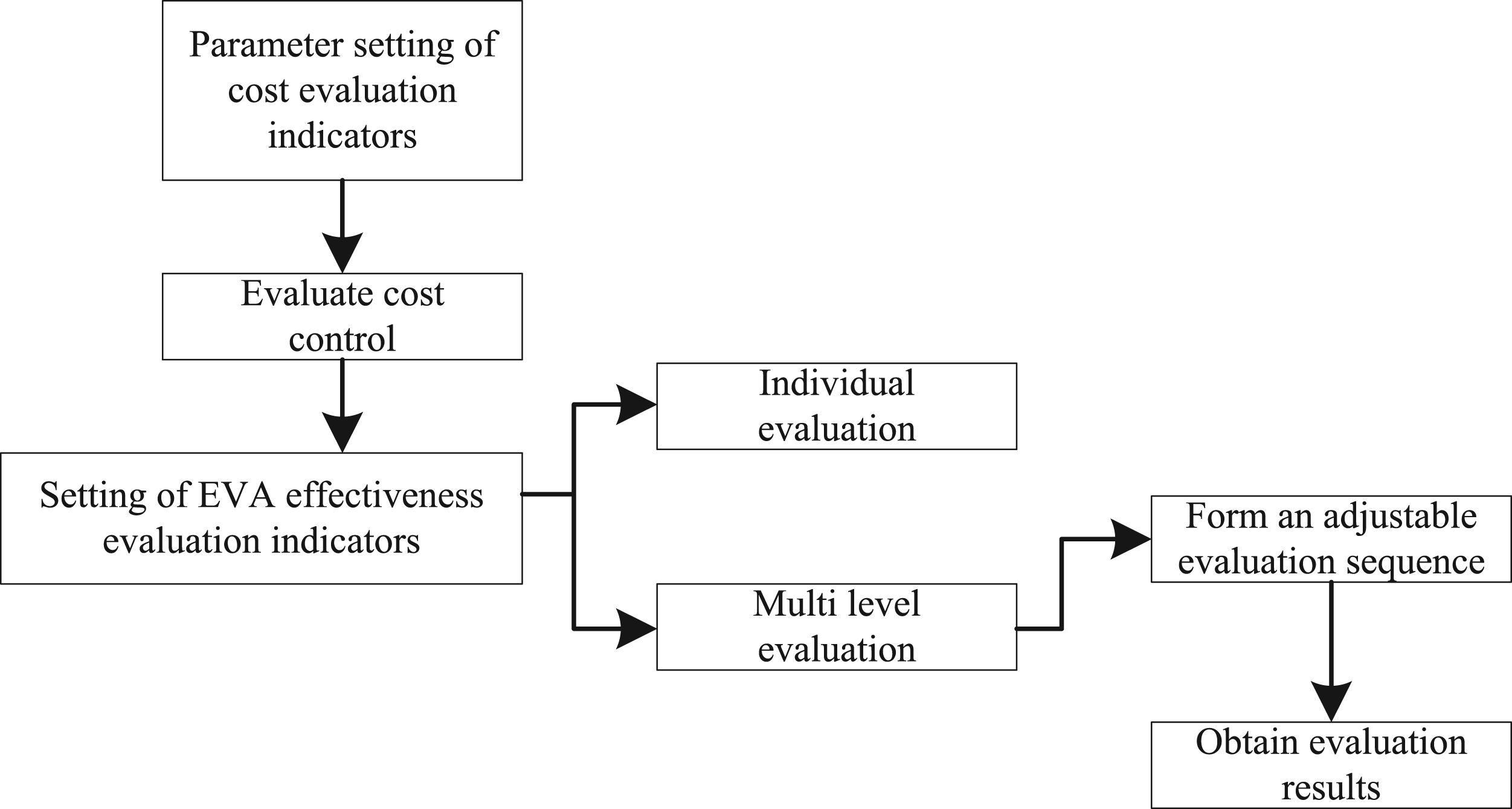
EVA effectiveness evaluation sequence structure diagram.
According to Figure 1, complete the design and application analysis of EVA effectiveness evaluation sequence structure. Then, on this basis, the evaluation hierarchy of the sequence is laid out in the form of EVA evaluation, and the gray correlation degree of balance evaluation is calculated, as shown in the following Formula 2:

Formula 2: Z represents the grey correlation degree of the balance assessment,
Build a multi-level fuzzy evaluation structure
After the EVA effectiveness evaluation sequence is set, the multi-level fuzzy evaluation structure is constructed according to the actual evaluation needs and standard changes. Use the goals set in the sequence evaluation process as guidance, set corresponding evaluation standards, and form a complete evaluation system. 24 Then, the sequence is introduced into the evaluation structure, and the fuzzy analysis method is used to classify the evaluation targets in multiple directions. 25 It should be noted that when building a fuzzy evaluation structure, multi-level evaluation criteria and equivalent evaluation stages 26 must be established. During the implementation process, they operate independently. This independence can, to some extent, enhance control over evaluation errors. Additionally, it allows for the establishment of an evaluation index featuring a multi-level fuzzy structure. Furthermore, corresponding parameter standards can be determined. 27 As shown in Table 1 below:
Multi level fuzzy evaluation structure evaluation index and parameter standard setting table.
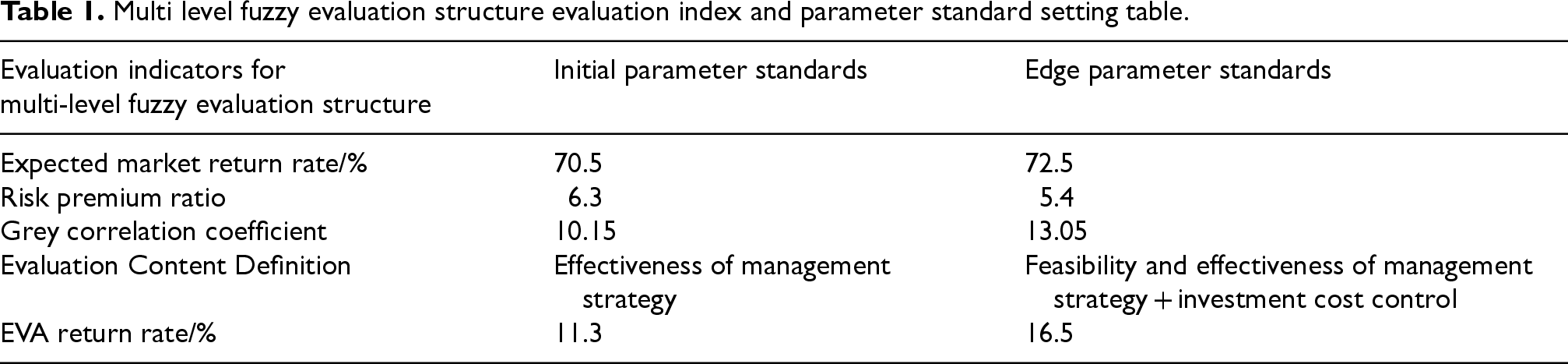
According to Table 1, set and study the evaluation indicators and parameter standards of multi-level fuzzy evaluation structure. Next, set the multi-level fuzzy evaluation structure 28 under the guidance of evaluation sequence and initial evaluation matrix. As shown in Figure 2 below:

Structure diagram of multi-level fuzzy evaluation.
According to Figure 2, the design of multi-level fuzzy evaluation structure is completed. When evaluating enterprises from a multi-dimensional perspective, we obtain the corresponding evaluation results based on the aforementioned structure and evaluation links. These results are then compared with the initial standards, forming a circular evaluation structure. This approach further enhances the effectiveness of the evaluation work's implementation. 29
Design of effectiveness evaluation model for risk cross control
After the multi-level fuzzy evaluation structure has been constructed, the subsequent step involves implementing the design of the effectiveness evaluation model through risk cross control. To do this, cross evaluation criteria need to be established. Then, the predefined evaluation objectives should be incorporated into the existing structure. Finally, an analysis and control of the strategic risk associated with investment project management should be carried out. 30 The specific framework is shown in Figure 3 below:

Diagram of risk cross control assessment framework.
Based on Figure 3, we will finalize the design and conduct an application analysis of the risk cross control assessment framework. This framework will be used to manage risks during the implementation of management strategies through a cross-functional approach. Additionally, we will incorporate a more comprehensive consideration of risk scenarios into the assessment process. By doing so, we can broaden the scope of the model's assessment and enhance the precision of the assessment model. Realize multi-directional evaluation and analysis of the effectiveness of corporate financial investment cost management strategy.
Experiment
This time is mainly about the design, verification and analysis of the evaluation model for the effectiveness of corporate financial investment cost management strategy. Considering the authenticity and reliability of the final test results, the analysis is carried out by comparison. Enterprise A is selected as the main target of the test, and professional software, combined with intelligent and big data technology, is used to set the evaluation cycle. Collect relevant evaluation data and information, summarize and integrate them for future use. Next, according to the actual needs and changes in standards measured by the effectiveness evaluation model, the final test results are compared and studied. Finally, the basic test environment is built.
Experiment preparation
This time, we are incorporating the actual investment background of real enterprise development and integrating the changes in actual innovation evaluation needs and standards. Our goal is to establish a correlation within the measurement environment for the effectiveness evaluation model of Enterprise A's financial investment cost management strategy. Enterprise A is a large-scale information company that plans to undertake targeted financial investments this year. Considering the company's current application status and economic conditions, it is necessary to formulate an initial plan for its cost management strategy for future implementation.
To begin with, we will utilize SPSS 14.0, a statistical analysis software, to estimate the costs for Enterprise A at each investment stage. This will allow us to roughly define a basic control range. Subsequently, based on this range, we will employ the least squares fitting method to construct a highly similar evaluation range. We will then set the corresponding evaluation criteria and calculate the JACARD coefficient by combining basic data and information, as demonstrated in Formula 3 below:

In Formula 3: P is the Jaccard coefficient,
Basic application indicators and parameter settings of the evaluation model.

To investigate the impact of variations in input parameters on the evaluation results and ensure the robustness of the decision-making process, this paper selects three key parameters—"Jaccard coefficient variation ratio,” “similarity coefficient,” and “investment cost control rate"—as variables. Their values are adjusted individually, and the effects of these changes on a hypothetical comprehensive evaluation score are observed. The comprehensive evaluation score is calculated based on these parameters, along with other fixed parameters, using a simple weighted summation formula, as follows:
Comprehensive Evaluation Score = (Weight of Jaccard Coefficient Variation Ratio * Jaccard Coefficient Variation Ratio) + (Weight of Similarity Coefficient * Similarity Coefficient) + (Weight of Investment Cost Control Rate * Investment Cost Control Rate) + Fixed Parameter Score
Here, the weights and the fixed parameter score are preset to simulate real-world evaluation scenarios. The experimental results are presented in Table 3.
Parameter sensitivity analysis.

Table 3 presents six scenarios: interest rate fluctuations, exchange rate shocks, asset impairments, policy shifts, technological iterations, and intensified competition, labeled as Scenarios 1 to 6, respectively. As indicated in Table 3, when the Jaccard coefficient variation ratio decreases from the baseline value of 2.3 to 2.0, the comprehensive evaluation score drops by 0.8 points (from 75.00 to 74.20). Conversely, when the Jaccard coefficient variation ratio increases to 2.6, the comprehensive evaluation score rises by 0.8 points (from 75.00 to 75.80). This suggests that the Jaccard coefficient variation ratio has a direct and relatively linear impact on the comprehensive evaluation score. A 12.7% decrease in the similarity coefficient (from 16.03 to 14.00) leads to a 1.2-point decline in the comprehensive evaluation score (from 75.00 to 73.80). Conversely, a 12.3% increase in the similarity coefficient (from 16.03 to 18.00) results in a 1.2-point increase in the comprehensive evaluation score (from 75.00 to 76.20). The influence of changes in the similarity coefficient on the comprehensive evaluation score is also notable and exhibits a linear relationship. A 6.4% decrease in the investment cost control rate (from 85.44 to 80.00) causes a significant 3.0-point drop in the comprehensive evaluation score (from 75.00 to 72.00). In contrast, a 5.3% increase in the investment cost control rate (from 85.44 to 90.00) leads to a 3.0-point rise in the comprehensive evaluation score (from 75.00 to 78.00). The investment cost control rate has the most pronounced impact on the comprehensive evaluation score, indicating that it is a crucial indicator in the evaluation process. In summary, the Jaccard coefficient variation ratio, similarity coefficient, and investment cost control rate all significantly influence the comprehensive evaluation score. Among these, the investment cost control rate has the most significant impact, and therefore, it warrants particular attention during the decision-making process.
On this basis, a fuzzy matrix of effective financial investment cost is set in the initial model, a fuzzy reasoning form is constructed, and the model is connected and overlapped to form a cyclical evaluation processing structure, and the basic test environment is built. Next, real measurement needs and standards are integrated. Measure and analyze the effectiveness evaluation model of enterprise A's financing and investment cost management strategy.
Experimental process and result analysis
Within the previously established test environment, a detailed study was conducted on the effectiveness evaluation model for Enterprise A's financing and investment cost management strategy. This study took into account the actual needs of the evaluation model and changes in analysis standards. By utilizing the fuzzy evaluation matrix designed earlier, we divided Enterprise A's investment stages into a cyclical evaluation structure. The subordinate function was maintained within the range of 16.35 to 18.11, allowing us to establish specific effectiveness evaluation structures and evaluation orientation criteria for each stage. First, the risk eigenvalue of the evaluation model is calculated, as shown in Formula 4 below:

In Formula 4: F represents the risk characteristic value of the assessment model,
Based on the aforementioned configurations, the risk characteristic value of the assessment model is computed and established as the risk assessment limit standard for the model. Subsequently, an analysis of the efficacy and reliability of Enterprise A's current financial investment cost strategic plan is conducted, taking into account the company's actual economic situation and market fluctuations. In light of the real investment scenario, three sets of management plans are formulated. These management strategic plans are then evaluated within the predefined fuzzy evaluation matrix to ascertain their feasibility. If the plan has a high adaptability, the utility value of the model evaluation is calculated, as shown in Formula 5 below:

In Formula 5: Q represents the utility value of the model evaluation, n represents controllable risk ratio, d is the deviation of Jaccard coefficient, m represents the standard value of evaluation orientation,
Comparison and analysis of test results.

As shown in Table 4, a comparative analysis of the test results has been completed. For all three sets of cost management strategic plans, the final evaluation utility value of the model exceeds 90%. This indicates that the model demonstrates strong relevance and stability in measuring the management strategy. It has also expanded the evaluation scope to some extent, enhanced control over evaluation errors, and holds practical application value.
To compare the effectiveness evaluation model of enterprise financial investment cost management strategy proposed in this article with existing research methods in practical applications. The experiment selected enterprise A and applied the methods proposed in this article as well as the relevant concepts mentioned in references8–11and 12 (as these references do not directly provide specific methods, this article will simulate and construct corresponding evaluation or analysis frameworks based on their research themes and core ideas for comparison) to evaluate the financial investment cost management strategy of the enterprise. The results are shown in Table 5.
Evaluation results of financial investment cost management strategies using different methods.

As shown in Table 5, the effectiveness evaluation model of the enterprise financial investment cost management strategy proposed in this paper performs well in cost identification accuracy, accurately capturing key cost factors, and has more advantages compared to the methods in references 8 and. 10 However, the methods in references,9,11 and 12 are weaker in cost identification, or due to different research topics and core ideas; In terms of strategy effectiveness rating, the method proposed in this article has the highest rating and can provide a more comprehensive evaluation of strategy effectiveness. The methods in references 8 and 10 have relatively high ratings but still have room for improvement, while the methods in references,9,11 and 12 have lower ratings, which may be related to the limitations of the evaluation framework construction and practical application; In terms of flexibility, both the method proposed in this article and the relevant concepts in reference 11 have high flexibility and can adapt to different enterprises and situations. The methods in references 8 and 10 have some flexibility but are slightly inferior, while the methods in references 9 and 12 have weaker flexibility or are fixed in research methods and frameworks; In terms of risk control ability, the method proposed in this paper is powerful and can effectively identify and control potential risks. The methods in references 8 and 10 have certain abilities but are insufficient, while the methods in references,9,11 and 12 are weak or related to research focus and practical application limitations. Overall, the method proposed in this article has significant advantages, as it can more comprehensively and accurately evaluate the effectiveness of enterprise financial investment cost management strategies, and has strong flexibility and risk control capabilities. However, the methods in references 8 and 10 have certain advantages but still have room for improvement. The comprehensive evaluation of the methods in references,9,11 and 12 is relatively weak, or due to limitations in research themes, core ideas, and practical applications. This experiment shows that the model proposed in this article has significant advantages in practical applications and can provide higher quality evaluations for enterprises.
To validate the applicability of the proposed evaluation model for the effectiveness of corporate financial investment cost management strategies in industries with different cost structures, such as manufacturing, service, and technology industries, an experiment was designed. The experiment involved selecting three representative companies from each industry as samples, collecting their financial data and relevant information on cost management strategies over the past three years, applying the model to each sample company to calculate the EVA effectiveness evaluation sequence and conduct multi-level fuzzy evaluations, and finally comparing the evaluation results of sample companies across different industries to analyze the model's applicability and differences in industries with diverse cost structures. The experimental hypothesis posited that the model could accurately reflect the effectiveness of cost management strategies in companies across different industries and that, despite significant differences in cost management strategies among manufacturing, service, and technology industries, the model could still capture these differences and provide reasonable evaluations. The results are presented in Table 6.
Analysis of model applicability in this paper.

Note: The EVA effectiveness evaluation sequence represents the average sequence of evaluation results over the past three years, and the multi-level fuzzy evaluation grades are determined comprehensively based on the evaluation sequence.
As shown in Table 6, there are significant differences in the EVA effectiveness evaluation sequences and multi-level fuzzy evaluation grades among manufacturing, service, and technology industries. Manufacturing companies generally have higher and more stable evaluation sequences, indicating that their cost management strategies are relatively stable and effective. Service companies exhibit greater fluctuations in their evaluation sequences and generally have lower overall grades, which may be related to the complexity and uncertainty of their cost structures. Technology companies have the highest evaluation sequences and are generally rated as excellent, reflecting the innovation and effectiveness of their cost management strategies. The proposed effectiveness evaluation model accurately reflects the effectiveness of cost management strategies in companies across different industries. The evaluation sequences and grades align with industry characteristics, effectively capturing inter-industry differences and providing reasonable evaluations, demonstrating good applicability in industries with diverse cost structures. However, the model may still have limitations, such as inaccurate handling of special cost items and incomplete consideration of industry-specific factors. Future research could further improve the model to enhance its adaptability and accuracy in evaluating cost management strategies across different industries. Overall, the model demonstrates good applicability in industries with diverse cost structures, accurately reflecting the effectiveness of companies’ cost management strategies and providing valuable references for corporate cost management.
Conclusion
To sum up, it is the design and verification analysis of the strategic effectiveness evaluation model of enterprise financial investment cost management. Compared to the original investment management evaluation model, the evaluation structure developed this time is notably more adaptable and versatile. It is tailored to the actual investment context of enterprises, making it more targeted and capable of transformation. This has effectively broadened the practical scope of evaluation. Concurrently, during the selection of enterprise investment projects, there is a heightened focus on managing project risk safety. The limit analysis structure of the effectiveness evaluation model has been enhanced and optimized to facilitate rational investment evaluation, thereby significantly mitigating investment risks across various dimensions. Furthermore, with the support of relevant technologies and in alignment with actual evaluation requirements and conditions, the model's controllable evaluation capacity has been improved. The evaluation stages have been refined, offering a highly feasible and low-risk approach for the multifaceted development of future enterprises.
Although the model constructed in this paper shows certain advantages in evaluating the effectiveness of enterprise financial investment cost management strategies, it still has obvious limitations. On the one hand, it is not accurate enough in dealing with special cost items. For example, for some cost items with unique nature or low occurrence frequency, such as additional costs incurred by enterprises due to sudden major natural disasters or costs caused by occasional major technical problems during the R & D process, the existing parameter settings and evaluation methods of the model are difficult to accurately identify and reasonably quantify the impact of these special costs on the effectiveness of cost management strategies. On the other hand, the consideration of industry-specific factors is not comprehensive. Different industries have their own unique cost structures and market environments. For instance, the manufacturing industry has fluctuating raw material costs, the service industry has a high proportion of labor costs, and the technology industry has large R & D investments. The model fails to fully integrate these industry-specific factors, which may prevent it from fully fitting the actual situations when applied in different industries.
In view of the above limitations, future research will consider taking the following improvement measures. For the treatment of special cost items, a special cost database will be established to collect various special cost cases and related data. Big data analysis and machine learning technologies will be used to explore the patterns and characteristics of special costs. Then, a special cost evaluation module will be set up in the model, and targeted evaluation indicators and parameters will be formulated to improve the accuracy of identifying and measuring special cost items. For the consideration of industry-specific factors, in-depth research will be conducted on the cost structures, market environments, and operation modes of different industries. Industry-specific factors will be broken down into specific indicators, such as the raw material price index for the manufacturing industry, the labor cost growth rate for the service industry, and the R & D input-output ratio for the technology industry. These indicators will be incorporated into the model's evaluation system, and the evaluation weights and methods will be adjusted according to the characteristics of different industries, so that the model can better meet the evaluation needs of cost management strategies in different industries and improve its adaptability and accuracy.
Footnotes
Funding
The author received no financial support for the research, authorship, and/or publication of this article.
Declaration of conflicting interests
The author declared no potential conflicts of interest with respect to the research, authorship, and/or publication of this article.