



Abstract
The integration of the Internet of Things (IoT) and 5G networks has transformed healthcare by enabling real-time monitoring, remote diagnostics, and seamless data sharing. However, these advancements also pose critical challenges, including data security, privacy risks, and integrity concerns, particularly in IoT-enabled healthcare systems. To address these issues, this study presents a blockchain-based framework for secure healthcare data communication within IoT architectures operating over 5G networks. The proposed model utilizes blockchain to enable decentralized, transparent, and tamper-resistant data management. It introduces non-terminal nodes—intermediate IoT devices responsible for forwarding, processing, or clustering data without being its origin or final recipient—enhancing the scalability and reliability of the network. Key components such as the SHA-256 hash algorithm, smart contracts, and clustering mechanisms are integrated into a layered architecture to improve data encryption, transmission, and ledger maintenance. This design ensures critical properties such as immutability, traceability, and trustless operation, effectively mitigating issues like unauthorized access, high latency, and poor scalability. The use of smart contracts automates access control and data validation, while clustering reduces communication overhead, optimizing overall system performance.
Experimental evaluations confirm that the proposed framework significantly reduces transmission delays and enhances throughput, without compromising security. By leveraging blockchain's strengths and 5G's speed, the model offers a secure, efficient, and scalable solution for healthcare data exchange in IoT-driven environments. This research highlights the potential of combining blockchain with IoT and 5G to address pressing concerns in digital healthcare systems, laying the groundwork for future innovations in secure and resilient healthcare infrastructure.
Keywords
Introduction
As healthcare data has grown exponentially in recent years, coupled with 5G networks and IoT devices, the healthcare industry is undergoing a revolution. In addition to improving patient outcomes, these advances also streamline the healthcare process by enabling monitoring, sharing, and decision-making in real-time. Although IoT devices are increasingly used for healthcare data communication, there are some security risks, privacy concerns, and the possibility of unauthorized access. 1 The development of robust, secure systems is essential for managing and transmitting sensitive healthcare information. Blockchain technology has provided tamper-proof, decentralized, and transparent data management platforms that solve these challenges. The inherent features of IoT architectures, such as immutability, distributed consensus, and cryptographic security, make it especially suitable for protecting healthcare data. Blockchain-integrated 5G networks provide healthcare systems with ultra-reliable, low-latency communication while ensuring patient confidentiality. As mentioned in existing models that rely on static trust mechanisms or centralized control, the proposed framework introduces a decentralized, adaptive approach combining SHA-256 encryption, smart contracts, and energy-aware clustering. This ensures secure and scalable data exchange, specifically tailored to the demands of real-time healthcare in 5G IoT environments.
A modern wireless communication network has become increasingly necessary over the last several years. As 5G technology is deployed worldwide, more capabilities will be available than in 4G communications. In the coming years, 6G technology, a modern wireless communication network with significant AI capabilities, will likely become commonplace. A large amount of communication has been enabled by advances in technology, such as artificial intelligence (AI), virtual reality (VR), three-dimensional (3D) media, and the Internet of Everything (IoE). The value of improving interaction processes can be seen in this example. In the future, they will have completely autonomous technologies for distant administration. Businesses, medicine, transportation, and space exploration are all taking advantage of MWCN systems. 1 A few of the salient features of MWCN include 5 Gigabyte networking capabilities, high-speed connections, and high-quality networks. MWCN systems are centered on small-cell networking, specifically highly dense small channels. Compared with other types of ad hoc networks, tiny channel networks tend to have more sensors per unit area. Consequently, there is typically a lot of correlation and redundancy between nodes when they perceive data. In addition to utilizing cutting-edge encryption and modulation algorithms, an innovative waveform architecture is required. 2
Electromagnetic radiation transmits data wirelessly throughout the universe, enabling society to advance greatly. The data security issues faced by MWCN are currently receiving a lot of attention, as depicted in Figure 1. The indigenous “genetic faults” of electromagnetic fields can allow anyone within the signal coverage area to intercept or assault signals at the physiological layer. As current security measures rely heavily on cryptography, which is primarily used in wired communications, they are not capable of addressing security concerns caused by communication network accessibility. 3 Using blockchain technology, physicians and Medicare will be able to significantly improve the safety of data handling technologies such as patient digital wellness data, medical consent, pharmacy supply chains, blockchain-based remote monitoring records, investment business information, and other confidential research data. Medical data transfers can be simplified, streamlined, secure, and more accountable with blockchain technology. Using blockchain technology and artificial intelligence (AI), the medical industry is about to transform. Blockchain technology, together with memory innovation, is being used to ensure the privacy of investors’ information during the implementation of the public ledger method. 4 There have been a variety of attacks on node communication, including insider threats and outcast attacks. Data gathering, route maintenance, and information propagation are all security concerns when forwarding.5-7 Intrusion is the act or behavior of damaging the wireless environment without permission. An intrusion compromises the security, authenticity, or accessibility of data. It is possible for legitimate network nodes to become corrupted and behave maliciously both internally and externally to the MWCN, which can undermine its safety. Rogue nodes within a network must be identified, contained, and eliminated as soon as possible. Security-related challenges have influenced MWCN's architecture and evolution patterns in significant ways. 8 By using blockchain-based technologies, we were able to detect malicious nodes in MWCN and prevent attacks on wireless transmissions.
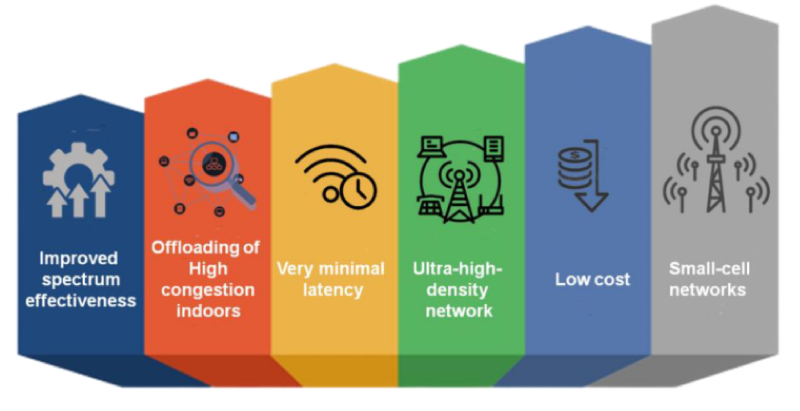
The overall feature of MWCN.
In addition to technological advances, smart healthcare and biomedicine have always been important issues to discuss in any way possible. 9 The only important thing in health services is improving the framework, confidence, processes, and effectiveness, as well as ensuring patients receives qualified nutrition and care. In today's society, people often wait until a major emergency before seeking health care. It is commonly believed that this indicates too much commitment to traditional lifestyle frameworks. 10 It has disrupted nearly every sector on this planet, from education to the supply chain. 11 It has also been used extensively in the healthcare sector, enabling diagnostic tests and monitoring patients’ operations. IoT also provides a major benefit of enabling healthcare management during non-active moments, which is impossible in traditional medicine. Faster diagnostics and treatments are possible thanks to improved access to and constant improvement of the system.12,13
In multimedia interactions, different formats, resolutions, information sources, and media types are combined to create complexity. 14 The medical domain has now emerged as one of the most complex, vital, and rapidly growing applications in multimedia, enhancing patient-doctor communication while improving their participation in healing. 15 Despite this, the power of providers decreases as the population grows, resulting in a lower standard of service. 16 It has traditionally been suggested that the current healthcare approach needs to be radically reformed in order to resolve such problems. As a result of today's data-intensive environment in healthcare, enormous quantities of data are produced, distributed, deposited, and obtained every day. 17 Electronic recording and transmission of medical records, as well as the storage and exchange of patient data over the Internet, compromise patient privacy and security. 8 It may be more likely for vendors to utilize different types of equipment and modify records and reports in order to benefit service users with multimedia references, which reduces manual intervention. 18 Blockchain technology is being adopted in industries such as healthcare, real estate, administration, and financial services. 19 As shown in Figure 2, blockchain technology has become increasingly relevant in healthcare.

Blockchain-based applications for healthcare.
Due to the sensitive nature of patient health records, security has become a major concern in IoMT-based healthcare systems. Maintaining the security of this system can be achieved through key management. In key management, keys are created, distributed, and preserved until they are destroyed. A lack of resources prevents IoT devices from using conventional key distribution systems. In recent years, research on lightweight key management techniques and secure communication frameworks has been a focus of the IoMT. It is possible to generate secrets with SKY Glow even if your IoT device is resource-constrained. 20 Discrete Cosine Transforms (DCTs) are used to transform communications channel observations into key bits generated through this scheme so that the correlation between each bit is maximized. IoT networks can generate symmetric secret keys using channel parameters, like received signal strength (RSS), according to. 21 This paper proposes an enhanced RSS signal-based key generation method based on correlated collared noise components.
Based on AES, 22 proposed a method for efficiently generating secret keys for one-time pad encryption. IoT and edge servers communicate securely with secret keys generated by the proposed scheme. A simulation was carried out to confirm the proposed scheme's feasibility and correctness. In 23 proposes a method for generating group keys from a variety of IoT devices. Reduced reliance on channel probing techniques improved the feasibility and efficiency of the proposed scheme. In, 24 a new key distribution method at the physical layer is presented. As a result of combining multiple communication channel characteristics, the proposed scheme substantially improved key generation rates. In his article, 26 the Author presented LORENA, a technique for generating symmetric keys in the Internet of Things (IoT) with low memory requirements. The LORENA sensor generates a shared secret key using an ECG signal.
An IoT-enabled health data security hybrid encryption technique was described in. 25 Several well-known encryption algorithms were combined in this technique, including ECC, AES, and Serpent. As part of the registration process, the public-private key pairs were generated to encrypt IoT health data with these algorithms. According to, 26 Rooted Elliptic Curve Cryptography with Vigenere Cipher (RECC-VC) offers a secure encryption scheme that utilizes elliptic curves. Implementing an exponential K-anonymity algorithm enhanced IoMT security. With RECC-VC, human health data can be securely transmitted from IoMT networks to cloud servers. Authors 27 introduced the concept of holomorphic encryption, through which plaintext characters are transformed into ASCII values. Their proposed system used tetrahedron-based and pentahedron-based configurations to generate secret keys. In this paper, the Author proposed an efficient and secure approach for managing keys in Wireless Body Sensor Networks (WBSNs). 28
It has been proposed that Hyperledger Caliper be used to share healthcare records on the blockchain. 29 A new study 30 looked at how blockchains could be used to share records over cloud services by using encryption schemes. The model presented proposes techniques to encrypt data with confidence and anonymity. As part of the scheme, data from multiple modules is collected and stored on a blockchain network without any consensus algorithm to create a smart home. A Bayesian model is used to monitor activities, and the data is stored on a blockchain network with no consensus algorithm. 31 Other papers discuss the security and encrypt ability of medical data communication through blockchains in cloud-based networks. 32 The Calliper hyper-ledger network was proposed for small businesses in. 33 There has been some recent work in this field, but this study has only focused on securing medical records using blockchain technology. 34 There was also a proposal to share health records using blockchains, 35 but the solution lacked encryption techniques, and some organizations did not find the cloud-based structure suitable. The Author 36 contains an interesting study related to the topic of discussion; however, it takes a little longer to respond because it uses mutable storage. A review of blockchain and health studies is presented in, 37 and a comparison between the two is made. The study, however, did not provide an implementation plan, just a comparison of the current systems. An additional blockchain-based system was presented in. 38 Its results, based on Hyperledger Fabric, were inferior to ours despite the fact that it was not related to healthcare.
Proposed methodology
In the Figure 3, you can see how blockchain technology works. Architecture for blockchain consists of four layers: infrastructure, platform, distributed computing, and applications. For a blockchain to run, it requires nodes, storage, and network facilities. To run a blockchain, nodes, storage, and network infrastructure are required. It is necessary to have nodes, storage, and network facilities to run a blockchain. Blockchain nodes include simple nodes (also known as light nodes), full nodes, and mining nodes. A simple node sends and receives transactions but does not keep a ledger or validate the transactions. Nodes keep a ledger and validate transactions. Often referred to as block generators, mining nodes generate new blocks by mining. Transaction ledgers are stored in the storage component. Platform layer components include Remote Procedure Calls (RPC) and HTTP Application Programming Interfaces (API). These APIs allow network participants to communicate using Remote State Transfers (REST).
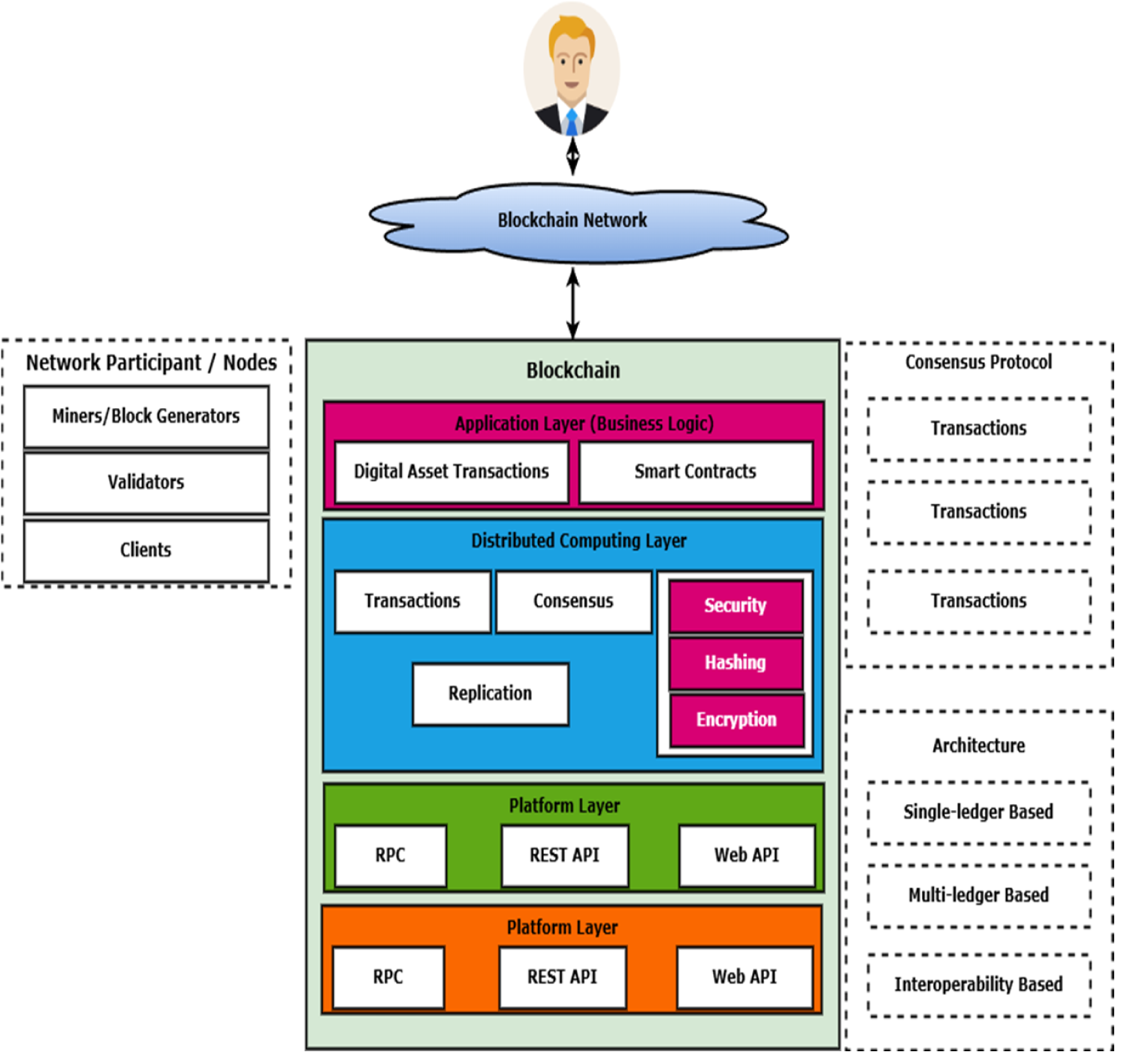
The procedure of the blockchain technology.
In a distributed computing model, transaction data is guaranteed to be only accessible locally, fault-tolerant, immutable, private, authentic and secure. An update to a blockchain transaction record cannot be undone. Blockchain networks use consensus protocols to determine how transactions should be processed, the ledger should be updated, and the next block miner should be selected. Also, this layer encrypts and hashes user data to protect data privacy and authentication. Those who execute smart contracts and transact with digital assets use the application layer. Clients can access blockchain-based applications through the platform layer. In terms of blockchain architecture, the layers are described as follows:
EMRs can be improved and enhanced with genomic research. EMRs can be improved and enhanced with genomic research. Researchers and doctors can also communicate and exchange data using a blockchain-based system, similar to how MedRec facilitates communication between medical professionals and patients. 39 As a result of their similar functionality, a comprehensive system can be designed to meet the needs of both patients and researchers. As an added benefit, patients receiving treatment who share their medical data with researchers will be able to benefit from this system. Figure 4 illustrates layered approaches to blockchain implementation in EMRs and genomic research.
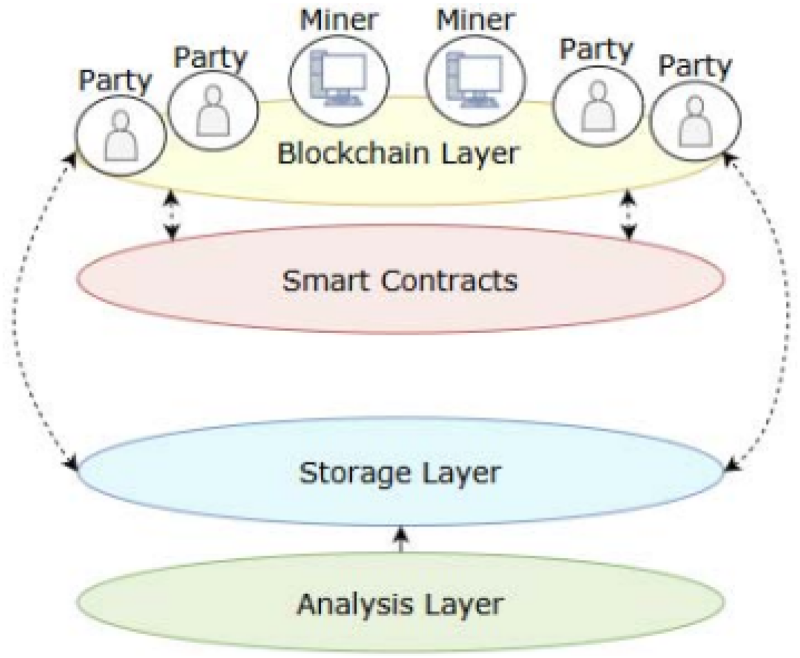
General layered architecture.
Figure 4 presents the structural diagram of the proposed multi-layered architecture used for secure data communication in IoT-enabled 5G healthcare environments. It outlines how blockchain functionalities—such as smart contracts, encryption, and storage—are distributed across infrastructure, platform, distributed computing, and application layers.
Blockchain layers are the places in a network where entities can communicate securely with one another through a dedicated application. A transaction or request can also be processed here. A dedicated miner is responsible for verifying and appending blockchain transactions. Consensus algorithms propose numerical puzzles, which are solved by these nodes at the expense of computational resources. Blockchain requests are handled via Smart Contracts, which act as access control mechanisms.40,41 A code that verifies the permissions of participants could be used to store their donated health data off-blockchain. It is intended to store patient and participant data securely on the Storage Layer or pointers to off-chain data using encrypted storage mediums. Researchers and doctors requesting access to data on the blockchain submit requests, which are handled by the smart contract associated with the request to determine permissions, such as read and write. For instance, if access is granted, a secure channel can be established for data transfer to the requesting party. Analysing lab samples and patient data is done prior to storing them. Blockchain-based entities can't access the Analysis Layer. The patient or participant provides a physical sample for analysis. Laboratory specialists will analyse the samples using these tools. A secure off-chain storage facility will be used to store data once the Processing Layer has processed it. In addition to patients, researchers, doctors, and specialists, several entities belong to the blockchain layer.
There are several types of small cells, each with a range of several meters to over one mile. The multiple types of small cells available in 5G smart healthcare can be useful for numerous applications. Data rates between 137 Mbps and 1.6 Gbps are needed for remote surgery with small cells. 42 The term femtocell refers to the smallest cell, while picocell refers to the smallest cell size. As opposed to macro cells, which have a range of around 20 miles, these are considered small cells. In small areas like hospitals, homes, and other places, femtocells can provide increased coverage and capacity. With a range of 0.1 kilometers, it can support up to 30 users. Picocells provide greater capacity and coverage, enabling 100 users to communicate over one kilometer. Picocells are typically used to increase cell phone coverage and wireless network coverage within a limited area. Despite being difficult to distinguish from picocells, microcells have a larger coverage area and can support more users. Up to 2000 users can be supported by microcells within a two-kilometre range. Mobile networks use Marco cells to provide wide-spread radio coverage. It provides a wide coverage area and high efficiency.
The IoT environment consists of diverse nodes that do not merely consist of sensors and their framework functions.43,44 There are significant differences between all of these units in terms of connectivity, frequency band, and power usage. The Base Station receives continuous updates from IoT systems; therefore, it has the complete topology of the network. The IoT model is divided into regions of defined duration, in which a number of instruments are clustered together, and equipment receives details about the community.45,46 Just During clustering, nodes monitor their neighbors’ identities, positions, and distances. Cluster formation is guided by three key criteria: residual energy, buffer availability, and social affinity among nodes. These parameters ensure that the most resource-efficient and stable nodes serve as cluster heads, which helps balance communication load and improve overall network lifespan.
Clusters are initially created when nodes with similar social profiles cluster together. As a result of cluster participation, the node with the most significant optimistic mark becomes the closest node on the list of closest nodes, and that node becomes a node with the same social trend. Nodes enter and disassociate clusters according to their social patterns. According to Eq. (1), a node's residual energy (



In general, vertices that are more connected are placed closer to the center of the structure and are more able to influence the others. It is considered high-ranked if the sum of its backlinks is high. PageRank captures this idea in the following way:

A damping factor of d is applied to N, the out degree of p is
A SHA hash function is one of a set of algorithms developed by the US National Institute of Standards and Technology (NIST). The SHA-1 hash algorithm was first proposed in 1995 by NIST. MD5 is modeled after Merkle Damgard's structure. When the input message is of variable length, the algorithm generates a 160-bit compressed MD using a string of any length. This scheme usually involves padding the message with 1 before adding the required 0 s to make it 64 bits (less than even multiples of 512). Padding a message is accomplished by adding 64 bits to the end, which is then converted into 512-bit blocks. It begins by padding the message length with bits. A 512-bit data block is created by dividing the input message into three parts. It is in this step that the hashing algorithm initializes the chaining variables, i.e., the size of internal states.
SHA-2 padding equals sixty-four bits (less than an even multiple of 512) by adding 0's (padded with 1). Each paddled message is divided into 64-bit data blocks of 512 bits each. A data block consists of 1024 bits divided into 64-bit words and includes SHA-512 and SHA-384 signatures. SHA-2 does not support multithreading, which makes it less efficient than SHA-1 for ensuring integrity in the long run. Aside from this, the SHA-256 algorithms are used primarily in cryptocurrency to secure the Bitcoin network's transactions. A new function, SHA-512, uses different constants, shift amounts, and rounds than SHA-256. The vulnerability of SHA-2 has been reported in a recent study. SHA-2's computation steps are summarized below:
SHA-256 was selected for this framework due to its strong balance between cryptographic security and computational efficiency. It provides robust collision resistance and is widely adopted in blockchain systems, making it both secure and practically implementable. Compared to alternatives such as SHA-3 or BLAKE2, SHA-256 offers broader compatibility with existing hardware and blockchain platforms, which is critical for resource-constrained IoT devices operating in 5G environments. Hashing should be performed on messages that have padded lengths greater than 1024 bits. A 128-bit message [ Value of the initial hash, In this case, C represents the compression function, and When SHA-256 is applied to a 64-bit message, the output is 64 bits, and the six logical attributes are Based on SHA-256, the output is the 64-bit message, and the six logical attributes act as
Result and discussion
In Figure 5, the time during node reading to process a transaction, along with the associated graph. Several model iterations were analysed in order to determine the maximum, average, and minimum performance of the model.
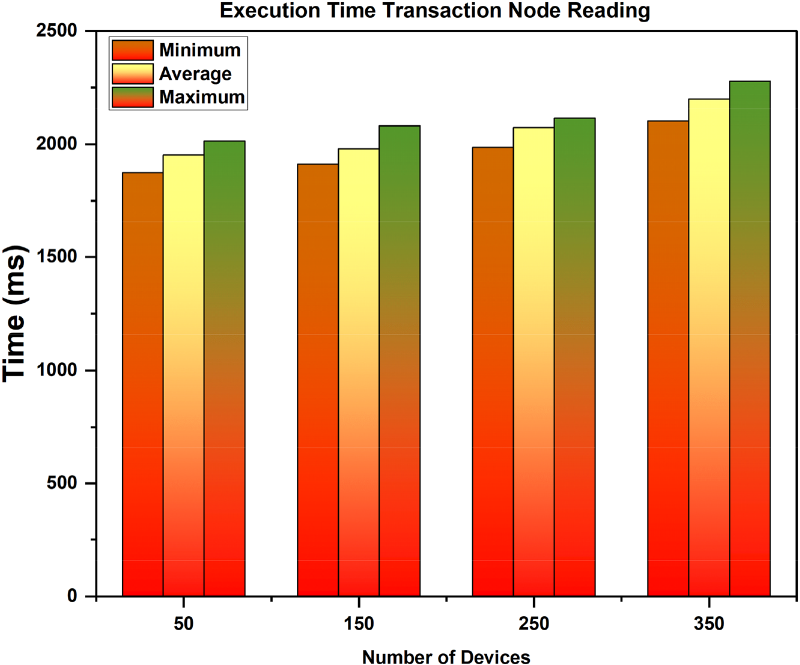
This graph represents the execution time for reading nodes.
A 5G network's performance is assessed based on the time it takes to exchange ledger records between network nodes. Across Blockchain nodes, data encryption takes time, which is accounted for by this delay. As shown in Figure 6, the delay corresponding to varying records is illustrated graphically.
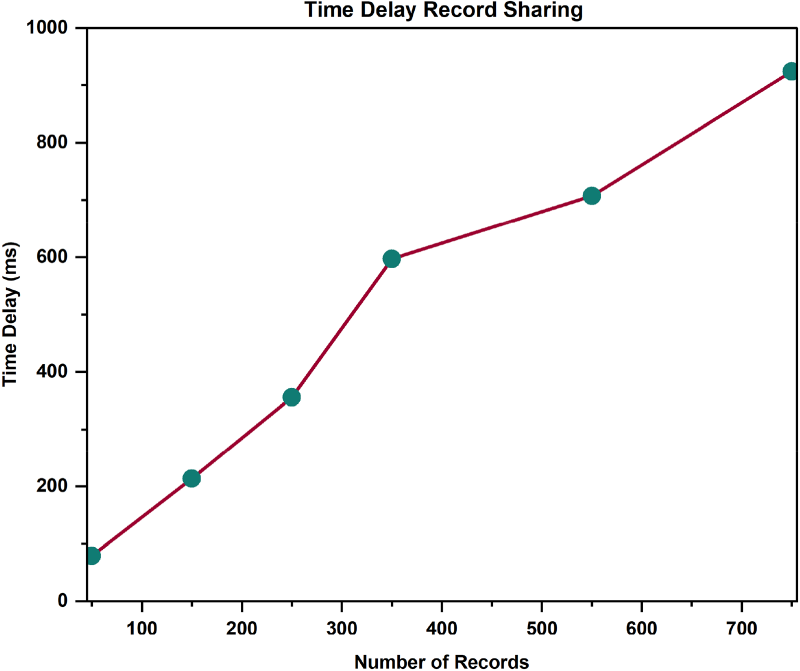
The graphs represent the sharing of records over time.
A variety of records have been evaluated for the number of records that need to be updated at the non-terminal nodes of a 5G network. There was documentation of delays, and Figure 7 presents the corresponding graph.
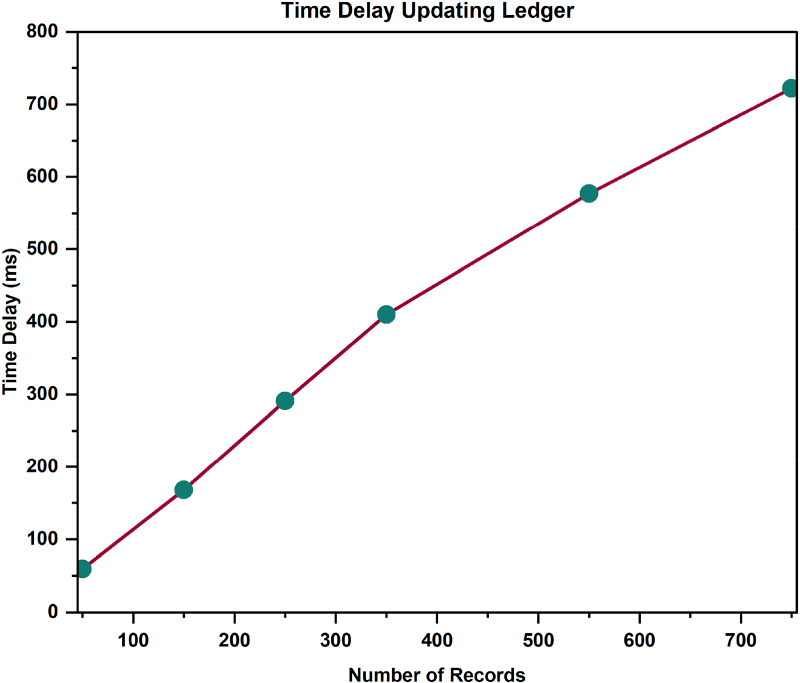
A graph displays the time delay between updates to a digital ledger.
In a 5G environment, SHA-256 was assessed for its performance within the blockchain framework. In Figure 8, graphs illustrating the results of the experiment are illustrated. In this study, 128-bit strings of characters are examined using a variable number of networking devices. Cryptography-based blockchain is integrated to estimate throughput. Cluster heads are responsible for managing encryption and ledger updates. While the experimental results demonstrate notable improvements in latency minimization and throughput, the absence of a comparative chart with existing protocols is acknowledged as a limitation. The current performance evaluation is based solely on the proposed model's behavior under various node configurations. However, incorporating benchmark comparisons against existing security and communication protocols would provide a clearer context for assessing relative performance. Future work will include such a comparative analysis using standard metrics to better highlight the advantages of the proposed blockchain-enabled framework in terms of communication efficiency and responsiveness in IoT-enabled healthcare networks.
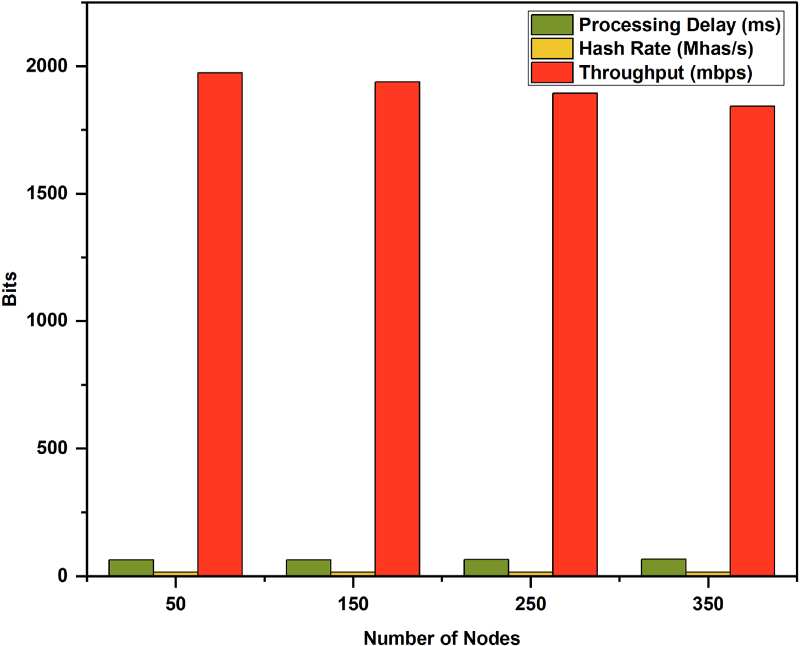
Graphs representing SHA-256 security scheme performance at variable node counts.
The performance evaluation was based on a simulated 5G network environment with varying numbers of nodes to emulate real-world healthcare IoT deployments. Key performance metrics included transaction processing time, delay in ledger synchronization, time required for record sharing, and encryption throughput, as illustrated in Figures 5 through 8. These metrics were selected to assess the responsiveness, scalability, and efficiency of the proposed model. Specific parameters such as node density, transmission range, and data packet size were used in the simulation to provide realistic network conditions. The inclusion of this information enhances the reproducibility and contextual understanding of the experimental results.
This study presents a blockchain-enabled framework to secure healthcare data communication in IoT architectures operating over 5G networks. By integrating SHA-256 encryption, smart contracts, clustering mechanisms, and a layered design, the model addresses core challenges including data privacy, unauthorized access, and scalability. Experimental evaluations demonstrate reduced latency, maintained data integrity, and improved throughput across varied network scenarios, highlighting the model's potential for modern, efficient, and secure healthcare systems. Despite its strengths, the current framework has limitations. Device-level energy efficiency—critical in resource-constrained IoT environments—was not quantitatively evaluated. Although clustering reduces redundant communication and balances load based on energy and buffer metrics, future work should include simulation-based and real-world energy profiling to assess consumption and performance trade-offs. Security-wise, while the model emphasizes decentralization and immutability, it lacks a formal threat model. Incorporating structured approaches like STRIDE in future work will allow systematic evaluation of vulnerabilities such as data tampering, insider threats, and denial-of-service attacks, thereby strengthening the framework's security validation.
Scalability analysis under dynamic network conditions also remains limited. Although varying node counts were tested, broader metrics such as consensus latency, block propagation time, and transaction throughput under high-load conditions were not explored. Future research will focus on extensive scalability evaluations in large-scale IoT deployments.
Furthermore, integrating artificial intelligence (AI) offers a promising direction. AI can support anomaly detection, predictive maintenance, and resource optimization. For instance, cluster heads equipped with machine learning could forecast node failures or detect threats, while AI-driven analytics could enhance early diagnosis and risk assessment using healthcare data. The proposed framework offers a strong foundation for secure, scalable, and intelligent IoT-based healthcare systems, with future enhancements focusing on energy efficiency, formal security validation, and AI integration.
Footnotes

Funding
The author received no financial support for the research, authorship, and/or publication of this article.
Declaration of conflicting interests
The author declared no potential conflicts of interest with respect to the research, authorship, and/or publication of this article.