



Abstract
Ethics play an important role in the practice of all professions. The best known of all is probably the Hippocratic oath in medicine. But what if a doctor relies on data and statistics to diagnose and treat his patients? If his work involves collecting, analysing, interpreting and drawing conclusions from data, the doctor becomes a statistical practitioner and is expected to follow the values and principles that apply to this profession. Professional ethics for statistics is application-oriented and committed to the goal of guiding statistical practitioners to act responsibly and to ensure the trustworthiness of statisticians and thus also of the statistics they produce. Alongside integrity and professionalism, the third value of professional statistics is respect, both in dealing with confidential data and with the impact of statistics on the communities affected. Respect, professionalism and integrity are the three components of the ‘statistical oath’. However, there is a long way to go from theory to practice. In this article, we will explore different paths we can take towards improving the knowledge and application of these professional ethics in areas of applications and forms of statistical practice. We will focus on one specific area, official statistics.
Keywords
Introduction
This article is not about statistical methods, neither about their development nor about their application in statistical practice. In this sense, it does not deal with the scientific topics familiar to statisticians. Rather, this article deals with questions relating to the science of statistics as a whole, namely its possibilities and limitations as well as its impacts, risks and side effects. This does not mean that it is about less scientific aspects, quite the opposite. “In the research literature, there is widespread agreement that the theory of science “operates in the spectrum of sociology of science and history of science” and that these three approaches “complement” and “contribute together to a better understanding of science.” 1 It is therefore a question of the extent to which statisticians can succeed in depicting reality (defined as?) objectively and without distortion using statistical methods, i.e., in tracking down the ‘truth’. In addition to the question of scientific knowledge and how it is gained, it is about the social integration of science: What impact do facts have on society and what influence does society and its processes have on the processes and results of statistics? These topics form the background against which the questions of ethics are dealt with, which are primarily concerned with the responsibility of science, scientists and practitioners for procedures, their results and the application of the results.
Like engineers, mathematicians, computer scientists and economists, statisticians have been trained in a professional world that is strongly determined by a positivist mindset. The discussion of questions of truth, knowledge and responsibility tend to be treated as something less important and less scientific. In the worst case, these are (mis)understood as relativisation, a threat to the statistical profession or even heresy. With this narrow understanding of science, the acquisition of knowledge and the role of evidence in today's society, there is a risk of being insufficiently prepared for significant problems. This initially concerns individual research and statistical production when, for whatever reason, these reach their limits and, for example, questions arise about the robustness and scope of statistical results (One illustration of this is the discussion about the so-called ‘reproducibility crisis’. 2 ) On another scale, it is about the role of science and experts (here in statistics) as part of the public discourse in the (late) modern society. “[Anthony] Giddens asserts that with the late modern reliance on generalized expert systems over local knowledges, and upon symbolic tokens such as money, trust remains a necessary part of life: ‘The disembedded characteristics of abstract systems mean constant interaction with “absent others”– people one never sees or meets but whose actions directly affect features of one's own life“ 3 ”. 4 Citizens are dependent on expert knowledge when it comes to the complex issues of our time (such as Covid, globalisation, climate), which in turn requires experts to handle their role and power responsibly. At the core of relations between the producers and consumers of evidence is the need for trust, or more precisely trustworthiness, which experts have to earn by demonstrating and proving their competence, reliability and honesty.5–7 A lack of trust in experts, science and statistics is grist to the mill of those who operate their political business models on that ground. Because of a “cognitive dissonance between possibly adverse impact of quantification, and their purported function of universal certainty, neutrality, and control” 8 it is necessary to promote receptiveness and understanding of the topics of sociology and the ethics of quantification, and to ensure that this begins as early as possible, i.e., by integrating such topics into the educational programmes. 9
The article is intended to contribute to achieving this goal. We will first introduce the topic and present the internal structures and sub-areas of statistical ethics. We will then look at two of these structural elements, firstly the professional ethics for applications in practice by individual statistical practitioners and secondly the rules for good practice in public statistics. Finally, different ways of promoting and implementing such professional ethics will be discussed.
Ethics in statistics
Professional ethics as a compass
Why are ethics for statistics necessary at all? Isn't it precisely one of the great hopes and expectations we have of statistics that its methods and data will provide us with the truths we are longing for? Isn't there a deep desire in phrases such as ‘data-driven decision making’ for a quasi-automatable, programmable production of facts that is independent of humans (and their faults)? Will this (erroneous) belief be further reinforced by artificial intelligence, statistics without pilots, self-driving algorithms? Is this trend eventually turning augmented into automated decision-making, and what would this mean for the quality of the decision, but also for public discourse and opinion-forming in civil society? The disappointment when this wish is not fulfilled or when robots will dominate the production of ‘facts’, is therefore great and turns into cynicism and whimsical jokes that put statistics entirely on the level of lies and manipulation. That poses a great danger of relativising and questioning fundamental differences between solid facts and their opposite, fake news. “The ideal subject of totalitarian rule is not the convinced Nazi or the convinced Communist, but people for whom the distinction between fact and fiction (i.e., the reality of experience) and the distinction between true and false (i.e., the standards of thought) no longer exist.”
10
Ethics become important when statistical methods are applied to real life issues, health, income, inflation, poverty, education and much more. If it is challenging to produce accurate statistics, it requires a great deal of expertise and skill to design statistics in such a way that they are timely, comparable, etc. and at the same time relevant to answering information needs. Only then do they fulfil the ‘fitness for purpose’ quality standard. And as the rule named after Charles Goodhart (Goodhart's Law, “that any observed statistical regularity will tend to collapse once pressure is placed upon it for control purposes”. 16 ) puts it, the risk of feedback and the temptation for decision-makers to influence the facts to their liking increases with their (political) relevance, resulting in policy-based evidence making.
Mapping a complex topic: Ethics
As far as it is referred to the importance of the Enlightenment for statistics in modern societies, it is necessary from today's perspective to point out, at least very briefly, that an ethical orientation necessarily requires an epistemological positioning and in particular an answer to the question of how objective, neutral and ‘true’ statistical representations of reality can be. The sociology of quantification deals with this topic and the back and forth between the spheres of influence of society and statistics.3,17–20 Ethics of quantification is one of the requests that follow from “the spread of quantification and the significance of new regimes of measurement”.
8
Hierarchical levels of statistical ethics.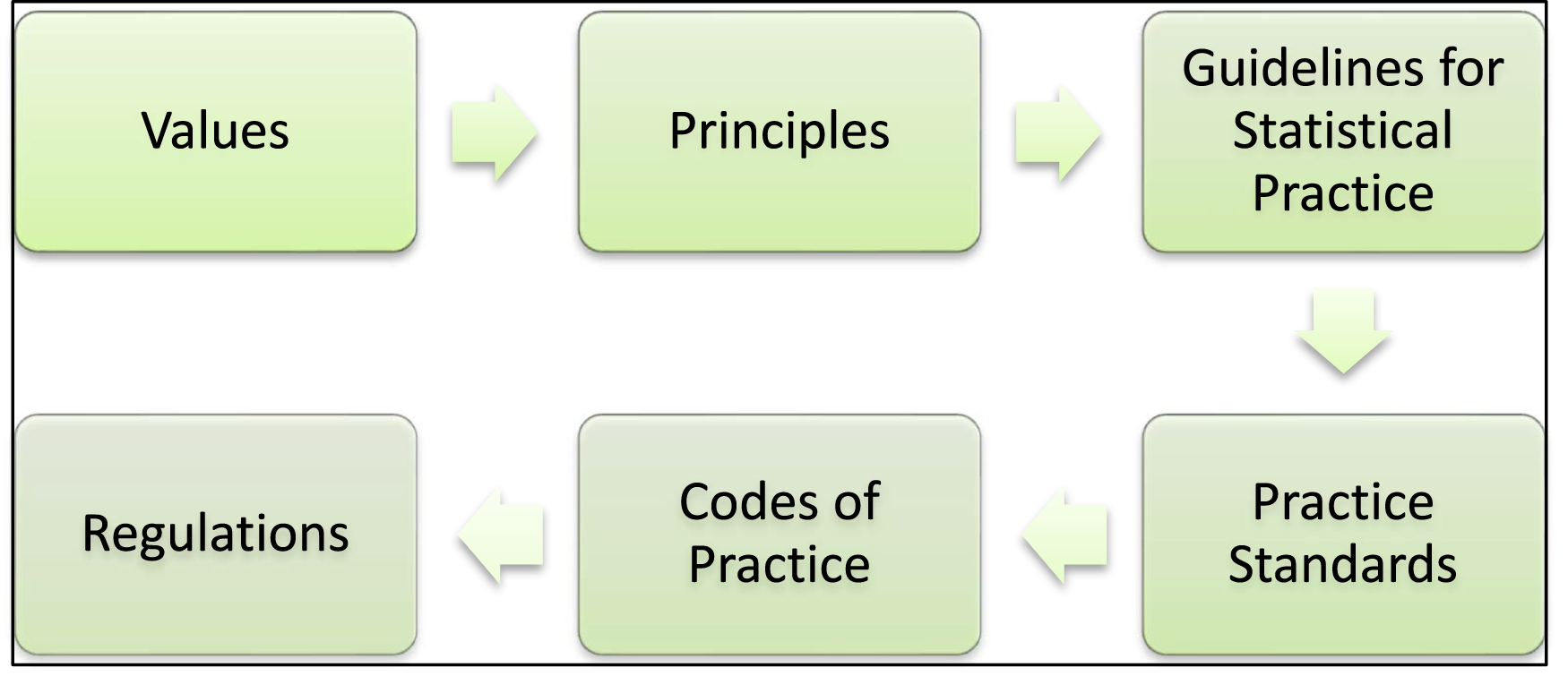
Luciano Floridi / Mariarosaria Taddeo
21
and David Hand
22
have developed convincing thoughts on this subject matter and have provided useful pointers, such as “Navigating between the Scylla of social rejection and the Charybdis of legal prohibition in order to reach solutions that maximize the ethical value of data science to benefit our societies, all of us and our environments is the demanding task of data ethics.”
21
“As far as ethical codes for data collection, manipulation, and use are concerned, these have various functions, including things such as the following:
providing guidance on how to behave in difficult circumstances;
preserving privacy in a way that users and the public will find acceptable;
ensuring that data are used in such a way as to benefit the public;
reassuring customers, the public, and others about an organization's integrity; and
reassuring employees that they work for a trust-worthy organization.” 22
And “However, the context of data science is so vast and diverse, and is changing so rapidly over time, that we cannot hope to put in place precise regulations. There cannot be a single and simple universal set of rules, and unexpected and unforeseen circumstances are certain to arise. The best we can hope for are some ethical principles that have to be interpreted or instantiated in particular applications. That is, the principles must be mapped to low-level guidance, and this is likely to be application specific.” … “At the highest level, the principles include such things as integrity, honesty, objectivity, responsibility, trustworthiness, impartiality, nondiscrimination, transparency, accountability, fairness, robustness, resilience, usability, efficiency, and independence. All good and desirable characteristics. These are then refined into lower, but still high-level principles.”
22
Depending on the area of application in which statisticians work, they will also encounter the ethical guidelines and specifications that are relevant there, be they general guidelines for scientific research, 23 rules for professional conduct in the neurosciences 24 or official statistics, 14 to name but a few.
Which level of the ethical hierarchy and which characteristics are suitable depends on the intended purpose: Whether a relatively open conveying of values is intended (e.g., in statistics training) or whether, as in the Code of Practice of the European Statistical System, 25 binding rules are required with regard to compliance with which reviews and certifications are to be carried out.
It is also necessary to distinguish for whom these ethical principles and guidelines are meant and relevant, for the individual practitioner of statistics (be it as a researcher or as a manager), for an institution (statistical authority, bank, etc.) or for those who determine the framework for statistics as ordering parties, financiers or users (Figure 2).
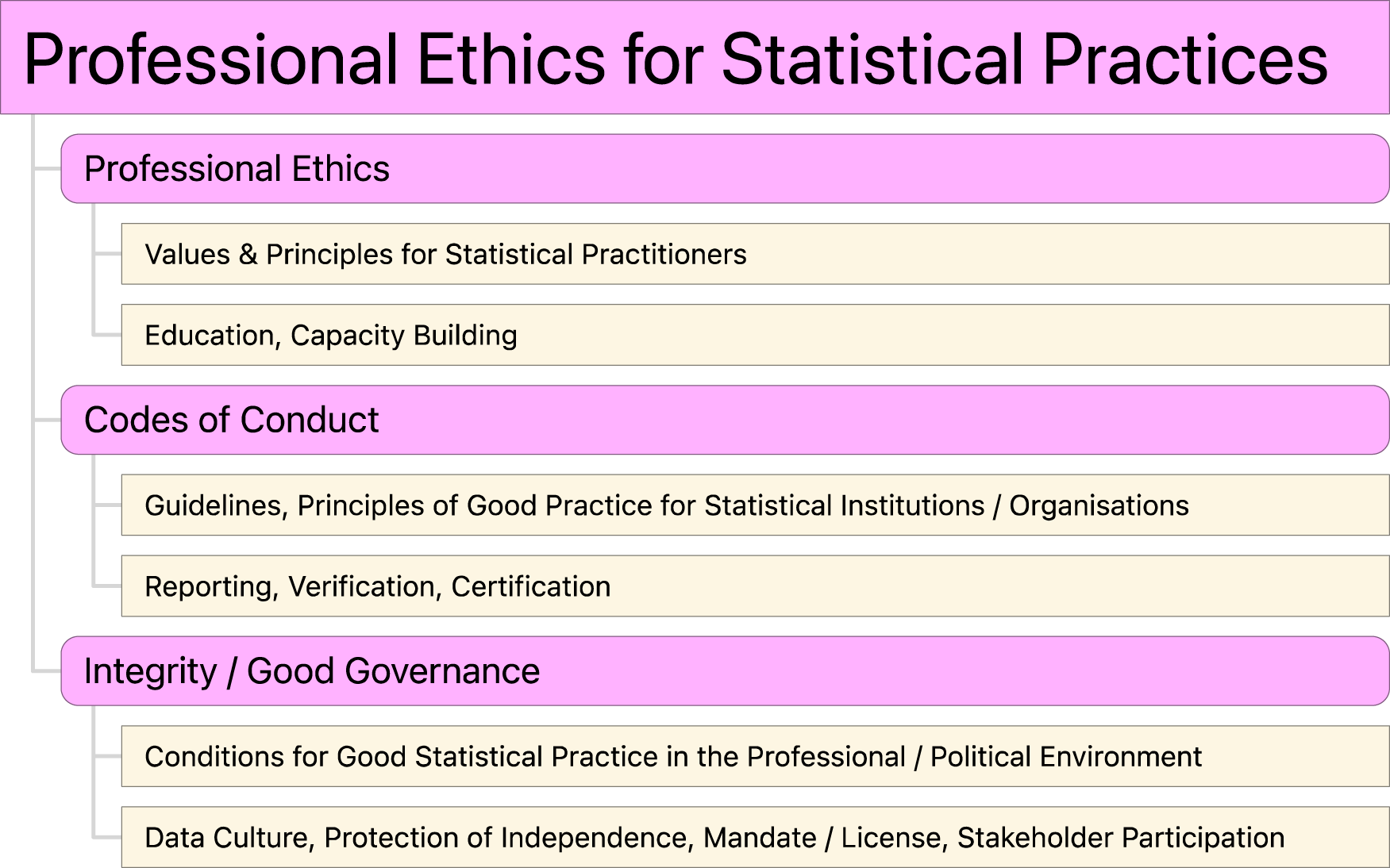
Forms and areas of application of ethics.
Following this distinction, questions will also arise regarding the tools for implementation (and control). On the one hand, this concerns the possibilities of verification through e.g., accreditation, certification or compliance monitoring and reporting. Finally, it is important to consider which measures will achieve the greatest success in promoting ethics. Various tools are available for this (Figure 3), and when using them it is important to consider what effect, reaction and possibly also counter-reaction they will have.
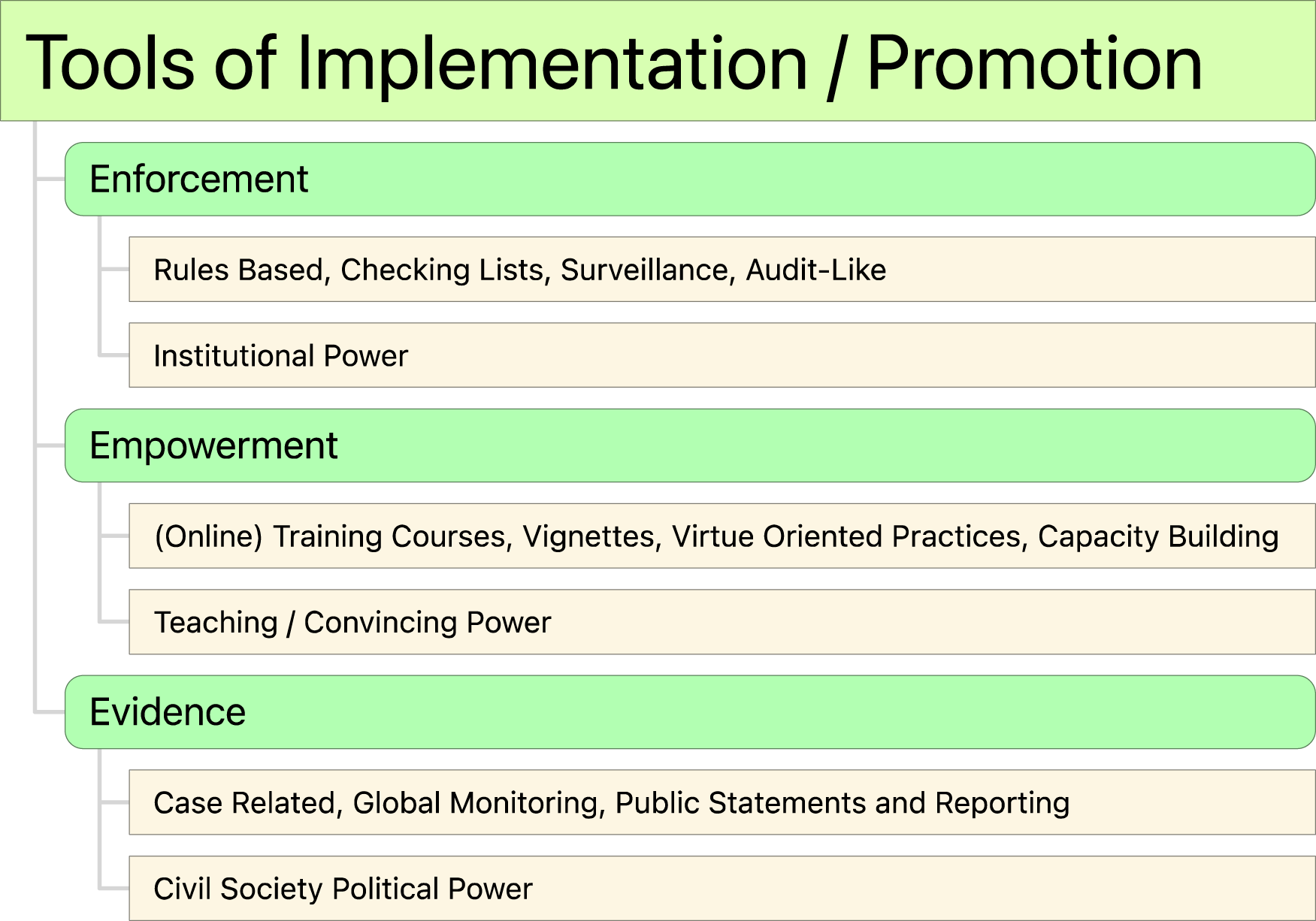
Toolkit for implementation of ethics in practice.
Furthermore, especially in a discourse on ethics from a global perspective, it should not be overlooked that it cannot be assumed that its derivation from universal human rights is not comprehended and shared without reservations. Rather, representatives of so-called critical theory and post-colonialism question the Enlightenment and articulate the tension between values and power,26–30 for example in connection with the demand for data sovereignty of indigenous peoples.31–34 Under these circumstances, an imbalance in favour of enforcement tools can potentially be counterproductive in communities with which a trust-based relationship is to be established.
Professional ethics in the narrower sense is aimed at the professionals in statistics, i.e., the individuals who work with statistical methods and thus generate statistical results. What matters here is not so much that these individuals possess training and a degree in the discipline of statistics. Rather, these ethical principles fundamentally address all those who practise statistics, regardless of the specialist discipline involved. When doctors are treating patients, they are bound by their Hippocratic Oath, but also by statistical ethics if they are working with data and performing statistics. Of course, this also applies vice versa, so that statisticians must observe the ethics of the specialised fields in which they work.
The International Statistical Institute ISI sees itself as the global statistical institution whose task it is to define, publicise and promote ethics. Due to the considerable breadth of the areas of application of statistics, the aim can only be to cover the top level of the aforementioned hierarchy of ethical rules, namely the generally shared professional values and the essential principles that derive from these values.
The ISI Declaration on Professional Ethics introduces the topic as follows: “The aim of this declaration is to enable the statistician's individual ethical judgments and decisions to be informed by shared values and experience, rather than by rigid rules imposed by the profession. The declaration seeks to document widely held principles of the statistics profession and to identify the factors that obstruct their implementation. It recognises that, the operation of one principle may impede the operation of another, that statisticians – in common with other occupational groups – have competing obligations not all of which can be fulfilled simultaneously. Thus, statisticians will sometimes have to make choices between principles. The declaration does not attempt to resolve these choices or to establish priorities among the principles. Instead, it offers a framework within which the conscientious statistician should be able to work comfortably. It is urged that departures from the framework of principles be the result of deliberation rather than of ignorance.”
35

Principles of the ISI declaration on professional ethics.
What is important is, firstly, the strategic importance that the ISI attaches to ethics and, secondly, the existence of a board (https://isi-web.org/ethics) whose tasks are to advise the management level on ethical issues and to undertake activities for promoting observance of ethical principles in statistics.
Politics of numbers: Public statistics and the state
Considering that (official) statistics as a child of the Enlightenment, especially in its application as official statistics, is already more than two hundred years old, the fact that the first version of a corresponding global ethics document (the ISI Declaration of Professional Ethics) dates back to 1985 is surprising.
36
Developments in the area of application of official statistics fall within the same period: “The need for a set of principles governing official statistics became apparent at the end of the 1980s when countries in Central Europe began to change from centrally planned economies to market-oriented democracies. It was essential to ensure that national statistical systems in such countries would be able to produce appropriate and reliable data that adhered to certain professional and scientific standards.”
14
“The objective should be to develop, improve and promote international acceptance of codes of practice and guidelines relating to science and technology in which the integrity of life-support systems is comprehensively accounted for and where the important role of science and technology in reconciling the needs of environment and development is accepted. To be effective in the decision-making process, such principles, codes of practice and guidelines must not only be agreed upon by the scientific and technological community, but also recognized by the society as a whole.”
37
“Neo-liberal governance, which seeks to achieve self-regulation of actuaries using measures and indicators rather than instructing them with regulations. This approach promises no less than modernity, democratisation and transparency. Furthermore, flattening of hierarchies and auditability are to be ensured as well as a general quality improvement. Improving efficiency is the overall goal of this approach.”
38
Since (official) statistics is a result of the Enlightenment as much as the nation state, it is closely tied to it (in both good and bad periods). Not least as a result of digitalisation and globalisation and as a response to emerging new information needs in times of crises, these statistical principles require continuous practical application and interpretation, and, to a limited extent, adaptation to new data sources, circumstances and methods. 40
With the Sustainable Development Agenda, a global strategy has been adopted for the individual goals and overall success of which reliable, verified facts are of decisive importance. Two goals should be explicitly cited here: “Goal 16 is about promoting peaceful and inclusive societies, providing access to justice for all and building effective, accountable and inclusive institutions at all levels. Goal 17 is about revitalizing the global partnership for sustainable development. … It requires partnerships between governments, the private sector, and civil society”; in particular Target 17.18 …, enhance capacity-building support to developing countries, …, to increase significantly the availability of high-quality, timely and reliable data …”
41
Trust in numbers in the time of datafication
The conditions under which public statistics operate are marked by the difficulties of their time. In the dictatorships of the twentieth century, statistics were put on a short leash by state interests; in the neo-liberal era, they were shrunk as superfluous ballast. Both had a devastating effect on the quality of evidence and the public trust based on it. Tim Holt, then President of the Royal Statistical Society and Director of the Office for National Statistics, commented on the establishment of modern statistical governance through the Statistics and Registration Service Act 2007: “Statistics, their production and interpretation, really do matter. It is uncommon to find some area of public debate that does not draw on a body of statistical information. As a result, public confidence in the statistical system and its outputs is vital. In particular this is essential if people are to have confidence in the decisions that are made on their behalf by elected leaders. For example, people will not accept the case for closing a school or hospital if they do not trust the statistics on which the case is made. More generally, no one will trust government if it is seen to rely on statistical information which is perceived as untrustworthy.”
42
“The new apparatus of number-crunching is well suited to detecting trends, sensing the mood and spotting things as they bubble up. It serves campaign managers and marketers very well. It is less well suited to making the kinds of unambiguous, objective, potentially consensus-forming claims about society that statisticians and economists are paid for.”
43
In 2019, the Royal Statistical Society has set out the following comprehensive and well-balanced recommendations in a Data Manifesto:
“Ensure official statistics are at the heart of policy debate
Commit to greater data sharing between government departments for statistics and research purposes
Champion basic training in data handling and statistics for politicians, policymakers and other professionals working in public services
Maintain the commitment to keep pace with other leading scientific nations on investment in research and development
Give the Office for National Statistics and the wider Government Statistical Service adequate resources
Prepare for the data economy by skilling up the nation
Involve the public in shaping the conversation about how data is used
Misinformation needs countering but without undermining free speech
Move beyond averages and break down data to a much more granular level
Keep data regulation updated to protect the public“
45
What is (positively) striking about this Manifesto and the list of recommendations is the close interlocking between statistics / data sciences and their applications. A holistic view of the interaction between the three historically important drivers of development in statistics, namely science, statistics and society,
38
ensures an adequate response to the challenges of our time. It is interesting to note that it is not so much any methodological-conceptual differences between statistics and data sciences that need to be bridged. Rather, they are two concepts and approaches to tasks of quantifying aspects of reality that are as complementary to each other as individual transport and rail transport are responses to questions of mobility. So, what essentially characterises the two is a decentralised organisation of statistical processing for the Big Data world on the one side and a centralised, standardised logic embedded in quasi-industrialised processes for the Official Statistics world on the other. It should be noted that the point here is not to evaluate one approach against the other, but to emphasise their complementarity (Source
46
).
UN Fundamental Principles and other codes of conduct
Professional ethics is an important basis for the formulation of rules for statistical institutions. In addition, however, there are two others:
Firstly, as statistical offices generally belong to the public sector, the respective framework conditions and rules of the particular administration apply to them, with the following principles emphasised as generally valid by the International Federation of Accountants:
“Behaving with integrity, demonstrating strong commitment to ethical values, and respecting the rule of law.
Ensuring openness and comprehensive stakeholder engagement.”
47
“The
Secondly, there is a close link to the development of quality management and quality codes in official statistics, as can be seen in the European Statistics Code of Practice, which has largely emerged from proposals from the joint working on quality proposals.
48
Meanwhile, it belongs to good practice in public statistics for institutions to specify quality codes tailored to their circumstances and framework conditions. Whether and to what extent international standards are adequately translated at national level and their compliance (externally) verified in this way are, however, further questions, the answers to which ultimately come up against the possibilities and limits of enforcing international standards in general. The European Union is a special case in this regard, where the statistical system, consisting of institutions at national and European level, are all subject to the same code, which is embedded in Community law. This makes it possible to enforce compliance with the quality code by means of joint governance, which includes an Advisory Board (ESGAB https://ec.europa.eu/eurostat/web/esgab/introduction) and regular Peer Reviews (Peer Reviews https://ec.europa.eu/eurostat/web/quality/peer-reviews).
To summarise, it can be observed that remarkable progress has been made in public statistics in recent decades, which has been driven not least by the dilemmas, conflicts and necessities of application in politics and public discourse. As the UNECE Data Ethics Review 52 has outlined, the discussion on appropriate quality codes will continue rapidly and intensively in the coming years.
The following sections focus on measures and activities dedicated to empowerment. The aim will be to create the prerequisites and framework conditions that prepare fertile ground for facts in the form of high-quality statistics to actually fulfil their purpose of serving public discourse, objectifying conflicts and providing trustworthy evidence for political decision-making. To this end, it is essential to keep an eye on the interaction between the producers of statistics on the one hand and their users on the other: “The pragmatic intent is completed by retroaction and feedback loops so that the indicators resulting from the model influence the behaviour of the various agents involved (citizens, consumers, firms, Government).” 53
Competences, competence levels
“Data literacy is the cluster of all efficient behaviours and attitudes for the effective execution of all process steps for the creation of value and/or decision making from data.” 54 With this broad concept for data literacy, it becomes clear that it is about much more than just being familiar with techniques and methods. Rather, competence in a comprehensive sense involves a combination of knowledge, skills and attitudes, which includes an awareness of and commitment to the values and principles of professional ethics. Furthermore, it is important at what level such competences must be available, which in turn - comparable to language competence - depends on the context in which and the purpose for which such competences are to be applied.
The need for professionalisation: Accreditation
A broad concept of skills, knowledge and behaviour should be applied in the training of professional statisticians and data scientists, including during their first years of professional practice. With this objective in mind, scientific statistics associations have developed accreditation procedures and formalised final certificates. An example is the certification as ‘European Accredited Statistician’: “The overall goal is to increase the quality of statistical work and information and thereby supporting mankind with statistical information in any field where statistics can give useful guidance. The purpose of the accreditation system is to provide a common European standard for defining the statistical profession, to provide steps for the applied statisticians and simplify the description of merits.”
55
“We are defining the standards needed to ensure an ethical and well-governed approach so the public, organisations and governments can have confidence in how their data is used.”
56
Critical thinking skills
In the interest of empowering civil society with the aim of broad participation in evidence-based political discourse, it is not least a matter of being able to deal critically with statistics in addition to technical and methodological skills. This task can be approached in relation to statistics in general by analysing the characteristics of statistical literacy from the perspective of critical thinking. 57 With the eight critical thinking skills distinguished here, it should be possible to successfully develop a soundly based culture of data and to counter ‘crank’ science using sophisticated pseudo-statistics. 58 In the specific domain of civic, public and official data, the task of trustworthiness, transparency and institutionally based authority from the perspective of the users of statistics arises with particular urgency, far-reaching consequences for the democratic order and often without the existence of alternative data sources. In this context, it is worth emphasising that an early and consistent introduction to the assessment of statistical facts (quality, trustworthiness, etc.) is important for everyone in schools, as well as learning how to use such facts for one's own information needs.
mention the importance early childhood education and its high return What this means in concrete terms for statistics in the public sphere is explained in detail in the article “Literacy in statistics for the public discourse.” 59
Statistical and data literacy skills required in policy-making
As briefly described in the introduction, policy has several roles and tasks in the processes of evidence-based decision-making. Just as there are data and facts for policy, it is conversely important to emphasise the different policies regarding the framework for data on the one hand and for statistics on the other. 60 Accordingly, different competences are also required in the political sphere, depending on whether someone is preparing decisions on the analytical side of policy advice with the help of evidence, whether it is a matter of communication or whether the legal-political determinants for actors and action in informational value creation are to be designed.
For the one side, namely the use of evidence for policy-making, the competences and literacy required for doing so can largely be referred to what has already been elaborated. More interesting, however, is the opposite direction of activities, namely the politics for data and the politics for facts. In this respect, qualities and competencies that generally apply to good management are (additionally) important. W. E. Deming has established his criteria for profound knowledge, according to which successful management is based on the following four competences: “Knowledge about variation, Psychology (psychology of individuals, groups, society and change), Theory of knowledge, Appreciation for a system.”61,62 In the field considered here, the system for which ‘Appreciation’ is required is about a comprehensive and deep understanding of the processes and interrelationships related to statistics as
a science of variation, data and uncertainty, with the extraction and interpretation of knowledge involving constant querying of all aspects, including issues, data, models, assumptions and analyses, a (modern) technology, reliable data sources, efficient processing methods, an infrastructure that needs to be regularly maintained and modernised, a common language between producers and users, all framed by and based on values, ethics, governance.
Governance, institutions and trust: Data culture
Trust is built on knowledge and experience as opposed to blind faith.
Trust in democratic institutions, such as public statistics, is characterised by a mutually reinforcing relationship between Wertschöpfung (value generation) and Wertschätzung (value appreciation). Creating Wert (value) in the form of informational products and related services is the task of public statistics. Whether and how well this can be achieved depends not least on structural preconditions such as governance, budget, competencies, etc. Wertschätzung (appreciation) on the part of the users of these products and services is influenced by concrete experiences, but also by opinions, attitudes, values and not least by (statistical) literacy.
For public statistics, danger arises when either the conditions for Wertschöpfung (value generation) or the factors influencing Wertschätzung (value appreciation) are unfavourable. Recent experience from the Covid pandemic has shown weaknesses and risks on both sides: On the one hand, weaknesses in the coordinated and qualified provision of relevant indicators, on the other hand, considerable gaps in statistical literacy. As a result, official statistics have come under pressure, their relevance to the breadth and urgency of politics is fading, their competence is suffering from a lack of investment, and their authority is being weakened by ‘alternative’ ways of producing quantitative world views, regardless of how they are obtained.63,64 This conceals an essential implication: Of course, an appreciation of public statistics in the policy-making circles is a prerequisite for them to initiate appropriate programmes and measures. In the absence of statistical literacy and an understanding of the role of public statistics in the democratic process, greater trouble is inevitable. Winning trust back is an objective whose importance can hardly be overstated. This can only be achieved through political initiatives and investments on both sides.
Let us summarise: There is a social and political dimension to literacy in data and statistics that we might call data culture. 65 If this important prerequisite is missing, then political programmes will be one-sidedly focused on the elements to which the public's attention is devoted in the short term. Comprehensive knowledge of structures and forward-looking investments in public infrastructure will be lacking, value creation and appreciation will suffer, trustworthiness will be (further) weakened.
Concluding remarks
This article takes an approach that firstly develops ethical guidelines and good practice codification for statistics, and official statistics in particular, and secondly examines the various ways in which such guidelines can be implemented in practice. It turns out that ethics is a complex and multi-layered subject, even at the theoretical level, for the realisation of which an apparatus of tools is available. The essential lesson from these discussions seems to be that ethics is a topic that can and should guide us in a social learning process to deal knowledgeably and wisely with the opportunities, risks and side effects of the comprehensive quantification of all areas of life.
Footnotes

Funding
The author received no financial support for the research, authorship, and/or publication of this article.
Declaration of conflicting interests
The author declared no potential conflicts of interest with respect to the research, authorship, and/or publication of this article.