



Abstract
Bribery significantly impedes a country’s development and governance, emphasising the critical importance of researching its drivers and dynamics to formulate effective policies. Of particular concern is the gender dimension of bribery, given its adverse impact on gender equality, coupled with the recognition that women’s empowerment contributes to combating corruption. This paper offers innovative insights into the gender dimension of bribery in Ghana, utilising data from the comprehensive 2021 Ghana Integrity of Public Services Survey. The findings, even after controlling for other influential variables, reveal that: (1) men are 27 percent more likely to pay bribes than women, (2) male officials are more likely to solicit bribes than their female counterparts, and (3) women are 2.3 times more likely to encounter requests for sexual favours than men. These findings significantly enhance the previously mainly correlation-based evidence, underscoring the gender dimensions of bribery. The study concludes by advocating for further research into officials’ perspectives on why they request bribes and calls for heightened policy attention to address the gender dimension of bribery, particularly in instances involving requests for sexual favours.
Keywords
Introduction
Corruption is a global phenomenon that undermines economic development, good governance, and social justice. 1 It can lead to the misallocation of resources, a loss of public trust and state legitimacy, low accountability and transparency, and the unequal distribution of social, economic, and political opportunities. This issue is of particular pertinence in Ghana, where corruption is estimated to cost the economy approximately five percent of its annual GDP, affecting sectors such as health, education, and defence, and leading to a corruption ranking amongst the worst in Africa and the world. 2 Bribery is one of the most common and visible forms of corruption. It involves the exchange of money, goods, or services between a public official and a citizen or a private actor to obtain a favour or an advantage that is otherwise not entitled or not legally required. 3
Whilst there is a growing body of literature on the causes and consequences of corruption, less attention has been paid to the gender dimension of corruption, especially in the context of developing countries.1,4 Moreover, little is known about how corruption impacts different groups of people, which can often depend on the socioeconomic status, political power, and gender of those groups. 3 For instance, public officials, predominantly male, are often the main perpetrators and beneficiaries of bribery. 5 Also, corruption can take form in a gendered way. For example, women often face the risk of request for sexual favours, whereas men do not.
This paper focuses on the bribery of public officials. In particular, the role of gender in corruption is analysed by using a logistic regression model to estimate the likelihood of the occurrence of bribery premised on an interaction with a public official. To isolate the gender effect, this study includes a host of control variables. The results show that when controlling for the type of official, the frequency of interactions with public officials, knowledge of anti-corruption agencies, and a range of socio-economic characteristics, a statistically significant gender effect remains. Namely, when interacting with officials, men are 27 percent more likely to pay bribes than women. People are also more likely to pay a bribe when in contact with a male official than a female official. Our model also estimates the likelihood of receiving a request for a sexual favour in an interaction with an official: this is 2.3 times more likely to happen to women than men.
This study uses a new data source, the 2021 Ghana Integrity of Public Services Survey (GIPSS). This is the first comprehensive, nationally representative population survey on corruption in Ghana, including 15,000 respondents. This unique dataset allows the model to separate the gender effect from other crucial variables determining the likelihood of bribery, especially the type of public official.
The results of this study underscore the importance of targeted and effective policy action to treat the gender-corruption nexus in Ghana. Several lines of action are recommended in this paper, besides a set of methodological recommendations for future surveys. The main recommendations highlight the importance of prioritising the successful implementation of policies such as the National Anti-Corruption Action Plan (NACAP), the Affirmative Action Act, and other national gender-focused policies. This will require hard decisions and strong leadership, but the results of this study provide unequivocal evidence of the need for a gender-based approach to corruption.
The paper is structured as follows: Section 2 provides a background to the gender dimensions of corruption, with considerations in the Ghana context. This is followed by the methodology in Section 3, including the definition of concepts, the data source, the estimation technique, and the selection of controls. The main results are given in Section 4 to 7. The results focus on the gender of bribe payers, the gender of officials, mechanisms of bribery by gender, and elicitations of sexual favours. In Section 8, several methodological and policy recommendations are made, aligned with the results of the paper and the general context of corruption in Ghana. Finally, Section 9 provides a conclusion.
Background
Gender refers to the socially constructed roles, behaviours, and expectations that are associated with being male or female in a given society. 3 Gender influences how people access and use public services, how they interact with public officials, and how they experience and respond to corruption.1,6 Gender also shapes the form and level of corruption, such as the prevalence and frequency of bribery, the types and amounts of bribes, and the use of sexual favours as a currency of corruption.1,7
The insights and recommendations from the United Nations Office on Drugs and Crime (UNODC) report “The Time is Now: Addressing the Gender Dimension of Corruption”, highlight the need to mainstream gender in anti-corruption policies and programmes. Understanding the gender dimension of corruption is important for designing and implementing effective anti-corruption policies and programmes that are responsive to the needs and rights of both men and women.7,8 However, there is a lack of empirical evidence of the role of gender in the corruption.2,9 This gap hinders the development of gender sensitive and evidence-based anti-corruption strategies and interventions. UNODC 10 argues that addressing the gender dimensions of corruption is essential for achieving the Sustainable Development Goals, as corruption disproportionately affects women and girls, especially in contexts of poverty and conflict.
Ghana has committed to fighting corruption through various initiatives, such as the National Anti-Corruption Action Plan (NACAP), which aims to raise awareness, strengthen institutions, and investigate and prosecute cases of corruption, while incorporating a gender perspective. 7 Moreover, Ghana has aligned its anti-corruption efforts with Sustainable Development Goal 16, which calls for reducing corruption and ensuring responsive, inclusive, and accountable institutions. 7 Despite these efforts, bribery remains a pervasive and persistent problem in Ghana, hampering its economic growth and democratic consolidation. 5
GSS and UNODC 1 used the same data source in this paper, finding that men are 1.6 times more likely to pay or be asked to pay a bribe than women in Ghana. However, this paper takes a more targeted approach. While the GSS and UNODC 1 report has mainly focused on exploring the correlates of bribery and gender, it is crucial to acknowledge that correlates do not necessarily establish a robust relationship or causality between the variables under examination. The observed gender disparities by GSS and UNODC, 1 such as the notably higher share of male public officials engaging in solicitation or acceptance of bribes compared to their female counterparts, and the increased vulnerability of women to sexual corruption, underscore the need for a more in-depth investigation into the underlying causes and consequences of these gender differences.
The findings in this study are corroborated by Aidoo et al., 11 who found that women are less likely to engage in bribery, and therefore recommend that women’s representation in positions of power be increased.
This paper contributes to the literature by providing a comprehensive and comparative analysis of the gender dimension of bribery across different types of public officials and sectors in Ghana. This contribution is particularly valuable as the current literature is often merely descriptive and does not control for multiple variables, which plays an important role in bribery in Ghana. Furthermore, policy recommendations are offered, and avenues for future research are suggested, emphasising the importance of considering the gender dimensions of bribery in the ongoing efforts to combat corruption in Ghana.
Methodology
Definition of concepts
Prevalence of bribery
This study defines the prevalence of bribery as ‘the proportion of adults who gave a non-monetary gift or money in addition to an official fee, or have done a favour in return for a service, to a public official in the 12 months prior to the survey, as a share of those who have been in contact with a public official’, which is measured for 23 different official types. It should be noted that contrary to the earlier report on corruption in Ghana, 1 this report defines bribery as those who actually paid a bribe, and not as those who either paid or refused a bribe, to allow for a distinction between drivers of payment of bribes and drivers of refusal of bribe payment when asked.
Frequency of contact
This is defined as the number of times the respondent had contact with an official in the 12 months preceding the survey.
Frequency of bribery
This is defined as the number of times the respondent paid a bribe to the specified type of official in the 12 months preceding the survey.
Income
Income refers to the household average income per month in Ghana Cedis including all wages and benefits, after taxes (net income).
Disability
Persons with a disability refer to people who reported to have difficulties doing certain activities because of a health problem. These activities include seeing (even if wearing glasses), hearing (even if using a hearing aid), walking or climbing steps, remembering, or concentrating, self care (washing and dressing), and communicating. Those who reported to have a lot of difficulty, or were not able to do, one of these listed activities are defined as having a disability, following the Washington Group Short Set.
Knowledge of anti-corruption agencies
Knowledge refers to the awareness of anti-corruption agencies in Ghana. The anti-corruption agencies included the Office of the Special Prosecutor (OSP), Commission for Human Rights and Administrative Justice (CHRAJ), the Economic and Organised Crime Office (EOCO), the Ministry of Justice (MoJ) and the Ghana Police Service (GPS). Having knowledge of these agencies is defined by respondents who answered yes to the question of whether they are aware of the listed agency.
Sexual favours
The specific question asked about sexual favours was: “In the past 3 years, since December 2018, did it happen to you that a teacher, master, lecturer, professor, health worker or other public official who may be your supervisor or colleague if you work in the public sector, made you understand that unless you provide sexual favours you will not, for example, get a job, promotion, pass an exam, get medical treatment or any other public service?” Moreover, our definition of being asked for a sexual favour also includes those who answered “Yes” the follow-up question: “In the past 3 years, since December 2018, have you been asked for sexual favours from public officials and you refused?”.
Data source
The data presented in this report was collected in the 2021 Ghana Integrity of Public Services Survey (GIPSS), a project funded by the German Federal Ministry of Cooperation and implemented by United Nations Office on Drugs and Crime (UNODC) and the Commission on Human Rights and Administrative Justice (CHRAJ) in collaboration with Ghana Statistical Service (GSS). This survey is the first comprehensive, nationally representative population survey on corruption in Ghana, including 15,000 respondents across the country.
Accurate data collection is essential for unbiased results, especially when considering a sensitive topic such as corruption where there is a particular risk due to non-responses. In this study, there are also additional concerns with differences in the experience or perception of bribery between genders, which could bias the results. Bias could also arise if there were differences in the response rate, or the likelihood of responding to certain questions, between men and women.
In this study data was collected from 1,500 Enumeration Areas (EAs), which were selected with probability proportional to size. In each EA, a fixed number of 100 households were selected, from which one adult member was selected for the interview. No replacements and no changes in the preselected households were allowed in order to prevent bias. In total 14,843 (99.0%) interviews were conducted, resulting in a nearly perfect response rate for both men and women. In addition, every respondent had to answer all questions. Hence, in the overall response rate, as well as question-specific response rates, there are no significant differences between men and women, making it less likely that differences in response rates affect the results.
The survey covered 23 different types of public officials, ranging from health workers and teachers to police officers and judges, and asked respondents about their contact, payment, and refusal of bribes, as well as their knowledge of anti-corruption agencies and their exposure to other forms of corruption, such as nepotism and vote buying. The survey also included questions on sexual favours.
Estimation technique
A logistic regression model is used to compute the likelihood of a person paying a bribe, conditional on the set of covariates discussed above. The same model is used to predict the likelihood to refuse to pay a bribe, as well as to predict the likelihood of having received a request for a sexual favour.
Given that the survey focuses on individual-level experiences of corruption, with only one respondent per household, the data is clustered at the individual level within EAs. Responses within the same EA may be correlated due to shared contextual factors, such as local governance or socioeconomic conditions. To account for this, clustering was specified at two levels: EAs as the primary sampling units and individuals within EAs. This ensures robust standard errors that reflect the hierarchical structure of the data and potential intra-EA correlation in corruption experiences.
To address any concerns with the size of the survey weight affecting the results, the same models were run with and without applying the survey weight as a robustness check. The results showed no significant differences in the overall outcomes, with no changes in significance or substantial size differences in the main coefficients. The only exception was the significance of contact with only a female official, which was significant at a 10 percent level when weights were included, but not when excluded. This is likely due to the small number of respondents who encountered only a female official, making the result more sensitive to the weights. This however does not alter the main finding that contact with male officials significantly increases the likelihood of paying a bribe. Overall, the inclusion of survey weights does not affect the main conclusions of the paper, confirming the robustness of the results.
Contact rate by gender and type of public official.

Contact rate by gender and type of public official.
This only displays the public officials for which the contact rate was above 10 percent for one of the genders.
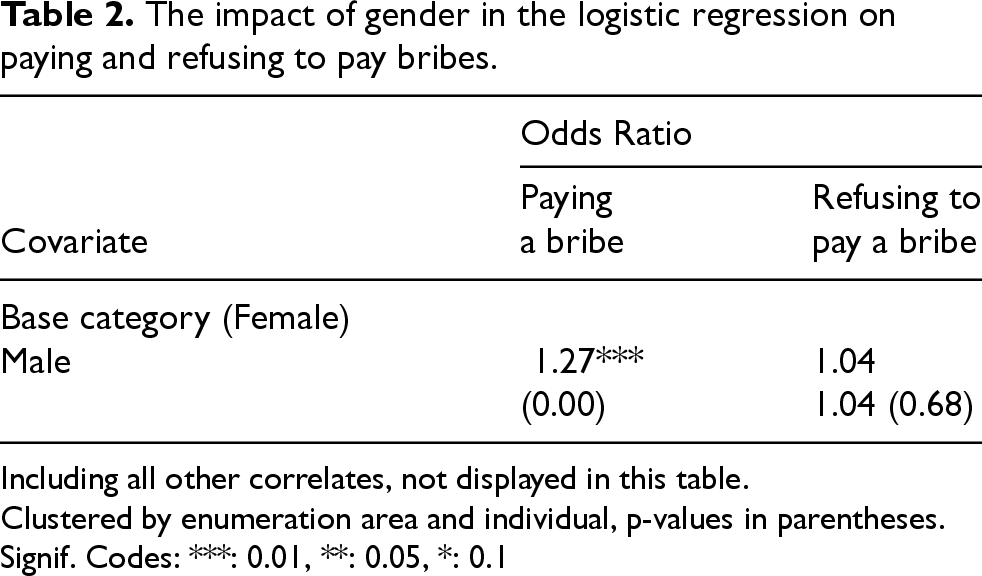
The impact of gender in the logistic regression on paying and refusing to pay bribes.
Including all other correlates, not displayed in this table.
Clustered by enumeration area and individual, p-values in parentheses.
Signif. Codes: ***: 0.01, **: 0.05, *: 0.1
The impact of gender of public officials in the logistic regression on paying and refusing to pay bribes.

Including all other correlates, not displayed in this table.
Clustered by enumeration area and individual, p-values in parentheses.
Signif. Codes: ***: 0.01, **: 0.05, *: 0.1
For the regression on paying bribes, the subset of those who have been in contact with the public officials was used. However, for the regression on refusing to pay a bribe, only the sub sample of those who either paid or refused to pay a bribe are included.
Rationale for selection of correlates
The selection of correlates in this study is designed to encompass a comprehensive range of factors that are known to influence an individual’s likelihood of engaging in bribery. These specific socio-demographic, economic, and situational variables are considered exhaustive because they cover key influences that shape attitudes towards bribery and access to resources. By including these variables, the impact of each factor, such as gender, can be isolated more effectively. This ensures that the analysis can account for potential confounding influences, allowing for a more unbiased and accurate understanding of the true effects of gender and other variables on bribery.
Socio-demographic variables
Socio-demographic variables such as region, locality type, sex, age, and education can have a significant role in influencing bribery. These factors can shape a person’s attitudes towards bribes, as well as their ability to pay or receive a bribe. For example, individuals with less education may be more likely to accept bribes due to their lack of knowledge about the legal implications.
Income
The income level of an individual has the potential of influencing the individual’s engagement in bribery. Persons who earn more money would have the ability and capability in engaging in bribery, whereas those who do not earn much are likely not to be in a capacity to pay bribes.
Employment status
Employment status can also correlate with bribery. For example, employed people may have more money available to pay bribes. Therefore, controlling for employment characteristics helps to control for these effects.
Disability
Bribery is an issue that affects people of all abilities. People with disabilities may not be able to get the same access to resources and services as those without disabilities and may be more likely to resort to bribery to gain access to the resources and services they need. Furthermore, people with disabilities may also be more vulnerable to bribery, particularly in countries with weak legal systems and enforcement of anti-bribery laws.
Interaction with officials
The inclusion of variables on interactions with officials in a regression on bribery is extremely important because it helps to capture the effect of different types of interactions between citizens and officials on the likelihood of bribery. Both the type of official, the gender of the official, and the frequency of contact are included.
For instance, persons who frequently get in contact with a government official would be expected to have a higher likelihood of being asked to pay a bribe. Moreover, the sex of the official could also influence bribery. Finally, the type of official people are in contact with could determine the probability of bribery occurring, as has been shown in previous studies. 1
Knowledge of anti-corruption agencies
Controlling for the knowledge of anti-corruption agencies as a correlate of bribery is necessary to understand the relationship between citizens’ knowledge of the bribery process and their willingness to engage in it. By understanding the connection between knowledge and bribery, governments and organisations can better develop policies and initiatives to reduce bribery and corruption.
Gender of bribe payers
The first dimension of gender in bribery that is discussed in this paper concerns the gender of the bribe payer. The main question to answer is: does the gender of the person who is in contact with the public official affect the likelihood of bribery? This question will first be attempted to be answered by comparing survey outcomes on contact with officials, as well as bribery, for men and women. After this, the focus shifts to the focal point of this paper, which is analysing the gender dimensions of bribery whilst controlling for other variables.
Contact with public officials by gender
In line with GSS and UNODC, 1 being involved in bribery can be defined as both paying a bribe as well as refusing to pay a bribe. Using that definition, 28.9 percent of men was involved in bribery, and 17.2 percent of women was involved in bribery. However, that most simple definition is not a great indicator, as it does not account for the fact whether people have even been in contact with public officials. Hence, one needs to take a step back and first analyse how many people are in contact with public officials. Then, as only those who have been in contact with public officials have had the chance to be involved in bribery, the prevalence of bribery can be computed for those who have been in contact with public officials.
In Ghana in 2021, 83.8 percent of the adult population had been in contact with at least one public official. There was a slight difference between men and women, where 84.9 percent of all men had been in contact with at least one public official, with a respective 82.9 percent of all women. In addition to contact in general, it is informative to see how the contact rate with specific types of public officials is correlated with gender. 1 highlights that that one of the most important factors when analysing the differences in bribery experiences between the two sexes is the type of officials there are in contact with. The contact rate with different public official types by gender display some remarkable findings, as presented in Table 1.
Table 1 shows that for most types of officials the contact rate is higher for men, particularly for police officers, local government representatives and officials from the Driver and Vehicle Licensing Authority. On the other hand, women have higher contact rates with doctors, nurses and midwives, as well as with other health workers in public hospitals.
This result directly indicates the necessity of this paper. Since there is a clear difference between the type of officials men and women interact with, it is insufficient to ignore this fact and continue to give descriptive statistics about which gender is more prevalent to pay bribes, without controlling for the type of official they interact with. As it could be that it is the official type people are in contact with, rather then the gender of people, driving differences in bribery prevalence between men and women.
Prevalence of bribery by gender
Even in a case where differences in prevalence of bribery between men and women is driven by other causes, it remains insightful to see how that results in differences in bribery prevalence between genders. The headline figure presented in the gender dimensions chapter of the Ghana corruption report 1 is that men are 1.6 times more likely than women to pay or be asked to pay a bribe when interacting with public officials: 34.1 percent of men pays or is asked to pay a bribe when interacting with public officials, as opposed to 20.7 percent of women. This is a very large difference, which makes it worthwhile diving deeper in understanding the dynamics of prevalence of bribery by gender.
Men and women exhibit notable differences in bribery behaviour, with 29.9 percent of men and 18.1 percent of women having paid a bribe when in contact with a public official. However, when considering refusing to pay bribes the differences were not as stark, 12.2 percent of men and 12.7 percent of women refused to pay a bribe when having been solicited to pay a bribe. This study emphasises the importance of distinguishing between payment and refusal of bribes, as detailed questions on official type and gender of the official are separately answered for paying and refusing bribes.
One explanation of the differences in the bribery prevalence could be that men and women have different perceptions about bribery. However, the survey outcomes show that there are no major differences in the perceptions of men and women about bribery. 1 shows that around 80 percent (80.3 for men, 80.5 for women) of people says it is never acceptable for a public official to request a bribe in order to speed up administrative procedures. Moreover, men and women also gave similar answers to questions about the perceived frequency of bribery requests by public officials. Hence, the perceptions about bribery cannot be a direct explanation to the major differences that are found.
Bribery by gender whilst controlling for other variables
To be able to give more insight into the drivers of bribery, it is essential to return to other factors that may influence the prevalence of bribery. A great advantage of the Ghana Integrity of Public Services Survey 2021 is that most of the questions concerning bribery were asked separately for 23 different official types, and many social and demographic variables were also collected. This allows for testing the difference between men and women and their tendency to pay bribes, controlling for a wide range of other variables which may influence the likelihood of a bribe occurring.
In Section 3.4, the selection of the correlates used in the logistic regression is justified. In summary, a host of controls that correlate with the likelihood to pay bribes are included, in doing so it is possible to test the role of gender keeping all other variables constant.
When controlling for the wide range of socio-demographic variables, knowledge of anti-corruption agencies, the frequency of contact, the type of official, and the sex of the official, it is possible to see whether or not there is still a significant gender dimension to the prevalence of bribery. Table 2 shows the odds ratio of the logistic regression model of the gender variable, whilst controlling for all other variables. The full regression table can be found in Table A1 in the Appendix.
Gender and age effects in the logistic regression on sexual favours.

Gender and age effects in the logistic regression on sexual favours.
Including all other correlates, not displayed in this table.
Clustered by enumeration area and individual, p-values in parentheses.
Signif. Codes: ***: 0.01, **: 0.05, *: 0.1
From Table 2 it can be concluded that keeping all other factors constant, men are 27 percent more likely to pay a bribe when they are in contact with a public official as opposed to women, which is statistically significant at the 1 percent level. On the other hand, there is no statistical difference between men and women in their likelihood to refuse to pay a bribe when in contact with a public official, when controlling for all other variables.
This means that there is no significant gender dimension to the refusal to pay bribes. This requires more research into specific reasons and mechanisms behind refusing to pay bribes. However, the main insight from this analysis is that when controlling for all the other variables, men are still 27 percent more likely to pay bribes than women.
From this section three major conclusions can be drawn. First of all, men are slightly more often in contact with public officials than women, and especially the type of officials that men and women are in contact with differs by gender. Secondly, it can be seen that men are more likely to pay bribes than women, while the perceptions of bribery is not different between the genders. Third, when controlling for other variables, there still remains a statistically significant difference between the likelihood of men and women to pay bribes.
When comparing the headline figure of GSS and UNODC 1 that men are 1.6 times more likely to bribe than women, to our more thorough econometric analysis, the result is that (even when taking the official type, socio-demographic characteristics and some additional variables into account) men are still significantly more likely to pay bribes than women, but men are only 1.27 times (27%) more likely to pay bribes then women. This result shows that there are some variables, such as the type of official people are in contact with, that explain part of the disparity between the bribery prevalence of men and women, but not all differences can be accounted for. This finding is essential as proof that there are still unexplained differences between men and women in the context of bribery in Ghana. Hence, leading to the direct conclusions that additional research is still required on what drives these gender disparities in bribery.
Gender of officials
The next dimension that this paper addresses is the gender of the public official. This section focuses on the question: Does the gender of the public official matter for the likelihood of bribery? In a similar way as the previous section, first of all the traditional method of analysing the survey outcomes is used, after which that is compared to the outcomes when controlling for other variables.
Bribery by gender of public officials
The headline figure of GSS and UNODC 1 on the differences between male and female public officials is: “The share of male public officials who solicit or take a bribe when interacting with the public is roughly twice that of female public officials”. It is presented that 25.2 percent of male public officials solicits or takes bribes as compared to 13.1 percent of the female public officials.
Now let us shortly digress into the public perception of the role of the gender of the public official. Public perceptions on the role of the gender of public officials indicate that 60.4 percent of Ghanaians believe male officials are more likely to request bribes. Men, at 62.8 percent lean slightly more towards this view compared to 58.5 percent of women. The perception is rooted in the belief that men, driven by a greater responsibility to provide for their families, are less hesitant to solicit bribes. It’s essential to note that these are public perceptions, not reflective of the actual behaviour of officials, highlighting the need for further research in this area.
Getting back to analysing bribery by the gender of public officials, the same problems arise as when analysing the role of the gender of the bribe payer: what if it is not really the gender of the official that makes the difference, but some other variable which is correlated with the gender of officials? One step towards analysing this difference was made by GSS and UNODC, 1 by analysing the prevalence of bribery by the sex of the public official and the type of public official. This shows that under police officers, 52.8 percent of the male public officials request bribes, as compared to a much lower 27.3 percent of female police officers. This insight shows that even when controlling for the type of official, significant gender disparities remain.
Bribery by gender of public official whilst controlling for other variables
Similarly as in Section 4.3, in this Section the logistic regressions on paying and refusing to pay bribes is analysed, but now the focus is shifted to the estimates on the effect of the gender of the public official. These results are presented in Table 3.
Table 3 shows that when controlling for other variables such as the type of official, the frequency of contact with the public officials, the gender of the person in contact with the public official and other social and demographic characteristics, the coefficient on the gender of the public official is significant and positive. This suggests that the gender of the public official has an influential role in determining the likelihood of paying a bribe. This result conforms that their is a gender-specific dimension to the mechanism of corruption in dealing with public services.
Compared to individuals who interacted with both male and female officials of a certain type within a year, those solely interacting with male officials are 1.92 times more likely to have paid a bribe, while those exclusively dealing with female officials are 1.19 times more likely. This surprising finding, even when accounting for contact frequency, suggests that those interacting with both genders are the least likely to pay bribes. Notably, individuals dealing exclusively with male officials are 1.6 (1.92/1.19) times more likely to pay bribes than those exclusively interacting with female officials, holding other variables constant. It must be mentioned here that these results could be affected by the high survey weights in GIPSS 2021. As explained in Section 3, the model was run without the survey weights, and in that case only being in contact with a male official was significant. This highlights that especially being in contact with male officials is a driver of paying bribes.
Conclusion on corruption and gender of public official
In conclusion, this section has shown that also for the gender of public officials, there is still a significant difference in the likelihood that people paid a bribe based on whether the public official is male or female. It is difficult to pinpoint exactly what causes this, although the perceptions in Ghana are mainly that this is because men need to provide more for families, as well as that they are simply less afraid to request bribes.
Research with public officials on their reasons to request bribes would be extremely insightful to be able to develop accurate policies against bribery. However, the difficulty in retrieving such data should be acknowledge, as officials will most likely not want to answer questions on bribery truthfully. It is therefore an important task in the progress of research on bribery and especially the gender dimensions, to be able to find novel ways to really dig deeper into the thought processes of officials when requesting bribes.
Mechanisms of bribery by gender
The results of this paper confirm the existence of a difference between men and women in paying and requesting bribes. There are several factors that explain why men and women engage or not in bribery, and our results raise the important question of what is driving the higher occurrence of bribery in men compared to women.
Firstly, power imbalances between men and women are an important factor in decision making. Since men hold more power than women, this can influence their decision to engage in bribery. 12 For instance, 13 find that powerful males can be more confident to take action perceived as unethical, also they may act with less fear of consequences and be less constrained by social norms and pressures. Power distance measures the extent to which there are levels of authority and inequality within a hierarchical structure. Hierarchical structures are mostly always gendered, with men above women. 14 explore how power distance relates to corruption. They find that power imbalances are associated with both higher corruption and lower female participation rates in politics. Gender pay gaps are also a reflection of the power imbalance and can directly constrain women’s ability to pay bribes and access services. 9 find that men are more likely to pay bribes in cash, whereas women are more likely to pay in kind, such as by food and drink or valuables. Less access to cash can also lead to sexual exploitation, which is shown to be far more likely to happen to women than men when in contact with a public official.
Aside from the power imbalances and their proximate outcomes, such as income differences between men and women. There is also ample evidence that behavioural differences can influence the incidence of corruption dependent gender. These differences are by no means biological but rather stem from socialisation. For instance, women may be less likely to engage in corrupt practices due to stronger moral beliefs or as sense of greater social responsibility. In an influential study, 15 conducted a cross-sectional study of over 150 countries and concluded that higher female participation rates in politics has a negative influence on corruption. In another seminal study, 16 find that women are less likely to condone bribe-taking and are less involved in such activities. Both of these papers cite socialization and gender norms as mechanisms behind why women are less involved in corruption. This has led many countries to pursue polices to encourage and enforce the participation of women in politics and other administrative areas.
The normalisation of corruption in society can also have different gender-based impacts. For example, 17 studies how societal norms influence men’s and women’s ethical views on corruption. He notes that men tend to be more accepting of corruption in environments where it is normalized. The UNODC 10 emphasizes that societal norms often dictate individuals’ participation in, exposure to, and experiences of corruption, with women often socialized to adhere more strongly to ethical norms. Women are also more likely to interact with certain service providers such as education, health and social care. It is found that the female contact rate is 30.3 percent for “Other health workers in public hospitals”, compared to 6.9 percent for males. This may influence the likelihood of bribery. For example, 16 also find that men are more likely to engage in bribery in situations where power is more concentrated (e.g., politics, large corporations), while women are typically more involved in corrupt practices in roles that are lower in the hierarchy or in sectors where women have historically faced exclusion. However, our results suggest that after controlling for the type of official there are still prominent gender differences.
The results of this paper show that there is a significant difference between female and male officials in their likelihood to request for a bribe. The literature offers several reasons for why women and men have different patterns of behaviour in relation to bribery. In particular, the role of power imbalances, socialisation and gender norms are commonly cited as the key mechanism behind gender differences in corruption. This is a critical area of research, as understanding the underlying mechanisms of bribery allows more effective policies to be enacted. However, the difficulty of such research has to be acknowledged due to sensitivity of gathering data on the drivers underlying bribery.
Sexual favours
Finally, an important element of gender and corruption is sexual favours. Hence, this section dives deeper into the question: How does gender influence the likelihood of request for sexual favours? This section stands separately from the previous sections of the paper, as questions on sexual favours were not asked for different official type, but just as separate questions to all participants of the survey. The question was both asked on a three-year time frame, as well as in a one-year time frame. For conciseness, the focus is solely on the three-year question, thus focusing on 2019–2021.
The perceptions of women and men about whether it is acceptable to be asked for sexual favours is not different for the two genders, where 85.5 percent of men responded to never think this is acceptable and a similar 85.8 percent of women gave that response.
According to GSS and UNODC, 1 2.62 percent of Ghanaians experienced requests for sexual favours during interactions with officials from 2019 to 2021. This breaks down to 3.39 percent for women and 1.64 percent for men, highlighting that the prevalence of such requests is twice as high for women compared to men.
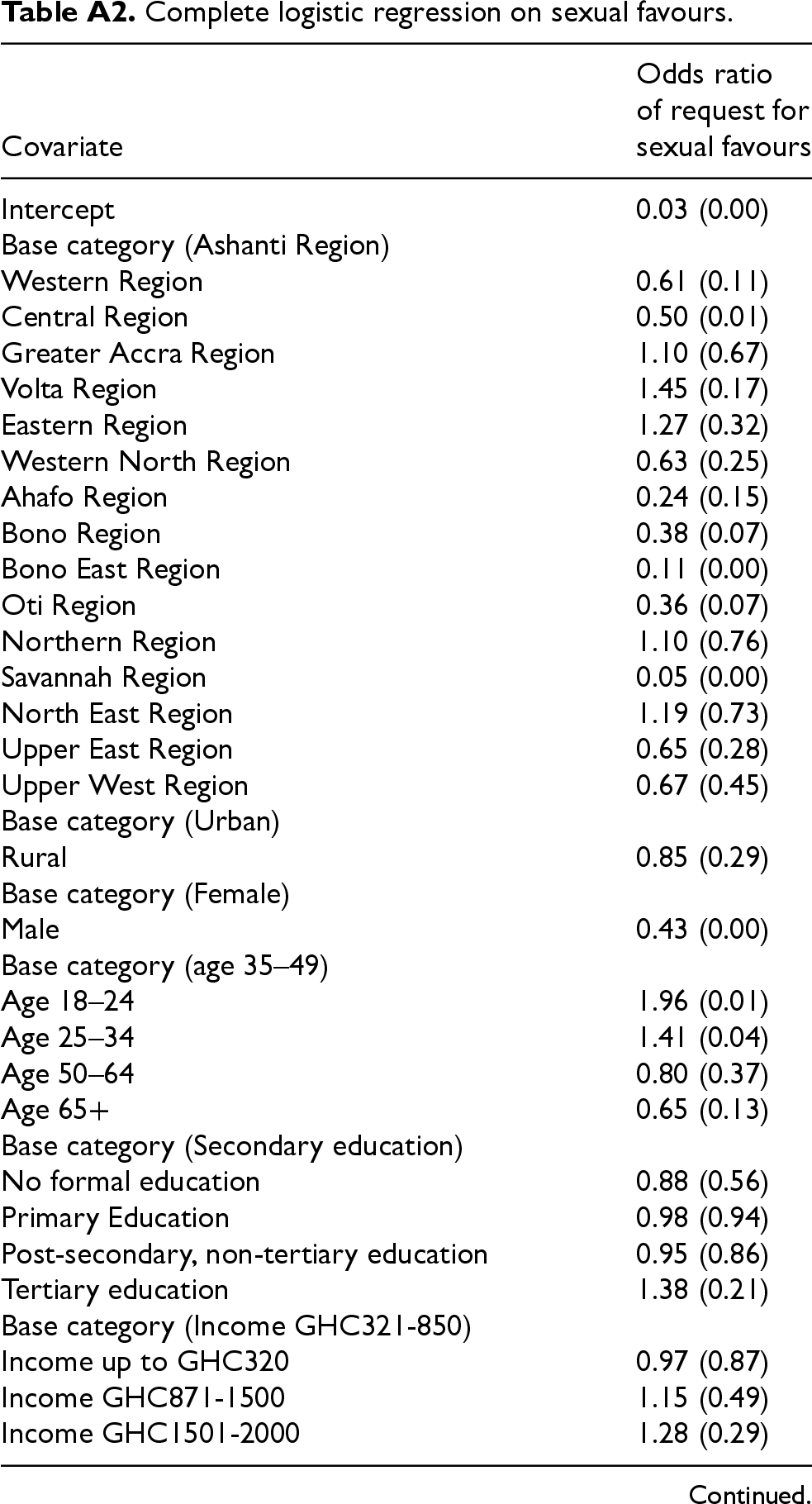
There is a lack of research on whether this gender disparity is still significant when controlling for other variables. Most interesting would be to control for the type of officials here as well, however, that is not possible given the type of data that was collected. It is possible to control for the other socio-demographic characteristics and see whether the effect of gender is still so substantial, this is shown in Table 4. The full regression table is shown in the Appendix in Table A2.
Table 4 shows that the odds ratio of men compared to women are 0.43, this means that women are 2.3 (1/0.43) times more likely to have had a request for a sexual favour in the last three years as compared to men, keeping all other variables constant. This only strengthens the conclusions from GSS and UNODC 1 that sexual favours has a strong gender element in it. Moreover, it can also be seen that people aged 18–24 and 25–34 are significantly more likely to be asked for sexual favours. This highlights the additional importance of researching the request of sexual favours for younger people, and especially young women.
Recommendations
This paper has shown the significance of gender dimensions of bribery in Ghana, indicating the need for policy change and further research. Hence, based on these outcomes, the following methodological and policy recommendations are proposed.
Methodological recommendations
The analysis in this paper has only been possible because of the successful design and implementation of the 2021 Ghana Integrity of Public Services Survey (GIPSS). The survey methodology was designed to be a large-scale household survey representative of Ghana’s 16 administrative regions. It targeted 15,000 interviews and had a response rate of 99 percent. The sampling methodology adopted was three-stage stratified clustered sampling. The Primary Sampling Unit (PSU) was the Enumeration Areas (EAs). Using the household register from the latest population census in 2021, 10 households were selected at random from each EA.
The survey methodology followed closely the standard methodology adopted by many other countries as per the guidelines and standards of the UNODC. However, new to this survey was the inclusion of a gender specific section, which captured differences between men and women with respect to paying and receiving bribes, as well as gender specific perceptions of corruption. The inclusion of this section was very successful and yielded a lot of interesting results, most of which have been discussed in this paper.
In particular, the quality of the data collected during GIPSS is notably high. This has been accredited to two key aspects of the data collection process. Namely, the development of a real time monitoring dashboard which accurately tracked metrics such as the GPS location of interviews, the length of interviews, and number of interviews completed by each interviewer per day. These metrics were monitored daily and any issues addressed promptly.
Furthermore, training of participants (interviewers, supervisors, and facilitators) was thorough. Additional refresher training was also conducted in which everyone involved in the survey was trained again, with a specific focus on the main errors found in the preliminary data. The supervisors on the survey also ensured that any issues were quickly resolved. For example, due to sensitivity of the topic, some household members were reluctant to provide information, but the availability of monitors to explain the survey objectives, build rapport, and involve opinion leaders in the community eased the collection of data and ensured the 99 percent response rate.
Despite the overall success of the GIPSS there were also some challenges. Below, ten recommendations to improve the collection of corruption data and future research into corruption are suggested:
The novel inclusion of the gender dimension into the survey proved to be very insightful and yielded important results. Therefore, it is strongly recommended to include a gender dimension to all future corruption surveys. Moreover, future research could focus on whether greater gender equality in public offices matters for the incidence of corruption. The real time monitoring and refresher training greatly increased the quality of the collected data, and therefore future surveys are recommended to include a similar mechanism to ensure the collection of high quality data. Data collectors felt that randomly selecting a household member to respond to the survey led them to miss out on important information. It is recommended that a better approach would be to interview all household members. The length and complexity of some questions was challenging for interviewees. Hence, it is recommended that survey questions are simplified to ensure consistency in their interpretation. Political sensitivity surrounding corruption is a potential barrier to regular corruption surveys. However, frequently measuring corruption is very valuable for policy makers to be able to assess the impact of interventions. Yet, since GIPSS in 2021, there has not been a follow up survey carried out in Ghana. Therefore, in future survey designs it is recommended to incorporate a timeline for an agreed number of follow-up surveys. Since the GIPSS 2021, the Ghana Statistical Service has developed mobile applications for the collection of self-reported data. These are potentially useful for collecting data in a cost-effective way. However, that self-reporting apps are most likely not useful for measuring corruption due to the risk of self-selection, leading to a biased sample, as well as misreporting due to the sensitivity of the topic. The use of telephone surveys is also not deemed an appropriate method of data collection as building rapport is much more difficult over the phone than in person, which is essential to get accurate results. Hence, the recommendation is to continue using household surveys. More research should be done on officials’ perspectives on why they request bribes to be able to more thoroughly understand the underlying dimensions of bribery. Thus, not only the public should be interviewed on corruption, but an innovative way to find honest perspectives of officials would be highly impactful. Future surveys on corruption and bribery should include the type of official people interact with, as this may determine the likelihood of bribery. This paper has shown the importance of analysing bribery surveys controlling for variables such as official type, age, and sex, instead of merely looking at correlation-based evidence on bribery. Future surveys should ensure the inclusion of control variables to improve the analytical rigour of results.
Policy recommendations
Based on the empirical evidence of the gender dimensions of bribery in Ghana, the following five policy recommendations are proposed:
Prioritise the successful implementation of the National Anti-Corruption Action Plan (NACAP) as well as national gender policies that aim to promote gender equality, equity and women’s empowerment at all levels and sectors. Putting a combined focus on anti-corruption as well as gender policies will be instrumental to reduce bribery. Enforce the affirmative action act that seeks to increase women’s representation and participation in decision-making positions, especially in the public sector. The act should ensure that women have a voice and influence in the formulation and implementation of anti-corruption policies and programmes. Enhance the awareness and education of the public on their rights and responsibilities as citizens and service users. The public should be informed about the negative impacts of corruption and bribery on the society and the economy, and the available channels and mechanisms for reporting and seeking redress for corruption-related grievances. Reform the system such that bribes do not facilitate or expedite the delivery of public services. This can be achieved by simplifying and streamlining administrative procedures, reducing the discretion and power of public officials, and increasing the oversight and sanctions for corrupt behaviour. Adopt modern techniques and technologies that can make bribery more difficult and detectable, such as cameras, automation, and digitalisation. These can help reduce the opportunities and incentives for bribery, as well as enhance the transparency and accountability of public officials.
Conclusion
Drawing upon a new data set capturing the prevalence of bribery in Ghana, this paper has found strong statistical evidence that the perceived male bias towards soliciting and paying bribes does indeed hold under scrutiny. Specifically, this study has shown that women are 2.3 times much more likely to suffer from requests for sexual favours when in contact with public officials compared to men. In addition, men are 27 percent more likely to pay bribes when in contact with a public official compared to a woman. Overall, the results have shown that the role of gender is critical to the corruption story.
These findings highlight the need for nuanced policy responses to deal with corruption. Policymakers should tailor interventions to address the distinct gender dynamics in bribery, recognising the differing roles played by men and women as both payers and recipients of bribes. Furthermore, the study highlights the importance of exploring the motivations behind requesting for bribes, warranting further research into the specific reasons and mechanisms underlying this behaviour from the perspective of officials.
The findings are in line with the existing correlation-based literature, even whilst including control variables, emphasising the need to take gender dimensions of bribery seriously. The study underscores the necessity for comprehensive investigations into the multifaceted aspects of bribery, encompassing variables such as the type of official and socio-demographic characteristics. As such, these findings prompt a re-evaluation of existing anti-corruption strategies and emphasise the imperative of addressing the gender dimensions of bribery for more effective policy formulations.
Footnotes
Acknowledgements
We express our heartfelt gratitude to our colleagues in the Ghana Statistical Service (GSS), particularly the project team of the Ghana Integrity of Public Services Survey (GIPSS), for providing the dataset that is used for this paper. We also extend our sincere thanks to the review team of the Statistical Journal of IAOS for their thorough review and insightful comments, which significantly enhanced the quality of this work. Finally, we acknowledge all individuals and institutions whose contributions and support made this paper a success.

Funding
The author received no financial support for the research, authorship, and/or publication of this article.
Conflicting interests
The author declared no potential conflicts of interest with respect to the research, authorship and/or publication of this article.
Appendix 1
Complete logistic regression on sexual favours.
| Odds ratio | |
|---|---|
| of request for | |
| Covariate | sexual favours |
| Intercept | 0.03 (0.00) |
| Base category (Ashanti Region) | |
| Western Region | 0.61 (0.11) |
| Central Region | 0.50 (0.01) |
| Greater Accra Region | 1.10 (0.67) |
| Volta Region | 1.45 (0.17) |
| Eastern Region | 1.27 (0.32) |
| Western North Region | 0.63 (0.25) |
| Ahafo Region | 0.24 (0.15) |
| Bono Region | 0.38 (0.07) |
| Bono East Region | 0.11 (0.00) |
| Oti Region | 0.36 (0.07) |
| Northern Region | 1.10 (0.76) |
| Savannah Region | 0.05 (0.00) |
| North East Region | 1.19 (0.73) |
| Upper East Region | 0.65 (0.28) |
| Upper West Region | 0.67 (0.45) |
| Base category (Urban) | |
| Rural | 0.85 (0.29) |
| Base category (Female) | |
| Male | 0.43 (0.00) |
| Base category (age 35–49) | |
| Age 18–24 | 1.96 (0.01) |
| Age 25–34 | 1.41 (0.04) |
| Age 50–64 | 0.80 (0.37) |
| Age 65+ | 0.65 (0.13) |
| Base category (Secondary education) | |
| No formal education | 0.88 (0.56) |
| Primary Education | 0.98 (0.94) |
| Post-secondary, non-tertiary education | 0.95 (0.86) |
| Tertiary education | 1.38 (0.21) |
| Base category (Income GHC321-850) | |
| Income up to GHC320 | 0.97 (0.87) |
| Income GHC871-1500 | 1.15 (0.49) |
| Income GHC1501-2000 | 1.28 (0.29) |
| Income GHC2001-3000 | 1.01 (0.97) |
| Income over GHC3000 | 1.53 (0.25) |
| Base category (Self-employment) | |
| Salaried emp. in private/faith-based sector | 1.24 (0.45) |
| Salaried emp. in public sector | 0.93 (0.82) |
| Employer | 1.69 (0.17) |
| Unemployed | 1.01 (0.96) |
| Student/Apprentice | 1.12 (0.69) |
| Housewife or housekeeper | 1.27 (0.50) |
| Retired | 0.58 (0.22) |
| Base category (Not disabled) | |
| Disabled | 0.93 (0.83) |
| Base category | |
| (No knwl Off. of the Spec. Prosecutor) | |
| Knowledge of Office of the Special Prosecutor | 0.83 (0.42) |
| Base category (No knwl of CHRAJ) | |
| Knowledge of CHRAJ | 1.36 (0.10) |
| Base category (No knwl of EOCO) | |
| Knowledge of Economic and Organised Crime Office | 0.70 (0.14) |
| Base category (No knwl of Ministry of Justice) | |
| Knowledge of Ministry of Justice | 1.67 (0.01) |
| Base category (No knwl of Ghana Police Service) | |
| Knowledge of Ghana Police Service | 1.17 (0.56) |
Clustered by enumeration area and individual, p-values in parentheses.