



Abstract
The mission of the International Statistical Literacy Project (ISLP) is to support, create and participate in statistical literacy activities and promotion around the world. The Statistical Literacy Program contributes to the understanding and better use of statistics through statistical literacy activities, especially for young people, teachers, media, decision-makers and citizens. This paper addresses the global challenges surrounding the lack of recognition of statistical literacy, emphasising that decision-makers often underestimate its importance, and the general public may not fully grasp its significance. Despite these challenges, there are worldwide efforts, such as the UN's Sustainable Development Goal on Education, to promote statistical literacy. The study analyses the visibility and understanding of statistical literacy using data from official National Statistical Office websites and survey responses from the country coordinators of the International Statistical Literacy Project (ISLP). National Statistical Offices play a key role in sharing statistical literacy learning materials online to support information users in their learning. The ISLP country coordinators, expert volunteers worldwide, play a key role in enhancing statistical literacy, as revealed by the thematic survey conducted for this study. Participants in the survey were from various parts of the world, including Europe, Asia, Africa, North America, South America, and Oceania.
Introduction
In the present era, data plays a crucial role in decision-making, and statistical literacy is essential for citizen education. The report “A World That Counts” 1 emphasises the significance of utilising available information for sustainable development, particularly in the face of the data revolution. The report calls on countries and the United Nations (UN) to leverage data for development, addressing access and usage deficiencies.
Statistical literacy initiatives align with the Sustainable Development Goals (SDGs), notably Goal 4 on Education. 2 Education is seen as fundamental to improving lives, and statistical literacy contributes to achieving this objective and promoting citizen participation. 2 The global citizenship approach, endorsed by UNESCO 3 , seeks to equip students with the knowledge for sustainable development. Statistical education enhances this perspective, fostering skills to comprehend and transform reality. In the contemporary scenario, statistical literacy is deemed essential for addressing global challenges, reinforcing democracy locally, and contributing to global sustainable development. Overall, international contributions position statistical services as advocates for democracy and sustainable development, with statistical literacy serving as a valuable tool in this regard.
The lack of statistical literacy presents strong challenges globally. Decision-makers often underestimate its importance, and the general public may not fully appreciate its significance. For example, during the COVID-19 pandemic, some decision-makers misinterpreted the difference between absolute risk reduction (ARR) and relative risk reduction (RRR) in vaccine trials, which led to miscommunications about the vaccines’ benefits. The work of von Roten 4 had already drawn attention to the (lack of) public understanding of the importance of statistics in society. Despite this, considerable efforts are made everywhere in the world to promote statistical literacy (for example, the Sustainable Development Goals developed by the UN, especially visible in Goal 4 on Education).
The International Statistical Literacy Project (ISLP) is aware of the need to promote statistical literacy in all domains and stages of life. This is especially relevant concerning sustainable development goals, particularly with regard to environmental concerns and education. In this paper, we analyse the visibility and the importance of statistical literacy. The data that this analysis is based on is derived from two sources: (1) the responses of the ISLP country coordinators to a survey questionnaire sent between 2022 and 2023, and (2) a list of statistical literacy teaching materials from official National Statistical Offices (NSO) websites around the world.
National statistical offices are traditionally the stewards of public data for the common good and will continue to play a pivotal role in comprehensive government initiatives aimed at leveraging the data revolution to support sustainable development. 1 One of the key missions of some NSOs is to promote the use and understanding of statistics. The Fundamental Principles of Official Statistics (UNFPOS), particularly Principle 4 - Prevention of Misuse- address statistical literacy activities (ex. disseminate census information with didactic, illustrative and interactive presentations). Statistical Offices of some countries like Canada, Finland, Brazil, and Portugal 5 share pedagogical materials on the Internet to support their citizens or specific target groups in developing statistical literacy. In addition to the NSOs, other organisations and individuals can carry out activities related to statistical literacy.
In our study, we also gathered data from the ISLP country coordinators. Country coordinators are expert volunteers in the ISLP Project, spread all over the world, who conduct activities aimed at enhancing statistical knowledge. In order to get an understanding of their activities, the ISLP carried out a thematic survey. The participants of this study were from all parts of the world: Europe, Asia, Africa, North and Central America, South America, and Oceania. The survey results and a summary of the findings are provided in this paper.
The paper is structured as follows: Section 2 introduces the main concepts and relevance of statistical literacy. We also address the methods and practices used to promote statistical literacy. Section 3 presents the International Statistical Literacy Project (ISLP) and describes its main initiatives. Section 4 defines the methodologies, the country coordinators and the initiatives undertaken to collected from NSOs regarding their statistical literacy resources. Sections 5 and 6 depict the results and conclusions, respectively.
Statistical literacy: Concepts and relevance
Interpretations of statistical literacy
We are living in interesting times. According to Jim Ridgway, 6 we find ourselves in a dynamic era, marked by a significant surge in both the quantity and quality of data sourced from official channels, offering valuable insights for decision-making. Moreover, innovative methods of data presentation and analysis, such as data visualisation, have emerged. All of these developments introduce fresh challenges and possibilities.
Statistical literacy serves as an essential everyday skill, enabling individuals to stay informed about current events and make informed daily decisions. In this article, and at the ISLP (International Statistical Literacy Project), we will follow the definition of Gal (2002). According to Gal (2002a), statistical literacy refers to people's ability to interpret, critically evaluate, and when relevant, express their opinions regarding statistical information, data-related arguments, or stochastic phenomena.
7
This is also the basic premise of the International Statistical Literacy Project: the most prominent priority is for the wider population to possess the basics of statistical literacy (see Figure 1). Focusing on social issues, there are several facets of basic statistical literacy skills that underpin the ability to engage people. According to the work developed in the scope of ProCivicStat,
9
these can be organised into three dimensions:
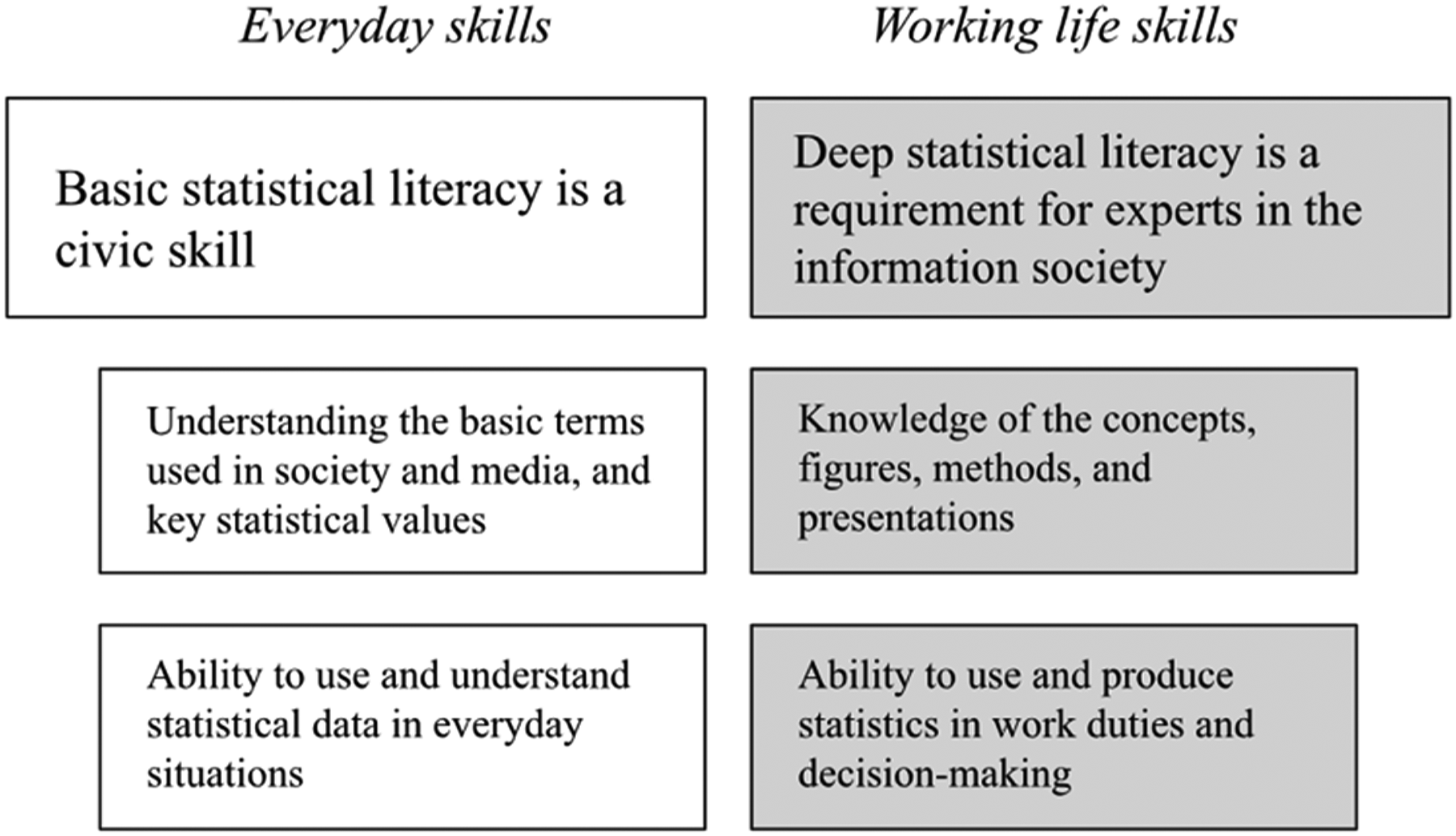
Definitions of statistical literacy as a civic skill (adapted from Helenius, 2022 8 ).
According to UNESCO, 10 literacy involves a continuum of learning that empowers individuals to reach their objectives, expand their knowledge and capabilities, and engage actively in both their local community and the broader society. The Oceans of Data Institute 11 describes a data-literate individual as one who: “understands, explains, and documents the utility and limitations of data by becoming a critical consumer of data, controlling his/her personal data trail, finding meaning in data, and taking action based on data”.
There are numerous interpretations or conceptions of statistical literacy, such as those we see in Wallman in 1993, 12 Iddo Gal in 2002, 13 Schield in 2010 14 , and Helenius in 2022 8 (see Figure 1), for example. When our goal is to promote statistical literacy among a wide range of people, we can emphasise the improvement of both the individuals’ professional skills and their social competencies in everyday life. In this context, statistical literacy becomes a crucial skill demanded by our information-driven society, enabling individuals to effectively organise, conduct, and comprehend diverse surveys and reports.
Statistical literacy was featured as a primary goal in the 2005 Guidelines for Assessment and Instruction in Statistics Education (GAISE). 15 In the 2016 version, 16 statistical literacy upholds Moore's claim 17 that statistical literacy should focus on the difference between experiments and observational studies. 18 Furthermore, including multivariate thinking and confounding in introductory statistics courses and textbooks will be the biggest change in statistical education in decades. These are exciting times for statistical literacy and statistics education.
In 2017, Gould 19 advocated for an expanded interpretation of statistical literacy that involves the notion of Data Literacy. This extended concept includes comprehending the entities responsible for and the motivations behind data collection, the methodologies employed for data acquisition, and also some proficiency in analysing and deciphering data obtained from both random and non-random samples. Issues such as data privacy and ownership, data representations, data provenance, data storage mechanisms, and predictive modelling are also very important in order to account for the greatly amplified role that data now plays in our lives. Data literacy is increasingly important, and the ISLP, along with its country coordinators, should pay attention to this skill. Data literacy skills can have a crucial impact on the individual, for example, in working life, particularly in developing countries 20 and also in the society and the economy as a whole.
As stated by Helenius et al., 21 in practice, initiatives to promote statistical literacy rely essentially on teachers, students, educational communities, NSOs, governments, some private companies, and other partners that contribute to capacity building for statistics education.
Good practices to achieve this include:
Cross-Disciplinary Approaches aiming at integrating statistics into various fields, such as health, economics, and social sciences; Accessible Resources, ensuring that statistical materials in different formats are accessible to diverse audiences, including those with disabilities or language barriers; Partnerships and Outreach Education and Curriculum Integration, and the engagement of educational communities, because incorporating statistics into school curricula at an early age helps foster statistical literacy.
In the following sections, the acronym ISLP is used to refer to the International Statistical Literacy Project.
The history of the ISLP
ISLP is a global project that promotes statistical literacy and is a part of the International Statistical Institute (ISI) and its association, the International Association for Statistical Education (IASE). The ISLP aims to support statistical literacy in all walks of life, among young people and adults, recognising that statistical literacy promotes a democratic society where the decisions of both citizens and decision-makers are based on reliable information, not assumptions.
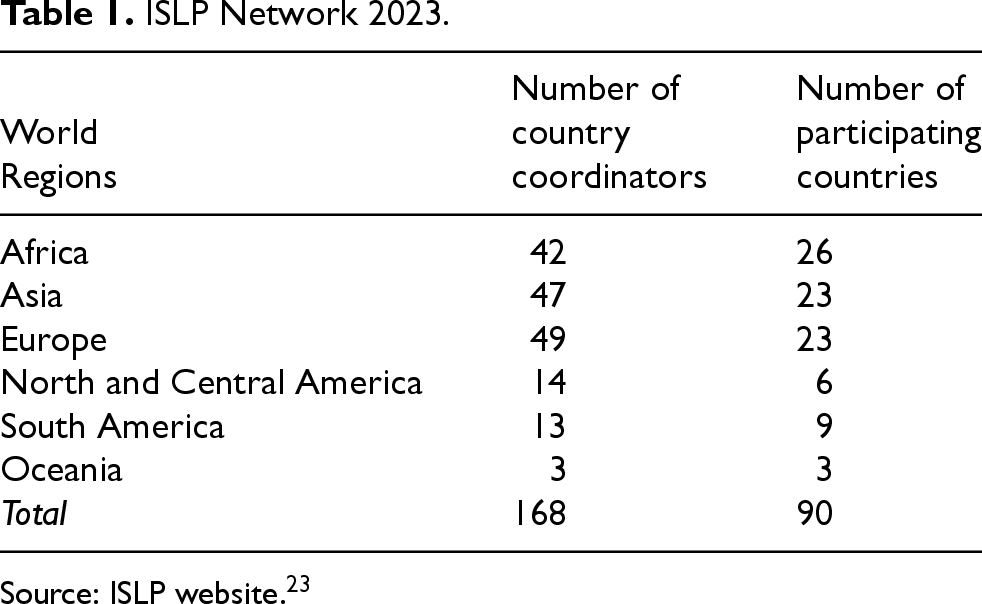
There are ISLP participants on every continent, and currently, it has 168 country coordinators in 90 countries (see Table 1). The ISLP is carried out mainly through volunteer work in cooperation with statistical societies, universities, research institutes, national statistical offices and educational institutions.
The International Statistical Literacy Project (formerly World Numeracy Project) was founded in 1994 under the ISI, with the mission of promoting quantitative skills (For details about the early history of the ISLP, see Helenius, 2018. 22
In 2010, the worldwide country coordinator network was founded, and the types of activities available as part of the ISLP were renewed. The project management team works mainly on a voluntary basis, with a shared willingness to promote an important cause. The ISLP has an executive team and an advisory board consisting of representatives from different parts of the world (see the ISLP website 23 ). Since 2020, it has had its project coordinator. The executive team oversees all projects on a general level and initiates statistical literacy activities in the global community at all levels.
In recent years, the ISLP's work has caught wind and the network's faith in joint development, cooperation and sharing know-how is strong. Its actions have stood out noticeably in the international statistical community.
The ISLP contributes to the understanding and better use of statistics through statistical literacy activities, especially for young people, teachers, media, decision-makers, and citizens. The current reality, marked by instant communication, has made the need for this project greater than ever before.
People get information from heterogeneous sources: social networks, electronic devices, databases, social media, etc. The diverse information flows of the Internet also include information that is not true or that is misleading. That is why the ISLP's mission is to provide all people with critical evaluation tools. This includes the know-how for evaluating the reliability and trustworthiness of information and statistics.
ISLP activities and functions
The ISLP promotes statistical literacy, as demonstrated by examples of methods outlined below.
The international poster competition for youth and the poster method as a teaching tool
The International Poster Competition began in 2010 with the participation of several countries representing six regions of the world, as can be seen in Table 2. The competition has evolved over the years. In 2018, the idea arose from the ISLP to launch the partial Latin American Poster Competition with the need to increase the participation of countries in South America and the Caribbean. In 2020, the undergraduate category was added. In 2024, the competition was extended to primary school children aged 9 to 12.
ISLP Network 2023.
ISLP Network 2023.
Source: ISLP website. 23
Countries entering the ISLP International Poster Competition by regions of the world, 2012–2023.
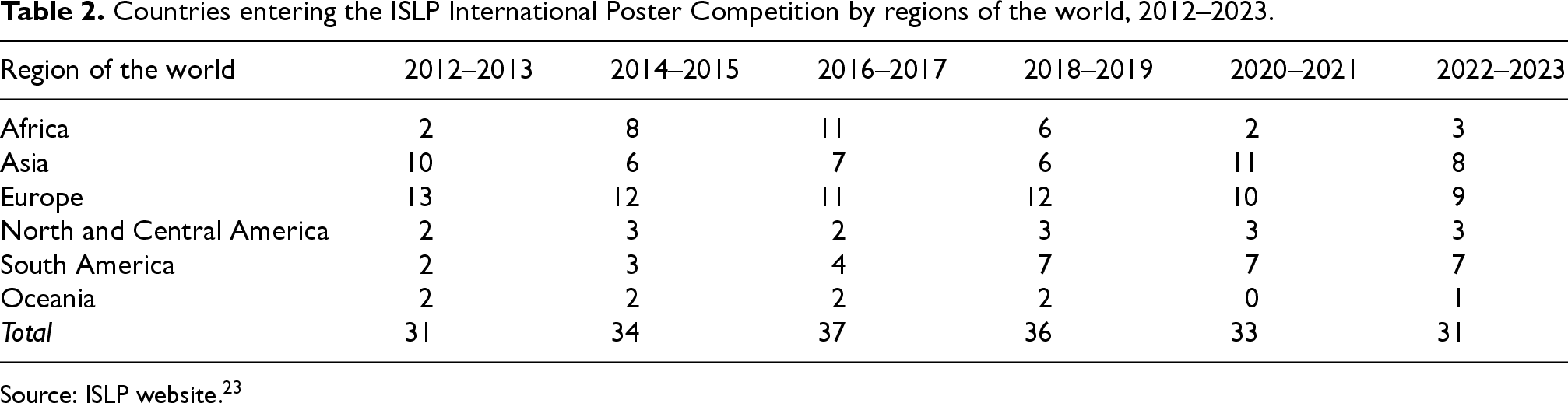
Source: ISLP website. 23
The International Poster Competition is organised every second year. The competition has four categories: primary schools (ages 9–12), lower secondary schools, upper secondary schools, and bachelor-level university students. In the competition, students conduct a statistical study and based on the study, design a statistical poster in teams of 1–5 students about a topic of their choosing. The competition facilitates young people's learning of statistical thinking, from thinking of a research problem to choosing a study method, data collection and analysis, to presenting data and making conclusions. The latest competition in 2022–2023 had around 20,000 participants from 24 countries (see Table 2).
Creating a poster is a pedagogical tool in teaching periods for statistics. 24 In many countries, this is a new teaching method that also fosters the creativity and independent thinking of students. As the poster competition participants work in teams of one to five people, the competition supports team-based learning and brings out the students’ strengths in different areas. One student can be mathematically talented, another visually, and another can have a strong command of the phenomenon studied. Creating posters also supports phenomenon-based learning, and teaching based on preparing posters can be used as a communal project with other disciplines (e.g., mathematics, history, art, information technology, biology). A characteristic of the competition is also promoting critical literacy, particularly a command and understanding of numerical information. These skills are needed in both work and personal life.
Teachers who have participated in the competition have given positive feedback. Young people have described the statistical study process as meaningful because they can study topics in their environment, for example. The competition also inspires youth who have not yet embraced statistics.
The ISLP organises the Best Cooperative Award competition for the best statistical practices. 25 The prize is given every two years to a statistical literacy project recognised as outstanding, innovative, and influential and reaching a broad segment of the general public. The projects that have received the award are the fruit of the cooperation of different types of institutions (national statistical offices, schools, statistical societies, media, libraries, etc.).
Submitted projects should possess specific attributes, including being current and having the potential for future relevance. They should also provide open access to project resources and membership. The projects should educate on statistical theory and data analysis concepts, illustrating their application in generating information about countries and societies. Furthermore, the contents of these projects should be pedagogically sound and appropriate for a general audience. Collaboration between institutions that do not typically work closely together, such as projects fostering cooperation between different entities, is particularly encouraged.
The winner from 2022–2023 was “What's Going On In This Graph?”, 26 an excellent free weekly educational feature co-created by the American Statistical Association and the New York Times Learning Network. It involves students sharing observations and questions about a publicly available graph relevant to their world. The online platform encourages student interaction and receives responses from peers and live teacher moderators.
The five previous winning entries include TREND - from Russia, 27 a school competition in statistics conducted by the Russian Association of Statisticians; LeME from Brazil, 28 a Statistical Multimedia Literacy project that involves collaboration between universities, other schools, communities, national societies and the Brazilian Ministry of Education. In 2017, the National Schools’ Poster Competition from Australia 29 won with collaboration among universities, national societies, industry professionals, schools, media experts, and sponsors, with additional support from the Australian Government's Department of Education and Training. In 2015, the winner was Exploristica, 30 which was a cooperation between the NSO and national societies.
ISLP's other outreach methods
The ISLP disseminates information about statistical literacy through the ISLP Newsletter 31 by organising webinars, sessions, workshops in statistical conferences, and events in the educational sector. It also has its website, 23 and it supports country coordinators with advice and instructions. The project is involved in initiatives such as collecting statistical literacy information sources with UNITAR and GIST under the UN. One of the tasks is to raise funds to secure the continuity of project functions.
Periodic meetings are held with the executive team and the advisory board to generate greater interaction in decisions, communication, activities, and representation in different international events. Online meetings for Poster Competition participants have been organised in Latin America since 2021. Moreover, different projects and actions are coordinated regionally by Country Coordinators.
Research on statistical literacy promotion practices: Methodology
Research was carried out to find out more information about statistical literacy promotion practices around the world through a survey of country coordinators and the collection of initiatives from NSOs regarding their statistical literacy resources.
Methods
In this study, the research methodology has two different approaches:
a survey aimed at the ISLP country coordinators and a scoping review of the websites of the NSOs related to statistical literacy resources.
A survey questionnaire was sent to the ISLP country coordinators in Autumn 2022. More responses were requested at the start of 2023. There were 42 survey responses in total. Just under 50% of the participating countries answered the questionnaire. The survey answers were transferred to a grid so that they could be compared and compiled.
A survey with similar questions was sent to ISLP country coordinators twice before, in 2016 and in 2018. The results of these surveys have been studied in the article by Helenius et al. 32
The research questions of this study are the following:
Based on the survey responses, what can we say about the challenges in advancing statistical literacy in different countries? What are the best practices that can be distributed through the ISLP Project? What kind of support would the country coordinators like to receive from the ISLP Project?
The survey was complemented by scoping NSO websites for learning materials and materials related to statistical literacy. The aim of the scoping was to find out how many national statistical offices promote statistical literacy on their websites.
The scoping review covered all NSO websites globally. These data were analysed, and statistical literacy sources were sought. The study examined the websites of 206 NSOs.
Countries were divided into six subcategories: Europe, Asia, Africa, North and Central America, South America, and Oceania. Inclusion of learning materials, general accessibility, and the variety of resources were central factors in determining the quality of the statistical literacy and educational sources. The potential for reusing and sharing the materials was also considered.
The purpose of the review was to
Outline:
Does the site mention statistical education and/or statistical literacy? Does the site have materials and resources for statistical education and/or statistical literacy? Extract:
Examples of good practices from statistical education and/or statistical literacy.
ISLP survey
The ISLP Survey was conducted to learn more about the country coordinators’ practical work. The questions concerned their challenges, best practices, and development suggestions for the ISLP.
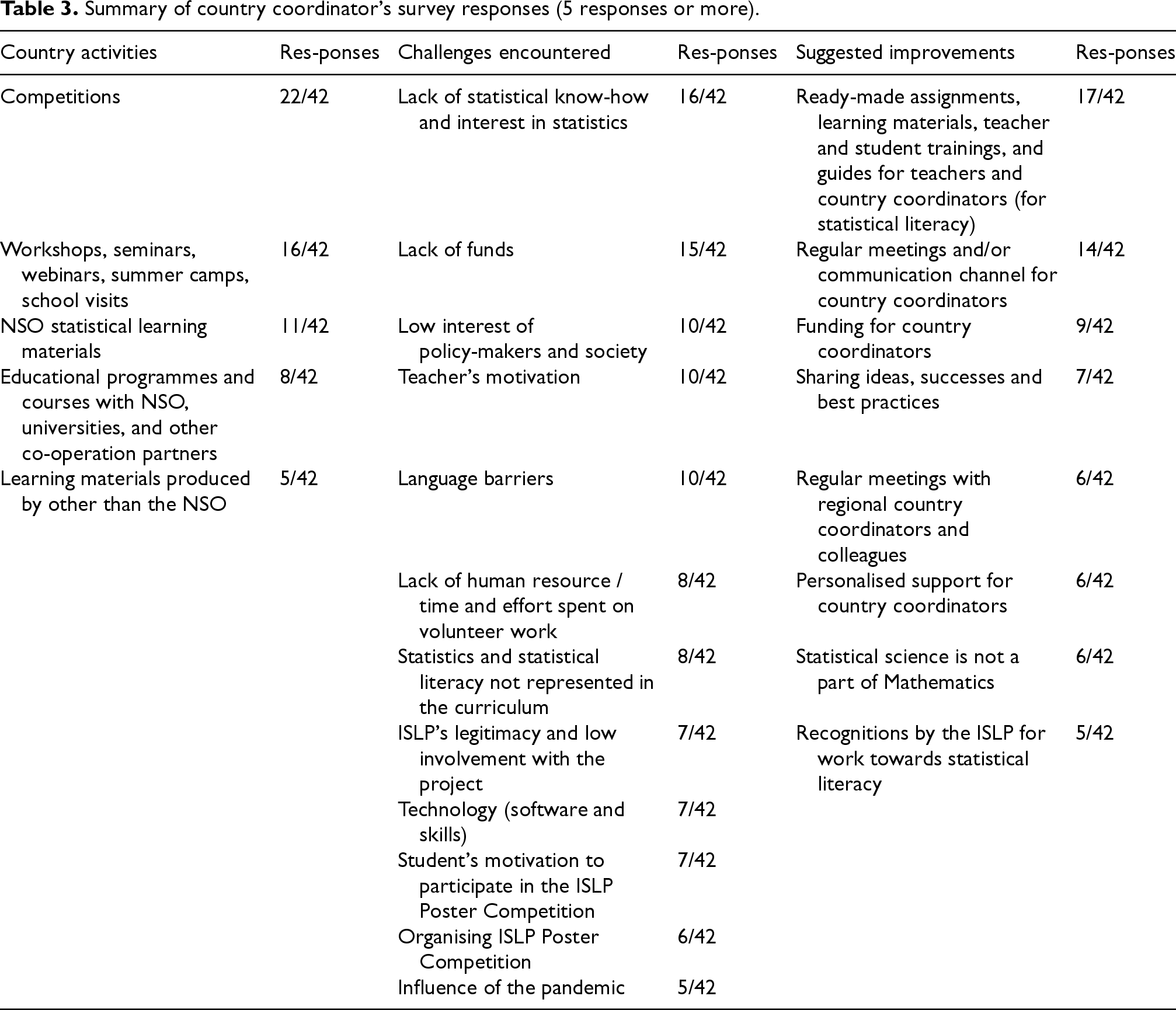
The results are summarised following the structure of the survey questionnaire. A copy of the survey questionnaire is included (see Attachment 1). Table 3 summarises the most common responses with five responses or more.
Date:
Represented country:
The name of the country coordinator(s):
Name three (or more) activities or challenges related to statistical literacy and the use of statistics in your country? What kind of challenges have you faced as a country coordinator? (give at least 3 examples) How should the ISLP project develop its functions? Other comments/suggestions regarding the ISLP and/or statistical literacy?
Summary of country coordinator's survey responses (5 responses or more).
Some challenges stood out, particularly with developing countries.
The country coordinators mentioned that the decision-makers and policy-makers, or managers, do not sufficiently understand the importance of statistical literacy in society (10 out of 42 responses). According to 7 responses, awareness about the ISLP is insufficient. Sixteen respondents, particularly from developing countries, mentioned a lack of statistical know-how and a low interest in statistics in the general public and society. Statistics and reliable information might not be seen as a foundation of democracy or as “something linked with real life […] a description of everyday life” (Italy).
The lack of financial (15 responses) and human resources (8 responses) caused problems. Organizing the ISLP Poster Competition was challenging in 6 countries: Angola, Cape Verde, Kenya, Sri Lanka, Uganda, and Zambia.
Countries were impacted by time constraints in different ways. Limited time for marketing efforts and obtaining cooperation partners could lead to difficulties in obtaining participants for the ISLP Poster Competition, as mentioned by Pakistan and Zambia, for example.
NSOs are involved in the promotion of statistical literacy at various levels. Eleven responses mentioned the statistical literacy learning materials in their countries’ NSO.
In 10 of the responses, it was mentioned that teachers are not motivated to promote statistical literacy (e.g., Iceland, Peru, Saudi Arabia). Representatives of developing countries specifically mentioned the teachers’ low level of statistical know-how.
Language barriers were common (10 responses) and can pose problems for French, Spanish, Japanese and Russian speakers, for example. The ISLP's materials are mainly produced in English, even though the ISLP Poster Competition's instructions have been translated into multiple languages (Spanish, Portuguese, Italian, French, Finnish). A need for more pedagogical materials was mentioned (e.g., Mexico, Pacific).
Statistical literacy is not only a skill, but it is also inherently tied to the societal and temporal structure of the country. Russia and the USA mentioned difficulties with promotion and marketing in a bigger country. Socio-economic challenges played a role in developing countries’ responses, such as the command of information technology (e.g., Benin) and access to new technological solutions (e.g., India). Sri Lanka mentioned the lack of equipment needed for online examinations. Sudden changes in external factors can also make promoting and teaching statistics more difficult. Five countries mentioned the impact of the coronavirus pandemic. The survey was conducted during the height of the pandemic.
Another theme that stood out was the school curriculum. Eight countries mentioned that statistics and statistical literacy are not sufficiently represented in the curriculum. Statistics might be absent entirely from the school curriculum (Serbia) or not made a mandatory subject (Hungary).
The ISLP poster method is intended for cross-disciplinary teaching. However, some coordinators (e.g., Portugal) described using the poster method in subjects other than mathematics as difficult, as only mathematics teachers are motivated to teach the poster method.
Best practices for advancing statistical literacy
Many good practices were already in place in many countries, such as workshops, competitions, seminars, conferences (e.g., JCOTS in Japan), symposiums on data and statistical literacy (e.g., Germany), webinars, distribution of infographics, conference presentations and student training and events (e.g., Taiwan). Teacher training is organised in many countries (e.g., Brazil, Italy, Germany, Japan). NSOs also organised school visits (e.g., Belgium, Finland) and provided learning materials. The NSO in Nepal published a book about statistics and statistical literacy in the Nepali language.
The USA highlighted the importance of using plain language to explain statistical information.
Innovative use of social media was mentioned, especially during the coronavirus pandemic. Indonesia was a particular pioneer. The NSO in Indonesia engages new generations with media platforms, including TikTok, pointing out that “each platform has a unique form that we must understand”. They also make statistical literacy comics.
Competitions were a popular way to promote statistical literacy among young people, with 22 responses. Competitions such as the ISLP Poster Competition and the European Statistics Competitions are organised in many countries, but there were also other competitions. There are also other competitions. Hungary organises a competition called StatWars and StatWars Uni. In the Pacific and Italy, there were data visualisation competitions.
Multiple census projects were mentioned: CensusAtSchools (Ireland, Japan), the Minicensus project (Czech Republic) and Census on school desks (Ireland). Hungary also organises EcoCamp, a statistical literacy camp for secondary school students.
The activities of statistical societies were also mentioned, such as the Statistics and Data Science Knowledge & Skills Testing and Certification System by JSS (Japan) and the establishment of the Teaching Statistics Section of the Royal Statistical Society in 2022 (UK).
How to improve the functions of the ISLP
Some key categories arose from the data. These categories were meetings, websites, resources and cooperation.
It was a common wish from country coordinators to increase the amount of contact and sharing of experiences with other coordinators. It was suggested 14 times that regular online meetings between coordinators or other communication channels be held. Also, regional and country-specific meetings and face-to-face meetings were proposed. Cooperation with local NSOs and country representatives from universities was also requested. Three country coordinators urged the ISLP to promote awareness of the importance of statistical literacy in the NSOs worldwide.
As many as 17 respondents wished for the ISLP to produce assignments, learning materials, teacher and student training, and guides for teachers and country coordinators. Two responses suggested updating the ISLP website, which should also include a list of free statistical courses.
Concrete resources such as funding were requested from the ISLP, especially from developing countries. Another suggestion was to find cooperation partners to fund projects, such as international organisations, companies and universities.
Seven responses requested sharing practical ideas and best practice examples. Existing good practices and materials can be reused in the classroom through templates for conducting a survey, for example. The ISLP Newsletter was seen as a good forum for sharing.
Some specific resources were requested, such as a model for measuring statistical literacy competencies. Another request was for online workshops and sessions to familiarise participants with statistical software that was freely available. It was suggested that country coordinators could support non-statistically minded students in their statistical journey through online workshops. Finally, a worldwide mentoring programme was requested from the ISLP. Six respondents wished for some personalised support.
Some of the responses reflected ISLP's key mission to bring statistical literacy to all people from all walks of life, not just statisticians. Coordinators of Peru and Ecuador proposed the promotion of statistical literacy in different societal and occupational groups, with Peru's example being handicraft sellers. Iceland's representative mentioned, “The framework should not be mathematics-centric, but should be framed as a societal one”. Some suggested that the ISLP should formalise its relationship with government agencies such as the ministries of education, economy, statistics directorates and statistical societies to promote and support the activities proposed by ISLP country coordinators.
Some of the suggestions were related to the ISLP Poster Competition. A suggestion for development was to organise a statistics-themed video competition and/or separate competitions for statistics and non-statistics students. Another idea was to organise an online event for the creators of winning posters. Finally, more marketing of the ISLP Poster Competition was suggested via different channels - and through different subject teachers, not just mathematics. For instance, support for organising the competition through an online event was mentioned.
NSO's statistical literacy online resources
The webpages’ target audiences were often young people (e.g., Belgium) or teachers (e.g., Argentina, Brazil). Many European NSOs cited Eurostat's Education Corner, 33 while some mentioned statistical literacy as a term without further information. Croatia has developed a portal for statistical education, 34 which Slovenia has translated. 35 Statistical competitions were also present on many of the sites in the context of statistical education.
In general, examining the sites offered insight into what various resources NSOs have developed for statistical education and improving statistical literacy.
For example, Singapore's Students’ Corner 36 offers a variety of statistical resources for students and educators in English. The site covers six topics (Society, Economics & Prices, Mathematics, Business, Geography and Environment, and Fun Facts) and includes different kinds of learning material, including quizzes, videos, and infographics, among others.
Another example is Argentina's INDEC (Instituto Nacional de Estadística y Censos [National Institute of Statistics and Censuses]) site Metadato INDEC: Programa de alfabetización estadística (INDEC metadata: Statistical Literacy Programme). 37 The site is in Spanish and has many learning materials, such as the Planeta Dato (Planet Data) series, which has three parts, in addition to other materials for teachers. The materials are downloadable and include activities and games in Word format. They contain vivid graphics and visuals, along with activities within the texts.
These materials are designed to be printed out but can also be used electronically. In addition to Planeta Dato, the site has an interactive part, Metadato en cápsulas (Metadata capsule), among other materials. 37
Brazil's IBGEeduca site 38 is a collection of education materials in Portuguese for three distinct audiences: children, young people, and teachers. The site provides free access to a book, Clube dos Curiosos (Curiosity Club) which features Pedro and Bel, who are eager to discover parts of Brazil. The site also contains activities and printable materials that are available for download.
Colombia's DANE (Departamento Administrativo Nacional de Estadística [National Administrative Department of Statistics]) has developed a site entitled DANE para Niños, Niñas y Adolescentes (DANE for Children and Adolescents). 39 The site has easily accessible materials, including extensive information on the activities of DANE and a section on playing with statistics (Jugando con la Estadística). This includes an activity sheet in PDF where the reader is chosen as an expert in Danépolis to count, organise, present and discuss the information on the sheet. This activity can be printed and used as such. This is an example of learning material that can be easily translated into other languages.
The previous examples were materials geared towards children and youth. However, there are also resources designed for audiences of all ages. A couple of examples must be mentioned here: Eurostat's Education Corner and Statistics Finland's Opi tilastoista (Learn from Statistics) page.33,40
Finally, using Census data is also typical in learning materials in countries that conduct a census (e.g., Australia, Portugal, Brazil, USA). Teaching materials can make use of regional information. Another theme for learning materials is data usage skills, which are a growing necessity in working life. The United States Census Bureau has targeted this need with a Census Academy, a learning hub for data skills. 41 The page contains materials such as free “how-to” online videos (“Data Gems”), as well as courses and webinars about data usage.
Conclusions
The ISLP plays a role in enhancing comprehension and effective utilisation of statistics. It achieves this through various statistical literacy initiatives, with a focus on engaging young individuals, educators, media, decision-makers, and the general public. This article has discussed global issues associated with the insufficient acknowledgement of the need for and importance of statistical literacy, highlighting the tendency of decision-makers to undervalue its importance and the limited awareness of its significance among the wider public. We have presented several ISLP activities and functions, such as the poster competition, that aim to address the issue.
All of the key themes of the statistical literacy initiative typology created by Helenius et al. 21 were present in the survey responses: Cross-Disciplinary Approaches, Accessible Resources, Partnerships and Outreach, and Education and Curriculum Integration.
The findings from the ISLP Survey have led to developments in the ISLP's actions, particularly concerning offering more interaction among the network members. From November 2023, regular online meetings for country coordinators have been offered. For the first time, the ISLP has organised the International Day of Statistical Literacy (IDSL) in May 2024. Also, an online event for utilising software to make a statistical poster will be organised, as well as an informational event about how to organise a poster competition.
The ISLP is renewing its website, as requested in the survey responses. Country coordinators just starting out are becoming familiar with the ISLP and using the website as a resource. They ask that it be updated periodically with activities and materials in their mother tongue to help them improve their participation in the ISLP. The new website will use the NSO statistical literacy resources discovered in this study.
There are also many good practices that came to light, such as statistical literacy comics (Indonesia), towards which a working group will be proposed. As there is always a need for good practices to reach young people, this suggestion is well-founded.
Integrating statistics into school curricula would be another essential action to promote worldwide. It is recommended that statistics and statistics teaching be considered interdisciplinary.
Measuring statistical literacy is a theme and an important topic for future research. Japan's example of a statistical literacy measuring tool is an idea which should be widely utilised.
Good practices can be shared across country borders via the ISLP. One practice that could be applied elsewhere is the Latin American online event, where the winners of regional Poster Competitions can present their posters.
The analysis of the NSO statistical literacy sites proved that there is great potential for NSOs to learn from each other's practices. Many good practices and resources already exist that should be better used instead of reinventing the wheel. Translating existing materials would be an opportunity, as there is a clear need for ready assignments and learning materials.
From the results of the surveys, there are indeed various challenges related to the promotion of statistical literacy, such as time constraints, especially in volunteer-based projects, that limit marketing efforts and in gathering cooperation partners. Special attention is needed for specific target groups like students and teachers. The involvement of National Statistical Offices varies, with some countries wishing for increased participation and others lacking funding.
The results of the study show that within the activities of each country, there is an interest on the part of the ISLP coordinators to disseminate and promote the poster contest as a resource for teaching. Statistical competitions are experienced as a valuable tool for engaging young people. However, there is a need to strengthen the know-how of teachers in this area and increase the competition's conspicuousness. In order to effectively promote statistical literacy, the coordinators need financial resources from internal or external sources. The results also showed that the work and accomplishments of the ISLP country coordinators should be more widely recognised in the international statistics community. The ISLP's newest initiative, the International Day of Statistical Literacy (IDSL), is a good example of an arena where this can be done. Appreciation can also be shown through the allocation of resources, for example, funding the country coordinators’ participation and presentations in international conferences.
The responses show that the country coordinators are interested in collaborating and continuing to be a part of this project. However, as a limitation, it should be mentioned that not all country coordinators responded to the survey. There are multiple reasons for the shortage of answers. For example, some of the country coordinators’ emails have changed, so they became unreachable for the project. The questionnaire was offered in both English and Spanish. If more language groups had been served, perhaps more answers could have been received. From this finding, it can be deduced that the list of ISLP country coordinators must be updated and improved in order to find out which country coordinators remain active. After this finding, the ISLP has started to update its country coordinator list in Africa, especially for NSO representatives.
Another limitation was that the responses reflected only some of the activities organised in each country. As per the authors’ prior knowledge, in some countries, there are also more activities organised than what was mentioned. A final limitation was related to the analysis of NSO websites, as the researchers could not access some of these due to technological restrictions.
If we compare the ISLP's previous studies and surveys with country coordinators in 2016 and 2018, the following remarks can be made. Some problems persist, such as the need to generate resources, particularly in Africa, and the need to overcome language barriers, particularly in Asia. Country coordinators have often started to cooperate more cross-sectorally. Latin America continues to have periodic virtual meetings. Some have participated more in online competitions. Technological difficulties still get in the way, but more people have access to technology and the Internet. There is a need for teacher training, particularly in Asia and Latin America.
It continues to pose a problem that statistics is not a specific subject in the school curricula. There continues to be a constant conversation about the definition of statistical literacy. When the country coordinator network was formed, it was mostly made up of academic professionals. Now, the NSO is more and more present in the ISLP. COVID-19 changed the way the ISLP network operated: from the physical to the virtual.
Overall, improving statistical literacy is an important goal in all parts of the world. Innovative initiatives are carried out in all parts of the world, and concrete steps have been taken to change the general public's view of the importance of statistical literacy. The worldwide organisations and projects, such as the ISLP, can help in the process by making sure that best practices are shared widely and applied across country borders. This way, the motivated pioneers of statistical literacy do not have to create what has already been created.
Footnotes
Acknowledgements
We are grateful to Lauri Pohjola and Olga Dunderberg for assisting with collecting sources and preparing an analysis of the National Statistical Office sites. We also thank Olga Dunderberg for formatting and revisions and Jake Nash for proofreading. Their work significantly improved the manuscript.

Funding
This research was supported by the World Health Organization.
Conflicting interests
The author(s) declared no potential conflicts of interest with respect to the research, authorship, and/or publication of this article.