



Abstract
This paper examines the evolution of the international statistical standards on work, that cumulated in the recent resolutions adopted at the International Conference of Labour Statisticians (ICLS) between 2013 and 2023. These changes enable a significant improvement in the gender relevance and analytical value of labour statistics, starting with the foundational standards adopted in the 19th ICLS which introduced a new forms-of-work framework and enhanced measures of labour underutilization. The evolutional shift from a largely economic rationale to integrate more social dimensions carried through in the subsequent standards on work relationships (20th ICLS) and the informal economy (21st ICLS). The forthcoming ICLS in 2028 aims to address issues relating to care work and digital platform work, which also have high gender relevance and a mix of economic and social relevance. Through a wide selection of indicators, the paper illustrates how the new statistical frameworks greatly expanded the potential for statistics to enhance our understanding of the world of work and the associated gender disparities, in areas such as access to employment, engagement in unpaid work, labour underutilization, and degree of labour market attachment. Nonetheless, the true potential and benefits can only be achieved when the latest standards have been effectively implemented and disseminated. The paper investigates the common challenges faced by countries (such as the treatment of breaks in statistical series and ensuring effective communication and dissemination given the added analytical complexity of the data generated), proposes solutions and highlights ILO's efforts to support countries’ adoption.
Keywords
Introduction
In many countries, official labour statistics still fail to capture the full extent of women's work or how their work differs in many aspects from the work of men. As just one example of a staggering gender gap, globally, 708 million women are outside the labour force due to unpaid care responsibilities, compared to just forty million men—reflecting the vast gender division of labour. Much of paid labour among women occurs in informal or non-standard forms of employment which puts them in a significantly more vulnerable – and difficult to measure – position. This persistent gender-gap in visibility limits the evidence available for designing policies that promote gender equality. The international statistical standards adopted since 2013 have sought to address very significant elements of this shortfall. By introducing broader concepts of work, a work-relationship classification, and a conceptual framework on informality, they create new possibilities for making women's contributions to the economy visible—and valued.
Statistical standards on labour, as with other statistical domains, have evolved substantially over recent decades. When observed over that longer period some general interrelated themes and directions can be noted.
A first, and somewhat obvious theme, is that standards emerge through a repeating cyclical process beginning with country level demands for certain data. This is followed by the development of statistical standards, application of those standards, accumulation of experience and subsequent review of existing standards. In other words, country-level demands and experiences are central throughout the process and the corpus of standards has evolved in a way that reflects those demands and experiences.
A second theme is that over time statistical standards on labour have gone through a process of shifting their frame of reference from primarily economic (provision of labour input to production) to a blend of economic and social reference points.
A third theme has been a substantial increase in the range of indicators proposed within statistical standards.
These three themes are inter-related in the sense that moves to better integrate the social dimension into the standards reflected country-level demands and followed country-level developments to a large extent. The same could be said of the increased detail promoted by the standards, reflecting the general increase in scope of national statistical production.
One of the key underlying motivators of these changes has been a desire to generate a range of indicators that more adequately describe gender-related differences in the world of work. The remainder of this paper begins by elaborating on the evolution of the statistical standards, and how these changes offer the potential to massively increase the gender relevance of labour-related data. This potential is illustrated through a selection of indicators highlighting gender gaps that were not visible under earlier rounds of standards. The paper will go on to discuss the state of implementation of the standards, and the dissemination and communication challenges that they bring. Finally, concluding remarks will highlight possible future steps to ensure the potential of the standards is widely achieved.
The evolution and future trajectory of standard setting in labour statistics
Looking back, the evolution of statistical standards adopted at the International Conference of Labour Statisticians (ICLS)
To understand the evolution of statistical standards on labour, a helpful starting point is to recognize that those standards are adopted in cycles whereby a foundational set of standards is adopted, defining core concepts such as employment and unemployment, and subsequently related standards are developed, building on those core concepts. Understood in this way we can say that two cycles of development have taken place since 1980. The first began with the adoption of Resolution I of the 13th International Conference of Labour Statisticians (ICLS) in 1982 and the second began with the adoption of Resolution I of the 19th ICLS in 2013 – which essentially replaced and expanded upon the earlier resolution.
The 1982 resolution (Resolution concerning statistics of the economically active population, employment, unemployment, and underemployment) established definitions of the economically active population, employment, and unemployment. Even the name of the resolution makes clear the primarily economic focus of the standards, setting the boundaries of employment equal to those of the System of National Accounts – SNA-68 as it was at the time. The definition included various unpaid activities such as work done by persons “engaged in the production of economic goods and services for own and household consumption…. If such production comprises an important contribution to the total consumption of the household”. 1
This use of the SNA as a reference point should not be considered surprising, given that, at that time, the SNA was a comprehensive and well-established framework, making the linkage between employment and the SNA a sensible approach to adopt, and any other approach potentially complicated by the need to explain the relationship to the SNA.
However, the primacy of the economic reference point should not be taken as an indication that social data needs were not recognized at the time. This was demonstrated by the inclusion of the definition of unemployment and time-related underemployment, designed to capture unmet needs for employment among the population.
Over the subsequent decades, the 1982 standards provided the reference definitions upon which many countries built their systems of labour statistics, while also becoming the base for the adoption of a sequence of related statistical standards. These include the adoption of a classification of status in employment in 1993 (ICSE-93), standards on informality statistics in 1993 and 2003, standards on employment-related income in 1998 and various others. Mirroring the 1982 standards the later standards typically embedded a primarily economic reference point. To give one example of this, ICSE-93 split all employment (as defined by the 13th ICLS resolution) between workers in employment for pay and workers in employment for profit. This split was designed to align with the SNA need for data separated between compensation of employees and entrepreneurial income.
As with the 1982 standards, the later standards did typically make reference to social data needs in various ways, but a more definitive social reference only started to emerge steadily over time, arising from demands by countries. A concrete example of this came in 2003, when the 17th ICLS adopted a checklist of good practices for mainstreaming gender in labour statistics, building on requests from countries for guidance to promote the production of labour statistics to assess key gender gaps. The checklist set out four requirements for a system that would “usefully address gender concerns” and called for the production and dissemination of statistics that would “adequately describe all workers and work situations in sufficient detail to allow relevant gender comparisons to be made” and “presented…. in a way that will clearly reveal differences and similarities between men and women in the labour market”. 2
The formulation of the checklist requirements points to the fact that through experience countries had found that while the statistics generated by application of the standards were undoubtedly highly gender relevant, the standards were not designed in a gender intentional way, something that required additional focus, initially in the form of the short checklist.
The 18th ICLS carried this theme forward by calling for the underlying standards themselves to be revised including “a possible revision of the current international standards on statistics of the economically active population, employment, unemployment and underemployment adopted by the 13th ICLS (1982);”. 3 The motivations for this as expressed during the conference included the desire for coverage of unpaid work in a more explicit way, the need for a framework that would address some of the shortcomings of the unemployment rate as an indicator and a more general desire to make the foundational standards increasingly gender intentional in their design, building on the requirements of the 2003 checklist.
This call was ultimately the basis for a resetting of the framework of ICLS standards, a process which has continued through to this day with several key landmarks to date.
Following an extensive development and consultation process, the foundation of this redevelopment was set through the adoption of Resolution I of the 19th ICLS in 2013 (Resolution concerning statistics of work, employment and labour underutilization).
As elaborated further by Walsh, there were 3 main inter-related developments that “in combination, are transformative, including…. the adoption of an overarching definition of work…. the identification of multiple forms of work based on the dual criteria of beneficiary of the good or service produced and the intention underlying the work…. and the definition of multiple indicators of labour underutilization”. 4
Each one of these key developments was designed to enhance the value for social policy making of labour statistics, with gender gaps being a particularly central concern. For example, the framework narrowed the definition of employment to focus on work done in exchange for pay or profit, and through the other forms of work provided recognition to the various unpaid working activities people perform, some of which had previously been included within the scope of employment (for example, subsistence farming). At once, this improved the meaningfulness of comparisons of data on male and female employment – given that women typically undertake the majority of unpaid work – while at the same time creating a higher degree of visibility for those unpaid working activities by separately defining them for the first time and promoting their separate measurement and reporting.
In particular, the forms-of-work framework defines own-use provision of services, also termed “unpaid domestic and care work”. By formally recognizing the measurement of unpaid domestic and care work, the 19th ICLS resolution makes a bold step toward addressing longstanding gender biases in labour statistics and advancing the goals of feminist economics. Notably, it addresses the first R in Diane Elson's influential Three Rs framework – Recognize; Reduce; Redistribute – for developing policy on unpaid care work. 5
The 19th ICLS standards also recognised that people can perform multiple different forms of work in the same reference period, meaning dual (or even triple) working burdens could now be highlighted, as opposed to the single status framework of the 1982 standards (employed, unemployed, not economically active). This is transformative in the study of unpaid work, either in the engagement of or intensity, and how affects and interacts with the participation in paid work.
While enhancing the social dimension through the standards was undoubtedly a key objective of this development, it does not imply that the provision of data for economic assessment was abandoned. The emphasis of the development process was to achieve a more balanced framework that met both economic and social needs. This was achieved by defining the forms of work in a way whereby the combination of different forms of work would achieve alignment with the SNA production boundary through the combination of employment, own-use production of goods, unpaid trainee work, organisation-based volunteering, and direct volunteering to produce goods. The further addition of direct volunteering to produce services and own-use provision of services created alignment to the general production boundary, being particularly important to support the production of household satellite accounts, which among other things, promised the generation of statistics to meet the growing ‘Beyond GDP’ demand.
As with the 1982 standards, the 2013 standards became the platform and catalyst for the revision and expansion of labour-related statistical standards. Through its design, it kept on promoting greater balance between social and economic data needs in the cycle of standard setting that followed. Key landmarks to date in that process include the adoption of standards on statistics on work relationships at the 20th ICLS in 2018 and standards on statistics on the informal economy in 2023.
Turning to the detail and complexity of standards, the clear trend in recent decades has been towards an increase in the range of indicators proposed, as well as in the detail and specificity of the criteria built into statistical definitions. The general addition of detail can be considered to reflect a variety of related factors including: A general increase in the scope of national statistical systems driven by increasing data demands and resources for statistics. This expansion was inevitably reflected in the standard-setting processes given that national experiences are fed in through the development and consultation processes. Increased complexity in the world of work in the form of new working relationships and modalities, an increasing role for technology and increased globalization, among other factors. This necessitates additional data but also more complex definitions to delineate the different working arrangements. The increased focus on social data needs requiring an additional level of detail than what is required for purely economic purposes where the emphasis is on quantifying labour input. For example, the decent work indicator framework of the ILO incorporates over 60 indicators across ten substantive elements related to the Decent Work Agenda,
6
while the overlapping UNECE handbook on Measuring Quality of Employment proposes an even larger number of indicators.
7
This expansion can be quantified through the different adopted resolutions. For example, the 1982 standards essentially provided a mutually exclusive classification of economic activity where all people were assigned to one of three statuses – employed, unemployed or not economically active. Jumping ahead 31 years, the 19th ICLS standards provide an overlapping set of definitions of multiple forms of work and a labour force status classification retaining but expanding the classification from 1982 by proposing a wider range of indicators on labour underutilization.
Similarly, the ICSE-93 incorporated 5 categories of status in employment, separated into 2 high level groups of ‘workers in employment for pay’ and ‘workers in employment for profit’. The replacement classification adopted in 2018 contains 10 detailed groups that can be aggregated according to two different hierarchical dichotomies, the primarily social classification based on dependency and the primarily economic classification based on risk. It also includes a wider classification of status at work covering all the forms of work defined in the 19th ICLS standards and proposes a set of cross-cutting variables that should be used to supplement the core classification.
Finally, the standards on statistics on the informal economy adopted in 2023 include over 100 indicators spread across 5 dimensions – all of which answer specific identified policy-oriented questions targeting different aspects of the economic and social impact of informality.
Furthermore, the definitions within the recently adopted standards are generally more detailed, based on more criteria that are more tightly defined. This responds to the need to establish boundaries that are more difficult to measure, for example between dependent contractors and employees as defined in ICSE-18, while also promoting enhanced comparability and harmonization across countries.
Recent work statistics standards serve as a foundational framework upon which other international standards are developed
It is important to acknowledge the pivotal role that the recent ICLS resolutions play in shaping other standard-setting efforts. The UNSD's International Classification of Activities for Time-Use Statistics 2016 (ICATUS-16) is one such example. It is aligned by design with the forms-of-work framework that was introduced in the 19th ICLS resolution concerning statistics of work, employment and labour underutilization. ICATUS-16 8 provides a standardised means for activities to be recorded in the conduct of Time-Use surveys, which are used to measure own-use provision of services (OPS), otherwise known as “unpaid domestic and care work”. There is a significant gender-based division in the distribution in OPS work globally, with women and girls undertaking the major share of such work. OPS statistics are thus imperative in informing policies that promote gender equality in the workplace and expand labour market participation.
Indeed, case studies have found that time-use survey data have directly impacted policy design and evaluation. The data have shed light on the gender imbalance in unpaid work among dual earner couples in South Korea. This provided the evidence base that led to enhanced family care and parental leave policies as well as the expansion of childcare facilities, as part of policy plans to strengthen gender equality. 9
In Senegal, data from its time-use survey showed that women on averaged spent 4.5 h a day on unpaid domestic and care work, significantly higher than men (0.6 h). This prompted the women's ministry to shape national policies that encourage women's economic empowerment, by facilitating their participation in paid work and reducing their domestic workload. These policies include a childcare strategy, family subsidies and a fund for women's entrepreneurship initiatives. 10
Lastly, Uruguay's National Care Plan showcases the direct influence of unpaid care work data on policy, aided by an enabling environment that fostered virtuous cycles between data, advocacy, and policy. 11
Trajectory of future ICLS
Having reviewed the evolution of the standards and identified some of the key patterns, it is worth reflecting on the trajectory of future standard setting, to the extent that this is known. The best reference point for this is the mandate that was established at the 21st ICLS in the form of requests for new standards development.
Several such requests were made, including updated standards on statistics on labour migration and new standards on statistics on care work and digital platform work, all of which are subject to significant country-level data demands, and all of which could be said to straddle economic and social policy domains. As such, while the content of these standards is yet to be established, it can reasonably be said that they do appear to continue the trends of recent times. Additionally with specific reference to gender, the standards on statistics on care work in particular will be targeted towards the provision of statistics to inform care policies, one important area of focus of gender-related labour market policies.
The following section of this paper builds on the preceding narrative by taking a range of key indicators from the latest standards and illustrating their high gender relevance, with a focus on how more recent standards provide a better frame for the understanding of gender gaps in the world of work.
Gender relevance of the latest resolutions illustrated through data evidencea
Participation in employment and other work activities, and key work characteristics
Employment-to-population ratio
The new standards adopted by the 19th ICLS address (among others) potential gender biases in labour statistics arising from differences in paid and unpaid work activities between women and men. A key change introduced by this foundational resolution is a new definition of employment that is narrower than the definition put forth in previous standards (adopted by the 13th ICLS). Employment is now defined as work done for pay or profit, producing goods and services mainly intended for use by others, and excludes unpaid work activities. 12 In contrast, the old definition included some forms of own-use production work such as subsistence agriculture, 1 thereby grouping individuals in very different work situations under the same category. This made the interpretation of data more convoluted and created some misalignment between the coverage of statistics and the needs of employment policy makers.
Under the improved statistical standards, the first international statistical definition of work was established, to define it as any activity performed by persons of any sex and age to produce goods or to provide services for use by others or for own use. Other forms of work besides employment are now measured separately through a forms-of-work framework that expands the scope of work statistics from employment to include all forms of work. The framework comprises five distinct forms of work according to the intended destination of the work and the nature of the transaction: employment, own-use production work, unpaid trainee work, volunteer work, and other work activities. It gives due recognition and visibility to all forms of work, regardless of whether they are paid or unpaid, thus providing a more accurate representation of individuals’ working lives. This has particular gender relevance, given the difference in work patterns between women and men.
Figure 1 in the Annexes illustrates the impact of the new standards, specifically the narrower employment definition, on the employment-to-population ratios for men and women. For many high- and upper-middle income countries, there is no difference between the ratio based on 13th ICLS standards and the ratio based on 19th ICLS standards for either sex. Most data points fall on the mid-line. This is because in these countries, own-use production work of goods is relatively low in prevalence and therefore the narrowing of the definition essentially had no impact. These countries were considered to have followed the 19th ICLS standards by default even though their questionnaires were not updated to specifically capture unpaid work. On the other hand, in low- and lower-middle countries (where own-use production of goods is far more common), the employment-to-population ratio according to 19th ICLS standards is typically notably smaller than that based on 13th ICLS standards – being the data points below the line.
The subsequent analysis within this section focuses on 60 countries that explicitly implemented the 19th ICLS standards to distinguish paid and unpaid work and hence reported lower employment-to-population ratios post implementation. In two-thirds of these countries, the adoption of the latest statistical standards resulted in a widening gender gap in the ratio for at least one age group. This occurred because the employment-to-population ratio for women declined more in percentage-point terms relative to men, reflecting women's greater likelihood of engaging in unpaid work that was previously classified as employment. The new employment definition is therefore essential to providing greater clarity regarding the gender inequalities that exist when it comes to participation in paid employment. Interestingly, the data showed no significant difference in the level of development between countries that experienced worsening gender parity and those that did not (see Figure 2 in Annex). The gender disparity in unpaid work points to the urgent policy need to invest in women's economic empowerment and address potential barriers they face to obtaining paid work.
Disaggregating the trends by age group, Table 1 in the Annexes shows that with the implementation of the 19th ICLS resolution, the widening gender gap in employment-to-population ratio was most prevalent among those aged 55–64. A total of 36 countries reported larger percentage-point declines among women than men in this age group. This trend was observed across countries of varying income levels, with the exception of the low-income group where the gender gap worsened among the prime working-age group (25–54) in more countries. This suggests that, in addition to a gendered distinction in unpaid work, older women face even greater disadvantages in accessing paid employment. Contributing factors could include labour market barriers or skills obsolescence, particularly in instances where women took career breaks in their earlier years to undertake caregiving responsibilities.
Subsistence foodstuff production rate
To accurately reflect the nuances and complexities of the labour market, key indicators must be used in a complementary manner. 13 One such example is the employment-to-population ratio, the analysis of which is greatly enhanced when studied alongside the subsistence foodstuff production rate.
Subsistence foodstuff producers are an important subgroup of persons engaged in own-use production work. Such unpaid work activities fall within the SNA production boundary and were previously included as part of the employment definition under the 13th ICLS standards. The 19th ICLS resolution recommends presenting statistics on subsistence foodstuff producers separately for the purpose of monitoring labour market performance, including insufficient access to, or integration in, markets or other factors of production, with the intent of better serving policy needs.
Whilst the employment-to-population ratio is consistently higher for men than women across countries, gender trends in subsistence farming are more mixed. Of the 36 countries with available data, just over half (19 countries) reported women having a higher subsistence foodstuff production rate. These countries fall above the mid-line in Figure 3 in Annex and are predominantly low- or lower-middle income countries, chiefly from the Africa region. This is consistent with ILO pilot studies which measured all forms of work which found that female participation in unpaid working activities was higher, most notably in the case of own-use provision of services. 14 Conversely, countries where men's participation in subsistence farming exceeded that of women were mainly from the Asia region, and were more likely to be upper-middle- or high-income countries. These findings indicate that gender distinctions in subsistence farming are influenced in part by regional context and level of development.
When we look at those in either employment or subsistence farming, as a percentage of the population, then gender gaps decline significantly in many countries, with the most pronounced drop observed in Bangladesh. This means there is a substantial and disproportionately higher prevalence of women involved solely in subsistence farming. Such workers would have previously been considered employed under the 13th ICLS standards even though their work situation is significantly different than those engaged in work for pay or profit. This masks the true gender gap in employment participation which should have in fact been larger (see Figure 4 in Annex).
The 19th ICLS resolution also recognizes that persons may engage in one or more forms of work, either in parallel or consecutively. For example, a person may be employed and engaged in own-use production at the same time. This facilitates the study of the simultaneous performance of multiple types of work, which is particularly relevant for understanding gender disparities and the participation of women in multiple forms of paid and unpaid work, especially in subsistence agriculture. In 22 of the 36 countries with available data (see Figure 5 in Annex), employed women had the same if not higher likelihood of experiencing a “double work burden” than their male counterparts, that is, the percentage of employed who are also engaged in subsistence farming. Moreover, a significant number (14) of these countries had a relatively large gap of at least 5 percentage points between genders. This dual burden for women is likely in addition to the existing unpaid domestic and care work activities, that disproportionately fall upon women due to gendered norms. By contrast, in countries where double work burden was more prevalent among men, substantial gender differences (exceeding 5 percentage points) were observed in only four countries, all located in Polynesia.
Being able to separately identify and measure the prevalence of subsistence farming and the regions they are concentrated in is crucial to effective policy development. Given the high share of women within subsistence farming, such labour policies would naturally be highly gender relevant. The Rural Employment Promotion project in Lao People's Democratic Republic is one such labour policy targeted at increasing incomes and boosting employment opportunities for both women and men in rural areas. The data on subsistence farming from its Labour Force Survey 15 would no doubt play a crucial role in the policy recommendations and evaluation process. Indeed, as part of the project implementation, one of the intermediate outcomes that was achieved with technical guidance from the ILO was to collect data via the 2017 Labour Force Survey that implemented the latest statistical standards. The results highlighted the enormous challenges facing rural workers, including a large proportion of workers who are out of labour force and undertake own-use production activities. 16
Hours of work
By enabling the separate identification and measurement of different forms of work, the 19th ICLS standards allow the study of participation in each form of work, but also that of the intensity of such participation in terms of hours spent or output produced. In fact, as relevant as the analysis of participation in each form of work and in multiple forms of work simultaneously is, it provides an incomplete picture. The picture becomes more thorough when the time spent on each form of work (and thus, also the total working time) is integrated into the analysis. Indeed, the long hours spent in one form of work may be the reason for not becoming involved in another; a reduction in working time in one form of work may lead to increasing the hours spent on another; and so on. What is more, these patterns and trade-offs in time spent across forms of work bear significant gender relevance.
Gendered social norms still underlie the distribution of paid and unpaid work in households around the world. ILO estimates suggest that in 2023, 748 million people aged 15 and above were outside the labour force due to care responsibilities, of which 708 million (almost 95 per cent) were women. Care responsibilities are the main barrier to women's labour force participation. Worldwide, 45 per cent of working-age women outside the labour force cite care responsibilities as the main reason not to integrate it, while this is identified as the main reason by only 5 per cent of working-age men outside the labour force. For men, the most common obstacle to labour force participation (affecting 58 per cent of working-age men outside the labour force) are personal reasons such as illness, disability, personal commitments, or participation in unpaid internships, apprenticeships, or traineeships. 17
It is not uncommon for women in many countries around the world to be available for employment only short hours given their family responsibilities. Conversely, long hours spent in employment can limit time available to dedicate to unpaid work. 14
In analyzing data on time spent on different forms of work, and particularly on own-use production of goods and services, it is important to consider the difficulties underlying its measurement. As a matter of fact, the measurement of working time is a long-recognized challenge for household surveys, including labour force surveys (LFS), where respondents may have trouble recalling with accuracy the amount of time spent on specific tasks, and their responses are often highly sensitive to how the questions are asked. 14
Traditionally, working time analysis has focused on employment only, but the 19th ICLS standards enable a wider understanding of working time across forms of work and of the total work burden, with significant gender relevance. Ideally, time spent on different forms of work during the same reference period would be separately but consistently measured by the same source. The joint study of time spent on employment, own-use production of goods, and own-use production of services is particularly relevant to understand people's world-of-work situations and decisions and cast light on gender patterns. The ILO Harmonized Microdata Repository does not separately identify time spent on own-use production of goods and time spent on own-use production of services. This is because of relatively limited data availability on time-spent on these activities at the time of writing, albeit availability is steadily increasing. Instead, as shown in Table 2 in the Annexes, this repository yields the time spent on own-use production (combining goods and services), and the coverage of the concept differs between countries depending on questionnaire design, local customs, and data needs.
Taking these limitations into account, the data presented in Annex Table 2 still reveals some interesting patterns. In all countries with data, men spend more hours on average in employment than women, although the width of the gap varies considerably across countries (from less than one hour in Lao PDR to almost 17 h in Bangladesh).
Since the ILO Harmonized Microdata Repository cannot inform separately on time spent on own-use production of goods and time spent on own-use production of services, the analysis of gender patterns in working time of own-use production is obscured. Among those not in employment, women spend longer hours in own-use production than men in four countries, while the opposite is true in seven countries. Clearer patterns would emerge with separate identification of own-use production of goods and services.
Indeed, results from the ILO LFS pilot tests (which were experimental in nature and thus did not apply representative samples) indicate that women spend substantially more time in unpaid household work (own-use provision of services), leading to them having higher total hours of work, on average. Employed women who responded to the pilot studies typically spent much longer hours in own-use provision of services (25 h per week) than employed men (9 h). This led to a total working time combining employment, own-use production of goods, and own-use production of services of 68 h per week for women and 58 h for men. If the analysis were limited to time spent only in employment, men would appear to have longer hours of work on average (40 versus 35 h a week). However, the gender gap in average working time is much wider for own-use production activities than for employment. 14
Data presented in Table 2 also suggests that time spent on own-use production is relatively insensitive to the hours spent in employment, both for men and women. This finding is also supported and broken down by the results of the ILO LFS pilot tests: the insensitivity is much more pronounced for own-use production of services, while own-use production of goods seems to be more affected by time spent in employment. This implies that unpaid household work must be carried out no matter what, regardless of the hours spent in employment. The insensitivity of time spent in own-use provision of services to the hours spent in employment applies both to men and women, but the number of hours worked in own-use provision of services is substantially higher for women. In fact, women retained on average a higher unpaid work burden than men whether they were employed or not. 14
Status in employment
The main resolution adopted by the 20th ICLS in 2018 introduced the 2018 International Classification of Status in Employment (ICSE-18). This is a revision and update of the previous classification (dated 1993, ICSE-93) to align it with the 19th ICLS standards and to better capture diverse and changing work relationships, including the blurring boundary between paid employment and self-employment. It is worth noting that implementing the 19th ICLS resolution is a prerequisite to adopting the ICSE-18.
One of the key features of the ICSE-18 is its increased level of detail, with seven aggregated categories and 10 detailed categories (compared to five categories in ICSE-93). This enables a more granular analysis of work relationships, while still boasting a balance between granularity and practicality (including statistical reliability of survey results). The more detailed level of work relationships analysis enabled by the ICSE-18 is particularly gender-relevant, given that broader ICSE-93 categories often muffled diverse situations faced by women and men.
Another key feature of the revised classification is its flexibility and forward-looking approach. It presents two dichotomies by which to organize the categories, either based on the type of authority exercised by the workers or on the type of economic risk they are exposed to. By doing so, the classification increases the flexibility of the analysis and its suitability for different (changing) purposes.
Also, the ICSE-18 notably introduces the new category of dependent contractors, enabling the identification of those who are not employees but are still dependent on a given economic unit. The 20th ICLS resolution defined dependent contractors as: “Workers who have contractual arrangements of a commercial nature (but not a contract of employment) to provide goods or services for or through another economic unit. They are not employees of that economic unit but are dependent on that unit for organization and execution of the work, income, or for access to the market. They are workers employed for profit, who are dependent on another entity that exercises control over their productive activities and directly benefits from the work performed by them… A defining characteristic of dependent contractors is that they are employed for profit and paid by way of a commercial transaction. They are therefore usually responsible for arranging their own social insurance and other social contributions”.
18
The analysis of the prevalence and characteristics of dependent contractors may also cast light on interesting labour-market gender patterns.
Data are available for 16 countries that implemented the ICSE-18 in a way that allows to make the correspondence with the former ICSE-93 (presented in Annex Table 3). It shows the heterogeneity of situations of dependent contractors, whose prior categorization depended greatly on questionnaire design, local context, and operational decisions. In all countries with data but one (Russia), dependent contractors would be classified in more than one category under ICSE-93, most commonly three categories: employees, own-account workers, and contributing family workers. The heterogeneity in the treatment of dependent contractors under the old classification highlights the relevance and need for this new category.
While in some of these countries the vast majority of dependent contractors used to be classified as own-account workers (namely, Antigua and Barbuda, Brunei Darussalam, Cambodia, Eswatini, Lao PDR, Mongolia, Nigeria, and Seychelles), in others (the Gambia, Russia, Tanzania, Timor-Leste, Tonga, Uganda, Zambia, Zimbabwe) the vast majority of them had been seen as employees. A smaller but not negligible share of dependent contractors in almost all countries with data were previously considered contributing family workers. In Eswatini, there were also some previously classified as members of producers’ cooperatives.
There is an observable gender pattern in the prior categorization of dependent contractors. In all countries with data, the shares of dependent contractors previously classified as contributing family workers and as employers are higher among women than men, and in 73 per cent of countries with data the share of dependent contractors previously classified as own-account workers is higher among women. Conversely, in all countries with data, the share of dependent contractors previously classified as employees is higher among men.
Another interesting feature of the 20th ICLS resolution is that, alongside the ICSE-18, it also introduced the 2018 International Classification of Status at Work (ICSaW-18), thereby expanding the scope of labour statistics (previously focused almost solely on employment) to work statistics. The ICSaW-18 enables the classification by status not only of jobs (employment) but also work activities (all forms of work), once again increasing the gender relevance of work statistics.
Informality rate
Informality is an area of key concern of the Decent Work Agenda and the 2030 Agenda for Sustainable Development, due to its far-reaching implications on socioeconomic development. Whilst the employment-to-population ratio measures the extent of the population that participates in employment (any kind of employment), data on informality provide a key assessment on the quality of employment. 19 The emergence of new and diverse work arrangements that deviate from more formal wage/salaried employment underscores the need for accurate measurement of informal employment. The policy implications are significant, as such work arrangements often place workers at greater risk of vulnerability and inadequate working conditions, characterized by a “lack or low coverage of social protection, poor or hazardous working conditions and generally low remuneration and productivity, and a lack of organization, voice and representation in policy-making”. 20 Women in the informal economy are particularly vulnerable – often working as domestic workers, home-based workers and contributing family workers – where a lack of visibility exacerbates their vulnerability, 21 emphasizing the gender relevance of informality statistics.
A pressing need emerged to reflect the latest world-of-work developments and align statistical standards on informality with the fundamental changes in recent standards on the measurement of all forms of work (not only employment) and work relationships. This led to the Resolution I concerning statistics on the informal economy which was adopted by the 21st ICLS in 2023. 22 The resolution presents an improved and comprehensive statistical framework that better addresses policy needs for data on different components of the informal economy and aligns with the latest statistical labour standards. It includes conceptual and operational definitions of the formal sector, informal sector, and household own-use production and community sector, along with conceptual and operational definitions of formal and informal employment and jobs.
The resolution adopted by the 19th ICLS in 2013 revised the definition of employment to one of a narrower delineation that associated work directly with remuneration (work done for pay or profit). As a result, certain groups of workers who were initially included in the definition of employment, such as subsistence farmers and own-use goods producers, were no longer considered as employed under the latest standards. This redefinition affects the informal employment rate, as such groups of workers had a higher tendency to be in informal employment. 23 An analysis of data from 50 countries where the implementation of the 19th ICLS resolution affected employment estimates revealed that the gendered impact on informality rates was varied. In half of the countries, the informality rate for women fell more sharply than for men in percentage-point terms (see Figure 6 in Annex), indicating that women were disproportionately represented in unpaid and informal work compared to men. The impact of the narrower definition was the same across gender in a small number of countries (five), while the remaining 20 countries observed a higher percentage-point decline in informality rate among men compared to women.
The 21st ICLS standards recognized that informality exists in all countries, regardless of income level or development status. Koolwal et al. 24 also highlights the importance of measuring informal employment in high-income countries, given the rise of employment arrangements that are a departure from the traditional employee model. As shown in Figure 7 in Annex, low- and lower-middle income countries expectedly had among the highest informality rates for both men and women, clustering at the top-right corner of the chart. Most of these countries (24 out of 30, including 16 from Africa) fall above the middle line, indicating that women were more prone to being informally employed compared to men. For such countries with high informality rates, policies promoting employment creation and formalizing informal jobs are essential for addressing gender inequalities.
At the other end of the spectrum are high-income countries, within which there are two distinct categories. The first are countries which have a dominance of formal employment and informality rates are low for both genders (below 10 per cent). These countries – mainly in Europe and Central Asia – generally report slightly higher informality rates among women, though gender differences are minimal as the data points are clustered close to the mid-line. The second category are high-income countries where informality rates are within the mid-range (10–60 per cent). In most of these countries (11 out of 13 countries, the bulk from the Americas), the informality rate for men was higher than that of women. This reflects gendered patterns that are more unique to that region. Even in high-income settings, informality statistics are still crucial for monitoring progress, ensuring a further reduction of informality and prevent informalization of formal jobs and enterprises that could in turn affect gender gaps. 25
Data on informality are essential for designing and evaluating inclusive economic and social policies. 23 They are also used for monitoring progress and support reporting on gender equality commitments such as the Sustainable Development Goals, Recommendation 204 on transition from the informal to the formal economy, Beijing Platform for Action, and the Convention for the Elimination of all forms of Discrimination against Women. 21
Among the 54 countries in Figure 7 (in Annex) which had higher informality rates among women than men, a further investigation was conducted into the gender gap by age. It found that for about two-thirds or 37 of the countries, the largest gender gaps in informality rates were observed either among older workers (aged 55–64) or seniors (aged 65 & over). This meant that in addition to gender disparities in informal employment, women also face disproportionately higher age barriers than men in accessing formal employment. Interruptions in women's careers – often due to childcaring and family responsibilities during their prime working years, can potentially lead to skills obsoletion which further limits their ability to re-enter formal employment later in life. Policy intervention in training and reskilling will help equip those in informal employment, especially women, with market-relevant skills needed to take on formal work opportunities.
Since the classification of status in employment is integral to the definition of informal employment, the recently adopted informal economy standards have been aligned with the ICSE-18. A notable change concerns contributing family workers. Whilst they were previously presumed to be in the informal economy, the new informality standards recognize that these workers can be in formal employment in situations where a country has formal arrangements in place that can be accessed by contributing family workers. In such countries, contributing family workers in formal employment are employed by a formal family business, whose job is registered and covered by social insurance. This acknowledgement of formalization potential has important gender implications, because women in informal employment are more likely than men to work as contributing family workers. 21
Lastly, with regards to data disaggregation and analysis, the resolution on the informal economy explicitly calls for the systematic disaggregation of indicators by sex. It also outlines gender-relevant indicators in an indicator framework, such as the gender pay gap, time spent on unpaid domestic and care work, and the conditions of workers in male or female-dominated economic activities, occupations, or places of work [ 22 para 140].
Unemployment and other forms of labour underutilization
Another major advancement in the gender relevance of labour statistics stems from the expansion of labour underutilization measures, introduced in the 19th ICLS resolution. Unemployment remains the core headline measure but is more strictly defined in practice by disallowing the relaxation of the job-search criterion. This enhances consistency of application and comparability of the indicator across countries. The resolution further recognizes that labour underutilization can also occur among the employed (in the form of time-related underemployment) and those outside the labour force (as potential labour force, comprising available potential jobseekers and unavailable jobseekers). 12
Time-related underemployment is defined as all persons in employment who wanted to work additional hours, whose working time in all jobs was less than a specified hours threshold, and who were available to work additional hours given an opportunity for more work. The potential labour force is a subset of persons outside the labour force, which aims to measure the potential supply of labour. It includes persons who are either 1) looking for a job but not currently available to work (i.e., unavailable jobseekers), or 2) who want and are available to work, but are not actively seeking employment (i.e., available potential jobseekers).
These two additional components supplement the core unemployment measure through the introduction of four headline indicators: the unemployment rate (LU1); the combined rate of time-related underemployment and unemployment (LU2); the combined rate of unemployment and potential labour force (LU3); and the composite measure of labour underutilization (LU4). 12 These new concepts and indicators provide a more comprehensive view of people with an unmet need for employment. Together, they provide more range and depth to the analysis that sheds light on gendered patterns, as women have a higher tendency to be in less explicit labour underutilization situations than unemployment.
Figure 8 in Annex examines the gender gap in the core unemployment rate (LU1) and the broadest composite labour underutilization measure combining unemployment, time-related unemployment, and the potential labour force (LU4). The majority, or two-thirds of the countries fall in Quadrant B, where women had a higher rate than men for both LU1 and LU4. In nearly all these countries within Quadrant B, the gender gap widened further for LU4 compared to LU1, as most data points are positioned above the mid-line in the chart. This demonstrates that women are not only more prone to unemployment than men, but they are also more vulnerable to other forms of labour underutilization compared to men, exacerbating the issue of insufficient labour absorption among women. These results serve as clear evidence for policymakers to formulate policies that encourage women to enter or re-enter the labour force.
In the remaining countries, the unemployment rate was higher for men than women (falling within Quadrants A or C of Figure 8 in Annex). Most of these are either high- or upper-middle income countries, groups with higher gender parity in education. 26 However, the same cannot be said for other forms of labour underutilization. Among the countries in Quadrants A or C, where unemployment rates were higher among men, the gender trend flips for half of them when the measurement is widened to include the time-related underemployed and the potential labour force. In other words, half of these countries reported a higher LU4 rate among women (situated in Quadrant A). The introduction of supplementary measures of labour underutilization is therefore essential, as it provides better clarity on the plight of women. It reveals that for countries in quadrant A, even in contexts where gender gaps in traditional unemployment appear minimal or reversed, women were actually more susceptible to time-related underemployment or were more likely than men to be outside the labour force with an unmet need for income-generating work. This casts light on the additional barriers faced by women not only to access employment, but also to become available for it and to actively conduct a job search.
The introduction of various labour underutilization components has helped countries have a greater understanding, monitor and effect policy change. In Rwanda, a new employment policy was adopted in 2019 to create jobs and reduce labour underutilization, with a focus on reducing the number in the potential labour force and bridging gender gaps. 27
Degree of labour market attachment
The improvements introduced by the 19th ICLS resolution to the measurement of labour underutilization enabled a more detailed analysis of people's degree of labour market attachment. This is done through the identification and measurement of key subgroups of people outside the labour force, namely unavailable jobseekers (those seeking employment but not available), available potential jobseekers (those available but not seeking), willing non-jobseekers (those not seeking and not available but willing to work), and those not willing to work. These subgroups boast different degrees of labour market attachment, and their analysis carries enormous gender relevance.
People's degree of labour market attachment varies depending on their situation: whether they are employed, whether they are available for employment (or for more employment), whether they are job-searching, and whether they are willing to work. The labour market attachment is clearly strongest and most evident for those in employment, recognizing that those in time-related underemployment may have a lower degree of labour market attachment than the employed who are not in time-related underemployment. Also, the unemployed have a fairly explicit labour market attachment given their job search and availability for employment. However, the degree of labour market attachment of those outside the labour force is more nuanced, calling for a deeper gender-sensitive analysis of its characteristics. 28
In fact, the 19th ICLS resolution recommends the measurement and analysis of people outside the labour force who are unavailable jobseekers, available potential jobseekers, willing non-jobseekers, and not willing to work, to shed light on specific subgroups affected by discouragement or by gender-based, economic or social barriers to employment. 12
In order to analyze the degree of labour market attachment, it is useful to study the distribution of the working-age population by the following groups: employed not in time-related underemployment, time-related underemployed, unemployed, unavailable jobseekers, available potential jobseekers, willing non-jobseekers, and not willing.
Those who are in employment and not in time-related underemployment (meaning their working time is considered sufficient to satisfy their need for employment) are not in labour underutilization (the farthest from it). They have the strongest labour market attachment, because indeed they have the strongest labour market insertion. In all of the 31 countries with data presented in Annex Table 4, the share of employed not in time-related underemployment in the working-age population is higher for men than for women. The gender gap in this share varies considerably from one country to the next, with less than five percentage points of difference in Angola compared to over 30 percentage points of difference in Afghanistan, Guatemala, Honduras, and Myanmar.
Those not even willing to take up employment are the ones with the weakest link (arguably none) to the labour market. In all 31 countries with data but one, the share of the working-age population not willing to take up employment is higher among women than men. The only exception is the Gambia, where the gender gap in this share is only a few decimal points (as seen in Annex Table 4).
In general, the unavailable jobseekers represent the smallest group in percentage distribution terms of the working-age population, both for men and women, across countries. This seems logical, given that job-seeking is a time- and resource-consuming activity, and it may not appear worthwhile to undertake it while not being immediately available to take up a job. In fact, in all countries with data except for one (Liberia) their share of the working-age population is under one per cent.
The share of willing non-jobseekers is also rather small, with it not exceeding one per cent in 17 out of the 31 countries with data and exceeding five per cent in only one of them (Uganda). In 28 out of these countries, the share of willing non-jobseekers is higher among women, although the numbers are so small that the gender gap is narrow.
It is telling to analyze the group representing the largest share of the working-age population. In 17 out of 31 countries with data, those in employment but not in time-related underemployment represent the largest share among men but those not willing represent the largest share among women. In 10 countries, those in employment but not in time-related underemployment represent the largest share among both women and men, and in the remaining four those not willing represent the largest share among both women and men (Eswatini. Liberia, Moldova, and Somalia).
It is important to highlight that the data mentioned above refer to the availability and willingness to participate in employment, that is, paid work. Thus, the figures do not convey any information on the participation, availability, or willingness to participate in other forms of work. In fact, participation in other forms of (unpaid) work may be (and often is) the reason not to be available or willing to take up employment. The gender pattern in the availability or willingness to take up employment is in line with the gendered distribution of the unpaid domestic and care work burden discussed above.
Reasons not to seek employment and/or not to be available for employment among people outside the labour force
In the quest to improve the knowledge of the magnitude and characteristics of labour underutilization and people's degree of labour market attachment, the 19th ICLS resolution also promotes the study of people outside the labour force and the reasons for not seeking employment and/or the reasons for not being currently available for employment.
For example, the study of the reasons for not seeking employment leads to the identification of a particular key group reinforced by the 19th ICLS resolution, the discouraged job seekers. They represent a specific subset of available potential jobseekers (and are thus part of the potential labour force): those who were available for employment but did not seek employment due to specific reasons, related to the labour market (such as the past failure to find a suitable job, lack of experience, qualifications or jobs matching the person's skills, lack of jobs in the area, considered too young or too old by prospective employers, etc.). Such individuals would likely have been unemployed if not for the barriers they faced in job search and thus represent a potential untapped pool of labour supply for the economy. Improving access to career-matching services or skills training opportunities and establishing job-search infrastructure will help to mitigate such labour market-related challenges and encourage such individuals to search for jobs.
If we look at discouraged jobseekers and unemployed individuals jointly, the discouraged job seekers’ share was higher among women in 47 of the 88 countries with available data (i.e., data points above the mid-line in Figure 9 in Annex). The gender gap in shares is substantial for many of these countries, highlighting the disproportionately larger hurdles that women face that deter them from actively seeking employment. Conversely, there were 36 countries where the share of discouraged job seekers was higher for men, though the differences tend to be small with most data points clustered near the mid-line.
Furthermore, the study of the reasons not to job search or not to be available for employment (that is, not to be in the labour force) also casts light on the prevalence of participation in other forms of work as a barrier to participation in employment. Indeed, people may not be currently interested in employment due to their dedication to volunteer work, or to their participation in an unpaid traineeship. In particular, participation in own-use production of services (also known as unpaid care and domestic work) is a common reason not to be in the labour force, one which still carries a heavy gender relevance given persistent engraved gendered norms within the household.
As mentioned in section 3.13, care responsibilities are the reason for 45 per cent of working-age women outside the labour force not to integrate it, while this is identified as the main reason by only 5 per cent of working-age men outside the labour force. For men, the most common obstacle to labour force participation (affecting 58 per cent of working-age men outside the labour force) are personal reasons such as illness, disability, personal commitments, or participation in unpaid internships, apprenticeships, or traineeships. 17
The share of women outside the labour force due to care responsibilities rises significantly when data is restricted to those in their prime ages, as they are more likely to be in childbearing and child-rearing stages or have other family care responsibilities. 17 The significant gendered patterns underscore the need for stronger caregiving support systems and provision of inclusive workplace practices, such as flexible work arrangements, to support and provide more opportunities for women to participate in the labour force, especially in their prime ages.
The importance of care work measurement was affirmed at the 112th session of the International Labour Conference in 2024, which highlighted a strong demand for international statistical standards in this area. This reinforces the mandate received at the 21st ICLS to develop international statistical standards on the topic of care work statistics, with draft recommendations expected to be presented for discussion and adoption at the 22nd ICLS in 2028. 29
Share of youth not in employment, education, or training (youth NEET rate)
This indicator measures youths who are outside the educational system and not engaged in training nor in employment, providing an indication of the potential youth labour market entrants. For young people who cannot find work, education and training is critical to acquiring market-relevant skillsets and improving their employability. A high NEET rate is therefore a key policy concern, as these youths run an increased risk of becoming disconnected from the labour market and face social exclusion, with potential repercussions on their career trajectory. 30 Given its analytical importance, this indicator is monitored as part of the Sustainable Development Goals. 31
The youth NEET rate has high gender-relevance, as the global rate among women was double that of men. 32 Without equal access to education, training and decent employment, young women are at greater risk of being left behind and not achieve economic empowerment.
It is essential to keep in mind that the youth NEET rate refers to the non-participation in education and one specific form of work: employment. It does not inform on the (potential) participation of those youth in other forms of work. This bears particular gender relevance since the reason for many youths to be NEET may be their dedication to unpaid care and domestic work. Similarly, some youths may be engaged in unpaid traineeships, internships, or apprenticeships which could not be categorized as participation in training, making them fall under the NEET definition.
Indeed, the abovementioned gender gap in the youth NEET rate should be interpreted jointly with participation rates in forms of work other than employment, to inform effective and targeted policy making.
Also, the narrower definition of employment set in the 19th ICLS standards can have an impact on the measurement of youth NEET. In countries that explicitly implemented the 19th ICLS resolution to capture paid and unpaid work separately, the impact of the narrower employment definition depends on the context and participation of youth in own-use production work that were previously considered as employment. Figure 10 in Annex conveys the effect of the methodological change on the gender gap in youth NEET rate. Most countries with available data (43 of 51) had a positive gender gap, meaning women had a higher NEET rate than men. Among these, half were positioned above the mid-line in the chart, signalling that the gender gap in youth NEET rate widened with the implementation of the 19th ICLS. Most of these countries are classified as lower-middle or low-income. Nonetheless, the increase is relatively modest in most cases. Bangladesh was an anomaly; its gender gap widened substantially from 9.2 percentage points to 39.0 percentage points. This may be linked to the country's high prevalence of subsistence farming among women (see section on subsistence foodstuff production rate), suggesting that some young women classified as NEET could be participating in unpaid forms of work.
In summary, this section has exhibited, through the use of data, the gender relevance and added analytical potential that the latest statistical standards bring to the study of the labour market. It also highlights how the use of multiple indicators in a complementary manner provides a more complete and holistic picture of the gender differences in the world of work. The analysis within this section is not exhaustive; it does not capture the entire breadth and depth of investigative potential that comes with the implementation of the latest statistical standards. There are other indicators stipulated in the ICLS resolutions that can also portray the gender dynamics of work (for example, the reasons for not “seeking employment”, not being “currently available” or not wanting employment). The intersectionality of gendered patterns with other characteristics (such as race, rural/urban region, presence of dependents) can also uncover specific marginalized subgroups and shed light on cultural norms and stereotypes. More details regarding the role of the 19th ICLS in addressing gender data gaps in the world of work are elaborated by Discenza and Walsh. 14
Given just how extensive the analytical potential created by the latest standards is, they inevitably create an enormous communications challenge, particularly in an environment where many users are accustomed to focussing on a limited set of key indicators. In the next section of the paper the communications challenges are discussed.
Effective communication and dissemination strategies for gender-relevant work statistics
The new statistical standards adopted by the 19th and subsequent ICLSs greatly improve the analytical value of work statistics, by enabling the in-depth understanding of nuanced labour market patterns and work-related situations. The improved knowledge of the labour market and the world of work made possible by the new standards involves: an increased visibility of paid and unpaid activities (and of the interaction between them); a more comprehensive and detailed measurement of labour underutilization; an understanding of the varying degrees of labour market attachment; a deeper grasp of work relationships and their impact on working conditions; a better delineation of the informal economy; and a heightened relevance of work statistics in all contexts (including their gender relevance, their relevance for rural areas, and their relevance in low-income contexts).
Indeed, the (unintended) gender bias in the now-expired old standards resulted in hiding or misrepresenting the amount and types of work done by women, and some other particular population groups. The new standards allow for the production of more detailed information to assess the full extent of work done (including particularly women's work), and the specific challenges and deficits faced.
After adoption by the corresponding session of the ICLS, the standards on statistics of work, employment, and labour underutilization, the standards on statistics on work relationships, and the standards on statistics on the informal economy were all accepted by the ILO Governing Body, thus becoming part of the international labour code.
Nonetheless, these standards are not legally binding. Their implementation is voluntary, but necessary to materialize the world-of-work knowledge gains mentioned above. What is more, the mere fact of implementing the standards does not guarantee the ability to take full advantage of their potential value added, but the way in which they are implemented plays a key role as well. In fact, the ILO has conducted extensive research and tests to develop evidence-based resources and guidelines on the statistical methods and tools to implement the standards soundly and consistently. These include model LFS questionnaires, add-on modules to measure (additional) specific topics, and variable derivation guides.
The production of official national statistics is also one that requires a calibrated approach. Besides ensuring adherence to the latest statistical standards, the data collected and produced must take into account the information needs and interests of various stakeholders; be it policymakers, researchers, businesses, or individual data users. This ensures data relevance and usefulness in guiding evidence-based policymaking, and can only be achieved through strong inclusive processes to involve a range of stakeholders from the earliest stage of needs identification.
Still, even after implementing the new standards through robust and tested statistical methods, their full potential can only be fulfilled through an effective communication and dissemination strategy. In fact, not knowing how to effectively communicate the results, or the fear of doing it wrongly, may be one of the main (if not the main) obstacle preventing some countries from implementing the standards. What is more, even after implementation, the inability to communicate effectively the results may still be an obstacle to their dissemination (or full dissemination). In fact, during the 20th and the 21st ICLSs, participants from various countries have shared their experiences in communicating the adoption of latest statistical standards, highlighting difficulties faced and lessons learned.
A general conclusion drawn from various country practices is that communicating and disseminating information after such a significant methodological change is no easy task, and it certainly cannot appear as an after-thought by the end of the implementation process. These communication and dissemination strategies must be carefully planned (and budgeted for) to accompany every step of the standards implementation process, and not just the final release of results. 33
Communication and dissemination strategies are important at every stage of the standards implementation process. Many National Statistical Offices have focused communication efforts on statistical capacity building. For example, they may organize statistical literacy workshops with media journalists to share technical expertise needed to ensure an accurate interpretation of data findings in the press. To educate the public on the new standards and definitions, countries such Spain, France, and Jamaica (and many others) produce content through social media. This has proven to be a conducive way to engage the public through clear and simple explanatory materials. 33 Singapore also engages in public literacy through its # Datatalk initiative, which features a series of infographics providing bite-sized information in a visually appealing manner. It also has a dedicated section in its website providing detailed information on the concepts and definitions of various key indicators.
During survey fieldwork operations, public communication can also help improve survey participation, understand why their response is important, and explain to key users any forthcoming changes. Social media during the fieldwork period is a popular avenue for engagement utilized by countries such as Uruguay, Spain, and Canada (amongst others). 33
Communication and dissemination refer to different activities, but they are closely related and interdependent. Communication strategies involve the identification of key users and stakeholders, deciding on the best channels and output formats to reach them, and designing the communicational materials and drafting the messages. Dissemination strategies involve the formats and extent of data provision, including the choice and number of indicators. Both seek to promote the use of work statistics and their accurate interpretation. 33
The implementation of the 19th, 20th and 21st ICLS standards bring an improvement in the knowledge base on the world of work, but in doing so it also increases the complexity of the analysis. This is because of the larger number of indicators to be jointly analyzed, and the wider range of data items covered. Thus, a key pillar of the communication and dissemination strategy is addressing this complexity, highlighting the analytical value added of the wider set of indicators, and simplifying the interpretative messaging to the extent possible. The knowledge gains from the new standards lie in the wider range of measures available to provide a fuller picture of the world of work (for example, combining analysis of data on participation in employment, own-use provision of goods, and own-use provision of services, to better understand people's work situations, trade-offs and decisions). Thus, the communicational emphasis should be on explaining clearly and concisely the joint analysis of a broad range of indicators, rather than on reducing the number of indicators disseminated. 34
In some situations, there could also be sensitivities involved in publishing data on labour market gender disparities, potentially leading to resistance in communication efforts. Effective stakeholder engagement in explaining the value of the new methodological developments and collaborative work in crafting messages from the results is thus essential.
The implementation of latest standards will, in all likelihood, generate significant breaks in series for a number of key labour market indicators. The depth of these breaks depends on the local context and labour market configuration, as well as existing measurement practices, but often times it is far from negligible. Therefore, the communication and dissemination strategies devised should put forth a clear and simple explanation of these breaks and prevent their misinterpretation. In fact, for these purposes, it can be helpful to produce and disseminate estimates based on the new standards alongside estimates based on the previous standards for selected headline indicators, clearly stating the differences. This duplication strategy (rendered possible by statistical methods which have to be planned in advance, like applying a survey design allowing to produce both sets of standards or using back-casting techniques) is only meant to last during the transition period, while data users are getting acquainted with the new standards. 33
The increased complexity and breaks in series brought about by the implementation of latest statistical standards may be perceived as an inconvenience by data users and stakeholders. The communication and dissemination strategy should address this risk, by focusing on the analytical and knowledge improvements accomplished, and highlighting the deficiencies of previous data series (where numerous work situations were muffled, misrepresented, or rendered invisible).
The accurate and comprehensive depiction of the world of work requires an in-depth and granular analysis based on wider sets of indicators than usual headline ones. Effective communication and dissemination strategies are essential to do justice to the full potential of the latest statistical standards, by simplifying (but not oversimplifying) complex messages and casting light on traditionally overlooked world-of-work issues.
Any good communication strategy must be gender intentional in its design, reflecting the principles of the 2003 guidelines to include indicators showing the extent and range of gender gaps in the world of work.
Implementation of latest work statistics standards: Improving gender relevance and challenges
The standards adopted by the ICLS are not legally-binding, meaning that their implementation is voluntary (but necessary to achieve their intended potential). However, as previously mentioned, after adoption by the corresponding session of the ICLS, the standards on statistics of work, employment, and labour underutilization, the standards on statistics on work relationships, and the standards on statistics on the informal economy were all accepted by the ILO Governing Body, thus becoming part of the international labour code. Moreover, the adoption by unanimity of the corresponding resolutions by the 19th, 20th and 21st ICLSs presumes that all countries agreed with their contents and understood their value and rationale.
Therefore, despite these standards not being legally binding, there is a reasonable expectation that, as resources allow, countries would progressively implement them, tending toward universal implementation eventually.
Implementing the 19th ICLS resolution in a core data collection activity such as an LFS requires a thorough revision of the survey methodology and questionnaire, which in turn requires resources. This is a clear a challenge for some countries, especially developing or low-income countries which often have resource constraints and limitations in the availability of technical expertise to track and implement the latest standards.
What is more, for optimal results, the implementation process should be carefully and holistically planned. It should consider not only the methodological revision necessary to align to the 19th ICLS standards, but also the need for continuity of time series of some indicators based on previous standards, as well as the communication and dissemination strategies mentioned before. The ILO has developed a substantive set of resources and materials to assist countries in the various stages of this implementation process, including notably model LFS questionnaires, add-on modules for optional coverage of specific topics, and tips for the communications and dissemination strategies. 13
Despite the difficulties associated with implementing such a thorough methodological revision, the number of countries adopting the 19th ICLS standards has grown continuously since 2013.
Given that the 19th ICLS standards covered various world-of-work measurement aspects (including the re-definition of employment, the introduction of a forms-of-work framework, and the adoption of new measures of labour underutilization), it is difficult to determine when they can be considered “fully” implemented. A very strict approach would only consider these standards implemented if all items covered by them are adequately measured, but such a strict approach is not in line with the accepted frequency of measurement of various items within the standards themselves. Indeed, the 19th ICLS resolution recognizes that, although the goal is to achieve measurement of all forms of work over a long time span, it is not necessary, practical, or sensible to measure all forms of work at once and/or with the same frequency. Data needs should establish the measurement frequency of each form of work, with some forms of work such as employment, which are central to policymakers and analysts, measured at regular intervals and with the highest frequency. 35
Using a more relaxed criterion to determine the implementation of the 19th ICLS standards based on the adoption of the refined definition of employment, according to data contained in the ILO Harmonized Microdata Collection, to date, 67 countries have explicitly applied them. In addition, 62 high-income countries have not modified the survey questionnaire to explicitly implement the standards, but still consider them applied due to the null or marginal estimated impact. In sum, 129 countries can be considered to have implemented the employment delineation of the 19th ICLS standards.
Implementing the 20th and 21st ICLS standards requires the implementation of the 19th ICLS standards. That is, applying the 19th ICLS resolution is a pre-requisite to applying resolutions by subsequent ICLSs.
From the 67 countries having explicitly implemented the 19th ICLS standards, 21 have also implemented the 20th ICLS standards, and four of them have also implemented the 21st ICLS standards (still too recent to elicit massive implementation efforts).
The message we can take from the current state of implementation is that indeed significant progress has been made, particularly in the implementation of the 19th ICLS standards. However, there is a long way to go until we could say all the latest standards are widely applied. To some extent this is natural as the work required to change existing surveys, or implement new surveys is extensive. However, lags in implementation remain a concern and is something we must consider as we continue on the path of development of more and increasingly detailed standards. After all the objective is not just the adoption of standards, it is the dissemination and use of high-quality data on the world of work.
Organizations, such as UN Women, Women in Informal Employment: Globalizing and Organizing (WIEGO) and Bill and Melinda Gates Foundation, have been instrumental partners throughout the standard-setting process. Some of these organizations participate as observers in the technical working groups established by the ILO to develop these conceptual frameworks. During working group meetings, they contribute expertise and experiences that greatly enrich the technical discussions. A consistent theme across the 19th, 20th and 21st ICLS resolutions is the need to engender statistics – ensuring that data are collected and produced without gender bias and are relevant to the study of gender inequality. To this end, the ILO partners with organizations to improve gender data and support countries to respond to data needs related to women's economic empowerment. 21
Concluding remarks
This article has sought to highlight the gender relevance of the suite of statistical standards on the world of work, highlighting in particular the standards adopted at the 19th, 20th and 21st ICLSs. Those standards can be said to be highly gender intentional in their design, embodying a trend towards more socially relevant standards, capable of meeting both economic and social data needs.
The selection of indicators presented in this article is already quite extensive. They demonstrate how the latest standards offer a huge potential to increase our understanding of the disparity between women and men in the world of work; whether it is differences in their access to employment, their working conditions within employment, their performance of unpaid work and how all those things interact.
However, the potential can only be achieved when countries apply the standards and disseminate the indicators that the standards allow to be generated. In that regard, it must be noted that implementation, while steadily increasing, takes time. Furthermore, even when implemented, countries are often not disseminating a wide enough range of indicators to achieve the potential promised by the standards.
The ILO and other agencies, including UN Women and the World Bank, have worked to highlight the value that the standards offer. Countries, which were ultimately the origin of the demands to develop the standards, should develop gender-intentional dissemination strategies, ensuring that the potential of the standards is achieved. Considering that the world of work, and related statistical standards are getting ever more complex, resources must be allocated to this task to avoid the creation of an ever-extending gap between standard-setting processes and the reality of measurement and reporting at country level.
Footnotes

Funding
The authors received no financial support for the research, authorship, and/or publication of this article.
Declaration of conflicting interests
The authors declared no potential conflicts of interest with respect to the research, authorship, and/or publication of this article.
Notes
Annexes b
Distribution of the working-age population by groups with different degrees of labour market attachment (%).
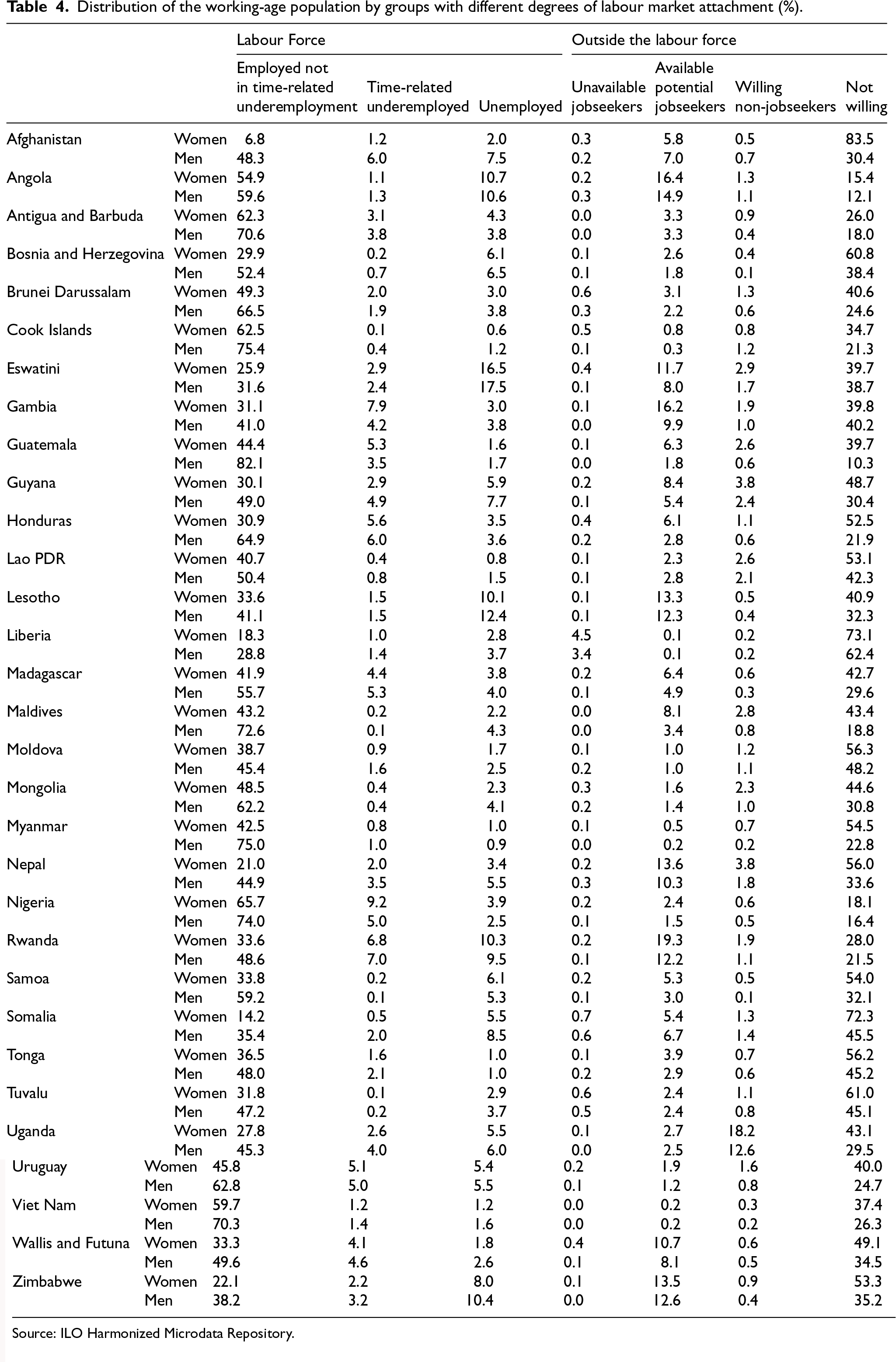
| Labour Force | Outside the labour force | |||||||
|---|---|---|---|---|---|---|---|---|
| Employed not | Available | |||||||
| in time-related | Time-related | Unavailable | potential | Willing | Not | |||
| underemployment | underemployed | Unemployed | jobseekers | jobseekers | non-jobseekers | willing | ||
| Afghanistan | Women | 6.8 | 1.2 | 2.0 | 0.3 | 5.8 | 0.5 | 83.5 |
| Men | 48.3 | 6.0 | 7.5 | 0.2 | 7.0 | 0.7 | 30.4 | |
| Angola | Women | 54.9 | 1.1 | 10.7 | 0.2 | 16.4 | 1.3 | 15.4 |
| Men | 59.6 | 1.3 | 10.6 | 0.3 | 14.9 | 1.1 | 12.1 | |
| Antigua and Barbuda | Women | 62.3 | 3.1 | 4.3 | 0.0 | 3.3 | 0.9 | 26.0 |
| Men | 70.6 | 3.8 | 3.8 | 0.0 | 3.3 | 0.4 | 18.0 | |
| Bosnia and Herzegovina | Women | 29.9 | 0.2 | 6.1 | 0.1 | 2.6 | 0.4 | 60.8 |
| Men | 52.4 | 0.7 | 6.5 | 0.1 | 1.8 | 0.1 | 38.4 | |
| Brunei Darussalam | Women | 49.3 | 2.0 | 3.0 | 0.6 | 3.1 | 1.3 | 40.6 |
| Men | 66.5 | 1.9 | 3.8 | 0.3 | 2.2 | 0.6 | 24.6 | |
| Cook Islands | Women | 62.5 | 0.1 | 0.6 | 0.5 | 0.8 | 0.8 | 34.7 |
| Men | 75.4 | 0.4 | 1.2 | 0.1 | 0.3 | 1.2 | 21.3 | |
| Eswatini | Women | 25.9 | 2.9 | 16.5 | 0.4 | 11.7 | 2.9 | 39.7 |
| Men | 31.6 | 2.4 | 17.5 | 0.1 | 8.0 | 1.7 | 38.7 | |
| Gambia | Women | 31.1 | 7.9 | 3.0 | 0.1 | 16.2 | 1.9 | 39.8 |
| Men | 41.0 | 4.2 | 3.8 | 0.0 | 9.9 | 1.0 | 40.2 | |
| Guatemala | Women | 44.4 | 5.3 | 1.6 | 0.1 | 6.3 | 2.6 | 39.7 |
| Men | 82.1 | 3.5 | 1.7 | 0.0 | 1.8 | 0.6 | 10.3 | |
| Guyana | Women | 30.1 | 2.9 | 5.9 | 0.2 | 8.4 | 3.8 | 48.7 |
| Men | 49.0 | 4.9 | 7.7 | 0.1 | 5.4 | 2.4 | 30.4 | |
| Honduras | Women | 30.9 | 5.6 | 3.5 | 0.4 | 6.1 | 1.1 | 52.5 |
| Men | 64.9 | 6.0 | 3.6 | 0.2 | 2.8 | 0.6 | 21.9 | |
| Lao PDR | Women | 40.7 | 0.4 | 0.8 | 0.1 | 2.3 | 2.6 | 53.1 |
| Men | 50.4 | 0.8 | 1.5 | 0.1 | 2.8 | 2.1 | 42.3 | |
| Lesotho | Women | 33.6 | 1.5 | 10.1 | 0.1 | 13.3 | 0.5 | 40.9 |
| Men | 41.1 | 1.5 | 12.4 | 0.1 | 12.3 | 0.4 | 32.3 | |
| Liberia | Women | 18.3 | 1.0 | 2.8 | 4.5 | 0.1 | 0.2 | 73.1 |
| Men | 28.8 | 1.4 | 3.7 | 3.4 | 0.1 | 0.2 | 62.4 | |
| Madagascar | Women | 41.9 | 4.4 | 3.8 | 0.2 | 6.4 | 0.6 | 42.7 |
| Men | 55.7 | 5.3 | 4.0 | 0.1 | 4.9 | 0.3 | 29.6 | |
| Maldives | Women | 43.2 | 0.2 | 2.2 | 0.0 | 8.1 | 2.8 | 43.4 |
| Men | 72.6 | 0.1 | 4.3 | 0.0 | 3.4 | 0.8 | 18.8 | |
| Moldova | Women | 38.7 | 0.9 | 1.7 | 0.1 | 1.0 | 1.2 | 56.3 |
| Men | 45.4 | 1.6 | 2.5 | 0.2 | 1.0 | 1.1 | 48.2 | |
| Mongolia | Women | 48.5 | 0.4 | 2.3 | 0.3 | 1.6 | 2.3 | 44.6 |
| Men | 62.2 | 0.4 | 4.1 | 0.2 | 1.4 | 1.0 | 30.8 | |
| Myanmar | Women | 42.5 | 0.8 | 1.0 | 0.1 | 0.5 | 0.7 | 54.5 |
| Men | 75.0 | 1.0 | 0.9 | 0.0 | 0.2 | 0.2 | 22.8 | |
| Nepal | Women | 21.0 | 2.0 | 3.4 | 0.2 | 13.6 | 3.8 | 56.0 |
| Men | 44.9 | 3.5 | 5.5 | 0.3 | 10.3 | 1.8 | 33.6 | |
| Nigeria | Women | 65.7 | 9.2 | 3.9 | 0.2 | 2.4 | 0.6 | 18.1 |
| Men | 74.0 | 5.0 | 2.5 | 0.1 | 1.5 | 0.5 | 16.4 | |
| Rwanda | Women | 33.6 | 6.8 | 10.3 | 0.2 | 19.3 | 1.9 | 28.0 |
| Men | 48.6 | 7.0 | 9.5 | 0.1 | 12.2 | 1.1 | 21.5 | |
| Samoa | Women | 33.8 | 0.2 | 6.1 | 0.2 | 5.3 | 0.5 | 54.0 |
| Men | 59.2 | 0.1 | 5.3 | 0.1 | 3.0 | 0.1 | 32.1 | |
| Somalia | Women | 14.2 | 0.5 | 5.5 | 0.7 | 5.4 | 1.3 | 72.3 |
| Men | 35.4 | 2.0 | 8.5 | 0.6 | 6.7 | 1.4 | 45.5 | |
| Tonga | Women | 36.5 | 1.6 | 1.0 | 0.1 | 3.9 | 0.7 | 56.2 |
| Men | 48.0 | 2.1 | 1.0 | 0.2 | 2.9 | 0.6 | 45.2 | |
| Tuvalu | Women | 31.8 | 0.1 | 2.9 | 0.6 | 2.4 | 1.1 | 61.0 |
| Men | 47.2 | 0.2 | 3.7 | 0.5 | 2.4 | 0.8 | 45.1 | |
| Uganda | Women | 27.8 | 2.6 | 5.5 | 0.1 | 2.7 | 18.2 | 43.1 |
| Men | 45.3 | 4.0 | 6.0 | 0.0 | 2.5 | 12.6 | 29.5 | |
| Uruguay | Women | 45.8 | 5.1 | 5.4 | 0.2 | 1.9 | 1.6 | 40.0 |
| Men | 62.8 | 5.0 | 5.5 | 0.1 | 1.2 | 0.8 | 24.7 | |
| Viet Nam | Women | 59.7 | 1.2 | 1.2 | 0.0 | 0.2 | 0.3 | 37.4 |
| Men | 70.3 | 1.4 | 1.6 | 0.0 | 0.2 | 0.2 | 26.3 | |
| Wallis and Futuna | Women | 33.3 | 4.1 | 1.8 | 0.4 | 10.7 | 0.6 | 49.1 |
| Men | 49.6 | 4.6 | 2.6 | 0.1 | 8.1 | 0.5 | 34.5 | |
| Zimbabwe | Women | 22.1 | 2.2 | 8.0 | 0.1 | 13.5 | 0.9 | 53.3 |
| Men | 38.2 | 3.2 | 10.4 | 0.0 | 12.6 | 0.4 | 35.2 | |
Source: ILO Harmonized Microdata Repository.