




Abstract
This paper proposes a comprehensive strategic framework for fostering and enhancing collaboration between Eurostat and the academic community. Acknowledging the vital role of academic institutions in driving innovation, methodological rigour, and advanced research capabilities, this strategy aligns with the European Statistical Governance Advisory Board (ESGAB) recommendation to organise academic outreach within a cohesive framework. Building on legislative framework, including Regulation (EC) No 223/2009 and the European Statistics Code of Practice (CoP), this approach identifies four foundational pillars: Skills and Education, Innovation and Methodology, Research, and Communication. These pillars are designed to create a mutually beneficial ecosystem that promotes the exchange of knowledge, supports the development of cutting-edge statistical methods, and enhances data quality and accessibility. The paper also reviews current collaborative efforts between Eurostat, National Statistical Institutes (NSIs), and academia, highlighting exemplary practices and innovative partnerships. The paper concludes by highlighting the expected impacts of enhanced Eurostat-academia collaboration and outlining future perspectives. Originally developed to support Eurostat’s strategy discussions and presented at New Techniques and Technologies for Statistics (NTTS) 2025 conference, the framework is offered as a transferable blueprint; while formal adoption is pending, we detail adoption pathways, preconditions, and evaluation metrics.
Introduction
In an era characterized by data-driven insights and interdisciplinary collaboration, the symbiotic relationship between statistical agencies and academic institutions is a key factor for innovation and progress.
The need for a stronger collaboration between Eurostat and academia has been emphasised in numerous official documents and recommendations over the past decade. Eurostat, as the statistical office of the European Union (EU) and a Directorate-General of the European Commission, plays a pivotal role in providing high-quality European statistics that underpin evidence-based policymaking, economic analysis, and societal understanding. It coordinates statistical activities at Community level, ensuring consistency, quality, and comparability of data across member states, while minimising reporting burdens. Eurostat i , as defined by Regulation No 223/2009 1 on European statistics, serves as the statistical authority of the European Union.
Academia, on the other hand, serves as a vibrant hub of research and innovation, where scholars explore the frontiers of knowledge across diverse disciplines, leveraging data to unravel complex societal and economic challenges. 2 The collaboration between Eurostat and academia is essential for fostering methodological rigour, innovative research, and advanced analytical capabilities that strengthen the overall quality and relevance of European statistics. This partnership does not only promote the development of cutting-edge statistical methods but also enhances statistical literacy, ensuring that data users and producers are equipped with the necessary skills to navigate an increasingly data-centric world. 3 Several key qualitative and regulatory frameworks underline the importance of this collaboration. The European Statistics Code of Practice (CoP) explicitly highlights the role of academic cooperation in multiple principles, 4 including Principle 1bis (Coordination and Cooperation), Principle 4.2 (Commitment to Quality), Principle 7 (Sound Methodology), and Principle 15 (Accessibility and Clarity). For instance, Principle 7 emphasises the recruitment of graduates in relevant academic disciplines and the continuous collaboration with the scientific community to improve statistical methodologies and promote the development of innovative tools.
Moreover, Regulation (EC) No 223/2009 explicitly states that ‘an adequate interdisciplinary cooperation with academic institutions should be developed’ to align concepts and methodologies effectively. This approach is further reinforced by the European Statistical Governance Advisory Board (ESGAB) ii , which in its 2021 and 2022 reports recommended that Eurostat establishes a comprehensive strategic framework for structured and sustained cooperation with academia.5,6 The ESGAB particularly emphasised the need to strengthen Recital 13 of Regulation 223/2009 to ensure long-term collaboration that fosters joint research, methodological innovation, and the exchange of ideas, ultimately enhancing the attractiveness of the European Statistical System (ESS) as a leading employer and knowledge hub.
This paper outlines the ESGAB's recommendations and proposes a comprehensive strategic framework to foster and enhance collaboration between Eurostat and academia. It aims to create a mutually beneficial ecosystem that promotes knowledge exchange, supports the development of cutting-edge statistical methods, and improves data quality and accessibility. Building on established legislative foundations, this strategy identifies four foundational pillars – Skills and Education, Innovation and Methodology, Research, and Communication– aimed at foster meaningful, interdisciplinary partnerships and ensuring that European statistics remain relevant, reliable, and of the highest quality in a rapidly evolving data landscape.
This framework is not a new stand-alone internal programme. It complements the Eurostat Annual Work Programme (AWP) and leverages existing instruments – including framework contracts (procured), grants (grant-funded), and ESSnet projects (co-created)- to commission, co-create, and evaluate work with academia where appropriate. While formal adoption is still pending, we have outlined preconditions and monitoring arrangements (Annex Table A1) to enable implementation through pilot projects and gradual scaling in line with established Commission procedures and quality standards. These approaches have been discussed with stakeholders, including during the 2025 Conference on New Techniques and Technologies for Statistics (NTTS 2025).
The remainder of this paper is structured as follows. Section 2 provides a review of the current initiatives and practices developed both at Eurostat and at the NSI level in collaboration with academia. Section 3 presents the strategic goals and pillars underpinning the proposed collaboration strategy. At the core of the proposal is a four-pillar framework that structures the strategy; Figure 1 provides a visual overview and serves as a blueprint for the discussion in Section 3. Section 4 outlines specific actions to implement the strategy. The paper concludes by highlighting the anticipated impacts of enhanced Eurostat-academia collaboration and highlighting future perspectives.
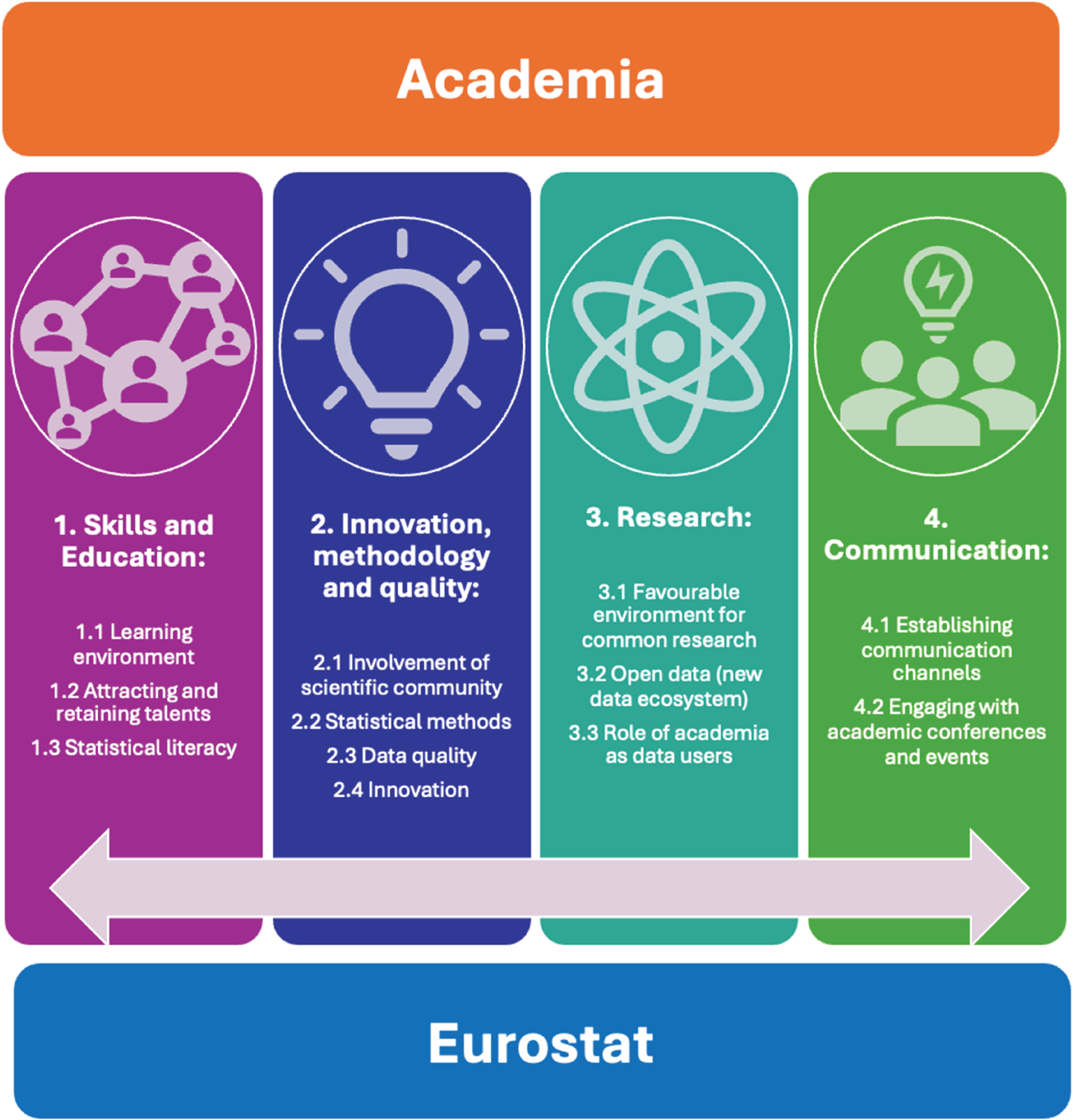
An approach based on four pillars.
Collaboration activities between Eurostat and academia
This section summarises the key types of collaboration between Eurostat and academia, grouped into four areas: education and training, data access, research initiatives and events – with emphasis on the instruments most relevant to official-statistics production.
The first area of collaboration promotes education and training in official statistics through complementary instruments. European Master in Official Statistics (EMOS) functions as a network of universities running master's programmes certified by the ESS, with common learning outcomes, work-based components (internships/placements), and co-supervised theses that connect students to production problems; EMOS graduates form a recurring talent pipeline for Eurostat and NSIs. 7 The European Statistical Training Programme (ESTP) offers practice-oriented courses and workshops– delivered in person or online – targeted at staff members in the statistical offices involved in production. Topics typically cover methodology and quality management, metadata and standards, new data sources and reproducibility, with assessments and certificates to support continuous up-/re-skilling. 8 The Education Corner complements these efforts with classroom-ready materials and public-facing explainers (lesson outlines, datasets, visualisations, plain-language briefs), supporting teachers and students and helping to build basic statistical literacy.7–9 Together, these instruments strengthen the talent pipeline, facilitate mobility between academia and producers, and accelerate the transfer of methods and good practices across the ESS.7–9
The second area focuses on data sharing and access through both open databases and, under specific conditions, microdata for scientific research iii . Open resources include Eurobase (cross-theme EU statistics) and Comext (international trade in goods for EU and many non-EU countries), alongside thematic series (e.g., Survey on the use of ICT in households any by individuals). In addition to public microdata (anonymised), restricted microdata provides more detailed information accessible via application, data-use agreements and secure environments; eligibility is limited to organisations recognised as research units iv . Broader access supports robust analyses, innovation in methods, and a stronger evidence base for policymaking. 1
The third area focuses on joint research, ranging from procured studies under methodological framework contracts to co-created projects via ESSnet and grant-funded actions. Calls are organised by topic and type of action; projects are implemented by universities (directly or via consortia/consultancies) and co-funded in line with EU policy objectives. Within this framework, methodological framework contracts are key mechanisms to engage top-tier expertise across three categories: ‘Methodological support’ (procured via framework contract), ‘Methodological helpdesk’ (procured; on-demand support and targeted studies), and ‘Technical support in methodology and for the production of statistics’ (procured; technical assistance for projects requiring substantial methodological input when developing new statistics and services).
Joint work typically includes ESSnet (European Statistical System Networking) projects – collaborative ESS consortia (co-created within the ESS) that enable knowledge transfer and methodological/technical cooperation across Member States (e.g., software implementation, metadata standardisation, and cross-country method comparisons) – and Grants awarded to eligible bodies under Eurostat's annual work programme (e.g., the “Cross-domain data collection platform for the ESS” 11 ). An illustration of ESSnet is “Smart Surveys Implementation” project v , involving several NSIs (DESTATIS, INSEE, ISTAT, SSB, StatBEL, SURS) and universities (Brussels, Mannheim, Utrecht).
Further coordination and visibility are provided through the CROS portal, which facilitates knowledge exchange to improve the development, production and dissemination of high-quality European statistics. The CROS portal supports partner search, calls, and dissemination across procured, grant-funded, and co-created (ESSnet) projects.
Outcomes of joint research are frequently disseminated via Statistical Working Papers, manuals/guidelines, technical reports, and peer-reviewed journals dedicated to official statistics (e.g., Statistical Journal of the IAOS, Journal of Official Statistics), thereby advancing methodological innovation and practice in the field.
The fourth area of collaboration pertains to events. Eurostat organises and participates in a wide range of workshops, conferences, and seminars in cooperation with academic institutions. These events provide a forum for sharing research findings, discussing methodological innovations, and fostering new collaborations. Among the key events are the Conference on New Techniques and Technologies for Statistics (NTTS), held triennially since 1992 and biennially since 2009; the European Data Users Conference, organised since 2015; the European Statistics Day, first celebrated on 20 October 2016 during the second Conference of European Statistics Stakeholders (CESS) and the biennial European Conference on Quality in Official Statistics, initiated in 2001. Other important events include the Annual EMOS Workshops, most recently held in Wiesbaden (2024) and the Job Skills Statistics event, organised online in October 2023. Eurostat also promotes competitions such as the European Statistics Awards competition. Furthermore, Eurostat participates actively in international conferences vi such as those organised by the IAOS and the International Institute of Statistics (ISI), the ISI World Statistics Congress and the United Nations (UN) World Data Forum.
Recent joint Eurostat/NSI–academia work-reported in SJIAOS and the Journal of Official Statistics – documents tangible outputs, including education/competence frameworks and EMOS development,7,9,16 bridges between official statistics and statistics education/communication,10,12 and collaboration case studies on method transfer and organisational conditions.18,15,14
Similar collaboration patterns are observed in other statistical systems. At the US Census Bureau, collaboration with academia is supported through a network of secure research data centres and formal disclosure review processes, alongside joint programmes for methods development and translational outputs, including modern privacy-preserving approaches for public releases. Within the UN Statistics Division, the UN Global Platform and expert task teams enable shared method development, cloud-based sandboxes, and dissemination via method guides and reproducible code, anchored in the Fundamental Principles of Official Statistics and guidance such as the Handbook on the Management and Organization of National Statistical Systems. These arrangements parallel the ESS focus on secure access, co-created methodology, and standardised documentation, and they reinforce the case for the operational choices proposed in Sections 3–4.
Initiatives of NSIs
The collaboration between academia and European NSIs is stated in Regulation 223/2009 1 and reflected in several CoP indicators, which emphasise the coordination role of NSIs and the need to foster interdisciplinary cooperation with academic institutions. However, these collaborations are shaped by diverse legal frameworks and national regulations, leading to considerable heterogeneity in approaches and strategies. Most of the initiatives outlined in the following paragraph are based on peer review reports available on the Eurostat website, which document the ongoing 2021–2023 peer review round. It should be noted that the list of NSIs engaging in collaboration with academia is not exhaustive and is subject to continuous updates.
In several countries, staff in national statistical institutes may hold part-time academic appointments (and, conversely, academic staff may hold part-time roles at NSIs), subject to national legal frameworks. Such dual affiliations facilitate co-supervision of theses, shared teaching, short-term staff exchanges, and faster diffusion of methods across the ESS.
In some countries, such as Statistics Estonia and Central Statistics Office of Ireland (CSO), regular contacts have been established to incorporate academic inputs into key topics (e.g., upcoming population and housing census, analyses on dwelling). Statistics Estonia has cultivated strong relationship with academia through informal personal contact, whereas the CSO formalises collaboration through specific contracts.
The Romanian National Statistical Institute signed formal protocols with academia to best manage cooperation in the field of data management. Based on memorandum of cooperation, ELSTAT (Hellenic Statistical Authority) has established close relationships with Greek universities for data analysis, time series analysis and modelling cases. 12 In Italy, Instituto Nazionale di Statistica (ISTAT) maintains an intensive ad hoc dialogue with universities through specific joint projects, mostly governed by bilateral agreements.
An innovative practice has been identified at Statistics Portugal, where resident researchers are employed through one-to-one agreements. These contracts with external academic researchers help provide the skills and knowledge needed to meet key development challenges, including research on the use of administrative data in the compilation of official statistics. The Luxembourg Statistical Authority (STATEC) employs academics in the field of economic, social, and business statistics. The Albanian Institute of Statistics (INSTAT) collaborates with academia as mandated by the Law on Official Statistics, ensuring representation from the academic world in its Statistical Council. 15 It is also worth noting that statistical councils of most European NSIs include representatives from academic institutions – as seen at Statistics Estonia, Statistics Portugal (INE), ISTAT, Statistics Belgium, and Statistics Poland. For instance, the Scientific Statistical Council of Statistics Poland consists of thirty academics from twenty universities, covering a wide range of disciplines, reflecting a commitment to openness and a strong focus on research. 13 Concerning human resources, new employees of the Maltese NSI are predominantly university graduates, while Statistics Belgium and Statistics Denmark have established partnerships with universities to harness IT technology, including high performance computing capabilities, regional statistical and methodological issues.
Statistics Netherlands collaborates with academic institutions to obtain specialised knowledge and expertise for implementing its strategic agenda. It employs both formal mechanisms, such as bilateral cooperation agreements, and informal approaches, fostering individual-level partnerships. Some NSIs, such as the Czech Statistical Office (CzSO), Federal Statistics Office (Destatis) in Germany and the Statistics Office of the Republic of Slovenia (SURS)maintain close contact with academia for advice on specific methodological issues. However, there is no formal legal mandate requiring the coordination of common activities with academic institutions. In this perspective, the SURS has planned the establishment of specific agreements with academia to enhanced cooperation with the scientific community and jointly develop new statistical methods on social statistics and demography.
The Austrian Micro Data Centre, established in 2022, represents a significant advancement, aiming to enhance research activities within the scientific community through access to microdata. INE has been promoting projects with academia to improve the access to microdata since 2021. Statistics Denmark is collaborating with academia to create its Data Science Lab, thereby enabling opportunities for strengthening fundamental statistical infrastructure for research, including the establishment of a longitudinal database covering the entire Danish population. A specific agreement between the Hungarian Central Statistical Office (HCSO) and Hungarian universities, facilitated the creation of a dedicated secure centre for academic researchers.
In term of training activities, Statistics Norway has offered students paid internships, either in the form of summer jobs or as part-time positions. A summer job will typically be an 8–week temporary engagement, allowing a student to work intensively on one or several projects for the designated period of internship. 14 ELSTAT offers internship opportunities for undergraduate students and provides support for master's thesis programmes. To further promote participation in training programmes, INE has established agreements with 29 universities to facilitate internships. Statistics Estonia hosts visits from student groups, while the CzSO collaborates with academic institutions to deliver specialised training.
Finally, regarding the dissemination activities, Greece has partnered with universities to promote statistical literacy, while Latvia organises ‘academic breakfasts’ to strengthen university cooperation. INSTAT fosters academic collaboration through initiatives like student internships and publications in the research Journal of Statistics and informative journal, with short and simple language. 15
A comprehensive strategic framework
An approach based on four pillars
Eurostat's mission is to provide reliable, comparable and high-quality statistics and data on societies, economies, and the environment to citizens, policymakers, researchers, and businesses. This is essential for supporting evidence-based decision-making, promoting transparency, and fostering public trust in statistical institutions. To achieve this role effectively, official statistics must continuously adapt to the evolving needs of society, incorporating new data sources, methodologies, and technological innovations.
The collaboration between Eurostat and academia can provide significant benefits, leveraging the complementary strengths of both communities. While academia is often driven by a focus on data exploration, methodological innovation, and scholarly publication, Eurostat's core mission centres on the production and dissemination of high-quality, policy-relevant European statistics. However, both institutions share a deep commitment to data and a common interest in harnessing emerging data ecosystems to improve the quality and relevance of statistical outputs. 14
For Eurostat, academic partnerships could provide access to cutting-edge research, innovative methodologies, and interdisciplinary perspectives, supporting the continuous improvement of data quality and the development of new statistical products. These collaborations enable Eurostat to remain at the forefront of methodological advances, integrate new data sources, and respond effectively to changing data demands. For the academic community, working with Eurostat offers unique opportunities for impactful, real-world research, access to high-quality data, and the ability to influence the future direction of statistical practices in Europe. This mutual exchange of expertise enhances the societal impact of statistical research, ensures the proper use of data for research purposes, and promotes a culture of innovation and experimentation within the ESS.
In this context, a possible strategy for fostering this collaboration could be organised around four pillars, providing a flexible framework that can be adapted as the needs of the statistical community evolve. This framework, reported in Figure 1, is designed to foster meaningful, sustained, and impactful collaboration between Eurostat and the academic community, aligning with the broader strategic goals of the ESS. The goals of a possible strategy for fostering collaboration with academia are to enhance Eurostat's ability in several key areas vii . These include improving quality of data and methods, developing new outputs and methodologies, and continuously adapting to technological advancements. Additionally, the strategic framework emphasises exploring new ways to incorporate emerging methodologies, such as new digital data sources, data science and artificial intelligence, into data collection, processing, and dissemination. Eurostat is also committed to fostering Innovation and experimentation in these areas. We further discuss cultural interfaces and practical bridging mechanisms in the new Section 3.3. The framework is summarised visually in Figure 1, which highlights the four pillars as the core components of the proposed strategy.
The framework operates through existing Eurostat/ESS instruments (framework contracts, grants, ESSnet, CROS) and is offered as a blueprint currently under consideration, with practical pilot routes and evaluation metrics specified in Sections 4 and 5 and informed by feedback received at NTTS 2025.
While the four pillars share scientific foundations collaboration operates under distinct institutional mandates, timelines, and incentives. Section 3.3 sets out practical bridging mechanisms (co-designed agendas, embedded residencies, dual affiliations, and dissemination norms) and summarises implementation risks and potential mitigations; monitoring indicators are listed in Annex Table A1.
Strategic goals
The ‘
The ‘
The ‘
The ‘
Building on the four key pillars of the strategic framework, the next section outlines a range of actions aimed at strengthening collaboration between Eurostat and the academic community. Each pillar serves as a foundation for targeted initiatives designed to enhance knowledge sharing, promote joint research, and support innovative statistical methodologies.
Implementation challenges and cultural interfaces
This subsection outlines how collaborations navigate shared scientific ground and diverging institutional logics, and how a practical ‘bridge’ can be designed and managed. Academia and official statistics share a commitment to sound measurement, error control, transparent design, and research ethics; they differ, however, in mandate, timelines, and incentives. Official statistics provide fit-for-purpose outputs on fixed cycles and under legal constraints, whereas academia prioritises novelty, academic freedom, and publications. These interfaces are widely discussed in the literature on boundary concepts, co-production, and use-inspired research.19–23 In this perspective, a boundary organisation may be understood simply as an arrangement that mediates across institutional cultures while retaining dual accountability, and boundary objects as shared artefacts (e.g., method notes, quality protocols, DUA templates, reproducible notebooks, synthetic datasets, dashboards, competency frameworks) that different communities can use and interpret without abandoning their own logics.19–21 Co-production provides the normative basis for jointly defining problems and solutions, 21 while use-inspired research and knowledge-system design emphasise translational value and uptake.22,23
Operationally, the bridge can be designed along a few concrete dimensions:
Key implementation challenges and their corresponding proposed mitigation actions include:
At project level, a minimum set of elements helps reduce hand-off frictions and shorten the research-to-production lag: (a) a co-defined problem statement and success criteria; (b) stage-gates tied to ESS timelines (prototype → pilot → production), with adoption owners named; (c) a risk register (data/privacy, schedule, quality) and contingency plans; (d) a reproducibility package (code, metadata, method note) deposited in an approved repository; and (e) a user-testing plan for communication (see Sections 4.2.2 and 4.4).
Taken together, well-designed boundary arrangements and artefacts increase role clarity, reduce transaction costs, and accelerate the uptake of methods in official production.19–21 The governance and mitigation toolkit aligns with knowledge-system principles for effective translation and sustained use22,23 and connects to the monitoring framework in Annex Table A1. For this purpose, a concise set of Key Performance Indicators (KPIs) is defined (see Annex Table A1).
For planning purposes, actions are grouped into near-term, medium-term, and longer-term horizons. Sequencing is guided by dependencies and feasibility: enabling steps precede scaling, and institutionalisation follows demonstrated benefits and stable resourcing. The risk landscape and potential mitigations are summarised in Section 3.3; monitoring indicators are listed in Annex Table A1.
In the near term, priorities may include: (i) enabling dual affiliations and short-term staff exchanges via standard templates and transparent eligibility; (ii) integrating methods clinics and micro-credentials into existing ESTP/EMOS offers; (iii) embedding user-testing of uncertainty explanations (A/B, comprehension checks) in release workflows; (iv) publishing concise method notes alongside major releases; (v) adopting co-supervision guidelines for MSc/PhD (authorship/IP, DUAs, reproducibility); and (vi) establishing light steering/liaison arrangements to coordinate pilots. Indicative owners: Eurostat production/methods units; NSIs; partner HEIs.
Over the medium term, consolidation and scaling would include: (i) implementing visiting researcher/residency schemes and sabbaticals with defined deliverables; (ii) rolling out standard DUAs and secure research environments; (iii) developing open comparative benchmarks for priority methods (e.g., seasonal adjustment, SAE, price indices/PPP); (iv) organising mobility weeks and joint academies; and (v) issuing targeted calls supporting the research line on Supranational Official Statistics. Indicative owners: Eurostat, ESSnet consortia, NSIs, international partners.
In the longer term, institutionalisation and infrastructure could involve: (i) formalising boundary-organisation arrangements (dual accountability, stable resourcing); (ii) scaling adoption of validated methods into ESS production with versioned protocols; (iii) establishing cross-border data linkages/infrastructures where feasible; (iv) sustaining fellowship lines and recurring joint workshops with international statistical organisations; and (v) updating policies/standards where appropriate. Indicative owners: Eurostat/ESS governance, NSIs, Commission services, international organisations.
Dependencies imply that near-term enablers typically precede medium-term scaling, while longer-term steps depend on evidence of value and stable resourcing. Priorities are expected to be reviewed periodically in considering uptake and user value (see Annex Table A1).
Pillar: Skills and education
The Skills and Education pillar is intended to serve three audiences: (i) Eurostat/ESS staff (continuous up-/re-skilling aligned with production needs), (ii) NSI staff (harmonised competencies and peer exchange across the ESS), and (iii) academics and students (EMOS and beyond), by preparing them for official-statistics problems through courses, co-supervised theses, and internships. Where appropriate, participation and uptake are monitored using the indicators listed in Annex Table A1.
Learning environment
To support the development of a dynamic and responsive learning environment within the ESS, several collaborative actions with the academic community could be considered.
One possible direction is to strengthen partnerships with universities, particularly those within the EMOS network – to support PhD/MSc in fields relevant to official statistics. These collaborations may involve joint supervision of doctoral projects, co-funding schemes, or the provision of access to Eurostat data for academic research. Such initiatives could help attract talented early-career researchers and recent graduates in statistics, economics, and related disciplines, while also fostering the development of innovative methodologies and analytical approaches.
Another path could involve enhancing the ESTP by encouraging greater academic engagement. ESTP courses already address the technical and soft skills needed by ESS staff; future editions might include emerging topics such as machine learning and artificial intelligence, in alignment with the European Statistical Programme 2021–2027. Opening these courses to EMOS students and inviting NSI staff to participate in EMOS-led webinars could further enrich the mutual exchange of knowledge and expertise.
In addition, co-developing specialised training programmes in collaboration with academic institutions may help better respond to the evolving needs of official statisticians. These programmes could be designed with flexible delivery modes, such as part-time, evening, or blended, to accommodate professionals already in the workforce, while promoting lifelong learning and upskilling across the ESS.
In this regard, the work by 16 emphasises the importance of embedding official statistics into university curricula, arguing that structured teaching of these topics- when aligned with practical needs and institutional priorities – can significantly enhance students’ understanding and readiness to work in national and international statistical institutions. Their experience highlights the value of connecting academic instruction with real-world statistical production, especially when supported by collaborative frameworks such as EMOS or teaching partnerships with NSIs.
Such collaboration should be developed in alignment with the Council Recommendation 1640/2023 on a European framework to attract and retain research, innovation and entrepreneurial talents in Europe. 17 In this context, Eurostat–academia partnerships can ensure that joint educational and research initiatives contribute not only to technical excellence but also to the upholding of shared European values. This perspective is further supported by broader literature stressing the need for stronger institutional-academic cooperation to modernise statistical training and ensure that the workforce is adequately prepared for the complexities of modern data ecosystems. 3
Overall, these actions would contribute to fostering a vibrant ecosystem of learning, innovation, and cooperation between Eurostat, NSIs, and academia. This learning environment is tied to clear adoption metrics (Annex Table A1), ensuring that training translates into measurable improvements in production workflows.
Postdoctoral participation is addressed under the Research pillar (Section 4.3.1).
Attracting and retaining talent
To support the goal of attracting and retaining high-quality talent within the ESS, several actions could be explored in partnership with academia. For example, Eurostat might strengthen recruitment strategies and expand the talent pool by attracting candidates from diverse backgrounds and experiences. In the context of EPSO's processes for recruitment, to select talented candidates in addition to other experience and skills, proven experience in research or proven participation in national and international research projects, could be included among the eligibility criteria to apply for job vacancies.
Eurostat could reinforce its role in informing EU policies and decision-making to instil a sense of purpose among employees. Closer cooperation with academia will promote the use of European statistics as well as the value of European statistics in academic circles and beyond.
In addition, encouraging short-term mobility and exchange opportunities – such as staff visits to NSIs or university departments – could support professional development, facilitate the transfer of best practices, and nurture a culture of innovation across the ESS.
To operationalise talent development under this pillar, the following provisions are proposed: (i) dual affiliations and short-term staff exchanges between Eurostat/NSIs and universities should be enabled through standard templates and transparent eligibility criteria; (ii) visiting researcher schemes and sabbaticals should be established with clear objectives (e.g., methods clinics, joint pilots), deliverables, and hosting arrangements; (iii) co-supervision of MSc/PhD theses should be supported via guidelines specifying authorship/IP rules, data-access conditions (e.g., secure environments), and reproducibility standards, with expected outputs (e.g., a short method note alongside the thesis); and (iv) participation should be recognised in performance reviews and counted towards professional development to align incentives and encourage sustained collaboration.4.1.3 Statistical Literacy
Although statistical literacy initiatives are essential, their effects are gradual and uneven across audiences. Accordingly, literacy efforts should be complemented by audience-centred communication (Section 4.4) and user-tested explanations of methods and uncertainty (Section 4.2.2), with materials tailored for low-literacy and hard-to-reach groups.
It is essential to improve statistical literacy to enable both data producers and users to interact more effectively with official statistics. To this end, several actions could be considered to foster greater awareness and understanding of statistical concepts and methodologies, especially through partnerships with academia.
One opportunity involves collaborating with universities and research institutions to offer targeted training for public sector professionals, aiming to strengthen their ability to interpret and apply statistical data in policymaking. Likewise, workshops and training modules could be integrated into academic programmes – especially at the master's or doctoral level – helping students and researchers gain familiarity with the tools and principles of official statistics.
Facilitate the organisation of hackathons and competitions explicitly aimed at enhancing statistical literacy among a broad spectrum of participants, including students, educators, and professionals from diverse backgrounds. The NTTS conference hosts hackathons and competitions to engage participants and encourage collaboration and innovation. Engage in data challenges and competitions that focus on using open data. These events will spur creativity, innovation, and the development of new applications or insights. Successful models, such as the European Statistics Competition (ESC) – an initiative established by Eurostat in collaboration with volunteer NSIs and targeted at secondary education students – provide valuable examples of best practices that could be emulated in this context.
Eurostat might also consider expanding internship and visiting researcher opportunities to students and scholars beyond the EMOS network. These placements would facilitate hands-on experience with statistical data and help bridge academic and professional communities.
In this context, international examples may provide useful insights. The strategy implemented by ELSTAT in Greece, for instance, demonstrates how long-term engagement with the educational system can reinforce public trust and awareness of the role of official statistics. This approach – including school visits, academic collaborations, dedicated learning materials, and national competitions – offers a model for how NSI can position statistical literacy as a cornerstone of a ‘virtuous circle’ between citizens and statistics. 12
Finally, collaborating with online learning platforms to create courses or modules that teach statistical concepts using real-world Eurostat data. This will make statistical education more accessible to a wider audience. Eurostat will sponsor scholarships for students pursuing degrees in fields related to statistics. This financial support will incentivize students to focus on statistical research and contribute to the field.
Pillar ‘innovation, methodology and quality’
Involvement of scientific community
A stronger involvement of the scientific community is key to promoting innovation and methodological progress within the ESS. To this end, several strategic actions could be considered to enhance collaboration between Eurostat and academia.
One possible step would be the creation of dedicated task forces or working groups aimed at fostering dialogue, facilitating knowledge exchange, and coordinating joint initiatives. These groups could act as focal points for identifying shared research interests, discussing methodological challenges, and exploring opportunities for collaboration. Regular assessments of emerging needs and gaps, both within Eurostat and in the academic landscape, could help guide the selection of research topics with the greatest potential impact on the development of official statistics.
The appointment of liaison officers within both Eurostat and academic institutions could be advantageous. These contact persons would play a key role in coordinating activities, responding to queries, and supporting the smooth functioning of collaborative projects. Clear and accessible communication channels would help bridge institutional differences and encourage sustained cooperation.
At a broader level, Eurostat might consider developing a common framework to guide collaboration across the ESS, drawing inspiration from national statistical strategies already in place across EU Member States. While approaches to academic cooperation may vary by country, identifying shared priorities and methodological principles could help define a coherent strategic direction. As highlighted by, 3 fostering structured engagement with the research community is essential to ensure the ESS remains innovative, scientifically grounded, and adaptable to future challenges.
This approach is consistent with the recommendations of Ndwifwa and Saxena, 18 who emphasised the value of creating sustainable mechanisms for academic collaboration, including co-design of research agendas, shared data access, and integrated training strategies. Such mechanisms help ensure that innovation in official statistics is not only technically sound but also institutionally supported and methodologically transparent.
Formalising cooperation through partnership agreements or memoranda of understanding with universities and research centres could also provide a solid institutional basis for long-term collaboration. These agreements would clarify roles and responsibilities, define areas of mutual interest, and create a stable framework for joint projects, data sharing, and capacity building.
Altogether, these initiatives could significantly enhance the integration of scientific expertise into the ESS, supporting a culture of continuous innovation and methodological rigour.
Statistical methods
To foster the development and application of innovative statistical methods, several paths of collaboration with academia could be pursued.
In parallel, communication is treated as part of the method: uncertainty intervals, assumptions, model choices, and revision policies should be explained and experimentally evaluated (e.g., comprehension checks) with diverse user groups, including low-literacy and hard-to-reach audiences. Outputs should include short ‘method notes’ and reproducible examples that translate technical details into plain language (see Section 4.4 and Annex Table A1).
As a first step, Eurostat could work jointly with academic partners to identify statistical domains where methodological innovation is most needed. These priority areas might involve challenges posed by new data ecosystems, including big data, real-time data streams, or unstructured sources. Academia can contribute advanced techniques such as machine learning, artificial intelligence, and novel estimation frameworks to address these challenges in a rigorous and forward-looking way.
A second action could be the establishment of structured staff exchange programmes. These programmes would allow academics to spend sabbaticals or short-term research stays at Eurostat, engaging directly with teams working on statistical production, as already implemented at Statistics Portugal through individual agreements with external researchers focused on areas such as the use of administrative data, or at STATEC (Luxembourg), which employs academics in economic and business statistics to support methodological development. In parallel, Eurostat staff could take part in visiting appointments or collaborative projects hosted by academic institutions. Statistics Netherlands offers a further example, using both formal agreements and informal partnerships with universities to gain access to academic expertise aligned with its strategic priorities. Similarly, the Statistical Office of the Republic of Slovenia (SURS) is planning structured agreements with academia to jointly develop new methods in social statistics and demography. These exchanges, organised at different levels of seniority and duration, would promote mutual learning, strengthen applied research capacity, and contribute to the refinement of statistical methods.
In addition, Eurostat may consider launching open consultations on statistics under development, inviting academics to provide methodological input and advice. Such inclusive processes would ensure that emerging statistical products benefit from diverse scientific perspectives, and would encourage transparency, innovation, and engagement from the broader research community.
Data quality
The ESS is aiming to enhance the quality of data, and academic collaboration can offer significant contributions in this area.
One promising direction involves inviting academic experts to conduct independent data quality reviews. These reviews could assess the accuracy, consistency, and completeness of selected datasets, offering evidence-based recommendations for methodological improvement. Academic input may also help validate outputs and assess their reliability for use in policy and research.
Eurostat could also support research projects exploring advanced techniques for data fusion, imputation, and quality assessment. Integrating diverse data sources – such as administrative records, surveys, and digital data – requires both statistical expertise and domain knowledge. Collaboration with academia can drive the development of innovative frameworks that combine these inputs effectively and responsibly.
Moreover, involving academic experts in reviewing quality assurance procedures could provide valuable external insights. Their participation in evaluating data processing and validation steps would help identify potential sources of error or bias and contribute to more robust quality control systems.
A relevant example is provided by, 15 who analyse the institutional collaboration between the Albanian statistical office (INSTAT) and academia. Their study shows how formal engagement – mandated by national statistical legislation – can enhance methodological soundness, strengthen statistical governance, and improve the overall quality and credibility of official statistics. This experience underlines the value of long-term, structured academic partnerships in reinforcing data quality within national statistical systems
Innovation
As part of innovation and quality, communication artefacts are treated as methodological outputs to be specified, versioned, and standardised (e.g., expressions of uncertainty, key definitions, visual encodings). Building on the user-testing work described in Section 4.2.2, outputs should include concise method notes, plain-language summaries, and reproducible examples, with accessibility-by-design applied. Monitoring is aligned with Annex Table A1 and cross-referenced in Section 4.4.
Promoting a culture of innovation within the ESS requires both structural support and openness to experimentation. A key instrument in this direction could be the promotion of funding opportunities and open calls for research and development projects. These initiatives, either managed directly by Eurostat or in partnership with other EU bodies, could contribute to the development of new methodologies, improve statistical infrastructure, and enhance the integration of innovative practices.
Eurostat could also benefit from strengthening its participation in national and international research networks that bring together academic researchers and official statisticians. These networks offer platforms for sharing practices, exchanging knowledge, and scaling up successful initiatives across the ESS. Identifying and disseminating good practices from NSIs could inspire innovation and coherence at the European level.
Finally, fostering robust feedback mechanisms involving data users, analysts, academics, and policymakers could help inform methodological refinement and enhance the relevance of statistical products Fostering a culture that values openness to feedback, alongside the development of effective mechanisms for responding to such input, would facilitate continuous learning and adaptation – both of which are essential components of sustained innovation. These efforts are essential to maintaining the responsiveness and quality of the ESS in a rapidly evolving data landscape. 3
Pillar ‘research’
Create a favourable environment for common research
Eurostat could consider a range of initiatives to enhance the research dimension of official statistics to create a more accessible environment for collaboration with academia.
Within this enabling environment, a dedicated research line on supranational official statistics is proposed to address methods and governance for EU-level indicators and cross-country comparability. Priority topics include: (i) harmonisation and aggregation strategies across heterogeneous national systems; (ii) reproducible benchmarking frameworks for methodological choices (e.g., seasonal adjustment, small-area estimation, price indices and PPP methods); (iii) consistency between micro- and macro-level integration and cross-border linkages (business registers, migration, administrative and new data sources); (iv) confidentiality protection and data-access pathways suitable for multi-country research; and (v) governance models clarifying roles, authorship, and adoption of methods at the supranational level. Indicative activities include comparative method reviews with open benchmarks, targeted fellowship calls, and joint workshops with international statistical organisations, to enable faster uptake into ESS production. Complementing this thematic focus, improved access to research infrastructure – including data repositories, analytical tools, and secure environments for data analysis – should be prioritised. Facilitating the joint use of these resources would better equip Eurostat and academic partners to undertake rigorous, policy-relevant research on official statistics.
Postdoctoral participation is positioned under the Research pillar. Residency and fellowship schemes (e.g., 12–24 months) should be established to deliver targeted methodological advances and translational outputs. Arrangements should specify: (i) supervision teams (Eurostat/NSI + academic), (ii) deliverables and milestones (e.g., open benchmarks, methods clinics, reproducible code and a concise method note), (iii) data-access modalities (DUAs, secure environments), and (iv) authorship/IP rules. Co-funding through existing instruments (framework contracts, grants, ESSnet) is envisaged, with monitoring aligned to Annex Table A1. Another opportunity lies in expanding the organisation of joint workshops and conferences. These events, co-hosted with universities or research networks, could serve as platforms for exchanging ideas, presenting findings, and building research partnerships. Topics might include technological innovations, infrastructure for data sharing, or emerging statistical methods. Such events could also promote EMOS, highlighting the added value for academic institutions joining the network.
Further, encouraging the publication of joint research outputs – particularly in specialised journals or dedicated special issues – would help disseminate findings and increase the visibility of collaborative work. This could enhance the academic profile of Eurostat while positioning official statistics within broader scientific discourse.
Supporting doctoral education is another important action area. Eurostat could offer grants or fellowships for PhD students working on statistical and interdisciplinary topics, providing them with opportunities to carry out part of their research within the institution. These exchanges would not only enhance research capacity but also cultivate future contributors to the ESS.
Finally, integrating Eurostat's expertise more directly into tertiary education – for instance, by involving its staff in university teaching – could help bridge the gap between academic theory and practical application. This collaboration would support the development of statistical competencies and increase awareness of career opportunities in official statistics.
Open data (new data ecosystem)
Promoting the use of open data is key to stimulating academic research and innovation. Eurostat could support this goal by encouraging the development of tools and methodologies that facilitate open data access, processing, and visualisation. A focus on harmonising metadata standards across NSIs and other data sources would improve interoperability and enhance the usability of public datasets.
Active participation in open data initiatives – at local, national, and international levels – would also help raise awareness of available resources and encourage their use in research. Engaging with the academic community through open data conferences or collaborative projects can further strengthen the culture of open science and reproducible research.
Role of academia as data users
Recognising academia as a key user of official statistics, Eurostat could implement several actions to strengthen this relationship. One option is to collaborate with academic journals to publish special issues that showcase the application of European statistics in research. These publications could help illustrate the policy relevance and societal impact of the data, encouraging its broader use in the academic community.
Eurostat might also consider establishing recognition initiatives – such as awards or acknowledgements – for academics who make significant contributions to research using European statistics. These initiatives can incentivise engagement and increase visibility for both researchers and Eurostat.
Moreover, promoting hands-on educational initiatives, such as interinstitutional summer schools, could offer students practical experience in addressing real-world statistical challenges. These programmes – modelled on successful initiatives like the European eSummer School (EeSS) – could combine data analysis, modelling, and interdisciplinary problem-solving. To ensure inclusivity, funding mechanisms and virtual participation options could be explored, reducing financial and logistical barriers to access.
Pillar ‘communication’
Establishing communication channels
To reinforce its engagement with the academic community, Eurostat could explore the development of more structured and accessible communication channels. One possible action involves creating a dedicated section on the Eurostat website that highlights collaborations with academia. This space could serve as a central hub for presenting current and past initiatives, outlining objectives, and showcasing results. Making such information easily available would contribute to transparency, encourage further engagement, and demonstrate the added value of joint efforts.
Additionally, Eurostat could formalise communication mechanisms through the task force dedicated to academic collaboration, facilitating information exchange and coordination across stakeholders. Regular updates on relevant developments – such as the launch of collaborative projects, publication of joint research, or calls for academic involvement – could be shared through press releases and announcements.
Social media platforms such as LinkedIn and X may also be leveraged to increase visibility. Sharing research highlights, success stories, and upcoming events can help broaden Eurostat's academic outreach and attract new collaborators.
Further initiatives might include the creation of visual tools – such as network maps – that depict the evolving landscape of Eurostat's partnerships with academic institutions and other stakeholders. These visualisations could help illustrate the breadth and interconnectedness of the research ecosystem.
Finally, Eurostat could consider establishing regular newsletters or online forums dedicated to its academic network. These channels would allow for the dissemination of updates, resources, and opportunities, while also providing a space for academics to exchange ideas and discuss issues related to statistical research. A dedicated email forum could foster continuous dialogue on both theoretical and applied topics, encouraging long-term engagement from academic affiliates.
Building on the methods work in Section 4.2.2, the Communication pillar is operationalised through the following actions: Explanations and visualisations of uncertainty should be systematically tested with users before release. Methods include A/B trials, think-aloud protocols and comprehension checks, with the aim of verifying that different audiences can correctly interpret the information. Multilingual, plain-language assets (fact sheets, FAQs, short videos) should be co-created with media partners, NGOs, and universities to reach low-literacy and hard-to-reach groups. A concise method note should be published alongside each major release, clarifying sources of error, the revisions policy, and links to reproducible examples. Accessibility by design should be ensured (alt text, contrast-safe palettes, screen-reader compatibility), and summary metrics (reach, comprehension, complaints) should be reported as part of quality reporting. KPIs for uptake and understanding (e.g., comprehension scores, time to find key facts, engagement with method notes) should be tracked, aligned with Annex Table A1.
Engaging with academic conferences and events
To further strengthen its visibility and presence in academic environments, Eurostat might intensify its participation in conferences, workshops, and other scholarly events. Presenting findings from joint research projects at academic conferences would not only enhance the visibility of Eurostat's work but also demonstrate the value of collaborative approaches in tackling complex statistical challenges. These events offer ideal platforms for exchanging ideas, receiving feedback, and identifying future research partners.
In addition, Eurostat could organise or take part in university-led initiatives such as ‘job days’ or career fairs. These events would provide opportunities to present Eurostat's educational programmes – such as EMOS – and inform students about potential career paths in the field of official statistics. Direct interaction with students helps build awareness of the skills required for working in statistical institutions and inspires interest in public service careers.
Eurostat could also welcome student groups for on-site visits, offering them a glimpse into the daily work of statisticians. Such initiatives would provide hands-on exposure to the operational side of statistical production and policy support, helping students understand how their academic knowledge can be applied in practice.
Conclusions
Strengthening collaboration between Eurostat and academia is essential to ensuring that European statistics remain methodologically sound, policy-relevant, and capable of adapting to a fast-evolving data ecosystem. This paper suggests a strategic proposal grounded in four interconnected pillars – Skills and Education, Innovation and Methodology, Research, and Communication – each addressing critical dimensions of this collaboration and offering concrete directions for future action.
While many NSIs and Eurostat have already established promising partnerships with academic institutions – such as resident researcher programmes, training initiatives, and joint methodological projects – the analysis reveals the need for a more structured, coordinated, and sustained approach. This aligns closely with the recommendation of the ESGAB to reinforce Recital 13 of Regulation (EC) No 223/2009, thereby enabling long-term, institutionalised cooperation that supports methodological innovation, interdisciplinary research, and the mutual exchange of expertise.
By implementing these measures, Eurostat and theESS can position themselves as not only producers of high-quality statistics, but also as active research partners and knowledge leaders. In return, academia gains access to data, research funding opportunities, and greater visibility and impact on European policymaking.
Looking forward, flexibility, reciprocity, and strategic alignment will be key to sustaining collaboration over time. This includes supporting enabling structures such as funding instruments, shared infrastructure (e.g., microdata centres), formal agreements, and active participation in national and international academic networks.
In doing so, Eurostat and the ESS will not only reinforce the scientific foundations and innovation capacity of European statistics, but also contribute to building a resilient, evidence-informed European society that reflects both the rigour of science and the needs of its citizens.
Footnotes
Acknowledgements
The research presented in this paper was conducted as part of the project Fostering the Collaboration between Eurostat and Academia, carried out under Framework on Methodological Support Contract Ref. No. ESTATMET3-000057-6000275881-REQ-01, with the support of Eurostat. The authors gratefully acknowledge the valuable comments and feedback provided by Cristiano Tessitore, Albrecht Wirthmann, and Maja Islam.

Funding
The authors received no financial support for the research, authorship, and/or publication of this article.
Declaration of conflicting interests
The authors declared no potential conflicts of interest with respect to the research, authorship, and/or publication of this article.
Notes
Monitoring & Evaluation indicators.
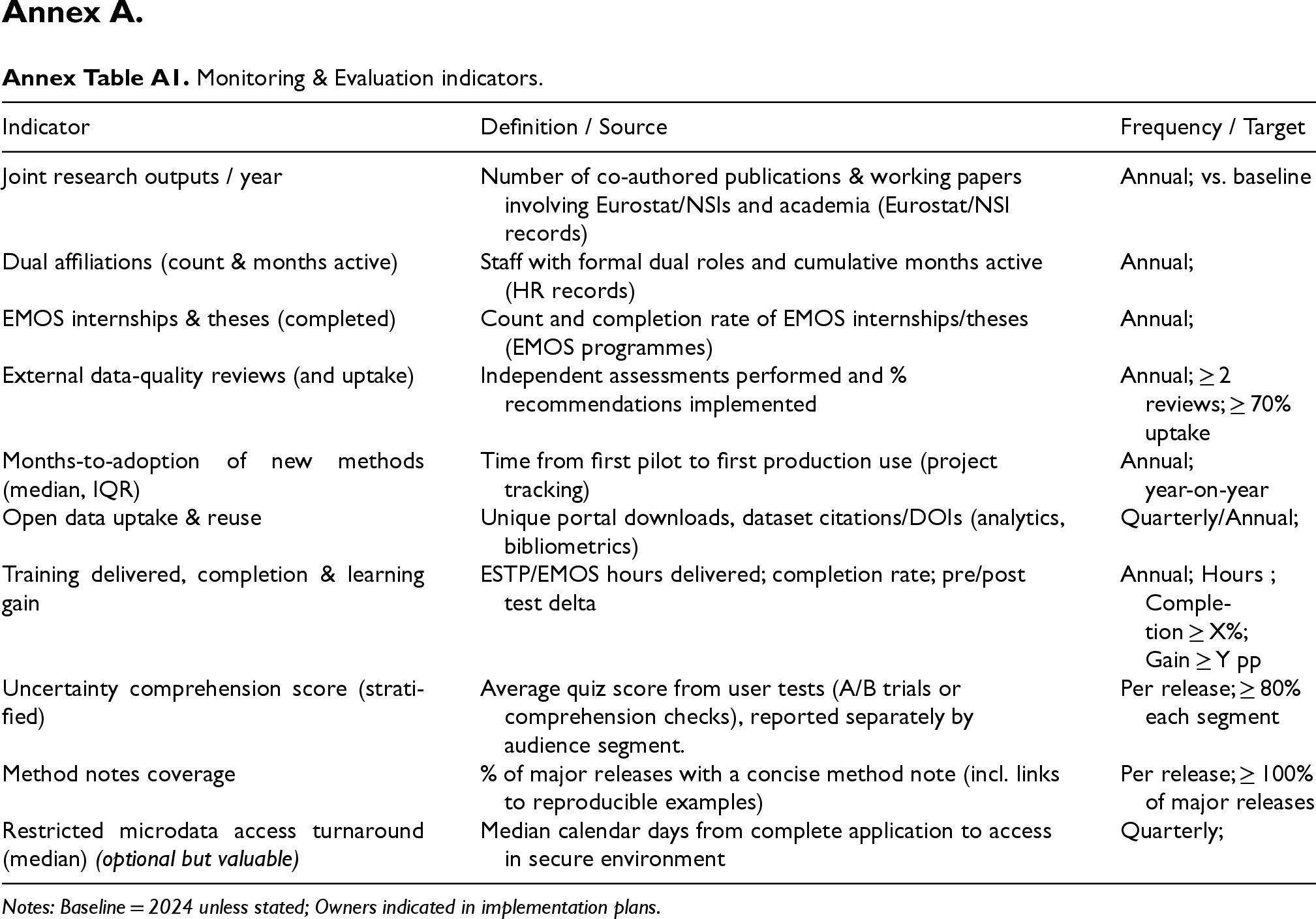
| Indicator | Definition / Source | Frequency / Target |
|---|---|---|
| Joint research outputs / year | Number of co-authored publications & working papers involving Eurostat/NSIs and academia (Eurostat/NSI records) | Annual; vs. baseline |
| Dual affiliations (count & months active) | Staff with formal dual roles and cumulative months active (HR records) | Annual; |
| EMOS internships & theses (completed) | Count and completion rate of EMOS internships/theses (EMOS programmes) | Annual; |
| External data-quality reviews (and uptake) | Independent assessments performed and % recommendations implemented | Annual; ≥ 2 reviews; ≥ 70% uptake |
| Months-to-adoption of new methods (median, IQR) | Time from first pilot to first production use (project tracking) | Annual; year-on-year |
| Open data uptake & reuse | Unique portal downloads, dataset citations/DOIs (analytics, bibliometrics) | Quarterly/Annual; |
| Training delivered, completion & learning gain | ESTP/EMOS hours delivered; completion rate; pre/post test delta | Annual; Hours ; Completion ≥ X%; Gain ≥ Y pp |
| Uncertainty comprehension score (stratified) | Average quiz score from user tests (A/B trials or comprehension checks), reported separately by audience segment. | Per release; ≥ 80% each segment |
| Method notes coverage | % of major releases with a concise method note (incl. links to reproducible examples) | Per release; ≥ 100% of major releases |
| Restricted microdata access turnaround (median) (optional but valuable) | Median calendar days from complete application to access in secure environment | Quarterly; |
Notes: Baseline = 2024 unless stated; Owners indicated in implementation plans.