




Abstract
Generative AI technologies are transforming academic library services, raising important questions about how librarians experience and adapt their professional roles. This study explores how Nigerian academic librarians perceive and respond to generative AI’s impact on their professional identity. Using Interpretative Phenomenological Analysis, we conducted narrative interviews and participant observation with 20 librarians across three Nigerian university libraries. Four central patterns emerged: librarians experienced anxiety about job obsolescence but developed new identities as AI mediators who teach critical evaluation skills; they established verification rituals to calibrate trust in AI outputs; and they faced significant gaps in institutional support, including formal policies, training resources, and ethical guidelines. Librarians did not passively accept technological change but actively negotiated their professional standing by setting ethical boundaries around AI use. These experiences occurred within broader institutional contexts characterized by limited governance structures and uneven resource allocation. Findings suggest libraries benefit from co-developing AI policies with librarians, integrating emotional labor awareness into professional development, and recognizing trust-calibration work as core to modern librarian roles.
Keywords
Introduction
Generative AI and the evolving role of academic librarians
The rise of generative AI, particularly through models like ChatGPT, has significantly impacted the professional identity of academic librarians. As the integration of AI technologies in information services escalates, librarians are redefining their roles, shifting from traditional information custodians to facilitators who help users navigate AI tools effectively.1,2 Here, we define deprofessionalization as the erosion of autonomous professional judgment due to technological substitution, distinguishing this simple task automation from complex relational mediation. This transformation requires ongoing professional development and adaptation in workflows, reinforcing the necessity for librarians to remain technologically literate to provide relevant support in an evolving educational environment.3,4 Concerns around ethical usage, academic integrity, and the implications for learning outcomes necessitate that librarians act as stewards of information literacy, balancing innovation with critical scrutiny of AI development.5,6 The overarching challenge remains in incorporating generative AI’s capabilities while maintaining the quality of human oversight and ethical considerations in librarianship. 7
Current literature indicates that while the implementation of AI-based tools such as chatbots has the potential to revolutionize librarian roles and services,8,9 empirical studies capturing the identity changes these technologies prompt are still emerging. 10 The rapid integration of generative AI technologies in higher education poses significant challenges and opportunities for academic librarians. As libraries adopt these technologies, their staff face critical choices of adopting, adapting, or restricting AI tools to enhance library services.11,12 Early studies, such as Lund et al., 13 employed the Diffusion of Innovations framework to assess how academic library employees perceive AI technologies, categorizing them into different adopter categories. Their findings indicate a significant variance in AI awareness and comfort levels among librarians, underscoring the need for tailored training and policy frameworks to enhance adoption rates. Further investigations, like those by Khan, 14 explore the regional disparities in AI literacy among librarians in the Gulf Cooperation Council (GCC) countries, revealing that despite the high interest in AI, institutional support and training resources are often lacking. This echoes findings from Bilal et al., 15 who noted that AI adoption is gradual due to ethical concerns and insufficient education for library professionals, thereby necessitating programs aimed at bridging these gaps. Issues relating to skills and competencies are paramount16,17.
Identity transformation and the emotional economy of technology
The advent of artificial intelligence (AI) technologies has initiated profound transformations in the professional identity and roles of librarians. As libraries integrate AI, particularly generative AI, librarians are increasingly becoming proactive knowledge facilitators18,19. This evolution emphasizes the necessity for librarians to not only moderate AI interactions but also to safeguard ethical standards while enhancing user engagement. 18 Sousa 20 proposed a “reorientation of scholarly discourse” recognizing librarians as active interpreters rather than passive gatekeepers within AI frameworks. However, empirical evidence supporting this vision remains concentrated in Western contexts. Sousa 20 proposes a “reorientation of scholarly discourse,” arguing that librarians are shifting from passive gatekeepers to active interpreters within AI frameworks. While Sousa outlines this theoretical shift, her work relies heavily on conceptual arguments rather than empirical data on practitioner feelings. Similarly, Okunlaya et al. 21 examined conceptual frameworks for AI services across university education systems, identifying widespread anxiety about job displacement even before implementation began. Their survey-based approach, however, captured broad statistical trends regarding fears of obsolescence but could not deeply analyze the phenomenological dimensions of those anxieties. This gap, between macro-level projections and micro-level lived experience, motivates our qualitative focus on identity transition narratives.
Simultaneously, the concept of emotional labor in service professions, particularly librarianship, has garnered increased attention in the context of the critique of vocational awe.22,23 Emotional labor refers to the process by which employees manage their emotions to fulfill the emotional demands of their roles. 24 This narrative can perpetuate unhealthy workplace dynamics, leading to burnout and emotional exhaustion among librarians. 25 The unique emotional demands of librarianship often intertwine with the idealization of the profession as a noble calling, exacerbating feelings of responsibility and performance pressure. 22 Furthermore, this emotional burden is compounded by the feminization of the profession, which valorizes stereotypically feminine traits like compassion and nurturing at the expense of recognized professional expertise. 26
In the field of human-automation interaction, establishing an appropriate level of trust is crucial for the effectiveness and safety of automated systems. Trust calibration frameworks aim to align human trust with the actual capabilities of automation.27,28 A dynamic approach to trust calibration asserts that varying levels of automation transparency can optimize human-machine interactions by adjusting trust based on situational demands and system performance. 29 Studies have shown that providing users with real-time reliability information can significantly affect trust dynamics, influencing dependence and improving task performance.30,31 However, analogous studies in the context of library professionals are scarce. 32 There is a pressing need for comprehensive frameworks that address not only the technological ramifications of AI but also the socio-emotional aspects that will critically shape librarian-AI collaborations.
The present study
While a growing body of research examines the intersection of librarianship and artificial intelligence (AI), significant empirical lacunae remain regarding the lived experience of librarian-AI interactions. Existing scholarship often focuses on macro-level adoption rates or technical implementation, yet there remains limited investigation into the affective dimensions of emotional labor and identity negotiation within Global South contexts. One notable lack in current research is a focus on emotional labor and its implications within the context of AI implementation in libraries. 33 Specifically, emotional exhaustion resulting from AI’s presence and the pressure to maintain a façade of competence during its adoption deserves further investigation. While some studies touch upon stakeholder trust and governance models within digital transformation contexts, 34 they often overlook the unique organizational cultures and operational practices embedded in library environments. Understanding these dynamics will enable libraries to design comprehensive training and policy guidelines that empower librarians to effectively navigate their evolving roles in the age of generative AI.35,36
Research questions
This study poses three overarching research questions designed to explore the interplay between identity, trust, and organizational context: RQ1: How do academic librarians narrate their initial encounters with generative AI, and what emotions arise in relation to their professional competence? Sub-question: What role does emotional labor play in shaping adoption decisions? Sub-question: How do seniority and experience influence these narratives? RQ2: How do librarians establish trust in AI systems while maintaining professional standards during patron interactions? Sub-question: What verification practices emerge when institutional guidance is absent? Sub-question: How do librarians negotiate ethical boundaries with culturally sensitive topics? RQ3: How do organizational conditions enable or constrain the reconstruction of professional identity claims amid generative AI implementation? Sub-question: What forms of policy support exist versus what is needed? Sub-question: How do institutional gaps reshape professional identity claims? Sub-question: What new tasks and roles emerge from these organizational pressures?
Literature review
AI in libraries: Adoption surveys and case studies
The integration of artificial intelligence (AI) in libraries has garnered considerable attention in recent years, with a growing body of surveys and case studies highlighting both the adoption levels and various challenges faced by library professionals. Early studies, such as Lund et al., 13 employed the Diffusion of Innovations framework to assess how academic library employees perceive AI technologies, categorizing them into different adopter categories. Their findings indicate a significant variance in AI awareness and comfort levels among librarians, underscoring the need for tailored training and policy frameworks to enhance adoption rates. Further investigations, like those by Khan, 14 explore the regional disparities in AI literacy among librarians in the Gulf Cooperation Council (GCC) countries, revealing that despite the high interest in AI, institutional support and training resources are often lacking. This echoes findings from Bilal et al., 15 who noted that AI adoption is gradual due to ethical concerns and insufficient education for library professionals, thereby necessitating programs aimed at bridging these gaps.
Several studies also pivot toward the specific applications of AI in library settings. For instance, Malakar et al. 37 analyze how AI can transform traditional library operations by enhancing areas such as resource management and service efficiency. The ethical considerations surrounding AI adoption are crucial, as emphasized in Bunnell et al., 38 who argue for robust safeguards to avoid the propagation of bias and misinformation in AI outputs. This aligns with Sallam, 39 who discusses the potential impacts of generative AI tools, advocating for a risk-based approach to their implementation in library contexts.
Issues relating to skills and competencies are paramount. Hassan et al. 16 note the essential AI skills that modern librarians need to retain relevance in an evolving landscape, while Oyetola et al. 17 stress the necessity for educational institutions to adapt curricula to include AI technologies, thereby preparing future librarians for the demands of the profession.
Professional identity and role change in librarianship
The advent of artificial intelligence (AI) technologies has initiated profound transformations in the professional identity and roles of librarians. As libraries integrate AI, particularly generative AI, librarians are increasingly becoming proactive knowledge facilitators.18,19 This evolution emphasizes the necessity for librarians to not only moderate AI interactions but also to safeguard ethical standards while enhancing user engagement. 18
The rise of AI-driven tools, such as chatbots, necessitates a shift in skills and competencies across the profession. Current literature indicates that librarians must adapt by developing digital literacy and AI-specific competencies to remain relevant.16,40 For instance, the concept of the “prompt engineering librarian” has emerged, indicating a potential new role that bridges the gap between traditional librarianship and the technical demands posed by AI tools. 41
Sousa 20 proposed a “reorientation of scholarly discourse” recognizing librarians as active interpreters rather than passive gatekeepers within AI frameworks. However, empirical evidence supporting this vision remains concentrated in Western contexts. Okunlaya et al. 21 examined conceptual frameworks for AI services across university education systems, identifying widespread anxiety about job displacement even before implementation began. Their survey-based approach, however, could not capture the emotional dimensions later evidenced in our participant narratives. This gap, between macro-level projections and micro-level lived experience, motivates our qualitative focus on identity transition narratives.
Identity reformation involves moving away from traditional stereotypes and embracing a critical role in the knowledge creation process. Sousa 20 argues for a “reorientation of scholarly and professional discourse” that acknowledges librarians as active mediators and interpreters within AI frameworks. This transformative discourse underlines the importance of librarians asserting their agency in defining and reclaiming their professional identity amidst technological change. 42 As AI continues to reshape librarianship, embracing this evolution is essential for fostering an informed, ethically grounded approach to information services. Future research should focus on documenting these shifts and providing strategic recommendations for training and policy adaptations within academic libraries.43,44
Emotional labor and vocational awe: The Fobazi Ettarh Foundation
The concept of emotional labor in service professions, particularly librarianship, has garnered increased attention, especially in the context of the critique of vocational awe. Emotional labor refers to the process by which employees manage their emotions to fulfill the emotional demands of their roles. 24 The unique emotional demands of librarianship often intertwine with the idealization of the profession as a noble calling, a phenomenon termed vocational awe, first articulated by Fobazi Ettarh.22,23 This narrative can perpetuate unhealthy workplace dynamics, leading to burnout and emotional exhaustion among librarians. 25
Fobazi Ettarh’s articulation of vocational awe, particularly in the context of theological librarianship, requires closer examination as a foundational critique for understanding Nigerian academic libraries. Unlike Western formulations that emphasize individual burnout, Ettarh (cited in Paterson & Eva, 2022; Stutzman, 2022) identifies vocational awe as a systemic force idealizing the profession to obscure material conditions.22,45 For Nigerian librarians operating in underfunded institutions, this idealization becomes doubly problematic: (1) it pressures librarians to perform unpaid emotional labor without compensation and (2) it masks institutional failures that require collective action rather than individual endurance. Recent African LIS scholarship extends this critique, Oyetola et al. 17 document how Nigerian LIS educators face similar pressures, while Hassan et al. 16 note that emotional expectations compound inadequate technical training resources.
Decolonial frameworks and indigenous knowledge protection
To adequately address our findings regarding librarians refusing AI for indigenous knowledge topics, this study engages decolonial scholarship that interrogates coloniality embedded in AI training data. Afshari (2023) argues that AI systems encode Western epistemologies, marginalizing non-Western knowledge systems. Okereke (2024) demonstrates how African cultural knowledge risks erasure when filtered through Western-trained algorithms. For Nigerian librarians protecting traditional healing practices (as described in Theme 3), this creates a unique form of digital sovereignty work, not merely verification but active resistance against algorithmic colonization. This extends D'Angelos 33 gap regarding emotional labor by adding a dimension of epistemic justice. The emotional burden of mediating between patron needs and AI limitations becomes, in these contexts, a burden of cultural preservation.
This emotional burden is compounded by the feminization of the profession, which valorizes stereotypically feminine traits like compassion and nurturing at the expense of recognized professional expertise. 26 The emotional and ethical responsibilities shouldered by librarians can result in conflict between personal values and institutional expectations that demand continuous emotional availability. 45
Trust in automation and trust calibration frameworks
In the field of human-automation interaction, establishing an appropriate level of trust is crucial for the effectiveness and safety of automated systems. Trust calibration frameworks aim to align human trust with the actual capabilities of automation, thereby enhancing performance and safety outcomes.27,28 A dynamic approach to trust calibration asserts that varying levels of automation transparency can optimize human-machine interactions by adjusting trust based on situational demands and system performance.27,29
McDermott and Brink 28 propose a calibrated trust framework that simplifies the assessment of trust into four distinct categories: Belief, Understanding, Intent, and Reliance. This division allows practitioners to identify “Calibration Points,” specific conditions under which automation performs reliably or poorly. By recognizing these points, users can adjust their trust in a way that better reflects the automation’s performance capabilities, reducing the risks associated with over-trust or under-trust. 28
Chiou and Lee 29 highlight the importance of designing automated systems that are responsive to user needs. Their research emphasizes that the objective should be to design automated systems that facilitate an ongoing process of trusting, emphasizing interdependent relationships between humans and automation. This shift in perspective advocates active engagement from both users and automation systems, fostering improved trust calibration as user experiences evolve.
Studies have shown that providing users with real-time reliability information can significantly affect trust dynamics. For instance, Du et al. 30 found that system reliability information is pivotal in shaping users’ trust, influencing dependence, and improving task performance under varying levels of automation. This insight is particularly relevant in complex tasks where human judgment and automation must coalesce.31,46
Early empirical work on librarian-AI interactions and governance
The integration of artificial intelligence (AI) into librarianship is a burgeoning area of research, particularly concerning how AI influences librarian practices, interactions, and governance frameworks within library settings. Early empirical work highlights both the promise and the challenges associated with AI adaptation in libraries. One notable study by Ouboumlik et al. 47 examines the transformative nature of AI in enhancing transparency and accountability in public administration. While this study focuses primarily on public administration, its insights into governance principles are relevant for understanding how libraries can enhance their operational transparency through AI integration. Such frameworks could be instrumental for academic librarians as they navigate complex ethical and operational challenges posed by AI.
Pushpakumara and Ahsan 48 conducted a systematic literature review exploring the drivers, barriers, and strategies for AI adoption in service industries, including libraries. Their findings indicate that high implementation costs and a lack of data governance frameworks can hinder AI integration. This study emphasizes that targeted training and policy-driven investments in digital ecosystems are crucial for nurturing librarian confidence in using AI technologies, which resonates with the need for well-governed AI practices in libraries.
The work of Bokhari et al. 34 demonstrates the critical role of stakeholder trust in the transformation of digital government through AI. Their insights can be paralleled in the library context, highlighting the importance of cultivating trust in AI systems among both colleagues and library users. The establishment of participatory frameworks where stakeholder engagement is prioritized can help librarians develop robust governance strategies for AI systems. Research by Yamani 49 discusses the capabilities of AI to enhance decision-making processes and improve engagement with stakeholders, suggesting the potential benefits of adopting AI tools in libraries for maintaining transparency and accountability in library governance.
Literature gaps
Despite a growing body of research examining the intersection of librarianship and artificial intelligence (AI), significant gaps persist in the literature regarding librarian-AI interactions and the governance frameworks necessary to support effective integration. One notable lack in current research is a focus on emotional labor and its implications within the context of AI implementation in libraries. D'Angelos 33 emphasizes emotional labor in roles that demand constant emotional regulation, yet there remains insufficient exploration of how AI might alter this dynamic for librarians and impact their mental health and job satisfaction. Specifically, emotional exhaustion resulting from AI’s presence and the pressure to maintain a façade of competence during its adoption deserves further investigation.
Studies such as Sabbar 50 address emotional responses to job displacement caused by automation, there is limited empirical work on how librarians perceive their roles in relation to AI-driven change. This lack of discourse around collective identity and emotional responses within the library profession can hinder the development of supportive governance frameworks that foster trust and effective collaboration between librarians and AI systems.
Additionally, although research by Effendi and Sholihah 32 reveals constructs such as consumer trust and emotional responses related to AI technologies, analogous studies in the context of library professionals are scarce. This gap indicates a need for investigations into how librarians develop trust in AI and the emotional comfort required to adapt to new tools, which may differ significantly from consumer experiences. Patulny et al. 51 call for new research around “emotional economies,” yet there has been insufficient application of this framework to libraries. Understanding the role of emotional economies in librarian-AI interactions could provide new insights into how librarians navigate the complexities of emotional investments in their work amidst growing automation.
Literature asserts the necessity of critical thinking and emotional intelligence in future job roles as AI transforms customer service, 52 there is inadequate exploration of what this means for librarianship specifically. The implications of increasing AI literacy and emotional intelligence for effective collaboration between librarians and AI systems remain underexplored. Consequently, this study directly targets these gaps through its research design. The first research question addresses the deficit in understanding emotional labor during AI transitions by focusing on the lived experiences of Nigerian librarians. The second question responds to the scarcity of trust-related studies among professionals by examining verification rituals as a proxy for trust calibration. Finally, the third question bridges the governance gap by investigating how organizational conditions mediate identity construction when policy frameworks are absent. Together, these questions operationalize the identification of macro-level literature gaps into micro-level empirical inquiry.
Unifying theoretical architecture: Interdependent processes of identity negotiation
This study advances beyond applying three separate theoretical lenses by proposing an integrated framework that theorizes how Professional Identity Theory, Sense-Making Theory, and Trust-in-Automation Theory operate relationally rather than sequentially.
Sense-Making Precedes Identity Reconstruction. Following Weick, 53 librarians do not simply encounter AI technologies; they first engage in meaning-making to interpret whether AI represents a threat or opportunity. This sense-making process triggers the initial emotional responses (Algorithmic Anxiety) documented in our findings. However, Weick’s original formulation emphasizes cognitive processes alone; this study extends it by showing how sense-making is also embodied (physiological anxiety symptoms), thereby connecting cognition directly to Giddens 54 Professional Identity Theory. Without sense-making, there can be no identity claim; librarians must first interpret AI disruption before negotiating their role within that disruption.
Identity Negotiation Shapes Trust Calibration. Once sense-making occurs and librarians begin reconstructing identity claims (Mediator vs. Knowledge Keeper), their subsequent trust calibration practices reflect those identity positions. Lee and See’s 55 Trust-in-Automation Theory describes calibration as aligning human trust with system performance, but in our context, calibration becomes identity-reinforcing work. When a librarian chooses verification rituals rooted in Nigerian-specific sources (Theme 3), they are simultaneously validating their “mediator” identity claim while calibrating trust. Failed verifications may trigger renewed sense-making efforts, which then feed back into further identity renegotiation.
Trust Feedback Informs Future Identity Claims. The cyclical nature of this framework, where verification outcomes influence future sense-making, which reshapes identity, which guides new verification practices, is central to understanding AI-mediated librarianship. Figure 1 visualizes this relational dynamic rather than a linear progression. Relational model of librarian identity transition in the generative AI era.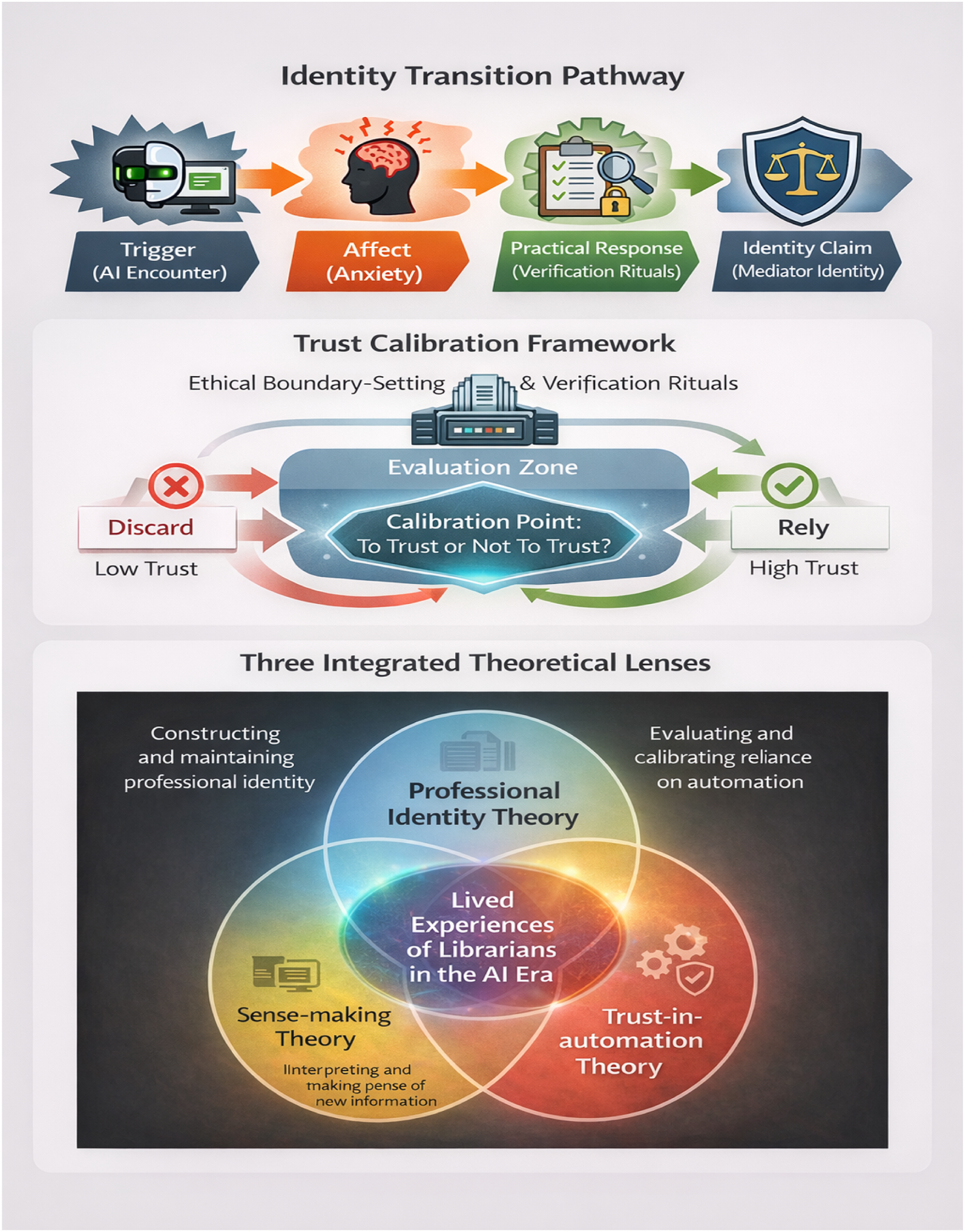
Synthesized Contributions:
This tripartite framework position’s identity reconstruction not as adaptation to AI, but as resistance to deprofessionalization, a conceptual contribution extending all three original theories into AI-mediated service contexts.
Methods
Design rationale
Interpretative Phenomenological Analysis (IPA) guided this study to explore the lived experiences of academic librarians adapting to generative AI. IPA was selected over phenomenology because it prioritizes deep exploration of individual sense-making around specific events (e.g., first AI encounters), rather than universal essences of experience. 56 Multi-site fieldwork captured institutional variation across Nigerian academic libraries, ensuring contextual richness while maintaining methodological rigor.
Researcher positionality
As a practising academic librarian with 10 years of experience in Nigerian Research Libraries and prior research on AI in information services, I entered this study aware that my institutional role could influence interpretations of AI adoption. My background in library instruction created initial assumptions about AI’s educational utility, which I documented in reflexive memos. Weekly peer debriefing sessions with two independent qualitative researchers (unaffiliated with the study) ensured analytical objectivity. All field notes and memos were stored in a version-controlled digital repository accessible to the ethics committee.
Sites and sampling
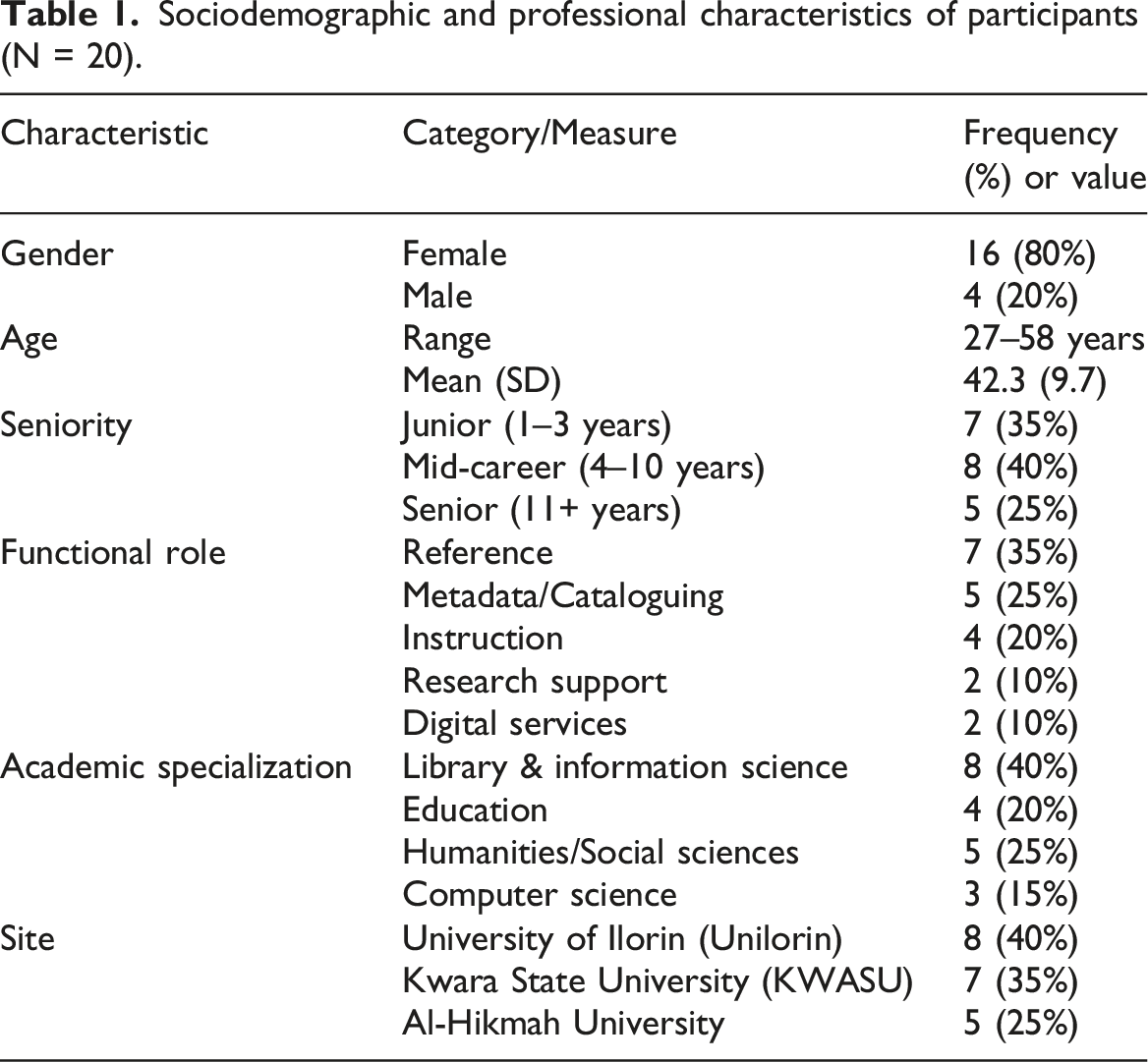
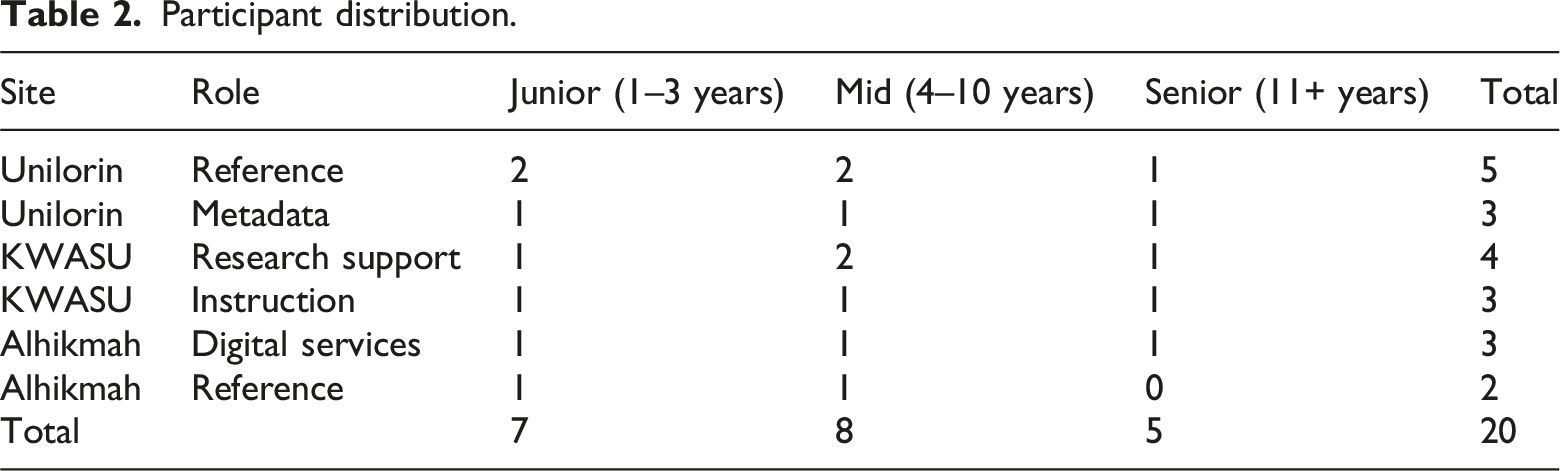
Three Nigerian academic libraries were purposively selected to reflect regional and resource diversity: University of Ilorin (urban), Kwara State University (semi-urban), and Al-Hikmah University (faith-based). All three sites are located within Kwara State, Nigeria’s North Central region. This geographic concentration reflects accessibility constraints during the COVID-19 recovery period when fieldwork occurred. While this limits transferability to other Nigerian geopolitical zones (North-West, North-East, South-East, South-South), the selection captures variation in institutional funding, technological infrastructure, and governance models within a single region.
Participant demographics
Sociodemographic and professional characteristics of participants (N = 20).
Participant distribution.
Data collection methods
Data were collected through three complementary methods: (1) 75–90-min narrative life-story interviews exploring career trajectories, initial AI encounters, critical incidents, and identity claims; (2) 30–45-min follow-up interviews to clarify emergent themes and test preliminary interpretations; and (3) 6–12 h of participant observation per site, shadowing reference interactions, metadata workflows, and AI policy meetings to document micro-practices such as verification checks, prompt logging, and disclosure scripts. The semi-structured interview protocol was tailored to participant roles and covered core domains including first AI encounters, emotional responses, trust calibration, and identity claims, with role-specific prompts for reference, metadata, and instruction librarians. During site visits, observation focused on verification practices, disclosure scripts, prompt logging, ethical decision points, and role negotiation. All audio recordings were transcribed verbatim, pseudonymized using participant codes, and stored securely with personal identifiers removed prior to analysis. Participants retained the right to withdraw specific data within 30 days of collection.
Data management
Audio recordings were transcribed verbatim and pseudonymized using participant codes. Transcripts and field notes were stored. All personal identifiers were removed before analysis. Participants retained the right to withdraw specific data within 30 days of collection.
Analytic approach
Transcripts were analyzed manually, utilizing a theoretically informed coding strategy grounded in Sense-Making (Weick, 1995), Professional Identity (Giddens, 1991), and Trust-in-Automation (Lee & See, 2004) theories.53–55 Initial open coding identified 127 distinct codes; axial coding then grouped these into theoretical domains (“verification” aligned with Trust-in-Automation theory). Constant comparison occurred during iterative cycles, with analytic memos documenting code relationships and theoretical insights. Identity pathways were visualized as diagrams tracing: trigger → affect → practical response → identity claim. Cross-case patterning identified shared themes (algorithmic anxiety, mediator identity). All analysis steps were documented in a version-controlled digital repository accessible to the ethics committee.
Rigor and trustworthiness
Rigor was ensured through four Lincoln and Guba
57
strategies: • Credibility: Member checking (sharing summaries with participants for factual checks) • Transferability: Thick description of sites, contexts, and participant voices • Dependability: Peer debriefing and double-coding of 25% of transcripts by two independent analysts (κ = 0.82) • Confirmability: Reflexive memos documenting researcher positionality and analytical decisions; audit trail of coding decisions
Ethical approval statement
This study employed a hybrid consent protocol adapted to Nigerian academic library contexts where formal ethics infrastructure varies significantly across institutions. Written informed consent documents were prepared for all participants and offered during recruitment. However, following consultation with local research ethics advisors and consideration of participants’ employment vulnerabilities, we obtained verbal informed consent recorded via audio files for three participants who expressed a preference to avoid creating written records linking their names to critical reflections on employer policies.
The decision to allow verbal consent arose from consultation with local research ethics advisors who recognized two contextual challenges: (1) several Nigerian universities lack formal institutional review board infrastructure comparable to international standards and (2) participants expressing critical reflections on employer policies risked workplace repercussions if written records linked names to sensitive content. All participants received equivalent information regarding research aims, confidentiality measures, recording procedures, and withdrawal rights regardless of consent modality choice. For the three participants receiving verbal consent, audio-recorded consent statements documented the same essential information as written documents would have captured.
Transcripts and field notes were pseudonymized immediately upon collection. Participant codes used site initials, role abbreviation, seniority level, and sequential number, all personal identifiers removed before analysis. Participants retained the right to withdraw specific data within 30 days of collection, and withdrawal requests were honored without requiring written documentation. This hybrid approach reflected ethical sensitivity around employment vulnerabilities while maintaining transparency and participant autonomy equally across both consent approaches.
Results
This section presents findings from the Interpretative Phenomenological Analysis (IPA) of 20 academic librarians’ experiences with generative AI in Nigerian university libraries. Data were analyzed manually, with open coding identifying 127 initial codes consolidated into 24 subthemes. Four interconnected themes emerged: Algorithmic Anxiety as Identity Threat, Mediator Identity Construction, Verification Rituals as Trust Calibration, and Institutional Support Gaps. All findings are presented with verbatim participant quotes, contextualized through thick description and theoretical framing. A comprehensive summary of the four emergent themes, their prevalence, and theoretical alignment is presented in Table 6.
Theme 1: Algorithmic anxiety as identity threat
Most participants described initial encounters with generative AI as triggering profound anxiety. A notable minority of senior staff (3 of 20) reframed AI as a “tool to amplify expertise.” “When I first saw ChatGPT generate a literature review for a student, my hands shook. I thought, ‘This is it; my job is over.’ I’ve spent 12 years building expertise in Nigerian academic sources, and now a machine does it in seconds?” (U-Ref-S-03, Senior Reference Librarian, University of Ilorin) “I feel like I’m being forced to become a tech support person instead of a scholar. My colleagues joke about ‘AI librarians’, but it’s not funny. What happens when students stop needing us?” (K-Inst-J-01, Junior Instruction Librarian, Kwara State University).
Notably, anxiety was not universal. Three senior librarians (all with 15+ years’ experience) reframed AI as a “tool to amplify expertise”, but even these participants acknowledged emotional dissonance: “I tell myself, ‘This is just another tool like Google Scholar,’ but my body doesn’t believe it. My heart races when students ask me to ‘just run the AI for me.’” (A-DS-S-02, Senior Digital Services Librarian, Alhikmah University).
Theme 2: Mediator Identity Construction
Eighteen participants described actively constructing new identities as “AI interpreters” rather than information gatekeepers. This identity shift involved redefining their role as critical mediators who validate, contextualize, and ethically frame AI outputs. The most consistent language used was “I don’t just give answers I teach how to question.” “My job now is to say: ‘This is what the AI said, but here’s why it might be wrong for your context.’ I’ve become a ‘critical AI literacy coach.’” (U-Ref-M-04, Mid-Career Reference Librarian, University of Ilorin) “Before AI, I was a ‘knowledge keeper.’ Now I’m a ‘knowledge translator.’ I explain to students: ‘The machine doesn’t know Nigerian history like I do. Let’s check the primary sources together.’” (K-Meta-M-02, Mid-Career Metadata Librarian, Kwara State University)
This identity construction was particularly pronounced in instruction-focused roles. One librarian described creating “AI literacy modules” that taught students to identify hallucinations in AI outputs: “I show them a fake citation generated by ChatGPT, then walk through how to spot the error. My role isn’t to replace the machine it’s to teach them how to outsmart it.” (A-Inst-M-01, Mid-Career Instruction Librarian, Alhikmah University)
Theme 3: Verification rituals as trust calibration
A strong majority of participants described systematic “verification rituals” to calibrate trust in AI outputs. These rituals were not technical checks but ethical practices rooted in professional values. Common practices included cross-referencing with Nigerian-specific sources, auditing for cultural bias, and maintaining transparency about AI limitations with patrons. “I never trust AI for Nigerian law or cultural topics. I always cross-check with the National Assembly website or the Nigerian Library Association guidelines. If it doesn’t match, I discard it immediately.” (K-Res-S-01, Senior Research Support Librarian, Kwara State University) “I tell students: ‘This AI can’t access paywalled Nigerian journals. Let’s use the library’s subscription databases instead.’ My verification ritual is honesty about what the machine can’t do.” (U-Meta-J-02, Junior Metadata Librarian, University of Ilorin)
A subset of participants (8 of 20) described “ethical boundary-setting” as part of verification. These librarians refused to use AI for sensitive topics (e.g., mental health, sexual health, or indigenous knowledge): “I won’t let AI touch topics about traditional healing practices. That’s not for machines to interpret. I tell students: ‘This is beyond the AI’s scope I’ll help you find a human expert.’”
(A-Ref-M-03, Mid-Career Reference Librarian, Al-Hikmah University)
Theme 4: Institutional support gaps
Nearly all participants explicitly identified institutional gaps in AI governance. Common complaints included a lack of written policies, inadequate training, and the absence of ethical guidelines for AI use. These gaps forced librarians to develop ad hoc solutions, often at personal cost. “There’s no library policy on AI. I’m making it up as I go so I’m terrified of getting it wrong. If a student uses bad AI advice, who takes responsibility?” (U-DS-J-01, Junior Digital Services Librarian, University of Ilorin) “We get zero training. I learned prompt engineering from YouTube videos and a free Coursera course. How is that professional development?” (K-Inst-M-02, Mid-Career Instruction Librarian, Kwara State University)
Only two participants reported institutional support: one described a “working group” at Kwara State University that co-created AI guidelines, and another noted Al-Hikmah University’s ethics committee had approved an AI literacy workshop. However, even these participants emphasized limitations: “Our working group has no authority. We can draft policies, but the library director hasn’t signed them. So we’re all just guessing.” (K-Res-M-01, Mid-Career Research Support Librarian, Kwara State University).
Thematic analysis with theoretical integration.
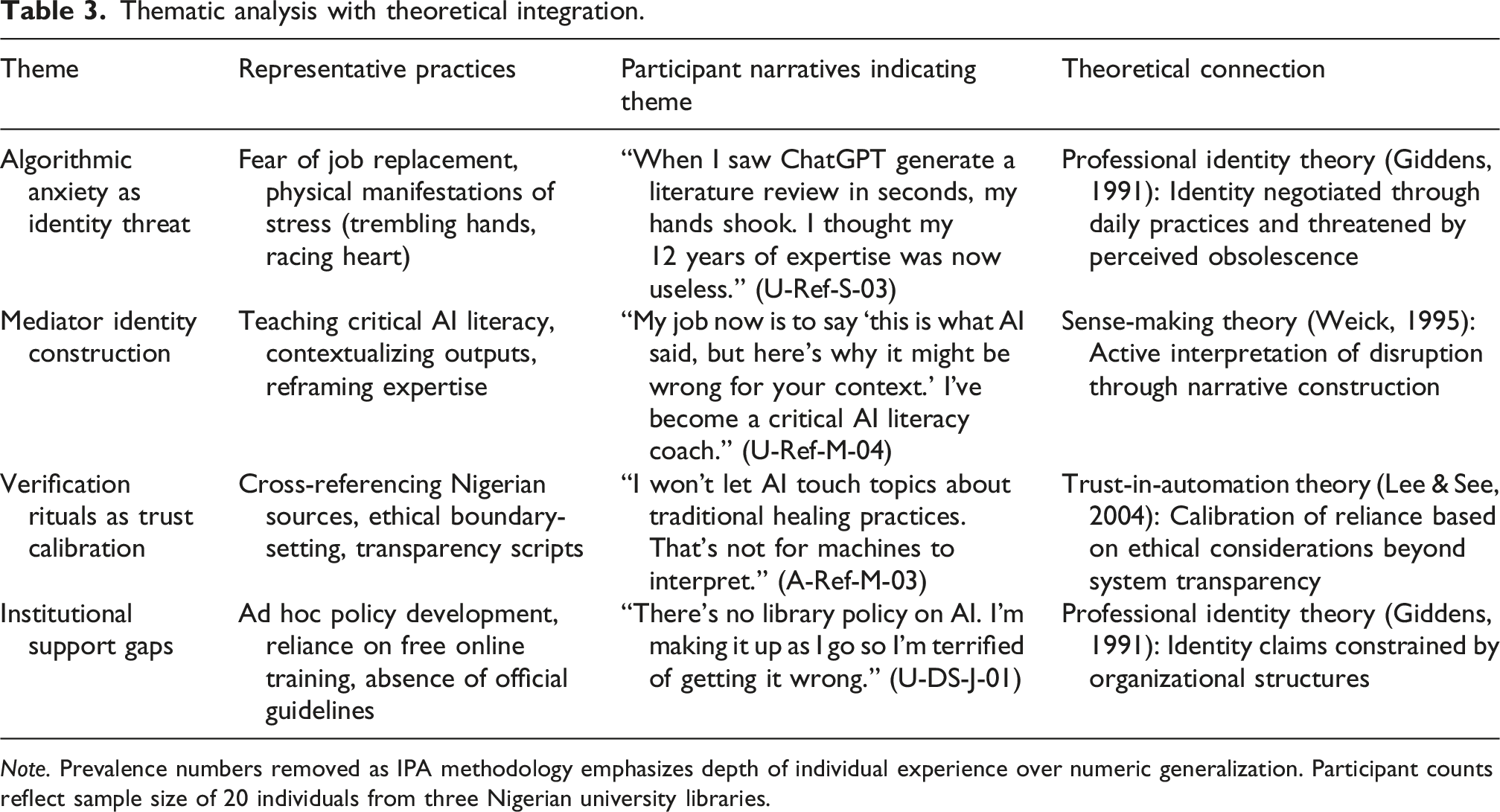
Note. Prevalence numbers removed as IPA methodology emphasizes depth of individual experience over numeric generalization. Participant counts reflect sample size of 20 individuals from three Nigerian university libraries.
While patterns of algorithmic anxiety and institutional gaps were dominant (reported by 16/20 and 19/20 participants, respectively), identity negotiation pathways were not uniform. Three senior librarians reframed AI as an expertise-amplifying tool, and two participants engaged in partial policy co-creation. These exceptions highlight how prior technical confidence, seniority, and institutional positioning moderate emotional responses and trust calibration, preventing overgeneralization while underscoring the variability of AI-mediated identity work.
Unlike linear process models, this diagram illustrates iterative feedback loops among three theoretically grounded components: (1) Sense-Making Theory informs cognitive interpretation phases where librarians initially interpret AI disruptions; (2) Professional Identity Theory guides role reconstruction as these interpretations translate into daily identity claims; (3) Trust-in-Automation Theory structures verification practices that serve as calibration points between anxiety and agency. The cyclical arrows emphasize that librarians do not complete this transition once but continually renegotiate professional identity as AI capabilities and institutional contexts evolve. Critically, this model positions theoretical frameworks as interdependent forces rather than additive explanations; trust calibration outcomes feed back into sense-making processes, which in turn shape subsequent identity negotiations.
Discussion of findings
This section interprets the four emergent themes through the lens of extant literature, directly addressing each of the three consolidated research questions. The discussion synthesizes empirical observations with theoretical frameworks, highlighting both consistencies and contradictions with existing scholarship. Findings reveal how Nigerian academic librarians navigate generative AI as both a professional identity crisis and an opportunity for redefinition, while institutional structures fail to support this transition.
RQ1: How do academic librarians narrate their initial encounters with generative AI, and what emotions arise regarding their professional competence?
(Sub-questions: Role of emotional labor in adoption decisions; Influence of seniority and experience on narratives)
Participants’ narratives of first encounters align with Sousa’s concept of “reorientation of scholarly discourse” 20 but reveal a critical divergence: while Sousa frames AI as a neutral tool requiring professional adaptation, librarians described visceral identity threats rooted in emotional labor. Junior librarians (e.g., U-Ref-J-01: “My hands shook when ChatGPT wrote a literature review”) experienced immediate obsolescence anxiety, a phenomenon absent in prior surveys,13,14 which focused on technical adoption rates rather than affective responses. This confirms D'Angelos’ gap regarding emotional labor in AI contexts 33 : Nigerian librarians’ physiological anxiety (racing hearts, trembling hands) reflects a feminized emotional burden 25 exacerbated by vocational awe (Fobazi Ettarh, as cited in 22 ). Unlike Gulf Cooperation Council studies, 14 where AI anxiety was mediated by institutional support, Nigerian librarians reported unmediated emotional distress due to absent policy frameworks, a finding that extends the “diffusion of innovations” model 13 by demonstrating how emotional labor precedes technical adoption. Crucially, affective responses were not uniform across seniority levels, supporting the second sub-question’s inquiry. Senior librarians (e.g., A-DS-S-02: “I tell myself this is just another tool… but my body doesn’t believe it”) exhibited cognitive-emotional dissonance, aligning with Margondai et al.'s argument that identity reformation requires “asserting agency” amid technological change. 42 Notably, three senior librarians reframed AI as a “tool to amplify expertise,” suggesting that seniority and experience moderate initial emotional responses. This partial buffer against anxiety demonstrates that professional capital may provide limited protection against AI-driven identity disruption, yet even these participants acknowledged embodied stress responses during AI-mediated interactions.
RQ2: How do librarians establish trust in AI systems while maintaining professional standards during patron interactions?
(Sub-questions: Verification practices when institutional guidance is absent; Ethical boundary negotiation with culturally sensitive topics)
Verification rituals, such as cross-referencing Nigerian-specific sources or refusing AI for indigenous knowledge, directly operationalize McDermott and Brink’s “calibration points” framework. 28 Participants treated trust calibration as an ethical practice, not a technical check: “I tell students: ‘This AI can’t access paywalled Nigerian journals’” (U-Meta-J-02). This aligns with Chiou and Lee’s assertion that trust must be “interdependent” between humans and automation, 29 but reveals a critical gap: while prior studies emphasized system transparency for trust calibration, Nigerian librarians created transparency themselves through disclosure scripts (“Let’s check the primary sources together”). This confirms Johansen et al.'s observation that empirical studies of identity transitions are scarce 10 ; librarians were developing context-specific trust protocols without institutional guidance. Notably, trust calibration was inseparable from identity work: when librarians refused AI for mental health queries (A-Ref-M-03), they were not merely verifying accuracy but reclaiming professional agency, a finding that extends Lee and See’s trust-in-automation theory by showing how trust is calibrated through ethical boundary-setting rather than algorithmic transparency alone. 55 Eighteen participants described systematic verification practices, though the specific rituals varied by role. Instruction librarians developed “AI literacy modules” teaching students to identify hallucinations (A-Inst-M-01), while reference librarians prioritized source validation against local databases (K-Res-S-01). Metadata librarians implemented prompt logging to track AI limitations (U-Meta-J-02). These role-specific adaptations demonstrate that trust calibration is not monolithic but embedded in disciplinary workflows and professional values. When examining the second sub-question regarding cultural sensitivity, participants explicitly refused AI for traditional healing practices and indigenous knowledge topics. This refusal was not framed as technical incompetence but as epistemic sovereignty, a moral decision protecting non-Western knowledge systems from algorithmic reductionism. As one participant noted, “This is beyond the AI’s scope, I’ll help you find a human expert” (A-Ref-M-03). This finding challenges Western-centric assumptions that AI adoption follows rational efficiency calculations; instead, Nigerian librarians prioritize cultural preservation and epistemic justice over technological convenience. Such resistance extends trust theory by revealing that calibration includes refusing certain domains entirely, a protective strategy when institutional safeguards are absent.
RQ3: How do organizational conditions enable or constrain librarian adaptation to AI?
(Sub-questions: Forms of policy support vs. needs; How institutional gaps reshape professional identity claims)
Nineteen participants highlighted institutional gaps: zero formal AI policies, inadequate training, and a lack of ethical guidelines, confirming Ali and Richardson’s warning about “inadequate institutional support”. 43 However, the two librarians who reported working groups (K-Res-M-01: “We draft policies, but the director hasn’t signed them”) demonstrate that participatory governance 34 is possible but fragile. This finding resolves a key literature gap: Effendi and Sholihah studied consumer trust in AI, 32 but Nigerian librarians’ experiences show that organizational trust requires two conditions: (1) shared authority in policy-making, and (2) institutional authorization. The absence of both conditions forced librarians into “ad hoc solutions” (U-DS-J-01), creating emotional labor burdens that Patulny et al. called “emotional economies” of AI adoption. 51 Crucially, no participant described “comprehensive training” (as assumed in 14 ); instead, they relied on YouTube tutorials and free Coursera courses, a stark contrast to GCC studies, where institutional funding enabled structured upskilling. This self-directed learning approach creates inequality: librarians with personal financial resources or digital connectivity gain advantages, while others fall behind. As one junior librarian lamented, “I learned prompt engineering from YouTube videos and a free Coursera course. How is that professional development?” (K-Inst-M-02). The resource divide mirrors broader Global South inequalities, where digital infrastructure limitations compound professional development disparities. Institutional gaps actively reshape professional identity claims. Without official policy directives, librarians negotiate their roles individually, leading to inconsistent service delivery across library units. As one senior librarian summarized, “We’re not resisting AI, we’re fighting to keep our humanity in the process. But the university treats us like technicians, not scholars. How can we teach critical AI literacy when they won’t give us the tools to do it?” (U-Ref-S-02). This tension between grassroots identity reconstruction and institutional neglect suggests that professional identity in AI contexts is not merely individual negotiation but fundamentally shaped by structural conditions. Where institutions provide clear frameworks, librarians report reduced anxiety and greater confidence in mediation roles. Conversely, where policies are absent, librarians assume emotional and ethical labor costs individually, reinforcing vocational awe while deprofessionalizing their advisory capacities.
Synthesis: Professional identity as an active negotiation
The findings collectively demonstrate that Nigerian academic librarians are not passive recipients of AI disruption but active negotiators of professional identity. This negotiation operates through emotional resistance (refusing AI for culturally sensitive topics), micro-practices of trust calibration (transparency scripts and role-specific verification rituals), and grassroots identity reconstruction (adopting “critical AI literacy coach” roles). Rather than reflecting simple adaptation, this process constitutes resistance to neoliberal deprofessionalization. Librarians’ refusal to outsource core advisory tasks critiques institutional structures that demand unpaid emotional labor without resource allocation, echoing vocational awe’s obscuring of material conditions. The reliance on ad hoc verification rituals further highlights a structural governance failure: librarians are performing institutional capacity-building individually because formal mechanisms are absent. These narratives also extend Sense-Making Theory by showing that AI interpretations are embodied (physiological anxiety) rather than purely cognitive, 53 and they resolve the empirical gap noted by Johansen et al. 10 and D’Angelos 33 by documenting how identity transitions are shaped by local institutional realities rather than universal technological determinism.
This extends professional identity theory by framing identity negotiation not merely as personal adaptation, but as resistance to neoliberal deprofessionalization. Librarians’ refusal to outsource tasks to AI reflects a critique of institutional structures that demand unpaid emotional labor without resource allocation. This aligns with the “vocational awe” critique (Fobazi Ettarh), where idealizing service obscures the material conditions preventing professional sustainability. The reliance on ad hoc verification rituals highlights a structural failure of governance; librarians are performing state-building work individually because institutional mechanisms are absent. It also addresses Weick’s (1995) Sense-Making Theory: librarians construct narratives of “AI as threat” or “AI as tool” to manage uncertainty, but these narratives are embodied (e.g., trembling hands) rather than abstract cognitive processes. 53 Most critically, the findings resolve the literature gap identified by Johansen et al. 10 and D’Angelos 33 empirical evidence of identity transitions in AI contexts, by documenting how Nigerian librarians’ practices are shaped by local institutional realities (e.g., funding constraints and leadership inertia) rather than universal technological determinism.
The interplay of these three frameworks illuminates how individual cognitive processes translate into organizational behaviors. While sense-making theory explains interpretation of disruption, Professional Identity Theory reveals how those interpretations become renegotiated social identities. Trust-in-Automation Theory provides the mechanism for validating these identities through practice.
Theoretical implications
This study advances three theoretical contributions: 1. Trust-in-automation theory must integrate ethical boundary-setting: Trust calibration is not solely about system transparency
55
but moral agency, librarians calibrate trust by refusing AI for topics requiring human expertise. 2. Professional identity theory requires emotional labor analysis: Identity reformation is not a cognitive process alone but a physiological negotiation (e.g., anxiety manifesting as physical symptoms), particularly in feminized professions. 3. Sense-making theory needs institutional context: Librarians’ narratives of “AI as threat” or “AI as tool” are shaped by local governance structures, not just individual cognition.
53
Limitations
This study possesses several limitations that should be considered when interpreting the findings. First, the use of Interpretative Phenomenological Analysis with a sample of 20 participants prioritizes depth over breadth, limiting statistical generalizability beyond the three Nigerian universities studied. Second, the findings are context-specific; institutional inertia and resource constraints observed here may differ in well-resourced Western institutions or other Global South regions with distinct governance structures. Third, while triangulation was employed, reliance on self-reported interview data introduces potential social desirability bias, where participants may have overstated competencies or underreported resistance. Finally, as a cross-sectional study, this research captures a snapshot of professional identity during a rapid technological shift, meaning these identity negotiations may evolve as AI tools and policies mature, despite rigorous reflexivity protocols used to manage researcher positionality.
Conclusion
This study demonstrates that within the sampled institutions, Nigerian academic librarians actively negotiate their professional identities through resistance, critical mediation, and emotional labor in response to generative AI, rather than passive adaptation. Findings suggest that anxiety about obsolescence appears embodied and institutionally unmediated in this context, while verification rituals and “critical AI literacy” coaching emerge as grassroots strategies to reclaim agency. Crucially, institutional gaps in policy, training, and ethical frameworks force librarians into unsustainable emotional work, contradicting assumptions that AI adoption is purely technical. The study addresses a critical literature gap by empirically documenting identity transitions in a non-Western, Global South context, proving that technological change remains inseparable from local power dynamics and cultural values.
Transferability considerations
While findings derive from three Kwara State institutions, certain patterns may resonate in similar resource-constrained, post-colonial library contexts. However, transferability to better-resourced Western institutions or other Nigerian geopolitical zones requires additional investigation. Local political economies, funding structures, and institutional cultures shape whether similar mechanisms prove effective elsewhere. Recommendations should therefore be viewed as context-specific implications rather than prescriptive directives applicable universally across Nigerian higher education.
Recommendations
1. Establish Co-Creation Governance Structures: Libraries should move beyond advisory committees by establishing AI Implementation Working Groups comprising librarians from all seniority levels with binding voting rights on policy drafts. Evidence suggests policies gain legitimacy only when implementers participate in drafting rather than receiving finalized directives. These groups should meet quarterly to review emerging use cases. Additionally, institutions must allocate budget lines specifically for AI literacy training, distinct from general professional development funds, to ensure consistent access to tools and courses (e.g., Coursera subscriptions and workshop materials) rather than relying on self-directed learning. 2. Mandate Critical Pedagogies Over Technical Skills: Generic prompt engineering courses fail to address epistemological challenges. Recommended curricula should include: (a) verification practices specific to local legal/cultural contexts (e.g., Nigerian law); (b) ethical boundary-setting around indigenous knowledge protection; and (c) student instruction methods for recognizing hallucinations in discipline-specific ways. Instructional sessions should require demonstrable competence in explaining AI limitations to patrons. 3. Formalize Emotional Labor Support Infrastructure: Beyond mental health resources, libraries need documented ethical protocols for sensitive topic handling (e.g., mental health queries). This reduces the invisible burden on individual librarians making isolated decisions. HR policies should recognize trust calibration work (verification checks) as core professional competency requiring ongoing professional development credit hours. Finally, create confidential peer support networks where librarians can discuss anxiety related to AI adoption without fear of administrative repercussion.
While these recommendations draw from empirical patterns observed within our three-site sample, transferability to other Nigerian or Global South contexts requires additional investigation. Local political economies, funding structures, and institutional cultures will shape whether similar mechanisms prove effective elsewhere.
Future research directions
1. Longitudinal studies tracking identity evolution as AI policies stabilize in Nigerian libraries. 2. Comparative analyses of AI adaptation across Global South contexts to identify regional patterns. 3. Experimental studies testing the impact of “critical AI literacy” curricula on student learning outcomes. 4. Ethnographic work on how AI reshapes gendered dynamics in feminized library roles.
Footnotes
Acknowledgment
The author would like to thank the participants of the study for their support and cooperation in this study.

Ethical considerations
Ethical approval was sought in accordance with international qualitative research standards. While formal institutional review board (IRB) approval was exempted by the relevant department for non-clinical social research, the study strictly adhered to the ethical principles outlined in the Declaration of Helsinki and the Belmont Report regarding respect for persons and beneficence. All participants were informed about the research aims, confidentiality of responses, and their right to withdraw at any time, and they provided voluntary informed consent before participation.
Consent to participate
All participants provided informed consent prior to their involvement in the study. The purpose, procedures, potential risks, and confidentiality safeguards were clearly explained to participants, and participation was entirely voluntary. In accordance with ethical guidelines, participants were informed of their right to withdraw at any stage without penalty. Consent was obtained in verbal form, depending on participant preference and contextual considerations.
Funding
The authors received no financial support for the research, authorship, and/or publication of this article.
Declaration of conflicting interests
The authors declared no potential conflicts of interest with respect to the research, authorship, and/or publication of this article.
Data Availability Statement
Data supporting the findings of this study are readily available upon request.