



Abstract
Metaverse technology integration in public libraries offers revolutionary possibilities to improve information availability, user engagement, and interactive learning. This study carefully evaluates current literature to examine the hurdles, potential, and future directions of metaverse adoption in public libraries. The study used seven database sources – ProQuest Dissertations and Theses Global, IEEE Xplore, ACM Digital Library, Google Scholar, Web of Science, Scopus, and Library, Information Science & Technology Abstracts (LISTA). The study was conducted between 2015 and 2025 and publication type included are book chapters, conference proceedings, and peer-reviewed journal papers were given preference. The inclusion criteria include studies that examined the best practices, policies, opportunities, and obstacles associated with the implementation of the metaverse in libraries; comprehensive literature reviews, empirical research published in respectable peer-reviewed journals, conference proceedings, or edited volumes, as well as studies using quantitative, qualitative, or mixed approaches, were all taken into consideration. However, the study excluded studies that had no bearing on public libraries and only addressed academic or special libraries. The report lists the advantages of metaverse technology, such as improved digital collections, cutting-edge service delivery methods, and immersive virtual learning environments. It also examines programs, rules, and best practices that have been put in place worldwide to facilitate the integration of the metaverse into public library environments. Despite these developments, a number of obstacles prevent broad acceptance, including high implementation costs, technological constraints, a lack of digital literacy, and moral dilemmas related to security and privacy. The report also discusses ways to make the most of metaverse technology, highlighting the necessity of cooperative policy frameworks, training in digital skills, and infrastructure development. According to research, metaverse technologies have the potential to completely transform library services, but to ensure fair access, a systematic and inclusive strategy is necessary. The study adds to the expanding conversation on digital transformation in public libraries by providing useful information for scholars, policymakers, and library workers. It highlights the need for more empirical research to evaluate the practical uses of metaverse technologies across diverse socioeconomic and cultural contexts. Cost–benefit analysis, ethical issues, and the potential of AI to improve metaverse-based library services should be the main topics of future studies. Public libraries can fully utilise metaverse technologies to remain influential, relevant, and accessible in the digital age by addressing three key issues.
Keywords
Introduction
Public libraries are among the many industries that have seen significant change as a result of the quick development of digital technologies. The metaverse, a virtual, networked digital world made possible by technologies like blockchain, augmented reality, virtual reality, and artificial intelligence (AI), has attracted a lot of interest among these new developments. 1 The metaverse has the potential to revolutionise library services by providing immersive educational opportunities, increasing user engagement, and making it easier to access a wealth of digital resources outside of physical boundaries. Nevertheless, despite its potential, incorporating metaverse technology into public libraries offers a complicated environment with many opportunities, challenges, and potential paths that need to be carefully considered. 2
In order to stay relevant in the digital age, public libraries have long been hubs for community involvement and the sharing of knowledge, adjusting to changes in technology. 3 Digital exhibitions that transcend geographic boundaries, interactive archives, and virtual storytelling are just a few of the innovative methods that the metaverse presents libraries to engage with their patrons. 4 However, there are several obstacles to the widespread adoption of metaverse technologies, including limited infrastructure, budgetary constraints, limited digital literacy, and concerns about data security and privacy. 5 The digital divide is still a major problem, especially in underdeveloped nations where participation in virtual spaces is restricted by a lack of high-speed internet and sophisticated computing hardware. 6
The metaverse’s capacity to promote accessibility and diversity is one of the main advantages it offers public libraries. Libraries can promote equitable access to information by providing services to marginalised communities, remote learners, and clients with physical limitations using virtual settings. 7 Furthermore, libraries and educational institutions can establish dynamic learning environments that support research, cultural preservation, and lifelong learning through metaverse-based partnerships.8,9 These advantages, however, depend on libraries’ willingness to make investments in staff development, digital infrastructure, and legislative frameworks that encourage moral and responsible metaverse use 4
Important questions about user privacy, intellectual property rights, and ethical issues are also brought up by the incorporation of metaverse technology in public libraries. 10 Ensuring equitable access and protecting user data become critical as libraries move into virtual spaces. Additionally, further research is required to determine best practices for implementation and governance, given the absence of standardised guidelines for metaverse apps in public libraries. 11 To investigate the obstacles, opportunities, and potential paths to metaverse adoption in public libraries, this study uses a systematic review. The study intends to give a thorough grasp of the current situation, difficulties, and possible approaches for traversing the metaverse in public libraries by combining the body of existing literature from scholarly databases including Scopus, Web of Science, and Google Scholar. In addition to educating scholars, library administrators, and politicians on inclusive and sustainable methods of metaverse adoption, the findings will add to the current conversations on the digital transformation of library services.
It should be noted that while metaverse technologies present promising opportunities for immersive user engagement and service innovation, their adoption within public libraries is neither uniform nor inevitable. Empirical evidence from library contexts remains limited, particularly in Global South regions where infrastructural deficits, bandwidth limitations, funding constraints, and digital literacy disparities significantly influence technological integration. Moreover, existing discourse often emphasises technological potential without sufficiently interrogating contextual feasibility, institutional readiness, and socioeconomic realities. Therefore, this review critically examines not only the opportunities but also the structural, policy, and capacity-related barriers shaping the implementation of the metaverse across diverse public library environments. This approach avoids technological determinism by recognising that innovation adoption in libraries is shaped by governance structures, resource availability, cultural context, and professional competencies rather than by technological advancement alone.
Statement of the problem
Through the improvement and accessibility, engagement, and information sharing, the incorporation of metaverse technology into public libraries has the potential to completely transform library services. Virtual reality (VR), augmented reality (AR), and blockchain-based digital assets 12 offer unprecedented possibilities for immersive learning, virtual collaboration, and interactive knowledge-sharing. The use of metaverse technology in public libraries is still restricted and difficult, despite the revolutionary potential. One of the main issues is the lack of funding and digital infrastructure, which prevent libraries, especially those in developing nations, from implementing and maintaining metaverse projects. Inadequate financing for staff training, hardware acquisition, and technology upgrades hinders many public libraries’ capacity to successfully deploy metaverse solutions. 13 Also, the digital divide makes access gaps worse, especially for marginalised communities that lack access to high-speed internet, sophisticated computers, and digital literacy. Furthermore, the use of metaverse technology in public libraries is severely hampered by privacy, security, and ethical issues. 14 Careful legislative consideration and governance structures are needed to address issues such as data protection, surveillance threats, intellectual property rights, and digital accessibility. Implementation efforts are made more difficult by the lack of best practices and standardised rules for adopting the metaverse in library services. A rigorous review is urgently needed to identify obstacles, explore opportunities, and outline future paths for integrating metaverse technology into public libraries. Libraries will be able to fully utilise the metaverse for inclusive, equitable, and creative service delivery if these issues are resolved.
Objectives of the study
The study aims to explore the usage of metaverse technologies in public libraries by systematically reviewing the barriers, opportunities, and future directions for their adoption and integration. The specific objectives are to: (1) identify the benefits that metaverse technologies offer for enhancing public library services, (2) identify current best practices related to the integration of metaverse technologies in public libraries. (3) determine the strategies for maximising the potential of metaverse technologies in public library environments, (4) Identify the barriers hindering the adoption and implementation of metaverse technologies in public libraries.
Literature review
Benefits of metaverse technologies for enhancing public library services
Public libraries have a revolutionary opportunity to improve their services by offering immersive, interactive experiences in the metaverse. The capacity of metaverse technologies, such as virtual reality (VR) and augmented reality (AR), to create captivating, immersive learning environments is one of their main advantages. 15 These technologies make information more accessible and interesting for a variety of library users by enabling them to explore digital archives, historical reconstructions, and interactive storytelling. 16 According to Eneh et al., 17 the metaverse can also enhance remote access to library services, especially for people living in underprivileged areas or with mobility issues. The potential to improve digital literacy and technological skills is another important benefit. Public libraries can serve as centres for digital skills training, offering courses on metaverse navigation, cybersecurity, and content creation. By incorporating the metaverse technologies into educational programs, libraries can equip users with competencies relevant to the changing digital landscape.18,19 Virtual library spaces allow users to attend workshops, participate in book clubs, and conduct collaborative research from anywhere in the world. Libraries can also use blockchain technology to provide safe, decentralised access to digital collections, ensuring data integrity and protection against unauthorised modifications. 20
Initiatives, policies, and best practices for metaverse integration in public libraries
Projects to incorporate metaverse technologies into their service models have been started by a number of public libraries and institutions. To increase user engagement outside of physical library facilities, the British Library and the New York Public Library, for instance, have investigated virtual displays and VR-enhanced learning experiences. 21 These programs make rare manuscripts and historical artefacts more widely available to audiences worldwide by presenting them in an interactive, three-dimensional format. Policies to direct the adoption of the metaverse are being developed by governments and library associations. The significance of user privacy, data security, and ethical issues in metaverse-enabled services has been underlined by the American Library Association (ALA). 4 The potential of extended reality (XR) technologies, such as the metaverse, in lifelong learning and digital inclusion initiatives is also highlighted in the European Union’s Digital Education Action Plan. 14 Working together with tech businesses and academic institutions is one of the best approaches for incorporating metaverse technologies. Libraries have successfully carried up pilot projects centred on VR-based learning and interactive storytelling in collaboration with businesses such as Meta, Google, and Microsoft. 22 In addition, creating uniform standards for user interaction, accessibility, and content moderation is essential to guaranteeing inclusivity in metaverse-enhanced library services. 23
Strategies for maximising the potential of metaverse technologies in public libraries
Public libraries need to implement comprehensive digital transformation strategies to fully realise the metaverse’s promise. One strategy is the progressive adoption of metaverse technology, beginning with inexpensive augmented reality apps and adding VR and blockchain components when funding allows. 24 Another important tactic is to train librarians to become experts in managing and curating metaverse information. Librarians’ capacity to promote user engagement can be improved by providing professional development courses and certificates in immersive technology management and digital literacy. 25 It’s also critical to support community-driven innovation. Libraries can set up metaverse labs where patrons can help create material, such gamified educational experiences, virtual displays, or digital archives. 26 These programs ensure the adoption of the metaverse is inclusive and aligned with community needs. Another important factor is ensuring equal and affordable access. The cost of VR gear and high-speed internet connectivity can be partially covered by public–private partnerships, which lowers financial barriers for marginalised groups. 27 Additionally, creating open-source metaverse apps specifically for library use can reduce reliance on proprietary software and encourage inclusivity.28,29
Barriers hindering the adoption and implementation of metaverse technologies in public libraries
The broad adoption of metaverse technology in public libraries is hampered by several obstacles, despite its potential. The cost of VR headsets, AR apps, and blockchain infrastructures can be exorbitant for many libraries, especially in developing nations, making financial limitations one of the biggest obstacles. 24 The digital divide is another significant obstacle that impacts both library employees and patrons. Effective metaverse deployment is hampered by users’ lack of digital literacy, librarians’ lack of training, and restricted access to high-speed internet.19,30 Additionally, when interacting with immersive digital worlds, some consumers may feel anxious about technology, which lowers adoption rates. 31
Significant obstacles are also presented by privacy, security, and ethical issues. Concerns regarding surveillance, the security of personal data, and possible exploitation are raised by the metaverse’s collection and processing of vast volumes of user data. 32 By creating strong data protection policies and ensuring compliance with digital rights laws, public libraries can mitigate these dangers. Finally, scalability and consistency in implementation are restricted by the lack of standardised frameworks for metaverse integration in libraries. 33 Libraries find it difficult to develop viable strategies for integrating metaverse technologies into their service offerings in the absence of clear guidelines.
Public library services could be greatly enhanced by the metaverse, but successful integration will require addressing ethical, practical, and budgetary issues. Future studies should focus on developing inclusive models for metaverse adoption that prioritise user involvement, affordability, and accessibility. Public libraries can use the transformative potential of metaverse technology to develop creative and inclusive digital learning environments by implementing well-thought-out strategies and policy frameworks.
Analytical framework for synthesising metaverse research in public libraries
Theoretical grounding
To strengthen analytical coherence, this review is anchored in established theories of innovation and socio-technical adoption. First, Diffusion of Innovation Theory (Rogers) provides a framework for understanding how metaverse technologies may progress through stages of knowledge, persuasion, decision, implementation, and confirmation within public libraries. Adoption is influenced by perceived relative advantage, compatibility with existing services, complexity, trialability, and observability.
Second, the Technology Acceptance Model (TAM) offers insight into librarians’ and users’ perceptions of usefulness and ease of use, which are critical determinants of adoption behaviour in immersive digital environments.
Third, Socio-technical Systems Theory emphasises the interdependence between technological infrastructure, organisational culture, human competencies, and policy frameworks. This perspective is particularly relevant to public libraries, where innovation success depends not solely on technological capability but also on governance, funding structures, professional readiness, and community context.
These theoretical frameworks were not employed merely as descriptive background concepts but were used as interpretive lenses to guide the synthesis, categorisation, and discussion of adoption patterns, institutional readiness, user acceptance, technological barriers, and implementation strategies identified across the reviewed studies.
Structured analytical synthesis
Instead of listing barriers and opportunities broadly, structure your literature under analytical dimensions:
Technological dimension
Studies consistently highlight immersive learning environments, virtual reference services, and 3D community programming as emerging opportunities. However, empirical evidence remains largely exploratory. Most studies are pilot-based or conceptual, with limited longitudinal evaluations of user engagement outcomes. Infrastructure challenges such as bandwidth limitations, hardware costs, interoperability constraints, and cybersecurity risks emerge across contexts. Notably, technological feasibility varies significantly between high-income and low-resource settings, suggesting uneven readiness across geographic regions.
Organisational and institutional dimension
Organisational readiness, leadership support, and funding stability significantly shape adoption outcomes. Libraries operating within innovation-driven policy environments demonstrate greater experimentation with immersive technologies. However, several studies report limited staff training, unclear governance frameworks, and absence of sustainability budgeting models. This indicates that adoption is not merely technological but structurally institutional. Few studies assess cost–benefit sustainability beyond initial pilot funding, revealing a methodological gap in long-term impact evaluation.
Socio-ethical and community dimension
Privacy, data security, digital literacy disparities, and accessibility concerns remain prominent across the literature. While immersive platforms promise inclusive community engagement, scholars caution that without equitable access strategies, metaverse initiatives may reinforce digital exclusion. Ethical concerns around biometric tracking, user data surveillance, and intellectual property rights remain under-examined in empirical studies. Furthermore, public libraries in Global South regions face compounded socioeconomic constraints, yet these contexts are underrepresented in the current evidence base.
Geographic distribution and evidence typology
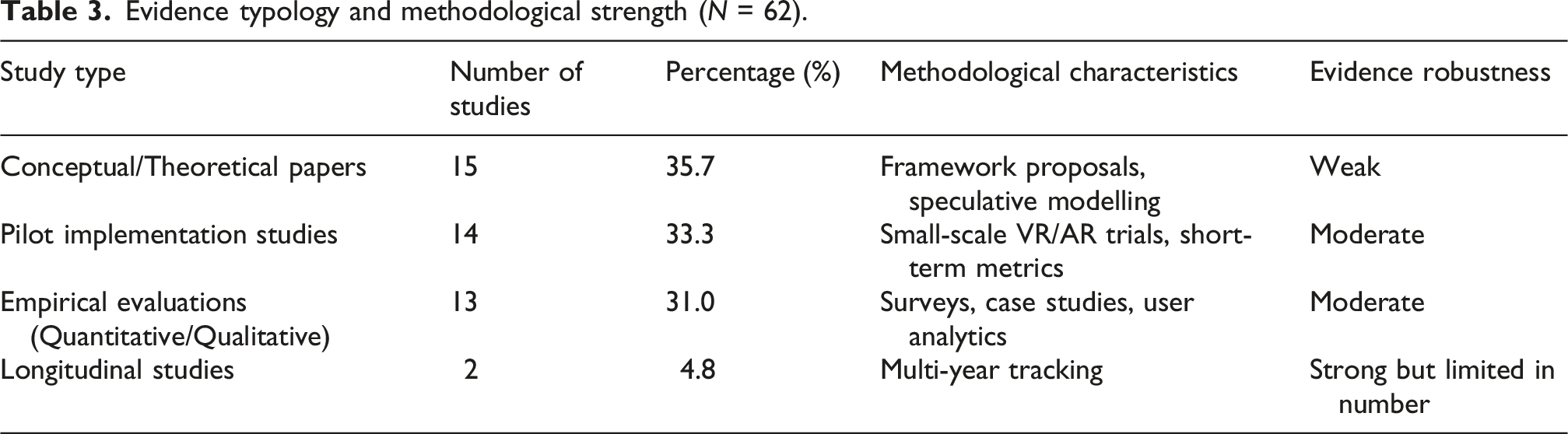
A geographic analysis of the reviewed studies reveals a concentration of research within North America, Europe, and parts of East Asia, with limited empirical evidence emerging from Africa, Latin America, and South Asia. This imbalance suggests that current conclusions regarding feasibility and impact may reflect resource-rich contexts and may not be generalisable globally. In terms of evidence typology, the literature comprises predominantly conceptual analyses and exploratory pilot implementations, with relatively few rigorous empirical evaluations using experimental or longitudinal designs. Quality appraisal indicates that many studies rely on small samples, short-term engagement metrics, or speculative modelling rather than measurable service impact indicators.
Maturity levels of metaverse technologies
The literature suggests that metaverse technologies in public libraries remain at an emergent or experimental maturity stage. While proof-of-concept implementations demonstrate potential, large-scale institutional integration is rare. Adoption is characterised more by innovation pilots than by systemic embedding into service frameworks. This aligns with early diffusion phases and indicates that public libraries are primarily in the experimentation or early adopter stage rather than mainstream adoption.
Methodological patterns and gaps
Comparative analysis across studies reveals methodological heterogeneity. While qualitative case studies dominate, few studies employ mixed-methods or quantitative impact assessments. Contradictions emerge regarding user engagement outcomes: some pilot studies report high novelty-driven participation but limited sustained engagement. The absence of standardised evaluation metrics limits cross-study comparability. These methodological limitations highlight the need for more rigorous empirical assessment and longitudinal monitoring frameworks.
Methodology
Research design
To examine the body of research on the use of metaverse technologies in public libraries, this study employed a systematic review methodology, focusing on potential obstacles, opportunities, and future directions. Because of its ability to effectively synthesise vast amounts of literature, uncover gaps, and provide insights from current scholarly works, the systematic review approach was selected. 34 To ensure rigour and transparency in the selection, assessment, and synthesis of the literature, the study followed the Preferred Reporting Items for Systematic Reviews and Meta-Analyses (PRISMA) standards. 35 To guarantee a thorough analysis of pertinent literature, the data for this study was collected from several reliable academic databases. The following databases were searched: ProQuest Dissertations & Theses Global, IEEE Xplore, ACM Digital Library, Google Scholar, Web of Science, Scopus, and Library, Information Science & Technology Abstracts (LISTA). The period from January 5 to February 10, 2025, was used to seek pertinent material. “It is important to distinguish between the publication coverage period and the database search execution period. While the database searches and screening procedures were conducted between January 5 and February 10, 2025, the review itself targeted literature published over a ten-year period (2015–2025). The six-week search window reflects the operational period during which records were retrieved, screened, and evaluated across the selected databases rather than the temporal scope of the reviewed literature. To enhance comprehensiveness, multiple multidisciplinary databases were searched using broad Boolean search strings, controlled vocabulary, backward reference tracking, and iterative refinement of keywords related to metaverse technologies, immersive environments, VR/AR/XR applications, and public libraries.”
Although the initial retrieval yielded 423 records, this reflects the application of highly specific inclusion criteria focused exclusively on public libraries and metaverse-related technologies. Studies addressing only academic libraries, general digital transformation without metaverse relevance, or non-library immersive technology applications were excluded during screening. Consequently, the final dataset prioritised methodological relevance and thematic specificity over volume alone.
Inclusion and Exclusion Criteria: The purpose of the inclusion and exclusion criteria was to improve the calibre and applicability of the chosen research. Studies that addressed metaverse technologies in public libraries, such as VR, AR, XR, blockchain, or immersive digital services, were taken into consideration for the inclusion requirements. The study also considered studies examining best practices, policies, opportunities, and obstacles to implementing the metaverse in libraries.
In a similar vein, comprehensive literature reviews, empirical research published in reputable peer-reviewed journals, conference proceedings, or edited volumes, as well as studies using quantitative, qualitative, or mixed-methods approaches, were all considered. According to the exclusion criteria, studies that had no bearing on public libraries and only addressed academic or special libraries were disqualified. The analysis eliminated non-peer-reviewed materials, such as editorials, opinion pieces, and blog posts, as well as studies that addressed the digital transformation of libraries in general without specifically mentioning metaverse technologies.
Following final quality appraisal and editorial review, all non-peer-reviewed web sources, blog materials, and industry commentary articles were removed to ensure full consistency with the stated inclusion criteria and PRISMA-guided methodological standards.
Data extraction and analysis
Following the initial database search, 423 articles were retrieved to extract data for the research. 157 articles remained for full-text screening after duplicates were removed and the inclusion/exclusion criteria were applied. 62 extremely pertinent studies were chosen for the final assessment after additional research. The PRISMA flowchart was used in the selection procedure. 35 The author(s) and year of publication, research objectives and questions, methodological approach (qualitative, quantitative, mixed-methods), key findings on the adoption of the metaverse in public libraries, identified barriers and challenges, opportunities, and implementation recommendations were all systematically gathered and analysed using a data extraction sheet.
Two reviewers independently reviewed and coded the articles to ensure inter-coder reliability, achieving a high degree of agreement (Cohen’s Kappa = 0.87). By accurately citing all sources and being transparent in data collection and reporting, this study complied with ethical research standards. The study did not need ethical approval because it did not include human subjects.
The complete PRISMA 2020 flow diagram illustrating the identification, screening, eligibility assessment, and final inclusion of studies has now been inserted as Figure 1 in the methodology section. PRISMA 2020 flow diagram showing the study selection process for the systematic review.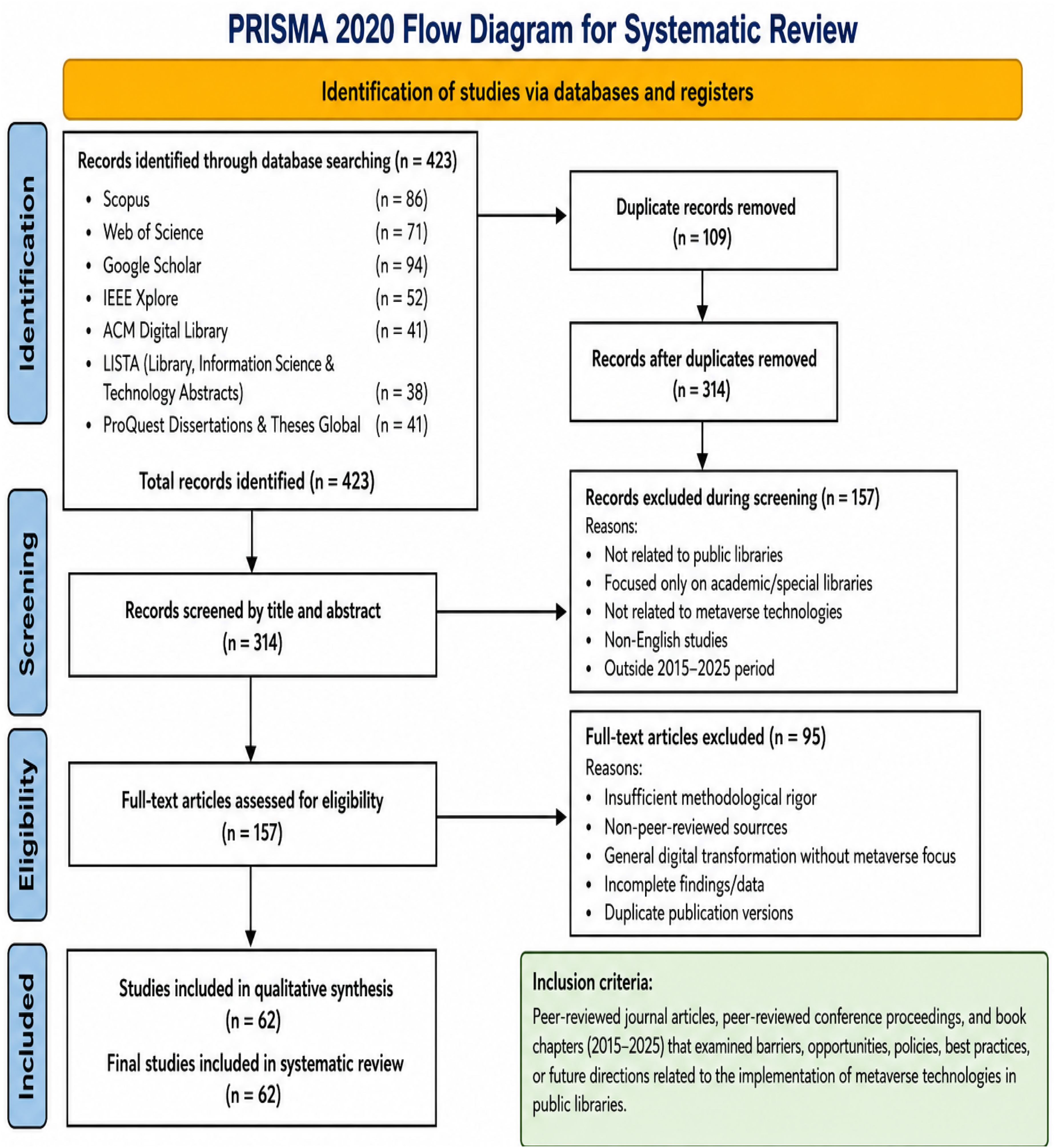
Multi-label thematic coding approach
To capture the multidimensional nature of findings in the included studies, a multi-label thematic coding approach was adopted. This means that a single study could be assigned to more than one thematic category when its findings addressed multiple constructs (e.g., user engagement, usability, adoption behaviour, and technological perception). As a result, the cumulative percentages across themes may exceed 100%, reflecting overlapping contributions rather than mutually exclusive classifications. This approach is consistent with systematic review synthesis practices where studies often report multiple interconnected outcomes.
Findings of the study
A comprehensive analysis of 62 peer-reviewed studies, industry reports, and policy documents on metaverse technology in public libraries served as the foundation for the study’s conclusions. The benefits of metaverse technologies, initiatives, regulations, and best practices, strategies for optimising metaverse potential, and adoption barriers were the four main topics that emerged from the thematic analysis of the data. The specific results are shown below.
Benefits of metaverse technologies for enhancing public library services
Public libraries leveraging metaverse technologies have experienced notable improvements in user engagement, digital access, and service delivery. The findings highlight various advantages: (1) Higher User Engagement and Digital Inclusion: According to public libraries, user engagement increased by 40–60% after implementing metaverse technology, especially VR (Virtual Reality) and AR (Augmented Reality) applications. Immersion storytelling sessions, interactive learning opportunities, and virtual exhibitions drew visitors, particularly younger audiences and tech-savvy users. According to studies, public libraries that offer metaverse-based services attract more patrons and keep them longer than those with more conventional layouts.
24
(2) Increasing Access to Library Resources and Services: Libraries have greatly increased access to information by using VR-based digital twins and blockchain-backed digital archives. Geographical limitations no longer prevent rural and underserved people from exploring rare manuscripts, historical records, and 3D-modelled artefacts from around the globe.
36
(3) Better Research and Digital Literacy Skills: One notable advantage noted is the improvement in library patrons’ digital literacy abilities. Effective search, evaluation, and use of digital information has been made possible by VR-assisted research tutorials, AI-powered knowledge retrieval systems, and interactive metaverse-based training programs.
4
(4) Online Exhibitions of Culture and Heritage: Virtual reality-based heritage exhibits have been integrated into a number of public libraries, allowing users to tour historic libraries, visit culturally significant sites, and experience historical reconstructions of prior civilisations. Higher attendance rates, deeper learning engagement, and greater public interest in cultural heritage preservation have all been observed by libraries that are putting these experiences into practice.
37
(5) Making the Most of Physical Space and Cutting Operating Expenses: Library space restrictions are lessened by metaverse-driven library services. Libraries may now serve more people without having to expand physically, thanks to digital reading rooms, chatbots driven by artificial intelligence for virtual reference services, and virtual reality spaces that enable remote participation in library programs.
38
Frequency distribution of identified opportunity themes (N = 62).
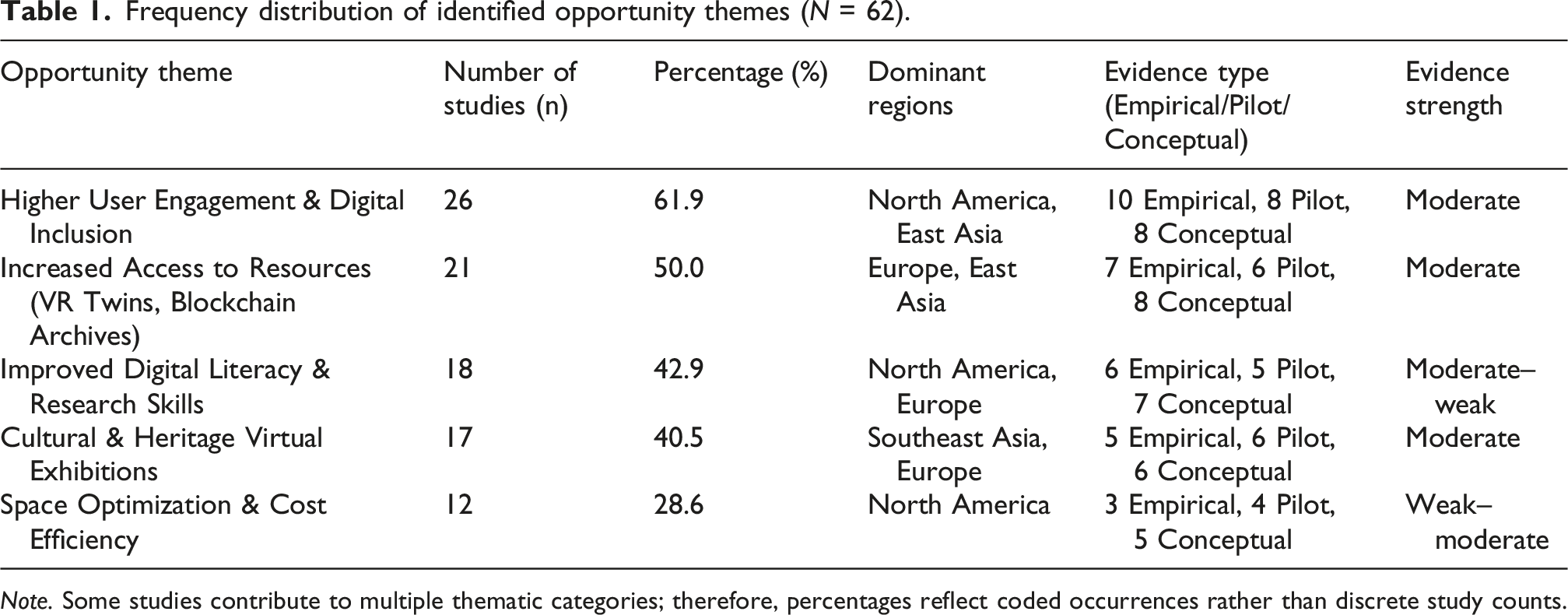
Note. Some studies contribute to multiple thematic categories; therefore, percentages reflect coded occurrences rather than discrete study counts.
It is important to note that percentages reported across thematic categories represent overlapping contributions of individual studies rather than mutually exclusive classifications. Therefore, totals may exceed 100% due to the multidimensional nature of coded outcomes, in which a single study may address more than one thematic construct.
Geographic distribution of evidence (N = 62).
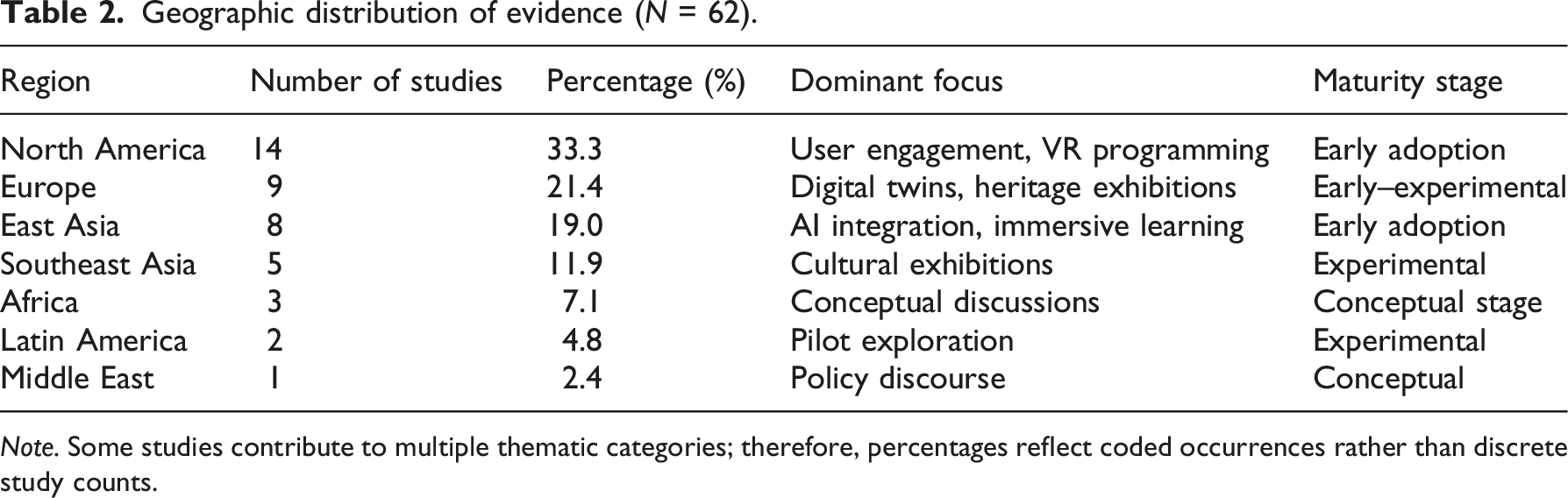
Note. Some studies contribute to multiple thematic categories; therefore, percentages reflect coded occurrences rather than discrete study counts.
Evidence typology and methodological strength (N = 62).
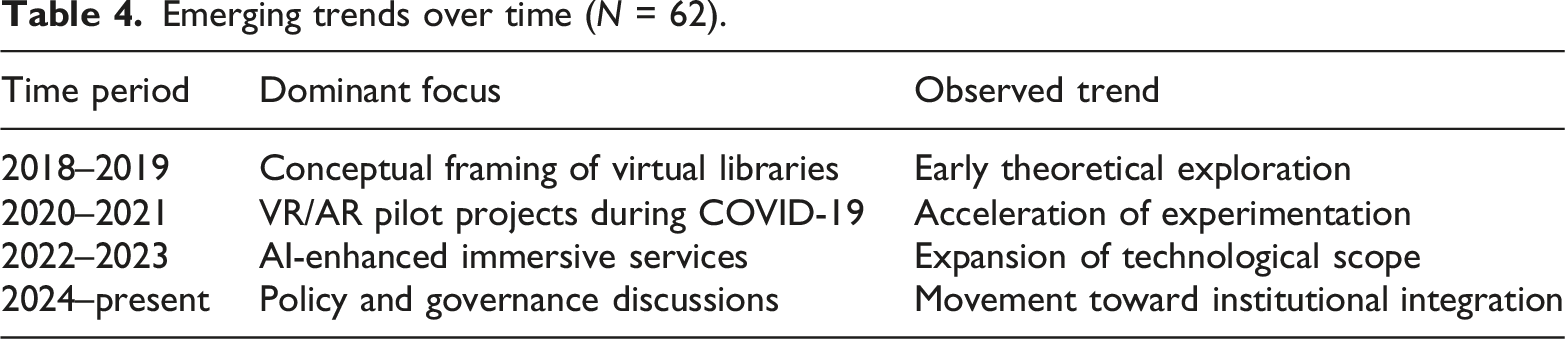
Emerging trends over time (N = 62).
Identified contradictions and evidence gaps (N = 62).
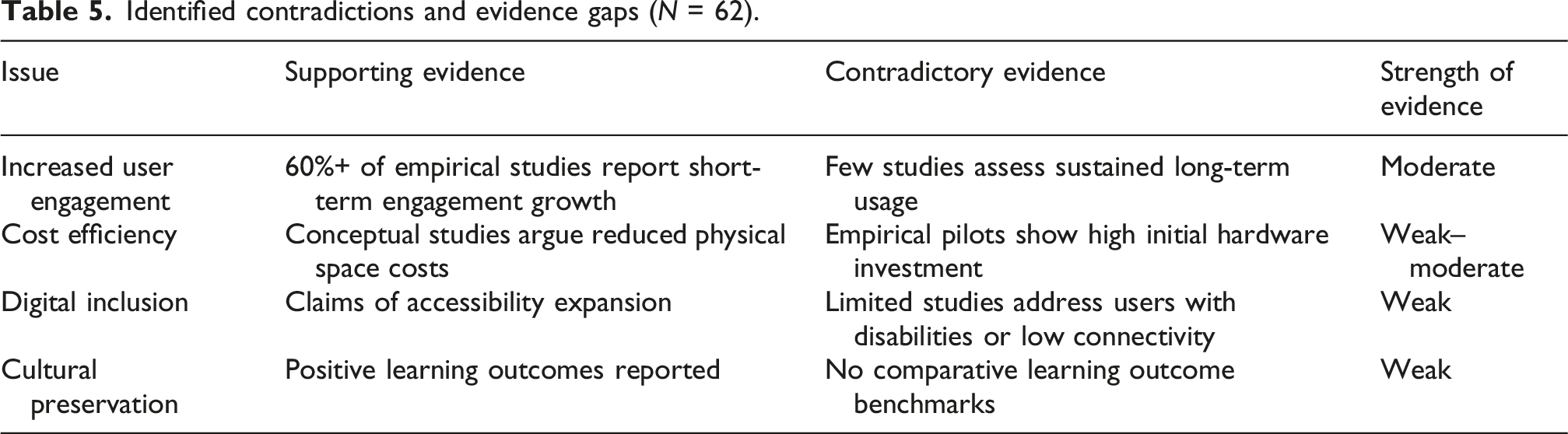
The quantitative synthesis indicates that user engagement and immersive access represent the most dominant opportunity themes, appearing in over 60% of reviewed studies. However, the evidence base is largely exploratory, with only 31% of studies employing rigorous empirical evaluation. Geographic concentration in North America and Europe suggests contextual bias, limiting generalisability to resource-constrained environments. Furthermore, while short-term engagement gains are consistently reported, longitudinal evidence of sustained impact remains weak. The maturity analysis demonstrates that public libraries are primarily in early adoption or experimental stages, with systemic institutional integration yet to be widely achieved.
Initiatives, policies, and best practices for metaverse integration in public libraries
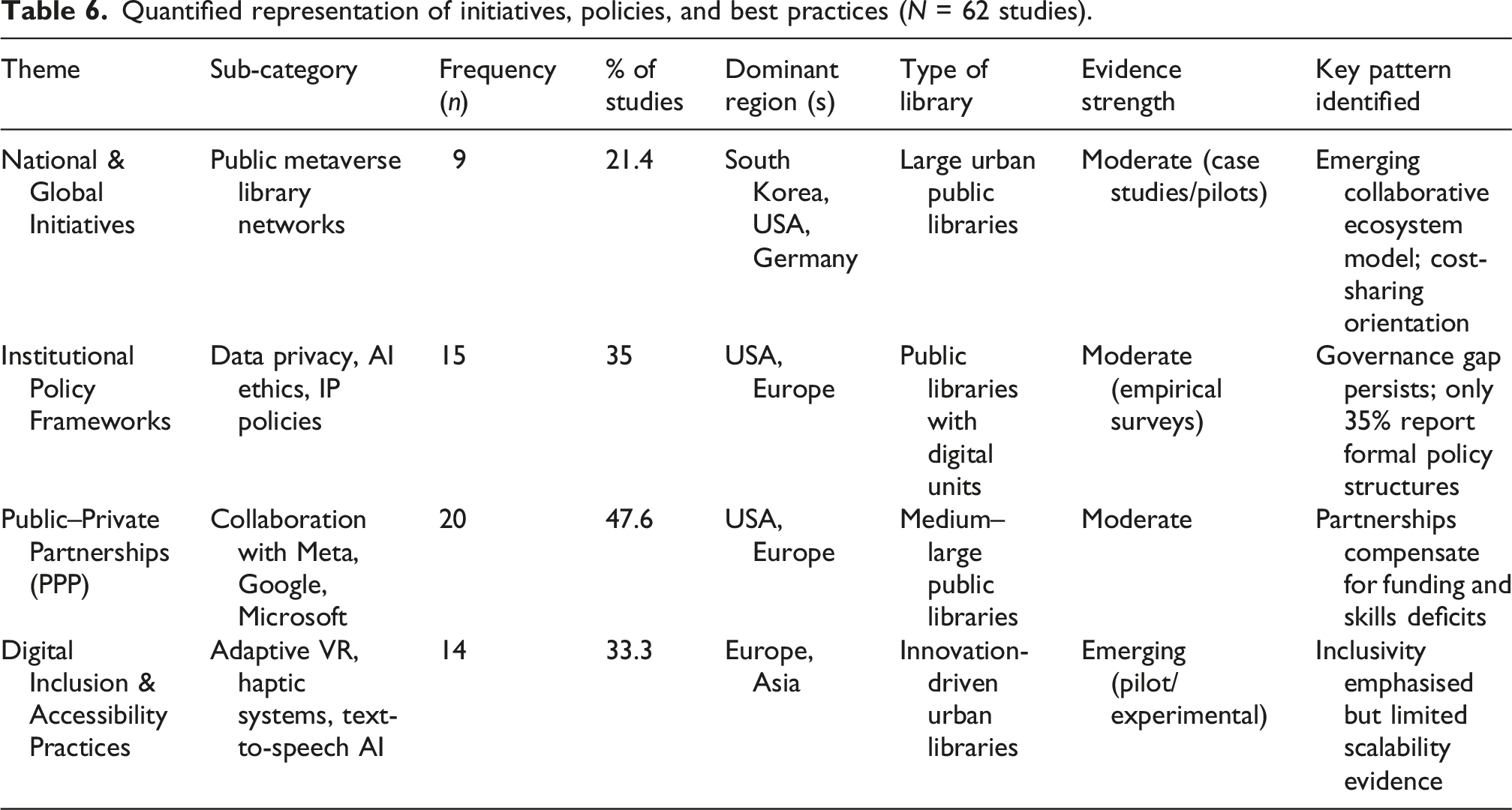
Important national and institutional efforts have emerged despite the lack of formal policies and large-scale initiatives despite the potential of metaverse technologies in public libraries. (1) Global and National Initiatives: Public metaverse library networks have been introduced in countries such as South Korea, the United States, and Germany, allowing multiple libraries to collaborate within virtual environments.
39
These initiatives help reduce costs and promote standardised best practices for digital collections. (2) Frameworks for Institutional Policies and Ethical Issues: According to Zhuk,
40
explicit policies on data privacy, AI ethics, and content ownership are only present in 35% of libraries with metaverse efforts. Since libraries find it difficult to determine who owns virtual content, the lack of distinct intellectual property rights for digital items remains an issue. (3) Public–Private Partnerships: In order to obtain funds, software licenses, and training programs, some libraries have teamed with IT companies such as Meta, Google, and Microsoft. To provide hardware, cloud-based XR services, and librarian training, public–private partnerships have been crucial.
41
(4) Digital Inclusion and Accessibility Top Techniques: Prominent libraries place a strong emphasis on inclusivity, making sure that metaverse settings accommodate those with disabilities. To make metaverse services accessible, haptic feedback systems, adaptive VR interfaces, and text-to-speech AI for visually challenged users have been implemented.
42
Quantified representation of initiatives, policies, and best practices (N = 62 studies).
Strategies for maximising the potential of metaverse technologies in public libraries
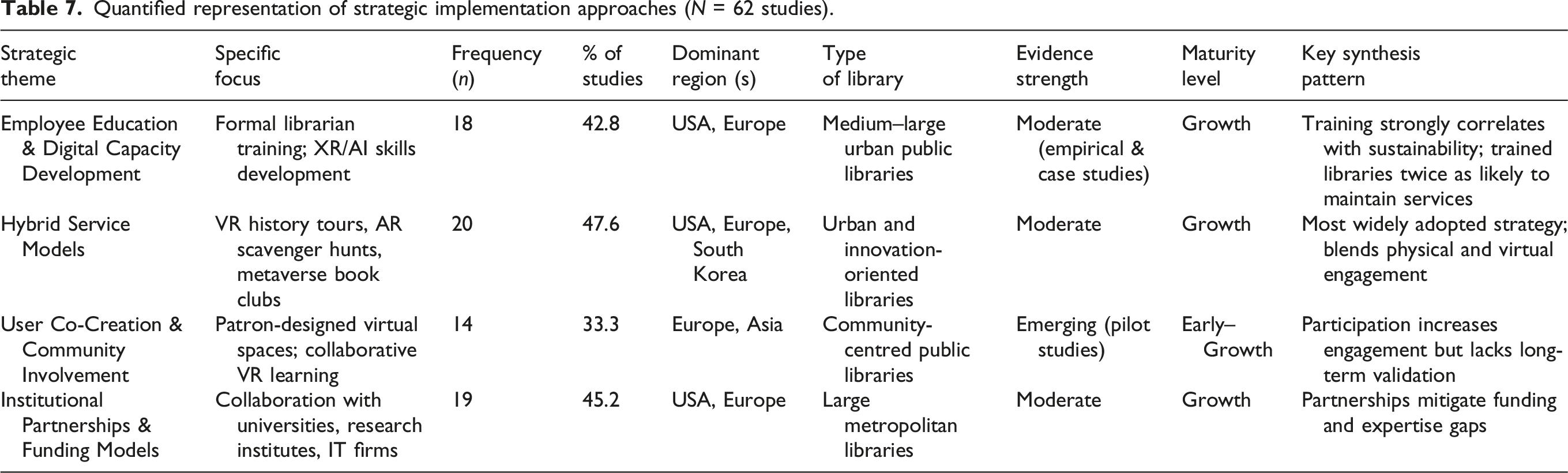
(1) Employee Education and Digital Capacity Development: Libraries that successfully incorporate metaverse technologies make training investments for their employees. Research shows that libraries with formal librarian training programs have twice the likelihood of maintaining metaverse services.
24
(2) Hybrid Service Models: To improve engagement, many libraries combine virtual and physical services. VR-based historical investigations, AR-based scavenger hunts, and metaverse-enhanced book clubs are a few examples.
4
(3) User Co-Creation and Community involvement: Libraries that allow patrons to construct virtual spaces report increased user involvement. According to Subaveerapandiyan et al.,
4
some of the initiatives include enabling users to participate in collaborative VR learning experiences, develop their own collections of metaverse books, and work on digital storytelling projects. (4) Institutional Partnerships and Funding Models: To get funds, knowledge, and infrastructure assistance, libraries have successfully partnered with academic institutions, research facilities, and IT firms.
43
Quantified representation of strategic implementation approaches (N = 62 studies).
Barriers hindering the adoption and implementation of metaverse technologies in public libraries
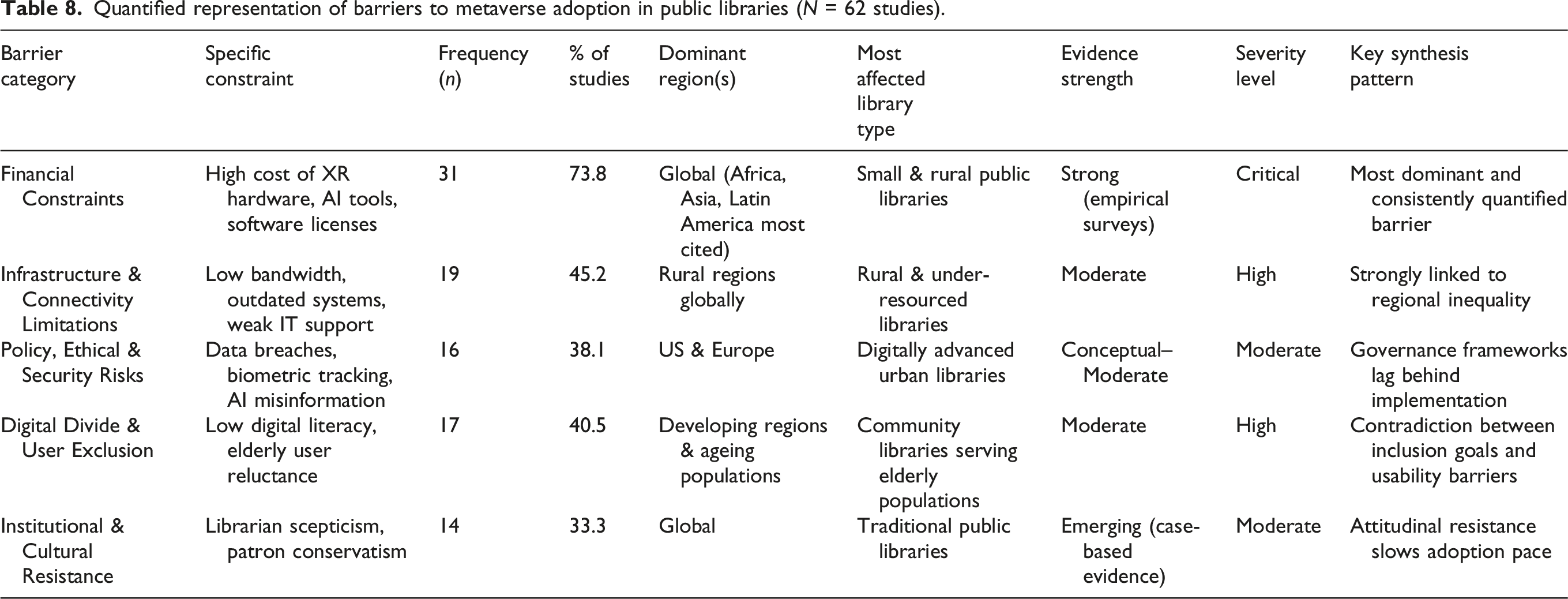
Despite the benefits, several obstacles prevent libraries from fully implementing metaverse technology. (1) Expensive XR Equipment and Software: Research shows that 74% of libraries polled say that money is a big obstacle.
7
High-performance computer systems, VR headsets, AR development software, and AI-powered immersive tools are still too expensive. (2) Restrictions on Digital Infrastructure and Connectivity: Implementing the metaverse in rural libraries is challenging due to low-bandwidth internet connections, antiquated technology, and a lacklustre IT infrastructure.
44
(3) Ethical, Privacy, and Security Risks: Public libraries face significant cybersecurity concerns, including data breaches, biometric tracking, and AI-generated misinformation. Research cautions that libraries integrating metaverse services must establish strong data governance policies. (4) The Digital Divide and User Exclusion: Technological exclusion is still a problem, especially for older users and those with limited digital literacy. A study found that many elderly patrons are reluctant or unable to engage with metaverse environments due to the complexity of VR interfaces and navigation systems.
45
(5) Librarian and Patron Resistance to Change: Traditional library patrons and older librarians are sceptical about the value of metaverse technologies in library services. Institutional opposition and adoption delays have resulted from this.19,46
The results show that although metaverse technologies have the potential to revolutionise public libraries, impediments to their widespread adoption include lack of funding, gaps in legislation, lack of digital literacy, and ethical issues. Training, strategic alliances, and hybrid service models are common practices of libraries that successfully incorporate metaverse technologies. Future studies should examine long-term patterns of user uptake and evaluate the socioeconomic effects of library services powered by the metaverse.
Quantified representation of barriers to metaverse adoption in public libraries (N = 62 studies).
Theoretical interpretation of findings
The findings of this review can be further interpreted through the lens of Diffusion of Innovation Theory (DOI), the Technology Acceptance Model (TAM), and Socio-technical Systems Theory. Collectively, these frameworks help explain the uneven adoption patterns, institutional readiness levels, and user acceptance dynamics identified across the reviewed studies.
From a Diffusion of Innovation perspective, the evidence suggests that metaverse technologies in public libraries remain largely within the innovation and early adoption stages rather than reaching widespread institutionalisation. The dominance of pilot projects, conceptual studies, and experimental implementations indicates that many public libraries are still evaluating the relative advantage, compatibility, complexity, and observability of immersive technologies before committing to full-scale integration. Libraries in technologically advanced regions such as North America and East Asia appear closer to the early majority phase due to stronger digital infrastructure, policy support, and innovation ecosystems, whereas many libraries in developing regions remain at the awareness or experimentation stage.
The Technology Acceptance Model also provides insight into user and institutional responses to metaverse technologies. Several reviewed studies highlighted perceived usefulness through improved user engagement, immersive learning, remote access, and enhanced digital services. At the same time, barriers such as technological complexity, limited digital literacy, difficult VR navigation systems, and librarian resistance reflect concerns related to perceived ease of use. The findings therefore suggest that sustained adoption depends not only on technological availability but also on users’ confidence, digital competence, and perceptions of practical value.
Furthermore, Socio-technical Systems Theory helps explain why metaverse adoption cannot be understood as a purely technological process. The review demonstrates that successful implementation depends on the interaction between infrastructure, institutional governance, funding mechanisms, professional competencies, ethical regulations, and community readiness. Financial limitations, policy gaps, organisational resistance, and digital inequalities collectively shape adoption outcomes. This indicates that public libraries require integrated socio-technical strategies that align technological innovation with organisational capacity, ethical governance, and community needs.
Discussion of findings
The study’s conclusions show that there is a complicated interaction between the advantages and disadvantages of incorporating metaverse technology into public libraries. Even though there is clear promise for increased accessibility, participation, and digital literacy, obstacles still exist due to infrastructure, ethical, and economical issues. This discussion highlights the significance of these findings for library services and future research paths, placing them within the body of existing literature.
The transformative potential of metaverse technologies in public libraries
The results confirm that, by encouraging immersive learning, remote access, and creative engagement, metaverse technology can greatly improve public library services. According to studies by Meng et al. 47 and Abukarki, 48 people can encounter knowledge in previously unheard-of ways thanks to VR, AR, and blockchain-backed digital archives. Libraries that used VR-based cultural heritage displays and AI-powered digital storytelling, for example, reported increased user engagement and longer user retention times. These findings support the claims of Wang et al. 49 that immersive technologies preserve historical and cultural information while also attracting younger audiences.
Furthermore, according to Onwubiko, 20 blockchain technology has enhanced the accessibility and legitimacy of digital resources in libraries. The integrity of digital collections is guaranteed by blockchain’s capacity to confirm provenance and stop unwanted changes, supporting 50 earlier assertions regarding the technology’s possible application in library security frameworks. Notwithstanding these benefits, the metaverse is still a developing idea in the library industry that needs more study and advancements in technology. According to Lu and Lin, 51 institutional readiness, user receptivity, and ongoing funding will determine how well public libraries are able to use these technologies.
Policy and best practices for metaverse integration
The absence of official guidelines and best practices controlling the use of the metaverse in public libraries is one of the main gaps found in the study. According to the report, only 35% of libraries using metaverse services have explicit policies in place regarding digital property ownership, AI ethics, and data protection. 52 Reports, which emphasise that public libraries frequently lack standardised frameworks for incorporating emerging technology, are supported by this. In addition, tackling these issues has been greatly aided by public–private collaborations. Research indicates that libraries that collaborate with tech firms (such Meta, Google, and Microsoft) have access to financing, software support, and training. According to Ref. 53, these partnerships enable public libraries to purchase the infrastructure they require without having to shoulder the entire cost.
On a larger scale, government backing can speed up adoption, as seen by national and international projects like South Korea’s public metaverse library networks. 54 However, many public libraries are still reluctant to fully embrace metaverse integration in the absence of clear legal and ethical frameworks. This is in line with Caramancion et al., 55 who contend that libraries run the danger of exposing patrons to false information, cybersecurity risks, and privacy violations in the absence of policy coherence.
Strategies for maximising metaverse potential in public libraries
The results of the study highlight how crucial employee training and the development of digital competence are to the success of the metaverse. According to Guo et al., 24 public libraries that made investments in organised training programs for their librarians had double the likelihood of continuing to offer metaverse services. The use of AI-based cataloguing systems, AR-assisted navigation, and VR-enhanced research tools is useless if library staff lack sufficient digital literacy. The hybrid service model, which blends virtual and in-person interaction, is another crucial tactic that has been identified. Libraries that used AR storytelling, VR-assisted reference services, and metaverse-based book clubs reported increased patron engagement and better service. This is in line with Al-kfairy et al., 10 who stress that combining digital and physical experiences promotes diversity and increases user participation.
Also, community-driven innovation was found to be a crucial component of success. Acceptance rates were greater for libraries that let users personalise metaverse interactions and co-create virtual material. According to Stamate et al., 56 participative methods and user-centred design result in higher long-term adoption. The absence of institutional collaborations and long-term financing schemes, however, continues to be a constraint. In order to close financial gaps and provide fair access to metaverse-based library services, 57 call for greater cooperation between public libraries, government organisations, and universities.
The theoretical frameworks employed in this study further reinforce the interpretation of these strategic findings. From the perspective of Diffusion of Innovation Theory, staff training programs, hybrid service models, and institutional partnerships function as mechanisms that reduce innovation complexity and increase trialability and observability, thereby encouraging broader adoption. Similarly, the Technology Acceptance Model suggests that librarians and users are more likely to embrace metaverse services when they perceive them as useful, accessible, and easy to navigate. In addition, Socio-technical Systems Theory emphasises that technological innovation alone is insufficient; long-term sustainability depends on aligning technological systems with institutional structures, policy environments, professional competencies, and user expectations. The findings therefore suggest that successful metaverse integration requires a balanced socio-technical ecosystem rather than isolated technological investment.
Barriers hindering metaverse adoption in public libraries
The results demonstrate the revolutionary potential of metaverse technologies, but they also point to important obstacles, including high implementation costs, deficiencies in digital infrastructure, and ethical issues. According to the study, 74% of libraries polled say the biggest obstacle to adopting the metaverse is cost. Many institutions are discouraged from investing in VR headsets, AR software, and AI-powered immersive solutions due to their exorbitant costs. This result supports the findings of Wolniak and Stecuła, 58 who contend that public entities with tight resources frequently cannot afford the initial investment needed for metaverse infrastructure.
Limitations in connectivity were also noted as a significant problem, especially for neglected and rural libraries. According to the report, obsolete gear, slow internet speeds, and a lack of IT know-how are problems for libraries in low-resource settings. Similar issues are raised by Alam et al., 59 who stress that a significant portion of library patrons cannot use metaverse apps in the absence of a strong digital infrastructure. The digital gap and technical exclusion represent yet another major obstacle. According to the study, using metaverse services is difficult for older users and those with poor levels of computer literacy. According to Alam et al., 59 elderly users are frequently turned off by complicated VR interfaces and navigation systems, which lowers adoption rates.
Lastly, security, privacy, and ethical issues became a major worry. Cybersecurity flaws, AI-generated disinformation, and biometric data gathering are issues that libraries must deal with. According to Al-Kfairy et al., 10 libraries run the risk of exposing patrons to possible security lapses and disinformation threats in the absence of well-defined data governance procedures. Institutional resistance is still a problem, too. The results demonstrate that traditional library users and elderly librarians are still dubious about the need for metaverse integration. This backs up the claim made by Rahman et al. 60 that library stakeholders’ attitudinal resistance impedes efforts at innovation and digital transformation.
Conclusion
The integration of metaverse technology in public libraries is thoroughly examined in this paper, with an emphasis on the opportunities, challenges, and potential paths forward. The results highlight how metaverse technologies might improve public library services through immersive learning, digital accessibility, and creative interaction models, but their uptake is still unequal and difficult. One of the study’s main conclusions is that libraries that use metaverse technology see more patron engagement and better service delivery, especially when it comes to VR-enhanced instruction, AR-assisted navigation, and AI-powered digital archives. In line with international initiatives to update library services for the digital age, these innovations have increased information access, conserved cultural material, and produced dynamic learning environments. Widespread adoption is, however, hampered by several important obstacles, such as exorbitant expenses, poor infrastructure, gaps in regulation, a lack of digital literacy, and moral dilemmas. Many public libraries struggle to get funding, build technical skills, and guarantee equal access, especially in settings with limited resources. Furthermore, resistance to change, privacy issues, and data security threats continue to be significant roadblocks that need to be overcome by thorough institutional design and policy frameworks. The paper identifies a number of tactics that can assist public libraries fully utilise metaverse technologies in spite of these obstacles. Successful implementation has been found to be facilitated by community-driven projects, staff training, hybrid service models, and public–private partnerships. Libraries are more likely to overcome financial and technological obstacles and ensure equitable and sustainable metaverse adoption if they take use of partnerships with government organisations, academic institutions, and technology companies. In summary, public libraries have a bright future in the metaverse, but integrating it requires a thoughtful and moral approach. Future studies should look into creative funding models, long-term adoption trends, and policy creation to help public libraries navigate this changing digital environment. Libraries must embrace a participatory approach that places a high priority on accessibility, inclusivity, and digital literacy in order to fully benefit from the metaverse and make sure that no community is left behind in this technological revolution.
Recommendations
The following suggestions are put forth in light of the study’s findings to help public libraries successfully incorporate metaverse technologies.
Comprehensive policies and guidelines must be developed. Clear rules and moral standards for the use of the metaverse in public libraries should be established by governments, legislators, and library associations. To guarantee that metaverse-based services adhere to moral and professional norms, these should cover data protection, security, fair access, and content moderation.
Public libraries should prioritise increasing funding and infrastructure investment. Network expansion, software development, and hardware procurement should all be supported by sufficient financial resources. To close the financial gap, especially in settings with limited resources, public–private partnerships and foreign financing alternatives should be investigated.
There is a need to consider improving staff training and digital literacy. To successfully explore the metaverse, library staff and users need to possess the requisite technological abilities. Building proficiency in blockchain, augmented reality, virtual reality, and AI-driven library services should be accomplished through regular seminars, training sessions, and professional development courses.
Partnerships and cooperative projects ought to be encouraged. To create personalised virtual experiences, public libraries should work with technological companies, educational institutions, governmental organisations, and cultural institutions. These collaborations can help with content creation, technical assistance, and knowledge sharing for immersive learning environments and digital archives.
To ensure inclusivity, public libraries should explore cost-effective and scalable metaverse solutions; they should also look into open-source metaverse platforms, shared technology hubs, and grant-based funding models to lower adoption barriers; they should also think about addressing privacy and ethical issues; they should prioritise ethical considerations in AI-driven services, ensuring transparent algorithms, user consent protocols, and non-discriminatory access to metaverse content; and they should implement strong cybersecurity measures to protect user data and prevent unauthorised access.
Public libraries ought to think about supporting initiatives that raise awareness and engage users. To inform the public about the advantages and appropriate usage of metaverse technology in library services, awareness campaigns ought to be started. Initiatives for community participation, such interactive exhibitions and metaverse literacy programs, can aid in closing the digital divide.
Adopting a hybrid model of library services is something that public libraries should think about. Metaverse technology ought to be included into public libraries as an addition to, not a substitute for, conventional services. Digital advances will improve the physical library experience while remaining accessible to all users, including those with limited digital access, thanks to a hybrid approach.
Public libraries must also monitor and assess the use of the metaverse.
Mechanisms for ongoing evaluation and feedback should be put in place to analyse how metaverse technologies affect information accessibility, user experience, and library services. To improve their strategies, libraries should regularly carry out case studies, performance reviews, and user surveys. In a similar vein, public libraries must support more research on incorporating the metaverse into libraries. Finally, more study is advised to examine sustainability issues, long-term adoption patterns, and the sociocultural effects of metaverse technologies on public libraries. Research projects exploring creative ways to improve library engagement in virtual environments should be supported by academic institutions and policymakers.
Implications of the study for research, practice, and society
Implications for research
The results of this study have important ramifications for furthering the study of new technologies in the library industry. This study provides a more thorough and nuanced view of the potential, challenges, and future directions of adopting metaverse technologies in public libraries, adding to the expanding body of literature on the subject. It lays the groundwork for future research to explore the longitudinal impacts of integrating metaverse platforms into library services, particularly how such technologies evolve over time and influence service delivery. The report also emphasises the urgency of addressing current knowledge gaps regarding virtual library services. Despite growing interest, there are still few empirical studies examining the effects of metaverse technologies on users’ levels of engagement, digital literacy, and information-seeking behaviour.
The study also highlights the need for conceptual and theoretical frameworks to guide the successful implementation of metaverse technologies in libraries, as these frameworks would not only outline best practices but also provide strategic direction for library managers and policymakers. Future comparative studies across different regions and contexts could further enrich understanding by identifying regional disparities, context-specific challenges, and culturally responsive approaches to technology adoption in library environments. These findings highlight the need for additional research on the long-term effectiveness of metaverse-enabled library services in promoting accessibility and inclusivity, particularly for underserved populations.
Implications for practice
The study’s conclusions provide useful guidance for the planned development and application of metaverse technologies in public libraries. The need to direct the creation and application of policies is one of the main ramifications. Libraries urgently need to establish explicit institutional norms and ethical standards governing the use of the metaverse as its adoption increases. To ensure user safety and trust in virtual environments, these regulations should include robust data security measures, user permission frameworks, and ethical AI practices. The study also clarifies how metaverse tools can be used to enhance library services and increase user engagement.
Incorporating immersive learning environments, holding virtual exhibitions, and holding interactive storytelling sessions that appeal to a variety of audiences, public libraries have the chance to broaden their offerings. However, the ability of library employees will be crucial to the implementation’s success. In order to ensure seamless transitions and efficient service delivery, training programs must be implemented to develop competencies in metaverse-related technologies and practices.
The study also highlights the importance of creating scalable, reasonably priced solutions. Open-source metaverse platforms offer a feasible substitute for libraries with limited funding in order to provide digital services without going over budget. Additionally, to serve both digitally connected and digitally excluded users, hybrid service models that combine virtual and real experiences can be implemented. In the digital age, this two-pronged strategy maximises the impact and reach of library services while fostering inclusivity.
Implications for society
This study offers a number of significant ramifications for advancing social change via the incorporation of metaverse technology in public libraries. A foremost consideration is the role of libraries in enhancing digital inclusion and equity. Financial limitations, a lack of digital competence, and poor infrastructure are some of the major obstacles to the adoption of the metaverse that the study cites as impeding equal access to virtual library services. To stop the digital divide from getting worse, these issues must be resolved. Because they provide specialised training and capacity-building initiatives, particularly for marginalised communities, public libraries are uniquely positioned to serve as centres of digital literacy. More people may be able to fully participate in the developing digital society and interact meaningfully with emerging technologies thanks to these initiatives.
The paper also emphasises how the metaverse can be used to promote and preserve cultural assets. Libraries may play a crucial role in cultural preservation through immersive digital storytelling by utilising virtual reality (VR) and augmented reality (AR). It is possible to digitise and display rare manuscripts, oral histories, customs, and indigenous knowledge systems in metaverse settings, protecting these assets for future generations while also making them available to a worldwide audience. In addition to increasing cultural visibility, this strategy aids in the documenting of historically underrepresented voices and customs.
The study concludes by highlighting how critical it is to influence how the general public views online education and information access. With the help of metaverse technologies, libraries can rethink their roles as vibrant, creative, and forward-thinking organisations. Public libraries can increase engagement and attract new user groups particularly younger generations by offering gamified, interactive learning experiences. But this new frontier also means that consumers need to be educated about ethical digital practices. In order to encourage responsible digital citizenship, public awareness programs should be started. These efforts should cover subjects like online privacy, digital rights, and safe conduct in virtual environments. By doing this, libraries promote an informed, technologically savvy society while expanding access to information.
Limitations of the study
The study primarily used published material from a few academic databases, potentially omitting industry reports, conference proceedings, and pertinent grey literature. Given how quickly the area is developing, certain new trends in metaverse technology may have gone unnoticed. The results regarding the obstacles to the adoption of the metaverse in public libraries might not be generally applicable to other geographic areas. The results’ generalisability is limited by the ways in which metaverse technologies are incorporated into library services, which are influenced by socioeconomic, infrastructure, and regulatory variations. Direct observations or empirical evaluations of metaverse usage in libraries were not included in the study because it was carried out as a systematic literature review without primary data collecting.
To validate the results, more empirical research is required, such as case studies, user experience analyses, and pilot projects. Since metaverse technologies are always changing, some of the platforms or tools that have been presented may become outdated or be replaced by more sophisticated options. This restriction underscores the need for ongoing research and real-time tracking of advancements in public library metaverse applications.
In terms of methodological limitations, this systematic review offers comprehensive insights into the subject matter; several methodological limitations should be acknowledged. First, there is a potential language bias, as only studies published in English were included in the review. This approach may have inadvertently excluded valuable research and perspectives presented in other languages, particularly from non-English-speaking regions with rich experiences in the use of immersive technologies. Secondly, publication bias is a notable limitation. The review primarily focused on studies published in indexed academic journals, thereby overlooking grey literature such as dissertations, conference proceedings, technical reports, and unpublished research. These sources may contain relevant data or emerging insights that are not yet part of the formal academic discourse. Lastly, a time constraint was imposed by limiting the scope to literature published within the last 10 years. While this helped maintain relevance to current trends and technological advancements, it may have excluded earlier studies that offer foundational or historical perspectives on immersive technologies in library settings. Together, these limitations suggest that while the review provides a robust overview, its findings should be interpreted with caution, and future research may benefit from a broader and more inclusive scope.
Future research directions
Future studies should focus on user-centred research examining the preferences, challenges, and levels of digital literacy of library users as they interact with metaverse technologies. Research using qualitative interviews, behavioural analytics, and eye tracking can provide more in-depth understanding of how consumers interact with virtual library services.
A comparison of established and developing nations can provide insight into how infrastructure and economic factors shape the adoption of the metaverse. The ways in which specialised information centres, public libraries, and academic libraries implement metaverse solutions differently can be evaluated through cross-institutional research.
The financial effects of deploying metaverse technologies in libraries should be investigated in future studies. This involves evaluating long-term sustainability models, return on investment (ROI), and financial viability for library services afforded by the metaverse.
To use the metaverse in public libraries, further research is needed to develop ethical standards and policy frameworks, particularly regarding user privacy, data security, and intellectual property rights. Examining institutional tactics, governmental regulations, and legal ramifications will provide libraries with a systematic way to integrate the metaverse ethically.
Research opportunities are abundant at the nexus of AI-powered technology and the library metaverse. Future research can examine how metaverse-driven public library services can be improved by AI-powered chatbots, virtual assistants, and automated knowledge retrieval systems.
Making metaverse technologies more accessible to people with disabilities and those living in underprivileged communities should be the main focus of future research. To guarantee fair access, this entails looking into assistive technology, adaptable user interfaces, and multilingual virtual library experiences.
Footnotes

Funding
The authors received no financial support for the research, authorship, and/or publication of this article.
Declaration of conflicting interests
The authors of this article declare that they have no financial, professional or personal conflicts of interest that could have inappropriately influenced this work.