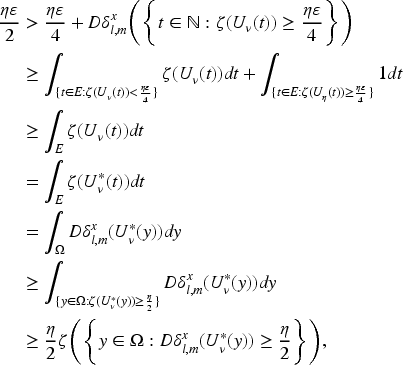
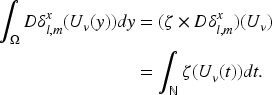
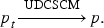
In this article, we introduce and study deferred Cesàro statistical convergence in measure by virtue of sequences of fuzzy valued measurable functions. We define inner and outer deferred Cesàro statistical convergence in measure for sequences of fuzzy valued measurable functions and exhibit that in a finite measurable set, both types of convergence are equal. Finally, we prove the new version of Egorov’s theorem by using deferred Cesàro statistical convergence for the sequences of fuzzy valued functions in finite measurable spaces.
The notion of fuzzy sets and its arithmetic operations was initially presented by Zadeh (1965) in 1965. After that, many mathematician studied the applications of fuzzy sets by introducing fuzzy topology, fuzzy ordering, etc. In addition, Matloka (1986) studied the theory of a sequences of fuzzy numbers. Many authors such as Tripathy and Nanda (2000), Savaş and Mursaleen (2004) and Hazarika and Savaş (2011) discussed the theory of sequences of fuzzy numbers.
A fuzzy number is a fuzzy set of real numbers which fulfills the given assertions:
normal, that is for some
fuzzy convex, that is where ,
is upper semi continuous,
the closure of is compact.
Also, the level cut of a fuzzy number for can be defined as
Hence, is a fuzzy number iff is a closed interval and Throughout the paper, is the space of all fuzzy numbers.
Let and be two fuzzy numbers. Then the distance between and which is defined by Matloka in Matloka (1986) is given as
where and is Hausdorff metric defined as
and are the lower and upper bound of level cut. For any we have
and are left continuous non-decreasing and right non-decreasing functions, respectively on
The concept of statistical convergence was initially presented by Fast (1951) and Schoenberg (1959) independently. Later on, Rath and Tripathy (1996) studied statistical convergence from sequence spaces point of view. In 1980 Gadjiev and Orhan (2002) studied the order of statistical convergence for a sequence of numbers.
As defined by Nuray and Savaş (1995), a sequence of fuzzy numbers is said to be statistical convergent to a fuzzy number , if
for each where the vertical bar implies cardinality of the enclosed set. Recently, Hazarika et al. define statistical convergence for double sequences of fuzzy valued measurable functions in Hazarika et al. (2020). Recently, the statistical convergence in measure is studied by Savaş (see Savaş, 2020, Savaş, 2020, Savaş, 2022). For more results on statistical convergence one may refer (Esi & Savas, 2015, Et et al., 2019, Mohiuddine et al., 2012).
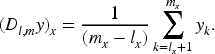
Suppose that and are the sequences of non-negative integers fulfilling
Then the deferred Cesàro mean of real-valued sequence as defined by R. P. Agnew in Agnew (1932) is defined as
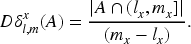
Let and Then, we say that is partial deferred Cesàro density of and is defined as
Also, is said to be a deferred Cesàro density or density of where
exists. The zero density set is given as
A sequence of fuzzy numbers is said to be deferred Cesàro statistically convergent to a fuzzy number if,
and it is denoted as
Throughout the paper, we write almost everywhere as a.e. and fuzzy valued function as FVF, respectively.
Main Result
The sequence of FVF is pointwise deferred Cesàro statistically convergent to FVF on if for every and such that we have where is said to be the deferred Cesàro pointwise statistically limit function of We may also write deferred Cesàro pointwise statistically convergent as or Thus, we say if for every
Let be the interval under consideration, and define a sequence of fuzzy-valued functions on as follows:
Define the function for all . Let the deferred Cesàro statistical parameters be given by and . We claim that is pointwise deferred Cesàro statistically convergent to on , that is,
The sequence of FVF is uniformly deferred Cesàro statistical convergent to FVF on if such that we get We may also write uniformly deferred Cesàro statistical convergent as or Thus, we say if for all
Let be the interval under consideration, and define a sequence of real-valued functions on by
Let for all . Define the deferred Cesàro statistical parameters as and . We assert that is uniformly deferred Cesàro statistically convergent to on , that is,
The sequence of FVF is deferred Cesàro equi-statistically convergent to FVF if for all and is uniformly convergent to zero function. We may also write deferred Cesàro equi-statistically convergent as Thus, we say iff for every and
Suppose that is a finite measure space. For we write as a sequence of FVF except on some subset of arbitrarily small measure and as a FVF except on some subset of arbitrarily small measure, respectively.
Let be a finite measure space with and the Lebesgue measure. Define a sequence of fuzzy-valued functions on by
where is fixed. Let the limit fuzzy-valued function be
The deferred Cesàro parameters as and . Then for every , there exists such that for all and ,
Hence, on , i.e., is deferred Cesàro equi-statistically convergent to .
We can say that iff and
In such case, we put Thus, implies that Moreover, implies that
Suppose that is a finite measure space. Consider is a measurable FVF and is sequence of measurable FVF defined a.e. on If a.e. on then such that and on
Let us consider that both and are defined a.e. on and Now, choose we see that
is measurable.
The function is measurable. Let For all we have iff
Let the function
is measurable, so we get For we have
Then, from above observation we conclude that is measurable and thus we have
Consequently, Let be given. For choose such that Fix such that
We have
Let Thus, Therefore, and we have
This proves that on
Suppose that is a finite measure space. Consider is a measurable FVF and is sequence of measurable FVF defined a.e. on then a.e. on iff there exists a sequence of sets on such that on and
Let us consider that both FVF and sequence of FVF are measurable and are defined a.e. on and a.e. on Then, by considering in theorem we get the conclusion. Now, let on Then we get on Hence, we get a.e. on
Let be measurable space. Also, consider set of all Fuzzy valued measurable function (FVMF) defined a.e. on such that and are in Then, the outer deferred Cesàro Statistical convergence in measure of a sequence of FVMF to FVMF is defined by
In this case, we write
Let the measurable space be defined with and as the Lebesgue measure. Define a sequence of fuzzy-valued measurable functions on
The limiting function is
which is a crisp function since the endpoints coincide. Now, for small , consider the set
where is a suitable metric between fuzzy numbers. As increases, the width of decreases, and . Therefore, for all large , we have for any . Thus, the set
has deferred Cesàro density tending to as . That is,
Hence, the sequence is outer deferred Cesàro statistically convergent in measure to , and we write:
By replacing the order of and in we get the inner deferred Cesáro statistical convergence in measure of a sequence of FVMF to FVMF as
In this case, we say that
Suppose that be a measure space and Then
If then
If then provided that
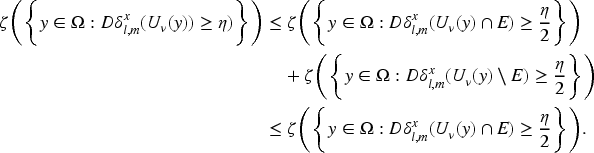
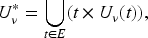
(i) We know that is a probability measure where Let us consider the product measure on product algebra of subsets Fix we have
We define as is measurable. Therefore, Now, for any we have
Firstly, we show that and
Set Since one may have such that we get the following
and
Let Then, we have from (2.3) that
Hence, we get
Suppose that Therefore, we get
To find the relation (2.2), we show that
For and for fix Fubini’s theorem applies to the characteristic function of if it has finite measure. We have
where and
Thus,
Suppose that such that we have
which proves that (2.5) is true.
(ii) Let Fix We need to show that and
Since and we have such that we have
By applying Fubini theorem for the characteristic function of we have
Suppose such that we have
Let be a measure space where and is the Lebesgue measure. Thus, . Define a sequence of fuzzy-valued measurable functions on as:
and define the limiting fuzzy-valued function as:
Here, each is a triangular fuzzy number that becomes narrower as and converges to the crisp fuzzy number . Fix any . For sufficiently large , the distance for all . Hence, for any , the set
becomes small in the deferred Cesàro statistical sense with respect to sequences and . Thus, . However, since , the converse implication, that is,
does not necessarily hold. The integration over an infinite measure space does not guarantee convergence in the deferred Cesàro sense. Therefore, this example shows that the converse of Theorem 2.12 fails when .
Suppose that is a finite measure space. Consider and are in A sequence of FVMF is deferred Cesàro statistical convergent in measure (or DCSCM) to a FVMF in symbol if the sequence is deferred Cesàro statistical convergent to 0 for This concept is equivalent to the following formula
Thus, or
Let be a finite measure space with and the Lebesgue measure. Define a sequence of fuzzy-valued measurable functions on by:
Each represents a triangular fuzzy number whose support width decreases as increases. The limiting function is defined as follows:
which is a crisp fuzzy-valued function. For any , consider the set:
where is a suitable metric on fuzzy numbers. As increases, for all , so . Hence, for every , the set
belongs to the , under suitable choices such as , . Therefore, is deferred Cesàro statistically convergent in measure to , denoted by:
Suppose that is a finite measure space and Then
Let Let then there exists a set such that
Thus, we get
This proves that
Suppose that is a measure space and If sequence of FVMF is pointwise deferred Cesàro statistically convergent to FVMF a.e. on then
Let a.e. on From theorem (2.8) is same as So we first show that Let us consider From theorem (2.5), such that and Let such that
Thus, we get
Hence,
as desired.
Suppose that is a finite measure space and If a.e. on then
Suppose that From theorem (2.5), such that on and Let such that
which exhibits that
Thus,
Suppose that is a finite measure space and If then a subsequence and such that a.e. on
Let so any subsequence of is also deferred Cesàro statistical convergent in measure to Also, has a subsequence i.e. deferred Cesàro statistical convergent in measure to a.e. on
Suppose that is a finite measure space. Consider The sequence is uniformly deferred Cesàro statistically convergent in measure (or UDCSCM) to w.r.t if the sequence
and
both are deferred Cesàro statistical convergent in measure to 0 for all The above equations are equivalent to following:
as well as
In such cases, we write or
Let be a finite measure space with and as the Lebesgue measure. Define a sequence of fuzzy-valued measurable functions on
Let the limiting function be
Then, for each ,
Thus,
Therefore,
So,
and similarly for the lower -cut. Hence, the sequence is uniformly deferred Cesàro statistically convergent in measure (UDCSCM) to , and we write:
Suppose that is a finite measure space and A sequence of FVMF is statistically convergent in measure to FVMF iff is uniformly statistically convergent in measure to w.r.t
Let us consider is deferred Cesàro statistically convergent in measure to Then,
is deferred Cesàro statistically convergent in measure to zero for every i.e.
Thus,
Therefore, we get
as well as
which obtain
as well as
Hence, is uniform deferred Cesàro statistically convergent in measure to w.r.t Then, we get
as well as
Thus,
as well as
From the above equations, we get
which obtains
which implies that is deferred Cesàro statistically convergent in measure to FVMF
Footnotes
Acknowledgements
The corresponding author thanks the Council of Scientific and Industrial Research (CSIR), India for partial support under Grant No. 25(0288)/18/EMR-II, dated 24/05/2018.
ORCID iDs
Sanjeev Verma
Swati Jasrotia
Kuldip Raj
Mohammad Mursaleen
Author Contributions
All authors jointly worked on deriving the results and writing the manuscript and approved the final version of manuscript.
Ethical Considerations
This article does not contain any studies with human participants or animals performed by any of the authors.
Funding
The author(s) received no financial support for the research, authorship, and/or publication of this article.
Declaration of Conflicting Interests
The author(s) declared no potential conflicts of interest with respect to the research, authorship, and/or publication of this article.
Data Availability Statement
Not applicable.
References
1.
AgnewR. P. (1932). On deferred cesàro mean. Communications in Analysis and Geometry, 33, 413–421.
2.
EsiA.SavasE. (2015). On lacunary statistically convergent triple sequences in probabilistic normed space. Applied Mathematics & Information Sciences, 9(5), 2529–2534.
FastH. (1951). Sur la convergence statistique. Colloquium Mathematicum, 2, 241–244.
5.
GadjievA. D.OrhanC. (2002). Some approximation theorems via statistical convergence. Rocky Mountain Journal of Mathematics, 32(1), 129–138.
6.
HazarikaB.AlotaibiA.MohiuddineS. A. (2020). Statistical convergence in measure for double sequences of fuzzy-valued functions. Soft Computer, 44, 6613–6622.
7.
HazarikaB.SavaşE. (2011). Some -convergent summable difference sequence spaces of fuzzy real numbers defined by a sequence of orlicz functions. Mathematical and Computer Modelling: An International Journal, 54, 2986–2998.
8.
JasrotiaS.SinghU. P.RajK. (2020). Applications of statistical convergence of order in difference sequence spaces of fuzzy numbers. Journal of Intelligent & Fuzzy Systems, 40(3), 4695–4703. https://doi.org/10.3233/JIFS-201539
9.
MatlokaM. (1986). Sequences of fuzzy numbers. Busefal, 28, 28–37.
10.
MohiuddineS. A.AlotaibiA.MursaleenM. (2012). Statistical convergence of double sequences in locally solid riesz spaces. Abstract and Applied Analysis, 2012(1), 1–9.
11.
MohiuddineS. A.LohaniQ. M. D. (2009). On generalized statistical convergence in intuitionistic fuzzy normed space. Chaos Solitons Fractals, 42(3), 1731–1737.
12.
MursaleenM.MohiuddineS. A. (2009). Statistical convergence of double sequences in intuitionistic fuzzy normed spaces. Chaos Solitons Fractals, 41(5), 2414–2421.
13.
NandaS. (1989). On sequences of fuzzy numbers. Fuzzy Sets and Systems, 33, 123–126.
14.
NegoitaC. V.RalescuD. (1989). On sequences of fuzzy numbers. Fuzzy Sets and Systems, 33, 123–126.
15.
NurayF.SavaşE. (1995). Statistical convergence of sequences of fuzzy numbers. Mathematica Slovaca, 45(3), 269–273.
16.
RajK.JamwalS.SharmaS. K. (2012). Multiplier generalized double sequence spaces of fuzzy numbers defined by sequence of orlicz functions. International Journal of Pure and Applied Mathematics, 78(4), 509–522.
17.
RajK.PandohS. (2019). On some spaces of cesàro sequences of fuzzy numbers associated with convergence and orlicz function. Acta Universitatis Sapientiae, Mathematica, 11(1), 156–171.
18.
RathD.TripathyB. C. (1996). Matrix maps on sequence spaces associated with sets of integers. Indian Journal of Pure and Applied Mathematics, 27(2), 197–206.
19.
SavaşR. (2020). On asymptotically deferred statistical equivalent measurable functions. Journal of Classical Analysis, 16(2), 141–147.
20.
SavaşR. (2020). Some inclusion theorems related to asymptotically deferred statistical equivalent measurable functions. Punjab University Journal of Mathematics, 52(12), 1–7.
21.
SavaşR. (2022). Rates of asymptotically statistical equivalents of measurable function. Mathematical Methods in the Applied Sciences, 45(18), 12119–12124.
22.
SavaşE.MursaleenM. (2004). On statistically convergent double sequences of fuzzy numbers. Information Sciences, 162, 183–192.
23.
SchoenbergI. J. (1959). The integrability of certain functions and related summability methods. American Mathematical Monthly, 66(5), 361–775.
24.
TripathyB. C.NandaS. (2000). Absolute value of fuzzy real number and fuzzy sequence spaces. Journal of Fuzzy Mathematics, 8, 883–892.
25.
ZadehL. A. (1965). Fuzzy set. Information and Computation, 8, 338–353.