



Abstract
This paper addresses a last-mile delivery optimization problem that integrates both home delivery and shared parcel locker services, where locker capacities are limited and characterized by stochastic availability. The problem is formulated as a novel variant of the vehicle routing problem with two delivery modes under uncertainty. To solve it, we propose a simulation-based optimization framework that integrates an Adaptive Large Neighborhood Search (ALNS) metaheuristic with Monte Carlo simulation. The ALNS explores high-quality delivery schedules, while the simulation assesses solution robustness against uncertain locker usage. Computational experiments on Solomon benchmark instances demonstrate that the proposed approach consistently outperforms deterministic strategies, delivering superior solution quality and stability. These findings underscore the effectiveness of intelligent optimization for solving complex logistics problems under uncertainty.
Keywords
Introduction
Online shopping has been becoming an indispensable part of people's daily life. Data from the China State Post Bureau Report shows that the retail sales of online transactions in 2021 amounted to $13.1 trillion, and the number of delivery packages has reached 108.3 billion. The successful development of e-commerce requires the fundamental support of logistics operations, in which the last-mile delivery plays a critical role especially in city logistics. Among the various delivery modes in last-mile delivery, home delivery and parcel locker delivery are two major delivery modes with high popularity. The former requires the items to be delivered to customers’ specific locations and involves the direct interaction between deliveryman and customers. The latter indicates that the deliveryman just need to deliver items to some shared parcel lockers and customers may pick up their items from these parcel lockers at their convenient time. In contrast to the home delivery mode, the application of shared parcel lockers can enable the bulk distribution of express delivery, thus improving the delivery efficiency significantly. Meanwhile, the shared parcel locker can provide customers with temporal storage services, which relaxes the time window requirement of customers. Besides, the application of shared parcel lockers can reduce the direct interaction between deliveryman and customers and provide the contactless delivery in the post-epidemic era.
The application of shared parcel lockers has drawn an increasing amount of attention from academic scholars as well. For example, Iwan et al. (2016) once explored the effect of shared parcel lockers from customer point of view, and demonstrated the application of shared parcel lockers can facilitate efficient distribution in last-mile delivery. Pan et al. (2021) and Mommens et al. (2021) confirmed that the utilization of shared parcel lockers for transferring goods in last-mile delivery can complement the home delivery mode and improve the efficiency and sustainability of delivery networks substantially. Although it is well acknowledged that the delivery mode in term of shared parcel lockers has the potential to increase the last-mile delivery efficiency substantially, its successful implementation requires the consideration of multiple factors in practice, such as the deployment of shared parcel lockers and their remaining available capacities during the delivery process. Due to the fact that customers could pick up or store their items in the shared parcel lockers at any time, the available capacities of shared parcel lockers vary substantially, which complicates the schedule of last-mile delivery and may lead to delivery failure as well. Especially in some e-commerce shopping festival, the amount of express delivery may reach a peak rapidly, which provide a severe challenge for the application of shared parcel lockers. Figure 1 illustrates the application of shared parcel lockers, especially with large delivery volumes. At the modeling level, most stochastic vehicle routing problems (VRPs) place uncertainty on customer demand or travel time. In contrast, the residual capacity of shared lockers is a third-party, shared facility constraint that interacts with multiple routes and customers and can trigger execution-phase recourse, e.g., reassignment and rollback. This mechanism remains underrepresented in the routing literature and motivates our study.
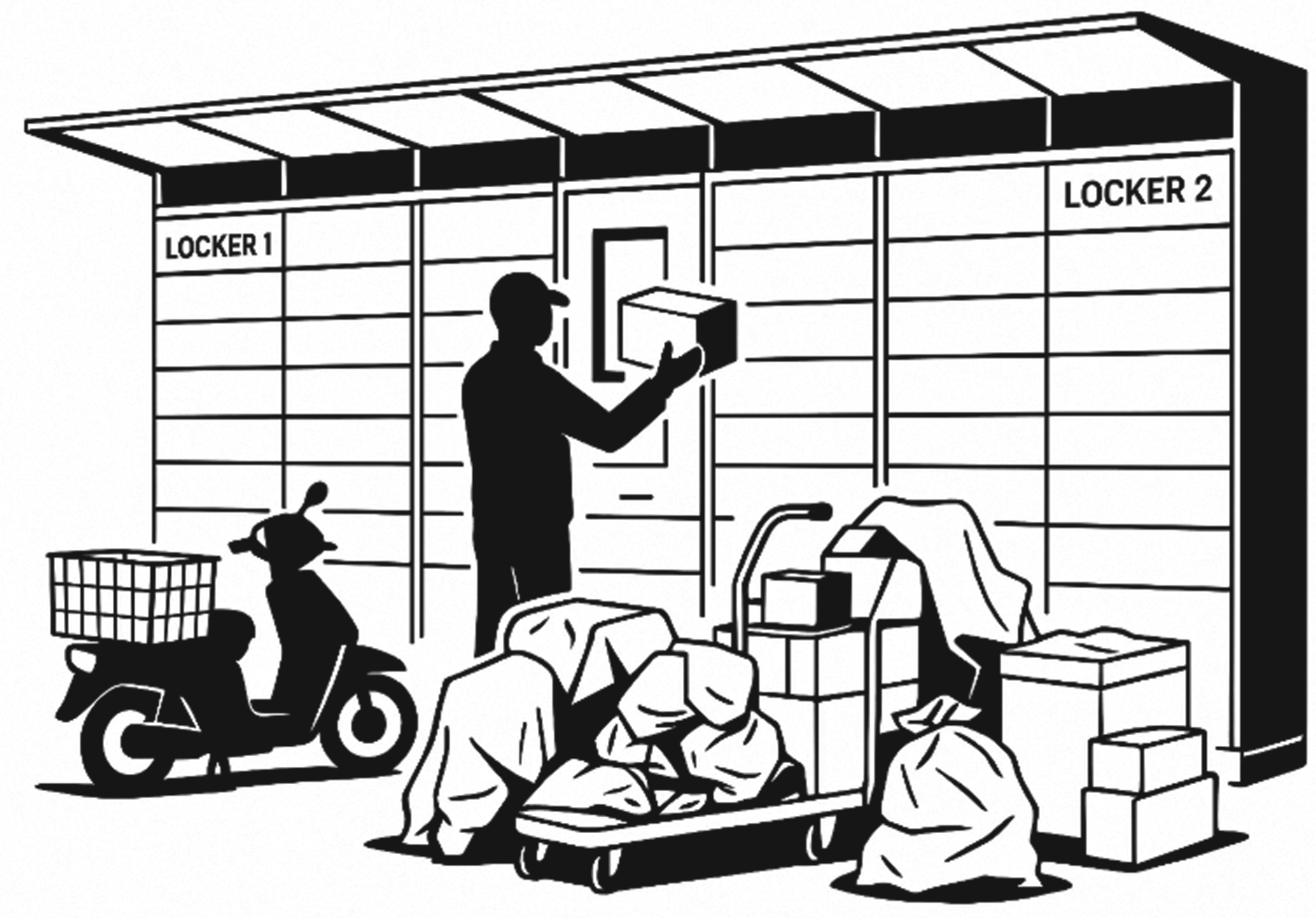
The application of shared parcel lockers.
Hence, this research presents a vehicle routing problem with stochastic locker capacity (VRPSTC) for last-mile delivery that integrates both home delivery and shared parcel locker modes. More importantly, the stochastic residual capacity of shared parcel lockers is explicitly modelled, which significantly complicates vehicle scheduling. Ignoring capacity uncertainty can trigger reassignment between customers and their preferred lockers and, in extreme cases, delivery failure. To solve this NP-hard problem, a problem-tailored simheuristic is employed that couples adaptive large neighborhood search (ALNS) with a two-phase Monte Carlo simulation (MCS), i.e., fast screening during the search and deep evaluation post-search, to identify solutions robust to locker-capacity uncertainty. In contrast to classical stochastic VRPs driven by demand or travel time variability, the present formulation locates uncertainty at a shared facility and makes the execution-phase recourse explicit. Building on this gap, the manuscript consolidates the problem-level mechanism, a problem-tailored simheuristic, and insight-level evidence regarding how locker-capacity statistics shape service feasibility and cost.
This study contributes at three levels: (1) Problem-level mechanism. It formalizes a vehicle routing problem with stochastic locker capacity (VRPSTC) where uncertainty arises from the residual capacity of shared parcel lockers during execution, triggering enroute reassignment or rollback between the home delivery and parcel-locker modes. This mechanism differs from classical stochastic VRPs that mainly consider random demand or travel time, by locating uncertainty at a third-party, shared facility jointly constrained by multiple routes and customers. (2) Method-level advance. It develops a problem-tailored simheuristic that couples adaptive large neighborhood search (ALNS) with a two-phase Monte Carlo simulation (MCS) schedule, i.e., fast in-search screening and deep post-search evaluation of an elite set, and integrates locker-aware destroy/repair and decoding with overflow penalties as surrogates for execution-phase recourse. Adaptive operator weighting is calibrated to this locker-aware setting, steering the search toward plans with fewer/shorter overflow-induced add-ons. This promotes robustness during the search, not only ex post, while remaining computationally scalable. (3) Insight-level findings. It quantifies the plan–execution gap by contrasting deterministic plans with their stochastic realizations and explains how the mean and dispersion of locker capacity shape service feasibility and operating cost, offering actionable guidance for configuring locker systems and planning coordinated last-mile delivery under capacity uncertainty.
The remainder of this research is organized as follows. Some relevant literatures regarding the last-mile delivery, the application of the shared parcel locker, and the stochastic delivery are reviewed in Section 2. Section 3 presents the studied problem and its corresponding mathematical model. The sim-heuristic framework is presented in Section 4. Section 5 presents the design and implementation of numerical experiments. Finally, Section 6 concludes this research.
In this section, three sub-categories of relevant literatures, i.e., the last-mile delivery, the shared parcel locker, and the stochastic delivery, are reviewed, which constitutes the foundation of the studied problem.
Last-Mile Delivery
Last-mile delivery in city logistics could be viewed as a variant of the general VRP with various additional factors arising from customer requirements, traffic regulations, local policies, etc. The implementation of last-mile delivery mainly relies on home delivery, which requires the direct interaction between customers and deliveryman (Visser et al., 2014). However, the mode of home delivery may encounter delivery failure due to customer absence, and the vehicle utilization in home delivery mode is commonly low in practice (Allen et al., 2018). Hence, various new technologies have been proposed to enhance the last-mile delivery efficiency, such as the application of cargo-bikes, unmanned aerial vehicle (UAV) and robots. Cargo-bikes are used to deliver goods to clients, enabling shorter delivery routes by driving in areas restricted for motorized traffic and being less impacted by traffic conditions (Fikar et al., 2018). Simoni et al. (2020) considered the utilization of robots in last-mile delivery to form a truck-robot delivery system, and showed that the application of robots can improve last-mile delivery performance significantly, especially in some high population density areas. Yan et al. (2023) studied the application of UAVs for last-mile delivery in Taiwan with delivery routing and scheduling design. Cha et al. (2023) further investigated the collaborative delivery using ground vehicles and UAVs for practical logistics delivery purpose.
In addition to the application of new technologies, the design of network is also a nonnegligible issue in last-mile delivery in terms of the deployment of transit stations and front stations especially. For example, Zhou et al. (2018) designed a two-echelon VRP problem for last-mile delivery, in which customers are allowed to take their packages at some transit stations or parcel lockers. Zhao et al. (2021) proposed a location-routing problem for last-mile delivery where simultaneous pickup and delivery are considered and the collected items need to be processed in certain depots. Nieto Isaza et al. (2022) designed a crowdsource last-mile delivery system, which involves a two-stage decision-making process, i.e., the first stage is to make decisions regarding the location of small depots so as to allow flexible crowd-demand matching, and the second stage is to determine the demand allocation of for each deliveryman. Moreover, environmental and social considerations are also inevitable in last-mile city delivery. For example, Trott et al. (2021) proposed a mixed integer linear model for the last-mile delivery, which measures the vehicle emission and its affect to the sustainable development of cities. Caspersen and Navrud (2021) further investigated customer awareness towards the green initiatives and identified that customers prefer environmentally friendly last-mile delivery modes. Du et al. (2022) incorporated the impact of carbon emission into a two-echelon joint delivery problem, aiming to reduce both the operation cost and the adverse environmental impact. Besides, the operations of last-mile delivery could be also influenced by some governmental regulations especially in the context of epidemic (Sandoval et al., 2022).
Shared Parcel Locker
The application of shared parcel lockers is another promising last-mile delivery mode, which can complement the home delivery mode and improve the delivery efficiency considerably, especially in high population density areas. The work of Punakivi and Tanskanen (2002) was one of the initial studies which introduces the concept of shared reception boxes and estimates that the use of unattended shared reception boxes in last-mile delivery could reduce transportation costs by 55–66% compared to the manned premises with a delivery time window. In addition to the reduction of distribution cost, Edwards et al. (2010) claimed that the application of collection-delivery points was a convenient and environmentally friendly delivery mode, which can also reduce CO2 emissions substantially. Wang et al. (2014) once compared three delivery modes in last-mile delivery, i.e., attended home delivery (AHD), reception box (RB) and collection-and-delivery points (CDPs), and pointed out that the application of CDPs played a significant role in areas with high population density. Grabenschweiger et al. (2021) investigated the last-mile delivery system with locker box stations, in which heterogeneous locker boxes were considered and compensation payment was involved if customer chose to use locker box. Pinchasik et al. (2023) used empirical shipment data and real-world routing optimization procedures to demonstrate that increased parcel locker use can reduce logistics costs, traffic, and emissions from last-mile distribution of a logistics service provider.
The applicability of shared parcel lockers relies on multiple factors. On the one hand, the customer preference and deliveryman perception can affect the usage of shared parcel lockers significantly. Vakulenko et al. (2018) once studied customer perception of shared parcel lockers as a new delivery service and investigated the customer value benefited from the usage of shared parcel lockers. Yu et al. (2021) analyzed the value of shared parcel lockers for customers who choose pickup service and for deliverymen who simplify the delivery process by dropping off their deliveries at shared parcel lockers. Ghaderi et al. (2022) claimed that the application of shared parcel lockers in last-mile delivery can improve delivery efficiency in view of the increase of successful delivery rate. On the other hand, the deployment of shared parcel lockers in last-mile delivery network can influence its effectiveness and efficiency as a new delivery mode. Deutsch and Golany (2018) demonstrated the design of the optimal number, location, and size of parcel lockers can affect the last-mile delivery performance considerably. Jiang et al. (2020) once studied a last-mile vehicle scheduling problem considering both home delivery and locker delivery, in which customers can determine their preferred delivery modes. Lin et al. (2022) studied the location deployment of shared parcel lockers by predicting the likelihood of customers who prefer shared parcel lockers so as to maximize the possible revenues. Rossolov (2023) justified potential Alternative Parcel Location (APL) sites by developing behavioral models for existing choices between home deliveries and post office deliveries, considering time expenditures for the pick-up process and in-store grocery shopping.
Stochastic Delivery
Stochasticity is inevitable in last-mile delivery problems considering the practical delivery scenarios in large cities. Among the various stochastic factors, stochastic travel time and stochastic customer demand are two mostly studied aspects in delivery problems. Laporte et al. (1992) was one of the early studies which views the travel time as a stochastic factor and proposes the concept of stochastic vehicle routing problem, and they designed a chance-constrained programming (CCP) model to solve the proposed problem, which can ensure the “path success” within a specified confidence interval. Miranda and Conceição (2016) studied the stochastic vehicle routing problem with the estimation of the vehicle arrival time and arrival probability within service time windows so as to guarantee the delivery service level. In contrast, the vehicle routing problem with stochastic customer demand refers to the fact that the customer demand is not deterministic in advance (Dror, 1993). The delivery problem with stochastic demand is commonly modeled as a two-stage stochastic programming model, which is comprised of priori optimization strategies and recourse strategies (Goodson et al., 2012). Simulation-based approach is another popular method to tackle the delivery problem with stochastic demand (Liu et al., 2017).
In contrast to delivery problems with stochastic travel time or stochastic customer demand, this study considers a new variant in which uncertainty lies in the available capacities of shared parcel lockers. In practice, residual locker availability fluctuates noticeably, and shortages or under-utilization are frequently observed, which can significantly affect delivery schedules. Hence, the proposed problem not only enriches the theoretical landscape but also yields practically useful managerial insights for locker-aware last-mile planning.
Simheuristics address stochastic routing by combining deterministic search (e.g., ALNS) with Monte Carlo simulation (MCS) to evaluate candidate plans under realizations (e.g., Guimarans et al., 2018; Keenan et al., 2021). Prior applications predominantly model uncertainty at the customer (demand) or arc (travel time) level. Our setting is different as uncertainty acts on a shared facility (parcel-locker residual capacity), which couples multiple routes and customers and can induce execution-phase recourse. Accordingly, our method is problem-tailored as it integrates locker-aware destroy/repair and decoding with overflow penalties (as surrogates for reassignment/rollback), together with a two-phase MCS schedule, i.e., fast in-search screening and deep post-search evaluation of an elite set, and adaptive operator weighting calibrated to reduce overflow-induced add-ons. This integration promotes robustness during the search, not only ex post, and positions the approach within state-of-the-art simheuristic practice for logistics under uncertainty.
Model Formulation
Problem Description
VRPSTC can be represented as a directed graph
The distribution center The delivery service mode chosen by each customer is known in advance and the customer order cannot be split. The specific geographical distribution of shared parcel lockers is known, and lockers operate 24 h a day by default. The available capacity of shared parcel locker
Figure 2 presents an illustrative example of the collaborative last-mile delivery system. In route 1, customer 1, 2 and 3 choose home delivery mode, and customer 5 and 6 choose the shared parcel locker delivery mode. However, in route 3, due to the uncertainty of the remaining available capacity, the locker 11 is unable to serve both customers 12 and 13 simultaneously. Thus, in this delivery solution, the order of customer 13 is eventually served by the locker 14.

An illustration of the last-mile delivery with home delivery and parcel locker delivery.
The following symbols and notations are adopted to form the mathematical model. Description Maximum capacity of the vehicle Order quantity of customer Service time for customer Time window settings of customer Design capacity of shared parcel locker Remaining available capacity of shared parcel locker Service time for shared parcel locker Travelling time from node Delivery cost from node Distance between note i and Description 1 if vehicle k travels from node i to node j directly, 0 otherwise 1 if customer Description
Mathematical model

Subject to










The objective function (1) is to minimize the sum of total delivery distance for couriers and the self-pickup distance for customers who choose the parcel locker delivery mode. Constraints (2) and (3) indicate that for customers with home delivery mode, the vehicle inflow and outflow are balanced. Constraint (4) means that for customer with locker pickup mode, no vehicles will visit their places. Constraint (5) shows that the demand of each customer is served by only one vehicle. In other words, no order split is allowed for all customers. Constraint (6) represents the relationship between the route variable
In this section, a simheuristic framework is proposed to tackle the introduced VRPSTC. Following the simheuristic idea, e.g., Juan et al. (2015), deterministic search is combined with Monte Carlo evaluation under capacity realizations, leveraging the empirical observation that high-quality deterministic plans are often good candidates in stochastic settings. Simheuristic approach is of high popularity and convenience to solve stochastic combinatorial problems in various scenarios (Guimarans et al., 2018; Keenan et al., 2021). Hence, the framework of simheuristic approach is typically composed of two major components, i.e., a heuristic algorithm to find deterministic solution and a simulation method to evaluate the performance of the deterministic solution in random scenarios. In particular, in this research, the adaptive large neighborhood search (ALNS) algorithm is adapted to search for deterministic solutions, and Monte Carlo simulation (MCS) is utilized to further evaluate the performance of the obtained solutions.
Figure 3 shows the flowchart of the proposed simheuristic framework. To start with, the model with random locker capacity is transformed into a deterministic model using the expected value of the locker capacity. Secondly, ALNS is adapted to solve the deterministic optimization model. In each searching phase of ALNS, once a new solution is generated and accepted, a preliminary simulation procedure is conducted to evaluate the expected performance of this deterministic solution in random scenarios. If the stochastic performance of this solution is accepted as well, it is temporarily stored in a stochastic solution list. After the completion of ALNS, the solutions in the stochastic solution list are further evaluated using MCS methods so as to find the stochastic solution with best performance.

The flowchart of the simheuristic framework.
In this research, ALNS is adapted to solve the deterministic problem, which is one of the most well-acknowledged algorithms to solve various vehicle routing problems (Dayarian et al., 2016; Keskin et al., 2021; Windras Mara et al., 2022). Figure 4 illustrates the flowchart of the ALNS algorithm. Initially, a simple and efficient heuristic method is used to construct an initial solution, thereby starting the search process of the ALNS algorithm. In the following searching phase, the initial solution is first destroyed and then repaired using selected operators, leading to an updated solution. Then, the updated solution is evaluated for updating the global optimal solution and the current solution. Meanwhile, relevant operators are evaluated and scored, and the weights of these operators are updated after a certain number of iterations. The above process is repeated until the termination condition is met.
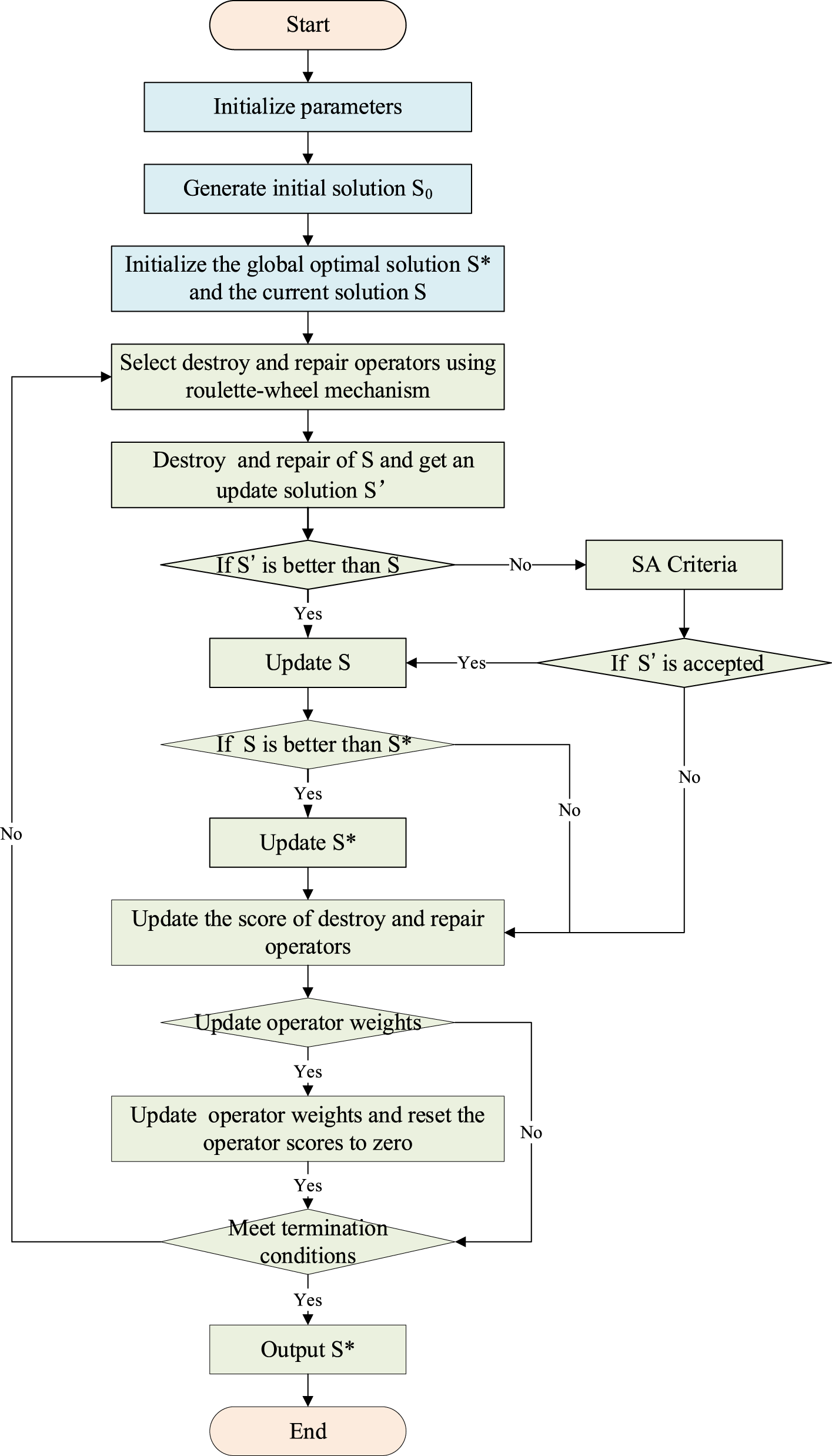
The flowchart of the ALNS algorithm.
The ALNS starts from a randomized initial plan Step 1 – Route construction (randomized). Create a list by shuffling Step 2 – Decoding under deterministic locker capacity. Given route k with sequence
Illustrative cases (Figure 5). Let Route 1 contain PL customers If If If If a route contains only HD customers and lockers (no PL customers), lockers are removed since they provide no service on that route.
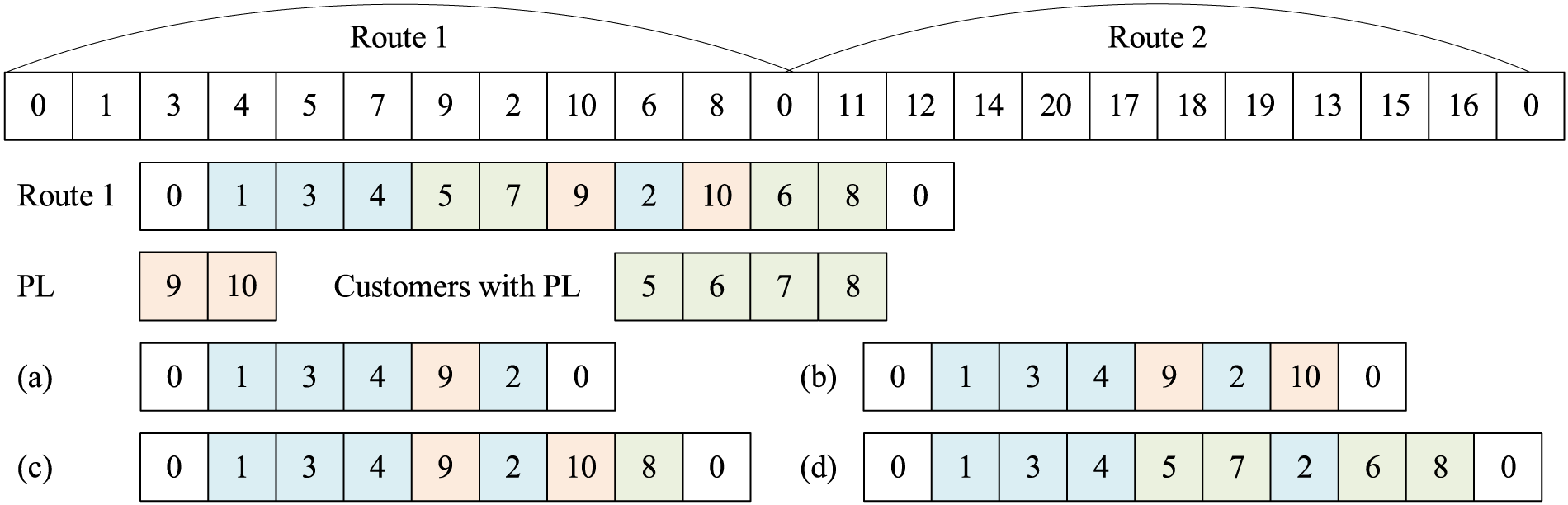
Initial solution and decoding under locker capacity. (Decoding assigns PL customers to the next locker with remaining capacity along the route; unused lockers/PL nodes are removed. The same rules apply in MCS with realized
We use the same decoding logic within Monte Carlo simulation by sampling
Let current solution S contain route set Random removal. Uniformly pick q nodes from S and push to Random-route removal. Uniformly pick a non-empty route Shaw removal. Similarity between nodes Worst removal. Node-removal gain Worst-distance removal. For node i with predecessor p and successor n,
Parameter Settings.

Candidate positions that violate vehicle capacity or HD time windows are discarded. Time is checked by forward-propagating service start times; lockers have no time window by default.
Let Greedy insertion. For each Regret-2 insertion. For each i, let Distance-greedy insertion. For each i, for each arc Greedy-with-noise. Perturb greedy costs: Distance-greedy-with-noise. Apply the same perturbation to
After reinsertion, decoding assigns PL customers to lockers along the route with remaining capacity; overflow triggers the penalty term.
Let
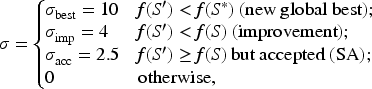

Then reset
The above setting is the canonical ALNS adaptation scheme; our scores
Acceptance and Stopping Criteria

Monte Carlo Simulation
ALNS searches for high-quality deterministic plans, while MCS evaluates their performance under stochastic locker-capacity realizations. In this work, every newly accepted solution during the ALNS search is evaluated by MCS rather than only ex-post selection.
The details of MCS implementation are presented as follows.
MCS implementation
Notations
1) Initialize
2) While
// sample once per locker (shared across routes)
For each
While
While
If
Decode the route k //apply reassignment/rollback if overflow occurs; add penalties)
Calculate the cost of route
Output the stochastic performance of solution S as
Numerical Experiment
In this section, the performance of the proposed ALNS is firstly evaluated through a number of computational experiments. The commercial optimization solver Gurobi 9.1.2 is leveraged for comparison when solving small-scale test instances. Then, some large-scale instances are also implemented to further confirm the performance stability of the ALNS algorithm. After that, the sim-heuristic framework is applied so as to find the most promising stochastic solutions. A detailed comparison between the best stochastic solution and the optimal solution obtained in deterministic context is provided as well. Finally, some sensitivity analyses are presented in view of the capacity design of shared parcel lockers. All numerical experiments are conducted on the Anaconda platform coded using Python 3.9, and implemented on a personal PC with AMD Ryzen 7 5800H, Radeon Graphics 3.20 GHz, and 16G RAM.
Instance Generation and Parameter Settings
Test instances are derived from the classical Solomon benchmark dataset as (Solomon, 1987) with additional modifications to suit the features of this research problem. In general, given N customer nodes, the number of customers with home delivery and self-pickup requirements are set as
Evaluating the Performance of ALNS
The performance of the ALNS is firstly examined and validated in comparison with the commercial optimization solver Gurobi 9.1.2 over a number of test instances. In order to facilitate the solving process, the time limit of Gurobi is set as 1800 s. Moreover, for each instance, the proposed ALNS is applied 10 times, and the average objective value and CPU times are collected. Table 2 summarizes the comparison result of ALNS and Gurobi over instances with 10, 20, and 30 nodes. It is noted that for instance with 10 nodes, both ALNS and Gurobi can find the optimal solutions within a short time. When the scale of instances reaches 20 nodes, Gurobi can find feasible solutions for most cases with the time limit setting of 1800 s. In contrast, the computational time of ALNS for solving instances with 20 nodes is around only 20 s, which distinctly dominates that of Gurobi. For instances with 30 nodes, although Gurobi can still find feasible solutions for some instances, ALNS can find better solutions over Gurobi using only 50 s averagely. Gurobi solves the deterministic surrogate (locker capacity fixed at
Comparison of ALNS and Gurobi Over Small-Scale Instances.

Comparison of ALNS and Gurobi Over Small-Scale Instances.
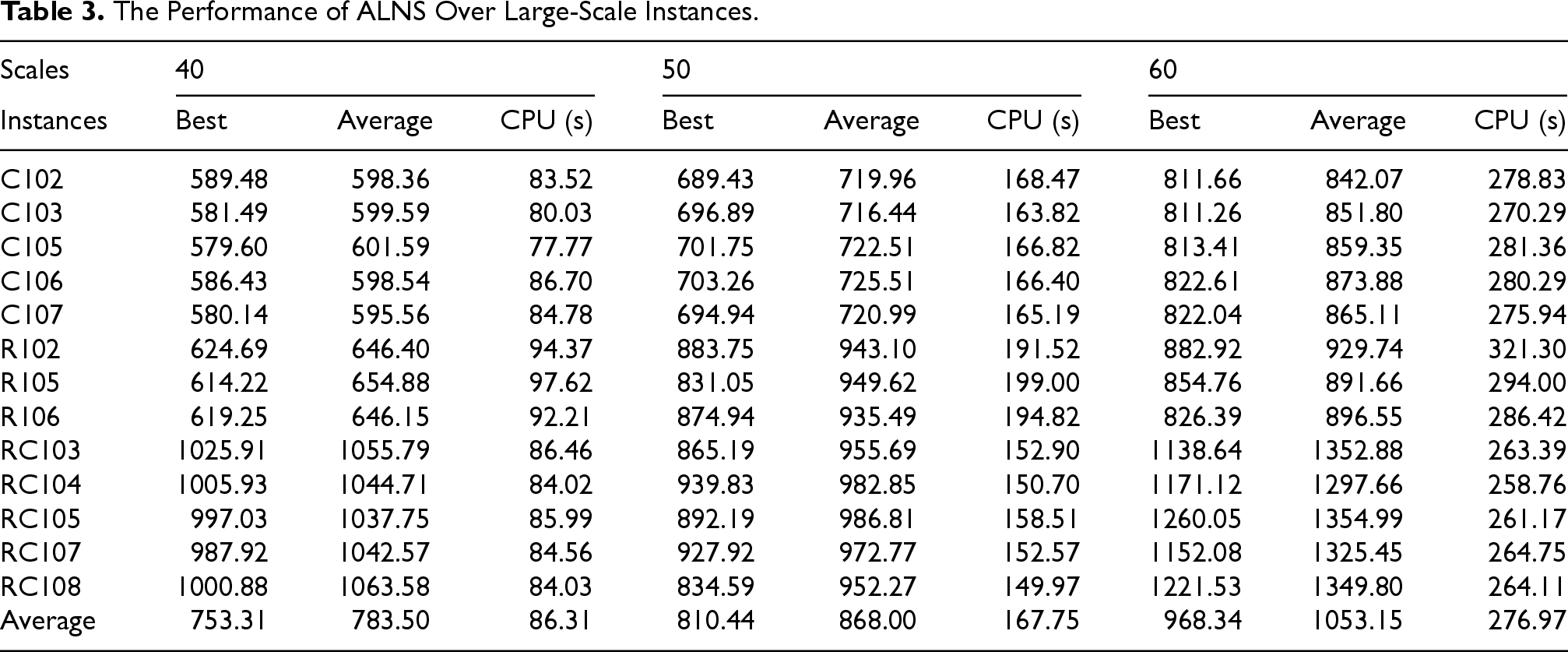
Instances with larger scales are also tested to further assess the performance of the proposed ALNS. As shown in Table 3, the devised ALNS is capable of solving instance with 40, 50, and 60 nodes using 113, 235, and 402 s averagely. By contrast, Gurobi cannot find any feasible solutions within 1800 s. Moreover, it is noticed that the ALNS possesses a relatively stable performance in terms of a small gap between the best objective value and the average objective value. Thus, it is concluded that the proposed ALNS performs well in terms of both computational efficiency and solution quality, especially when the scale of instances becomes large.
The Performance of ALNS Over Large-Scale Instances.
In this sub-section, the available capacity of each locker
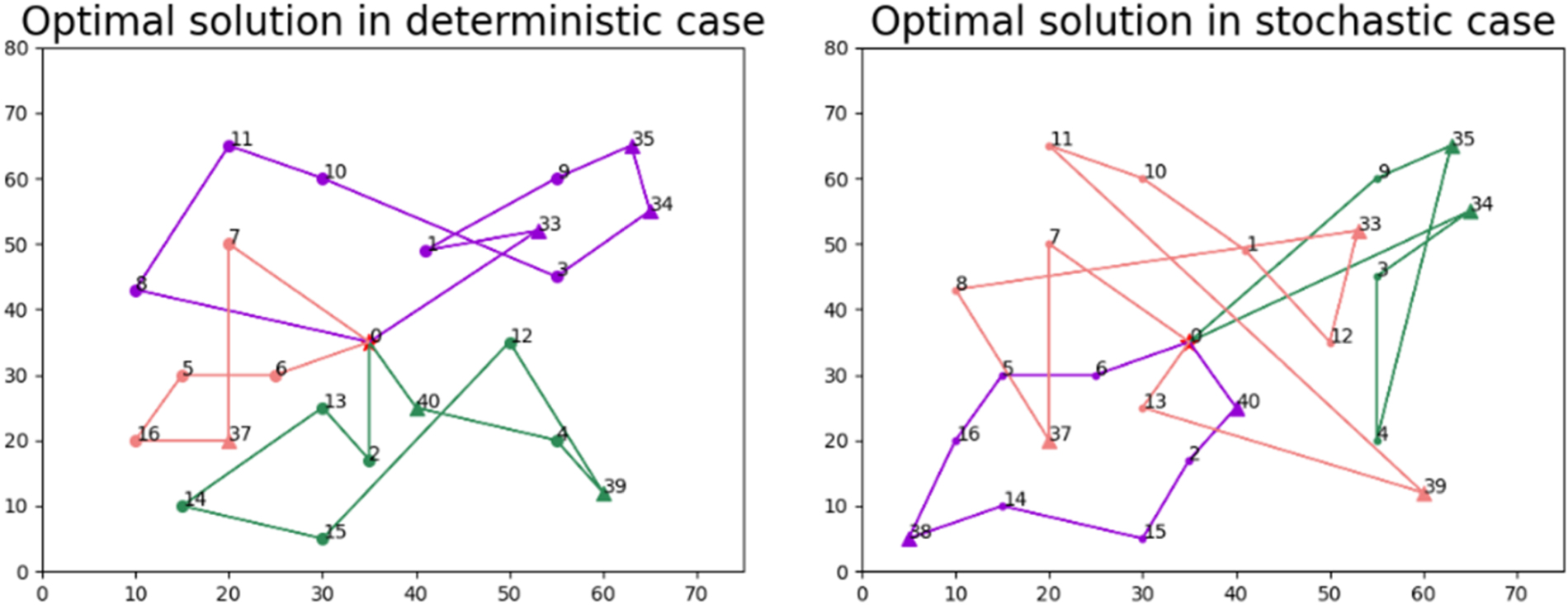
The comparison of optimal solutions in deterministic and stochastic scenarios.
Table 4 summarizes a performance comparison between deterministic and stochastic scenarios over some test instances, in which DTC1 represents the objective value of the optimal deterministic solution, STC1 indicates the expected objective value of the deterministic solution with MCS evaluation, and STC2 represents the expected objective value of the optimal stochastic solution. Note that the solution of DTC1 is acquired using the expected available capacity as a deterministic input, and this corresponding solution is further assessed through MCS so as to obtain the expected objective value in STC1. Simulation results show that the value of STC1 exceeds that of DTC1 to the extent of 73.51% on average, which indicates that the ignorance of uncertainty regarding the available capacity of the shared parcel locker could lead to a huge operational cost deviation. The difference between STC1 and STC2 suggests that the optimal stochastic solution and the optimal deterministic solution might be also slightly different, which is practically consist with the principle of sim-heuristic framework as the optimal deterministic solutions are likely to the promising solutions in stochastic scenarios. Indeed, the optimal stochastic solution and the optimal deterministic solution in RC101 is the same, and the slight difference between STC1 and STC2 regarding RC101 is due to the randomized MCS procedure. Figure 7 visualizes the difference between STC1 and STC2 over these instances. Across instances, executing the deterministic plan (DTC1 → STC1) yields a substantially higher expected cost due to locker shortfalls, while the simheuristic solution (STC2) consistently narrows this gap by reducing reassignment/rollback incidence.
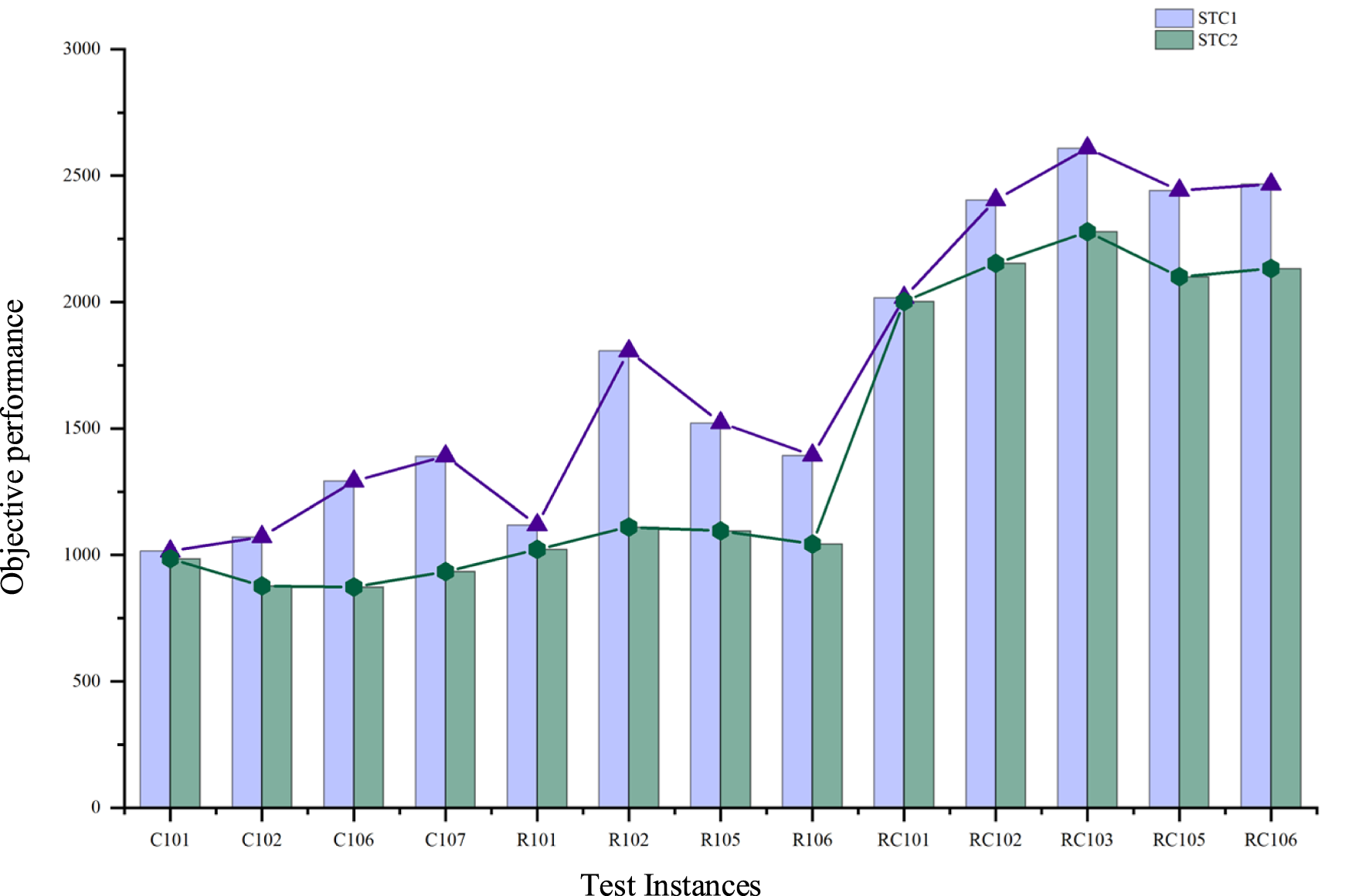
The comparison between deterministic and stochastic solutions.
Performance Comparison Between Deterministic and Stochastic Solutions.
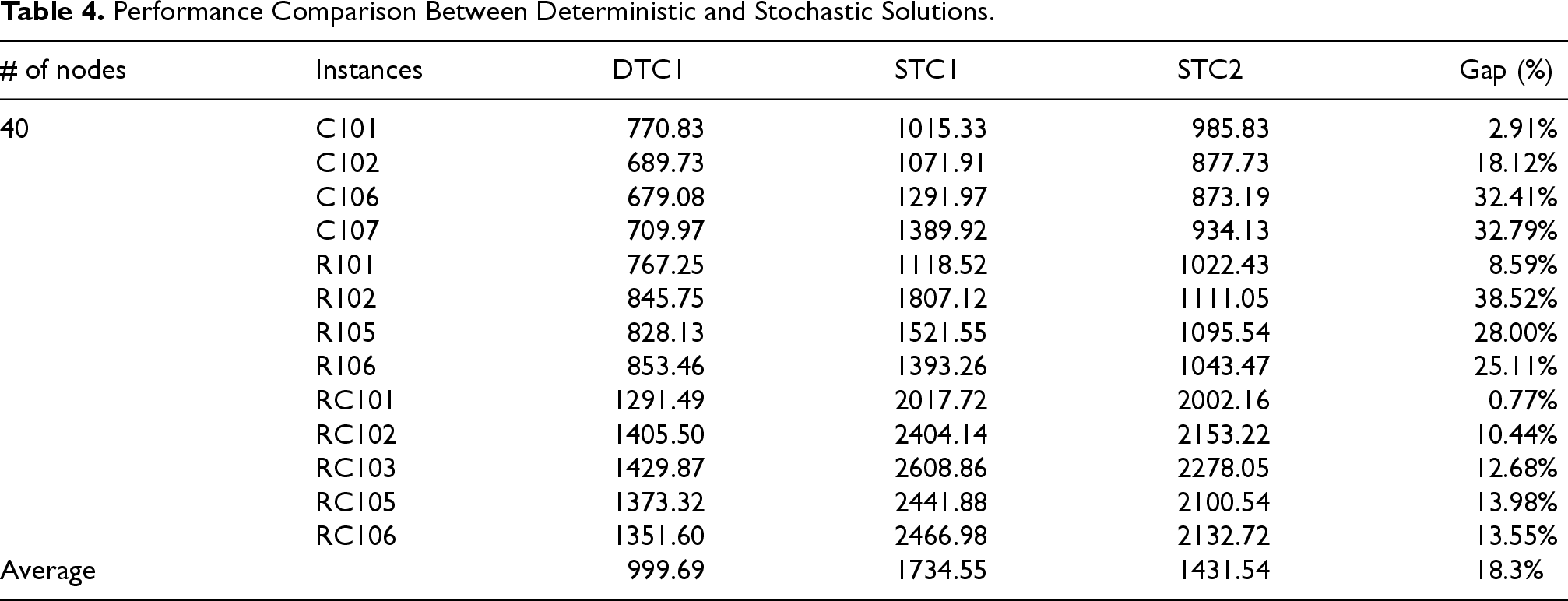
Beyond the deterministic objective (DTC1), the gap to STC1 quantifies the expected execution penalty caused by locker shortfalls when the deterministic plan runs under capacity realizations (Section 4.2). The reduction from STC1 to STC2 captures the robustness gain obtained by screening plans across realizations within the simheuristic and selecting by
In this subsection, the impact of the available capacity of the shared parcel locker is further investigated in terms of different parameter settings of the mean and variance. As described previously, the design capacity of the shared parcel locker is set as 100 by default, and normal distribution is assumed to simulate its remaining available capacity, as
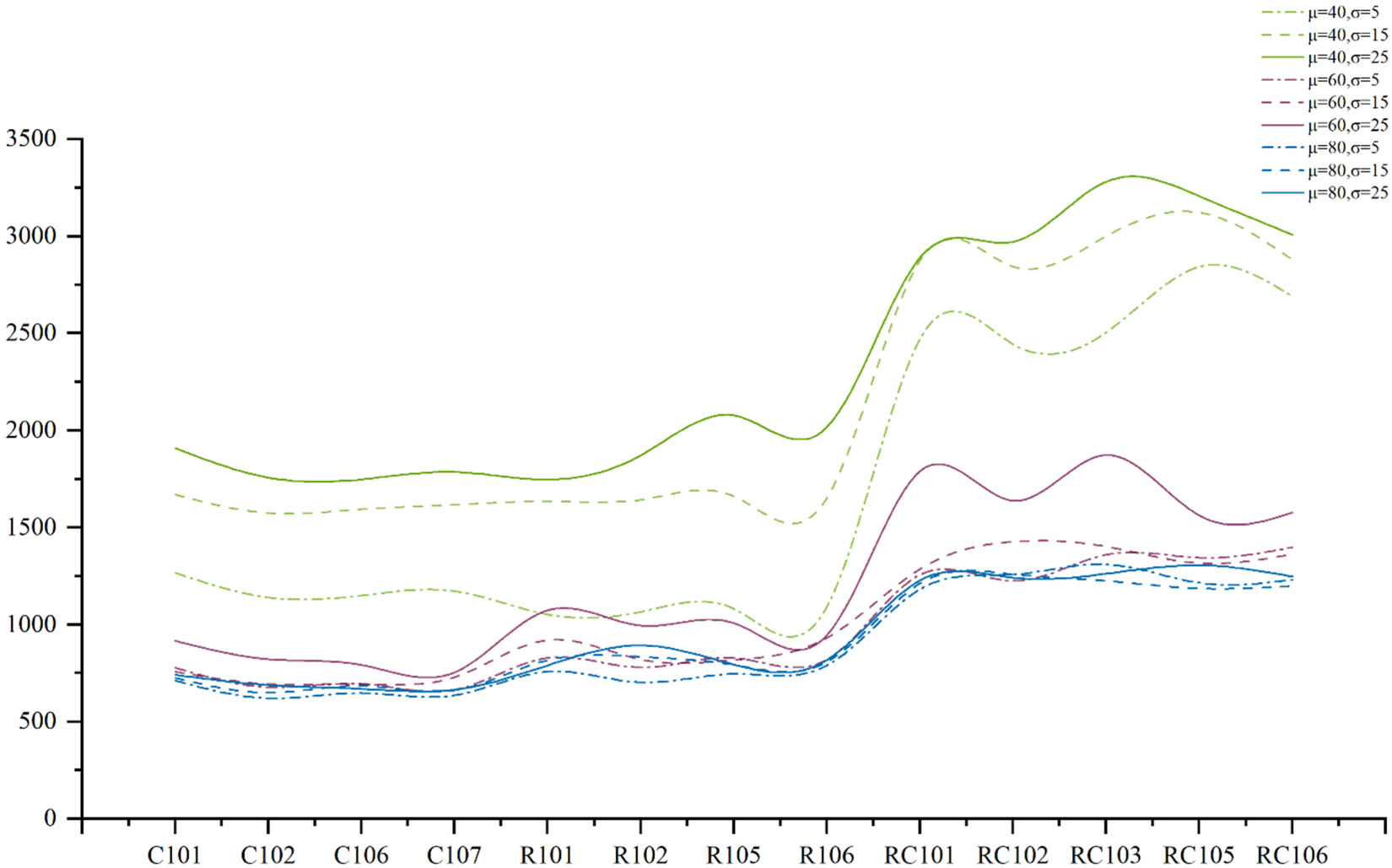
Total cost changes with different fluctuations of available capacities.
Sensitivity Analysis Regarding the Variance of the Available Capacity of Shared Parcel Lockers.
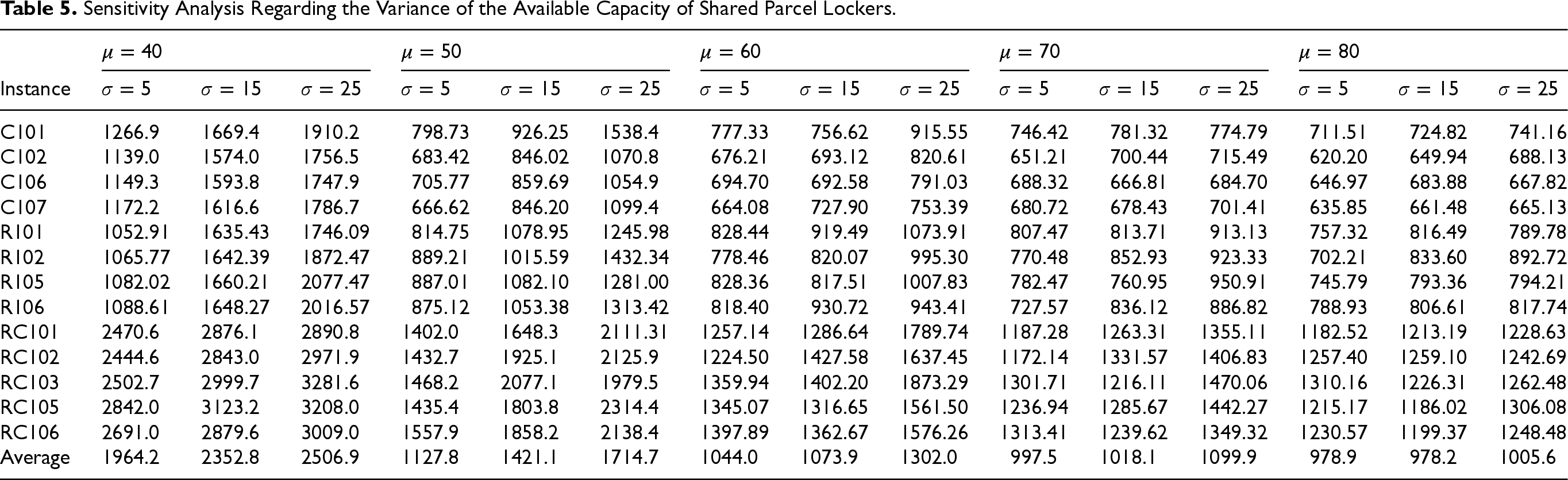
Across instances, mean availability dominates the cost response: when the expected locker capacity is tight, total cost increases markedly relative to cases with ample mean availability (Table 5; Figure 8). In contrast, the impact of variance is conditional on the mean. Under tight means, higher variance systematically raises cost because shortfalls (and thus reassignment/rollback) become more frequent. When the mean is ample, variance has a much weaker and less systematic effect. Operationally, this pattern suggests that raising baseline availability (e.g., adding cells or redistributing loads) is the first-order lever, while variance mitigation (e.g., visit timing or micro-rebalancing) becomes relevant only when means cannot be lifted. These findings complement the plan–execution evidence in Section 5.3: reducing the frequency of capacity shortfalls directly limits recourse actions and narrows the plan–execution gap between deterministic plans and stochastic realizations. These mean-dominant patterns persist across bounded distributional families with matched
This study proposes a vehicle routing problem with stochastic locker capacity for last-mile city logistics, integrating home delivery and parcel-locker pickup modes. A defining feature of the formulation is that uncertainty acts on a shared facility, i.e., the residual capacity of parcel lockers, which can trigger execution-phase recourse (reassignment to alternative lockers or rollback to home delivery) and thus complicates routing decisions compared with deterministic settings. To address the problem's NP-hardness, a simheuristic framework is adopted, coupling adaptive large neighborhood search with Monte Carlo simulation to search for promising plans and evaluate their performance under capacity realizations. Numerical results indicate double-digit cost reductions (10∼20%) when locker-capacity uncertainty is explicitly considered, relative to executing deterministic plans that ignore such variability. Moreover, the sensitivity analysis clarifies how the mean and dispersion of locker availability shape feasibility and cost. From an operational perspective, explicitly accounting for shared-facility uncertainty reduces the plan–execution gap and limits costly recourse actions. In deployments where average locker availability is tight or highly volatile, locker-aware planning combined with robust solution screening (via simulation) becomes essential to sustain service levels and control last-mile cost.
Despite these efforts, several limitations remain. The experiments rely on synthetic instances rather than first-hand industrial data, which may affect external validity; a priority is to collect and analyze operational data to calibrate capacity statistics and validate the model in practice. In addition, while the approach relies on a metaheuristic, further algorithmic enhancements (e.g., operator tuning, acceptance strategies, problem-specific repair heuristics) could improve efficiency and scalability. Future work may also explore richer uncertainty treatments (e.g., alternative bounded distributions or service-level-oriented calibration in simulation) and evaluate policy variants for locker deployment and load rebalancing under realistic operating constraints. Complementarily, locker availability and/or service levels could be modeled as fuzzy quantities (e.g., trapezoidal or intuitionistic fuzzy sets) and assessed via alpha-cut or credibility-based analyses; moreover, fuzzy MCDM (e.g., centroid/graded-mean ranking under intuitionistic trapezoidal sets) can aid locker deployment decisions and parameter tuning under multiple, possibly qualitative criteria—integrating managerial preferences and imprecise information with our probabilistic, simheuristic core. Concretely, we will (i) calibrate
Footnotes
Acknowledgements
The authors would like to thank editors and reviewers for their valuable comments.

Author Contribution
Funding
This work was supported by the Zhejiang Provincial Natural Science Foundation (No. LY23G020001)
Conflict of Interest
The authors declare no conflict of interest.