



Abstract
To address the challenges of feature extraction difficulties and complex background interference in unmanned aerial vehicle (UAV) remote sensing vehicle target detection, YOLOv11 is chosen as the baseline model due to its efficient detection speed, excellent detection accuracy, and the ability to precisely identify objects of small target. Firstly, we introduce the FasterNet neural network, which maintains high detection accuracy while achieving a breakthrough in computational speed and significantly reduces the number of parameters and computational complexity. Secondly, based on the FasterNet model, we propose the Efficient Multi-scale Attention (EMA) mechanism. Through multi-scale feature fusion and efficient computational design, the model enhances its understanding of complex information. Finally, we integrate the DySample and Lightweight Adaptive Extraction (LAE) modules into the neck network. These two modules support dynamic feature alignment and adaptive channel optimization, optimizing the allocation of computational resources. Basing on improving modules, we propose the YOLOv11-FEDL model. Its optimized feature extraction mechanism forms an efficient, flexible, and robust object detection framework. The resulting architecture enhances detection performance while simultaneously lowering computational complexity. In the lightweight experiments conducted on the Cardrone and VisDrone2019 datasets, the mAP@0.5 metric reached 89.7% and 39.1% respectively, the inference speed increases to 301.80 FPS and 334.10 FPS respectively, and the average inference time is reduced to 2.41 ms and 2.43 ms respectively. The improved model maintains comparable detection accuracy while reducing the parameter count to 2.33 M and the computational complexity to 5.3 GFLOPs, and the inference speed is increased by approximately 20%.
Introduction
Unmanned aerial vehicle (UAV) remote sensing technology, with its high mobility and wide-area coverage capabilities, has become an important data acquisition method in the field of intelligent transportation (Li, Li et al., 2024). However, in the task of vehicle target detection from the UAV perspective, the feature extraction of small targets and the interference from complex backgrounds remain the key bottlenecks restricting the detection accuracy. Although the emergence of deep neural networks has driven revolutionary development in the field of target detection and has become the mainstream technology (Bakirci, 2025; Chen & Liang, 2025; Ding et al., 2024), traditional deep learning-based target detection models, although performing well in conventional scenarios, are limited by fixed receptive fields and static feature fusion mechanisms, which easily lose fine-grained information in the detection of small targets, and their high computational complexity also limits their real-time deployment on resource-constrained devices. Therefore, in order to effectively apply target detection technology to mobile devices, it is necessary to achieve the collaborative optimization of lightweight architecture and efficient detection capabilities (Cao et al., 2023; Li, Qin et al., 2024; Mishra et al., 2023).
Object detection algorithms based on deep learning are mainly divided into two categories: two-stage algorithms and one-stage algorithms. Two-stage algorithms generate candidate regions, select bounding boxes that may contain objects, and then classify and regress these candidate boxes to accurately locate the position and category of the objects. Typical representatives include R-CNN (Girshick et al., 2015) and Faster R-CNN (Ren et al., 2016). These algorithms perform well in high-precision tasks, but they have limitations such as slow operation speed, complex parameter settings,and insufficient scene generalization ability, which restrict their application scope. In comparison, single-stage algorithms abandon the step of generating candidate regions and directly predict object locations and class probabilities. Typical representatives include the SSD (Yan et al., 2022), YOLOv8 to YOLOv11 (Barr, 2025; Qiu et al., 2024; Wang et al., 2025; Yi et al., 2023) series models. Due to the elimination of the candidate region generation process, these algorithms have a faster processing speed and can achieve real-time detection, which is highly advantageous in scenarios requiring rapid response. By reviewing the evolution of the YOLO series models, it can be seen that with version iterations, the models have been steadily improving detection accuracy while continuously moving towards lightweight development. This paper focuses on the research of lightweight object detection algorithms base on the YOLOv11 model.
To achieve the lightweighting of neural networks, researchers have proposed strategies such as model pruning, lightweight architecture design, knowledge distillation, quantization, and neural architecture search (Zhou et al., 2022). As the latest advancement in this field, this study presents a lightweight method based on YOLOv11. Through architecture optimization and reallocation of computing resources, it significantly reduces the model parameter size and computational load while maintaining detection accuracy. These contributions can be summarized as follows: We propose the FasterNet structure on the YOLOv11 network, aiming to reduce the number of parameters and computational load of the model. On the basis of FasterNet, the Efficient Multi-scale Attention (EMA) mechanism is added to enhance the model's perception of objects of different sizes through multi-scale feature modeling. We integrate the DySample and Lightweight Adaptive Extraction (LAE) modules into the neck network to enhance the multi-scale feature fusion capability while maintaining a lightweight design, in order to achieve efficient and accurate object detection. We rationally leverage the pivotal roles of feature extraction and attention mechanisms within the network to create a mutually reinforcing effect between them. Experimental validation was conducted on the Cardrone and VisDrone2019 datasets. The approach maintains vehicle object detection accuracy while simultaneously reducing network complexity.
The paper can be organized in the following manner. In Section II, we present an overview of the related work. Section III elaborates in detail on the proposed traffic object detection method. Subsequently, in Section IV, we provide interpretations and analyses of the experimental results, which serve as evidence for the effectiveness of our method. Finally, the conclusions and future research directions are stated in Section V.
In this section, we briefly introduce the development of feature extraction network architectures and attention mechanisms. These preliminary studies serve as an important foundation for this paper.
Feature Extraction Network
Feature extraction is the core of the YOLO backbone network. Through structures such as convolutional layers, pooling layers, and residual connections, it extracts the hierarchical features of the image layer by layer. These features not only contain low-level details such as edge contours and texture directions, which help with precise positioning, but also integrate high-level semantic information such as object categories and shapes, assisting the model in completing precise recognition and classification.
Özcan and Dönmez (2021) proposed the DarkNet-19 network, which extracts image features to achieve efficient and accurate object detection. Building upon the DarkNet-19 network, Al-Jabbar et al. (2023) further launched the DarkNet-53 network, primarily utilizing deep convolutional structures to efficiently extract image features, thereby enhancing the accuracy and speed of multi-scale object detection. Hu et al. (2024) based on the research of DarkNet-53, proposed the CSPDarkNet-53 network, which is an optimization of DarkNet-53. This network mainly improves feature extraction capabilities by incorporating the Cross Stage Partial(CSP) structure, reduces computational costs and memory overhead, and simultaneously enhances the model's accuracy and robustness.
In recent years, to meet the requirements of real-time performance and resource efficiency, researchers have focused on the design of lightweight feature extraction networks. For instance, Zhang et al. (2024) proposed the StarNet, Through star operation and hierarchical architecture design, while maintaining high-precision object detection, the computational complexity is significantly reduced. Liu et al. (2025) proposed MobileNetV4, which improves the inference speed and computational efficiency while maintaining accuracy through innovative design.
Attention Mechanism
Attention mechanism, as a key technology in the field of deep learning, is a common and effective method for enhancing model performance (Gao et al., 2024). It can focus on the critical information within the input data, significantly improving the model's ability to capture and process important features. Figure 1 visually illustrates the basic architecture of the attention mechanism module. The input data undergo multiple layers of feature mapping to generate feature maps at different levels. The attention mechanism module dynamically adjusts the weights of each layer's features, enhancing key features and suppressing redundant information. Feature fusion is achieved through cross-layer connections, and finally, the adjusted multi-level features are summarized and output. Its a simple and plug-and-play module, allowing it to be integrated into various model architectures. Moreover, when applied to different datasets, the attention mechanism can demonstrate different adaptive effects.
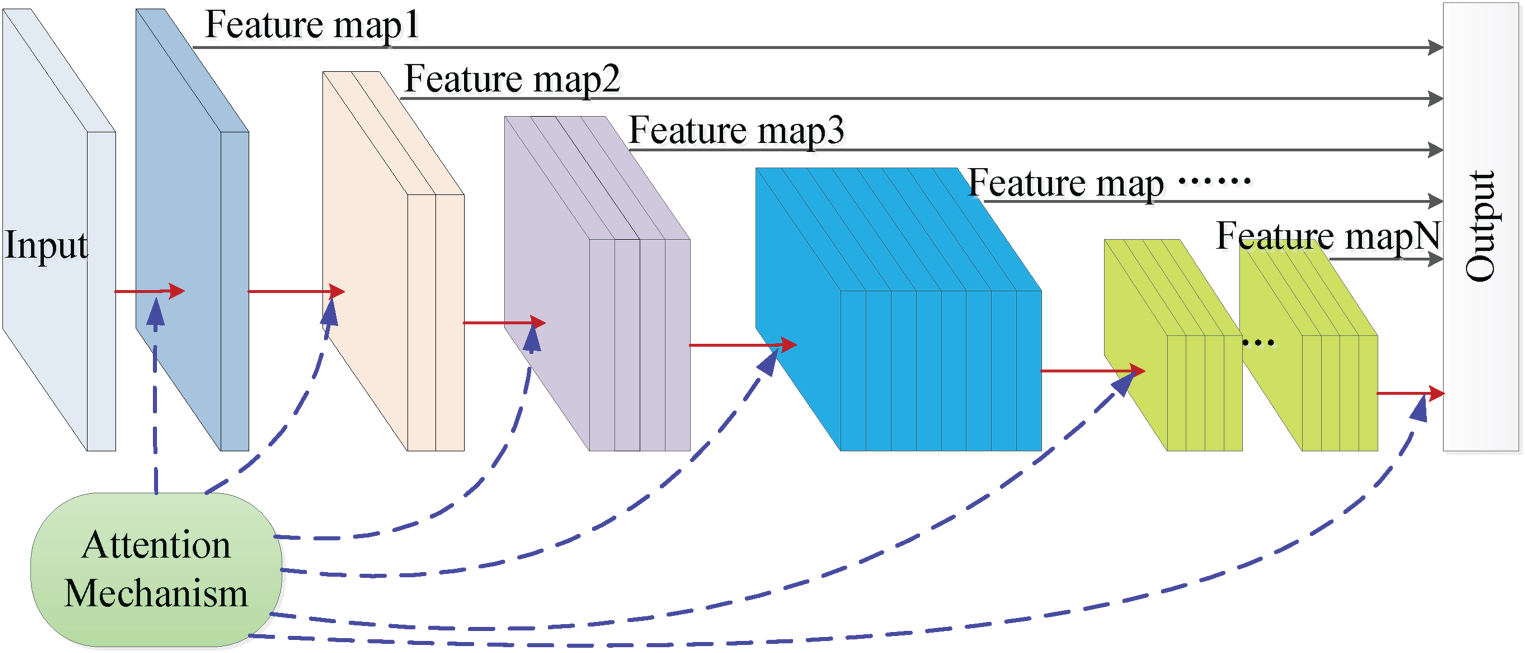
The application of attention mechanisms in neural networks.
The attention mechanism is now widely applyed in various types of models. Li et al. (2025) proposed Iterative Attention Feature Fusion (iAFF), by means of multi-scale channel attention and iterative fusion, the feature representation is optimized, especially enhancing the ability of detecting small targets. Wang et al. (2023) proposed an innovative convolutional self-attention (ConvSA) mechanism, integrating convolution with self-attention to capture local features. This paper proposes a novel attention mechanism called Efficient Multi-scale Attention (EMA). This mechanism retains the ability of the traditional attention mechanism to dynamically focus on key features while significantly reducing the complexity of parameters, enabling the development of lightweight models.
In response to the difficulties in extracting features of vehicle targets in remote sensing images and the complexity of background interference, this study has constructed a lightweight detection architecture with multiple modules working collaboratively. Through the four modules proposed—FasterNet, EMA, Dyample and LAE—this research systematically achieves precise and efficient detection of vehicle targets in remote sensing scenarios. Firstly, the original backbone network is replaced with a lightweight FasterNet to maintain high accuracy while reducing computational complexity and improving inference speed. Secondly, an EMA mechanism is introduced based on the improved architecture to enhance the understanding ability of complex scenes through cross-scale feature fusion. Finally, the neck network integrates the DySample and LAE modules. The former achieves dynamic feature alignment, and the latter optimizes channel calculations. The two work together to improve the detection accuracy of small targets and occluded objects while maintaining real-time performance. The following provides a detailed elaboration on the overall architecture design and the technical characteristics of each functional module.
Overall Model Structure
As illustrated in Figure 2, an improved network architecture is proposed. The entire architecture consists of five components, including input images, feature extraction, feature processing, feature output, and detected images. (1) The input to the model is RGB images, the model adopts a standardized resolution of 640 × 640 pixels to ensure the stability of feature extraction. (2) In this study, a lightweight YOLOv11 is used as the baseline network, and FasterNet is employed as the backbone feature extractor. A four-level feature pyramid structure is constructed, with the feature map resolution decreasing successively to 32 × 160 × 160, 64 × 80 × 80, 128 × 40 × 40, and 256 × 20 × 20. This enables the model to simultaneously capture fine-grained details as well as high-level information. And an EMA attention mechanism is subsequently introduced to enhance the model's feature representation capability, improving the accuracy of target localization. (3) In the feature processing stage, considering the requirements of lightweight models, Dysample and LAE modules are introduced to improve the efficiency of feature extraction and upsampling, and enhance the model's ability to capture both detailed and global information,the two work together to convert the features into an expression form suitable for different detection heads. (4) For feature output, the original decoupled head of YOLOv11 is employed to predict the class, location, and confidence of objects. The model adopts a multi-scale output strategy, generating three-level feature maps of 80 × 80, 40 × 40 and 20 × 20 respectively, which are suitable for the detection requirements of small, medium and large-scale targets. (5) The trained neural network can be utilized for the detection of traffic images.

Overall architecture of the improved network.
In consideration of model lightweighting, we optimize the backbone network of YOLOv11 by replacing it with the FasterNet network, which can efficiently extract and process features from input data. The key mechanism in FasterNet, namely the Partial Convolution (PConv), only performs convolution on a subset of channels while retaining the remaining channels. This approach reduces computational and memory costs while maintaining efficient feature extraction, thereby achieving rapid and precise detection of vehicle targets.
The architecture of FasterNet is illustrated in Figure 3. Input data first passes through an embedding layer, which transforms the raw input into a feature representation suitable for network processing. Within each FasterNet block, the input features first undergo partial convolution (PConv). This mechanism applies convolution only to a subset of input channels while preserving the rest, thereby reducing computational cost and parameter count without compromising feature diversity. Subsequently, a T-shaped structure composed of two pointwise convolutions (PWConv) performs cross-channel feature fusion, further enhancing computational efficiency. A four-level hierarchical architecture employs embedding and merging layers to progressively aggregate multi-scale features, preparing them for subsequent processing stages. Additionally, a cross-scale feature interaction mechanism is introduced after the integration module to enable information exchange among features at different resolutions. After processing through all stages, a global processing layer compresses the feature maps into a fixed-length vector. Finally, a fully connected layer generates the final prediction results. FasterNet is a lightweight neural network architecture that aims to achieve efficient computation and low memory access. It can significantly reduce the amount of computation and parameters while ensuring that the detection accuracy is not greatly affected.

Diagram illustrating the working principle of the FasterNet module.
Following the feature extraction phase, integrating the EMA mechanism enables adaptive focusing on critical multi-scale input information, yielding richer and more comprehensive feature representations. This effectively compensates for conventional networks’ limitations in detecting small and dense objects within complex scenes. The lightweight EMA module seamlessly integrates into any CNN architecture. Incorporating EMA into the model offers three key advantages: enabling a multi-scale feature fusion mechanism, effectively mitigating complex background interference, and achieving superior lightweighting capabilities while maintaining high computational efficiency.
Figure 4 shows the application of EMA in the baseline model. First, the three-dimensional input tensor graph

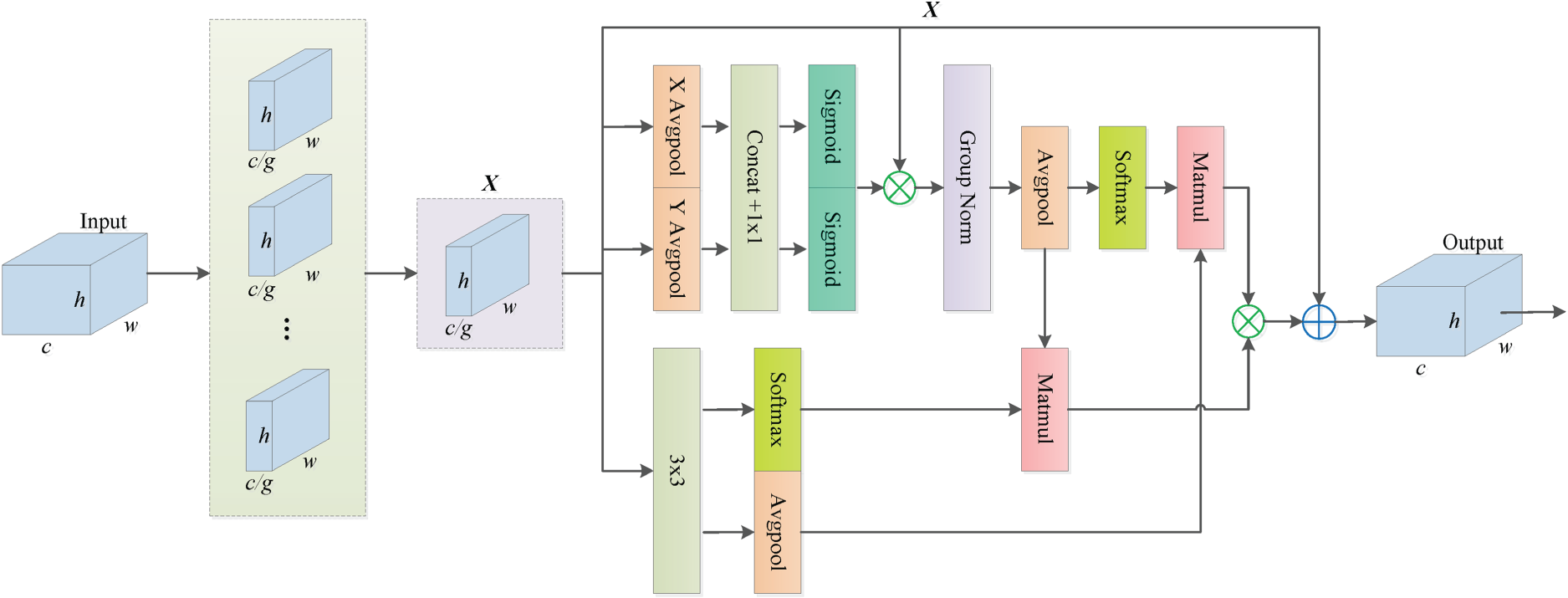
A schematic diagram illustrating the structural components and working principle of the EMA module.
Then, use the 3 × 3 convolution kernel to convolve the input
In UAV remote sensing vehicle targets, the significant variation in target scales poses a severe challenge to traditional Upsample (Nie et al., 2021) methods. To overcome this technical bottleneck, DySample employs an adaptive sampling mechanism to enhance the model's robustness against scale variations. When integrating into the neck network, DySample not only improves the performance of dense prediction tasks but also significantly reduces computational resource consumption, offering an optimized solution for resource-constrained scenarios. Furthermore, to address the issues of feature loss and semantic imbalance inherent in traditional models, the LAE module is introduced. LAE enhances the responsiveness of feature channels for small targets by focusing on local regions and suppressing background noise, thereby mitigating mutual interference among densely packed targets.
DySample
In the drone remote sensing target detection, the neck network of YOLOv11 achieves the collaborative optimization of multi-scale target detection and computational efficiency through the DySample mechanism. This method employs dynamic convolutional bypass and point-wise sampling strategies to construct a learnable spatially variant sampling grid, establish cross-layer feature mapping relationships, and achieve pixel-level fusion of shallow texture details and deep semantic features. Through dynamic resource allocation strategies, it reduces computational costs while improving resolution output, significantly enhancing model efficiency and detection accuracy. As shown in Figure 5, it presents the dynamic upsampling mechanism based on sampling and the modular architecture design.

The sampling-based dynamic upsampling and module designs within the DySample framework. The input feature, upsampled feature, generated offset, and original grid are denoted by
The dynamic upsampling methodology is analyzed in Figure 5(a). Given an input feature map

Given an upsampling scale factor s and input feature map


The Pixel Shuffling-based reshaping step is omitted from the DySample architecture. Finally, the feature map
Figure 5(b) shows the Sampling Point Generator component from Figure 5(a). Figure 5(a) comprehensively presents the entire process from the input feature map
To enhance small target feature representation, the LAE module is integrated into the neck network architecture. As illustrated in Figure 6, the LAE architecture comprises two parallel processing pathways: an adaptive feature extraction branch and a lightweight feature extraction branch.The adaptive branch facilitates cross-channel information interaction through combined average pooling and convolution operations, performing downsampling via neighborhood pixel recombination while incorporating a channel-wise dynamic weighting scheme. This mechanism enables adaptive feature response calibration, preserving spatial structural integrity while boosting semantic discrimination capability. The lightweight branch achieves efficient dimensionality reduction through a cascade of 1 × 1 convolution, average pooling (Bashivan et al., 2025), spatial reorganization, and Softmax-based (Yang & Xu, 2025) channel attention. This pathway maintains spatial coherence and inter-channel correlations with reduced parameter complexity.

The structure of Lightweight Adaptive Extraction module (Liu et al., 2023).
We introduce the dataset and evaluation metrics used in the experiment, and then conduct ablation experiments on the two datasets and elaborate on the related research results in detail. Based on this, we further analyzed the performance of the proposing model in depth, and finally verified the advantages of the improved method over other methods through comparative experiments.
Datasets
The private Dataset is named Cardrone (full name: CARLA Drone Dataset). Twelve typical targets of urban scenarios such as vehicles, pedestrians and traffic signs have been marked, and scenarios such as traffic congestion and port operations have been simulated. This study uses the Cardrone dataset, which contains 4,072 training images and 1,357 validation images, and focuses on the three types of objects, namely Car, Truck, and Bus, for research. The VisDrone2019 dataset is specifically designed for tasks such as target detection, tracking, and pedestrian reidentification in complex scenarios. This dataset covers multiple types of scenarios in 14 cities in China, including diverse environments such as urban streets, campuses, and ports, and labels 10 predefined categories such as pedestrians, cars, and bicycles. The dataset focuses on static image object detection, containing 6,471 training images, 548 validation images and 3,190 test images.
Evaluation Metrics
We use standard metrics to evaluate the object detection model: Precision (P), Recall rate (R), Mean Average Precision (mAP), mean forwarding time, mean inference time and frames per second (FPS). In addition, we use some other metrics, including mAP@0.5, mAP@0.5:0.95 and GFLOPs.
The training of the object detection model is supervised, that is, the model will learn and adjust the parameters according to the real labels manually labeled, and a predicted value will be obtained after training. According to the confusion matrix (Ahmad et al., 2022), the predicted and true values are labeled as true positive (TP), true negative (TN), false positive (FP), and false negative (FN), as shown in Table 1.
Confusion Matrix.

Confusion Matrix.
Precision is characterized by the proportion of instances identified by the model as vehicle targets, which are indeed confirmed as vehicle targets, relative to the total number of instances predicted by the model as vehicle targets. The calculation process is shown in Equation (5):

Recall is defined as the ratio of instances that are truly classified as vehicle targets to the total number of instances predicted by the model. The calculation process is shown in Equation (6):

Average Precision (AP) is calculated by averaging the precision values obtained from Precision-Recall (PR) curves.The calculation process is shown in Equation (7):

The experiments in this paper are carried out on two data sets, and the mAP values are calculated separately according to the following formula. Because mAP represents the average accuracy over all classes, the calculation is different for the two datasets. For the Cardrone dataset, the mAP is calculated as shown in (8). For the VisDrone2019 dataset, the mAP is calculated as shown in (9). The number of classes in the VisDrone2019 dataset is 3, so the average accuracy across 3 classes is calculated. Similarly, the mAP calculation on the VisDrone2019 dataset is the average accuracy over 8 categories.


Other evaluation metrics are GFLOPs, average inference time and FPS of the model, calculated by (10)–(14):





Where Kh, Kw represent the convolution kernel size,
The experimental setup is shown in Table 2 and Table 3, which details the software and hardware configuration.
The Experimental Environment for our Model.
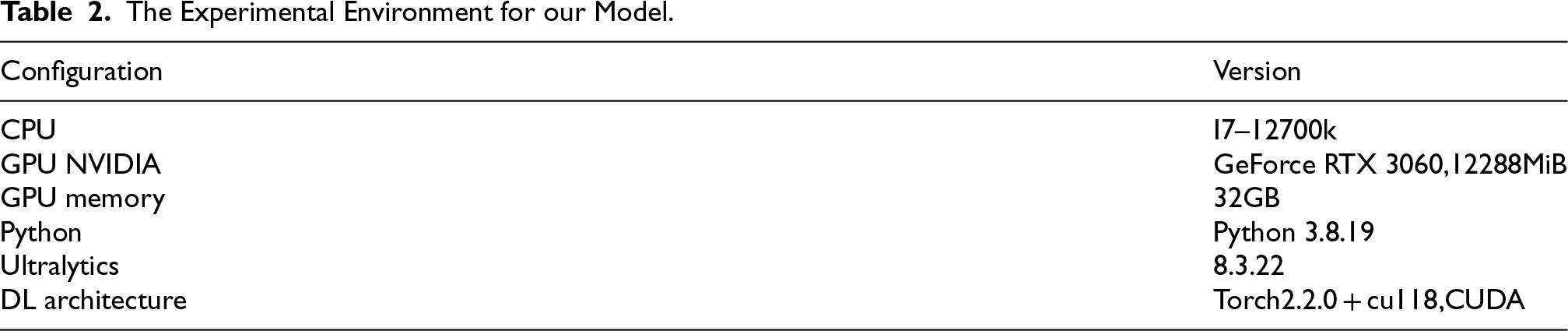
The Experimental Environment for our Model.
The key Parameters we Used During Model Training.
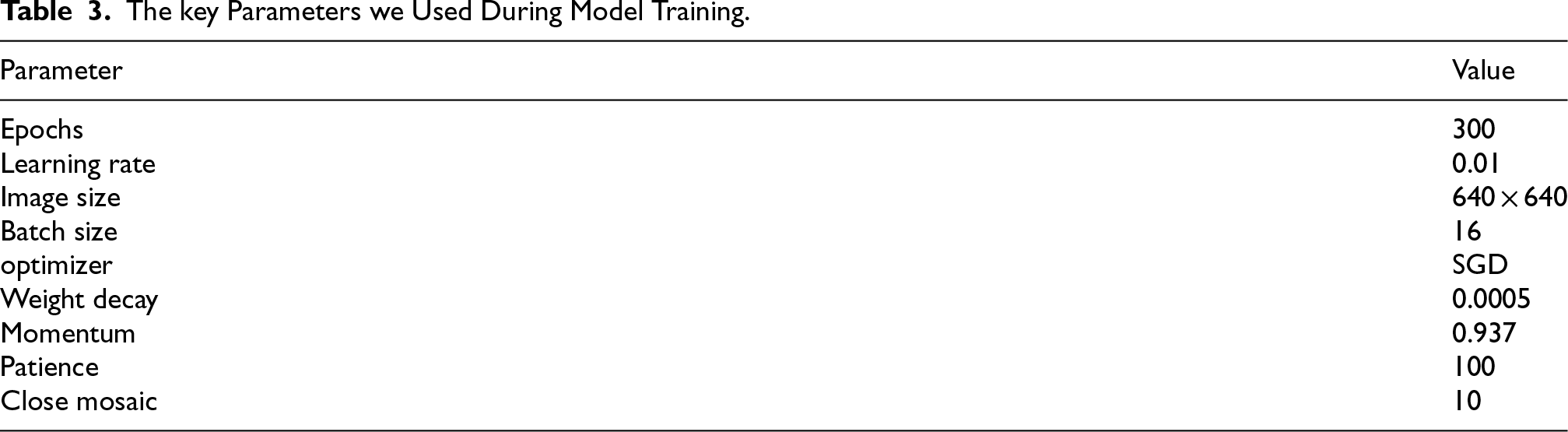
In order to evaluate the effectiveness of our propose YOLOv11-FEDL model, we conduct ablation experiments on Cardrone and VisDrone2019 datasets. In view of the fact that the scale of model parameters and computational complexity is mainly affected by variables such as input image resolution, batch size and network depth. In ablation experiments, the consistency of controllable conditions such as resolution and batch size should be strictly maintained to ensure the effectiveness of contrast between different configurations.
As shown in Table 4, although the introduction of FasterNet and EMA modules led to a 0.8% decrease in detection precision, it significantly reduces the model parameter size to 2.33 M and the computational complexity to 5.5 GFLOPs, while improving the inference speed. This laid a lightweight foundation for practical scene deployment. After further integrating the DySample and LAE modules, while maintaining the basic stability of detection accuracy, the system achieved inference acceleration (301.80FPS) while maintaining high frame rate processing capabilities, and continuously optimized the computational complexity. Taking the addition of the EMA module alone as an example, the GFLOPs drops from 6.5 to 6.3, the number of parameters decreases from 2.58 M to 2.53 M, with a slight decline in accuracy. The average inference time shortens from 2.86 ms to 2.61 ms, and FPS increases from 249.10 to 290.24, it enables faster image processing and achieves a higher frame rate. Experimental verification shows that this phased modular improvement strategy successfully achieved a better balance between detection accuracy and computational efficiency.
Ablation Experiments to Validate the YOLOv11-FEDL Model on the Cardrone Dataset.

Ablation Experiments to Validate the YOLOv11-FEDL Model on the Cardrone Dataset.
Method (1) corresponds to the original YOLOv11 model. The bolded items represent the maximum values of each category.
As shown in Table 5, although the FasterNet and EMA modules are introduced, which led to a decrease in detection precision from 39.7% to 38.8%, it significantly reduced the model parameter size to 2.33 M and the computational complexity to 5.5 GFLOPs, and improve the inference speed to 2.51 ms, providing strong support for subsequent practical application deployment. After further introducing the DySample and LAE modules, the model accuracy steadily increases to 39.1%, and maintain an efficient FPS processing speed (334.10) throughout the process. Taking the addition of the EMA module alone as an example, the GFLOPs decrease from 6.5 to 6.3, and the number of parameters drops from 2.58 M to 2.53 M, while the accuracy remains unchanged. The average inference time is shortened from 2.74 ms to 2.61 ms, and the FPS increases from 286.70 to 300.26, making it highly suitable for scenarios that demand rapid response. The experimental results show that through modular improvement, a better balance between accuracy and efficiency has been achieved, and the improved model demonstrates significant advantages in lightweight deployment capabilities and comprehensive detection performance.
Ablation Experiments to Validate the YOLOv11-FEDL Model on the VisDrone2019 Dataset.
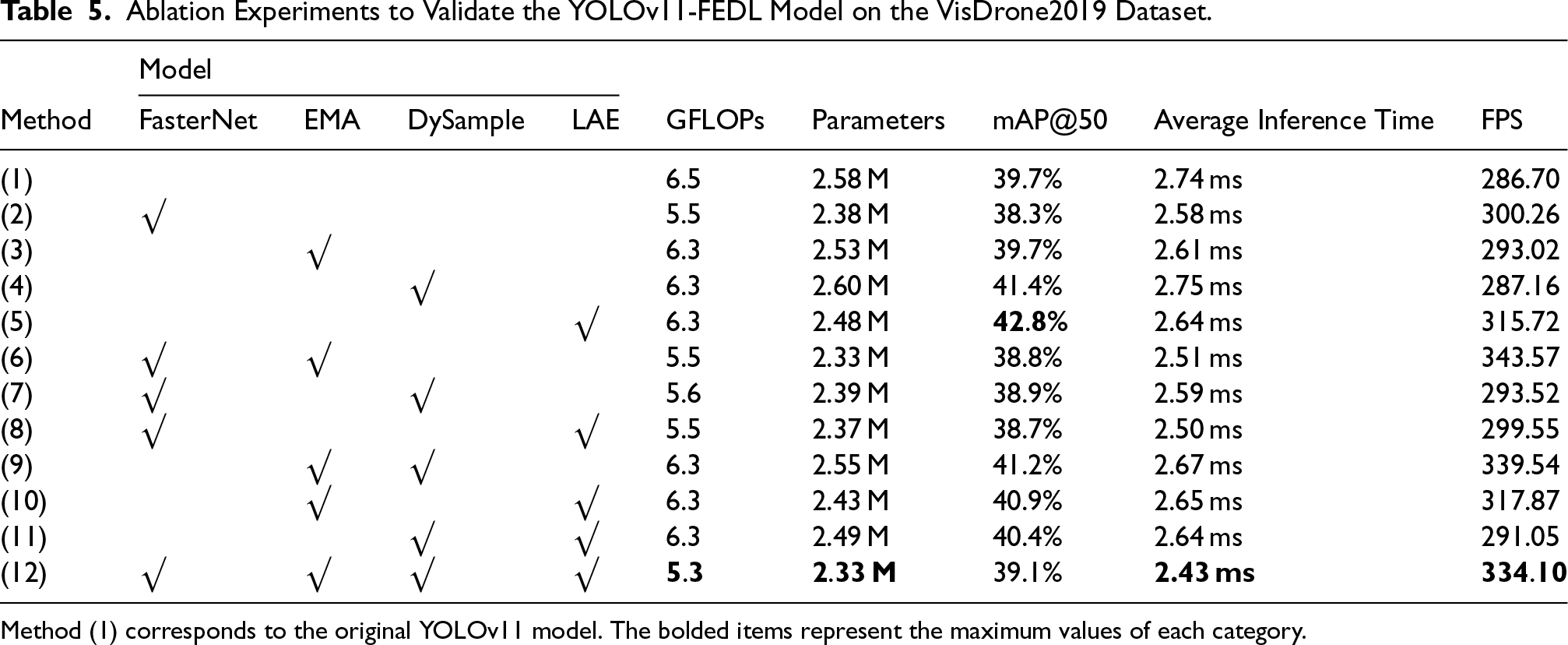
Method (1) corresponds to the original YOLOv11 model. The bolded items represent the maximum values of each category.
Through the data analysis shown in Table 6, based on the Cardrone dataset experiment, the proposed method achieves 93.5%, 91.2%, 89.7% mAP@50 accuracy on the Medium, Small, and Nano models of YOLOv11, which is similar to the performance of the original model. The differences among the medium, small and nano models are reflected in GFLOPs and Parameters. The medium model achieves the best detection accuracy, but its inference speed is relatively slow. The small model strikes a balance between accuracy and speed, and its performance lies between that of the medium and nano models. The nano model, as the representative of extreme lightweighting, has the lowest detection accuracy but the fastest inference speed. The computational complexity is reduced by 3.8, 1.8 and 1.2 GFLOPs, the number of parameters is reduced by 1.71 M, 1.16 M and 0.25 M, and the inference speed is improved to 113.00, 164.63 and 301.80 FPS, respectively. This improvement in balancing accuracy and efficiency has a better effect in terms of time and space, and provides a better model selection for tasks in resource-constrained scenarios.
Compared with the Experimental Results of Several Models of YOLOv11 on the Cardrone Dataset, the Resolution of the Model is 640 × 640.
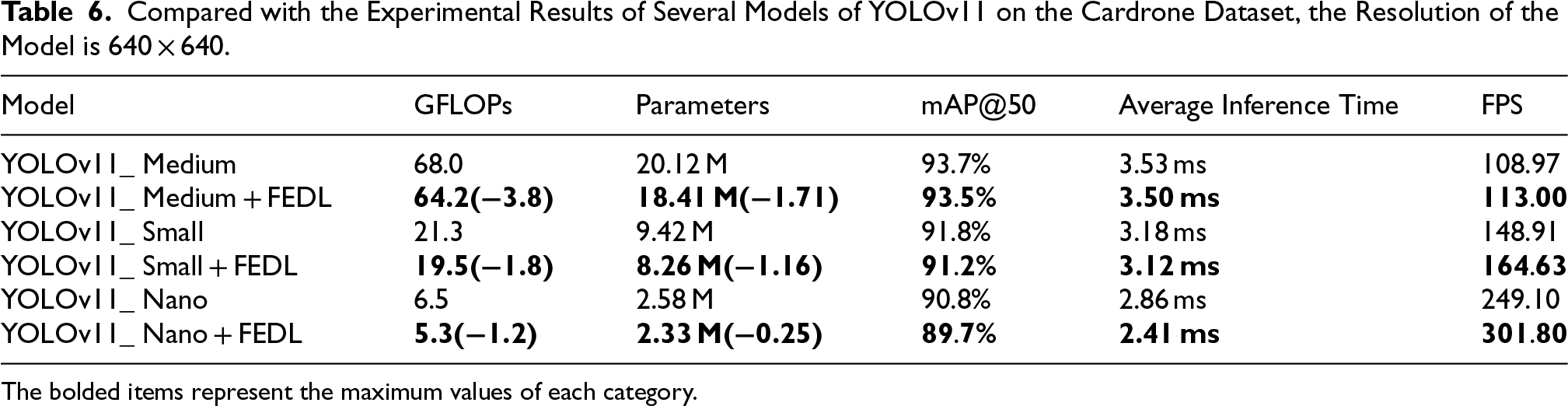
Compared with the Experimental Results of Several Models of YOLOv11 on the Cardrone Dataset, the Resolution of the Model is 640 × 640.
The bolded items represent the maximum values of each category.
To comprehensively evaluate the performance of the YOLOv11-FEDL model, its experimental results are compared with several other state-of-the-art methods on the Cardrone dataset. Table 7 shows the detection results of the proposed method and other detectors. The calculation amount of the proposed method is 5.3 GFLOPs, and the number of parameters is 2.33 M, which is significantly lower than that of YOLOv9 s (26.7 GFLOPs, 7.17 M parameters), YOLOv10 s (24.5 GFLOPs, 8.0 M parameters) and other models. Secondly, its mAP@50 reaches 89.7%. This performance level is close to models such as YOLOv8n (90.4%) and YOLOv12n (90.4%). Its average inference time is only 2.41 ms, and the frame rate is as high as 301.80 FPS, which is significantly faster than other models. The experimental results show that the proposed method achieves the lightweight of the model while maintaining high accuracy. Moreover, it has faster image processing speed and can meet the application scenarios with higher real-time requirements. As shown in Figure 7, this is the precise-recall curve of our proposed method on the Cardrone dataset. The results show that the Medium model has the best detection effect, and the three models have a good detection effect on “car”, “truck” and “bus”. For the detection results of the Nano model, it has the fastest detection speed and the smallest model.
Compared with the Experimental Results of Other Models on the Cardrone Dataset, the Resolution of the Model is 640 × 640.

The bolded items represent the maximum values of each category.
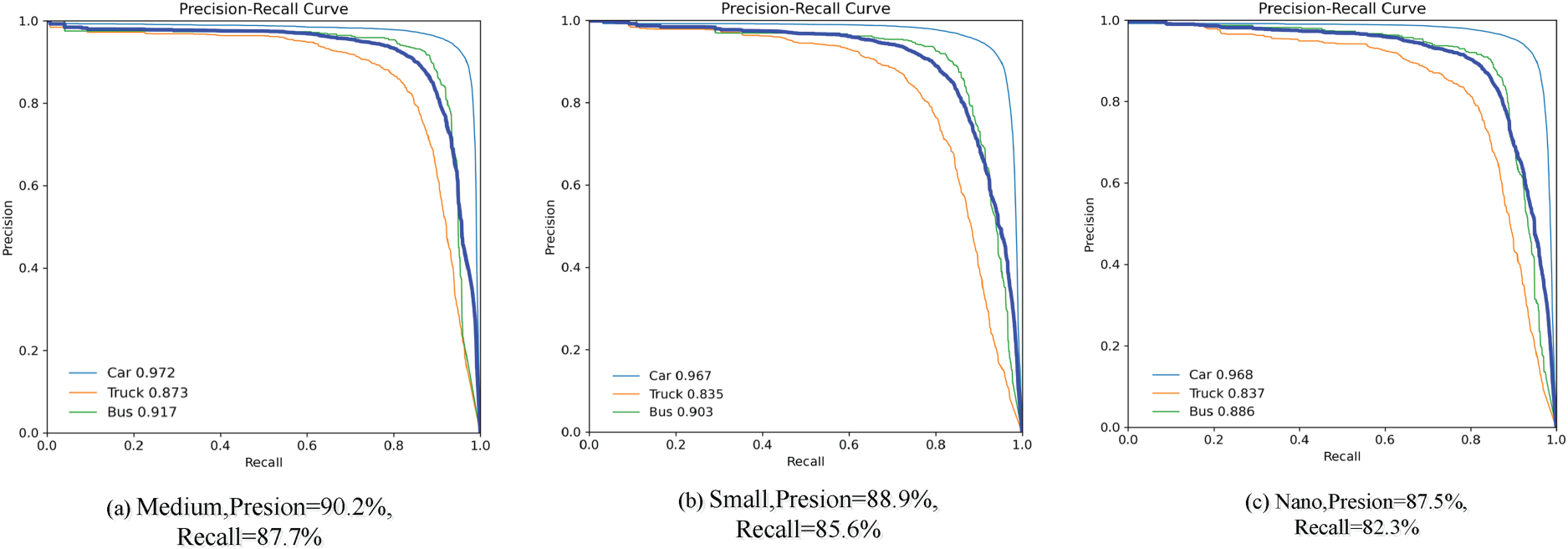
Precise-recall curve of our proposed method on the Cardrone dataset. Here average precision and average recall represent precision and recall for all classes with IoU = 0.7.
The detection results based on the Cardrone dataset are shown in Figure 8. The improved model achieves accurate vehicle recognition in a variety of complex scenes, including typical scenes such as night road, factory interior and no occlusion. Through visual verification, the improved model shows excellent detection performance in the above complex environment, which proves that it has good environmental adaptability.

Test results for our proposed Nano model. Here are the detected image results on the Cardrone dataset.
We compare the improved Medium, Small and Nano models of YOLOv11 on the VisDrone2019 dataset, and the results are shown in Table 8, which are consistent with the experimental results on the Cardrone dataset. The differences among the medium, small and nano models are reflected in GFLOPs and Parameters. The medium model achieves the best detection accuracy, but its inference speed is relatively slow. The small model strikes a balance between accuracy and speed, and its performance lies between that of the medium and nano models. The nano model, as the representative of extreme lightweighting, has the lowest detection accuracy but the fastest inference speed. The results show that the computational complexity and the number of parameters are reduced compared with the original model. Although there is a slight decrease in mAP@50, 0.2%, 0.6%, and 0.6% for Medium, Small, and Nano models, respectively, the impact on model performance is negligible. In terms of speed, our proposed method exhibits obvious advantages. Through experiments, it can be proved that the method shows significant advantages on both Cardrone and VisDrone2019 datasets, indicating that our proposed method has strong generalization ability.
Compared with the Experimental Results of Several Models of YOLOv11 on the VisDrone2019 Dataset, the Resolution of its Model is 640 × 640.
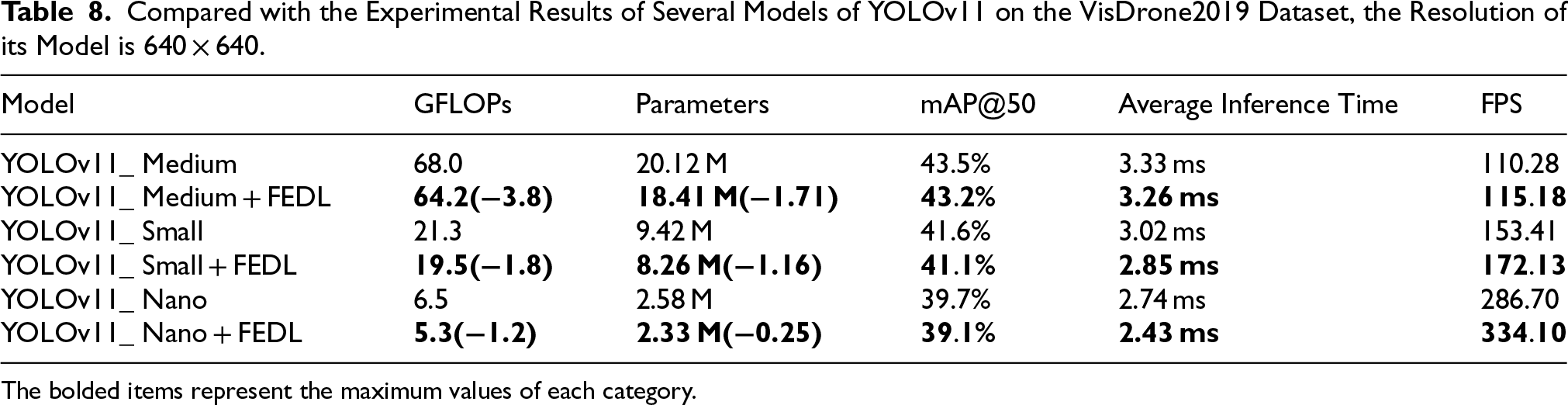
Compared with the Experimental Results of Several Models of YOLOv11 on the VisDrone2019 Dataset, the Resolution of its Model is 640 × 640.
The bolded items represent the maximum values of each category.
As shown in the experimental data in Table 9, we can see that the proposed method reflects obvious advantages. It performs well in the amount of calculation and parameter, which are as low as 5.3 GFLOPs and 2.33 M, respectively, which are significantly lower than other models such as Faster R-CNN and YOLOv9 s. Although its mAP@50 value of 39.1% is slightly lower than those of models such as Faster R-CNN and YOLOv12n, this performance level is still acceptable for real-time object detection tasks. More importantly, the propose method shows significant advantages in terms of inference speed and frame rate. The average inference time is only 2.43 ms, and the frame rate is as high as 334.10 FPS, which is far higher than other models, which means that the proposed method can process images at an extremely fast speed. Experiments show that the proposed method achieves a good balance between accuracy and efficiency, and can well meet the needs of limited resources.
Compared with the Experimental Results of Other Models on VisDrone2019 Dataset, the Resolution of the Model is 640 × 640.
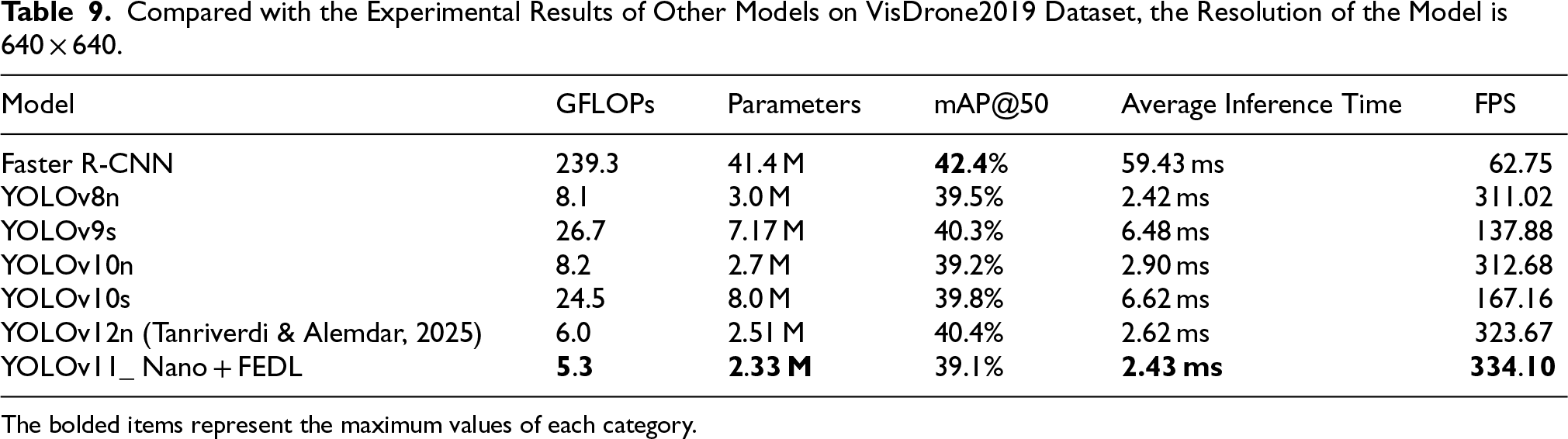
The bolded items represent the maximum values of each category.
For the evaluation on the VisDrone2019 dataset, we plot the precision-recall (PR) curve as shown in Figure 9. The experimental results show that the proposed method achieves good performance in all types of vehicle detection, and the performance is most prominent in the detection task of bus category, and the corresponding red PR curve is significantly better than that of other vehicle categories.
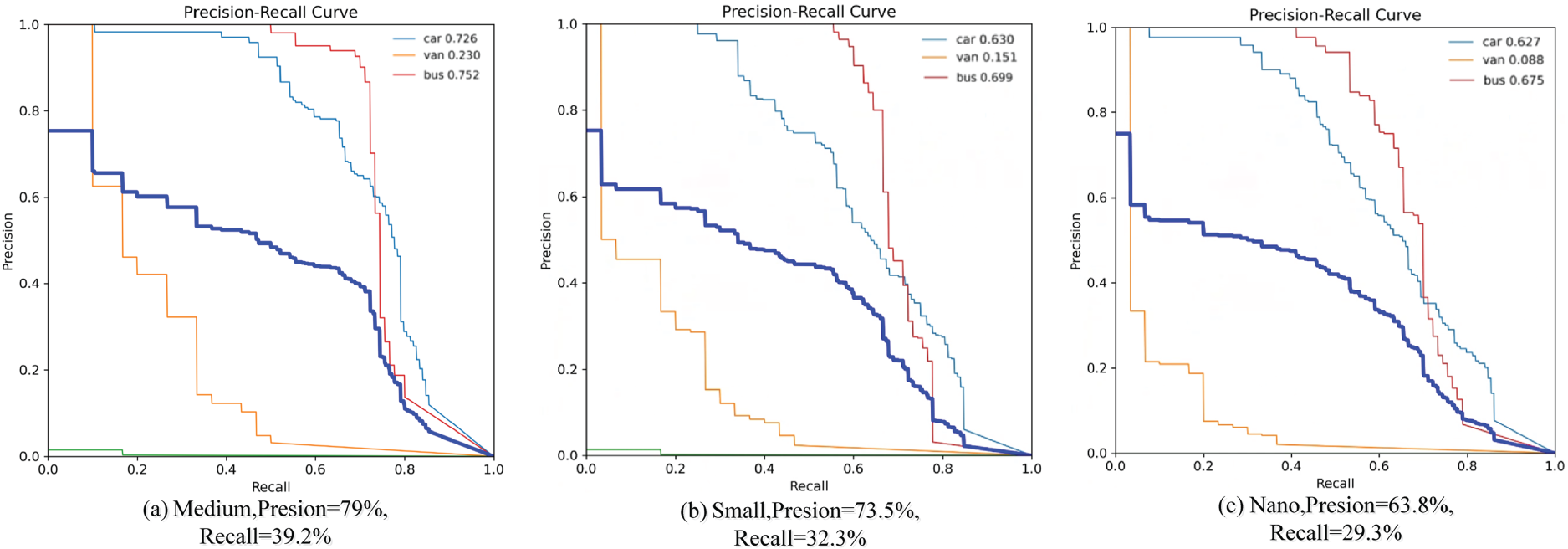
Precise-recall curve of our proposed method on the VisDrone2019 dataset. Here average precision and average recall represent precision and recall for all classes with IoU = 0.7.
Based on the test results of the VisDrone2019 dataset, as illustrated in Figure 10. the improved model demonstrates significant enhancement in vehicle detection performance under complex scenarios. Experimental evaluations confirm the model maintains high-precision recognition capabilities across typical challenging environments including nighttime roads, daytime highways, and industrial interiors. The experiment validates that the optimized algorithm architecture effectively strengthens feature extraction and environmental perception capabilities while preserving real-time processing efficiency. Its environmental adaptability has been thoroughly validated through multi-scenario testing, providing robust technical support for practical deployment applications.

Test results for our proposed Nano model. Here are the detected image results on the VisDrone2019 dataset. 0 represents car, 1 represents truck, and 2 represents bus.
As shown in Figure 11, Figure 11(a) presents the detection results on the Cardrone dataset, while Figure 11(b) displays those on the VisDrone dataset. Comparative analysis reveals that the model still exhibits certain recognition errors in some scenarios, which mainly manifest in three forms, non-vehicle objects with car-like outlines being misclassified as vehicles, pedestrians being incorrectly identified as vehicles, and interclass confusion among vehicle types, such as cars being recognized as buses. Despite these misdetections, the model demonstrates excellent overall detection performance. These recognition errors may primarily stem from two aspects. On one hand, the datasets used may suffer from quality issues, such as inaccurate annotations, which adversely affect the model's learning process. On the other hand, since this research focuses on building a lightweight model architecture, the improved model has certain limitations in its representational capacity. It may not fully learn the complex features of vehicle targets, thereby leading to recognition deviations.

Visual analysis results of models with poor detection performance. (a) Visualization results of the Cardrone dataset. (b) Visualization results of the VisDrone2019 dataset. 0 represents car, 1 represents truck, and 2 represents bus.
This paper proposes a novel lightweight network model based on YOLOv11. Firstly, a lightweight FasterNet backbone network is presented, whose main purpose is to reduce the number of parameters and computational complexity of the network, achieving a lightweight model. Secondly, we build the EMA mechanism based on FasterNet. Through the design of multi-scale feature fusion, the model can better capture complex environmental information. Finally, we integrate the DySample and LAE modules into the neck network. This enhances the multi-scale feature fusion ability and background suppression effect of the neck network. This enhances the multi-scale feature fusion ability and background suppression effect of the neck network. Experiments were conducted on the Cardrone and VisDrone2019 datasets. The results demonstrate that while the proposed model exhibits significant fluctuations in detection accuracy during initial training stages, it gradually stabilizes with iterative progression. Ultimately, the approach successfully constructs a lightweight YOLOv11 model without compromising detection precision, providing a more efficient solution for real-time visual tasks.
Footnotes

Funding
The authors disclosed receipt of the following financial support for the research, authorship, and/or publication of this article: This work was supported in part by the Young Faculty Interdisciplinary Research Cultivation Program of Lanzhou University of Technology under Grant 062518, the Youth Science and Technology Foundation of Gansu Province under Grant 24JRRA974, the provincial key research and development (R&D) plan projects of Gansu under Grant 23YFFA0060; Zhang Yue.
Declaration of Conflicting Interests
The authors declared no potential conflicts of interest with respect to the research, authorship, and/or publication of this article.