



Abstract
Healthcare industry is harnessing AI and Machine learning for services like patient monitoring and disease diagnosis to assist health care practitioners in delivering accurate and timely medical results. The results can be further precise when multiple hospitals contribute their health care data for training a common ML model. Traditional Machine learning for such use cases involves aggregating the data from various hospitals in a central server where a ML model is trained to get the results. Security and privacy of data is a concern for sharing data as multiple participants are involved. The proposed work FedBlockSiamese uses Federated Learning which can be used for training machine learning models collaboratively with data from multiple clients but without leaving the client device. Thus, the privacy of the data is preserved through local model training on the client. The proposed work also utilizes blockchain to enhance security and trust in Federated Learning environment. The communication between client and server is verified with the help of Blockchain to prevent malicious clients purposefully sharing incorrect data. A Siamese Network is implemented in each client to classify the chest X-Ray images based on similarity score. These Siamese Networks exchange and update their model weights through a blockchain, allowing the Federated model to adapt to evolving threat landscapes. Our approach improves model security, adversarial attack resistance, and malicious client identification without compromising data privacy. Our findings demonstrate that the integration of Siamese Networks with Blockchain technology significantly enhances the resilience of Federated Learning systems against malicious actors. This innovative solution has the potential to revolutionize Federated Learning applications across various domains where data privacy and security are paramount concerns.
Introduction
Machine Learning (ML) and Artificial Intelligence (AI) has not only disrupted industries but also transformed the way healthcare is delivered, making it more efficient, accurate, and accessible. AI/ML has become an essential tool in the healthcare sector, used for tasks such as disease diagnosis, patient outcome prediction, and individual treatment planning. It helps in early disease detection and its application can vary from Drug Discovery and Development, Medical Imaging, Personalized Medicine, Virtual Health Assistants, Predictive Analytics, etc. AI-powered medical imaging has transformed the field of radiology. Machine Learning models can analyse X-rays, MRIs, CT scans, and mammograms with remarkable accuracy. For instance, deep learning algorithms can identify tumours, fractures, and abnormalities faster and more precisely than human radiologists. This not only speeds up diagnosis but also reduces the risk of misdiagnosis. Medical images, such as CT scans and MRIs, are a crucial part of the diagnostic process for many diseases. Diagnosis can raise concerns about patient privacy and data security. Additionally, it may be difficult to ensure that the local datasets at each hospital or clinic are representative of the overall population, which could affect the performance of the global model. Healthcare data is often fragmented across various hospitals, clinics, and research institutions. Federated Learning (FL) (Anusuya & Karthika Renuka, 2024; Li et al., 2019; Tedeschini et al., 2022) allows various entities to combine their data resources for model training without the requirement to centralize or transfer data, thus solving the difficulties posed by data fragmentation. Federated Learning is a decentralized approach to machine learning that allows models to be trained utilizing several dispersed data sources, while ensuring that the data remains localized and private. The participating clients may be malicious and can try to submit poisoned model updates to ruin the training. In conventional FL, there is no mechanism to verify the trustworthiness of the clients. Blockchain technology is also a decentralized approach providing trust, immutability and auditability. The decentralized environment offered by blockchain (Li et al., 2021; Liu et al., 2020; Lu et al., 2020; Moudoud & Cherkaoui, 2023) and Federated Learning helps in applications like healthcare where multiple hospitals must collaboratively train their data. The existing FL frameworks for medical imaging uses neural networks for classification, which does not capture the similarity based diagnostic patterns required in certain clinical practice. Siamese Network has shown strong performance in similarity analysis by using distance-based representations. Hence Siamese Network architecture is best suited for diagnosis which requires comparison between patient images and the reference image. Although Pneumonia detection can be easily done by CNN architecture with better classification accuracy, our work focusses on Siamese Network as it is best suited for intra class variability. In Federated Learning environment where the data sets in client may be non-iid, learning a global decision boundary may suffer from distribution shifts. Siamese Networks learn from distance based embedding space which does not skip the distribution shifts and hence it can be best suited for distributed clients with non-iid data. Existing Blockchain enabled FL frameworks do not address mitigating malicious participants in medical imaging domain. The Siamese Network also has not been explored in a decentralized environment. Addressing these gaps, we have proposed FedBlockSiamese, a novel blockchain based Federated Learning framework that combines Siamese neural networks for similarity based medical image classification. The proposed work ensures privacy, trust and robustness against malicious participants in distributed environment by providing decentralized training, blockchain based verification and secure off-chain model exchange. Federated Learning inherently preserves privacy of data, FedBlockSiamese extends this baseline privacy by integrating blockchain for verification of model updates and exchanging encrypted model updates off-chain. This mechanism secures from malicious clients and from attacks like replay attacks and model poisoning.
Key Contributions
The key contributions of this work are summarized as follows:
Related Work
Federated Learning in Medical Imaging
Federated Learning (FL) has emerged as an effective paradigm for collaborative model training across distributed medical institutions while preserving patient data privacy. Several works have demonstrated the applicability of FL for medical imaging tasks like disease diagnosis, tumor identification and image classification. As data is trained locally, FL addresses data-sharing constraints imposed by frameworks like HIPAA and GDPR. Existing FL based medical imaging applications use standard classification architectures like CNN. The works by (Li et al., 2019; Tedeschini et al., 2022) used Federated Learning for brain tumor segmentation to enhance security. The work (Tedeschini et al., 2022) used U-net model in Federated framework for brain tumor segmentations. Several other works such as (Luo et al., 2023; Nalawade et al., 2021; Ullah et al., 2023) have also used Federated Learning for brain-tumor segmentation.
Naeem et al. (2022) provided a general review of existing work in Federated Learning-based brain tumor diagnosis studies. These implementations are used for label prediction rather than similarity-based reasoning which would be important where diagnoses are done by comparing images.
Blockchain Enabled Federated Learning
Federated Learning can be made secure and trustworthy by integrating into blockchain technology. Blockchain integrated with FL provides ledgers guaranteeing immutability, traceability and transparency of model updates. Existing works have studied and implemented blockchain for secure aggregation and client verification in distributed environment (Li et al., 2022b; Moudoud et al., 2021; Uprety & Rawat, 2021). Blockchain enabled Federated Learning has been implemented across various applications like Healthcare, Edge computing, IoT and Autonomous or Interconnected vehicles for secure data exchange, enhancing trust and for auditability. Concepts like Blockchain sharding and asynchronous FL are the recent advancements in this domain. Few works have used Blockchain to secure FL against poisoning attacks using secure logging of transactions (Mahmood & Jusas, 2022). Nguyen et al. (2021) analysed the use cases of Blockchain enabled FL in Edge Computing and discussed the problems faced by existing Federated Learning.
Li et al. (2022c) proposed a blockchain-enabled Federated Learning in 6G networks for controlling malicious behaviour. Most of the works provide theoretical concepts and lack real-world deployable methods. Regardless of these attempts, most existing Blockchain-enabled Federated Learning approaches still remain theoretical or partially adopted, not providing a practical end-to-end framework that provides trust against malicious participants and effective learning performance in real-world medical applications. A blockchain integrated Federated Learning architecture used Blockchain to exchange and verify updates to the local learning model (Kim et al., 2019). Blockchain is becoming an attractive approach to solve the trust problem of data sharing in Federated Learning, due to its decentralized, traceable, and tamper-proof characteristics (Li et al., 2022a). BlockFL was adopted to ensure the integrity of the data and motivate enough client data and computational resources to participate in the training on Federated industrial IoT learning (Zhang et al., 2020). In addition, blockchain has been used to identify the changing ownership of a model trained with Federated Learning, as well as to evaluate participation in Federated Learning environment (Cai et al., 2020). It was also suggested to maximize the network load, safeguard integrity and stability, and motivate participants to participate in the learning process fairly and autonomously (Hao et al., 2020).
The traditional Federated Learning central coordinator has been replaced with the Blockchain (Xuan et al., 2021), which offers a secure and reliable Federated Learning environment instead. Blockchain has also been used to bootstrap trust in Federated Learning, in which the server gathers a root dataset and employs it as the basis to guide local model updates (Cao et al., 2020). In addition, a secure and trackable Federated Learning hybrid blockchain architecture has been proposed in Moudoud et al. (2021). Furthermore, in cross-device Federated Learning, Blockchain has been employed for proof-based secure aggregation that guarantees accuracy and privacy (Hahn et al., 2021). Combining Blockchain with proxy re-encryption mechanisms has been suggested for various applications such as medical record exchange, secure distributed storage, electronic health record sharing and energy trading systems. Blockchains, as an encrypted distributed database, provide a secure and decentralized platform for data storage and management (Al-Jaroodi & Mohamed, 2019; Jin et al., 2019; Rodríguez-Molina et al. 2021). On the other hand, proxy re-encryption enables secure conversion of ciphertext from one key to another without revealing the plaintext, rendering it well-suited for applications such as secure distributed storage and personal data access control (Ateniese et al., 2006; Rodríguez-Molina et al., 2021). These technologies together can be utilized in applications which require security and privacy for sharing data like EMR and peer-to-peer energy trading applications (Huang et al., 2022; Son et al., 2020).
Siamese Neural Network
Siamese Networks have been efficiently used in image matching, object tracking, and change detection, however, there is a research gap with regards to the use of these networks in Federated Learning, especially in image-related applications.
It is apparent that studies by Fu (2020) and Wu et al. (2020) show that Siamese Networks are helpful in image-classification tasks and the process of image tracking, respectively, but their use in the context of Federated Learning should be investigated further. Siamese Networks have proven effective for use in change detection tasks in remote sensing images (Mo et al., 2022) and brain tumor classification and brain tumor classification (Deepak & Ameer, 2021). However, their adaptation for Federated Learning aimed at resolving the challenges related to privacy and data distribution in collaborative image analysis is among the promising yet underdeveloped areas. The work by Liu (2023) on few-shot learning for image classification target a highly relevant area and demonstrate that Siamese Networks can be a valuable tool in data-limited applications, providing a new avenue for the exploration of Federated Learning with limited data provided from the center.
In recent years, researchers have focused on providing improved confidentiality and robustness to Federated Learning data using techniques such as Secure Aggregation and Differential Privacy (DP). Secure Aggregation protocols prevent the central aggregator and any other participant in the distributed computation process from inferring any sensitive information from the client's local updates by confidentially aggregating all the clients’ updates (Indrason & Saha, 2024). Differential Privacy perturbates noise to the data or the clients’ updates, so that no sensitive information is revealed from them. Hence it helps in mitigating attacks like membership inference attacks. Privacy and security enhanced Federated Learning are most effective when integrated with blockchain technologies. Blockchain integrated FL provides immutability, auditability and verifiable participation, which are important for collaborative environment (Almarri & Aljughaiman, 2024). Blockchain along with Secure Aggregation and Differential Privacy offers a complete secure and privacy-preserving FL environment (Alzoubi, 2024). Our work is modularly designed such that Secure Aggregation and Differential Privacy can be integrated as optional layers. Secure Aggregation can be implemented on the server which collects all the clients’ weights off-chain. Differential Privacy can be added to provide privacy and for regulatory compliance. Our layered approach provides a balance between performance and security, making it useful for real-world medical imaging tasks.
Preliminaries
Federated Learning
Federated Learning (FL) is essentially a decentralized approach to machine learning that allows a group of clients to train a common global model without sharing their own datasets. The central server shares a global model with all the participating clients, which perform training on their datasets. The model updates from each client are shared with the server which then aggregates to produce an improved global model. Let Wt denote the global model at round t, and
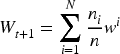
FL, despite its ability to limit direct data exposure, is still subject to threats from malicious clients, poisoned updates, and the lack of transparency in model aggregation, thus creating the need for security and trust mechanisms that are more robust. The procedure of Federated Learning is given in Algorithm 1.
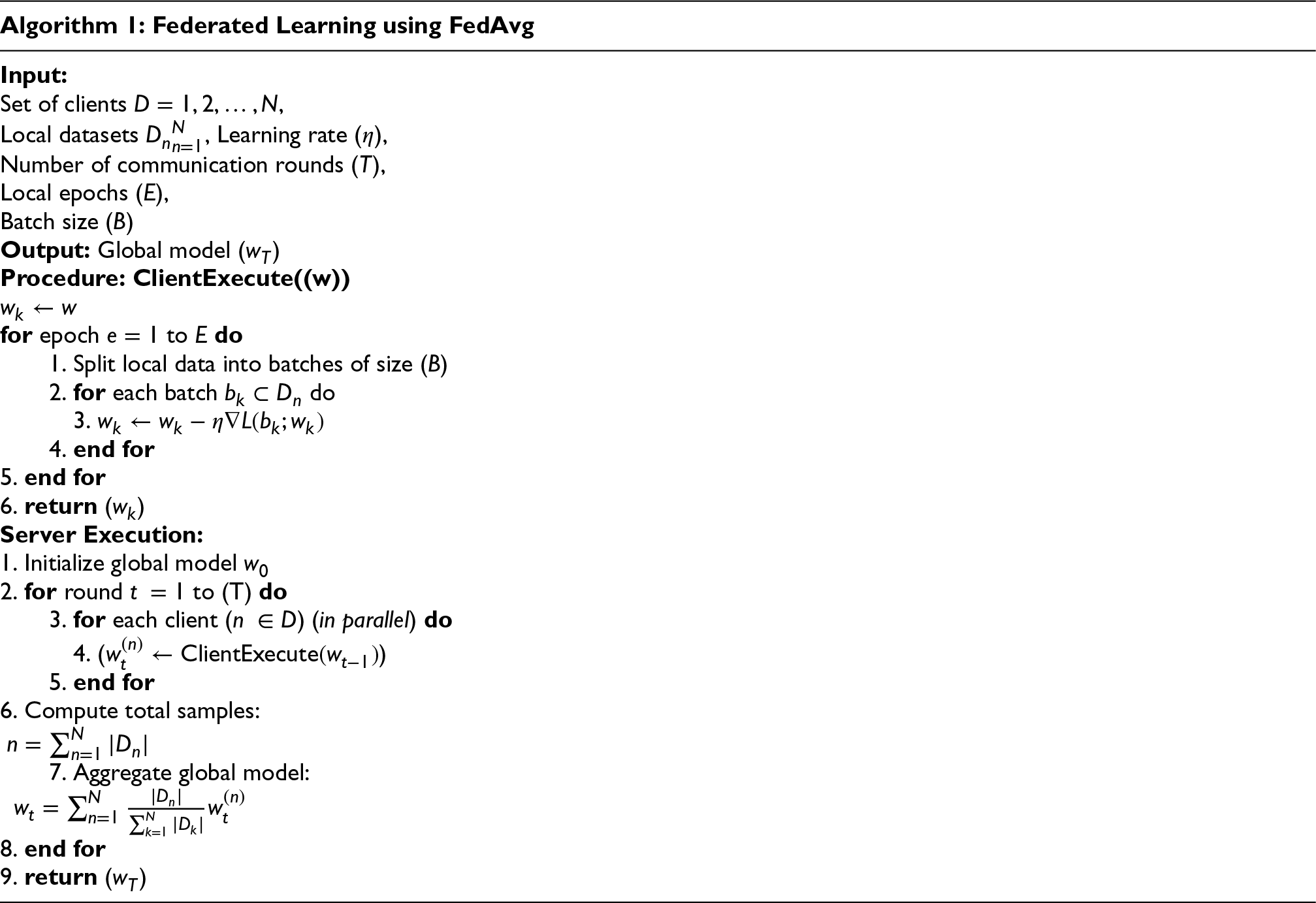
The Siamese Network was initially introduced in 1993 to authenticate the signature on a check by comparing it with the signature stored by the bank. It has mostly been used to measure the similarity between two vectors in computational domains. A Siamese Network has two interconnected networks that employ shared weights to produce equivalent output vectors. These networks cooperate by concurrently processing two separate input vectors. Typically, a predetermined output vector is computed beforehand, serving as a benchmark for comparing the other output vector. The Siamese Network has become a widely used structure for the process of learning visual representations without the need for supervision. The core principle of contrastive learning is to reduce the proximity between positive sample pairs and maximize the separation between negative sample pairs. At the beginning, the Siamese Network feeds two inputs into two neural networks to extract the representation vectors of the inputs and then map these representations into a latent space. The two similar sub-networks are called "twins". The twins have identical architecture and same configurations. Each twin consists of a feature extractor. A pair of images are given as input to the Siamese Network, with each image in the pair is given to a sub-network. The feature extractor produces embeddings in the form of vectors from the input given with the help of convolutional layers, activation functions, pooling layers and hierarchial feature extraction.a feature vector as output. The difference between the vectors from each sub-network is used to calculate the similarity measure. The output of a Siamese Network is a similarity measure.
The equation for a standard feature extraction process is as follows:

Let x be the input picture, W be the weight matrix, b be the bias vector, g be an activation function, e.g., ReLU, sigmoid, etc., F be the feature vector, so, W denote the weight matrix, b represents the bias vector, and g represent the activation function (such as ReLU, sigmoid, etc.). The next step is to finally measure the similarity between the two images by the use of a Siamese Network that utilizes a similarity function. The most widely used similarity function is the Euclidean distance, represented as:

Where x1 and x2 are the input images. The final output of the Siamese Network is a similarity score between the two inputs, which is typically used to make a binary decision (e.g., match or non-match) or a ranking decision (e.g., which input image is more like the other).
Blockchain technology stores records of all transaction in a decentralized network, which are immutable and transparent. Each block is linked to previous block cryptographically. Blockchain can be used in FL for authenticating clients, verifying the integrity of exchanged gradients and for auditability of the model training.
Proxy Re-Encryption
Proxy Re-Encryption (PRE) is a cryptographic algorithm used for encrypting plain text. A semi-trusted third party transforms cipher text encrypted by one to ciphertexts that can be decrypted by another key. This property makes this technique suitable for distributed systems which require secure data transmission and controlled access.
Proposed Fedblocksiamese Framework
Our work FedblockSiamese offers secure and trustworthy similarity based medical image analysis for multiple hospitals that wish to do collaborative analysis. The framework has three important components: Siamese Neural Network Federated Learning and Blockchain
FedBlockSiamese segregates learning, verification and aggregation while the majority of the existing work in FL uses blockchain for secure aggregation or logging purposes. The model updates are securely exchanged offchain and blockchain is exclusively used for mitigating malicious client, validating model updates and for traceability.
System Architecture
The FedBlockSiamese architecture consists of three logical layers: Client Layer (Healthcare Institutions) Federated Aggregation Layer and Blockchain Verification Layer
Each hospital uses Siamese Neural Network privately on their medical images and sends the model updates to a central server. The aggregation layer is responsible for collecting the model updates from various servers and is not involved in the client verification. A permissioned blockchain parallelly is executed which authenticates the client updates. The layered architecture ensures that the data remains local but still participates in learning and implementation overhead is minimized as the updates are not exchanged through Blockchain.
Siamese Network Architecture
Every customer uses a Siamese Neural Network that consists of two convolutional neural networks with shared weights as the twin networks. The networks are responsible for producing feature embeddings from the medical images, which are then compared using Euclidean distance to classify the images according to their distance from each other. The network is trained locally through the usage of a contrastive loss function, which aims at reducing the distance for similar image pairs while increasing it for dissimilar ones. It is very crucial to highlight that the similarity scores are only utilized during inference, and not during federated aggregation. Thus, only the model parameters are exchanged during training. This setup guarantees that the Federated Learning process is still in line with the conventional aggregation methods but also opens the door for similarity-driven medical diagnosis at the time of inference. Pneumonia detection is a binary classification, but clinicians frequently check similarities between suspected cases and known pathological patterns (Figure 1 illustrates the system architecture of the proposed work and Figure 2 shows the architecture of Siamese Network).
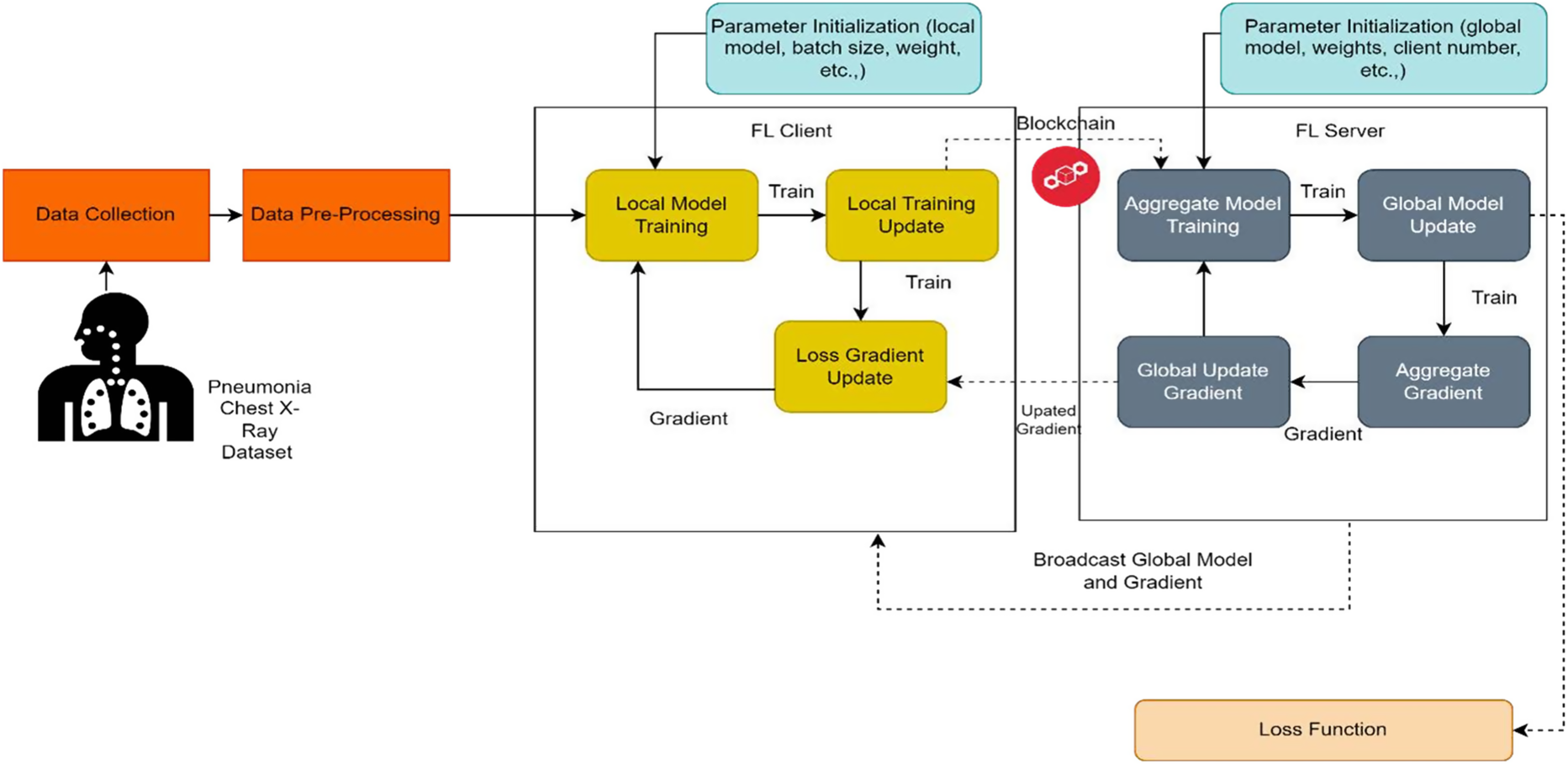
Architecture of Proposed FedBlockSiamese Framework.
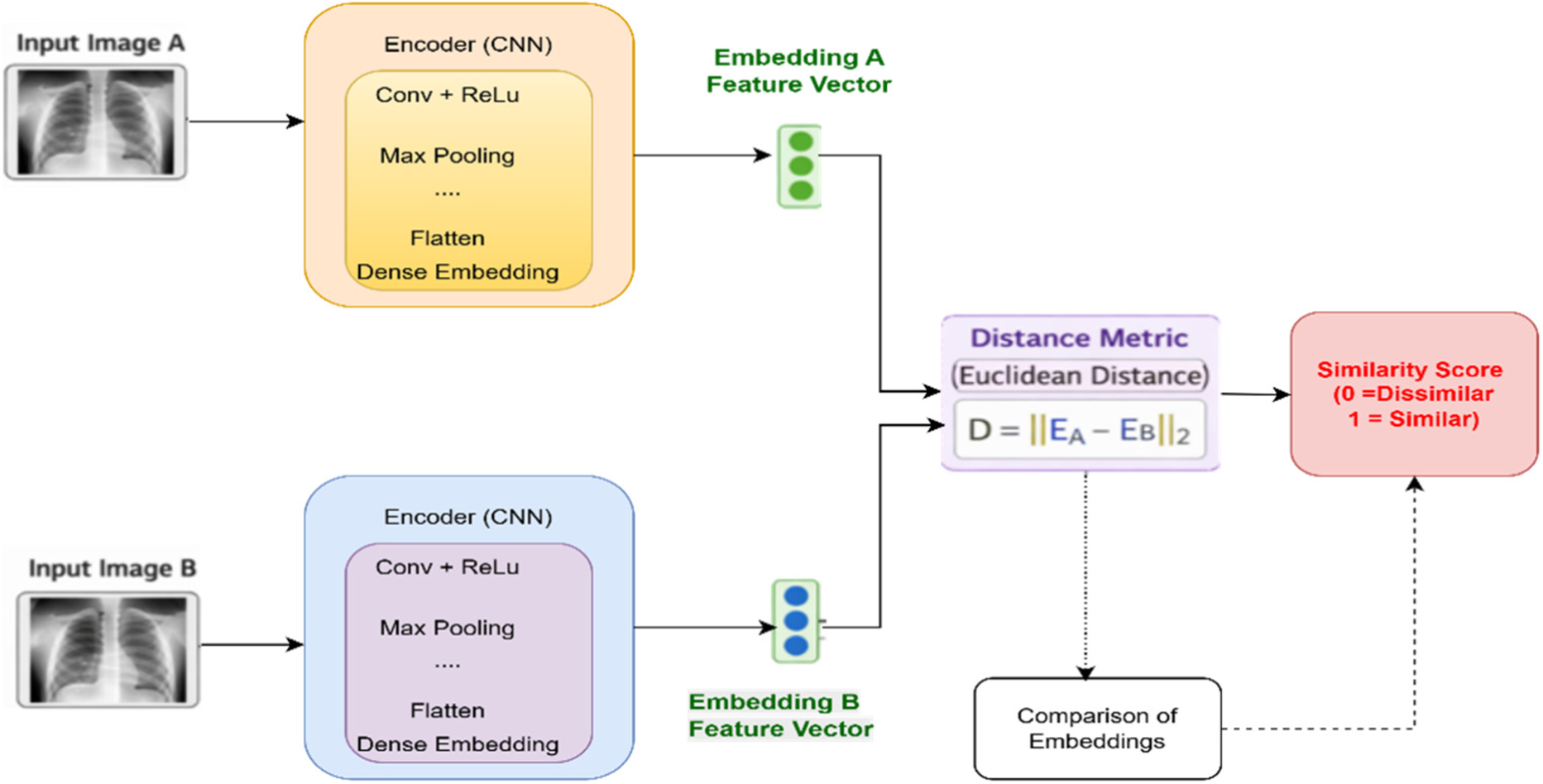
Siamese Network.
In federated learning settings, the chest X-ray data across different hospitals are typically non-iid, meaning that the distribution of images, disease severity, demographics, and imaging conditions can vary significantly between clients. A standard CNN classifier learns a fixed decision boundary based on the training distribution, which may not generalize well when the data distribution shifts across institutions. In contrast, a distance-based embedding space focuses on learning relative similarity between samples rather than a rigid boundary, allowing the model to group clinically similar cases even when their distributions differ across clients. As a result, the embedding-based approach is generally more robust to distribution shifts, making it more suitable for federated medical imaging scenarios where non-iid data is common.
FedBlockSiamese makes use of a private blockchain network that operates with a Proof-of-Stake (PoS) consensus method. The choice of PoS is based on its low resource requirements, efficient power consumption, and applicability in consortium-based healthcare where the involved parties are not fully trusted. The blockchain consists of: Hashes of encrypted model updates, Client identifiers, Timestamps and round numbers, Verification status of updates.
The model weights are not stored in the blockchain, ensuring scalability and less communication overhead.
Secure Model Update Exchange
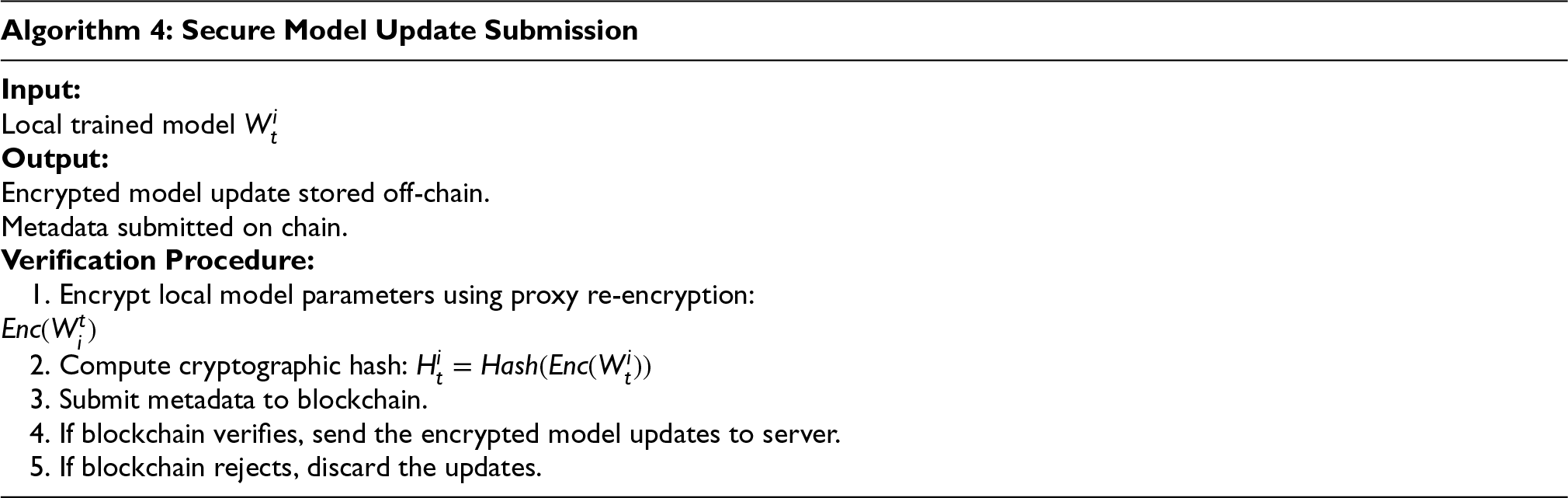
The model updates are communicated securely using proxy re-encryption. Each client encrypts the model parameters before exchanging. The aggregation server can only decrypt the updates after the blockchain-based validation has confirmed both the authenticity of the update and the legitimacy of the client. This hybrid on-chain/off-chain design balances security and performance, as it allows the exchange of model updates securely while at the same time guaranteeing trust.
Update Verification and Malicious Client Mitigation
Smart contracts used in blockchain impose policies for verification of the model updates or gradients from clients. Each update undergoes: Hash consistency validation. Timestamp verification to mitigate replay attacks.
Client authentication based on registered stakes.
In the aim of reducing delays caused by the Blockchain, FedBlockSiamese employs an asynchronous update mechanism. Model parameters are linked with round identifiers and timestamps. The parameters that come past the cut-off time are either postponed until the next rounds or are eliminated completely, depending on the smart contract rules.
Algorithm Description
The algorithmic workflow of our proposed work is given in this section. C = {C1,C2, . . .,CN} denotes the set of participating healthcare clients. B denotes the permissioned blockchain network. T denotes the total number of federated communication rounds.



Experimental Setup
This section describes the dataset, Federated Learning configuration and implementation details used.
Dataset
In order to assess the proposed framework's effectiveness, experiments were performed using a publicly available chest X-ray dataset specifically for pneumonia detection (https://www.kaggle.com/datasets/paultimothymooney/chest-xray-pneumonia). There are a total of 5,863 X-Ray images in JPEG format, which are divided into two categories: Pneumonia and Normal. The study utilized anterior-posterior chest X-ray images obtained from retrospective cohorts of children patients aged one to five years old at Guangzhou Women and Children's Medical Center in Guangzhou. The chest X-ray imaging was performed as part of the patients’ routine clinical care. A preliminary assessment was carried out during the inspection of chest x-ray images to guarantee quality control by discarding scans that were of poor quality or unreadable. The dataset is a standard reference in medical imaging research, and it gives a truthful evaluation of distributed diagnostic models. The dataset underwent preprocessing, first by changing the size of all images to the same resolution and then by normalizing the pixel intensity values. For creating a Real-world Federated Learning environment, the dataset was split among several clients, with each client representing a healthcare organization, thus ensuring no raw data was shared between them. The chest X-ray task is viewed as a proof-of-concept, showing the potential of the FedBlockSiamese framework. The design itself does not depend on the type of modality, and it can easily be referred to other medical imaging tasks like CT, MRI, and histopathology images.
Federated Learning Configuration
The FL implementation used five independent clients representing hospitals or healthcare institutions. Each client is deployed on an Intel Core i7 processor, 16 GB RAM and NVIDIA GPU. A central server with similar specifications was used for aggregation purposes. The Federated Learning environment is implemented using five distributed clients, each representing an independent hospital or medical institution. Each client is deployed on a GPU-enabled workstation equipped with an Intel Core i7 processor, 16 GB RAM, and an NVIDIA GPU (RTX 2060 or equivalent). A centralized aggregation server with similar computational resources coordinates model aggregation but does not access raw medical data. Each trains a local Siamese neural network on its dataset, for 5 local epochs during each communication round with a batch size of 32 and a fixed learning rate. The global training was executed for 50 communication rounds.
Blockchain Environment
The model updates are verified using a permissioned blockchain network. A Proof-of-stake consensus mechanism is employed for verification because of its less computational overhead. The components that are stored in blockchain are: The hash value of encrypted model updates Client identifiers and communication round numbers Timestamps Verification status.
Proxy Re-Encryption and Communication Setup
Proxy re-encryption is used to encrypt the model updates, which are transmitted off-chain between the client and the server. The communication involving model updates is secured by proxy re-encryption, thus preventing attacks caused by model weight thefts. Segregation of communication and validation processes helps FedBlockSiamese to achieve balance between communication efficiency and security by reducing latency and bandwidth consumption.
Evaluation Metrics
The performance of the proposed framework is measured using the following standard classification evaluation metrics: Accuracy, Precision, Recall and F1-Score. Parameters like communication overhead and convergence rate are used.
Results and Discussion
In Figure 3, a comparative study is shown for the four models: centralized Siamese training, standard Federated Learning (FL), blockchain-enabled Federated Learning (BCFL), and the proposed FedBlockSiamese approach. BCFL represents the conventional Federated Learning integrated blockchain architecture which stores and validates the model updates directly on blockchain. BCFL was experimentally conducted to be used as baseline work for comparison. Accuracy, precision, recall and FL-score is higher for FedBlockSiamese compared to FL and BCFL. Though the performance of centralized training is higher compared with others, FedBlockSiamese is closest to centralized training, but provides security and privacy to data. The performance of FedBlockSiamese shows the effectiveness of using Siamese Networks for similarity-based learning across distributed data. For xray image diagnosis tasks, improved score of parameters like recall is crucial as it shows the sensitivity in identifying pneumonia cases. Figure 4 shows the convergence of FedblockSiamese, FL and BCFL. FedblockSiamese shows better convergence compared to the other two. Though Blockchain integration adds additional implementation overhead convergence is not impacted as our work segregates the communication and verification process. Figure 5 shows the communication overhead of the FL, BCFL and FedBlockSiamese. Standard FL has the least amount of communication overhead as the weights are sent unencrypted. BCFL mechanism has the highest communication overhead as it uses blockchain for storage, exchange and verification. Compared to BCFL, our work has significantly less communication overhead due to using a proxy-reencryption technique to transmit encrypted model updates off-chain while relying on the blockchain only to verify metadata. As proven in Figure 5, FedBlockSiamese strikes an efficient balance between the two extremes of communication efficiency and security.
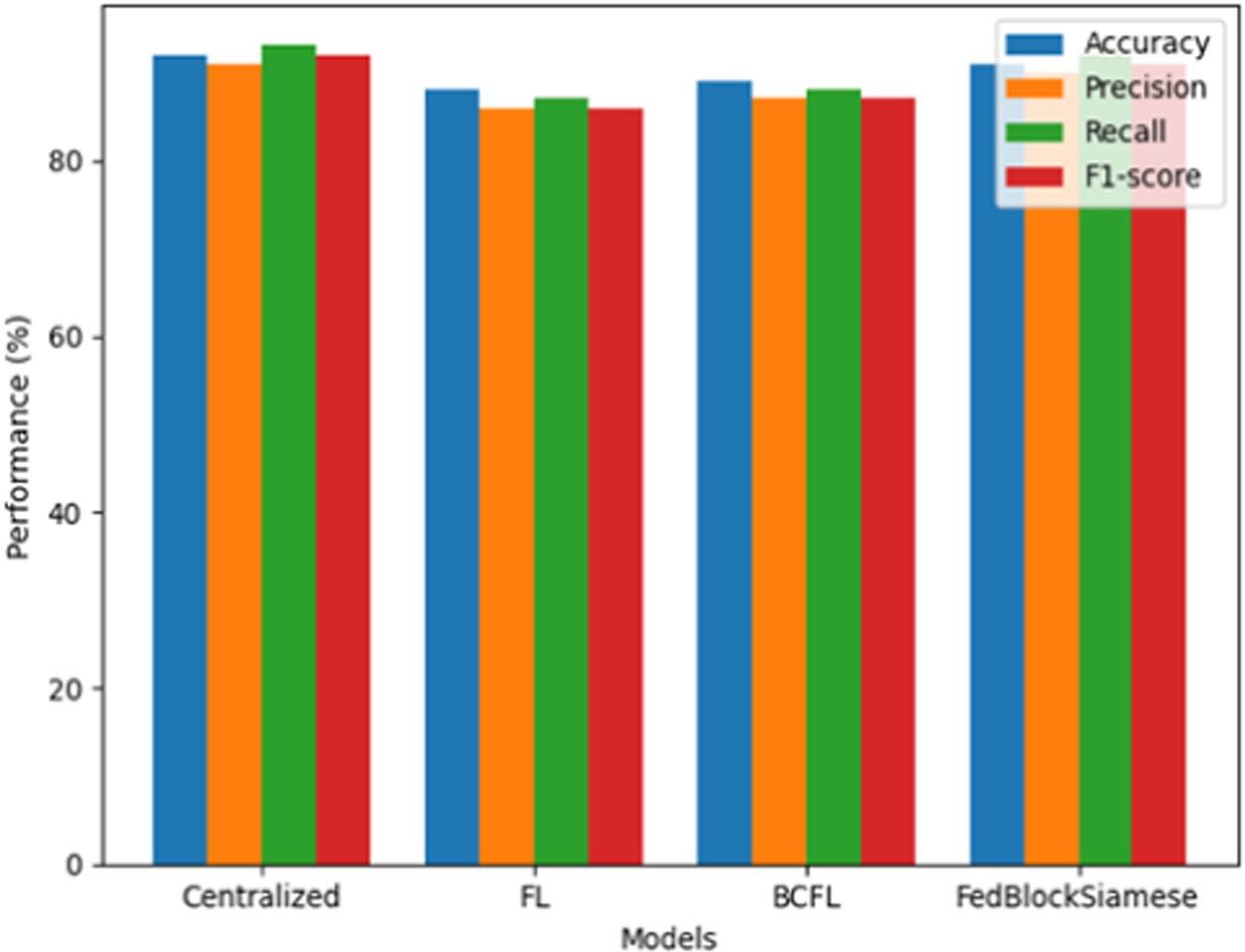
Performance Comparison.
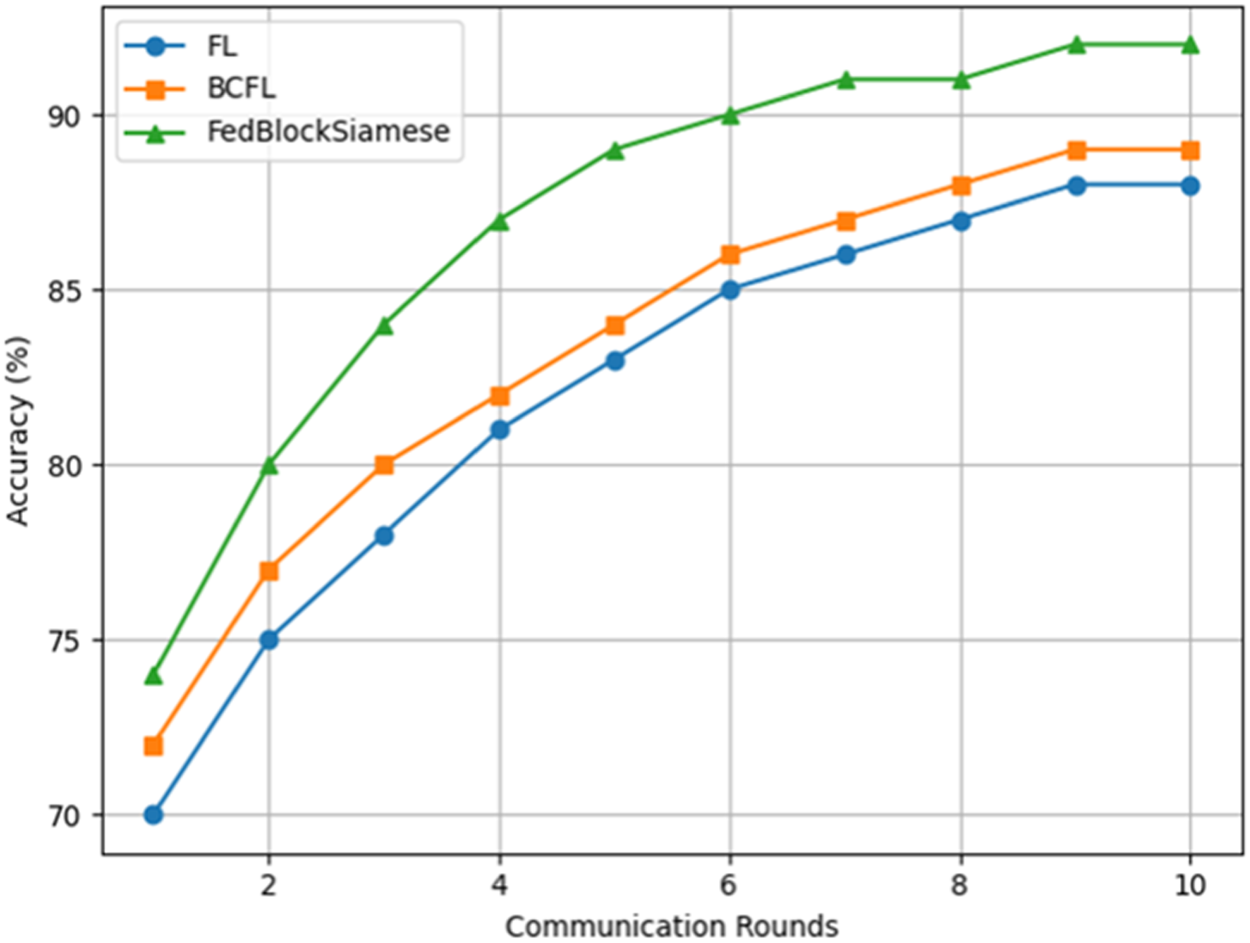
Convergence Analysis.
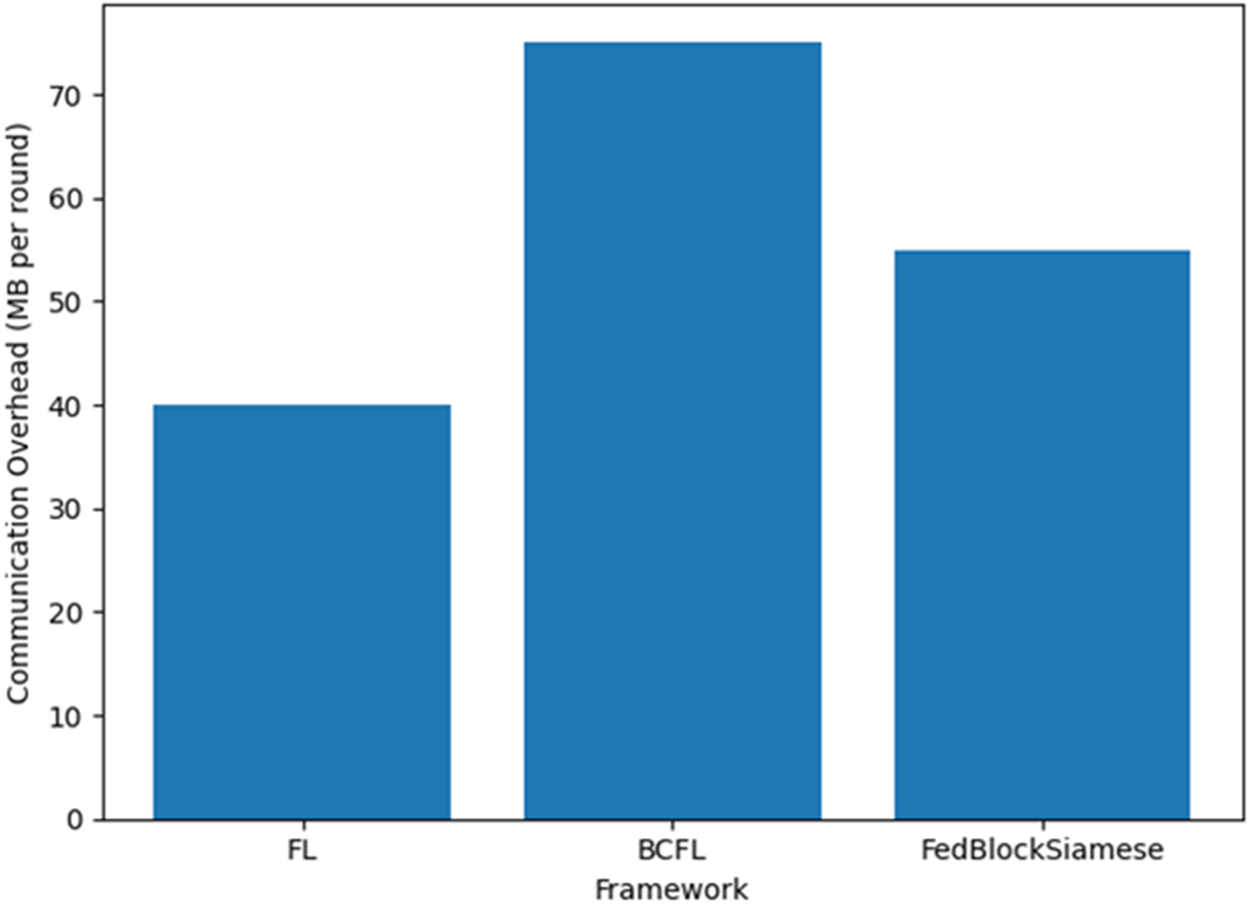
Communication Overhead.
An Ablation study is conducted to evaluate the performance of each module. Figure 6 shows the comparison between FL only (using CNN), FL with Siamese Network, FL with BC verification and the complete FedBlockSiamese Network. FL with Siamese Network shows a better performance than standard FL. FL with Blockchain does not increase accuracy but also does not reduce it either. The complete FedBlockSiamese shows better performance in terms of classification accuracy.
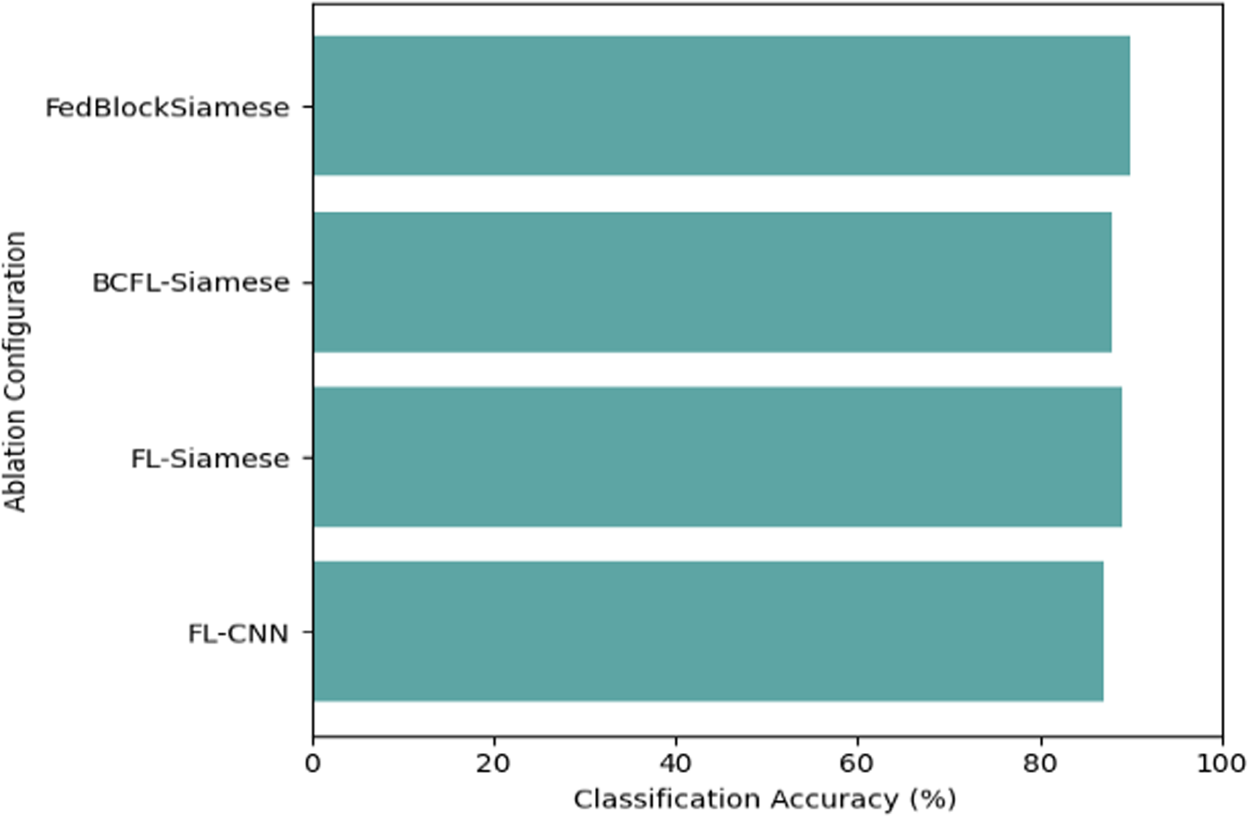
Ablation Study of FedBlockSiamese Components.
This section examines the security and privacy characteristics of the proposed FedBlockSiamese framework, addressing how it protects against few of the common threats that in Federated Learning systems, including attacks from malicious clients; model poisoning; inference attacks; and communication weaknesses.
Threat Model
FedBlockSiamese considers a scenario where the participating clients may be malicious. Those clients intend to poison the model updates or submit an old update or gather sensitive information from the model exchange process. The server is semi-trusted and does not have access to the medical data. A permissioned consortium is used for the blockchain network.
Protection Against Malicious Model Updates
Our framework uses blockchain based verification before the aggregation, to mitigate poisoned or unauthorized update. Every model update is associated with hash values, timestamp and client identifier. These values are validated with a smart contract. Updates which are inconsistent or have duplicate values or non-complaint are prevented from participating in the successive aggregation process.
Secure Model Update Transmission
The model updates are transferred securely by encrypting with proxy re-encryption. The model updates are transferred offchain after verified using blockchain. Proxy re-encryption helps to transmit securely, thus reducing the risk of information leakage during transit.
Resistance to Model Inversion and Inference Attacks
Federated Learning reduces the risk of data exposure as the data does not leave the client device. Though FL enhances the security and privacy of distributed learning, it is still vunerable to attacks like model inversion or inference attacks when the model updates are exposed. Our framework FedBlockSiamese prevents these risks by encypting and validating these updates.
Privacy Preservation and Data Confidentiality
Medical data does not exit the client premises and the clients’ model updates are communicated confidentially. This ensures compliance with data privacy regulations. The blockchain also stores only the metadata and hash value instead of the original gradients. This design allows multiple hospitals to combine and securely analyse the medical images.
Conclusion
In this work we proposed FedBlockSiamese, a secure and practical blockchain-enabled Federated Learning framework for collaborative medical image analysis. By combining similarity-based Siamese neural networks and blockchain-based verification with proxy re-encryption for secure off-chain model exchange, the proposed framework overcomes some of the limitations of existing Federated Learning systems in terms of trust, robustness and confidentiality. In contrast to conventional approaches, FedBlockSiamese distinguishes and separates learning from blockchain operations, allowing for an elegant separation of learning, verification and aggregation. Blockchain is just used for update verification and enforce trust models. As aggregation is executed off-chain, FedBlockSiamese improves the latency and communication overhead issues. The use of Siamese Networks allows for similarity-driven learning which is useful in medical diagnosis scenarios.
Results conducted on pneumonia in chest xrays with the model FedBlockSiamese show typically better diagnostic power than Federated Learning and generic blockchain Federated Learning baselines. It exhibits better convergence stability, less communication overhead with respect to BCFL, and greater robustness through a blockchain-based verification of updates. Ablation experiments further demonstrate that both the Siamese architecture and the blockchain verification are necessary components that contribute to the effectiveness of the framework. FedBlockSiamese prevents malicious updates by verifying them on the blockchain and preserves model confidentiality via proxy re-encryption. Medical images do not leave the participating centres ensuring privacy compliance and enabling secure collaboration. As a Future work, the framework can be integrated with formal privacy-preserving approaches, such as differential privacy and secure aggregation, to have stronger theoretical guarantees against inference attacks. The framework can be further extended by allowing large number of hospitals to participate and working on different image types like scan and MRI to check the scalability and adaptability. Our framework provides a secure solution for distributed and collaborative medical image analysis by integrating Federated Learning, secure algorithms and blockchain technology.
Footnotes
Acknowledgments
The authors gratefully acknowledge the support of PSG College of Technology, Coimbatore for providing the necessary facilities and environment to carry out this research.
Ethical approval and informed consent statements
This study did not involve human participants or animals, and therefore ethical approval was not required.
Funding
The authors received no financial support for the research, authorship, and/or publication of this article.
Declaration of Conflicting Interests
The authors declared no potential conflicts of interest with respect to the research, authorship, and/or publication of this article.
