



Abstract
Organizational decision-making frequently occurs in environments characterized by uncertainty, heterogeneous information, and qualitative expert judgment, which classical quantitative models cannot adequately capture. This article develops a mathematically grounded, fuzzy-logic–based theoretical decision architecture to enhance robustness, interpretability, and scalability in complex organizational systems. Building on an integrative synthesis of recent advances in fuzzy MCDM methods, AI-enhanced fuzzy inference, and sustainability-oriented performance modeling, three dominant research clusters are identified and consolidated into a unified multilayer framework. The proposed model is structured around four interdependent components—contextual conditions, technical fuzzy mechanisms, moderating structures, and observable outcomes—linked through an explicit feedback process formalized via composite fuzzy operators. Rather than introducing new algorithms, the framework specifies how established fuzzy components are functionally differentiated, constrained, and coordinated at the system level. It explains how expert-judgment quality, membership-function calibration, inference engines, interoperability with enterprise systems, and validation and traceability mechanisms jointly determine decision stability and transparency. The model further establishes key formal properties, including monotonicity, boundedness, adaptive stability, and traceable reproducibility, ensuring internal coherence and well-behaved system dynamics. By addressing the lack of unified, reproducible, and scalable architectures in the fuzzy decision-making literature, this study provides a generalizable theoretical foundation for explainable, sustainability-aligned intelligent decision systems under organizational uncertainty.
A Clear and Practical Framework for Improving Decision-Making under Uncertainty Using Fuzzy Logic and Artificial Intelligence
This article presents an accessible, system-level framework that explains how organizations can make better, more transparent, and more reliable decisions under conditions of incomplete or uncertain information by structuring and coordinating fuzzy logic, artificial intelligence, and expert knowledge within an integrated decision-support architecture.
Organizations often need to make important decisions in situations where information is incomplete, uncertain, or partly subjective. In these contexts, managers and experts rely on experience and judgment, but traditional numerical models are often unable to capture this reasoning clearly or consistently. As a result, decisions may become difficult to explain, hard to reproduce, or unreliable over time. This article presents a clear, structured framework for organizing fuzzy logic and artificial intelligence into a complete decision system to support better organizational decision-making. Instead of proposing a new algorithm or software tool, the study explains how different elements of decision-making should be arranged and coordinated at the system level to ensure reliability, transparency, and scalability.
The framework is organized into four connected layers. The first layer captures the decision context, including uncertainty, expert judgment, and organizational data. The second layer consists of the technical mechanisms—such as fuzzy logic models and AI-based adaptation—that process this information. The third layer focuses on validation, traceability, and organizational learning, which help ensure that decisions can be audited and consistently reproduced. The final layer represents the decision outcomes, which can be directly linked to performance and sustainability indicators, such as ESG metrics or Balanced Scorecard dashboards. A key contribution of the framework is the inclusion of a feedback loop that enables organizations to learn from past decisions and improve future ones without altering the system's overall structure. Overall, the article provides researchers and practitioners with a practical, understandable approach to designing intelligent decision-support systems that remain explainable, stable, and trustworthy in uncertain organizational environments.
Keywords
Introduction
Background and Motivation
Fuzzy logic has become a central analytical tool for addressing uncertainty in organizational decision-making, as it formalizes qualitative human judgments into computable rules. Its relevance has increased across domains such as supplier selection, sustainable performance management, project planning under uncertainty, and corporate sustainability. Empirical and conceptual studies consistently show that fuzzy methods improve decision quality in complex environments—for example, in supplier evaluation models (Chang et al., 2022), facility relocation decisions using hybrid MCDM approaches (Sequeira et al., 2023), sustainable performance assessment (Anjomshoae et al., 2021), parameter-sensitive enterprise decisions (Baral et al., 2025; Nazim et al., 2022; Yıldırım et al., 2019), and AI-enhanced fuzzy inference systems embedded in digital enterprise workflows (Jia et al., 2024; Weinzierl et al., 2025). Together, these contributions illustrate the growing methodological and organizational value of fuzzy logic across diverse managerial contexts.
Recent research highlights several broad trends in fuzzy decision systems, including the hybridization of fuzzy logic with multicriteria decision-making techniques (e.g., FAHP, fuzzy TOPSIS, fuzzy GRA), the emergence of next-generation fuzzy models (e.g., type-1, type-2 Mendel and John, 2002, and spherical fuzzy sets), the integration of fuzzy logic with artificial intelligence and machine learning, and the alignment of fuzzy methodologies with strategic management frameworks such as the Balanced Scorecard. These developments reflect fuzzy logic's capacity to incorporate heterogeneous criteria, subjective assessments, and multidimensional uncertainty in organizational decision-making contexts (Baral et al., 2025; Kumar et al., 2024; Nazim et al., 2022; Yıldırım et al., 2019).
As a result, the application of fuzzy logic in organizational settings has expanded rapidly. Current implementations include supply-chain supplier evaluation, hybrid dashboards integrating qualitative and quantitative indicators, project scheduling under uncertainty using fuzzy GERT networks, demand forecasting through rule-based fuzzy inference systems, and intelligent service platforms in sectors such as tourism, energy, and waste management (Dey et al., 2024; Pournader et al., 2021; Pregina et al., 2024). Collectively, these studies demonstrate the growing integration of fuzzy approaches into organizational decision processes operating under uncertainty.
While these developments demonstrate the growing relevance of fuzzy logic in organizational decision-making, a closer examination of the literature reveals persistent structural limitations that constrain its reproducibility, scalability, and system-level integration.
Literature Context
Despite these advances, the literature also highlights several unresolved limitations: (i) strong dependence on expert judgment for constructing membership functions, which introduces variability and bias; (ii) high sensitivity of results to parameter calibration; (iii) limited scalability when fuzzy models are deployed within complex enterprise systems such as ERP or BPM; and (iv) insufficient longitudinal and real-world validation. These weaknesses point to the need for more rigorous evaluation protocols, greater standardization, and improved integration with digital organizational infrastructures (Sequeira et al., 2023; Weinzierl et al., 2025).
Recent developments have also highlighted the role of explainability in enhancing the transparency and trustworthiness of decision-support systems. In contexts where fuzzy-logic components are embedded within broader analytical pipelines, post-hoc interpretability tools (e.g., local surrogate explanations and related methods) can help clarify how inputs contribute to outputs, complementing the intrinsic transparency of rule-based fuzzy inference (Mamdani and Assilian, 1975; Molnar, 2020; Ribeiro et al., 2016; Samek et al., 2017; Takagi and Sugeno, 1985; Zadeh, 1965). Such hybrid perspectives are particularly useful in applications where prioritization under uncertainty must be communicated to diverse stakeholders. Nevertheless, computational cost and the lack of standard traceability protocols remain barriers to scaling these approaches in real-time enterprise environments (Molnar, 2020; Samek et al., 2017).
Alongside these technical developments, recent theoretical frameworks have increasingly explored integrating fuzzy logic with artificial intelligence and sustainability-oriented performance metrics, such as ESG and the Balanced Scorecard. These approaches leverage fuzzy MCDM techniques to prioritize strategic actions while supporting explainability and managerial interpretability. In sustainable supply chains and industrial decision-making, second-generation fuzzy models (e.g., spherical fuzzy sets) have demonstrated enhanced capacity to handle multidimensional ambiguity and generate context-sensitive recommendations (Yıldırım et al., 2019; Zavadskas et al., 2015).
Taken together, these developments indicate a clear movement toward hybrid and integrative approaches. However, the literature still lacks a system-level theoretical architecture that explicitly explains how contextual conditions, technical fuzzy mechanisms, and organizational validation structures interact to produce stable, reproducible, and scalable decision outcomes. This gap motivates the unified framework proposed in the following section (Jia et al., 2024; Kumar et al., 2024; Mendel and John, 2002; Weinzierl et al., 2025).
Novelty and Theoretical Contribution
In this context, the purpose of this study is to propose an integrative fuzzy logic–based theoretical framework that explains how uncertainty, expert judgment, data integration, and methodological calibration interact with fuzzy decision mechanisms to generate robust, interpretable, and scalable decision outcomes in complex organizational systems. To align explicitly with the mathematical foundations of fuzzy systems research, the proposed framework formalizes the relationships among its core components using fuzzy-set theory and dynamic inference structures, modeling organizational decision environments as fuzzy information spaces transformed through composite fuzzy operators.
Accordingly, this study does not aim to introduce a new fuzzy algorithm or optimize an existing inference technique. Instead, it advances a formally grounded theoretical architecture that integrates fuzzy logic, hybrid FL–AI/ML mechanisms, and explainability principles into a unified multilayer decision system with feedback and adaptive properties. This contribution responds to the fragmentation of existing fuzzy decision-making research, which remains largely method-centric and lacks unified system-level architectures that ensure reproducibility, scalability, and organizational interpretability.
Although fuzzy logic has been extensively applied through fuzzy MCDM methods, fuzzy inference systems, and hybrid fuzzy–AI models, existing approaches remain largely method-centric, domain-specific, and weakly integrated at the system level. The novelty of this work lies in advancing a system-level theoretical architecture that unifies fragmented research streams by integrating contextual inputs, technical fuzzy mechanisms, moderating structures, and decision outcomes within a coherent multilayer model with explicit feedback dynamics.
This perspective addresses a critical gap in the literature: the absence of formally grounded architectures that explain why fuzzy decision systems succeed or fail across organizational settings, and under which conditions they remain reproducible, explainable, and scalable. By formalizing these interactions and establishing minimal structural and mathematical properties, the proposed framework provides a generalizable theoretical foundation for uncertainty-aware and explainable intelligent decision systems beyond specific methods or application domains.
Importantly, the theoretical novelty of this study does not stem from the proposal of new fuzzy operators, membership functions, or multicriteria decision-making algorithms. All technical components employed in the framework—such as fuzzy MCDM engines, fuzzy inference systems, and hybrid fuzzy–AI mechanisms—are well established in the literature, and combinations of these elements have been explored in prior studies. The non-substitutable contribution lies instead at the system-architecture level. Specifically, the framework specifies how these components are functionally differentiated, constrained, and coordinated within a unified multilayer decision architecture. By formalizing contextual conditions as a structured fuzzy input space, introducing an explicit moderating layer governing validation, traceability, and organizational learning, and embedding all components within a dynamic feedback-driven structure, the model defines an architectural organization that cannot be reproduced by assembling existing fuzzy MCDM–AI–ESG frameworks without redefining their system-level logic. Conventional approaches typically aggregate methods or indicators, whereas the proposed framework constrains their interaction through explicit architectural roles and stability conditions.
Theoretical Background
The Role of Fuzzy Logic in Organizational Decision-Making
Fuzzy logic (FL) is increasingly recognized as a foundational approach for addressing uncertainty and ambiguity in organizational decision-making. Its strength lies in its ability to formalize qualitative, imprecise human judgments into mathematical models that improve decision reliability in complex environments. Applications range from supplier selection and project planning to sustainability evaluation, where traditional crisp models often fail to capture the nuances of human reasoning (Anjomshoae et al., 2021; Chang et al., 2022).
The theoretical foundations of the proposed framework build on classical fuzzy-set theory and inference architectures, including the original formulation of fuzzy sets, linguistic fuzzy control, and functional fuzzy modeling for dynamic systems, as established in seminal works by Zadeh (Zadeh, 1965), Mamdani and Assilian (Zadeh, 1965), and Takagi and Sugeno (Mamdani and Assilian, 1975). Aggregation mechanisms commonly used in multicriteria fuzzy decision-making, such as ordered weighted averaging operators, further support the integration of heterogeneous criteria under uncertainty (Yager, 1988).
The rise of AI and digital transformation has heightened demand for explainable, adaptive decision systems. Recent studies suggest that embedding fuzzy logic into enterprise systems—especially those involving machine learning—enhances interpretability and organizational trust. For instance, Weinzierl et al. (Weinzierl et al., 2025) demonstrate that integrating fuzzy reasoning into business process management (BPM) architectures enables decision engines to become more transparent and context-aware, supporting real-time operational control.
At the applied level, hybrid frameworks are gaining prominence. At the applied level, hybrid frameworks are gaining prominence. In particular, post-hoc explainability tools (e.g., local surrogate explanations and related interpretability methods) are increasingly used to enhance transparency when fuzzy-logic components are embedded within broader AI/ML decision pipelines (Molnar, 2020; Ribeiro et al., 2016; Samek et al., 2017). Similarly, Sequeira et al. (Sequeira et al., 2023) employ fuzzy AHP-TOPSIS for facility relocation decisions, enabling the evaluation of competing criteria in uncertain environments. These cases illustrate how fuzzy logic combined with explainable AI (XAI) tools provides both analytical robustness and decision traceability—qualities increasingly valued in complex organizational settings.
However, limitations persist. The construction of fuzzy systems still relies heavily on expert input for defining membership functions and rule sets, which can introduce bias and reduce reproducibility (Nazim et al., 2022). Additionally, parameter sensitivity and computational costs hinder the deployment of fuzzy–XAI systems at scale, particularly in enterprise platforms such as ERP or SCM. Fuzzy rule–based decision-support systems encode expertise in compact IF–THEN rules, making the inference process transparent and easier to communicate, which enhances clarity and practical applicability in organizational decision-making contexts (Mamdani and Assilian, 1975; Takagi and Sugeno, 1985; Zadeh, 1965).
Theoretical work is also advancing toward broader integration. Zavadskas et al. (Zavadskas et al., 2015) propose a fuzzy TOPSIS model to rank ESG strategies in sustainable manufacturing, showing how fuzzy MCDM can align AI-enhanced analytics with corporate responsibility goals. In supply chains, Yıldırım et al. (Yıldırım et al., 2019) adopt spherical fuzzy sets to evaluate sustainability under high ambiguity, reinforcing the role of next-generation fuzzy approaches in managing multidimensional complexity.
Taken together, these developments position fuzzy logic not only as a methodological asset but as a strategic enabler in modern organizations. Its capacity to bridge human intuition and algorithmic systems—while accommodating complexity, uncertainty, and transparency—makes it particularly suited to the evolving demands of data-informed, sustainability-oriented management.
Cluster Analysis: Trends and Thematic Streams in the Literature
Recent research in fuzzy logic applied to organizational management can be synthesized into three dominant thematic clusters that recur consistently across the literature. The first cluster centers on fuzzy MCDM methods—such as FAHP, fuzzy TOPSIS, and GRA—which support prioritization, ranking, and decision-making under uncertainty (Baral et al., 2025; Chang et al., 2022; Nazim et al., 2022; Sequeira et al., 2023; Yıldırım et al., 2019). A second cluster focuses on sustainability and performance frameworks, in which fuzzy systems integrate ESG indicators, subjective KPIs, and Balanced Scorecard metrics (Anjomshoae et al., 2021; Dey et al., 2024; Kumar et al., 2024). The third cluster highlights the convergence of fuzzy logic with artificial intelligence and machine learning, including adaptive fuzzy control and the embedding of fuzzy inference into digital enterprise workflows (Jia et al., 2024; Pournader et al., 2021; Weinzierl et al., 2025). Together, these clusters reveal an emerging integration across methodological, technological, and sustainability-oriented approaches, contributing to a more unified research landscape.
Within this structure, sustainability- and performance-oriented applications (e.g., ESG- and Balanced Scorecard–based fuzzy models) are treated as a normative substream rather than an independent cluster, as they primarily build on fuzzy MCDM and fuzzy inference mechanisms while introducing domain-specific performance objectives.
A synthesis of recent studies shows that these thematic patterns have evolved in parallel and now interact increasingly closely. Building on this structure, current scholarship can be grouped into three major clusters, each reflecting a distinct application domain and methodological orientation: Fuzzy MCDM Cluster. This cluster is grounded in methodological developments that refine fuzzy multicriteria decision-making techniques, particularly FAHP, fuzzy TOPSIS, and fuzzy GRA. These approaches have been applied to contexts such as supplier selection, facility location, and supply-chain sustainability, demonstrating strong capacity to structure heterogeneous criteria under uncertainty (Baral et al., 2025; Chang et al., 2022; Nazim et al., 2022; Sequeira et al., 2023; Yıldırım et al., 2019). Recent contributions extend these techniques to dynamic decision environments in which criteria may be interdependent, partially conflicting, or imprecise. Overall, this cluster emphasizes methodological rigor and model optimization, while also revealing persistent dependence on expert-derived inputs for membership-function calibration and weighting schemes. Sustainability and Performance Sub-Cluster (Normative Dimension). This cluster examines how fuzzy logic supports sustainability-oriented performance measurement systems, including ESG-based evaluation frameworks and the Balanced Scorecard. This stream does not constitute an independent methodological cluster but rather a normative application domain that extends fuzzy MCDM and inference models toward sustainability-oriented performance evaluation. Prior research has shown that fuzzy models are effective for integrating heterogeneous and subjective indicators—particularly environmental, social, and governance metrics and qualitative KPIs—into coherent assessment structures (Anjomshoae et al., 2021; Kumar et al., 2024). Recent advancements extend these approaches to new application domains, such as fuzzy evaluation of waste-management performance (Dey et al., 2024) and fuzzy TOPSIS-based prioritization of ESG strategies in manufacturing (Zavadskas et al., 2015). Together, these contributions demonstrate alignment between fuzzy decision models and contemporary sustainability management frameworks. Fuzzy sustainability models fundamentally rely on the mathematical properties of fuzzy aggregation operators, which enable the integration of heterogeneous qualitative and quantitative ESG indicators into coherent evaluative structures. These operators—such as weighted fuzzy integrals, ordered weighted averaging (OWA) functions, and fuzzy distance measures—provide the mathematical basis for constructing sustainability performance scores under uncertainty. Thus, the normative cluster also contributes essential formal elements that reinforce the internal consistency of a unified fuzzy decision model. AI + Fuzzy Logic Cluster. This cluster examines the growing convergence between fuzzy logic and artificial intelligence, particularly through adaptive, learning-oriented, and explainable decision systems. Research in this area includes fuzzy Q-learning models that enable real-time adaptive control in dynamic environments (Jia et al., 2024), as well as reviews highlighting the role of fuzzy methods as key tools for managing ambiguity and unpredictability in AI-enabled supply chain decision-making processes (Pournader et al., 2021). Further developments demonstrate how fuzzy logic can be embedded in business process management systems to support transparent, context-aware decision-making within digital enterprise workflows (Weinzierl et al., 2025). Collectively, these contributions position fuzzy–AI integration as a critical mechanism for enhancing adaptability, interpretability, and operational responsiveness in organizational settings.
Taken together, these clusters reflect a trend toward multidisciplinary integration. Fuzzy logic is no longer confined to isolated decision-support tools—it increasingly permeates strategic, operational, and sustainability-focused decision-making environments. This evolution underscores its role as a bridge between expert intuition, algorithmic reasoning, and enterprise analytics.
From a theoretical standpoint, these developments build on the foundational principles of fuzzy-set theory and inference architectures established in classical works on fuzzification, linguistic control, and functional fuzzy modeling (Mamdani and Assilian, 1975; Takagi and Sugeno, 1985; Zadeh, 1965), as well as on aggregation operators widely used in multicriteria fuzzy decision-making (Yager, 1988). At the same time, existing surveys and meta-frameworks reviewing fuzzy variants and hybrid fuzzy–AI integrations (Pournader et al., 2021) primarily focus on methodological taxonomies rather than on unified system-level decision architectures.
Despite these developments, the literature reveals several persistent limitations: Dependence on Expert Judgment: Many fuzzy models rely on subjective inputs for defining membership functions and rule sets, introducing bias and reducing reproducibility (Nazim et al., 2022). Parameter Sensitivity: The output of fuzzy MCDM models is often susceptible to parameter calibration, complicating their validation and comparability (Baral et al., 2025). Scalability Issues: When implemented in complex enterprise systems such as ERP or BPM, fuzzy models may encounter integration and performance bottlenecks (Weinzierl et al., 2025). Lack of Longitudinal Validation: Most studies are limited to cross-sectional or single-site applications. There is a lack of empirical validation across time or organizational contexts. Fragmentation among Fuzzy Model Variants: The proliferation of fuzzy extensions (type-1, type-2, spherical fuzzy sets, etc.) complicates cross-study synthesis and standardization (Yıldırım et al., 2019).
Despite their maturity and increasing sophistication, these clusters largely evolve in parallel and remain focused on specific methods, domains, or performance objectives. Fuzzy MCDM models primarily address ranking and prioritization problems; sustainability-oriented frameworks focus on aggregating ESG and performance indicators; and fuzzy–AI hybrids emphasize adaptivity and learning. However, none of these streams provides an explicit system-level architecture that integrates contextual conditions, technical mechanisms, moderating structures, and feedback dynamics into a single coherent model. This lack of architectural integration limits reproducibility, scalability, and explanatory power across organizational settings, motivating the development of the unified framework proposed in the following section.
Building on the synthesis of the three dominant clusters, the next section advances an integrative theoretical framework that consolidates their complementary contributions into a unified decision architecture. Rather than extending individual fuzzy models, the framework organizes methodological, sustainability-oriented, and AI-enhanced elements into a coherent system-level structure that prioritizes reproducible validation protocols, technical scalability, and interoperability with digital enterprise infrastructures, thereby reinforcing fuzzy logic as a strategic decision-making tool under growing organizational uncertainty.
While recent fuzzy decision-making frameworks and hybrid fuzzy–AI models have significantly advanced methodological sophistication, most existing approaches remain focused on specific techniques, domains, or performance objectives. Frameworks based on fuzzy MCDM, explainable fuzzy–AI hybrids, or sustainability-oriented fuzzy models typically emphasize algorithmic optimization, indicator prioritization, or domain-specific integration. In contrast, they rarely articulate how contextual conditions, validation mechanisms, and feedback dynamics jointly shape the stability, interpretability, and scalability of fuzzy decision systems across organizational settings.
The framework proposed in this study advances beyond these approaches by shifting the analytical focus from individual fuzzy methods to a system-level theoretical architecture. By integrating contextual inputs, technical mechanisms, moderating structures, and outcomes within a unified multilayer model, and by formalizing feedback and minimal structural properties, the proposed framework provides a more general and explanatory perspective on fuzzy decision-making under uncertainty than existing theoretical or hybrid models.
Accordingly, the three dominant clusters—fuzzy MCDM methods, AI–fuzzy integration, and normative sustainability-oriented applications—are analytically distinct but structurally interconnected, motivating the unified system-level architecture proposed in the following section.
Architectural Admissibility and Exclusion Criteria
To strengthen the practical applicability of the proposed framework, we explicitly define architectural admissibility and the corresponding exclusion criteria. A fuzzy decision system is admissible under this framework if its structure supports coherent inference, stable operation (when feedback exists), and interpretable, verifiable mappings from inputs to outputs. Conversely, a system is deemed non-admissible if it violates any of the following structural conditions: E1. Boundedness and well-posedness. Inputs and outputs must be explicitly bounded (or transformable to bounded domains), and the input–output mapping must be well-defined for all admissible inputs. Systems with undefined regions, unbounded outputs without safeguards, or ambiguous domains are excluded. E2. Operator regularity for coherent aggregation and inference. The aggregation, implication, and composition operators used in the inference pipeline must satisfy basic regularity requirements compatible with coherent reasoning (e.g., monotonicity and continuity under the selected semantics). Architectures using operators that induce discontinuous or non-monotone behavior without justification or controls are excluded. E3. Feedback/recurrence must be well-defined and stable (when present). If the architecture includes feedback loops, recurrence, or iterative updating of states/parameters, the update rule must be explicitly specified and accompanied by stability safeguards (e.g., bounded updates, contraction-like behavior, or empirically validated convergence). Unspecified or potentially unstable feedback mechanisms render the system non-admissible. E4. Endogenous moderation/adaptation requires traceability and validation. When the system includes endogenous moderation (e.g., adaptive membership functions, self-tuning rules, or learning-based parameter updates), the adaptation mechanism must be traceable (i.e., explainable in terms of what changes, why, and under which data) and must be validated to prevent arbitrary drift or post-hoc fitting. Untraceable or unvalidated adaptation is an exclusion condition. E5. Semantic consistency and interoperability constraints. Input variables, linguistic labels, and membership functions must preserve semantic consistency across modules and data sources (units, meaning, and directionality). Architectures that combine variables with mismatched semantics (e.g., incompatible units, contradictory linguistic scales, or inconsistent polarity across the rule base) without explicit harmonization are excluded.
These exclusion criteria make the framework operational by clarifying the minimal structural properties required for a fuzzy decision system to be considered admissible. The formal properties discussed later in the manuscript further operationalize these criteria by providing verifiable conditions and diagnostic checks aligned with E1–E5.
Architecture versus procedural fuzzy MCDM pipeline. Although fuzzy MCDM studies are often presented as a procedural pipeline (e.g., define criteria – elicit judgments – fuzzify – aggregate – rank/defuzzify – report results), the contribution of this manuscript is articulated at the architectural level. A procedural pipeline describes what is done as a sequence of computational steps, typically allowing validation and sensitivity checks to be performed ex post. By contrast, the proposed framework specifies how the system must be structured and which design-time constraints must hold for it to be admissible.
In this architecture-centric view, validation and feedback are endogenous constraints rather than optional after-the-fact steps. First, validation is embedded as an admissibility requirement that constrains parameterization and any endogenous moderation/adaptation (criterion E4), preventing untraceable drift and ensuring that updates remain explainable and empirically defensible. Second, when feedback/recurrence is part of the design, it is treated as a structural component whose update rule and stability safeguards must be specified a priori (criterion E3), rather than a procedural iteration applied post hoc. Therefore, validation and feedback are framed as architectural constraints that govern permissible system behavior, not merely procedural checks performed after results are obtained.
Importantly, the formal properties presented in this section operationalize the architectural admissibility conditions (E1–E5) by translating them into verifiable constraints and diagnostic checks. Therefore, violation of any criterion E1–E5 is sufficient to classify the system as non-admissible under the proposed framework.
Reproducibility and comparability under open membership-function specification. The framework intentionally leaves the specification of membership-function families and parameters open to accommodate domain-specific elicitation, data availability, and contextual calibration. Moreover, when uncertainty in membership functions must be represented explicitly, the architecture remains compatible with type-2 fuzzy sets, following the foundational formulation by Mendel and John (Mendel and John, 2002). However, reproducibility and cross-study comparability are ensured at the architectural and representational levels, rather than by prescribing a single parametric choice. Specifically, the framework fixes (or requires explicit declaration of) the variable set and measurement conventions (units/normalization), the linguistic scale design and semantic anchors, admissible operator choices for inference/aggregation/defuzzification, the rule-base structure and mapping from inputs to outputs, and the admissibility constraints (E1–E5) that bound permissible system behavior.
To make the remaining parametric flexibility reproducible, the manuscript requires a minimum reproducibility bundle, including: (i) the full definition of inputs/outputs and normalization, (ii) the complete rule base and operator set, (iii) the membership-function family used for each linguistic term and the calibration procedure (expert elicitation protocol and/or data-driven fitting), (iv) semantic anchoring of linguistic labels (e.g., thresholds or reference points that define “low/medium/high”), and (v) validation and diagnostic evidence consistent with the admissibility criteria. With this specification, different studies may legitimately use different membership-function parameterizations, while still remaining comparable at the architectural level and reproducible through transparent calibration and reporting.
Proposed Theoretical Model
The proposed model should be interpreted as a theoretical decision-system architecture rather than as a specific fuzzy algorithm or application-oriented method. Its purpose is not to introduce new fuzzy operators or inference schemes, but to explain how established fuzzy components can be systematically organized to enhance decision quality in organizational environments characterized by uncertainty and complexity. To this end, the framework adopts a multilayer structure in which contextual conditions, computational fuzzy mechanisms, and moderating structures jointly converge into observable decision outcomes aligned with sustainable performance objectives, such as ESG and Balanced Scorecard indicators. Accordingly, the proposed framework should not be interpreted as an integrative toolbox that aggregates fuzzy MCDM techniques, AI-based mechanisms, or sustainability-oriented indicators, but as a formal decision architecture that constrains how these components are functionally differentiated, coordinated, and validated within a unified system over time.
Although the model's internal components may be instantiated using standard techniques (e.g., FAHP, fuzzy TOPSIS, Mamdani, or Sugeno inference), the architecture itself is not reducible to any of these methods in isolation. Its theoretical distinctiveness lies in the explicit separation and coordination of contextual inputs, technical mechanisms, moderating conditions, and outcomes within a unified structure, coupled with a formal feedback process governing calibration, learning, and long-term system stability.
Mathematically, the model represents each contextual, mechanistic, and moderating construct as a fuzzy set


In line with the theoretical scope of this study, the parametric form of the membership functions is intentionally left unspecified. The framework does not assume a particular functional shape (e.g., triangular, trapezoidal, Gaussian), as its objective is to characterize the architectural role of membership functions within a multilayer decision system rather than to optimize their numerical specification. Membership functions are therefore treated as bounded, parametrizable mappings whose calibration is governed by contextual conditions, validation mechanisms, and feedback-driven adaptation processes.
From a formal perspective, the proposed framework can be read as a canonical fuzzy decision system with clearly defined components. The inputs correspond to a vector of contextual fuzzy variables capturing uncertainty, expert judgment, data integration, and calibration conditions. These inputs are processed through fuzzy inference and aggregation mechanisms, instantiated via admissible fuzzy operators acting on fuzzified information spaces. The rule base is implicitly represented by the structure of these operators and their parameterization, which can be instantiated using standard Mamdani- or Sugeno-type inference schemes. The framework is organized into four decision layers—context, technical mechanisms, moderating structures, and outcomes—whose interactions are formalized through composite operators and an explicit feedback function. The outputs consist of defuzzified decision indicators reflecting robustness, interpretability, sustainability alignment, and scalability, which can be directly integrated into organizational decision-support systems.
Operator abstraction and admissible instantiations. The operators
To ensure mathematical coherence, all operators are assumed to satisfy minimal regularity conditions standard in fuzzy systems research, including monotonicity with respect to their inputs, continuity on bounded domains, and boundedness preservation (i.e., mapping admissible fuzzy sets into admissible fuzzy sets). These mild constraints are sufficient to guarantee internal consistency of the multilayer architecture while allowing flexible implementation choices.
To illustrate the operational logic of the proposed framework, consider the following hypothetical organizational decision scenario. Consider a hypothetical organizational decision involving prioritizing strategic initiatives under uncertainty, such as selecting improvement actions that balance operational efficiency and sustainability objectives. In the proposed framework, this problem first enters the context layer, where uncertainty levels, expert judgments, and heterogeneous indicators (e.g., qualitative assessments and enterprise data) are represented as fuzzified inputs. These inputs are then processed in the technical mechanisms layer, where fuzzy MCDM aggregation and inference operators transform the fuzzy information into structured priority evaluations. The moderating layer subsequently constrains and refines these results through validation, traceability, and calibration mechanisms, ensuring consistency and interpretability of the decision logic. Finally, the outcome layer produces a ranked or scored decision output that can be integrated into organizational performance dashboards. Through the feedback loop, the resulting outcomes inform future calibration and expert refinement, illustrating how the system adapts over time without altering its theoretical structure.
Constructs and Relationships
Unlike conventional fuzzy decision models, the constructs defined in this section are not treated as independent methodological choices but as interdependent architectural components whose joint configuration determines system-level behavior. Within the context layer, several input factors condition the practical application of fuzzy logic: (a) organizational uncertainty and complexity; (b) expert judgment quality, determined by experience, consensus, and bias reduction; (c) data integration from enterprise systems (ERP, BPM, SCM); and (d) methodological calibration, referring to the definition and adjustment of membership functions and weighting schemes within bounded parameter spaces, potentially supported by expert consensus, validation protocols, and AI-assisted self-adjustment mechanisms. These factors are fundamental for explaining the initial variance in fuzzy system performance (Chang et al., 2022; Nazim et al., 2022).
The technical core comprises the mechanisms by which fuzzy logic is operationalized in organizational management. First, fuzzy MCDM engines—including FAHP, fuzzy TOPSIS, and fuzzy GRA—support prioritization, classification, and alternative selection across diverse decision contexts (Baral et al., 2025; Chang et al., 2022; Nazim et al., 2022; Sequeira et al., 2023; Yıldırım et al., 2019). Second, fuzzy inference and control systems, including the Takagi-Sugeno models (Mamdani and Assilian, 1975), provide real-time decision-making capabilities in dynamic operational environments (Jia et al., 2024). Third, integrating fuzzy logic with artificial intelligence and machine learning enables parameter self-adjustment, pattern detection, and adaptive behavior under uncertainty (Pournader et al., 2021; Weinzierl et al., 2025). Finally, advances in data governance and interoperability facilitate the incorporation of fuzzy systems into enterprise digital ecosystems. Collectively, these mechanisms underpin expected outcomes in decision quality, sustainable performance, and organizational scalability (Anjomshoae et al., 2021; Dey et al., 2024; Kumar et al., 2024).
The third component, the moderators, addresses the main gaps identified in the literature: (i) longitudinal and multisite validation protocols that ensure replicability; (j) open data and traceability, enabling parameter auditing and rule versioning; and (k) training processes and communities of practice that bring together domain experts, analysts, and IT teams. These elements help mitigate bias, increase model reproducibility, and strengthen organizational adoption.
The expected outcomes of the model unfold across three key dimensions: (l) decision quality, measured in terms of robustness, stability, and explainability of the generated rankings; (m) sustainable performance, through the integration of financial and non-financial metrics into BSC/ESG dashboards; and (n) scalability and adoption, referring to the capacity of the models to integrate smoothly with enterprise processes and remain operational at large scale.
To align the proposed propositions more closely with fuzzy systems theory, the following statements are formulated in terms of system-level properties and operator constraints rather than as purely descriptive claims. Each proposition refers to a structural condition of the multilayer architecture and to formal properties—such as monotonicity, boundedness, stability, or traceability—that govern the behavior of the composite fuzzy operators underlying the decision system.
Based on the integrative synthesis of the literature and the structure of the proposed model, the following theoretical propositions articulate the key relationships among contextual conditions, technical mechanisms, moderating factors, and organizational outcomes: P1 (Contextual monotonicity). Improvements in expert judgment quality and contextual coherence induce monotonic improvements in the output of fuzzy MCDM operators, whereas unmitigated bias introduces non-monotonic perturbations that reduce robustness (Nazim et al., 2022). P2 (Calibration stability). Explicit calibration protocols and bounded membership-function parameter spaces increase the stability and explainability of fuzzy inference outcomes under repeated evaluation (Baral et al., 2025). P3 (Adaptive boundedness). The integration of AI/ML mechanisms with fuzzy inference operators enhances adaptive behavior while preserving boundedness of decision outputs over time (Jia et al., 2024; Weinzierl et al., 2025). P4 (Interoperability preservation). Data governance and interoperability operators increase the consistency of fuzzy decision outputs when embedded in ERP/BPM/SCM environments by constraining information flows within admissible system states (Weinzierl et al., 2025). P5 (Traceable reproducibility). Multisite validation protocols and parameter traceability mechanisms ensure that fuzzy decision mappings remain reproducible under equivalent contextual conditions (Anjomshoae et al., 2021; Pournader et al., 2021). P6 (Normative aggregation coherence). Integrating fuzzy decision outputs into ESG and Balanced Scorecard aggregation structures preserves decision coherence by aligning fuzzy aggregation operators with strategic performance metrics (Dey et al., 2024; Kumar et al., 2024).
These propositions are consistent with the formal properties of the proposed model discussed in Section 4.6, where monotonicity, boundedness, adaptive stability, and traceable reproducibility are formally established for the multilayer fuzzy architecture.
Closing the Gaps
The model directly addresses the weaknesses identified in the literature. Reproducibility is strengthened through validation and traceability protocols; AI-assisted self-adjustment mechanisms mitigate calibration sensitivity; scalability is supported by interoperability and continuous learning; methodological standards and shareable data facilitate comparability across studies; and strategic alignment is reinforced by integrating metrics into sustainable performance frameworks.
Taken together, the proposed model consolidates the primary mechanisms, contextual drivers, and boundary conditions that shape the effectiveness of fuzzy logic in organizational decision-making. By articulating the relationships among expert judgment, methodological calibration, AI-assisted adaptation, data governance, and sustainability-oriented performance systems, the framework provides a coherent basis for explaining how fuzzy MCDM engines and fuzzy inference systems generate robust, interpretable, and scalable decision outcomes. This synthesis closes the gaps identified in the literature. It establishes the conceptual foundation required for the subsequent section, which outlines the methodological approach used to structure the model and validate its internal logic.
The theoretical model was developed through an integrative synthesis of the three dominant research clusters identified in the fuzzy logic literature. The structure, relationships, and propositions were derived through iterative conceptual analysis, supported by pattern identification across studies on fuzzy MCDM models, AI–fuzzy hybrid systems, and sustainability-oriented performance frameworks. This approach ensures that the resulting framework reflects both methodological convergence and emerging research trends.
Materials and Methods
This study adopts a theory-building approach grounded in an integrative synthesis of literature, combining structured review techniques, conceptual clustering, and iterative model refinement. Given that the purpose of the article is to develop a theoretical framework rather than test empirical hypotheses, the methodological emphasis lies in systematically organizing, integrating, and abstracting existing knowledge to construct a coherent, logically consistent model of fuzzy-logic–based decision-making in organizational contexts.
Literature Search Strategy
A structured search was conducted across Scopus, Web of Science, and ScienceDirect, focusing on publications from 2020 to 2025 to reflect the most recent advances in fuzzy logic (FL), hybrid AI–fuzzy systems, fuzzy MCDM models, and sustainability-oriented performance frameworks.
Keywords included: fuzzy logic, fuzzy MCDM, fuzzy inference systems; type-1/type-2 fuzzy, spherical fuzzy, fuzzy TOPSIS, fuzzy AHP; explainable AI, XAI–fuzzy integration; ESG, Balanced Scorecard, sustainable performance; ERP/BPM/SCM integration, decision-making under uncertainty.
Search results were filtered using the following inclusion criteria: Conceptual or applied studies using fuzzy logic in organizational settings. Articles proposing methodological advances in fuzzy MCDM or inference engines. Studies integrating fuzzy logic with AI or digital enterprise systems. Papers addressing sustainability, performance dashboards, or ESG indicators via fuzzy methods.
Exclusion criteria involved: Engineering-only applications without organizational relevance. Studies lacking methodological transparency. Purely mathematical developments without managerial implications.
This process yielded a curated corpus of publications forming the basis for the theoretical synthesis.
Thematic Coding and Cluster Identification
Following the initial screening, all selected articles were subjected to thematic coding, enabling the identification of recurring constructs, methodological advances, and conceptual gaps. Through iterative comparison and cross-referencing, the literature was organized into three dominant clusters, consistent with the structure later presented in the theoretical background: Fuzzy MCDM cluster (methodological precision and model development). Sustainability and performance cluster (ESG, Balanced Scorecard, qualitative KPIs). AI + fuzzy logic cluster (hybrid systems, explainability, digital integration).
The clustering was performed manually, guided by conceptual similarity and citation linkages. The objective was not bibliometric quantification but the identification of conceptual structure, ensuring a clear and logically grounded foundation for model construction.
In addition to thematic relevance, selected publications were assessed for the mathematical rigor of their fuzzy formulations—specifically the explicit definition of membership functions, rule bases, aggregation operators, and inference structures. Studies lacking a precise mathematical specification of their fuzzy components were excluded to ensure that the resulting theoretical synthesis rested on formally consistent foundations. This criterion aligns with the requirements of mathematics-oriented journals, in which conceptual frameworks must derive from well-defined, reproducible fuzzy operators.
Integrative Synthesis and Construct Extraction
Using the clusters as analytical anchors, the next step involved integrative synthesis. This process entailed identifying: Core contextual conditions affecting fuzzy logic performance (uncertainty, complexity, expert judgement, data integration). Operational mechanisms (fuzzy MCDM engines, inference and control systems, hybrid AI–FL models, data governance). Moderating and boundary conditions (validation protocols, traceability, organizational training, interoperability).
Constructs were retained only if: Supported by multiple independent studies, Consistently present across clusters, and Conceptually necessary for explaining organizational decision-making with fuzzy logic.
This ensured analytical parsimony while maintaining theoretical completeness.
Derivation of Model Architecture
The final model architecture—context, mechanisms, moderators, and outcomes—was derived following an iterative layering process: Mapping constructs to their functional role in the decision-making process. Identifying causal and conditional relationships repeatedly described in the literature. Abstracting these patterns into a generalizable, multi-layer theoretical structure. Verifying that the resulting architecture addressed the methodological gaps previously identified (e.g., reproducibility, calibration sensitivity, scalability).
The resulting structure is the initial conceptual form of the model presented in the Theoretical Background.
Formally, the four-layer structure was validated by assessing whether each construct could be mapped to a distinct mathematical role within a fuzzy decision system—input fuzzification (context), inference and aggregation (mechanisms), constraint operators and stability regulators (moderators), and defuzzified outputs (outcomes). This mapping ensured that the architecture did not merely reflect conceptual coherence but also adhered to the canonical stages of fuzzy-system design, providing the model with theoretical and mathematical grounding.
Development of Propositions
Six theoretical propositions (P1–P6) were formulated through pattern matching between constructs and reported empirical regularities.
Each proposition reflects: A recurrent causal mechanism supported across multiple studies, A theoretically justified relationship between components of the model, and A boundary condition relevant to organizational environments.
These propositions serve as the logical backbone connecting the components of the model and provide the bridge between cluster-level findings and system-level dynamics.
Internal Coherence and Logical Validation
As the article is conceptual rather than empirical, validation focuses on internal coherence rather than statistical testing. The model underwent: Coherence testing: ensuring that relationships do not contradict the theoretical premises. Completeness assessment: confirming coverage of all significant gaps identified in the literature. Boundary analysis: verifying that the model can be adapted to settings with varying degrees of uncertainty, data quality, and technological maturity.
This conceptual validation ensures that the framework presented in the Results section is logically sound, grounded in the literature, and applicable across organizational contexts.
Methodological Limitations
As with any theory-building approach, limitations include: Dependence on published literature, which may introduce publication bias. The conceptual (non-empirical) nature of validation. Possible underrepresentation of niche or emerging fuzzy logic variants not yet widely cited.
Nevertheless, the selected methodological approach is appropriate for the study's objective: to synthesize dispersed research streams into a unified, scalable, and theoretically consistent model.
Results
The methodological process based on integrative synthesis, thematic coding, and structural derivation produced a refined multi-layer theoretical model that explains how fuzzy logic (FL) supports organizational decision-making under uncertainty. Unlike the preliminary conceptual structure presented in the theoretical background, the final model reflects an internally validated, systematically consolidated architecture that emerged from the triangulation of constructs across the three dominant research clusters.
As an output of the integrative synthesis, three dominant thematic clusters were consolidated. These clusters represent the methodological, normative, and technological foundations that enable the construction of the multilayer model. Table 1 summarizes the core themes, representative authors, and specific contributions of each cluster to the emergent framework.
Thematic Clusters Identified and Supporting Literature.
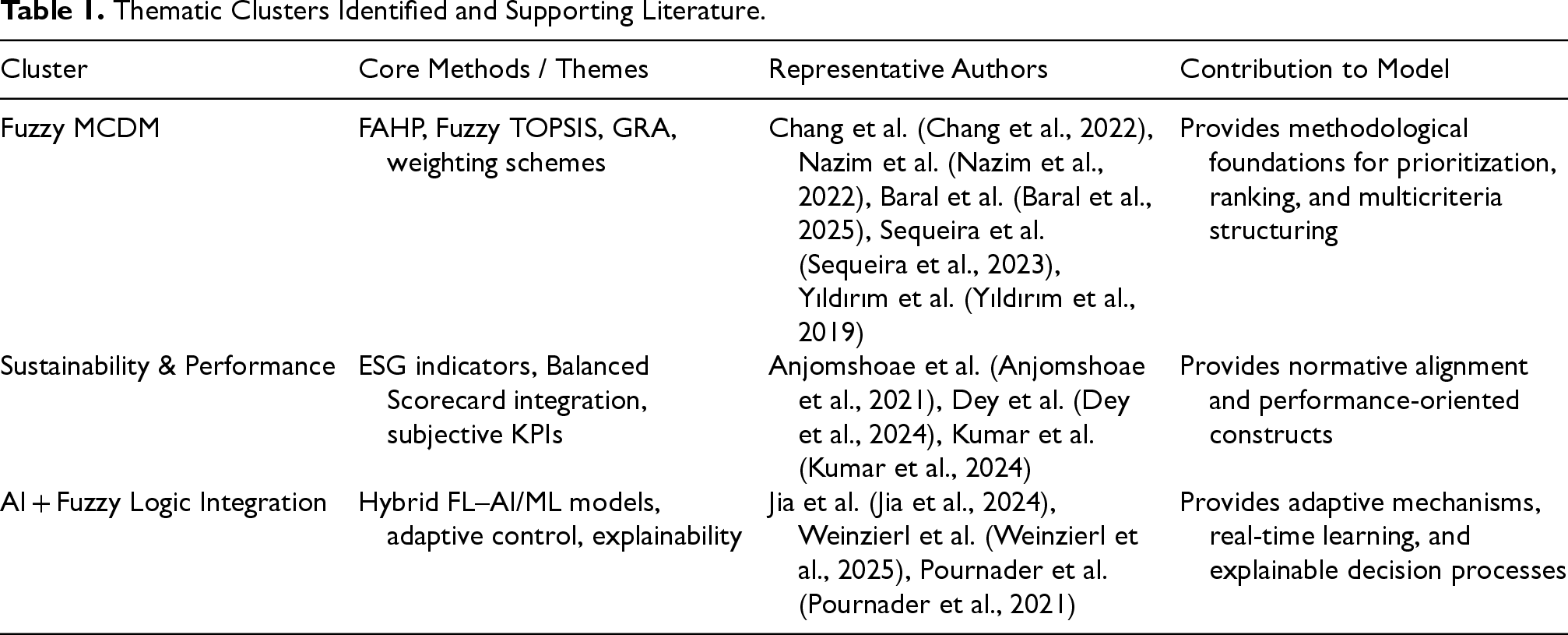
Thematic Clusters Identified and Supporting Literature.
The analysis yielded a consolidated multilayer decision model conceptualized as a feedback-driven system composed of four interdependent dimensions: (1) organizational context, (2) technical mechanisms, (3) moderating conditions, and (4) observable outcomes. These dimensions operate through directional flows and an iterative learning cycle, forming a unified architecture that integrates expert judgment, enterprise data, digital infrastructures, and hybrid FL–AI/ML components. A detailed representation of this model is provided at the end of this section.
The model illustrates a four-layer vertical architecture: Layer 1 – Organizational Context. Functions such as the input domain, capturing environmental uncertainty, task complexity, expert-judgment quality, enterprise-system data integration (ERP, BPM, SCM), and calibration practices related to membership functions and fuzzy weights. Layer 2 – Technical Mechanisms. Represents the computational core of the system. It includes fuzzy MCDM engines (FAHP, fuzzy TOPSIS, fuzzy GRA), fuzzy inference and control systems (Mamdani and Assilian, 1975; Takagi and Sugeno, 1985), hybrid FL–AI/ML adaptation modules, and data-governance/interoperability pipelines that ensure operational embedment. Layer 3 – Moderating Conditions. Operates as an institutional layer that shapes reliability and consistency. It comprises longitudinal/multi-site validation protocols, parameter-traceability structures, and rule versioning, and training ecosystems that support organizational learning. Layer 4 – Observable Outcomes. Captures the system-level outputs derived from the interaction among the previous layers, including decision quality (robustness, stability, explainability), sustainable performance (integration into ESG/BSC dashboards), and organizational scalability (interoperability with enterprise platforms).
These four layers are enclosed within a closed-loop feedback cycle, where outcome information flows back into the context layer. This feedback loop enables recalibration, expert refinement, rule updating, and continuous adaptation—transforming the model from a static analytic tool into a dynamic, learning-oriented organizational capability.
To ensure transparency in how each component of the final model was derived, all extracted constructs were mapped systematically onto the four layers of the model. Table 2 presents the mapping logic and justifications linking each construct to its corresponding layer.
Mapping of Extracted Constructs to Model Layers.
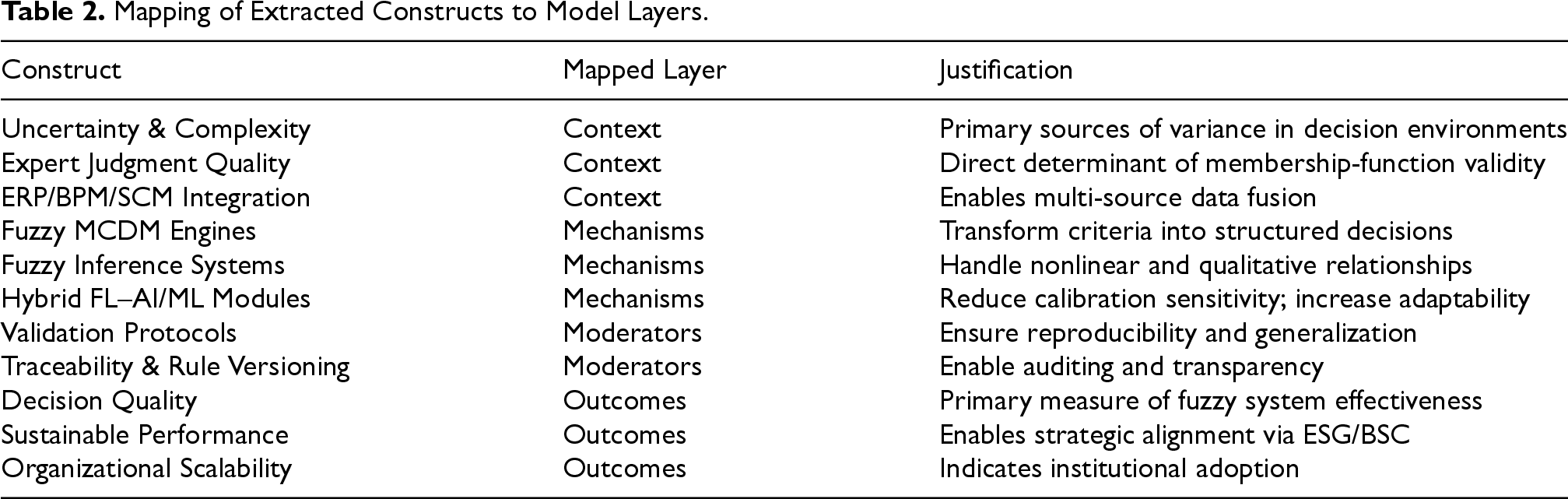
Mapping of Extracted Constructs to Model Layers.
The layered configuration shown in Figure 1 is not merely descriptive: it reflects the causal logic identified through the synthesis of the literature.
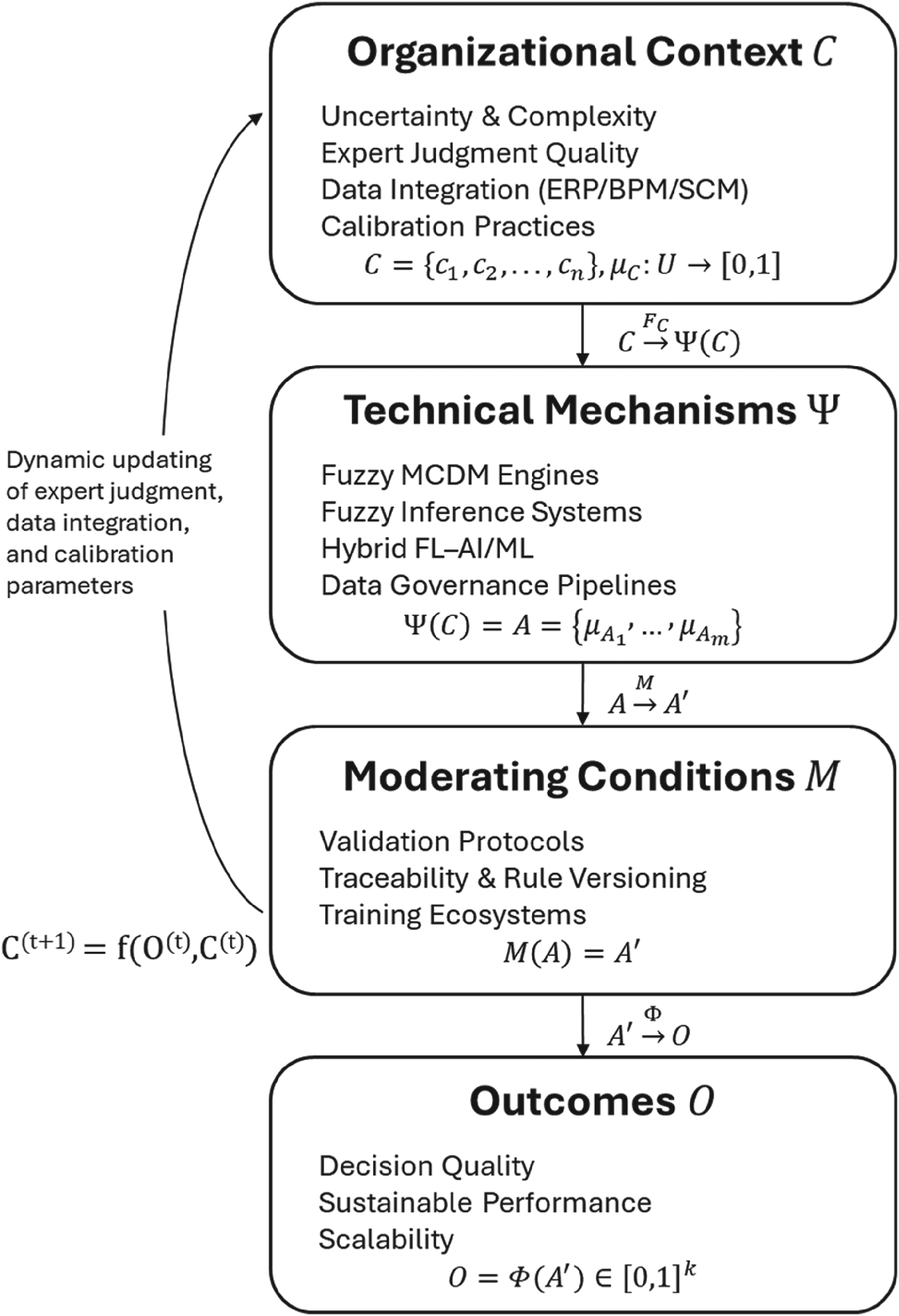
Multilayer fuzzy intelligent decision system with dynamic feedback. Note: Solid arrows indicate the primary deterministic information flow across layers (from contextual inputs to decision outcomes), while dashed arrows represent the recursive feedback mechanism used for calibration, learning, and parameter adaptation over time.
The integrative analysis confirmed that contextual factors constitute the primary determinants of variance in fuzzy system performance. Variability in expert judgment, incomplete ERP/BPM/SCM integration, and inconsistent calibration practices were identified as recurrent sources of instability in the literature.
Conversely, structured consensus-building, documented data governance, and standardized membership-function calibration significantly increase interpretability, robustness, and legitimacy of fuzzy-based decisions. These findings validate the foundational role of the context layer and support propositions P1 and P2.
Interpretation of the Technical Mechanisms Layer
The technical layer acts as the transformation engine, converting contextual ambiguity into structured outputs. The synthesis confirmed that fuzzy MCDM engines, inference systems, and hybrid AI/ML modules operate interdependently rather than in isolation.
Hybridization with machine learning proved critical for reducing calibration sensitivity, identifying emerging patterns, and enabling real-time adaptation—addressing long-standing limitations highlighted in the literature. This supports propositions P2 and P3.
Interpretation of the Moderating Conditions Layer
Moderators emerged as institutional enablers that guarantee the long-term reliability of fuzzy decision systems. Multi-site validation protocols, parameter traceability, and training ecosystems were consistently referenced as mechanisms that improve reproducibility, transparency, and organizational adoption.
Without these moderators, even technically well-designed fuzzy systems tend to degrade over time or remain confined to prototype stages. These findings validate propositions P4 and P5.
Interpretation of the Outcome Layer
The outcomes represent the strategic and operational value produced by the system. The capacity to generate robust, explainable decisions, integrate results into ESG/BSC dashboards, and scale across enterprise infrastructure demonstrates that fuzzy logic functions as an organizational capability, not merely a computational method.
This alignment between fuzzy decision outputs and organizational performance frameworks is consistent with the performance-management literature on structured evaluation systems, particularly the Balanced Scorecard and its extensions (Kumar et al., 2024). Moreover, making architectural constraints explicit (e.g., admissibility, validation, and stability safeguards) strengthens decision transparency and supports explainability-oriented evaluation practices (Molnar, 2020; Ribeiro et al., 2016).
These results support proposition P6 and confirm the model's alignment with sustainability-oriented performance frameworks.
Extended Structural Analysis: Interactions Across Layers
The synthesis revealed three cross-layer dynamics: Cascading Coherence. Each layer conditions and enables the next. For example, high-quality context inputs (expert judgment, data integration) enhance the internal performance of technical mechanisms, which in turn increase the effectiveness of moderators (traceability, validation). Bidirectional Adaptation. The feedback loop enables the system to self-adjust: Outcomes improve calibration; Calibration improves expert judgment; Expert judgment improves context inputs; and Better inputs enhance system performance. This establishes fuzzy logic as an evolutionary system capable of continuous learning. Institutional Embedding. Moderators transform computational tools into organizational capabilities. Without validation protocols and rule-versioning structures, fuzzy systems remain technically sound but strategically insignificant.
These systemic properties demonstrate that the final framework exceeds the sum of its individual components, becoming a dynamic mechanism for managing uncertainty.
System-Level Behavioral Properties of the Model
Three emergent behavioral patterns characterize the final model: Adaptive Stability. The system absorbs contextual variability while maintaining robust outputs due to hybrid FL–AI/ML mechanisms. Transparent Reproducibility. Traceability, validation, and rule versioning generate auditable decision trails, supporting digital governance. Scalable Sustainability. Embedding outcomes in ESG/BSC dashboards links operational decisions with long-term sustainability and organizational strategy.
These properties illustrate how the model closes the methodological and organizational gaps identified earlier, addressing issues of bias, calibration sensitivity, reproducibility, and limited scalability.
Beyond describing the model's structure, the synthesis process also enabled evaluation of how the proposed architecture addresses the main limitations consistently reported in the literature. Table 3 summarizes the alignment between each identified limitation and the mechanisms incorporated into the final model.
How the Final Model Addresses Limitations in the Literature.

How the Final Model Addresses Limitations in the Literature.
The resulting model integrates the four layers and the feedback loop into a cohesive, theoretically grounded framework. It synthesizes the methodological precision of fuzzy MCDM, the interpretability of fuzzy inference, the adaptive capacity of AI/ML, and the institutional safeguards required for sustainable organizational adoption.
In doing so, the model provides a robust explanation of how fuzzy logic generates transparent, reliable, and scalable decisions in complex organizational environments, establishing the foundation for the discussion presented in the next section.
Finally, the internal coherence of the model was assessed through a triangulation process across the three clusters. This step ensured that independent conceptual streams supported the relationships, mechanisms, and assumptions embedded in the model. Table 4 presents the cross-cluster triangulation matrix.
Triangulation Evidence Across Clusters.

Triangulation Evidence Across Clusters.
Figure 1 synthesizes the results of the integrative analysis into a four-layer architecture that reflects how fuzzy logic operates within organizational decision systems. The model structures the flow of information from contextual inputs to technical mechanisms, moderating conditions, and decision outcomes. At the same time, the external feedback loop illustrates how outputs recursively influence expert judgment, data integration, and calibration protocols. This dynamic configuration demonstrates that fuzzy logic–based decision systems evolve continuously through iterative learning and organizational adaptation.
The figure represents the proposed four-layer fuzzy decision system as a mathematical structure composed of: (1) a contextual input vector C, whose elements are fuzzified through
The figure illustrates the formal structure of the proposed fuzzy decision architecture, including contextual fuzzification, inference mechanisms, moderating operators, and defuzzified outputs, as well as the recursive feedback function governing system adaptation. In Figure 1, validation and (when applicable) feedback/recurrence are depicted as architectural constraints that bound admissible operation, not as external procedural steps.
The integrative analysis also enabled the identification of key formal properties of the multilayer fuzzy model. These properties ensure mathematical coherence, internal stability, and alignment with established principles of fuzzy decision systems. Monotonicity. Given a contextual input vector Adaptive Stability. Hybrid AI–fuzzy mechanisms introduce a dynamic adaptation operator Traceable Reproducibility. The moderator layer implements rule-versioning and parameter-traceability functions T, which guarantee that:
Boundedness of Outcomes. Since every inference operation is based on membership functions Feedback-Consistency. The recursive feedback loop is expressed as:
meaning that improvements in contextual quality (e.g., higher expert consensus or better data integration) cannot reduce the quality of intermediate fuzzy inferences.
after a finite number of iterations, ensuring convergence toward stable inference parameters even under fluctuating contextual inputs.

allowing full reconstruction of any decision output.
ensuring robustness and eliminating unstable or non-computable outputs. This boundedness assumption applies directly to the admissible parameter space of membership functions, ensuring numerical stability and preventing ill-posed calibration even when specific parametric families are instantiated in applied implementations.
where 
Minimal contraction condition. Let 

These formal properties confirm that the model is not only conceptually coherent but mathematically well-behaved, supporting its applicability as a dynamic, scalable, and explainable fuzzy decision system in organizational settings.
Core Insights: A Multilayer Decision System for Managing Uncertainty
Building on the results presented in Section 4, this study provides several system-level insights into how fuzzy logic supports organizational decision-making under uncertainty. Rather than treating fuzzy models as isolated computational tools, the proposed framework shows that their effectiveness depends on how technical mechanisms are embedded within broader organizational and institutional structures.
A central insight is that fuzzy logic achieves its maximum explanatory and organizational value when conceptualized as an integrated decision system. Variability in performance observed across prior applications can be explained not solely by differences in fuzzy algorithms, but by misalignment between contextual conditions (e.g., expert judgment quality, data integration, calibration practices), computational mechanisms (fuzzy MCDM, inference systems, hybrid FL–AI/ML), and institutional safeguards (validation, traceability, training). This systemic perspective clarifies why technically sound fuzzy models may still produce unstable or non-reproducible outcomes when deployed in complex enterprise environments.
The results further highlight the critical role of contextual and moderating conditions as first-order determinants of system stability. Structured calibration, data governance, and validation mechanisms reduce noise propagation and mitigate expert bias, whereas their absence amplifies sensitivity and fragility. These findings are consistent with prior work emphasizing that structured performance frameworks and interpretability-oriented practices improve the credibility and communicability of decision-support outputs (Kumar et al., 2024 Molnar, 2020; Ribeiro et al., 2016).
From a technological standpoint, integrating fuzzy logic with AI/ML mechanisms enables adaptive behavior while preserving interpretability, addressing long-standing limitations in parameter sensitivity and scalability. However, the analysis also shows that adaptivity alone is insufficient: without traceability and validation structures, learning-oriented systems remain difficult to audit and institutionalize.
Finally, integrating fuzzy decision outputs into organizational performance frameworks—particularly ESG and Balanced Scorecard dashboards—illustrates how fuzzy logic can serve as a strategic capability rather than a standalone analytic method. By aligning operational decisions with sustainability-oriented performance metrics, the framework reinforces the role of fuzzy systems in decision environments that combine quantitative indicators with qualitative assessments. This perspective is further supported by studies that emphasize the importance of incorporating human and contextual variability into organizational decision systems, such as research on telework and managerial perceptions.
Collectively, these insights position the proposed framework as a dynamic, learning-oriented organizational architecture, highlighting that the value of fuzzy logic in uncertain environments depends less on algorithmic sophistication than on system-level coherence and institutional embedding. This distinction highlights that the framework's contribution lies not in the coexistence of multiple techniques, but in their formal orchestration within a stable, auditable system-level architecture.
Theoretical Implications
This study contributes to the theoretical development of fuzzy decision systems in five substantive ways: Systemic integration across research clusters. The proposed architecture provides a unifying theoretical frame that integrates methodological, sustainability-oriented, and AI-enhanced fuzzy research streams. By accommodating type-1, type-2, spherical, and hybrid fuzzy variants within a single system-level structure, it advances beyond fragmented, method-centric formulations. Formalization of context as a mathematical input space. Representing uncertainty, expert judgment, data integration, and calibration practices as elements of a fuzzy information vector clarifies how contextual heterogeneity shapes inference behavior. This formalization aligns organizational decision modeling with the foundational principles of fuzzy-set theory. Dynamic and recursive foundations of fuzzy organizational systems. The introduction of an explicit feedback operator transforms fuzzy decision systems into adaptive dynamic environments, enabling iterative learning and convergence toward stable decision states. This perspective extends traditional static fuzzy MCDM formulations toward dynamic system theory. Institutionalization of reproducibility and explainability. By theorizing validation, traceability, and rule versioning as integral operators rather than procedural add-ons, the framework embeds reproducibility and explainability directly into the decision architecture. This positioning strengthens the conceptual linkage among fuzzy systems, explainable AI, and emerging digital governance paradigms. Bridging decision science with sustainability theory. Incorporating ESG and Balanced Scorecard indicators into the outcome structure expands the theoretical scope of fuzzy logic beyond operational efficiency, situating it within broader debates on sustainable strategy, organizational resilience, and long-term competitiveness.
Taken together, these contributions position the model as a theoretical scaffold for future mathematics-oriented research on fuzzy dynamic systems, decision stability, and explainable hybrid architectures.
Practical Implications
The proposed framework offers several practical implications for organizations seeking to deploy fuzzy decision systems at scale: Guidelines for implementing fuzzy decision models. Organizations should invest in structured expert-knowledge elicitation, consistent calibration protocols, and integrated data pipelines to ensure robustness and interpretability of fuzzy decision outputs. Contextual conditions should be explicitly managed as part of system design and governance. Blueprint for digital integration. The emphasis on interoperability with ERP, BPM, and SCM environments provides a practical roadmap for embedding fuzzy engines into enterprise workflows, enabling automated decision support across procurement, risk management, sustainability monitoring, and operational planning. Institutional structures for reliability. Validation procedures, rule versioning mechanisms, and parameter traceability support decision auditing, regulatory compliance, and organizational learning, reducing reliance on individual experts and facilitating long-term system adoption. Support for sustainability management. Integrating fuzzy decision outputs into ESG and Balanced Scorecard dashboards enables managers to evaluate trade-offs among economic, environmental, and social criteria in a structured, interpretable manner, particularly in high-uncertainty industries. Enhanced adaptability and learning. Hybrid FL–AI/ML modules enable organizations to deploy decision systems that evolve with new data, improving predictive capability, reducing recalibration effort, and supporting continuous organizational learning. Together, these implications translate the proposed system-level architecture into actionable design principles for organizations aiming to operationalize fuzzy logic within complex, data-intensive decision environments.
Limitations and Future Research Directions
Although the study advances a mathematically grounded conceptual framework, several limitations must be acknowledged. First, the model has been validated through internal logical coherence rather than empirical testing; future work should therefore assess its predictive ability, robustness, and generalizability across sectors and organizational contexts. Second, as a theory-building effort, the framework relies on the existing literature, which may reflect publication bias or underrepresent emerging fuzzy variants. Third, while formal properties such as monotonicity, boundedness, and adaptive stability were established, simulation-based analyses could further clarify convergence behavior and parameter sensitivity. Finally, organizational dynamics related to human factors, cultural resistance, and skill gaps remain outside the current mathematical scope.
Future research may advance the framework along several complementary directions. Empirical validation through multi-site and longitudinal studies could assess the robustness and reproducibility of decisions in real organizational settings. Simulation-based evaluation using synthetic or historical enterprise data may further support analysis of stability, sensitivity, and feedback dynamics under varying levels of uncertainty, expert disagreement, and data quality.
In addition, prototype implementations embedded within enterprise decision-support environments—such as ERP, BPM, or sustainability dashboards—would enable incremental adoption and mixed-method evaluation. In such settings, qualitative criteria (e.g., interpretability, traceability, organizational usability) could be assessed alongside quantitative performance indicators. Finally, controlled experimental or quasi-experimental designs may compare conventional fuzzy models with implementations guided by the proposed system-level architecture, providing concrete empirical evidence while preserving the theoretical generality of the framework.
Conclusions
This study develops a multilayer fuzzy-logic–based theoretical framework that explains how organizations can transform uncertainty, heterogeneous information, and qualitative expert knowledge into robust and interpretable decision outputs. By integrating contextual conditions, computational mechanisms, moderating structures, and sustainability-oriented outcomes, the model consolidates previously fragmented research streams and provides a coherent foundation for deploying fuzzy systems in complex organizational environments.
The analysis confirms that performance in fuzzy decision systems depends critically on the configuration of the context layer, particularly the quality of expert judgment, data integration, and calibration rigor. The technical mechanisms—fuzzy MCDM engines, inference systems, and hybrid FL–AI/ML modules—constitute the computational core that transforms ambiguity into structured outputs. At the same time, the moderating conditions ensure reproducibility and institutional trust through validation, traceability, and organizational training.
The model's formal properties demonstrate that it behaves as a dynamic, learning-oriented system capable of maintaining stability under uncertainty and scaling across enterprise infrastructures. When integrated into ESG/BSC dashboards, it also provides a bridge between operational decision-making and strategic sustainability performance.
In sum, fuzzy logic—when embedded within a structured organizational architecture—emerges as a powerful, adaptive, and explainable approach to decision-making in environments characterized by complexity, incomplete information, and the need for transparent, auditable outcomes. The proposed framework advances a system-level theoretical architecture that integrates contextual conditions, fuzzy inference mechanisms, moderating structures, and decision outcomes within a unified multilayer model with explicit feedback and formal properties. This provides a mathematically consistent and organizationally viable foundation for advancing both theoretical understanding and practical design of fuzzy decision systems in modern enterprise settings. Future research may extend this framework through deeper integration with machine learning and neuro-fuzzy models for adaptive calibration, tighter coupling with explainable AI paradigms to strengthen transparency and governance, and simulation-based or empirical validation across organizational contexts.
Footnotes
Acknowledgments
The authors thank the anonymous reviewers of the journal for their constructive suggestions to improve the quality of the article. The usual disclaimers apply.
Institutional Review Board Statement
(Not applicable).
Informed Consent Statement
(Not applicable).
Author Contributions
Conceptualization, R.M.-V. and A.S.-R.; software, G.G.-V., Y.F.-O. and R.P.-C.; methodology, G.G.-V., M.E.V.-A. and R.M.-V.; validation, G.G.-V., R.P.-C. and M.E.V.-A.; formal analysis, A.S.-R. and R.M.-V.; investigation, G.G.-V., A.S.-R., R.P.-C., M.E.V.-A., Y.F.-O. and R.M.-V.; data curation, R.M.-V., Y.F.-O. and A.S.-R.; writing—original draft preparation, R.M.-V.; writing—review and editing, A.S.-R.; visualization, M.E.V.-A., Y.F.-O. and R.P.-C.; supervision, G.G.-V.; project administration, R.P.-C. All authors have read and agreed to the published version of the manuscript.
Funding
The authors received no financial support for the research, authorship, and/or publication of this article.
Conflicts of Interest
The authors declare that the research was conducted in the absence of any commercial or financial relationships that could be construed as a potential conflict of interest.
Use of Artificial Intelligence
The authors declare that no generative artificial intelligence (AI) or generative AI-assisted tools were used in the conception, data analysis, or interpretation of results. AI-based assistance (ChatGPT, OpenAI) was employed solely for language refinement and proofreading of the final English manuscript, without altering the scientific content or analytical conclusions.
Data Availability Statement
The original contributions presented in this study are included in the article. Further inquiries can be directed to the corresponding author.
