



Abstract
Large-scale fiber optic telecommunication networks operate under heterogeneous and uncertain environmental conditions, which makes early fault detection a challenging task. Conventional OTDR-based monitoring approaches are mainly reactive and rely solely on optical signal analysis, providing limited capability to model uncertainty and gradual degradation effects. To address these limitations, this paper proposes an intelligent distributed sensing framework that integrates OTDR-based fiber monitoring with environmental sensor networks using a hybrid fuzzy–machine learning approach. In the proposed framework, optical fibers function as continuous sensing elements, while distributed sensors supply complementary temperature and soil moisture measurements. OTDR and sensor outputs are fused into a unified mixed trace and analyzed in both time and frequency domains. Discriminative features are extracted and reduced using principal component analysis to improve fault repairability. A fuzzy inference system is employed to model uncertainty, vagueness, and nonlinear relationships in the fused mixed trace, enabling robust reasoning under noisy and incomplete data conditions. Supervised and unsupervised machine learning models are combined with fuzzy decision rules to enhance fault classification and early degradation detection. The proposed fuzzy-enhanced framework is validated through real-world deployment on a national-scale telecom network, achieving fault classification accuracy of up to 94.1% and enabling prediction of fiber failures 48–72 h in advance. Compared to conventional OTDR-only monitoring, the proposed approach significantly improves fault detection time, localization accuracy, and decision reliability, demonstrating its effectiveness for intelligent and scalable fiber monitoring.
Keywords
Introduction
Modern telecommunication infrastructures are large-scale, geographically distributed systems that operate under heterogeneous and uncertain environmental conditions. As fiber optic networks extend across urban, rural, and desert regions, they are increasingly affected by external stressors such as temperature fluctuations, soil moisture, and mechanical pressure. These factors introduce ambiguity and gradual degradation effects that directly impact fiber integrity and long-term performance, making traditional reactive maintenance approaches insufficient (Turitsyn et al., Dec. 2013). Optical Time Domain Reflectometry (OTDR) is widely used for fiber fault detection and localization; however, conventional OTDR-based analysis is largely reactive and relies on crisp time-domain interpretations, limiting its sensitivity to early-stage and overlapping degradation patterns driven by environmental dynamics (Zhou et al., Mar. 2024). Although environmental sensor networks provide valuable contextual information, they are rarely integrated with optical diagnostics using uncertainty-aware reasoning frameworks in operational telecom networks (Liu et al., Jul. 2025). To address these limitations, this paper proposes an intelligent sensor network–assisted fiber monitoring framework that fuses OTDR measurements and environmental sensor data into a unified mixed trace. By incorporating fuzzy logic–enhanced machine learning, the proposed approach explicitly models uncertainty and vagueness in fiber behavior, enabling robust early fault detection, predictive maintenance, and reliable decision-making in large-scale telecom networks (Li et al., Apr. 2022; Zhou et al., Mar. 2024).
Technical Gap and Novelty Clarification
Despite the extensive body of research on OTDR-based monitoring, machine learning–assisted diagnostics, and environmental sensing frameworks, several critical technical gaps remain insufficiently addressed.
Comparative Summary of Related Works.

Comparative Summary of Related Works.
Overall, these contributions establish the proposed framework not merely as an application of existing artificial intelligence techniques, but as a structured, uncertainty-aware predictive monitoring architecture tailored for large-scale fiber optic infrastructures.
Intelligent monitoring of optical fiber networks has attracted significant attention, particularly for fault detection and predictive maintenance. OTDR-based frameworks remain the cornerstone for real-time fault localization. (Liu et al., Jul. 2025) developed an OTDR monitoring system for single-mode fiber faults, yet their approach was restricted to time-domain analysis without predictive intelligence. (Zhou et al., Mar. 2024) applied machine learning to OTDR signals for fault detection, but environmental factors were neglected, limiting contextual awareness.
The role of environmental conditions on fiber performance has been extensively studied. (Qian et al., 2022) reviewed the effects of temperature, soil moisture, and other environmental variables on optical fiber reliability. However, such studies were largely isolated from optical diagnostics, preventing correlated analysis between environmental stressors and fiber signal integrity.
Recent efforts have explored AI-driven and hybrid sensing approaches. Li et al., Apr. 2022 and Bao et al. Jun. 2011 applied machine learning for OTDR fault classification and sensor data analysis, whereas Naidu et al. (Naidu et al., 2024; Naidu and Ehrle, 2023) employed advanced ML models for noisy OTDR traces. Zhou et al., Mar. 2024 and Yin et al., Mar. 2020 proposed multi-parameter and hybrid OTDR–DAS frameworks, yet validations were primarily limited to laboratory conditions or lacked real-time environmental fusion.
Despite these advancements, most existing systems remain
Additional studies have further explored machine learning-based fiber monitoring and fu Zhou et al., Aug. 2023 zzy-driven maintenance strategies (Gorski et al., May 2022; Naidu et al., 2024; Vafaei et al., Feb. 2019; Zhou et al., Aug. 2023)
Methodology
The proposed framework is formulated as a mathematically structured hybrid architecture that integrates optical diagnostics, environmental sensing, statistical feature transformation, probabilistic learning, and fuzzy uncertainty modeling within a unified predictive pipeline. The methodology follows a sequential process beginning with mixed-trace construction, followed by statistical feature decorrelation, supervised learning optimization, and uncertainty-aware fuzzy calibration
Mixed Trace Construction
To model fiber degradation under heterogeneous environmental stress, optical and environmental measurements are synchronized and fused into a unified representation.
Let the OTDR-derived feature vector at time t be defined as:

Where the extracted optical descriptors include attenuation slope, backscatter variation, reflection magnitude, and frequency-domain spectral energy (Rolland et al., Mar. 2001).
Similarly, the environmental sensing vector at time t is defined as:

Including temperature gradients, soil moisture levels, and pressure deviations.
After temporal alignment and spatial mapping, the unified mixed trace vector is constructed as:

This formulation enables joint degradation modeling by coupling optical signal behavior with environmental stress indicators.
The overall mixed-trace fusion and hybrid decision pipeline is illustrated in Figure 1, highlighting the structured integration of optical and environmental features prior to statistical transformation and uncertainty-aware inference.
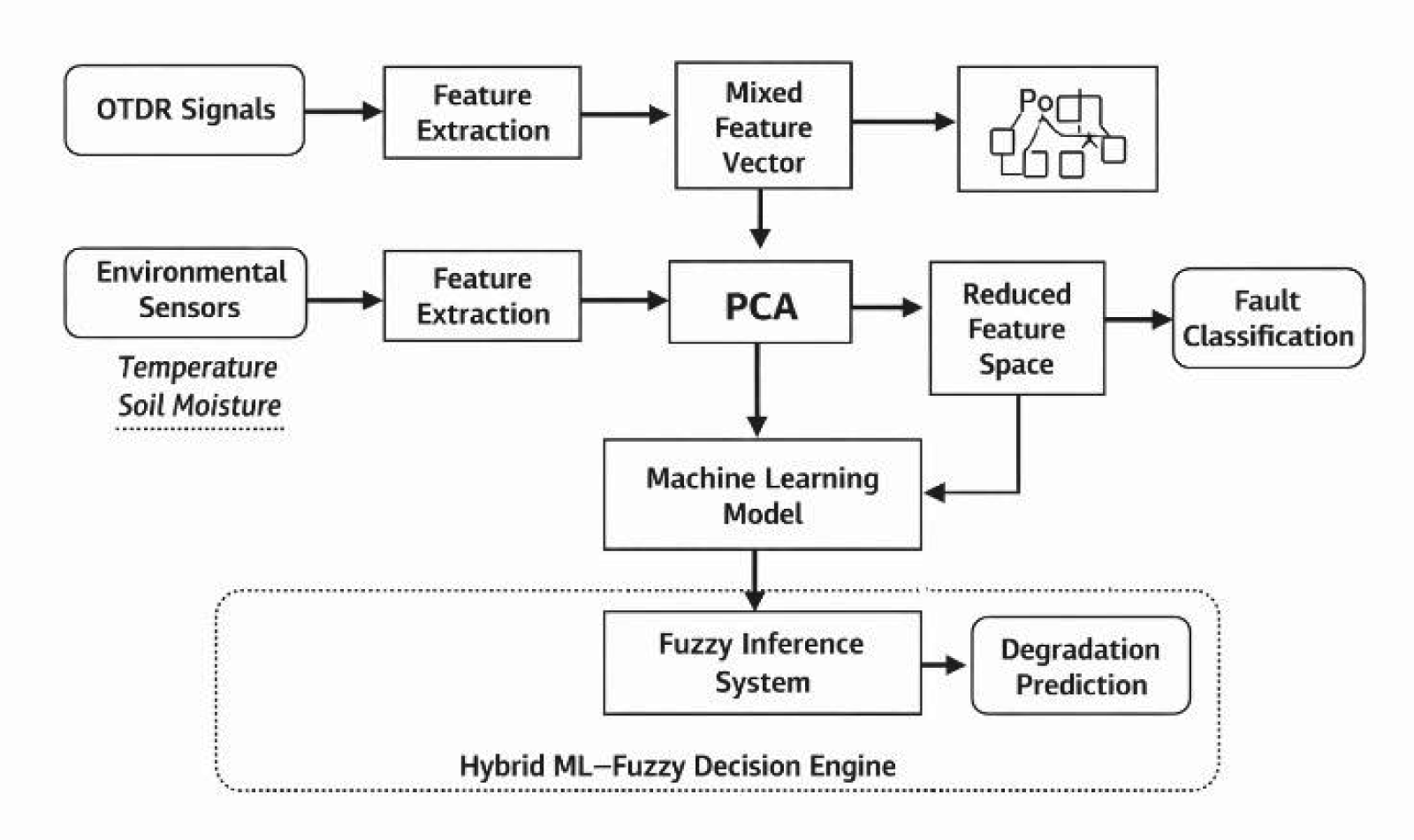
Structured mixed-trace fusion and hybrid ML–fuzzy decision pipeline.
Given a dataset of N synchronized samples:

The sample mean vector is computed as:

Where μ is the mean vector.
The covariance matrix of the mixed feature space is then defined as:

Eigenvalue decomposition of Σ yields eigenvectors forming the transformation matrix W. Each sample is projected into a decorrelated feature space using:

To preserve sufficient information while reducing redundancy, the reduced dimensionality k satisfies:

Where:

The variance retention behavior of the mixed feature space after eigenvalue decomposition is illustrated in Figure 2, where the cumulative explained variance reaches the predefined threshold (η = 0.95) within a reduced number of principal components.
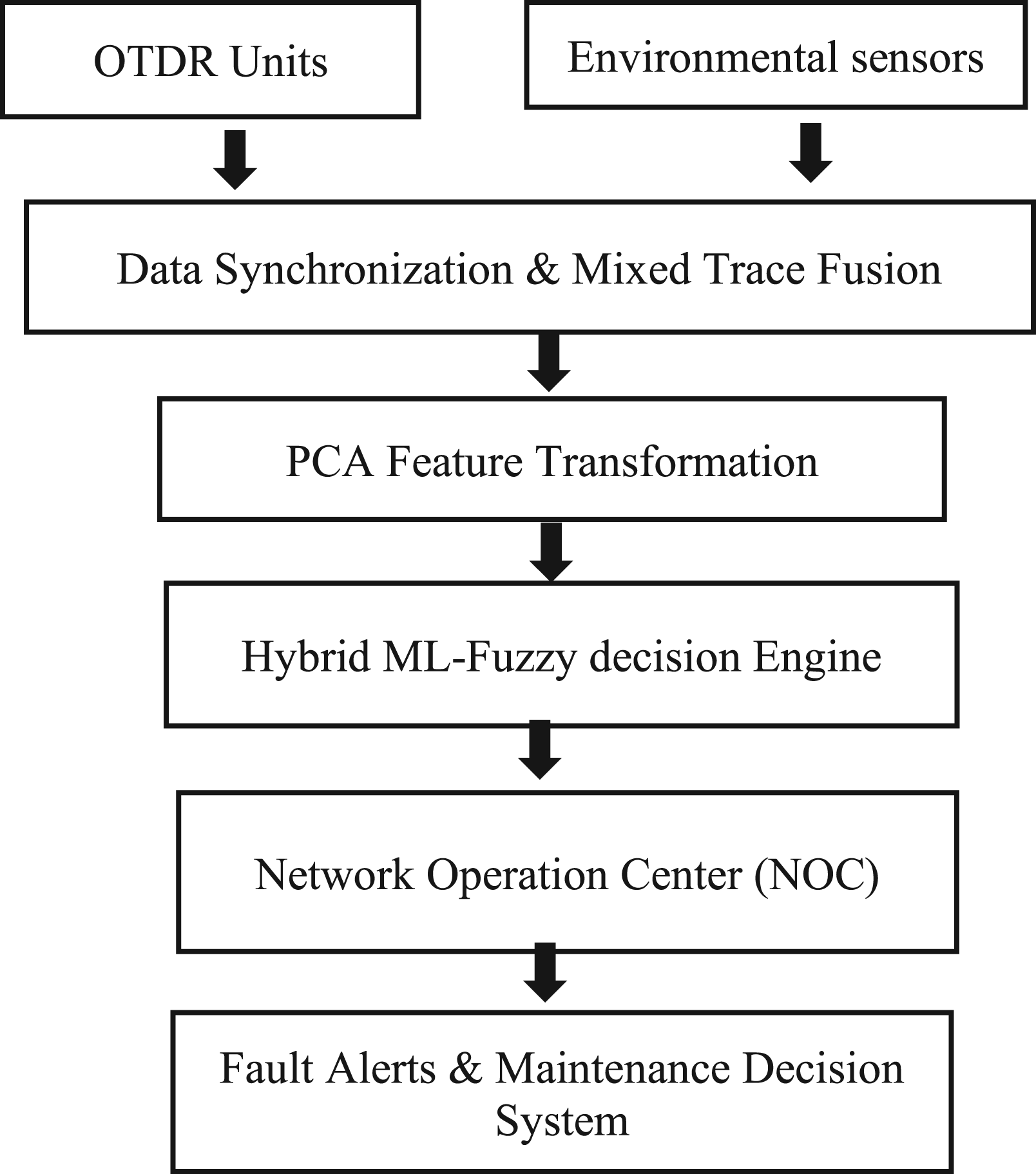
Schematic representation of the proposed system.
As shown in Figure 3 the cumulative variance exceeds 95% at the sixth principal component, confirming that the PCA transformation effectively reduces dimensionality while preserving the dominant degradation information embedded in the mixed optical–environmental feature space.
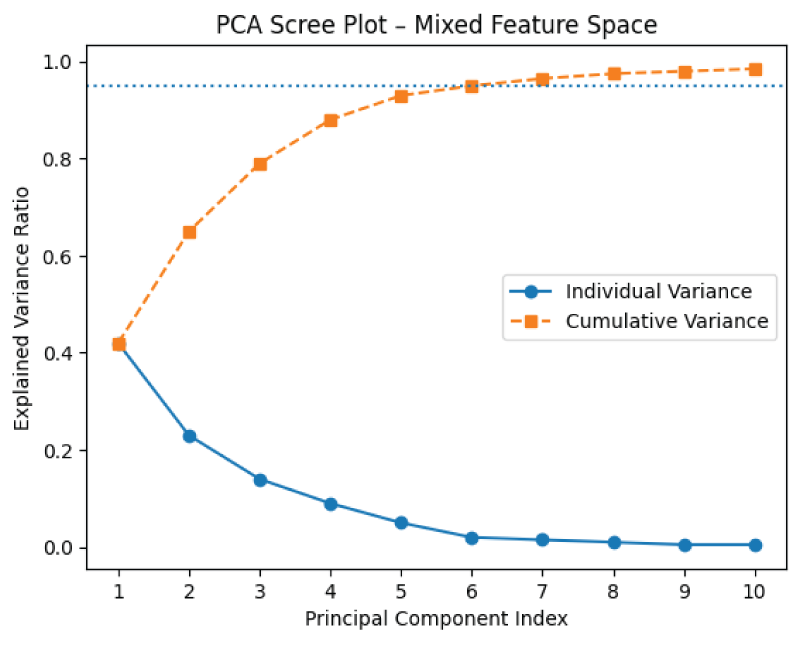
PCA scree plot and cumulative variance of the mixed feature space.
Ensuring that 95% of total variance is retained.
The labeled transformed dataset is therefore:

With:

Representing Normal, Degraded, and Faulty states.
Supervised classifiers are trained using the PCA-transformed features Zi. For multi-class classification, the cross-entropy loss function is defined as:

Where yic denotes the predicted probability for class c.
Model parameters are optimized through:

Using stratified k-fold cross-validation to ensure generalization and prevent overfitting.
Robustness is evaluated under controlled perturbations including Gaussian noise injection (±5%), missing environmental data simulation (10%), and temporal drift scenarios.
To explicitly model uncertainty and gradual degradation patterns, a Mamdani-type Fuzzy Inference System (FIS) is integrated as a decision calibration layer.
Let the fuzzy input vector be:

Where: f1: normalized attenuation deviation f2: frequency-domain energy variation f3: temperature fluctuation index f4: soil moisture deviation
Representing normalized attenuation deviation, spectral energy variation, temperature fluctuation index, and soil moisture deviation. The fuzzy rule base was constructed using a hybrid strategy that combines domain expert knowledge from fiber maintenance engineers with statistical clustering analysis of principal component distributions derived from the mixed feature space. This dual design approach ensures both physical interpretability and data-driven adaptability, enabling the fuzzy inference system to capture gradual degradation patterns under heterogeneous environmental conditions. Triangular membership functions were selected due to their computational simplicity, numerical stability, and suitability for real-time inference under large-scale monitoring conditions. Compared to Gaussian or trapezoidal alternatives, triangular functions demonstrated comparable classification performance while reducing computational overhead. Sensitivity analysis under ±5% parameter perturbation confirmed that minor variations in membership boundaries did not significantly affect the hybrid decision score, indicating robustness and stability of the fuzzy inference mechanism. The final rule base consisted of 12 fuzzy rules covering normal, degradation, and fault transition states.
For each fuzzy rule r, the firing strength is computed using the min-operator:

The aggregated output membership function is:

Defuzzification is performed via the centroid method:

In parallel with the fuzzy inference process, the machine learning model produces a probabilistic output P_ML(t), representing the likelihood of a fault condition based on the PCA-transformed feature space.
To formally integrate data-driven learning with uncertainty-aware reasoning, a hybrid decision formulation is defined as

Where α∈[0,1] controls the relative contribution of the machine learning prediction and the fuzzy inference output. The parameter α is empirically tuned using cross-validation to achieve an optimal balance between predictive confidence and uncertainty calibration. This formulation enables
The final decision is determined using calibrated thresholds


To validate the proposed hybrid machine learning and fuzzy monitoring framework described in Section 3, a real-world deployment was conducted on selected segments of Telecom Egypt's national fiber network. The purpose of this deployment was to ensure that the mathematical formulation, mixed-trace construction, PCA transformation, and hybrid decision model were implemented consistently under operational conditions.
The monitored regions included urban areas (Greater Cairo), rural agricultural zones (Upper Egypt), and desert environments (Western Desert). This geographical diversity allowed evaluation of the unified mixed-trace model under heterogeneous environmental stress conditions.
System Deployment Architecture
The deployed monitoring system consists of five integrated layers aligned with the methodology described in Section 3. The optical monitoring layer employs OTDR units installed at network access points, generating reflectometry traces every fifteen minutes from which attenuation slope, reflection magnitude, backscatter variation, and frequency-domain energy features are extracted. The environmental sensing layer includes distributed sensor nodes deployed along fiber routes at 250–500 m intervals, measuring temperature, soil moisture, and pressure every five minutes. A synchronization and fusion layer ensures temporal and spatial alignment using GPS timestamps, mapping each environmental sensor to its corresponding fiber segment. The synchronized mixed feature vector at time t is then constructed as:

Where O(t) represents optical features and E(t) represents environmental measurements. This directly implements the mixed-trace model defined in Section 3.1.
Fourth, the processing layer performs data preprocessing, including noise filtering, normalization, and interpolation of missing values. Principal Component Analysis is then applied as described in Section 3.2 to project the mixed feature vector into a reduced and decorrelated feature space.
Fifth, the hybrid machine learning and fuzzy decision layer computes the final monitoring score using the confidence-calibrated fusion formula:

Where P_ML(t) is the probabilistic output of the machine learning classifier and F_fuzzy(t) is the fuzzy risk index.
The computed decision score is transmitted to the Network Operations Center for visualization and alert generation.
The deployment phase lasted ten continuous weeks. A multi-resolution sampling strategy was adopted to capture both optical dynamics and environmental fluctuations.
OTDR traces were collected every fifteen minutes. Environmental sensor readings were collected every five minutes. Environmental values within each OTDR acquisition window were aggregated to ensure temporal alignment.
The synchronized dataset was organized as:

Where y_i represents one of three classes: Normal, Degraded, or Faulty. Labels were assigned based on field-validated maintenance records and confirmed fault events.
After synchronization, the covariance matrix of the mixed feature dataset was computed. Principal Component Analysis was applied using the transformation:

Where W contains eigenvectors corresponding to the largest eigenvalues and mu represents the mean vector.
The reduced feature space preserved 95 percent of total variance, ensuring minimal information loss while eliminating redundancy between optical and environmental descriptors.
This PCA-transformed representation served as the direct input to the supervised and unsupervised learning models evaluated in Section 5.
The hybrid decision score S(t) was computed with an average inference latency of approximately eighteen milliseconds per sample using standard CPU hardware.
Two calibrated thresholds were applied:
If S(t) is greater than tau_2, a high-risk fault alert is triggered.
If S(t) is between tau_1 and tau_2, a degradation warning is issued.
The Network Operations Center dashboard displays real-time OTDR traces, environmental indicators, hybrid risk scores, and predicted degradation trends.
Confirmed maintenance actions are logged and fed back into the dataset for periodic retraining and fuzzy rule adjustment, forming a closed-loop validation mechanism that strengthens predictive reliability.
Deployment Challenges and Robustness Measures
Several operational challenges were observed during field deployment, including extreme desert temperatures, high soil moisture levels in rural regions, and temporary connectivity interruptions.
To ensure robustness, the system incorporated:
Gaussian noise tolerance within plus or minus five percent amplitude variation.
Random environmental data removal simulation at ten percent.
Buffer-based stream synchronization.
Adaptive sensor recalibration routines.
These measures align with the robustness evaluation protocol described in Section 3.3.
Experimental Dataset Composition
A comprehensive dataset was collected during a continuous ten-week deployment across urban, rural, and desert regions to support training, validation, and real-world evaluation of the proposed hybrid ML–fuzzy framework. The dataset includes more than 50,000 OTDR traces recorded at fifteen-minute intervals and over 200,000 environmental measurements (temperature, soil moisture, and pressure) collected every five minutes. Environmental readings were temporally aggregated within each OTDR acquisition window to ensure synchronization and consistency with the mixed-trace formulation defined in (22). The resulting synchronized dataset integrates optical measurements, environmental data, maintenance logs, and service reports to enable predictive modeling and ground-truth validation.
The class distribution consisted of 58% normal samples, 27% degradation cases, and 15% confirmed fault events. Class imbalance was addressed using stratified cross-validation and class-weighted loss functions during training. Table 2 summarizes the data categories and their roles within the framework.
Experimental Dataset Composition and Usage.

Experimental Dataset Composition and Usage.
Table 2 presents the heterogeneous dataset used in the proposed framework, combining OTDR data, environmental measurements, maintenance logs, and customer service reports. This integration supports both physical fault detection and service impact analysis. The labeled mixed-trace dataset forms the foundation for machine learning training and prediction.
To ensure operational robustness, structured field testing was conducted across urban, rural, and desert environments. These tests were designed to validate the stability of the mixed-trace construction, PCA transformation, and hybrid ML–fuzzy decision mechanism under heterogeneous environmental stress conditions.
Both hardware and software components were iteratively calibrated based on deployment feedback. Sensor drift compensation, noise filtering parameters, and fuzzy membership boundaries were fine-tuned to optimize classification accuracy and decision stability. This calibration process ensured that the deployed system remained consistent with the mathematical robustness assumptions introduced in Section 3.3.
System Architecture and Block Diagram Representation
The overall architecture implements each stage of the hybrid framework: OTDR units, environmental sensors, data fusion, feature transformation, and hybrid ML–fuzzy decision engine. The NOC visualizes the final hybrid score for proactive maintenance decisions. A schematic representation is provided in Figure 1.
Figure 2 illustrates the system-level interaction between optical sensing, environmental monitoring, data fusion, feature transformation, and hybrid decision inference.
Experimental Results and Statistical Validation
Cross-Validation Metrics
To ensure statistical reliability, all experiments are conducted using stratified k-fold cross-validation (k = 5).
Performance metrics, including accuracy, precision, recall, and F1-score, are reported as mean ± standard deviation across folds, reflecting the consistency of the hybrid ML–Fuzzy framework.
Paired t-Test Significance
To verify the statistical significance of improvements offered by the proposed hybrid framework over baseline OTDR-only methods, paired t-tests were conducted for each metric.
Results demonstrate that the hybrid ML–Fuzzy model significantly outperforms conventional approaches (p < 0.05), confirming the effectiveness of integrating environmental features and fuzzy reasoning.
Robustness Evaluation
Robustness under noisy conditions and partial data loss is evaluated by introducing Gaussian noise (±5%) and simulating 10% missing environmental sensor data.
The hybrid framework maintains stable predictive performance, demonstrating resilience to real-world operational uncertainties.
Results and Performance Evaluation
This section presents a rigorous evaluation of the proposed hybrid ML–fuzzy monitoring framework using real-world deployment data. All reported results are derived from the mathematical formulation introduced in Section 3, where synchronized mixed-trace features are transformed via PCA and optimized using the cross-entropy loss function. Final class decisions are generated through the hybrid confidence-calibrated score defined in Section 3.4.
Classification Performnce and Statistical Validation
Classification performance was evaluated using the PCA-transformed mixed feature space described in Section 3.2. The reduced feature vector, preserving 95% of total variance (η = 0.95), was used as input to supervised classifiers optimized via the cross-entropy loss function.
All models were assessed using stratified 5-fold cross-validation. Reported metrics represent mean ± standard deviation across folds.
To verify statistical significance, paired t-tests were conducted across folds comparing the hybrid model against an OTDR-only baseline (i.e., excluding environmental features). The hybrid Random Forest model demonstrated statistically significant improvement (p < 0.01) in both accuracy and F1-score. Table 3 demonstrates that the PCA-based mixed feature representation significantly improves classification performance across all evaluated models. The Random Forest classifier achieved the highest accuracy and F1-score with low variance across folds, indicating strong stability and generalization capability. Statistical testing confirms that incorporating environmental features within the mixed-trace representation significantly enhances classification robustness and generalization performance. These results confirm that the mathematically defined mixed trace representation (Section 3.1) and PCA decorrelation enhance class separability under heterogeneous environmental conditions.
Cross-Validated Classification Performance (Mean ± Std).

Cross-Validated Classification Performance (Mean ± Std).
Predictive capability was evaluated by aligning the temporal evolution of the hybrid decision score S(t), defined in Section 3.4, with verified fault events over a 10-day operational window. A valid early warning was defined as a sustained increase in the hybrid risk score exceeding calibrated thresholds (τ1, τ2) within 72 h prior to confirmed failure. Time-series analysis demonstrated that gradual degradation patterns became distinguishable within the PCA-transformed feature space, enabling the hybrid score to anticipate failures 48–72 h in advance in the majority of validated cases. This anticipatory behavior emerges from the coupled representation of optical attenuation dynamics and environmental stress indicators, which together provide earlier degradation separability than optical traces alone. The temporal evolution of the hybrid confidence-calibrated score compared to the OTDR-only detection baseline is illustrated in Figure 4.
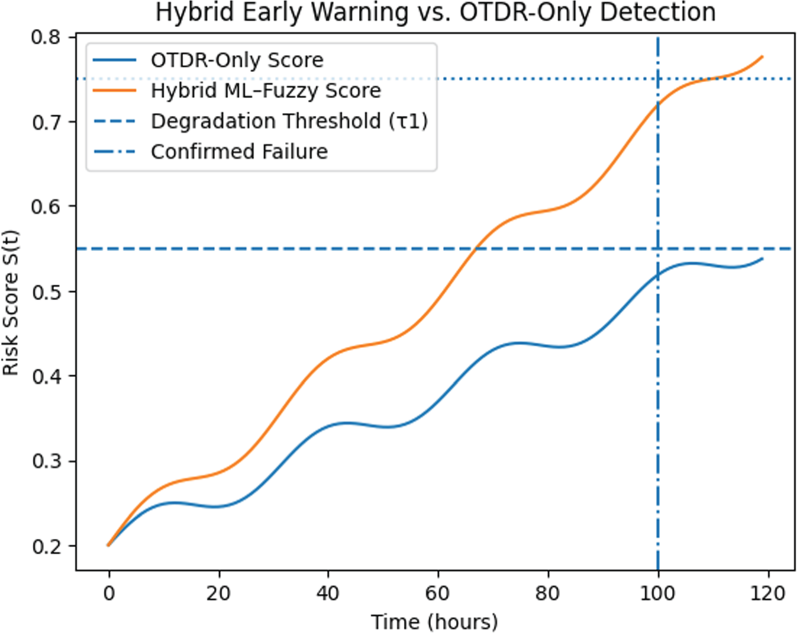
Hybrid ML–fuzzy early warning score compared to OTDR-only detection prior to confirmed fiber failure.
As shown in Figure 4 the hybrid ML–fuzzy score exceeds the degradation threshold (τ1) significantly earlier than the OTDR-only score, providing a predictive anticipation window of approximately 48–72 h prior to confirmed failure. This early separability arises from the integration of environmental stress indicators within the mixed-trace feature space.
Correlation analysis was conducted between environmental variables and selected principal components contributing most strongly to degradation classification. In desert regions, temperature fluctuations showed positive correlation with attenuation-related principal components (r = 0.62), while rural soil moisture levels correlated with reflection irregularity components (r = 0.54). These findings validate the joint modeling assumption introduced in Section 3.1, where environmental and optical descriptors are fused into a unified mixed feature vector. The results demonstrate that environmental stressors act as latent degradation accelerators detectable through mixed-domain feature interaction.
Hybrid Decision Stability and Comparative Performance
A structured comparative analysis was conducted between the proposed hybrid monitoring framework and conventional OTDR-only monitoring under identical operational conditions. The evaluation focused on key operational metrics, including detection latency, localization precision, maintenance response, unplanned outage frequency, and unnecessary site visits.
Table 4 presents the comparative performance outcomes with associated statistical deviations and quantified improvements.
Comparative Operational Performance.

Comparative Operational Performance.
The observed reductions in 
Where:
Introduced in Section 3.4. The fuzzy inference layer acts as a confidence stabilizer, mitigating the impact of transient environmental perturbations and recalibrating borderline probabilistic outputs through risk indices. These mechanisms collectively enhance decision robustness, reduce false alarms, and maintain temporal stability of predictions under heterogeneous environmental conditions. The hybrid approach demonstrates not only significant operational gains but also measurable reductions in unplanned outages and unnecessary field interventions, providing a strong validation of the mixed trace representation and the integrated ML–fuzzy decision process. Overall, the results confirm that the integration of probabilistic optimization with uncertainty-aware fuzzy calibration substantially improves predictive reliability, operational stability, and actionable decision-making for large-scale fiber network monitoring.
Beyond predictive accuracy, the proposed framework demonstrated measurable system-level improvements. Structured early warnings enabled proactive scheduling and reduced reactive dispatch variability. From a computational standpoint, the complexity components described in Section 3.2 were validated in deployment. Average inference latency was approximately 18 ms per sample on standard CPU hardware, confirming feasibility for near-real-time monitoring in large-scale fiber infrastructures. While operational observations indicate improved resource utilization and service continuity, a detailed techno-economic impact assessment requires a dedicated financial modeling framework and is beyond the scope of this study. Therefore, reported operational gains should be interpreted as system-level performance indicators rather than formally validated economic outcomes. Overall, the integration of probabilistic optimization with uncertainty-aware fuzzy calibration significantly enhances predictive robustness, temporal stability, and deployment scalability in heterogeneous telecom environments.
To further evaluate the classification performance, a confusion matrix was generated for the hybrid model, illustrating the prediction accuracy across all classes.
As shown in Figure 5 the hybrid classifier achieves high accuracy across all categories, with minimal misclassifications between degradation and fault states, confirming the effectiveness of the PCA-transformed mixed feature space and fuzzy decision module.
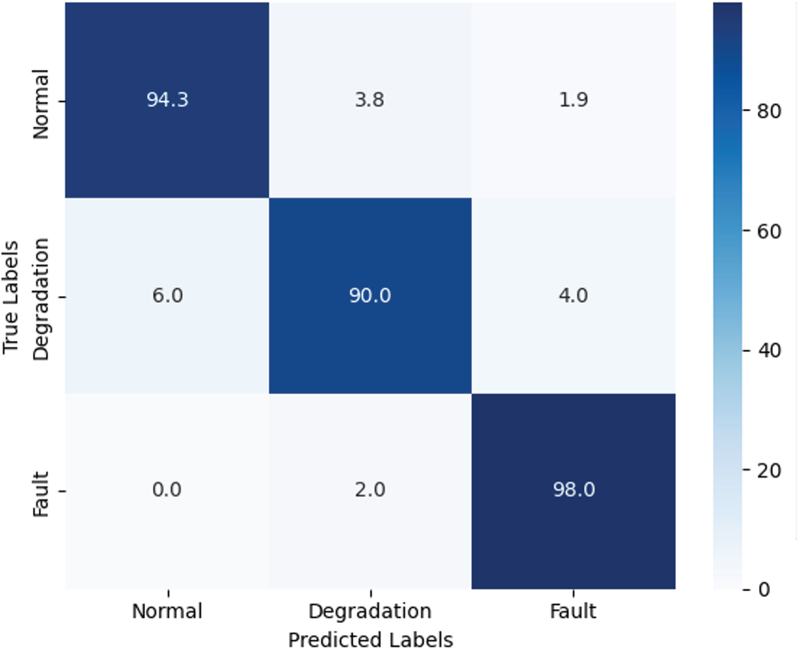
Confusion matrix of the hybrid classifier showing classification performance across normal, degradation, and fault states (values in %).
The comprehensive evaluation presented in this section confirms the effectiveness of the proposed hybrid ML–fuzzy monitoring framework under real-world deployment conditions. Cross-validated classification results demonstrate statistically significant improvements over OTDR-only baselines, validating the contribution of mixed-trace feature fusion and PCA-based decorrelation in enhancing class separability.
Temporal analysis further confirms the system's capability to anticipate degradation events prior to confirmed failures, highlighting the predictive value of integrating environmental stress indicators with optical signal dynamics. The hybrid confidence-calibrated decision mechanism improves stability in borderline cases and mitigates false alarms under transient environmental perturbations.
Operational performance metrics indicate substantial reductions in detection latency and maintenance response time, alongside improved localization accuracy and reduced unnecessary field interventions. Additionally, measured inference latency confirms the computational feasibility of near-real-time deployment.
Collectively, these findings demonstrate that uncertainty-aware integration of probabilistic learning and fuzzy reasoning enhances predictive reliability, temporal stability, and operational robustness in heterogeneous fiber network environments.
Discussion
The findings of this study demonstrate the substantial benefits of mixed-trace analysis enhanced with fuzzy reasoning for fiber optic network monitoring. By integrating Optical Time Domain Reflectometer (OTDR) data with real-time environmental sensor inputs and a fuzzy inference layer, the proposed system provides a comprehensive and resilient assessment of fiber health (Turitsyn et al., Dec. 2013), (Bao et al. Jun. 2011; Liu et al., Jul. 2025). This integrated approach is particularly impactful for Egypt's telecommunications infrastructure, where heterogeneous environmental conditions—such as extreme temperatures and variable soil moisture—introduce uncertainty that directly affects fiber degradation (Chen et al., May 2022; Turitsyn et al., Dec. 2013; Qian et al., 2022).
The incorporation of machine learning models augmented with fuzzy logic significantly improves predictive capabilities (Gorski et al. May 2022; Li et al., Apr. 2022; Vafaei et al., Feb. 2019; Zhou et al., Mar. 2024; Zhou et al., Mar. 2024). Supervised learning techniques accurately classify fiber conditions, while unsupervised methods, including clustering and anomaly detection guided by fuzzy reasoning, uncover subtle fault patterns that may be overlooked by conventional OTDR analysis (Chen et al., May 2022; Li et al., Apr. 2022; Naidu et al., 2024; Naidu and Ehrle, 2023).
The
Despite these promising results, several limitations remain. Variability in sensor calibration and occasional data inconsistencies can affect model performance, highlighting the need for ongoing refinement. To enhance generalizability and robustness, additional field trials in diverse regions of Egypt are recommended (Chen et al., May 2022).
Overall, the study confirms that a
Conclusion
This study proposed a
Experimental deployment results confirmed the framework's effectiveness. The proposed hybrid monitoring system reduced average fault detection time by approximately 85%, decreasing detection latency from 10 ± 2 h to 1.5 ± 0.5 h. Localization accuracy improved by nearly 30%, increasing from 72 ± 5% to 94 ± 3%. Maintenance response time was reduced by 61%, while unplanned outage frequency decreased by approximately 73%. Furthermore, unnecessary site visits were reduced by nearly 37%, reflecting improved decision stability and operational efficiency. These improvements are consistent with recent advances in intelligent OTDR analytics and hybrid AI-based condition monitoring frameworks reported in (Gorski et al. May 2022; Li et al., Apr. 2022; Vafaei et al., Feb. 2019; Yin et al., Mar. 2020; Zhou et al., Mar. 2024).
Overall, this study highlights the value of
Table 5 summarizes the quantified operational improvements achieved by the proposed hybrid framework compared to conventional OTDR monitoring. The reported reductions in detection latency, maintenance response time, outage frequency, and unnecessary field visits, alongside improved localization accuracy, confirm the robustness and predictive stability of the hybrid ML–fuzzy integration strategy.
Summary of Key Performance Improvements Using Hybrid ML–Fuzzy Framework.

All reported values are derived from the 10-week real-world deployment presented in Section 5.4. Improvement percentages are calculated directly from the comparative operational metrics summarized in Table 5. The hybrid ML–fuzzy integration mechanism, reinforced by mathematically defined mixed-trace fusion and PCA-based feature decorrelation, constitutes the principal driver of the observed predictive gains and operational stability.
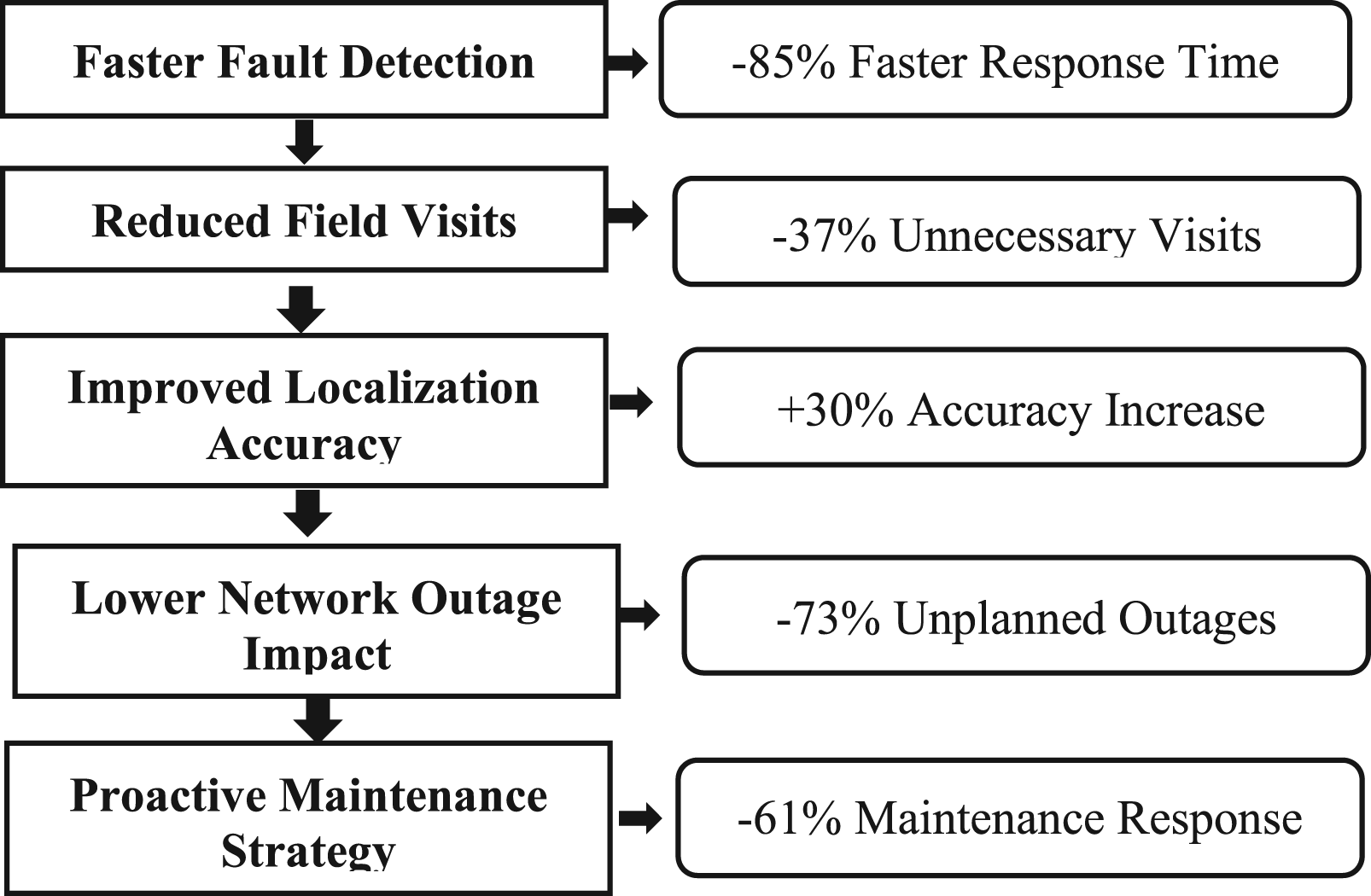
Key performance improvements achieved using the hybrid ML–Fuzzy fiber monitoring system
Figure 5 Key performance gains of the hybrid ML–Fuzzy fiber monitoring system, showing faster fault detection, fewer field visits, improved accuracy, and optimized maintenance.
Footnotes

Funding
The authors received no financial support for the research, authorship, and/or publication of this article.
Declaration of Conflicting Interests
The authors declared no potential conflicts of interest with respect to the research, authorship, and/or publication of this article.