




Abstract
In this research, the academic impacts of the 2022 Kyrgyz–Tajik ethnic conflict were examined through the perspective of teachers who were victims of the conflict. Utilizing the qualitative research method of a case study, an unstructured interview technique was employed. The study group of the research consisted of teachers from two schools in Aksai town located in Batken City in the South of Kyrgyzstan, where the conflicts are most intense. The researchers resided in the village for 2 weeks, endeavoring to comprehend the situation faced by the research participants. The research explored the effects of conflict in three phases: initial conflict effects, short-term post-conflict effects, and long-term post-conflict effects. Psychological effects were the most commonly expressed issue within the academic impacts at the onset of the conflict. During the conflict, the most frequently discussed academic impact was related to problems in distance education. It was determined that among the academic effects after the conflict, psychological impacts were once again the most commonly discussed issue. The initial effects of the conflict are characterized by fear and anxiety experienced by both themselves and their students; the short-term academic effects of the conflict are characterized by technological inadequacies as well as a lack of engagement or focus in students’ work; and the long-term effects of the conflict are characterized by an inability to focus on lessons, anxiety disorders, and mood disorders.
Introduction
While cultural elements generally play a unifying role among members of the same culture, they can also occasionally lead to discord. Groups sharing the same culture and ideology unite, while societies feeling different from each other culturally may disintegrate. Therefore, the foundation of relations between states involves both common interests and cultural backgrounds (Omelaenko, 2020, 24). Huntington (2017, 51) suggests that the most dangerous conflicts occur not between social classes or the rich and poor but among individuals with different cultural identities. Conflicts may vary based on a country’s level of development or its level of democratic attitudes. In countries with a developed democratic approach, inter-ethnic conflicts do not completely disappear, but there is a significant reduction in the level of violence.
Social or political inequalities often form the basis of inter-ethnic conflicts. This is often rooted in social or political inequalities. The most violent form of inter-ethnic conflict involves one group arming itself and engaging in violent conflict, killing others (Hashmi, 2015). Violent ethnic conflicts are generally less frequent in countries where pluralistic democracies are strong and there is organizational freedom. In these developed countries, disputes may arise regarding the language to be used in schools and employment, permission for the entry of immigrant ethnic groups into the country, whether different groups should be subject to a single civil law regarding marriage, divorce, and inheritance, or the necessity for multiple civil laws derived from different religious or traditional laws and whether some groups should receive positive discrimination advantages.
Conflicts have caused considerable devastation in developing countries as they began to decolonize themselves after 1945 and have consistently accounted for the majority of wars. Especially after the break-up of the Soviet Union (1991) and Yugoslavia (2002), numerous violent ethnic and conflicts have emerged. For example, the conflicts between Croatia, Serbia, and Slovenia, as well as the ethnic conflicts within Bosnia, took place visibly before the eyes of the whole world and television (Sadowski, 1998, 17). Ethnic conflicts in Azerbaijan, Chechnya, Georgia, and Tajikistan have also caused significant destruction. Simultaneously with the collapse of communism in Eastern Europe and the Soviet Union, conflicts arose in many countries as dozens of ethnic groups struggled to become independent states or due to irredentism, leading to numerous conflicts in the region (VanEvera, 1994, 21).
Conflicts between ethnicities affect all layers of social life and, in particular, bring academic life almost to a standstill. The closure of schools, which are the cornerstone of a holistic, sustainable intervention providing resources for the protection and development of all children, and the cessation of education, are unacceptable circumstances (Marakis et al., 2019, 31). Education is one of the cornerstones of human development and progress (Vespoor, 2008, 316). Smitha (2014, 119) emphasizes that conflicts, including inadequate funding, poverty, increased child labor, cultural factors, and the presence of armed and ethnic conflicts in countries, are factors that inhibit children’s access to school. Conflicts endanger the security of families and children, causing them to transition from safe school environments to dangerous conflict situations. Education, which creates a safe space, is a protector of children’s lives (INEE, 2004).
This research aims to examine the academic implications of inter-ethnic conflicts through the case of the current Kyrgyz–Tajik ethnic conflict. Moreover, the study is based on the claim that most conflicts, such as the conflict between the Kyrgyz and Tajik ethnicities, are ethnic conflicts. Although some researchers (Collier, 2004, 564; Patel, 2012, 7; Toktomushev, 2018, 23) argue that ethnic conflicts are not a specific type of conflict, Banton (2000, 482) argues that such conflicts are ethnic conflicts that are driven by a particular type of motivation based on ethnic cleavages. Ethnic diversity in Central Asia is also a major topic of debate. In particular, Kyrgyzstan’s tensions with its border neighbors and the fear of being invaded by them exacerbate ethnic problems (Weyerman, 2005, 27). Although the recent conflicts between the Kyrgyz and the Tajiks may seem like land and water disputes, the fact that the two ethnic groups have great cultural and linguistic differences from each other suggests that this conflict has an ethnic dimension. Because the Uzbeks, the other ethnicity with which the Kyrgyz have problems, have common values with the Kyrgyz in terms of history, culture, and language, even though they are a different country. The Tajiks, on the other hand, differ from the Kyrgyz in terms of language, being close to Persian and having a different culture (Weyerman, 2005). In addition, the authors of this study observed in their interviews with Kyrgyz teachers that the motivation for the conflict, although it may seem like water and borders, is actually based on ethnic elements. Especially the fact that Tajiks living within the borders of Kyrgyzstan participated in this conflict despite the fact that they do not have water and border problems gives a strong idea that the motivation of the conflict is ethnic.
In this context, the statements and inferences that will be presented based on teachers’ perspectives on academic life will form the basis for an assessment of academic life in the conflict between Kyrgyz–Tajik ethnicities. The theoretical literature related to the academic impacts of conflict will first be reviewed in this study, followed by an exploration of the Kyrgyz–Tajik conflict. Subsequently, the academic impacts of the Kyrgyz–Tajik conflict based on teacher interviews will be presented. Conflicts addressed in this study will be examined separately from nationalism or civil wars. Therefore, arguments related to national culture and civil wars will be discussed only in terms of providing an analytical perspective on conflict literature.
Theoretical Background
Inter-ethnic Conflicts in Kyrgyzstan
Inter-ethnic conflicts are a significantly crucial issue for Kyrgyzstan, a state comprising a multicultural structure that hosts representatives from over 90 different ethnicities/clans. The majority of the population of Kyrgyzstan is made up of Kyrgyz, Uzbeks, and Russians (Alisheva et al., 2007, 6). According to the data of the National Statistical Institute for 2022, these ethnic groups are Kyrgyz 74%, Uzbek 15%, and Russian 5% (NACSTAT, 2022). With the independence of Kyrgyzstan from the Soviet Union, this cosmopolitan structure has led to the emergence of some inter-ethnic conflicts.
Kyrgyzstan’s history of inter-ethnic conflicts, particularly starting from its independence up until 2010, witnessed various conflicts that prompted the state to review its policies concerning relations among ethnic groups, particularly the Kyrgyz–Uzbek conflicts (Ibraimova, 2012). Toktomushev (2018, 25) emphasizes that these conflicts are more about border demarcation and security than inter-ethnic tensions within Kyrgyzstan’s multi-ethnic population. According to Zanca (2007), these conflicts, which first erupted in 1990, were rooted in territorial disputes and resulted in hundreds of casualties. In 2010, inter-ethnic conflicts between Kyrgyz and Uzbeks resurfaced, leading to approximately 2000 fatalities (Abashin & Savin, 2012, 29). Subsequently, conflicts occurred between local Turks and Kyrgyz in the capital, Bishkek, during the same year. A study conducted by Omuraliev et al. (2012, 40) determined that the causes of these inter-ethnic conflicts were political, socio-economic, legal, and cultural.
This region within the Fergana Valley is inhabited by dense populations of Kyrgyz, Uzbeks, and Tajiks, occupying fertile lands. In these lands where these ethnic groups coexist, not only are cemeteries, pastures, and markets shared, but it is also an area where ethnic and political boundaries are weak (Reeves, 2005, 73). Hence, following the dissolution of the Soviet Union, this region has been designated as an intervention area, offering the potential for the international community to enter the region to reduce conflict potential and strengthen peace (Bichsel, 2009; Heathershaw, 2010, 134).
The most recent inter-ethnic conflict in this region is the conflict between Tajiks and Kyrgyz over border disputes. The most important reasons for this conflict include unresolved issues inherited from the Soviet past, inefficient use of natural resources, militarization of border regions, and rational-based policies (Toktomushev, 2018, 41). The creation of the border between Kyrgyzstan and Tajikistan was first discussed in 1924 during the Soviet era. During this period, disputes emerged in Central Asia with the process of national-territorial border formation. The border disputes between the Kyrgyz and Tajiks first started in the Soviet period in 1974 and took place in 1982, 1989 between the residents of the villages around the Vorukh River. During the Soviet period, Kyrgyz and Tajik people living in these areas shared water and pastures, but with the collapse of the Soviet Union and the establishment of nation states, serious problems began to arise. In 2002, negotiations were held in Bishkek and in 2003 in Dushanbe with the participation of representatives of both countries, but no agreement was reached. The Kyrgyz side suggested that the decision should be made according to the 1955–1959 documents, while the Tajik side insisted on the 1924–1927 map (Ulukbek Uulu & Abdyldaev, 2022). According to Mamytov (2022), the conflicts between Kyrgyzstan and Tajikistan can be divided into three stages. The first one is the border dispute in the Chon Alay settlement in the Osh Region between 2002 and 2010. This dispute disappeared with the clarification of the borders. The second phase was the pasture sharing dispute between 2012 and 2020, when both sides insisted on their own documents, no agreement was reached and conflicts occurred. The third and final phase was the conflict around the Vorukh River, which started in 2020 and continues to this day, with the use of heavy weapons.
After Tajikistan gained its independence, although it is a Muslim people, the fact that it is different from the Turkic peoples in this region has been effective in having problems with its neighbors. In particular, the fact that it has a Farsi language has caused it to be separated from the Turkic-speaking peoples in this region. In addition, when disagreements with Uzbekistan, for example, over trade routes were added to these disagreements, problems became inevitable. Disputes over the use of water resources in the region have also triggered these problems (Niyatbekov & Dodikhudoev, 2007, 89). Tajikistan’s need for water has a negative impact on its relations with neighbors such as Uzbekistan and Kyrgyzstan. The fact that the borders drawn between these countries are located on water resources creates the problem of not sharing water rather than sharing land (Toshmuhammadov, 2004).
Academic Life in Batken Before the Kyrgyz–Tajik Conflict
Education reforms have been continuously carried out in post-independence Kyrgyzstan. Important changes regarding the needs of schools were made in 2007–2008. At that time, steps were taken to solve the problems such as lack of buildings, teaching materials and teachers in Batken schools, where approximately 100 thousand students’ study (Esenkulov, 2008, 172). However, inadequate teacher salaries caused Kyrgyz teachers to turn to other professions. Later, the increase in teacher salaries in 2011 and 2015 made this profession one of the most popular professions in Kyrgyzstan (Toktonazarova, 2017). To meet the need for teachers in schools in Batken city, salaries were continuously increased and retired teachers were re-hired (Bulan Institute, 2018, 10). School buildings have also been upgraded and new buildings have been constructed. In 2018, the proportion of only secondary school graduates in Batken reached 96% (UNICEF, 2018, 10). By 2020, although the number of teachers was still insufficient (Public Foundation KG Analytics, 2022), the Kyrgyz government increased the education budget and raised teachers’ salaries, bringing Batken city up to national standards in terms of educational opportunities. With the outbreak of the Kyrgyz–Tajik conflict, education in the city came to a standstill. On May 2, 2021 alone, more than 100 buildings in Batken city were burned down, including two schools (Omuraliev, 2022, 43). Problems in academic life have taken an important place among the problems caused by the conflict.
Method
Model
This study has been designed based on the premise that reality cannot be independent of the human mind and that an individual’s position in this world is not that of a mere observer but an influencer. It adopts a qualitative approach, representing the interpretative tradition, wherein the views, thoughts, and emotions of participants are taken into account, emphasizing the formation of reality in this manner (Creswell, 2003; Patton, 2002). The research aims to investigate the academic life during the Kyrgyz–Tajik inter-ethnic conflicts in Batken Region of Kyrgyzstan in September 2022. As the research covers a specific time frame and a particular issue, the instrumental case study design from the qualitative research patterns has been preferred. The choice of an instrumental case study is due to its ability to provide insights into a subject or redraw a generalization. Additionally, an instrumental case study is a useful research type for deepening the understanding of a significant issue (Stake, 2003, 137).
Positionality Statement
The researchers are experienced in ethnographic and qualitative research. One of the researchers belongs to the Kyrgyz ethnicity, while the other researcher who led the data collection and analysis processes has a different ethnic identity. Both authors contributed to the interpretation of the findings and implications of the study. However, our ethno-racial backgrounds are likely to influence our interpretation of the data. To avoid speaking for the data, both authors have tried to bracket any existing biases or assumptions. Before presenting the findings, the researchers acknowledged their perspectives as experienced researchers in a spirit of self-reflection. They met the participants of this study for the first time. Before the interviews, the researchers spent a week in Aksai, a town in Kyrgyzstan bordering Tajikistan, to observe the effects of the conflict. They observed the fears and anxieties of the people in the region, especially in schools.
Study Group
Kyrgyzstan is a multicultural country divided into seven regions. The place where inter-ethnic conflicts occur is the Batken region of Kyrgyzstan and Sughd region of Tajikstan. In this region where Kyrgyz and Tajik people live together, conflicts arise due to land and border disputes. In 2022, intense conflicts occurred between the two ethnic groups, bringing social life to a standstill. At least 100 people lost their lives in the conflict, and 140,000 people were evacuated (Azattyk, 2022). It was decided to conduct this research in the Batken region, where inter-ethnic conflicts occurred. The area where the conflicts occurred is the vicinity of Vorukh, located on the Kyrgyzstan–Tajikistan border, where approximately 35,000 Tajiks reside, and it is the second-largest settlement in the region. This location is shown in Figure 1. Vorukh Region Between Kyrgyzstan and Tajikistan, Where Conflicts are Taking Place.
Profile of the Participants.

Data Collection and Analysis
Within the scope of this study, the researchers directly reached the teachers in the settlement where the data would be collected and conducted interviews. The reason for selecting interviews as the data collection technique is the significant utility of this method in accessing people’s internal perceptions, attitudes, and feelings (Zhang & Wildemuth, 2009, 44). Within the realm of interview types, the unstructured interview technique was chosen. This choice was made because this method is a way of understanding complex behaviors without imposing any a priori classification that might limit the research area (Punch, 1998, 92). Therefore, the aim was to obtain opinions and thoughts from teachers about how they provided education during the inter-ethnic conflict, whether they engaged in any teaching activities with children, and whether they distanced themselves from academic life. According to Patton (2002, 110), unstructured interviews are an extension of participant observation. Despite occasional pauses in data collection, Kyrgyz and Tajik ethnic clashes continued with minor incidents. Within these conflicts, the education and training process was examined from the perspective of teachers. It was decided that the best approach would be through unstructured interviews. During this process, the researchers visited the villages closest to the conflicts and stayed among the conflict-affected people for a certain period. The reason for this was to understand the psychology of the community they were embedded in to better comprehend the teachers’ viewpoints.
In the analysis of the data, MAXQDA 22 qualitative analysis software was utilized. The process of coding and categorizing the data employed the thematic analysis technique. Thematic analysis is a method that systematically defines, organizes, codes, and provides insights into patterns of meaning (themes) within a dataset. This approach allows for the interrogation of hidden meanings, assumptions, and ideas in the data (Braun & Clarke, 2006). By this technique, the data in the study were thoroughly familiarized by the authors through multiple readings, and codes and themes were established and reported.
Validity, Reliability, and Ethical Statement
Regarding the validity and reliability of the study, the inter-coder reliability is considered. Inter-coder reliability is a measure of how much agreement there is between researchers when coding the same data set. In other words, inter-coder reliability serves to interpret a code reliably over time (Richards, 2009). Therefore, the researchers will independently code the data, and the results will be compared. Krippendorff (2004, 419) recommends having at least three researchers to reduce the bias of the coder. Described as the researcher triangulation technique, this method ensures the validation of findings while also adding breadth to the phenomenon of interest by incorporating diverse perspectives (Denzin, 1978, 211). Therefore, all three authors of the study participated in the coding process.
Findings
The time since the beginning of the inter-ethnic conflicts has been examined in three academic stages. The first period covers 1 month in 2022, starting from September 14, when the conflict started. The second period covers 1 month after the end of the conflict, when distance education started on October 13th and lasted until the end of the 2022–2023 academic year. Finally, the third stage encompasses the 2023–2024 academic year post-conflict, including the new teachers and students. These three stages encompass three different periods in time and indicate distinct events and processes. These stages are presented in Figure 2 as the effects at the beginning of the conflict, short-term effect after the conflict and short-term effect after the conflict, respectively. Hierarchical Code-Subcode Model of Inter-Ethnic Conflicts and Academic Life.
Effects at the Beginning of Conflict
The commencement of conflict resulted in an abrupt cessation of the educational process. Participants’ experiences during this period were observed to be significantly emotionally affected. Emphasizing that there was chaos and that they were psychologically affected, Nursultan said that she was looking for a place to go with her family and grandchildren, thinking about how to feed so many people, so she could not think about teaching.
The sudden outbreak of armed clashes caused great panic in the school and teachers and students looked for a place to escape. Kubanich emphasized that everyone ran to one side in panic, families were looking for their children and that children were the most affected in this environment. It was observed that teachers who experienced this panic environment were angry towards those responsible for the conflict. Teachers stated that both Kyrgyz and Tajiks blamed those who created these conflicts and that this hatred should end as soon as possible. Proshanov (2007), while explaining the causes of the conflict, points out that as a result of unlawful behavior, anger arises on both sides and this causes the conflict. It was observed that Kyrgyz teachers blamed the opposing ethnic group for the conflicts and were angry with them. The effects that occur on society during this process are presented in figure 3. Hierarchical Code-Subcode Model of Academic Life at the Beginning of Conflict.
The effects at the beginning of the conflict are characterized by panic and fear. When describing the effects of the conflict, the participants emphasized the panic in students and parents the most. In addition to teachers who were highly psychologically affected, panic also set in among children. Parents had difficulty finding their children and taking them out of school. It is clear from the participants’ accounts that children were the most affected group in this conflict. Undoubtedly, children will carry the chaos and panic they experienced and witnessed at the outbreak of the conflict for a long time. Elbedour et al. (1993) describe children caught up in the conflict experience as a collateral damage population.
In this process, teachers not only saved their own lives but also took on the task of rescuing their students and returning them to their families. In this environment of armed conflict, teachers have memories that they cannot forget and that have turned into trauma for them. Nurbek, who stated that he was traumatized, described the situation that was the most severe for him as follows: “When bombs were being dropped during the conflict, students started to flee, but some couldn’t walk as their legs were affected. One incident that I’ll never forget: Just when the fighting started, I rushed outside and saw a little student who was trying to pick up their bag but was unable to move. I immediately picked up the child and put them in my car. I managed to fit 15 students into my small car. Then I realized that my daughters were still at school, and my wife, who is also a teacher, was there. I immediately turned back. Amidst the bullets, I rescued my children.”
Referring to the severity of the panic environment, the participants stated that people did not know what to do. Explaining that everyone was trying to save their own lives, Nurayim stated that he was very scared and set out to escape, but cars did not pick him up even if he was an acquaintance.
As can be seen from Figure 4, it was determined that there were effects on public education and training in the form of psychological and teacher support at the beginning of the conflict. During the interview process, it was observed that teachers had not yet recovered from the fear of the conflict. Furthermore, some teachers’ homes suffered damages during the events, affecting them materially. Islam mentioned that his home was bombed, leaving it in ruins. He also highlighted the lasting effects on himself, stating that the phrase “be careful” was heard frequently during that period, and now, when someone tells him to be careful, it induces panic. Influences at the Beginning of Conflict.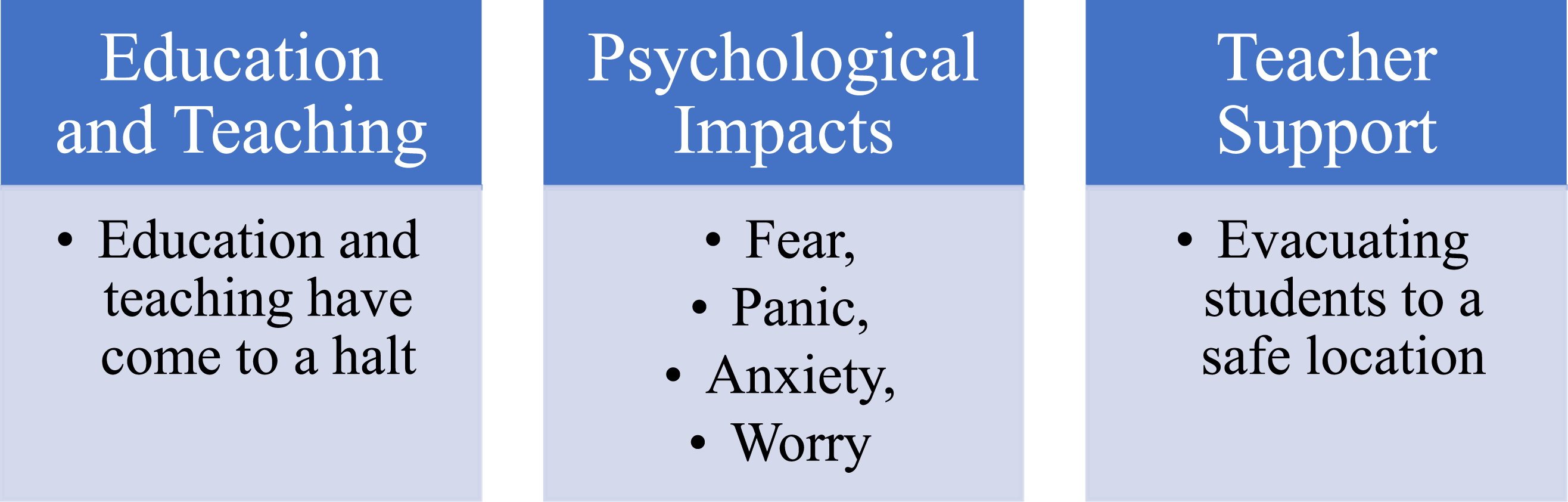
For a month until distance education commenced, there was educational chaos, and teachers were uncertain about what to do. During this period, teachers endeavored to maintain contact with the student’s families and attempted to gather students together and receive updates using online platforms, as they were concerned about their students’ safety.
Short-Term Post-Conflict Effects
This process started shortly after the outbreak of the conflict and continued in the post-conflict period, during which distance education was introduced. Teachers were tasked with reaching children and their families and creating online lesson environments. However, Aikanish mentioned that it was not easy for traumatized teachers to prepare lessons and that they themselves had difficulty focusing on the lesson and were afraid of the loss of their students in the conflict.
This conflict environment, which was very severe for teachers and families who experienced severe fear and suffered losses from their families, also deeply affected students. Some students showed behaviors similar to the symptoms of post-traumatic stress disorder. One of them was students’ inability to speak. Mukadas reported that some students did not speak at all in class.
Short-term post-conflict impacts are presented in detail in Figure 5. Especially students were greatly affected by this event. Students did not attend classes for about a month and experienced events that could have caused severe trauma. Teachers conducted the lessons through online platforms. They also prepared presentations, shot lecture videos, and sent them to the students. They also administered exams in an online format. Teachers stated that the lessons were not effective enough because students were in different places and their psychological health was negatively affected. However, they said that these lessons were effective in keeping students and families connected to the ordinary flow of life. Hierarchical Code-Subcode Model for Short-Term Post-Conflict Effects.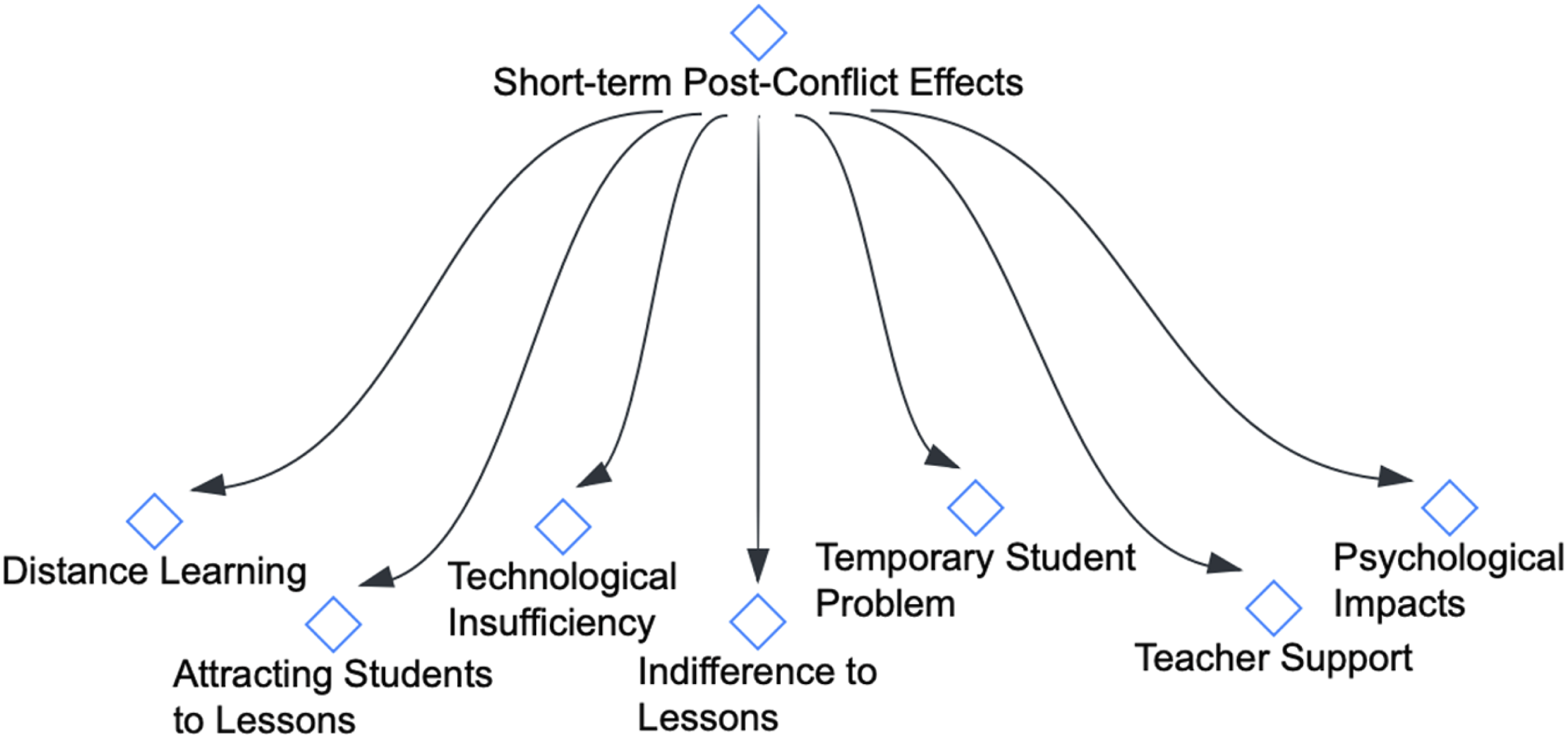
No matter how hard the teachers tried, the lessons were interrupted and it became almost impossible to teach especially the practical lessons. One of the issues that teachers had difficulty with in this process was technological inadequacy. The fact that online education requires computers or cell phones and students do not have them has reduced the effectiveness of the lessons.
The effects of what happened in this process are presented in detail in Figure 6. Among these effects, the intensity of the disruptions experienced in the education process draws attention. It was observed that there was especially technological inadequacy. In some families, the large number of children and the availability of only one phone also caused a problem. This also allowed only one of the children to participate in the lesson. Teachers’ interviews revealed that technological inadequacy was experienced in almost every family. Some students were not able to find a suitable environment for the class, and some stayed in temporary places or with relatives. They did not have the opportunity to participate during class times. Short-Term Post-Conflict Effects.
Some of the students fled to settlements where there was a school and started face-to-face education at the school there. The state has announced that any child from a conflict zone can be enrolled unconditionally in the nearest school. However, students who started face-to-face education had problems adapting to school. In particular, teachers reported that these students, whom they regarded as temporary students, were not sufficiently taken care of.
One of the issues that teachers had difficulty with in this process was the students’ lack of interest in the lessons. While the children could not forget the conflict environment, they lived and experienced, the fact that they and their families were constantly following the news about the conflict during this process caused them to be disinterested in the lesson. Most of the teachers complained about this issue.
The fact that children and their families were constantly following the news caused students to be interested in the news in class. Aikanish stated that students talked about the news instead of the lesson. Another problem was that students did not do their homework.
In this process, teachers both prepared course content and tried to attract students to the lessons. Aigul explained that she could not attract not only her students but also her own children. While teachers were working in this process by preparing online lessons and sharing them with students and conducting online lessons, they also made great efforts to reach out to families and include them in the educational environment.
In this process, the teachers did not limit the duration of the lessons and said that they could reach the families and students whenever they wanted. Aikanish said that they were interested in each student individually. Stating that at first, they were not interested in the lesson either, Aisanam explained that he lost his relatives and this situation affected him negatively. Aisanam said that during the lesson, in order to motivate the students and improve their psychological health, they started by telling them things that would make them laugh and be happy as if nothing had happened.
Long-Term Post-Conflict Effects
The post-conflict period covers the academic year 2023–2024, when face-to-face education started from online education. This process is characterized by the effects of the conflict on academic life despite the end of the conflict. In this process, there are effects that may turn into post-traumatic stress disorder, especially in teachers and students. It is not easy for teachers and students who have witnessed a destructive event to overcome the scarring effect of this event. In this process, teachers offer psychological support in addition to their teaching profession in order to heal the wounds of children. While describing the negative effects on children, Kubanich said that children did not want to come to school and that they had an experience they would never forget for the rest of their lives. Some studies (Bonanno, 2004; Bonanno et al., 2007) have shown that such tragic events have a positive effect on the psychological resilience levels of adults. In a study conducted at Harvard University, it was determined that children show certain protective tendencies to survive in the face of difficulties (Center on the Developing Child, 2015). One of the factors that cause children’s psychological problems to continue to increase is gossip and rumors. In other words, conversations about the resumption of conflicts between people have a negative impact on children’s mental health. While explaining this situation, Aiperi said that the students could not adapt to the lesson because the conflicts would start again.
Rumors and hearsay contribute to the continued and worsening psychological problems experienced by children. In other words, conversations among people about the resumption of conflicts affect children’s mental health negatively. Aiperi explained this situation: “Now, there are rumors among students that conflicts will start again. This greatly affects the students. They cannot adapt to the class, thinking that conflicts might erupt again.”
Aware of the trauma and its aftermath on students, teachers are also performing the role of a psychologist to help students overcome this situation. Gulsara described the psychological support provided by teachers: The stress levels are very high, and panic is prevalent among students. I can even say that we are currently facing stress that was not experienced during the conflict. At the moment, teachers are not only teaching but also working as psychologists. We treat students more gently than ever to improve their mental state. We read articles online about stress relief methods. We try to understand how we should approach students. For instance, I sometimes give some high-stress level students activities like drawing or writing compositions.
Students, regardless of their class level, are constantly following news updates and fearing the recurrence of conflicts. Jildiz stated that students are concerned about where they would hide if conflicts resume. This fear leads them to pray every day for conflicts not to start and prevents them from focusing on the lessons. Mukadas stated that this situation is more severe for some students, who experienced speaking issues. She mentioned that even if they asked questions, the children didn’t respond, and when pressed for an answer, the children expressed their fear.
Participants emphasized that the effects of trauma on teachers and students continue to this day. Teachers are treating students gently and trying to help them forget the trauma they have experienced. Nurbek expressed his experiences in this regard:
Psychological trauma has begun in children, and they have lost interest in classes. Aware of this, we try to convey things more gently. Sometimes psychologists come and support, but this is not an immediately eradicable trauma. Students have changed a lot from a year ago; they are constantly following the news. If children hear the smallest noise, they get scared.
The effects of what happened in this process are presented in detail in Figure 7. These effects appear to be intensified academically and psychologically. Teachers think that students are academically behind. They stated that before each lesson, they start the lesson by reviewing the previous year’s lessons. Gulsara, one of the participants who drew attention to the fact that students were falling behind, stated that they had difficulty in lessons and that they spent at least 10 min at the beginning of each lesson repeating previous lessons. The burning of most of the school buildings also makes it difficult to find a classroom. Gulsara drew attention to this and stated that the fact that the classrooms of the buildings they currently use as schools are close to each other or that there are no classroom walls causes the sounds to mix with other classrooms and they have difficulty in teaching. Nurbek said that he was surprised that the topics he taught to students in online education did not stick in their minds and that he repeated the topics. Nuriza, on the other hand, said that their school had been successful every year in the “Golden Letter” exam, which is a national exam, and that they used to study for this exam during the year, but now no one even thinks about this exam. Hierarchical Code-Subcode Model for Long-Term Post-Conflict Effects.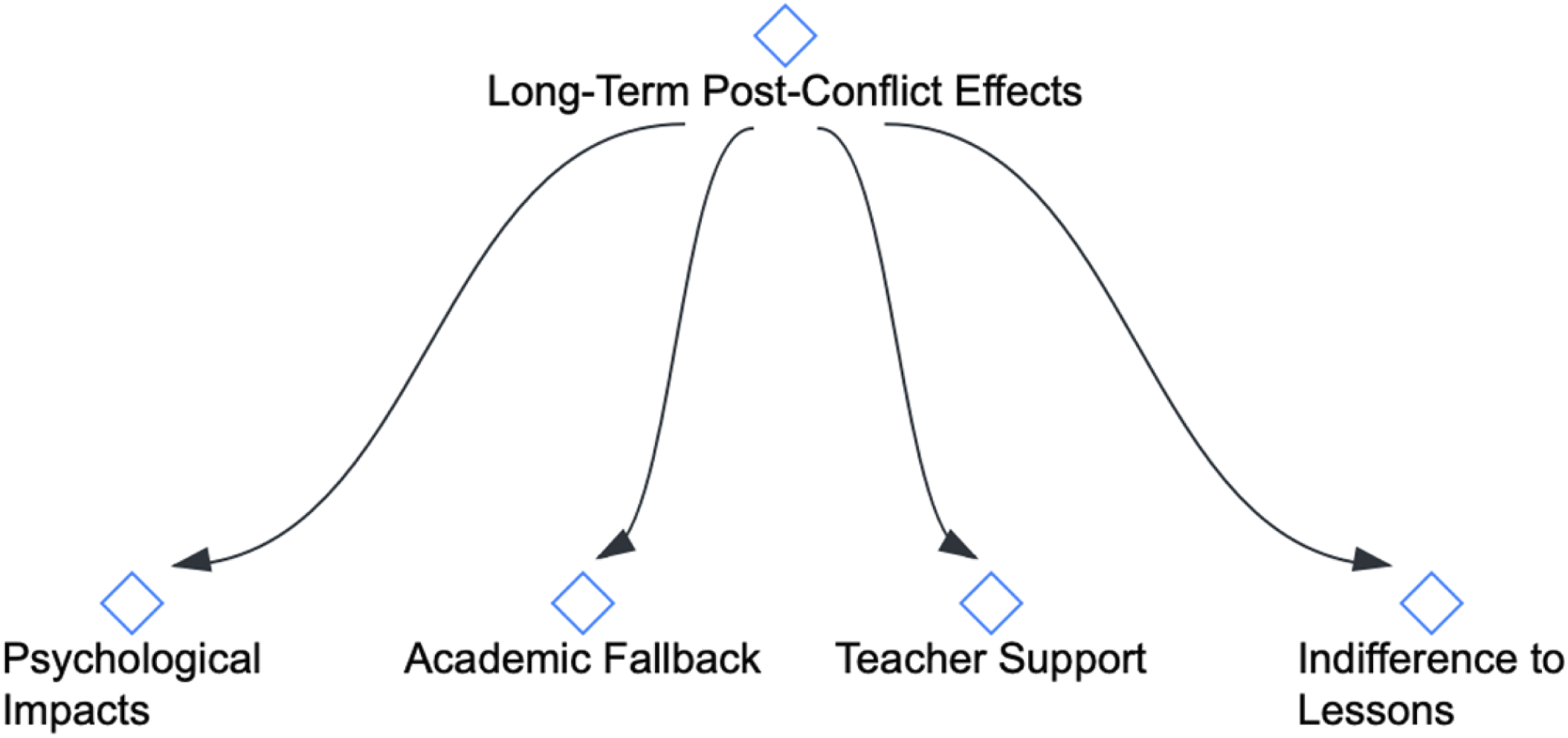
It is also understood that the news about the resumption of conflicts between people in the village caused students to lose interest in the lesson. Aiperi expressed her opinion on this issue and said that these news among the people prevented the students from concentrating on the lesson.
When Figure 8 is examined, the importance of teacher support in this process is understood. It has been observed how gently teachers who try to provide psychological support to students treat the students. The teachers said that although they behaved as if nothing had happened in front of the students, when they got together, they talked about the conflicts all the time. Nurbek reported a big change in his approach to children, saying that he used to be a harsh and angry teacher, but now he was a very understanding teacher, trying to make the children laugh as much as he could, not shouting at them and avoiding giving them too much homework. These behaviors of Nurbek and other teachers show that they are careful about protecting children’s mental health. This is because negative situations such as conflict have not only economic but also mental health implications (Bratti et al., 2015). Long-Term Post-Conflict Effects.
Discussion and Conclusion
This study aims to view the academic life during the Kyrgyz–Tajik inter-ethnic conflicts through the eyes of teachers. Based on the perspectives obtained from the participants, the effects of inter-ethnic conflict on academic life have been examined in three separate stages. The first stage covers the effects at the beginning of the conflict. The most commonly mentioned effect during this period among teachers is psychological. All the participants emphasized that during this phase, intense psychological effects like anxiety, fear, and panic were experienced by both teachers and students. Participants highlighted that during this phase, teachers and students were only trying to save their lives, and no one was thinking about lessons. Conflict and war situations can disrupt or even halt social services like health and education (Baingana et al., 2005). The fundamental reason for this is people being concerned about their lives. While the literature provides less attention to the fear and panic experienced during conflict, studies (Kessler, 2000; Lohr et al., 2015; Marmar et al., 2015; North 1999; Rosenbaum et al., 2015; Schuster et al., 2001; Zatzick et al., 1997) have primarily focused on psychiatric disorders after natural disasters. However, understanding what happens during the conflict is crucial for diagnosing and treating possible illnesses afterward.
Despite experiencing fear and panic, teachers were observed to be concerned about their students’ lives and trying to save them. Uncertainty prevailed among teachers and students about what would happen in general. According to Fullerton and Ursano (2004), the severity of the traumatic experience determines the intensity of the psychological problems experienced by individuals or groups. Wright and Bartone (1994) suggest that those most affected during such disasters are the ones directly experiencing the catastrophe and fall into the primary risk group. Teachers identified within this primary risk group were observed to be concerned about keeping students and families together and maintaining the learning process when the conflict started.
Teachers and students were asked to go to safe places, and remote learning was announced by the ministry (Bilim, 2022). However, this process posed significant challenges. Especially in the teaching process, issues like reaching students, engaging them in lessons, increasing their interest, and technological insufficiency were encountered. It was observed that families listening to constant conflict news and discussing it hindered the students’ focus on their lessons. Fojtík (2018) mentions that remote learning demands higher motivation than face-to-face education. However, children unable to listen to lessons or interact began discussing conflicting news during classes. According to Özgöl et al. (2017), students not only disregard the importance of the lesson in remote education but also significantly decrease their participation.
Some families, having many children but only one phone, couldn’t have their children attend classes. One of the issues frequently complained about by the participants was technological insufficiency. Many studies (Ergin et al., 2022; Odabaş, 2003) in the literature have also highlighted technological insufficiency among the challenges of remote education. While explaining issues related to technological adaptation, Ertmer (1999) lists equipment and technological support as primary problems.
Another concern voiced by teachers was that a topic that could be covered in 1 hr in face-to-face classes took much longer in remote education. This situation can be associated with teachers having to spend more time preparing for the class in remote education (Zhang et al., 2004). Before starting the class, teachers have to design and plan all stages of the class (Caplan & Graham, 2008). Teachers, while describing the difficulties of remote education, mentioned their concerns, like not being able to reach students and students not listening to the lessons. Hence, they found themselves needing to focus individually on almost every student, developing online class materials suitable for them. According to Smaldino et al. (2008), as education moves away from the traditional classroom setting, the online environment becomes a challenge for teachers. While younger teachers adapt better to these difficulties, it was observed that older teachers struggle to overcome these challenges. This is because in remote education, unlike the traditional classroom environment, teachers need to prepare multimedia and video content for classes (Anderson, 2004). This requires teachers to be familiar with technological elements and consider their impact on students (Wang, 2014).
It was observed that these online classes conducted by teachers not only had academic benefits but also ensured the continuation of social life. Through these classes, families and students came together to share news. In this context, it was understood that teachers assumed roles as psychologists, leaders, and educators. The trauma experienced by teachers and students during this period led them to migrate to different places. As a result, separated students who could not communicate found a chance to interact only through these classes. Although remote education does not provide interaction as much as face-to-face education (Panahi & Borna, 2014), it somewhat contributed to the reduced interaction among students in this process.
When looking at academic life from the perspective of teachers after the conflict, it is observed that psychological issues come to the forefront. Teachers believe that these issues are causing problems in teaching lessons as they did before the conflict. The inability of students and teachers to focus on lessons, constant fears of renewed conflicts, and students’ concerns are some of the issues. Moreover, from the teachers’ perspective, there have been positive effects of the conflict on academic life. Post-conflict, teachers have changed significantly, no longer behaving as strictly towards students, and are trying to understand them. The participants associated this change, observed in almost all teachers during the conflict, with what the students went through and teachers witnessing the situation. In addition to their teaching duties, teachers act as psychological counselors to positively impact students’ mental health. Conflicts not only increase the occurrence of mental disorders (Baingana et al., 2005) but also necessitate providing mental health support to affected students (Joop & Jong, 2002). Teachers, aware of the increase in psychiatric disorders due to conflict, are working to help students overcome this trauma.
According to North et al. (2002), people exposed to conflicts may develop psychiatric disorders such as acute stress disorder, post-traumatic stress disorder, and trauma-related depression after a disaster. Among the mental disorders and psychosocial consequences related to conflict are insomnia, fear, irritability, anger, aggression, depression, flashbacks, etc. (Baingana et al., 2005). Teachers listed problems such as high sensitivity to loud noises, inability to sleep, and continuous anxiety among students. According to Silove et al. (2000), societies affected by conflicts have a prevalence of psychosis and mood disorders. Teachers reported that children could suddenly become angry or cry abruptly, and young children didn’t want to come to school associating the trauma experienced in the conflict with school. In some places, children affected by conflict either couldn’t go to school or, if they did, received very weak service (Baingana et al., 2005).
Footnotes

Funding
The author(s) received no financial support for the research, authorship, and/or publication of this article.
Declaration of Conflicting Interests
The author(s) declared no potential conflicts of interest with respect to the research, authorship, and/or publication of this article.