



Abstract
This protocol describes a systematic review that will examine the effects of organizational transparency interventions on trust in AI-assisted decision-making and in human decision-makers. The review addresses a dual-trust dynamic — cognition-based trust in AI-assisted decisions and affect-based trust in human decision-makers — that existing reviews have not synthesised together. Eligible studies will involve organizational decision-makers interacting with AI-assisted systems and will measure trust-related outcomes in response to transparency interventions such as disclosure protocols, process transparency, or leader communication strategies. Database searches will span psychology, management, information systems, and AI literatures from 2015 to present across PsycINFO, Scopus, Web of Science, ACM Digital Library, IEEE Xplore, and grey literature sources. A convergent segregated mixed-methods synthesis will be used: random-effects meta-analysis for quantitative evidence and thematic synthesis following Enhancing Transparency in Reporting the Synthesis of Qualitative Research (ENTREQ) for qualitative evidence. Findings will be integrated in a cross-interpretation stage to produce theory-informed conclusions on mechanisms and moderators of trust asymmetry. The review is registered with the Campbell Collaboration Business and Management Coordinating Group.
Keywords
Introduction
As artificial intelligence (AI) becomes increasingly embedded in organizational decision-making, it fundamentally reshapes how decision-makers are perceived and trusted. Trust, broadly defined as “the willingness to be vulnerable to the actions of another party based on positive expectations of their intentions or behaviour” (Mayer et al., 1995, 2007), is a critical determinant of effective leadership and decision acceptance. Traditional leadership frameworks emphasize human traits such as competence, integrity, and benevolence, which build affect-based and cognition-based trust (Gill et al., 2024; McAllister, 1995). Trust itself is understood as a multidisciplinary phenomenon spanning psychological, sociological, and economic perspectives (Rousseau et al., 1998).
AI-augmented decision-making introduces a critical duality for trust: stakeholders must evaluate both the AI-assisted decision outcome and the human decision-maker who is accountable for it. While AI can enhance cognition-based trust in the decision by providing accurate, data-driven insights, it can simultaneously undermine affect-based trust in the decision-maker, creating a phenomenon termed trust asymmetry (Afroogh et al., 2024; Atf & Lewis, 2025). Empirical evidence suggests that transparency, particularly at the organizational level, such as through disclosure practices and communication protocols, is a key factor in fostering trust, yet existing studies largely focus on either the AI system itself (e.g., algorithmic explainability) or the human decision-maker in isolation (Montealegre-López, 2025), leaving a gap in understanding this dual-trust dynamic.
This trust asymmetry is particularly salient in organizational leadership contexts, where stakeholders evaluate both the quality of decisions and the credibility of the leaders communicating them. Addressing this gap is crucial for designing organizational processes that sustain calibrated trust in digitally mediated environments (Afroogh et al., 2024; Atf & Lewis, 2025; Montealegre-López, 2025). Organizational transparency interventions, such as structured disclosure protocols and leader communication strategies, operationalize system-level enablers like algorithmic explainability to bridge this gap. For instance, interface features that visualize AI decision pathways (per HCI principles in Glikson & Woolley, 2020) enhance perceived competence in the decision while reinforcing the decision-maker’s benevolence through clear accountability narratives.
This review prioritizes system-level transparency interventions (e.g., algorithmic explainability, interface feedback, disclosure practices) as the primary lever, examining their impact on both trust in AI-assisted decisions and trust in human decision-makers as co-primary outcomes, with organizational legitimacy and contextual factors serving as moderators. This narrowing of focus ensures conceptual coherence while maintaining the dual-trust perspective.
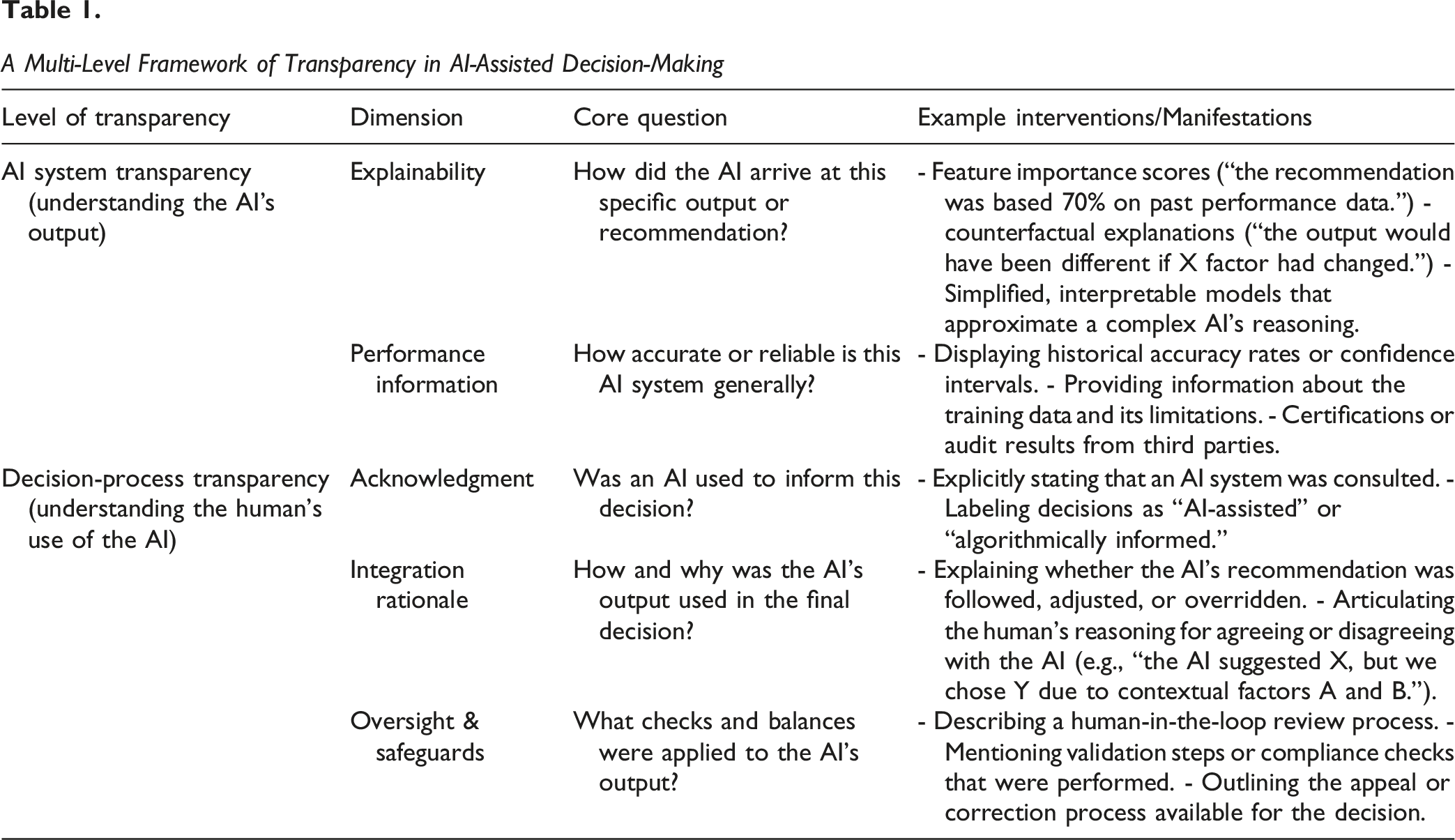
Conceptual Mapping of Transparency Interventions to Trust Mechanisms
A Multi-Level Framework of Transparency in AI-Assisted Decision-Making
Policy Relevance
This review addresses an increasingly pressing gap in organizational and AI governance research enabling relevant insights for policymakers, organizational leaders, and AI governance bodies as they address the accelerating integration of AI in decision-making processes. The erosion of system trust — when confidence in institutional processes collapses rather than in specific actors — poses a distinct governance risk in AI-augmented contexts (Kroeger, 2015) that transparency mandates are designed to mitigate. The review aligns with UN Sustainable Development Goal 8 (Decent Work and Economic Growth) and Goal 16 (Peace, Justice, and Strong Institutions), both of which emphasize fair, transparent, and accountable systems. It directly supports the implementation of transparency mandates within emerging regulations like the European Union (EU) AI Act (2024), the White House AI Bill of Rights, and principles outlined by the Organization for Economic Co-operation and Development (OECD) AI Policy Observatory and the Canadian Artificial Intelligence and Data Act (CADA), the forthcoming OSFI Guideline E-23 on Model Risk Management (effective 2027), and the AGILE framework for responsible AI adoption in Canadian financial services (Financial Industry Forum on Artificial Intelligence [FIFAI], 2026).
Its findings hold direct policy relevance to guide both governance and practical trust-building interventions:
Governance and Regulatory Interventions
• •
Trust-Building Interventions
• •
By focusing on organizational transparency as a lever for calibrated trust, this review offers concrete evidence, including a proposed policy toolkit mapping findings to CADA, OSFI Guideline E-23 (effective 2027), and the AGILE framework for responsible AI adoption in Canadian financial services (Financial Industry Forum on Artificial Intelligence [FIFAI], 2026) implementation, to ensure AI adoption under these new policies enhances, rather than erodes, legitimate and human-centered governance, fostering systems that are both technologically advanced and socially credible. The findings will also inform practical design and governance guidance for organizations and AI developers, including: • Interface design principles that enhance explainability and user control. • Communication protocols that foster both cognition- and affect-based trust. • Recommendations for integrating transparency interventions into AI governance policies to mitigate trust asymmetry and improve adoption outcomes.
The Intervention
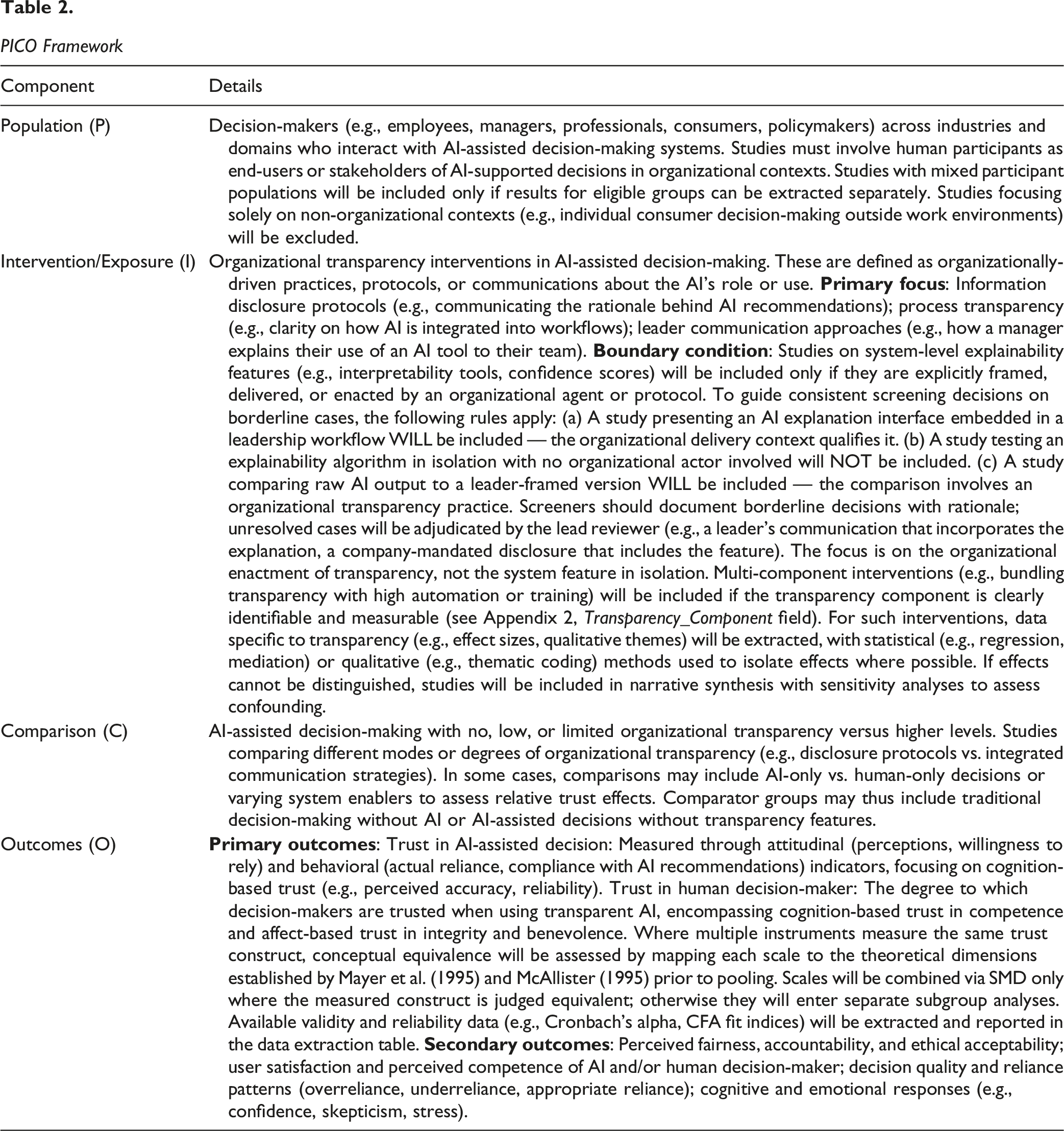
The “intervention” in this review is organizational transparency interventions in AI-assisted decision-making. These are defined as organizationally-driven practices, protocols, or communications about the AI’s role or use, aimed at clarifying the integration of AI into human-led decisions to foster trust.
• Information disclosure protocols (e.g., communicating the rationale behind AI recommendations to stakeholders). • Process transparency (e.g., clarity on how AI is integrated into workflows, including oversight and safeguards). • Leader communication approaches (e.g., how a manager explains their use of an AI tool to their team, articulating integration rationale and accountability).
Key components of the intervention include: • • o o o o
PICO Framework
The theoretical rationale for this intervention draws on trust theory and organizational psychology. Trust in organizational decision-making comprises both cognition-based trust (confidence in the accuracy and reliability of decisions) and affect-based trust (confidence in the integrity, competence, and intentions of decision-makers) (Gill et al., 2024; McAllister, 1995). This review is guided by a theoretical framework suggesting a potential “trust asymmetry” (or gap) in AI-assisted decision-making, where AI use may differentially influence these dimensions: strengthening cognition-based trust in the AI-assisted decision through data-driven insights, while weakening affect-based trust in the human decision-maker if reliance on automation is perceived as diminished judgment or accountability. The review will empirically examine whether, how, and under what conditions organizational transparency interventions mitigate this asymmetry, drawing on enabling mechanisms such as attribution theory (shifting responsibility loci between AI and human) and organizational justice (enhancing informational fairness to reduce uncertainty; Folger & Cropanzano, 2001; van den Bos et al., 2001).
Mechanisms through which the intervention is expected to influence outcomes include:
These mechanisms directly address the review’s research questions: effects on dual trust targets, conditions moderating asymmetry (e.g., decision stakes, communication modes), and effective strategies for calibration. A logic model (included in the Appendix) illustrates the pathways from intervention components (organizational transparency practices + system-level enablers) → intermediate outcomes (enhanced understanding, perceived legitimacy, reduced uncertainty) → primary outcomes (balanced cognition- and affect-based trust in AI-assisted decisions and human decision-makers, leading to appropriate reliance and acceptance).
Why It Is Important to Do This Review
Despite a growing body of research on trust in artificial intelligence (AI), the effects of organizational transparency interventions on both trust in AI-assisted decisions and trust in the human decision-maker remain fragmented. Classic trust theories (Mayer et al., 1995, 2007; McAllister, 1995) and recent advances (Gill et al., 2024; Hamm et al., 2025) highlight the dual foundations of cognition-based and affect-based trust. Yet most AI research has focused on system-level trust in automation (Dzindolet et al., 2003; Jian et al., 2000; Lee & See, 2004), rather than examining how organizational practices like disclosure and communication protocols alter perceptions of human leaders. Empirical work shows that stakeholders often resist delegating judgment to AI systems, particularly in high-stakes advice contexts (Longoni et al., 2019), and that transparency standards applied to algorithmic decisions are inconsistently held relative to human decisions (Zerilli et al., 2022) — both dynamics that organizational interventions must navigate.
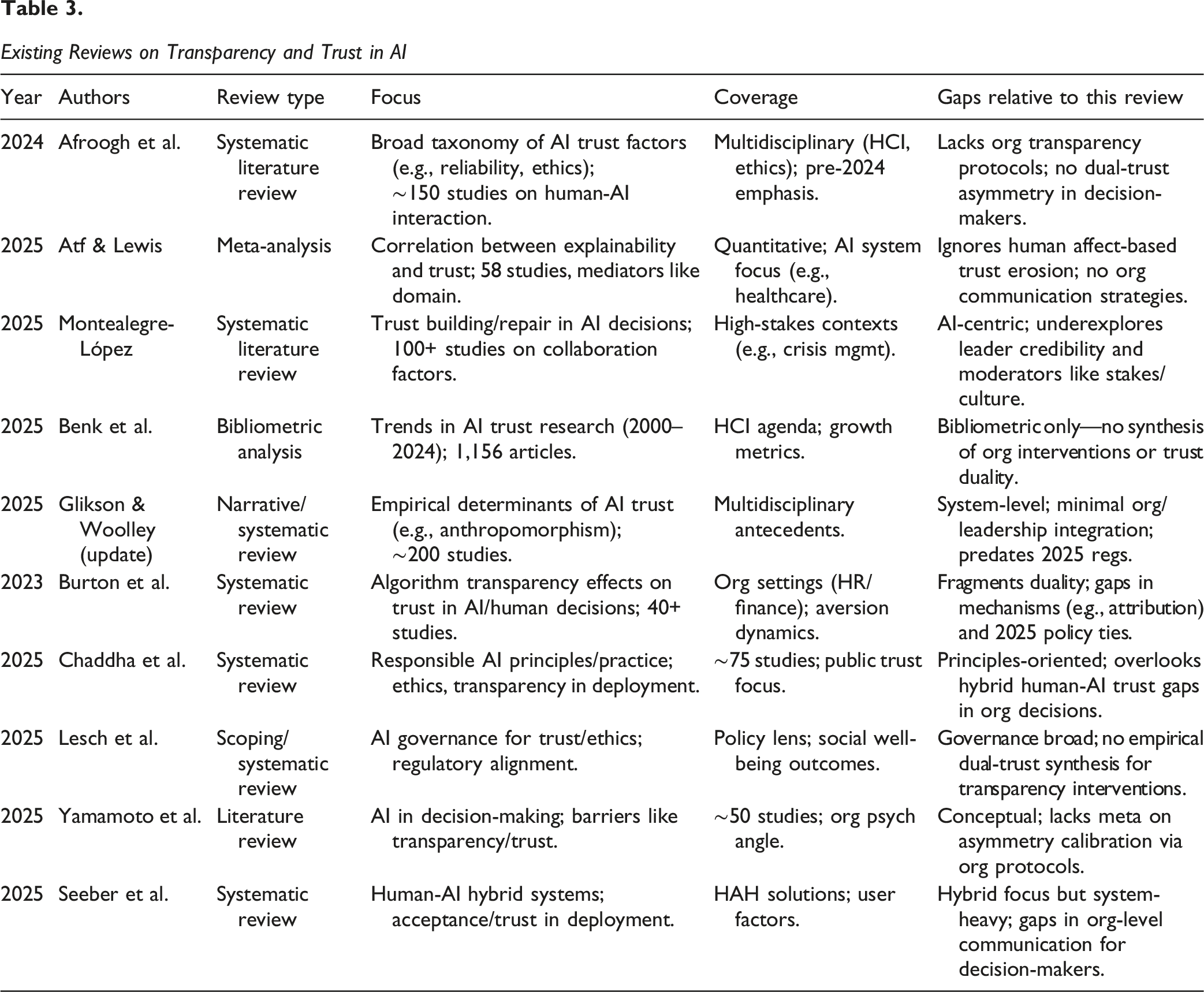
Recent reviews and meta-analyses underscore this gap. Afroogh et al. (2024) mapped broad challenges in AI trust research, Atf and Lewis (2025) focused on the correlation between explainability and trust, and Montealegre-López (2025) reviewed trust in AI-driven decision-making but primarily considered trust in AI systems themselves. Emerging work on trust in conversational and interactive AI agents further highlights gaps in understanding how users calibrate trust in human-AI hybrid systems (Lukyanenko et al., 2022). Benk et al. (2025) conducted a bibliometric analysis highlighting rapid growth in AI trust research but limited integration of organizational and leadership contexts. To date, no systematic review has synthesized findings on how organizational transparency interventions, enabled by system-level mechanisms, shape trust in both AI-assisted decisions and the human decision-maker, a duality essential for organizational processes. While recent work has begun to explore trust in leadership within digital contexts (Cortellazzo et al., 2019), a specific focus on the AI-transparency-trust nexus—and the “trust asymmetry” where AI boosts cognition-based trust in decisions but erodes affect-based trust in decision-makers—remains required.
Guided by best practices in management and information systems research (Kunisch et al., 2023), this review will capture empirical studies that jointly consider organizational transparency, trust in AI, and trust in the human decision-maker. Evidence indicates that how employees appraise AI-generated decisions directly shapes their trust in and reliance on those decisions (Yu et al., 2023), underscoring the need to examine both trust targets concurrently. Specifically, we will code for (a) how these interventions influence cognition- and affect-based trust (Gill et al., 2024; Mayer et al., 1995; McAllister, 1995), (b) conditions under which trust asymmetry emerges (e.g., decision stakes, transparency practices, organizational culture), and (c) strategies that sustain trust in both the AI-assisted decision and the human decision-maker, thereby mitigating asymmetry. This synthesis will generate both theoretical insights and practical guidance for organizations and policymakers implementing AI in decision-making contexts, clarifying: • How organizational transparency influences trust in both decisions and decision-makers. • Moderators such as decision stakes (high-vs. low-impact), organizational context (e.g., corporate vs. public sector), and stakeholder groups (e.g., affected employees vs. deploying leaders). • Evidence for trust asymmetry and conditions narrowing/widening the gap (e.g., via specific communication strategies).
A search of Campbell Collaboration, PROSPERO, Cochrane Library, and other relevant registries (e.g., OSF Registries, INPLASY) as of November 2025 identified no ongoing protocols overlapping with this focus on organizational transparency interventions for dual trust dynamics in AI-augmented organizational settings.
Existing Reviews on Transparency and Trust in AI
Practical relevance: Findings will inform organizations, policymakers, and practitioners on designing AI-assisted decision systems that maintain both accuracy and credibility, supporting ethical, legitimate, and effective decision-making practices. A Campbell-style systematic review is ideally suited because it allows the research to answer not only what works—the effects of transparency on trust—but also how and why, uncovering underlying mechanisms and contextual moderators across diverse literatures and study designs. Campbell standards explicitly support mixed-methods synthesis and policy-relevant recommendations, enabling this review to combine quantitative effect synthesis with thematic analysis of qualitative mechanisms to produce robust, actionable, and policy-relevant findings (Schilke et al., 2021). Notably, disclosure of AI use can itself erode trust in the decision-maker under certain conditions (Schilke & Reimann, 2025), underscoring the need for this review’s nuanced synthesis. This review directly addresses Campbell’s mission by synthesizing evidence on a social intervention, transparency mechanisms to improve outcomes in organizational and managerial settings, a core social science domain. The findings are intended to inform organizational policy and leadership practice.
Objectives
The objectives of this review are framed as research questions that directly address the challenges of transparency and trust in AI-augmented decision-making contexts, with a specific focus on the duality of trust.
Overall Alignment With Review Objectives
Collectively, these questions will enable the review to: • Systematically map empirical evidence on the effect of organizational transparency on the dual-trust dynamic in AI-assisted decision-making. • Identify gaps in the concurrent study of trust in the AI system and trust in the human decision-maker. • Generate actionable insights for policymakers and organizational leaders on designing transparency practices that preserve stakeholder confidence in AI-augmented contexts, including variations by AI system type, automation level, organizational context, and stakeholder group.
This framing ensures a focused synthesis of quantitative and qualitative evidence, uncovering mechanisms (e.g., via informational justice and attribution shifts) and providing guidance on transparent AI implementation to enhance decision quality and trust. The synthesized findings will be formulated into an evidence-based framework to guide organizational leaders and policymakers in selecting and implementing transparency interventions that effectively calibrate trust in AI-assisted decision-making.
Methods
Review Type
Systematic review with mixed-methods integration, assessing both intervention effects and enabling mechanisms/implementation. This review will include a range of study designs to capture the complexity of how organizational transparency affects trust in AI-assisted decision-making and the human decision-maker. To manage methodological heterogeneity, we will use a convergent segregated synthesis approach. Quantitative and qualitative evidence will be synthesized separately: effect sizes and meta-regression analyses for quantitative studies, and thematic synthesis for qualitative studies. Findings will then be integrated in a cross-interpretation stage to produce comprehensive, theory-informed conclusions.
Intended Registration
Campbell Collaboration (Business and Management Coordinating Group); prospective preregistration (e.g., OSF Registries) prior to screening completion.
Reporting
We will report the overall review using the Preferred Reporting Items for Systematic Reviews and Meta-Analyses 2020; PRISMA 2020) guidelines. Search methods will be reported using PRISMA-S. Qualitative synthesis will be reported following the Enhancing Transparency in Reporting the Synthesis of Qualitative Research (ENTREQ) guidelines. Where applicable, we will apply PRISMA-Equity to address equity considerations in AI decision contexts. We will adhere to Campbell Standards and the Assessment of Multiple Systematic Reviews 2 (AMSTAR 2) checklist for methodological rigour, with the completed Campbell Standards checklist uploaded as supporting information.
Criteria for Considering Studies for This Review
Studies will be selected according to the components of the research questions using the PICO framework (Population, Intervention, Comparison, Outcome) + study design, as appropriate for this intervention review. Eligible studies must explicitly examine organizational transparency features in relation to trust outcomes in AI-assisted decision-making contexts. Trust outcomes are used as an inclusion criterion at the eligibility stage. To mitigate potential reporting bias arising from studies that may have measured but not reported trust outcomes, authors of otherwise eligible studies will be contacted for unpublished data as part of the expert consultation process. This review will include all eligible studies involving human participants who interact with AI-assisted decision-making systems in organizational contexts across industries and domains.
Context (C)
Organizational settings where AI supports human judgment and decision-making (e.g., business, public administration, healthcare, legal, consumer services).
Types of Studies
This review will include empirical studies (quantitative, qualitative, or mixed-methods) published in English from 2015 onward that examine organizational transparency interventions in AI-assisted decision-making and report on trust-related outcomes (primary) or secondary outcomes (e.g., fairness, legitimacy, decision acceptance). Study designs may include: • • •
While both peer-reviewed and grey literature will be reviewed for eligibility, only sources presenting primary data will be included (e.g., dissertations, conference papers, preprints if empirical and reviewed). Materials such as theoretical papers, editorials, opinion pieces, commentaries, and reports without original data will be excluded. Technical AI papers without human participants or trust outcomes will also be excluded. To manage heterogeneity, a convergent segregated synthesis approach will be used: separate synthesis of quantitative (effect sizes/meta-regression) and qualitative (thematic) evidence, followed by cross-interpretation.
Types of Participants
Participants will include organizational decision-makers (executives, managers, teams) and stakeholders (e.g., employees, professionals, policymakers) evaluating AI-assisted decisions. Studies must focus on human participants in organizational contexts; those solely on non-organizational settings (e.g., isolated consumer experiments) will be excluded.
Duration of Follow-Up
All durations will be included; short-term (<1 month), medium-term (1–12 months), and long-term (>12 months) follow-ups will be captured and analyzed where available, with subgroup analyses exploring temporal effects on trust dynamics.
Summary
This systematic review will include all eligible studies involving human participants who interact with AI-assisted decision-making systems in organizational contexts across industries and domains. Eligible studies will examine the impact of organizational transparency interventions, including disclosure practices, process clarity, and communication protocols enabled by system-level tools like algorithmic explainability, on trust in both AI-assisted decisions and the human decision-maker. Primary outcomes include cognition-based and affect-based trust, reliance on AI recommendations, and perceptions of decision-maker credibility. Secondary outcomes encompass fairness, accountability, decision quality, user satisfaction, and cognitive or emotional responses. To capture the full range of evidence while managing heterogeneity, the review will include quantitative studies (experimental, quasi-experimental, cross-sectional, and longitudinal), qualitative studies (interviews, focus groups, case studies), and mixed-methods designs integrating numerical and narrative data, limited to post-2015 English-language publications. Studies will be included if they explicitly examine the relationship between organizational transparency and trust; commentaries, technical AI papers without human participants, and non-peer-reviewed sources will be excluded. Collectively, these criteria will enable a focused synthesis of empirical and theoretical insights, identifying mechanisms, moderators, and practical strategies for fostering balanced trust in hybrid human–AI decision-making contexts.
Search Methods for Identification of Studies
Briefly describe the anticipated search strategy.
A comprehensive, interdisciplinary search strategy will be implemented, guided by Campbell Information Retrieval Standards and PRISMA-S. Searches will target both quantitative and qualitative evidence on organizational transparency interventions, trust in AI-assisted decisions, and trust in human decision-makers.
Databases to Be Searched
• Psychology/organizational behavior: APA PsycINFO/PsycARTICLES (EBSCO), Google Scholar • Management/business: Business Source Premier (EBSCO), ABI/INFORM Complete (Pro Quest). • Multidisciplinary: Scopus (Elsevier), Web of Science Core Collection (Clarivate Analytics). • Information systems/AI: ACM Digital Library, IEEE Xplore. • Grey literature: ProQuest Dissertations & Theses, SSRN, arXiv, organizational websites, conference proceedings (e.g., ACM CHI, ICML, Academy of Management).
Grey literature will be systematically identified through targeted searches of repositories, conference proceedings, and organizational websites, with screening mirroring peer-reviewed processes for consistency. Key organizations include the AI Now Institute, Partnership on AI, World Economic Forum, OECD AI Policy Observatory, Data & Society, MIT Initiative on the Digital Economy, and Stanford HAI, selected for their empirical work on AI ethics, governance, and organizational implementation. Organizational website searches will follow a standardized protocol: (1) site-specific functions with keywords, (2) browsing publication sections, and (3) reviewing annual reports/research digests. Grey literature will also be sourced via Google Advanced Search with aligned keywords, filtered for English PDFs (2015–present). Google Scholar searches will use the aligned keyword string in Appendix 1, sorted by relevance, date-limited 2015–present, with the first 10 pages (200 results) screened; screening will cease when 3 consecutive pages yield no relevant results. For each organizational website, the search date, number of results reviewed, and screener initials will be documented in a standardized log.
Search terms will combine controlled vocabulary (e.g., MeSH, PsycINFO thesaurus) and free-text keywords covering key concepts: artificial intelligence, machine learning, algorithmic decision-making, organizational leadership, trust, legitimacy, transparency, explainability, and decision acceptance. Boolean and proximity operators will maximize sensitivity while maintaining specificity (e.g., “organizational transparen*” NEAR/5 ″AI” OR “artificial intelligence”).
To minimize bias, restrictions will be placed on English language publications from 2015 to present (to focus on recent AI advancements) and no geographical jurisdiction. Reference lists of included studies and relevant systematic reviews will be hand-searched, and experts in the field contacted to identify additional or unpublished studies. Experts will be identified through authorship of highly cited works retrieved in the database searches and through recommendations from the review team. Contact will be made via institutional email with a standardised query requesting unpublished studies, preprints, or datasets relevant to the review scope. Up to two follow-up attempts will be made if no response is received within four weeks. All search strategies will be peer-reviewed (e.g., using the Peer Review of Electronic Search Strategies (PRESS) checklist), fully documented, and reported in an Appendix. Search results will be imported into a reference management system, with duplicates removed before screening. Searches will be re-run prior to final analysis.
Electronic Searches
The electronic search strategy will be developed in consultation with an information specialist and peer-reviewed using the PRESS checklist. Results will be imported into EndNote (or Zotero) for deduplication, then transferred into Covidence for screening. Searches will be run initially on December 11, 2025 and re-run prior to the final analysis to capture newly published studies. A draft search strategy for PsycINFO is included in Appendix 1.
Data Synthesis
Quantitative evidence will be synthesized using random-effects meta-analysis in R (metafor package), with effect sizes (e.g., standardized mean differences for trust outcomes) pooled where appropriate. Heterogeneity will be assessed via I2 and τ2 statistics, with meta-regression and subgroup analyses exploring moderators (e.g., decision stakes, transparency modes) to address research question 2. Publication bias will be examined using funnel plots and Egger’s test, with trim-and-fill adjustments if indicated.
For Research Question 2 (conditions of trust asymmetry), a quantitative meta-analysis of a single ‘asymmetry score’ is not feasible due to heterogeneous measurement across primary studies. Therefore, evidence for asymmetry will be synthesized qualitatively and narratively by identifying and analyzing studies that report contrasting or differential effects on trust in the AI-assisted decision versus trust in the human decision-maker. Evidence of asymmetry will be coded as present when a study reports: (a) a statistically significant difference between trust-in-AI-decision and trust-in-human-DM measures within the same study, or (b) qualitative findings explicitly describing differential trust effects. Where both trust targets are measured in the same study, a within-study contrast will be computed wherever the data permit. A dedicated field (Asymmetry Evidence: Yes/Partial/No) will be added to the data extraction form in Appendix 2.
Qualitative evidence will be synthesized thematically in NVivo (or equivalent), following ENTREQ guidelines, to identify enabling mechanisms (e.g., attribution shifts, fairness heuristics) and contextual nuances for research questions 1–3. Themes will be derived inductively from participant narratives on trust duality and asymmetry. Thematic coding will be conducted independently by two reviewers, with disagreements resolved through discussion. For Research Question 2 specifically, qualitative synthesis will follow the convergent integrated approach described in the JBI Manual for Evidence Synthesis (Aromataris & Munn, 2020), converting textual findings to qualitative statements and mapping them to the asymmetry conditions identified quantitatively. This will enable cross-interpretation of quantitative effect patterns and qualitative mechanism narratives.
To manage methodological heterogeneity, a convergent segregated synthesis approach will be employed (Lizotte & Thombs, 2021; Sandelowski et al., 2006): quantitative and qualitative findings synthesized separately, then integrated via cross-interpretation to produce theory-informed conclusions (e.g., mapping meta-analytic effects to thematic pathways). Narrative synthesis will supplement where meta-analysis is infeasible (e.g., due to few studies per outcome). All code and outputs will be archived on OSF for transparency.
Included settings: Organizational environments where AI-assisted decisions influence operational, managerial, or strategic outcomes (e.g., corporate, public sector, healthcare, legal, or academic organizations). Laboratory experiments that simulate organizational decisions (e.g., resume screening, resource allocation, performance evaluation) will be included if they explicitly link to organizational transparency practices and trust dynamics. Excluded settings: Laboratory experiments utilizing abstract or decontextualized tasks with no meaningful connection to organizational decision-making (e.g., perceiving random patterns, game-like tasks without organizational analogy).
Data Collection and Analysis
Description of Methods Used in Primary Research
Studies are likely to use surveys (e.g., for attitudinal trust measures), behavioural observations (e.g., reliance on AI recommendations), field experiments (e.g., testing disclosure protocols), interviews/focus groups (e.g., exploring perceived fairness), and case studies (e.g., in-depth org implementations of communication strategies).
Selection of Studies
Two reviewers will independently screen titles and abstracts, followed by full texts, against eligibility criteria. Inter-rater agreement will be assessed using Cohen’s kappa; if < 0.60, calibration exercises will be conducted and criteria refined. Discrepancies will be resolved through discussion or consultation with a third reviewer. Reasons for exclusion at the full-text stage will be documented in a PRISMA flow diagram. If Covidence’s machine-learning prioritized screening feature is used, this will be reported in accordance with the Campbell position statement on use of AI in evidence synthesis (doi:10.1002/cl2.70074), including the algorithm used, training set size, and any manual verification steps applied.
Data Extraction and Management
Two reviewers will independently extract data using a standardized form (Appendix 2), capturing study design, participants, intervention components and the perceived source of the transparency intervention (e.g., the AI system, the human decision-maker, an organizational policy). Disagreements will be resolved through consensus or third-reviewer arbitration. Funding sources and conflicts of interest from primary studies will be recorded. For multi-component interventions, extraction will detail the transparency component (e.g., type: disclosure vs. process; format: visual vs. narrative; implementation: integrated vs. supplementary) and methods for isolating effects (e.g., regression controls, thematic coding). A dedicated field (Transparency_Component; see Appendix 2) will code it as “Primary” (core focus with isolated effects) or “Secondary” (bundled but identifiable), enabling appropriate synthesis. Extracted data will be managed in Covidence or Excel. For quantitative outcome data entering meta-analysis, dual independent extraction will be conducted by both reviewers; discrepancies will be resolved by discussion or third-reviewer adjudication. For descriptive and qualitative fields, 20% of extracted records will be cross-checked for accuracy.
Assessment of Risk of Bias in Included Studies
Risk of bias will be assessed using tools matched to design: ROB 2.0 (Sterne et al., 2019) for RCTs, ROBINS-I (Sterne et al., 2016) for non-randomized quantitative studies, and CASP for qualitative studies. For RCTs assessed with ROB 2.0, risk of bias will be rated per outcome (low/some concerns/high) across five domains; sensitivity analyses will exclude outcomes rated high risk for each specific outcome. For non-randomized studies assessed with ROBINS-I, an overall study-level risk rating will be derived (low/moderate/serious/critical); sensitivity analyses will exclude studies rated serious or critical overall risk. CASP will be used to assess methodological quality of qualitative studies. Two independent reviewers will conduct assessments; discrepancies resolved via discussion or a third reviewer. Bias ratings will inform sensitivity analyses and Grading of Recommendations, Assessment, Development and Evaluations (GRADE) certainty judgments.
Measures of Treatment Effect
For quantitative outcomes, effects will be expressed as standardized mean differences (SMD; e.g., Hedges’ g for trust scales), odds ratios (ORs) for dichotomous data (e.g., acceptance rates), or correlation coefficients (r) for associations (e.g., transparency-trust links), depending on study reporting.
Operationalization of Outcome Measures and Effect Size Calculation
Primary outcomes (trust in AI-assisted decision: cognition-based, e.g., perceived reliability via scales like Jian et al., 2000; trust in human decision-maker: cognition- and affect-based, e.g., benevolence/integrity via McAllister, 1995) will be operationalized as continuous variables where possible, with SMD as the primary effect size to compare means across heterogeneous scales. For each outcome, we will extract means, SDs, and sample sizes per group (e.g., high-vs. low-transparency), or derive SMD from t/F-statistics, p-values, or reported coefficients per Higgins et al. (2023, Ch. 10). Dichotomous outcomes (e.g., reliance yes/no) will use ORs; correlations (e.g., transparency r trust) will be extracted directly; where conversion to SMD is required, the formula d = 2r/√(1−r2) will be applied (Borenstein et al., 2009, Ch. 7). Fisher’s z will be used separately to pool correlation coefficients across studies where appropriate. Conversions (e.g., OR to SMD) will follow standardized formulas documented in the Appendix; non-convertible studies will enter narrative synthesis. Behavioral indicators (e.g., compliance rates) will prioritize observed data over self-report.
Unit of Analysis Issues
Clustered designs (e.g., team-level interventions) will adjust for intra-cluster correlation using guidance from Higgins et al. (2023, Ch. 23); crossover studies will analyze first-period data only; multiple time points/groups will be averaged or analyzed separately to avoid unit-of-analysis errors. Multiple reports from the same study will be consolidated; conceptually similar outcomes (e.g., related trust subscales) combined via multivariate meta-analysis if feasible.
Criteria for Determination of Independent Findings
Findings will be deemed independent if from distinct studies or samples; overlapping data (e.g., conference paper + journal article) will be linked and treated as one.
Dealing With Missing Data
Authors will be contacted (up to two attempts) for missing data (e.g., SDs for SMD calculation). If unavailable, imputation via intention-to-treat assumptions or multiple imputation will be used, with sensitivity analyses comparing complete-case vs. imputed results. Studies with >20% missing outcome data will be excluded unless bias is low; this threshold follows established guidance that missingness above 20% substantially increases the risk of bias in pooled estimates (Higgins et al., 2023, Ch. 8).
Assessment of Heterogeneity
Heterogeneity will be quantified using I2 (>50% substantial) and Q-statistics (p < 0.10 significant). Sources will be explored via meta-regression on moderators (e.g., decision stakes, transparency practices) or subgroups.
Assessment of Reporting Biases
Publication/outcome reporting biases will be assessed via funnel plots (Egger’s test for >10 studies per outcome) and trim-and-fill; selective reporting via comparison of methods/results sections.
Data Synthesis
Quantitative synthesis will use random-effects meta-analysis (R, metafor package) for pooled SMD/OR/r, with forest plots by outcome (e.g., dual trust targets). Multi-component interventions will enter meta-analysis only if transparency is “Primary” (isolated via experimental manipulation or statistical control) or “Controlled Comparison” (e.g., AI-with- vs. without-transparency); “Secondary/Not Isolated” studies will be narrative only. Qualitative synthesis will use thematic analysis (NVivo) per ENTREQ, deriving themes on mechanisms (e.g., fairness heuristics for RQ2). A convergent segregated approach will integrate separate quant/qual syntheses, then cross-interpretation (e.g., meta-effects mapped to themes for RQ3 strategies). Narrative synthesis will handle sparse data or high heterogeneity.
Subgroup Analysis and Investigation of Heterogeneity: Moderators pre-specified for meta-regression and subgroup analyses include: (1) decision stakes (high/medium/low), (2) transparency practices (disclosure vs. process vs. leader communication), (3) organisational culture/context (corporate vs. public sector), (4) communication strategies (narrative framing, accountability narrative), (5) stakeholder type (internal employees, external clients, board members), (6) AI system type (predictive, prescriptive, recommendation), and (7) automation level (advisory, partial, full). These will be tested via meta-regression where data are sufficient (minimum 10 studies per subgroup). Subgroups/meta-regression will test moderators from RQ2: decision stakes (high/low), transparency practices (disclosure vs. communication), organizational culture/context (e.g., public vs. corporate), and communication strategies. AI-related factors (e.g., type, automation) will be explored only if tied to org transparency.
Sensitivity Analysis
Analyses will test robustness by excluding high-risk studies, alternative effect measures (e.g., fixed-vs. random-effects), missing data assumptions, and multi-component inclusions (e.g., Primary only vs. +Controlled).
Treatment of Qualitative Research
Qualitative studies will be appraised via CASP and synthesized thematically to elucidate mechanisms (e.g., asymmetry conditions) and gaps, integrated with quant via joint displays.
Summary of Findings and Assessment of Certainty of Evidence
A Summary of Findings table will use GRADE for primary outcomes (trust duality), rating certainty (high/moderate/low/very low) based on risk of bias, inconsistency, indirectness, imprecision, and publication bias, following GRADE guidance (Guyatt et al., 2011; Journal of Clinical Epidemiology, 64(12)) and the Cochrane Handbook (Higgins et al., 2023, Ch. 14). Evidence profiles will highlight implications for policy/practice (e.g., effective strategies per RQ3).
Supplemental Material
Supplemental Material - Effects of Organizational Transparency Interventions on Trust in AI-Assisted Decision-Making and Human Decision-Makers: A Systematic Review of Enabling Mechanisms
Supplemental Material for Effects of Organizational Transparency Interventions on Trust in AI-Assisted Decision-Making and Human Decision-Makers: A Systematic Review of Enabling Mechanisms by Rachel Hor, Wendy Carroll, Michael Zhang, Yinglei Wang, Alison Manley in Campbell Systematic Reviews
Footnotes
Acknowledgements
We gratefully acknowledge the guidance and support of the Campbell Coordinating Group in the preparation of this protocol. We'd also thank Dr. Wendy Carroll, Dr. Camilla Holmvall, Dr. Michael Zhang, Dr. Yinglei Wang and Alison Manley for their valuable input on the search strategy, methodological advice, or other assistance that contributed to the development of this review.
Author Contributions
The review team brings complementary expertise across content, methodology, statistics, and information retrieval:
•
•
•
•
Funding
The author(s) received no financial support for the research, authorship, and/or publication of this article.
Declaration of Conflicting Interests
The authors declare no financial, personal, or professional conflicts of interest related to this review. None of the authors has been involved in the development of interventions, primary research, or prior systematic reviews directly addressing trust in AI-augmented organizational decision making.
Data Availability Statement
Campbell expects data sharing. Please provide a statement indicating whether the data is available and if so, how to access it. For more information see Wiley’s Data Sharing policy where you can find templates for data availability statements. More information can also be found on our  . Please add the option that is right for your submission here. The data generated and analyzed during this review will be made publicly available upon completion of the study. All extracted study data, coding frameworks, and synthesis materials will be deposited in an open-access repository (e.g., OSF) and will be accessible via a DOI provided in the final publication.
Preliminary Timeframe
We anticipate submitting the completed systematic review within 9 months of protocol approval, targeting June 2026. This timeline allows for comprehensive literature searching, screening, data extraction, and synthesis of both quantitative and qualitative evidence.
Plans for Updating This Review
The review team will be responsible for maintaining and updating the review. We plan to update the review every 2–3 years or sooner if significant new evidence emerges that may alter conclusions regarding trust mechanisms or interventions in AI-augmented decision making. Updates will involve re-running searches, screening new studies, and incorporating them into the synthesis. The corresponding author (Rachel Hor) will coordinate updates, with contributions from the original review team or additional collaborators as needed.
Trust Definition
“Trust” is defined as the willingness to be vulnerable to the actions of another party based on positive expectations of their intentions or behaviour (Mayer et al., 1995, 2007). “Trust asymmetry” refers to situations in which AI-augmented decision-making enhances cognition-based trust in the AI-assisted decision (e.g., perceived accuracy/reliability) while simultaneously reducing affect-based trust in the human decision-maker (e.g., perceptions of integrity/benevolence; Afroogh et al., 2024; Atf & Lewis, 2025).
AI System Types
AI systems include predictive (forecasting outcomes), prescriptive (recommending actions), and recommendation tools used to augment human decision-making in organizational contexts. System-level features (e.g., explainability) are included only if tied to organizational transparency practices.
Data Sharing Note
All extracted data, coding frameworks, analytic scripts (e.g., R for meta-analysis, NVivo for thematic synthesis), and synthesis materials will be deposited in an open-access repository (e.g., OSF) upon completion of the review, accessible via DOI for transparency and reproducibility.
Decision Stakes
•
•
•
Supplemental Material
Supplemental material for this article is available online.
References
Supplementary Material
Please find the following supplemental material available below.
For Open Access articles published under a Creative Commons License, all supplemental material carries the same license as the article it is associated with.
For non-Open Access articles published, all supplemental material carries a non-exclusive license, and permission requests for re-use of supplemental material or any part of supplemental material shall be sent directly to the copyright owner as specified in the copyright notice associated with the article.
