




Abstract
Even though U.S. public broadcasting has existed for more than 50 years, little research has been done on the attitudes of its journalists. This study, based on a sample of 394 U.S. public media journalists, represents the largest-scale effort to date to catalog the professional values and beliefs of these professionals. Our findings suggest these journalists are more liberal than both the U.S. population and commercial journalists, though they find it important not to be seen as partisan in their work. And while more people of color work in public broadcasting than in commercial media, public media journalists are unsatisfied with the diversity in their newsrooms and how it represents the communities they serve. When asked about their preferred professional roles, U.S. public media journalists tend to identify more with the interpretive and populist-mobilizer functions of journalism than the adversarial and disseminator functions.
For nearly two decades, public broadcasting in the United States has been ranked the “most trusted” brand among all news outlets (Corporation for Public Broadcasting, 2021). At a time when trust in journalism is eroding (Brenan, 2023; Fink, 2019), an in-depth study of those news people whom the public trusts most is warranted. Our study, therefore, focuses on who public broadcasters are and how they think about their jobs in light of the dramatic technological, economic, and political changes that have affected the U.S. news media.
Curiously, despite National Public Radio (NPR) and Public Broadcasting Service (PBS) television having existed for more than 50 years (Everhart et al., 2023; NPR, n.d.), few studies have surveyed the professional values of U.S. public media journalists. Instead, most research on public media in the United States has been done at the station level of analysis, whether by the Corporation for Public Broadcasting (Corporation for Public Broadcasting, 2016), consultants who strategize for public media brands (e.g., Public Media Company, 2021), or NPR and PBS themselves. So why has it taken 50 years to examine the work and role perceptions of U.S. public broadcasters? Workforce size may be an answer.
At NPR's 50th anniversary in 2021 (NPR, n.d.), a look at the number of U.S. public broadcasters showed significant growth during the previous decade. Between 2012 and 2021, the number of public broadcasters in the United States surged by a third (Thomas, 2021). These job gains run counter to a Pew Research Center report showing that overall U.S. newsroom employment has fallen 26% since 2008 (Walker, 2021). But despite this increase in the number of public media journalists, only about 4,400 public broadcasters work in newsrooms across the country (Thomas, 2021). They represent only about one-tenth of all journalists in the United States and a little more than one-fourth of all broadcast journalists (Bureau of Labor Statistics, 2022), which might explain why more research has been done on commercial rather than public media.
The different fortunes of commercial and public media journalism also suggest Americans are making conscious choices about where to spend their media budgets. Several economic studies examining the relationship between those giving money and those receiving it (e.g., Duarte et al., 2012; Lapavitsas, 2007; Sapienza et al., 2013) suggest that the transfer of monetary resources is mediated by the sender's trust in the recipient. Since public broadcasters are journalists whose work is directly supported through a long-held scheme of gathering listener donations (Johnson, 2013) and because donations are often given in support of a cause (e.g., Van Lange et al., 2007), financial support of public broadcasting by its audience can be seen as support of a product whose mission aligns with audience priorities (Stavitsky & Avery, 2003).
Except for the approximately $3 per capita charged by Congress to fund the Corporation for Public Broadcasting (Neff & Pickard, 2021)—an amount that makes up only 7% of the money generated by NPR affiliate stations (NPR, 2023a)—all contributions from the American public to the news media are voluntary. Consequently, these donations represent a choice to support public media financially.
This is made clearer by looking at public radio financing. Individual donations to the largest 129 NPR news stations grew from $261 million in 2008 to $478 million in 2021 (Barthel & Worden, 2023), an increase of 83% that far outpaces the 24% U.S. inflation rate over the same period (U.S. Bureau of Labor Statistics, 2024). Moreover, the number of donors to those stations increased by about 43%, from 1.66 million in 2008 to 2.38 million in 2021 (Barthel & Worden, 2023), showing that an increasing number of people support these stations. It should also be noted that underwriting (i.e., advertising) revenue to those same stations fell from $198 million in 2008 to $169.8 million in 2021, echoing an overall trend in the U.S. news media (Barthel & Worden, 2023).
However, these numbers must be contrasted with the fact that Americans have not given money as freely to other journalistic forms. Indeed, over the same period referenced above (2008–2021), U.S. daily newspaper circulation fell by more than half, from 48.6 million to 22.7 million, and advertising revenue fell by 73%, from $37.8 billion to $10.2 billion (St. Aubin & Naseer, 2023).
In the case of commercial television news, there are no donors or daily circulation to judge users’ financial affinity for the product, so the closest analog is advertising revenue, where there have been larger fiscal declines than those seen in public media. Even including digital ads, local TV ad revenue fell from $20.6 billion in solely over-the-air revenue in 2008 to a combined (over-the-air and digital) figure of $16.5 billion in 2021 (St. Aubin & Naseer, 2023), a drop of about 20% (compared to NPR affiliates’ 14% underwriting decline during the same period). Thus, the U.S. public has increased its support of public broadcasting and advertisers have been less willing to pull their funding from NPR affiliates than from commercial TV or newspapers.
It follows that an investigation of who public media journalists are and how they think of their profession could shed more light on why public support for them appears to differ in terms of the resources offered to each form. To examine this important group of U.S. journalists, we collected a representative sample of 394 public journalists to generate new insights into who they are and how they think about their jobs. Answers to these questions will allow us to better evaluate the state of public media (and the news media in general) in the United States.
Literature Review
Public broadcasting in the United States occupies a special place in the media ecosystem. At a time of media consolidation (Champlin & Knoedler, 2002), consternation about convergence (Dwyer, 2010; Prayogi et al., 2020; S. Wallace, 2013), and the shrinkage of newsroom staff across the country, public broadcasting pushes back against many prevalent trends. Its newsrooms are not corporately owned, have grown markedly in recent years, and are at the forefront of podcasting (Aufderheide et al., 2020; Newman & Gallo, 2019; Sullivan et al., 2020).
Despite these seemingly innovative stances, there have been very few analyses of the opinions and practices of U.S. public media journalists. Studies at the organizational level of analysis (e.g., Corporation for Public Broadcasting, 2016) considered the newsroom an entity instead of thinking of its employees as individuals with different views and opinions. Some longitudinal studies sought opinions only from public media managers (e.g., Papper & Henderson, 2023), leaving aside the views of many rank-and-file editors, reporters, newscasters, and producers. Other research (Barthel & Worden, 2023) left out many of the small newsrooms that comprise a significant part of the public media ecosystem, thus providing an incomplete picture with data slanted toward large-market stations and the NPR and PBS networks.
Public Media as a Field
Public media journalism may be best studied within Bourdieu's field theory of employment Bourdieu's (1977). Benson and Neveu (2005), quoting Bourdieu, note that journalism is “the site of actions and reactions performed by social agents endowed with permanent dispositions” (p. 30). We argue that these “permanent dispositions” shape the way public broadcasters do their jobs—specifically, the ways in which their role perceptions guide their work and cause them to work in public broadcasting. Consequently, public broadcasting can be seen as its own “interpretive community” (Zelizer, 1993), where journalists self-associate and form their journalistic reality based on their interactions with other like-minded individuals. This also aligns with Hanitzsch et al. (2019), who note that newsroom culture “is an important source of influence and a strong predictor of journalists’ professional views” (p. 74).
The organizational structure of public media likely contributes to generating this unique journalism culture. Public media organizations are not-for-profit (Waldman, 2011), charged with creating media for “instructional, educational, and cultural purposes” (Public Broadcasting Act of 1967, 2015). This means money generated by public media organizations comes from federal and state grants, sponsored underwriting (i.e., advertising), philanthropies, and audience donations (Barthel & Worden, 2023). Consequently, public journalists must do work of a quality that pleases these sources, lest one cash spigot or another be shut off. Among these sources are governmental players who sometimes threaten to cut public broadcasting funding, as presidential candidate Mitt Romney famously did during the 2012 election (The Washington Post, 2012).
However, most financial support for public broadcasting comes from the American public. National Public Radio reports that gifts from individual donors make up a plurality (41%) of public media fundraising by its member stations (NPR, 2023), with other sources of funding, such as corporate underwriting (advertising), accounting for only 13% and support by the universities that own many station licenses making up just 8%. Other sources of funding include investments (16%), foundations (8%), and appropriations from the Corporation for Public Broadcasting (7%) and federal, state, and local governments (7%).
The power of individual donors is underscored by previous scholarship (e.g., Atkin & McCardle, 2015; Aufderheide, 1996; Dempsey, 2020), which finds that the U.S. public broadcasting audience tends to be more educated and affluent, more civically engaged, and more liberal politically than the average American.
This study also allows for reconsidering of Bourdieu's field theory vis-à-vis U.S. public broadcasting, which is absent from Benson's (2006) consideration of how Bourdieu comports with institutionalism. Bourdieu's rubric Bourdieu's (1996, p. 124) situates all of journalism within the field of cultural production based on four factors: (a) a low degree of autonomy, (b) a high degree of economic capital, (c) low levels of what Bourdieu calls “symbolic, specific capital” (essentially a measure of honor or prestige associated with a work product), and (d) large-scale production capability. This rubric was meant to position journalism among other fields of cultural production in Bourdieu's native France, but it may also provide useful definitional terms for explaining how public media distinguishes itself within the field of journalism.
When considered against commercial journalism (which, again, was not Bourdieu's aim as he classified French journalism, which also has its own strong public service media tradition), U.S. public media is more appropriately classified as small-scale production because it is dwarfed in its number of outlets by commercial media (Bureau of Labor Statistics, 2022) and, as mentioned above, relies on many small, individual donations for the largest chunk of its funding. Despite these challenges, public broadcasting in the United States exhibits very high symbolic, specific capital, as it dominates national media awards ceremonies, such as the Edward R. Murrow Awards, given each year by the Radio Television Digital News Association. In fact, of the 48 Murrow Awards given across all radio categories in 2022, public journalists took home 34 (RTDNA, 2023).
This study proposes a new way of looking at another Bourdieu category: autonomy. But instead of judging extra-industry autonomy (opposing other fields of production), it poses an intramedia query: whether public media journalists have more autonomy in producing news than their commercial counterparts. This is an important component of media studies, reflecting whether institutional forces stifle individual decision-making or enhance it. Also, if journalists have more autonomy to control the topics of their stories and the aspects they emphasize, then the diversity of a newsroom matters more, as its reporters will be free to do a wider range of stories that appeal to their intersectional (Crenshaw, 2013) identities.
Public Media as a Reflection of U.S. Journalism
Americans tend to put very little faith in the media, with a majority (78%) saying they have little or no confidence in it (Brenan, 2023). However, Freedman (2019) suggests public media—especially the British Broadcasting Corporation (BBC)—may offer solutions to waning trust in journalism. Curran et al. (2011) note that “the public service model of broadcasting gives greater attention to public affairs and international news, and thereby fosters greater knowledge in these areas, than the market model” (p. 22). Thus, U.S. public broadcasters may view their work differently than the news media's performance as a whole, offering a unique perspective on the industry's work. We therefore ask:
RQ1: How do public media journalists view the performance of the U.S. news media?
Public Broadcasting Demographics as a Reflection of Community
As early as the 1970s, public broadcasting in the United States has been criticized—fairly or not—as being left-leaning politically. Documents the New York Times obtained in 1979 include a memo to then-President Richard Nixon from aide Peter Flanigan saying, “[p]robably no amount of restructuring will entirely eliminate the tendency of the Corporation [for Public Broadcasting] to support liberal causes” (Brown, 1979, p. 9). This jibes with Nixon's jeering of the PBS NewsHour as “the liberal hour” (Kramer, 1979) and his desire to defund public media.
Indeed, conservative think tanks such as the Heritage Foundation (Gonzalez, 2017) and libertarian groups such as the Cato Institute (Burrus, 2017) continue to bang the defunding drum to this day. This is despite analyses suggesting that public media reporting falls in the center of the ideological scale and its trustworthiness is not undercut by partisanship (Ad Fontes Media, 2022; AllSides, 2021). All the same, NPR remains concerned about the perception it might favor one political party or ideology over another (Dvorkin, 2005; Jensen, 2017).
At the same time, recent studies (Willnat et al., 2022) show that most U.S. journalists self-identify as left of the political center, putting NPR and PBS closer to the norm than to the fringes of U.S. journalism. This leaves the question of whether there are other ways in which public journalists might be molded to be more liberal. i
Perhaps the nation's higher education system provides some insight. Two-thirds of all public media stations in the United States are licensed to a university (NPR, 2013). Gross and Simmons (2014) have shown that U.S. colleges tend to attract more liberal professors. Many of these same colleges have begun hiring public journalists with national reporting pedigrees to teach classes (e.g., Herships, n.d.; Ott, 2021; Sadie Babits, n.d.). This provides a pipeline for younger journalists—a group of people more liberal than previous generations (Zell & Bernstein, 2014) to be trained in public media norms and routines.
News critics have also fretted over whether NPR was getting too “gray” (Farhi, 2015), which is coded language referring to the network's aging producers and listeners (Hertel & Zacher, 2018). This aligns with surveys that found the average age of journalists nationwide has continued to rise as Baby Boomers put off retirement (Fry, 2020; Willnat et al., 2019). Moreover, internal NPR presentations show that the average age of a listener has increased to 54, and NPR is now looking to reach a younger demographic, particularly younger women (Neyfakh, 2016). In response, NPR and its member stations have poured resources into podcasting, which often attracts younger audiences (Newman & Gallo, 2019) and dominates lists of the most listened-to public media broadcasts (Aufderheide et al., 2020; Sullivan et al., 2020).
Another way public media has tried to reflect national trends is by hiring more women to leadership roles in its newsrooms (Hill, 2022) and attempting to address the dearth of people of color working in public media (NPR, 2020; Pamintuan, 2021). While this follows a national trend—U.S. news organizations of all stripes have committed to more diverse hiring in recent years (G. Burns, 2022)—diversity has been a key tenet of NPR newsroom employment almost from the network's founding. Jack Mitchell, the first producer of NPR's afternoon news magazine program All Things Considered, noted in 2005 that: Before diversity became fashionable, [NPR programming director Bill] Siemering had proclaimed it central to his concept of public radio. By the mid-1970s, women, gays, and racial and ethnic minorities adopted identity politics and demanded a piece of the action in many realms, but particularly in the media … at NPR they found an organization with a hospitable philosophy and better-than-average practice. (Mitchell, 2005, p. 79) RQ2: Do public media journalists differ demographically from commercial journalists? RQ3: How well do public media journalists think their newsrooms reflect the diversity of communities they cover?
Public Media's Fulfillment of Journalistic Functions
For over five decades, media scholars have scrutinized the professional journalist roles of U.S. journalists. Based on Johnstone's (1976) seminal study of U.S. journalists conducted in 1972, the most comprehensive explication of these roles has been presented by Weaver and his colleagues (1986, 1991, 1996, 2007; Willnat et al., 2017, 2019, 2022) across multiple publications spanning from 1986 to 2022. They described how these roles represent four fundamental journalistic perspectives, including the interpretive, populist-mobilizer, adversarial, and disseminator functions. While the questions that represent these functions have been asked of a small number of public journalists as part of the decennial American Journalist surveys, this study is based on the largest and most representative sample of U.S. public media journalists ever collected.
As this paper argues, public media seeks to tell long-form, complex stories through daily magazine-style programs such as Morning Edition (NPR, 2024), All Things Considered (NPR, 2023), and the PBS NewsHour (PBS NewsHour, 2023). Because these are prestige news shows, journalists at PBS and NPR are encouraged to create stories that match, as closely as possible, the quality and format of these programs in hopes that their stories will be featured on them and reach a national audience, with NPR offering its affiliate station reporters a style guide which it says is designed “…to help ensure a level of editorial consistency and excellence that our audiences have come to expect.” (NPR, 2024a). The rundown of a typical Morning Edition show, for instance (NPR, 2024b), typically includes between 18 and 20 stories. When one considers the “clock” (Jensen, 2018) that governs how much time is spent on stories (as opposed to newscasts, underwriting breaks, music beds, local station breaks, etc.), just more than 77 min in each 2-h Morning Edition are devoted to stories. This means each story receives, on average, around 4 min of time.
This long-form news offers more opportunity to interpret complex topics, which might prompt public journalists to report paying greater attention to the interpretive function of journalism (Jastrzebski & Willnat, 2023). Salgado and Strömbäck (2012) found that journalists tend to see the interpretive function as one that serves a public service role—a finding that aligns well with the mission-driven nature of public media organizations (e.g., Capital Public Radio, 2023; Lakeshore Public Media, 2023; Nebraska Public Media, 2023).
Moreover, because public journalists value long-form stories that take more time to report and edit, they might feel less connected to journalism's disseminator function, which prizes swift and frequent content creation. Whereas commercial outlets rely on ratings to raise the cost at which they may sell advertising, public stations receive a plurality of their funding from small donations given by the audience (NPR, 2023a). These donors often receive tax breaks for contributing to non-profit stations (e.g., Indiana Public Media, 2024), thus helping themselves as they help fund their local NPR or PBS outlet. This funding structure might also lead public journalists to devalue the disseminator function since they must appeal directly to their audience—whatever its size—and not to advertisers by being performative about showing the largest possible audience they can.
A more public-oriented stance can also lead to “a renewed vision of public service on behalf of the audience” (Túñez-López et al., 2020, p. 14) rather than a profit motive. Túñez-López et al.'s (2020) study of European public broadcasters found that public media journalists were less reliant on advertising revenue and allowed the audience to take part in content creation, so they felt connected enough to the process to want to support it.
In other words, the public media audience participates in interpreting the news rather than being preached to—which might lead journalists doing these stories to prize the roles that make up the populist-mobilizer function. It follows that U.S. public broadcasters may seek authority and currency in the news marketplace by creating more audience-involved stories than many commercial outlets, thus maintaining their public-oriented stance and not compromising their not-for-profit principles.
A key goal of the media's populist-mobilizer function, as shown in Ramaprasad and Kelly's study of Nepalese journalists’ attitudes Ramaprasad and Kelly's (2003), is to investigate the government because it helps “give ordinary people a chance to express views on public affairs” (p. 304). Ferrucci (2019) extended this principle to U.S. non-profit media (which include, but are not limited to, public broadcasters) and noted these newsrooms serve as “community advocates”—reporting with news consumers’ best interests in mind. Such reporting might shed light on conflicts with the actions of those in power, such as government or business interests. Thus, public journalists might transition from the populist-mobilizer function of journalism to the adversarial function (sometimes known as the “watchdog” function), which empowers journalists to serve as a check on elected officials and titans of industry—and consequently say they prize this function accordingly. Given these possible preferences for specific journalistic functions among public journalists, we ask:
RQ4: Which journalistic roles are rated the most important by U.S. public media journalists?
Public Media as Preserver of U.S. Democracy
Perhaps the deepest well of literature on public media documents journalists’ perceptions of their role in democracy. Indeed, the term used most often outside the United States to refer to the type of news NPR or PBS stations create is “public service journalism” (e.g., Mills, 2020; Papathanassopoulos, 2010; Rahman, 2020; Rexha, 2016). Consequently, public media journalism is usually viewed as a public service profession (e.g., Cushion, 2017), much as working at a government job might be.
Literature also suggests public journalists share a primary motivation with government employees: public service as a means of promoting a well-functioning democracy. In both the journalists’ and the government employees’ cases, this motivation may be described as serving a “watchdog” role—seeking to increase transparency and accountability of politicians and other public figures and institutions (e.g., Weaver et al., 1991).
This may be seen as similar to the concept of “civic journalism” (Friedland et al., 1994) (sometimes also labeled “public journalism”), though it may diverge from the more recent idea of “solutions journalism” (e.g., McIntyre, 2019) since long-form stories may explicate a topic but do not necessarily have to propose remedies to a problem. This approach contrasts with the actions of commercial media, which have been shrinking the length of their stories over time (Hallin, 1992) and often lean into sensationalism to help create stories that advance profit-seeking motives (Arbaoui et al., 2020; Belt & Just, 2008).
Predating NPR and PBS by a half-century, the BBC was designed to serve the entire populace in an educational capacity (Reith, 1924) rather than as a means to create an audience that buys a news product (Hoyt, 1995). Enli (2008) found that “participation is included in the broadcasters’ self-legitimating rhetoric: the institutions seem to have found a powerful rhetorical tool in the coupling of the classic ideal of serving the public as active citizens” (p. 116). In other words, the more involved the audience can become in journalism, the more public broadcasters feel they are serving the public and doing their jobs.
This survey expands the literature on public media by asking those journalists to rate the importance of six actions they might take to support democracy in the United States. Half of these actions were chosen for their ability to differentiate public media from its commercial competition: “doing stories not done by commercial media,” “not being seen as partisan,” and “reaching a wider audience.” The other half were chosen as emblematic of public media reporting: “covering local education issues,” “covering local politics,” and “including more marginalized sources in stories.” Therefore, we ask:
RQ5: Which actions do public journalists believe are most important to furthering democracy in the United States?
Methods
The journalists in this study were selected based on a multi-stage sampling procedure that included all U.S. public broadcasting stations. To determine which public broadcasting stations qualified for inclusion in our sample, we looked at all stations receiving grants from the Corporation for Public Broadcasting. This comprised 1,551 transmitters belonging to NPR and PBS affiliates, as well as community radio stations (Corporation for Public Broadcasting 2014).
Because some stations operate multiple transmitters with different call letters (but under the same station umbrella), we created a list of all transmitters sorted by the media organization each belonged to. This procedure resulted in a list of 485 stations to sample. We also included two NPR and three PBS offices in our sample for a final list of 490 public broadcasting outlets.
To obtain the contact information of public broadcasting journalists, we searched the stations’ websites and various media databases that list journalists’ contact information. We only included full-time journalists with titles such as reporter, editor, news director, producer, correspondent, and host. We chose not to sample the entire NPR (N = 276) and PBS (N = 84) populations because their size threatened to give undue weight to the attitudes of national journalists. Instead, we randomly selected one-half of all NPR (N = 138) and PBS journalists (N = 42) to be included in our sample. ii
Based on this procedure, we identified 1,227 valid e-mail addresses of journalists working at 214 public broadcasting outlets (209 affiliate stations, as well as NPR offices in Washington, D.C. and Culver City, CA; and PBS offices in Arlington, VA, New York City, and Boston). All journalists were contacted in January 2022 via e-mail, followed by four reminder messages. A total of 337 public broadcasting journalists completed the survey between January 15 and April 1, 2022, resulting in a response rate of 27%.
Journalists were interviewed using a questionnaire identical to a large-scale survey conducted among U.S. journalists every 10 years (Willnat et al., 2019), except for some additional questions that asked specifically about diversity efforts in public media newsrooms and the amount of local programming each station creates. To increase the overall number of respondents, we added 57 public media journalists from this sample, which increased the final public media sample to 394 respondents. iii
Overall Trends in U.S. Journalism. Journalists’ perception of their profession was measured by asking whether they thought journalism in the United States was going either in the right or wrong direction. Journalists also were asked to evaluate how well they thought their news organization is informing the public in general and how well the news media are performing in the following five areas: (1) providing authoritative news reports, (2) holding political leaders accountable for their actions, (3) making sure Americans have the knowledge they need to be informed about public affairs, (4) making residents feel connected to their community, and (5) covering issues that are relevant to most Americans.
Journalistic Autonomy. Journalists’ perceived autonomy in their work was measured with three questions that asked how much freedom they had in covering subjects that they thought were important, how much freedom they had in selecting the stories they would like to work on, and how much freedom they have in deciding which aspects of a story should be emphasized.
Newsroom Diversity. To measure the diversity of public media newsrooms, journalists were asked how well their newsrooms reflect their community's diversity regarding race, gender, age, political orientation, and sexual orientation.
Journalistic Roles. To better understand how public journalists think about their roles in society, respondents were asked to state how important they considered several “classic” professional roles identified in prior research (Weaver et al., 1991). Journalists were asked, for example, how important they thought it was to “get information to the public quickly,” “provide analysis and interpretation of complex problems,” or “investigate claims and statements made by the government.”
Actions Taken for Democracy: To assess what democratic actions public journalists might consider effective, they were asked how important they considered six actions their newsrooms could take to ensure the future of American democracy: (1) covering local politics, (2) covering education issues, (3) reaching a wider audience, (4) doing stories not covered by commercial media, (5) including sources from marginalized groups, and (6) not being seen as partisan.
Demographics. Journalists’ gender, age, education, race, religion, political party affiliation, political leaning, marital status, and income were measured for statistical control purposes.
Findings
Public Broadcasters’ Attitudes Toward U.S. Journalism
This study asked U.S. public broadcasters to describe how they feel about the nation's news media generally and how they see public broadcast newsrooms specifically. On the overarching direction of U.S. journalism, public broadcasters are pessimistic. Just 28% think journalism is going in the right direction, and almost twice that many (48%) believe it is going in the wrong direction. However, reflecting Gans’ (1979) long-held notion that journalists believe in the work they do, almost all of them (97.5%) believe the news media are “very important” to American democracy.
Public journalists also appear to believe the U.S. news media could be more in touch with news consumers. About one in 10 of them say the news media do either an “outstanding” or a “very good” job making residents feel connected to their communities (7.1%) or covering issues relevant to most Americans (11.7%). The findings also suggest public media journalists believe journalism could be performing its “Fourth Estate” function better, with only about two in 10 saying the news media do at least a very good job holding political leaders accountable for their actions (21.5%) or making sure Americans have the knowledge they need to be informed about public affairs (20.8%). On the other hand, slightly more than a third (36.5%) of public media journalists believe that the U.S. news media excel at providing authoritative news reports.
Demographics
The findings indicate near-parity in terms of gender, with public media newsrooms comprised of 50% men and 49.2% women, as well as 0.8% gender non-binary respondents. However, a gender pay gap persists, with male public broadcasters earning, on average, about $6,500 more annually than their female counterparts. Respondents have been journalists between 1 and 52 years and spent an average of 19 years in the profession—with the last nine, on average, in their current newsroom. Like the journalism profession as a whole, U.S. public broadcasters are disproportionately college-educated, with about 96% holding post-secondary credentials—more than double the rate of the U.S. population (U.S. Census Bureau, 2022).
Media observers have worried about the “graying” of NPR in recent years (Farhi, 2015), but the 2022 sample shows a reversal of a decades-long trend. While recent findings (Willnat et al., 2019) indicate that commercial journalists are, on average, 47 years old, public media journalists cut that number to 45 years.
Our findings also indicate that more than one in five public broadcasters (21.9%) identify as belonging to a minority group. Since about 18% of U.S. commercial journalists belong to a minority group (Willnat et al., 2019), the public media figure represents a slightly more diverse group of journalists. However, both groups are still far from a proportional reflection of the U.S. population, in which 42.2% of Americans identify as something other than white (U.S. Census Bureau, 2021).
As noted earlier, public broadcasters are sometimes criticized as being liberal politically. The survey findings indicate that public broadcasters do, in fact, identify as more liberal than commercial journalists (Jastrzebski & Willnat, 2023). Not only do about 6% more public journalists say they are Democrats or lean Democratic but commercial journalists appear more than three times more likely to identify as Republicans. Relatedly, slightly fewer public broadcasters identify as true independents (16.7–20.1% for commercial journalists).
Journalistic Autonomy
Because journalistic autonomy varies substantially between different types of media in the United States (Willnat et al., 2019), journalists were also asked how much freedom they believe they have in their jobs. While similar levels of autonomy are seen in choosing broad topics that will receive reportage, nearly half (46.5%) of public media journalists say that they have “almost complete freedom” to choose the stories they report, which compares favorably to 35.4% of commercial journalists who reported such levels of freedom in previous studies (Willnat et al., 2019).
The gap closes slightly when considering which aspects of a story get emphasized. While 44.3% of public media journalists say they have “almost complete freedom” to emphasize what they want, a slightly smaller percentage of commercial journalists (39.2%) say the same. These higher levels of journalistic autonomy among public media journalists provide further evidence for our assertion that public broadcasters might not fit well into Bourdieu's traditional field model.
Perceived Newsroom Diversity
To assess perceived newsroom diversity, public broadcasters were asked to rate how well their newsroom reflects its community across five measures: race, gender, age, political orientation, and sexual orientation. As shown in Table 1, public journalists believe their newsrooms are especially unrepresentative of their communities in terms of political orientation and race, with only a small minority of journalists saying diversity on these two criteria is either “very good” or “outstanding” (9.7% for political orientation, 21.9% for race).
Newsroom Diversity as Representation of Community (in Percent, N = 337).
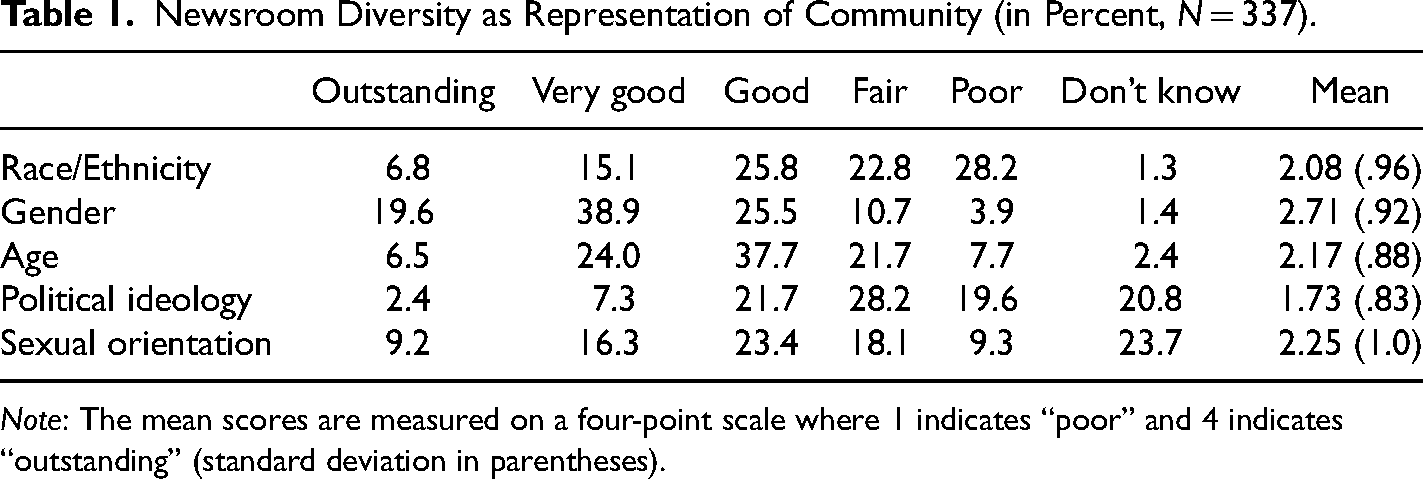
Note: The mean scores are measured on a four-point scale where 1 indicates “poor” and 4 indicates “outstanding” (standard deviation in parentheses).
Interestingly, about 21% of public broadcasters say they “don’t know” how well their newsroom's attitudes reflect the political makeup of their community. Since it is easy to learn about a community's political distributions by examining election returns or voter registration databases, the fact that one in five public broadcasters do not know how well their newsroom reflects their community suggests a lack of information about their colleagues’ politics. This might indicate that even though most public broadcasters in this study say they lean Democratic, a significant percentage may keep those beliefs private. Such a decision would confer some credibility on these journalists (and public broadcasting as a whole), as it suggests that journalists holding any bias toward left- or right-leaning political ideas may choose not to broadcast them.
Newsroom representation for sexual orientation and age is rated somewhat higher, but with still less than one-third (30.5%) of public media journalists saying their newsroom is either “very good” or “outstanding” when it comes to age diversity and about one-quarter (25.5%) saying the same for sexual orientation. Similar to the high level of perceived uncertainty about political leanings in the newsroom, nearly one-quarter (23.7%) of public broadcasters say they “don’t know” how well their newsroom reflects their community's sexual orientation.
However, public journalists generally appear happy with the gender breakdown in their newsrooms, which, as shown earlier, appears to be a nearly 50–50 split between men and women. Almost six in 10 journalists (58.5%) rate their newsroom's gender representativeness as either “outstanding” or “very good.”
As seen in Figure 1, most public broadcasters with fewer than 10 years in the profession are women, including 72% of those in their first five years in the job. However, men continue to stay in public broadcasting longer than women, making up an increasing majority of public broadcasters in most 5-year increments past 10 years of experience.
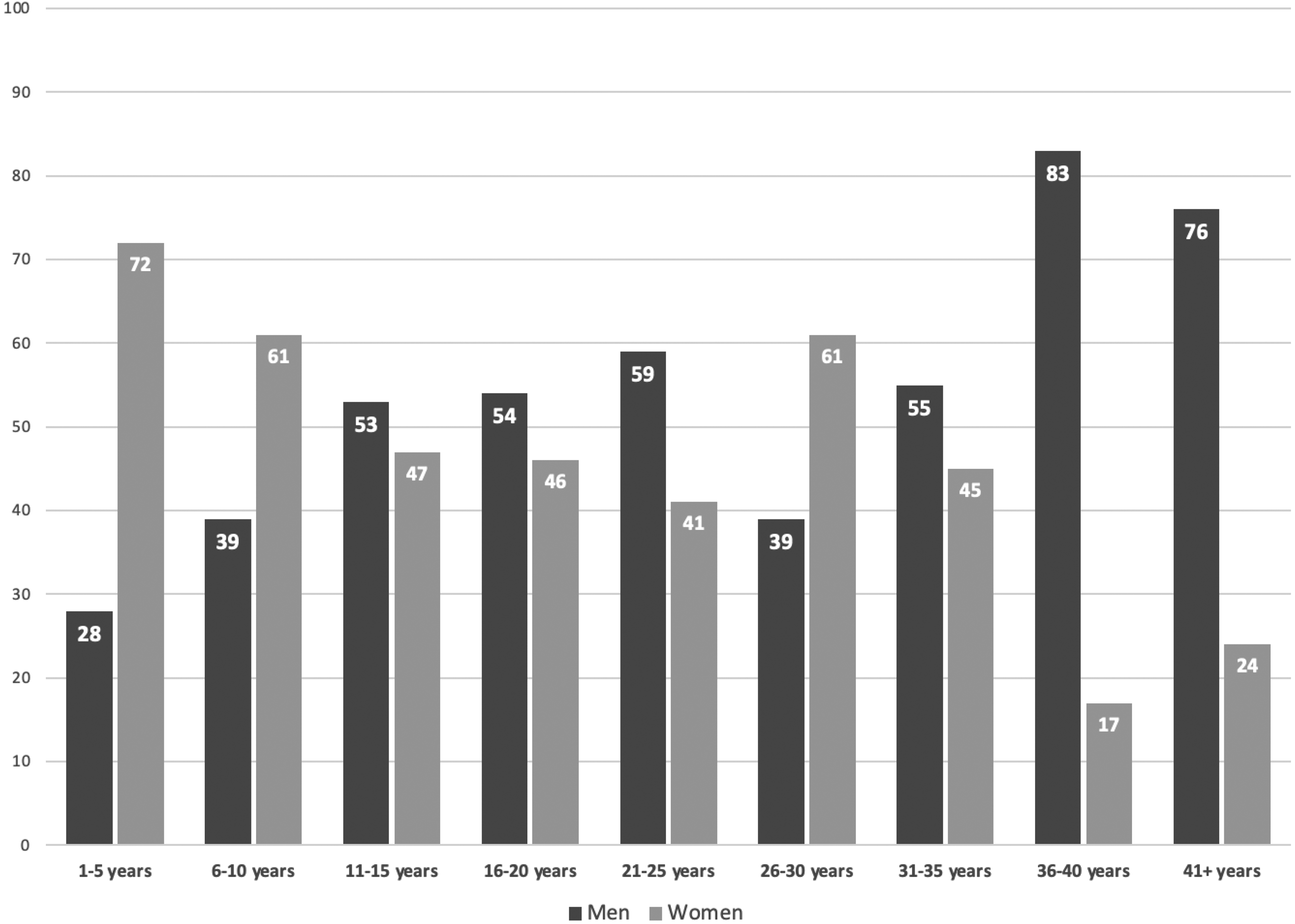
U.S. Public Media Journalists’ Years in Journalism by Gender (N = 394).
A separate regression analysis (not shown) of factors that might influence how long public journalists stay in their jobs suggests that for both men and women being married (b = .21, p < .001 for men and b = .18, p < .01 for women) and having higher income (b = .34, p < .001 for men and b = .36, p < .001 for women) correlates positively with remaining in journalism. This suggests that—for both men and women—the length of time journalists stay in their jobs is more likely to be influenced by financial rather than personal decisions.
Journalistic Roles
We argued earlier that public media journalists should be more likely to endorse the interpretive and populist-mobilizer function rather than the adversarial and disseminator function. To ensure the various journalistic roles tested in this study cluster around broader journalistic “functions,” we performed a factor analysis. As seen in Table 2, the observed patterns of correlations among the 15 roles coalesce similarly for public and commercial journalists into the interpretive-watchdog, the disseminator, the adversarial, and the populist-mobilizer function—as they have done in previous studies of U.S. journalists for the past 40 years (Willnat et al., 2019). We therefore feel confident that we can compare the prevalence of these four functions among the public media journalists in our sample.
Factor Analysis of Role Perceptions Among U.S. Public Media Journalists (N = 394).
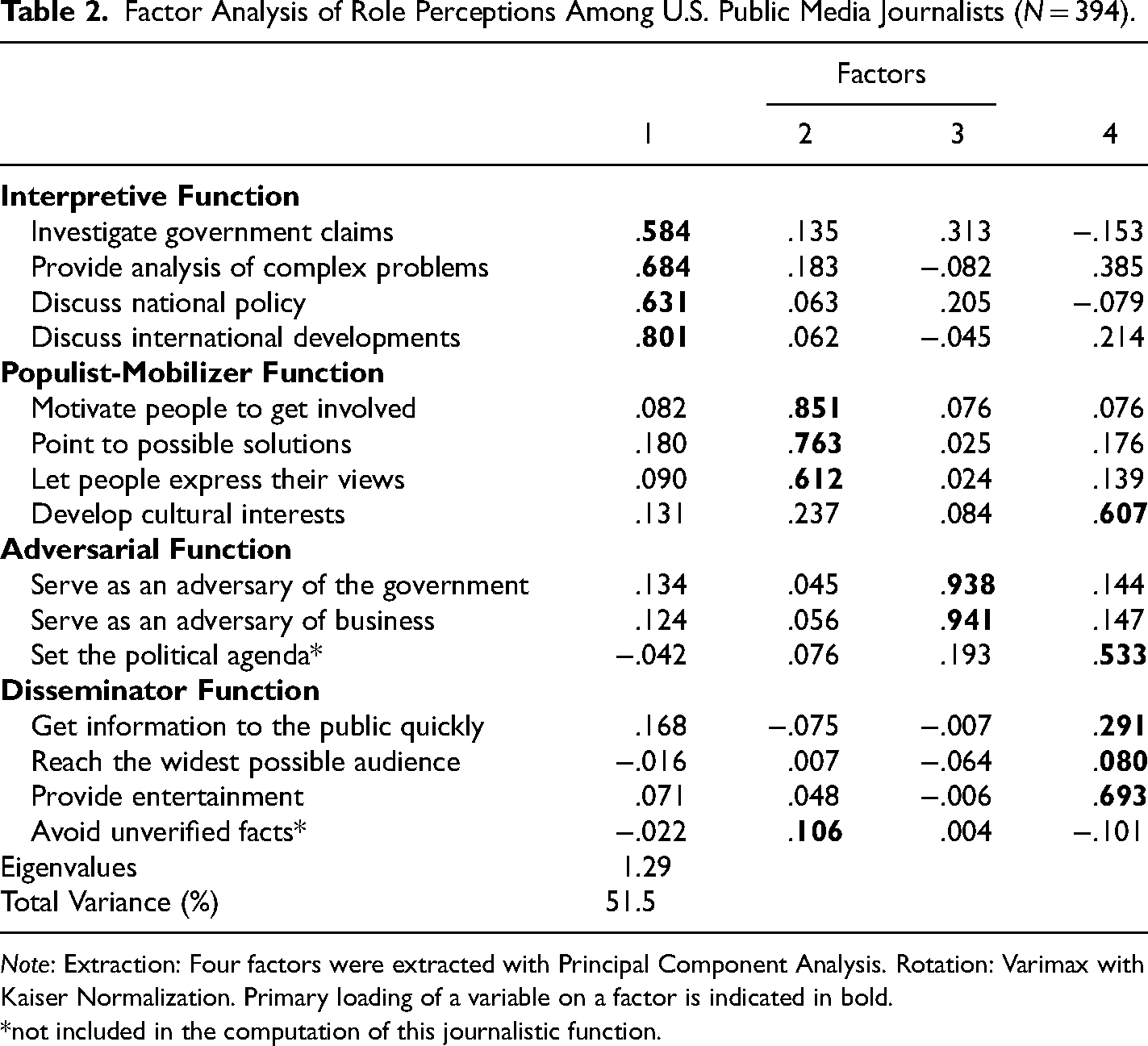
Note: Extraction: Four factors were extracted with Principal Component Analysis. Rotation: Varimax with Kaiser Normalization. Primary loading of a variable on a factor is indicated in bold.
not included in the computation of this journalistic function.
Overall, the findings indicate that public journalists primarily support the interpretive and populist-mobilizer functions rather than the adversarial or disseminator functions. As shown in Table 3, the overall means of the question sets measuring the interpretive (M = 3.43) and populist-mobilizer function (M = 2.97) are significantly higher than the means for the disseminator (M = 2.51) and adversarial (M = 1.66) functions.
Perceived Journalistic Roles of U.S. Public Media Journalists (in Percent, N = 394).
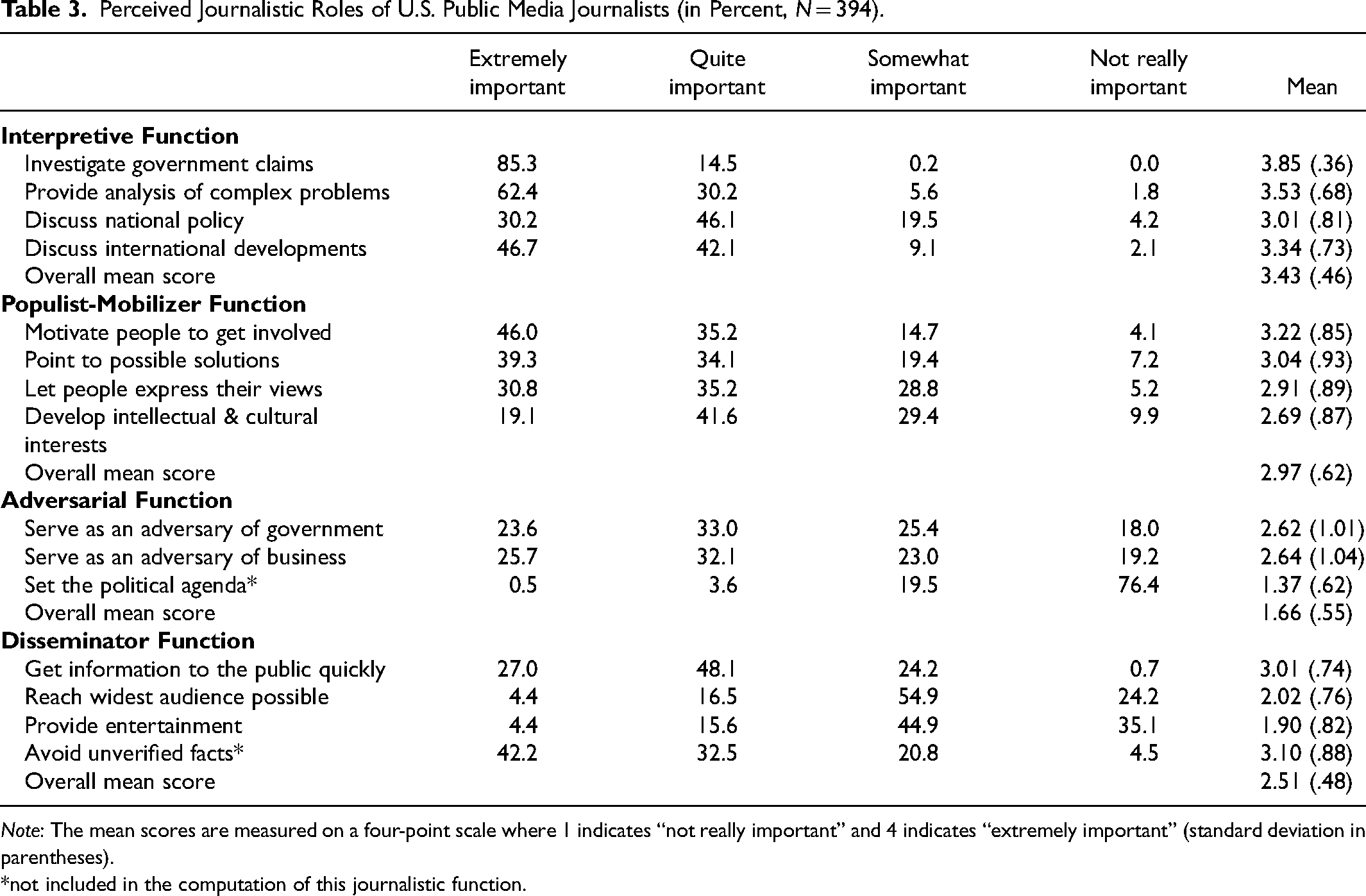
Note: The mean scores are measured on a four-point scale where 1 indicates “not really important” and 4 indicates “extremely important” (standard deviation in parentheses).
not included in the computation of this journalistic function.
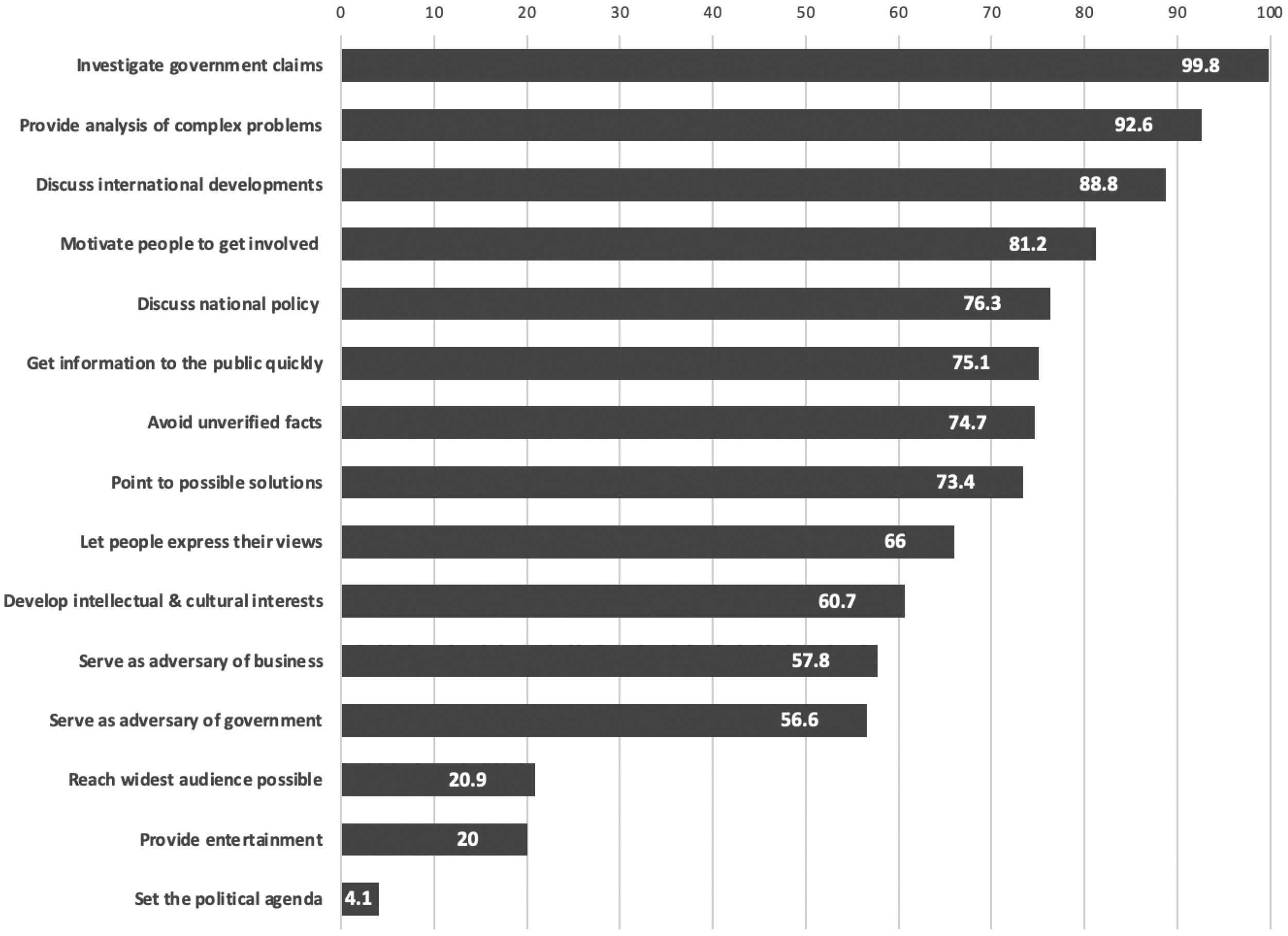
A closer look at the individual roles reveals that the majority of public journalists endorse the media's interpretive function by believing that it is either extremely or quite important to “investigate government claims” (85.3%) and “provide analysis of complex problems” (62.4%). And, though fewer public broadcasters believe them to be “extremely important,” sizable majorities still find discussing national (76.3%) or international policy (88.8%) at least “quite important.”
Similarly, the majority of public journalists endorse the media's populist-mobilizer function by saying that it is either extremely or quite important to “motivate people to get involved” (81.2%), “point people to possible solutions” (73.4%), “letting people express their views” (66%), and “develop cultural interests” (60.7%) through their work.
Less support was found for the roles comprising the adversarial and disseminator functions. In terms of being adversarial, only a slim majority of journalists find it extremely or quite important to serve as an adversary of the government (56.6%) or business (57.8%). And more than three-fourths (76.4%) say it is “not really important” to set the political agenda. Regarding the disseminator function, only about 21% of respondents find it either extremely or quite important to reach the widest possible audience, and just 27% say it was extremely important to get information to the public quickly.
Little support was found for setting the political agenda, which only about one-quarter of public media journalists (23.6%) find extremely or quite important. Similarly, only a small percentage of journalists find “reaching the widest possible audience” (20.9%) or providing entertainment (20%) to be extremely or quite important.
Public Media and Democracy
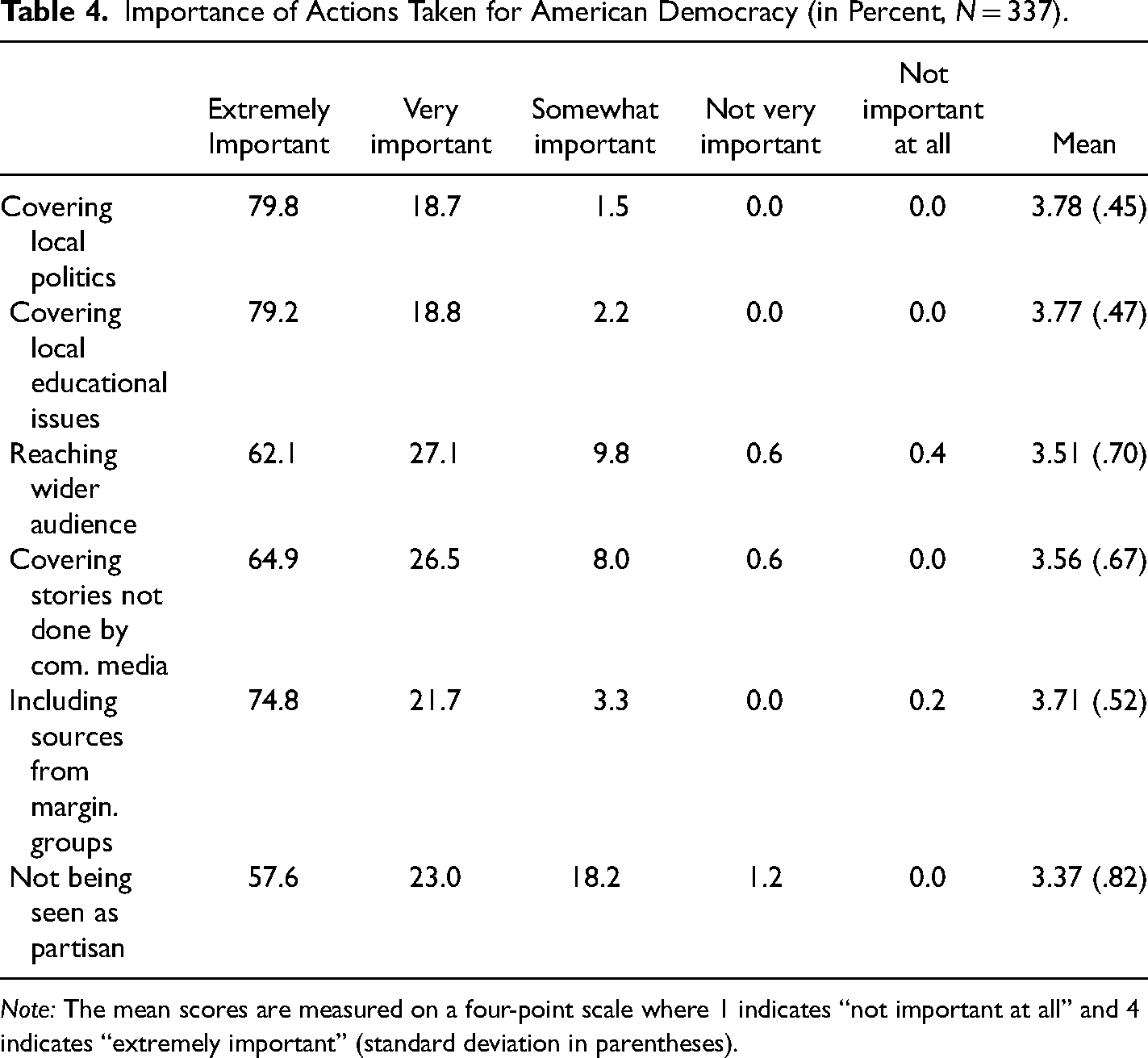
Finally, public media journalists were asked a separate set of questions about how they feel their industry specifically can bolster democracy in the United States. These questions are salient in a post-Donald Trump era where powerful political and business interests feel comfortable scapegoating journalists for scrutinizing the decisions made by those in power. As shown in Table 4, a majority of public media journalists find all six of the listed actions “extremely important” to preserving democracy in the United States. Two of these—coverage of local politics and education issues—relate to specific news coverage areas that affect large swaths of the public. That eight in 10 public media journalists (79.8%) consider the coverage of local politics “extremely important” supports studies showing that more local reporting leads to more competitive political races and higher voter turnout (Rubado & Jennings, 2020).
Importance of Actions Taken for American Democracy (in Percent, N = 337).
Note: The mean scores are measured on a four-point scale where 1 indicates “not important at all” and 4 indicates “extremely important” (standard deviation in parentheses).
About three in four (74.8%) public media journalists also say it is “extremely important” to include more sources from marginalized groups in news stories. This aligns with public media employing a slightly higher percentage of journalists who are persons of color (21.9%) than do commercial newsrooms (17.6%), as well as with our finding that public broadcasters of color are about 5% more likely (78.4–73.7%) than their white colleagues to rate this as an important action in democracy preservation (Jastrzebski & Willnat, 2023).
As previous studies have shown, public media consumers seek out non-commercial outlets primarily because “NPR engages their mind in a more positive way than other media does” (NPR & Edison Research, 2021). This might explain why public media newsrooms are interested in differentiating themselves from commercial news sources. It thus makes sense that almost two-thirds of those polled (64.9%) say it is “extremely important” to democracy that public media create different stories than commercial media.
Despite the criticism that public journalists tend to be liberal, only a slight majority (57.6%) say it is “extremely important” for public media not to be seen as partisan. This may reflect a shift away from traditional journalistic norms, such as a push for “objectivity,” which is now largely seen either as more of a performative act (Boudana, 2011) or a “myth” (L. R. Wallace, 2019).
Discussion
This study is the first to measure the attitudes of U.S. public media journalists using a representative sample. It finds that U.S. public broadcasters tend to be younger, more liberal, and more likely to be female than their commercial counterparts. They are also slightly more likely to be people of color. However, U.S. newsrooms still have much work to do before they approach parity with national population trends, and public broadcasters say they need to include more sources from underrepresented groups in their stories.
There is some evidence these numbers result from hiring practices changing to employ more women and minorities in recent years. For instance, a report that collected data from 110 media studies (Chancellor et al., 2021) shows women's employment in TV newsrooms hit an all-time high in 2019 and details how collective bargaining between the union representing NPR reporters demanded a workforce more representative of the national demographics in the United States. In fact, NPR and its nonprofit investigative reporting partner ProPublica both reported female-majority newsrooms.
As expected, public broadcasters value their work and its role in preserving American democracy. While they, like other journalists, believe journalism in the United States is going in the wrong direction, they believe their work serving as a watchdog over local government, covering education issues, and doing stories not done by commercial broadcasters are among the ways they can best serve as democratic protectors.
As shown in Figure 2, a hierarchical rendering of support for journalistic roles consistently sees those aligned with the interpretive and populist-mobilizer functions rise to the top, with most receiving support from at least three-fourths of journalists. The fact that pluralities of the public media journalists polled indicate the highest possible support for “motivating people to get involved” and “pointing to possible solutions” suggests a definitive direction for those in the profession today: helping their public take part in stories (similar to the “civic journalism” movement of the 1990s) and providing enough guidance that actions taken by the public might help remedy issues (evoking the newer vanguard of “solutions journalism”). Thus, instead of seeing themselves as enemies of powerful, moneyed interests, public journalists prefer to provide information to the public, which may help listeners and viewers more easily interpret their circumstances and, if they choose, act to either preserve or change them.
Journalistic Role Perceptions Among U.S. Public Media Journalists (N = 394). Note: Percent of public media journalists who said this role was either “extremely important” or “quite important.”
But the “public” in “public media” remains paramount. A donation-based service does not help explain less support for the disseminator function, but prioritizes news consumers as U.S. public media forwards the populist-mobilizer role. Since commercial media must seek ratings and engagement to charge higher advertising rates, dissemination is of the utmost importance. On the other hand, the public media's main revenue source comes from donations by audience members who contribute because they support the organization's public service mission.
And while newsrooms in the United States may want to change themselves to represent their communities better, they appear agreeable to the audience they already have. While most journalists say it is extremely important for the furthering of American democracy that public media reach a “wider” audience, only a small minority places the same importance on reaching the “widest possible” audience. This suggests that public journalists believe they know their target audience and accept the fact that they do not have to reach all news consumers.
They also appear to know that their workforce can serve that audience better by becoming ever more diverse (though, as a group, they are more representative than commercial journalists). Our findings indicate that more than one in five public broadcasters identify as belonging to a minority group, which compares favorably to previous studies that found somewhat lower percentages of minorities among commercial journalists (Willnat et al., 2019). If public media newsrooms are, as the data show, more diverse in terms of race and gender than commercial newsrooms, there may be reasons to believe they are also more welcoming to people of different backgrounds.
The large percentage of “don’t know” responses for how well public media newsrooms represent their communities is worthy of more study. Nearly one in five journalists say they do not know how well their newsroom represents their community politically. This speaks to the fact that, even though public broadcasters admit they are liberal, they may not broadcast that fact in the newsroom or through their work. Since it is easy to find out a community's politics by examining voting records or political party registrations, the only axis public broadcasters might not know about is their colleagues’ politics. This should help shield public media from critics who lambast it as liberal propaganda.
Moreover, if reporters are not making their political views known through their reportage or conversations with colleagues, and a majority (57.6%) of all public broadcasters say it is extremely important for public media not to be seen as partisan, then it stands to reason the audience is getting a product that is not unfairly slanted. Future studies could interrogate whether this is, in fact, a driving factor in determining the content of public media news stories.
Almost four in 10 public broadcasters in our study also were uncertain about how well their newsrooms reflect their community's sexual orientation. For obvious reasons, it is much harder to learn about a particular community's sexuality than the same group's voting patterns, so establishing a baseline may be difficult. Consequently, further studies about how comfortable public broadcasters feel disclosing their sexuality (and other personal details) could prove helpful in establishing how welcoming or open public media newsrooms are to those who wish to join the profession.
More research should also be done on how public broadcasters generate knowledge of their community or remain connected to it, which would yield a clearer picture of whether these journalists’ perceptions of their connectedness are accurate. The journalists themselves also appear to crave this knowledge, judging by the responses to an open-ended question in the survey asking journalists what steps can be taken to protect U.S. democracy from the threats facing it today: nearly 20 public broadcasters suggested more community engagement as a strategy.
This study also suggests that future work could assess whether any link exists between public media's current storytelling and other action-focused reporting models. One might be the turn-of-the-century tradition of “civic journalism,” which saw newspapers begin to host public forums and use feedback from readers as the basis for questions posed to leaders. This suggested a way for journalists to go beyond their Fourth Estate role and serve as a driver of public conversation and public action. Another template may be found in the more recent conception of “solutions journalism,” wherein stories are seen as successful if they assess a problem and propose some sort of remedy.
Future work could also focus on determining whether there are attitudinal differences between broadcasters working for national organizations such as NPR and PBS and those working for member stations (which are not run by the national organizations, even if they air their programming). Such studies could delve deeper into whether the resources offered to journalists at each type of newsroom color their thoughts on the kind of work that needs to be produced and which roles each type of work most often serves to enact.
Finally, we would like to acknowledge the limitations of this study. First, the insights of this study are limited by the general nature of surveys, which rely primarily on closed-ended questions. More long-form answers could be gathered through semi-structured interviews, and these responses would gain additional currency when paired with content analyses of U.S. public broadcasters’ work. Some of those questions could compare commercial and public broadcasters’ views about their motivations for practicing journalism, specifically how money drives these actions. While previous studies have investigated how profit motives drive news decisions, finding out how public media newsrooms sidestep these pressures may serve as a lesson for all journalists in a workspace shrunken by media consolidation.
However, as public media outlets in the United States continue to expand their staffs, more money is being allocated to support non-profit news (e.g., American Journalism Project, 2024). Learning how these wells of cash are being mined could shed more light on the importance public media consumers place on their news sources and the people doing the reporting—a loyalty that many commercial outlets would likely envy.
Finally, the findings also suggest U.S. public journalists may be due for a reclassification in the field theory literature since, in our intra-media reconsideration of Bourdieu's typology, only commercial journalism embodies Bourdieu's tenets of journalism (low autonomy, large amounts of money, work lacking in prestige, and large-scale production). This suggests that future research could develop and adopt new definitional terms, allowing for the study of U.S. public media as distinct from commercial news.
Footnotes
Declaration of Conflicting Interests
The author(s) declared no potential conflicts of interest with respect to the research, authorship, and/or publication of this article.
Funding
The author(s) disclosed receipt of the following financial support for the research, authorship, and/or publication of this article: This work was supported by the John Ben Snow Research Foundation.
i.
We note here that a journalist's political orientation does not necessarily imply their stories will reflect the same positionality (Hassell et al., 2020), which might explain why trust in public media has remained so high for the past two decades (PBS, 2022). We define the terms “liberal” and “conservative” in relation to these two American political parties to separate our definition from broader conceptions that are often grounded in political ideologies. Feldman (2013), for example, defines left-wing ideologies such as socialism to be “based on the values of equality, social justice, and widespread involvement in the political system” (p. 594) and right-wing ideologies—including nationalism and fascism—as those that “emphasize social control and unequal influence over political and economic systems” (p. 594). Since the United States is neither a socialist nor a fascist nation, we align political beliefs with the two dominant U.S. parties. In so doing, we follow a rich tradition of literature about the U.S. media, which equates “liberal” and “conservative” attitudes with being “Democratic” and “Republican,” respectively (e.g., Garrett et al., 2021; Hmielowski et al., 2020; Lee & Hosam 2020).
ii.
 and PBS offices were not sampled in full in part because of the large resource differences between these national organizations and many member stations that air their programming. Because resource availability plays an integral role in news coverage decisions, the researchers felt it important to focus mostly on responses from member stations but did not want to exclude national journalists from the sample.
iii.
Because both commercial and public media journalists received the same questionnaire (except for a series of questions on the performance of U.S. public broadcasting), this move of respondents from the main to the public sample does not affect the statistical analyses nor does it significantly impact the representativeness of each sample.