




Abstract
There exists an increased focus on school mathematics, especially first-year algebra, due to recent efforts for all students to be college and career ready. In addition, there are calls, policies, and legislation advocating for all students to study algebra epitomized by four rationales of the Algebra for All movement. In light of this movement, there must be a clear consensus about what is taught in the name of algebra. Yet, researchers documented this is not the case. The present research proposes to unify the leading algebra standards and assessment framework documents to identify the key ideas of algebra. The analysis resulted in six key ideas: (a) Variables, (b) Functions, (c) Patterns, (d) Modeling, (e) Technology, and (f) Multiple Representations. Outlined is the research process and resulting unification of existing algebra framework documents, and consideration is given for its uses in educational policy regarding algebra and potential directions for future research.
To the casual observer, algebra might appear to be a stalwart of the school curriculum, and in many respects, it is. But . . . school algebra has varied in the content taught, the purposes for which it has been included, and the students to whom it has been offered.
In recent years, there have been efforts to ensure that K-12 students are college and career ready. The call for all students to obtain these goals has meant more focus on mathematics, especially algebra, at the policy level. Historically, perspectives on the understanding and teaching of algebra have taken on many forms. The present article unifies the leading standards and assessment framework documents to identify the key ideas of algebra.
Over the last three centuries, the study of algebra evolved from not being a part of high school or college curricula to being a requirement for students graduating from high school (Chazan, 2008; Kilpatrick & Izsák, 2008). Courses in algebra first appeared in North American colleges and universities during the 18th century. In the 19th century, these same institutions made algebra an admission requirement. Prior to this, algebra was included in the school curriculum for vocational purposes because of its connections to surveying and navigation (Overn, 1937). As a result, algebra was a part of the secondary school curriculum for both practical and academic reasons. 1
Since the inclusion of algebra in the school curriculum, there has been fluctuation in the proportion of students taking algebra (Angus & Mirel, 2003). With the increase in high school enrollment in the United States during the first half of the 20th century, the number of students studying algebra initially increased (Jones & Coxford, 1970). However, when students were not successful in algebra and schools became vocationalized, enrollment in the course decreased (Angus & Mirel, 2003; Jones & Coxford, 1970). In the last quarter of the 20th century, with increased requirements for graduation and a decreased emphasis on preparation for vocational careers, this trend reversed and the number of students taking algebra grew (Angus & Mirel, 2003; Campbell, Hombo, & Mazzeo, 2000). Presently, there are calls, policies, and legislation advocating for all students to study algebra epitomized by the Algebra for All movement (American Diploma Project [ADP], 2004; College Board, 2000; No Child Left Behind Act [NCLB], 2001).
In light of this Algebra for All movement, there must be a clear consensus about what is taught in the name of algebra. Yet, this is not the case. School algebra has been taught from different perspectives often reflecting the political climate of the time. Current researchers also document the inconsistency in what it means when a student studies algebra due in part to the implications of the Algebra for All movement (Cogan, Schmidt, & Wiley, 2001; Schmidt, 2002, 2009; Stein, Kaufman, Sherman, & Hillen, 2011a, 2011b; Waterman, 2010). In response to these disparities, there are calls to identify the key ideas and concepts that students should learn in algebra (Arbaugh et al., 2010; RAND Mathematics Study Panel, 2003; Schmidt, 2002; Stein et al., 2011a).
Consistency in algebra is needed because it is viewed as the gatekeeper course to advanced mathematics and science coursework in secondary and postsecondary education (Moses & Cobb, 2001; RAND Mathematics Study Panel, 2003). Despite the importance of the course, there is variation in what is taught in an algebra course (Cogan et al., 2001; Stein et al., 2011a, 2011b; Waterman, 2010). This inconsistency exacerbates the achievement gap in historically marginalized groups and results in a need to advance the Algebra for All movement (Cogan et al., 2001; Gammoran, 1987; Moses & Cobb, 2001; Paul, 2005). In response, researchers called for consistency in the essential key ideas that constitute an algebra course (Arbaugh et al., 2010; RAND Mathematics Study Panel, 2003; Schmidt, 2002; Stein et al., 2011a). Identifying the key ideas of algebra is the necessary first step to ensure that what is taught in the name of algebra results in topic rigor, regardless of the textbook used, name of the course, and when the course is taken (preferably in eighth or ninth grade; Schmidt, 2002).
Algebra is also typically the initial course for an advanced mathematical course sequence and provides the foundational knowledge needed for proceeding mathematics courses (RAND Mathematics Study Panel, 2003) and computer technology (Moses & Cobb, 2001). Enrolling in this course impacts students’ future opportunities; students who have not completed algebra and geometry by their junior or senior year have limited options for postsecondary education (College Board, 2000). Researchers indicated that taking algebra in eighth or ninth grade leads to increased college enrollment (Pelavin & Kane, 1990; Spielhagen, 2006a, 2006b) and increased achievement (Gammoran & Hannigan, 2000). Therefore, a rigorous course in algebra is considered a gatekeeper course because it strongly influences admission into postsecondary studies and careers.
The purpose of the present study is to address the aforementioned calls to unify first-year algebra (henceforth referred to as algebra). Specifically, the present article addresses the following question: What are the key ideas of algebra in the leading standards and assessment framework documents? In what follows, the authors describe the background and arguments in support of the Algebra for All movement, provide a rationale for the need to unify algebra, outline the research process and resulting unification of existing algebra frameworks, and consider its uses in educational policy regarding algebra.
Algebra for All
Approximately two decades ago, only students who planned to attend college would take algebra (Chazan, 2008; RAND Mathematics Study Panel, 2003). Since then, policymakers made suggestions about the mathematics courses that high school students should be required to take, with particular recommendations for all students to take algebra. For instance, in its education reform initiative, the College Board (2000) advocates that districts require all students to complete a rigorous well-designed algebra course by the end of ninth grade. Similarly, the ADP (2004) proposes that, instead of needing a certain number of years of mathematics coursework, high school students must successfully complete specific courses starting with algebra. In making recommendations for research and development in mathematics education, the RAND Mathematics Study Panel (2003) acknowledges that such programs should be grounded in the critical content areas of mathematics. This panel chose to focus its recommendations in the area of algebra noting that such initiatives could empirically contribute to the discussions surrounding the implications of Algebra for All movement.
There are four factors that have been used to justify the argument that all students should study algebra: (a) global competitiveness of the United States, (b) equitable opportunities for students, (c) the incorporation of algebraic thinking in the K-12 mathematics curriculum, and (d) high-stakes assessments (RAND Mathematics Study Panel, 2003). In the subsequent sections, each rationale is described in more detail.
Global Competitiveness of the United States
In the United States, mathematics education is considered a crucial factor in the nation’s supremacy. At critical junctures in history, such as wars and economic crises, the quality and rigor of American mathematics curricula were the focus of debate (Schoenfeld, 2004). For example, in response to the economic crisis in the 1980s, the National Commission on Excellence in Education (1983), created by the U.S. Secretary of Education at that time, wrote the report A Nation at Risk which opens ominously: “Our Nation is at risk. Our once unchallenged preeminence in commerce, industry, science, and technological innovation is being overtaken by competitors throughout the world” (p. 5). This view was exacerbated by the shrinking pool of qualified applicants for the increasing number of jobs requiring the study of postsecondary mathematics (Madison & Hart, 1990), by the poor mathematics performance of American students on the Second International Mathematics and Science Study and the Third International Mathematics and Science Study (McKnight et al., 1987; Schmidt, McKnight, Cogan, Jakwerth, & Houang, 1999), and by comparisons of American and international curricula that show U.S. students are essentially a year behind their international counterparts by age 13 (Greene, Herman, & Haury, 2000).
Algebra plays a critical role in this conversation. “Algebra occupies a special place among the various domains [of mathematics] because it is more than a topical domain. It provides linguistic and representative tools for work throughout mathematics” (RAND Mathematics Study Panel, 2003, p. 48). A foundation in algebra enables one to solve problems by modeling, evaluate quantitative relationships, and express and justify generalizations. A variety of professions and a knowledgeable and informed citizenry now require these skills, once only relevant for jobs requiring a strong mathematical background (RAND Mathematics Study Panel, 2003).
Equitable Opportunities for Students
In addition to improving the mathematical proficiency of students, the differences in proficiency between various groups in the U.S. must also be addressed (RAND Mathematics Study Panel, 2003). For example, on the National Assessment of Educational Progress (NAEP), the gap in mathematics scores between White students, and Black and Hispanic students, and students eligible and not eligible for free or reduced lunch still persists (National Center for Education Statistics [NCES] 2009, 2011). With its Equity Principle, the National Council of Teachers of Mathematics (NCTM; 2000) “challenges the pervasive societal belief in North America that only some students are capable of learning mathematics” (p. 12) and argues that all students can and must learn mathematics (National Research Council [NRC], 1989).
Due to the importance of algebra as both a mathematical domain and a school subject, algebra emerged as the gatekeeper course, which determines whether or not a student has access to advanced-educational and career opportunities (Moses & Cobb, 2001). Researchers found that students benefit from taking algebra with respect to achievement (Gammoran & Hannigan, 2000) and college enrollment (Pelavin & Kane, 1990; Spielhagen, 2006a, 2006b). However, historically students of color and economically disadvantaged students were underrepresented in algebra courses (Gammoran, 1987). Furthermore, tracking policies result in watered-down mathematics curricula for many students, especially students from underrepresented populations, limiting their prospects (Cogan et al., 2001; Paul, 2005). “This curtailment of opportunity falls most directly on groups that are already disadvantaged and exacerbates existing inequities in our society” (RAND Mathematics Study Panel, 2003, p. 47). Therefore, Moses and Cobb (2001) argued that algebra is the gatekeeper not only for educational and career opportunities but also for citizenship and should be considered the new civil right.
Algebraic Thinking in K-12 Mathematics
The call for all students to take algebra extends far beyond the single course and has implications for the K-12 mathematics curriculum. Kaput (2000) states, “algebra reform is the gateway to K-12 mathematics reform” (p. 1) and promotes the incorporation of algebraic thinking in all grade levels, algebrafying K-12 mathematics curricula. The NCTM (1989) Curriculum and Evaluation Standards was the first national standards document that included algebra for Grades K-12. The document included patterns and relationships standards for kindergarten to Grade 4, patterns and function standards and algebra standards for Grades 5 to 8, and algebra and functions standards for Grades 9 to 12. The revised NCTM (2000) standards addressed algebraic thinking by incorporating an algebra content strand in all Pre-K-12 grade bands in the Principles and Standards for School Mathematics (PSSM). Similarly, algebraic thinking is integrated into the Common Core State Standards (CCSS) in Mathematics (National Governors Association Center for Best Practices [NGA] & Council of Chief State School Officers [CCSSO], 2010a) for kindergarten to Grade 5. The development of algebraic thinking throughout the elementary and middle grades prepares students for a formal course in algebra (Kilpatrick & Izsák, 2008; Spielhagen, 2006a).
High-Stakes Assessments
With the passing of the NCLB (2001), assessment extends beyond the classroom teacher or the school (Chazan, 2008). Under NCLB, each state
shall have . . . academic standards for all public elementary school and secondary school children . . . including at least mathematics, [and] reading or language arts . . . which shall include the same knowledge, skills, and levels of achievement expected of all children [and assessments that align with these academic standards]. (p. 1445)
Although the statute does not specifically address algebra, standards such as the CCSS in Mathematics include algebra standards (NGA & CCSSO, 2010a). Therefore, students must enroll in algebra and demonstrate competency in this area on high-stakes state assessments, including assessments aligned with the CCSS. Whereas students could previously complete their K-12 education without taking algebra, presently students in a majority of the states are required to demonstrate proficiency in algebra as a prerequisite for graduating high school (Chazan, 2008).
Need to Unify Algebra
The focus of the Algebra for All movement centers on who should study algebra and when (Stein et al., 2011a, 2011b). In addition, there is considerable debate about, and variation in, the perspective from which mathematics is taught. Historical events, organizations, and the current political climate of the time influence the pendulum swings in thinking about mathematics (Richardson & Eddy, 2011). For instance, during most of the 1800s, the first half of the 20th century, and the early 1970s back-to-basics movement, algebra was viewed as generalized arithmetic with a focus on drill and repetition of algebraic processes and formulas and little emphasis on its practical value (Kilpatrick & Izsák, 2008). Whereas, the 1957 launch of Sputnik by the Soviet Union during the cold war (Schoenfeld, 2004) and the introduction of school mathematics standards (NCTM, 1989, 2000) in the last decade of the 20th century shifted the emphasis of algebra curricula from manipulation of symbols to a functions-based approach which supports and is supported by problem solving, conceptual understanding, and the integration of technology (Kilpatrick & Izsák, 2008).
Consistency of Algebra Content
In addition to the various changes in perspective with regard to school algebra throughout history, researchers found that there is a lack of consistency in the content that is taught in the name of algebra (Cogan et al., 2001; Stein et al., 2011a, 2011b; Waterman, 2010). In an analysis of the 1995 Third International Mathematics and Science Study with respect to eighth-grade mathematics, the researchers posed the following questions:
What, for example, does it mean for a student to study algebra? Does it mean that the student enrolls in a course entitled “Algebra”? Does it mean that the student uses an algebra textbook in the course? Can it mean either of these, or is a student studying algebra only when enrolled in an algebra course that uses an algebra textbook? (Cogan et al., 2001, p. 337)
Cogan et al. (2001) and others (Schmidt, 2002, 2009; Waterman, 2010) find that there are not consistent answers to these questions. In similar research regarding the teaching of algebra, Stein et al. (2011b) highlight the significance of the problem: “A confounding factor in this [policy] discussion is the variation in what constitutes an eighth grade algebra course in terms of the textbook used, and the skills and the concepts taught” (p. 15).
Using the Third International Mathematics and Science Study data, Cogan and others (2001) categorize eighth-grade mathematics courses into six types (remedial, regular, enriched, pre-algebra, algebra I, and geometry). In examining the content that the students study in these courses, they looked at the type of textbook used and content emphasized by the teachers. The analysis showed that “the type of textbook employed in a course has an impact on the structure of students’ learning opportunities beyond the differences attributable to the particular course in which the students are enrolled” (Cogan et al., 2001, p. 333). For example, teachers of algebra utilizing an algebra text dedicated more instructional time to equations, inequalities, formulas, slope, trigonometry, and interpolation and less instructional time to whole numbers, estimation, and number sense than those who utilized texts that did not align with the course. These differences exist both across tracks and within tracks (Cogan et al., 2001; Schmidt, 2009). In general, the mathematics content to which students are exposed in different courses, including algebra, cannot be determined with confidence (Cogan et al., 2001).
A study of the mathematics course sequence of students in their transition from eighth grade to ninth grade in nine school districts in California found similar results (Waterman, 2010). One of the major findings is that there were 27 different names for algebra. In addition, about 65% of the students taking algebra in eighth grade were put in algebra again in the ninth grade. Several possible explanations for this lateral movement include a discrepancy between eighth-grade and ninth-grade algebra despite the common name and a lack of understanding on the part of the teacher about the key ideas that constitute algebra. Schmidt (2002) calls upon policymakers to address the inconsistencies in students’ learning experiences:
Math education in this country could benefit greatly from the current trend of establishing educational standards, although in this case the standards needed first are not those for student achievement, but rather standards for course, textbook, and topic rigor. Expecting all students to pass algebra before graduation, for example, will mean little if algebra means one thing in Maine but something else in Arizona. (p. 6)
The development of the CCSS was an attempt to address this concern.
Universal Algebra Policies
Stein et al. (2011a) distinguish between two types of algebra course access. Selective policy involves some mechanism that restricts student access to algebra, whereas universal policy provides access to algebra for all students in eighth or ninth grade. Although there are advantages for students who take algebra under selective algebra policies, such as increased upper-level mathematics course enrollment and higher scores on measures of achievement, these benefits do not necessarily hold true under universal algebra policies. One of the challenges of universal algebra policies is that more unprepared students are taking algebra. However, achievement increased in contexts in which students with weaker mathematics backgrounds received extra support. Stein et al. also warn against false negatives; that is, situations in which students, who would not have taken algebra under selective policies, are tracked into a watered-down version of the course under universal algebra policies.
Underrepresented groups of students, economically disadvantaged students, and students with less educated parents continue to be underrepresented in algebra despite increases in eighth-grade algebra enrollment in recent decades (Loveless, 2008; Moses & Cobb, 2001; Stein et al., 2011a). Even though some students who take algebra are underprepared as evidenced by the increase in algebra enrollment in conjunction with a decrease in overall achievement of these students (e.g., Loveless, 2008), there exists a subset of students who are prepared for but not selected to take algebra, in particular students from historically marginalized groups (Stein et al., 2011a).
Stein et al. (2011a) propose, “the key for policy is to ensure that students receive instruction that both is geared to their needs and moves them toward commonly accepted standards for what it means to be competent in algebra” (p. 485). The present article addresses the need to unify the various characterizations of algebra.
Characterizing Algebra Versus Defining Algebra
Euler (1984) states, “Algebra has been defined, The science which teaches how to determine unknown quantities by means of those that are known” (p. 186). While this simple definition succinctly summarizes the essence of algebra, the definition does not characterize the essential elements of algebra; that is, the key ideas necessary to establish the consistent topic rigor in courses and textbooks as argued by researchers (Cogan et al., 2001; Schmidt, 2002; Stein et al., 2011a). Summaries of existing characterizations of algebra (or algebra frameworks) by various researchers and organizations are presented in the following section.
Existing Characterizations of Algebra
The existing characterizations of algebra serve two primary purposes: classroom instruction and assessment. Groups, such as NCTM (1989, 2000), RAND Mathematics Study Panel (2003), ADP (2004), NGA with the CCSSO (2010a), Texas Higher Education Coordinating Board (THECB) with the TEA (2008), and TEA (2012), recommend a coherent articulation of algebra across the K-12 curriculum for classroom instruction. 2 Characterizations of algebra for assessment purposes also exist. While some characterizations such as CCSS and Texas Essential Knowledge and Skills (TEKS) impact both classroom instruction and state assessments in mathematics, others are solely for assessment purposes. These national (NAEP) and international (Programme for International Student Assessment [PISA] and Trends in International Mathematics and Science Study [TIMSS]) assessments provide a snapshot of student academic achievement and include the algebra domain. The people/organizations, purpose, sources, and processes used in guiding the development of each of the characterizations of algebra are described in what follows.
Frameworks Informing Classroom Instruction
NCTM principles and standards
The PSSM (NCTM, 2000) has its origins in the Curriculum and Evaluation Standards for School Mathematics (NCTM, 1989) with its purpose to inform classroom instruction. The development of the 1989 standards document began in 1986 with the establishment of the Commission on Standards for School Mathematics. This commission had two charges:
1. Create a coherent vision of what it means to be mathematically literate both in a world that relies on calculators and computers to carry out mathematical procedures and in a world where mathematics is rapidly growing and is extensively being applied to diverse fields. 2. Create a set of standards to guide the revision of the school mathematics curriculum and its associated evaluation toward this vision. (NCTM, 1989, p. 1)
Four working groups (K-4, 5-8, 9-12, and Evaluation) drafted and revised the standards over the summers of 1987 and 1988. The NCTM membership reviewed the drafts and the end product was a document developed by consensus consisting of 54 standards for the development and evaluation of mathematics curricula. As part of the project, the commission also outlined four new educational goals for a mathematically literate society: “(1) mathematically literate workers, (2) lifelong learning, (3) opportunity for all, and (4) an informed electorate” (NCTM, 1989, p. 3).
The 2000 Standards document used the 1989 document, along with the Professional Standards for Teaching Mathematics (NCTM, 1991) and the Assessment Standards for School Mathematics (NCTM, 1995) as the foundation for creating the new standards document. Furthermore, the writing groups, which consisted of teachers, teacher educators, administrators, researchers, and mathematicians, utilized resources including instructional materials, state standards, research findings, existing policy, as well as similar international documents (NCTM, 2000). One of the notable changes in the document was that the goals for mathematical literacy were modified to emphasize that individuals need to know and understand mathematics (a) for life, (b) as a part of cultural heritage, (c) for the workplace, and (d) for the scientific and technical community. The work of revising the standards took place over three summers (1997-1999) and involved multiple levels of review and input. Fourteen Association Review Groups provided advice and guidance to revisions of the standards and nearly 30,000 paper copies, as well as online access, were provided to parties interested in reviewing the document. In all, 650 individuals and more than 70 groups submitted reactions to the draft. NCTM commissioned a panel of 25 experts to finalize the document.
RAND
The Office of Education Research and Improvement (now the Institute for Educational Sciences [IES]) commissioned the RAND report (RAND Mathematics Study Panel, 2003), Mathematical Proficiency for All Students: Toward a Strategic Research and Development Program in Mathematics Education. The underlying purpose for the RAND study panel was improving the mathematical proficiency of all students. The report outlines a three-pronged research agenda for mathematics: (a) developing teacher knowledge, (b) teaching and learning reasoning and problem solving, and (c) teaching and learning algebra in kindergarten through 12th grade. The study panel synthesized and reported the “expectations related to algebraic proficiency” (RAND Mathematics Study Panel, 2003, p. 44). While the report cited examples of sources for the synthesis of the characterization of algebra, such as NCTM (2000), ADP (2004), Learning First Alliance (1998), and state standards (e.g., California, Georgia, and Illinois), the description of the process lacked details for determining the characterization.
ADP
The ADP was a two-year project, supported by Achieve, Inc., The Education Trust, the Thomas B. Fordham Foundation, and the National Alliance for Business, with the purpose of establishing a connection between the secondary curriculum and postsecondary study and careers (ADP, 2004). In particular, K-12, postsecondary, and business leaders from five states (Indiana, Kentucky, Massachusetts, Nevada, and Texas) collaborated to develop benchmarks in Mathematics and English highlighting the skills necessary to be prepared for and successful in college and the workplace. To identify the benchmarks, a six-step process was utilized: define workplace expectations, secure input from employers on preliminary workplace expectations, define postsecondary expectations for credit-bearing coursework, synthesize the preliminary workplace and postsecondary expectations, convene content area expert and employer panels, and gather tasks and assignments from employers and postsecondary faculty (ADP, 2004).
CCSS
The NGA and the CCSSO (2010b) initiated the development of the CCSS. Two of the criteria underpinning the development of the standards were as follows: (a) They are inclusive of all learners, and (b) they must define the skills and knowledge necessary for success in college, the job market, and the global economy and society. Furthermore, the standards are used to create assessments of student achievement. With these purposes in mind, content experts, teachers, and researchers developed K-12 standards and college and career readiness standards, which were ultimately integrated into the K-12 standards. The writers of the standards utilized standards of high-performing states and countries, research-based learning progressions, expert feedback, and general public feedback in the form of approximately 10,000 comments to develop the CCSS. In addition, an advisory group, consisting of members from Achieve, Inc., ACT, the College Board, the National Association of State Boards of Education and the State Higher Education Executive Officers, provided assistance.
Texas College and Career Readiness Standards (TxCCRS)
The 79th Texas Legislature commissioned the creation of the TxCCRS (THECB & TEA, 2008). The purpose of the standards document was to align secondary and postsecondary education so that students are prepared for college and careers upon graduation. Similar to the reasons described by Achieve in initiating the ADP, the preparedness of high school graduates in Texas for college study was an issue (Commission for a College Ready Texas, 2007). The THECB and TEA appointed vertical teams, consisting of secondary and postsecondary instructors, for each of the content domains: English/language arts, mathematics, science, and social studies. The vertical teams created an initial draft of the TxCCRS; the process of their creation was not elaborated. The vertical teams compared the draft standards for mathematics and found alignment with national college and career readiness standards (Commission for a College Ready Texas, 2007). Furthermore, the draft standards were open to public comment, which was used to finalize the document (The Educational Policy Improvement Center [EPIC], 2009; THECB & TEA, 2008). After adoption of the TxCCRS, three validation studies were conducted to evaluate the alignment of the TxCCRS and entry-level general education courses at Texas postsecondary institutions, entry-level career and technical education college courses at Texas postsecondary institutions, and courses in nursing and computer programming. The results from each of the studies indicated a high level of alignment (EPIC, 2009).
TEKS
The purpose of the TEKS includes both informing classroom instruction and assessment of student knowledge. In 2010, the Texas Commissioner of Education initiated the revision process for the TEKS. The revised TEKS are considered a total overhaul of the former iteration. In particular, the higher academic standards and expectations as outlined in the TxCCRS in preparing students for success in the evolving workplace and the new and more rigorous state assessments were underlying influences on the revision process (TEA, 2011). In the crafting of the new TEKS, a group of 13 mathematics educators and mathematicians from Texas reviewed current research and resources such as standards from Massachusetts, Minnesota, and Singapore, the NCTM standards, the CCSS, the report of the National Mathematics Advisory Panel, the TxCCRS, and the Texas state assessments. The draft document went through several review iterations with feedback provided by a panel of national expert advisors, review committees, and the general public with the final version adopted in 2012.
Table 1 provides an overview of the algebra frameworks informing classroom instruction previously discussed. The various components indicate there may be some similarities between the frameworks, which would be expected since the development of many of them utilized similar documents and experts. Even national and international assessment frameworks used some of these documents in their creation. In the next section, there is a review of the assessment frameworks for NAEP, PISA, and TIMSS.
Algebra Frameworks Informing Classroom Instruction.
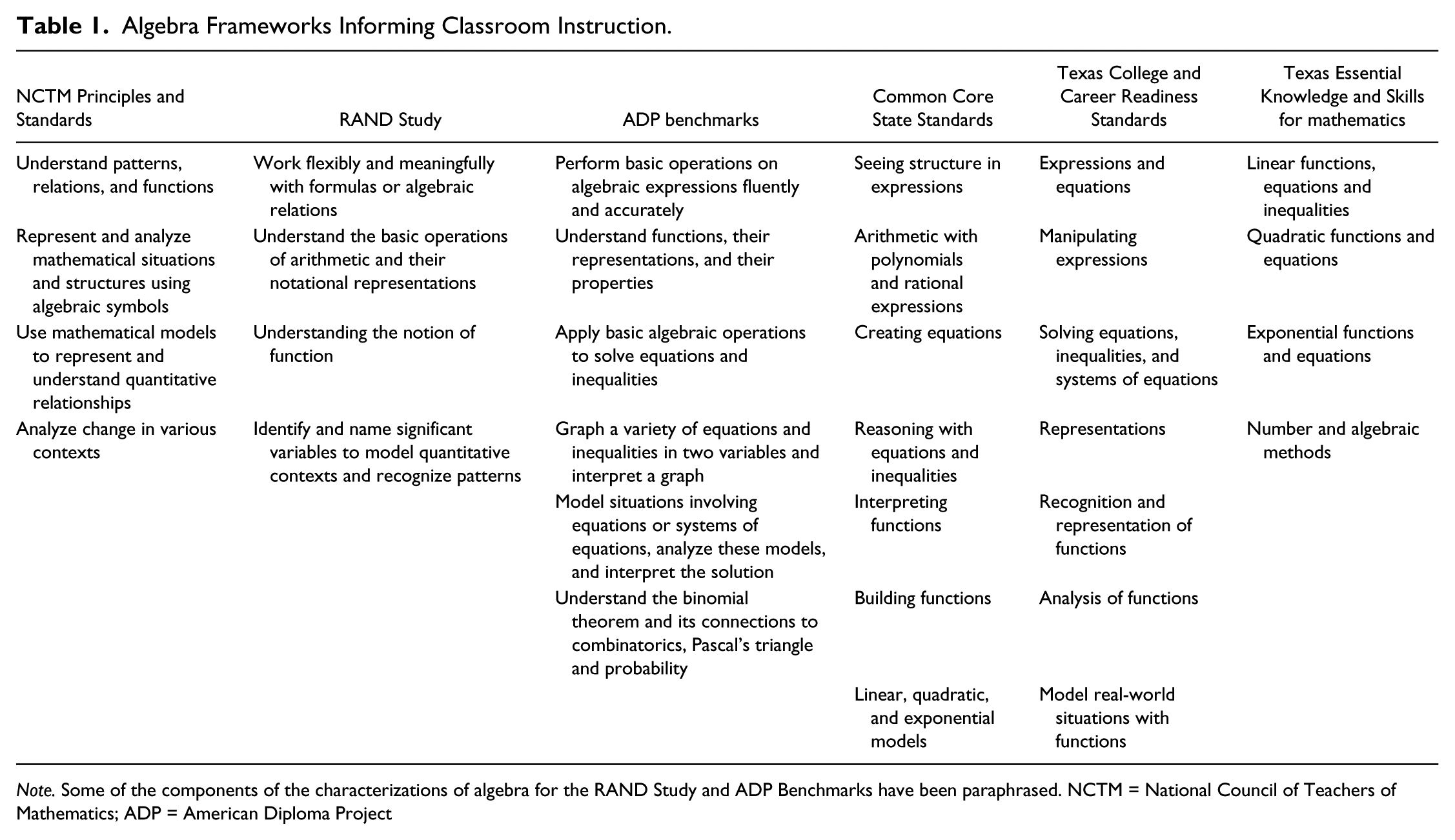
Note. Some of the components of the characterizations of algebra for the RAND Study and ADP Benchmarks have been paraphrased. NCTM = National Council of Teachers of Mathematics; ADP = American Diploma Project
Assessment Frameworks
NAEP
The NAEP has been conducted since 1969 with the first mathematics assessment administered in 1973 (NCES, n.d.). There are two strands of NAEP assessment, the Long-Term Trend Assessment NAEP and the Main NAEP (Mathematics series begun in 1990; NCES, 2013). The purpose of both versions of the NAEP is to evaluate education and its progress in the United States as it pertains to student achievement in mathematics and reading (as well as several other subjects). The Main NAEP tests students in Grades 4, 8, and 12 every 2 years and has a strand that focuses on algebra, with variables and relationships being a topic within that strand. For these reasons, the framework for the Main NAEP was utilized in the analyses in the present study.
A committee of experts, through consensus, determined the frameworks in the original plans for the NAEP. The Committee had a twofold charge: (a) to confer with teachers, administrators, school board members, and others concerned with education to determine the value of the project and (b) develop and evaluate “instruments and procedures for assessing the progress of education” (Tyler, 1966, p. 2). In 2000, the CCSSO revised the NAEP assessment framework for 2005 (NAGB, 2004). Similar to the previous NAEP framework, stakeholders such as policymakers, teachers, and professional organizations were involved in the process and utilized the most current standards documents such as the NCTM Principles and Standards. The revised framework maintained five content areas, one of which was algebra. An additional area within algebra, mathematical reasoning, was added for the 2011 NAEP (NAGB, 2010).
PISA
PISA, initiated in 1997, is an international assessment consisting of reading, mathematics, and science literacy. The PISA was developed in response to Organisation for Economic Co-Operation and Development (OECD) member countries’ expressed need for reliable data on student and educational system performance. Administered every three years to 15-year-old students, PISA is unique in that the purpose is not on knowledge and skills that students have mastered by a certain point in the school curriculum but on their ability to “make the well-founded judgments and decisions needed by constructive, engaged and reflective citizens” (OECD, 2013, p. 17). To construct the assessment, OECD defined each domain. The mathematics domain is defined in terms of students’ use of decision making, problem solving, and communication skills as they relate to actively participating in society, as opposed to just following a prescribed mathematical procedure to solve a problem.
To determine the mathematics content, PISA identified a set of overarching ideas rather than treating each topic in isolation (i.e., algebra, geometry, etc.). This approach aligns with the purposes of the assessment. Solving and understanding problems in a real-world context often requires the integration of more than one content strand. Furthermore, the overarching ideas represent the range of content included in various mathematics curricula and assessments across the world (OECD, 2009). The original iterations of the mathematics domain reflected the standards from Denmark and other Western European countries. With mathematics serving as the major domain for the 2012 assessment cycle, a new framework that also incorporated NCTM/NAEP perspectives was developed (J. Dossey, personal communication, November 2, 2012).
TIMSS
The TIMSS is an international mathematics and science assessment project overseen by the International Association for the Evaluation of Educational Achievement (IEA): an international cooperative comprising national education research institutions and governmental research agencies. The TIMSS is given every four years to fourth- and eighth-grade students. The purpose of TIMSS is to provide data for the improvement of teaching and learning in mathematics and science over time (Mullis, Martin, Ruddock, O’Sullivan, & Preuschoff, 2009).
The current TIMSS has its historical roots in the first and second Mathematics and Science Studies, which occurred between 1964 and 1984. In 1990, the IEA decided to assess mathematics and science in the same year, starting in 1995. New common frameworks were developed to address concerns about the structure of previous frameworks and to make comparisons across countries with different educational systems. Initial work on the development of the mathematics curriculum framework started in 1989 (funded through a grant from the British Columbia Ministry of Education) and transitioned to the Survey of Science and Mathematics Opportunity project in 1990 (funded through the U.S. NCES and the National Science Foundation). The frameworks were reviewed in a number of venues by different stakeholders including mathematics educators from several countries at a conference of the U.S. NCES, national project coordinators and their committees, and participants at a conference on evaluation under the International Commission on Mathematical Instruction (Robitaille et al., 1993). The resulting frameworks “represent a consensus developed by many individuals and groups, each seeking the best way possible to communicate ideas about science and mathematics curricula in a mutually understandable and highly useful way” (Robitaille et al., 1993, p. 8).
The development of the TIMSS 2011 framework involved National Research Coordinators (NRCs) from participating countries (Mullis et al., 2009). The coordinators consulted with national experts to complete questionnaires on how to best revise the mathematics and science domains. The Science and Mathematics Item Review Committee (SMIRC) used responses from these questionnaires to make revisions to the framework. The NRCs and the SMIRC used an iterative process to develop the final framework, which is similar to the previous framework to allow for comparisons across time.
The aforementioned assessments do not dictate what or how content is to be taught; however, they do reflect the content that is valued. Table 2 summarizes the algebra frameworks for the national and international assessments. Although the underlying purposes of each assessment vary, there are commonalities in the characterization of algebra across these frameworks.
Assessment Algebra Frameworks.
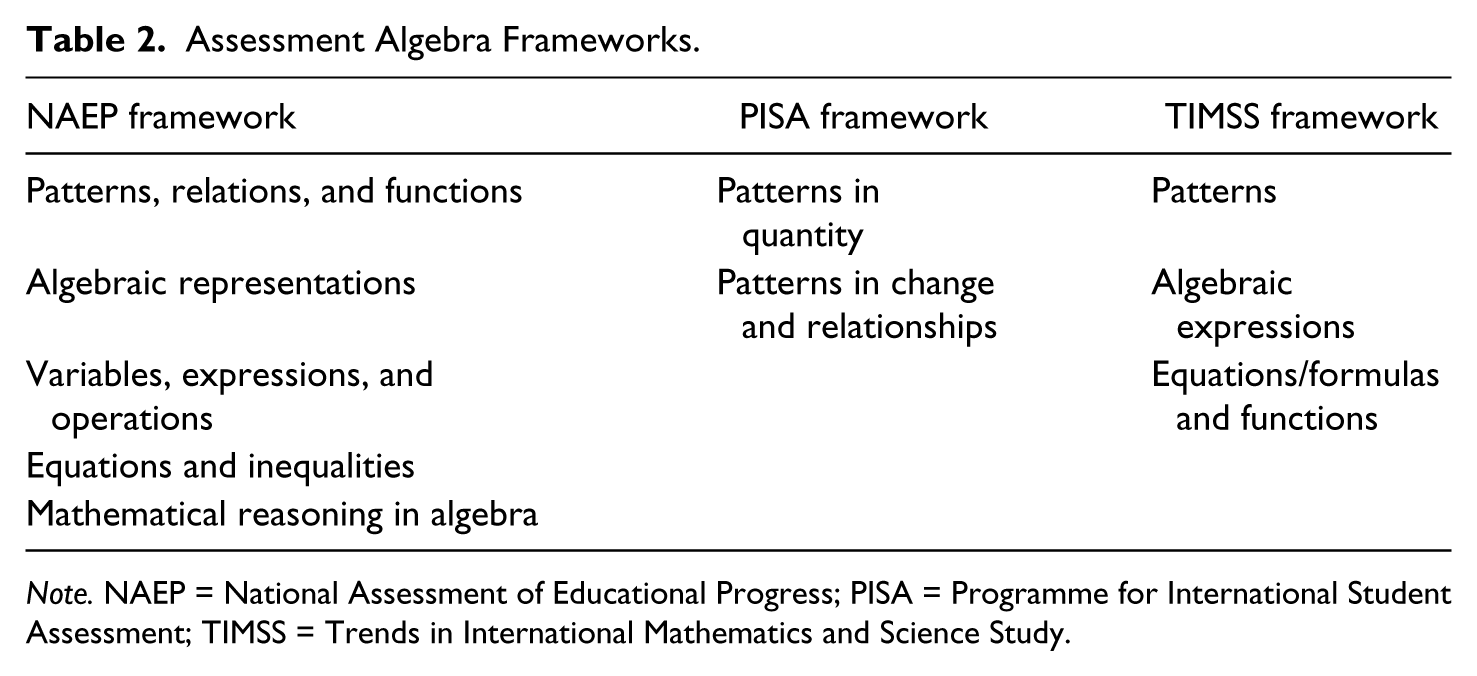
Note. NAEP = National Assessment of Educational Progress; PISA = Programme for International Student Assessment; TIMSS = Trends in International Mathematics and Science Study.
Method
There is an urgent need for all students to have consistent and equitable access to the course called algebra (Moses & Cobb, 2001; RAND Mathematics Study Panel, 2003). The purpose of the present study is to unify the Algebra for All movement and the existing characterizations of algebra to provide consistency in algebra course content for students.
The frameworks in Tables 1 and 2 represent the overarching ideas of algebra as characterized by the organizations concerned with classroom instruction and assessment. With the exception of RAND, all of the frameworks include a description of each overarching idea; however, the level of detail varies across documents. For example, each overarching idea (domain) in the CCSS is divided into multiple clusters of standards. In contrast, PISA describes the overarching ideas in three brief paragraphs.
The data analysis process occurred in two stages: (a) the algebra standards and assessment framework documents were organized into a matrix (Miles & Huberman, 1994) and (b) a thematic analysis approach (Braun & Clarke, 2006) was utilized for analyzing the data. For the first stage, the student expectations/outcomes related to algebra from the nine different frameworks were aligned. In the second stage, the aligned expectations/outcomes were coded to find the key ideas in algebra. This process culminated in the unification of the expectations/outcomes as presented in the various frameworks.
Stage 1—Alignment of Framework Documents
The researchers examined the student expectations/outcomes for algebra in nine documents: the NCTM PSSM, the RAND study, ADP, CCSS-M, TxCCRS, the TEKS, NAEP, PISA, and TIMSS. To prepare the data for analysis, a subset of the researchers organized the student expectations/outcomes into a matrix (Miles & Huberman, 1994). Because the NCTM PSSM were developed prior to the other student expectations documents and were also a partial response to U.S. student achievement on TIMSS and the NAEP, they were used as one of the dimensions for the matrix. The expectations/outcomes from the other eight documents were aligned to each student expectation for algebra in the NCTM PSSM for Grades 6 to 8 and 9 to 12 (25 in total, 10 for Grades 6-8, and 15 for Grades 9-12). Table 3 lists the relevant algebra sections of each framework document, which were aligned to the algebra standards in the NCTM PSSM. Due to its lack of specificity regarding student expectations, RAND does not appear in the matrix. To ensure the reliability of the alignment process, for each document, at least two researchers individually aligned the expectations/outcomes. The researchers then compared the alignment and reconciled any disagreements. Furthermore, a second subset of researchers reviewed the initial alignment. Based on their feedback, any discrepancies were addressed. Tables A1 and A2 in the appendix are examples of a portion of the matrix for one of the NCTM PSSM 9 to 12 student expectations.
Sections of Framework Documents Aligned to the NCTM PSSM Student Expectations in Algebra.
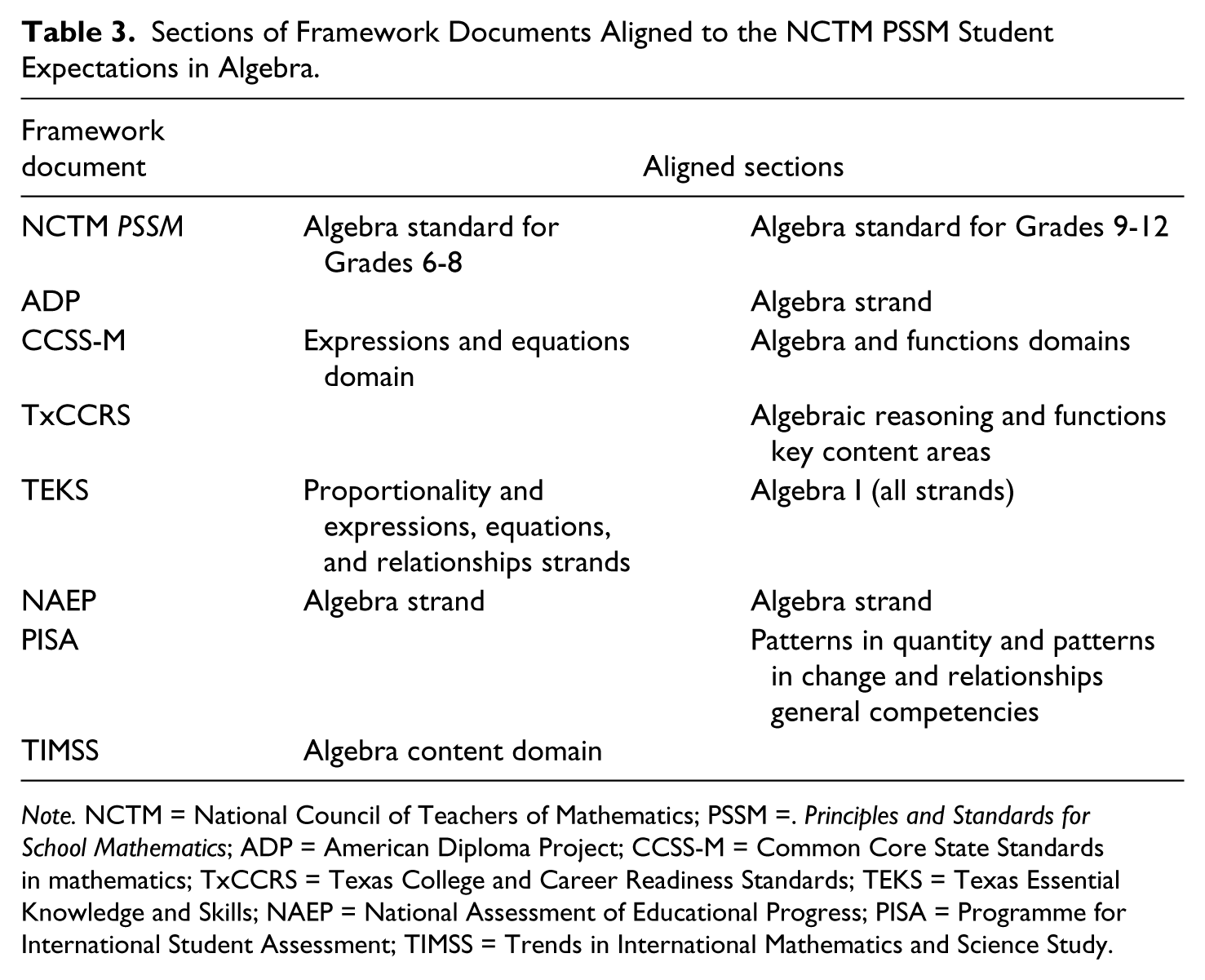
Note. NCTM = National Council of Teachers of Mathematics; PSSM =. Principles and Standards for School Mathematics; ADP = American Diploma Project; CCSS-M = Common Core State Standards in mathematics; TxCCRS = Texas College and Career Readiness Standards; TEKS = Texas Essential Knowledge and Skills; NAEP = National Assessment of Educational Progress; PISA = Programme for International Student Assessment; TIMSS = Trends in International Mathematics and Science Study.
Stage 2—Coding of the Student Expectations/Outcomes in Algebra
Following the alignment of the framework documents, the researchers employed thematic analysis to analyze the data. Specifically, the researchers generated initial codes, organized the codes into themes, reviewed the themes with respect to the data, and named and defined the themes (i.e., the six key ideas; Braun & Clarke, 2006). Two of the researchers completed the initial coding. They generated a list of data-driven codes that represented the content of all of the expectations/outcomes for algebra expressed in the eight framework documents (all but RAND because of its lack of specificity). In total, there were 32 codes, such as recognize and generate equivalent forms of algebraic expressions, understand and compare properties of classes of functions, explicit versus recursive functions to generalize patterns, model and reason about the real world, technologies, and concrete models. The codes were sorted and ultimately grouped into six key ideas (or themes)—four content and two processes for learning the content—to represent and unify the existing algebra frameworks. 3
The second phase of the analysis process involved evaluating the validity of the six key ideas with respect to the data set in its entirety (Braun & Clarke, 2006). Each key idea was assigned a color code, and researchers, different from the original coders, highlighted the entire student expectations/outcomes related to each key idea. Ideally, if the six ideas were an accurate representation of algebra as expressed in the framework documents, the entire student expectations/outcomes would be highlighted. After completing this process, effectively all of the student expectations were highlighted. The few exceptions were ideas related to pre-algebra (e.g., using scientific notation to represent very large or small quantities) and algebra II (e.g., recognizing when the quadratic formula gives complex solutions).
This process ensured that the six key ideas represented and unified the various algebra framework documents. The four key ideas for content are variables, functions, patterns, and modeling. The two key ideas for the processes of learning the algebra content are technology and multiple representations.
Findings
This section provides an explanation for each of the six key ideas for algebra. While the titles of the key ideas are succinct, the descriptions elaborate on the essence of each component. Each description is accompanied by a table (Tables 4-9), which contains an example student algebra expectation/outcome from each of the framework documents (excluding RAND). The sample expectations/outcomes center on a common concept within that key idea and are illustrated with an example.
Example Expectations/Outcomes for Variables.
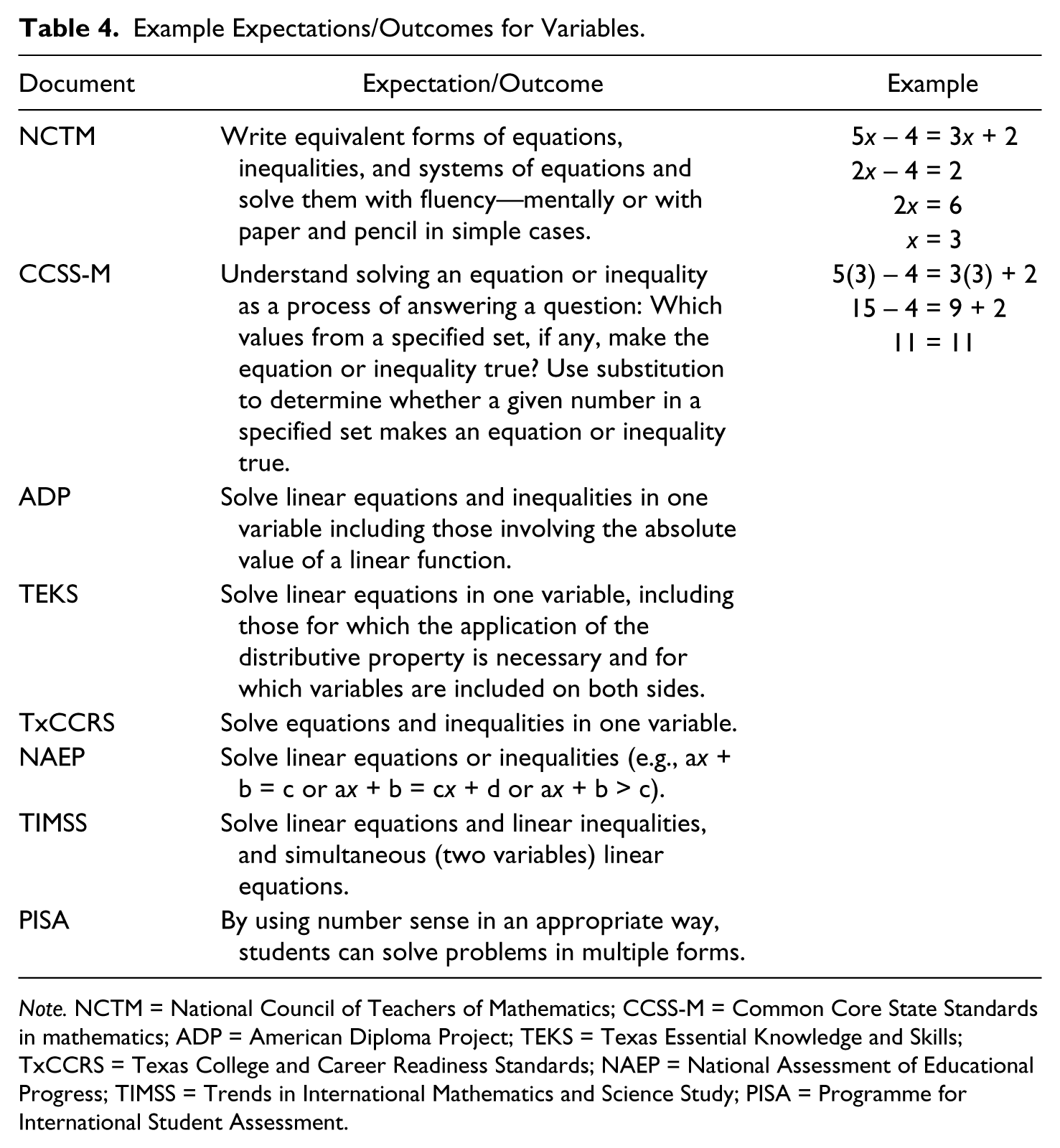
Note. NCTM = National Council of Teachers of Mathematics; CCSS-M = Common Core State Standards in mathematics; ADP = American Diploma Project; TEKS = Texas Essential Knowledge and Skills; TxCCRS = Texas College and Career Readiness Standards; NAEP = National Assessment of Educational Progress; TIMSS = Trends in International Mathematics and Science Study; PISA = Programme for International Student Assessment.
Example Expectations/Outcomes for Functions.

Note. NCTM = National Council of Teachers of Mathematics; CCSS-M = Common Core State Standards in mathematics; ADP = American Diploma Project; TEKS = Texas Essential Knowledge and Skills; TxCCRS = Texas College and Career Readiness Standards; NAEP = National Assessment of Educational Progress; TIMSS = Trends in International Mathematics and Science Study; PISA = Programme for International Student Assessment.
Example Expectations/Outcomes for Patterns.

Note. NCTM = National Council of Teachers of Mathematics; CCSS-M = Common Core State Standards in mathematics; ADP = American Diploma Project; TEKS = Texas Essential Knowledge and Skills; TxCCRS = Texas College and Career Readiness Standards; NAEP = National Assessment of Educational Progress; TIMSS = Trends in International Mathematics and Science Study; PISA = Programme for International Student Assessment.
Example Expectations/Outcomes for Modeling.
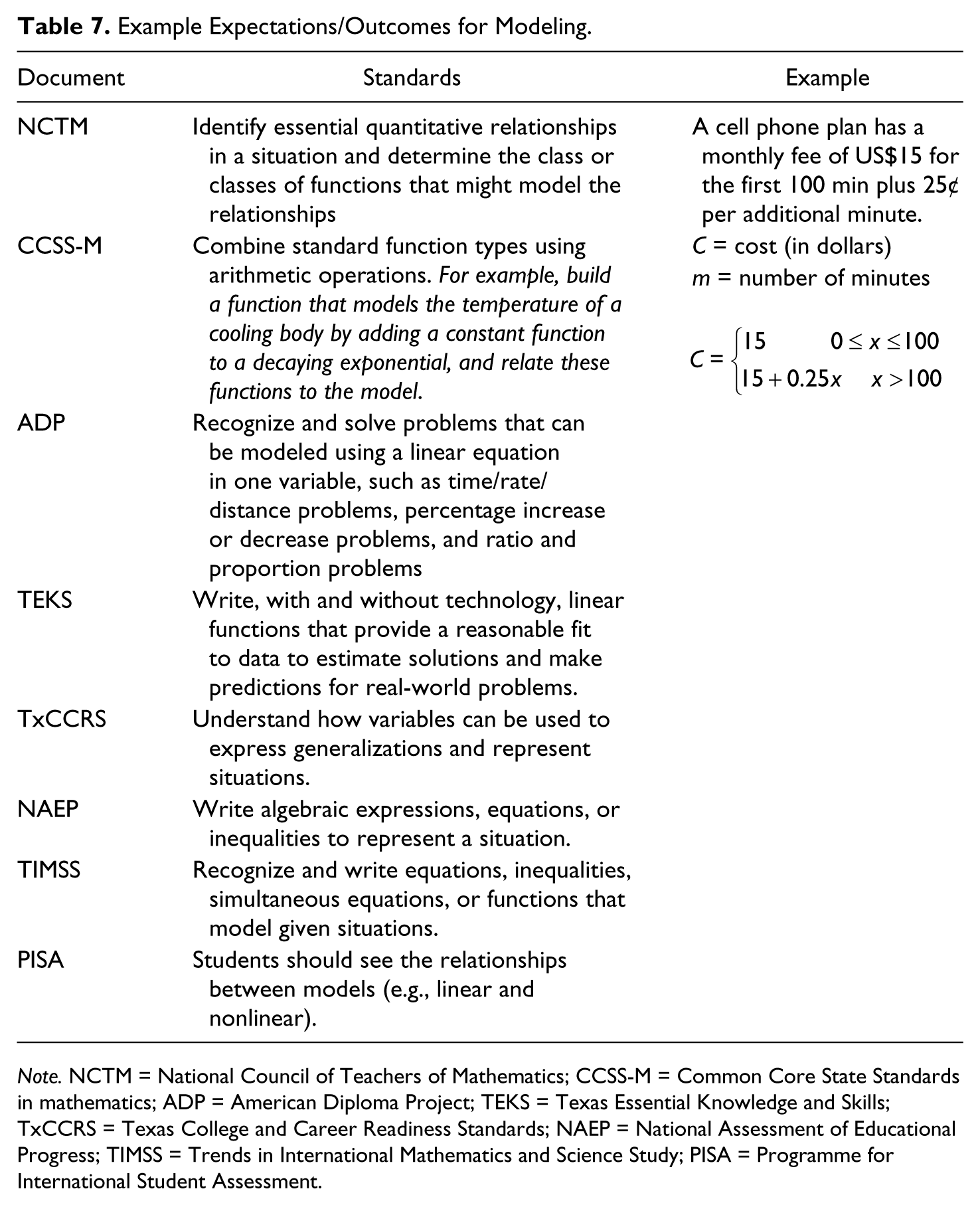
Note. NCTM = National Council of Teachers of Mathematics; CCSS-M = Common Core State Standards in mathematics; ADP = American Diploma Project; TEKS = Texas Essential Knowledge and Skills; TxCCRS = Texas College and Career Readiness Standards; NAEP = National Assessment of Educational Progress; TIMSS = Trends in International Mathematics and Science Study; PISA = Programme for International Student Assessment.
Example Expectations/Outcomes for Technology.
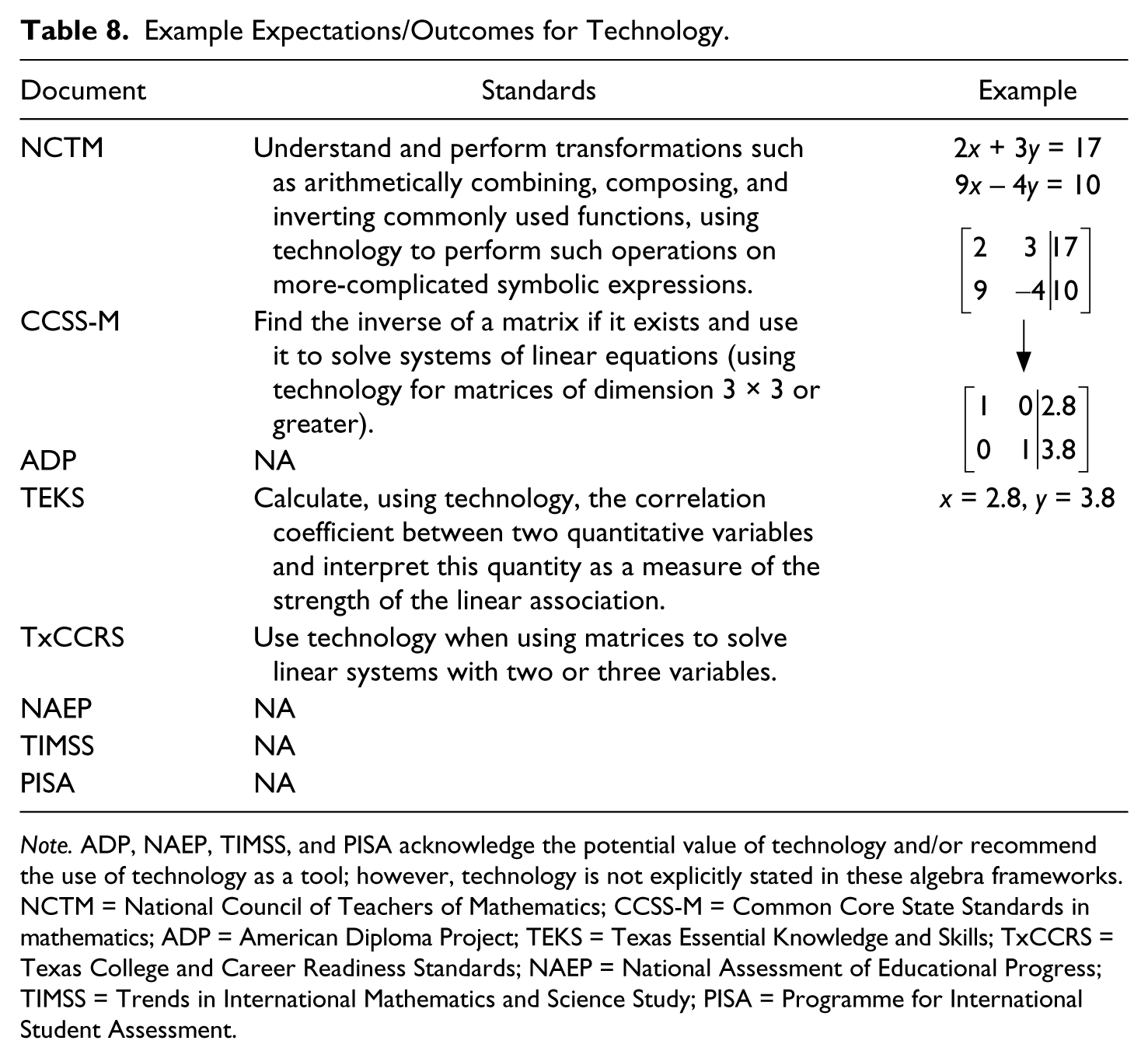
Note. ADP, NAEP, TIMSS, and PISA acknowledge the potential value of technology and/or recommend the use of technology as a tool; however, technology is not explicitly stated in these algebra frameworks. NCTM = National Council of Teachers of Mathematics; CCSS-M = Common Core State Standards in mathematics; ADP = American Diploma Project; TEKS = Texas Essential Knowledge and Skills; TxCCRS = Texas College and Career Readiness Standards; NAEP = National Assessment of Educational Progress; TIMSS = Trends in International Mathematics and Science Study; PISA = Programme for International Student Assessment.
Example Expectations/Outcomes for Multiple Representations.

Note. NCTM = National Council of Teachers of Mathematics; CCSS-M = Common Core State Standards in mathematics; ADP = American Diploma Project; TEKS = Texas Essential Knowledge and Skills; TxCCRS = Texas College and Career Readiness Standards; NAEP = National Assessment of Educational Progress; TIMSS = Trends in International Mathematics and Science Study; PISA = Programme for International Student Assessment.
Variables
A foundation in algebra requires an understanding of the meaning of a variable as well as the different possible roles of variables in expressions, equations, and inequalities. Students need to be able to read, write, evaluate, and interpret these expressions, equations, and inequalities in one or more variables. Equivalent forms of expressions, equations, and inequalities are created by applying the properties of operations (e.g., Table 4). Being able to understand and generate equivalent forms of equations and inequalities is one means of solving equations and inequalities. There are other approaches, such as graphing, that aid in solving and interpreting the solutions of linear and quadratic equations (with real solutions), inequalities, and systems of linear equations in two variables.
Functions
Students need to develop an understanding of functions and the difference between functions and relations, as well as to convert flexibly between, and interpret different representations of functions (e.g., Table 5). Furthermore, students should be able to make comparisons between different families of functions (in particular, linear and quadratic) to highlight their characteristics, such as rates of change, intercepts, zeroes, domain, range, and asymptotes.
Patterns
Patterns can be represented in multiple ways (e.g., pictures and tables). Students must recognize, analyze, and describe patterns such as proportional relationships and arithmetic sequences. Students must also be able to generalize these patterns explicitly and recursively (e.g., Table 6).
Modeling
Modeling encompasses representing, analyzing, and making conclusions from real-world application problems and involves aspects of the three previously discussed key ideas of algebra.
For instance, students use expressions, equations, and inequalities to model situations (e.g., Table 7). When students understand the characteristics of a context, like rate of change, they are able to choose the appropriate family of functions to model the situation (e.g., linear or quadratic). Moreover, when students are working with data from a real-world situation, they can extrapolate the model based on their understanding of generalized patterns of change.
Technology
Technology tools (e.g., dynamic geometry software, graphing calculators, computer algebra systems, and spreadsheets) provide students with dynamic platforms to develop an understanding of algebraic concepts and the procedures associated with the concepts. Students can use the graphing capabilities of various technology tools to understand the meaning of a solution to a system of equations. Students can also perform algebraic procedures such as solving systems of equations (e.g., Table 8) using spreadsheets or computer algebra systems.
Multiple Representations
The use of multiple representations is connected to all of the other key ideas of the unified algebra framework. The different types of representations include concrete models, tables, graphs, words, and symbols (e.g., Table 9). Students are expected to solve equations, inequalities, and systems of equations in multiple ways using different representations. By relating and comparing different representations, students are able to identify and contrast the characteristics within and between families of functions. In addition, students can model real-life situations using multiple representations. Therefore, students must be able to represent, select, apply, and translate among all the different representations.
Discussion
In response to researchers’ call for consistency in the essential key ideas that constitute an algebra course (Arbaugh et al., 2010; RAND Mathematics Study Panel, 2003; Schmidt, 2002; Stein et al., 2011a), the present article unifies the leading standards and assessment framework documents with respect to algebra expectations. The six key ideas of algebra, which emerged from the analysis, include (a) Variables, (b) Functions, (c) Patterns, (d) Modeling, (e) Technology, and (f) Multiple Representations.
All students should take a rigorous course in algebra preferably in the eighth or ninth grade. However, equity in rigor and course taking of algebra has historically been lacking for economically disadvantaged and diverse populations (Cogan et al., 2001; Gammoran, 1987; Moses & Cobb, 2001; Paul, 2005; RAND Mathematics Study Panel, 2003). Ensuring equitable opportunities is one of the four rationales for the Algebra for All movement. The others include global competitiveness of the United States, algebraic thinking in K-12 mathematics, and high-stakes assessments. The United States is a stronger competitor in the global economy when its citizenry has a strong foundation in algebra preparing them for postsecondary mathematics and careers (RAND Mathematics Study Panel, 2003). This foundation in algebra is established beginning in kindergarten and continues through the 12th grade (NCTM, 1989, 2000). Students are expected to demonstrate their proficiency in algebra on high-stakes state assessments under NCLB. Existing characterizations of algebra included some or all of the rationales of the Algebra for All movement. Table 10 provides a summary of how classroom instruction and assessment frameworks of algebra align with the rationales of the Algebra for All movement.
Alignment of the Existing Characterizations of Algebra With the Rationales for the Algebra for All Movement.

Note. NCTM = National Council of Teachers of Mathematics; ADP = American Diploma Project; TxCCRS = Texas College and Career Readiness Standards; CCSS = Common Core State Standards; TEKS = Texas Essential Knowledge and Skills; NAEP = National Assessment of Educational Progress; PISA = Programme for International Student Assessment; TIMSS = Trends in International Mathematics and Science Study.
The NCTM (2000) Standards stress the importance of providing equitable opportunities for all students to learn mathematics and includes five content strands spanning across K-12 mathematics, one of which is algebra. Like NCTM, the RAND Study Panel (2003) views algebra as a content area that is developed through all grade levels, K-12; however, the panel stresses the foundational nature of algebra in relation to other mathematics content areas and science, technology, engineering, and mathematics (STEM) disciplines. This perspective about algebra positions it as the gateway to the full range of educational and career opportunities requiring flexible problem solving and strong quantitative reasoning skills to effectively compete in the global economy. Similarly, the ADP and TxCCRS developed frameworks, which include algebra, to ensure that all students are prepared for postsecondary education and/or careers.
While a subset of the classroom instruction frameworks (NCTM, TxCCRS, CCSS, and TEKS) use the term standard, the definition of standard varies across documents. NCTM (1989) defines standards as “a statement that can be used to judge the quality of a mathematics curriculum . . . statements about what is valued” (p. 2). Similarly, the TxCCRS serve as benchmarks for students to be prepared in their transition to postsecondary education and/or career opportunities. In contrast, the TEKS and CCSS provide the specific student expectations within the mathematics curriculum. This distinction is important when considering the TEKS and CCSS connections to all four Algebra for All rationales. The TEKS and CCSS, which contain K-12 algebra standards, provide the instructional framework required for student success on high-stakes assessments. High-stakes assessments strongly influenced classroom instruction as the NCLB (2001) mandates annual measures of student achievement. NCLB is grounded in closing the achievement gap and ensuring that all students meet high learning standards. The TEKS and CCSS link equitable opportunities for all students with the skills necessary to compete in the global economy.
In contrast, NAEP, PISA, and TIMSS created frameworks for mathematics to assess the mathematical preparation of students in the participating countries. The NAEP, a longitudinal assessment of mathematics achievement in the United States, has been administered in the United States since 1973 with minimal change. NAEP documents student progress in mathematics over time and can therefore be viewed as an internal measure of the global competitiveness of the United States. PISA and TIMSS extend beyond the borders of the United States and provide a common assessment for participating countries. The results of these assessments are frequently used to assess the global competiveness of and quality of schools in the participating countries. As the three assessments do not report achievement on an individual student level, they are not considered high-stakes assessments.
Each of the previous nine framework documents of algebra was developed for a different purpose and influences the teaching, learning, and assessment of algebra in varying ways. By aligning the student algebra expectations/outcomes, a unification of these nine frameworks representing algebra has been established. Furthermore, the purposes of each of the frameworks were examined through the lens of the Algebra for All movement and address some or all of the four rationales for the Algebra for All movement. Therefore, the unification of the frameworks meets all four of the rationales across classroom instruction and assessment. As the process of characterizing algebra is a human endeavor influenced by the political climate as seen in the evolution and influence of national and international frameworks documents over multiple decades, these results provide a longitudinal view, rather than cross-sectional view, on what is important in algebra.
Conclusion
In conclusion, the idea of algebra as a gatekeeper provides imagery for the pathway to college and career readiness. Taking a rigorous algebra course by the end of ninth grade opens the gate to the desired pathway to college and career (ADP, 2004; College Board, 2000). However, there are several scenarios in which taking algebra does not result in college and career readiness. Sometimes a wall is behind the gate, and, instead of continuing on the pathway, students must back up and retake algebra. For example, Waterman’s (2010) research uncovered 65% retook algebra after taking the course in eighth grade. A fake gatekeeper is established when students take a watered-down curriculum for their entire mathematics sequence, and, instead of opening the gate to the desired pathway, an illusion of the pathway is followed (e.g., Cogan et al., 2001; Paul, 2005). For example, Stein and others (2011a) describe how universal policies for students taking algebra in the eighth grade can lead to a watered-down curriculum. Other students arrive too late at the gatekeeper course limiting their opportunities for college and career readiness. College Board (2000) and ADP (2004) both advocate algebra as the starting point by the ninth grade to have the necessary mathematical knowledge needed for college. Understanding the purposes of each of the existing standard and framework documents and then analyzing them to draw out the key ideas of algebra that unify them provides the necessary background for stakeholders to provide a rigorous and timely algebra course to allow students an opportunity to advanced mathematics courses.
The purpose of the present article is not to create another framework but to unify existing classroom instruction and assessment frameworks that characterize algebra so that all students have the opportunity to be on the correct pathway to college and career. This unification process resulted in six key ideas of algebra: (a) Variables, (b) Functions, (c) Patterns, (d) Modeling, (e) Technology, and (f) Multiple Representations. The key ideas address both content and processes for learning algebra.
We foresee this unification of algebra framework documents as the necessary foundation of key ideas for policymakers, school personnel, and education researchers allowing for better connections and communication among and between these stakeholders. The unification of algebra frameworks will provide stakeholders with a common language to use when evaluating, researching, and writing curriculum and policy for the learning of algebra. As revised and new high-stakes assessments are created, stakeholders will be able to navigate the different frameworks that were used to create them using the key ideas of algebra described herein.
As evident in the present article, only the aspects of algebra that are part of the traditional first-year course are addressed. The need remains for other secondary mathematics content to be analyzed across frameworks as described in the present article. Such alignments would further facilitate the transparency of the pathway to college and career readiness.
Footnotes
Appendix
Example of the Alignment of NAEP, TIMSS, and PISA to the NCTM PSSM Student Expectations for Algebra.
| NCTM Algebra Standards 9-12 | ||
|---|---|---|
| 1.Represent and analyze mathematical situations and structures using algebraic symbols | ||
| B. Write equivalent forms of equations, inequalities, and systems of equations and solve them with fluency—mentally or with paper and pencil in simple cases and using technology in all cases | ||
| NAEP | TIMSS | PISA |
| 3. Variables, expressions, and operations | Algebra: Algebraic Expressions | Patterns in Quantity |
| 12.b. Write algebraic expressions, equations, or inequalities to represent a situation. | 3. Simplify or compare algebraic expressions to determine if they are equal. | • By using number sense in an appropriate way, students can solve problems requiring direct, inverse and joint proportional reasoning. |
| 12.d. Write equivalent forms of algebraic expressions, equations, or inequalities to represent and explain mathematical relationships. | Algebra: Equations/Formulas and Functions | • They are able to estimate rates of change and provide a rationale for the selection of data and level of precision required by operations and models they use. |
| 4. Equations and Inequalities | 1. Evaluate equations/formulas given values of the variables. | • They can also examine alternative algorithms, showing why they work or in what cases they fail. |
| 12.a. Solve linear, rational, or quadratic equations or inequalities, including those involving absolute value. | 2. Indicate whether a value (or values) satisfies a given equation/formula. | • They can develop models involving operations, and relationships between operations, for problems involving real-world data and numerical relations requiring operations and comparisons. |
| 12.d. Solve (symbolically or graphically) a system of equations or inequalities and recognize the relationship between the analytical solution and graphical solution. | 3. Solve linear equations and linear inequalities, and simultaneous (two variables) linear equations. | |
| 4. Recognize and write equations, inequalities, simultaneous equations, or functions that model given situations. | ||
| 6. Solve problems using equations/formulas and functions. | ||
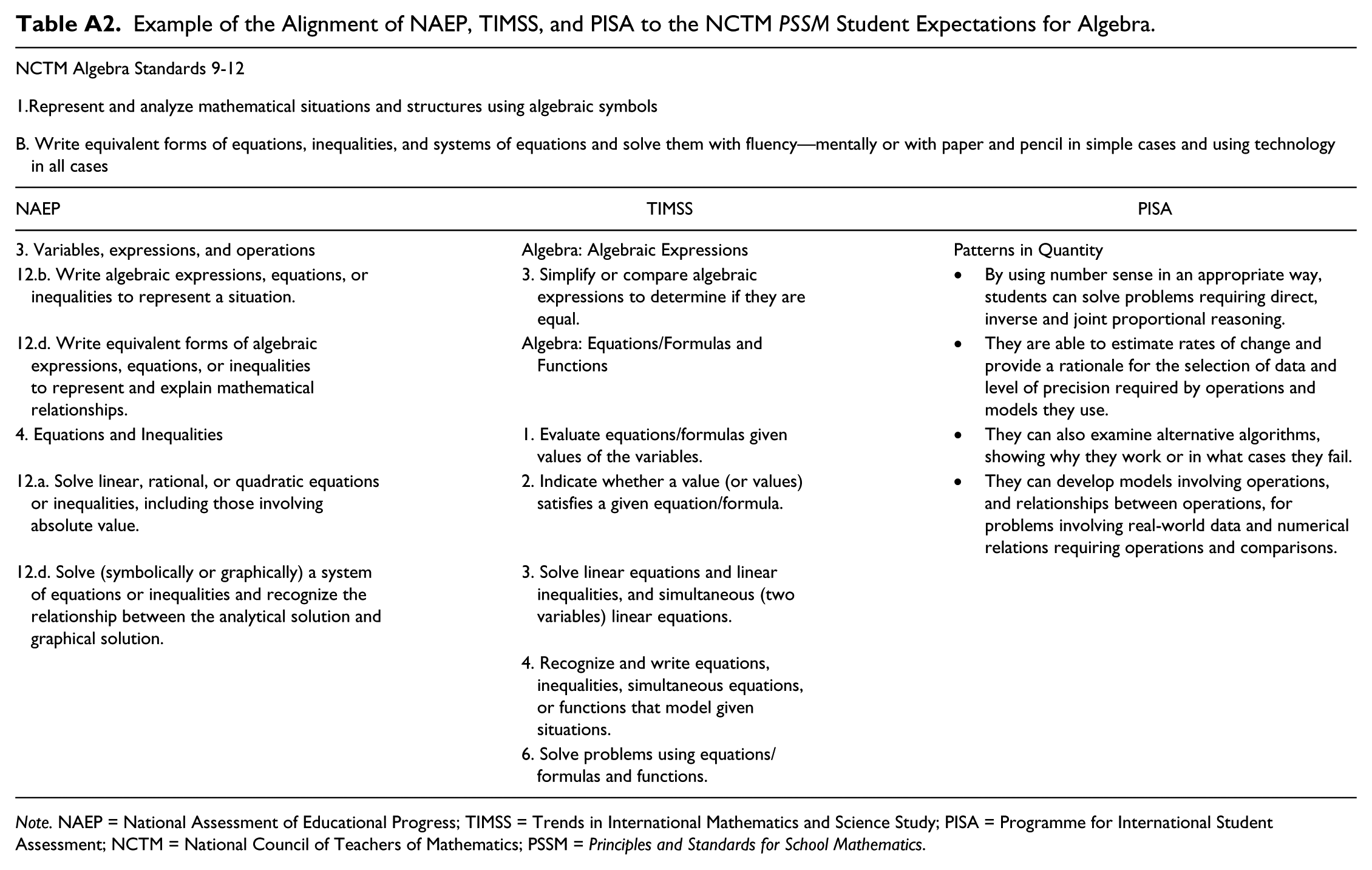
Note. NAEP = National Assessment of Educational Progress; TIMSS = Trends in International Mathematics and Science Study; PISA = Programme for International Student Assessment; NCTM = National Council of Teachers of Mathematics; PSSM = Principles and Standards for School Mathematics.
Declaration of Conflicting Interests
The authors declared no potential conflicts of interest with respect to the research, authorship, and/or publication of this article.
Funding
The authors disclosed receipt of the following financial support for the research, authorship, and/or publication of this article: This work was partially supported by several funding sources: Baylor University Internal Grant (2011); Texas Christian University Invests in Scholarship (2012-2013); Texas College and Career Readiness Initiative (2012), Texas Woman’s University College of Arts & Sciences Research Development Funds (2012), Texas Higher Education Coordinating Board (1138, 2010-2011), and Baylor University Research Committee and Provost for Research (2010-2011).