




Abstract
The purpose of this qualitative study was to provide empirical evidence of the extent to which the types of tasks recommended by Sheffield for eliciting characteristics of mathematical promise allowed for the manifestation of these characteristics in primary-grade students within a problem-based learning (PBL) context. Data included student work collected from two mathematics PBL units, teacher interviews, surveys used by teachers to identify mathematically promising students and video-recorded classroom observations. Data analysis followed Miles and Huberman’s data reduction method with findings reported as themes. Results indicate that students, including those from underserved populations, exhibit characteristics aligned with attributes signifying mathematical promise as proposed by Sheffield within a PBL context.
Research indicates that the United States is not identifying or retaining its best and brightest science, technology, engineering or mathematics (STEM) students for careers in these fields (National Science Board [NSB], 2010; President’s Council of Advisors on Science and Technology, 2010). For example, Lowell, Salzman, Bernstein, and Henderson (2009) found strong overall rates of retention of students in the STEM pipeline from high school through midcareer with the exception of the highest performing students who marked a steep decline in retention. Findings like these, coupled with the U.S. students’ mediocre national and international assessment results (e.g., National Assessment Governing Board, 2009; Olson, J., Martin, M. & Mullis, I., 2008) led the NSB to critically examine STEM education in the United States. As a result, the NSB proposed keystone recommendations for identifying and developing the next generation of STEM innovators. These recommendations include identifying all types of talents and nurturing potential in all demographics of students, and preparing educators to recognize promise, particularly among those individuals who have not been given adequate opportunities to transform their potential into academic achievement (NSB, 2010). Considering the concern of U.S. policy makers for the future of STEM advancement and the key role of mathematics in these areas, understanding how mathematical promise manifests itself in students is critical to the development of STEM leaders.
Characteristics of Mathematically Promising Students
One of the most well-known descriptions of the characteristics of mathematically talented or gifted students was provided by Krutetskii (1976). Characteristics identified by Krutetskii included “flexibility of mental processes in mathematical activity and an ability to generalize mathematical material” (p. 275). Many researchers have built on Krutetskii’s work (Deal & Wismer, 2010; Garofalo, 1992, 1993; Heinze, 2005; Schoenfeld, 1992; Sriraman, 2003). Deal and Wismer (2010) identified talented students’ (a) abilities to transfer mathematical reasoning to new and untaught situations and (b) possession of analytical deductive and inductive reasoning skills without prior exposure to these types of skills. Garofalo (1992, 1993) found that mathematically talented students preferred challenging problems to routine tasks and were not concerned with computational accuracy but more interested in the meaning of the problem. Schoenfeld (1992) recognized that mathematically talented students see everyday phenomena in mathematical terms and have a proclivity for self-regulation (i.e., they seek to confirm solutions and strategies). Heinze (2005) also reported that mathematically gifted students used the deep structure of a task to calculate or deduce an answer and that mathematically gifted students were better able to verbalize and explain their solutions. Furthermore, gifted mathematics students were also noted to have different decision-making behavior, which aided in their abilities to generalize (Sriraman, 2003). Better understanding of attributes such as these are important for identifying and fostering talent in students.
In 1995, the National Council of Teachers of Mathematics (NCTM) summoned a task force to describe mathematically promising students. The task force described these students as “having the potential to become the leaders and problem solvers of the future” and mathematical promise as being “a function of variables: (a) ability, (b) experience/opportunity, (c) motivation and (d) belief, that ought to be maximized” (Sheffield, Bennett, Beriozábal, DeArmond, & Wertheimer, 1995, p. 310). Traditionally, ability (as determined by standardized tests) has been the main factor considered for gifted identification (House, 1999). To address the inequities inherent in identification based on standardized scores, the task force recommended an inclusive rather than an exclusive approach to identification (Wertheimer, 1999). Furthermore, Usiskin (1999) suggested that curriculum designed with high expectations for students is critical in fostering mathematical promise and acknowledged that many schools do not provide this experience. Yet, according to the NCTM task force, mathematics abilities should and could be enhanced and developed in all students.
Although work examining the teaching and learning of mathematically talented students is well documented (e.g., Benbow & Stanley, 1983; Gavin et al., 2007; Lubinski & Benbow, 2006), the intent of this article is to provide supporting evidence for the characteristics of mathematical promise proposed by Sheffield (2003), which have not been empirically tested. The characteristics are grouped into four overarching categories: (a) Mathematical Frame of Mind: loves exploring patterns and puzzles; sees mathematics and structure in a variety of situations; recognizes, creates and extends patterns; organizes and categorizes information; has a deep understanding of simple mathematical concepts, including strong number sense, (b) Mathematical Formalization and Generalization: generalizes the structure of a problem often from only a few examples; uses proportional reasoning; thinks logically and symbolically with quantitatively and spatial relations; develops proofs and other convincing arguments, (c) Mathematical Creativity: processes information flexibly—switches from computation to visual to symbolic to graphic representation as appropriate in solving problems; has original approaches to problem solving; reverses processes; strives for mathematical elegance and clarity in explaining reasoning and (d) Mathematical Curiosity and Perseverance: curious about mathematical connections and relationships—asks “why” and “what if”; has energy and persistence in solving difficult problems and digs beyond the surface of a problem. (Sheffield, 2003, p. 3)
Sheffield (2003) asserted that when mathematically promising students are provided with appropriately challenging tasks (i.e., mathematical investigations), they might exhibit all or some of these characteristics. Based on the recommendations set forth by the NCTM Task Force, Sheffield outlined 10 essential criteria for developing investigations to foster mathematical promise. Some of these criteria include providing opportunities for exploring and branching out into new related areas; opportunity to demonstrate abilities on a variety of levels and in a variety of ways; allowing children to question, reason, communicate, solve problems, and make connections to other areas of mathematics as well as to other subject areas and real world problems. (Sheffield, 2003, p. 6)
One curriculum model that offers the potential for developing tasks that have many of the characteristics outlined by Sheffield is problem-based learning (PBL).
PBL
PBL is defined as “an inquiry process that resolves questions, curiosities, doubts, and uncertainties about complex phenomena in life” (Barell, 2007, p. 3). It is an instructional method used in classrooms to engage students in learning and foster self-motivated inquiry. In turn, the students are expected to actively participate and take ownership of their learning. In a PBL curriculum, students spend time investigating, analyzing, and collaborating to solve an ill-structured problem. Students engage in research and discuss and revise their solution strategies while the teacher facilitates the process. The type of high-level thinking that students use during PBL is necessary for engaging and identifying mathematically talented mathematics students (Wheatley, 1999).
Considerable research has been conducted on PBL in medical school settings with regard to knowledge acquisition and retention, student attitudes, and development of clinical skills (Colliver, 2000). The findings from these studies show mixed results, and the discrepancies are often attributed to differences in programs and assessment modes (Colliver, 2000; Prince, 2004).
Similarly, assessment has played a role in K-12 PBL studies investigating learning effects and student engagement. Because of the interdisciplinary framework and specialized content inherent in this type of curricula, the extent of learning is difficult to measure (VanTassel-Baska, Bass, Ries, Poland, & Avery, 1998).
In K-12 settings, PBL curricula have proven effective in student engagement and longitudinal student achievement (Kim et al., 2012; VanTassel-Baska, Avery, Little, & Hughes, 2000). Several studies (Dods, 1997; Gallagher & Stepien, 1996; Liu, Hsieh, Cho, & Schallert, 2006; Senocak, Taskesenligil, & Sozbilir, 2007) reported that secondary school students retained more information when taught with a PBL model than a traditional lecture. Furthermore, research has shown that students who engage in PBL are better able to engage in the research process through the identification of a problem, stating appropriate hypotheses, and testing a solution (e.g., Cockrell, Caplow, & Donaldson, 2000; Gallagher, Stepien, & Rosenthal, 1992; VanTassel-Baska, 1997).
Researchers at the Center for Gifted Education at the College of William and Mary found that implementing primary- and middle-grade PBL units (a) positively influenced students’ critical thinking skills (Kim et al., 2012), (b) resulted in an increase in student achievement over 3 consecutive years (Kim et al., 2012) and (c) provided a rich and engaging experience when designed using an authentic, local problem (VanTassel-Baska, 1997). Furthermore, parents, teachers, and administrators perceived an increase in student engagement, reasoning skills, and habits of mind (VanTassel-Baska et al., 2000).
Research Question
Providing empirical evidence for the manifestation of mathematical promise and the types of tasks that facilitate the emergence of these characteristics in primary-grade students can contribute to the current literature in these areas. As noted by Wiliam (2007), the traditional approach of evaluating students’ mathematical ability and potential with standardized test scores is insufficient. Instead, understanding students’ mathematical ability requires a close look at actual classroom work and performance. Therefore, in an attempt to provide evidence for Sheffield’s (2003) a priori characteristics of mathematical promise, the research question for this study was as follows:
Method
The data collected in this study were obtained as a part of a larger grant funded by the U.S. Department of Education’s Jacob K. Javits Gifted and Talented Students Education Program. The larger project’s overarching goal was to help teachers identify talented students in the STEM areas, particularly those from underrepresented populations. Data were obtained from two, second-grade PBL mathematics units that were differentiated to make mathematical concepts more accessible and enhanced with dynamic technology to increase student engagement. The first PBL unit centered on pattern concepts and applications, and the second PBL unit focused on monetary values and graphing.
Setting
Henderson County 1 is a semirural area in the mid-Atlantic region of the United States. The region suffered tremendous economic downfall in the past decade with the local industry of furniture mills leaving the area. At the time of this study, 58% of children were eligible for free/reduced lunch, 11% were English language learners, and 18% had identified special education learning challenges. Across this student population, 65% were White, 24% African American, 10% Hispanic, 0.1% Asian; 7% of the teachers did not meet the federal definition of highly qualified and 11% of the teachers were provisionally certified. The district reported that 3% of students were identified as gifted and were served by their general education teacher through differentiated instruction within the general education classroom setting.
Participants
Teachers
Data from three second-grade teachers were used; each teacher was female and worked in one of two schools, Lipton Elementary (Ms. Jones and Ms. Johnson) and Island Elementary (Ms. Walton). Each of the teachers was certified to teach at the elementary level with Ms. Johnson having PK-6 certification, Ms. Walton certified at the K-5 level, and Ms. Jones holding PK-4 certification. Ms. Jones held a master of arts degree while Ms. Johnson and Ms. Walton each earned a bachelor of arts degree. Ms. Johnson was relatively new to teaching as she was in her third year, Ms. Walton was in her 10th year and Ms. Jones was a veteran with 32 years of experience.
Students
The students included five second graders identified by the three participating teachers as being mathematically promising (Talent Identification Protocol is described in data sources); three students were informally recognized as having mathematical promise prior to implementation of the project’s units. The five students were Caucasian, one of the students was male (John) and four of the students were female (Amy, Shannon, Tamara, and Sara). Two of the students participated in the Free and Reduced Lunch Program (Amy and Sara) and one of the students was classified as having an ED disability (John).
Procedures
Content review and pilot
Each PBL unit was piloted with six rising second graders who attended school in a different county than the participants of the research study. The pilots proved to be successful in two ways. First, the lessons were found to be at the appropriate cognitive level for the students and, second, only minor changes needed to be made to the structure of lessons (e.g., replacing pictures used on manipulatives or modifying the amounts of manipulatives for each student).
The units were then sent out to a six-member expert panel for a content review. Five of the reviewers included higher education faculty members in the fields of educational technology, elementary mathematics education, mathematics, gifted education, and computer science. The sixth reviewer was a former middle and high school mathematics teacher who ran a successful federally funded education grant focused on identifying mathematical talent in middle school. The reviewers were asked to evaluate each of the units on content validity, instructional validity, developmental appropriateness, clarity, and feasibility.
Each expert reviewer was asked to evaluate each lesson (10 lessons per unit) in six areas: content validity, instructional validity, developmentally appropriate, equitable, clarity, and feasibility. Within each of the areas there were several questions associated with each question (a total of 15 questions across the six areas). Each question was based on a scale of “completely” to “not at all” with a “not applicable” option. For questions that reviewers did not indicate “completely” they were asked to highlight what about the identified lesson did not match. An example of a question from the content validity section is shown in Figure 1 (for a copy of the complete reviewer form please contact the first author).
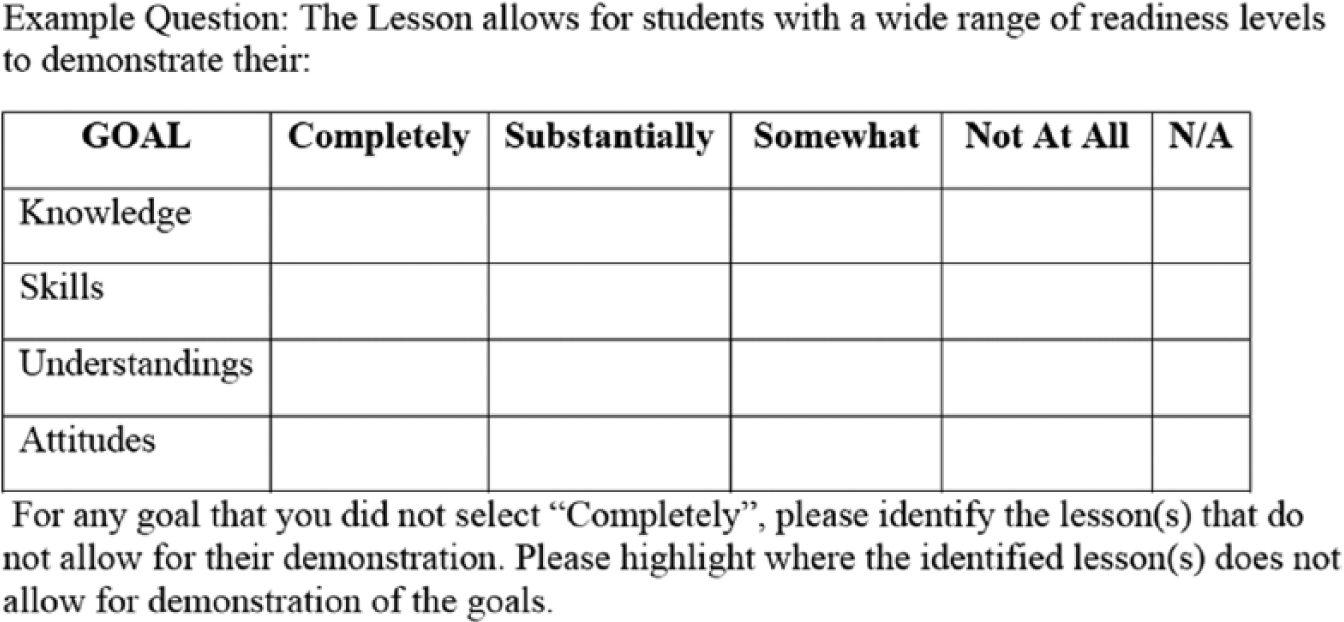
Example of content validity question.
The comments from the reviewers were minimal; hence, only minor changes to the units’ lessons were required. Examples of reviewers’ recommendations included the following:
Sample Reviewer Comment 1: While there is guidance for clear and complete instructions, the teacher isn’t given too much guidance on how to spark passion for/excitement about the challenge—or about the role that math will play in attacking the challenge . . . suggest contextualized video so that kids are eager to watch it.
Sample Reviewer Comment 2: Are you providing the teachers with titles of books, possible videos, audios, and websites, or are they to find them on their own? I would give them a resource list (I couldn’t find it in the materials though).
Professional development (PD)
The first PBL unit, Let’s Plan a Party, was implemented in the fall. During the summer preceding this implementation, the teachers attended 1 week (40 hr) of PD as a cohort in a larger PD program. In November (following Unit 1 implementation), they returned as a cohort for 3 days (24 total hours) to participate in additional PD, which was focused on the content and pedagogy undergirding the second mathematics unit, Pay It Forward. The second unit was implemented in February of the following calendar year. The teachers received an additional day of PD (8 hr) immediately preceding implementation of Pay It Forward to clarify key objectives and address implementation questions. Across the 9 days (72 hr), PD included unit modeling with the teachers experiencing the material as students, sharing the latest research on the manifestation of talent in children from underrepresented groups, instruction on the mathematics content critical to the units, and advanced mathematics content that could be used to further the development of advanced learners. The teachers also attended sessions within the larger PD program on problem solving, technology usage, and differentiated instruction.
The November PD followed the same format as the previous summer sessions but instead the focus was on the second unit, Pay It Forward. At this point, the teachers were significantly more familiar with the PBL model after the weeklong intensive summer PD and their experiences implementing the first unit. For this reason, the PD only lasted 3 days.
The research team provided a description of mathematical promise to the teachers that was consistent with the NCTM task force definition (Sheffield et al., 1995) and Sheffield’s (2003) description. Teachers were asked to look for evidence of these emerging talents in their students during implementation of each of the units. For the purposes of this article, the term mathematically promising will be used to describe these students who were identified by the teachers.
Data Sources
Unit 1: Student class work
Unit 1: Let’s Plan a Party challenged students to plan a party for their class by applying numeric and geometric patterns. Two data sources were used from this unit: (a) party planning binders and (b) party store catalogs. Students completed class work in the “Party Planning Binder.” They were afforded opportunities to express their mathematical work using multiple modes (e.g., stickers, numbers, written language, and drawing) when completing tasks in these binders. The party store catalog mirrored an online store; students used this catalog in class to purchase the party supplies. Similar to the party planning binders, students had opportunities to engage in writing and drawing in these catalogs.
Unit 2: Student class work
Unit 2: Pay It Forward challenged students to purchase items for the Society for the Prevention of the Cruelty to Animals (SPCA) using a benefactor’s donation. This unit engaged students with bar and pictograph representations, connections between monetary values and fractions, and number concepts and operations embedded in counting money. Four data sources were used from this unit: (a) student notebooks, (b) benefactor notebook (filled with student work), (c) student handouts (for collecting written responses during interactive activities), and (d) final presentations.
Student assessments
For each unit, students completed pre- and post tests that were based on state and national mathematics standards and aligned with the content focus for each unit (see Appendices A and B). In addition, students completed daily formative assessments such as exit cards and lesson reflections. To ensure that inferences about students learning were based on evidence, four principles were followed in developing and implementing all assessments: (a) each assessment was aligned to classroom instruction, (b) each assessment was aligned to state and national standards, (c) all resources for both the instructional and assessment cycles were provided, and (d) pilot testing and teacher interviews after administration of the assessments were conducted to ensure relevant cognitive processes were emphasized (e.g., problem solving) throughout the assessments. The assessments included first- to third-grade standards to provide teachers with a range of information about student knowledge and skills.
Student talent identification protocol
During PD, teachers engaged in activities designed to help them identify characteristics of mathematical promise in students. At this time, the teachers were given the Student Talent Identification Protocol (see Appendix C) to use during unit implementation. The protocol items included characteristics of mathematical talent, and each item was discussed with the teachers during PD. When teachers returned to their classrooms after PD, they used the Talent Identification Protocol to identify and rate students with mathematical promise while they were implementing the PBL units. Teachers noted that they recognized mathematical promise in some students prior to implementation of the units (without formal identification procedures). The characteristics of mathematical talent in these students were also rated using the Talent Identification Protocol during unit implementation.
The Protocol was informed by two sources: (a) characteristics identified as important areas of mathematical ability for third-grade students by the Early Childhood Longitudinal Study–Kindergarten (ECLS-K; National Center for Educational Studies (NCES; 2002), and (b) NCTM third-grade standards. Although the students in this study were second-grade students, the third-grade NCTM standards were used to capture mathematically advanced second-grade students. The Protocol employed a Likert-type format with a scale of 1 to 5 for student readiness on the particular item (1 = not yet, 2 = beginning, 3 = in progress, 4 = intermediate, 5 = proficient) or not applicable.
Teacher interviews
Teachers were interviewed via webcam video several times during and after each unit. These interviews supported teachers’ talent identification during unit implementation. The interviews were informal and primarily focused on the teachers’ perceptions of students’ experiences with each lesson and took place approximately every other day. Following the final lesson in each unit, the teachers were interviewed about their perceptions of students’ experiences with the entire unit. A final interview was conducted at the completion of both units. These final interviews were conducted using a predetermined list of interview questions (see Appendix D) and focused on the teachers’ perceptions of the experiences and mathematical work of each of the targeted students when engaging in the PBL units.
Video observations
Daily classroom observations were conducted during each lesson using a network camera system installed in each classroom and remotely controlled by the research staff. The video software allowed for 360° pan and tilt rotation of the camera and a zoom feature that could focus in on something as small as a page number written in a student’s notebook. Notes and transcriptions were recorded during each observation and these notes and transcriptions were used during coding and analysis to get a clearer picture of the characteristics of mathematical promise. All video recordings were archived and stored securely on a network system maintained by the university.
Data Analysis
Based on the data sources and goals of the study, Miles and Huberman’s (1994) data reduction methodology was employed. To begin, the researcher developed a contact summary sheet (Miles & Huberman, 1994) for each of the six subjects. These sheets were developed using the students’ written work coupled with the teacher’s responses on the talent identification surveys and organized in a two-column, graphic organizer. The left column listed each data source containing students’ written work and a section for the talent identification survey items. The right-hand column described the corresponding student work and the teachers’ responses to the survey. These contact summary sheets were used to guide questions for the teacher interviews. Following this, the analysis of the contact summary sheets and the transcriptions of teacher interviews led to the reduction of video footage. For this study, nine lessons were used, four of Ms. Walton, three of Ms. Johnson and two of Ms. Jones, which totaled approximately 15 hrs. of video footage. These nine recordings were chosen because they provided footage of the targeted students useful in triangulating the evidence. Specifically, the students engaged in ways that informed the research findings during each of these nine lessons. Two raters completed all coding independently, followed by adjudication in discrepant cases.
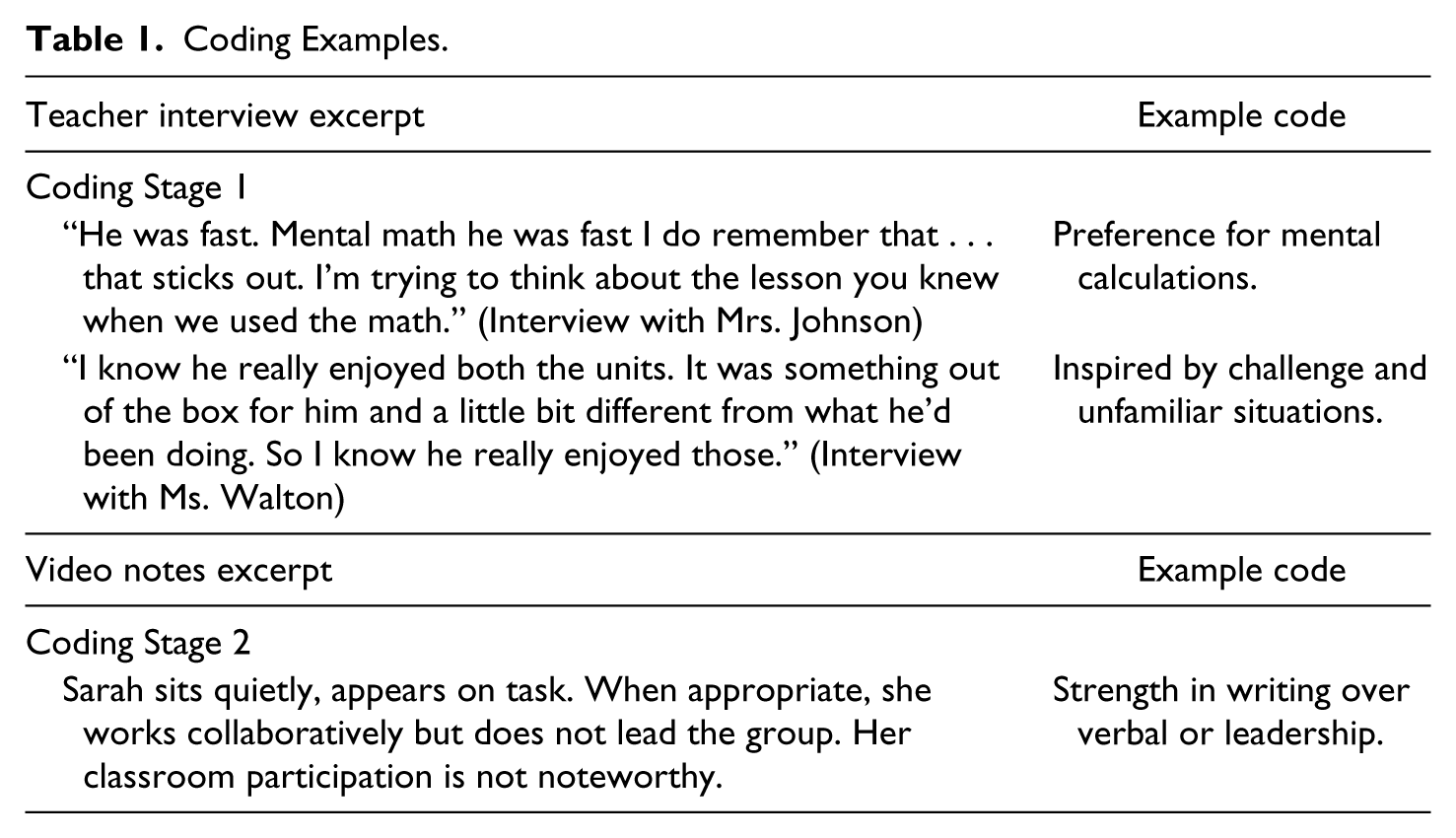
The teacher interviews were analyzed and coded together with the student work, which led to a list of emergent codes (See Table 1). After this initial coding, videotaped recordings of lessons were observed and detailed notes were taken concerning the mathematical work and expression of the targeted students. The next level of coding used the notes from these observations, teacher interview transcriptions, and student work to identify emergent themes. Categories were then grouped together into modes of mathematical expression including numeric, written words, kinesthetic, verbal, and illustration. Traditional curriculum fosters numeric, written words, and verbal modes of expression while reform curriculum, consistent with PBL, provides opportunities for students to express themselves in many ways such as through kinesthetic means and illustrations (Agodini, Harris, Thomas, Murphy, & Gallagher, 2010). Therefore, it was important to identify students’ modes of expression to examine the role the PBL curriculum played in expressing mathematical promise. In the third level of coding, Sheffield’s (2003) characteristics of mathematical promise were identified in each student’s written work. In the final stage of coding, the student work, transcriptions of teacher interviews, notes about classroom observations, and memos were analyzed; codes were grouped to document the characteristics of mathematical promise and forms of mathematical expression. The varied and multiple forms of data sources and raters (i.e., webcam teacher interviews, classroom video, teacher survey responses, and student written work) were strategies employed to establish credibility, dependability, and confirmability of the findings.
Coding Examples.
Findings
While engaging with the differentiated PBL curricula, each student in this study displayed characteristics of mathematical promise. Findings are organized into the four previously described categories, Mathematical Frame of Mind, Mathematical Formalization and Generalization, Mathematical Creativity, and Mathematical Curiosity and Perseverance. These categories provide a framework for describing how this group of students expressed characteristics of mathematical promise, suggested by Sheffield (2003), while engaging in the PBL units.
Task type plays a critical role in providing students opportunity to demonstrate promise, which is why Sheffield recommends several criteria for tasks that foster mathematical promise. As a result of the PBL curricula and embedded tasks, students in this study expressed their mathematical promise in several ways including through verbal expression, kinesthetic (use of tactile manipulatives), numeric, written words, and illustrations. Table 2 depicts the progression of students’ demonstrated mathematical promise. The first column lists the recommended criteria (Sheffield, 2003) for eliciting mathematical promise, which were embedded in the project tasks. The second set of columns depicts the modes of expression students used when demonstrating their promise. The third and fourth columns describe the types of characteristics and associated themes for characteristics of mathematical promise.
Progression of Students’ Demonstrated Mathematical Promise.

Note. PBL = problem-based learning, I=illustration, K=kinesthetic, N=numeric, V=verbal, W=written.
Mathematical Frame of Mind
According to Sheffield (2003), some of the characteristics that a student with a Mathematical Frame of Mind might demonstrate are (a) a love for exploring patterns and puzzles, (b) observing mathematics and structure in a variety of situations, (c) recognizing, creating, and extending patterns, (d) organizing and categorizing information, and (e) having a deep understanding of simple mathematical concepts including a strong number sense. All of the students in this study exhibited one or more of these characteristics during the units. Amy and Shannon’s work will be used to illustrate the five characteristics of a Mathematical Frame of Mind. The mathematical tasks that students engaged with possessed several criteria described by Sheffield for tasks to elicit mathematical promise. Specifically, (a) the students were given the autonomy to develop their own solutions (not regurgitate a teacher’s solution/strategy), (b) the students were given the freedom to explore various possibilities for solutions, (c) they could use many different means for expressing their ideas, (d) the tasks required students to make connections to real-world problems (e.g., the overarching PBL instructional model), (e) students worked together in small group exploration, and finally (f) there was more than one correct answer and path to the solution.
Amy
Amy’s teacher, Ms. Walton, stated that she believed the PBL units helped Amy blossom in how she thought about and expressed her mathematical ideas. Ms. Walton noted Amy’s ability to connect the pattern concepts that they were learning in class to her world outside of the mathematics classroom. This example illustrates Amy’s recognition of mathematics and structure in a variety of situations.
. . . I think it was the pattern unit, when we were talking about other things that have patterns so that we can kind of connect it she would connect it to things that I never would have thought of like if we were talking about growing pattern or repeating pattern. She would connect patterns to her world outside the classroom. That was different for her. (Ms. Walton, Interview 4)
Ms. Walton’s statements were supported by observations of Amy in the classroom as well as her written work; she showed promise in terms of finding, creating, and extending patterns. For example, Amy was observed in class, verbalizing her thought processes while she figured out and extended a growing pattern. In her party store catalog, Amy was given a picture of three boxes that contained cupcakes, and her teacher drew a representation of the cupcake picture on the blackboard. Amy talked through the pattern by saying that the first box had 2 (cupcakes) and then it was doubled to make 4 and then that was doubled to make 8 so the next box would have 16 cupcakes. While most students found a different pattern for this activity (e.g., adding even numbers to each preceding box +2, +4, +6, +8 . . . ) that resulted in the following sequence: 2, 4, 8, 14, 22 . . . Amy’s (also correct) approach resulted in the sequence 2, 4, 8, 16, 32, and so forth. This type of thinking depicted her recognition of creating and extending patterns as described by Sheffield (2003).
Shannon
In a task from the Pay It Forward unit, Shannon used six pages of her notebook to describe to the benefactor how she and her group chose to spend their money for the SPCA. This task charged students with selecting items from store circulars to purchase for the SPCA while staying within budget limitations and justifying these choices. As shown below, Shannon’s explanation was logical and organized. Her written statement described an extensive record of transactions.
I have $2.35. I would like to purchase at least 2 items. Me and Jackie are going to combine our money now we have $3.39 we may purchase 8 bundles of newspaper and 1 pack of cotton balls. We will have 39 cents left over because we only spent $3.00 and we had $3.39 . . . We bought 10 things and have 16 cents left maybe we should donate the money to the SPCA as a tip for their hard work. I just kidding they can collect the left over money and then they could have a little more money. (Excerpt from Shannon’s written work)
Shannon’s work showed that she possessed several characteristics of a student with a Mathematical Frame of Mind described by Sheffield (2003), including her ability to organize information and her understanding of simple mathematical concepts, and her number sense was evident in that she fluidly added and subtracted more than one type of number to solve this problem, including whole and decimal numbers.
Mathematical Formalization and Generalization
Sheffield (2003) suggested that a student characterized as having the ability for Mathematical Formalization and Generalization demonstrates any of the following four attributes: (a) generalizes the structure of a problem, often from only a few examples, (b) uses proportional reasoning, (c) thinks logically and symbolically with quantitative and spatial relations, and (d) develops proofs and other convincing arguments. The activities did not include opportunities for observing the first characteristic, generalizing the structure of a problem. However, there were several students whose work showed logical progression through quantitative measures as well as many students who developed convincing arguments and used proportional reasoning. The work of two of these students, Sara and Tamara, will be showcased here.
Sara
Sara’s work illustrated her ability for logical thinking with carefully considered justifications. An example of this was in Sara’s written explanation of her SPCA wish list item choices shown in Figure 2.

Sara’s logical thought process.
In the above example, Sara explained why she and her group chose certain items to purchase for the SPCA. After calculating the cost of these items and subtracting that cost from the total amount of money they had, the group decided to purchase more items and spend the remainder of their money. Sara’s detailed explanation in Figure 2 showed organization, logical thinking, and justification. Sara’s work was consistent with Sheffield’s (2003) characteristics of Mathematical Formalization and Generalization in that she “developed convincing arguments and thought logically and symbolically with quantitative relations" (p.3).
Tamara
Tamara was a student in Ms. Jones’ class with a penchant for written expression and for developing convincing arguments. Tamara filled every page with explanations and complete sentences, even in cases where she could have gotten by with a one-word answer. During an activity in Pay It Forward, Tamara was charged with the task of choosing to purchase the SPCA wish list items from either the “Pharmacy” or at the “Drug Store.” Each vendor carried the same products and charged the same amount, but the number of products in each package differed (e.g., the Drug Store charged US$9.00 for a 6-pack of post-it notes while the Pharmacy charged US$9.00 for a 4-pack of post-it notes). To help students solve this problem, they were introduced to an Adobe Flash application that was designed, by the research team, to engage them in making cost comparisons with these items along with stickers and handouts used for documenting their work.
This task made use of a number of recommended criteria for developing mathematical promise, including making students think and branch out into new and unrelated areas by asking them to compare items costing the same amount but that include different quantities. The task gave children opportunities to demonstrate abilities on a variety of levels, made appropriate use of technologies, and actively engaged the students by allowing them to express their answers using written text, numbers, and illustrations.
As Figure 3 illustrates, Tamara listed the costs of each product, the number of items in each package, and the “better deal” between the stores. In her explanation, Tamara also demonstrated the ability to reason proportionally, which Sheffield lauds as a characteristic of mathematical promise. First, she explained that one package of pens cost US$2.00 and therefore three packages costs US$6.00. Next, Tamara stated, “I can get three bottles of hand sanitizer for twelve dollars, and four bottles of hand sanitizer for $16.00” (Figure 3).
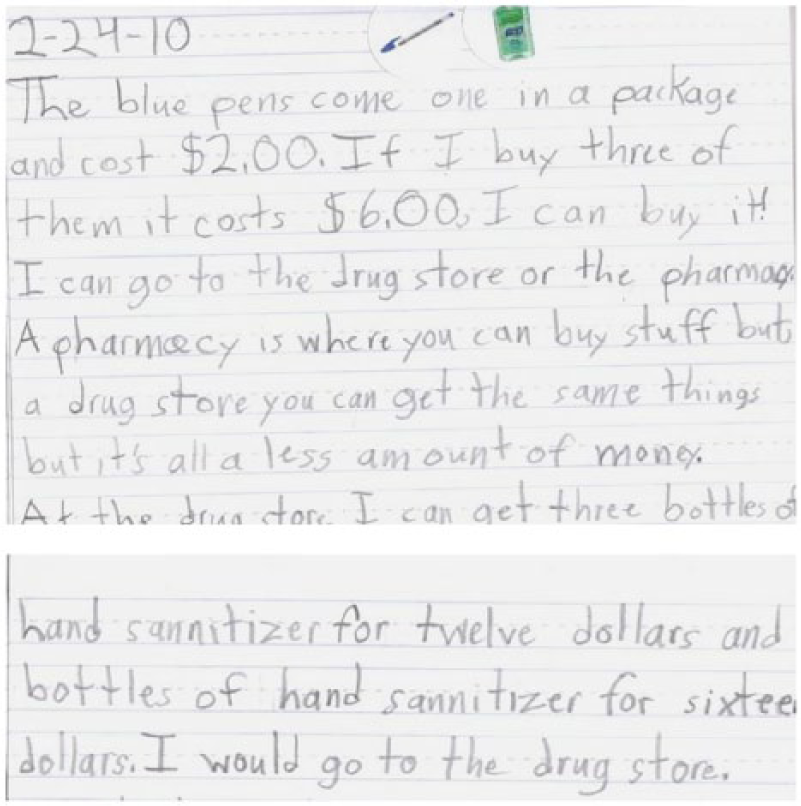
Tamara’s logical, convincing arguments.
Tamara’s work indicated that she took advantage of these task attributes to produce a well-articulated problem solution. Her work showed that she had “a strong number sense, could develop convincing arguments, and used proportional reasoning and thought logically” (Sheffield, 2003, p. 3).
Mathematical Creativity
In the third category, Sheffield (2003) proposed that mathematically promising students might manifest their talent in creative ways. Specifically, a student may (a) process information flexibly—switch from computation to visual to symbolic to graphic representations as appropriate in solving problems; (b) have original approaches to problem solving—solves problems in unique ways, tries unusual methods; (c) strive for mathematical elegance and clarity in explaining reasoning; and (d) reverse processes—can switch from a direct to a reverse thought. Considering the primary source of data for this study was student written work, it was not possible to make judgments about a student’s ability to reverse his or her thought process. Although there were several students whose work illustrated the other three attributes depicting Mathematical Creativity, Tamara and Shannon’s work particularly stood out.
Tamara
In an activity from the Pay It Forward unit, the benefactor sent a card to each student showing pictures of SPCA wish list items and pictures of several coins. The benefactor asked the students to answer the following question: “Is enough money shown on your card to pay for the pictured item? Too much-how much is left over? Not enough—how much more do you need? Please show your work here.” Although there was one correct solution to this “real-world” question (for each card), students were given the liberty to demonstrate their understanding on a variety of levels (cards were differentiated for different readiness levels) and in a variety of ways (numerically, written, drawings, etc.). This task is an example of an instance when students were called upon to problem-solve individually (not in a small group). These task characteristics all fulfill Sheffield’s (2003) recommendations for developing mathematical promise using interesting mathematical investigations. Tamara’s solution included a written statement of the amount of money that she had, with illustrations of her money and the amount of money that her wish list item cost (see Figure 4).
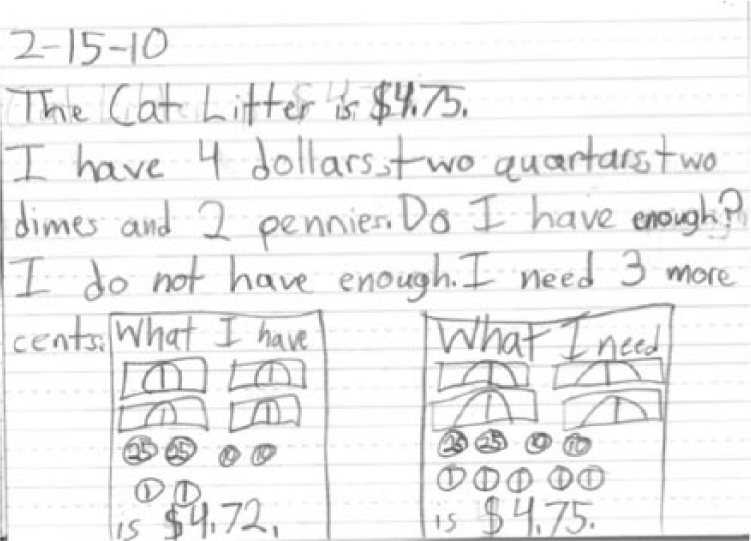
Tamara processing information flexibly.
In the example in Figure 4, Tamara wrote her ideas in an organized manner in that she first listed the cat litter amount, she then stated how much money she had, next she restated the question “Do I have enough?” and then answered the question. Tamara did not get confused with solving this multistep problem (counting her money, determining if she has enough and how much more she needs) and focused on the important information in the problem. She solved this problem using words, numbers, and illustrations, which aligns with Sheffield’s (2003) characteristic of a mathematically promising student who is Mathematically Creative and “switches from computation to visual to symbolic to graphic representations as appropriate in solving problems as well as strives for mathematical elegance and clarity in explaining reasoning” (p. 3).
Shannon
Shannon’s work showed many examples of advanced and divergent ways of thinking that describe a Mathematically Creative student who “has original approaches to problem solving” (Sheffield, 2003, p. 3). For example, during Pay It Forward, when finding more than one way to express US$1.00, Shannon used a multiplication symbol to represent the amount of each coin (e.g., 2 × 5 dimes and 2 × 2 quarters), which was not done by the other students. Another example of her divergent and advanced thinking was on the postassessment for this unit. One of the questions asked that the students create a pictograph based on a given tally. Shannon was the only student who used division to determine how many representations she needed to draw in each category of the pictograph (see Figure 5).

Shannon’s use of division.
Each of these tasks called on individual reflection and problem solving, which was listed as possible task criteria for developing mathematical talent. Because Shannon had these opportunities for individual work, she was able to demonstrate her unique solutions and strategies. Furthermore, Shannon’s teacher was receptive to her unique solutions and strategies as evidenced in the next example. During Let’s Plan a Party, Shannon and the small group she was working with were asked to determine how many and which type of packages of napkins the class should order for the party. The activity of choosing the optimal number of napkin packages for the cost included many of Sheffield’s criteria for an interesting mathematical investigation. First, the task challenged Shannon to think and reason using previous knowledge (i.e., basic adding strategies) while discovering unknown concepts such as considering the cost associated with each type of package and the cost of the combination of packages.
Shannon finished the activity before the rest of the class (and her group) and, at her teacher’s request, she went on to determine the cost of ordering these napkins. There were three different packages to choose from and each package required a different amount of money and contained a different amount of napkins from one another. After adding several combinations of napkin packages to determine which ones to purchase for 20 students, Shannon determined a combination that required the least amount of money and provided exactly enough napkins for the class party. Her written work showed the logical process that she used to determine the solution, and the quote below represents her teacher’s astonishment at this situation. Furthermore, this real-world activity actively engaged Shannon, and as Ms. Jones indicates below, she was receptive to Shannon’s unique solutions (criteria proposed by Sheffield for interesting mathematical investigations that foster promise).
She would have more out of the box thinking that would make me feel like she should be the teacher and I need to get a lesson—especially with those napkins! When we were figuring out the patterns with the napkins, the way I figured it out was more money to be spent the way I was trying to tell the kids but she had figured it out she had set it up so that when you buy the packages of napkins you would spend less money. And I was just so flabbergasted, I said you know, you’re right Shannon! (Ms. Jones, Interview 6)
Mathematical Curiosity and Perseverance
The characteristics included in this category each deal with a student’s perseverance when problem solving. Mathematical Curiosity and Perseverance manifested itself in each of the three ways theorized by Sheffield (2003): (a) is curious about mathematical connections and relationships—asks “why” and “what if,” (b) has energy and persistence in solving difficult problem, and (c) digs beyond the surface of a problem, continuing to explore after the initial problem has been solved. The three students whose work will be used to illustrate this category are Sara, Tamara, and John.
Sara and Tamara
In another set of examples illustrating Mathematical Curiosity and Perseverance, Sara and Tamara’s work evidenced all three characteristics in this category. During Pay It Forward, students were asked to provide several ways of representing US$1.00 (Task 6: Multiple Representations of US$1.00). Although this problem had a finite number of solutions, it was presented to students in an open-ended way by allowing them to find as many coin combinations as they could instead of the more traditional, closed approach that might ask students to find a specific number of combinations (e.g., “provide three ways”). This allowed students to branch out and explore multiple combinations of coins and encouraged continued exploration once the initial question was answered. These criteria (branching out and continued exploration) coupled with the opportunity for multiple modes of expression and individual reflection and problem solving enabled Sara and Tamara to communicate their mathematical promise (Figure 6). Like Tamara, Sara’s solution to this problem was evidence of what Sheffield (2003) described as a student with Mathematical Curiosity and Perseverance in that she “was curious about mathematical connections and relationships and digs beyond the surface of a problem, continuing to explore after the initial problem has been solved” (p. 4).

Sara and Tamara’s representations of US$1.00.
Sara and Tamara’s work were notable because they each represented the US$1.00 amount in many more ways than their peers. Sara found 11 different ways of representing US$1.00 with some unique combinations such as “3 dimes and 14 nickels” and “6 nickels and 7 dimes” while Tamara found 15 different ways. Among the students in this study, Sara was the only student to combine more than two types of coin: “7 dimes and 1 quarter and 1 nickel” and Tamara also had some interesting coin combinations such as 90 pennies and 1 dime or 8 dimes and 4 nickels. These students’ abilities to find a number of different combinations of coins to represent US$1.00 suggested that they were each fluent in representing numerical values in multiple ways. The girls did not rely on calculations, but instead, they provided clear lists of accurate (notwithstanding Tamara’s use of the phrase “half quarter” instead of “half dollar”) coin combinations. This suggests that these students looked for relationships between the quantities.
John
John’s teacher, Ms. Johnson, described him as being mathematically promising but his emotional issues sometimes masked his promise. She stated during an interview that he was “strong with math facts, mental math, money and recognition and he is fast (solving math problems)” (Ms. Johnson, Interview 6). On the survey that Ms. Johnson completed about John for identifying mathematically promising students, she wrote, “he demonstrates a lot of strengths; however, negative attitude or feelings sometimes interfere with performance.”
John’s mathematical strength was apparent when looking at his written work. In some cases, John went above the given task and solved the higher level activities. For example, during the Let’s Plan a Party unit, he found the number and cost of napkin packages to purchase for the class party and then continued the pattern (after finding the solution) until he reached the last row of the graphic organizer.
Ms. Johnson explained that he was motivated to go beyond what was required of him in this case because he enjoyed the problem-based nature of the unit. She believed that John was more successful solving authentic mathematical tasks (such as the one in Figure 7) than when he only read the subject matter in a textbook.

John’s work finding the amount and cost of napkins.
John’s written work combined with classroom observations of his behavior and Ms. Johnson’s interview showed that he demonstrated characteristics of Mathematical Curiosity and Perseverance only when he was faced with a challenging task. The authentic nature of the units inspired him to have energy and persistence in solving difficult problems. It seemed that when John was engaged in tasks such as this one (which actively involved him, dealt with real-world problems, allowed more than one level and way of demonstrating his abilities, and provided a means for continued exploration) his mathematical promise was evident.
Discussion
The findings in this study provide evidence of face validity of Sheffield’s (2003) a priori themes that describe the characteristics of mathematically promising students: (a) Mathematical Frame of Mind, (b) Mathematical Formalization and Generalization, (c) Mathematical Creativity, and (d) Mathematical Curiosity and Perseverance. These characteristics were clearly visible in the student work in this study; however, the findings reveal the importance of some additional contextual factors to ensure that students have the opportunity to demonstrate mathematical talents. The findings of the study also suggest that when given appropriate learning opportunities, students belonging to traditionally underrepresented groups in the area of mathematics (e.g., low socioeconomic status [SES], females, ED disability) can demonstrate these characteristics. This finding aligns with the NCTM (1995) Task Force recommendation of experience/opportunity for maximizing student success (Sheffield et al., 1995).
Classroom Practices Matter for the Development of Talent
Much effort has been focused on improving the academic performance of students. Many believe that if (a) academic standards are rigorous; (b) there is close alignment between curriculum, instruction, assessment, and the academic standards; and (c) teachers possess the skills to teach the standards at a high level, then student performance will improve (Wenglinsky, 2002). Others suggest that restructuring classrooms to focus on the construction of knowledge rather than passive absorption of information, using sophisticated information-gathering tools to stimulate students, incorporating collaborative interactions among peers, and using assessment tools to measure complex, higher order skills rather than simple recall of facts all result in improved academic achievement (e.g., Hopson, Simms, & Knezek, 2002). This study’s findings suggest that the PBL context allows for the use of the types of tasks necessary to foster mathematical promise as recommended by Sheffield (2003).
Curricular focus
The curriculum implemented in this study aligned with the NCTM (2000) recommendations regarding both content and process standards. For both of the units, emphasis was placed on the recommended mathematics content standards and the process standards of problem solving, communication, reasoning, and mathematical connections. The authentic nature of the PBL tasks allowed students to connect to patterns outside of the mathematics classroom such as in the example of Amy who saw the ideas of growing and repeating patterns occurring outside of school. Furthermore, the construction of fuzzy problems allowed for multiple, accurate interpretations and responses mathematically. The semistructured nature of the PBL framework allows for those students who can go farther to do so in the same context of the problem without doing unrelated tasks for further challenge. These types of foci provide students opportunities to engage in the real understanding of a problem, making a plan to solve the problem, carrying out that plan, and then reflecting on the work—even if they do something different from their peers. These types of meaningful problems engage students, which in turn increases motivation, one of the variables considered by the NCTM Task Force (1995) as necessary for maximizing mathematics potential.
Often, in today’s high-stakes testing environments, these types of differentiated experiences are minimized at the expense of all students focusing only on rules or procedures for solving decontextualized mathematical problems. This type of decontextualized curriculum limits opportunities for students to become actively engaged in the learning process. Subsequently, teachers have limited opportunity to see the potential students may have, thus resulting in the nonrecognition of their talent.
Assessment focus
“What a student learns depends to a great degree on how he or she has learned it” (NCTM, Commission on Standards for School Mathematics, 1989, p. 5, emphasis in original). Preassessment can offer a window into the students’ mathematical and creative thinking such as in the case of Shannon who was able to offer more than one accurate way to solve the problem. Teachers who are able to make use of informal “on-the-fly” assessment data can maximize students’ experiences with mathematical content. This was highlighted in Mrs. Jones’ words describing how Shannon was able to demonstrate another way of proportional reasoning to get the best price per unit cost. The teacher who is able to be open to this formative data, and use these data to flexibly adjust the instructional plans, is more likely to be able to nurture and recognize mathematical talents.
Underrepresented Groups
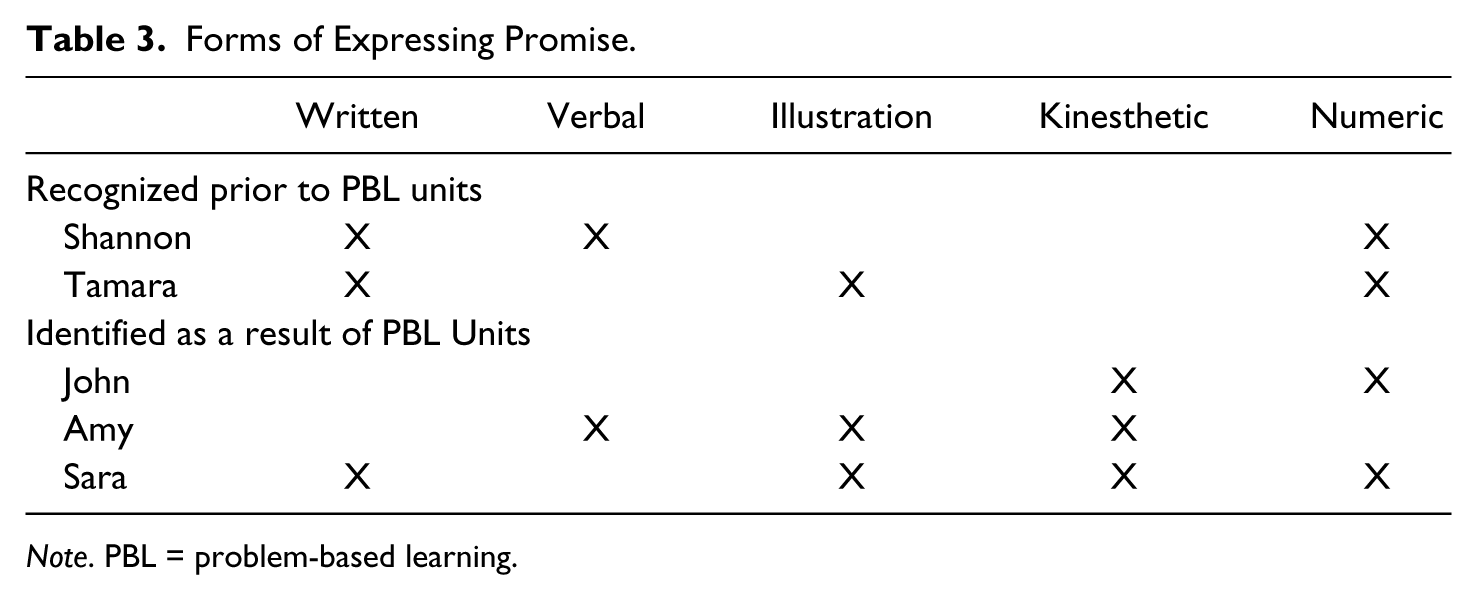
It is interesting to note that the two students who were recognized by their teachers as having mathematical promise prior to participation in the PBL units (Shannon and Tamara) could each express themselves well by using a combination of numeric means with either written words or verbal language (see Table 2). These forms of expression benefited the students when experiencing the “business as usual” instruction because these are traditional forms of expressions that are regularly used and encouraged in a typical primary-grade classroom. Table 3 shows that Shannon and Tamara were each identified prior to experiencing the PBL units and both of these students expressed their mathematical knowledge using narrative and numeric writing.
Forms of Expressing Promise.
Note. PBL = problem-based learning.
The other three students (Sara, Amy, and John) who were identified as a result of participating in these PBL units did not express themselves using a combination of numeric with either verbal or written means (see Table 3). These students each used at least one form of “non-traditional” modes to express their talents such as verbal, illustration, or kinesthetic (without the numeric complement). Sara was the only outlier but according to her teacher, Sara’s method of using sentence writing and illustrations as forms of mathematical expression developed as a result of her participation in the PBL units. Although she was a strong writer prior to the implementation of the PBL units, it was not until she discovered this writing outlet that she was identified as having mathematical promise.
This study’s findings suggest that when mathematics is presented to students in ways that engage them, and when the tasks are appropriately challenging for them, they are able to interact with the content in ways that provides a window into their mathematical potential and suggest that talent can manifest itself in nontraditional ways. Moreover, students from underrepresented groups with regard to talent identification (Sara and Amy were eligible for free and reduced lunch and John was identified as having an emotional disturbance [ED] disability 2 ) expressed themselves with these means. If we do not provide for opportunities that allow for students to demonstrate potential (because of the reliance on practices that value precision, speed, and “one-right-answer” thinking rather than seeing mathematics as a complex, multidimensional discipline) then the talent pools will continue to be populated by traditional evidence of mathematical talent.
Sheffield’s (2003) characteristics of mathematically promising students have face validity in this sample. The development of talent in underrepresented groups is a complex problem. Simply changing one aspect of a classroom is insufficient in moving toward a more equitable approach to talent development. Rather, a multifaceted approach to curriculum, instruction, assessment, and teacher development may be one step toward addressing the underrepresentation of minority and economically impoverished students in gifted programs.
Teacher Preparation for Teaching High-Quality Curriculum
While the project had an intended curriculum, the expectation of the instructional materials being implemented in exactly the same way in all classrooms was not realistic. As noted by Ball and Cohen (1996), “the enacted curriculum is actually jointly constructed by teachers, students, and materials in particular contexts” (p. 7). Teachers’ mathematical content knowledge and ability to use informed professional judgment play an integral role in the delivery of curriculum.
Much has been written regarding the types of mathematical knowledge (e.g., Ball, Thames, & Phelps, 2008; Shulman, 1986) that are necessary for teachers to possess to effectively teach mathematics. In the context of this study, participating teachers received 72 hr of PD focused on a variety of topics, including advanced mathematical content knowledge related to the two project units, and the importance of teaching in a flexible manner so as to be equipped to recognize and respond to students’ needs throughout the unit. Teachers need familiarity with how to teach in these ways because, as this study showed, students will go beyond expected content expectations. This study suggests that the PBL framework is a good fit for a talent development model as it allows for students to explore a common problem with sophisticated complexity.
Limitations
As with all research studies, this study is not without limitations. Although the students who were identified by the teachers as having mathematical promise did produce work and display behaviors suggestive of mathematical talent as identified by Sheffield (2003), these students may not have represented the entire set of students across the classrooms that might have had mathematical potential. Perhaps the talent was still in a latent form or did not emerge in such an overt fashion as it did with the identified students. Because of these developmental differences in young children, looking for talent on a continuous basis is an extremely important component of any identification process as it minimizes the oversight of potential talent. The second limitation that is worth noting is the fact that the teachers were the only individuals to complete the surveys, limiting the ability to investigate interrater reliability. While this is a limitation, this is not unlike the typical process that is used by a large portion of local education agencies’ gifted identification procedures where teachers are the first gatekeepers in the referral and screening stages of identification (Callahan, Moon, & Oh, 2013). Findings from this study suggest that the protocol may allow for the capturing of attributes that indicate mathematical potential, even in students typically underidentified for gifted programs in the area of mathematics (i.e., females, students with an ED disability, or students from impoverished environments).
Footnotes
Appendix A
Appendix B
Appendix C
Appendix D
Declaration of Conflicting Interests
The authors declared no potential conflicts of interest with respect to the research, authorship, and/or publication of this article.
Funding
The authors received no financial support for the research, authorship, and/or publication of this article.