



Abstract
Asking questions that invite students to access advanced thinking skills during classroom discourse is a key strategy for challenging and supporting high-ability middle school readers. This critical teaching practice requires careful teacher listening. However, empirical research around teachers’ listening orientations, or how teachers listen, is sparse. We investigated five middle school reading teachers’ listening orientations as they conducted differentiated reading conferences as part of their first year implementing the Schoolwide Enrichment Model–Reading Framework (SEM-R). Our qualitative analysis of multiple data sources revealed evidence of differing teacher listening orientations, including evaluative, interpretive, student oriented, teacher oriented, undetermined, and combinations of these. This exploratory study has important implications for understanding how teachers’ listening orientations contribute to classroom discourse. Specific implications pertaining to high-ability readers are highlighted in the article.
Above all, we must listen to and take seriously what children have to say as we talk with them about the tasks in which they are engaged.
Overview of the Study
Classroom discourse has received a wealth of attention from researchers as a central strategy for promoting student learning and development (Cazden, 2001; Lawrence & Snow, 2011; Nystrand, 2006). In recent years, alternative approaches to traditional discourse structures have come to the foreground in support of providing students with appropriately challenging learning experiences (Applebee, Langer, Nystrand, & Gamoran, 2003; Elizabeth, Ross Anderson, Snow, & Selman, 2012). These alternative approaches have included more emphasis on back-and-forth exchanges between and among the teacher and students. The use of varied teacher questioning strategies during discourse exchanges has also been widely promoted as a strategy responsive to the diverse needs of readers, particularly with more advanced readers (Reis, 2014; Shaunessy, 2000). However, researchers have given little attention to investigating the role of reading teachers’ listening behaviors during these exchanges (Sangster & Anderson, 2009). Because alternative discourse approaches can be characterized by dynamic participant interactions around open-ended questions, teachers must listen actively and openly. In addition, attention to classroom discourse, questioning, and listening may be important in promoting professional growth for teachers and their capacity to differentiate for the wide range of student reading readiness levels (Firmender, Reis, & Sweeny, 2013).
The act of listening is a dynamic and complex, yet essential, component of discourse (Harkness & Wachenheim, 2008). Costa (2001) pointed out the complexities of listening: “Some psychologists believe that the ability to listen to others, empathize with them, and understand their points of view is one of the highest forms of intelligent behavior” (p. 81). Although there is limited evidence about how teachers listen to students in the reading or gifted education literature, teacher listening has been the subject of empirical studies in mathematics education. Researchers have demonstrated that teachers display different modes of listening behaviors, also referred to as listening orientations (Davis, 1994; Davies & Walker, 2007), and that teachers’ expectations of students at different readiness levels may influence the accuracy of their listening (Wallach & Even, 2005). The aim of this study was to contribute to the field’s understanding of the role of teacher listening behaviors in the context of classroom discourse in reading with students at varied reading levels, including higher ability readers (Gilson, 2014; Netz, 2014).
This qualitative study took place at one middle school in the Northeastern region of the United States. Gifted middle school students, who tend to spend most or all of their instructional time in general education classrooms, are a unique population requiring qualitatively different learning experiences to guarantee continuous development (International Reading Association [IRA], 2012; Reis, 2014). Therefore, we examined middle school teachers’ listening behaviors and their perceptions of their listening within individualized reading conferences with students at differing readiness levels. These conferences occurred during the school’s first year of implementing the Schoolwide Enrichment Model–Reading Framework (SEM-R; Reis et al., 2005). The aim of this framework is to provide enriched reading instruction and learning experiences for students. Through this focus, the following research questions guided the study:
Although we acknowledge how dynamic discourse is between the teacher and student, this study attempted to focus on a “micro-level view” of teacher listening during individualized reading conferences in an attempt to limit the number of mediating variables (Sangster & Anderson, 2009, p. 121). Other researchers have addressed the role of student listening during discourse exchanges (see Friend & Caruthers, 2012; Sangster & Anderson, 2009).
Theoretical Framework
From a sociocultural perspective, student learning and development can occur during the teacher-to-student social language interchanges of classroom discourse (Vygotsky, 1978). According to Vygotsky’s (1978) sociocultural theory of learning, conceptual understandings and higher level functions are first modeled through an interpersonal social context such as whole-group, small-group, or teacher-to-student interchanges in the reading classroom. Scaffolding delivered during teacher-to-student verbal exchanges, for example, may be in the form of asking questions, providing clues for the solution, or modeling the specified learning objectives (Vygotsky, 1978). Compatible with Vygotsky’s (1978) theory, Gee (2001) conceptualized these exchanges as means for students to build meaning from language and learn new perspectives on experiences, thus allowing students to later consider and imitate them independent of teachers’ support. Discourse can serve as a metaphorical scaffold to promote student learning, which also requires careful teacher listening behaviors (Cazden, 2001). Because teacher behaviors have a contributing role in the sociocultural context of discourse, we applied Vygotsky’s (1978) and Gee’s (2001) theoretical views of student growth and development to guide this study.
Discourse in Classrooms
Discourse is a complex and dynamic phenomenon that can be a tool for meaning making (Imm & Stylianou, 2012; Louca, Zacharia, & Tzialli, 2012). In the current study, discourse was conceptualized as the interactive, oral conversations between a teacher and student that were instructional in nature (Cazden, 1998; Nystrand, 2006; Vygotsky, 1978) and inclusive of participants’ listening behaviors.
Discourse approaches
The situational contexts of classroom discourse include whole-group or peer discussions, debates, or individual conversations (Cazden, 2001; Nystrand, 2006). More traditional classroom patterns of discourse have been characterized by the IRE three-turn sequence (Mehan, 1979), in which the teacher initiates a question (I), a student responds (R), and the teacher offers an evaluation (E). A variation called the IRF pattern includes a follow-up (F) move such as a comment, further instruction, or an acceptance of the student’s response (Sinclair & Coulthard, 1975). Teacher questions in these traditional discourse patterns predominantly include recitation, or recall questions (Nystrand, 2006; Nystrand, Wu, Gamoran, Zeiser, & Long, 2003). Because these patterns tend to be highly evaluative, teacher directed, and focused on questions that access lower level thinking, they have been criticized for restricting student participation and thinking (Bakhtin, 1984; Lemke, 1990; Nystrand et al., 2003; Nystrand & Gamoran, 1990).
More recent studies of alternative discourse structures have emphasized distinctions between univocal or monologic and dialogic approaches, with the latter offering more flexibility in the exchange of ideas (Applebee et al., 2003; Elizabeth et al., 2012; Reznitskaya et al., 2012). In monologic discourse, the speaker dominates the flow of ideas and ownership of knowledge, limiting the potential for back and forth exchanges (Bakhtin, 1984). Dialogic approaches are characterized by a shared responsibility for constructing knowledge; asking divergent or open-ended questions that require students to apply, analyze, or evaluate text; and responding to each other’s contributions (Anderson & Krathwohl, 2001; Bakhtin, 1984; Reznitskaya et al., 2012).
Dialogic approaches can have positive effects on student achievement (Caulfield-Sloan & Ruzicka, 2005; Samson, Strykowski, Weintein, & Walberg, 1987), increase student talk time and elaboration of responses (Murphy, Wilkinson, Soter, Hennessey, & Alexander, 2009; Reznitskaya et al., 2012; Soter et al., 2008), and potentially challenge high-ability readers (Netz, 2014). Several key variables may influence the potential for high-quality discourse (Zhang, 2008), including relationships between participants (McElhone, 2013), expectations of students (Netz, 2014), and the quality of teacher questions (Nystrand et al., 2003).
In a rare study focused on discourse in a gifted classroom, Netz (2014) found that language arts and social science teachers in Grades 5 to 8 who allowed students to initiate exchanges opened the space for dialogic discourse to occur. Other research on teachers’ use of follow-up responses, including questions following teacher’s initiating question, has indicated the potential to advance student participation and thinking at higher levels (Chin, 2006; McElhone, 2013; van Zee & Minstrell, 1997; Wolf, Crosson, & Resnick, 2005). McElhone (2013) examined how an elementary teacher used high press and reducing press follow-ups so students could elaborate and clarify their thinking during reading workshop discussions. McElhone stated the teacher “. . . emphasized the importance of listening to students, respecting their ideas, and giving them opportunities to talk ‘long and windingly’” (p. 5).
SEM-R
High-ability middle school readers, who require differentiated learning to guarantee continuous development (IRA, 2012; Reis, 2014), may greatly benefit from dialogic discourse. These are the students who read at about two or more grade levels above their peers and demonstrate advanced language skills and abilities in reading (Reis, 2014). Absence of appropriate challenge is detrimental as it may lead to underachievement, limited growth, or an inability to perform challenging work in later grades (Matthews & McBee, 2007; Reis, 2014; Reis & McCoach, 2000).
SEM-R is a research-based model for effectively addressing the needs of varied readers, including high-ability readers (Reis et al., 2005; Reis, Fogarty, Eckert, & Muller, 2008). The SEM-R provides students with differentiated literacy instruction and learning experiences in three distinct phases. In Phase 1, students engage in whole-group mini-lessons and are introduced to high-interest reading selections through book hooks. Phase 2 emphasizes independent reading and differentiated student conferences with the teacher around self-selected texts that are slightly above students’ reading level. In the current study, Phase 2 SEM-R conferences were the primary setting for data collection because they provided the context for carefully examining teachers’ listening orientations with students at different reading levels. In Phase 3, students develop and explore their reading interests through such activities as independent research projects, literature circles, or author studies. Research on SEM-R has indicated improvement in student comprehension and fluency, and students involved in SEM-R may have more opportunities to answer questions that require higher levels of thinking (Fogarty, 2006; Little, McCoach, & Reis, 2014; Reis et al., 2005).
Teacher listening
According to the IRA (2012), adolescent literacy encapsulates the “ability to read, write, understand and interpret, and discuss multiple texts across multiple contexts” (p. 2). Speaking and listening skills are also emphasized in the English Language Arts component of the Common Core State Standards (CCSS; National Governors Association Center for Best Practices [NGA] & Council of Chief State School Officers [CCSSO], 2010). Therefore, teachers have multiple responsibilities in developing students’ literacy skills, including students’ ability to participate in instructional discourse around text. Developing such discourse requires teachers to engage in and model appropriate listening behaviors.
Listening is a challenging (Dunphy, 2010) and complex process (Hoag & Wood, 1990). The International Listening Association (ILA; 1995) posited the following: “Listening is the process of receiving, constructing meaning from, and responding to spoken and/or non-verbal messages” (p. 4). Similarly, Purdy (1986) described listening as a “process that happens in the interpretive interaction of communication” (p. 3). Davis (1994) also explained that “ . . . listening is not a solitary act, it is a reciprocal engagement” (p. 280). We conceptualized listening as an interpretive and interactive process rather than a one-sided aspect of communication. Direct observation of the internal processes of teacher listening is difficult; however, analyzing teacher response behaviors such as questioning strategies can signal how teachers listen (Davis, 1997).
Research on teacher listening
Few empirical studies have addressed reading teachers’ listening. In one study, Sangster and Anderson (2009) investigated junior high school English teachers’ and students’ perceptions of listening. Their analysis of interviews pointed to the importance of normative listening obligations and behaviors, including putting forth effort to listen to others and acknowledging speakers’ rights to be listened to attentively. Whereas only a paucity of studies on reading teachers’ listening exists, the empirical literature on mathematics teachers’ listening is growing (Davis, 1994, 1996, 1997; Harkness & Wachenheim, 2008; Wallach & Even, 2005). Davis’s (1994, 1996, 1997) research on middle school mathematics teachers’ listening orientations, or mode of listening, has paved the way for others in his field (e.g., Davies & Walker, 2007). Davis (1994) stated that “Listening thus is not primarily an act; it is an orientation” (p. 272). Accordingly, teacher listening is influenced by the student and what teachers are listening for in students’ responses. Davis (1997) identified three different, yet not mutually exclusive, modes of listening: evaluative, interpretive, and hermeneutic listening. In evaluative listening, the teacher listens primarily for the accuracy of students’ answers and controls the direction of the discourse. Teachers with an interpretive listening orientation listen to understand students’ sense-making and to ensure that they comprehend students’ contributions. The direction of the discourse is influenced by students’ responses; however, the teacher ultimately holds the authority of the knowledge. Davis (1997) explained that hermeneutic listening “. . . demands the willingness to interrogate the taken for granted and the prejudices that frame our perceptions and actions” (p. 370). The teacher and student engage together in a more conversational format in which the teacher is willing to listen to and learn from the student. The learning space is shared between participants, and the teacher is more a partner than the authority figure.
Davis’s (1994, 1996, 1997) work on teacher listening revealed two important observations. First, the teachers’ modes of listening shifted over time concurrent with professional reflection. Second, the teachers’ listening appeared to reflect their beliefs about who controls the direction of the classroom discourse. Teacher beliefs can also influence the accuracy of teachers’ listening. In one noteworthy study, Wallach and Even (2005) investigated a mathematics teacher’s ways of hearing students at different readiness levels discuss a mathematics word problem. The researchers discerned five distinct ways of hearing: over-, compatible-, under-, non-, and biased-hearing. The findings of this study demonstrated the fallibility of the teacher’s hearing. The authors concluded these variations may have been influenced by the teacher’s hope for student success, prior knowledge of her students, and her understanding of the task and the solution.
Even though listening carefully and accurately to others is challenging for the listener, it is an important skill for teachers to recognize and enhance (Harkness & Wachenheim, 2008; Hoag & Wood, 1990). One practice for improving teacher questioning and listening is the use of reflection journals. In Dunphy’s (2010) study of pre-service early childhood teachers, participants interviewed children to learn about their mathematical thinking, and then the teachers recorded their thoughts about the interviews in journals. Some teachers noted they asked too many questions or gave students too little thinking and responding time. In a similar study of pre-service teachers’ use of listening journals in a math methods course, Harkness and Wachenheim (2008) found the teachers initially considered themselves to be good listeners until they were forced to think deeply about listening. Their reflections revealed that this awareness was at times painful because they had to come to grips with the fact that listening was an area in which they needed to improve. (p. 68)
Based upon this body of literature, it seems logical to conclude that teacher listening may contribute to classroom discourse dynamics. If mathematics teachers listen to students in varied ways, we hypothesized that reading teachers’ listening might also vary. If specific ways of listening are more effective than others to engage students, including higher ability readers, in dialogic discourse, then understanding reading teachers’ listening differences is a vital first step.
Method
Participants
The study was conducted at one urban middle school in the Northeastern region of the United States from January to June of 2013, during the school’s first year of implementing the SEM-R (Reis et al., 2005). In this school of 1,206 students in Grades 6 to 8, 85.4% of students were eligible for free/reduced-price meals, 12.7% were English Language Learners, and 20.1% were identified with disabilities. The percentage of minority professional staff was 11.4%. All the reading and English Language Arts teachers at the school were directly recruited for the study by the lead author during the teachers’ regularly scheduled SEM-R meetings. A total of five teachers agreed to participate. These teachers were each asked to select a struggling (S), average (A), and high-ability reader (H), relative to other students in their respective classes, to participate in the study. Tables 1 and 2 provide all available demographic data on the teachers and students. The participants were informed of the general purpose for the research study, including the emphasis on listening to students during the conferences in reading class.
Teacher Participant Demographics.
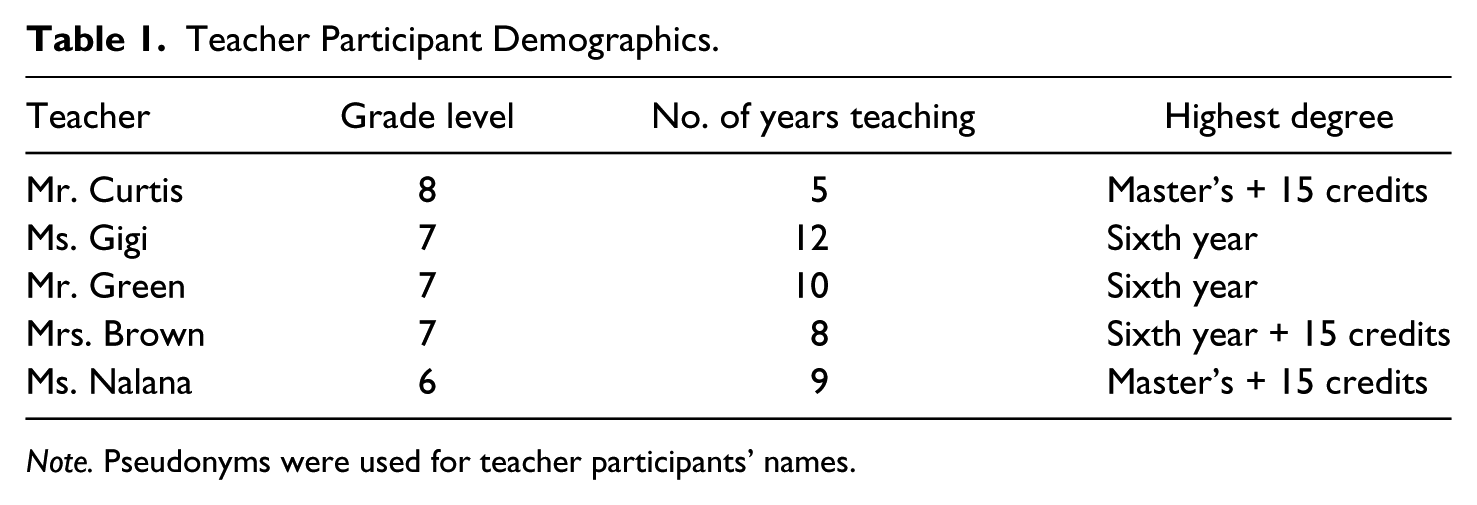
Note. Pseudonyms were used for teacher participants’ names.
Student Participant Demographics and Number of Reading Conferences Conducted.
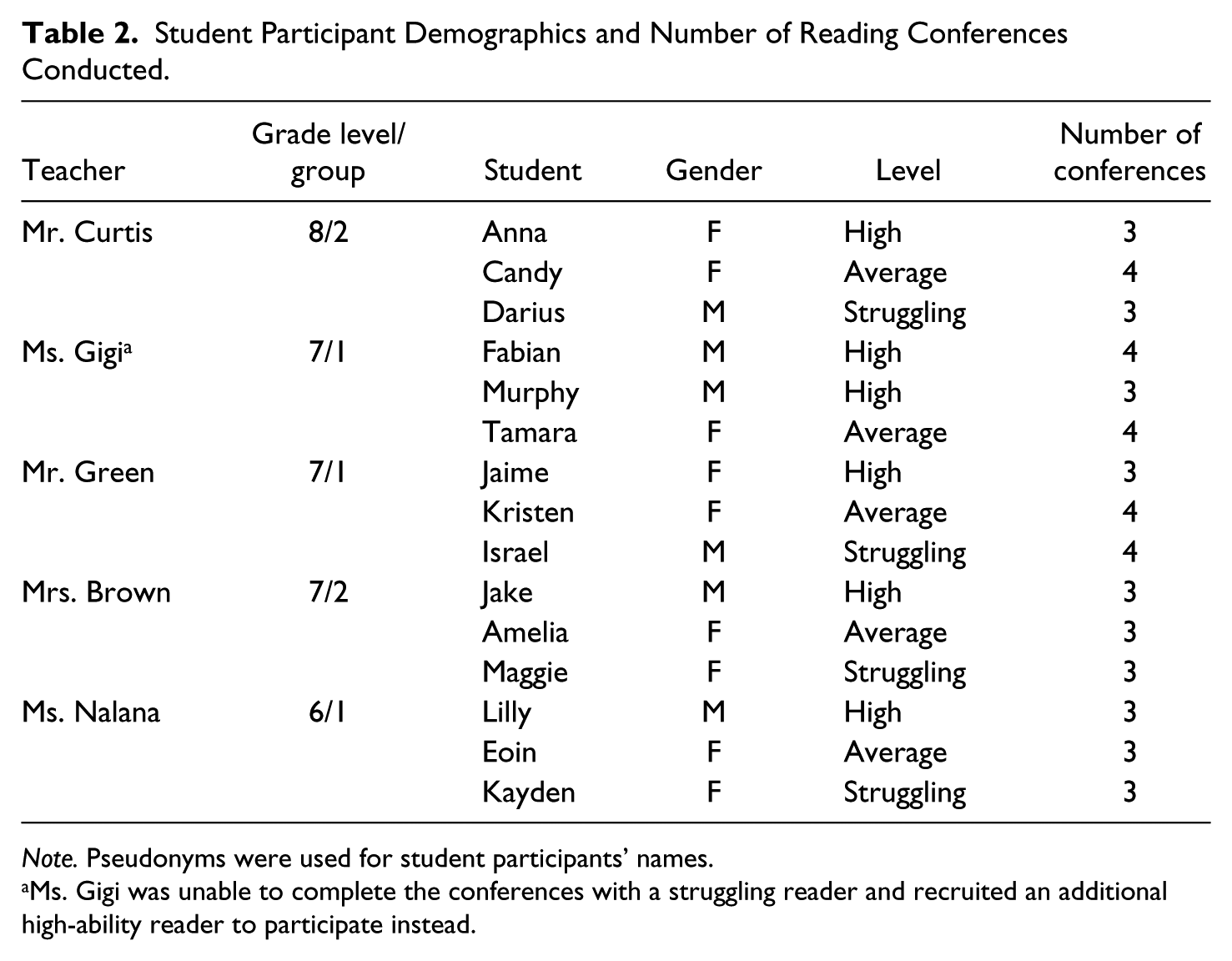
Note. Pseudonyms were used for student participants’ names.
Ms. Gigi was unable to complete the conferences with a struggling reader and recruited an additional high-ability reader to participate instead.
Data Sources
We applied a basic qualitative research design (Merriam, 2009) to answer the research questions. According to Merriam (2009), in a basic qualitative study “data are collected through interviews, observations, or document analysis” (p. 23). Therefore, we gathered data from multiple data sources to triangulate the findings. The data sources included semi-structured and audio-recorded Initial Interviews (II; see Appendix A for interview protocols). A total of five IIs (one per teacher) were completed, ranging from 23 to 42 min. Next, the teachers video- and audio-recorded SEM-R Reading Conferences (RCs) with each of their participating students, for a total of 51 conferences across the teachers. The conferences ranged from 2.5 to 16 min each. Teachers also completed a brief researcher-created teacher Reflection Form (RF) for each conference (see Appendix B). A total of 47 RFs were analyzed. Another semi-structured In-Depth Interview (IDI) was conducted with each teacher after they began recording their RCs. The lead author shared a transcription and video clip of one discourse exchange with each student so the teachers could explain how they were listening to their students.
Data Analysis
The lead author reviewed all collected data and documented any initial insights in analytic memos (Birks, Chapman, & Francis, 2008). To answer both research questions, we applied grounded theory coding procedures to each teacher’s data set with students at differing reading levels (Strauss, 1987; Strauss & Corbin, 1998). Next, we analyzed all data across teachers for each student reading level and finally across all teachers and students (Merriam, 2009; Patton, 2002). We used a combination of NVivo-9 software (QSR International, 2010), Microsoft Excel, and pencil and paper coding to complete the analysis.
The general data analysis process for both research questions can be illustrated in the following explanation in which we analyzed teachers’ perceptions of their listening with high-ability readers. First, we initially assigned open codes (e.g., listening so students talk) and in vivo codes (e.g., “listening like a teacher”) to the teachers’ RCs with high-ability readers. We also applied a priori deductive codes (Saldaña, 2009; e.g., scaffold, clarify, go deeper) for the teachers’ use of follow-up questions (Gilson, Little, Ruegg, & Bruce-Davis, 2014), because we used those codes in a related study of follow-up questioning. However, we remained open to coding any new follow-up questions. As additional open codes emerged, we moved to both inductive and deductive coding. In other words, previously created open codes were applied deductively to the remaining data. Eventually, just deductive codes were applied as fewer new codes emerged (Strauss & Corbin, 1998). All codes were then classified into categories based on similar characteristics using a constant comparative procedure (Glaser & Strauss, 1967; Strauss, 1987). For example, we classified the codes listening so students talk, open listening, listening for direction, and listening like a teacher into one category called Student Focused Listening. Other categories of codes for the high-ability RCs included Facilitate Shared Discussion, Student Ownership, and Student Focused Follow-Up Responses. Next, the lead author applied axial coding to identify relationships among these categories and subsumed them into a core category called Student-Oriented Listening With Higher Level Readers, which contributed to a major finding of the study (Glaser & Strauss, 1967).
Specific to Research Question 1, we also applied procedures from discourse analysis to the RCs (Sinclair & Coulthard, 1975). First, we deductively identified the exchanges between the teachers and students, which started with an initiation (e.g., teacher question) and included all subsequent follow-up responses until the next initiation (Sinclair & Coulthard, 1975). Then, we inductively coded each exchange at the line-by-line level for specific types of teacher initiations, follow-up responses, and any other indicators of teacher listening that emerged. Next, to gain a more holistic understanding of the teachers’ listening, we analyzed the codes in each exchange and assigned a category label to that exchange (e.g., Teacher-Oriented Listening). We then calculated the total number of exchanges categorized by specific listening orientations. As the number of RCs was variable across the teachers, these totals were converted to percentages.
Trustworthiness
To strengthen the dependability of the findings, we carefully recorded an audit trail throughout the study (Lincoln & Guba, 1985). In addition, we documented all definitions of the codes and categories for each data source in separate codebooks to support triangulation of the findings (Denzin & Lincoln, 2000). Second coders checked multiple iterations of the codebooks for clarification, coded portions of each data source, and reviewed the major findings (Lincoln & Guba, 1985; Thomas, 2006). Any discrepancies in our coding were discussed until we reached 100% agreement between at least two coders.
Findings
The following themes emerged around Research Question 1: (a) Teachers exhibited three major types of listening orientations during the reading conferences and (b) teachers exhibited evidence of multiple listening orientations within individual discourse exchanges. For Research Question 2, we found the following themes: (a) Teachers’ perceptions also revealed three major types of listening orientations and (b) teachers engaged in professional teacher reflection on their listening. Illustrative examples for each finding are presented below.
Analysis of the data sources for both Research Questions 1 and 2 indicated that teachers’ listening could be classified into three major types of listening orientations: evaluative, interpretive, and student-oriented listening. However, student-oriented listening occurred to a lesser degree in the teacher–student RCs than did the other two types. Figure 1 lists the major characteristics of each of these listening orientations. It also details the key relationships or distinctions between the orientations based on a comparison of the findings between the two research questions. Specific findings relevant to the high-ability readers in the study are detailed in the last column of the figure.
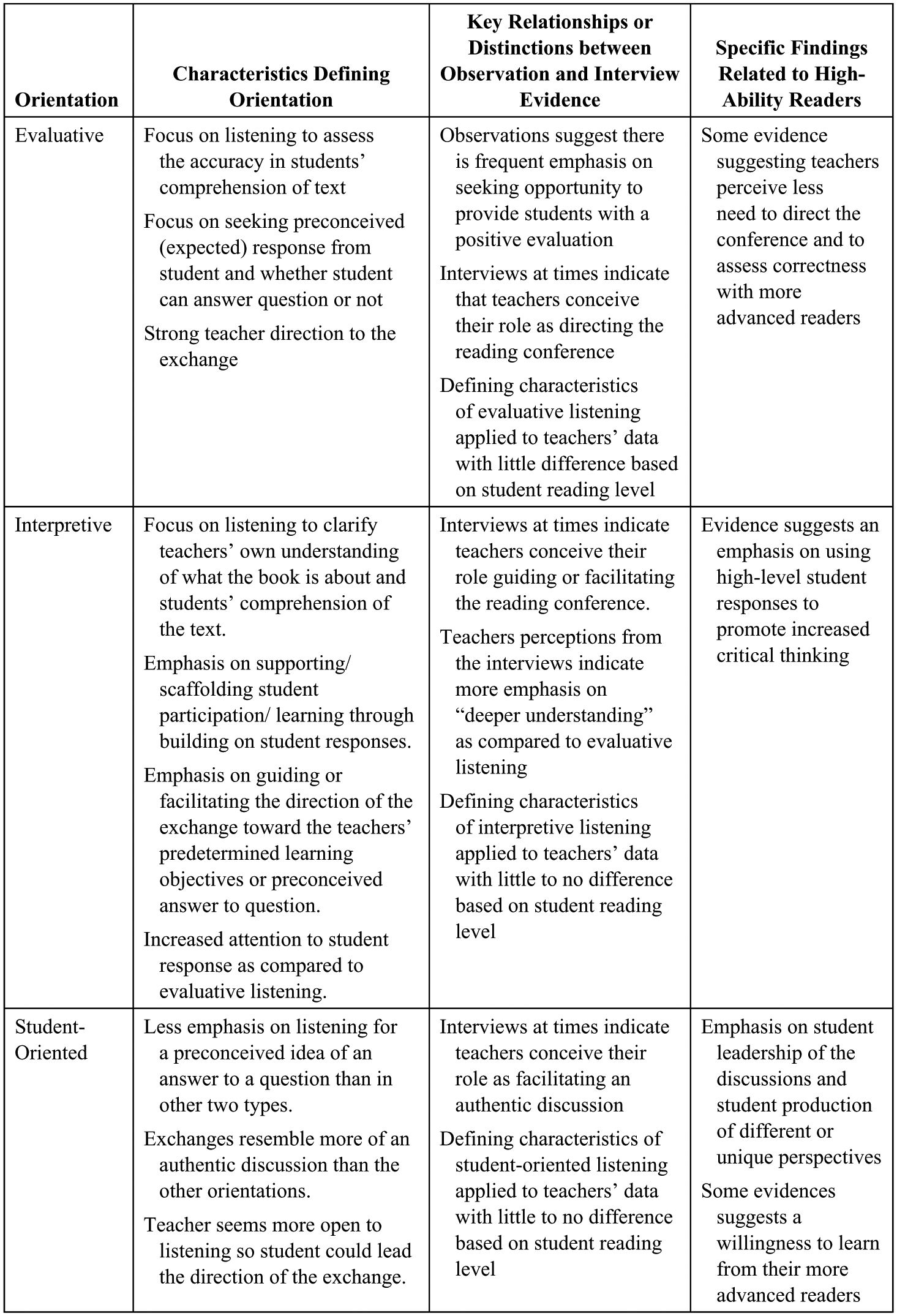
Characteristics of and relationships between major teacher listening orientations.
Research Question 1
Research Question 1 stated, “What types of listening orientations do reading teachers exhibit during individualized reading conferences with students at varied reading levels?” To answer this question, we first calculated the total percentage of exchanges within each of the listening classifications. As Table 3 shows, across all teachers and with most of the students, regardless of reading level, the majority of the exchanges indicated an interpretive listening orientation (52% of all exchanges). Only minor differences appeared at the individual teacher level. To a lesser degree, the exchanges also indicated that teachers listened with an evaluative orientation (21% of all exchanges) or with student-oriented listening (6%). Some exchanges showed evidence of multiple listening orientations within the same exchange. In some of these instances, teachers appeared to exhibit a blend of or combination of two different ways of listening within a single exchange (e.g., evaluative and interpretive listening), whereas in other cases, teachers seemed to shift their listening orientation from one to another in sequence. In very few cases, teachers exhibited teacher-oriented listening or undetermined listening, classified as Other (3%) in Table 3. Due to space constraints, only one or two representative exchanges or excerpts from longer exchanges from the RCs with struggling (S), average (A), or high-ability (H) readers are presented below to define and illustrate each listening orientation.
Percentage of Exchanges by Listening Orientations for All Readers.
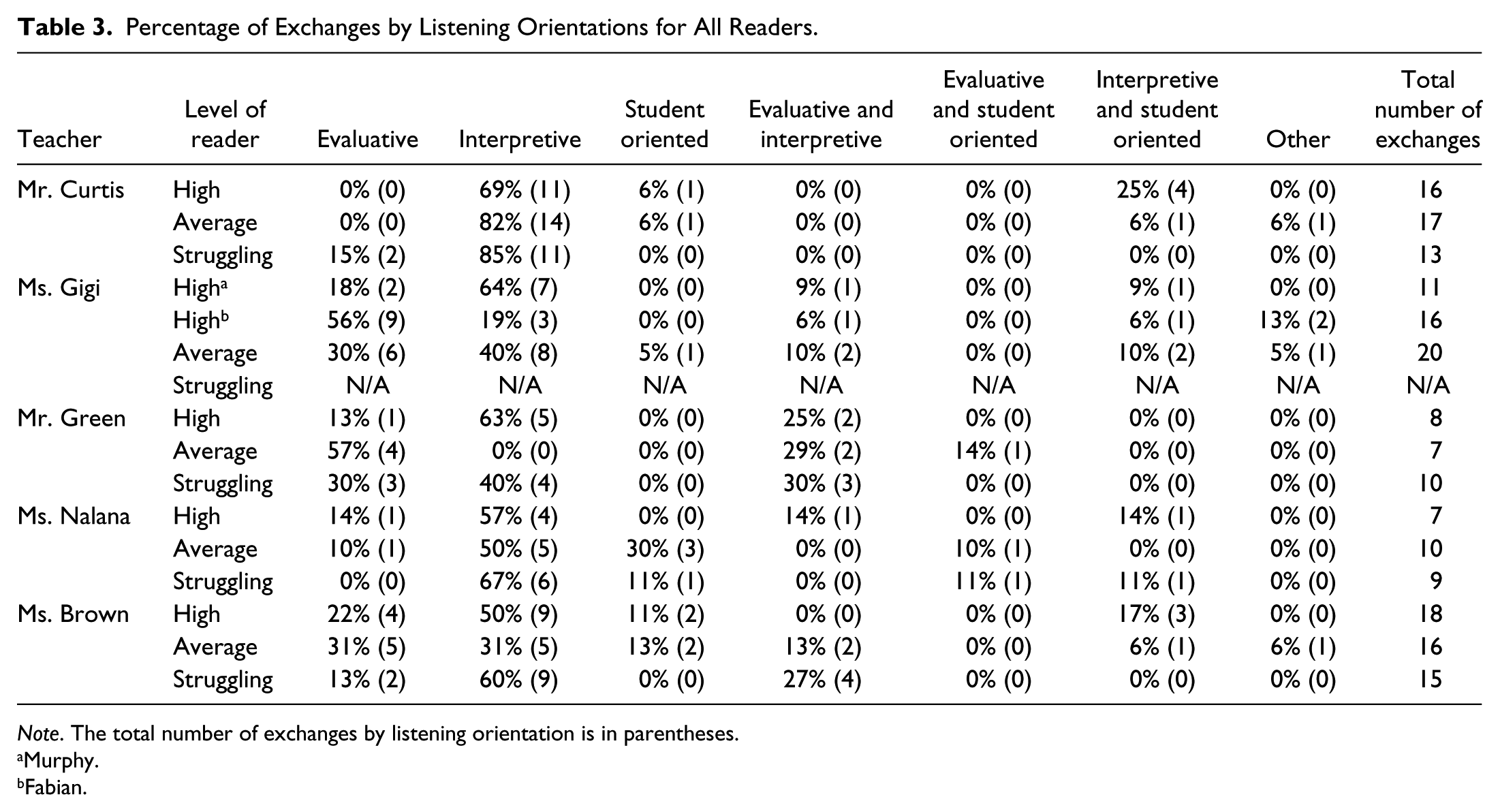
Note. The total number of exchanges by listening orientation is in parentheses.
Murphy.
Fabian.
Evaluative listening
When Ms. Brown exhibited an evaluative listening orientation with Amelia (A), our analysis of the transcribed exchange indicated that she listened for preconceived answers and to assess whether her student could answer the questions about The First Part Last (student-selected book for independent reading). Ms. Brown’s evaluative listening is exemplified in the following:
T: And then what are the reasons that you think he cannot take care of the baby?
S: Well sometimes when his friends are around, he just like, [pause]
T: I’m thinking about a word, immature. Do you think Bobby’s immature?
S: Sort of yeah.
T: And do you think he’s distracted by his friends?
S: Yeah.
T: Can you expand on those?
S: He’s [long pause]
T: But you said his friends wanna hang out, and he wants to go. So it’s kind of like he’s side-tracked or distracted.
S: Yeah. ’Cause his friends like really pull him a lot,
T: Mhm
S: But then sometimes he can take the baby, when they just go over a friend’s house just to hang out.
T: Mhm
S: But if they go like to a restaurant or something he can’t bring the baby all the time.
T: Mhm, He’s a only a few years older than you, he’s only about 5 years older than you. Would you be able to see in your life that everywhere you go you’d have to take an infant who needs so much care? No. So there’s reasons why Bobby could make a really good dad and is trying and there’s other reasons why he, he really can’t. So the advice that you would give yes or no, you’re on the spot. You know what it takes to raise a baby. You know how your mom loves you. You’ve seen how a parent you know guides their child and has to put their child first. Can he do it? Yes or no?
S: I don’t think so.
T: No.
S: No. (RC, April 2, 2013)
Lines 3 and 5 demonstrated that this exchange was evaluative as Ms. Brown seemed to be listening for preconceived answers and clearly directed the discourse. In Line 9, Ms. Brown provided Amelia (A) with an answer. Then, at the end of her turn in Line 15, she directed her to give a yes or no answer, illustrating that the teacher held the autonomy in controlling the direction of the discourse.
In the next exchange, Ms. Gigi and Fabian (H) discussed the novel Seal Team Six. Ms. Gigi seemed to listen to assess his ability to simply identify an example of figurative language. In Line 3, her feedback was encouraging and positive.
T: Ok in this paragraph show me something that, that looks like figurative language. It’s kind of interesting.
S: Um, we were meals on wheels.
T: See how you could find it right away?
S: Yeah.
T: So if you were beginning to go off track this kind of would bring you back. (RC, March 27, 2013)
Interpretive listening
Exchanges between Mr. Green and his student, Israel (S), tended to be interpretive in nature. He seemed to listen to Israel to clarify his own understanding of the basic story elements of Israel’s book or to listen for opportunities to scaffold for Israel’s comprehension. In this exchange, Mr. Green and Israel discussed the novel The Last Shot:
T: All right so the, the question I want to ask that I mentioned to you . . . is what do you think the most important event is in the story so far?
S: When the, when the coach from Louisville I think told, told him that he was watching him.
T: Mhm. And did he tell him that like before the game or after the game?
S: Well he tells him like, during the game he tells the coaches to tell him that he was watching him.
T: Ok and what—did it explain a reaction like did he react to that or did he just start playing and choke? Was that like what happened? So he, he didn’t say anything to, (talks to other students) Um.
S: He got excited that’s why.
T: He got excited ’cause they’re there for him. But ultimately that excitement turned to nerves and he, he blew it.
S: Yeah. (RC, March 26, 2013)
Mr. Green asked follow-up questions in Lines 3 and 5 to encourage Israel to provide further elaboration about an important event in the story. Then, in Line 7, Mr. Green’s follow-up served to clarify his own understanding of the story, which Israel confirmed in Line 8. These teacher moves indicated that Mr. Green was listening to gain an understanding of the story elements.
This next exchange between Ms. Nalana and Lilly (H) exemplified an interpretive listening orientation with Lilly (H). They were discussing the book Life as We Knew It.
T: Alright um how does the book demonstrate that not all changes can be predicted or controlled?
S: The fact that Mom’s trying to stop her from basically meeting him, it’s gonna be impossible because they both go to school every day and they meet there.
T: Okay. So how about what it has to do with, not the tsunami, but when the meteor hits the sun, or the moon?
S: The astronauts, they think it’s just gonna hit the moon a little bit and it’s not gonna have that much force. But actually it has so much force that the moon gets so big that the world gets terrified to even look at the sky every day. And whenever it’s day time, you can still see the moon there.
T: Oh okay. So basically, here is says, it couldn’t be really predicted. Like, the book shows that it was saying how the astronomers were like no it’s not gonna be that big of a deal and all chaos basically breaks out because of it. (RC, April 23, 2013)
Ms. Nalana accepted Lilly’s response in Line 3 by saying “Okay,” but then the follow-up question in that same line changed the direction of the exchange. Ms. Nalana guided Lilly toward what appeared to be the Ms. Nalana’s predetermined answer, and then in Line 5, she used evidence from the book to support her own answer.
Student-oriented listening
Mr. Curtis seemed to listen to open the space for Anna (H) to share her thinking about her book rather than asking for clarification about the story elements, guiding her toward a certain answer, or scaffolding with multiple follow-up questions. In this exchange excerpt, Anna shared her opinion about the novel, Gerald’s Game, with Mr. Curtis and did most of the talking while he listened and accepted her responses.
T: What is your overall opinion then of the book right now?
S: I’m just kind of waiting for her to get out because she’s kind of going on her dresser and taking lotion oils trying to like grease up the handcuffs so she can slide out. For now, she’s—before I came over here, I read this part where she’s going to try harder to get out the cuffs without cutting herself or she might lead to death or she might bleed to death. That’s what her voices are telling her not to go too deep. Her voices are actually being cautious telling her steps that she could do to get out of the handcuffs.
T: Ok. So if someone were to ask you about the book as of right now would you suggest to them to read the book or not to read the book or what would your opinion be?
S: It probably would be—you could be. I would tell them that the book is kind of ok ’cause it’s really detailed in the book ’cause if she has a dream it will keep going after chapter after chapter about that dream instead of getting to the main point whether she’s not going to get out. So I would say it’s a very detailed book.
T: Ok.
S: That’s why it’s so long. (RC, April 29, 2013)
In this next exchange, we also see evidence of a more student-oriented way of listening while Ms. Nalana and Eoin (A) have a discussion about The Wednesday Wars:
T: All right, so this is just a question about like the cover of the book. So it says “Is the cover of the book good—a good match for what you find inside? Why or why not?”
S: I think it’s like 50/50.
T: Mhmm.
S: Because it does like display stuff from the school.
T: Mhmm.
S: But like the book is mainly about Miss Baker and him like, like, like not feuding but like being around each other and stuff.
T: Mhmm.
S: And like it doesn’t show Miss Baker here and I think that it would be good to just show her too.
T: That goes with like the next question. Like how would you change it to suit better the book?
S: Um, if Miss Baker and him like show their faces in here I think yah it would look kind of better because like um then you’d be able to see them and like how they feel around each other like in the beginning and stuff.
T: Yah, ’cause like here you just say like ok [the] kid is in class so you know it has to do with school, but then you have no idea that it has to do with a teacher and they might not be getting along. (RC, May 8, 2013)
This exchange indicated student-oriented listening as Eoin (A) spoke more, and Ms. Nalana encouraged him with to go deeper with his thinking in Line 9. Throughout the exchange, Ms. Nalana mostly responded with “Mhm,” but at the end in Line 11, she agreed with his thinking and provided her own reasoning. Furthermore, Ms. Nalana did not appear to guide Eoin toward a preconceived idea for the answer to the question.
Combinations of listening orientations
The following excerpt represents an example of how teachers shifted their listening orientations during one exchange. In the first conference with Amelia (A) around her book Matched, Ms. Brown’s listening appeared to be interpretive and then changed to a student-oriented mode in Line 9.
T: Ok. So is love a topic that you like to read about? Have you read other books about love, or?
S: Sort of.
T: Ok. So that’s something that you like. Umm, but you like the idea of arranged marriages kind of thing? ’Cause it is matched so they’re being arranged to date each other, right?
S: Mhm.
T: And at 17 they’re being arranged. Do they have to marry each other or is just matched to date?
S: They date and then when they’re I think 21 they have to sign some papers and get married.
T: Ok. So it’s just one partner that they have to have in that community. What happens if they’re not compatible?
S: Then that’s, in the book it’s called an infraction, and then they’re, they’re gonna have to be single for the rest of their life. And they’re gonna be called as an aberration.
T: And what’s aberration mean?
S: It means like, it’s that you haven’t caused something but say like one of your parents did something wrong and they like, like if they had to go away that’ll go on you, so you would have to take the blame, even though if it wasn’t you.
T: Oh. Interesting. (RC, March 18, 2013)
Throughout the exchange, Ms. Brown asked clarifying follow-up questions as in Lines 5 and 7 to further understand the events of Amelia’s book demonstrating evidence of interpretive listening. Then in Line 9, Ms. Brown’s question, “And what’s aberration mean?” indicated a shift in her listening to a student-oriented listening orientation, which is noteworthy because she learned a new term within the context of the book from Amelia (A). This showed openness to sharing the authority of the knowledge.
Teacher-oriented listening
Teacher-oriented listening, although a rarity in the data set, is noteworthy, in that it included exchanges or large portions of exchanges between the teacher and student in which the teacher did all or most of the talking and the student did not speak or only spoke at a minimum. An example can be seen in the following brief exchange between Ms. Gigi and Fabian (H) about his book Seal Team Six:
T: Tell me about hell week. Uh it was like, ’cause he’s in Seals and they have to learn . . .
S: Mhm
T: . . . to fight in the sea, land and air. But this session was in sea so they were testing them how long they could hold their breaths. How far they could swim and how long they could stay floating. And was it just one week? [shh to the class]
S: Yes.
T: Um, Ok. (RC, March 27, 2013)
Ms. Gigi clearly did the majority of the talking and answered her own question that she directed to him in the first line “Tell me about hell week.” Fabian (H) only spoke at a minimum.
Undetermined listening
Furthermore, in a few teacher–student exchanges, it was difficult to determine what type of listening orientation the teacher exhibited or whether the teacher was listening at all as there was not enough teacher response. Instances in which students did all the talking or when the teacher responded only with “Mhm” or did not respond before moving to a new exchange were classified as undetermined listening. This is illustrated in Ms. Gigi and Fabian’s (H) brief exchange around the main characters of Goosebumps: Haunted Mask.
T: Umm tell me who the main characters are in this book.
S: Uhh, Sabrina. Carly Beth is the main character.
T: Mhmm.
S: Are her friend Sabrina and that’s really it for now. Steve and um what’s his name? Chuck. They’re like just more side characters.
T: Ok.
S: Nothing really to do. (RC, January 30, 2013)
The nature of teachers’ follow-up responses, the degree to which teachers directed the flow of the exchanges, and the extent to which teachers and students controlled or shared in the construction of knowledge around the novels all indicated how the teachers listened to students. Although the qualitative analysis of the transcribed and videotaped RCs revealed that the teachers exhibited varied ways of listening to their students, the majority of exchanges showed an interpretive listening orientation regardless of students’ reading readiness.
Research Question 2
The second research question was, “What are teachers’ perceptions of how they listen to question responses from students at varied reading levels during individualized reading conferences?” Analysis of teachers’ perceptions about their listening also indicated three major classifications of listening to students, with little to no differences based on students’ reading levels. These included (a) evaluative listening orientation, (b) interpretive listening orientation, and (c) student-oriented listening orientation. The characteristics of these orientations were similar to those found in Research Question 1 with some slight differences (see Figure 1). Another theme, professional teacher reflection on their listening, also emerged from the data analysis in which there were some differences based on students’ reading levels. These themes are illustrated below.
Evaluative listening orientation
Some of the teachers’ perceptions of their listening and questioning behaviors were characterized as an evaluative listening orientation. This type of listening orientation was evident across all teachers’ shared perceptions about listening to students at each reading level.
Analysis of teachers’ perceptions revealed the use of their listening as an assessment tool. For instance, Ms. Nalana reflected that during a reading conference she was listening to Eoin (A) “To see if what he said was accurate with the story so far” (RF, May 8, 2013). Similarly, Ms. Gigi explained what she was listening for with her struggling readers: “That they’re able to comprehend my question and answer the question” (II, January 11, 2013). This way of listening was also reflected in Ms. Brown’s statement about how she listened to Jake (H), “. . . I notice that in the conferences, I have like trained my mind to go in and listen for the skill I’m trying to get out of them” (IDI, May 8, 2013).
Interpretive listening orientation
All five teachers’ perceptions also revealed an interpretive listening orientation with all students regardless of reading level. Mr. Curtis shared his perceptions about listening when discussing his struggling readers: Honestly, whether or not the information is correct is irrelevant, and I tell them that in my class all the time. It’s not whether or not you can give me the right answer, it’s whether or not you can argue that your answer is right. (IDI, May 27, 2013)
This was also echoed by Mr. Green in his reflection about listening to Jaime (H): “[I] listened for an honest opinion along with evidence/examples to support this opinion” (RF, March 18, 2013). At times, teachers expressed listening to student thinking to help guide students toward an objective rather than solely evaluating their answers. Regarding listening to average readers, Ms. Gigi explained, “I’m listening to see how far I can push a kid without him getting frustrated that he’s not getting enough out of the book” (II, January 11, 2013).
Student-oriented listening
This orientation was also evident across all teachers’ shared perceptions, with some differences linked to students’ reading levels. Neither did Mr. Green’s interviews indicate student-oriented listening with his average readers nor did Ms. Gigi’s interviews with her struggling readers. Teachers perceived that their listening at times was open to student contributions and student directing and/or talking during the RCs. For example, Ms. Nalana had an expectation that students would ask questions: “Um, with my struggling readers, I would hope that they, you know, would ask me questions if they don’t understand something, . . . which they do even if it’s just a word they don’t understand” (II, March 24, 2013). This implied a willingness to listen to what the students would like to discuss during conferences. It should be noted that it was a rarity across the whole data set of teacher–student conferences that the students actually initiated a question. Mr. Curtis quantified his perception of the proportion of talk time for each interlocutor, “[H]aving them do, instead of 50/50, now it’s 70/30; with them the 70 and me the 30; them doing more of the talking” (II, January 8, 2013). Mr. Curtis also shared his thoughts about potentially being receptive to new perspectives that he could learn from his high-ability readers: And then my advanced reader might be so abstract, that I might be completely engaged in “Wow, I never thought of it that way,” or “This is a perspective I have never looked at before,” or “You completely just blew my mind with that.” (II, January 6, 2013)
Professional teacher reflection
A pattern emerged in the data analysis of the interviews and RFs. Although not a specific intention of the study, teachers evaluated their own listening behaviors and set some goals for improvement as well. These professional teacher reflections included thoughts about their listening preferences and how easily or frequently they listened to students by reading level. Three of the five teachers were forthright in stating a preference for listening to their high-ability students. For example, Ms. Nalana expressed more of an enjoyment talking to her high-ability students as it was easier and she had more trust in the probable accuracy of their responses. However, due to this trust she did not listen to them as closely as she did with other students and was “more lax with them” (II, March 24, 2013). She reflected, “I mean, I would like to think I listen with each kid the same, but I probably don’t do it as much with . . . the kids who don’t struggle because they’re usually really accurate” (II, March 24, 2013). Ms. Brown also noted a difference in how she listened to students. “. . . I am more of a listener [with my high-ability readers] than I am with my average and low readers. I listen more to their opinions” (II, March 13, 2013). She went on to explain, “My listening is easier with the high-ability readers because it’s more of a discussion” (II, March 13, 2013). This was also evident in Ms. Brown’s written reflection, It is easy to listen to Jake [H] because he has a good grasp of the material in his book. He is able to openly discuss the main idea and theme so it is my job to make him become more of a critical thinker when reading. (RF, March 26, 2013)
During the interviews, the teachers shared their goals for improvement of their listening practices. Ms. Brown set a goal to improve her listening with struggling readers after she described the reasoning behind her lack of engagement when students do not provide coherent responses: It makes me lose interest in what they’re saying and it makes me kind of confused in what they’re saying and need to ask the questions and most of my questions begin with “wait, wait, wait I don’t understand what you’re saying.” . . . So those are the things I want me to improve on. A lot of my listening with low-level learners. (II, March 13, 2013)
Mr. Green also questioned his listening in general: I guess, and maybe I need to change my thinking. I’m always looking for fault first, and if, if there’s something missing or something that they could add, or if there’s a just a general misunderstanding, then that, I look to try to help them find the better response or the correct response. Um, and then, and that’s, that’s really how I always approach it even with the, the really strong readers. (II, January 18, 2013)
Not all the teachers’ evaluations of their listening during the interviews were overly critical. For example, Ms. Gigi reflected about how she was working on allowing her high-ability student talk more: “I have a tendency to talk a lot but try vigilantly to let the student lead the conversation, after my initial question. I think it [who talked more] was pretty equally divided” (RF, March 28, 2013).
Discussion
This research study was informed by the literature indicating that discourse has the potential to promote student learning and development, including among higher ability readers (Cazden, 2001; Gee, 2001; Harkness & Wachenheim, 2008; Vygotsky, 1978). Our aim was to identify and understand how middle school reading teachers listened to diverse readers during the first year of implementing the SEM-R (Reis et al., 2005; Reis et al., 2008). Our findings for both research questions align with research in the mathematics education literature, in that the reading teachers exhibited differing listening orientations (Davies & Walker, 2007; Davis, 1994, 1997). In addition, the findings across both research questions revealed that teachers’ listening was complex and mediated by their expectations of students, attitudes, and beliefs (Harkness & Wachenheim, 2008; Hoag & Wood, 1990; Wallach & Even, 2005), and to some extent, students’ reading levels and understanding of their books. The findings are especially relevant to educators and researchers in the field of gifted education. The implications are discussed below.
The defining characteristics of Davis’s (1994, 1997) evaluative, interpretive, and hermeneutic listening of mathematics teachers were similar to those in the current study. However, the term student-oriented listening was applied instead of hermeneutic. Student-oriented listening seemed more suitable, because the reading teachers in the current study did not seem to listen to open the space for students to think critically by intentionally questioning accepted knowledge as described by Davis (1997). However, if a goal of gifted education is to facilitate students’ critical thinking strategies, as indicated by the National Association for Gifted Children (NAGC) Gifted Programming Standard 3.4.1. (National Association for Gifted Children, 2010), it is vital to further investigate why teachers were not listening hermeneutically. It is possible that the teachers may not have listened hermeneutically because variables differed among the study contexts compared with those in the mathematics education research, such as the teaching structure (i.e., reading conferences versus whole class discussions), subject-specific content (mathematics vs. reading concepts), or differences in the teacher–student relationships.
Although the teacher listening orientations in the current study had individual defining characteristics based on the analyses for both research questions, elements of teacher listening may be more clearly described as emerging along a continuum. Specifically, aspects of assessment, expectations for student participation and responsibility, and teacher openness to sharing control of the discourse can be conceptualized on a continuum of increasing or decreasing degree from evaluative to interpretive to student-oriented listening (see Figure 2). A total of approximately 2% of the exchanges from the teacher–student conferences across the entire data set (N = 193) indicated both evaluative and student-oriented listening (see Table 3), which suggests that evaluative and student-oriented listening may be on opposite ends of this continuum. Furthermore, all teachers expressed an expectation for students to participate; however, greater expectations for students to come prepared to lead conferences was more characteristic of student-oriented listening. This latter finding has important consequences for educators working with high-ability readers. If an accepted expectation is to nurture gifted students’ leadership skills (see Gifted Programming Standard 4.3.2.; National Association of Gifted Children, 2010), then it seems logical that teachers should exhibit a greater incidence of student-oriented listening to allow gifted students the opportunity to lead the direction of classroom discourse with their own questions and comments.

A continuum of teacher listening orientations.
It should also be underscored that although the data analysis indicated evidence of variability in listening orientations for both research questions, student-oriented listening was the least represented type of listening orientation across the teacher–student conferences. Instead, teachers generally exhibited an interpretive listening orientation with the majority of students regardless of reading ability, followed by evaluative listening (see Table 3). An encouraging finding was that no one teacher’s entire set of exchanges indicated a primarily evaluative listening orientation. However, it is concerning that so few of the teachers’ exchanges were classified as student-oriented listening, especially for high-ability readers. Only 27% or three of the 11 exchanges classified as student-oriented listening were with high-ability readers. This represented a mere 2% of all the exchanges across the entire data set. Researchers have reported limited evidence of dialogic discourse occurring in classrooms (Elizabeth et al., 2012; Nystrand et al., 2003), which may partially explain the lack of student-oriented listening across the exchanges in our study. Given that the literature supporting dialogic discourse allows the space for students to be active contributors to the discourse exchanges and their own learning processes (Applebee et al., 2003; Bakhtin, 1984; Caulfield-Sloan & Ruzicka, 2005; Elizabeth et al., 2012; Reznitskaya et al., 2012; Samson et al., 1987), researchers should investigate why teachers’ use of student-oriented listening is also limited. Missed opportunities to challenge high-ability readers could be detrimental to student engagement and reading achievement, as may have been the case during the exchanges classified as teacher-oriented listening. Furthermore, student-oriented listening as delineated in this study aligns with recommended practices in the NAGC–Council for Exceptional Children (CEC) Teacher Preparation Standards in Gifted and Talented Education (NAGC & CEC, 2013). These standards serve as a guiding framework for developing educators’ dispositions, skills, and content knowledge to better serve gifted students. According to Standard 6.3 “Beginning gifted education professionals model respect for diversity, understanding that it is an integral part of society’s institutions and impacts learning of individuals with gifts and talents in the delivery of gifted education services” (NAGC & CEC, 2013). When teachers are open to listening to students’ responses to questions or alternative methods for arriving at an answer, this could demonstrate respect for students’ diverse ideas.
A Case for Differentiated Listening
The findings for both research questions indicated that the reading teachers were, in general, listening for something in students’ responses or listening for a specific reason, notably to check students’ comprehension of their novels. Teachers may have maintained an evaluative listening orientation throughout some of the exchanges with students who the teachers were less certain comprehended their novels; whereas, when the teachers had higher expectations of the students’ comprehension, they may have listened less evaluatively. It can be argued that the teachers’ listening orientations were responsive to students’ demonstrated comprehension of the novels, which aligns with the tenets of differentiating instruction (Tomlinson, 2001); however, it is not entirely clear how proactive or intentional teachers were with their listening as a specific tool for differentiating instruction during the conferences. It is worthwhile to explore the idea of intentionally differentiating one’s listening orientations. For example, if a teacher’s objective is to add rigor to the curriculum by opening the space for gifted students to lead and engage in critical and creative thinking skills during classroom discourse, the teacher might intentionally exhibit student-oriented listening. Researchers might investigate the effect of differentiated listening on gifted students’ participation, engagement for learning, and reading achievement.
To a lesser extent, the reading teachers in the current study exhibited a combination of listening orientations within a single exchange or at times shifted their listening orientations. One might argue that these are, therefore, not listening orientations; yet, the shifts might reflect a need to respond to unanticipated student contributions or multiple intentions for teachers’ listening. For example, the findings of Research Question 2 showed that 10 of the 14 exchanges (71%) classified as both interpretive and student-oriented listening were with just the higher ability readers. Furthermore, no exchanges with higher ability readers were classified as both evaluative and student-oriented listening. The least number of exchanges classified as both evaluative and interpretive was with high-ability readers (five of 18 exchanges, or 28%). These findings suggest that teachers responded to high-ability students by exhibiting both interpretive and student-oriented listening in a greater percentage of exchanges than with an evaluative listening orientation combination. Although these data seem encouraging, they still represented small percentages of the total number of exchanges across the entire data set (N = 193 exchanges).
Because the findings of this current study revealed limited evidence of varying one’s listening by student reading levels in the actual RCs, another next step would be to explore possible professional development interventions focusing on differentiating or shifting teachers’ listening orientations (Davis, 1997). Davis (1997) found that over the course of a year, a middle school mathematics teacher in his research study moved from displaying primarily evaluative listening to listening interpretively and then to enacting a hermeneutic mode of listening. The study involved multiple reflective discussions between the researcher and the teacher about her pedagogical practices, learning theories, and the meaning of mathematics. Based on Davis’s (1997) findings and those in the current study, future research might focus on the effects of ongoing professional development that supports gifted education teachers’ awareness in shifting their listening orientations in direct response to the needs of high-ability readers.
Teachers’ Perceptions
It was also concerning that the findings from Research Question 2 revealed that all the teachers perceived that they were using listening behaviors characteristic of student-oriented listening with their high-ability readers; however, this finding was not evidenced in the analysis of the RCs for Research Question 1. Only two of the five teachers had exchanges classified as just student-oriented listening with high-ability readers. Furthermore, of the remaining three teachers, only two had one exchange classified as both student-oriented and interpretive listening. The purpose of the study was not to evaluate teachers’ accuracy of their perceptions; however, this discrepancy warrants further investigation, especially given that student-oriented listening may hold promise for advancing gifted students’ communication and thinking skills.
Teachers’ Dispositions
As others have found, particularly Wallach and Even (2005) in their study of the mathematics teacher whose listening was inaccurately influenced by her prior knowledge of her students’ abilities, teachers’ dispositions about students cannot be overlooked when considering teacher listening. Davis (1994) advised, “The listener must always be oriented toward gaining a fuller understanding, always vigilant to the fallibility of interpretation” (p. 367). In the current study, the teachers’ listening orientations were mediated to some degree by their attitudes, beliefs, and/or how difficult it was to listen to students. Three of the five teachers preferred to listen to high-ability readers, whereas one teacher reflected that she did not listen to the high-ability readers as much because they usually responded accurately. If teachers filter their listening with students based on assumptions or preferences, doing so may lead to lost learning opportunities. Effective listening is a necessary component of discourse and, thus, an important skill for teachers to support all students’ growth, including gifted students (Harkness & Wachenheim, 2008; Hoag & Wood, 1990). Despite evidence suggesting that careful reflection can promote increased awareness of teachers’ listening patterns (Dunphy, 2010), the degree of reflection in which teachers regularly engage is not clear. Attard (2007) suggested that teachers are not socialized toward deep reflection about practices that might be challenging. Also, Otienoh (2009) expressed that teachers have limited practice in reflective thinking and also found that limited time and support were barriers to ongoing reflection. Therefore, it is essential for teacher educators and administrators in schools to increase attention to teacher listening and provide opportunities for deep reflection on potential listening barriers and filters.
Researchers in the mathematics field have found that listening journals are supportive of increasing teacher awareness of their listening patterns (Dunphy, 2010; Harkness & Wachenheim, 2008). The RFs in our study could serve as a journaling tool, given that an unanticipated finding was that teachers reflected critically on their listening abilities and wrote goals for improving their listening. Future research might investigate how supportive the RFs, in conjunction with audio recordings of discourse exchanges, are in guiding gifted education teachers’ reflective thinking that results in improved listening with high-ability readers. Furthermore, the teachers in this study expressed an appreciation for having time to share their reflections to the lead author; therefore, future researchers should investigate the effect of having teachers share their reflections with mentor teachers or administrators and discuss specific goals and steps for improving their listening skills (Dunphy, 2010; Harkness & Wachenheim, 2008).
The results of this study open the door to theoretical discussions and empirical research around the role of teacher listening in supporting and challenging students in the reading classroom—a phenomenon rarely addressed in the fields of reading and gifted education. To further understand this complex phenomenon, subsequent investigations should center on identifying the effects of mediating variables on teachers’ listening orientations, the relationship between listening orientations and student achievement and engagement in reading, and appropriate methods for improving teacher listening during discourse with high-ability readers.
Limitations
The limitations of this study may inform improvements for future research. Although we acknowledge that it is challenging and somewhat limited to investigate teacher listening independent of other variables such as students’ texts, listening behaviors, or relationships with their teachers, our aim was to begin at a micro-level view to better understand this elusive construct of teacher listening (McElhone, 2013; Sangster & Anderson, 2009). It would be worthwhile to include students’ perceptions in future investigations to compare with their teachers’. Ms. Gigi was unable to recruit a struggling reader to complete the study. Therefore, the caution should be used when interpreting any findings pertaining to struggling readers.
Another possible limitation was that the lead author served as both a researcher and a SEM-R reading coach during the course of the study. This dual role may have influenced how forthcoming the teachers were during the interviews; however, teachers reflected on all recorded conferences independent of the researcher. As the teachers were aware of the purpose of the study, it is possible that they adjusted their listening behaviors as a result of participating in the study and completing the RFs. We were also unable to ensure that teachers accurately identified their students as “high,” “average,” or “struggling” readers and whether there was an appropriate match between the challenge level of the students’ books and their reading readiness levels. These factors may have influenced how well students were able to discuss their books with the teachers. To ensure the credibility of findings in future studies, researchers should establish a more rigorous protocol for identification of students and the level of their books.
Footnotes
Appendix A
Appendix B
Teacher to Student SEM-R Individualized Conference Reflection Form
Date: ___________________________
Teacher:______________________________________________________________
Student:__________________________________________________________
Bookmark Question: ___________________________________________________
____________________________________________________________________
Why did you choose this bookmark question?_______________________________
____________________________________________________________________
What did you listen for in your student’s response to this question?
____________________________________________________________________
____________________________________________________________________
If any, what follow-up questions did you ask after your student responded?
____________________________________________________________________
____________________________________________________________________
____________________________________________________________________
Why did you ask these follow-up questions?
____________________________________________________________________
____________________________________________________________________
____________________________________________________________________
Who talked more in the conference, you or your student?
_____________________________________________________________________
Declaration of Conflicting Interests
The author(s) declared no potential conflicts of interest with respect to the research, authorship, and/or publication of this article.
Funding
The author(s) received no financial support for the research, authorship, and/or publication of this article.