




Abstract
The purpose of this study was to describe the current state of psychological wellbeing in gifted and nongifted undergraduate student sample populations and identify undergraduate populations experiencing heightened levels of distress within a large Midwestern public university. Study participants included 641 honors and 386 nonhonors undergraduate students. Each participant completed an electronic survey including a series of 10 measures of psychological adjustment to assess student psychological wellbeing. Significant differences between honors and nonhonors student sample populations were identified. Findings also suggest sophomore students share unique characteristics that may be responsible for lower levels of psychological wellbeing. Potential services that may improve the university undergraduate experience are discussed.
Introduction
Framework
More than 10 years ago, Rinn (2005) published a highly regarded piece examining the relationship between academic achievement and subjective wellbeing in undergraduate students enrolled in a university honors program. Analyzing nearly 300 self-report questionnaires revealed significant differences between junior and senior class-standing students in regard to academic self-perception, and educational and career aspirations. However, Rinn (2005) found no significant differences between students of freshman and sophomore class standing.
Although Rinn’s (2005) work continues to represent one of the few leading studies to analyze the wellbeing of university honors students, her research methodology lacked a nonhonors student sample to serve as a comparison group. Without a nonhonors comparison sample, particularly one of sufficient size to permit comparisons between students of differing class standings, any conclusions formed related to potential associations between academic giftedness and psychological wellbeing must be interpreted with a certain degree of caution. Additionally, consistent increases in collegiate student mental health concerns have been observed since the 2005 publication of Rinn’s work, warranting updated research in the field of gifted education (Center for Collegiate Mental Health, 2015; Ibrahim, Kelly, Adams, & Glazebrook, 2013).
The present study attempts to update and supplement Rinn’s (2005) piece in light of rising national college mental health concerns within the United States (Center for Collegiate Mental Health, 2015). This descriptive work provides insight into the current mental health of gifted students at the undergraduate level. Additionally, this study attempts to investigate whether differences between honors and nonhonors undergraduate education programs confer differential student psychological outcomes. Astonishingly little research examining giftedness at the postsecondary level currently exists, leading to a lack of consensus for identifying gifted undergraduates. As a result, researchers in the field of gifted education most often rely on honors college membership as a gauge for collegiate giftedness. Therefore, within the context of this study, giftedness will be defined as membership within a university honors college (Kerr, 2009; Neumeister, 2004; Rinn, 2005; Rinn & Plucker, 2004). This work offers a nonhonors student comparison sample and a larger sample population, and analyzes more features of student wellbeing than originally provided by Rinn (2005), effectively making this updated work a more comprehensive examination of the topic.
Background
Assessing giftedness in a given population of any age can prove exceptionally difficult. Numerous models of giftedness currently exist, complicating our identification of such individuals. Generally, a gifted individual may be identified according to his or her heightened ability to perform intellectually, motivationally, and/or creatively (Renzulli, 2011). However, giftedness is largely determined within the context of the local setting. A student perceived as exceptional at one institution of higher learning could be considered simply average at another (Robinson, 1997).
Undergraduate institutions typically rely upon standardized test scores (such as the SAT or ACT), high school grade point averages, writing samples, and records of leadership and extracurricular activities to determine a student’s potential for achievement. Within the context of the university, gifted students are described as individuals reporting high levels of success in each of these domains, noting that the level of achievement used to determine giftedness would vary depending on the local circumstances of each undergraduate institution (P. F. Haas, 1992; Robinson, 1997).
Research has shown that gifted students may possess unique psychosocial and personality characteristics that separate them from the rest of the undergraduate population. Gifted college students are often able to quickly learn new information, comprehend complex and abstract ideas, identify complicated patterns, and make multidisciplinary connections (Johnsen, 2004; Rinn & Bishop, 2015; Robinson, 1997; Roeper, 1991). Gifted students report higher levels of persistence and a greater need for achievement, and place a higher value on studying than their nongifted peers (Hébert & McBee, 2007).
However, giftedness may not be entirely positive. Although all students face new challenges when beginning their college education, gifted students may experience the onset of a unique set of problems. According to Rinn and Plucker (2004), . . . many academically talented students are comfortable with, and perhaps dependent upon, the strategies and support networks that have allowed them to achieve pre- collegiate educational success. Removing these supports and encountering increased competition may lead to unique problems that the majority of undergraduates never encounter (p. 62).
Current research has associated giftedness in undergraduate students with perfectionism, feelings of isolation, fear of failure, a heightened need for approval, and a preference for solitude, supporting Rinn and Plucker’s (2004) assertion (Neumeister, 2004; Rinn & Bishop, 2015; Roeper, 1991).
In an effort to better serve the unique needs of gifted undergraduate populations, some institutions offer honors colleges. As many gifted students attending public institutions choose to participate in these honors programs, giftedness at the undergraduate level is most often synonymous with honors college membership (Kerr, 2009; Neumeister, 2004; Rinn, 2005; Rinn & Plucker, 2004). Initially, honors colleges were designed to challenge academically talented students attending less reputable public institutions, as well as provide them with more personalized instruction (Hébert & McBee, 2007; Rinn, 2006). Small class sizes, close student–faculty interaction, interdisciplinary course content, seminar-style teaching methods, and the implementation of challenging educational platforms (such as the accelerator model) attract high-achieving students and faculty to universities offering honors programs, thereby bolstering an institution’s reputation (Brimeyer, Schueths, & Smith, 2014; Fischer, 1996; Morgan & Apple, 2007; Rinn, 2004; Rinn & Plucker, 2004; Robinson, 1997). Some institutions also offer living-learning communities for their honors students, providing students with an academically focused and socially cooperative living environment (Inkelas, Vogt, Longerbeam, Owen, & Johnson, 2006; Inkelas & Weisman, 2003).
Although a substantial body of literature exists examining the psychosocial and personality characteristics of the gifted (Hébert & McBee, 2007; Johnsen, 2004; Rinn & Bishop, 2015; Robinson, 1997; Roeper, 1991), far less exists assessing the subjective wellbeing of gifted undergraduates specifically (Rinn, 2005). The concept of wellbeing incorporates a complex array of features from within the human experience to describe positive functioning. For decades, numerous indicators of wellbeing such as life satisfaction and locus of control have been used to assess human happiness (Bradburn, 1969; Ryff, 1989). As a functional definition, wellbeing “is most often interpreted to mean experiencing a high level of positive affect, a low level of negative affect, and a high degree of satisfaction with one’ s life,” (Deci & Ryan, 2008).
When using classical models of wellbeing to assess happiness in gifted populations, contradictory data complicate our understanding of these groups. Commonly, our society views gifted youth as having heightened degrees of interpersonal sensitivity, greater levels of social isolation, and increased levels of stress when compared with their average-ability peers (Neihart, 1999). The notion that giftedness is associated with lower levels of psychological wellbeing is reinforced by classic examples of famously talented artists and writers who either committed suicide or partook in self-injurious behaviors (Cassady & Cross, 2006). Various contemporary investigations of gifted students have further supported this belief. A recent study of 670 secondary students attending either gifted or nongifted high schools revealed lower reported levels of life satisfaction in the gifted population than in the nongifted population (Fouladchang, Kohgard, & Salah, 2010).
Alternately, another body of literature exists indicating that giftedness may be associated with higher levels of psychological wellbeing. In a study examining self-concept in secondary students identified as “intellectually gifted,” children displayed high degrees of self-concept and a positive life outlook (Riaz & Shahzad, 2010). In a recent piece investigating personal wellbeing in gifted students admitted to an early college-entrance program, researchers found a healthier overall degree of wellbeing in the gifted population than found in nongifted peers of the same age (Boazman & Sayler, 2011).
Although the empirical body of knowledge dedicated to giftedness is slowly growing, many studies have only examined giftedness in elementary and secondary school populations (Eklund, Tanner, Stoll, & Anway, 2015; Zeidner & Shani-Zinovich, 2011). Currently, a distinct paucity of research investigating the relationship between giftedness and psychological wellbeing at the undergraduate level exists. Studies that do attempt to analyze this relationship fail to offer a nonhonors comparison group to serve as an adequate control (Boazman, Sayler, & Easton-Brooks, 2012; Rice, Leever, Christopher, & Porter, 2006; Rinn, 2005). Additionally, the literature indicates that students move through unique developmental stages during the undergraduate experience, requiring that a study be conducted with a sufficiently large sample such that psychological comparisons between students of differing class standings may be completed (Broido & Schreiber, 2016; Dearnley & Matthew, 2007; Perry, 1970; Rinn, 2005).
The current study aims to (a) describe the current state of psychological wellbeing in gifted (honors) and nongifted (nonhonors) undergraduate student sample populations within a large Midwestern university and (b) identify potential differences by class standing associated with heightened levels of distress, which may be used to determine potential services that may improve the university undergraduate experience.
Method
Participant Demographics
Study participants included 641 undergraduate students currently enrolled in a university honors program within a large Midwestern public university, as well as 386 undergraduate nonhonors students enrolled in the same institution. To be admitted to the university honors college, students are required to submit an application detailing their relevant qualifications. A high school GPA of 3.5 or higher and an ACT score of 28 or greater are necessary for honors college admittance, though other factors including writing sample quality and previous honors and leadership activities are considered when determining an individual’s honors college admission status.
Among honors participants in the current study, 23.5% (n = 152) were male, 75% (n = 479) were female, and 1.5% (n = 10) identified as “other.” Honors participants in the current study reported a mean undergraduate GPA of 3.62, with female respondents reporting a slightly higher GPA (3.69) than male respondents (3.53). The mean age of honors respondents was 20.7 years. A total of 13.6% (n = 87) of honors respondents indicated that they held a freshman class standing, 25.9% (n = 166) held a sophomore class standing, 26.5% (n = 170) held a junior class standing, and 34.0% (n = 218) reported a senior class standing.
Among nonhonors participants, 31% (n = 118) were male, 68% (n = 263) were female, and 1% (n = 5) identified as “other.” Nonhonors participants in the current study reported a mean undergraduate GPA of 3.2. The mean age of nonhonors students was 21.3 years. In all, 18.4% (n = 71) of nonhonors respondents indicated that they held a freshman class standing, 15.0% (n = 58) held a sophomore class standing, 30.8% (n = 119) held a junior class standing, and 35.8% (n = 138) reported a senior class standing.
Materials
Each participant in this study completed a demographic survey identifying gender, age, undergraduate GPA, academic class standing, and employment status. Survey respondents completed a series of single-item questions assessing procrastination habits and sleep quality. Additionally, participants completed a battery of measures of psychological adjustment to assess student psychological wellbeing. These measures included the Perceived Stress Scale (PSS), the 11-item Center for Epidemiologic Studies Depression Scale (CES-D), the six-item State-Trait Anxiety Inventory (STAI), the Personal Feelings Questionnaire (PFQ), the Positive and Negative Perfectionism scale (PNP), the Preparation-Prevention Control subscale of the Desirability of Control (DC) scale, the Academic Efficacy subscale of the Patterns of Adaptive Learning Scales (PALS), and the General Life and Self subscales of the Extended Satisfaction With Life Scale (ESWLS).
Each of the scales selected for use in this study are widely used, widely recognized, and well established in higher education. A total of 10 indices were selected to most effectively replicate and preserve the integrity of Rinn’s (2005) original work while also acknowledging modern national mental health trends (Center for Collegiate Mental Health, 2015). Additionally, the authors sought to design the most efficient survey possible, seeking to optimize the participation rate and to avoid student fatigue (Marteau & Bekker, 1992).
In designing the current study, three measures were selected that could be combined together to justify a single score representative of dysthymic affect. Dysthymic affect is a low-grade chronic mood disturbance in which sufferers experience periods of emotional distress followed by short-lived bouts of normal mood (Dysthymia, 2013; Sansone & Sansone, 2009). Frequently, dysthymic affect is characterized by feelings of anxiety, stress, and depression (Ravindran, Griffiths, Merali, & Anisman, 1996; Slavin-Mulford, Clements, Hilsenroth, Charnas, & Zodan, 2016). Based on recent work explicating a general factor linking depression, anxiety, and stress (Henry & Crawford, 2005; Moore, Dowdy, & Furlong, 2016; see also Gross & Jazaieri, 2014), the STAI, PSS, and CES-D standard scales were combined to provide a dysthymic affect measure.
Measures
PSS
The PSS is a 10-item measure designed to assess the degree to which an individual perceives situations in his or her life as stressful. Respondents use a 4-point scale ranging from “almost never” to “very often” to report the frequency of a given set of feelings that one might have experienced within the last month. Sample items include “In the last month, how often have you felt that you were unable to control the important things in your life?” and “In the last month, how often have you found that you could not cope with all the things that you had to do?” Cronbach’s alpha ranges from .84 to .86 for the three samples examined. The PSS showed a test-retest correlation of .85 (Cohen, Kamarck, & Mermelstein, 1983). A number of recent studies have indicated that the PSS is highly effective in determining the perceived stress levels of respondents in undergraduate populations (Nikčević, Caselli, Green, & Spada, 2014; Pettit & DeBarr, 2011; Roberti, Harrington, & Storch, 2006; K. J. Smith, Rosenberg, & Timothy Haight, 2014).
CES-D
The original CES-D is a 20-item measure developed for National Institute of Mental Health studies (Radloff, 1977). It is widely regarded as one of the most effective instruments in screening for symptoms of depressed mood in a number of diverse study populations (Andresen, Malmgren, Carter, & Patrick, 1994). The 11-item version of the CES-D used in the current study was developed using factor analytics presented by Radloff (1977). A validation study conducted by Kohout, Berkman, Evans, and Cornoni-Huntley (1993) indicates that the shorter 11-item CES-D produces results consistent with those observed using the original 20-item scale, with little loss of accuracy (Kohout et al., 1993). The 11 items included in the CES-D 11 are a subset of the original 20-item measure. Respondents indicate the extent to which they may have felt or behaved in the past week using a 3-point scale ranging from “hardly ever or never” to “much or most of the time.” Sample items include “I felt everything I did was an effort” and “My sleep was restless” (Kohout et al., 1993; Radloff, 1977). The CES-D 11 has demonstrated high internal consistency, with a Cronbach’s alpha of .81 (Kohout et al., 1993). Test-retest reliability estimates in the original sample ranged from 0.45 to 0.70, but this is expected, as the CES-D was designed to measure current affective symptoms, which are predicted to fluctuate over the course of time (Radloff, 1977). The CES-D was selected for use in this study as it has proven useful in clinical and empirical examinations of depressed mood in university undergraduate populations (Brinkmann, Schüpbach, Joye, & Gendolla, 2009; Gress-Smith, Roubinov, Andreotti, Compas, & Luecken, 2015; Kohout et al., 1993; Liao & Wei, 2015).
STAI
The six-item version of the Spielberger STAI employed in the current study is an instrument commonly used to identify and quantify anxiety. Its frequent use by psychological researchers provides a firm literature base from which sound comparisons can be developed. Respondents use a 4-point scale ranging from “not at all” to “very much” to indicate the extent to which they are experiencing a given set of feelings in the present moment. Sample items include “I feel tense” and “I am worried.” Cronbach’s alpha for the six-item STAI is .82, indicating acceptable internal consistency (Marteau & Bekker, 1992). Test-retest reliability coefficients ranged from .65 to .75 in the original sample; however, test-retest reliability is predicted to be low for state anxiety, as it expected to vary over time (Spielberger, Gorsuch, Lushene, Vagg, & Jacobs, 1983). The STAI was selected for use in this study as several recent studies have illustrated its success in detecting anxious mood in university undergraduates (Huang, Yang, Miao, Lu, & Zhu, 2012; Perea, Paternina, Gomez, & Lattig, 2012; Tluczek, Henriques, & Brown, 2009).
PFQ
The revised PFQ (PFQ-2) was developed by D. H. Harder and Zalma (1990) to more accurately measure feelings of shame and guilt. Shame, in particular, has regularly been linked to depressed mood and complications regarding emotional regulation, making the 10-item Shame subscale of the PFQ-2 a measure of key interest in this investigation. Questionnaire participants use a 5-point scale ranging from “you never experience the feeling” to “you experience the feeling continuously or almost continuously” to indicate the extent to which he or she experiences a given feeling. Sample items include “Feeling humiliated” and “Feeling disgusting to others.” The Shame subscale of the PFQ-2 demonstrates acceptable internal consistency with a Cronbach’s alpha of .78 and high test-retest stability with a coefficient of .91 (D. H. Harder & Zalma, 1990). The PFQ-2 has proven to be highly effective in examining feelings of shame in undergraduate populations (Ferguson & Crowley, 1997; D. W. Harder, Cutler, & Rockart, 1992; Watson, Hickman, & Morris, 1996).
PNP
The PNP (Terry-Short, Owens, Slade, & Dewey, 1995) consists of two subscales—a Positive Perfectionism (PP) subscale and a Negative Perfectionism (NP) subscale. These scales probe functional differences among perfectionists. These functional differences reflect distinctions between positive and negative reinforcement (Skinner, 1969). We used a short form of the PNP consisting of 20 Likert scale items; possible responses range from strongly disagree (1) to strongly agree (5). Scores were obtained by summing the coded set of 10 items that represented PP and a set of 10 items that represented NP. Sample items include “I gain deep satisfaction when I have perfected something,” Producing a perfect performance is a reward in its own right,” I set impossibly high standards for myself,” and “Other people expect nothing less than perfection from me.” On a separate sample (n = 118), test-retest values at 10 weeks were .77 and .82 respectively for the PP and NP subscales. Cronbach’s alphas obtained in the norm sample were .87 and .89 for the PP and the NP subscales respectively (Terry-Short et al., 1995), and in the current study were .77 and .89 in the honors sample. In the nonhonors sample, the Cronbach’s alphas were .81 and .89 for the PP and the NP subscales, respectively.
DC Scale
The DC scale constructed by Burger and Cooper (1979) was designed to quantify an individual’s motivation for control over life circumstances. The DC scale is composed of five subscales assessing a broad range of control factors, including a General Desire for Control, Decisiveness, Avoidance of Dependence, Leadership, and Preparation-Prevention Control. The five-item Preparation-Prevention Control subscale used in this study is a measure of anticipatory-style reactivity as opposed to its mirror image of delay or procrastination tendencies. This subscale asks respondents to indicate the extent to which a given set of statements applies to them. Sample items include “I like to get a good idea of what a job is all about before I begin” and “When I see a problem I prefer to do something about it rather than sit by and let it continue.” When initially developed, Kuder-Richardson coefficient estimates for the DC scale ranged from .80 to .81, indicating acceptable internal consistency. The DC scale showed a test-retest coefficient of .75 (Burger & Cooper, 1979). The DC scale was originally developed using data obtained from university undergraduates, and continues to prove useful in psychological examinations of college students (Amoura, Berjot, Gillet, & Altintas, 2014; Burger, 1986; Burger & Cooper, 1979).
PALS
The PALS are a collection of individual subscales measuring student academic strategies, goals, perceptions, and beliefs. The PALS were developed using goal orientation theory to assess the relationship between a student’s learning environment and his or her academic motivations and behaviors. Due to the rigorous academic nature of a university honors college, we believed that assessing students’ perceptions of their own academic efficiency would prove beneficial. Thus, we selected the Academic Efficacy scale of the PALS for use in the current study. The five-item Academic Efficacy subscale asks respondents to indicate how true a given set of statements is to them personally. Sample items include “I’m certain I can master the skills taught in my classes this year” and “Even if the work is hard, I can learn it.” The Cronbach’s alpha for the Academic Efficacy scale of the PALS was .78 (Midgley et al., 1997). Numerous studies have indicated that the PALS are effective in measuring personal perceptions of academic competency in undergraduate populations (Bembenutty, 1999; Linnenbrink, Ryan, & Pintrich, 1999; M. Smith, Duda, Allen, & Hall, 2002).
ESWLS
The ESWLS measures one’s life satisfaction within nine domains as appraised by the individual himself or herself. These nine domains include general life, self, marital, family, job, sex, physical appearance, school, and social satisfaction. The ESWLS participants provide data that allow clinicians and nonclinicians alike to determine the subjective wellbeing of individual scale respondents. The General Life and Self-Satisfaction subscales were selected for use in this study as broad measures indicative of personal wellbeing. Respondents were asked to indicate the extent to which they agreed with a given set of statements using a 5- and 7-point Likert scale for the General Life Satisfaction and Self-Satisfaction subscales, respectively. Sample items include “The conditions of my life are excellent,” for the General Life subscale and “I am satisfied with my person or self as an individual,” for the Self-Satisfaction subscale. Cronbach’s alphas for the General Life and Self-Satisfaction subscales were .89 and .87, respectively. The General Life and Self-Satisfaction subscales both showed test-retest correlations of .83 (Alfonso, Allison, Rader, & Gorman, 1996). A number of recent studies have indicated that the ESWLS is an effective tool for measuring life satisfaction in university undergraduates (Gnilka, Ashby, & Noble, 2013; Kong, Ding, & Zhao, 2015; Kustanowitz, 2000).
Procedure
The assessments were electronically distributed to all honors college enrollees through the office of the honors college Director (n = 1,539) during the winter 2016 semester. During the same semester 2,000 nonhonors students were randomly selected by the university Office of Institutional Analysis to participate in the current study. Assessments were also electronically distributed to all nonhonors students. Scale presentation was randomized and all assessments were completed using SurveyMonkey® technology. No personally identifiable information was collected from the study participants. As an incentive to participate in the study, all respondents in each of the samples were offered the chance to anonymously submit their email following completion of the assessment as entry into a $100 gift card raffle.
Data collected from 641 honors and 386 nonhonors students were included in the final study group, although approximately 150 additional assessments were collected. Participants were excluded from this study for a multitude of reasons: (a) duplicate submissions were excluded; (b) assessment submissions containing incomplete data (less than 25% complete) were excluded; (c) nontraditional-aged students (age 27 or above) were excluded, as research indicates that the life circumstances of traditional and nontraditional students are too different to examine them as a single group (Newbold, Mehta, & Forbus, 2010).
The Human Research Review Committee of the participating institution approved this study.
Results
SAS/STAT® version 9.4 software (copyright © 2016 SAS Institute Inc.) was used to compute the mean, standard deviation, and Cronbach’s alpha for each psychological measure in both the honors and nonhonors student samples. These may be found in Table 1.
Descriptive Statistics and Correlation Coefficients Between 10 Selected Psychological Measures.

Note. Unshaded values represent the honors student sample (n = 641). Shaded values represent the nonhonors student sample (n = 386).
p < .05. **p < .01.
Within each of the five positive measures of wellbeing [ESWLS, SWS (Satisfaction with Self), DC, PALS, PP], honors students displayed greater mean values than those presented by nonhonors students. Within each of the five negative indices of wellbeing (NP, CES-D, STAI, PSS, PFQ-2), nonhonors students displayed greater mean values than those exhibited by honors students.
Significance of differences within each sample by class standing (freshman, sophomore, junior, and senior) and corresponding mean levels of dysthymia were tested for using PROC GLM with the SAS 9.4 program for Windows (2016, SAS Institute Inc., Cary, NC, USA). Based on our a priori assumptions and the limited number of orthogonal contrasts (only four means per sample), we selected the Tukey-Kramer Studentized Range (HSD) Test because it adjusts for differing sample sizes and corrects for multiple pairwise comparisons while maintaining the family-wise type 1 error rate with more power than the broader Scheffé or Bonferroni type tests (Westfall, Tobias, & Wolfinger, 2011).
Mean values and differences in dysthymic affect by class standing are shown in Table 2.
Mean Values of Dysthymic Affect by Sample and Year.
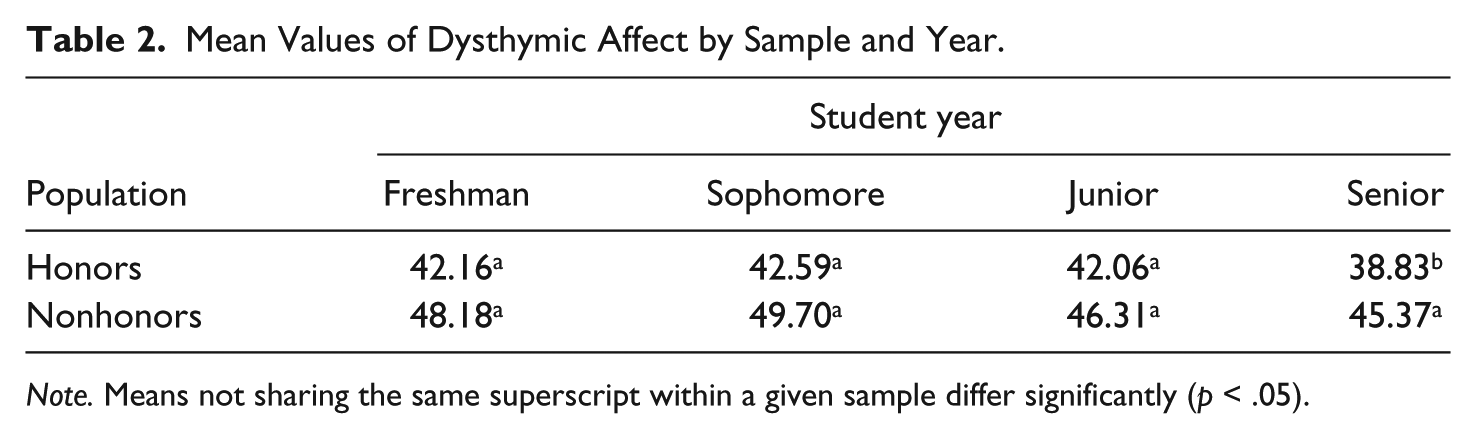
Note. Means not sharing the same superscript within a given sample differ significantly (p < .05).
Honors students in their senior year exhibited significantly lower levels of dysthymic affect than honors freshman, sophomores, and juniors. Nonhonors students did not exhibit any significant differences in dysthymic affect by class standing. The highest level of dysthymic affect was reported in the sophomore samples of both honors and nonhonors populations.
Significance of differences in dysthymia affect between the two samples were determined using independent samples t tests. All analyses were completed using PROC TTEST with the SAS 9.4 program for Windows (2016, SAS Institute Inc., Cary, NC, USA). The Benjamini-Hochberg (B-H) procedure was used to control the false discovery rate (Thissen, Steinberg, & Kuang, 2002). All between-sample, by class standing, comparisons were significant, as shown in Table 2. Freshman, sophomore, junior, and senior honors students displayed significantly lower levels of dysthymic affect than nonhonors students in each corresponding class.
To compare psychological wellbeing between honors and nonhonors samples within each of the four class-years included, mean values of the 10 measures used in this study were compared using an independent-samples t test. The B-H procedure was used to control the false discovery rate (Thissen et al., 2002). Table 3 describes these comparisons.
Descriptive Statistics of 10 Selected Measures of Psychological Wellbeing in Honors and Nonhonors Undergraduates in four Separate Student Years.
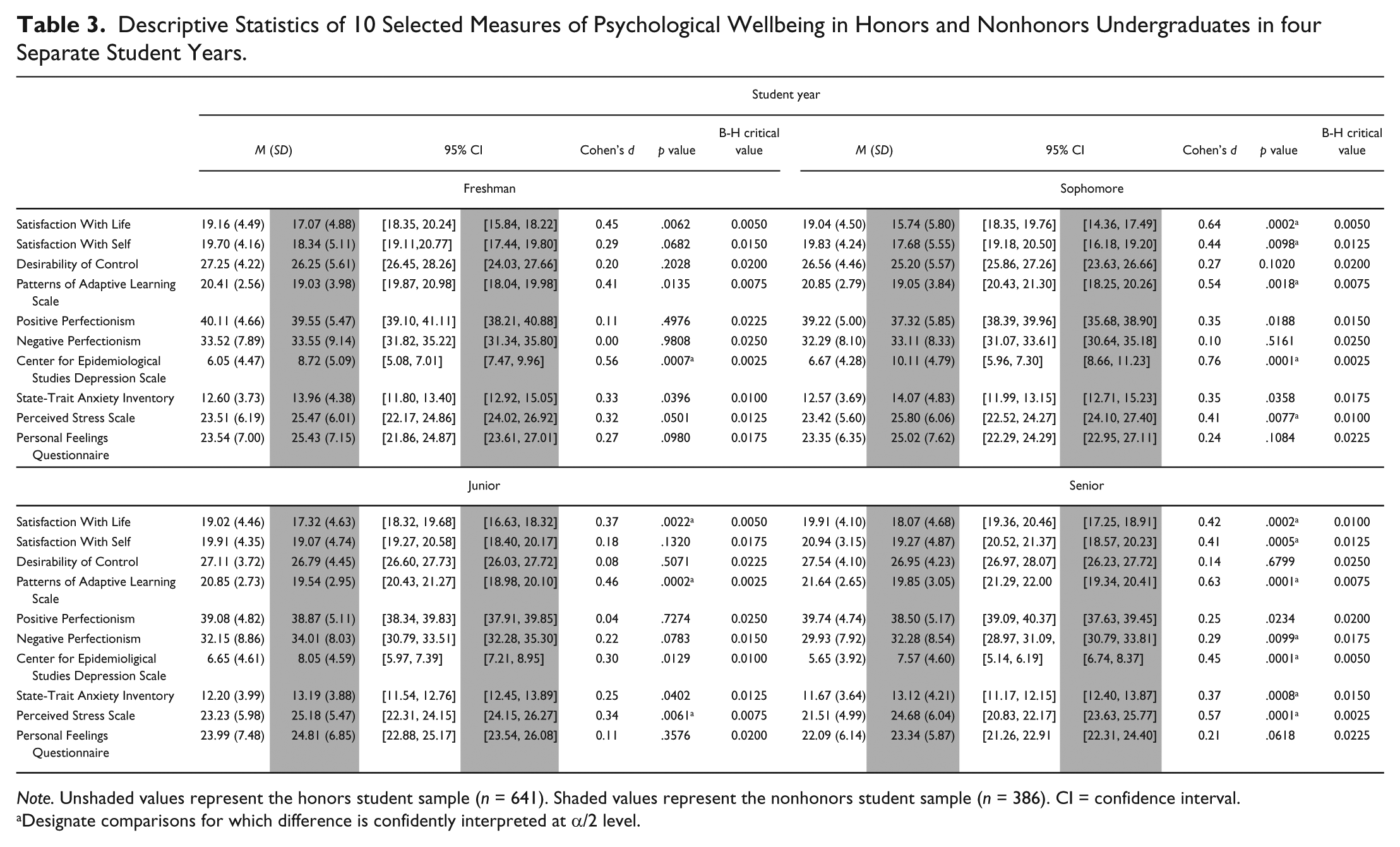
Note. Unshaded values represent the honors student sample (n = 641). Shaded values represent the nonhonors student sample (n = 386). CI = confidence interval.
Designate comparisons for which difference is confidently interpreted at α/2 level.
Freshman honors and nonhonors students indicated significant differences in only one of the indices analyzed, with nonhonors students indicating significantly higher levels of depressed affect than honors students. Sophomore nonhonors students reported significantly lower levels of general life satisfaction, satisfaction with self, and academic self-efficacy than their honors peers. Sophomore nonhonors students also reported significantly higher levels of depressive symptomology and perceived stress than sophomore honors students.
Junior honors and nonhonors students reported significant differences in three of the measures analyzed. Honors juniors reported significantly higher levels of life satisfaction and academic self-efficacy than their nonhonors peers. Junior nonhonors students reported significantly higher levels of perceived stress than honors students of the same class standing.
Senior honors and nonhonors students reported significant differences in seven of the 10 indices examined. Senior honors students reported significantly lower levels of negative perfectionism, depressed affect, anxiety, and perceived stress. Honors seniors also reported significantly higher levels of satisfaction with life, satisfaction with self, and academic self-efficacy.
Discussion
The purpose of this study was to (a) describe the current state of psychological wellbeing in gifted and nongifted undergraduate student sample populations within a large Midwestern university, and (b) identify potential differences by class standing associated with heightened levels of distress, which may be used to determine potential services that may improve the university undergraduate experience. Consideration of the data presented in this work reveals a number of notable findings.
Overall, honors students reported healthier levels of positive wellbeing on most scales across classes, and significantly lower levels of dysthymic affect than their nonhonors peers. Why might this be so? Current research indicates that gifted students enrolled in a university honors program demonstrate significantly higher academic achievement and report greater levels of academic self-concept than gifted students who choose not to participate in an honors program. This suggests that the academic and/or social environment of the honors program plays a key role in student success (T. J. Haas, 2015; Rinn, 2007). An examination of the different educational and social environments experienced by honors and nonhonors participants in this study reveals that, upon their acceptance to the program, honors students are, effectively, offered the opportunity to participate in an honors living-learning community. These student-focused living environments are designed to facilitate student interactions with faculty and peers, encourage interdisciplinary learning, and provide a setting for organized educational activities (Inkelas & Weisman, 2003; Wynn, Mosholder, & Larsen, 2014). Research suggests that living-learning communities may help facilitate a student’s progression through the psychosocial developmental stages associated with undergraduate education (Inkelas et al., 2006). Participation in a living-learning community has also been associated with greater gains in cognitive functioning and the development of higher-order thinking than students living in traditional residence halls (Terenzini, Pascarella, & Blimling, 1999; Wynn et al., 2014).
Additionally, living-learning communities offer honors students an academically and socially supportive atmosphere, thereby possibly providing students with a greater sense of community and belonging among their equally high-ability peers (Spanierman et al., 2013; Wawrzynski, Jessup-Anger, Stolz, Helman, & Beaulieu, 2009). Pemberton (1969) suggested that the supportive nature of the living-learning environment may help ease the transition from high school to college. This combination of academic, intellectual, and social support provided by a living-learning community may account, in part, for why honors students reported healthier levels of psychological wellbeing than their nonhonors peers.
The basic design of honors education may also promote higher levels of psychological wellbeing in honors students. Membership in a university honors program frequently provides students with increased opportunities for autonomy in terms of selecting the direction of their education. Honors college membership may motivate students to finish their degree early, earn multiple degrees, and explore a wider range of classes than their nonhonors counterparts. Additionally, honors students are heavily encouraged to take part in experiential learning through internships, study abroad, leadership roles, and faculty-directed research (Achterberg, 2005; Clauss, 2011).
Encouraging students to take an active role in directing the course of their education may provide honors undergraduates with a greater perceived locus of control (Clauss, 2011). Studies indicate that a significant positive relationship between internal locus of control and psychological wellbeing exists, with individuals reporting a greater sense of control also describing healthier levels of happiness (April, Dharani, & Peters, 2012; Mobarakeh, Juhari, Yaacob, & Redzuan, 2015; Myers & Diener, 1995). Given these prior findings, the relationship between an honors education and student locus of control may account, in part, for why the honors students in the current study reported higher levels of psychological wellbeing than their nonhonors peers (Clauss, 2011).
To further examine the observed differences between honors and nonhonors students in the present study, particular aspects of the honors education, itself, were considered. The honors program curriculum of the participating institution is largely predicated on the accelerator model. The use of this educational model may account for some of the observed greater levels of positive wellbeing and lower levels of dysthymic affect in honors students. This is because a central tenet of the accelerator model is to match and then slightly exceed a student’s cognitive and affective skill sets based on carefully and deliberately titrating the degree of challenge within a course in order to maximize a student’s cognitive growth. The degree of engagement within the classroom is intended to circumvent boredom and disengagement, but not to significantly exceed students’ cognitive abilities. Student cognitive growth is maximized when the degree of challenge encourages some level of manageable student discomfort, but avoids producing chronic feelings of anxiety, frustration, failure, or anger, which appears consistent with our descriptive findings (Morgan & Apple, 2007). As honors students often have greater cognitive skill sets than typical nonhonors undergraduates, they may be better able to cope with the challenges associated with the rigor of a college education (Achterberg, 2005; Barfels & Delucchi, 2003). It is feasible that some of the students reporting significant levels of dysthymic affect are facing academic challenges that exceed their cognitive and affective skill sets. If this is true, it is important for students to communicate their concerns to their professors. Maintaining effective communication within the teacher–student relationship is essential in assuring that the learner maximizes his or her academic and professional potential (Aultman, Williams-Johnson, & Schutz, 2009).
The accelerator model closely resembles what many researchers agree to be the best method of facilitating a student’s progression through each of Perry’s (1970) widely known developmental stages. Perry’s (1970) full learning model is based on a stage model of intellectual development and encompasses nine stages or positions. Starting with basic duality (in which knowledge is basically right or wrong), it culminates with a sense of personal identity and commitment despite uncertainty or conflicting sources (Burns, Stephenson, & Bellamy, 2016; Thomas, 2008). A precise balance of academic challenge and support (such as that found in the accelerator model) can aid a student’s movement through each of these stages (Brand, 1988; Canon & Newble, 2000; De L’Etoile, 2008; Nilson, 1998). We believe the honors college’s use of the accelerator model contributes to the greater level of psychological wellbeing of honors students by means of effectively supporting students through each of Perry’s developmental stages during their undergraduate education.
Another key finding of this study was the considerably lower levels of psychological wellbeing (as indicated by greater levels of dysthymic affect) observed in sophomore students in both honors and nonhonors populations alike. This well-characterized decline in sophomore undergraduate populations is commonly referred to as the “sophomore slump.” Often, the sophomore slump is regarded as a period in which second-year students struggle to define themselves personally, academically, and professionally (Gump, 2007; Tower, Blacklock, Watson, Heffernan, & Tronoff, 2015; Wang & Kennedy-Phillips, 2013). As course content becomes more complex and academic expectations intensify, sophomore students may find their sense of academic self-efficacy and personal competency threatened. Students may begin to seek a sense of purpose and direction for their lives as they struggle to navigate their own education (Gahagan & Hunter, 2008; Sanchez-Leguelinel, 2008; Tower et al., 2015).
While most universities do provide programs designed to help students adjust to increasing academic and professional demands, attention is often focused predominantly on incoming freshman as they transition into the undergraduate experience. Junior and senior students are often provided ample services meant to assist with their integration into their chosen career path. However, many universities provide the fewest number of support services to students in their sophomore year of study (Sanchez-Leguelinel, 2008; Schaller, 2005).
To better address the unique challenges sophomore undergraduates face, research suggests a multitude of potential university interventions. Institutions should consider offering programs specifically designed for sophomore students. Effective sophomore programming initiatives should focus on the personal and professional obstacles second-year undergraduates may experience (Graunke & Woosley, 2005; Hunter et al., 2010; Sanchez-Leguelinel, 2008; Schaller, 2005; Wang & Kennedy-Phillips, 2013). Programs should assist sophomore students in identifying their individual academic and professional passions, and providing opportunities for structured exploration through service learning, study abroad, and internships. Trained advisors should support students through the process of self-reflection, so that students may better analyze and sort through, and learn from, their past exploratory experiences (Graunke & Woosley, 2005; Hunter et al., 2010; Schaller, 2005).
Sophomore students may also benefit from programs designed to increase opportunities for faculty interaction. Connecting students to faculty both within and outside of the academic environment may provide sophomores with a greater sense of belonging within the larger university community (Graunke & Woosley, 2005; Hunter et al., 2010).
Work at the John Jay College of Criminal Justice found great success with a sophomore peer-counseling program (Sanchez-Leguelinel, 2008). Sophomore students were required to meet with an upperclassman advisor to discuss their academic and career planning, encouraging students to become active participants in their own education. Yet, this program also allowed sophomores to identify and address personal and social concerns, providing them with easy access to university support resources and services (Sanchez-Leguelinel, 2008). A peer-counseling program such as this may be particularly beneficial in institutions that lack the financial means to launch larger scale sophomore programming.
Although some university administrators may be weary of certain suggestions presented in this article due to time and financial considerations, we propose that institutions interested in developing additional undergraduate programs designed to meet student psychosocial needs employ the use of a brief survey such as the one used in the current study. Using our brief psychological survey could allow undergraduate institutions to use a very cost effective and minimally invasive screening assessment that might allow them to selectively approach individuals who may be at risk for a variety of psychological concerns. 1
Limitations
Although this study presents a number of statistically significant differences both within and between honors and nonhonors student populations, based on our measures it is difficult to determine whether these differences can, or even should, be interpreted in a clinically meaningful manner. This study was designed to establish and assess undergraduate wellbeing on a large scale. While this was successfully completed, determinations of a diagnostic or clinical nature are beyond study parameters. However, our findings suggest that future research directed toward qualitatively analyzing honors and nonhonors student wellbeing with greater specificity may prove beneficial.
Participant self-selection calls for caution in interpreting the findings. The findings presented in this work are only indicative of those who chose to participate. For example, honors students reported slightly younger ages than nonhonors students. However, the honors and nonhonors samples had comparable responses rates across each class. Additionally, similar patterns of change over time in reported levels of psychological wellbeing and distress were observed in sophomore and senior students, respectively. The sample similarities identified lend a degree of confidence in the results of this work despite some of the inherent limitations imposed its reliance on samples of convenience.
Self-selection resulted in a substantially greater number of female participants included in this study. However, female students were responsible for the vast majority of assessment responses in both honors and nonhonors sample populations, allowing the samples to remain comparable. Additionally, the gendered response rate patterns of this study are consistent with rates observed by prior investigations of undergraduate student survey participation (Adams, 2010; Reisenwitz, 2016; Sharkness, 2012). Future research should aim to better quantify psychological wellbeing in university undergraduate males.
Although nonhonors students who may have met honors college admissions criteria were not excluded from the comparison group, the authors believe the educational environment of the honors and nonhonors programs experienced by each group likely accounts for the observed differences in psychological wellbeing. Although the correlational nature of this study does not permit the confirmation of this belief, findings described in Table 3 support this notion. This study found that freshman honors and nonhonors students only differed significantly in terms of one measure of psychological wellbeing, while sophomore, junior, and senior honors and nonhonors students differed in a number of psychological measures. This suggests that although the freshman population as a whole is largely similar, progression through the university undergraduate experience through either an honors or nonhonors educational path may be, at least in part, responsible for a psychological divergence. Future research should seek to compare the wellbeing of solely high-achieving students in different educational programs.
Conclusions
This study has quantitatively examined the psychological wellbeing of honors and nonhonors students alike at the undergraduate level. An association between giftedness and greater levels of psychological wellbeing was observed, as well as lower levels of dysthymic affect in that population. Our findings were consistent with ample prior findings indicative of the “sophomore slump” phenomenon, and we have outlined a number of interventions that may prove helpful in reducing or alleviating sophomore student distress.
Additionally, this work has provided direction for further research: Why do honors students report greater levels of psychological wellbeing than their nonhonors peers? More specifically, what unique student psychosocial characteristics or program features of the honors undergraduate experience might leave honors students better prepared to manage the stressors of a university education? This work may be used by university administrators and faculty to better serve undergraduate populations through the development of directed programming initiatives.
Footnotes
Declaration of Conflicting Interests
The authors declared no potential conflicts of interest with respect to the research, authorship, and/or publication of this article.
Funding
The authors received no financial support for the research, authorship, and/or publication of this article.