




Abstract
The purpose of this study was to form a deeper understanding of how high school teachers view giftedness and gifted education. Open-ended surveys and interviews were conducted with high school teachers in a suburban school district with three large high school, and data were analyzed using a grounded theory methodology. Data were collected and analyzed in two phases with two groups of teachers (n1 = 7 and n2 = 13). Text data from both phases were analyzed separately and then validated using constant comparison processes. Initial coding, focused coding, and theoretical coding led to data categories and an emergent theory to explain high school teachers’ perceptions regarding gifted education. Results indicated a need to clarify the perception of giftedness among high school teachers, as well as how effective training of those teachers can be implemented.
Evidence continues to support gifted education programs as an important part of the educational structure (Reis & Renzulli, 2010), and that giftedness may manifest in a variety of forms (Dai & Chen, 2014; Konstantopoulos, Modi, & Hedges, 2001). As such, the field continues to struggle over definitions for seemingly simple but, in fact, very complex terms such as gifted, giftedness, and gifted education. However necessary debate and discussion at the researcher level may be, ambiguous concepts lead to confusion and frustration for teachers as they seek to serve their students. Competing ideas, approaches, and policies in gifted education may result in contradictory curriculum models adopted by local school systems, especially in the climate of high-stakes accountability testing (Moon, Brighton, & Callahan, 2003). At the high school level, competing priorities may be compounded as teachers of gifted students often have to satisfy the standards of Advanced Placement or International Baccalaureate, which may or may not share the same commitments (e.g., open enrollment) as gifted education (Kyburg, Hertberg-Davis, & Callahan, 2007). It is possible that high school gifted education is uniquely affected by contested definitions, vague policies, and research-to-practice gaps (Ambrose, VanTassel-Baska, Coleman, & Cross, 2010; Dai & Chen, 2014). Few studies have examined the unique perspectives of high school teachers in gifted education programs and how their gifted education practices might be affected by the struggle to define giftedness. With the increasing influence of talent development approaches (Subotnik, Olszewski-Kubilius, & Worrell, 2011), understanding high school teachers’ struggles—both practical and philosophical—may be critical for designing and implementing programs.
Giftedness and Gifted Education
Competing Conceptions of Giftedness
Experts in the field of gifted education do not agree on what it means to be gifted (Ambrose et al., 2010; Dai & Chen, 2014; Subotnik et al., 2011). The National Association of Gifted Children (NAGC) defines gifted individuals as those who demonstrate outstanding levels of aptitude (e.g., exceptional ability to reason and learn) or competence (e.g., documented performance or achievement in top 10% or less) in one or more domains. Domains include any structured area of activity with its own symbol system (e.g., mathematics, music, language) and/or set of sensorimotor skills (e.g., painting, dance, sports; NAGC, n.d.). The state of Texas, where the current study was conducted, defines a gifted and talented student as a child or youth who performs at or shows the potential for performing at a remarkably high level of accomplishment when compared to others of the same age, experience, or environment and who: (a) exhibits high performance capability in an intellectual, creative, or artistic area; (b) possesses an unusual capacity for leadership; or (c) excels in a specific academic field. (Texas Education Agency, 2009, p. 18)
Researchers have also offered guidance to classroom educators on the nature and needs of the gifted. One widely cited, copied, and adapted model in gifted education is Renzulli’s (1978) three-ring conception of giftedness. This conception, often at the core of the gifted paradigm of talent development (Dai & Chen, 2014), defines giftedness as the intersection of above-average ability, creativity, and task commitment, with the construct of creativity summarily defined as original ideas or products of value in a particular context. Renzulli (2005) has continuously updated and clarified his model, and it has been influential on other models of giftedness that stress creativity or task commitment as essential components of giftedness.
Mönks and Katzko (2005) described giftedness within a context of family, peers, and school. While they point out that giftedness is a term that can mean more than one thing, along the lines of the paradigms described by Dai and Chen (2014), any programming model for gifted learners should adhere to three guiding principles: (a) grounding in a theoretically based model of giftedness, (b) high methodological standards, and (c) accounting for identification difficulties related to social preconceptions, such as those of women and minorities. Dai and Chen (2014) further pointed out that many gifted programs do not meet those criteria. Contested identification processes add to the confusion and frustration for high school gifted education teachers (Carman, 2011; Coleman, 2014; Schroth & Helfer, 2008; Siegle, Moore, Mann, & Wilson, 2010). Moreover, practices commonly associated with gifted education, such as ability grouping and academic acceleration, may be questioned or rejected in high school settings (Siegle, Wilson, & Little, 2013).
Cross and Coleman (2005) suggested a straightforward solution to the problems identified by Mönks and Katzko (2005): redefine giftedness. They argued giftedness is a combination of advanced development and creativity, that it is clearly developmental in nature, and that, while it begins as potential, it must evolve into performance and achievement in recognizable domains. This talent development model, they argued, is a more effective means of delivering gifted services but not often used by school systems who assess gifted students based on potential. On the contrary, Gordon and Bridglall (2005) were critical of the giftedness-as-performance model in their research. They argue such a model, one that does not account for potential in identification and placement, is inherently biased against those students who struggle with poverty, language barriers, or institutionalized discrimination, a concern shared by educators in several studies (Bianco, Harris, Garrison-Wade, & Leech, 2011; de Wet & Gubbins, 2011; Hargrove & Seay, 2011).
Some theorists in gifted education have questioned the merit of classifying students as gifted. Borland (2005) argued that gifted education would be better if schools were to abandon the label of giftedness altogether. He contended that the attempt to label a thing that is so unclear in its definition has led to a situation in school systems where gifted education is largely ineffective, of questionable validity, and a misuse of resources. Instead, Borland argued for individualized education for all students similar to the differentiation paradigm of gifted education. Peters, Mathews, McBee, and McCoach (2013) extended Borland’s argument and advocated for an advanced academics model of data-driven differentiation that focuses on local norms and matching student needs to services.
These theoretical conversations can be confusing for educators who are less aware of the definitional debates and disagreements in the field. Any of these models could form the basis for gifted programming, with no guarantee of consistency from one school to the next. Teacher training in gifted education typically occurs via school-led professional development (Siegle et al., 2010; Siegle et al., 2013), and those schools may define giftedness differently than the teachers themselves had been trained to conceptualize it.
Policies and Practices for Gifted Education
Policies and practices influence the structure of high school classrooms, and those policies and practices influence the perceptions of gifted education held by high school teachers. Although a complete analysis of those policies and practices are beyond the scope of the current study, existing research identifies some factors relevant to understanding high school teachers’ perceptions.
Baker’s (2001) analysis of gifted education programs in the United States revealed several disparities in the field, especially in terms of funding and program access for low socioeconomic students. Baker identified a national trend of consistent underrepresentation of Hispanic students in gifted programs and suggested students in the lowest socioeconomic quartile are far less likely to participate in gifted programs. He further identified a radical disparity in funding for gifted programs based on district-level resources and community economic characteristics. Kettler, Russell, and Puryear (2015) argued this is likely attributable to the fact that, despite a widespread belief in the power of federal and state education mandates, gifted education policy and spending decisions are made at the district (and often campus) level, translating to spending without oversight in many cases. A consistent lack of funding for gifted services in some schools, or the underrepresentation of groups within them, has the potential to convince some educators that those are normal or acceptable outcomes and not problems in need of correction.
Public policy may affect gifted education programs in other ways. Despite researcher agreement about the value of ability grouping in gifted education, Fiedler, Lange, and Winebrenner (2002) reported pervasive myths about ability grouping, including a persistent belief that it is the same as tracking, a practice detrimental to students who are Black, Hispanic, and/or economically disadvantaged and may have contributed to their exclusion from some school programs. At the same time, ability grouping was criticized, the demand for standardized testing and education reform was rising (Moon et al., 2003), placing demands on gifted classroom practice for one-size-fits-all methodologies under the pressure to prepare students for state-level examinations. It has been suggested that this standardization of education policy at the state- and federal level contributes to the decision by experienced educators to leave the classroom do to a lack of teacher voice in the school-level decision-making process (Ingersoll, 2007). Research suggests that this exodus of teachers has an especially adverse effect on targeted educational programs such as special education and gifted education because of the difficulty of replacing experienced teachers with training in the specialized skills and research supported practices that effective instruction in those areas require (Lee & Smith, 1996).
Teacher Perceptions of Giftedness
Existing studies on teachers’ perceptions of giftedness and gifted education are sparse. What research that does exists has been organized and classified into three related categories for the purposes of this study: assumptions, referring to thoughts on giftedness and gifted education held by pre-and early service teachers, attitudes referring to those thoughts about giftedness and gifted education held by in-service teachers, and practices, referring to tools and procedures for serving gifted learners.
Assumptions
Carman (2011) presented pre- and early service teachers with common stereotypes about gifted students related to gender, ethnicity, age, various talents, and “nerdiness.” She found the majority of participants held stereotypical assumptions of gifted learners in four or more of the five aforementioned categories examined, attributable to a lack of experience with actual gifted learners or training in gifted education. High-quality training has been shown to be vital in servicing gifted learners, especially in the social and emotional aspects of those services (Rizza & Morrison, 2002).
Attitudes
Experience has also been shown to be an important factor in gifted identification. For instance, Brown, Renzulli, Gubbins, Siegle, and Zhang (2005) found experienced teachers favored the use of factors such as individual expression, ongoing assessment, multiple identification criteria, and contextual variables when determining placement for gifted services. Schroth and Helfer (2009) echoed that finding, suggesting teachers in general, and those with gifted experience to a greater extent, were more likely to support an expanded definition of giftedness than school officials and administrators. In contrast, in a study using methods designed to measure implicit conceptions, no difference in patterns of beliefs about giftedness was found between teachers with and without experience working with gifted children (Miller, 2009). Finally, in a survey distributed to teachers across eight states, responses suggested there was broad acceptance of the fact that IQ testing alone could not correctly identify gifted learners who were culturally, linguistically, and/or economically diverse (de Wet & Gubbins, 2011).
Studies have found that socioeconomic status, academic strength, and student interests were all important to teachers making gifted identification recommendations but were more likely to affect recommendations from more experienced educators (Siegle et al., 2010). The ethnicities of teachers themselves can be a factor that influences gifted referrals, as experienced White teachers were aware of many of the outside-of-school variables that can confound placement for Black students, but they were not as aware of the inside-the-school variables as were Black teachers (Hargrove & Seay, 2011).
Experienced teachers of the gifted have also expressed frustrations with the growth of standardized testing. Participants in Mendoza’s (2006) study, all teachers of gifted students, voiced concerns that federal and state mandates were severely impeding what they saw as their ability to correctly serve gifted learners. This, they felt, was not only a product of time constraints created by test preparation, but also due to changes in curriculum models, which were becoming overly standardized for the sake of test performance and were detrimental to the gifted and their unique learning needs.
McCoach and Siegle (2007) examined three possible predictors of educators’ attitudes about giftedness: (a) training or experience in gifted education, (b) training or experience in special education, and (c) self-perceptions as gifted. Training or experience in gifted education was a predictor of positive attitudes toward giftedness in general, and teachers with more experience in gifted education were more likely to self-identify as gifted themselves, but the other relationships were nonsignificant (McCoach & Siegle, 2007). This, coupled with the fact that some anecdotally suggest the best teachers of the gifted are gifted individuals themselves (Rosemarin, 2014), raises some interesting, but as yet unexplored, questions for the field. There may also be a caution to experienced educators of the gifted who impose their own negative affects with overly simplistic labels of gifted learners as misfits or outside-the-box personalities (Geake & Gross, 2008).
Practices
Despite substantial empirical support for the effectiveness of acceleration and ability grouping in the field of gifted education, these practices are not always used in practice because teachers and schools are not supportive of them (Missett, Brunner, Callahan, Moon, & Azano, 2014). Studies have offered further insight as to why this may be the case, especially in terms of acceleration via grade-skipping. School systems worry about disruption to the age-level model used in most schools and teachers often express concerns about the social well-being of students who participate in grade-skipping, despite no evidence it is detrimental to them (Siegle et al., 2013). This unsupported teacher belief may also contribute to the underrepresentation of girls (Bianco et al., 2011), second language learners (Harris, Plucker, Rapp, & Martínez, 2009), and ethnic minorities (Schroth & Helfer, 2008) in gifted programs because teacher referrals are the primary means by which students are identified for possible placement.
The Current Study
The current study examined the understanding of giftedness among high school teachers of the gifted. Those understandings included not only a basic definition of giftedness, but also how those definitions affect classroom practices for gifted learners and how they are altered by teachers’ experiences with secondary gifted education. Using a qualitative, interpretive framework rooted in a constructivist approach to grounded theory research (Charmaz, 2006, 2014), the following research questions guided the inquiry through all phases of current research and analysis:
Method
The current study took place in two phases (see Figure 1), each following the four basic steps of the analytic process in grounded theory. Originated in the 1960s by Glaser and Strauss (1999), grounded theory seeks to unify the precise methodology of positivism with the contextual factors of pragmatism. Grounded theory stresses an intellectual separation from existing theory so as to allow the explanation for a phenomenon or interaction to emerge organically from collected data in an inductive fashion (Creswell, 2013). It emphasizes the coding of textual data to identify abstracts or concepts of potential interest or that might contribute to the creation of a descriptive theory (Yin, 2014). Grounded theory was chosen because of its usefulness in research where there are gaps in existing literature (Charmaz, 2006; Creswell, 2013), in this case the shortage of research on the perceptions of giftedness among high school teachers. Research of this type begins the construction of a theoretical underpinning that can then be challenged, altered, and improved upon through subsequent research conducted in whatever method would then be most appropriate (Strauss & Corbin, 1990). The current study followed the constructivist approach to grounded theory advocated by Charmaz (2006, 2014).

Research design of the current study.
Phase 1
Participants
Seven high school teachers responded to an open-ended survey on various aspects of gifted education practice. The respondents averaged 11 years in the classroom with service ranging from 1 year to 31 years of experience. Four possessed a master’s degree or higher. Only one of the respondents possessed a state-level teacher’s certification for gifted and talented education, though the participating district has its own G/T training requirements whether the GT certification is possessed or not. Four respondents also reported that they had been identified as gifted learners during their own schooling. The participants in the study were all employees of the participating district, a large suburban school system in north Texas, and part of a relatively small population of teachers in a specialized program; thus, identifying characteristics such as age and gender were not reported to support the anonymity of participants.
Data collection
An open-ended survey of 10 questions was created and administered by the participating district to all high school teachers of identified gifted students (n = 22) and responses were shared with the researchers in the current study (Appendix A). Of the teachers surveyed, 11 responded. However, four of the responses lacked significant amounts of information, yielding the final set of seven responses for analysis. Responses were collected electronically and analyzed following the constructivist grounded theory framework.
Analysis
The survey responses of all the high school teachers of the gifted who completed the survey were coded line-by-line fashion to gain a familiarity with the data (initial coding). Initial coding and categorization revolved around questions of how the participants perceived giftedness and gifted education practice. The goal of initial coding was to create first impressions of the data represented by initial categories.
The next step in the analytic process was focused coding, wherein the initial data categorization was organized into broad ideas (Braun & Clarke, 2006) that emerged across the responses from participants. Focused coding sought to identify general commonalities in the responses of participants about questions regarding their perceptions of giftedness.
The final analytic procedure for Phase 1 was theoretical coding. In this process, the initial categories were organized into more detailed categories to start putting dissected data back together in a coherent and orderly fashion (Strauss & Corbin, 1990). The desired result here was to generate themes generally represented in the survey responses so those themes could then be added as necessary items at the end of the semistructured interview protocol for Phase 2. As such, the themes took the form of direct statements about the nature of giftedness, gifted education, and talent development that coalesced from repeated statements made by the participants or concepts relied on by them to answer the Phase 1 survey questions.
Phase 2
Participants
For the second phase of the study, 13 high school teachers were recruited from the gifted education program in the same district. The participants averaged 17 years of classroom teaching experience, with a range of service of 1 year to 31 years. Participants were recruited from each of the high schools in the district to balance variables such as demographics, individual campus culture, school spending, campus administrative policies, and differences in educational structures dictated by the campus leadership. It is important to note that it is impossible to know whether some of the participants in Phase 1 were also participants in Phase 2, as no identifying information was gathered during Phase 1 to ensure the anonymity of participants’ responses.
Data collection
Participants provided in-depth responses to a series of 17 questions and subsequent follow-up questions through a semistructured interview protocol (Appendix B). Interviews were conducted at the participant’s school to make the participant as comfortable as possible with the interview process. Interviews were audiorecorded for later transcription, with memo writing by the researcher throughout the interview process. As a form of data triangulation, a portion of the semistructured interview questions were designed to follow up on the themes identified in Phase 1 of the study (Charmaz, 2006).
Analysis
The semistructured interview responses were subjected to the same three-part coding structure detailed above. Once theoretical coding was complete in Phase 2, the categories and themes from both phases were compared. This type of comparison helps achieve concept saturation (Strauss & Corbin, 1990), thereby enhancing the trustworthiness of the research findings. This then led to the final, unifying process of both phases of the research, theoretical coding, which identified what the data conveyed about the environment and context in which it was collected.
Theoretical coding and categorization are fluid concepts created by competing schools of thought in grounded theory that can be used in concert with one another in research situations such as the current one. Charmaz (2006, 2014) recommended an analysis wherein the researcher goes into the process open to emergent categories, allowing the data to speak for itself. This constructivist approach to grounded theory seems to be favored by those who have studied teacher perceptions in areas other than giftedness. For example, topics as broad as how school mealtimes affect learning (Satoko, Gray, & Goodell, 2015) and how teachers of foreign languages maintain their proficiency (Valmori & De Costa, 2016) have been studied using constructivist grounded theory, and they seem to generally agree on Charmaz’s advice to let the data speak for itself, rather than an a priori approach to final coding.
Memoing
Vital to all portions of the analysis process was the practice of memo writing, or memoing, which takes place throughout the research process. Because grounded theory is inductive in nature, and the methodology of the study may change throughout the course of the research (Murphy, 2008), it is vital for the researcher to keep detailed memos of the process, context, analysis, and his or her own thoughts on the study as it progresses from start to finish (Charmaz, 2006). These memos represent not only the systemization of the data but, as Thornberg (2012) suggested, are also a vital secondary source of data in the analysis phase of the study. For the current study, memoing began with the initial question of how high school teachers conceptualize giftedness. It continued through the initial review of the literature and was vital in the development of the research questions of the current study. During the analysis phase of the study, the initial memos were consulted to identify any biases on the part of the researcher that might affect the reporting of data. This analysis was conducted following the same grounded theory model as that used on the Phase 1 and Phase 2 data itself.
Results
Phase 1
Eight categories emerged from the data during initial coding (Table 1). Line-by-line analysis of the survey responses were conducted and observations were made guided by the overall research questions. As the survey responses were read, a tabulation was created and added to each time a response addressed beliefs about the nature of giftedness or best practices associated with it. During this coding step, analysis only focused on frequency and not on respondents’ feelings about the topics being addressed. Referral back to memos made during the design of the current study and those recorded while the initial coding was conducted confirmed that the creation of the codes was consistent with the desired research objectives.
Categories Identified During Phase 1 Initial Coding.
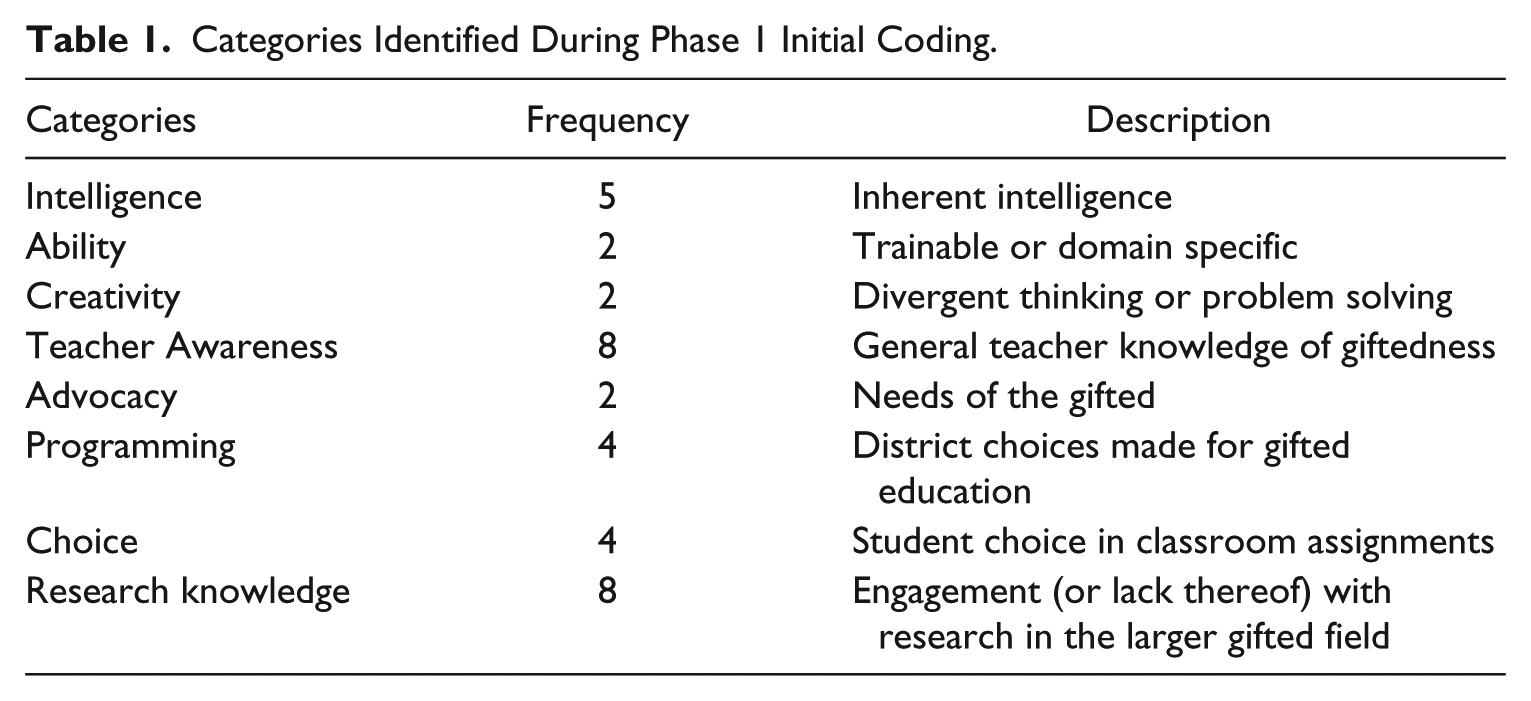
During focused coding, the objective was to identify emergent themes in the data. By searching for commonalities in repeatedly used phrases or concepts about giftedness or gifted education in the eight categories from the initial coding, focused coding produced four emerging themes: (a) inherent giftedness, (b) classroom differentiation, (c) training and programming, and (d) advocacy for the gifted (Table 2). To draw these four emergent themes from the data, responses were studied more closely to ascertain the beliefs and perceptions of the respondents on the topics in questions.
Themes Identified During Phase 1 Focused Coding.
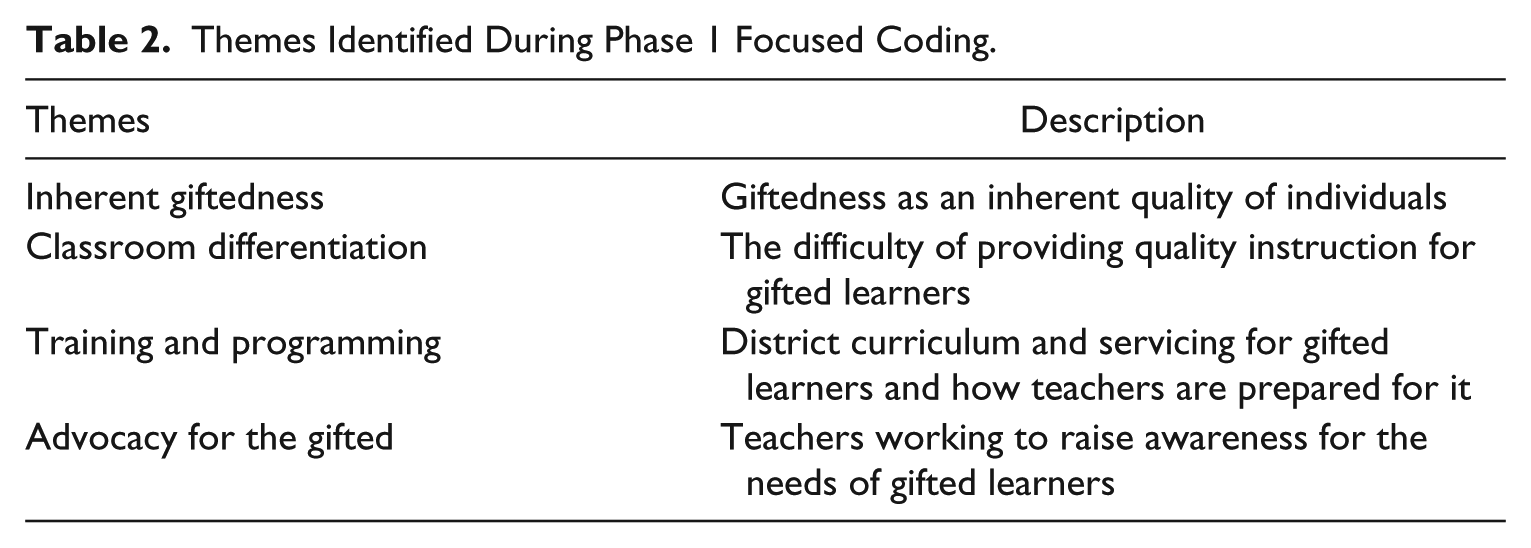
The initial codes of intelligence, ability, and creativity were re-examined for a deeper understanding of participants’ beliefs about the nature of giftedness. One participant described giftedness as, “certain topics/skills/subjects/concepts come easily to a person” (survey response, October 29, 2016), implying at least some belief in giftedness manifesting in a domain-specific manner. Another participant defined giftedness as “the ability to see a problem and to use external resources to attain a solution” (survey response, October 29, 2016), implying a belief in giftedness as skills of problem solving or creative thinking. However, analysis of the Phase 1 data showed a preference among the respondents for conceptualizing giftedness as “natural ability” (survey response, October 29, 2016) or as “being endowed with extra abilities” (survey response, October 29, 2016), language that lends itself to a conceptualization of giftedness that is, as one respondent phrased it, based in “native intelligence” (survey response, October 29, 2016). For this reason, the first of the focused codes generated during this step of coding was about the nature of giftedness as an inherent quality and not one that could be trained.
The second focused code for Phase 1 analysis focused on classroom differentiation, as the survey respondents reflected a strong belief that some degree of “student choice and flexibility” (survey response, October 29, 2016) was essential in high quality gifted education practice. Respondents also noted that allowing for choice and flexibility was a challenge because of time constraints and the variety of demands placed on instructors of the gifted related to working with a special population of students.
The third focused code for Phase 1 focused on training and programming for gifted education. Starting from the initial codes of Teacher Awareness, Programming, and Research Knowledge, survey responses were re-examined for insight into how high school teachers of the gifted learned what they knew about giftedness and gifted education. Respondents expressed a general sense of feeling like “valued participants in our local programs” (survey response, October 29, 2016), but they often expressed frustration with either their own lack of knowledge about giftedness or that of their working colleagues. Adding to this was the almost complete lack of engagement by survey participants with any scholarly works from the larger field of gifted education, with only one participant responding that he or she read, “at least one scholarly work a month on the subject of giftedness” (survey response, October 29, 2016).
The final focused code for Phase 1 dealt with advocacy for the gifted. Respondents to the Phase 1 survey felt that had a duty to “help gifted students understand who they are” (survey response, October 29, 2016), or to “grow in all aspects of their life” (survey response, October 29, 2016). This type of language seems to imply a strong belief in teachers as trainers of gifted students for their own self-advocacy. Responses seem to suggest that this training of self-advocacy extends beyond the realm of curriculum and learning for most of the respondents and is focused more on students as complete human beings. “It is imperative that I as an educator help my students in every area of growth,” one participant responded, echoing a sentiment expressed by most participants (survey response, October 29, 2016).
In the final step of analysis for Phase 1, the emergent themes from the focused coding process were subjected to theoretical coding. During theoretical coding, the four themes (Table 3) were formulated into direct statements that were then added to the Phase 2 collection instrument (Appendix B). The following direct thematic statements emerged from the entirety of the Phase 1 analysis: (a) giftedness, or being gifted, refers to certain natural abilities that some people are just born with; (b) differentiating instruction for individualized learning is the most difficult part of gifted education; (c) the formal knowledge of giftedness among teachers and the (participating) district’s programming for it are both inadequate to the task of gifted education; and (d) Teachers are the most important advocates for gifted students and their needs. This step of advanced coding was designed to produce clear statements about what the Phase 1 data seem to suggest. Those statements could then be authenticated by comparison with the findings from the Phase 2 analysis, an essential part of the constant comparison at the center of grounded theory research and a necessary precaution for any study dealing with a relatively small population and sample size.
Emergent Ideas During Phase 1 Theoretical Coding.

Phase 2
Participants in Phase 2 were interviewed in a semistructured interview process following a script (Appendix B) that included 17 questions, four of which were designed as responses to theoretical codes identified in Phase 1 analysis. These questions were included in the Phase 2 instrument as a means of authentication of the analysis and as a measure of the trustworthiness of the overall data analysis. It should also be noted that an additional response item was added to the Phase 2 data instrument: the best instructors of the gifted are gifted people themselves. This item was added because the responses to the Phase 1 survey indicated some of the participating district’s instructors of the gifted self-identified as gifted themselves. Although that was not an initial focus of the current study, identifying any underlying assumptions that gifted self-identification might create on the part of participants is important in the construction of a theoretical framework for this and further studies (Charmaz, 2006) and illustrates the ability of this type of research to adapt to the realities of research findings throughout the research process.
Eleven categories developed from coding the data during the initial coding of Phase 2 (Table 4). This followed the same line-by-line approach as that employed in Phase 1. Data and results were tabulated in the same fashion and analysis was again guided by the overall research questions of the current study, which focused the analysis on perceptions of giftedness and gifted education practice among the participants in Phase 2 of the study. The initial coding yielded similar codes to those found in Phase 1, though with an increased quantity and specificity most likely attributable to the more in-depth format of the data collection for Phase 2.
Categories Identified During Phase 2 Initial Coding.

The 11 initial categories were then analyzed for commonalities during focused coding. Focused coding identified seven themes emerging from the Phase 2 data regarding beliefs about various aspects of giftedness and gifted education centered on the participants’ beliefs about those things (Table 5). To draw these seven emergent themes from the data, responses were studied more closely to ascertain the feelings and beliefs of the respondents on the topics in questions.
Themes Identified During Phase 2 Focused Coding.
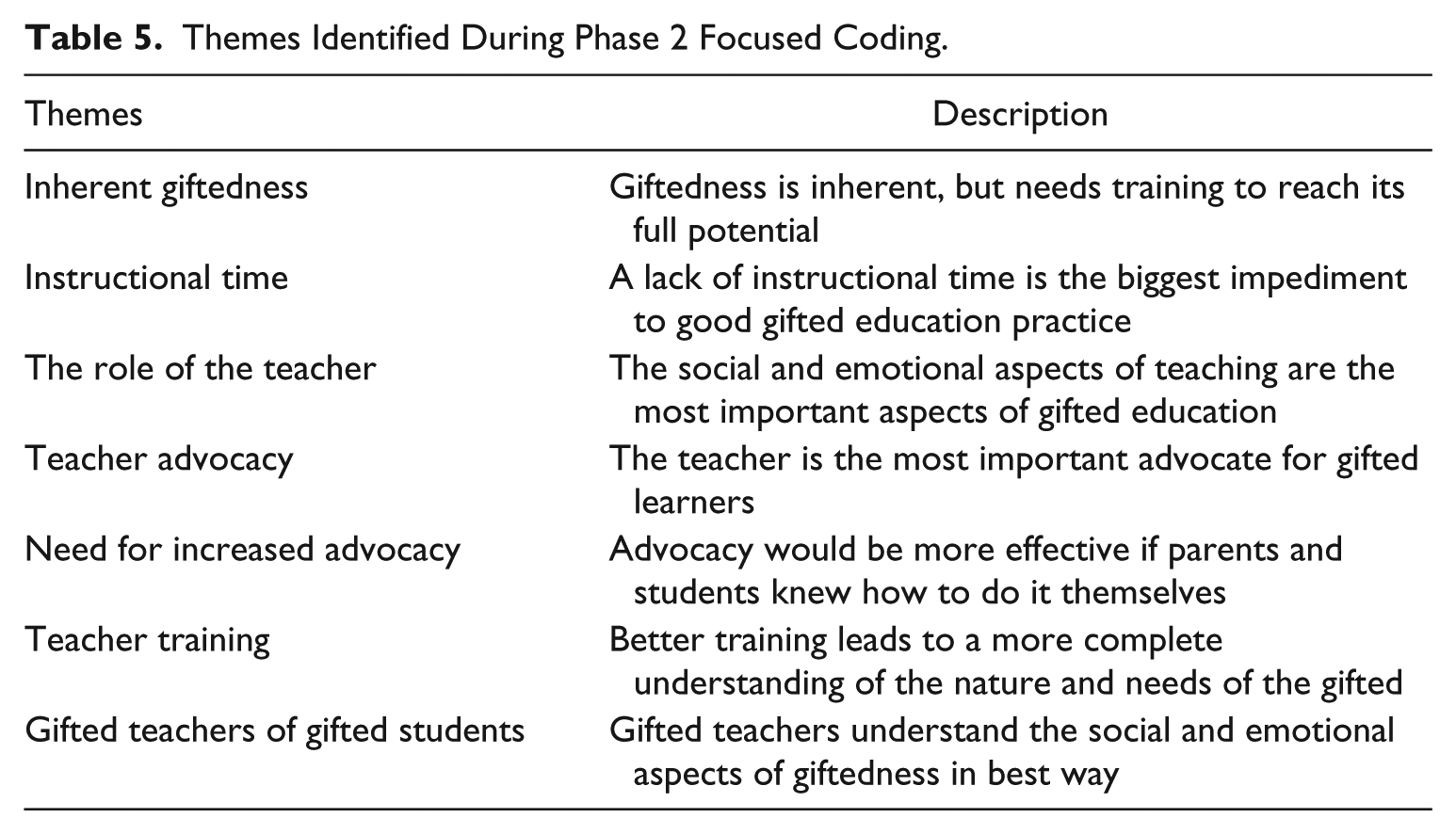
As in Phase 1, the initial categories of intelligence, ability, and creativity were re-examined for a deeper understanding of participants’ beliefs about the nature of giftedness. Although the participants had differing opinions of giftedness as, “a component of IQ or intelligence” (interview response, December 05, 2016), or as “operating outside the norm” (interview response, November 29, 2016), the respondents all stated that giftedness was an inherent quality that some people naturally possessed. One participant stated, “I do think giftedness. . . It’s something you are born with. If you are truly gifted, I think that’s innate” (interview response, November 15, 2016).
Analysis also shows that some of the respondents reported that giftedness was a quality that had to be properly trained to reach its full potential. One participant’s response to being directly asked if giftedness was an inherent quality that did not require any training offered a response that best encapsulates those of all the participants in Phase 2. “No. If we don’t foster it, it can be lost” (interview response, November 15, 2016). Another participant added, “I think we can foster improvement in any student” (interview response, November 17, 2016), echoing another sentiment expressed by all the participants in the study.
The second focused code for Phase 2 dealt with classroom instructional time. One participant put it succinctly, I wish I had more hours in the day. My kids get so caught up in the higher order of thinking that I often feel like I have rushed through important content. Or vice versa. We get into content and lose the big idea. (Interview response, December 07, 2016)
All interview participants echoed that sentiment in some fashion, with a concern often being that gifted students will become bored and not engaged with their assignments if they are not properly challenged.
The third focused code from Phase 2 dealt with the role of the teacher. None of the Phase 2 participants reported that content mastery or classroom management or other essential skills of an effective educator were unimportant, but all of their responses focused more on the social and emotional components of teaching. One participant reported, “My job is to let them be themselves so that they feel like they have an environment where they can say anything” (interview response, November 16, 2016). Another reported that the job of gifted instruction was about, “getting out of their way so they can grow” (interview response, December 06, 2016). Statements such as these, common throughout the interviews, imply a belief in the growth of the student as an individual and not just as a student of the subject matter being taught. Many respondents also reported that much of their job was as a de facto counselor to their students. One participant reported when asked what his or her students would say if they were asked what they needed him or her most for, “To listen to us” (interview response, December 09, 2016).
The fourth and fifth focused codes for Phase 2 both dealt with teacher advocacy for the gifted. The responses echo the sentiment from the Phase 1 data that teachers are the most important advocates for the gifted. Often, the respondents reported that this was a necessity given the bureaucracy that often comes with a large school district but that it was far from an ideal situation. One participant stated, “Parents know their kids the best, but they simply do not know how to navigate the school system” (interview response, December 08, 2016).
The need for teacher training was frequently present in the survey responses and was the basis for the sixth focused code for Phase 2. Participants all agreed that all teachers needed more and better training in gifted education. They expressed frustration about the general indifference to giftedness and gifted education in the school environment. “There is this sneering judgment from the rest of the school,” one participant stated. “Like they don’t believe that giftedness is even a thing” (interview response, December 08, 2016).
The final focused code for Phase 2 dealt with the idea of gifted people as the best instructors of the gifted. It was added to the interview instrument because approximately half of the respondents in both Phase 1 (n = 4) and Phase 2 (n = 6) self-reported as being identified as gifted. When asked directly if the best teachers of the gifted were gifted people themselves, one respondent stated, “That’s absolutely true. It sounds elitist, but it is true” (interview response, December 08, 2016). Although not all respondents felt as strongly, there was general consensus among the participants, whether gifted or not, that gifted people themselves were, “better advocates for the gifted kids because they sort of understand them better” (interview response, November 30, 2016).
In the third step of analysis, theoretical coding, the emergent themes from focused coding were formulated into seven direct statements on the nature of giftedness and gifted education (Table 6). During the Phase 1 analysis, this was done so that the statements could be added to the Phase 2 data collection instrument as a means of authentication and verifying trustworthiness in terms of the Phase 1 data analysis. For the Phase two theoretical codes, the direct statements serve a similar function, saturating the concepts being analyzed, though in this case as a direct means of comparison between the themes identified by the Phase 1 instrument and those from the more nuanced instrument in Phase 2 wherein respondents had the ability to provide more thorough responses to the researchers’ questions about various aspects of giftedness and gifted education practices at the secondary level. For purposes of clarity, the resulting theoretical codes for Phase 1 (Table 3) and Phase 2 (Table 6) will be compared below.
Emergent Ideas From Phase 2 Theoretical Coding.

Theoretical Coding Comparison
A comparison of the theoretical coding from both the Phase 1 and Phase 2 data analysis provides the most direct way to illustrate the findings of this study (Table 7). This approach also serves to most clearly address the two research questions posited by the study. The first of those questions asked is how high school teachers of the gifted perceive giftedness.
Side-by-Side Comparison of Theoretical Coding (Phase 1 and Phase 2).
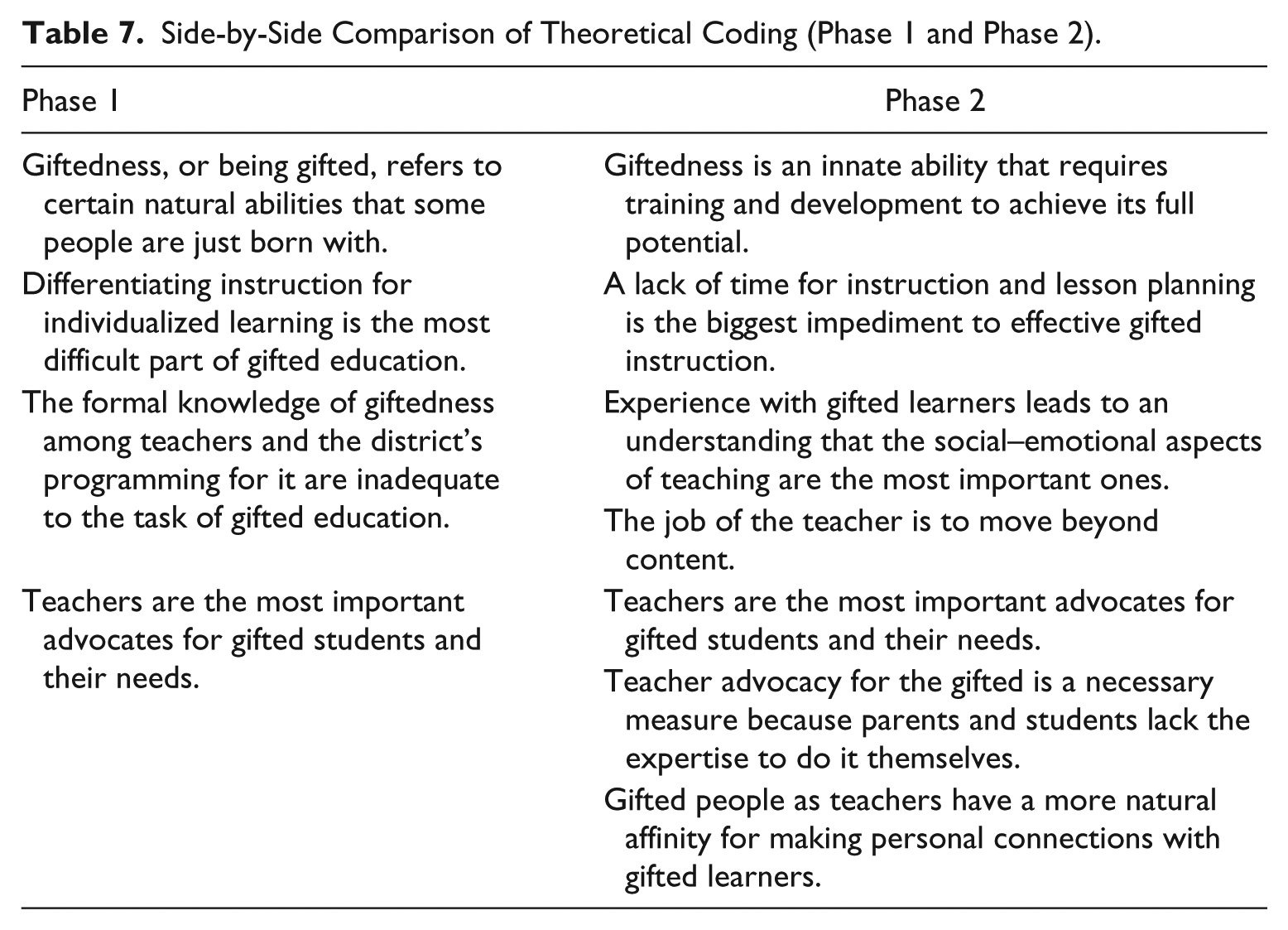
This question, perhaps more straightforward than the second, is addressed by the first theoretical code generated for both the Phase 1 and Phase 2 data analysis. The code for Phase 1, conducted with an open-ended survey instrument, shows a very strong predilection among the respondents for what could be characterized as a gifted child paradigm of giftedness (Dai & Chen, 2014). Consultation with the initial research memos identifies an assumption by the researcher that the gifted child paradigm would most likely be favored by participants in the study simply because it is the longest serving one in gifted education.
However, a comparison between the Phase 1 theoretical codes and the Phase 2 theoretical codes (Table 7), generated from data collected through long-form, semistructured interviews, show a more nuanced position from high school teachers of the gifted. Although all the interview participants expressed a belief that giftedness was an innate quality that some people are born with and that it could not be taught to those without it, all also stated that any natural gift had to be developed through proper training or education for it to reach its maximum potential. All respondents were also quick to state that they felt traditional views of giftedness as an aspect of intelligence were too restrictive and that high levels of ability in other areas, such as the creative arts and sports, should be considered as expressions of giftedness when schools are making the decision to place students for gifted services.
In this way, the participants in Phase 2 of the current study echoed a view of giftedness more in line with the talent development paradigm of giftedness (Dai & Chen, 2014; Subotnik et al., 2011). Talent development, while not necessarily denying the presence of innate natural ability, concerns itself far more with the development of high level ability, whether intelligence or otherwise, for maximum achievement (Dai & Chen, 2014). This perspective also reflects the three-ring model of giftedness proposed by Renzulli (1978), which sees the construct as the intersection of high-level ability, creativity, and task commitment.
It is important to note that none of the participants in the study used the language of the academic discipline of gifted education in referring to their beliefs about giftedness as either gifted child or talent development, or even as a paradigm, but rather expressed views on the construct that aligned with those terms as they are used in the larger research field. In fact, an absence of knowledge about the larger field of gifted education was a notable phenomenon identified in the current study. Most of the participants in both phases freely admitted that they did not read any research or literature on giftedness or gifted education. Despite many of them being veteran teachers, and an average service with gifted learners of 11 years, only two of the 13 participants in the Phase 2 interviews could name a researcher even closely aligned with the field of gifted education (both referenced Howard Gardner and his theory of multiple intelligences).
Instead, the respondents reported that training from the participating district was the primary source of the knowledge and information that informed their classroom practices. It is here that the results of the study address the second research question posited by the study: What assumptions, attitudes, and feelings do high school teachers of the gifted have about gifted education?
Theoretical coding for Phase 1 of the study shows that responding teachers felt that teachers’ knowledge of giftedness and the programming of the participating district for it were both inadequate. However, the Phase 2 analysis revealed a more nuanced opinion on the part of the participants in that portion of the study. Most respondents agreed that teachers lacked appropriate knowledge of giftedness and how to service it, but they were far more forgiving of district efforts than the participants in Phase 1. Phase 2 participants often expressed frustration with some practices in the participating district such as identification procedures for gifted services but felt that the participating district was an enthusiastic supporter of and believer in gifted education, which they felt was the single biggest factor in good gifted programming from an administrative level. Their beliefs focused far more heavily on teacher themselves moving beyond curriculum and content and becoming more engaged with the social and emotional aspects of giftedness that they felt needed to be served more appropriately in the school environment.
To the larger question of attitudes, assumptions, and feelings, the Phase 2 participants expressed other ideas that differed from the Phase 1 data. For example, in Phase 1, the respondents reported that effective differentiation was the most difficult part of good gifted instruction. However, the Phase 2 respondents reported that the larger problem is a lack of instructional and planning time, either for differentiation or anything else. The more experienced among the Phase 2 participants reported a far more comfortable proficiency with effectively differentiating for their gifted learners in the planning and instructional time allotted to them. Those more experienced respondents in Phase 2 expressed frustration with the ability to engage depth and complexity elements in their lesson plans more frequently because of the demands of content coverage associated with the nature of their courses, all of which were tied to Advanced Placement or International Baccalaureate standards at the secondary level.
A final way that the Phase 1 and Phase 2 participants differed was on the place of teacher advocacy for the needs of the gifted. Phase 1 participants reported that teachers were the best advocates for the gifted and their needs. While not refuting that directly, the Phase 2 participants offered a more nuanced position. Phase 2 analysis shows that respondents agreed that teachers were the most important advocates for the gifted, but they also said that was not an ideal situation. Instead, they felt that teachers had to be advocates for the gifted because parents, who they felt should be the greatest advocates, simply did not know how to do that advocacy very well due to a lack of expertise on the nature and needs of the gifted and a lack of knowledge about how to navigate the sometimes complicated nature of the school system itself.
Theoretical Coding
After comparison of the theoretical codes for the Phase 1 and Phase 2 analysis, and triangulation with memoing done throughout the study, four data-driven themes emerged from the existing study (Table 8). Theoretical coding is the final step of grounded theory analysis, when and if the results of a study warrant it, and is meant to explain something about the data in the context in which it was collected (Charmaz, 2014; Glaser, 1992). The first of these theoretical codes illuminates high school teachers’ beliefs about the nature of giftedness. The in-depth responses of the Phase 2 interviews suggest a more nuanced understanding of the nature of giftedness and what servicing it requires among teachers than the abbreviated responses in the Phase 1 instrument can convey.
Emergent Ideas from the Current Study.
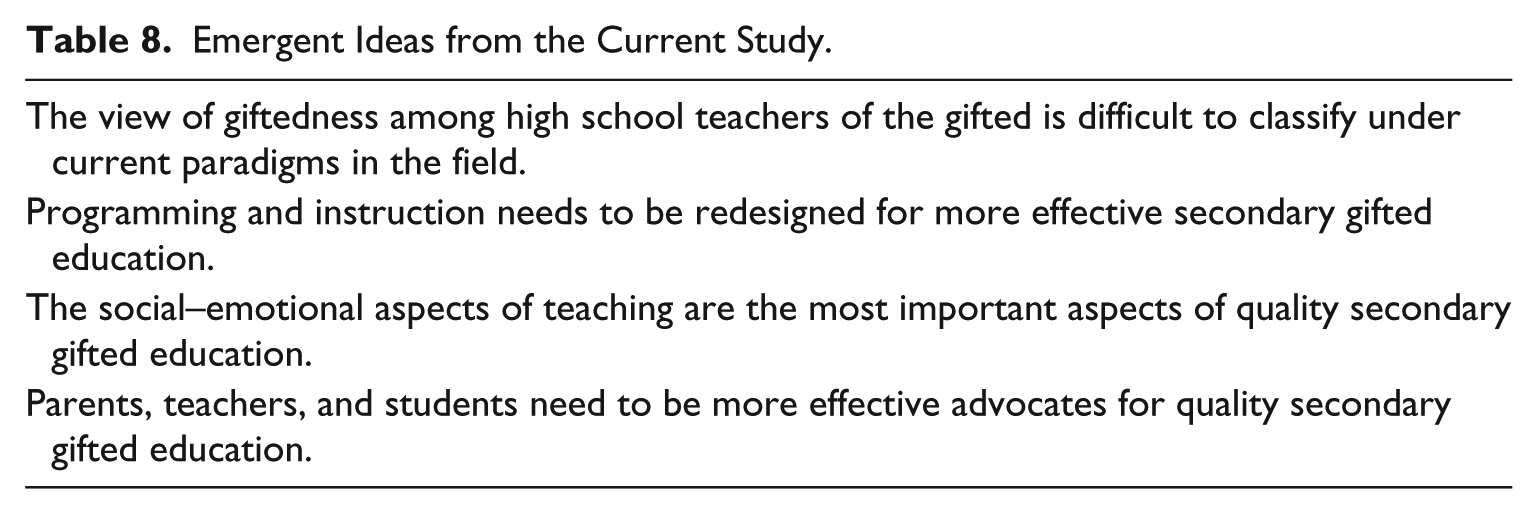
The second theoretical code to emerge from this current study has to do with the current state of programming and instruction. Both Phase 1 and 2 participants expressed frustration with the current state of educational practices for the gifted. Although they differed on what the exact source of those frustrations might be, all of their responses clearly suggested that time was the commodity that they felt they needed more than anything else.
The third theoretical code to emerge from the current study had to do with the social and emotional aspects of teaching gifted learners. Few respondents in either phase of the study reported a struggle with advanced content or classroom management, for example, but many in both phases reported that they felt their work really had to focus on the mentoring and advocacy elements of educating the gifted at the secondary level. Whether that was guiding students to a larger worldview or helping them cope with the unique social and emotional needs often associated with giftedness, many respondents reported that it was those sorts of tasks that occupied more of their time than more traditional classroom tasks.
The fourth theoretical code to emerge was on the nature of advocacy for the needs of gifted learner. Phase 1 participants felt that teachers were the most important advocates, and Phase 2 participants expressed similar feelings. They viewed advocacy as a necessity because the nature of the school system made it difficult for parents and students to advocate for the needs of gifted learners, leaving teachers as the only intermediaries who both understood the nuances of gifted identification, placement, and servicing, and who knew students well enough to help them through it.
Discussion
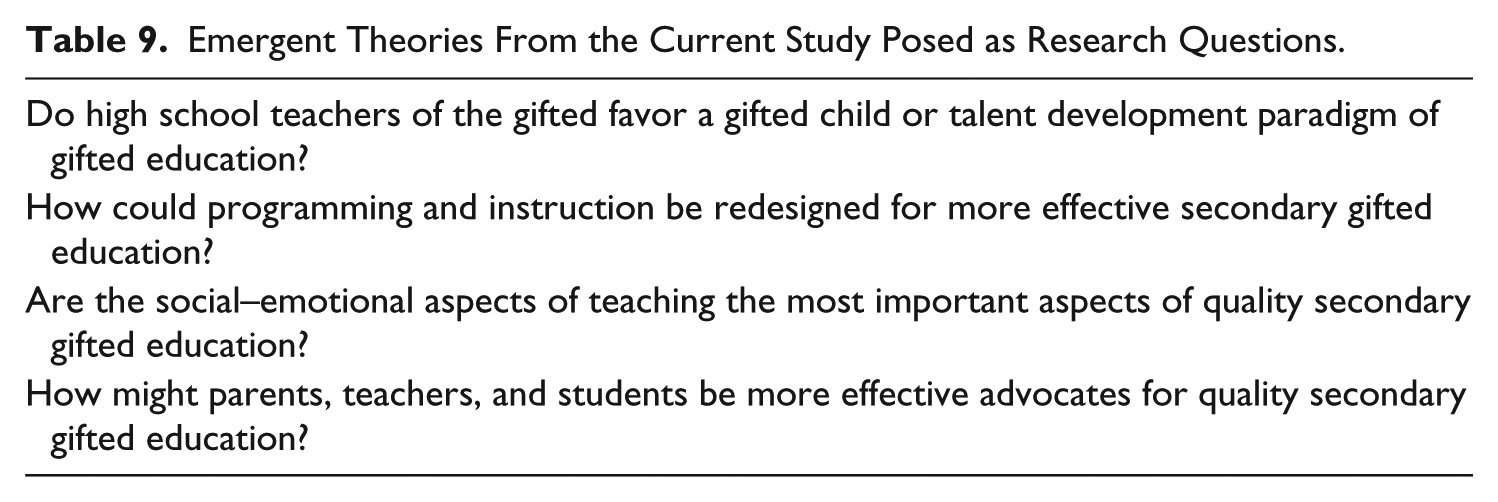
From the perspective of the constructivist approach upon which this study was built, the purpose of grounded theory research is to create a theoretical framework in a situation where there are gaps in the existing knowledge and research, in this case the beliefs about giftedness among high school teachers of the gifted, and from which future research could arise (Charmaz, 2006). This type of research is designed to posit questions for further research. As such, the four theoretical codes identified in this study are presented herein as actionable research questions (Table 9). The following discussion thus provides a context for each question and what factors might need to be accounted for in future research designs that hope to answer those questions.
Emergent Theories From the Current Study Posed as Research Questions.
Paradigm of Gifted Education
Do high school teachers of the gifted favor a gifted child or talent development paradigm of gifted education?
The current study revealed two key factors that may need to be addressed in further research. First, high school teachers’ beliefs about giftedness may align with a gifted paradigm, but simply lack the exposure to research-based writing to express that in the commonly used language of the field. Second, the attitudes about the nature of giftedness may express a practical approach to understanding the construct that is being missed by the current state of research in the field.
On the surface, it may seem shocking that all of participants in the current study seem so unfamiliar with gifted education research and theory. However, the field itself is divided on even the most fundamental aspects of what it means to be gifted. Dai and Chen (2014) identified three major paradigms of giftedness that illustrate a debate in the field over whether giftedness is an inherent quality or something that can be taught or developed. Participants in the current study lacked formal knowledge of that debate. However, when given the chance to explain their thoughts on giftedness, as they were in Phase 2 of the current study, their thinking was far more nuanced than it may appear in cursory surveys or questionnaires.
It might be prudent for the field moving forward to consider the practitioners whose work the research in our field is supposed to support and inform. The preceding literature review, and the very methodology of the current study, are based on the lack of research-based evidence about the perceptions of the people who guide gifted learners through high school and into adulthood. Logic would dictate that their expertise, or perhaps lack thereof, should be of some concern to the larger field of gifted education.
Programming and Instruction
How could programming and instruction be redesigned for more effective secondary gifted education?
A fascinating development between the two phases of the current study was the difference in beliefs about the most difficult aspects of effective gifted education. Phase 1 participants felt that differentiation was the most difficult aspect of gifted instruction, although exactly how they understood the concept of differentiation and what it entailed was somewhat nebulous. However, Phase 2 responses suggest that this is not because of differentiation practices for individualized learning themselves, but because of the struggle to have time either in instruction or planning for many of those practices, such as project- or problem-based learning. All the participants in the current study taught courses tied to AP or IB standards, a common practice in secondary gifted education, and the demands of those programs, along with the requirements to meet the constantly changing and sometimes unclear state standards (Moon et al., 2003) create significant demands on instructional and planning time. This, in turn, makes it difficult for teachers to try new or improved instructional practices that might be more beneficial for their gifted learners.
The current study also identified a consistent frustration with a lack of training offered by the participating district. Participants freely admitted that they were heavily reliant on the district for quality training and information on the implementation of gifted services. Educators’ reliance on district training for the understanding of giftedness (McCoach & Siegle, 2007), gifted practices (Siegle et al., 2010), and even the basics of gifted referral (Schroth & Helfer, 2008) are well documented in the literature. What is noticeably absent are studies that focus on educational leaders and administrators and their knowledge of giftedness. This suggests that future studies may need to focus not only on classroom instructors but also on those who guide gifted programming and what expertise they have and how they effectively pass it on to those at the classroom level.
Social–Emotional Aspects of Giftedness
Are the social and emotional aspects of teaching the most important aspects of quality secondary gifted education?
As the data collection and analysis proceeded, a trend that emerged was the relationship between teacher experience with the gifted and an increased focus on the social–emotional elements of teaching. All participants in the current study felt that they had to move beyond the content requirements of their course to develop their gifted learners as a means of expanding the students’ understanding of themselves and the world in which they live. More experienced participants in the study clearly saw the mentorship and one-on-one bonding elements of teaching as the most vital and important part of quality gifted education. They felt that gifted students needed them more at the secondary level as friends, mentors, and de facto counselors than as deliverers of content. Current research shows the connection between teaching experience and a better understanding of giftedness (Carman, 2011; Geake & Gross, 2008; McCoach & Siegle, 2007; Schroth & Helfer, 2009), but the exact ways in which the role of the teacher of the gifted shifts at the secondary level has yet to be addressed by the field.
Related to this, perhaps, was the question posed to Phase 2 participants in regard to whether gifted people themselves were the best teachers of the gifted. Respondents in the current study focused more on personal connections and mentorship in how they answered. Not all respondents self-identified as gifted, but those who did felt that gifted teachers were the best instructors of gifted learners. They were joined in this belief by those teachers with the most experience with gifted learners, whether gifted themselves or not. The respondents all felt that the most important aspect of gifted education at the secondary level was in the social–emotional aspects of teaching, that gifted high school students needed their teachers as mentors and guides more than as content masters. The participants in the current study felt that it was logical, then, that gifted people would naturally understand those aspects of gifted learners better than their nongifted peers. They were also quick to clarify that being gifted alone was not enough and that like any teacher, gifted people who enter the classroom need training and expertise in vital aspects of the job, such as pedagogical skill and content mastery.
There are currently few studies that deal with the question of whether gifted people make the best teachers of the gifted or not. The current study suggests that future research in this area might be beneficial to the field. It also suggests, however, that any study that deals with such a topic would need to delineate what is meant by better, and in what aspects of the craft, when comparing gifted teachers and their nongifted peers in terms of their effectiveness as classroom instructors of gifted students at the secondary level.
Gifted Advocacy
How might parents, teachers, and students be more effective advocates for quality secondary gifted education?
The role of the teacher as advocate for the needs of the gifted also varied in its specificity between Phase 1 and Phase 2. Respondents on the Phase 1 instrument felt that teachers were the best advocates for gifted students. Participant in the Phase 2 analysis saw their role in it as perhaps a necessary evil in place of more ideal solutions that involved students and parents more fully. The teachers in the study felt that parents of the gifted sometimes lack the ability or understanding to effectively advocate for the needs of gifted learners, either because they do not understand their own child’s giftedness and its manifestations or because they do not understand how to navigate the school system in terms of things such as gifted identification and placement for services. This feeling is supported by current research that suggests this inability to advocate is especially true for English language learners (Harris et al., 2009), twice-exceptional learners (Rizza & Morrison, 2002; Schultz, 2012), female gifted learners (Bianco et al., 2011), and gifted minority students (Hargrove & Seay, 2011).
Participants suggested a possible solution to that problem would be for the school system to assume the responsibility of training students who are gifted or who show gifted potential and their parents on how to effectively work within the school system in terms of gifted advocacy. Further research would be required on the effectiveness or feasibility of such a suggestion. Before it became the basis for more widespread programming and spending decisions within the gifted education system at the secondary level, studies would need to demonstrate what result such a practice might yield for the benefit of gifted learners.
Limitations and Future Directions
Grounded theory is well suited for studies that address gaps in existing research literature. It was chosen as a methodology for the current study because there is a gap associated with high school teachers’ perceptions of giftedness and gifted education. Addressing this gap is not without limitations.
An obvious limitation for a study of this nature is that created by the dearth of research regarding the perceptions of giftedness among high school teachers of the gifted. In addition, a study of this type has a relatively small number of respondents due to the time-consuming nature of the data collection design and the fact that school systems simply do not employ a large population of teachers specialized in the education of the gifted, even large suburban ones such as the current study’s participating district. A small population could also create a situation where there is a commonality in many responses because the participants may very well have known each other and shared their ideas on the subject matter addressed herein or attended many of the same trainings in the participating district. This small population could also potentially create a situation where some of the respondents to the Phase 1 instrument are the same as those in the Phase 2 instrument and the demands of participant anonymity and confidentiality would make that impossible to know.
As such, the results of the current study should be understood as a starting point. Grounded theory is an inductive approach to research design intended to empirically identify emergent theories that can then be tested with other designs. The framework suggested by the current study and the questions derived from it should be viewed as the recommendations for further research that they are intended to be.
Footnotes
Appendix A
Appendix B
Declaration of Conflicting Interests
The author declared no potential conflicts of interest with respect to the research, authorship, and/or publication of this article.
Funding
The author received no financial support for the research, authorship, and/or publication of this article.
