




Abstract
By matching International Baccalaureate (IB) and non-IB U.S. public schools based on state, grade span, and enrollment, we used recent public data to confirm relations among a hierarchy of school characteristics and whether schools made available any of IB’s four programs. We fortified prior claims regarding how poverty, minority concentration, and geographic locale as a function of proximity to cities relate to IB availability, a proxy for opportunity to learn international-mindedness. Our proximity approach to data from public schools and a descriptive look at data from private schools highlighted the unique importance of proximity to cities in identifying where IB opportunities do and do not exist. We conclude by specifying recommendations for decision-makers who might need resources to make IB implementation viable or to win local hearts and minds before doing so.
Keywords
International Baccalaureate (IB) offers four educational programs that can confer several benefits to its participating students ages 3 to 19 (Bunnell, 2010a; Gardner-McTaggart, 2016; Tarc, 2009). Such benefits can include boosting one’s postsecondary success (Coca et al., 2012; Saavedra, 2014) and deepening one’s international-mindedness (Medwell et al., 2017), which incorporates aspects such as multilingualism, intercultural understanding, and global engagement (Castro et al., 2015). However, international-mindedness garners far less attention in IB research than postsecondary success, likely because the latter might be a more direct conduit to enhancing students’ applications to prestigious universities and later for desirable professions (Sriprakash et al., 2014; Stevenson et al., 2017). Consequently, IB research has focused typically on its upper secondary-school options, specifically the Diploma and Career-Related Programs, which serve students in U.S. Grades 11 and 12 and the equivalents of those grades in nearly 160 countries. Meanwhile, international-mindedness, the concept that unites all four IB programs, including the Primary Years (pre-K through 5) and Middle Years Programs (6–10), is most often a footnote (Hacking et al., 2017).
This study examines all four programs in IB’s continuum explicitly to detect the availability of education for international-mindedness. Studying IB’s continuum rather than focusing narrowly on its best-known Diploma Program—which some secondary schools adopt to help students acquire college-readiness and demonstrate it on exams that can bear credits for transfer to higher-education institutions, like Advanced Placement (AP)—represents a departure from much prior IB research. Exploring the full IB continuum offers an opportunity to challenge imprecise and common narratives in which researchers and policymakers alike invoke “IB” and AP interchangeably (e.g., Achieve and Jobs for the Future, 2015; Iatarola et al., 2011).
Relative rarity of IB’s four programs is a major reason for limited understanding of what distinguishes them from AP (see below). In the United States as of September 2020, less than 2% of elementary or secondary schools had completed IB’s multi-year application and verification process to become authorized implementers of any of its programs (Common Core of Data; International Baccalaureate, 2020). With IB programs existing in so small a subset of schools, this study arose from a recognition that these programs, approximating an opportunity to learn international-mindedness (Hacking et al., 2018), might be available in certain communities and not others in ways that potentially associate with school characteristics. Our review of the few previous studies that associated school characteristics and IB Diploma Program availability (e.g., Provasnik et al., 2007) and/or student access within the rare schools that make it available (e.g., Perna et al., 2013) formed the basis for our inquiry across IB’s continuum.
Importantly, IB research on availability and access (Donaldson, 2017; Perna et al., 2013; Provasnik et al., 2007; Thier, 2015) has relied upon data prior to a push from the early 2000s toward “IB for All” in U.S. public schools (Padula, 2017). That push was intended to shift the landscape of program availability and uproot IB’s elite reputation of catering to affluent and/or intellectually advanced students (Bunnell, 2008; Doherty et al., 2012; Kyburg et al., 2007). Data employed for most studies of IB availability preceded Bunnell’s (2010b) description of U.S. IB growth as “exponential” (p. 66), a claim itself that occurred before a 39.3% increase in U.S. IB schools from 2012 to 2017. 1 Therefore, this study afforded opportunities to (a) consolidate prior research on school characteristics and availability of Diploma Programs; (b) examine such characteristics with more recent data across the IB continuum, in the process enabling an emphatic shift to the core concept of education for international-mindedness; and (c) study equitable access overall. Thus, this study illuminates characteristics of schools that do and do not make education for international-mindedness available through IB’s four-program continuum. Next, we further explore the importance of studying the entire IB continuum when examining opportunity to learn international-mindedness and address school characteristics, such as proximity to cities, which have shown salience in prior research of IB availability.
IB and the Opportunity to Learn International-Mindedness
IB has been characterized as an opportunity for students, educators, and whole school communities to learn international-mindedness (Hacking et al., 2018). Importantly, the very notion of “opportunity to learn”—a term that has broadened profoundly in meaning from the 1960s when counting instructional seat time was the normal definition (McDonnell, 1995)—is now considered essential for educational equity. Current, holistic opportunity-to-learn definitions incorporate curriculum (Elliott & Bartlett, 2016) and school-provided learning engagements (Brown et al., 2009; Herman et al., 2000), such as advanced academic coursework (Moller et al., 2013). If schools creating the conditions for students’ advanced course-taking is considered a leverageable factor in attempts to reduce inequities (see Achieve and Jobs for the Future, 2015; National Academies of Sciences, Engineering, and Medicine, 2019), the logic of focusing IB opportunity-to-learn research on the Diploma Program and its postsecondary benefits is certainly understandable. Unfortunately, doing so can have the unintended effect of sidelining international-mindedness as an essential learning opportunity (Hill, 2012; Lai et al., 2014).
Considerable amounts of research—most of which IB commissioned—links IB’s secondary-school programs to postsecondary success. For example, Diploma Program alumni in the United States enrolled in higher education immediately after Grade 12 more regularly than non-Diploma Program peers (Bergeron, 2015). Matched demographically with non-Diploma Program peers in the same U.S. district, Diploma Program alumni exceeded higher-education enrollment rates overall and at institutions with higher admissions standards (Coca et al., 2012; Saavedra, 2014). Upon entering higher education, Diploma Program alumni posted higher grade-point averages than their non-Diploma Program peers at flagship universities in California (Shah et al., 2010) and Virginia (Inkelas et al., 2013), even after accounting for student characteristics. Moreover, IB alumni of the Diploma and Career-Related Programs persisted at 2-year (Caspary et al., 2015; Mack et al., 2018) and 4-year institutions (Bergeron, 2015; Caspary et al., 2015; Conley et al., 2014) at rates as much as 20% above national averages. Regardless of whether Diploma Program alumni earned the IB diploma or not, 80% of them completed university degrees on time, surpassing national rates by 24% to 27% (Bergeron, 2015; Caspary, 2011), even controlling for socioeconomic status (Caspary et al., 2015; Shah et al., 2010).
Understandably, these findings would draw considerable interest for research and policy. But studying IB solely for its postsecondary benefits effectively ignores the central role that international-mindedness is meant to play (Singh & Qi, 2013). Consequently, unnuanced characterizations have infiltrated IB research, in part due to an implicit assumption that the College Board’s AP option and the IB’s Diploma Program are substitutional (e.g., Hertberg-Davis & Callahan, 2008; Iatarola et al., 2011; Kyburg et al., 2007; Provasnik et al., 2007). Given its far larger footprint, AP is more familiar to many U.S. education researchers than IB (Donaldson, 2017), likely foisting attention toward the particular IB program that is the most similar, but not identical, to AP.
Both secondary-school, university-level coursework programs are characterized as “gold standard” options (Byrd, 2007) to address A Nation at Risk’s (Gardner et al., 1983) call for graduates who are “marketable and competitive in an increasingly international and information-minded workforce” (Donaldson, 2017, pp. 1, 46). Still, noticeable AP-Diploma Program differences contribute to this study’s frame. For instance, AP high schools typically offer discipline-specific courses that students can select “cafeteria-style” (Shaunessy-Dedrick et al., 2015, p. 111). Thus, AP students can choose courses narrowly to meet their interests or aptitudes. Instead, the entire IB continuum places palpable emphasis on interdisciplinarity and holistic development (Hayden & McIntosh, 2018). So, while IB offers flexibility for authorized Diploma Program schools to offer individual Diploma Program classes to students, IB strongly encourages that students take its university-level courses in all six disciplinary areas. Moreover, full Diploma candidacy also entails completion of components that underscore international-mindedness: IB’s signature Theory of Knowledge course and Creativity, Action, Service (Metli et al., 2019; Sriprakash et al., 2014).
Ultimately, studies that conjoin AP and the Diploma Program for their “structural equivalence” fail to capture the latter’s “unique” contribution among advanced academic coursework (Donaldson, 2017, pp. 18, 72). Given that international-mindedness is positioned as the unique feature that distinguishes IB from other education models (Hacking et al., 2017), an IB inquiry that spans the PreK to 12 school spectrum to capture opportunity to learn international-mindedness seems warranted. Furthermore, treating the Diploma Program as indicative of IB education seems particularly non-representative in the United States, where the Diploma Program imprint (50.74% of U.S. IB schools offer the Diploma Program) 2 is lighter than in the 157 other nations with IB schools (67.79%). Thus, a more inclusive research plan seems especially useful in the United States when compared to the rest of the IB-offering world.
IB’s history further explains the Diploma Program’s outsized influence on research. The Diploma Program began in 1968, long before the IB established its Primary Years (1994), Middle Years (1997), or Career-Related Programs (2012). Creating IB education for elementary and lower secondary schools effectively decoupled opportunities to learn international-mindedness from the Diploma Program, with the academic rigor that typifies it (Hill, 2012). Perna et al. (2013) recognized that the totals of Primary and Middle Years Programs in U.S. public schools had achieved near-parity with the Diploma Programs by 2011, but still restricted their inquiry to IB’s better-known program and its anticipated postsecondary benefits.
The proliferation of IB’s newer programs align both with efforts to educate a wider distribution of students for international-mindedness (Hill, 2012; Padula, 2017) and demand for research designs that would enable studies of its continuum. For all four programs, IB evaluates the extent to which schools develop curricular expectations (Hacking et al., 2017; Medwell et al., 2017), enact pedagogy (Saavedra, 2014), and endorse commitments among teachers and students (Bergeron & Dean, 2013; Hacking et al., 2017) that yield opportunities to learn international-mindedness (Gardner-McTaggart, 2016). Program-specific or curriculum-focused studies connect IB participation to international-mindedness, highlighting student outcomes such as:
Civic mindedness and citizenship (Faas & Friesenhahn, 2014; Saavedra, 2014).
Interconnectedness (Wade & Wolanin, 2013).
Intercultural understanding; awareness of diversity, human rights, sustainability, and conflict resolution (Beckwitt et al., 2015; Sizmur & Cunningham, 2012).
Perspective-taking and empathic concern (Stevenson et al., 2016).
Social justice orientation (Saavedra, 2014; Sizmur & Cunningham, 2012).
Also at issue in this study, school characteristics—poverty, minority concentration, and proximity to cities—have shown potential to associate with how prone a school might be to bringing opportunities to learn international-mindedness into its community.
Associating Schools Characteristics with IB Availability
The few studies of IB availability have identified relevant characteristics such as a school’s level of poverty (i.e., proportion of enrolled students who are eligible for free or reduced-price meals; Donaldson, 2017; Thier, 2015) or minority concentration (i.e., proportion of enrolled students of color; Donaldson, 2017; Perna et al., 2013; Thier, 2015), and its geographic locale (Donaldson, 2017; Provasnik et al., 2007; Thier, 2015). Curiously, the latter seems to be the most troublesome of these variables. Donaldson (2017) also highlighted a gross under-interrogation of the Diploma Programs within U.S. private schools. We found no prior studies of IB availability in U.S. private schools for any of the four programs.
Poverty and Minority Concentration
Using 14 years of longitudinal data in Florida starting from 1995, Perna et al. (2013) descriptively showed increases in high-poverty schools offering the Diploma Program and percentages of Latinx students among schools offering the Diploma Program. However, that study did not disentangle those trends from national upticks in poverty during the 2007 to 2008 economic downturn and overall growth in the U.S. Latinx population in recent decades. In the Perna et al. study, percentages of black students among schools offering the Diploma Program remained flat. Applying similar methods to those described below—also matching U.S. public IB and non-IB schools across the IB continuum—but using academic year 2012 to 2013 data that preceded recent surges in IB adoption across the nation, Thier (2015) found no relation between school-level poverty and IB availability and that schools with higher minority concentration were more likely to offer IB programs than less diverse schools. In the most recent Diploma Program-exclusive, opportunity-to-learn study, Donaldson (2017) demonstrated district-level socioeconomic status to associate with its likelihood of having one or more schools that offered the Diploma Program. Donaldson also associated school characteristics (e.g., a Diploma Program’s ethno-racial representativeness of its school’s student population; whether under desegregation order) with student-level access to the Diploma Program at their local school but did not specifically analyze school-level IB availability.
Proximity to Cities and Problems with Operationalizing Geographic Locale
Multiple studies have reported limited IB availability for schools in towns and rural areas when compared to schools in cities and suburbs, both regarding the Diploma Program (Donaldson, 2017; Provasnik et al., 2007) and IB’s four-program continuum (Thier, 2015). However, these studies have parsed schools in ways that geographic locale researchers critique (e.g., Greenough & Nelson, 2015; Puryear & Kettler, 2017; Thier & Beach, 2019; Thier et al., 2020). For example, Donaldson (2017) and Provasnik et al. (2007) studied IB availability using the National Center for Educational Statistics’ Metro-Centric locale codes (previously replaced in 2006 with the more precise Urban-Centric codes) to dichotomize cities/suburbs from towns/rural areas. As geographic locale scholars often caution against using simplistic rural–urban dichotomies (e.g., Corbett, 2015; Reich et al., 2014; Roberts & Green, 2013), Thier (2015) used the Urban-Centric codes to disentangle cities, suburbs, towns, and rural areas. However, Thier failed to account for ways that schools in suburbs (Urban-Centric codes 21, 22, and 23) resemble schools both in towns and rural areas at the fringes of suburbs (31 and 41, respectively), against which Greenough and Nelson (2015) caution.
Consequently, this study’s method describes an approach to geographic locale that is designed to more precisely associate educational opportunities and proximity to cities. Ultimately, a more precise operationalization of proximity to cities allows a study to extricate findings that depend on rurality from those that depend on remoteness, ideas that are overlapping but not transposable, rather than blunt dichotomies (Thier et al., 2020). Meanwhile, IB’s mission—to develop inquiring, knowledgeable, and caring young people who help to create a better and more peaceful world—might stir more controversy in some U.S. locales than others (Andrzejewski & Alessio, 1999; Beltramo & Duncheon, 2013; Reysen & Katzarska-Miller, 2018). As cities tend to cluster people who share cosmopolitan views, synching with constructs such as international-mindedness (Appiah, 2006; Sevincer et al., 2017), proximity to cities might be especially salient for an examination of the availability of any of the four IB programs as an indication of the opportunity to learn international-mindedness.
Therefore, this study capitalized on recent U.S. data for public and private schools to examine the IB continuum, not a single program, focusing on the opportunity to learn international-mindedness and addressing three questions meant to confirm prior research:
Method
To address RQs 1 and 2, we analyzed data that we merged manually from IB’s online list of schools and the National Center for Education Statistics’ Common Core of Data, academic year 2017–2018, for U.S. public schools across the K-12 span using non-random matching (Shadish et al., 2002). We matched U.S. public schools that did and did not offer one or more IB program (n = 1,562 each) by state, grade span, and enrollment. Matching those public-school data allowed us to logistically regress a hierarchy of school characteristics (poverty, minority concentration, and proximity to cities) onto a dichotomous criterion of whether a school made available any of IB’s four programs, aiming to confirm—across the IB continuum and in more recent data—the likelihood of relations between IB availability and those school characteristics. That procedure was infeasible for our sample of U.S. private schools with IB programs (n = 141) due to data limitations, so we addressed RQ3 descriptively, exploring distributional effects only for proximity to cities for those schools in comparison to national private-school data. Next, we have detailed our study’s variables and management of data from two publicly available sources, including procedures for matching and excluding cases, as well as analyses per question.
Variables
Making between-school comparisons, we examined associations of a dichotomous criterion (IB availability) and two continuous school characteristics (poverty and minority concentration) with one categorical school characteristic (proximity to cities). Missingness for any variable never exceeded 3.17%, so we did not impute values. In Table 1, we have shown each of the school characteristics of interest for (a) our analytical sample of IB schools, (b) matched non-IB schools, and (c) all U.S. public schools, displaying how the variables of interest for this study suggest appropriate results from the matching procedures that we describe below.
Corresponding Demographics of IB and Matching Non-IB Schools to National Data.
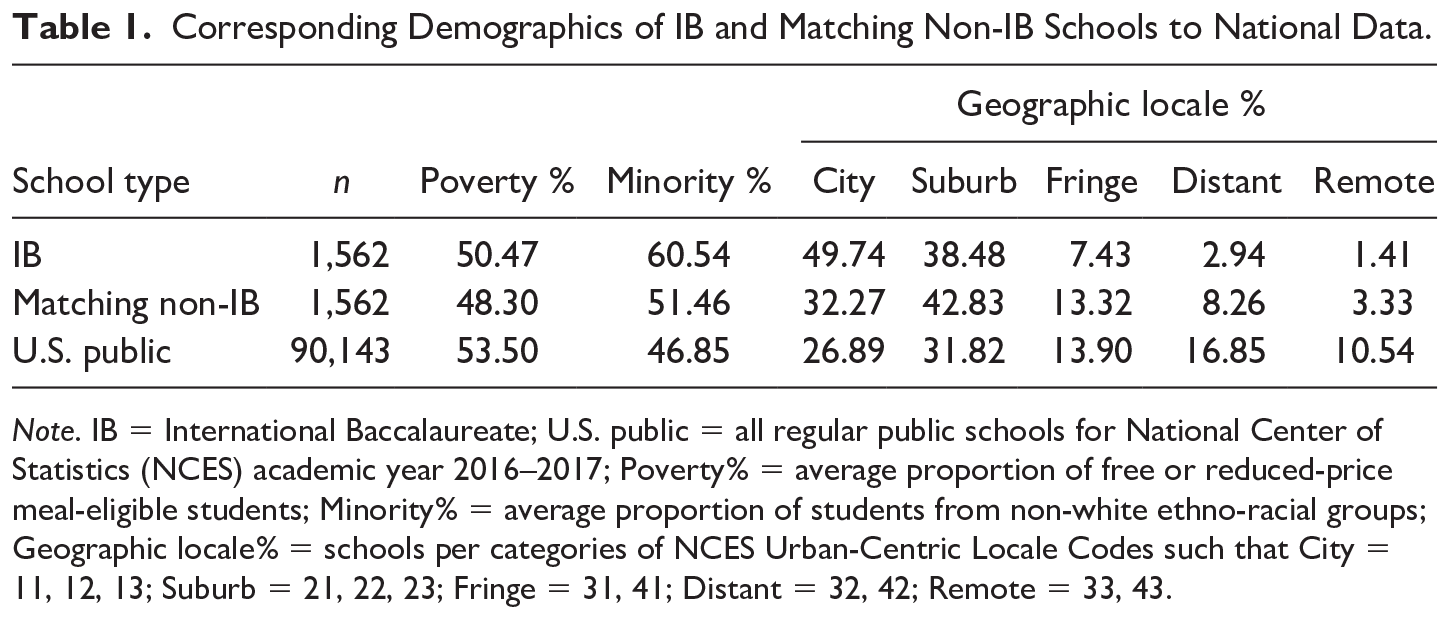
Note. IB = International Baccalaureate; U.S. public = all regular public schools for National Center of Statistics (NCES) academic year 2016–2017; Poverty% = average proportion of free or reduced-price meal-eligible students; Minority% = average proportion of students from non-white ethno-racial groups; Geographic locale%= schools per categories of NCES Urban-Centric Locale Codes such that City = 11, 12, 13; Suburb = 21, 22, 23; Fringe = 31, 41; Distant = 32, 42; Remote = 33, 43.
Poverty and minority concentration
To approximate poverty, we used each school’s proportion of students eligible for free or reduced-price meals. Absent a better alternative, this imperfect poverty indicator (Harwell & LeBeau, 2010) enabled alignment between this study and related inquiries (Donaldson, 2017; Perna et al., 2013; Thier, 2015). Minority concentration reflected each school’s proportion of students from non-white ethno-racial groups. Some previous IB opportunity-to-learn studies explored implications only for students who identify as African American and Latinx (e.g., Perna et al., 2013), but more recent studies have included students of American Indian/Alaska Native, Asian, Native Hawaiian/Pacific Islander, or mixed ethno-racial backgrounds as federal data tracking improved (e.g., Donaldson, 2017).
Proximity to cities
An important methodological difference between this study and previous IB opportunity-to-learn inquiries is our employment of the proximity approach for which we recategorized the Urban-Centric locale codes’ 12 levels into a five-level ordinal variable: cities, suburbs, as well as fringe, distant, and remote town and rural areas (Thier et al., 2020). Previous approaches treated geographic locale as a nominal, rather than an ordinal, variable (Provasnik et al., 2007; Thier, 2015). Using the proximity approach, we specified cities as the reference (i.e., omitted) group. The proximity approach 4 aligns with recent education research that recognizes important distinctions between town/rural fringes of cities and suburbs rather than towns/rural areas that are more distant or remote from cities (Greenough & Nelson, 2015; Puryear & Kettler, 2017; Thier et al., 2020). Assuming concentric rings around cities, this approach increasingly differentiates peripheries, capturing proximity from cities: “the dominant form of class segregation” (Wei & Knox, 2015, p. 52) to recognize the authority and privileged definitions of success stemming from centrally located places (Shils, 1961; Tyack, 1974). In Table 2, we disaggregated data for all other variables of interest by geographic locale.
Public Schools’ (N = 3,124) Variables of Interest per Geographic Locale.

Note. SD in parentheses. IB = International Baccalaureate.
Managing Data Sources
With no single data set enabling analyses of IB availability (Donaldson, 2017; Thier, 2015), we merged two public sources. In July 2018, we found on IB’s website 1,657 public and 191 private schools in the United States that offered at least one IB program. IB’s online list provided contact information and the programs its schools offered, but no data regarding our school characteristics of interest: poverty, minority concentration, or proximity to cities. Thus, we matched school names and addresses from IB’s online list to the Common Core of Data, academic year 2017–2018. IB authorizes its schools on a rolling basis, so the 2017–2018 data allowed us to analyze availability after a recent crest in U.S. schools adopting IB programs. The data sets shared no unique school identifiers, requiring us to match schools manually.
Matching procedures
We matched each U.S. public IB school in our sample to a U.S. public non-IB school, seeking to avoid confounding variability in our estimations. An exceedingly low base rate of IB-available schools placed us in a common circumstance for users of matching designs: how to best identify a sufficient amount of “good” matches (Stuart, 2007). Several options exist for matching comparison cases with treatment cases in education research, but the relatively small proportion of IB schools in the United States (i.e., <2% of all public schools) prompted us to use a nearest neighbor 1:1 match. That choice avoided computational and interpretive challenges that can come from highly unbalanced designs, which would have been likely had we matched each IB school against multiple comparison schools (Hallberg et al., 2018; Keppel & Wickens, 2004). That choice did not, meanwhile, thwart our identification of comparisons that best approximated our data set’s schools, which opted to offer IB (Hallberg et al., 2018; Jacob et al., 2016). We expected observable factors, not randomness, to associate with whether a school adopted an IB program, so our matching approach adhered to logic from research on IB access that advocates for controlling the type of self-selection that can plagues IB studies (May et al., 2014). Moreover, we aimed to facilitate associative rather than causal claims, so we deemed a nearest neighbor 1:1 match to be appropriate, recognizing a greater likelihood of identifying plausible comparison schools than selecting ideal matches (Hallberg et al., 2018; Stuart, 2007).
Adapting procedures from Thier (2015), we matched schools (a) within states in recognition of different jurisdictional policy contexts that variously incentivize or restrict IB adoption (as Klugman (2013) argues for AP availability); (b) by grade span to account for localities’ various priorities in adopting fee-intensive 5 educational models across elementary and secondary sectors; and (c) by enrollment because we expect schools with more students to offer more programmatic variety. We coded each of 1,562 U.S. public IB schools as 1 = IB available and its matched U.S. public non-IB school as 0, doubling our analytical sample (n = 3,124). Private schools’ idiosyncratic natures (e.g., religious/secular; boarding/day; and for-profit/non-profit) rendered invalid any pursuit to match schools by structural variables such as state or grade span like we did for public schools.
Per state, we sorted all relevant public schools in the Common Core of Data by grade span and enrollment, retaining only schools with grade spans that corresponded to that state’s IB public-school sample. This order of operations enabled us to employ enrollment (a school-size proxy) as a critical matching variable, allowing us to account explicitly for an aspect of rurality/remoteness in other studies (e.g., Kettler et al., 2016), which the proximity approach does not address directly (Thier et al., 2020). When multiple non-IB schools tied for the nearest matching number of enrolled students (i.e., identical or equal differences above and below IB school’s enrollees), we used a random number generator (Haahr, 2020). We required randomly generated matches for 292 of 1,562 schools (18.69%).
Exclusions
We excluded 95 public IB schools, 82 of which we could not match across data sources, a limitation reported in previous IB availability studies (Donaldson, 2017; Thier, 2015). We also excluded 13 public IB schools in the District of Columbia (DC) because the jurisdiction’s near-exclusive large-city designation would have artificially inflated any observed effects of proximity to cities. Thus, our U.S. public IB sample included n = 1,562 schools (94.27% of the population at the time of data harvesting) in the 46 states where IB had a presence during the timeframe under analysis (none in the Dakotas; private only in Vermont and Rhode Island). We applied similar exclusion rules to three private schools in DC and 47 schools in other jurisdictions that did not match across data sources, yielding n = 141 (73.82% of the population).
Analyses
To address RQs 1 and 2, we conducted hierarchical logistic regression in SPSS version 25 (IBM Corp., 2017), regressing three school characteristics onto a dichotomous criterion (Pampel, 2000). We entered our continuous variables sequentially (poverty before minority concentration) and then proximity to cities, allowing us to analyze what each variable’s main effect contributed to the logged odds of IB availability (Field, 2013; Pampel, 2000), while focusing on proximity to cities when accounting first for the continuous school characteristics. As a fourth block, we examined all possible two-way interactions among the school characteristics, intending to examine three-way interactions as a fifth block if significance patterns had dictated we do so.
Seeking the strongest possible evidence of confirmation for the importance of our school characteristics of interest, we compared models by four fit statistics: χ2 differences; correct classification percentage; Nagelkerke’s R2 (a pseudo-R2); and −2 log likelihood. Due to a naturalistic, unbalanced design (see Table 2), we set α = .05, but our relatively large sample led us to counteract that liberal significance level by computing Bayesian information criteria (BIC) per effect, which also aided interpretability (Pampel, 2000). Following Field (2013), we substituted Wald values for z2 when calculating BIC, as in Equation 1.

We turned exponentiated betas into odds ratios to ease interpretation (Equation 2; Pampel, 2000).

Applying the natural log for our sample (8.05) to all main and interaction effects, we followed evaluation rules to distinguish BIC based on evidence of association when interpreting non-normally distributed data, as with the kinds of sigmoidal curves that logistic regressions produce (Pampel, 2000; Raftery, 1999).
To address RQ3, we used the proximity approach again, this time comparing geographic distributions of U.S. private IB schools to the National Center for Education Statistics’ corresponding estimates among all private schools.
Results
In this section, we have shown results per school characteristic and presented models in tabular form to reveal main effects, interaction effects, and BIC per model based on public IB school data, before examining private IB schools’ data descriptively.
Poverty and Minority Concentration
Across logistic regression models, relations between poverty and IB availability were the most complex of any school characteristic under analysis. On its own in Model 1, poverty associated with improved odds of IB availability (see Table 3). For each SD increase of school-level poverty, which would require about 26% more students becoming eligible for free or reduced-price meals, schools had 31% better odds of offering IB, suggesting that schools with more poverty were more likely to make IB programs available. But when minority concentration entered in Model 2, poverty’s relation to IB availability changed direction. Poverty’s effect became negative, indicating that minority concentration suppressed an otherwise positive relation. When controlling for minority concentration, poverty associated with 63% worse odds of IB availability, suggesting poverty to be a marker of restricted IB availability only among highly diverse schools, not contributing to restricted IB availability on its own.
Effects of Poverty, Minority Concentration, Proximity to Cities, and International Baccalaureate Availability (n = 3,124 Schools).
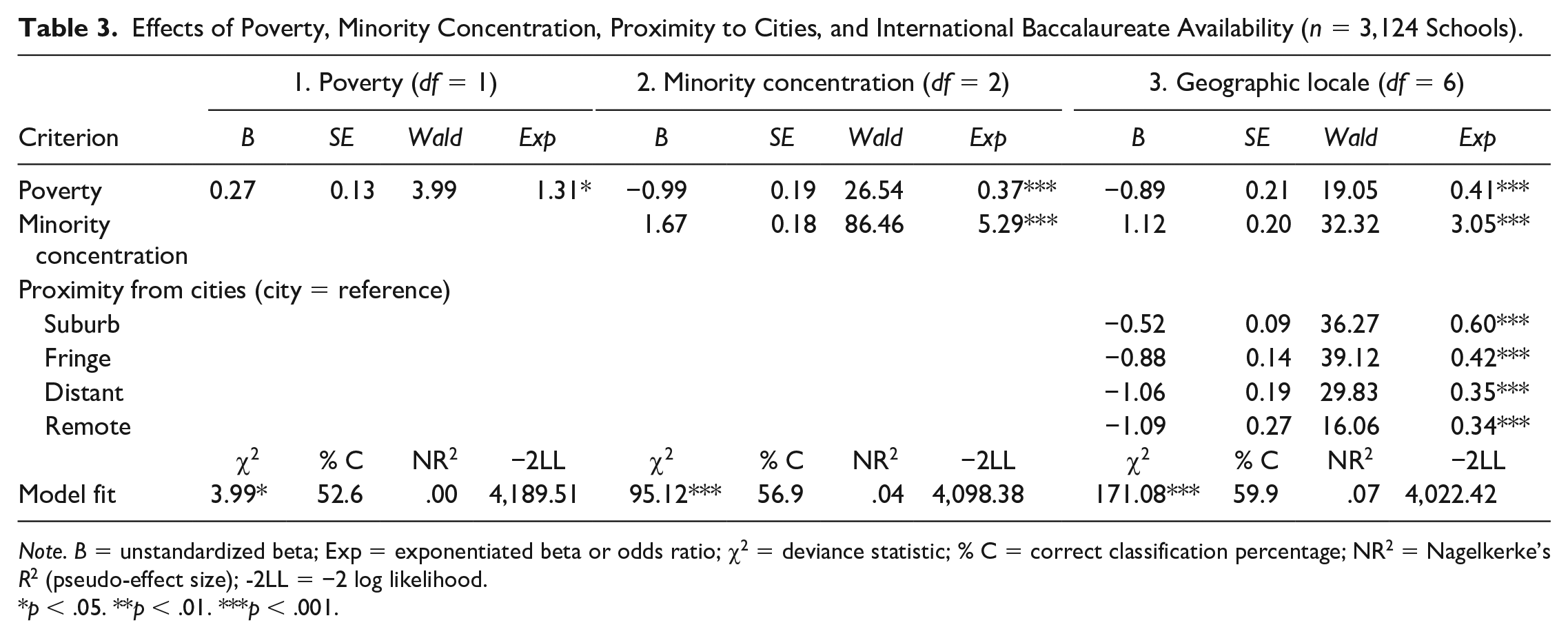
Note. B = unstandardized beta; Exp = exponentiated beta or odds ratio; χ2 = deviance statistic; % C = correct classification percentage; NR2 = Nagelkerke’s R2 (pseudo-effect size); -2LL = −2 log likelihood.
p < .05. **p < .01. ***p < .001.
When controlling for both minority concentration and proximity to cities in Model 3, poverty was still suppressed, but by a slightly smaller magnitude. Each SD increase of poverty associated with a school having 59% lower odds of IB availability. However, when modeling for potential moderators among school characteristics, there were no statistically significant interactions between poverty and minority concentration or between poverty and any of the geographical locales, except for the most remote schools (see Table 4). In concert, this pattern of main and interaction effects suggests that IB availability did not depend on whether a school had a high degree of poverty, but rather how diverse that high-poverty school was or if that high-poverty school was very far from a city.
Two-Way Interactions of International Baccalaureate Availability (n = 3,124 Schools).
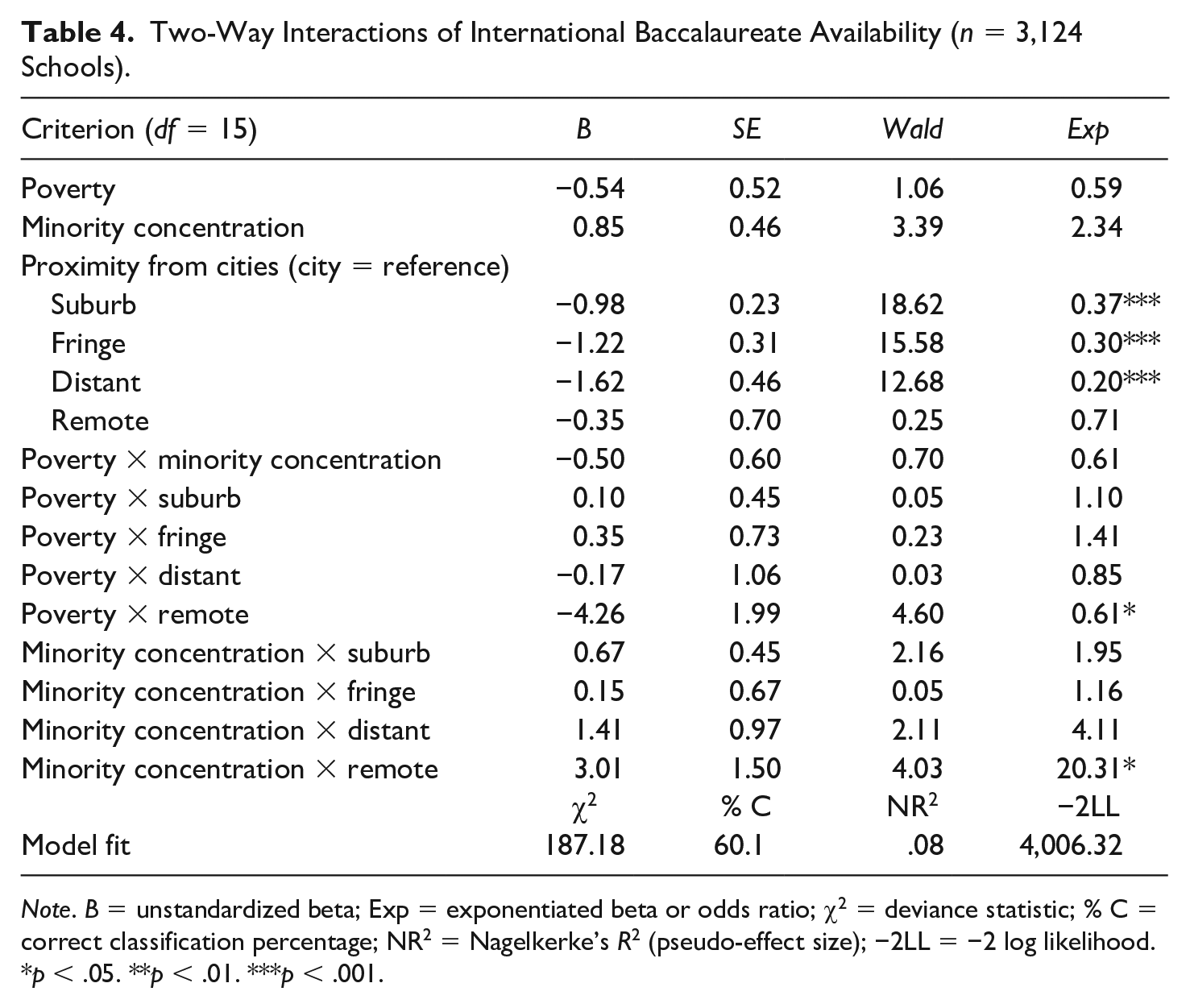
Note. B = unstandardized beta; Exp = exponentiated beta or odds ratio; χ2 = deviance statistic; % C = correct classification percentage; NR2 = Nagelkerke’s R2 (pseudo-effect size); −2LL = −2 log likelihood.
p < .05. **p < .01. ***p < .001.
Our main-effects models showed minority concentration’s importance. Entering minority concentration into Model 2 associated with dramatically increased odds of IB availability. For each SD increase of minority concentration, which would require a 28% increase in a school’s proportion of students of color, a school had a 429% better chance of offering IB. Adding minority concentration also improved all four fit indices. When geographic locale categories entered in Model 3, minority concentration remained a relatively strong association: a 205% increase in odds of IB availability. In Model 4, however, minority concentration did not significantly interact with any variable except for the most remote schools. Taken together, this pattern of results shows the strong relation between school-level diversity and IB availability, one that was robust to most variations in school proximity to cities. Also, the BIC (see Table 5) revealed the strength of association for minority concentration on IB availability on its own and on poverty, which produced a “very strong” effect only when other variables, such as minority concentration and proximity to cities, were present.
Validating the Strength of Association for Minority Concentration and Proximity to Cities.
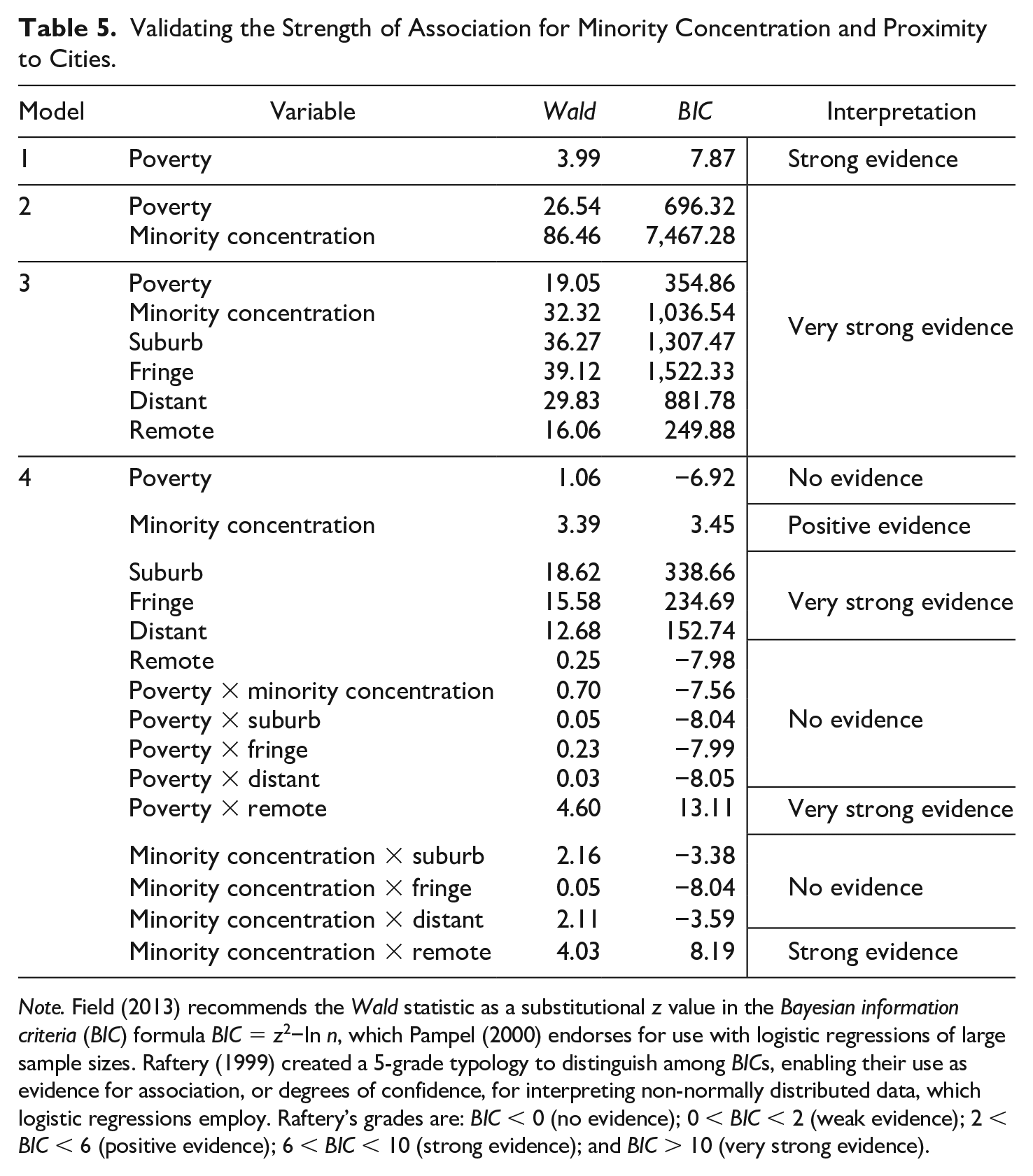
Note. Field (2013) recommends the Wald statistic as a substitutional z value in the Bayesian information criteria (BIC) formula BIC = z2−ln n, which Pampel (2000) endorses for use with logistic regressions of large sample sizes. Raftery (1999) created a 5-grade typology to distinguish among BICs, enabling their use as evidence for association, or degrees of confidence, for interpreting non-normally distributed data, which logistic regressions employ. Raftery’s grades are: BIC < 0 (no evidence); 0 < BIC < 2 (weak evidence); 2 < BIC < 6 (positive evidence); 6 < BIC < 10 (strong evidence); and BIC > 10 (very strong evidence).
Proximity to Cities for U.S. Public and Private Schools
The proximity approach did show schools’ odds of IB availability to decline in linear fashion from cities outward. Controlling for poverty and minority concentration, schools in suburbs were 40% less likely to make IB available than schools in cities. IB availability looked even more grim at fringes (58% less than cities) or in distant and remote areas (65% and 66% less, respectively). According to these findings, cities held an advantage over suburbs, an advantage that increased as proximity from cities increased. All four fit indices improved once the four geographic locale levels entered the model as a block. But relative differences between the first two main-effects models (i.e., by adding minority concentration) were slightly stronger than when adding geographic locale levels in Model 3: χ2 (+91.13 vs +75.96), correct classification (+4.3% vs +3.0%), Nagelkerke’s R2 (+.04 vs +.03), and −2 log likelihood (−91.13 vs −75.96). Wald differences for poverty, the only variable in all main-effects models, also showed minority concentration as slightly more influential (+22.55: Model 1 to 2), though in a positive direction, than the negative effect of proximity to cities (+15.06: Model 2 to 3).
When examining patterns among the 15 possible two-way interactions in this study, only relations that involved geographic locale variables showed any significant moderation. Thus, the proximity approach proved especially useful in Model 4. Despite a decreasing number of schools, IB and non-IB, along the concentric rings from cities to suburbs to fringe to distant to remote, which yielded larger standard errors due to higher degrees of unbalance in the design for those proximity levels, remoteness seemed to be a particularly important moderator. Significant interactions associated with lower IB availability in high-poverty, remote schools as did higher IB availability in more diverse, remote schools. Thus, our results from two-way interactions did not warrant exploration of three-way interactions.
Like we observed with public schools, data from private schools showed limited IB availability beyond cities (see Table 6). Compared to national geographical locale distributions for private schools overall, IB disparities favored schools in cities, suburbs, and fringes, the latter having been shown to mirror suburbs for several variables that indicate educational inputs and outcomes (Greenough & Nelson, 2015; Thier et al., 2020). Although the decline was not as strongly linear as we observed for public schools, private-school data further supported the inverse relation between proximity from cities and IB availability. If IB availability distributed in private schools according to national estimates, 32.26% of IB schools would be in cities, but 41.84% were, a disparity of 9.48%. Much smaller disparities existed in suburbs (4.44%) and fringes (1.63%), resulting in IB availability disadvantages for distant (−10.17%) and remote communities (−5.38%). If private-school IB availability were proportional to overall private-school distributions, 27 private IB schools would reside in distant or remote towns and rural areas. That would still be less than half the amount in cities or suburbs. However, our national data set revealed only five private IB schools anywhere beyond the United States’ suburban fringe.
International Baccalaureate Geographic Locale Disparities among Private Schools.
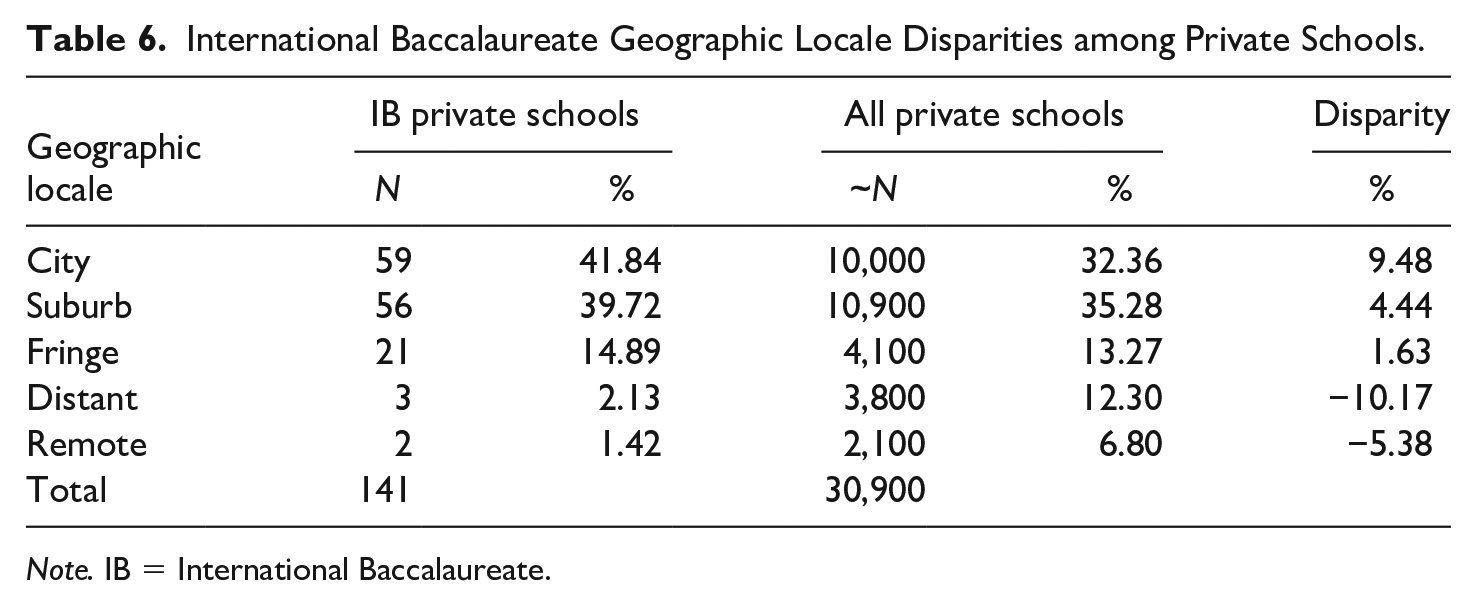
Note. IB = International Baccalaureate.
Discussion
By matching IB and non-IB U.S. public schools based on state, grade span, and enrollment, this study used recent data to confirm relations among a hierarchy of school characteristics and whether schools across the K-12 continuum made IB available. Our findings strengthen prior claims regarding how poverty, minority concentration, and geographic locale (in this study as a function of proximity to cities) relate to IB availability. Our proximity approach and descriptive look at IB private schools’ geographic locales highlight proximity’s unique importance in identifying the existence of opportunity to learn international-mindedness.
Confirming prior findings that might still seem counterintuitive, schools with either high levels of poverty or minority concentration were more likely to offer IB than an average school. Meanwhile, schools—public and private—featured fewer and fewer IB opportunities when they resided farther and farther from cities. Adding complexity to these school characteristics’ associations with opportunity to learn international-mindedness, the poverty-to-IB availability link was positive on its own but became negative when models accounted for minority concentration and remoteness. This finding suggests that whether a student attends a school in poverty matters less for that student’s opportunity to learn international-mindedness than where that school in poverty resides or the ethno-racial composition of that school in poverty. By contrast, proximity from cities showed remarkable consistency in its association with IB availability, shining a light on students in remote schools having reduced potential opportunities to learn international-mindedness. Next, we further explore the importance of whether a school offers opportunity to learn international-mindedness and the misleading nature of asking whether places are rural or not. We conclude by offering recommendations to education decision-makers who can enable or foreclose students’ opportunity to learn international-mindedness. We also highlight this study’s limitations and next steps in this area of research.
Democratizing Education for International-Mindedness?
Once regarded as the exclusive province of elite international schools, IB’s growth, particularly in the United States, seems targeted at correcting inequities that have arisen from IB’s continuum of programs being available to some communities and not others. The very notion of international-mindedness contradicts a reputation that IB seems intent on shedding: serving students from affluent, Westernized/Caucasian backgrounds, or even an internationally mobile, elite subset of affluent Caucasians of Western heritage (Doherty, 2009; Donaldson, 2017; Gardner-McTaggart, 2016). Fittingly, the last few decades have witnessed prodigious expansion in conceptualizations of what IB is and for whom it can be useful. Once a curiosity that few in the United States had heard of (Gazda-Grace, 2002), IB now joins AP, both “largely accepted as normative features of the American educational landscape,” though more for advanced academics than instilling international-mindedness (Donaldson, 2017, pp. 43–44). Still, IB’s focus on international-mindedness is becoming a selling point for schools, though not yet rivaling its potential to provide a globally transferable credential that can unlock postsecondary opportunities (Hill, 2012). The “IB for All” strategy evolved to push current and aspiring IB schools to offer its programs as widely as possible (Padula, 2017). This strategy seems jointly positioned to satisfy IB’s equity motives, commercial realities, and endeavors toward an education that supersedes traditional academic boundaries (McGuinness & Swartz, 2016).
As we review an evolving body of findings about IB availability in the United States, we see more socioeconomic than geographic progress in democratizing opportunity to learn international-mindedness. Poverty levels among U.S. public schools offering the Diploma Program more than doubled from 1985 to 2008 (12% to 25%) and the percentage of those schools receiving Title I funds increased more than 13-fold (3% in 1999 to 40% in 2009; Perna et al., 2013). In studies with more recent data and across IB’s continuum, poverty proportions of IB schools crept to 50%, adhering to national trends. Thus, findings across the continuum that school-level poverty either does not associate with IB availability (Thier, 2015) or indicates greater IB availability as in this study, provide some evidence of effectiveness for the “IB for All” strategy. Seemingly, patterns of IB program adoption are ameliorating gaps that formerly appropriated program availability only to more affluent school communities. Likewise, IB availability seems more equitably distributed to schools with higher minority concentrations than what earlier studies had reported. IB opportunity-to-learn data showed conflicting results of whether IB adoption had begun to infiltrate schools in communities of color (Perna et al., 2013). Latter studies reveal more diverse schools to be more likely to offer IB, now with stronger effects after considerable programmatic expansion in the U.S. public sector. In combination with findings that pertain to school poverty, we see a pattern that suggests IB moving on from its elitist beginnings, at least domestically.
Naturally, local variation in how communities select educational models (or not) create conditions that might individually raise or lower their likelihood of adopting IB programs. But looking across findings regarding IB availability, we see a distribution that is neither even nor the result of randomness. We have argued that the dichotomy of whether a school makes IB available is an important proxy for whether a school community offers its students opportunity to learn international-mindedness. However, dichotomously examining whether schools are “rural” does not seem adequate for mapping what seems to be pressing, current equity issue for IB. Our study seems to have solidified proximity to schools as a characteristic of interest for IB research, nudging aside, but not replacing, important contextual factors such as poverty and minority concentration. Certainly, opportunities that schools offer depend on many factors, but data regarding the limits of IB availability keep pointing to where communities exist more so than whether those communities are poor or diverse.
Proximity Continues to Matter, But Why?
Evidently, proximity to cities remains a relevant school characteristic for studying IB availability as it does for other opportunities to learn (e.g., Hogrebe & Tate, 2010; Johnson, 2012; Puryear & Kettler, 2017). Geography clearly matters as it did with Diploma Program-only data during IB’s infancy in the United States (Provasnik et al., 2007), and across all its programs amid an adoption surge (Thier, 2015), and now with stronger associations using recent data from public and private schools. This study addresses scholarly calls for greater understanding of “socio-spatial realities” amid education during a globalization-dominated century (Biddle & Azano, 2016, p. 32). However, our findings might underestimate proximity effects. Differences between the U.S. public school population and our matching non-IB schools regarding poverty and minority concentration were noticeably smaller than for the geographic locale categories that enabled us to study proximity from cities. If non-IB schools better represented the U.S. school population, already large effects sizes would have grown because geographic differences between IB and non-IB schools would be more pronounced.
Furthermore, very large BIC in this study adds confidence to both this study’s findings and those of Thier (2015), who reported large effects, but not as much (BIC ≤ 46.41). The larger BICs in this study might also underscore the importance of examining relations between IB availability and proximity to cities rather than a generic analysis of geographic locale. Even in the face of very large BICs, one should recall that Raftery (1999) proposed an eye-ball, not an empirical, approach. Still, this study’s more pronounced effects seem to result from recent data and/or more precise models.
As one explanation for our proximity-based findings, perhaps they reflect the effectiveness of decades-long, district-wide scale-up efforts in cities such as Chicago, Houston, and Los Angeles (Coca et al., 2012; Fox, 1985). But this study may also have detected a marker of urban districts’ relative ease for adopting IB. Such districts can benefit from school clustering and robust public transportation in cities, potentially more readily magnetizing students to certain schools (Donaldson, 2017). Meanwhile, the absence of structures that facilitate redistribution of IB opportunities in towns and rural areas raises a question: To what extent might IB’s notion of international-mindedness appeal less to education decision-makers (and perhaps the communities they represent) in areas far from cities than within them?
Recommendations for Education Decision-Makers
Different recommendations are likely needed if reduced IB adoption (i.e., availability) depends more on a misalignment between program requirements and local resources than if it depends on misalignment between program goals and local values. This study cannot determine if education for international-mindedness exists less frequently in distant or remote areas more so due to those places’ structural features or community norms. Therefore, we conclude this paper with a call for studies that could disentangle those possibilities. Meanwhile, we make recommendations in the case of each so education decision-makers can bring education for international-mindedness to distant and remote schools whether the issue involves a misalignment of resources or of values.
The resource challenge
Availability of any educational program is a necessary component of student opportunity to experience and benefit from that program. Assuming decision-makers at state and local levels esteem the opportunity to learn international-mindedness, our findings compel us to prompt those decision-makers to seek solutions that would benefit schools in distant and remote areas. But rather than simply replicating efforts that have shown promise for high-poverty, highly diverse contexts in cities, we urge consideration of communities’ specific needs to detect where and why IB programs might be well-received.
For example, online possibilities might seem like an expeditious solution for expanding IB availability. Online solutions might be necessary, but they are certainly not sufficient for addressing place-based inequities. Internet access favors cities. Moreover, online options can be useful with older students (e.g., in a Diploma Program) but do not afford the supervision that students in Primary or Middle Years Programs likely need, nor the hands-on learning that Career-Related Program students would need to complete their career pathways. K-12 adaptations to the realities of COVID-19 have brought these challenges into stark relief. Furthermore, advocates of controversial policies such as school choice might wonder if privatization might solve the international-mindedness gap we found in distant and remote communities. However, those areas have few nearby schools, by definition, necessarily limiting the locally available options that a market-driven solution would require (Tieken, 2017). Our private-school data show few school choices for opportunities to learn international-mindedness anywhere beyond the fringes that surround suburbs.
As an alternative, we recommend that state education departments engage in two types of partnerships. First, states can learn from organizations such as the National Rural Education Association or the Rural School Community Trust about barriers, and facilitators, that accompany the school communities distant and remote from cities, the latter often being the places that generate large-scale educational policy. Second, states can put educational decision-makers from distant and remote communities in contact with their peers in cities to harvest ideas about what has worked already in cities and suburbs with an eye on what might be economically scalable in distant and remote areas. Schools that are distant and remote from cities might learn how to adapt city mechanisms that have benefited students from low-income backgrounds and/or ethno-racial minority groups (Bland & Woodworth, 2008; Donaldson, 2017; Karakos et al., 2017; Kyburg et al., 2007; O’Brien et al., 2017). But such partnerships would need districts and schools to lay a seedbed for accommodating IB adoption. That would involve aligning curriculum horizontally and vertically to meet jurisdictional requirements as districts and schools develop local capacity to monitor and support students and faculty through implementation efforts (Beckwitt et al., 2015; Bland & Woodworth, 2008; Padula, 2017).
Specifically, the Career-Related Program, now available on its own or as a Diploma Program addendum, might be useful for distant and remote communities, which often experience brain drain and collapsing local industries (Corbett, 2002). In schools that partner with local employers, Career-Related Programs can provide an integrated pathway that surrounds students with international-mindedness as it prepares them for university, apprenticeships, or employment immediately after high school (Beach et al., 2018). Encouragingly, schools in rural areas are more likely than schools in other geographic locales to offer career technical education and job-shadowing programs (Hutchins & Akos, 2013), essential ingredients for Career-Related Program implementation. Furthermore, the Career-Related Program does not exclusively yield vocational futures; it has also been shown to engender university success (Behle, 2017; Mack et al., 2018).
If adopting the Career-Related Program in distant and remote communities seems like a silver bullet, allow us to temper any expectations of an easy solution. IB implementation can be more resource-intensive, bureaucratically elaborate, and slow-moving than other advanced academic options (Donaldson, 2017). State policymakers or district leaders aiming to increase adoption of IB programs need to support implementers with flexibility, financing, and examples of promising practices (Bland & Woodworth, 2008; Hall et al., 2009; Siskin & Weinstein, 2008). Strong implementation can require whole-school immersion, collaborative planning, continuous teacher training, and the promotion of community involvement (Chadwick et al., 2019; Hall et al., 2009; Kyburg et al., 2007), the latter of which might be more or less challenging in distant and remote schools. On one hand, community involvement could be a protective factor. Schools in towns and rural areas can play a central role, one of few institutions able to galvanize a widespread community. On the other hand, wide-open spaces are harder to wrangle, maybe even more so around a concept with less local familiarity such as international-mindedness.
If international-mindedness discords with local values
Decision-makers in education face competing priorities, such as state-mandated standardized testing regimes that esteem basic literacy and numeracy as they narrow curricula away from aspirational goals such as international-mindedness (Berliner, 2009; Zhao, 2015). Given a wide range of possible priorities, some communities might provide more fertile ground for IB adoption than others. For example, Latinx students in more recently authorized Diploma Program schools are more likely to receive proportionate access to an IB education (Donaldson, 2017), signaling progressive attitudes within some diverse schools, perhaps more common for schools that use an equity lens to inform decision-making. Meanwhile, whether schools offer IB programs because their communities are diverse or if the availability of IB program courts diversity remains unclear (Thier, 2015). Therefore, it seems useful to ask whether IB, or certain facets of its programs, connect more with students from low-income and/or ethno-racial minority families. Might international-mindedness appeal more to families from groups that a hegemonic majority characterizes as “diverse”?
Correspondingly, school leaders can benefit their communities by asking what, if any, of their local norms reveal the appetite for, or rejection of, education for international-mindedness. Describing communities beyond city limits, Corbett (2002) characterized a phenomenon he calls “learning to leave.” He shows a coastal town school that raised up promising young people as success stories, only to position them for egress toward greater university and employment opportunities that were far more abundant in cosmopolitan centers. In an era defined, at least in part by a rise in telecommuting and readily available information via smartphones, perhaps bringing education for international-mindedness to distant and remote places can serve an important function. By advancing cosmopolitan values in a distant and remote place, the opportunity to learn international-mindedness might lead promising young people who would have otherwise contributed to a community’s brain drain to instead remain local and help their community stay vibrant or return to vibrance. If students have avenues to expand their worldviews without feeling compelled to leave the communities they call home, they might be able to absorb ideas from any number of elsewheres and apply them locally. Of course, showing students a wider view of the world could also accelerate “learning to leave” by revealing options that only exist elsewhere.
Limitations
Despite this study’s design to improve prior techniques, limitations remain. First, IB represents merely one opportunity for internationally minded education. Cambridge, the College Board, and other organizations offer options with similar aims (Donaldson, 2017; Thier, 2015). Locally generated programs can do so, as well. Second, our matching procedure did not enable multilevel comparisons of schools within states. State-specific patterns of IB adoption and other interstate differences certainly have potential to influence IB availability. State-level effects on IB adoption remain unknown, although there seem to be some patterns regarding what programs are adopted (and not) within a given state.
For example, as states with the largest populations of IB schools, California and Texas show only trivial differences between their proportions of schools that offer the Middle Years, Diploma, or Career-Related Programs. However, Texas IB schools have adopted the Primary Years Program nearly 30% more than California IB schools. Perhaps state-level conditions lead Texas schools to embrace education for international-mindedness in elementary schools more so than in California. Moreover, Connecticut is atypical in that its schools’ Primary Years Program adoption exceeds Diploma Program adoption. Such differences raise questions about adoption patterns within states, which this study could not interrogate due to its matching procedures and inadequate sample size for such analyses in most states. We certainly encourage examination of potential interactions between states’ influence on adopting IB and any other models that aim to educate for international-mindedness, which we regard as a critical opportunity that geography should not associate with, although it seems to do so. Third, the possibility exists that random sampling variability influenced our matching procedures and thus our results. However, we confirmed findings from earlier data and employed mostly similar procedures. Likewise, we recognize that our proximity findings are more likely to underestimate than overestimate observed effects, strengthening our confidence in the accuracy of our matches and the utility of our results. Fourth, other school characteristics might influence IB availability, such as per-pupil spending, but that variable was not immediately available for linking with our data set, so we could not interrogate it further.
Next Steps for Research
Our findings raise several questions that future studies can address. First, it would be illuminating to know whether the presence of an IB program prompts enrollment from diverse populations or schools that are already diverse adopt IB programs because it synchs with school leaders’ perceptions of their populations’ values. Second, educational equity is more complex than simply tracking ethno-racial variables (Powell, 2016), and communities are not easily deposited into regression equations. Still, our finding that minority concentration suppresses the effect of poverty on IB availability without those school characteristics interacting significantly raises the importance of further examining schools’ socioeconomic diversity. With poverty and minority concentration as potential boons for IB adoption, rather than risk factors, a study of the extent to which IB has sloughed off its elitist roots seems warranted (see Donaldson, 2017).
Third, the international nature of IB education begs for comparisons of our domestic findings with similar international studies. Do the relations we have found generalize across national borders? In Australia, IB opportunity is described as depending upon geographic locale but also myriad other community factors (Dickson et al., 2017). An inquiry that descriptively examines locations of AP and/or the Diploma Program in more than 120 nations shows those educational opportunities to favor students in cities over their peers who live at distances from metropolitan areas (Thier et al., 2016). But no IB continuum studies have estimated IB availability outside the United States. With nearly 400 IB schools, a nation such as Canada would provide an ample opportunity to replicate or adapt this study.
Fourth, our data highlight the existence of success stories worthy of qualitative inquiry about how they serve IB to communities with high levels of poverty, high levels of diversity, both, and neither. Echoing calls to find and study such IB unicorns from a socioeconomic perspective (Donaldson, 2017), we wonder how the few IB schools in distant and remote setting are beating implementation odds. What local traits compel adoption for those schools? What local strengths or extramural networks, if any, support their implementation efforts? What local challenges must they overcome that peer institutions in other geographic locales do not? Answers to these questions might separate the opportunity to learn international-mindedness from the geographic constraints that our results have confirmed.
Footnotes
Acknowledgements
The authors want to thank Jeongim Jim for her help preparing portions of the data set.
Declaration of Conflicting Interests
The authors declared no potential conflicts of interest with respect to the research, authorship, and/or publication of this article.
Funding
The authors received no financial support for the research, authorship, and/or publication of this article.
