



Abstract
To outline the current state of empirical knowledge in rural gifted education, a systematic review of the international empirical literature was conducted with peer-reviewed journal articles published from 2000 to 2020. Six inclusion/exclusion criteria guided the searches that were undertaken of the ERIC and PsycINFO databases, six peer-reviewed journals in gifted education, and three peer-reviewed journals in rural education, along with the reference lists of the journal articles identified from the database and journal searches. The 103 journal articles that were eventually identified as meeting search criteria were thereafter analyzed to document key details, including the countries/regions of origin, publication outlets, authorship, approaches to data collection and analyses, and the major findings. A discussion of the key issues and trends in the identified studies, along with areas for focus in future investigations, concludes the review.
To date, rural gifted students (from kindergarten to college) as a group do not appear to have been given substantial attention in the research literature in either the fields of gifted education or rural education (Azano, 2014; Lewis & Boswell, 2020). This is despite their potentially large numbers, which is reflected in the fact that a significant percentage of the world population live in rural areas (e.g., approximately 20% of Americans and 29% of Australians; Australian Bureau of Statistics, 2016; Azano, 2014; LeBeau et al., 2020; Puryear & Kettler, 2017; Townend et al., 2020; U.S. Census Bureau, n.d.). The research in rural gifted education is complicated by the lack of consensus on who indeed qualifies as a rural gifted student. At present, multiple definitions of giftedness and rurality are simultaneously being used in different parts of the world, as no single definition of either giftedness or rurality has achieved universal consensus or wide acceptance (Kettler et al., 2016; Makel & Johnsen, 2020).
A number of prominent definitions of giftedness currently exist. Among the most prominent of these definitions are as follows: (a) the intelligent quotient (IQ)-based definitions, first proposed by Terman (1925), that consider giftedness to be a narrow and unitary trait associated with high intellectual ability; (b) Renzulli’s (1988) three ring definition, which considers giftedness to constitute the possession of, or capability to possess, three distinct traits—above average ability, creativity, and task commitment; (c) the definition used in Tannenbaum’s (1986, 2003) star model, which considers giftedness to exist if there is an interaction between five psychological and social factors—superior general intelligence, exceptional special abilities, nonintellective traits, environmental supports, and chance; (d) Gagné’s (2003, 2009) definition, which recognizes giftedness to be the possession of outstanding natural abilities in one or more domains (e.g., intellectual, creative, socioaffective, and sensorimotor) to a degree that would place an individual at least among the top 10% of his/her age peers; and (e) the definition of Subotnik et al. (2011, 2012), which considers giftedness to be a developmental construct that is primarily defined as potential in the early stages of one's development, achievement in the latter stages, and eminence in the final stages. Multiple other definitions exist that may or may not incorporate elements of the above definitions (Dai & Kuo, 2016; Shavini, 2009; Ziegler, 2005), along with attempts at the creation of a common inclusive definition (National Association for Gifted Children, 2019) which have, to date, not had the anticipated success.
Similarly, there is variation in how rurality is defined by scholars and practitioners. Existing definitions appear to give varying levels of consideration to factors such as population size, population density, proximity to urban areas, sociocultural characteristics, and the economic characteristics of a particular area (Azano, 2014; Kettler et al., 2016; Kinkley & Yun, 2019; Plunkett, 2012, 2018; Puryear & Kettler, 2017). On the basis of one or more of these factors, school districts in different parts of the world may be given designations as being rural, urban, or derivatives thereof (e.g., remote and suburban), by organizations such as national statistical agencies and government education departments (Puryear & Kettler, 2017). As an example, one of the most commonly adopted definitions of rurality in Australia is based on the Accessibility/Remoteness Index of Australia (ARIA+), which measures rurality on the basis of road distance to the closest urban center, with the smallest urban center defined as having a population of at least 1,000 (Australian Bureau of Statistics, 2016). Using ARIA+ scores, the Australian Standard Geographical Classification divides localities in Australia into “major cities,” “inner regional,” “outer regional,” “remote,” and “very remote” areas (Australian Bureau of Statistics, 2016). It is noteworthy that even among rural areas, there may be some heterogeneity, with Puryear and Kettler (2017) highlighting distinctions among rural areas classified as “fringe,” “distant,” and “remote” in the United States. For example, they found that rural fringe areas may have greater similarities to urban or suburban areas than to rural distant or rural remote areas.
Independent of the specific definitions of giftedness and rurality that are adopted within any educational context, a common understanding appears to exist that rural areas, and the student population attending schools in these areas, may have unique qualitative and quantitative characteristics (Cromartie & Bucholtz, 2008; Plucker, 2013; Puryear & Kettler, 2017). As such, rural gifted students may face a number of experiences that contrast to their urban counterparts. Some of the possible positive experiences of rural gifted students may include a greater likelihood of individualized educational attention due to relatively small class sizes (Abel, 1993; Colangelo et al., 2003; Croft, 2015; Ellzey & Karnes, 1991), greater opportunities for close relationships with teachers (Abel, 1993; Townend et al., 2020), greater leadership opportunities (Colangelo et al., 2003; Jones & Southern, 1992), greater involvement in school and extracurricular activities (Colangelo et al., 2003; Jones & Southern, 1992), a sense of community cohesion (Plucker & Puryear, 2018), greater access to community resources (Colangelo et al., 2003; Townend et al., 2020), stronger relationships with friends and family (Stambaugh, 2015), safety and stability (Plucker & Puryear, 2018), and greater potential for teachers to be autonomous (Croft, 2015; Gentry et al., 2001).
At the same time, rural gifted students may be faced with a number of challenges that may play a role in their underidentification and the underserving of their educational needs (Townend et al., 2020). These challenges may include the relatively small numbers of gifted students for social interaction (Azano et al., 2014; Gagnon & Mattingly, 2016), persistent poverty (Assouline et al., 2021; Hardré et al., 2009; Howley et al., 2009), a reduced likelihood of attaining advanced levels of education (Assouline et al., 2017), indifferent or negative community attitudes toward education and gifted education (Azano et al., 2014; Hernández-Torrano, 2018; Mattingly & Schaefer, 2015; Plunkett, 2012), a lack of experienced teachers with training in gifted education (Azano et al., 2014; Howley et al., 2009; Plucker & Puryear, 2018), a lack of availability or access to identification instruments that are suitable for rural gifted students (Floyd et al., 2011; Plucker, 2013), and a lack of range and rigor in the available educational provisions (Assouline et al., 2017; Azano et al., 2014; Pendarvis & Wood, 2009).
The purpose of this study was to examine the current state of empirical knowledge in rural gifted education. More specifically, this study sought to investigate the following aims:
To outline the key details (i.e., countries of origin, publication outlets, and methodological approaches) of the current empirical research in rural gifted education. To summarize and synthesize the major findings of the current empirical research in rural gifted education. To discuss the emerging issues and trends in the current empirical research in rural gifted education. To identify areas for possible attention in future research in rural gifted education.
The overriding research question that guided the study was “what is the state of current knowledge about rural gifted education, as assessed using the empirical peer-reviewed international literature?” It was hoped that the study would allow for a clearer and more complete understanding of the existing intellectual territory in rural gifted education to reconcile the existing evidence, highlight gaps in the current knowledge, identify areas for further investigation, and as a basis to move the area forward. This systematic review of the literature may be useful as a resource to optimally inform the development of rigorous and effective theory, practice, policy, and conventions in rural gifted education.
Method
To answer the research question and to address the four aims of the study, a systematic review of the published empirical international literature in rural gifted education was conducted.
Search of Research Studies
As an initial step in conducting the systematic review of literature, a number of inclusion/exclusion criteria were established, as follows, to identify appropriate research studies:
A study that is relevant to gifted students in rural or related settings. A primary empirical study that excludes reviews of the research on rural gifted education. A study that is published in an academic peer-reviewed journal (and therefore excludes research that is published in other types of publication outlets such as conference proceedings, books, book chapters, reports, government documents, and dissertations, which may undergo less rigorous review procedures; Borrego et al., 2014). A study that is published in the period from January 2000 to October 2020 (including advance online publications). A study that is published in the English language. A study that is published by researchers based in any part of the world.
Each inclusion/exclusion criterion reflected an element of the overriding research question that guided the study. That is, the period of investigation (i.e., January 2000 to October 2020) was selected to give coverage to the most recent and current research on rural gifted education; English language publications of researchers based around the world were included to ensure that the study considered the accessible international literature in the area, while the publication type was restricted to primary empirical studies in peer-reviewed journals to ensure that the most rigorous empirical peer-reviewed literature was included. Lastly, all studies that were selected needed to have relevance to gifted students in rural or related settings, under any definition of giftedness and rurality, so that the systematic review of the literature had an appropriate focus on rural gifted education.
The specific search procedures that were followed adopted many of the search procedures outlined in Borrego et al. (2014) and included:
Search of the ERIC and PsycINFO databases. Review of the articles published in six key peer-reviewed journals in the field of gifted education (i.e., Gifted Child Quarterly, High Ability Studies, Journal of Advanced Academics, Journal for the Education of the Gifted, Roeper Review, and the Australasian Journal of Gifted Education). Review of the articles published in three key peer-reviewed journals in the field of rural education (i.e., Rural Special Education Quarterly, Journal of Research in Rural Education, and The Rural Educator). Citation search, which involved a review of the reference lists of the peer-reviewed journal articles identified during the ERIC/PsycINFO database search and a review of the articles published in the key journals in the fields of gifted education and rural education.
ERIC/PsycINFO Database Search
Among the six inclusion/exclusion criteria established to identify appropriate research studies, four criteria (i.e., publication in a peer-reviewed journal, publication from January 2000 to October 2020, publication in the English language, and research studies that originate from any part of the world) could be readily assessed during the search of the ERIC and PsycINFO databases by the use of the search tools in the two databases that specifically allowed for the search of peer-reviewed journal articles, publications within any date range, and English language research studies. Both databases index research studies that originate from various parts of the world.
More complex procedures were necessary to assess studies that were indexed in the ERIC and PsycINFO databases with respect to the remaining two inclusion/exclusion criteria (i.e., relevance to gifted students in rural and related settings, and a primary empirical study). To assess the relevance of studies to rural gifted education, a number of search words and logical connectors were employed to examine the titles and the abstracts of potentially relevant journal articles. The inference was made during the search that if there was no reference to giftedness and rurality (or related terms) in either the titles or abstracts of the study, the study may at best have only limited relevance to this systematic review of the literature. The specific search words and logical connectors used were:
Giftedness: gift* OR talent* OR high abilit*
Rurality: rural OR remote OR regional OR isolated OR “non-urban” OR Indigenous OR Aboriginal OR “Native American” OR “American Indian” OR “First Nations”
The inclusion of search words such as “Indigenous” and related terms (i.e., “Aboriginal,” “Native American,” “American Indian,” and “First Nations”) was in recognition of the substantial percentage of students of Indigenous backgrounds living in rural areas in different parts of the world (Baxter et al., 2013; Montgomery, 2001; Plunkett, 2018).
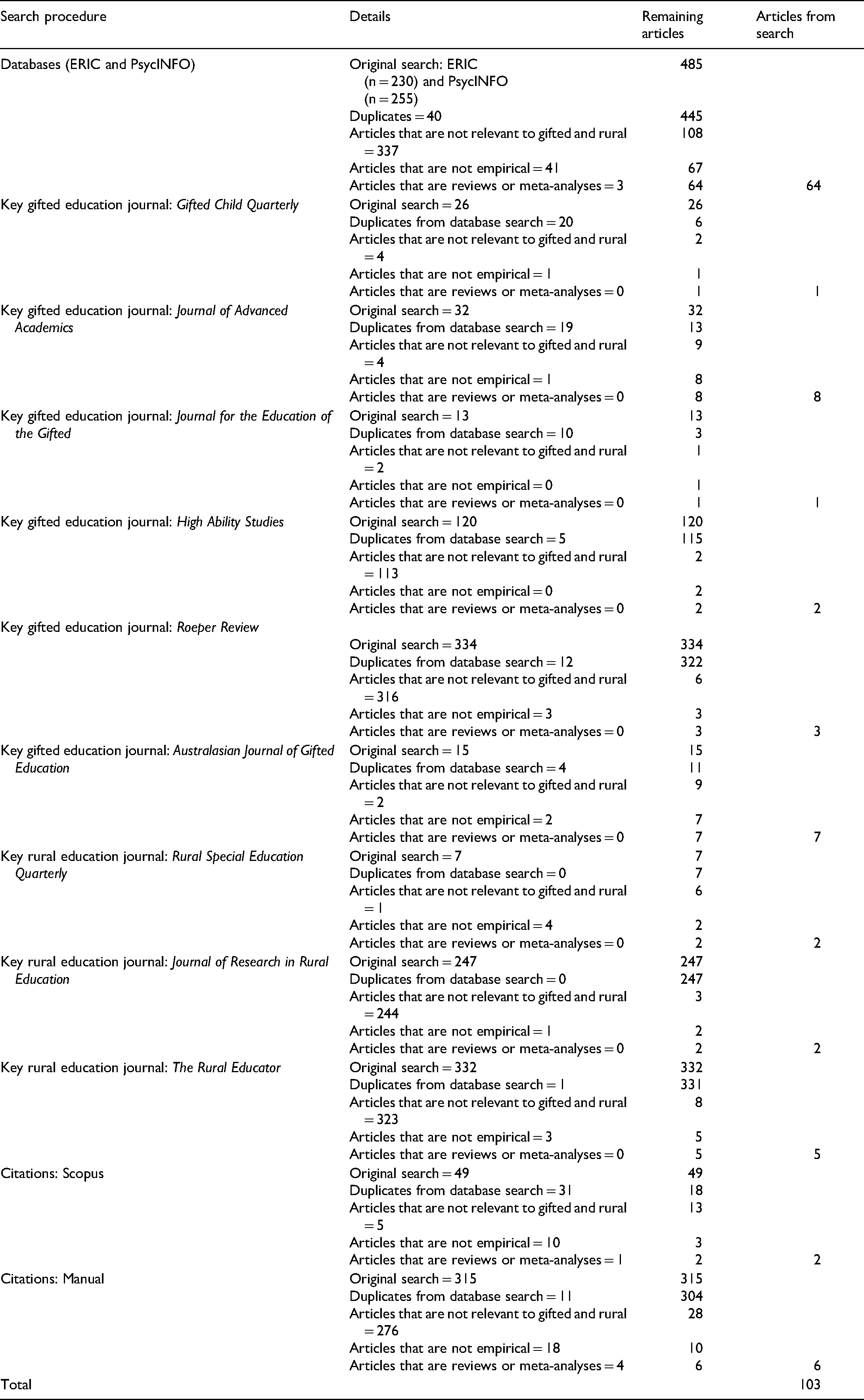
Any peer-reviewed journal articles that included any of the search words for giftedness and any of the search words for rurality in either the title or the abstract were retained for further consideration. The initial search of the ERIC database identified 230 potentially relevant journal articles, while the initial search of the PsycINFO database identified 255 potentially relevant journal articles. As 40 of these articles were identified in both databases, the total number of original journal articles identified from the two databases was 445. All of these articles were screened for relevance to rural gifted education by reading the abstracts, and if necessary, other relevant sections of each article. This additional step was necessary to address the lack of certainty about the relevance to rural gifted education of all articles that were initially identified using the search words and logical connectors, including the possibility that a study involving gifted Indigenous students could have been conducted in an urban setting. It also allowed for an assessment of whether these journal articles were primary empirical studies (i.e., the final inclusion/exclusion criteria).
As noted above, articles were retained for inclusion if any cohort of study participants qualified as gifted in any domain under any definition of these terms, and these study participants resided or attended schools in an area under any definition of rurality. Such broad conceptualizations were adopted in acknowledgment of the different definitions of giftedness and rurality that are currently being used in different parts of the world, which will be reflected in the international peer-reviewed empirical research in rural gifted education. Furthermore, there was no requirement for the entire cohort of participants for any particular study to be rural gifted students for the study to be included. Nevertheless, studies that dealt with topics that were only vaguely related to giftedness and rurality, but were not specific to giftedness and rurality (e.g., studies relating to college students from rural areas or educational attainment in rural areas), or had only fleeting or cursory references to giftedness and rurality (e.g., studies that only referenced research on rural gifted education), were excluded. Moreover, for those studies where the entire cohort did not comprise rural gifted students (or were related to rural gifted education), the focus of the reporting was on those findings relating to the rural gifted cohort. After screening all 445 journal articles that were initially identified during the searches of the ERIC and PsycINFO databases, 64 journal articles could be retained.
Search of Key Journals in the Field of Gifted Education
During the search of articles in the key journals in the field of gifted education, three of the inclusion/exclusion criteria did not need to be separately considered, as all six journals qualify as peer-reviewed journals, publish in the English language, and publish articles prepared by scholars based in different parts of the world. Therefore, only the three remaining inclusion/exclusion criteria (i.e., relevance to rural gifted education, publication from January 2000 to October 2020, and a primary empirical study) needed to be assessed. For this purpose, the search tools on the websites of each of these journals (these search tools were operated by Sage for Gifted Child Quarterly, Journal of Advanced Academics, and Journal for the Education of the Gifted; Taylor and Francis for High Ability Studies and Roeper Review; Informit for the Australasian Journal of Gifted Education) were utilized.
Each of the journal search tools had a function to specify the date of publication of articles, along with a function to specify search words and logical connectors. Therefore, the next step involved the input of the relevant dates, and the search words/logical connectors that were used in the ERIC/PsycINFO database searches into the journal search tools, to allow for a review of the titles and the abstracts of the articles that were published in each journal from January 2000 to October 2020. It is noted that as the search tools for two of the journals (High Ability Studies and Roeper Review) did not have the function of applying the search words and logical connectors only to abstracts, they were applied to entire articles instead (leading to a greater number of identified articles from these two journals).
Multiple articles were identified during this procedure (i.e., 26 from Gifted Child Quarterly, 32 from the Journal of Advanced Academics, 13 from the Journal for the Education of the Gifted, 120 from High Ability Studies, 334 from Roeper Review, and 15 from the Australasian Journal of Gifted Education). After removing those articles that were already identified in the ERIC and PsycINFO database searches, the titles and abstracts (and, as necessary, other sections) of each of the remaining articles were read, to assess both their relevance to rural gifted education and the primary empirical nature of these articles (as for the ERIC/PsycINFO database searches, a broad definition of giftedness and rurality were applied, and there was no need for the entire cohort of participants to qualify as being rural gifted students). This process resulted in an additional 22 journal articles being retained (i.e., one from Gifted Child Quarterly, eight from the Journal of Advanced Academics, one from the Journal for the Education of the Gifted, two from High Ability Studies, three from Roeper Review, and seven from the Australasian Journal of Gifted Education).
Search of Key Journals in the Field of Rural Education
As for the key gifted education journals, the three selected rural education journals qualified as peer-reviewed journals, publish in the English language, and publish articles prepared by scholars based in various parts of the world. Therefore, only the three remaining inclusion/exclusion criteria (i.e., relevance to rural gifted education, publication from January 2000 to October 2020, and a primary empirical study) needed to be applied to the articles in the key rural education journals. The search of articles in the Rural Special Education Quarterly followed identical procedures to the search of articles in the key gifted education journals, including the use of the search tool on the journal website (operated by Sage). While identical procedures were also followed during the search of articles in the Journal of Research in Rural Education and The Rural Educator, the limited functions of the search tool on the websites for these two journals meant that manual searches were necessary of the articles in these journals.
After this process, nine additional journal articles were retained (i.e., two from Rural Special Education Quarterly, two from the Journal of Research in Rural Education, and five from The Rural Educator). Therefore, a total of 95 articles were identified for inclusion in the study after the ERIC/PsycINFO database searches and the search of articles in the key gifted education and rural education journals.
Citation Search
As the final step in the search procedure, a citation search was conducted by reviewing the reference lists of all of the journal articles that were identified from the ERIC/PsycINFO database and key journal searches. For this purpose, two searches were conducted. The first search employed the Scopus database to review the titles and abstracts of the articles in the reference lists of 70 of the 95 articles that the database recognized. Manual reviews were undertaken of the titles and abstracts of the articles in the reference lists of the remaining 25 journal articles. All searches were conducted by the application of the six inclusion/exclusion criteria that were developed at the commencement of the systematic review of the literature.
For the articles referenced in one of the 70 articles recognized by Scopus, four of the inclusion/exclusion criteria (i.e., publication in a peer-reviewed journal, publication from January 2000 to October 2020, publication in the English language, and research studies that originate from any part of the world) could be readily applied, as Scopus indexes journal articles that originate from various parts of the world, and as its search tool has functions to search specifically for peer-reviewed journals, publications within a specific data range, and English language research studies. To assess the relevance of these articles to rural gifted education and the primary empirical nature of these articles, the procedures used in the ERIC/PsycINFO database searches and the search of the key selected journals were again followed. In comparison, the manual reviews of articles in the reference lists of the remaining 25 journal articles that were not recognized by Scopus involved manual assessments of the six inclusion/exclusion criteria with respect to each of the articles.
The Scopus citation search and the manual citation search identified an additional two and six journal articles, respectively, that met all of the inclusion/exclusion criteria for the systematic review of the literature. Therefore, a total of eight additional journal articles were identified from the citation search. Consequently, the total number of peer-reviewed empirical journal articles published from January 2000 to October 2020 in the English language by scholars based around the world on the topic of rural gifted education was established to be 103. Table 1 provides greater details of the entire search process.
Search Process.
Analysis of Identified Studies
The 103 studies that were identified to fit within the inclusion/exclusion criteria for the systematic literature review were analyzed to identify key details relating to the country/region of origin of these studies, the nature of publication outlets, and the methodological approaches (including the approaches to data collection and analysis) that were adopted.
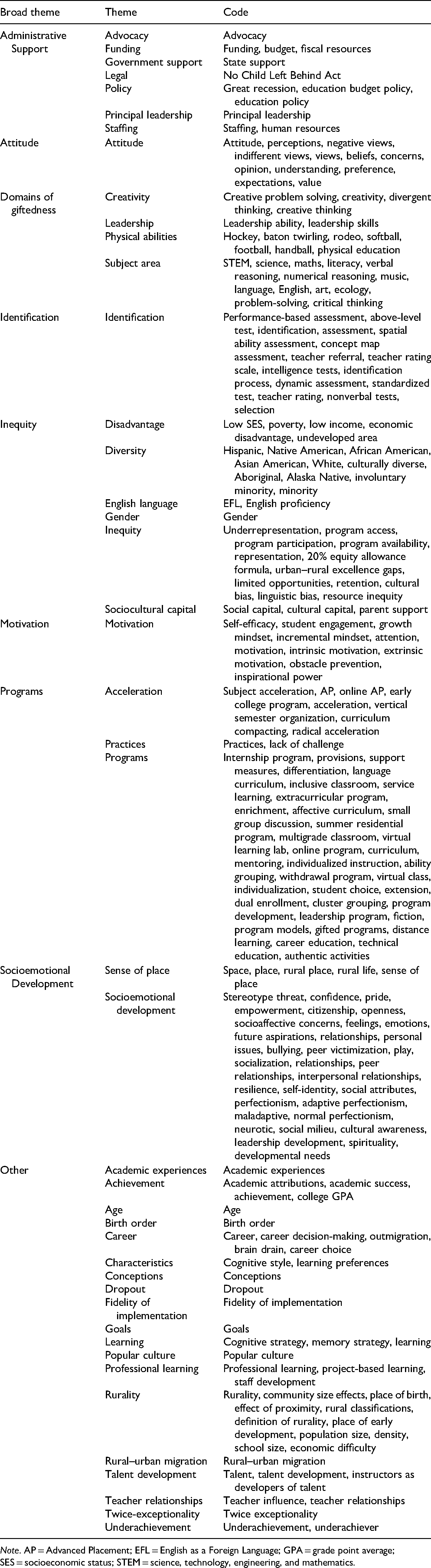
Thereafter, to identify the major topics that were the focus of these studies (to allow for the optimal organization of the summary/synthesis of the major findings of these studies), a thematic analysis was undertaken of the abstracts of the identified studies. For this purpose, multiple elements of the thematic analysis protocol of Braun and Clarke (2006) were followed. First of all, the abstracts of the selected articles were read numerous times to gain as much familiarity as possible with the abstracts prior to analysis. Thereafter, codes were iteratively and recursively generated from the abstracts by asking questions such as “What is being described in the data?,” “How is it understood?,” and “What does it mean?” (Tuckett, 2005). Upon the generation of codes, an iterative and recursive search was made of themes in the codes by the sorting of codes that may be potentially related to one another. Finally, potentially related themes were sorted into groups to identify broad themes.
Throughout the analysis, all codes were repeatedly reviewed for their fit to the definition of a code (i.e., the most basic segment of data relating to a study topic), while all codes that comprised each theme and all themes that comprised each broad theme were repeatedly reviewed to assess their coherence within each theme/broad theme and their distinctiveness to other themes/broad themes. All analyses were conducted in a manner such that semantic rather than latent themes/broad themes that did not go beyond the semantic content of the abstracts were identified.
In the end, the thematic analysis procedures identified 235 codes, 44 themes, and 9 broad themes. Table 2 provides greater details on these codes, themes, and broad themes. Of the nine broad themes (i.e., administrative support, attitudes, domains of giftedness, identification, inequity, motivation, programs, socioemotional development, and other), the final (i.e., “other”) broad theme comprised themes that were given comparatively less attention in the 103 identified articles and did not readily fit the other eight broad themes.
Major Topics of Identified Articles.
Note. AP = Advanced Placement; EFL = English as a Foreign Language; GPA = grade point average; SES = socioeconomic status; STEM = science, technology, engineering, and mathematics.
The broad themes were used to organize the summaries and syntheses of the key findings of the identified studies, which were informed by multiple readings of the results and conclusion sections of those identified studies that were relevant to each broad theme.
Results
An overview of the key details of the 103 identified articles may be found in Table 3.
Key Details of Identified Articles.

Relevant broad theme.
Country/Region of Origin
The 103 studies that formed the final list of studies relating to rural gifted education were conducted in 14 different countries (i.e., Australia, Canada, China, Denmark, Iran, Ireland, Israel, Malaysia, South Africa, Spain, Taiwan, United Kingdom, United States, and Zimbabwe), with the majority of the research having been conducted in the United States (73 studies), Australia (14 studies; one of these studies was conducted jointly in Canada), and Canada (4 studies). Interestingly, there were certain regions within the United States and Australia, where much of the research from these countries was concentrated (e.g., 18 studies in southwest U.S. [including eight studies in Texas], 15 studies in midwest U.S., and seven studies in New South Wales, Australia). Of note was the very low number of studies from Latin America (no studies), the Middle East (two studies), Asia (three studies), Europe (four studies), and Africa (four studies).
Publication Outlets
The identified studies were published in 30 different academic peer-reviewed journals, most of which were in the field of gifted education (76 studies) and rural education (9 studies). The seven journals that had the greatest frequency of publication of the selected articles were the Journal of Advanced Academics/Journal of Secondary Gifted Education (22 studies), Gifted Child Quarterly (16 studies), Australasian Journal of Gifted Education (11 studies), Roeper Review (10 studies), Journal for the Education of the Gifted (7 studies), The Rural Educator (5 studies), and High Ability Studies (4 studies). The remaining studies were dispersed in a variety of journals in the fields of education, psychology, and sports science. One article was published in a methodology journal (i.e., Journal of Ethnographic and Qualitative Research).
Methodological Approach
The methodological approach that was adopted in the 103 studies had a greater tendency to adopt quantitative approaches over qualitative approaches, with 50 quantitative studies and 35 qualitative studies. In comparison, 18 of the studies could be best described as having adopted a mixed-methods approach. In the quantitative studies and the quantitative components of mixed-method studies, the predominant form of data collection was the use of surveys, although smaller numbers of the studies involved secondary data analysis or experimental and related methods. The major forms of data analysis in these studies included the calculation of descriptive statistics, correlation analysis, chi-square analysis, multivariate analysis of variance, regression analysis, factor analysis, analysis of variance, t-tests, and logistic regression. Less commonly used were discriminant analysis, odds ratio analysis, and mixed-effects modeling. In comparison, the qualitative studies and the qualitative components of the mixed-method studies collected data using interviews, observations, and focus groups and utilized analytical techniques such as thematic analysis, document analysis, grounded theory analysis, content analysis, constant comparative analysis, and ethnographic analysis. The participants of the identified studies could be broadly divided into three categories—gifted students (from kindergarten to college) or gifted adults, the teachers of gifted students, and the multiple stakeholders in gifted education (which included gifted students, teachers, peers, family members, principals, community members, mentors, academics, administrators, psychologists, and/or other specialists/experts in gifted education) as a collective.
Key Findings
From the thematic analysis of the abstracts, the topics that were the focus of the 103 selected studies could be divided into the broad areas of attitudes toward gifted students and gifted education, the domains of giftedness, the identification of gifted students, the programs for gifted students, the socioemotional development of gifted students, the motivation of gifted students, inequity, and administrative support for gifted students. Nevertheless, it is noted that some overlap is inevitable between these broad areas (e.g., funding or staffing support for rural gifted education may be related to both inequity and administrative support). Furthermore, Table 3 shows that most of the 103 identified studies related to more than one of these broad areas.
The key findings of the identified studies in each of these broad areas are summarized and synthesized below. It was not possible to refer to every single identified article in the summaries and syntheses.
Attitudes Toward Gifted Students/Gifted Education
Multiple studies have been published that focus on the attitudes, perspectives, and understandings of various stakeholders in the education of rural gifted students. These studies may be broadly divided into studies that focus on the attitudes of rural teachers, preservice teachers, and the gifted students themselves. Those studies relating to the attitudes of teachers have tended to indicate that current teachers in rural areas may have some reservations toward, and/or a lack of knowledge about, gifted education provisions and gifted students. Specifically, Siegle et al. (2013) found that teachers in different (including rural) U.S. locales are mostly aware and accepting of acceleration practices, although many may be concerned about their social implications and about certain forms of the practice (e.g., grade skipping and early entrance to kindergarten). In comparison, Sajedifard and Shahgoli (2020) found that the majority of the participating rural English as a Foreign Language (EFL) teachers in Iran had either negative or indifferent attitudes toward curriculum differentiation. These teachers noted that among the barriers to the implementation of curriculum differentiation practices were issues relating to time, class size, motivation, support, resources, a perception of a lack of fairness/necessity, and a lack of knowledge about gifted education. Similarly, Brown et al. (2005) found that rural educators, consultants, and administrators may be among the groups with the least familiarity with rigorous research-informed gifted identification practices, such as the use of a multiple criteria approach to the identification and a need to consider the student context.
The studies involving rural preservice teachers of gifted students included a focus on attitudes toward various gifted education provisions. For example, Troxclair (2013) noted that preservice teachers who had no training in gifted education had contradictory attitudes toward gifted education, that encompassed positive views toward the need to support gifted learners, but negative attitudes toward the social value of gifted students, and gifted provisions such as ability grouping and acceleration. Relatedly, Harris and Hemmings (2008) noted that preservice teachers with minimal training in gifted education tended to prefer teacher nominations over IQ tests and other forms of nomination to identify gifted students, and provisions such as enrichment, extension, and curriculum differentiation over full-time ability grouping and acceleration to educate gifted students. Of note, when comparisons were made between rural preservice teachers who have and have not completed gifted education studies by Bannister-Tyrrell et al. (2018), no significant differences were found between these two groups in terms of their perceived knowledge about gifted students or perceived teaching competence for gifted students.
In comparison, the studies that focused on the attitudes of gifted students each had a different focus. Lamb and Lane (2013), who investigated student perspectives on being identified as physically gifted, found that students generally had positive perspectives, which may be related to the motivational effects of the gifted label. Nevertheless, these students simultaneously identified some challenges, including those relating to balancing their commitments in the sporting and academic domains. Student perspectives of play were the focus of Beisser et al. (2013), who found that rural gifted students demonstrated a preference for physical play over social or cognitive play and acknowledged that play may facilitate structured learning, experiential learning, and social skill development.
Domains of Giftedness
Another group of studies had a focus on the different domains in which rural students have been identified as gifted, which may be broadly divided into the Science, Technology, Engineering, and Mathematics (STEM), language and related areas, art/creativity, and the physical domains. Those studies with a focus on giftedness in the STEM domain broadly fell into studies that examined the experiences of gifted students in STEM educational programs, and studies that focus on the identification of giftedness in STEM areas. In the former category were studies that found that while instruction in STEM areas, in general, may not be sufficiently challenging, advanced, or relevant in rural communities (Howley et al., 2005), special STEM programs that were designed specifically for gifted students have the potential to produce positive outcomes including engagement and challenge (Ihrig et al., 2018; Missett et al., 2010), the promotion of problem-solving skills (Missett et al., 2010; Wang, 2009), the promotion of enhanced knowledge (Wang, 2009), support for creativity and critical thinking abilities (Ihrig et al., 2018), and enhanced social skills (Wang, 2009). In the second category were studies that were conducted with substantial numbers of rural gifted students to develop, test, and refine alternative instruments to effectively identify culturally diverse/Indigenous/ economically disadvantaged gifted students in STEM areas (Alfaiz et al., 2020; Bahar & Maker, 2020; Maker & Zimmerman, 2020), and alternative inclusive approaches to identification involving above-level testing (Assouline et al., 2017).
In comparison, the studies that had a focus on language related to a number of disparate topics including instructional strategies, learning strategies, and the predictors of achievement. Among the studies that had a focus on instructional strategies, Sriraman and Adrian (2004) demonstrated the effectiveness of using fiction as a didactic tool to promote the examination of existential questions about life and society among rural gifted students, while Smith and Arthur-Kelly (2016) found some variety in the differentiation practices utilized in Australian multigrade classrooms when teaching reading. In contrast, among those studies that focused on the student perspective, Ali and Yunus (2013) found that gifted Malaysian students may be more likely to adopt cognitive strategies (e.g., practicing, receiving and sending messages, and analyzing and reasoning) than memory strategies (e.g., mental linkages, and applying images and sounds) to learn a second language. Finally, El-Abd et al. (2019) found that three factors—high prior achievement, the belief that ability is fixed rather than malleable, and female gender—may be predictive of high levels of literacy achievement among rural gifted students.
Identification was the focus of two studies relating to the domain of arts or creativity among rural gifted students. Specifically, Maker (2020) investigated the development, testing, and refinement of an alternative assessment for spatial ability in her study involving a substantial number of rural gifted students, while Clark and Zimmerman (2001) developed an approach to the identification of artistically talented rural students of diverse backgrounds that was sensitive to local cultures and included an examination of work samples and community exhibits, teacher observations, and self-nominations. Furthermore, three studies were conducted with a focus on Zimbabwean Indigenous conceptualizations of giftedness that incorporated elements of creativity. Among these studies were Ngara and Porath (2004, 2007), which noted that in the Ndebele and Shona cultures of Zimbabwe, giftedness may be considered to be an inherent attribute that may be manifested in high levels of creativity, exceptional achievements, and an ability to solve problems.
Finally, the studies that had a focus on physical giftedness largely involved analysis of national-level secondary data on the population size/density of the area of origin of elite athletes in select sports (i.e., football, hockey, and handball) to examine “place of birth” or “place of early development” effects. Collectively, the findings of these studies produced mixed results. That is, Rossing et al. (2016) found that elite Danish football players tend to come from urban areas and elite handball players tend to come from rural areas, while Finnegan et al. (2017) found that young footballers are more likely to gain entry into Ireland's elite football development program if they come from a county with a low population density (that also has an elite football training center). In Canada, the population size of the area of origin was not identified to be an accurate or consistent predictor of later participation in the National Hockey League (Farah et al., 2019).
Identification of Gifted Students
The majority of studies relating to the identification of gifted students from rural backgrounds had a focus on gifted students from Indigenous, economically disadvantaged, and culturally diverse backgrounds. Many of these studies could be described as validation studies. Specifically, a series of studies by Sarouphim (2000, 2001, 2002, 2004) assessed the validity of different versions of the DISCOVER instrument (i.e., K–2, Grades 3–5, Grades 6–8, and Grades 9–12), which is a nontraditional performance-based assessment that was designed to assess problem-solving abilities (Maker, 1994), with substantial numbers of economically disadvantaged participants (including Indigenous participants) living in rural areas. These studies found that the DISCOVER instrument aligns with Gardner's theory of multiple intelligences, is free of gender bias, and may be useful in the identification of rural gifted students of culturally diverse backgrounds.
Another group of studies focused on the development, field testing, and refinement of a set of alternative instruments to identify giftedness among economically disadvantaged, culturally diverse students in a number of different domains. These studies, which were also conducted with substantial numbers of participants from rural areas, included assessments in mathematics (Bahar & Maker, 2020), spatial ability (Maker, 2020), physical science (Alfaiz et al., 2020), and concept mapping (Maker & Zimmerman, 2020). All of these studies demonstrated the utility of the refined versions of these instruments in the identification of gifted students from low-income and culturally diverse backgrounds (including gifted Indigenous students) living in rural areas.
In addition to the studies conducted by Sarouphim and Maker (and her colleagues) were a series of individual validation studies conducted by a number of different scholars. These included studies to demonstrate (a) the validity of the HOPE scale in the independent assessment of academic giftedness and social giftedness among low-income rural and urban students (Peters & Gentry, 2010); (b) the validity of instruments that measure four noncognitive constructs (i.e., student engagement, self-efficacy, growth mindset, and stereotype threat) relating to the language arts in a low-income rural community (Callahan et al., 2020); (c) the effectiveness of an expanded above-level testing model (involving a broadly defined group of high achieving students) to identify rural gifted students for an extracurricular STEM enrichment program (Assouline et al., 2017); and (d) the psychometric properties of the My Class Activities instrument in the assessment of student attitudes toward their class activities with respect to interest, challenge, choice, and enjoyment (Gentry et al., 2001).
A number of nonvalidation studies relating to the identification of rural gifted students were also conducted. These included studies that had a focus on the identification of Indigenous gifted students. Specifically, Chaffey and his colleagues conducted two studies that involved dynamic assessment (i.e., “approaches to the development of decision-specific information that most characteristically involve interaction between the examiner and examinee, focus on learner metacognitive processes and responsiveness to intervention, and follow a pretest-intervention-posttest administrative format,” Lidz, 1997, p. 281) to successfully identify Indigenous gifted elementary school students in rural Australia and Canada (Chaffey et al., 2003, 2005). In both of these studies, the Coolabah Dynamic Assessment was utilized, which features a “test–intervention–retest” format with a metacognitive educational intervention that is designed to support the socioemotional, cognitive, and academic self-efficacy of the participating Indigenous students. In comparison, Montgomery (2001) investigated a successful program (Project LEAP) that was designed to identify gifted Native American high school students living in rural areas. The success of the program in addressing the underrepresentation of Native American students in gifted programs was attributed to the authenticity of the identification process, which incorporated portfolios, student grades, standardized test scores, and rating scales.
A separate group of studies had a focus on the process of identification of rural gifted students. Collectively, these studies advance knowledge on different features of an optimal identification process for rural gifted students. First, a number of scholars have highlighted the importance of a diverse, multidimensional, and “whole school” approach to the identification process (Clark & Zimmerman, 2001; Shaunessy et al., 2004; Wood & Zundans-Fraser, 2013), despite the fact that rural educators may not necessarily agree that this is important (Brown et al., 2005). Additionally, Wood and Zundans-Fraser (2013) suggest that the identification process should begin early, be an ongoing process that continues over a student's time at school, and should match the educational interventions that are provided to the identified students. In comparison, Clark and Zimmerman (2001) found that a successful program of identification should be locally generated with input from local stakeholders who may be most sensitive to local cultures and the characteristics of students.
A number of studies also had a focus on strategies to reverse the underrepresentation of culturally diverse and economically disadvantaged rural gifted students. Specifically, Pendarvis and Wood (2009) highlighted the effectiveness of professional development and deliberate efforts to promote the referral of these students into gifted programs, Shaunessy et al. (2004) noted the usefulness of nonverbal measures of intelligence (such as the Culture-Fair Intelligence Test and the Raven Standard Progressive Matrices), while Brice and Brice (2004) outlined the importance of rigorous teacher rating scales that are not culturally or linguistically biased.
Programs and Provisions for Gifted Students
Along with identification, a relatively large number of studies on rural gifted education had a focus on the various programs and provisions that may be offered to gifted students. These programs and provisions may be more accessible in large schools (e.g., schools that enroll >400 students in the United States), the southern and western states of the United States (in comparison to other parts of the United States), and for Asian/Pacific Islander Americans than Hispanic and Native American students (many of whom live in rural areas; Baker, 2001). Unfortunately, between 2012 and 2016, there was a slight decrease in not only the likelihood of schools in rural areas of the United States having a gifted program but also the rate of enrollment in gifted programs in rural schools (Yaluma & Tyner, 2020). In Australia, Duff (2020) identified nine different types of gifted programs/provisions being offered in rural secondary schools in the state of Queensland, although there was variation between these schools in their offerings—at one extreme, one school only offered one gifted education provision (i.e., targeted extension classes), while at the other extreme, another school offered eight different provisions (i.e., academic competitions, classroom differentiation/extension, extracurricular enrichment and extension, high-quality teaching/targeted learning, Queensland Minerals and Energy Academy programs, specialized gifted programs, specific learning and engagement services, and university subjects).
In their study of the academic experiences of rural gifted students in western South Africa, Oswald and Rabie (2017) proposed that, in general terms, the optimal offering for rural gifted students should encompass a series of complementary factors that need to come together—a nurturing home environment that acknowledges and supports the development of the gifted student's potential, teachers who are well trained in gifted education, learning opportunities that match the specific needs of students, and educational policies that address the specific needs of these students. Similarly, Wood and Zundans-Fraser (2013) proposed that optimal programs/provisions are those that are congruent with the needs of the selected students, while also incorporating opportunities for gifted students to interact with others of similar ability. Wood and Zundans-Fraser (2013) also noted the importance of full and early communication about the programs/provisions with key stakeholders. Unfortunately, the educational provisions received by gifted students in rural areas generally appear to be slow-paced, unnecessarily repetitive, insufficiently challenging, and nonrelevant to their experiences, and therefore nonconducive to a sophisticated understanding of their subject area (Howley et al., 2005). Moreover, the few programs/provisions that are targeted to gifted students may suffer from a lack of longevity or permanence (Han & Marvin, 2000).
Most of the other studies that have been conducted on programs and provisions for gifted students relate to individual programs/provisions (i.e., acceleration, service learning, specialized curricula, enrichment, and ability grouping) that have been demonstrated to be useful for gifted students. Among the studies that investigated acceleration, a large number relate to Advanced Placement (AP) programs. A number of studies have made assessments of AP access, enrollment, and success across schools and found that rural schools were much less likely to offer AP programs than urban and suburban schools, particularly if the schools enrolled small numbers of students and students from economically disadvantaged backgrounds (Anderson & Chang, 2011; Gagnon & Mattingly, 2016; Klopfenstein, 2004; Robinson, 2003). Furthermore, these schools were found to have lower rates of AP enrollment and lower success rates in AP courses, in comparison to urban and suburban schools. While Missett et al. (2010) propose that the provision of online AP programs using a case-based and problem-based model designed for gifted students may potentially address the problem, both Barbour and Mulcahy (2006) and LeBeau et al. (2020) found that increased access to AP programs in rural schools through online delivery may not always translate into increased AP exam participation.
Online acceleration provisions were also the focus of two other studies on rural gifted education. Both studies provided recommendations on how specifically online acceleration provisions should be designed for maximum effectiveness. In Offir et al.’s (2003) investigation of a distance learning program that gave talented Israeli high school students access to a university course in computer science, recommendations included a need to create a sense of academic self-efficacy in participating students, a need to encourage academic career aspirations, a need to ensure that participating students have prior knowledge of basic concepts related to the subject content, and a need to promote accurate self-monitoring and self-evaluation of comprehension of the content. In comparison, Swan et al. (2015) concluded that an optimal online acceleration program may be one that is designed in a “blended mode,” whereby participants are supervised in a “brick and mortar” location away from the student's home by an adult who is physically present.
The remaining studies on acceleration include studies relating to curriculum compacting, “vertical semester organization,” dual enrollment, and early college programs. Stamps (2004) investigated curriculum compacting in a rural classroom in the United States and concluded that it may be a useful approach to the elimination of unnecessary repetition of already mastered skills. The elimination of unnecessary content was also the theme in two Australian studies that focused on “vertical semester organization,” a curricular organizational process whereby progression to higher levels is dependent on student needs, abilities, and interests rather than age (Fardell & Geake, 2003, 2005). In one of these studies, the practice was seen as offering substantial flexibility that was conducive to positive academic outcomes (Fardell & Geake, 2003), while the other study found a universal preference for the practice over the traditional age-graded lock-step approach to progression (Fardell & Geake, 2005). With respect to the remaining two acceleration options, Johnson and Brophy (2006) identified four factors that may be conducive to dual enrollment in high school and college (i.e., a more academically challenging curriculum, reduced financial burdens, social opportunities, and opportunities to sample college-level coursework), while Allen and Roberts (2019) outlined how different forms of successful early college programs (i.e., one involving a consortium of high schools and another where students study on college campuses) may develop in different rural settings.
Among the other types of gifted programs/provisions, a number of studies investigated specialized curricula or related programs/provisions. This subgroup of studies included curricula and related programs/provisions that were both highly successful and those that needed improvement. Among the successful programs was Project LEAP, which was designed to identify and meet the needs of gifted rural Native American high school students, and featured an extensive collaboration among rural districts to mobilize necessary resources, along with the incorporation of authentic activities that had real-life relevance for the participating students (Montgomery, 2001). The discussion-based affective curriculum in Jen et al. (2017), which had a focus on rural gifted Native American students, was also successful, as demonstrated by positive outcomes for the participating students, including greater self-confidence and a greater openness to others. Another successful program was the STEM talent development program outlined in Ihrig et al. (2018), which produced benefits including enhanced creativity and creative thinking.
Among the specialized curricula and related programs that needed improvement was the online science program investigated by Nicholas and Ng (2009). The reduced engagement by students in the postcamp online portion of their program was attributed to a need for greater facilitation of activities, a need for greater technical support, the competing time demands on students, and the noncompulsory nature of the activities. In comparison, the barriers to the effective delivery of a research-based language arts curriculum in Azano et al. (2014) were found to be a lack of time, complex teaching loads, professional isolation, and negative attitudes of other teachers and administrators.
Individual studies have also been conducted on the less commonly adopted and/or nontraditional programs and provisions for rural gifted students. Specifically, Donnison and Marshman (2018) showed the numerous positive psychosocial outcomes (i.e., confidence, a sense of pride, and active citizenship) of a service-learning project involving the creation of a teenage-safe space in a rural area of Australia, while Wang (2009) demonstrated the positive learning effects and enhanced social skills for gifted Indigenous students and low socioeconomic background students from Taiwan, due to their participation in an ecology enrichment program. In comparison, the focus of Gentry and Keilty (2004) was on the staff development practices that lead to the successful and long-term implementation of a form of ability grouping (i.e., cluster grouping). The authors showed that useful staff development practices included ongoing teacher professional development, the provision of both formal and informal support for teachers, and continuing conversations to create buy-in and ownership. Finally, Gentry et al. (2008) investigated an exemplary career and technical education center that catered to rural gifted students by the creation of individualized learning opportunities that were challenging and meaningful, provided support for student-centered choices, and expert instruction. Unfortunately, the general nonavailability of specialized career education/development opportunities for gifted students in many rural settings appears to hinder the optimal career development of these students (Seward & Gaesser, 2018) and may be a factor that contributes to the rural brain drain (Sherman & Sage, 2011).
Socioemotional Development
The small collection of studies that focused on the socioemotional development of rural gifted students covered issues ranging from perfectionism and the development of social skills to bullying and the receipt of emotional support from others. Those studies that investigated perfectionism generally found that gifted students in rural areas tend to have perfectionistic tendencies, although the adaptative forms of perfectionism that are associated with a striving for one's personal best appeared to be more common than the maladaptive forms associated with a fixation on mistakes, anxiety, and distress (Locicero & Ashby, 2000; Schuler, 2000). Margot and Rinn (2016) identified some gender, birth order, and grade level differences in perfectionism, as assessed using Frost et al.'s multidimensional perfectionism scale. One of their findings was that first-born and 8th-grade gifted students may have among the highest levels of the maladaptive “concern over mistakes” dimension of perfectionism.
The studies that investigated the development of social skills in rural gifted students each approached the topic from a different angle. Wang (2009), who examined a summer enrichment program for gifted students (including gifted rural students) in Taiwan, demonstrated a number of positive academic and social outcomes of the program, including the development of social skills due to opportunities for social interaction among gifted students from different backgrounds. In comparison, Beisser et al. (2013) outlined the role of play in not only the facilitation of structured and experiential learning, but also the development of social skills. The development of social skills in the form of leadership-related skills was the focus of Milligan (2004) who demonstrated the effectiveness of a leadership program in the promotion of skills in character building and group dynamics. Finally, in their survey of mostly rural teachers of gifted students in southeastern United States, Bain et al. (2003) identified one of the major goals of gifted programs to be the promotion of social skills.
Bullying or peer victimization was among the foci of two other studies relating to the socioemotional development of rural gifted students. Specifically, Chen et al. (2015) found that the participating academically gifted students in rural areas did not have very high levels of involvement in bullying (as victims, bullies, or bully-victims), which was attributed to the successful implementation of a socioemotional intervention program (i.e., Supporting Early Adolescent Learning and Social Success). Similarly, bullying was not a prominent feature of the study that investigated the socioaffective concerns of students attending a summer enrichment program, which included numerous Native American students from three different tribes (i.e., the Navajo Nation, two Ojibwe reservations, and one Lakota reservation; Jen et al., 2016). The major socioaffective concerns of these rural gifted students instead related to their feelings, emotions, future aspirations, and relationships.
Two other studies investigated the socioemotional development of rural gifted students by focusing on the socioemotional support provided by caring adults. Specifically, in Herbert and Beardsley’s (2001) case study of a rural gifted Black student living in poverty, some of the success of the student as a creative writer was attributed to the emotional support provided by the student's extended family (i.e., uncles) and adults outside of the family (e.g., a teacher who advocated for the student's creativity, lunch chef, and football coach). Similarly, Kostenko and Merrotsy (2009), who examined the talent development of a gifted Aboriginal student living in the Yukon Territory of Canada, noted the pivotal role of sociocultural capital, including emotional support from the student's parents, his extended family, and two of his teachers.
Motivation
A small number of studies have been conducted on the topic of motivation with rural gifted students. One study that investigated multiple different forms of motivation among rural gifted students is Callahan et al. (2020), which validated instruments designed to assess the constructs of student engagement, self-efficacy, growth mindset, and stereotype threat with respect to the language arts with gifted elementary school students in a high poverty rural community. After pilot testing, and consultation with relevant experts in language arts and gifted education, the study produced a revised and redeveloped set of instruments with sound psychometric properties.
The other motivation-related studies in rural gifted education largely focused on individual types or forms of motivation. For example, both Offir et al. (2003) and Assouline et al. (2021) investigated self-efficacy among rural gifted students. Specifically, in their investigation of talented Israeli high school students, Offir et al. (2003) concluded that as many of these students are likely to feel uncertain about their ability and may underestimate their acquired knowledge, it may be important to create a sense of self-efficacy and encourage academic career aspirations. In comparison, in their study of high achieving Grade 6 rural students in the United States, Assouline et al. (2021) found that most participating students appeared to have high levels of self-efficacy, as indicated by their perceptions of their abilities in comparison to age peers.
The focus of Street (2001) was on the role of intrinsic and extrinsic motivation on academic achievement among gifted secondary students in rural Australia. Among the findings of Street (2001) were that intrinsic motivation was a common contributor to academic achievement among gifted students across the participating schools, more so than extrinsic motivation (e.g., competition, performance goals, and formal and informal recognitions), which was promoted and encouraged only in one school. A motivation-related construct of a different type, engagement, was investigated in Missett et al. (2010) and Ihrig et al. (2018). Both of these studies related to special gifted programs in STEM (science, technology, engineering, and mathematics) areas that were successful in engaging the participating gifted students from rural areas. In Missett et al. (2010), the STEM program promoted inductive thinking and the use of problem-solving skills, through activities that involved data interpretation, the analysis of case studies, and arriving at solutions to complex real-world science problems. In Ihrig et al. (2018), student engagement was supported through a challenging curriculum and the provision of support for creativity and critical thinking. Smith and Arthur-Kelly (2016) also investigated student engagement, but in multigrade literacy classes, and found that gifted readers were more engaged—in reading and writing activities and behaviorally—than their peers with reading difficulties.
Finally, in a study that may be broadly related to motivation, Zhang et al. (2016) investigated the attentional qualities of intellectually gifted Chinese rural-to-urban migrant children in elementary school, in comparison to their gifted urban and nongifted rural-to-urban migrant peers. While intellectually gifted rural-to-urban migrant children did not perform as accurately as their intellectually gifted urban peers on some attention tasks, their attentional structures developed earlier than their intellectually gifted urban peers according to the analysis of the performance of the two cohorts on seven attention tests. Furthermore, intellectually gifted rural-to-urban migrant children were found to have superior attentional qualities compared to their nongifted rural-to-urban migrant peers in terms of accuracy, reaction time, and attentional structures.
Inequity
Multiple studies on rural gifted education have a focus on the lack of equitable support for rural gifted students. Among the most prominent of these studies are a collection of studies that have undertaken an analysis of national-, state-, or district-level data, the findings of which have generally indicated the inequity and disadvantage of rural gifted students in comparison to their urban and suburban peers. For example, Kettler et al. (2015) found in their secondary analysis of state-level data that rural schools in Texas, in comparison to schools in other locales in the state, spend less on gifted education per student and allocate a smaller portion of their faculty to gifted education services. Similarly, Baker (2001) found that smaller schools (which may be more common in rural areas) are substantially less likely to offer gifted education programming than larger schools (e.g., schools that enroll 400 or more students in the United States are six to eight times more likely to offer gifted education programming than schools that enroll 1 to 49 students), according to data from the National Educational Longitudinal Study. It is noteworthy that Hernandez-Torrano (2018) pointed to these factors (i.e., lower financial support for advanced programs and availability of specialist teachers) along with less favorable attitudes toward giftedness and traditional conceptions of giftedness as being among the possible reasons for the existence of a rural–urban excellence gap in Spain. Unfortunately, there appears to be a declining trend in the availability of gifted programs and enrollment in gifted classes in schools in the United States across all locales (including rural locales; Yaluma & Tyner, 2020).
Among different ethnic subgroups of gifted students within rural areas, there appears to be substantial inequity in access to gifted education provisions. For example, in one secondary analysis of national- and state-level data (which incorporated data from rural areas), Native American students were identified to be a group with the lowest access to gifted education programs (Baker, 2001; Warne et al., 2013). Nevertheless, Pendarvis and Wood (2009) proposed that professional development of teachers and concerted efforts to increase referrals of these students into gifted programs may potentially address some of the inequitable representation of these students.
Also of relevance to the topic of inequity among rural gifted students are the multiple studies related to identification that have been previously noted as having been conducted with rural gifted students (or substantial numbers of rural gifted students) who are also of economically disadvantaged backgrounds, Native American backgrounds, or other minority backgrounds. Parallel to these studies on the identification of various subgroups of rural gifted students are the multiple studies, also noted above, that have investigated gifted programs that have been successful in supporting these subgroups of rural gifted students.
Administrative and Related Support
The final group of studies on rural gifted education relates to administrative and related support for rural gifted students, which may take the form of school leadership, model policy guidelines, and advocacy from various stakeholders in the education of rural gifted students. Specifically, Lewis et al. (2007), who investigated the leadership of principals in schools that have been recognized with high-quality gifted programs, noted that the principals in these schools tended to be instructional leaders who provided strong support for their staff, promoted collegial relationships, and a team approach, and supported academically driven programs. In comparison, Pendarvis and Wood (2009) investigated a successful rural school district policy and program to identify underrepresented gifted students, which promoted teacher professional development of nontraditionally identified gifted students, and efforts to improve the referral process for these students into gifted programs. Finally, Kennedy (2003) identified a number of advocacy factors that enabled a rural school district to expand its gifted program in the United States. Most of the factors in this study related to parent initiatives including the preparation of gifted program proposals, research, dissemination of appropriate materials from the field of gifted education, a strong parent presence at board meetings and hearings, and a sound working relationship between parents, the superintendent, and the gifted program coordinator.
Discussion
Overview of Key Findings
Overall, the collection of identified studies has indicated the following with respect to the published English language international empirical research on rural gifted education from January 2000 to October 2020:
While studies have been conducted in 14 different countries, the bulk of the research in rural gifted education originates from the United States (73 studies) and Australia (14 studies). Most of the studies have been published in academic peer-reviewed journals in the field of gifted education based in the United States (57 studies). A mix of quantitative (50 studies), qualitative (35 studies), and mixed (18 studies) methodological approaches have been used. While a range of data collection methods (e.g., surveys and interviews) and analytical procedures (e.g., descriptive statistics, correlation analysis, chi-square analysis, thematic analysis, and document analysis) have been adopted, very advanced methods or analytical procedures are uncommon. The study participants may be broadly divided into gifted students, the teachers of gifted students, and the stakeholders in the education of gifted students as a collective (nevertheless, the participants would also have other identities that were not always explored in the reviewed studies). The attitudes toward giftedness and gifted education in rural areas may be mixed, indifferent, conflicting, and include reservations about some commonly promoted gifted education practices. The investigations have focused on STEM, language, arts, creativity, and the physical domains of giftedness. A number of instruments designed to identify rural gifted students from Indigenous, low socioeconomic status, and culturally diverse backgrounds have been developed and validated. Some features of an optimal identification process for rural gifted students include diversity and multidimensionality in the identification process, early identification, ongoing identification, sensitivity to local characteristics and cultures, and the incorporation of nonverbal instruments, authentic instruments, and dynamic testing instruments. While current program offerings for gifted students in rural areas are often slow-paced, excessively repetitive, and nonchallenging, a number of examples of successful programs exist—“blended mode” online acceleration, a university distance learning program that encourages academic career aspirations and creates a sense of academic self-efficacy, curriculum compacting that removes excessive repetition of content, flexible “vertical semester organization” options that allow progression on the basis of ability and educational needs, early college programs that are adaptive to the specific rural environment, a discussion-based affective curriculum, a STEM talent development program that supports creative and critical thinking, a service-learning program that produces positive psychosocial outcomes, an ecology enrichment program that results in positive learning effects and enhanced social skills, cluster grouping practices that are preceded by relevant staff development, and a career education center that creates individualized learning opportunities. Although rural gifted students may demonstrate positive or negative socioemotional development, some factors that may promote positive socioemotional development include participation in gifted and related programs; support by family members, teachers, or school staff; and opportunities for social networking. For optimal motivation and related outcomes, rural gifted students should be supported to create a sense of self-efficacy through positive interactions with teachers and positive learning experiences; and supported in their engagement in learning through a challenging curriculum, the development of problem-solving skills, and the promotion of inductive thinking/critical thinking/creativity. The rural–urban excellence gap may be related to the comparatively lower access rural gifted students have to gifted programs, the comparatively lower levels of spending on gifted education by rural schools (including spending on technological resources), the comparatively lower levels of staff allocation to gifted education in rural schools. Effective administrative and related supports for rural gifted education may include instructional leadership that is supportive of teachers, collegial working relationships, educational policies that promote teacher professional development (including professional development on the characteristics of rural gifted students, their learning and socioemotional/affective needs, and their career explorations), advocacy for gifted education by key stakeholders (including the parents of gifted students), meaningful funding support, the appropriate allocation of trained teaching staff to gifted programs, and adequate government support.
Key Issues and Trends in Rural Gifted Education Research
Over the past 20 years, research on rural gifted education appears to have established itself as an emerging area within the broader fields of gifted education, and to a lesser extent, rural education. Nevertheless, it continues to be an underresearched area that is characterized by a small and limited research base that lacks some depth and breadth. That is, while numerous studies have been conducted on a variety of topics in rural gifted education, there continue to be deficiencies in the research on these topics. As an example, the two areas with the greatest research in rural gifted education, identification and programs/provisions, appear to be limited as existing studies have tended to focus on individual identification instruments (and particularly the validation of individual instruments), individual elements of the identification process, and individual programs and provisions, that do not give adequate attention or coverage to the entire range of issues in these areas (e.g., the full range of identification instruments, or programs/provisions for all domains of giftedness). Important macroscopic perspectives with respect to identification processes and gifted education programs/provisions appear largely to be absent in the current research.
The disparate, one-off studies that comprise much of the research in rural gifted education may not be conducive to the establishment of clear patterns of evidence and do not appear to collectively form a part of any systematic program of research. There is, therefore, a lack of connectivity between many of the studies that have been conducted, and a sense that only “snippets” of knowledge (and corresponding gaps in knowledge) exist in rural gifted education. To compound the problem, while there are scholars who have developed an emerging research base in rural gifted education (e.g., Assouline, Azano, Callahan, Gentry, A. Howley, C. Howley, Kettler, Maker, Puryear, Sarouphim, and Wood), rural gifted education does not appear to be the main or only area of research focus for many of the published scholars. Additionally, as most of these scholars are based in Western societies (and predominantly the United States), the present knowledge base in rural gifted education has a clear United States/Western bias that may be most applicable and meaningful within the United States/Western contexts. Some examples of the types of studies that may have limited relevance outside of the United States are those relating to AP programs and legislation such as the No Child Left Behind Act.
Despite the limitations in the research, some important progress has been made in the area over the past 20 years. Among the most notable developments is the increase in the number of empirical studies since 2015. Specifically, the 2015–2020 time period saw an average of 6.5 studies per year, which is greater than the 3.4 studies per year average in the 2005–2009 and 2010–2014 periods, and greater than the 6.0 studies per year average in the 2000–2004 period. Relatedly, the studies that have been conducted in the more recent past have come from scholars based in an increasingly diverse range of countries and regions. That is, while studies from 2000 to 2009 have tended to originate in the United States, Australia, and to a lesser extent Canada, the last five years have also seen studies from China, Denmark, Iran, Ireland, South Africa, and Spain.
There has also been a notable increase in the number of studies dealing with giftedness in the physical domain since 2015 (Farah et al., 2019; Finnegan et al., 2017; Rossing et al., 2016), to demonstrate the slowly increasing diversity of the domains of focus of studies. Parallel to this is the increase in the number of studies relating to online and technologically based learning over the past 10 years (Bannister-Tyrell et al., 2018; LeBeau et al., 2020; Missett et al., 2010; Swan et al., 2015), and an increasing tendency for research involving secondary data analysis of national- or state-level data in the United States (Gagnon & Mattingly, 2016; Kettler et al., 2015; LeBeau et al., 2020; Puryear & Kettler, 2017; Yaluma & Tyner, 2020). The slowly increasing number, countries/regions of origin, domain diversity, diversity of topic, and methodological diversity of studies in rural gifted education are welcome developments.
Areas for Future Research
To complement the positive recent developments, there is a continuing need for a substantially greater volume of research in rural gifted education. In the areas that have so far been investigated (i.e., attitudes, the domains of giftedness, identification, programs, socioemotional development, motivation, inequity, and administrative support), there is a need for a greater number of future studies to address a more complete range of issues in these areas. Some areas in need of particular research attention include giftedness in the social domain, giftedness in the leadership domain, giftedness in subject areas other than STEM and languages within the intellectual domain, twice-exceptionality, giftedness in early childhood, underachievement, homeschooling, and counseling. Furthermore, there is a need for the incorporation of more holistic and integrated perspectives in research, the introduction of more meaningful systematic programs of research, the acknowledgment of diverse conceptualizations of giftedness and rurality in research, the replication of existing studies, and more studies that are specifically targeted at the existing gaps in research, to allow for a clearer and more complete pattern of knowledge in rural gifted education to be established. Additionally, as an area that straddles the fields of gifted education and rural education, obvious benefits would be seen from greater collaboration between scholars who publish in the two fields. Scholars such as Azano, A. Howley, and C. Howley, who have made multiple contributions to both the fields of gifted education and rural education, may be best positioned in such efforts due to their expertise, profile, and connections in these fields. Relatedly, in recognition of the fact that many scholars in rural gifted education may be working alone, there may be value in the promotion of greater collaboration among scholars within rural gifted education around the world, perhaps with the support of scholarly and other organizations in gifted and rural education.
With respect to the manner in which future studies are undertaken, the area may benefit from conducting studies with larger and more representative samples of rural gifted students, and the adoption of nontraditional methodological approaches. At present, the samples of most studies may be described as small and accessible convenience samples that restrict the possibility of methodological innovation and/or the generalizability of findings. Alternatively, a growing number of studies have undertaken secondary data analysis of national-, state-, or district-level databases that tend to be intermixed with nonrural data and/or data on nongifted students and contain a limited range and type of data, to restrict the range of analyses that may be performed. Other approaches to sampling and methodology in future studies may be conducive to more robust, generalizable, and nuanced findings in rural gifted education.
In recognition of the United States/Western-centric nature of the existing studies (i.e., existing studies tend to have a focus on rural gifted student cohorts based in the United States/Western countries, on issues that are specific to rural gifted student cohorts in these countries), there is a need for greater studies in non-Western contexts, along with studies that compare the situation for rural gifted students in Western and non-Western contexts. In particular, this review has identified a deficiency of studies from the four most populous regions of the world (i.e., Asia, Africa, Europe, and Latin America) that collectively account for almost 95% of the world population (United Nations, 2019). Indeed, only 13 of the 103 identified studies originate from these regions. Even within the two regions from which the majority of the identified studies have been conducted (i.e., Northern America and Oceania), there was a comparative lack of studies from the northeast and western regions of the United States and the states and territories outside of New South Wales in Australia. While it is recognized that this pattern in the origin of studies may be related to the parts of the world where the most prolific scholars in rural gifted education are based, the comparative lack of knowledge on rural gifted education outside of Northern America and Oceania is a concern that needs to be addressed.
Finally, it is noteworthy that many studies in rural gifted education are best classified as discussion papers, opinion pieces, reports, book chapters, and books that were excluded from the criteria for eligible studies for this systematic review of the literature. While the publication of studies across diverse types of publication outlets is desirable, the area would no doubt benefit from a greater number of empirical studies that utilize rigorous and sophisticated research designs, along with advanced and innovative data collection and analysis techniques.
Conclusion
As a scholarly area, meaningful progress has been made in our knowledge of rural gifted education over the past 20 years. This first known systematic review of the literature in the area has provided a timely overview of the current state of empirical international knowledge in rural gifted education, highlighted emerging issues and trends, identified key strengths and weaknesses, and provided recommendations for further investigation. It is hoped that this review will provide a platform and impetus for a sustained and coordinated program of research to make further advances in our knowledge of rural gifted education.
Footnotes
Declaration of Conflicting Interests
The authors declared no potential conflicts of interest with respect to the research, authorship, and/or publication of this article.
Funding
The authors disclosed receipt of the following financial support for the research, authorship, and/or publication of this article: This work was supported by an anonymous donor.
