



Abstract
Using the test scores of more than 1,000,000 students who participated in the Advanced Placement Computer Science (AP CS) exams from 1997 to 2020, this study examined the direction and magnitude of the trends in gender disparity in participation and top achievement in advanced exams. The findings indicated that the male-to-female ratio (MFR) among AP Computer Science (CS) exam participants declined from 4.87 to 2.26 between 1997 and 2020. Similarly, the MFR among top scorers (students who scored 5 out of 5) in any type of AP CS exams declined rapidly, in favor of female students, from 8.00 to 2.14 during the same period. Possible implications of these findings for educators, particularly for AP CS teachers and school counselors, were also discussed in the context of the underrepresentation of females in computing fields.
Keywords
Together with rapid and ongoing advancements in science, technology, engineering, and mathematics (STEM) fields, the need for employment in the STEM workforce continues to flourish. As reported by the U.S. Bureau of Labor Statistics, the number of STEM careers is projected to grow over 10% by 2030, which is 50% more than that of all other occupations (Bureau of Labor Statistics [BLS], 2021). Among the projected STEM occupations, the largest share, up to 70%, is expected in computing jobs. This means “even though many STEM occupations are expected to enjoy faster than average employment growth in the 2019–29 decade, high demand for computer occupations is largely behind the expected increase in STEM employment in the next decade” (Zilberman & Ice, 2021, p. 2).
Although the growth in the number of computing occupations will open new opportunities for millions of individuals in the coming generations, recent trends project that men will acquire most of these jobs, which indicates a significant gender disparity warranting attention (National Academies Press, 2021; OECD, 2011). Today, women comprise more than half of the nation's workforce and dominate social science and education careers; however, they make up roughly 30% of STEM occupations (National Science Board, 2018). Further statistics demonstrate a poorer picture of women employment when Computer Science (CS) disciplines are taken into account (National Science Board, 2018; Sax et al., 2017). According to national reports, women occupy only one out of four CS jobs (U.S. Bureau of Census, 2021).
Gender disparities in the CS labor market are a social justice issue affecting women's access to these innovative and well-paying jobs (Beyer, 2014; NCWIT, 2021; Page, 2008). Reducing the underrepresentation of women in computing would require a systematic approach; this endeavor isn’t easy because it involves a longstanding problem. Researchers investigating the underrepresentation of women in computing occupations have proposed a variety of psychosocial and educational factors perpetuating the problem including, but not limited to differences and inequities in work conditions, lack of occupational policies, differences in cognitive abilities, and attitudes and interests in STEM (e.g., Beyer et al., 2003; Ceci & Williams, 2007; Dweck, 2007; Halpern et al., 2007; Pew Research Center, 2021). Further, some researchers have related the gender disparities in the STEM workforce to the gaps in college and pre-college-level educational attainments as the earlier gender disparities mirrored and were exacerbated in the industry (NCWIT, 2021). Additionally, research suggests that participation in Advanced Placement (AP) CS programs is a strong predictor of pursuing majors in computing, particularly for girls (Babes-Vroman et al., 2017; Sax et al., 2022). In line with this perspective, we aimed to investigate the gender gaps in pre-college CS education to manifest an in-depth understanding of the existing trends in gender disparities. In particular, we examined gender disparities in participation and top achievement in AP CS exams because these assessments are the only nationwide data to evaluate trends in the pre-college CS education today.
Gender Gaps in CS Education
Research investigating the nature of gender disparities in the CS workforce identified comparable issues in the CS-related educational settings and attainments. For example, women represented only one in five CS graduates in 2019 (NCWIT, 2021). Similarly, as of 2016, fewer than 20% of CS doctorate degrees at PhD granting institutions were earned by women (Zweben & Bizot, 2018). National reports have suggested that the underrepresentation of women in computing might be associated with barriers and conditions that emerge during pre-college educational settings (Master et al., 2021; NAP, 2021). In line with these reports, a large body of research indicates that K–12 experiences contribute significantly to later tenacious disparities, given that these experiences determine most students’ career choices (Busch, 1995; Haller & Beyer, 2006; Joseph & Thomas, 2020; Madkins et al., 2019; Sonnert, 2009; Wang et al., 2015; Wilson, 2002).
Several studies associated female underrepresentation in CS with parenting-related factors (Bhanot & Jovanovic, 2009; Ing, 2014; Miller & Kimmel, 2012; Sax et al., 2020; Sonnert, 2009; Wang & Hejazi Moghadam, 2017; Wang et al., 2015). Traditionally, parents have perceived their daughters’ and sons’ abilities unequally and they also have had biases about guiding their kids to STEM careers (Sonnert, 2009). For example, parents usually undervalue their daughters’ abilities in STEM fields but they overvalue their sons’ abilities (Bhanot & Jovanovic, 2009). Moreover, girls had lower parental encouragement and support to pursue a career in CS, which resulted in lower interest in computing (Wang & Hejazi Moghadam, 2017). When supported by their parents, girls cultivated comparable interest and confidence in computing-related activities (Ing, 2014; Miller & Kimmel, 2012).
In a related vein, teachers and school settings have played a crucial role in helping girls participate and succeed in computing programs too. In particular, teachers have been very influential for students in choosing a career or major. However, teachers are less likely to encourage girls toward CS careers when compared to boys, which is another factor contributing to the underrepresentation of women in computing (Google & Gallup, 2016). Further, when girls were exposed to female role models such as teachers, they were more likely to visualize themselves in computing careers (Haller & Beyer, 2006). Moreover, girls, whose high school CS teachers were women, were significantly more likely to enroll in computing courses compared to their female peers whose CS teachers were male (Haller & Beyer, 2006).
In addition to the crucial role that teachers play, developing a sense of belonging in the classroom contributes to girls’ self-efficacy beliefs (Master et al., 2016; Medel & Pournaghshband, 2017; Tillberg & Cohoon, 2005). Girls were found to be unwilling to enroll in computing courses when they noticed that activities, projects, and lessons were prepared according to boys’ interests. According to Master et al. (2021), gender-related stereotypes about computing may contribute to gender imbalance too. For example, even having students presume “women are less interested in computing than men” may contribute to the gender disparity in computing jobs (Master et al., 2021). Likewise, when girls don’t see other girls in the CS classroom, they lack belonging and interest in computing (Wang et al., 2015). Relatedly, Webb and Miller (2015) and Cheryan et al. (2013) underscored that girls showed greater interest in computing when they felt belonging in computing.
Prior experiences in CS classes affect girls’ interest in computing too (Cohoon & Cohoon, 2006). A growing body of research indicated that participation in high school CS courses significantly predicted girls’ choices in majoring in CS-related fields (Babes-Vroman et al., 2017; Brown & Brown, 2020; Wang et al., 2015). For instance, analyzing 67,000 college students’ responses, Babes-Vroman et al. (2017) found that participation in AP CS programs during high school correlated positively with the decision to enroll in CS bachelor's degree programs. In another study, Brown and Brown (2020) conducted a 4-year longitudinal study and reported that enrollment in the AP CS programs predicted students’ college enrollment. According to the researchers, students were more likely to attend higher education if they participated in AP CS programs (Brown & Brown, 2020). Similarly, |Wang et al. (2015) indicated that taking an AP CS course in high school significantly affected girls’ decisions to study computing in college. More particularly, enrollment in AP CS A course during high school influenced nearly 4 out of 10 girls’ decisions to study computing-related majors (Wang et al., 2015). Concluding altogether, these findings draw attention to the importance of prior experience, in particular to the participation in AP CS courses, for the retention of girls in the computing disciplines (Babes-Vroman et al., 2017).
Despite the persistent gender disparities found in the computing field, researchers have consistently indicated that gender has no bearing on CS ability (e.g., Beyer, 2014; Boda & McGee, 2021). For example, Boda and McGee (2021) investigated gender disparities in AP CS A exam achievement. Using the AP exam scores of over 500 students from Chicago Public Schools, the authors examined the participation and achievement differences between girls and boys from 2016 to 2019. According to their findings, girls were equally as likely as boys to pass the AP CS A exam. They also underscored that student participation in a course taught by a CS instructor with a prior AP CS A teaching experience further predicted success in an AP CS A program (Boda & McGee, 2021).
Lack of access to computing education and resources might be another factor causing later disparities in the labor market. This is particularly true in environments where girls may not have the same opportunities to engage with computing as their male peers. According to the Capacity for, Access to, Participation in, and Experience of equitable CS education (CAPE) framework (Fletcher & Warner, 2021), equity in computing education is an outcome of access to computing resources and education. The developers of the framework, Fletcher and Warner (2021), emphasized that “if students are to choose to participate in CS, they must first have equitable access to CS courses and programs” (p. 25). In addition, they added that the underrepresentation of women in computing is not a result of a mere factor but inequities in the entire ecosystem of CS education. The authors indicated that without placing a systematic perspective on disparities, understanding why girls avoid computing would not be possible.
AP Program
The AP program was founded by College Board (formerly known as College Entrance Examination Board), a not-for-profit educational organization, in 1955 to provide high school students with college-level courses. The AP program initially started with 12 AP courses and served approximately 1,000 students from 110 high schools during its first year. The number of students registered for the AP courses and the number of courses offered grew gradually over the years. In 2020, the number of students who took at least one AP exam increased to 2.64 million, and the number of high schools that offered AP programs reached 20,000 in the United States alone. The majority of U.S. high schools offer at least one AP course for their students; over 4.7 million AP exams were given in 2020 (College Board, 2021c).
Currently, the program offers 38 college-level courses in diverse subjects including math, science, CS, history, social sciences, art, English, and foreign languages. In most cases, the length of an AP course lasts for approximately two semesters; it starts in the fall and concludes with an official exam at the end of the spring semester. The exam scores range from one to five, where a score of “five” represents the highest possible score that is often equivalent to letter grade “A” at the college level. Some higher education institutions individually set minimum scores that could enable students to get college credit.
AP CS Program
The Advanced Placement Computer Science (AP CS) is a subset of the AP program. During the past several decades, the program has offered three CS courses and examinations, namely AP CS A, AP CS AB, and AP CS Principles. AP CS A and AP CS Principles programs are still in operation, but the AP CS AB program was discontinued in 2009. Detailed information about the AP CS A, AP CS Principles, and AP CS AB programs is presented below.
AP CS A
The AP CS A program was designed to develop students’ understanding of the object-oriented programming (OOP) paradigm, and introduces students to implementing algorithms in order to solve computational problems through organizing, processing, and analyzing large data sets. The core principle of this course is to find and design solutions to computational problems through OOP language, such as Java, which is widely used in the industry. However, a recent debate among educators has centered around switching the programming language from Java to Python. The course also includes a minimum of 20 h of lab experience where students can work individually or in groups to identify and develop solutions to computational problems, test and improve their solutions, trace and debug errors, and offer optimized solutions for the lab problems.
Although there is no prerequisite for AP CS A, some school districts recommend math skills and an earlier introduction to computing courses. More specifically, students should be comfortable with functions, coordinate systems, variables, and algorithm development mechanisms. Taking first-year high school algebra courses will assist students in taking the AP CS A exam and will give them the necessary mathematical background. Students who take the AP CS A course learn computational thinking and more rigorous coding skills, such as writing, implementing, and testing Java programs similar to what is needed in software engineering fields.
AP CS Principles
The AP CS Principles course is the youngest CS course in the program as it started in 2017. The course provides general knowledge about computing and can be characterized as an introductory computing course for non-CS majors. Unlike the AP CS A course, the AP CS Principles focus less on programming but place a greater emphasis on the big ideas of computing such as computational thinking and the influence of computing in the world (College Board, 2021a). The AP CS Principles is not a prerequisite for the AP CS A course; they are mutually exclusive programs. However, some high schools recommend students to first enroll in the AP CS Principles before registering for an AP CS A course. The AP CS Principles course does not limit participants to use any programming language or environment (language agnostic—the exam employs pseudocode). It provides flexibility for the districts and schools to adopt any College Board-approved curricula (i.e., Beauty and Joy of Computing, Code.org CS Principles, and Mobile CS P) or employ any language (i.e., Javascript, Python, and Snap).
AP CS AB
The AP CS AB curriculum focused on advanced topics such as analysis of algorithms (i.e., advanced algorithmic efficiency and Big O notation). More specifically, the course included advanced data structure topics such as linked lists, stacks, maps, trees, heaps, and hashing in addition to the more in-depth AP CS A topics. The AP CS AB program was intended to be an equivalent of a two-semester (academic year) college-level CS course and students were required to use the Java language program. Although passing the AP CS A was not a prerequisite for the AP CS AB program, many stakeholders considered the AP CS AB as an extension to the AP CS A program given that it provided a more intensive study of algorithms, comprehensive examination of data structures, and detailed focus in data abstraction. However, the program was discontinued in 2009, as not enough schools offered it, and the enrollment and passing rates were low.
Present Study
One program that has been regarded as the industry standard for pre-college CS education is the AP Program (College Board, 2021b). It is widely acknowledged that AP courses play a critical role in majoring in computing-intensive fields and broadening the participation of women in the computing workforce (Brown & Brown, 2020; Howard & Havard, 2019; Sax et al., 2022; Sax et al., 2020; Wang et al., 2015). However, to the best knowledge of the authors, no current studies investigated the direction and magnitude of gender disparities in AP CS exams. Given that the AP CS program is a major pipeline for the computing workforce, such an investigation also helps to understand current and future directions of gender disparities in K–12 CS education and beyond (Sax et al., 2022).
Within this study, the authors examined publicly available data that belonged to three AP programs, AP CS A, AP CS AB, and AP CS Principles. Readers might question why data from a discontinued program, AP CS AB, and a very fresh program, AP CS Principles, were included in the study. We were aware that including data from these exams would not provide us with enough data points to investigate trends for each of these exams individually. However, including these data in aggregate AP CS data would enrich our findings and discussions and would also help us to document the differences among exams. In addition, including data from all exams would provide us with a more diverse student profile who ended up taking one of these exams.
The primary goal of this study was to investigate the trends in gender disparities in participation and top achievement among AP CS examinees. Researchers in other STEM areas, in particular mathematics, have suggested that differences in gender representation in the labor force were associated with gender disparities in high levels of achievement in early educational attainments (Lazear & Rosen, 1990; Makel et al., 2016; Wai et al., 2010). In line with this perspective, we analyzed the gender disparities in participation and top achievement separately. Our methodologies for identifying gender disparities in participation and top achievement among AP CS students are presented. The following research questions guided the present study:
What are the trends in gender disparity in participation in AP CS exams? What are the trends in gender disparity in top achievement in AP CS exams?
Method
Research Design and Data Source
In this study, the authors used trend analysis as a research design methodology to answer the research questions. Trend analysis provides researchers with a robust method to understand how things have changed over time. Despite its unique strength to identify patterns existing within the datasets, it is rarely used in educational research (Rae, 2014). Through trend analysis, the authors analyzed the data obtained from the College Board's annual AP National Summary reports. The data drew from test scores of over 1,000,000 students who participated in one of the three AP CS exams (CS A, CS AB, and CS Principles) from 1997 to 2020. The AP National Summary reports included detailed information about exam participation and performance separated into several categories, including exam type, grade level, and gender (College Board, 2020). The number of participants and male-to-female ratios (MFRs) of participants in each of these three exams is shown in Table 1. Likewise, Table 2 shows the gender breakdown and MFR of top achievers who scored five on the exams over the years.
Number of Participants and Male-to-Female Ratios (MFRs) in Advanced Placement (AP) Computer Science (CS) Exams.

Note. F = Female; M = Male.
Number of top Scorers and Male-to-Female Ratios (MFRs) in Advanced Placement (AP) Exams.
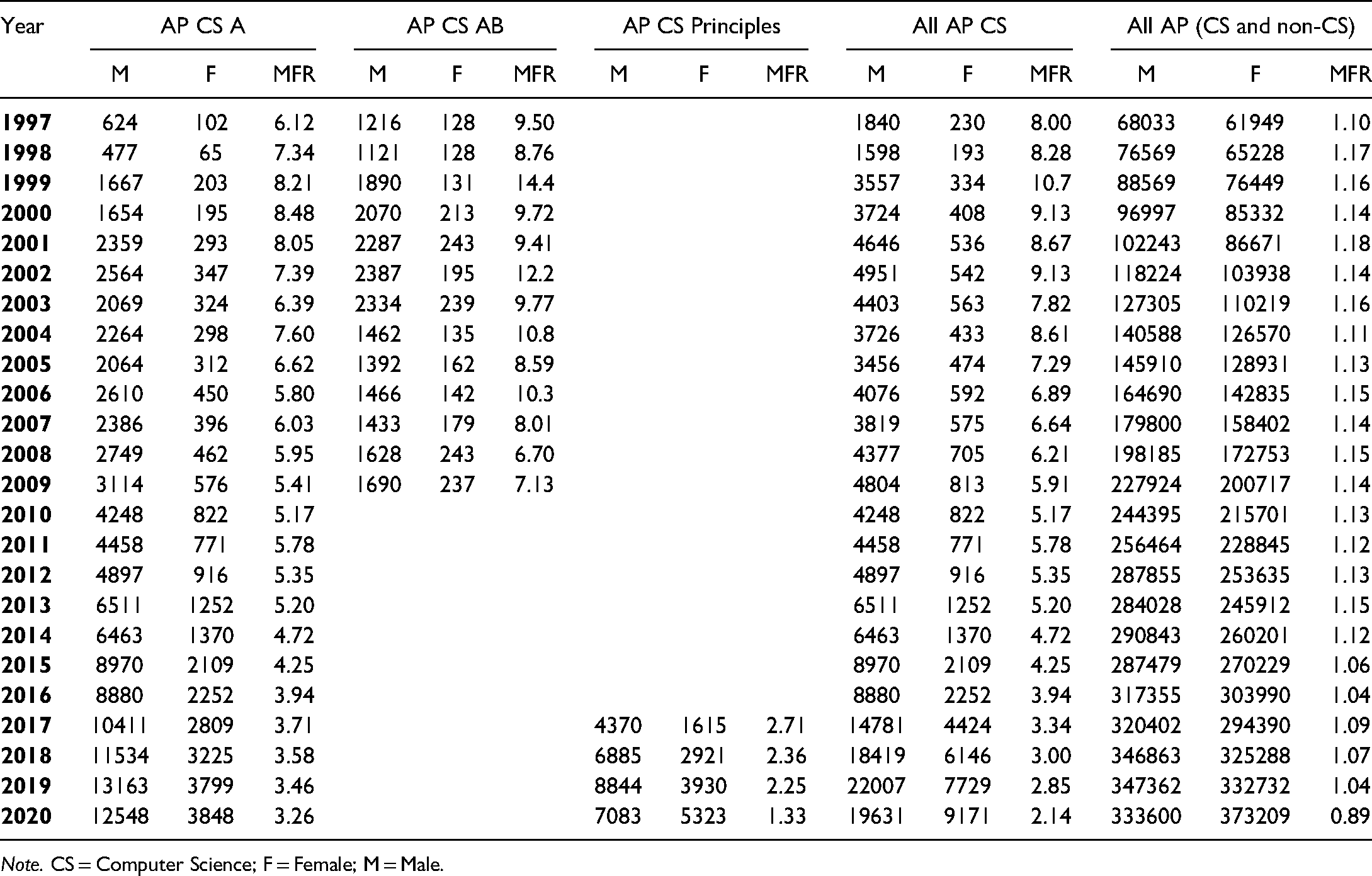
Note. CS = Computer Science; F = Female; M = Male.
Procedures for AP CS Exams
AP CS A exam
According to the College Board data, more than 65,000 students participated in the AP CS A exam in May 2020; 18,048 of these students received a score of “five,” which is described as “extremely well qualified” and considered as a college grade equivalent of a letter score “A” or above. The overall mean score was 3.26, and the SD was calculated as 1.40; around 25% of test-takers scored at the “extremely well qualified’’ level in the 2020 AP CS A exams (College Board, 2021b).
The AP CS A exam lasts 3 h and consists of 40 multiple-choice questions (50% exam weight) accompanied by another section of four free-response items (50% exam weight) that assesses methods and control structures, classes, array/arraylists, and 2D arrays (College Board, 2021a). Table 1 provides the number of AP CS A test takers from 1997 to 2020. Table 2 shows the number of females and males who earned five out of five, which is “the extremely well qualified” level.
AP CS Principles
The AP CS Principles program was piloted in 2016 and introduced in 2017. The AP CS Principles attracted a larger number of students since its launch compared to AP CS A, which showed steady increases over the years. More particularly, the number of test-takers grew rapidly from 43,780 in 2017 to more than 116,525 in 2020 according to the College Board data. Among the 116,751 students who took the AP CS Principles exam in May 2020, 83,605 students received a score of “three” or higher, but only 12,775 students achieved a “five” which represents 10% of participants. The overall mean score was 3.09, and the SD was calculated as 1.10 (College Board, 2021b).
The AP CS Principles exam consists of two parts: the Create performance task and the end-of-course exam. For the Create performance task (30% weight of the exam), students have at least 12 h to develop a program during class time. The College Board specifically emphasizes class time in order to address access, lack of infrastructure, and equity issues. For the end-of-course exam (70% weight of the exam), unlike the AP CS A exam, students are required to respond to the 70-multiple choice questions in two hours that includes single-select (57), single-select with a reading passage (5), and multi-select (8) assessment items; there are no free-response questions. The AP CS Principles exam included an Explore task that asked students to identify the impacts of computing and write a paper on these, but the Explore task was dropped in the 2020–2021 period, and was replaced with reading passage questions followed by single-select multiple-choice questions about a computing innovation (College Board, 2021a). The gender breakdown of AP CS Principles exam takers is shown in Table 1. The gender breakdown for students who received a score of 5 appears in Table 2.
AP CS Ab
Similar to the AP CS A exam, the examination consisted of multiple-choice and open-ended questions. Students were provided exactly three hours to complete the exam in the last administration of the exam (College Board, 2008) and both sections held equal weights. The AP CS AB program did not receive satisfactory demand and recognition from stakeholders to sustain the program. Every year, participation in the program decreased and the number of test-takers declined significantly. For instance, 7,403 students participated in the program in 2001; however, the program lost approximately 33% of exam takers and only 4,900 students participated in the 2009 administration of the exam. Tables 1 and 2 depict the gender breakdown for exam takers and top scorers respectively for the AP CS AB program from 1997 to 2009.
Data Analysis
Disparity index calculations
Researchers have used different types of disparity indexes to explore disparities in educational settings (Bahar, 2021a; Bahar, 2021b; Ellison & Swanson, 2010; Hyde et al., 1990; Hyde et al., 2008; Lindberg et al., 2010; Makel et al., 2016; Olszewski-Kubilius & Lee, 2011; Robinson & Lubienski, 2011; Wai et al., 2018). In this study, similar to some prior studies (Bahar, 2021a; Makel et al., 2016; Wai et al., 2018), we compared the number of males to females in AP exam participation and top achievement and we reported an MFR as a measure of gender disparity index. The MFR index can be presented as
Index of Gender Disparity in Participation: In this study, we defined the gender disparity in participation as a measure of AP exam participation. We reported the index using the MFR among the number of students who participated in the exam.
Index of Gender Disparity in Top Achievement: Researchers who investigated the disparities in top achievement generally looked into the performances of top achieving students (Bahar, 2021a; Benbow & Stanley, 1983; Makel et al., 2016; Wai et al., 2010; 2018). Given that AP exams are criterion-referenced and student exam scores range from 1 to 5 with 5 being the highest possible score, we identified a score of 5 as top achievement. This is in line with the AP Score Scale table published by the College Board, which recommended a score of 5 as “extremely well qualified” with a college course grade equivalent of A + or A (College Board, 2021a). According to the College Board reports, roughly 20% of the participants received a score of 5in the past AP CS exams. In this study, similar to the participation index defined earlier, we also reported the top achievement index in terms of the MFR among the students who scored five on any of these AP CS exams.
Analysis of research questions
The analysis of the research questions needed the use of MFR values. For this purpose, after retrieving the number of participants and top scorers on any AP CS exams from the College Board's database, the MFRs were calculated for participation and top achievement for each year between 1997 and 2020. To explore the trend in gender disparity in participation and top achievement in the exams, the Mann-Kendall (MK) trend test was employed. The MK trend test (Kendall, 1975; Mann, 1945) is a nonparametric test to detect the presence and significance of trends in a time series (Hamed, 2008). Although it is not a common method in educational research, the MK trend test has been recommended as a powerful tool to explore the flow of changes in educational settings (Bahar, 2021a). One of the strengths of the MK test is that, apart from parametric trend tests, the MK does not require data to be normally distributed (Hamed, 2008) and can be used with smaller data sets (Bahar & Maker, 2020).
To assess the direction and the magnitude of the slope of trend lines over time, Sen's nonparametric slope estimates were used. As an alternative method to the parametric least squares regression line procedures, Sen's slope estimator is a robust method that is resistant to outliers (Sen, 1968; Wilcox, 2001). The XLSTAT software was used to perform both MK trend tests and Sen's slope estimators.
Results
The number of male and female students who participated in each type of AP CS exam was shown in Table 1 as well as the MFRs for each year between 1997 and 2020. Similar information concerning the number of male and female students who scored five on the exam was shown in Table 2. To give readers a better picture of the status quo in gender disparities among AP CS exam participants and top achievers, we additionally calculated the number of students and MFR values for all AP exams (including non-CS exams) and depicted them over Tables 1 and 2. Having the MFRs in AP CS and non-AP CS exams given together on the same tables allows readers to draw comparisons across AP exams.
Research Question 1
The findings indicated that the MFRs among students who participated in any type of AP CS exam declined from 4.87 to 2.26 between 1997 and 2020 (Table 1). According to the MK test, the MFR trend was downward, statistically significant (p < .001), and favored females (Table 3). The Sen's slope estimator procedures showed that the magnitude of the change in the trend line (slope) was −0.179 per year (Figure 1), which means the decline in the MFR was roughly one point in every 5–6 years. This shows that if the current trend remains steady, the number of males and females who participate in all types of AP CS exams will reach parity in less than two decades.
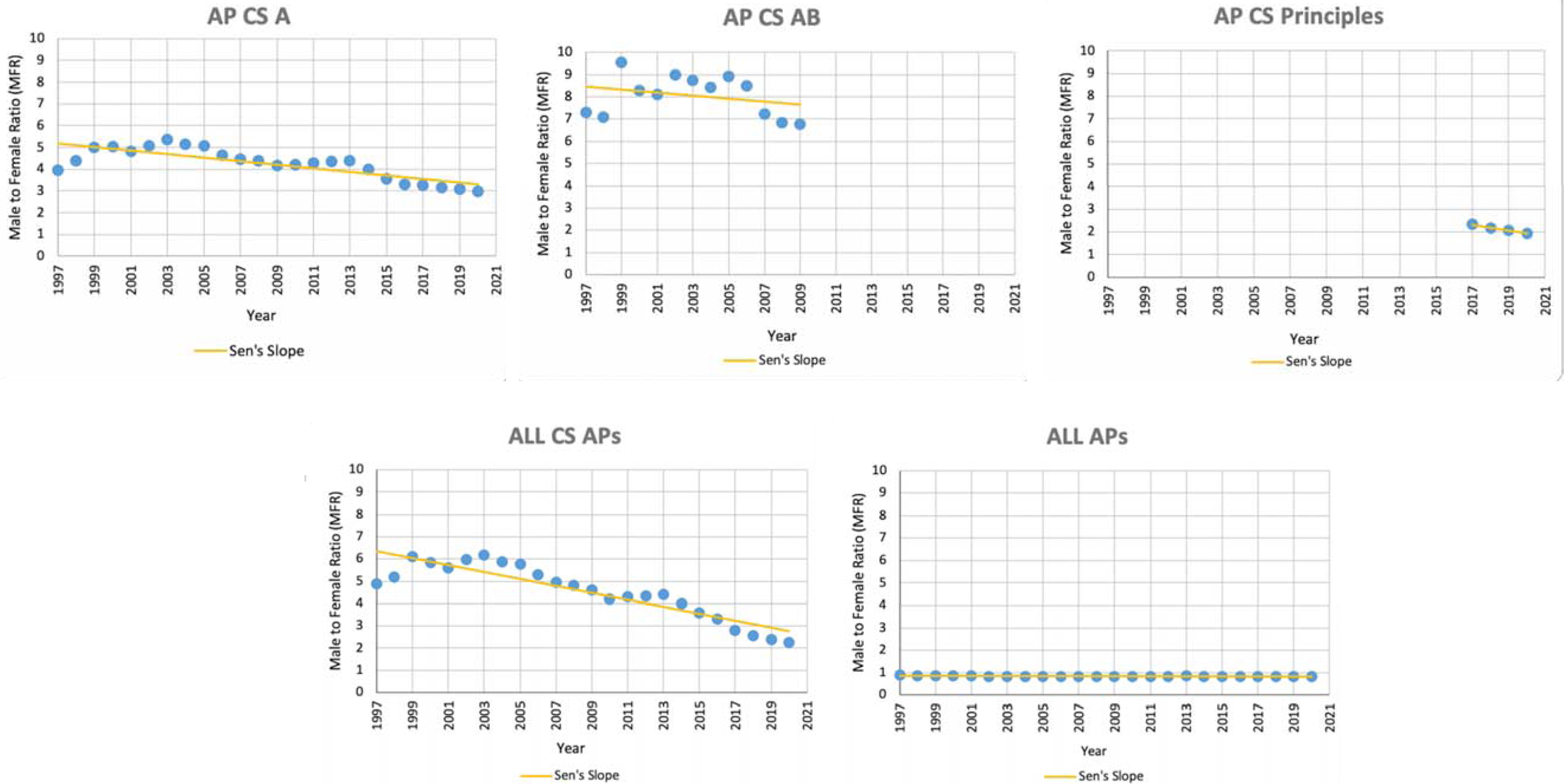
Trends in male-to-female ratios (MFRs) among all participants and Sen's slopes.
Mann-Kendall (MK) two-Tailed Trend Test Summary Statistics.
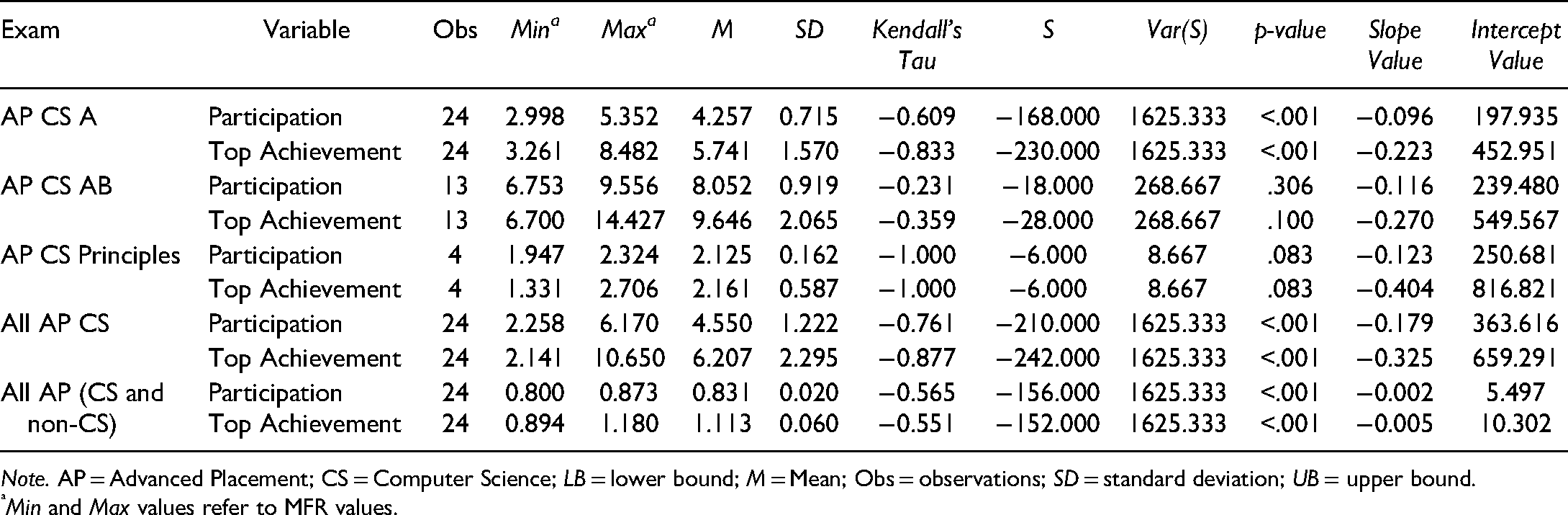
Note. AP = Advanced Placement; CS = Computer Science; LB = lower bound; M = Mean; Obs = observations; SD = standard deviation; UB = upper bound.
Min and Max values refer to MFR values.
The results of the MK test for the AP CS A exam were similar to that of all-AP CS exams. As the MFR values declined from 3.97 to 2.97 (Table 1), a significant decreasing trend existed (p < .001) between 1997 and 2020 (Table 3). The Sen's slope estimator procedures showed that the magnitude of the change in the trend line was −0.097 per year (Figure 1), which means the decline in MFR was roughly one point in every 10 years. This shows that if the current trend stays steady, the number of males and females who participate in the AP CS A exam will reach parity in less than two decades.
For CS AB and CS Principles exams, the MK test could not detect significant trends, which might be a result of a small data set (Figure 1). However, similar to CS A, the Sen's slope estimators presented a decline in the MFR slope for CS AB (slope value: −0.116) and CS Principles exams (slope value: −0.124).
Research Question 2
The trend in gender disparity in top achievement in AP CS exams showed similar behaviors to the trend in participation. The findings indicated that the MFRs among students who scored five (top score) on any type of AP CS exam declined rapidly from 8.00 to 2.14 between 1997 and 2020 (Table 2). According to the MK test, the MFR trend was downward, statistically significant (p < .001), and favored females (Table 3). The Sen's slope estimator procedures showed that the magnitude of the change in the trend line was −0.325 per year (Figure 2), which means the decline in MFR was roughly one point in every 3–4 years. This shows that if the current trend stays steady, the number of males and females who scored five in all types of AP CS exams will reach parity in several years.
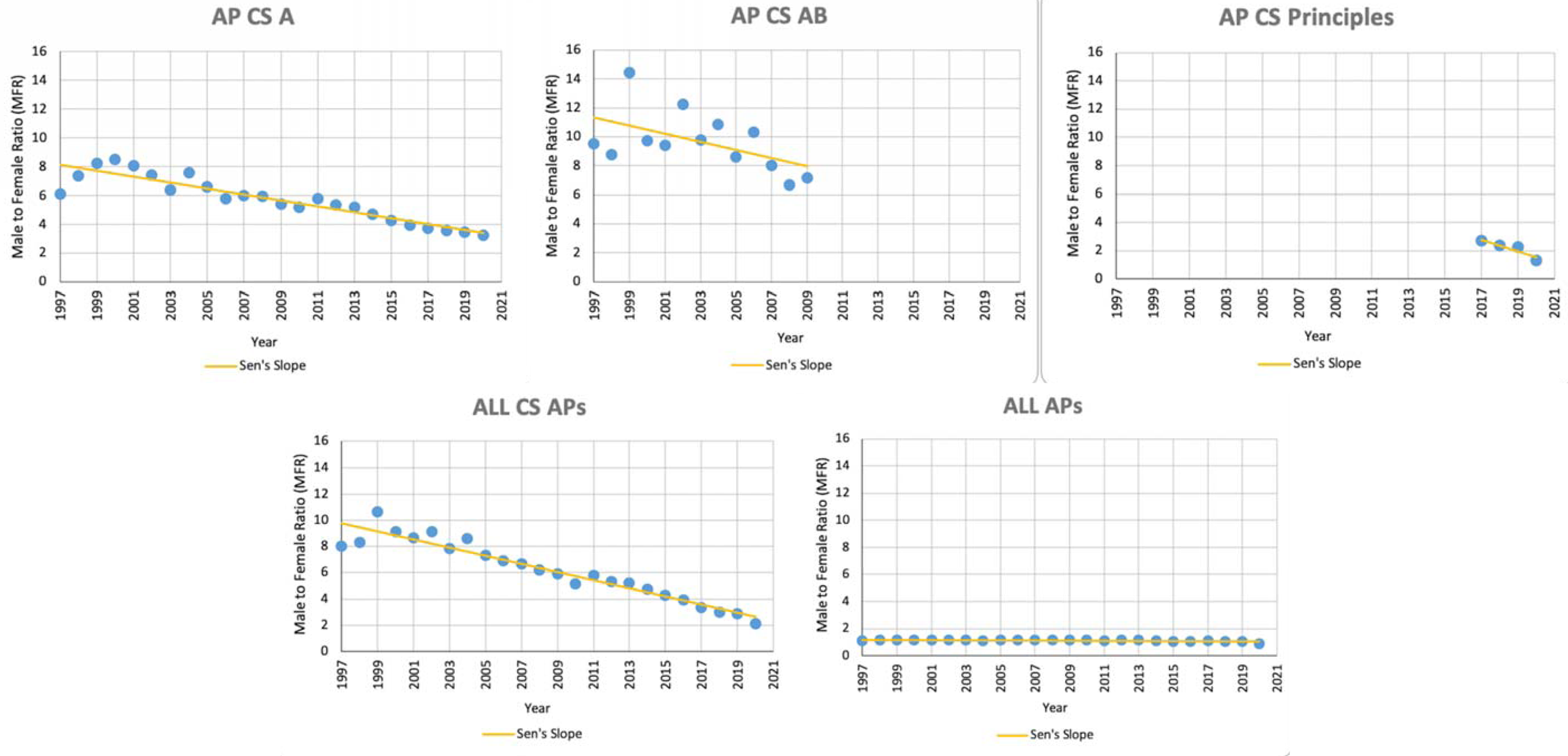
Trends in male-to-female ratios (MFRs) among top scorers (score of 5) and Sen's slopes.
The results of the MK test for the AP CS A exam were similar to that of all AP CS exams. As the MFR values declined from 6.12 to 3.26 (Table 1), a significant decreasing trend existed (p < .001) between 1997 and 2020 (Table 3). The Sen's slope estimator procedures showed that the magnitude of the change in the trend line was −0.223 per year (Figure 2), which means the decline in MFR was roughly one point in every 4–5 years. This shows that if the current trend stays steady, the number of males and females who scored five in the AP CS A exam will reach parity by around a decade.
Similar to the MK test results in participation, the MK test could not detect significant trends for top achievement in CS AB and CS Principles exams (Figure 2). However, similar to CS A, the Sen's slope estimators presented sharp declines in the MFR slope for both CS AB (slope value: −0.270) and CS Principles exams (slope value: −0.404).
Discussion
This study provided us with important findings discussed in this section. In line with our research questions, we presented these findings under two major headings: (a) gender disparities in participation and (b) gender disparities in top achievement.
Trends in Gender Disparity in Participation for AP CS Exams
There is an increase in the number of programs that attempt to broaden the participation of girls in CS education in order to expand their access, interest, and attitude toward computing (Cummings et al., 2021; Ericson et al., 2016; McAlear et al., 2019; Michell et al., 2017; Scott et al., 2017). In spite of these efforts, nationwide reports emphasize that gender disparity continues to exist (Google & Gallup, 2015; 2016). Generally, our findings are consistent with prior studies, which have identified gender disparities, in favor of males, in participation in CS programs (Boda & McGee, 2021; Ericson & McKlin, 2018). As shown in Table 1, the number of AP CS exam takers was in favor of males for all three exams. According to the data we evaluated, the MFRs among any kind of AP CS exam takers in 2020 was roughly 2.26, whereas the MFR in the same year for all AP exams was around 0.80. Overall, comparing the MFR values among AP exam participants, the data indicated that the percentage of female students in a non-CS AP exam room was three times more than those of females in an AP CS exam room. Our findings confirm that the gender disparities in AP CS programs are similar to those in the computing workforce.
Although these numbers presented clear evidence for female underrepresentation in AP CS programs, the trend analysis provided hope for closing the gender disparities in the future. From 1997 to 2020, the MFR value declined from 4.87 to 2.26 for all AP CS exam takers. The trend analysis indicated a significant decreasing trend in MFR values across years, which has been in favor of females. Further, according to Sen's slope estimator procedures, if the current trend stays steady, the number of males and females who participate in all types of AP CS exams will reach parity in less than two decades. All of these promising findings show that the percentage of female students participating in AP CS classrooms is increasing steadily.
According to the data, while in operation between 1997 and 2009, the AP CS AB program could not succeed to gain sufficient interest from students; more specifically, there was a lack of interest from female students. During these 13 years, the average number of female participants in the AP CS AB exam was barely over 500 for any year. Meanwhile, the MFR value for the same exam was roughly 8.00, which was twice more than that for the AP CS A exam during the same period. After the AP CS AB exam was discontinued following the 2009 exam, the AP CS A served as the only CS course in the AP program until 2017. The trend analysis indicated that MFR values for AP CS A exam have significantly decreased, in favor of females, between 1997 and 2020. Further, the findings showed that, even without the addition of the AP CS Principles course in 2017, the MFR among participants in AP CS A exams would reach parity in the next two decades. However, it is evident that reaching parity in MFR values is shortened by half with the addition of the AP CS Principles course.
Investigating the factors that affected the decline in MFR values and significant decreasing trends in gender disparities was beyond the goal of this study. However, we argue that the addition of the AP CS Principles course to the AP CS program was one of the factors that accelerated the decline of the MFR in the overall AP CS program. Given that no trend in MFR values existed among participants in AP CS Principles, readers can question how the addition of the AP CS Principles accelerated the decline of MFR in the overall AP CS program. One of the facts behind our argument was that, as of 2020, the MFR among participants in AP CS A exam was 2.97, whereas it was only 1.94 for the AP CS Principles exam. Moreover, the number of girls who participated in the AP CS Principles exam jumped from 13,000 to 39,000 in just 3 years. Considering the number of female students in the entire AP CS program never reached 13,000 in any year before 2016 even when AP CS A and AB courses were combined, it is reasonable to assume that the AP CS Principles course played a role in the decline of the MFR value among AP CS participants.
Although it is still far from having parity in MFR values among participants, the AP CS Principles course has been the most successful AP CS program to reach females. One can question what makes AP CS Principles more successful than AP CS A and CS AB courses aimed at reaching females. We believe that this is a very valid and important question to unearth why females are underrepresented in AP CS programs and even further in the CS labor force. At this point, we pivot our point of view on the matter and suggest looking into why females did not favor AP CS A or AB programs compared to the AP CS Principles. Given that average MFR values in AP CS A program has been almost double of that in AP CS Principles, understanding the factors that contribute to such high MFR values in a different CS program might provide researchers with significant clues to answer the question. However, this is an essential question left for future researchers.
Trends in Gender Disparity in top Achievement for AP CS Exams
One purpose of this study was to explore the trends in gender disparity for top achieving students who scored “five” at the AP CS exams. As seen in Table 2, the number of male students who received “five” at the AP CS programs was higher than the girls for all AP CS exams. According to the findings, the average MFR among students who scored 5 from any kind of AP CS exam between 1997 and 2020 was roughly 6.2, whereas the MFR value for the same period for all other AP exams was around 1.11. Similar to the findings associated with AP CS participation, the data indicated that the percentage of top-scoring female students (scoring five out of five) in a non-CS AP exam room was almost six times more than those of females in an AP CS exam room. Overall, these findings were consistent with earlier research, which reported that AP CS programs mostly favored male students in regards to top achievement (Boda & McGee, 2021; Brown & Brown, 2020; Ericson & Guzdial, 2014). However, we found that, from 1997 to 2020, the MFR value among top scorers declined from 8 to 2.14 for all AP CS exam takers. Regarding the decline in MFR values, the trend analysis indicated significant downward values across years, which has been in favor of females. Comparing the numbers over years, the decline in MFR values has been a significant accomplishment for gender equity.
Although overall trends for top achievement and participation were similar, the MFR values among top scorers were higher than those among all participants for overall AP CS data. For example, the average MFR among students who scored five on any kind of AP CS exam between 1997 and 2020 was roughly 6.2, whereas the MFR value among all AP CS participants was around 4.55. This is an interesting finding because factors associated with the underrepresentation of females in AP CS participation were not reflected at the same rate in top achievement. Several prior studies pointed out similar problems in mathematics and spatial thinking domains as the gender gaps were found to be widening significantly at the right tail of the achievement curve (Bahar, 2021a; Benbow, 1988; Gallagher et al., 2000; Wai et al., 2009; Webb et al., 2007). Among these researchers, some of them associated higher gender disparities among top achievers with differences in cognitive abilities between males and females in these domains (Benbow, 1988; Gallagher et al., 2000; Wai et al., 2009; Webb et al., 2007). Although this claim may seem to offer a plausible explanation regarding higher gender disparities among students scoring five in the AP CS exams, we think the consistent decline in the disparities over the years suggests a different explanation. Supporting our perspective, studies in CS education revealed that females could achieve as high as males when interventions were specifically designed for their needs and interests. For example, Boda and McGee (2021) also acknowledged that girls who participated in the Chicago Alliance for Equity in Computer Science (CAFÉCS) program performed as well as males in the AP CS A programs in Chicago. CAFÉCS is a Researcher-Practitioner Partnership that places the accent on equity in CS education in Chicago Public Schools. The goal of the organization is to ensure that all students regardless of gender, ethnicity, and ability have access to engaging and rigorous CS courses. CAFÉCS offers teacher professional development and assists students for courses like AP CS. In another study, Ericson et al. (2016) demonstrated that girls who attended the Sisters Rise Up 4 CS program performed better in the AP CS A exam than boys. Ericson and her colleagues founded Sisters Rise Up 4 CS in Georgia and the program has been a part of the Expanding Computing Education Pathways program, which provides assistance, tutoring sessions, role models, and engaging technology experiences for girls who are taking AP CS exams. Ultimately, the program aimed to increase the number of girls passing AP CS exams, and therefore increase the number of women pursuing computing fields. Looking into the commonalities in these programs, the availability of mentors who were near-peer role models along with increased attention to equity, diversity, and inclusion made a difference (Cummings et al., 2021; Ericson & McKlin, 2012; 2018; Ericson et al., 2016). Additionally, introduction to computing through culturally and socially relevant programs, implementing inclusive pedagogy, and incorporating socially meaningful activities into the courses might have led girls to higher achievement in AP CS programs (Boda & McGee, 2021; Christensen et al., 2021; Ericson & McKlin, 2018; Goode & Chapman, 2011; Marcher et al., 2021; Margolis et al., 2008).
Moreover, if the high MFR values among top achieving students were related to cognitive abilities, it would make sense to expect similar findings across different countries and cultures. However, females have outperformed males in CS programs in England (Kemp et al., 2019). Similarly, in Malaysia, females dominated the computing workforce (Mellström, 2009). Melstrom has associated these findings with the cultural and social settings instead of cognitive abilities. Similar to what previous research suggested, social barriers might be playing an important role with regard to top achievement. In addition, stereotypes that depict computing as a masculine field, and a lack of belongingness, encouragement by parents and teachers, and role models in media and classroom in addition to an unsophisticated understanding of computing careers, and naive perceptions about computing might cause females to think that they do not have sufficient abilities to earn top scores in CS (Master et al., 2021; Wang & Hejazi Moghadam, 2017; Wang et al., 2015). In turn, this might lead young women to fail to perform at their highest level and may cause them to achieve lower scores than males. However, revealing possible factors for these disparities in top achievement are beyond the scope of this study; therefore, this is an important endeavor for future researchers.
Implications for Practice
Our findings have important implications for educators to ameliorate the gender differences in K–12 CS programs. First, our trend analysis indicated that large gender gaps, in favor of boys, emerged in CS education; however, the disparities have been declining significantly over the years. In particular, the addition of the AP CS Principles course has accelerated the period to reach parity in participation and top achievement. This implies that a people-oriented, socially meaningful, culturally relevant, and responsive computing curricula that cover a broader range of computing topics that are designed to encourage females to participate in CS education would definitely make a difference (Christensen et al., 2021; Marcher et al., 2021). On a parallel track, many experts in the field of CS education advocated for altering the programming language in AP CS A from Java to Python and incorporating topics more appealing to girls, such as data science, as Barbara Ericson and Barbara Liskow discussed during their keynote talk at the SIGCSE 2022 event. In regards to this fact, prior research and anecdotal evidences suggested that practices and strategies, which were designed to promote belonging and interest such as creative and expressive computing, have been successful in expanding girls’ participation and top achievement in CS courses (Barker et al., 2002; Guzdial, 2021; Master et al., 2016). At this point, we stress that educators, in particular CS teachers and school counselors, play a crucial role in encouraging the participation of females in CS programs. Teachers and counselors can contribute to the recruitment of a higher number of females to CS courses through initiatives that are designed to foster female students’ self-efficacy such as formal and informal school or after-school activities. Furthermore, like prior studies suggested (Ericson & McKlin, 2012; 2018; Ericson et al., 2016), increasing the appearance of female role models at the school by inviting successful female professionals as guest speakers and providing networking opportunities with peers who major in CS programs would allow females to observe others and increase their self-efficacy toward CS occupations too.
Given that early exposure to introductory and inclusive computing programs in elementary, middle, or early high school might motivate students to take AP CS courses (Tsan et al., 2016), school curricula should be enriched with a higher number of pre-AP CS courses. Similarly, research suggested that students who participated in the AP CS Principles program are more likely to enroll in the AP CS A program. For example, Brown and Brown (2020) found that females who participated in the AP CS Principles program were more motivated to take the AP CS A exam and likely to go to college when compared to students who didn’t participate in the AP CS Principles programs. Similarly, Sax et al. (2022) found positive associations between participation in AP programs and majoring in computing fields for girls. In another study, Boda and McGee (2021) found that students who enrolled in early CS programs increased girls’ participation in AP CS programs. Combining them with the findings of our study, we suggest educators reach and recruit female students earlier through these introductory courses to increase their perseverance. Making students feel a sense of belonging to the CS classroom through engaging them with relevant projects, ensuring that they are safe in CS classrooms, and helping them understand that computing is a highly creative, collaborative, and socially meaningful and people-oriented occupation might influence girls’ participation and achievement in AP CS programs.
Lastly, in line with prior studies (Google & Gallup, 2016; Haller & Beyer, 2006), we believe teachers play a crucial role in increasing girls’ participation in CS education and workforce. If we would like to increase females’ participation and achievement in CS programs, we will need to equip our teachers with equitable and inclusive pedagogical knowledge as well as subject knowledge. However, most of the AP training initiatives, including College Board's AP Summer Institutes for teachers, are designed to increase teachers’ content knowledge. We recommend that professional development programs for in-service CS teachers should be designed in a way that considers equity as a priority. Relatedly, pre-service CS teacher education programs should draw attention to equity problems in computing so that teacher candidates graduate with awareness and competency to address the issue proactively and offer more inclusive CS courses and programs (Brown & Brown, 2020; Gray et al., 2020; Master et al., 2021). Finally, as Fletcher and Warner (2021) suggested, we recommend that teachers, administrators, and policymakers are encouraged to utilize the CAPE framework to identify antecedents to systemic gender inequities (Fletcher & Warner, 2021). Having such a paradigm will support educators and policy makers to approach the disparity problem from a broader exosystemic perspective, and we believe this will ease the process of designing efficient interventions for K–12 settings.
Implications for Future Research
According to the authors’ best of knowledge, no prior studies to date have investigated the association between disparity trends in participation and top achievement for AP CS exams. Thus, there is no similar study to compare and contrast the findings of our study. Nonetheless, it might be inferred from these findings that increasing females’ participation in AP CS programs will also positively influence the percentage of top-scoring females at AP CS programs. This is encouraging, particularly for the increased representation of women in the computing workforce. Given that prior studies have associated the disparities in the labor force with gaps in high levels of achievement in early educational attainments (Lazear & Rosen, 1990; Makel et al., 2016; Wai et al., 2010), declining MFR values in participation will not only positively reflect in top achievement in AP programs but also reflect in later job opportunities for females. However, we also assert that reaching parity in MFR participation values might not be enough to reach parity among top achievers. Examining the factors that contribute to lower MFR values in top achievement is still an important question for future researchers. It would also be appropriate to utilize qualitative methods to answer some of the follow-up questions that we suggested in this study.
Limitations
The empirical findings reported herein should be considered in the light of some limitations. First, we investigated the gender disparities among students who took AP CS exams, rather than those for students who enrolled in AP CS programs. Students are not mandated to take the corresponding AP exam after completing the course, and the datasets we obtained from College Board only represent the data belonging to examinees rather than students who enrolled in the program. For example, as of 2018–2019 school year, out of 117,787 high school students who enrolled in any AP program in the State of Georgia (Georgia Department of Education, 2021), only 84,239 of them chose to take an AP exam. Although we do not have national data available to us, from the example of Georgia, we conclude that roughly 1 out of 4 students who enrolled in an AP course does not take the AP exam followed by the course. This means that our findings allowed us to make discussions only about AP exam takers rather than all students enrolled in AP CS courses.
The second limitation concerns the data that belonged to the 2020 examination year. Given that 2020 testing was compromised by COVID-19 shutdowns that began about a couple of months before the AP exam period in May, the exam scores from 2020 might have shown discrepancies from the regular trends. We could have taken out the 2020 exam data from the dataset but we did not for a couple of reasons. First, we did not have any evidence from the literature to claim whether pandemic conditions might have impacted male and female participation and achievement differently in 2020. Second, the impact of COVID-19 was not temporary, and it is still prevalent all over the world. Taking out the 2020 data from the analysis would look like skipping a reality and this would be misleading for readers so we chose to include it in the dataset. However, these results must be interpreted with caution by readers and future researchers.
Lastly, another limitation was about the potential threats with the longitudinal data that might have masked possible measurement variances over the dataset's 24-year period. Considering the rapid growth of AP CS program over the years, some readers can question whether AP CS exams can be considered as a stable indicator of gender gaps in computer education. Although we find this as a relevant concern, we do not have any information/evidence to reject this practice. However, we believe further qualitative investigations are needed to disclose these potential threats, if they exist, so that we recommend future researchers to investigate these points.
Conclusion
Due to the ubiquity of computing in today's world, there is an increasing attempt to bring CS education in pre-college years, particularly at the high school level. In this context, the AP CS program has been a major pathway to educate and motivate students for future computing careers. Given that achievement in AP CS exams is a significant indicator of future career opportunities in computing fields, we will need to increase the number of females participating in these programs. This notion suggests that extending inclusive educational initiatives and strategies as well as creating new pathways for females is needed now more than ever before. Putting equity and inclusion at the center of these initiatives not only increases females’ participation in computing classrooms, but also assures a higher number of top-achieving women. This effort may further influence females’ representation in computing careers and help diminish the gender disparities in computing jobs and other STEM fields (Cummings et al., 2021; Vachovsky et al., 2016).
Footnotes
Declaration of Conflicting Interests
The authors declared no potential conflicts of interest with respect to the research, authorship, and/or publication of this article.
Funding
The authors received no financial support for the research, authorship, and/or publication of this article.
