




Abstract
The cultivation of neighborhood-based social capital has gained significant attention in the disaster management sector in recent years as a means to increase community disaster resilience. However, within the sector, the concept of social capital remains unclear and its measurement is limited at the neighborhood level due to a focus on predominately top-down and quantitative approaches. By using a qualitative, inductive-driven approach, this paper proposes an integrated social capital measurement framework that combines qualitative and quantitative measures for evaluating levels of social capital in neighborhoods. Nine focus groups consisting of 58 participants across a range of socioeconomically and ethnically diverse urban neighborhoods in New Zealand and the United States were conducted. Three key themes were identified that relate to the formation, activation, and benefits of social capital resources: community demography, cultural influences on social support, and neighborhood governance. By synthesizing the study’s results and existing literature, this paper proposes a measurement framework that incorporates both quantitative indicators and contextual questions across six structural and four cognitive social capital domains. The framework can serve as a starting point for neighborhood stakeholders, emergency management practitioners, policymakers, and researchers to assess the resilience of neighborhoods and identify areas for improvement.
Introduction
A growing emphasis in policy, research, and practice on building community disaster resilience over the past two decades has spawned a proliferation of community disaster resilience assessments and tools (Cutter 2016; International Federation of Red Cross and Red Crescent Societies 2016; Ostadtaghizadeh et al. 2015; Sharifi 2016). The ability to measure disaster resilience allows policymakers, researchers, and practitioners to baseline existing levels of resilience, evaluate the effectiveness of resilience interventions, and track progress toward desired resilience goals (Committee on Increasing National Resilience to Hazards and Disasters and Committee on Science, Engineering, and Public Policy 2012).
Increasingly, these assessments highlight the importance of enhancing the resilience of the social environment, or “social resilience,” and complementing this with other physical or built mitigation measures as a means to enhance communities’ readiness to future hazard events (National Institute of Standards and Technology 2015). In particular, social capital—a component of social resilience—has been highlighted by nongovernment and government stakeholders as a key way to increase the resilience of individuals and communities (Kwok et al. 2016; Kwok et al. 2018). Lessons from past disasters such as the Kobe earthquake in Japan, Hurricane Katrina in the U.S. Gulf Coast, Hurricane Sandy in the eastern United States, and the Christchurch earthquakes in New Zealand underscore the important roles that social capital played in facilitating community disaster and recovery (Aldrich 2012b; Elliott, Haney, and Sams-Abiodun 2010; Nakagawa and Shaw 2004; Paton et al. 2014; The Associated Press-NORC Center for Public Affairs Research 2014). These experiences illustrate how people, organizations, and communities actively invest in and activate social capital to plan for future natural hazard events and procure necessary resources for disaster response and recovery.
However, despite decades of research on the conceptualization and measurements of social capital and continued investments in interventions that seek to increase the levels of community-level social capital by nongovernmental agencies (e.g., Australian Red Cross 2012; Herbst and Yannacci 2013) and local governments (e.g., City and County of San Francisco 2016; Wellington City Council 2017), the disaster management sector has yet to clearly define what social capital is and how it can be measured (Australian Red Cross 2012).
This paper offers stakeholders involved in building community disaster resilience an integrated assessment framework to use in a novel approach to baselining social capital and evaluating progress toward increased neighborhood social capital levels. This framework derives a set of quantitative and qualitative measures by drawing on the contributions of diverse neighborhood stakeholders who are seen as being on the frontline of disaster preparedness and response (Gaillard and Mercer 2013). This assessment approach moves the rhetoric of social capital and community disaster resilience to actionable collective strategies that reflect the different needs and priorities of individual neighborhoods.
This paper reports findings on focus group discussions with stakeholders from five neighborhoods in New Zealand and the United States. While the topic of the focus groups centered on social resilience, a recurring theme in the discussions pertained to the perceived importance of social capital. As such, this paper presents the authors’ analysis of participants’ framing of social capital and development of disaster resilience-related social capital measurements. Although the proposed assessment framework presented in this paper needs to be validated by relevant stakeholders who will be using it (e.g., community leaders, emergency management practitioners, and policymakers), it serves to provide them with a starting point to assess the relative resilience of their neighborhoods and identify areas for improvement.
Rationale for Identifying Social Capital Measures within the Context of Disaster Resilience
Despite extensive research on the conceptualization and measurements of social capital, there remains confusion within the disaster management sector over what social capital is and how best to measure it (Australian Red Cross 2012). Predominately, resilience assessments benchmark and evaluate social capital through a positivistic lens, which results in two challenges. The first challenge is the omission of a consideration of contextual influences on social capital levels within a standardized, quantitative-based approach (e.g., Sherrieb, Norris, and Galea 2010). Such an approach overlooks local values, dynamics, and conditions that could have facilitated or hindered the development and manifestation of social capital resources (Mohan and Mohan 2002). As will be discussed later, social capital is a place-based and context-specific resource (Mohan and Mohan 2002). Consequently, reliance on standardized indicators for policy and programme development could impair the responsiveness of interventions to local conditions and their effectiveness in achieving intended objectives.
Encouragingly, this problem is beginning to be addressed through qualitative studies that explore how social capital unfolds in a disaster environment; these studies point to the contextual influences relating to racial, cultural, gender, rural/urban, and livelihood factors (Chamlee-Wright and Storr 2009; Cox and Perry 2011; Ganapati 2012; Graham, Debucquoy, and Anguelovski 2016; LaLone 2012). While these studies seek to identify contextual influences of social capital in a disaster environment, they do not (and are not intended to) derive resilience measures from their findings. Thus, more research is needed to ground resilience assessment and evaluation measurements through contextual findings.
The second challenge is that, while social capital measures are quite mature in the literature, their application within the context of disaster risk reduction (DRR) remains nascent. As a result, established measures may not apply to disaster contexts. For instance, practitioners at the Australian National Disaster Resilience Roundtable (Australian Red Cross 2012) stressed the importance of developing measures that are fit-for-purpose instead of using generic standard social capital assessments: In order to gauge the strength of social capital in communities, it is recommended that a number of simple indicators be chosen to help with targeting and planning activities. These indicators should be easy to use, universal and need to be applied in a way that does not require complex analysis. Consideration should be given to indicators that relate to disaster resilience. (P. 5)
This challenge of creating customized social capital measures creates an opportunity to develop measures that enable community and government stakeholders to identify barriers to and opportunities for disaster preparedness, response, and recovery.
To address these two challenges of considering contextual influences on social capital and applying them to disaster contexts, this study used an inductive, qualitative-driven approach to examine the conceptualization of social capital by stakeholders from five neighborhoods in New Zealand and the United States that are at risk of future seismic events, finding recurring themes that form the basis of social capital measures applicable across study neighborhoods.
This paper first provides an overview of how social capital is conceptualized and measured within the disaster literature. This is followed by discussions on the study’s methodology and results, with a focus on three social capital themes: community demography, cultural influences on social support, and neighborhood governance. Through a synthesis of the literature and this study’s results, this paper proposes a set of indicators and contextual questions for assessing neighborhood-based levels of social capital. This paper concludes with the study’s limitations and future research directions.
Literature Review
For decades, researchers outside the disaster management field have sought to examine social capital as a means to understand various social issues, including family and youth problems, education, community life, work and organization, democracy and governance, and development issues (Woolcock 1998, footnote 20). As a concept, social capital is integral to many government policies and community programmes that aim to facilitate desired societal outcomes (Lelieveldt 2008; Putnam 2000; Woolcock and Narayan 2000). Although researchers have come up with a range of conceptualizations of social capital, most agree that social capital exists within social relationships or social networks (Castiglione, Van Deth, and Wolleb 2008; Lin 2008). Lin (2008:15) defines social capital as “resources embedded in one’s social networks, resources that can be accessed or mobilized through ties in the networks.”
A conceptualization of social capital distinguishes social capital by its features, sources (or inputs), or benefits (or outputs; Castiglione et al. 2008; Grootaert and van Bastelaer 2001). Putnam (1995) describes the features of social capital as including social networks, social norms, and social trust. Sources of social capital include mechanisms such as obligations and expectations, information channels, and social norms within social structures that could either facilitate or constrain the development of social capital (Coleman 1988). Putnam (1995) conceives that civic engagement fosters norms of generalized reciprocity and encourages the emergence of social trust, both of which form the foundation for collective action (an output) by promoting coordination and communication between individuals and groups in resolving societal challenges.
Another conceptualization revolves around two dimensions: its scope (micro, meso, and macro) and forms (structural and cognitive; Grootaert and van Bastelaer 2001) (Figure 1).
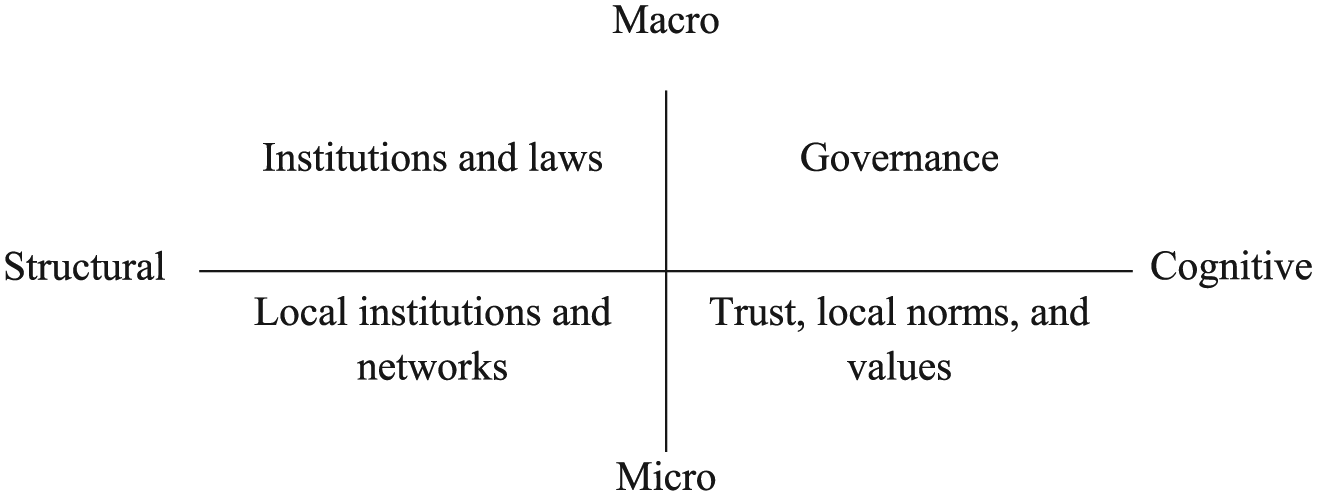
Scope and forms of social capital.
The scope of social capital refers to whether its resources are located at the level of household or community (micro), city or region (meso), or nation (macro; Grootaert and van Bastelaer 2001). Structural social capital consists of established patterns of behaviors such as roles, rules, and procedures within social organizations and networks. Cognitive social capital deals with civic culture, which comprises characteristics such as norms, values, attitudes, and beliefs that are informed by culture and ideology (Uphoff 1999). Together, structural and cognitive social capitals form the basis for collective actions that generate benefits for the collective whole (Uphoff 1999). Table 1 describes the sources and manifestations of structural and cognitive dimensions of social capital, as well as their domains and common elements.
Structural and Cognitive Dimensions and Characteristics of Social Capital.
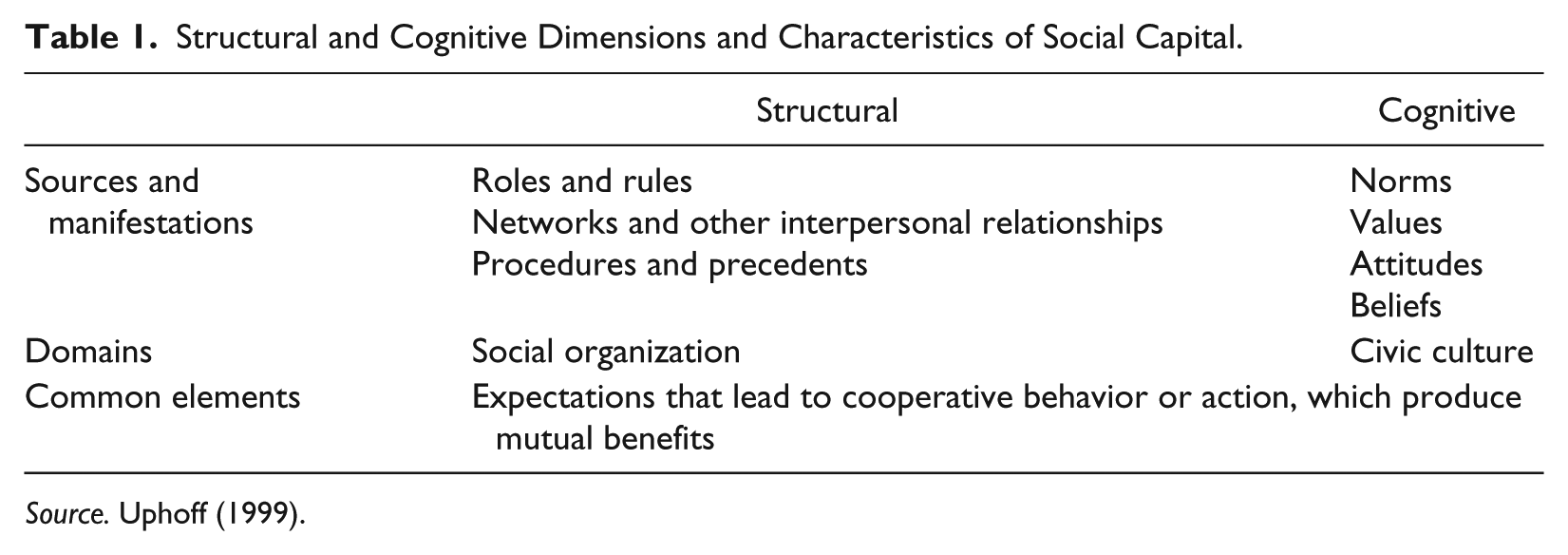
Source. Uphoff (1999).
As social relationships or social networks are a key component of social capital, a dominant conceptualization of social capital focuses on the three types of relational associations: bonding social capital, bridging social capital, and linking social capital (Woolcock and Narayan 2000). Bonding social capital is characterized by relationships of similarity such as family friends, neighbors, and people with shared interests and beliefs (Aldrich 2012a; Putnam 2000; Woolcock 2002). Because of their strong identities and sense of belonging, bonding social capital is more “inward looking and tend[s] to reinforce exclusive identities” but is “good for undergirding specific reciprocity and mobilizing solidarity” such as fulfilling members’ psychosocial and financial needs (Putnam 2000:22). Bridging social capital comprises “relations of respect and mutuality” between people from different networks, differentiated by factors such as socioeconomics, social identity, religious beliefs, age, ethnic group, or location of residences (Szreter and Woolcock 2004:655). While bonding and bridging relationships are horizontal in nature in which members share similar power differentials, bridging networks are more outward looking, serve as links to external assets, and are used for information diffusion (Putnam 2000; Szreter and Woolcock 2004). Linking social capital differs from the other two types as it consists of relational networks in which people “interact across explicit, formal or institutionalized power or authority gradients in society” (Szreter and Woolcock 2004:655). These are vertical relationships of differing power differentials based on mutual respect and trust, and are developed with the intent to achieve mutually beneficial objectives (Szreter 2002). Linking networks may include a variety of groups that hold decision making and resource allocation power.
These three distinct strands of social capital conceptualizations have been used to operationalize how social capital is examined within disaster resilience literature, which is discussed next.
Social Capital and Disaster Resilience
In alignment with existing conceptualizations of resilience, this paper describes resilience as an adaptive capacity (Becker, Paton, and McBride 2013; Berkes 2007; Klein, Nicholls, and Thomalla 2003 Norris et al. 2008; Paton 2006). Adaptive capacity is the ability of communities to identify and procure resources and competencies, so they can prepare for external stressors and appropriately respond to the consequences caused by the stressors (Engle 2011). Increasing adaptive capacity allows a community to improve how it manages and meets the unpredictable demands that arise from a natural hazard event and attains functionality in a new post-disaster environment (Paton and Johnston 2017). The role that social capital plays in increasing adaptive capacities of individuals and communities in disasters has received significant attention recently as a variety of disaster-related outcomes have been linked to the activation of the resources embedded within both informal and formal social networks.
A large body of research illustrates that community-based informal and formal networks serve to catalyze protective, response, and recovery actions such as preparing for disasters and mitigating hazard risks (Bihari and Ryan 2012); sharing disaster preparedness information at the individual and household levels (Becker et al. 2012; Becker et al. 2017); making official government warnings more credible, especially when there is preexisting distrust between community members and their governments (Litt 2008); assisting with the timely evacuation of friends, families, and neighbors (Hawkins and Maurer 2009; Litt 2008); responding to disaster impacts such as injuries and fires (Nakagawa and Shaw 2004); providing immediate disaster relief services and supplies (Feuer 2012; Hayward 2013); and planning for long-term disaster recovery through collective decision making and collective action (Adger 2003; Bolin and Stanford 2006; Graham et al. 2016; Montgomery 2013; Nakagawa and Shaw 2004). Furthermore, social capital has been linked to the promotion of other forms of capital within the context of natural hazard events, such as cultivating leadership skills (human capital; Becker et al. 2012), enhancing the financial well-being of individuals and households (financial capital; Shimada 2014), improving community governance and planning coordination (political capital; Aldrich 2012a), and protecting ecological services (natural capital; Adger et al. 2005).
While social capital is essential to effective disaster management efforts, people who are not part of a network may be excluded from collective benefits, as seen in various disaster response and recovery activities (Aldrich 2011; Aldrich and Crook 2008; Ganapati 2013). For instance, vulnerable populations (e.g., the elderly, women, and minority groups) in India were found to be excluded from aid in post-tsunami southeast Asia as they could not gain access to organizations that distributed it. In post-Katrina New Orleans, displaced residents without the financial resources to relocate or rebuild were further marginalized when neighborhoods with strong social infrastructure prevented the placement of undesirable housing trailers that sought to shelter them (Aldrich and Crook 2008). Recognizing how social capital can facilitate and impede disaster resilience is key to its assessment.
Social capital as a place-based resource
One of the connecting threads of the research referenced above is the spatial aspect of social capital. Although it could be argued that people’s social relationships can be based on shared interests that are irrespective of geographical locations, much of social capital within the context of disasters is proximal and is shaped by the character and context of places (Hawkins and Maurer 2009; Mohan and Mohan 2002; Murphy 2007). For example, the socioeconomic context of a women’s social network in an African American community (e.g., daily interactions through reciprocal assistance in childcare and job referrals) contributed to their effective evacuation response prior to the landfall of Hurricane Katrina (Litt 2008). Bonding social capital such as the women’s network is vital to low-income and marginalized groups, especially in the absence of government support and services (Adger 2003). In a second instance, LaLone (2012) examined the mobilization of social capital of rural Appalachian communities after the landfall of tornadoes. The setting of her research reveals that the long-standing social norm of generalized reciprocity—the exchange of goods and services without an expectation of immediate pay back—in families and among neighbors has been shaped by the historically coal-mining and farming industries as means to buffer against fluctuations of employment in those industries (LaLone 2012). Documented patterns of reciprocity are essential to successful early disaster response (LaLone 2012). These examples highlight that the activation of social networks in a disaster situation is confined, at least initially, within a narrowly defined area such as a neighborhood, even in hazard events that span a large geographic area (Murphy 2007).
Because social capital is largely a place-based phenomenon that is shaped by various contextual influences, this paper focuses on the conceptualization of social capital at the neighborhood (micro) level. As neighborhoods are at the frontline in preparing for as well as dealing with the aftermath of disasters, the neighborhood scale of analysis offers unique opportunities for examining how people invest in the development and mobilization of social capital resources to adapt to potential natural hazard events.
Measuring Social Capital within the Context of Disaster Resilience
The varied conceptualizations of social capital in social research have resulted in a wide array of measurement approaches ranging from quantitative to qualitative measures, from macro to micro levels, from structural to cognitive dimensions, from bonding to linking aspects, and from inputs to outputs (Grootaert and van Bastelaer 2001). Currently, there are numerous general social capital measurement tools. The more notable ones include the World Bank’s Social Capital Assessment Tool (SOCAT; Grootaert and van Bastelaer 2002) and the Social Capital [Community] Benchmark Survey in the United States (Harvard University 2000). Many measures from these tools have been integrated into national census and population surveys. Grootaert and van Bastelaer (2001) advocate three types of proxy indicators to measure social capital: membership in local associations and networks, trust and adherence to community norms, and collective action. The structural indicator of group membership not only captures the number of associations and members but also the extent of membership diversity, decision-making processes, and cultural relevancy of groups. The cognitive indicator of trust and norms adherence evaluates people’s expectations of social support and behaviors by group members that incorporate certain levels of trust. Collective action, an output indicator, reflects the social cohesiveness underlying the provision of community services or benefits (Grootaert and van Bastelaer 2001).
Disaster resilience assessments have shown an increasing recognition of social capital’s role in contributing to community disaster resilience. In a review of 14 assessments, Cutter (2016) found several recurring social capital measures across them, including participation in and saturation of civic organizations, and religious affiliation levels and the presence of religious organizations. These structural measures and measurement variables are listed in Table 2.
Recurring Social Capital Measures in Disaster Resilience Assessments.

Source. Cutter (2016).
While Cutter’s (2016) measures focus on structural variables, the authors of this paper delved deeply into the literature to elicit other ways social capital could be measured. From 12 selected disaster resilience assessments, they identified eight social capital measurement domains (Table 3).
Social Capital Domains and Measures in Selected Disaster Resilience Assessments.
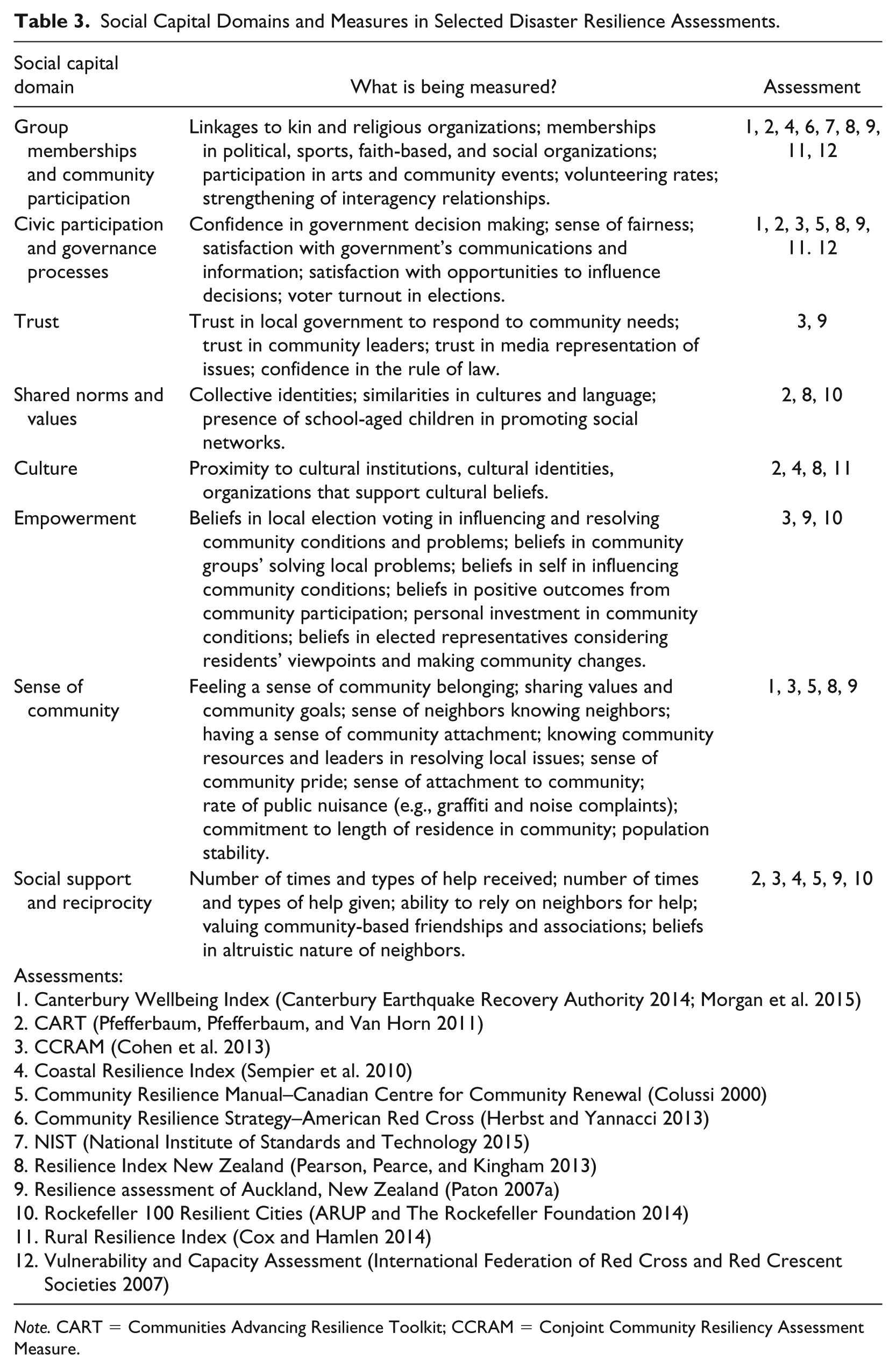
Note. CART = Communities Advancing Resilience Toolkit; CCRAM = Conjoint Community Resiliency Assessment Measure.
Overall, social capital is measured as input indicators (e.g., civic participation), direct social capital measures (e.g., trust, shared norms), and outputs (e.g., social support, empowerment) that span both structural and cognitive dimensions. For example, while participation in community groups fosters trust between members and cultivates leadership skills, which in turn increases social support and empowers members to make decisions that benefit their communities (Becker et al. 2011; Paton et al. 2014), assessments are more likely to quantitatively measure group memberships, civic participation, governance processes, and social support/reciprocity rather than cognitive dimensions such as trust, shared cultures and values, and empowerment.
Comprehensive measurement of both structural and cognitive dimensions of social capital is not new, but it has yet to gain traction in disaster research. Many behavioral and health science researchers, for instance, have recognized the need for assessing social capital holistically (Álvarez and Romaní 2017; Harpham, Grant, and Thomas 2002). For example, Onyx and Bullen (2000) developed and tested quantitative social capital measures across structural dimensions that included community participation and social networks and cognitive dimensions that pertained to trust, social norms, and social agency. Another example is the SOCAT, which is a three-part, mixed-method tool consisting of a qualitative community profile that seeks to identify contextual features of social capital, a quantitative household survey that measures structural and cognitive dimensions of social capital, and an organizational profile that examines relationships and networks within formal and informal institutions (Grootaert and van Bastelaer 2002; Krishna and Shrader 2000). Health researchers such as Harpham, Grant, and Thomas (2002) adapted the SOCAT by reducing the number of measures and distinguishing social capital attributes as either deriving from bonding or bridging relationships.
As disaster resilience assessments increasingly incorporate social capital measures, few tools address both the structural and cognitive dimensions of social capital. While most disaster research on social capital adopts the three structural types of social capital—bonding, bridging, and linking (Aldrich 2012a; Britt et al. 2012; Hawkins and Maurer 2009; Nakagawa and Shaw 2004)—this study expands the framework of social capital to also include cognitive dimensions. The cognitive aspect is essential for understanding and evaluating how existing norms, values, and beliefs give rise to social capital and how social capital resources could be mobilized under potential natural hazard events. The study’s authors adapted the conceptualizations of social capital by Grootaert and van Bastelaer (2001) and Woolcock and Narayan (2000) and developed an integrated framework (Figure 2) both to understand how neighborhood stakeholders conceptualize social capital within the context of disaster resilience and to develop micro, neighborhood-based resilience measures. Therefore, this study proposes a new assessment tool for use by disaster management stakeholders that integrates quantitative and qualitative measures of the structural and cognitive dimensions of social capital at the neighborhood level.
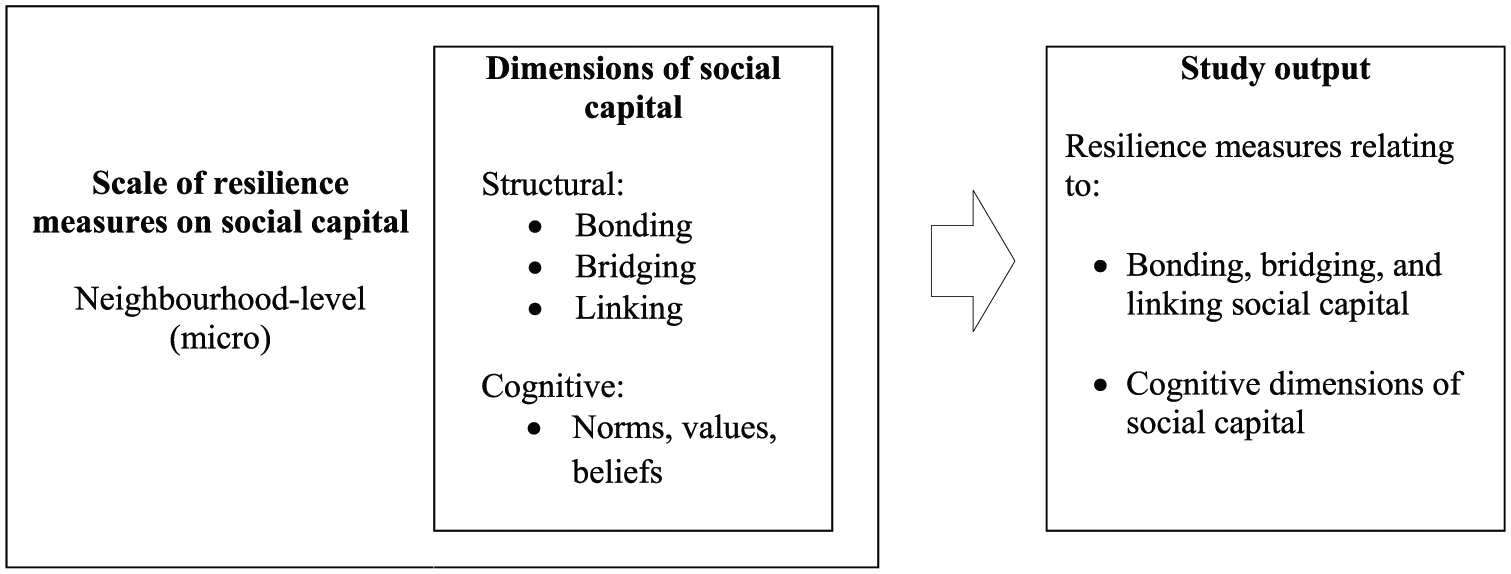
Integrated framework of social capital.
Method
Study Areas
To solicit a range of stakeholder perspectives, the authors selected five neighborhoods with wide-ranging socioeconomic levels and racial/ethnic compositions as research sites—two in the Wellington region of New Zealand and three within the City and County of San Francisco, USA. These two urban regions are comparable because they face similar exposure to significant seismic hazards (Cousins 2013; Stirling et al. 2012; U.S. Geological Survey 2015), and their disaster resilience policies share an emphasis on building neighborhood-based social capital. One of the main goals of Wellington’s resilience strategy is to ensure “people are connected, empowered and feel part of a community” through participatory, place-based community planning (Wellington City Council, 2017:41). In San Francisco, the city’s Resilient San Francisco strategy calls for “empower[ing] neighborhoods through improved connections” by building connected neighborhoods and improving neighborhoods’ connections to the city government (City and County of San Francisco 2016:104). Thus, the selection of the neighborhoods in these two regions aligns with the applied nature of this research.
The selection of neighborhoods was based on several criteria. To identify measures that would be applicable to different types of neighborhoods, study neighborhoods represented different socioeconomic levels and demographic compositions. The study’s authors used government census data to identify potential neighborhoods in each region and then consulted with emergency management practitioners and community leaders from each region to narrow the list of study sites. This process provided opportunities for aligning the goals of the research study with those of community stakeholders. The consultation process sought to gain buy in and engagement from neighborhood stakeholders in the research process, with the intention of increasing the likelihood that they would adopt the resulting assessment measures.
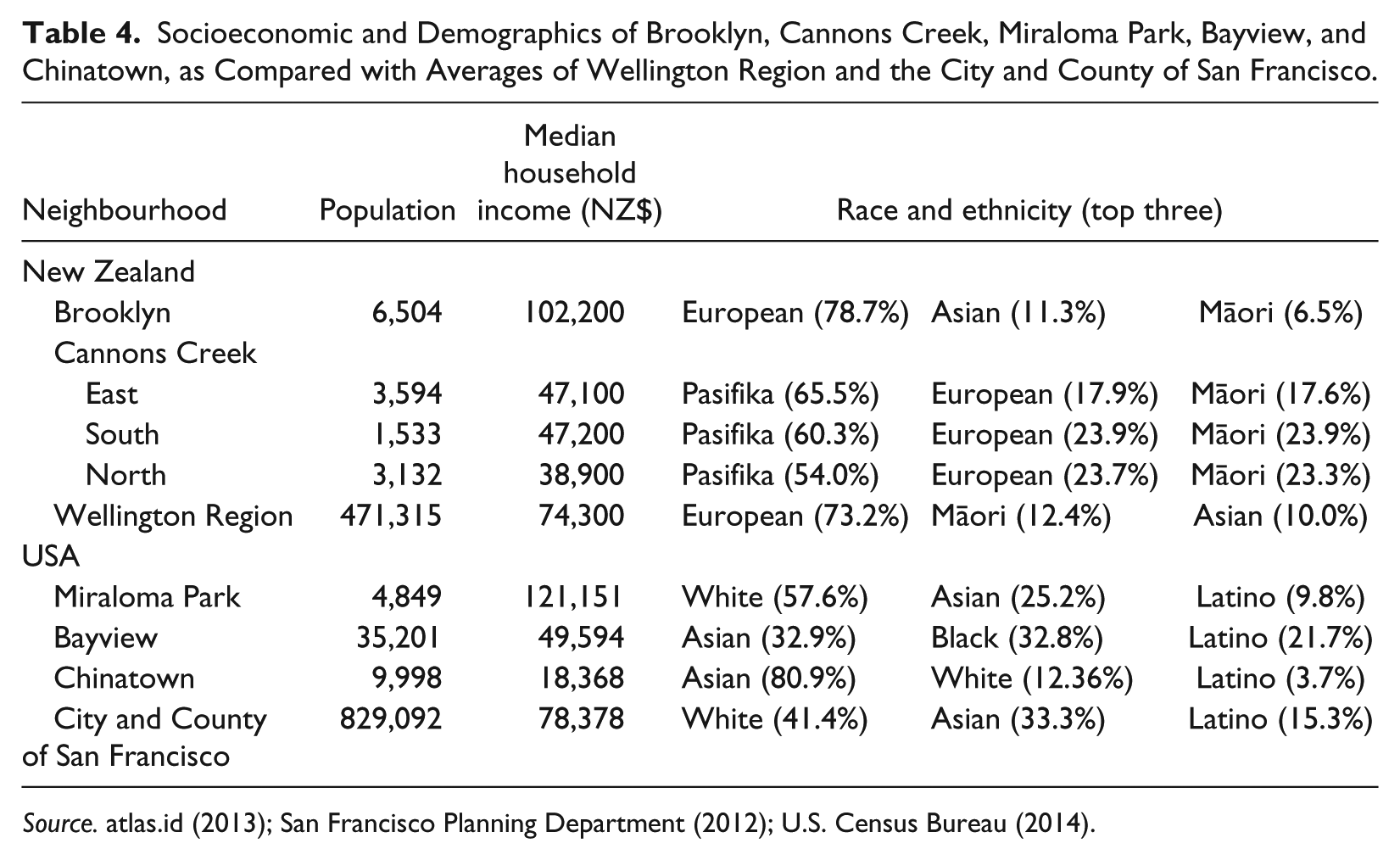
The consultative process resulted in the selection of two neighborhoods in the Wellington region—Brooklyn in Wellington city and Cannons Creek (consisting of Cannons Creek East, South, and North) in Porirua city—and three neighborhoods in San Francisco, Miraloma Park, Bayview, and Chinatown. A summary of the neighborhood socioeconomic and demographic characteristics is presented in Table 4.
Socioeconomic and Demographics of Brooklyn, Cannons Creek, Miraloma Park, Bayview, and Chinatown, as Compared with Averages of Wellington Region and the City and County of San Francisco.
Participants’ Sampling and Recruitment
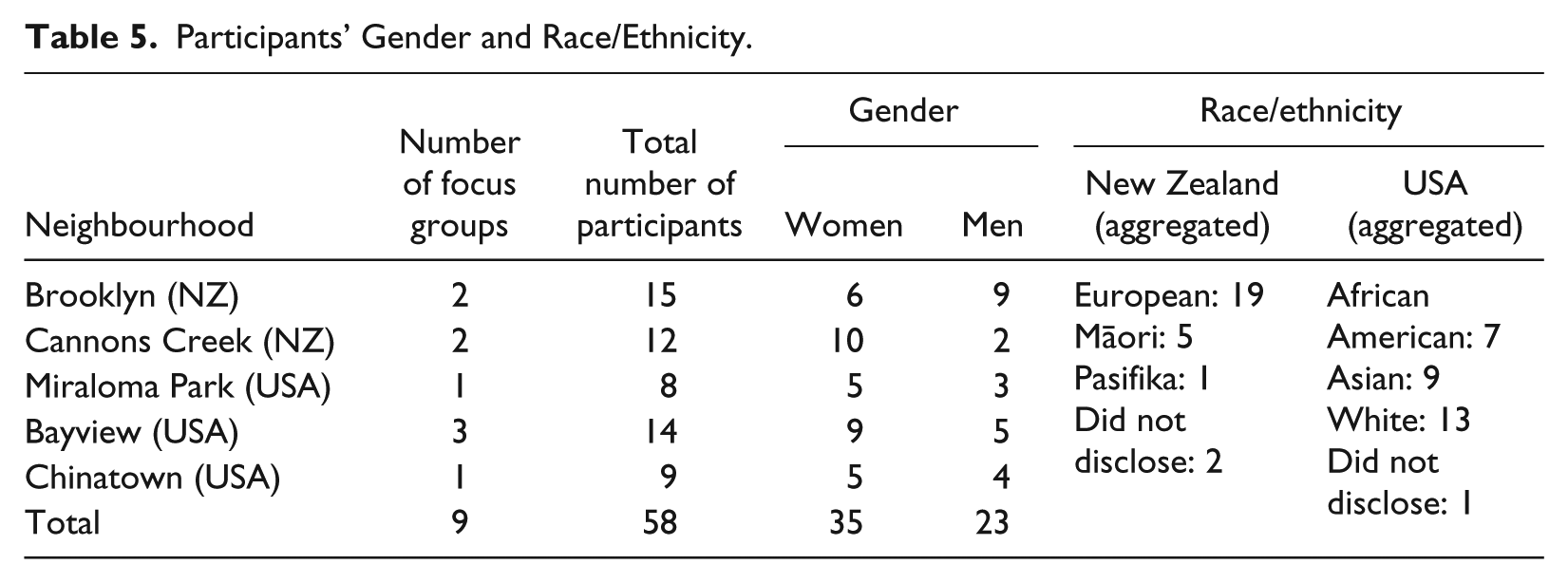
All study protocols were submitted to Massey University’s ethics review board (#4000015451). The study used purposive sampling methods to identify a mix of participants, including referrals from representatives of government and community-based agencies, recruitment by neighborhood leaders, flyers posted on community-based announcement boards and social media pages (i.e., community-based Facebook pages), and recruitment in areas with high foot traffic. The primary author of this paper recruited a total of 58 participants who attended one of nine focus groups between March 2016 and October 2016. Each participant was offered a retail gift card as a token of appreciation. A summary of participants’ characteristics is shown in Table 5.
Participants’ Gender and Race/Ethnicity.
Focus Group Procedures and Data Analysis
As part of a larger study on social resilience, focus group participants responded to a set of semistructured, open-ended questions. The development of the questions was informed by a workshop on social resilience conducted with disaster researchers and emergency management professionals (Kwok et al. 2016). The focus group questions pertain to four categories of social resilience: (1) skills, abilities, and knowledge; (2) community resources, which include physical assets, goods, or services; (3) values and beliefs; and (4) community processes, and are as follows: How would you describe your neighborhood? When you hear the phrase “community resilience,” what do you think of? and What does your neighborhood need (e.g., skills, abilities, knowledge, resources, values and beliefs, and community processes) to anticipate, cope with, and overcome the challenges and changes from a disaster, such as an earthquake? Participants’ perceptions on social capital were extrapolated from their responses to these questions.
It is important to highlight that while these questions do not specifically ask participants about social capital, this approach allows for an open inquiry to capture responses without constraints and limitations (Budd 2008). As such, specific components, characteristics, and perceptions of social capital and potential interdependencies of social capital to other factors relating to disaster resilience can be examined.
Each focus group was conducted in English and lasted one-and-a-half hours. All focus group discussions were audio-taped and transcribed verbatim, with the exclusion of “ums” an “ahs” during the transcription process. The transcriptions were coded and analyzed inductively by identifying recurring patterns (themes) in the data that related to the existing framing of social capital from the literature (Braun and Clarke 2006).
Results
The analysis of focus group data produced three overarching themes that underpin the perceived formation, activation, and benefits of different dimensions of social capital (i.e., structural or cognitive; bonding, bridging, or linking) within the context of neighborhood resilience. Using selected participant quotes, this paper illustrates each of the three themes: community demography, cultural influences on social support, and neighborhood governance. The paper also discusses the implication of each theme on measuring social capital.
Community Demography: Length of Neighborhood Tenure and Demographic Changes
The community demography theme consists of two dimensions as they pertain to bonding social relationships and community identities: length of residence (tenure) and demographic changes. First, a high rate of homeownership contributes to neighborhood resilience by strengthening social connections and community attachment. This was especially true in the study for the high-socioeconomic neighborhoods of Brooklyn and Miraloma Park, as well as the low-socioeconomic neighborhood of Bayview, which has one of the highest homeownership rates in San Francisco (Roscoe 1995). A participant in Brooklyn said, I think there’s a sense that you are gonna be here longer. I flatted here when I was in university, and [I had] nothing to do with the community. My community was downtown—socialising at the university and I slept here when I got back here, that was it. I think also homeowners are, they don’t all, they’re more likely to have children . . . When people got children they become a lot more cemented because they are using the facilities.
This excerpt also underlies the importance of tenure stability in promoting disaster resilience. When asked about what would happen to Bayview after a disaster, without skipping a beat, a participant declared, “Bayview will rise.” The participant pointed to the history of events that have tested the strength of the community—from racism to violent crimes to fires—and believed the deep bonding social ties that have been built over the years in overcoming these challenges would sustain the community in a major disaster: Time and time and time, over and over, th[is] community has risen up without a community plan. They know who lives where. Because people have lived there for 30, 40, 50, 60, 70 years. If, when we had an earthquake, we didn’t need no one to come in and tell us. You would’ve checked on your wife, on your elder, on your senior, or the person you know who is in a wheelchair. The community has rose to the occasion [to a building fire]. They rallied around with them [the displaced residents] less than eight hours later . . . They didn’t have to be coached, prodded, or urged, or looking for recognition. They just automatically, with instinct of community and family, rise to the occasion. So I don’t believe that we won’t continue to rise.
However, for neighborhoods with a more transient population (i.e., renters) such as Cannons Creek, enhancing community resilience requires providing disaster preparedness education to this segment of the population. According to a Cannons Creek’s participant, The other thing about our community, it may be not as much as it was, but it’s quite a transient one, because there’s lots of renters. People come and go a lot. So we can’t assume everyone knows [about where to go and what to do in a disaster], because they might’ve just arrived.
Second, community demographic changes affect preexisting social networks and functions. This could be viewed as a resilience impediment or an enhancer, depending on how such changes are perceived to impact community identities and cultures. For participants, positive perceptions were associated with demographic changes that built upon the existing strengths of a neighborhood, while negative perceptions were characterized by changes that replaced long-established community identities and cultures through residential displacement. An example of the former was illustrated in the more socioeconomically homogenous neighborhood of Miraloma Park, where an influx of new residents was viewed to positively contribute to the community, as a participant said: When we moved in here 17 years ago, my daughter was the only kid in the entire block. I think it’s actually completely flipped now to see many, many young families and young kids . . . I haven’t seen those families move out, which is really nice to see.
However, newcomers to a neighborhood can threaten the strength of bonding social capital when they displace long-term residents, especially those who are low-income and are racial minorities. In Bayview’s focus groups, African American participants conveyed a sense of community loss as they felt their historically African American neighborhood (Higgins 2004) was gradually eroding due to the high cost of living and doing business. As one participant explained, When I came out in ’73 . . . they had Black stores and all kinds of businesses and stuff. And over the years, that disappeared. But then it’s [presence of businesses] on the rise again. But . . . the fact you don’t see many Black business. You don’t see many black people; you don’t see people that occupying the housing, the homes.
While negative perceptions toward demographic changes were especially apparent in Bayview focus groups, other discussions also pointed to the evolution of social networks over time. Despite rapid demographic changes and a projected decline in racial diversity in San Francisco communities (PolicyLink and Program for Environmental & Regional Equity 2015), a Bayview focus group participant believed that new residents would eventually be considered part of the community and that the initial perceived divide (“us vs. them”) would ultimately dissipate as they became part of the neighborhood. This particular view illustrates that social relationships within a neighborhood can evolve from bridging to bonding relationships.
Even though there existed differences between focus groups across all the studied neighborhoods, common to all of them was the perceived need to preserve community cultures and identities amid demographic changes or after a disaster. This point was conveyed by a Bayview focus group participant: And over 10 years from now, call it two years from now, how much of the same population will still be populating right here—that’s the longer measure [of] community resilience—are you scattered to the four winds? Even though new people live here . . . so there’s that geographic versus cultural.
The perceived and actual changes in community demographics, therefore, influence the quality and strength of social connections, which in turn affect perceived characteristics of resilience such as community identity, collective action, knowledge of community resources, community attachment, and social support. For communities with vulnerable populations, maintaining residential stability is essential to the development of city policies. These policies, as stated by focus group participants, should include expanding affordable housing for low-income residents, improving public transportation and community amenities, ensuring local ownership of businesses, and implementing local hiring policies in a post-disaster environment. San Francisco has recently approved policies and programmes to ensure the retention of low-income residents in the city (refer to Goal 3 of the city’s resilience strategy, City and County of San Francisco 2016) and the hiring of local residents in city-funded construction projects (San Francisco Office of Economic and Workforce Development 2010). These city-level structural interventions are critical to maintaining individual, household, and neighborhood levels of social resources and resilience.
The implication of community demographic changes on social capital measurements is discussed next.
Measuring underlying drivers and impacts of demographic changes
Within the theme of community demography, social capital measures not only need to capture the rate of homeownership and length of residence quantitatively, but also qualitatively assess those factors’ impact on the well-being of vulnerable residents, community identity, and community engagement. Residential stability, as it relates to homeownership and length of residence in a neighborhood, reflects the extent and strength of people’s social networks, available levels of social support that they might receive, and investments in their communities.
Research participants perceived that communities facing rapid demographic changes and gentrification might face new vulnerabilities if long-term residents were to leave, eroding or severing important relationships that had formed over years. This is especially likely for residents from disadvantaged communities, where place-based bonding and bridging relationships have been documented to provide residents with the necessary resources to meet the challenges of everyday life as well as in disaster situations; the strength and power of these relationships evaporate when people move out (Elliott et al. 2010; Litt 2008).
Residential stability is also found to be positively correlated with place attachment through increased social ties (Brown, Perkins, and Brown 2003). Place attachment, which is the positive cognitive and affective bond that people have to their environment (Altman and Low 1992), has been documented to promote civic participation and neighborhood revitalization efforts (Brown et al. 2003; Conway and Hachen 2005; Manzo and Perkins 2006). However, people who do not stay in one place for long reduce their chances to develop the emotional connection to their neighborhood that is foundational to community engagement (Manzo and Perkins 2006).
Increasingly, disaster researchers have identified the importance of the linkages between residential stability, social capital, and place attachment in influencing disaster outcomes. For instance, Bihari and Ryan (2012) conclude that residents with higher perceived social capital and place attachment levels are more likely to take hazard mitigation actions and engage in community hazard planning. Another study by Chamlee-Wright and Storr (2009) found that despite structural constraints such as racism, poverty, and government incompetence that had prevented many residents from returning to their homes after Hurricane Katrina, those who did return cited their attachment to their neighborhoods as a primary reason. As such, residential stability is essential for maintaining the necessary social connections that facilitate disaster response and recovery efforts (Sherrieb et al. 2010).
Therefore, these research findings provide a basis for developing social capital measures that enable emergency management practitioners and relevant stakeholders to baseline and track demographic changes and their potential impact on localized social networks of residents, especially those from low-income communities.
The next section examines the role of neighborhood-level social connections in providing residents with a sense of social support in everyday situations and during times of stress.
Cultural Influences on Social Support
The second theme, cultural influences on social support, can be traced to participants’ cultural values, beliefs, and norms. While culture can be conceptualized in different ways, this paper adopts Triandis’s (2002) formulation of culture as comprised of elements that are both physical (e.g., buildings, tools) and subjective (e.g., social norms, roles, beliefs, and values). This study focuses on the subjective dimension of culture. The authors identified two recurring subjective cultural components that affect social support (an output of bonding social capital): unspoken duties as neighbors and participants’ cultural values and norms.
Regardless of socioeconomic and demographic differences between neighborhoods, all focus group conversations emphasized the normative value of neighborliness, or a sense of duty as neighbors. The importance of bonding relationships is conveyed by participants’ beliefs in “neighbours helping neighbours” across a range of situations, from dealing with everyday stresses to preparing for and responding to disasters. Participants felt that social relationships are foundational to social support in everyday situations. For instance, a participant expressed the deep social ties that exist in her community when recounting the death of an immigrant local business owner: The H&K [liquor and deli store] on the corner of Jennings [Street] and Fitzgerald [Avenue], the mother, people called her “grandma,” passed away. [Residents] mourned [her] loss . . . as if though she was our grandmother. I could remember when my grandmother sent me to the store and go there to buy Pall Mall Red cigarettes for my grandmother, because the store knew us. So they became part of the community . . . The oldest brother at H&K, at the funeral, he said, “I want to thank you community, because of the death of our mother, you guys held us up.”
In preparing for and responding to disasters, participants recounted past experiences of either taking upon their neighbor’s preparedness efforts themselves or assisting their neighbors to prepare for a disaster, such as knocking on each other’s doors when there was a flood (Cannons Creek focus group). Participants indicated that neighbors play a vital role in providing support for vulnerable residents (e.g., the elderly), providing information such as hazard risks and community resources to the neighborhood, and organizing others to help advocate for community needs. The unspoken duty as a neighbor is captured in the following quote: I know who my next door neighbours are. They might not know who I am, but I do know who they are. I know they’ve got two dogs. I know that down the road has about three or four cats. What I try to do, or what I am working trying to do, is just to build up a stock of cat and dog food. Canned goods for myself and possibly canned goods for others (Brooklyn focus group).
The other cultural component of social support is a shared sense of cultural connections and beliefs rooted in participants’ race or ethnicity. This was particularly evident by participant comments in Chinatown, Bayview, and Cannons Creek, which have high numbers of racial or ethnic minorities, and was less present in the racially or ethnically homogenous neighborhoods of Brooklyn and Miraloma Park. Discussions in the Chinatown, Bayview, and Cannons Creek focus groups highlighted the importance of embedded cultural values within the Chinese, African American, and Māori (New Zealand’s indigenous people) communities in supporting those in need. Chinatown focus group participants also conveyed a shared sense of cultural identity. For example, when participants were asked whether they would return to Chinatown after a disaster, a participant said, “I will come back to help . . . because we are all Chinese people.” According to focus group participants, this sense of shared identity was reinforced not only because of the homogenous demographics of the community, but also because many residents residing in the community were immigrants themselves. The perceptions of participants suggest that residents believed they had to support each other in their newly adopted country.
In the Bayview focus groups, participants discussed at length the importance of bonding social capital embedded within extended families—whether they were blood-related or not—within the African American culture in helping to raise families and support each other. A participant illustrated this sense of communal duty to build families through an everyday scenario: I would throw a rock at Mr. B, or get sassy with him at the ice-cream parlour. Before I got down to Gilman Street, Ms. Sarah said, “You were over there in the afternoon. I’ve seen you throwing some rocks.” When I get to [my] grandmother’s house, she’s already outside. I didn’t have to wait to tell her. The community reprimanded me.
Furthermore, neighborhood-based cultural institutions facilitate the activation of bonding social capital and provide critical social support for residents in natural hazard events. In Cannons Creek, a recent flood prompted a local marae (Māori community center) to open a soup kitchen that served residents in need. These institutions act as moderating influences on a neighborhood’s social capital.
Responses from participants relating to the theme of cultural influences on social support point to the importance of cultural norms and values in cultivating social support among neighbors. The next section discusses the implication of cultural values and practices in the development of social capital measurements.
Measuring the integration of cultural values and practices in DRR interventions
Cultural factors play a vital role in the ways people and groups prepare for and recover from disasters (Norris and Alegría 2008). They also shape the ways in which people and communities connect with each other, which in turn affects how people receive and personalize hazard risk information, take protective actions, and respond to and recover from disaster impacts (Paton, Okada, and Sagala 2013). Given the importance of the cultural context of social networks, more needs to be done by community resilience assessment tools to account for place-based and context-specific cultural values, beliefs, and practices—the cognitive components of social capital. One way to measure the cultural dimension of social capital is by assessing the extent of integration of cultural values, beliefs, and practices in the planning and implementation of strengths-based DRR interventions. Such interventions build on preexisting social and cultural community assets to produce outcomes that encapsulate the sociocultural fabric and diversity of a community. Participants who were racial or ethnic minorities in this study conveyed their cultural values when articulating their need for culturally appropriate interventions that support the psychological resilience of residents. In Bayview, several focus group participants referred to a lack of culturally competent psychosocial services provided to racial minorities. As a participant in the Bayview focus group stated, With Black folks, you can’t always say, “You are suffering from PTSD, come over here and let me work with your mental health”—you’ve just shut them out. You gotta meet them at where they are. So if they are having mid-night basketball, this is just an example . . . Well, all those 200 people sitting in the stands that are waiting for the game to start, you [service providers] should come there and just do healing, not talk about why aren’t you going to mental health. Historically, African-Americans didn’t buy into mental health, counselling, all those things. When you did it, you snuck it in. We didn’t believe in a lot of that psychological and go see a psychiatrist, and all those therapists.
This quote highlights the need for aligning cultural values and practices of individuals and communities with DRR interventions. A successful integration can be found in Chinatown, San Francisco. The Chinatown Disaster Preparedness Committee, led by the NICOS Chinese Health Coalition, was formed after the 1989 Loma Prieta earthquake to address the training, preparedness, and response needs of the predominately Chinese community (Center for Infectious Disease Research and Policy N.d.). The committee created a bilingual disaster response plan that addressed the response actions of the community during the first 72 hours after a major disaster (NICOS Chinese Health Coalition 2007). Participants in the Chinatown focus group felt that having both a dedicated committee and a neighborhood-specific disaster response plan that meets the cultural and linguistic needs of community stakeholders is essential for the recovery of their community after a disaster.
Beyond the neighborhood level, the integration of cultural knowledge and assets of groups in policies and practices at all levels of government is essential to enhancing the adaptive capacities of neighborhoods (International Federation of Red Cross and Red Crescent Societies 2014). An example of national-level DRR policies that integrate cultural practices can be found in New Zealand. The National Civil Defence Emergency Management Plan outlines the role of Te Puni Kōkiri—a national government agency in responsible for leading Māori public policy and advising policy affecting Māori well-being—in linking iwi (Māori tribes) and Māori groups with government agencies and authorities during and after an emergency event (Ministry of Civil Defence and Emergency Management 2015; Te Puni Kōkiri N.d.). In addition, government-funded research initiatives for building New Zealand’s disaster resilience specifically call for the integration of Māori cultural beliefs and practices within its national resilience strategy (Ministry of Business, Innovation and Employment 2016). However, much more work needs to be done in incorporating cultural sensitivity in disaster planning (Elder et al. 2007). A way forward is to create a DRR engagement and planning framework in collaboration with cultural and ethnic groups. Assessment tools can contribute to such an effort by setting goals and key performance indicators in this regard.
The next section illustrates how the strength of social capital in each of these neighborhoods is also influenced by the effectiveness of neighborhood governance.
Neighborhood Governance—Collective Action, Advocacy, and Leadership
Governance at the neighborhood level is often informal by nature (Lelieveldt 2008). As such, the final theme centers on a neighborhood’s bridging and linking social capital resources and capacities as they relate to its experiences in collective action, ability to advocate for community-wide needs, and presence of effective neighborhood leaders in contributing to effective neighborhood governance. These three components of neighborhood governance draw attention to the perceived importance of residents and community-based organizations (CBOs) coming together (bridging social capital) to resolve community-wide challenges and advocate for their needs (linking social capital).
Focus group data suggest that all neighborhoods possess and have activated a certain degree of bridging social capital resources and capacities. In higher socioeconomic neighborhoods, a Brooklyn focus group participant recounted how residents gathered to help fundraise to rebuild a community hall which was razed by a fire, and Miraloma Park participants discussed how neighbors and groups came together to create (and have continued to sustain) a community-wide neighborhood association that would be able to handle future disasters. Although low-income communities might be labeled as vulnerable to a variety of external threats and hazard events, the perspectives of participants from low-income neighborhoods (Cannons Creek, Bayview, Chinatown) illustrate that the vulnerabilities of their communities can be ameliorated by strong preexisting social and organizational connections. In Cannons Creek, participants discussed a time when residents and CBOs came together in council meetings to advocate for the well-being of residents by protesting the approval of a liquor license for a local business. They felt such actions demonstrated the strong neighborhood ties that could be deployed in future natural hazard events. In Bayview, a participant pointed out Bayview’s ability to prevail from a hazard event because of its network of individuals and CBOs: [From the] extended families to the service providers and organisations here, who [for] generation and generation, their kids can go back and be like, “So and so still work in here. So and so helped my kids. You can go to so and so, they can be trusted cause it’s consistent, right? And this person is like my auntie . . .” I think that speaks volumes—you need that especially those who you are working with . . . You need to have that base . . . You have a lot of people here in Bayview who fit that role—and that’s really rare. I agree that has made this community very, very resilient.
In another example, local activists and CBOs of San Francisco’s Chinatown have long fought for the preservation of the Chinese culture and the neighborhood’s way of life (Green 2016). There was a widespread belief among focus group participants in Chinatown that the network of Chinatown-based CBOs would continue to ensure that the community culture and rights of residents would be protected. This belief was expressed within the context of disaster recovery: [Chinatown organizations] advocate for a lot of things, like equality, opportunity, [stopping] mistreatment in the workforce or workplaces; they assist individuals with that. I feel like that organisations will be the first to say, “Okay, we’ve gotta maintain the culture of Chinatown.”
Regardless of a neighborhood’s socioeconomic level, participants generally expressed a need for effective community advocacy, which rests on having a leadership that unites and represents the interests of different community groups in local governments (linking social capital). They believed unified leadership is crucial to building resilience in both the pre- and post-disaster environment. However, focus group data highlight differences in the existing levels of linking social capital resources and capacity between high- and low-socioeconomic neighborhoods, in which leadership within higher income neighborhoods appeared to be more unified than their lower income counterparts.
An example of a unified leadership in a community setting is exemplified by CBOs such as the Miraloma Park Improvement Club (MPIC; 2016), which represents the interests of residents. A participant in the Miraloma Park focus group believed the MPIC is expected to play a vital role in community recovery: We have a place—MPIC—is going to become really important, and part of the reason is you need some governance. I think it’s really important that in order for a neighbourhood to have a voice and be heard by either an elected official or by a utility company or by a fire station or by a road paving [agency], in order to get road paving or road repair type of thing, we need to have some sort of a group that speaks for more than just one person. And I think we are fortunate that we have MPIC. And MPIC has spoken loudly in the past and we’ve gotten things and I think we are known in City Hall. So all of that helps in a sense that we have this in place already in times of no stress. So during times of stress, hopefully this group will be able to work together to build what we need in terms of leadership. Let’s put it that way, that’s a way of building leadership in order to recover and get the neighbourhood up on its feet.
In Brooklyn, similarly, the community disaster response planning sessions conducted by the local emergency management agency have brought together key community leaders, many of whom participated in this study. Focus group participants believed that if something were to happen in their neighborhood, they would know how to work together to get needed resources. However, participants’ responses in low-income neighborhoods such as Bayview and Cannons Creek alluded to an absence of bridging social capital in the form of unified leadership representing different community priorities. This could be partly attributed to the fragmented approaches used by local government agencies in allocating resources and services. As explained by a participant in Cannons Creek: [After a disaster,] we have to look after ourselves. So we are resilient. We are ready but . . . The churches will be the hubs, the schools, the marae [Māori community centre], and they will be the centre point. But they don’t want us to be huddled apparently. They [Civil Defence] still want us to keep separate [in silos].
A similar sentiment was also expressed by a Bayview participant: Bayview is very diverse, but it’s still very segregated in many ways. And I think some of the challenges as we’ve mentioned are common throughout because at the end of the day, the majority of folks who live here are of low income, as least relative to San Francisco. So I think that there isn’t a bonding of bringing all those entities together to unite and actually have a larger voice to advocate for at least the common challenges that this community and what does this community needs . . . I think [governmental] leadership plays to that. They play to the fragmentation.
Focus group participants from Cannons Creek and Bayview also felt the need to increase the linking type of social capital by ensuring that local governments would be more transparent and accountable to their constituents through increasing community participation and inclusion in the decision-making process. In the fast-changing neighborhood of Bayview, the need for community inclusion is more salient. For instance, participants felt that social housing decisions that they believed to have caused the displacement of many low-income residents and African Americans were made “behind closed door” or “under the table.” When participants were asked who was making those decisions, they responded, “The people who have the power to do it” or “the people with money.”
Participants from Bayview and Cannons Creek believed that many of these challenges were the result of long-standing discriminatory structural policies of the past that have shaped socioeconomic disparities between the rich and the poor and between those in power and those who have traditionally lacked power and been disenfranchised (e.g., minorities, women, low-income individuals, and the elderly). They believed that increasing access to information and providing opportunities for engagement are essential to empowering underserved residents in the DRR planning process. Across all neighborhoods, participants conveyed their need to be empowered to make the best choices for themselves and their community in a disaster environment. Underlying these sentiments are cognitive issues of trust toward CBOs, decision makers, and decision-making processes.
Measuring neighborhood governance by assessing the effectiveness of civic infrastructure
The previous section highlights that bridging and linking social capital resources can be enhanced and effectively activated through coordinated leadership and collective efforts. Measuring neighborhood-based governance can be achieved through assessing residents’ perspectives on the effectiveness of local leaders (Paton 2007a), and the evaluation of civic infrastructure—the networks of CBOs and groups—can serve as proxies for leadership capabilities (Graham et al. 2016). In particular, focus group data illustrate that collective efforts are frequently facilitated by formal and informal community groups. Results from focus groups are consistent with past research studies that demonstrate the importance of civic infrastructure in capitalizing existing community strengths and capabilities to building disaster resilience (Graham et al. 2016). For instance, neighborhood-based groups provide avenues for cultivating beliefs, skills, and capacities (e.g., trust, leadership, community engagement, and social networks) that enable local stakeholders to effectively resolve conflicts and prioritize their needs (Becker et al. 2012). These groups also affect individual and community disaster preparedness (Becker et al. 2012) and recovery of communities (Chamlee-Wright and Storr 2011; Montgomery 2013; Nakagawa and Shaw 2004; Simo and Bies 2007).
Effective civic infrastructure in a disaster environment requires the presence of proactive leaders. For instance, Paton et al. (2014) find that community groups with passive leaders—people who waited to be told by government entities what they should do—invariably closed off opportunities for community engagement and prolonged a sense of community uncertainty that undermined its recovery. Even in high-socioeconomic communities, disaster recovery can be hampered due to ineffective leaders or emergent leaders who lack the capacity for organizing in-situ (Paton, Mamula-Seadon, and Selway 2013). Their study also finds that organizations and groups that did evolve into effective recovery entities demonstrated several common attributes, such as having active leaders and an inclusive community planning process (Paton et al. 2014).
As informal and formal networks and leadership contribute to neighborhood-level social resources, resilience assessment tools need to reflect not only the presence of active community leaders and density of CBOs and groups, but also their effectiveness in bringing about changes, whether in securing resources or advocating for the collective needs of a neighborhood from decision makers. In addition, assessment measures need to account for the extent of collaboration between organizations, their ability to meet the needs and enhance the capacities of their constituents, and issues relating to trust in leadership and decision-making bodies and processes. Hence, the ability to baseline and track progress of civic infrastructure’s capabilities and processes (i.e., leadership, decision-making process, and trust toward the governing process), especially in culturally and ethnically diverse and low-income communities, is essential as they positively influence the trajectory of post-disaster recovery (Storr and Haeffele-Balch 2012).
Proposed Measurements for Neighborhood-Based Social Capital
The three themes of community demography, cultural influences on social support, and neighborhood governance unveil opportunities for integrating community perspectives in social capital–related resilience measurements and DRR interventions at the neighborhood level. Although the importance of social networks and capacities is increasingly being recognized by disaster management policymakers and practitioners, assessing social capital and its nuances has yet to be fully integrated into community-based disaster planning process, in both rural (LaLone 2012) and urban settings (Montgomery 2013; Schmeltz et al. 2013). While the three themes identified in this study are often shaped by policies and structural mechanisms that are implemented at the city level, specific neighborhood-level measures and DRR actions could be developed that reflect local beliefs and needs.
This study proposes in Table 6 an initial set of measures that can be used to assess social capital levels across the study neighborhoods. These measurements, which are based on the integrated framework presented in Figure 2, can be used to support neighborhoods’ efforts in evaluating and setting targets toward enhancing the multiple dimensions of social capital. The measures are presented in a matrix table that categorizes social capital into structural and cognitive dimensions across bonding, bridging, and linking relationships.
Proposed Common Indicators and Contextual Questions for Measuring Neighborhood-Based Social Capital.

Note. CBO = community-based organizations; DRR = disaster risk reduction.
The structural dimension of social capital relates to social organizations (Uphoff 1999) and consists of six factors essential to enhancing horizontal and vertical linkages (i.e., bonding, bridging, and linking relationships):
Population stability
Neighborhood-based organizations and groups
Coordination between CBOs
Linkages to cultural and ethnic minority communities
Presence and effectiveness of neighborhood leaders and CBOs
Inclusive and transparent government processes
The cognitive aspect of social capital, which relates to civic culture (Uphoff 1999), spans across these relational linkages and comprises four factors as follows:
Cultural beliefs and expectations
Trust
Social support
Empowerment through collective action
Two types of assessment measures are proposed for each factor. The first type of measures consists of quantitative indicators (as denoted by “I”) that either directly or indirectly (using proxy variables) assess the discrete aspects of each factor. The second type involves a set of open-ended questions (as denoted by “Q”) that seek to explore the contexts of social capital sources and manifestations in each neighborhood. The mix of quantitative indicators and exploratory questions in this integrated approach seeks to assess neighborhood-level social capital more holistically than has been done to date. While the indicators provide a quick and easy measure of the structural aspects of social capital, answers to the contextual questions can reveal underlying assumptions, beliefs, and practices of neighborhood stakeholders that are valuable in developing neighborhood-relevant DRR interventions that facilitate the development of social capital.
The proposed measures in Table 6 are based on the findings of focus groups from the study sites. The authors caution readers in applying these measures to other communities as they may not be applicable in different geographical contexts (e.g., perceived social support might be measured differently in different countries). Rather, the authors want to emphasize the need for an integrated approach to assessing social capital at the neighborhood level.
Structural Social Capital Factors
The first two structural social capital factors—population stability and neighborhood organizations and groups—assess the strength of bonding social capital.
Population stability
Key quantitative measures of a neighborhood’s residential stability include the length of residential tenure, ratio between renters and homeownerships, and demographic changes. While these measures have been used in various community resilience tools (e.g., Cutter, Ash, and Emrich 2014), this study’s social capital assessment framework also evaluates underlying drivers of changes. Contextual questions ask neighborhood leaders and long-term residents their understanding of influences that have contributed to demographic changes and the impacts that such changes have on social relationships between people. In particular, these questions focus on vulnerable populations (e.g., low income and racial or ethnic minority residents) as they are often disproportionately affected by disaster consequences (Norris and Alegría 2008). Their ability to activate resources through their social networks is essential to buffering the impacts of disasters. Answers to these questions could inform existing policies that maintain social connections by preventing or slowing an exodus of established residents.
Neighborhood-based organizations and groups
This factor measures the sources of bonding social capital as they relate to civic infrastructure. Variables that assess bonding social capital levels include the enumeration of civic infrastructure and community participation. Research suggests that existing levels of community groups and participation have a positive correlation to social capital, which in turn contributes to disaster resilience (Vallance 2011). Supplementing these measures are exploratory questions that identify critical CBOs, especially those that serve the needs of vulnerable residents. Neighborhood leaders and government decision makers can use information gleaned from the data to ensure that appropriate levels of resources are allocated to these organizations.
The next two factors assess bridging social capital by assessing the extent of coordination between CBOs and their linkages to minority communities.
Coordination between CBOs
Key quantitative measures for this factor assess the extent to which community organizations and groups collaborate with one another and with different communities. Collaboration and coordination between CBOs enable timely disaster response and recovery (Johnston, Becker, and Paton 2012). The study uses a measure to assess how frequently different communities come together, as neighborhood-wide events enhance social capital and disaster resilience (Okada, Yokomatsu, and Ikeo 2010). The exploratory questions seek to understand existing gaps and barriers in interagency coordination.
Linkages to cultural and ethnic minority communities
Cultural and ethnic minority communities are disproportionately impacted by disasters for reasons such as discrimination and inequalities in first response (Elder et al. 2007; Norris and Alegría 2008). This factor seeks to assess bridging relationships between mainstream groups and organizations and those that serve racial and ethnic minorities. Measures for this factor, therefore, assess the number of community groups serving racial and ethnic minorities and the existing collaboration between them and nonracial minority groups. As it pertains to disaster resilience, an assessment question also evaluates the extent to which cultural practices of ethnic groups are integrated in disaster planning process and plans. This question highlights an existing need for culturally appropriate DRR plans (International Federation of Red Cross and Red Crescent Societies 2014).
The last two structural factors assess governance capacities and efficacy of a neighborhood’s linking social capital.
Presence and effectiveness of neighborhood leaders and CBOs
Proactive local leadership and effective CBOs are key to timely disaster response and recovery of communities. Quantitative measures—the presence of neighborhood leaders and their track records in securing resources—assess the likelihood of neighborhoods receiving the necessary tangible and intangible resources for DRR and disaster response, which is critical in a post-disaster environment (Aldrich 2012a). Open-ended questions delve into leaders’ abilities to represent the collective interest of their communities, identify underserved communities and community needs, examine existing processes that neighborhood stakeholders can use to hold their leaders accountable, and develop capacity-building programmes for existing and emergent neighborhood leaders. These questions address key concerns raised by focus group participants to ensure that the voices of minority groups are heard, leaders and CBOs are held accountable to their constituents, and mechanisms are employed to bring about positive community changes through capacity building and access to decision makers.
Inclusive and transparent government processes
Essential to community disaster resilience is ensuring that decision-making processes are inclusive and fair (Burby 2003). The set of quantitative measures evaluates the engagement process by assessing the presence of community outreach plans and community-wide meetings by local government agencies. Focusing on disaster management, these questions also assess whether local needs are integrated into existing emergency plans. It might be that local governments are already outreaching to communities for input on various decisions. As such, the exploratory questions gauge the extent of community engagement in decision-making processes and barriers to engagement, as well as identifying and incorporating cultural values and practices into DRR planning. Addressing these questions enables emergency management practitioners and policymakers to enhance local participation, so outcomes of the planning process reflect local priorities.
Cognitive Social Capital Factors
The four cognitive social capital factors that have been identified from focus group data are integral to the formation and manifestation of social capital. Thus, stakeholders involved in assessing neighborhood disaster resilience should consider how each cognitive factor influences the quality and effectiveness across the different types of social capital.
Cultural beliefs and expectations
Consisting of discrete measures, such as the number of languages spoken in a neighborhood and the percentage of racial and ethnic residents (Cutter et al. 2003), along with open-ended questions that explore how cultural beliefs and practices manifest within a neighborhood, this factor examines the intersection among race, culture, social capital, and disaster resilience. As differences in cultural practices affect how specific communities form relationships and respond to disasters (Chamlee-Wright and Storr 2010), cultural measures offer insights on prevention, response, and recovery actions that need to be taken in a post-disaster environment. For instance, the celebration of cultural beliefs and practices in neighborhood-based events signals inclusiveness that need be replicated during disaster recovery.
Trust
Trust is an integral measure of the cognitive dimension of social capital, such as that used in World Bank’s SOCAT (Grootaert and van Bastelaer 2002) and in various community disaster resilience assessments (see Table 3). Complementing quantitative measures of trust are questions that seek to understand how trust at the neighborhood level has been enhanced or eroded in the past. Answers to these questions enable decision makers to develop appropriate strategies that strengthen trust between neighborhood stakeholders and organizations prior to a hazard event (Paton 2007b). For instance, people’s ability to trust information coming from a government institution depends on prior experiences (Becker et al. 2011). As hazard events are infrequent, it is essential to build trust through fair, inclusive, and empowering engagement with community members prior to a hazard event (Becker et al. 2011).
Social support
Social support enables participants to anticipate and cope with a range of circumstances, especially in a natural hazard event (e.g., Ganapati 2012). Research on social support demonstrates positive correlations between the pre-disaster frequencies of giving and receiving help and post-disaster levels of social support (Kaniasty and Norris 1995, 2000). Key measures for this factor examine the frequency and perceptions of social support and assess conditions that enhance (or erode) levels of social support. These questions would address structural (e.g., demographic shifts) and cognitive forces (e.g., cultural beliefs) and identify solutions that foster social support expectations and behaviors.
Empowerment through collective action
Results from this study highlight the ability of neighborhood stakeholders to come together in resolving community-wide challenges and meeting community needs. Empowerment, which refers to “citizens’ capacity to gain mastery over their affairs and to deal with issues and opportunities using intrinsic resources” (Paton 2007a:34), is essential to the manifestation of collective action at the neighborhood level. It is this capacity that plays an important role in community disaster resilience (Paton 2007a). The study’s social capital questions measure empowerment through assessing neighborhood stakeholders’ experiences, perceptions, and challenges to collective action. By understanding challenges to collective action, for instance, stakeholders can work with decision makers at the neighborhood and city levels to develop strategies to reduce barriers for people to work together.
Limitations and Future Research
Although the measures proposed in this measurement framework are far from exhaustive, they serve as a starting point for neighborhood-based DRR planning and evaluation process. The framework highlights the importance of capitalizing the strengths of both quantitative and qualitative approaches to measuring social capital across different social capital types (i.e., bonding, bridging, and linking) and dimensions (i.e., structural and cognitive). Quantifiable measures can provide a snapshot of existing levels of social capital in a neighborhood, and open-ended questions give context to key challenges and opportunities that can be used for developing disaster resilience strategies and for tracking progress.
The extrapolation of key dimensions of social capital from focus group data is not without its limitation. First, the makeup of these focus group participants may not reflect all the different voices and perspectives that exist within a neighborhood. Given that the focus groups were conducted in English, this study did not account for the perspectives of community members who are not fluent in English. Past studies have demonstrated that non-English speakers and those from minority cultures, such as refugees and non-English speaking immigrant groups, hold different perspectives pertaining to disaster preparedness and response, and employ unique strategies to buffer against hazard event impacts and recover from disasters (Chamlee-Wright and Storr 2010; Eisenman et al. 2009; Marlowe and Lou 2016). Future studies are needed to solicit the perspectives of communities who were not part of this research study. Second, the development of the proposed framework and measures was conducted by the study’s primary author who brought his own interpretations and biases to the process. In resolving this problem, validation of the proposed social capital assessment framework and measures with neighborhood stakeholders is needed. Future studies would, therefore, involve developing a process with neighborhood leaders, community groups, and emergency management practitioners and policymakers at the city level to verify that the assessment framework and measures reflect their information needs and priorities. This process could also refine the assessment measures and implementation methods.
Conclusion
The study’s proposed social capital measurement framework sought to capture the diverse perspectives of neighborhood stakeholders on three issues—community demography, cultural influences on social support, and neighborhood governance—that have shaped neighborhood-based social connections and capacities in contributing to disaster resilience. The measurement framework includes quantitative indicators and exploratory questions that guide neighborhoods in baselining and setting performance targets for the levels, quality, and goals of social connections and capacities. As the importance of social capital is widely acknowledged in community-based resilience planning, effective development and enhancement of social capital require an understanding and an evaluation of local conditions and perceptions. Thus, the proposed assessment measures reflect common measures of social capital that could both be applied across the study’s research sites and be used to examine neighborhood-specific influences.
By synthesizing the perspectives of neighborhood stakeholders with those from the literature, the proposed framework and measures align with Gaillard and Mercer’s (2013) argument that the integration and application of both scientific and local knowledge are essential to enhancing the resilience of communities. It is pertinent that stakeholders at the local level (i.e., neighborhood stakeholders and emergency management practitioners) and at the city or regional levels (i.e., policymakers and researchers) are involved in the validation and implementation of resilience measures. Only then will resilience measurements and subsequent community-based DRR interventions be able to address the needs and build adaptive capacities of local communities.
Related Resources
The Neighborhood Empowerment Network’s Empowered Communities Program outlines San Francisco’s approach to building neighborhood resilience. See http://www.empowersf.org/ecp-communities/
The Organisation for Economic Co-Operation and Development Statistics Directorate has compiled a databank of questions from social capital surveys around the world. See http://www.oecd.org/sdd/social-capital-project-and-question-databank.htm
The Saguaro Seminar at Harvard Kennedy School’s website provides links to the 2000 Social Capital Community Benchmark Survey and the 2006 Social Capital Community Survey that measure the civic engagement of Americans. See https://www.hks.harvard.edu/centers/taubman/programs-research/saguaro
The United Nations Development Programme undertook a review of disaster resilience measurements. See https://www.preventionweb.net/publications/view/37916
The Wellington Region Emergency Management Office’s Get Prepared website provides an overview of its approach to building disaster resilience of communities across the region. It also includes information on personal and organizational preparedness. See https://getprepared.nz/my-community/
Footnotes
Acknowledgements
Thank you to all the participants who contributed to this study. Appreciation for participant recruitment efforts also goes out to the Wellington Region Emergency Management Office, Salvation Army–Cannons Creek (Porirua), BMAGIC (San Francisco), Bayview Senior Services (San Francisco), Search Results Web result with site links Community Youth Center (CYC; San Francisco), Self-Help for the Elderly (San Francisco), Neighborhood Empowerment Network (NEN; San Francisco), and Neighborhood Emergency Response Team (NERT; San Francisco). The views and opinions expressed in this paper are those of the individual authors and not those of collaborating or other sponsoring organizations.
Declaration of Conflicting Interests
The author(s) declared no potential conflicts of interest with respect to the research, authorship, and/or publication of this article.
Funding
The author(s) disclosed receipt of the following financial support for the research, authorship, and/or publication of this article: Financial support for this research was provided by the Massey University’s College of Humanities and Social Sciences and GNS Science, project #470SIH20-00, New Zealand.