




Abstract
This study examines the importance of inclusive human development in promoting education quality in a panel of 49 sub-Saharan African countries for the period 2000–2012. The empirical evidence is based on ordinary least squares (OLS), fixed effects (FE), and quantile regression (QR) estimations. It is apparent from the OLS and FE findings that inclusive human development has a negative effect on the outcome variable. This negative effect implies that inclusive human development improves education quality. This result should be understood in the light of the fact that the adopted education variable is a negative economic signal given that it is computed as the ratio of pupils to teachers. Therefore, a higher ratio reflects diminishing education quality. From QR, with the exception of the highest quantile, the tendency of inclusive human development in reducing poor quality education is consistent throughout the conditional distribution of poor education quality. Policy implications are discussed.
Introduction
Three main tendencies motivate the positioning of the study on the relevance of boosting quality education with inclusive human development, notably, the poor education quality in Africa, growing noninclusive development on the continent, and gaps in the attendant literature. The three points are expanded in the same order as they are presented.
First, compared with other regions of the world, the quality of education in Africa is poor. Consistent with Antoninis (2017), education systems are decidedly substandard in sub-Saharan Africa (SSA) because of, inter alia, (1) crumbling infrastructure, (2) many teachers are ill-prepared and not well equipped for classrooms that are largely overcrowded, and (3) approximately 25 percent of young people in the subregion are unable to read, while about 90 percent of children lack appropriate reading skills. In summary, education standards are slipping in SSA, which represents a global education goal risk because schools in the subregion may not be working to attain the aspirations of Sustainable Development Goal (SDG) 4 of global education.
Second, concerns about the achievement SDG 4 are even more relevant in the light of evidence that most countries in SSA did not achieve most Millennium Development Goals (MDGs) because of exclusive development. Accordingly, despite the growth resurgence experienced by the subregion for over two decades, the number of people living in extreme poverty has been consistently growing (Asongu and Kodila-Tedika 2017). This is a further indication that the fruits of economic prosperity from the growth resurgence have not been tangibly trickling down to the poorer factions of the population for the alleviation of extreme poverty and investment in human amenities, including health and education facilities. It follows that achievement of SDG 4 in the post-2015 development agenda will depend on economic growth that is sensitive to inequality-adjusted human development (IHDI). The purpose of the present research is therefore to clarify the policy issue arising by assessing the relevance of inclusive human development on education quality. Beyond the policy motivation, the positioning of this research is also motivated by a gap in the extant scholarly literature.
Third, despite the challenging policy syndromes discussed in the previous paragraphs, the contemporary SSA-centric literature has failed to assess the nexus between inclusive human development and education quality. This is understandable because, on one hand, reports on the achievement of MDGs are recent and, on the other hand, challenges of SDGs relative to reports on the attainment of MDGs are also recent. In the light of these observations, the contemporary literature on promoting education in Africa has largely focused on, inter alia, critical analysis of the quality of education in countries (Mosha 2018), PhD by publication for enhanced development outcomes (Asongu and Nwachukwu 2018b), and the effectiveness of education intervention programs (Conn 2017).
On the inclusive human development front, according to a recent survey by Asongu (2017), Africa-centric contemporary studies have focused on relationships between “inequality-adjusted human development” and a multitude of macroeconomic factors, notably, development assistance, globalization, information technology, knowledge economy, financial development, software piracy, policy harmonization across countries, and health worker migration. Other contemporary studies on sustainable development have been oriented toward, inter alia, agriculture (Adenle, Azadi, and Manning 2018; Kara et al. 2018), gender equality (Adelakun-Odewale 2018; Efobi, Tanankem, and Asongu 2018), energy (Asongu 2018; Kuada and Mensah 2018; Trotter and Abdullah 2018), and information and communications technology (Abor, Amidu, and Issahaku 2018; Afutu-Kotey, Gough, and Owusu 2017; Asongu and Boateng 2018; Bongomin et al. 2018; Gosavi 2018; Humbani and Wiese 2018; Issahaku, Abu, and Nkegbe 2018; Minkoua Nzie, Bidogeza, and Ngum 2018; Muthinja and Chipeta 2018).
Noticeably, the engaged contemporary literature has not investigated the problem statement motivating this study. This research, therefore, complements the attendant literature by attempting to respond to the following question: Does inclusive human development boost quality education in Africa?
We are aware of the risks of doing measurement without an established theoretical underpinning. However, we argue that applied econometrics should not exclusively be motivated by the need to accept or reject existing theories. Accordingly, we are consistent with recent empirical literature in arguing that an empirical analysis that is motivated by sound intuition is a useful scientific activity (Narayan, Mishra, and Narayan 2011). Moreover, such an empirical study could also be useful for theory-building. The potential relationship between education quality and inclusive human development is simple to follow: On one hand, fruits of economic development are invested in the delivery of public commodities which include facilities for human development, and on the other hand, education quality depends on how such fruits of economic development are equitably distributed among the population and attendant sectors of human development.
The rest of the study is structured as follows. A discussion on the data and methodology follows this introduction before the empirical results are presented in the next section. The last section concludes with implications and future research directions.
Data and Method
Data
The research focuses on a panel of 49 SSA countries. The data range from the year 2000 to 2012 and are obtained from various sources, namely, the World Development Indicators of the World Bank and United Nations Development Program (UNDP). The adopted sample and periodicity are due to constraints in data availability at the time of the study.
The dependent variable of poor education quality is the “pupil-teacher ratio” in primary education. The outcome variable reflects a negative economic signal because increasing levels are an indication of poor quality. Accordingly, a higher pupil-teacher ratio is an indication that more pupils are accommodated by one teacher, hence denoting lower education quality owing to limited time devoted by the teacher to attend to the needs and deficiencies of each pupil. The conception and measurement of this indicator for poor education quality are consistent with recent Africa-centric literature on education (Asongu and Nwachukwu 2016a; Asongu and Odhiambo 2018; Tchamyou 2019a).
The study focuses on primary education instead of higher levels of education for two main reasons. On one hand, there are limited degrees of freedom for corresponding variables in secondary education quality and tertiary education quality. On the other hand, given that we are focusing on the importance of inclusive development in education quality, compared with other levels of education, primary education has been documented to be more associated with socioeconomic benefits when countries are at initial stages of industrialization (Asiedu 2014; Asongu and Nwachukwu 2018a).
The main independent variable of interest is inclusive human development which is proxied by the IHDI. The choice of this indicator is also in accordance with recent African inclusive development literature (Asongu, Efobi, and Beecroft 2015; Asongu and Nwachukwu 2016b). The IHDI is a human development index (HDI) that is adjusted for the prevalence of inequality. The HDI represents the national average of rewards in three areas, notably, (1) knowledge, (2) decent standards of living, and (3) long life and health. The IHDI adjusts the HDI for inequality by accounting for the distribution of the three underlying rewards across the population.
Seven main control variables are adopted in the conditioning information set, notably, four nondummy and three dummy variables. The nondummy variables are remittances, foreign direct investment (FDI) inflows, foreign aid, and Internet penetration, whereas the dummy variables are low income, English common law, and political stability within the framework of conflict-affected countries. The dummy variables are expected to increase the quality of primary education. As for the nondummy variables, it is anticipated that (1) low-income countries are positively associated with poor education quality compared with their high-income counterparts; (2) English common law countries are negatively linked with poor education quality compared with their French civil law counterparts; and (3) sustained conflicts and political strife can decrease the capacity of governments to deliver quality primary education to the population. The dummy variables are consistent with recent inclusive development literature (Asongu and le Roux 2017; Mlachila, Tapsoba, and Tapsoba 2017), and arguments for their expected signs are as follows.
First, low-income countries naturally have fewer resources with which to address the education quality needs of the population. This is essentially because financial resources are needed to recruit and pay more workers to decrease the “pupil-teacher ratio.” Second, English common law countries in Africa have been established to be more associated with higher human development (Asongu and Nwachukwu 2018c), especially in terms of education (Agbor 2015) compared with their French civil law counterparts. The segmentation by legal origin is from La Porta, Lopez-de-Silanes, and Shleifer (2008:289), whereas the categorization of nations by income levels is in line with the World Bank’s classification of income groups. 1 Consistent with Asongu, Nwachukwu, and Pyke (2019), politically unstable countries represent those that have witnessed significant political strife, violence, and instability for at least half of the investigated periodicity.
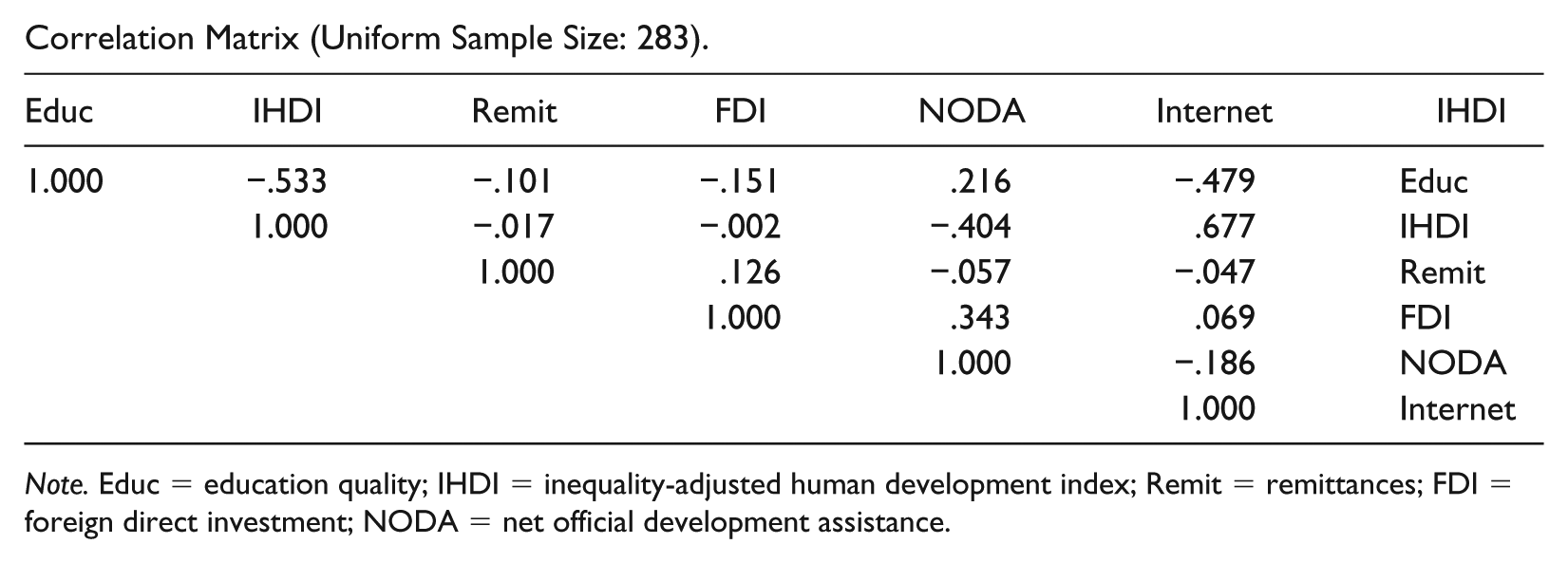
As concerns the nondummy variables, they have been documented to enhance conditions for economic prosperity that are relevant for the improvement of general well-being, including education (Asongu and Tchamyou 2019; Gyimah-Brempong and Asiedu 2015; Sun and He 2014; Tchamyou 2017). For instance, (1) Gyimah-Brempong and Asiedu (2015) have established that remittances positively affect education and human capital formation; (2) Sun and He (2014) have concluded that foreign direct investment promotes human capital; (3) foreign aid has also been documented to promote primary education and lifelong learning in Africa (Asongu and Tchamyou 2019); and (4) information and communications technology is a fundamental driver of knowledge economy and learning in Africa (Tchamyou 2017). The definitions and sources of the variables are provided in Appendix A, whereas the summary statistics is disclosed in Appendix B. The correlation matrix is provided in Appendix C.
Method
Three estimation techniques are adopted to control for various heterogeneity in the data, notably, (1) baseline ordinary least squares (OLS) with control for some common time invariant variables, (2) fixed effects (FE) to control for country-specific heterogeneity, and (3) quantile regressions (QRs) to control for initial levels of poor quality education and time invariant variables, which further account for the unobserved heterogeneity. The use of a multitude of estimation strategies to increase the robustness of the findings is consistent with recent literature (Asongu, Nwachukwu, and Aziz 2018).
OLS and FE Regressions
The baseline OLS specification with heteroscedasticity and autocorrelation consistent (HAC) standard errors is presented as follows:

where
The corresponding panel fixed-effects specification is as follows:

where
QRs
The previous estimation approaches are based on mean values of education quality. Whereas such mean values are relevant for policy implications, they nonetheless motivate blanket policies that could not be totally effective when education quality varies from one country to another. To address the concern of cross-country differences in education quality, the study complements the approaches based on mean values with QRs.
Consistent with the attendant literature (Asongu and Odhiambo 2019; Koenker and Bassett 1978; Tchamyou and Asongu 2017), the QR approach accounts for existing levels of education quality by clearly articulating countries with low, intermediate, and high levels of education quality. Accordingly, this QR is used in empirical literature to improve the policy relevance of estimations based on means values of the outcome variable (Asongu 2013; Okada and Samreth 2012). Furthermore, in accordance with Hao and Naiman (2007) and Koenker (2005), the QR technique is different from the linear regressions from a multitude of angles, notably, it (1) determines conditional quantiles (vs. conditional mean), is based on sufficient data (vs. an OLS technique which can be used on small data), follows an agnostic distribution (vs. the normality assumption), is computationally more intensive (vs. a linear technique which is computationally less intensive), and is robust to the control of outliers (vs. sensitivity to outliers).
The

where

where unique slope parameters are estimated for each
In the light of the above, separate regression equations for the QR and OLS for the research question being investigated are as follows:


The OLS and QR, respectively, in Equations 5 and 6 focus on the role of inclusive human development on education quality, where
Empirical Results
This section presents the empirical findings. While Table 1 presents OLS and FE results, Table 2 discloses the findings of QR. The specifications in Table 1 are such that variables in the conditioning information set are increased from the left-hand side to the right-hand side. Hence, the first specifications pertaining to the OLS and FE regressions are univariate. It is apparent from the findings that inclusive human development has a negative effect on the outcome variable. This negative effect implies that inclusive human development improves education quality. This finding is consistent across specifications and the involvement of more variables in the conditioning information set. When interpreting the findings, it is relevant to note that education quality is a negative economic signal because increasing levels denote diminishing levels of education quality. As clarified in the data section, this is essentially because an increasing ratio of the outcome variable or number of “pupils per teacher” reflects a decreasing ability of teachers to allocate more time for imparting knowledge to their pupils.
Ordinary Least Squares and Fixed-Effects Regressions.
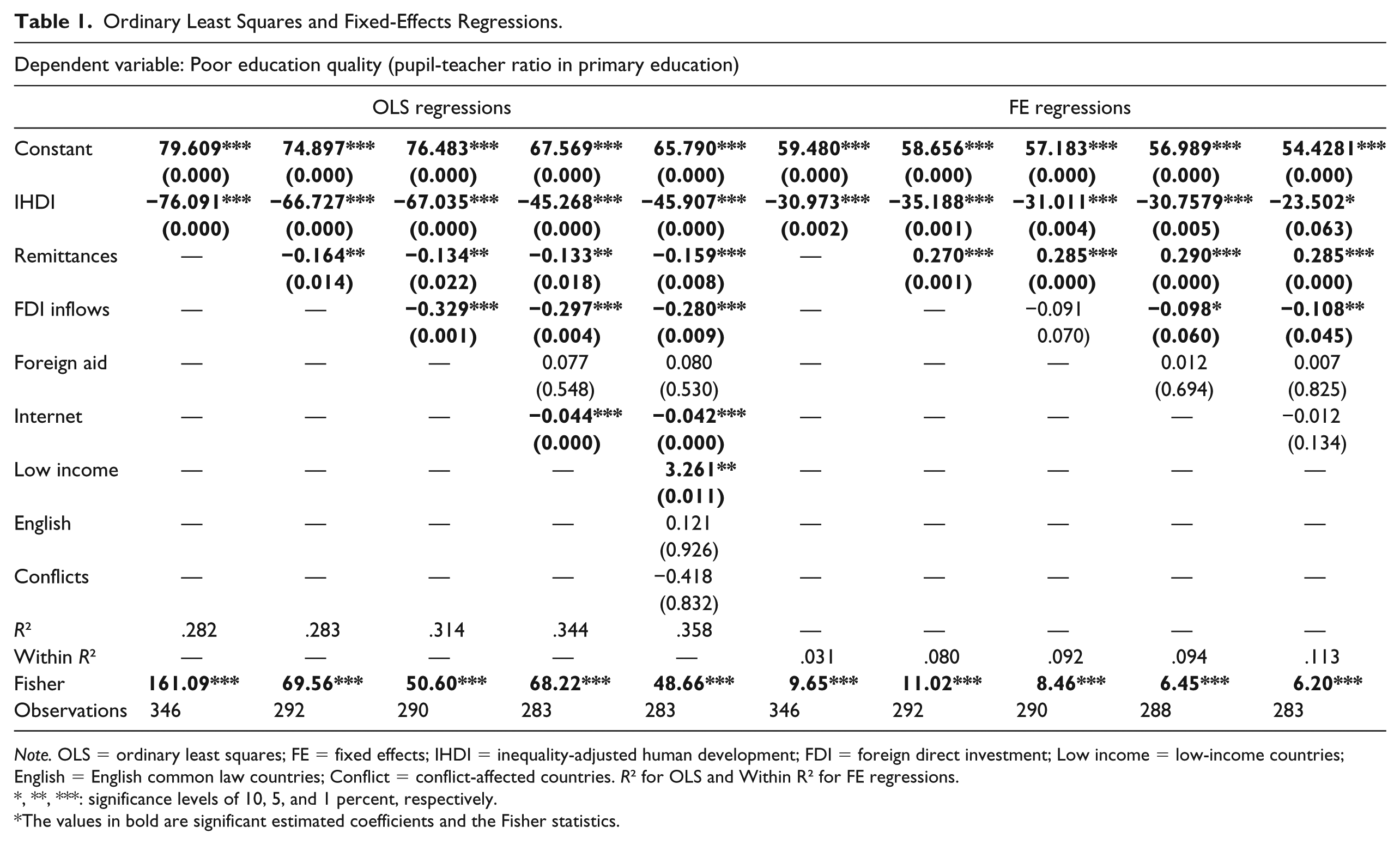
Note. OLS = ordinary least squares; FE = fixed effects; IHDI = inequality-adjusted human development; FDI = foreign direct investment; Low income = low-income countries; English = English common law countries; Conflict = conflict-affected countries. R² for OLS and Within R² for FE regressions.
*, ***: significance levels of 10, 5, and 1 percent, respectively.
The values in bold are significant estimated coefficients and the Fisher statistics.
Quantile Regressions.

Note. IHDI = inequality-adjusted human development; FDI = foreign direct investment; Low income = low-income countries; English = English common law countries; Conflict = conflict-affected countries. Lower quantiles (e.g., Q.10) signify nations where poor educational quality is least.
*, ***: significance levels of 10, 5, and 1 percent, respectively.
The values in bold are significant estimated coefficients.
Most of the significant control variables have the expected signs. Accordingly, the significant nondummy variables have expected negative signs, which imply that they increase education quality. As for the dummy variables, the only significant estimate (i.e., low-income countries) has the expected positive sign because compared with high-income countries, low-income countries are associated with lower levels of education quality.
In Table 2, the QR results show estimates with and without fixed dummy effects on the right-hand side and left-hand side, respectively. In the interpretation of the results, it is relevant to note that the lowest quantile (i.e., Q.10) indicates countries where poor education quality is least, whereas the highest quantile (i.e., Q.90) denotes countries where poor education quality is highest. From the findings, with the exception of the highest quantile in which the effect of inclusive human development is not significant, the established negative effect of inclusive human development on poor education quality is consistent throughout the conditional distribution of inclusive human development. The fact that the effect in the highest quantile is not significantly negative is an indication that in countries where poor education quality is highest, inclusive human development is a necessary but not a sufficient condition for reducing poor education quality. Most of the significant control variables have the expected signs.
In the light of the above findings, it is relevant to note that if inclusive human development can boost the equality of education, it is also logical to infer that the absence of poor quality education is the consequence of the pupil-teacher ratio that is tied to both enrollment and educational resources. Moreover, by extension poor education may also be affected by noninclusive economic growth. This is essentially because of the evidence of growing exclusive development in the subregion. On one hand, approximately half of countries in SSA did not attain the MDG extreme poverty target (Asongu and le Roux 2019). On the other hand, the fact that most countries in the subregion have a majority of the population still living in extreme poverty is startling because SSA has been enjoying more than two decades of growth resurgence (Fosu 2015; Tchamyou 2019b; Tchamyou, Erreygers, and Cassimon 2019). Hence, the growing exclusive development despite the growth resurgence is evidence that the fruits of economic prosperity are not equitably distributed across the population for, inter alia, health, social, and educational needs.
Conclusion and Future Research Directions
This study has examined the importance of inclusive human development in promoting education quality in a panel of 49 SSA countries for the period 2000–2012. The empirical evidence is based on OLS, FE, and QR estimations. It is apparent from the OLS and FE findings that inclusive human development has a negative effect on the outcome variable. This negative effect implies that inclusive human development improves educational quality. This result should be understood in the light of the fact that the adopted education variable is a negative economic signal given that it is computed as the ratio of pupils to teachers. Therefore, a higher ratio reflects diminishing education quality. From QR, with the exception of the highest quantile, the tendency of inclusive human development in reducing poor quality education is consistent throughout conditional distribution of poor education quality.
The results have implications for challenges to SDGs, the relevance of government effectiveness in quality education, and importance of holistic policies that promote quality education in both private and public schools. Accordingly, government effectiveness is essential in promoting quality education. In essence, government effectiveness according to Andrés, Asongu, and Amavilah (2015) is understood as the formulation and implementation of policies that deliver public commodities which include quality primary education (or the accommodation of more pupils by fewer teachers). This is consistent with a recent Global Education Monitoring (GEM) report which has concluded that regulations and standards in SSA need to be enhanced to provide more quality private and public education in the subregion (Antoninis 2017). The absence of effective standards has led to low learning outcomes and challenges for teachers. According to the World Bank report, most countries in the subregion lack standards to promote early children education as well as monitoring and enforcing mechanisms of existing standards. Our findings complement the recommendations of the report from the perspective that the formulation and implementation of such standards should clearly articulate the relevance of inclusive human development in quality education.
This research further argues that sending children to private schools may not solve the issue because private schools are largely meant for wealthy families, and in the long term, if only wealthy children are better educated, it may further exacerbate exclusive development which will further increase poor education quality. For instance, it is anticipated by the World Bank report that by 2021, about 25 percent of primary school-age pupils in SSA will prefer private academic institutions, which is up from approximately 13.5 percent in 2015 (Antoninis 2017). According to the narrative, the functioning of these private schools is not an indication that the SDG 4 for global quality education will be achieved. Our findings propose that a more general policy of education, driven by inclusive human development or “human development for all,” will go a long way to giving both the poor and rich, in private and public schools alike, the quality of education needed to address other economic development challenges of the subregion.
Future studies can focus on assessing country-specific cases to improve room for more targeted policy implications. Accordingly, as more data become available, time series estimations can be considered within the framework of the Autoregressive Distributed Lag (ADL) Model. Moreover, given the SDG challenges in SSA, considering other indicators of inclusive development (such as gender equality) within the empirical framework is worthwhile. Some examples of gender equality indicators from the International Labour Organization are the female labor force participation, female unemployment, and female employment rates. A notable caveat to the study is that “education quality” is a multidimensional concept, and hence, other metrics should be considered in future studies, notably, access to food nutrition, health care, transportation, and teacher preparation. These alternative metrics are available in World Development Indicators of the World Bank.
Related Resources
The World Bank
The World Bank provides information on World Development Indicators. Research and statistics as well as policy and guidance are also provided by the multilateral development institution. For more information, see https://datacatalog.worldbank.org/dataset/world-development-indicators.
The United Nations
The UNDP also provides statistics and policy guidance on poverty and multidimensional human development indicators. For more information on the IHDI used to proxy for inclusive human development, see http://hdr.undp.org/en/content/inequality-adjusted-hdi.
The International Labour Organization
The concluding section of the study has suggested other areas for future research. Information on the suggested gender economic inclusion variables is provided by the International Labour Organization (see https://www.ilo.org/global/statistics-and-databases/lang–en/index.htm).
Footnotes
Appendix
Correlation Matrix (Uniform Sample Size: 283).
| Educ | IHDI | Remit | FDI | NODA | Internet | IHDI |
|---|---|---|---|---|---|---|
| 1.000 | −.533 | −.101 | −.151 | .216 | −.479 | Educ |
| 1.000 | −.017 | −.002 | −.404 | .677 | IHDI | |
| 1.000 | .126 | −.057 | −.047 | Remit | ||
| 1.000 | .343 | .069 | FDI | |||
| 1.000 | −.186 | NODA | ||||
| 1.000 | Internet |
Note. Educ = education quality; IHDI = inequality-adjusted human development index; Remit = remittances; FDI = foreign direct investment; NODA = net official development assistance.
Acknowledgements
The authors are indebted to the editor and reviewers for constructive comments.
Declaration of Conflicting Interests
The author(s) declared no potential conflicts of interest with respect to the research, authorship, and/or publication of this article.
Funding
The author(s) received no financial support for the research, authorship, and/or publication of this article.